

Hostname: page-component-6766d58669-rxg44 Total loading time: 0 Render date: 2026-05-19T02:52:19.981Z Has data issue: false hasContentIssue false

Excavations at Sparta: the Roman stoa, 1988–91. Part 2

Published online by Cambridge University Press:  27 September 2013

G. B. Way Well
Affiliation:
King's College London
J. J. Wllkes
Affiliation:
University College London

Abstract

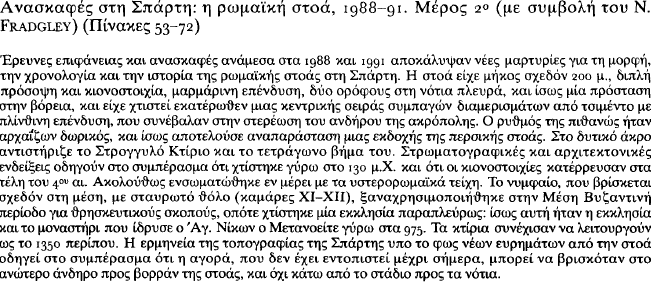
Survey and excavation between 1988 and 1991 have revealed new evidence for the form, date, and history of the Roman stoa at Sparta. Nearly 200 m long, it was double-fronted and colonnaded, finished in marble, with two storeys on the S side and perhaps a single portico to the N, set either side of a central row of brick-faced concrete compartments that helped consolidate the acropolis plateau. Its order may have been archaizing Doric; it may have represented a reconstructed version of the Persian stoa. At the W end it buttressed the Round Building and its square podium. Evidence of the stratigraphy and architecture suggests it was built c. AD 130 and that the colonnades collapsed in the late 4th cent., after which it was partly incorporated into the late Roman wall circuit. The nearly central, cross-vaulted nymphaeum (bays XI–XII) was reused in the Middle Byzantine period for religious purposes, when a church was built nearby; possibly this was the church and monastery founded by St Nikon Metanoeites c.975. Occupation continued until c.1350. Interpretation of the topography of Sparta in the light of the new evidence from the stoa suggests that the still elusive agora may have been on the upper plateau N of the stoa, rather than beneath the stadium to the S.

Information

Type
Articles
Copyright
Copyright © The Council, British School at Athens 1994

Access options

Get access to the full version of this content by using one of the access options below. (Log in options will check for institutional or personal access. Content may require purchase if you do not have access.)

Article purchase

Temporarily unavailable