





Introduction
Increasing temperatures associated with climate change could enhance the fecundity of invasive species and lead to range expansion across agricultural and natural ecosystems (Finch et al. Reference Finch, Butler, Runyon, Fettig, Kilkenny, Jose, Frankel, Cushman, Cobb, Dukes, Hicke and Amelon2021). In the northeastern United States, average temperatures may rise 3 C by 2050, coupled with an increased frequency of daily high temperatures above 35 C (Hayhoe et al. Reference Hayhoe, Wake, Huntington, Luo, Schwartz, Sheffield, Wood, Anderson, Bradbury, DeGaetano, Troy and Wolfe2007; Prasad et al. Reference Prasad, Gunn, Rotz, Karsten, Roth, Buda and Stoner2018). Increasing temperatures and other elements of climate change may facilitate range expansion by invasive species, which are highly adaptable and potentially highly competitive in novel environments (Finch et al. Reference Finch, Butler, Runyon, Fettig, Kilkenny, Jose, Frankel, Cushman, Cobb, Dukes, Hicke and Amelon2021; Jarnevich et al. Reference Jarnevich, Holcombe, Bella, Carlson, Graziano, Lamb, Seefeldt and Morisette2014).
In addition to competition from invasive species, water deficit is another important agricultural stressor that is likely to be exacerbated by climate change. Although total precipitation during the growing season is projected to increase in the northeastern United States, the spatiotemporal distribution of precipitation will be more variable, resulting in more drought and flooding events (Hayhoe et al. Reference Hayhoe, Wake, Huntington, Luo, Schwartz, Sheffield, Wood, Anderson, Bradbury, DeGaetano, Troy and Wolfe2007; Krakauer et al. Reference Krakauer, Lakhankar and Hudson2019). Concurrently, anticipated temperature increases will intensify evapotranspiration and increase agricultural water stress, reducing crop productivity (Hayhoe et al. Reference Hayhoe, Wake, Huntington, Luo, Schwartz, Sheffield, Wood, Anderson, Bradbury, DeGaetano, Troy and Wolfe2007). For instance, drought stress in non-irrigated corn (Zea mays L.)-cropping systems, including those in the northeastern United States, could cause substantial yield losses (Zipper et al. Reference Zipper, Qiu and Kucharik2016).
Although both invasive species and water deficits could negatively impact agricultural production, the dual threat of range expansion by invasive species and increasing water stress may pose an even greater risk. One troublesome invasive weed species that is expected to experience range expansion in the coming decades is Johnsongrass [Sorghum halepense (L.) Pers.], a C4 perennial monocot (Poaceae) (Schantz, Reference Schantz2025; Warwick and Black Reference Warwick and Black1983). The native range of S. halepense is in western Asia, the Mediterranean, and North Africa, but this species has now invaded a reported 124 countries worldwide (Yang et al. Reference Yang, Zhao, Xian, Qi, Li, Guo, Chen and Liu2023). Sorghum halepense was introduced to many countries either intentionally as a forage or unintentionally through grain trade (Yang et al. Reference Yang, Zhao, Xian, Qi, Li, Guo, Chen and Liu2023). In the United States, S. halepense is regulated as a noxious weed in 20 states and included on invasive species lists in 16 states (Quinn et al. Reference Quinn, Barney, McCubbins and Endres2013). Anticipated climate change is projected to shift both the distribution and the damage niche of S. halepense northward into traditional corn-growing areas of the United States and southern Canada (Clements and DiTommaso Reference Clements and DiTommaso2011; McDonald et al. Reference McDonald, Riha, DiTommaso and DeGaetano2009).
The competitiveness and allelopathic effects of S. halepense (Schwinning et al. Reference Schwinning, Fay and Polley2025; Ştef et al. Reference Ştef, Cărăbeţ, Grozea, Radulov, Manea and Berbecea2015; Vasilakoglou et al. Reference Vasilakoglou, Dhima and Eleftherohorinos2005) have made the species one of the most problematic weeds in agricultural production (Klein and Smith Reference Klein and Smith2020; Yang et al. Reference Yang, Zhao, Xian, Qi, Li, Guo, Chen and Liu2023). In the southern United States and other warm areas of its range, this weed reproduces effectively by producing both large quantities of dormant seeds and an extensive rhizome system enabling vegetative reproduction (Monaghan Reference Monaghan1979; Travlos et al. Reference Travlos, Montull, Kukorelli, Malidza, Dogan, Cheimona, Antonopoulos, Kanatas, Zannopoulos and Peteinatos2019). Herbicide resistance (HRAC Groups 1, 2, 3, and 9) has also been reported in S. halepense, with some populations exhibiting multiple resistance (Heap Reference Heap2025). These traits contribute to the difficulty of controlling S. halepense in some cropping systems (Govindasamy et al. Reference Govindasamy, Sarangi, Provin, Hons and Bagavathiannan2020).
Many studies have examined competition between S. halepense and crops such as corn (Bendixen Reference Bendixen1986; Ghosheh et al. Reference Ghosheh, Holshouser and Chandler1996; Klein and Smith Reference Klein and Smith2020; Travlos et al. Reference Travlos, Montull, Kukorelli, Malidza, Dogan, Cheimona, Antonopoulos, Kanatas, Zannopoulos and Peteinatos2019). However, few studies discuss competition between corn and S. halepense at its range edge, including New York State. Plant species often have different fitness and competitiveness at the edges of their ranges, compared with the range center (Geber Reference Geber2008; Lyu and Alexander Reference Lyu and Alexander2022). A lack of knowledge about S. halepense competitiveness at the range edge could compromise weed management in non-irrigated corn-cropping systems of the northeastern United States.
In this replicated greenhouse experiment, we investigated competition between a central New York S. halepense biotype and corn under two soil moisture levels. Studying an S. halepense biotype from central New York could offer insights into competition at the range edge, contributing to the design of future weed management strategies and cropping systems in the context of climate change. We proposed the following two hypotheses. First, water stress would reduce biomass accumulation and height of both species. We also hypothesized that S. halepense would grow taller and accumulate more biomass under interspecific versus intraspecific competition. In contrast, corn would grow taller and produce more biomass under intraspecific versus interspecific competition. These outcomes were expected under both water-stress and well-watered conditions.
Materials and Methods
Experimental Design
Sorghum halepense rhizomes were collected from a small agricultural population in North Rose, NY, USA (43.187°N, 76.886°W) in July 2021. Plants originating from the collected rhizomes were maintained under greenhouse conditions until they were used for the experiment.
The experiment was conducted twice (replicated in time) in a greenhouse at Cornell University in Ithaca, NY, USA. The first run was conducted in the summer of 2023, and the second run was conducted in the spring of 2024. The greenhouse photoperiod was maintained at 13 h with a photon flux density of 250 ${\rm{\mu }}$
mol m−2 s−1. The temperature was set to 26/22 C (day/night). The experiment was set up as a randomized complete block design. Eight blocks were established in the first run and served as replicates. In the second run, 20 replicates were used to increase statistical power. The distance between each replicate was 50 cm to reduce light competition, which was likely minimal throughout the experiment.
${\rm{\mu }}$
mol m−2 s−1. The temperature was set to 26/22 C (day/night). The experiment was set up as a randomized complete block design. Eight blocks were established in the first run and served as replicates. In the second run, 20 replicates were used to increase statistical power. The distance between each replicate was 50 cm to reduce light competition, which was likely minimal throughout the experiment.
The experiment included two factors: soil moisture level and competition. The soil moisture factor included two treatments: drought (D) and well-watered (WW) conditions. Plants subjected to the drought treatment were watered to field capacity every 2 wk (approximately 500 ml of water). The well-watered treatment was watered every 2 to 3 d with approximately 500 ml of water to maintain field capacity. The competition factor included three treatments: corn monoculture (CC), S. halepense monoculture (JJ), and interspecific competition (CJ).
Sorghum halepense plants were established by planting rhizome pieces collected from the existing S. halepense plants maintained in the greenhouse. Rhizomes were trimmed to 15-cm pieces, which usually had two nodes, and gently washed to remove soil. Rhizomes were then layered on a plastic tray covered with moist sand and stored in the greenhouse’s headhouse at around 25 C until sprouting was evident. Using rhizomes represented vegetative reproduction of S. halepense in the field, and the 15-cm rhizome piece length mimicked fragmentation by soil tillage and seedbed preparation.
In both rounds, S. halepense rhizomes were planted simultaneously with corn. In the corn monoculture treatment, two corn seeds (DEKALB® brand, Bayer Crop Science, St Louis, MO, USA) were planted in 7.8-L pots. In the S. halepense monoculture, two S. halepense rhizome pieces were planted in each pot. For the interspecific competition treatment, one corn seed and one S. halepense rhizome piece were planted in a pot.
Corn seed and S. halepense rhizomes were planted at a depth of 5 cm in pots filled with Cornell Peat-Lite Mix growing medium. The medium was composed of peat, vermiculite, and perlite in a 2:2:1 volume mixture, and each pot also received approximately 36 g of agricultural limestone, 28 g of 10-5-10 N-P-K fertilizer, and 28 g of calcium sulfate as the amendment. Both species emerged at high rates within a similar time frame (no more than 2-d difference between species) and exhibited healthy initial growth.
All pots were watered to field capacity every 2 to 3 d during early plant establishment. The drought treatment was introduced after 2 wk, when corn plants had two to three mature leaves. The drought treatment continued for 42 d, that is, three 2-wk drought cycles. At the end of the 42-d period (estimated V9–V11 stage for corn), aboveground plant tissue for each species was cut at the soil line, oven-dried for at least 48 h at 55 C, and weighed to determine biomass.
Data Collection
Soil volumetric water content (%), soil conductivity (mS cm−1), and soil temperature were measured every 7 d. Measurements were collected with a time domain reflectometry meter (FieldScout TDR150 Soil Moisture Meter®, Spectrum Technology, Aurora, IL,USA). Each measurement was repeated three times in each pot, and the mean value was used for analysis.
For the monoculture treatments (CC and JJ), biomass per plant was calculated by dividing the total dry biomass by two. The aboveground biomass data were used to calculate the log response ratio for each species. Log response ratio is a measurement of the relative tolerance of interspecific versus intraspecific competition (Goldberg et al. Reference Goldberg, Rajaniemi, Gurevitch and Stewart-Oaten1999):
 $${\rm{LnRR}}\; = {\rm{ln}}\left( {\;{{{B_c}} \over {{B_a}}}} \right)$$
Then, ln is natural logarithm; Bc
is biomass of the target species growing under interspecific competition (CJ); Ba
is biomass of the target species growing under intraspecific competition (CC or JJ). where LnRR is the log response ratio. If LnRR $ \gt $
0, then the target species produced more biomass under interspecific competition. If LnRR
$ \gt $
0, then the target species produced more biomass under interspecific competition. If LnRR $ \lt $
0, then the target species produced more biomass under intraspecific competition.
$ \lt $
0, then the target species produced more biomass under intraspecific competition.
In the 2024 run of the experiment, we also measured the root biomass of corn and S. halepense to evaluate resource partitioning of each species under the different soil moisture levels. Root systems for each species were carefully separated, rinsed to remove soil, and placed in paper bags. Root material was oven-dried for 7 d at 55 C and weighed. The root or shoot biomass of individual corn or S. halepense plants in monoculture (CC or JJ treatments) was calculated by dividing the total root or shoot biomass measured in those treatments by two. The root-to-shoot ratio was calculated according to the following equation (Rogers et al. Reference Rogers, Prior, Runion and Mitchell1995):
 $${\rm{RS}}\;{\rm{ratio}} = \;{{{B_{\rm{r}}}} \over {{B_{\rm{s}}}}}$$
where RS ratio is the root-to-shoot ratio; B r is the dry root biomass of the target species; and B s is the dry shoot biomass of the target species.
Statistical Analysis
Statistical analyses were conducted in R v. 4.3.2 (R Core Team 2024). We performed mixed-effects ANOVA to analyze the influence of drought stress and competition on corn and S. halepense using the lme4 package (Bates et al. Reference Bates, Mächler, Bolker and Walker2015). The soil moisture level, competition, and interaction were treated as fixed factors, and block was treated as a random factor. The data from the two runs of the experiment (2023 and 2024) were analyzed separately to improve model accuracy. Aboveground biomass and height data were square root-transformed to fulfill the model assumptions. Model assumptions were tested using the Shapiro-Wilk test and diagnostic plots. To determine treatment differences, the estimated marginal means of each treatment group was calculated, and Tukey’s honestly significant difference (HSD) test was used to determine differences (emmeans and multcomp packages).
Results and Discussion
Soil Conditions
In both rounds of the experiment, soils under the well-watered treatment had a higher volumetric water content and conductivity, confirming that the well-watered soil had higher moisture levels (Supplementary Figures S1 and S2). In Run 1, well-watered soil had a mean volumetric water content and conductivity of 25.7% and 0.278 mS cm−1, which were 324.5% and 394.5%, respectively, higher than the corresponding values of the soil under drought treatment. In Run 2, the well-watered soil’s volumetric water content and conductivity were 23.51% and 0.283 mS cm−1, which were 206.2% and 187.9%, respectively, higher than the corresponding values of drought-treated soil. In Run 1, the temperature of well-watered soil was similar to the temperature of drought-treated soil. In Run 2, the temperature of well-watered soil was somewhat lower than that of the drought-treated soil (Supplementary Figures S1 and S2).
Influence of Soil Moisture on Corn and Sorghum halepense Growth
In both Run 1 and Run 2, corn in the well-watered treatment accumulated significantly more aboveground biomass than corn experiencing drought stress under both competition treatments (Table 1). In Run 1, well-watered corn accumulated 55.0% more aboveground biomass than drought-stressed corn under the CC competition treatment and 66.4% more aboveground biomass than drought-stressed corn under the CJ competition treatment (Figure 1A). In Run 2, well-watered corn accumulated 64.0% and 49.3% more aboveground biomass than drought-stressed corn under the CC and CJ competition treatments, respectively (Figure 1B). Well-watered corn also achieved significantly greater plant height than corn in the drought treatment for both competition levels (Table 1). In Run 1, well-watered corn was 7.0% and 7.8% taller than drought-stressed corn in the CC and CJ competition treatments, respectively (Figure 1C). In Run 2, well-watered corn was 27.9% and 23.4% taller than drought-stressed corn in the CC and CJ competition treatments, respectively (Figure 1D).
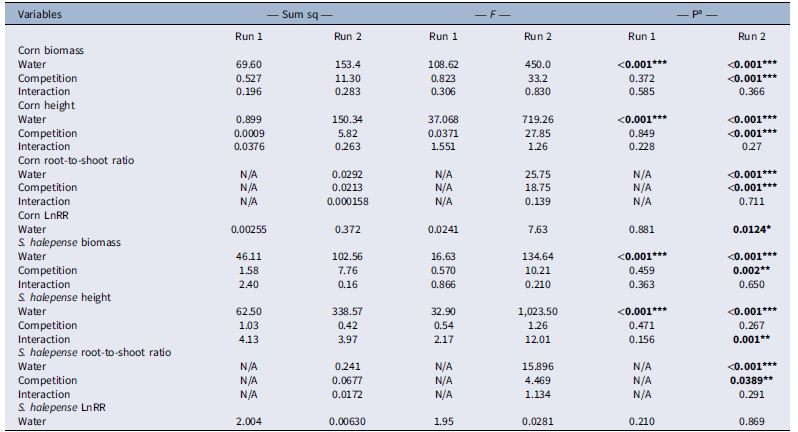
Results of ANOVA testing the fixed effects of water, competition, and their interaction on the aboveground biomass, height, root-to-shoot ratio, and log response ratio (LnRR) of corn and Sorghum halepense in two greenhouse trial runs, with block included as a random effect.

a Within a year, different numbers of asterisks (*) represent different significance levels based on Tukey’s honestly significant difference (HSD) test: ***P < 0.001; ** P < 0.005; * P < 0.05.
Biomass and height of corn in Run 1 (A and C) and Run 2 (B and D). Bars represent mean $ \pm 1$
SE, with different letters indicating significantly different treatments (P < 0.05). D, drought; WW, well-watered; CC, corn monoculture; CJ, interspecific competition.
$ \pm 1$
SE, with different letters indicating significantly different treatments (P < 0.05). D, drought; WW, well-watered; CC, corn monoculture; CJ, interspecific competition.

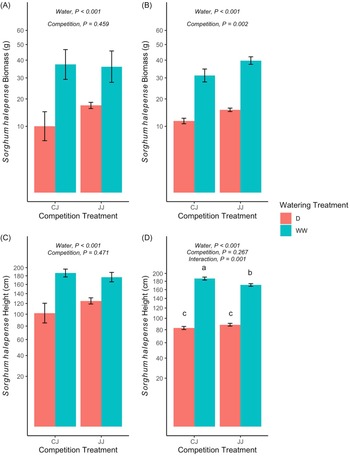
In both runs of the experiment, well-watered S. halepense also accumulated significantly more aboveground biomass and height than drought-stressed S. halepense under both competition treatments (Table 1). In Run 1, well-watered S. halepense accumulated 93.1% and 44.5% more aboveground biomass than drought-stressed S. halepense for the CJ and JJ treatments, respectively (Figure 2A). In Run 2, well-watered S. halepense accumulated 59.7% and 63.5% more aboveground biomass than drought-stressed S. halepense for the CJ and JJ treatments, respectively (Figure 2B). In Run 1, well-watered S. halepense was 75.9% and 41.8% taller than drought-stressed S. halepense for the CJ and JJ treatments, respectively (Figure 2C). In Run 2, the well-watered S. halepense was 124.0% and 93.7% taller than drought-stressed S. halepense for the CJ and JJ treatments, respectively (Figure 2D).
Biomass and height of Sorghum halepense in Run 1 (A and C) and Run 2 (B and D). Bars represent mean $ \pm 1$
SE, with different letters indicating significantly different treatments (P < 0.05). D, drought; WW, well-watered; CJ, interspecific competition; JJ, Johnsongrass (S. halepense) monoculture.
$ \pm 1$
SE, with different letters indicating significantly different treatments (P < 0.05). D, drought; WW, well-watered; CJ, interspecific competition; JJ, Johnsongrass (S. halepense) monoculture.

These data are consistent with our first hypothesis, which was that drought stress would reduce the biomass and height of corn and S. halepense in both rounds of the experiment. These results are also consistent with the well-documented negative effects of water stress on plants, including corn and S. halepense (Adee et al. Reference Adee, Roozeboom, Balboa, Schlegel and Ciampitti2016; Osakabe et al. Reference Osakabe, Osakabe, Shinozaki and Tran2014; Seleiman et al. Reference Seleiman, Al-Suhaibani, Ali, Akmal, Alotaibi, Refay, Dindaroglu, Abdul-Wajid and Battaglia2021; Sinha et al. Reference Sinha, Gupta and Rana1986). Relative reductions in plant height due to drought were greater in S. halepense compared with corn. This difference between species could indicate that S. halepense was less drought resistant and more negatively affected by water stress. Alternatively, the interspecific difference might reflect greater phenotypic plasticity in the weed species (Baker, Reference Baker1974) compared with the crop. According to this explanation, a reduction in S. halepense height could be associated with a broader shift in resource allocation from aboveground to belowground organs. This possibility is explored in the next section.
Influence of Soil Moisture and Competition on Resource Partitioning
In Run 2, corn had a higher RS ratio under the well-watered treatment versus the drought treatment (Table 1). The average RS ratio was 0.23 (drought) and 0.27 (well-watered) under intraspecific competition. Under interspecific competition, the average RS ratio was 0.20 (drought) and 0.24 (well-watered) (Figure 3A). Corn’s RS ratio was higher under intraspecific versus interspecific competition (Table 1; Figure 3A).
Root-to-shoot ratio of corn (A) and Sorghum halepense (B) in Run 2. Bars represent mean $ \pm 1$
SE, with different letters indicating significantly different treatments (P < 0.05). D, drought; WW, well-watered; CC, corn monoculture; CJ, interspecific competition; JJ, Johnsongrass (S. halepense) monoculture.
$ \pm 1$
SE, with different letters indicating significantly different treatments (P < 0.05). D, drought; WW, well-watered; CC, corn monoculture; CJ, interspecific competition; JJ, Johnsongrass (S. halepense) monoculture.

The RS ratio of S. halepense was also influenced by soil moisture and competition (Table 1). Unlike corn, S. halepense developed a higher RS ratio under drought stress. The average RS ratio of S. halepense was 0.49 (drought) and 0.41 (well-watered) under intraspecific competition. Under interspecific competition, S. halepense had an average RS ratio of 0.58 (drought) and 0.44 (well-watered) (Figure 3B). Unlike corn, S. halepense had a higher RS ratio under interspecific competition than intraspecific competition (Figure 3B).
The results demonstrated that water stress altered resource allocation in both corn and S. halepense. Under resource stress, plants often shift their biomass allocation to better acquire scarce resources (Freschet et al. Reference Freschet, Violle, Bourget, Scherer-Lorenzen and Fort2018; Poorter and Nagel Reference Poorter and Nagel2000). Drought increased the RS ratio of S. halepense, indicating an increased proportion of resources allocated to belowground organs (roots and rhizomes) relative to aboveground development. This finding aligns with previous research on S. halepense under drought stress (Acciaresi and Guiamet, Reference Acciaresi and Guiamet2010). The plasticity in resource partitioning helped S. halepense maintain water uptake under soil water deficiency, increasing drought resistance in this species (Leguizamón et al. Reference Leguizamón, Yanniccari, Guiamet and Acciaresi2011; Leguizamón and Acciaresi Reference Leguizamón and Acciaresi2014).
Unlike in S. halepense, drought stress reduced the RS ratio in corn, suggesting that corn allocated a smaller proportion of resources to the root system under water stress compared with the well-watered treatment. This finding contradicted previous literature reporting a numerically higher RS ratio of corn under drought stress (Yan et al. Reference Yan, Weng, Jing and Bi2023). Compared with S. halepense, which exhibits high morphological plasticity enabling its increased RS ratio under drought stress, corn does not exhibit this plastic response as strongly (Acciaresi and Guiamet, Reference Acciaresi and Guiamet2010). This characteristic may reflect past breeding efforts: corn breeders would select for lines that achieve drought resistance without reallocating resources from aboveground organs (grain and silage yield) to belowground organs. For these reasons, it would not be surprising if corn exhibited no change in its RS ratio in response to drought. However, the finding that the RS ratio apparently declined under drought in corn could suggest death or breakage of some fine roots during the processes of soil drying or root rinsing.
Responses of Corn and Sorghum halepense to Competition
In Run 1, corn aboveground biomass and height were similar under interspecific relative to intraspecific competition (Table 1). In Run 2, corn accumulated significantly more aboveground biomass and more height under interspecific competition relative to intraspecific competition (Table 1). Corn produced 19.3% more aboveground biomass and 6.6% more height in the CJ treatment compared with the CC treatment (Figure 1B and 1D). These findings were reflected in the log response ratio values for corn. Log response ratios were near zero but numerically positive in Run 1 and more positive in Run 2 (Figure 4A and 4B). A positive log response ratio indicates higher biomass production under interspecific compared with intraspecific competition.
The log response ratio (LnRR) for corn (A and B) and Sorghum halepense (C and D) in Run 1 and Run 2. A positive LnRR indicates higher biomass production under interspecific compared with intraspecific competition. A negative LnRR indicates higher biomass production under intraspecific compared with interspecific competition. Bars represent mean $ \pm 1$
SE, with different letters indicating significantly different treatments (P < 0.05). D, drought; WW, well-watered.
$ \pm 1$
SE, with different letters indicating significantly different treatments (P < 0.05). D, drought; WW, well-watered.

In Run 1, S. halepense aboveground biomass and height did not depend on competition. In Run 2, S. halepense accumulated significantly more aboveground biomass under intraspecific relative to interspecific competition (Table 1). Biomass of S. halepense was 12.9% higher under intraspecific competition in the well-watered treatment and 15.5% higher in the drought treatment (Figure 2C). Sorghum halepense height was influenced by an interaction between watering and competition treatment, with well-watered S. halepense under interspecific competition reaching the greatest height (Figure 2D). The log response ratio value for S. halepense was negative for the drought treatment in Run 1 and both moisture levels in Run 2 (Figure 4C and 4D), indicating increased growth under intraspecific compared with interspecific competition.
The findings that corn grew larger under interspecific competition, whereas S. halepense generally grew larger under intraspecific competition, do not support our second hypothesis that S. halepense would exhibit a competitive advantage. In this experiment, an individual corn plant exerted a greater competitive effect than an individual S. halepense plant. Although corn and S. halepense emerged at similar times, corn exhibited faster initial growth and grew larger than S. halepense. The larger size of corn plants compared with S. halepense likely resulted in greater resource capture. Thus, a size difference likely contributed to the greater relative competitiveness of corn, potentially in combination with other morphological or physiological factors.
Drivers of Variation in Relative Competitiveness
The existing literature on competition between S. halepense and corn predominantly refers to situations in which weeds grow in addition to a constant crop density, that is, situations corresponding to additive designs for competition experiments. Such studies have reported that S. halepense competition reduces corn yield (Bendixen Reference Bendixen1986; Karkanis et al. Reference Karkanis, Athanasiadou, Giannoulis, Karanasou, Zografos, Souipas, Bartzialis and Danalatos2020; Leguizamón et al. Reference Leguizamón, Yanniccari, Guiamet and Acciaresi2011; Mitskas et al. Reference Mitskas, Tsolis, Eleftherohorinos and Damalas2003). In contrast to these studies, our research answered a different question focused on relative competitiveness rather than yield loss. For this reason, we used a replacement design. Replacement experiments are preferable to additive experiments to assess the relative strength of interspecific and intraspecific competition (Hamilton Reference Hamilton1994).
In a replacement greenhouse experiment evaluating S. halepense accessions from nine U.S. states, Smith et al. (Reference Smith, Atwater, Kim, Haak and Barney2021) found that S. halepense accessions grew larger under competition with corn versus competition with an S. halepense phytomer. This finding contrasts with our result. A primary difference between the study by Smith et al. (Reference Smith, Atwater, Kim, Haak and Barney2021) and our study was that those authors used S. halepense biotypes collected from warmer states that are closer to the species’ range core. In contrast, we used one biotype that was collected from New York State, the northern range edge of this species (Fletcher et al. Reference Fletcher, Atwater, Haak, Bagavathiannan, DiTommaso, Lehnhoff, Paterson, Auckland, Govindasamy, Lemke, Morris, Rainville and Barney2023). Sorghum halepense biotypes from the northern range edge accumulate less biomass and height than biotypes from the range core, such as the southern United States (Fletcher et al. Reference Fletcher, Atwater, Haak, Bagavathiannan, DiTommaso, Lehnhoff, Paterson, Auckland, Govindasamy, Lemke, Morris, Rainville and Barney2023). Northern range edge biotypes also flower earlier to complete their life cycles within a shorter growing season, which is especially important, because range edge environments may be too cold to allow perennation via rhizome overwintering (Fletcher et al. Reference Fletcher, Atwater, Haak, Bagavathiannan, DiTommaso, Lehnhoff, Paterson, Auckland, Govindasamy, Lemke, Morris, Rainville and Barney2023; Lakoba et al. Reference Lakoba, Welbaum, Seiler and Barney2021; Warwick et al. Reference Warwick, Thompson and Black1984). These observations suggest that biotypes from the range edge may encounter a trade-off between growth and reproduction that reduces their vegetative growth and therefore their competitiveness.
Our study only used one S. halepense biotype from the central New York area. It is likely that other S. halepense biotypes, especially biotypes from warmer areas, would be more competitive. Our results are therefore most relevant to land managers in New York State and other northern range edge areas. To develop management guidance for all land managers, it will be important to continue performing research on biotypes of S. halepense from across the broad geographic range of this invasive species (Fletcher et al. Reference Fletcher, Atwater, Haak, Bagavathiannan, DiTommaso, Lehnhoff, Paterson, Auckland, Govindasamy, Lemke, Morris, Rainville and Barney2023; Smith et al. Reference Smith, Atwater, Kim, Haak and Barney2021).
Effects of Drought on Competitive Dynamics
In Run 2, the log response ratio for corn was significantly higher under drought than under well-watered conditions (Table 1; Figure 4B). This result indicates that corn’s advantage under interspecific versus intraspecific competition was enhanced when the soil moisture level was low. For S. halepense, especially in Run 1, the log response ratio was numerically lower under drought than under well-watered conditions (Figure 4C and 4D). This trend suggests that drought may have strengthened S. halepense’s advantage under intraspecific versus interspecific competition (not significant).
These results are consistent with our other findings suggesting that belowground resource limitation was a major influence on plant growth in this experiment. Belowground resource limitation was strongest in the presence of corn (the larger species) and/or drought. The RS ratio for each species was higher in the more growth-suppressive competition treatment, which was the one including more corn plants (intraspecific competition for corn and interspecific competition for S. halepense; Figure 3). Especially in Run 2, the combination of intraspecific competition and drought led to the lowest corn growth observed in the experiment. Water uptake by two corn plants in the CC drought treatment could have led to severely water-limited conditions. This treatment had the (numerically) lowest water content in some weeks of 2024 (Supplementary Figure S2).
A limitation in our experiment was that we only included two watering levels, comparing a severe drought with field capacity. These levels may not capture the full range of resource allocation responses and competitive interactions that could occur under intermediate drought stress. Future research could benefit from incorporating a gradient of soil moisture treatments.
Overall, our results suggest that the central New York ecotype of S. halepense was a weaker competitor for water compared with corn. Environmental and biological constraints at the range edge may have contributed to this finding. However, a reduction in weed competitiveness relative to crop competitiveness does not mean that the weed will not cause yield loss. Future climate change (Lakoba and Barney Reference Lakoba and Barney2020; Yang et al. Reference Yang, Zhao, Xian, Qi, Li, Guo, Chen and Liu2023) and continued gene flow could increase the fitness of S. halepense at the range edge, leading to higher growth and invasive potential.
Supplementary material
To view supplementary material for this article, please visit https://doi.org/10.1017/wsc.2025.10055
Acknowledgments
The authors thank Patrick O’Briant for collecting the S. halepense New York ecotype; Bobbie Ann Kuhlman, Jeffrey Tanner Persky, and Scott Anthony for maintaining the S. halepense populations; Micah Sher, Rosa Xia, and Ryleigh Coffey for assisting with data collection; and Andrew Siefert of the Cornell Statistical Consulting Unit for providing helpful statistical advice.
Funding statement
This research was supported in part by NIFA-Federal Capacity Funds (Hatch NYC-125946).
Competing interests
The authors declare no conflicts of interest.




 Open access

