




Introduction
In recent years, human palaeogenomics has been integrated into the study of prehistoric human mobility and dispersal—a research avenue with a long history in archaeology. Publications addressing prehistoric population genomics rarely include discussion of associated archaeological evidence, even though the ancient DNA (aDNA) samples derive from archaeological contexts, and genomic variation is interpreted in the context of archaeological background information. Indeed, there is growing criticism of aDNA studies for making oversimplified connections between genes and culture, while neglecting the archaeological evidence. Well-known examples include two studies that propose a massive migration from the Eurasian Steppe towards the west in the third millennium BC (Allentoft et al. Reference Allentoft2015; Haak et al. Reference Haak2015)—which have drawn strong criticism from archaeologists (e.g. Vander Linden Reference Vander Linden2016, Reference Vander Linden2019; Heyd Reference Heyd2017; Johannsen et al. Reference Johannsen, Larson, Meltzer and Vander Linden2017; Furholt Reference Furholt2018, Reference Furholt2019; Carlin Reference Carlin2020)—as well as the debate concerning aDNA and the introduction and spread of agriculture in Europe (Hofmann Reference Hofmann2015; Ion Reference Ion2017).
Critics stress that archaeological cultures cannot be regarded as ethnic, linguistic and genetic units that acted as historical agents, as these cultures are predominantly representations of the ways in which culture-historical studies organised their data. Furthermore, the movement of people—as indicated by genetics—results from complex cultural processes, rather than from mere migration. It is also argued that a flawed, essentialist view of cultures in aDNA research, just as in early culture-historical archaeology, plays into the hands of racist ideologies (Hakenbeck Reference Hakenbeck2019). Consequently, more sustained collaboration and bottom-up approaches, starting with the actual evidence rather than idealised culture-historical models, are required (Johannsen et al. Reference Johannsen, Larson, Meltzer and Vander Linden2017; Veeramah Reference Veeramah2018). Archaeologists, however, must also seek to improve the ways in which they engage with palaeogeneticists and their results. In order to move forwards and more productively combine archaeological and aDNA data when studying prehistoric population admixture and movement, more in-depth archaeological analyses are needed.
Based on aDNA analysis, the origin of the Scandinavian hunter-gatherers—the Mesolithic Scandinavian hunter-gatherer genetic group—was an admixture that took place when genetically defined ‘western’ hunter-gatherers and ‘eastern’ hunter-gatherers migrated into Scandinavia from the south (western hunter-gatherers) and north (eastern hunter-gatherers) from two separate Ice Age refugia (Günther et al. Reference Günther2018). This model is in accordance with the dual-route postglacial dispersal known for many animal species (e.g. Hewitt Reference Hewitt2001). According to Günther et al. (Reference Günther2018), the western and eastern hunter-gatherer genetic groups can be associated with two specific lithic blade technologies present in Early Mesolithic Scandinavia (Sørensen et al. Reference Sørensen, Rankama, Kankaanpää, Knutsson, Knutsson, Melvold, Eriksen and Glørstad2013).
The earliest human aDNA from the Scandinavian Peninsula, however, is radiocarbon-dated to 7935–7598 BC (Huseby Klev: Kashuba et al. Reference Kashuba, Kirdök, Damlien, Manninen, Nordqvist, Persson and Götherström2019; all dates are given as calibrated ranges BC (2σ); for details, see the text and Table S1 in the online supplementary material (OSM)), while the earliest archaeological evidence for human activity (Table S1) dates to c. 11 300–10 000 BC in southern Sweden (Hässelberga), c. 9500 BC in northernmost Norway (Lagesiid'bakti 1), and c. 8900 BC in Finland (Jokivarsi 1). Consequently, there were more than 1500 years of human occupation and, as we demonstrate, considerable cultural variability across Fennoscandia (an area consisting of the Scandinavian and Kola Peninsulas, Finland and Karelia) before the earliest attested genomic evidence.
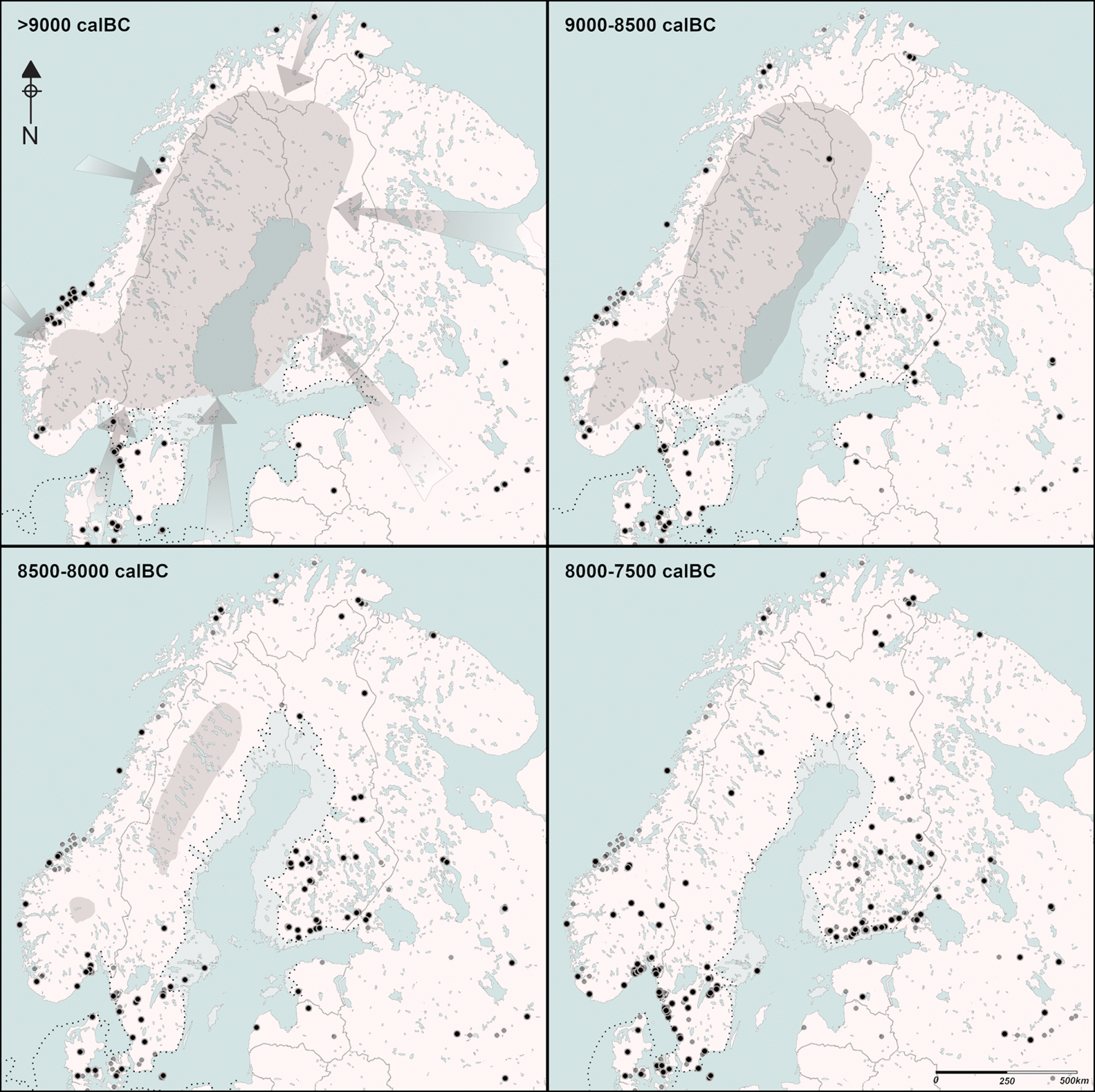
We collate a range of data to show that, in northernmost Fennoscandia where the first colonising populations would have met, groups belonging to different technological traditions coexisted in the Early Post-glacial period, and probably before 9000 BC. The data include the following results: lithic technological attributes from Mesolithic sites in the area; 572 radiocarbon dates (including five previously undated sites in northern Norway and the Kola Peninsula in Russia); and 205 shoreline dates (based on the tempo of isostatic land upheaval and consequent shore displacement chronology) from pre-7500 BC sites in the Scandinavian Peninsula and adjacent areas (Figure 1 & Table S1A–B). Based on the lithic tool technology, we conclude that the Early Post-glacial human dispersal into the Scandinavian Peninsula includes at least six migration events. We therefore argue that the gene flow that resulted in the Scandinavian hunter-gatherer group probably originated much earlier and involved more complex processes than assumed in recent palaeogenomic modelling of two single-event migrations.
Dated, pre-7500 BC sites (black dots, Table S1) and the retreat of the Scandinavian Ice Sheet (Hughes et al. Reference Hughes, Gyllencreutz, Lohne, Mangerud and Svendsen2016) in four time-slices. Arrows indicate the direction of ice retreat, and grey dots indicate sites from previous time-slices (maps by M.A. Manninen).
From the Early to Middle Mesolithic in Fennoscandia
In our approach, lithic technology represents a manifestation of cultural tradition, identifiable in the archaeological record by the different production stages of lithic tools. This reductive process entails sequences of learned motor actions that require skill, are common to members of a social group, and are transmitted between individuals and generations through social learning (e.g. Richerson & Boyd Reference Richerson and Boyd2005). Experimental studies demonstrate that systematic lithic production requires theoretical knowledge, as well as a degree of expertise, which can only be acquired through practice and practical guidance via direct and repeated interaction with a skilled person (e.g. Pelegrin Reference Pelegrin1990). Consequently, tracing the spread of knowledge-intensive technological concepts, such as blade production, is a powerful tool for detecting social contact and the dispersal of technology. The introduction of complex lithic blade technology into an area suggests repeated encounters with populations that had already mastered the technology and/or with new groups migrating into an area (Pelegrin Reference Pelegrin and Desrosiers2012).
The routes to Scandinavia
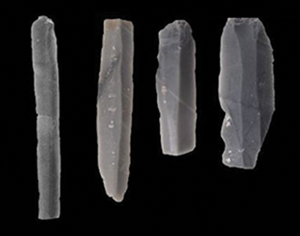
When mapped, our dataset of dated sites illustrates the basis of the simple, dual-route model of human dispersal (Figure 1): a wave of colonisation that entered the Scandinavian Peninsula from the south and moved rapidly northwards, and an eastern colonisation front that reached Fennoscandia from the east. Mapping also allows us to follow temporal and spatial patterns of human dispersal from the first signs of pioneer colonisation up to the earliest aDNA samples dated to c. 7700 BC. Due to constraints of the physical environment, land routes to northern Norway from the east were blocked by ice until c. 10 000 BC (Hughes et al. Reference Hughes, Gyllencreutz, Lohne, Mangerud and Svendsen2016). The area of present-day Norway was first colonised from the south, via western Sweden, by groups following the ice-free coastline to northernmost Fennoscandia (e.g. Blankholm Reference Blankholm2018: 2). These first colonisers show affinity with the Final Palaeolithic Ahrensburg Culture (c. 10 900–9700 BC) of the west European Plain in terms of both lithic technology and tool morphology (Berg-Hansen Reference Berg-Hansen2017), and their sites typically yield one-sided blade cores with one or two opposed platforms, small single-edged and tanged arrowheads of the western type and geometric microliths (Figure 2). Blade production consisted of gradual core reduction from one core-face, alternating between two opposing platforms, which result in straight but slightly irregular blades. Most of the blades display features diagnostic of direct percussion techniques, in that they have an interior platform angle from approximately 60–80° degrees and no lips, but evidence of cone formation (Berg-Hansen Reference Berg-Hansen2017).
Typical examples of ‘western’ (epi-)Ahrensburgian (W) and ‘eastern’ (E) Early Mesolithic technology from a variety of pre-7500 BC Fennoscandian sites. W: 1) opposite-platform blade core; 2) flake-axe; 3) microlith; 4–5) burins; 6–9) projectile points; E: 1) conical blade core; 2–3) core-platform rejuvenation flakes; 4) burin; 5) snapped blade; 6) end scraper on blade; 7) inset microlith; 8–9) ‘post-Swiderian’ arrowheads (photographs by H. Damlien & M.A. Manninen; photograph of W9 courtesy of E.C. Holte).

The same production method was applied to raw materials of varying size and quality in different parts of the study area. As far north as Finnmark in northern Norway—where South Scandinavian flint does not occur naturally—production was possible using local quartzites and cherts. This technological strategy differs in many details from the contemporaneous eastern technology recently identified in northern Finland and Norway.
Early eastern migration into northern Norway is confirmed by finds from northern Finland and north-eastern Norway that bear traits typical of Early Mesolithic pressure-blade technology of the east European Plain (Rankama & Kankaanpää Reference Rankama and Kankaanpää2011; Sørensen et al. Reference Sørensen, Rankama, Kankaanpää, Knutsson, Knutsson, Melvold, Eriksen and Glørstad2013). Blades were produced from conical cores with faceted platforms by the successive removal of blades and platform-preparation flakes, resulting in progressively narrower and shorter blades. The majority of the blades display features diagnostic of pressure and indirect percussion techniques (Pelegrin Reference Pelegrin and Desrosiers2012). The blades are regular to very regular, straight with ideal termination, and have an interior platform angle of around 90°. Blades commonly have lips and a low frequency of bulbar scars and cone formation. Reduction started from spade-form pre-cores featuring one guiding ridge to initiate the first blade. Present knowledge on the origin of this production concept suggests that it is related to the slotted bone-tool technology that developed in eastern Siberia c. 15–20 000 years ago (Knutsson et al. Reference Knutsson, Knutsson, Molin and Zetterlund2016), which, in some cases, spread in tandem with ground-stone tool technology (Hartz et al. Reference Hartz, Terberger and Zhilin2010).
The arrival and spread of eastern Mesolithic technology in the north
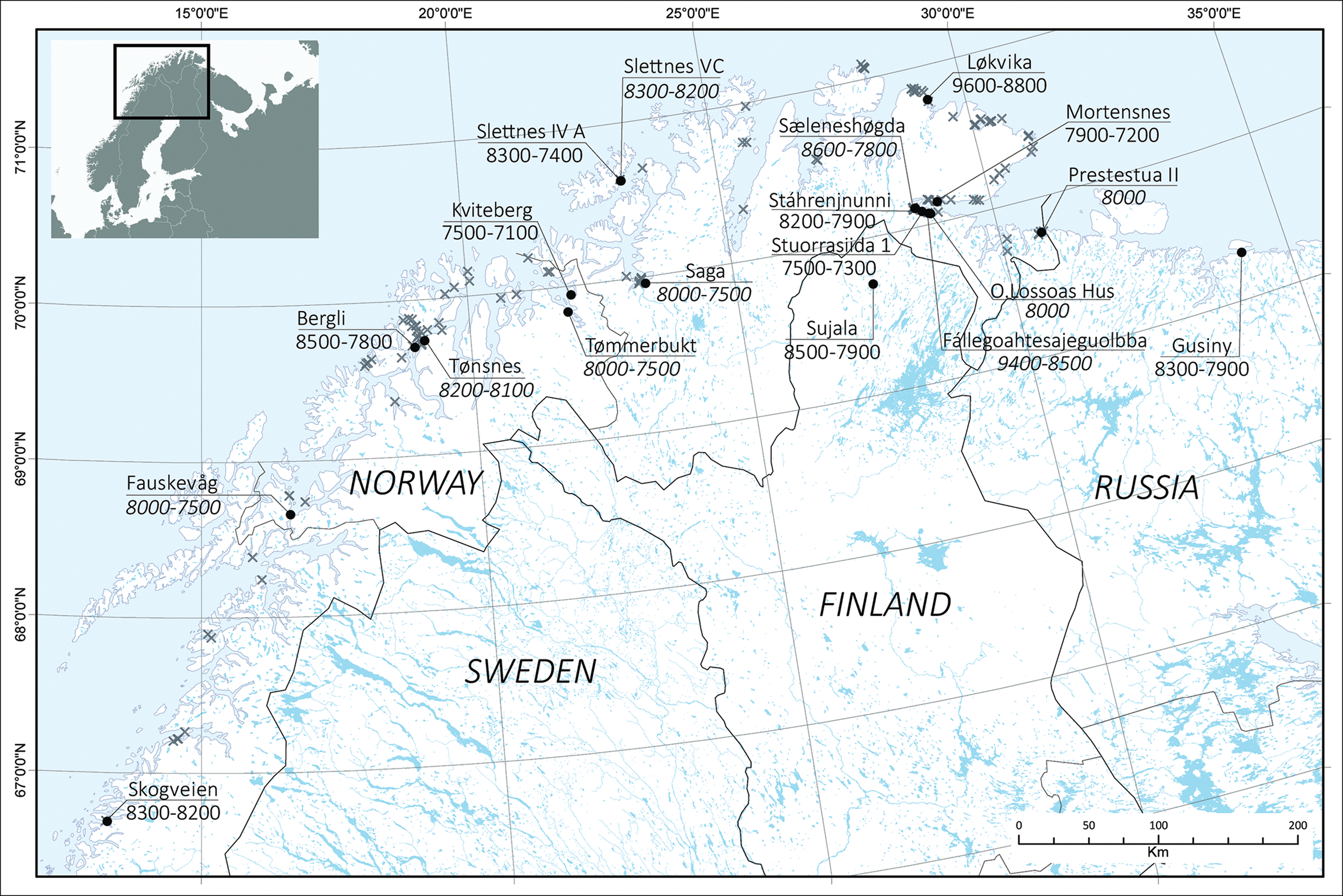
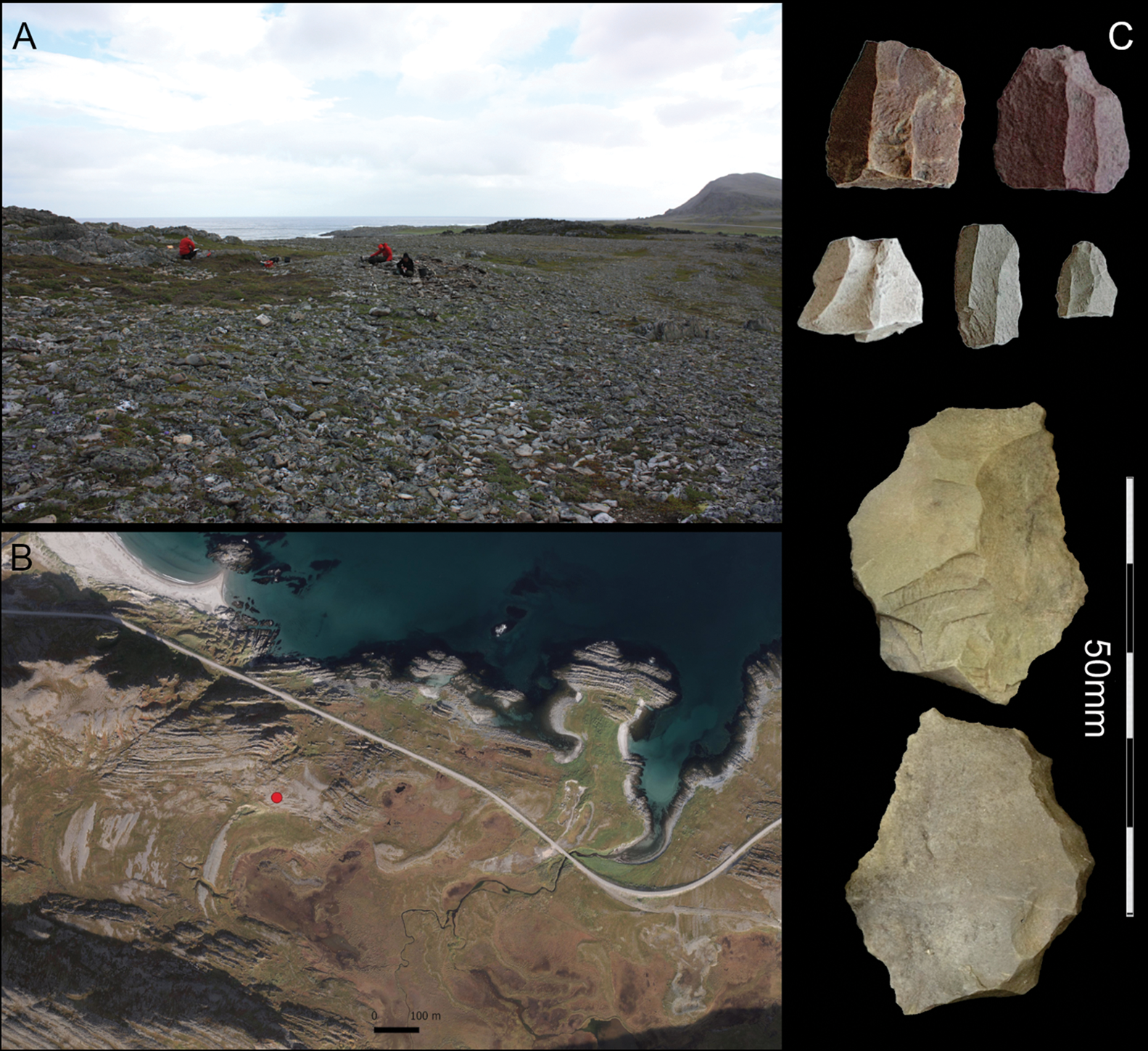
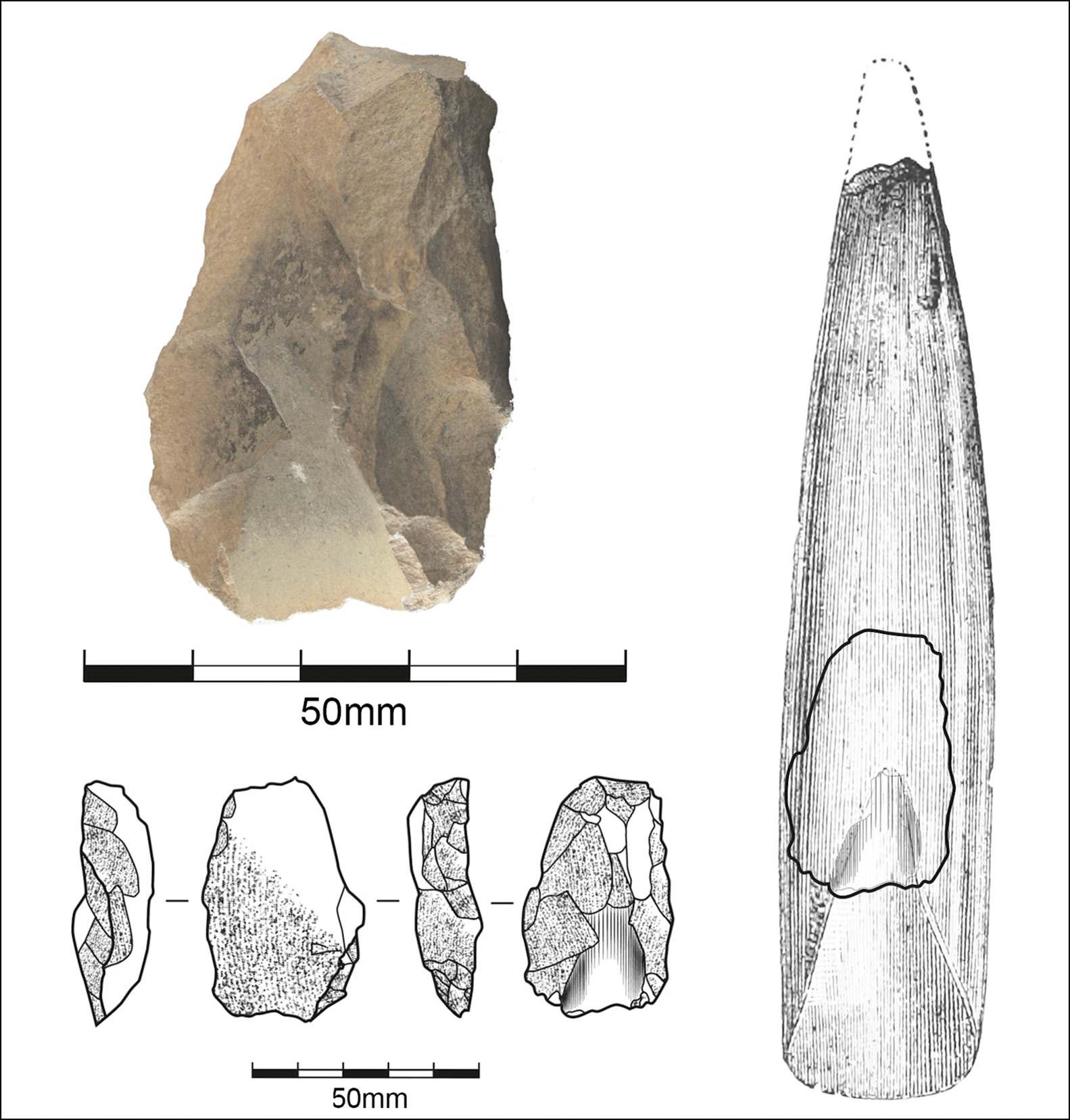
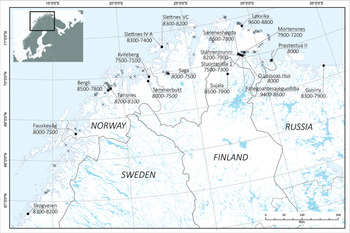
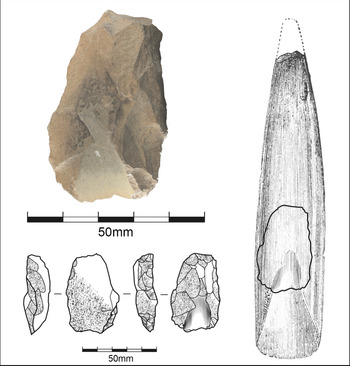
The earliest evidence of the eastern pressure-blade concept in northern Norway derives from eastern Finnmark, close to the Russian border (Figure 3). Fragmented blades and core tablets representing the eastern pressure-blade technology were found in Løkvika, on the northernmost coast of Norway. The Løkvika blade assemblage (Figure 4) is associated with two small hearths, from which burnt bone and charcoal have been dated to 9659–8826 BC (Kleppe Reference Kleppe, Riede and Tallavaara2014; Table S1). The Fállegoahtesajeguolbba site, on the southern shore of Varangerfjord in the easternmost part of Finnmark, has also yielded eastern technology, and dates by shore-displacement chronology to between 9400 and 8500 BC (Rankama & Kankaanpää Reference Rankama and Kankaanpää2011; Kleppe Reference Kleppe, Riede and Tallavaara2014). Also in the Varangerfjord area, more early evidence of the eastern pressure-blade technology is found at Stahrenjunni, a cluster of house-pits, of which house E was radiocarbon-dated to 8230–7835 BC, and Mortensnes R10, a site with eight house-pits, of which pit F2 is radiocarbon-dated to 7906–7186 BC (Table S1). Macro-tools from Stahrenjunni comprise three flake axes, one of which deserves particular attention, as it was made on a fragment of a ground hollow-edged gouge of eastern type (Figure 5). The nearby Sæleneshøgda site, dated by shore-displacement chronology to c. 8600–7800 BC, has yielded artefact types representing both eastern and western Early Mesolithic lithic production, including eastern (ground and pecked axes and adzes) and western (epi-Ahrensburgian flake axes) macro-tools (Anttiroiko Reference Anttiroiko2015; Rankama & Kankaanpää Reference Rankama, Kankaanpää and Blankholm2018; see the OSM).
Early northern sites: all Early Mesolithic Norwegian sites, regardless of technological tradition, are marked with grey crosses (Breivik Reference Breivik2016: appendix C); dots mark dated sites with eastern pressure-blade technology (cal BC); shore-displacement dates are in italics (for details, see the OSM and Table S1) (map by A.R. Niemi).
A–B) The Løkvika site and its current environment (the red dot indicates site location); C) blade fragments and a core tablet (dorsal and ventral side) from Løkvika (photographs by J.I. Kleppe; imagery for B @2020 Geovekst/Kartverket).
Flake-axe from the Stahrenjunni site, made on a fragment of a ground, hollow-edged gouge of ‘eastern’ type (photograph and drawings by C.S. Rosenvinge & P. Persson).
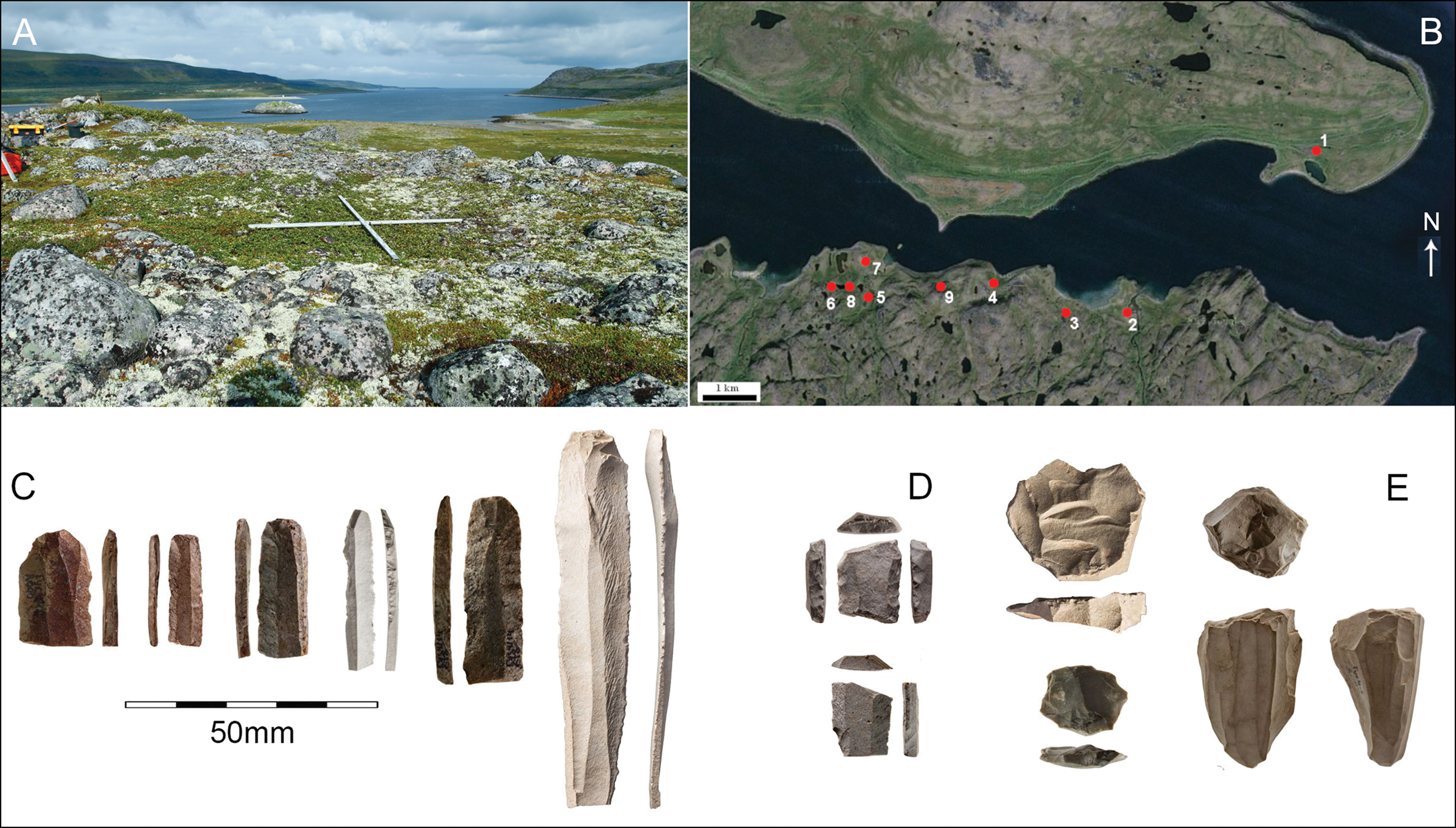
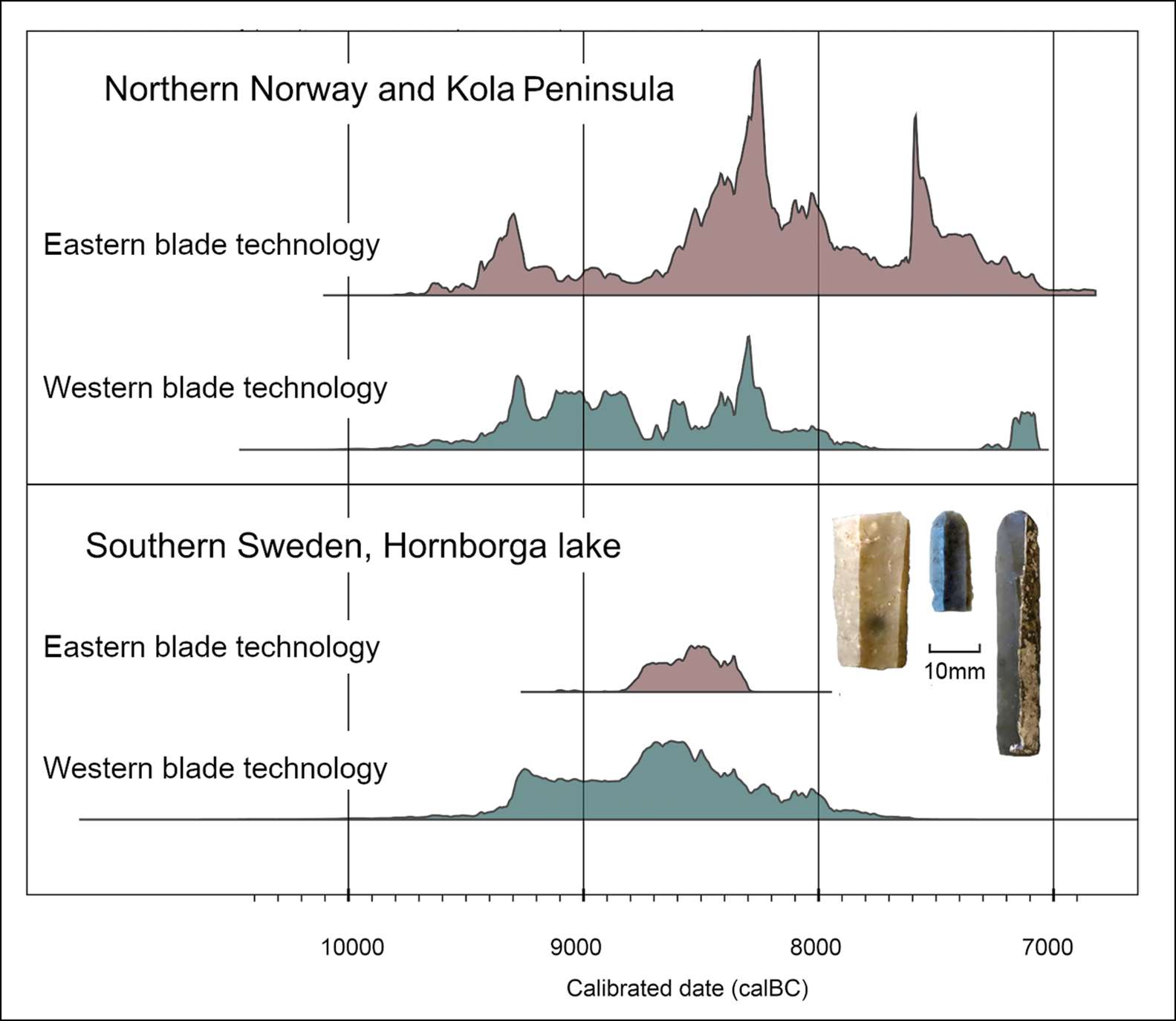
Farther east, on the Russian side of the Barents Sea, the Gusiny site-cluster (see Table S1 and the OSM) on the northern shore of the Kola Peninsula has yielded lithic assemblages representing both the western and eastern production concepts (Figure 6). Gusiny 4, area one—radiocarbon dated to 8526–8247 BC—yielded blades and blade fragments diagnostic of the eastern pressure-blade technology. Gusiny 7, a site yielding pressure-blades and related eastern lithic types, dates to 8304–7649 BC, which overlaps the Gusiny 4 dates. At the nearby Gusiny 6 site, however, a shallow house-pit (house eight) yielded an assemblage including flake axes and single-edged points—artefacts typical of the western epi-Ahrensburgian production concept. The date 8289–7980 BC on charcoal associated with the lithic material suggests that these finds are contemporaneous with the eastern blade assemblages found nearby at Gusiny 4 and 7. This indicates that on the Kola Peninsula, just as in Norwegian Finnmark, the western and eastern technological traditions were contemporaneous in the area for some 1000 years.
A) Gusiny 6, house depression eight before excavation; B) Mesolithic sites in the Kildin strait region: 1) Mogilnoe 3; 2–3) Zarubikha 3 & 10; 4) Kildin strait 2; 5–8) Gusiny 4–7; 9) Kabelnaya; C) blades, D) retouched blades; E) core tablets and an eastern-type core from Gusiny 4 (photographs by A. Murashkin; imagery for B @2020 TerraMetrics; map data @2020 Google).
The most thoroughly published evidence of eastern pressure-blade technology in the study area derives from the Sujala site. This is located in northernmost Finnish Lapland, and is radiocarbon-dated to 8691–7794 BC (Table S1). Excavations at the site have yielded a large lithic assemblage, comprising exhausted sub-conical blade cores with faceted platforms, pressure-blades, ventrally surface-retouched tanged points, core tablets and other artefacts typical of the eastern production concept (Rankama & Kankaanpää Reference Rankama and Kankaanpää2011).
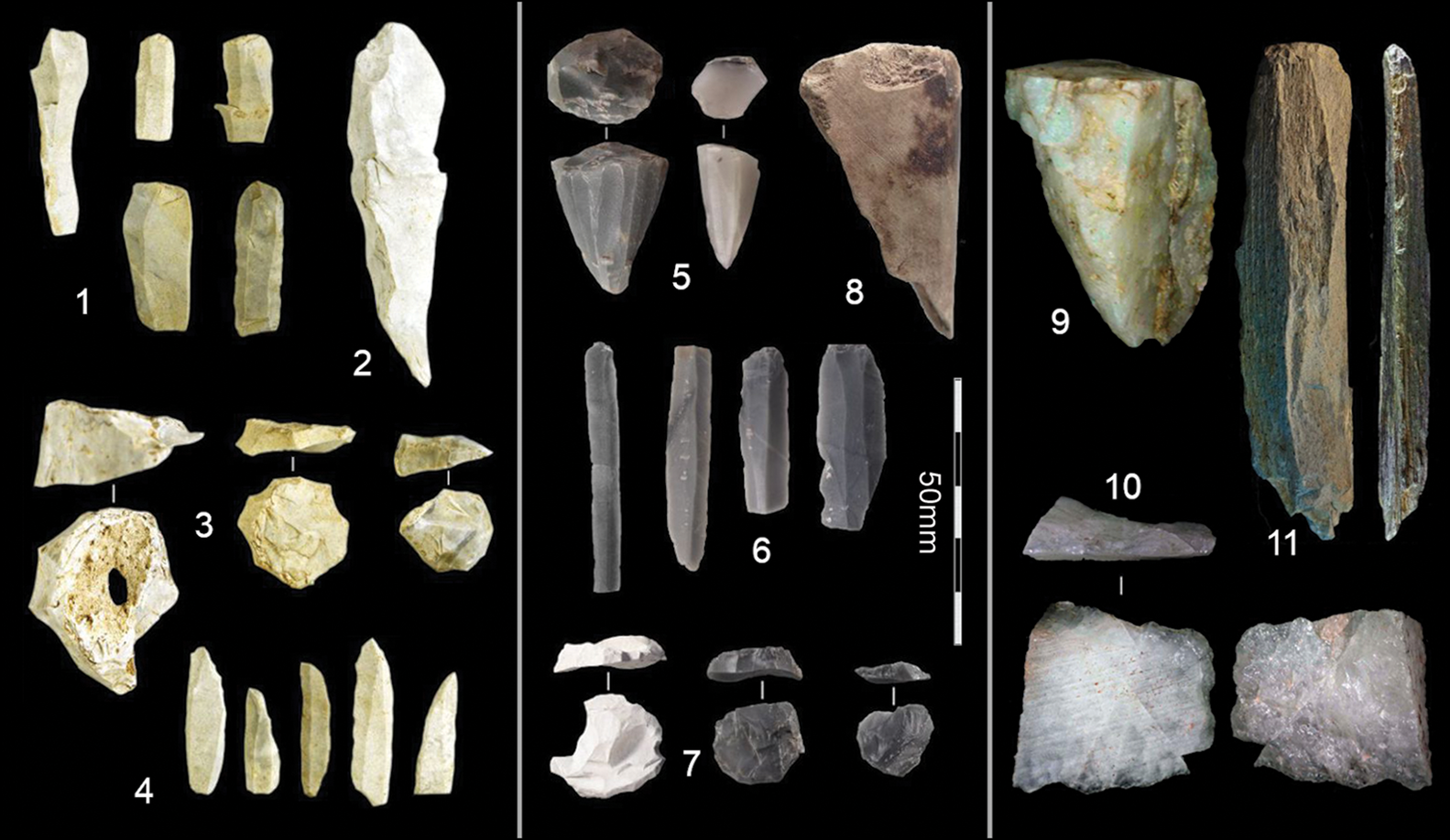
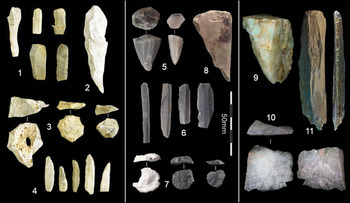
In north-western Norway, the earliest evidence of eastern blade technology is found at the Slettnes VC site on the island of Sørøya in western Finnmark, at the Bergli sites near Tromsø and at the Skogveien site in Nordland (Table S1). The Bergli 1 site, radiocarbon-dated to c. 8500–7600 BC, yielded eastern pressure-blade technology, and a large quantity of ground macro-tools. At Skogveien, platform-rejuvenation flakes with characteristic faceting, fragments of conical cores, a few blades and six microliths have been recovered (Figure 7). A charcoal sample dates the site to 8284–8221 BC. Conical cores and pressure-produced blades from Slettnes VC have been found within beach gravel deposited during post-glacial sea-level rise, c. 8000–5000 BC (the Tapes transgression; Fjeldskaar & Bondevik Reference Fjeldskaar and Bondevik2020), while shore-displacement chronology dates the site to c. 8300–8200 BC (see the OSM). Finally, a set of sites with eastern blade technology in north-western Norway (i.e. Slettnes IVA, Kviteberg, Tømmerbukt, Fauskevåg, Mælan) has yielded later dates, mostly c. 7700–7500 BC, while others (e.g. the Tønsnes sites) remain undated.
Eastern technology from sites in north-western Norway and north-eastern Finland: 1) blade fragments; 2) crested blade; 3) core tablets; 4) lanceolate microliths (1–4 are from Skogveien); 5) cores; 6) blades; 7) core tablets; 8) fragment of polished macro-tool (5–8 are from Kviteberg); 9) quartz core; 10) quartz scraper on flake fragment; and 11) greenstone knife (9–11 are from Nuottajärvi 1) (photographs by A.R. Niemi; 9–11 courtesy of G. Lybäck).
The eastern pressure-blade production concept elsewhere in Fennoscandia
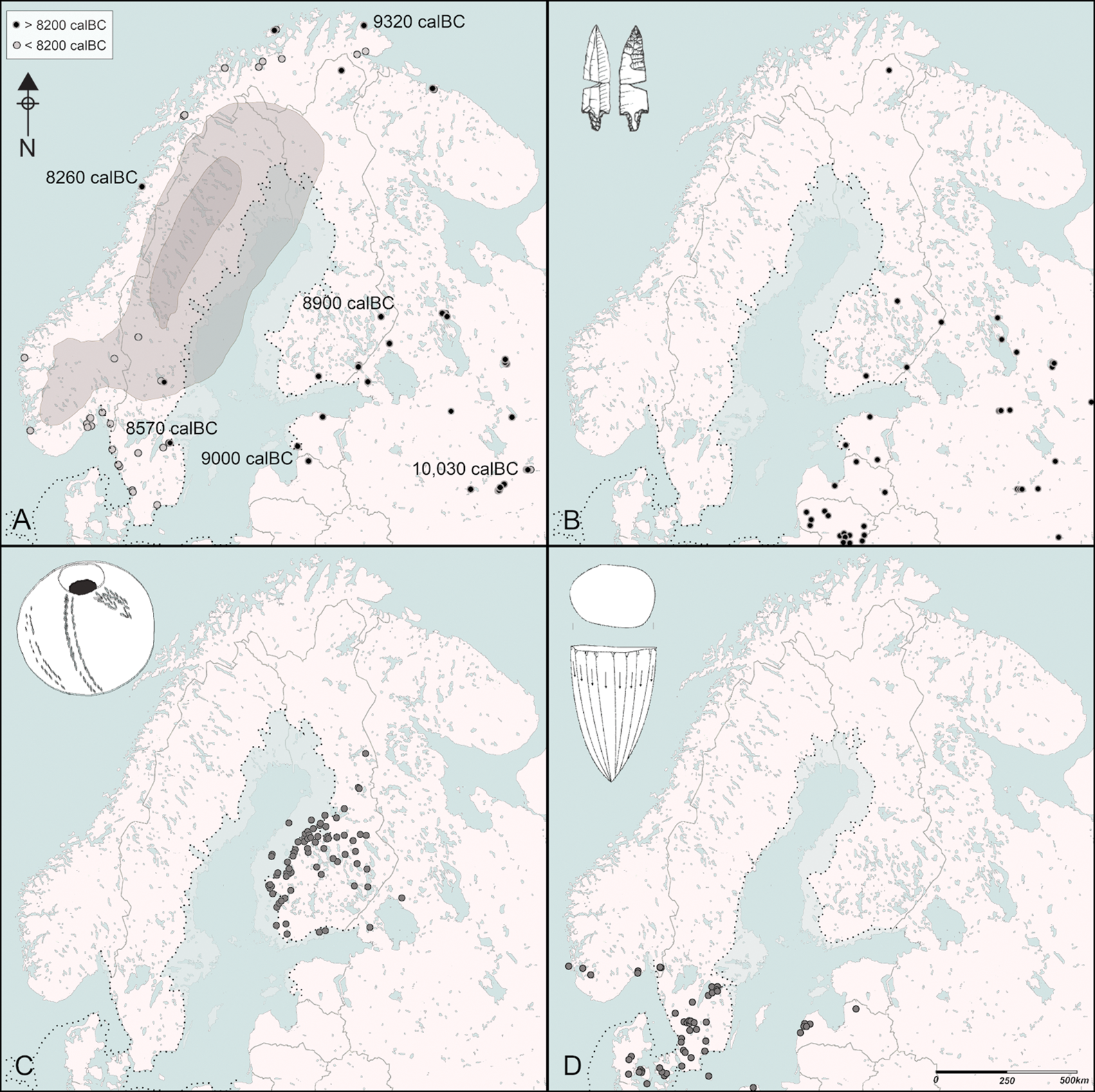
In South-eastern Fennoscandia, the earliest sites representing the eastern technology are found in Karelia and southern Finland, and date to c. 9000–8200 BC (Figure 8A–B). Pressure-blades and surface-retouched tanged points on blades (so-called ‘post-Swiderian’ points—a type not found in the Scandinavian Peninsula so far) are present at many of these sites, while blades are predominantly made on imported carboniferous flint (e.g. Hertell & Tallavaara Reference Hertell, Tallavaara and Rankama2011). By 8000 BC, however, pressure-blade production had ceased in the area (Manninen & Hertell Reference Manninen, Hertell and Rankama2011; Tallavaara et al. Reference Tallavaara, Manninen, Pesonen, Hertell, Riede and Tallavaara2014).
A) Radiocarbon-dated contexts with eastern pressure-blade technology. Grey areas represent the glacier at 9000 and 8000 BC; rounded dates are for earliest appearance in respective areas; B) finds of ventrally surface-retouched, tanged ‘post-Swiderian’ arrowheads; C) finds of globular mace heads, c. 8100–7600 BC; D) sites with pressure-blade production from plain-platform cores (c. 8000 BC onwards) (C after Schulz (Reference Schulz1996) and Risla (Reference Risla1999); D after Guinard (Reference Guinard, Knutsson, Knutsson, Apel and Glørstad2018) and Damlien et al. (Reference Damlien, Berg-Hansen, Zagorska, Kalniņš, Nielsen, Koxvold, Bērziņš and Schülke2018a & Reference Damlien, Kjällquist, Knutsson, Knutsson, Knutsson, Apel and Glørstadb); data in Tables S1–2 are used for A–B) (maps by M.A. Manninen; drawings by H. Damlien & M.A. Manninen).
In south Norway, profound changes in lithic technology are documented c. 8300–8200 BC, with the introduction of eastern pressure-blade production (Damlien Reference Damlien2016). The earliest radiocarbon-dated site with eastern technology is Langemyr (8211–7795 BC; Table S1). A clear change is also seen in projectile-point morphology and macro-tool technology. Sites in south Norway post-dating 8300 BC are characterised by an absence of tanged points and a rarity of geometric microliths (Damlien Reference Damlien2016). The earliest evidence of ground macro-tools (axes) of eastern type derives from sites radiocarbon-dated to c. 8200–7600 BC, while modification by pecking before grinding—assumed to be a local practice—is found from c. 7900–7700 BC onwards, according to shore-displacement chronology (Eymundsson et al. Reference Eymundsson, Fossum, Koxvold, Mansrud, Mjærum, Knutsson, Knutsson, Apel and Glørstad2018).
In central Sweden—in areas south of the Early Holocene ice sheet dome—recent analyses of stray-find collections and excavations of early sites have revealed eastern blade production contemporaneous with its presence in Western Scandinavia, but utilising local, igneous rocks (Knutsson & Knutsson Reference Knutsson and Knutsson2012; Knutsson et al. Reference Knutsson, Knutsson, Molin and Zetterlund2016: 34). The earliest radiocarbon-dated context is from the Orsandsbaden site (8791–7613 BC; Table S1).
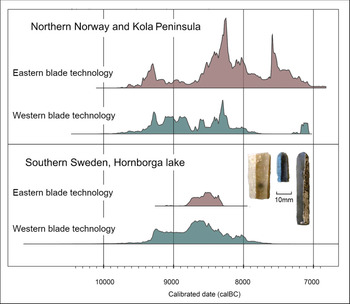
The eastern pressure-blade concept has also recently been identified in southern Sweden, where the earliest securely dated site with evidence for pressure-blade production is the lake-shore site Ytterbergs udde, located 1km from the Almeö site by the same Hornborga Lake. The latter yielded contemporaneous dates associated with western technology (Figure 9; Kindgren Reference Kindgren and Fischer1995). At Ytterbergs udde, a hearth containing charcoal and calcined bone within an area interpreted to be a hut floor is dated to 8635–8472 BC (Table S1). Finds from the hut area include blades made with eastern production technology, blade cores, a few microliths, and burins and scrapers on non-local Senonian flint. Single blades of eastern type, produced by indirect percussion, are also known from a Pre-boreal peat layer dated to 9270–9230 BC at the Kanaljorden site in Motala. At Kanaljorden, however, evidence of on-site production is lacking, and therefore we cannot be certain that the production concept was known in the region at this point (Hallgren Reference Hallgren, Persson, Riede, Skar, Breivik and Jonsson2018; see the OSM).
Chronological overlap between eastern and western technology in northernmost Fennoscandia (northern Norway and the Kola Peninsula; sites sorted according to lithic technology) and Southern Scandinavia (Hornborga Lake sites, one with western and one with eastern technology; see Table S3), as shown by summed probability distributions of radiocarbon dates. The inset shows eastern blades from Ytterbergs udde (photographs by K. Knutsson).
Recently, an east–west spatial divide in pressure-blade core-preparation strategies—suggested by plain vs faceted platforms—has been documented in southern Sweden from c. 8000 BC onwards (Damlien et al. Reference Damlien, Kjällquist, Knutsson, Knutsson, Knutsson, Apel and Glørstad2018b; Guinard Reference Guinard, Knutsson, Knutsson, Apel and Glørstad2018). The divide follows watersheds, while the distribution of cores with plain platforms extends through southern Scania (the southernmost province in Sweden) to Denmark, where the concept first appears c. 7000 BC (Figure 8: D; Sørensen et al. Reference Sørensen, Rankama, Kankaanpää, Knutsson, Knutsson, Melvold, Eriksen and Glørstad2013).
Non-blade technologies
Knowledge-intensive blade production leaves powerful evidence for detecting the movement of blade-production technology. Partly because of this, however, sites without blade production can be easily overlooked. Many of the pre-7700 BC sites in Fennoscandia, for example, have not yielded such evidence. In Eastern Fennoscandia, simple flake technology, mostly on macrocrystalline quartz, begins to dominate the archaeological record, along with a variety of ground-stone tools on slates and igneous rocks by c. 8900 BC (Manninen et al. Reference Manninen, Hertell, Pesonen, Tallavaara, Knutsson, Knutsson, Apel and Glørstad2018). The earliest sites with quartz-flake production and with no evidence of blade production or use are Myllykoski in southern Finland (9171–8565 BC) and Antrea Korpilahti in Karelia (c. 8570–8380 BC) (Table S1). Besides quartz, a variety of tool types of the so-called ‘Ancylus Mesolithic’ (Matiskainen Reference Matiskainen1989) characterise the period following the first centuries of post-glacial human presence in southern Finland. Of these, the globular mace-head, dated to c. 8100–7600 BC, has the most clearly defined distribution (Figure 8C).
Similarly, in northern Sweden and western Finnish Lapland, the establishment of pioneer sites that follow the timing of the retreating ice offers evidence for the use of lithic technology that is characterised predominantly by flaked quartz. The earliest dates are from Aareavaara 1276 (9305–8641 BC), Kangos (8202–7613 BC) and Nuottajärvi 1 (Figure 7; 8271–7963 BC; Table S1), all of which are located close to the Swedish-Finnish border. Farther south in Sweden, Dumpokjauratj (7936–7533 BC) and Vojmsjön (8239–7614 BC) have also yielded evidence for a flake-based quartz technology.
Unlike the changes in blade technologies, the change to less diagnostic quartz-based technology is best explained by a lack of suitable lithic raw materials in Eastern Fennoscandia and northernmost Sweden that would have allowed the first eastern colonisers to continue to use their existing blade technology without extensive effort. Although the technology was simplified and some of the earlier modes of production were lost, flakes of quartz and other local materials offered a wide range of uses, which are also identified in contemporaneous assemblages representing the eastern production concept—most notably as edges in composite tools (Knutsson et al. Reference Knutsson, Knutsson, Molin and Zetterlund2016). Many organisational dimensions of the overall technological system therefore did not need to change, as the use of quartz provided an alternative option for producing efficient edges. In terms of tracing the movement of diagnostic technological traits, however, the simple quartz-based technology is currently of no use. Nevertheless, if only for geographic proximity, it seems probable that Swedish Lapland was also colonised from the east.
Discussion
Although our results strongly support the view that post-glacial human dispersal into Scandinavia took place from two general directions, the pre-7500 BC archaeological data support more complex processes than those proposed by two single-event gene-culture dispersal events (Günther et al. Reference Günther2018). The discovery of lithic tools and production waste characteristic of the eastern technological tradition at the Løkvika and Fállegoahtesajeguolbba sites in eastern Finnmark suggests that the wave of eastern dispersal was initiated much earlier than previously assumed (see Kleppe Reference Kleppe, Riede and Tallavaara2014, Reference Kleppe and Blankholm2018), and probably before 9000 BC. Taken together with the evidence of pioneer colonisation from the south that reached northernmost Norway along a coastal route before 9000 BC (Blankholm Reference Blankholm2018), our data suggest the coexistence of groups belonging to different cultural traditions from the time the region was initially settled.
There is no archaeological evidence for cultural mixing or the transmission of knowledge/skills from this first millennium of coexistence. Although the groups visited the same landscape, any interaction did not result in lithic technological change. This initial settlement period, however, is followed by a sudden increase in archaeological evidence for the eastern technology, at c. 8300 BC. From this point, the eastern technological tradition spread rapidly along the Barents Sea coast and southwards into central and southern parts of the Scandinavian Peninsula. This pattern also strongly supports the introduction of the eastern technology to Northern Fennoscandia earlier than 8300 BC; the plentiful archaeological evidence represents the stage when a new technology becomes common and therefore clearly visible in the archaeological record.
Our data show the contemporaneous presence of both eastern and western technological concepts in the north after 8300 BC. This is represented clearly by the flake axe made on a ground-stone tool from Stahrenjunni, and by the Gusiny sites, Sæleneshøgda and Skogveien. Meanwhile, the continuous production of western-tradition lanceolate microliths at sites with an otherwise mostly eastern technology points to an amalgamation of the two traditions in this region. We therefore suggest that the processes that led to the increased archaeological visibility of the eastern technological tradition after 8300 BC and the genetic admixture detected in aDNA samples at c. 7500 BC can be traced back one millennium earlier than the expansion of the eastern technology from the north into Southern Scandinavia.
The sites around Hornborga Lake in south-eastern Sweden suggest that blade production employing the eastern concept was already in use in this area before c. 8500 BC. As the inland route at this early date was still blocked by ice, this phenomenon could be explained by people crossing the Baltic Sea by sledge or boat. As evidence for this is mostly unpublished, however, it cannot be discussed further here. Along the south-western coast of Scandinavia, a sudden technological change is observed at c. 8300 BC, as the eastern blade-production concept began to dominate; no sites or artefacts representing a mixed eastern/western technology are known in this area. A delay is observed, however, in the introduction of ground and pecked macro-tool technology, the latter of which seems to represent a regional innovation that is not found in Northern Scandinavia (Eymundsson et al. Reference Eymundsson, Fossum, Koxvold, Mansrud, Mjærum, Knutsson, Knutsson, Apel and Glørstad2018). Moreover, regional variation is documented in pressure-blade core-platform preparation strategies in southern Sweden after c. 8000 BC.
The data also demonstrate regional variation in the eastern technological tradition in Fennoscandia. In Finland, while ground macro-tool technology continued, blade production was completely replaced by a flake technology by c. 8000 BC, and in northern Sweden, quartz-flake technology was already dominant at the earliest sites. In eastern Finnmark and Kola, we observe a long period of coexistence of hunter-gatherer groups belonging to different cultural traditions, before a mostly eastern technology becomes prominent c. 8300 BC. The tanged points of eastern type, however, did not spread into Scandinavia, even though they occur in high numbers at Sujala and other sites in the east.
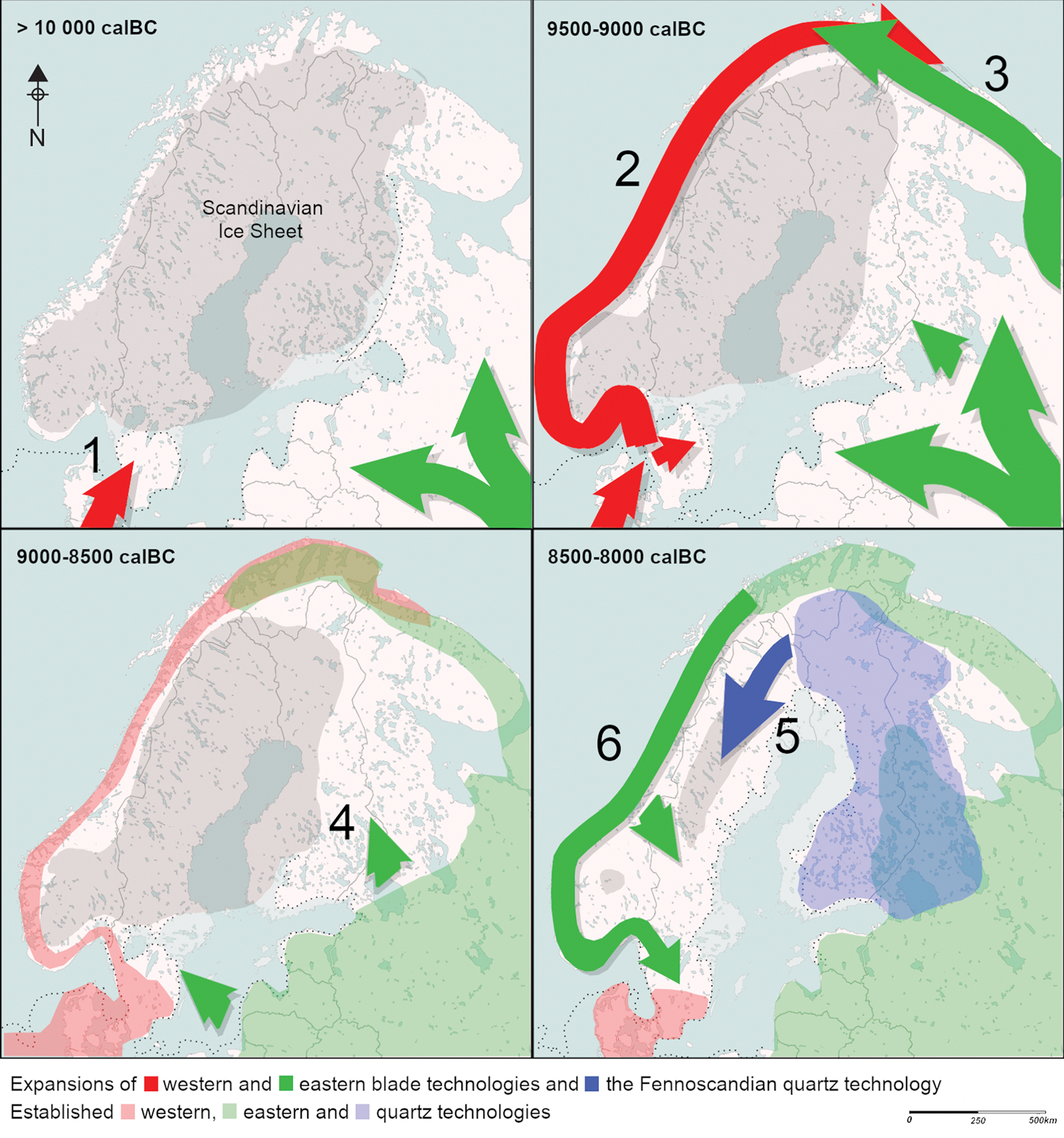
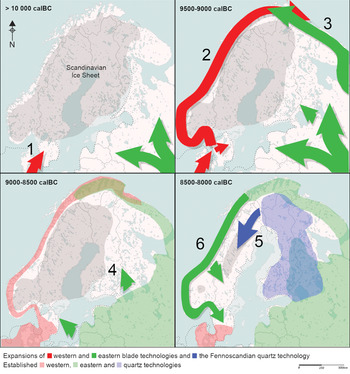
We conclude that the data on archaeological sites and technological change in Fennoscandia pre-dating the earliest aDNA, indicate at least six pre-7500 BC population events:
1) The initial dispersal into southern Sweden from the south c. 11 300–10 000 BC.
2) The north-westward migration along the Norwegian coast from western Sweden c. 9500–9300 BC.
3) The pre-9000 BC north-eastern migration into northern Norway and Kola.
4) The eastern dispersal into Finland and Karelia c. 9000–8400 BC.
5) The movement of quartz-using groups into northern Sweden from the east between 8900–8200 BC.
6) The southward migration of groups using the eastern technology along the Norwegian coast and into central Sweden c. 8400–8000 BC.
Furthermore, a migration across the Baltic Sea Basin to southern Sweden c. 8500 BC can be suggested (Figure 10). All of these events resulted in several possible encounters between culturally and/or genetically distinct groups that shaped the cultural and genetic diversity of Early Mesolithic Scandinavia.
Six archaeologically visible expansions of technology in pre-7500 BC Scandinavia that can be linked with population movement and/or gene flow. All six pre-date the currently earliest aDNA sequence from Scandinavia (maps by M.A. Manninen & P. Persson).
Conclusion
Our contextual analyses of dated sites and lithic technologies from the pre-7500 BC Scandinavian Peninsula and nearby areas in Finland, Russia and Denmark show that, with the careful selection of archaeological proxies and good chronological resolution of sites and material culture traits, it is possible to tackle generalised spatio-temporal archaeological phases, such as the Scandinavian Early to Middle Mesolithic, in order to provide a more nuanced picture of migration events, periods of cultural co-existence and of social transmission than is usually attempted in prehistoric archaeology—and especially in studies of ancient population genetics. Such analysis and treatment of the data may be key in the more effective integration of aDNA data into the study of prehistoric human mobility and dispersal, as the selection of research avenues in aDNA studies and the interpretation of palaeogenomic results mirror the information that archaeologists provide. We therefore now hand over to aDNA researchers, in the hopes that the refined picture provided in this article will help us all to understand better also the genetic history of Mesolithic Scandinavia.
Acknowledgements
We wish to thank the two anonymous reviewers for their valuable comments.
Funding statement
This research was supported by The Research Council of Norway (project 231305).
Supplementary material
To view supplementary material for this article, please visit https://doi.org/10.15184/aqy.2020.252





 Open access

