


Introduction
The tundra covers 7.2 × 10⁶ km2, or 4.8% of the entire land surface of the Earth. Within the Arctic Circle, however, the tundra surface occupies 20% of the entire surface, and is the second largest surface after the ocean. Being located between the ice-filled ocean and the glaciers, the tundra region shows a distinctively mild climate during the short snow-free season in summer when the terrestrial ecology is most active. Apart from the atmospheric conditions, the summer climate of the tundra region is strongly affected by the snow-cover depth which influences the onset of the snow-free season. After the snow cover disappears, the tundra exhibits a distinctive heat-balance regime which makes the summer climate of this region so different from that of the Arctic Ocean or glaciers. The base camp of the Axel Heiberg Island Expedition of McGill University, Montreal, Canada, became the first site of a continuous investigation of microclimate and heat balance on the tundra, which is sufficiently long to be called climate-logical. In this paper, the main features of the tundra climate, its heat balance and the physical processes of the heat balance that create the tundra climate are presented.
Tundra Climate
Before the onset of melt, the regional climate difference in the Arctic is small and influenced weakly by the surface characteristics (Table 1), because of the homogeneity of the surface in this season. Regardless of whether the surface is ocean, tundra or glacier, the Arctic surface is covered by the dry-snow cover which has fairly consistent thermal and radiative characteristics. During the dry-snow season, usually before June, the air-temperature distribution is influenced mainly by the surface roughness and the altitude. The regional differences driven by the differences in the radiative and thermal characteristics become significant only during the melt period. The melt period on the Arctic tundra is usually brief owing to the limited water equivalent of the snow cover. The year’s highest monthly mean temperature on the tundra appears soon after the melt period, and is 2–4°C warmer than over ocean or glacier surfaces.
Monthly statistics of air temperature for various surfaces

In addition to higher mean air temperature, the tundra climate in summer is characterized by a larger daily temperature range (daily maximum minus minimum). The daily temperature range consists of the amplitude of the diurnal periodicity (24 h) and the aperiodic component (daily range minus diurnal amplitude). The former is created by the 24 h period in the solar elevation, and the latter by advection and convection. Prior to March, the solar elevation is small, and the aperiodic change dominates the daily range. In this season there is a slight regional variation in the daily temperature variation which is largest on the tundra. This type of temperature change is associated with the wind speed which is a good indicator of the vertical mixing of the boundary layer. Since the vertical temperature difference in the stable boundary layer is large, the temperature variability caused by vertical mixing is more significant than the temperature change due to the horizontal advection of different air masses for a short period such as a day. Given the same wind speed, the vertical mixing is usually more intense over the tundra than over the oceans and glaciers, due to the tundra’s rough surface and topography. After the year’s maximum daily range and diurnal amplitude are observed in April, the daily temperature range becomes small in high summer throughout the Arctic. This seasonal phenomenon is called a Fram-type temperature change (Reference SimpsonSimpson, 1919) Even during this season, however, the daily range remains higher in the interior tundra than at the coastal and oceanic sites. The daily maximum temperature on the tundra can be as much as 5–10°C higher than at ocean and glacier sites. The daily minimum temperature is 1–4°C warmer on the tundra than over oceans and glaciers at the same altitudes. The larger daily range for the tundra region in summer is due to the larger diurnal amplitude rather than the aperiodic component. From detailed investigations of the mesoscale temperature distribution on Axel Heiberg Island (Reference Ohmura and MüllerOhmura and Müller 1977), it was deduced that the major transition between the oceanic and tundra climate takes place within 1–2 km of the coastal zones. Almost all meteorological stations in the Canadian Arctic and Greenland are located in this narrow coastal strip. If the modelcomputed characteristics of temperature for the land surfaces in the Arctic are to be validated by meteorological observations, the latter should be viewed with caution. They represent a very special temperature condition which prevails only in this coastal zone and are not necessarily representative of the interior tundra climate generally. Of all the stations in this region, Eureka on Ellesmere Island and Søndre Strømfjord on the west coast of Greenland are most representative of the tundra climate.
Heat Balance
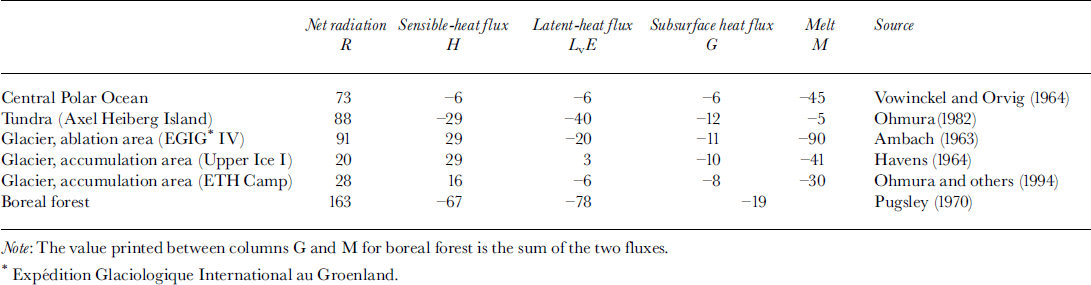
The distinctive nature of the tundra surface emerges during the melt period. During this short period the surface albedo falls from about 0.8 to 0.1, whereas other low-altitude Arctic surfaces, such as ocean and the ablation areas of glaciers, retain a relatively high albedo of about 0.5. This sharp decrease in albedo is often considered to cause the regional difference in net radiation which further influences temperature. It is, however, not correct to attempt to explain the regional temperature difference through the difference in net radiation. The distribution of net radiation is fairly homogeneous over ocean, tundra and the glacier ablation areas despite the albedo difference, as is shown for the three summer months June-August in Table 2. The effect of high albedo over the ice surfaces is compensated for by smaller emissions on the melting ice. The regional difference in surface temperature requires consideration of the entire heat-balance process. Further, the heat-balance equation must be viewed from a slightly different standpoint. This equation represents more than the conservation of energy for the Earth’s surface; it describes how the Earth’s surface reacts upon the imposed energy-flux changes. To arrive at this statement, the individual terms in the net radiation are expressed in the following energy-balance equation:

where Q is the direct solar radiation, q is diffuse sky radiation, a is albedo, L↓ is longwave incoming radiation, a is the Stefan-Boltzmann constant, T is the surface temperature, H is sensible-heat flux, Lv is latent heat of vaporization, E is evaporation rate, G is subsurface heat flux and M is the heat of fusion. The sign is defined positive when the flux is directed to the surface.
Energy balance (Wm–2 ) for various surfaces in the Arctic
When these terms are individually examined, one realizes that there is a term which is fundamentally different from all the other terms. This term is the surface emission, usually hidden as a part of the net radiation. The surface emission term differs from other terms in that it is completely determinable by other terms. Other terms will be subject to changes by external conditions which are not expressly represented in this equation, such as cloud which influences global radiation, or wind which influences the turbulent fluxes. The surface emission term can be interpreted as the ultimate way in which the surface reacts thermally under given fluxes. Along this line of thought, the surface temperature can be expressed as:

or formulated in a differential manner:
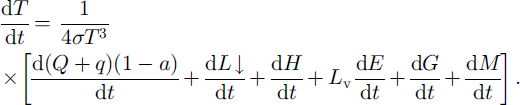
Equation (2) illustrates how the surface temperature is formed. The contributions of each heat-flux term to the surface temperature formation are presented in Table 3 for various surfaces. One sees in the table that a significant difference is found not in net radiation but in an energy sink, and especially for tundra the small heat flux of melt is responsible for maintaining the higher temperature in the tundra region. Equation (3) expresses the influence of the changes in heat fluxes upon the temperature variability The small diurnal amplitude of the temperature over the oceans and glaciers observed in summer is mainly due to the canceling effect of the diurnal change in the melt rate whose phase is shifted by 12 h in comparison with that for solar radiation. Equation (3) also explains how the same magnitude of the flux change on the righthand side causes temperature change to be larger in a colder climate. This aspect has a global relevance. It is generally known that the temperature change in the polar region is larger with almost all climate changes. The paleoclimatic case-studies for the last ice age maximum (CLIMAP Project Members, 1976), as well as global climate model experiments for the enhanced greenhouse effect (Reference Manabe and StoufferManabe and Stouffer, 1994), produced this trend. The temperature sensitivity of the polar regions to a climate change is by now well established, and usually explained through the positive feedback relationship between the cryosphere and the temperature, which is certainly an important component. This process, however, is not the entire reason for the known high climatic sensitivity of the polar regions. The combination of the low temperature and how the thermal and electromagnetic energies are convertible to each other, that is, Planck’s radiation law, is also a contributing basis for the high temperature sensitivity of the polar regions. The same magnitude of increase in the incoming longwave radiation as a result of the enhanced greenhouse effect causes almost twice as much temperature rise in the polar regions as in the tropics. Therefore, this type of climate sensitivity is certainly not exclusive to the polar regions, but should also apply to other regions of lower temperature, such as high altitudes.
Radiation and energy balance for various surfaces in the Arctic

Intensive microclimatological investigations on Axel Heiberg Island not only produced the scientific basis for understanding the tundra climate but reached far beyond the conventional boundaries of Arctic science. The research environment in the High Arctic Research Group of McGill University was truly interdisciplinary, though without the organization of a formal curriculum of interdisciplinary courses. Graduate students in different research areas worked side by side, learning from each other. The late Fritz Müller’s dedication and enthusiasm made a deep impression on many of his students. The author of the present paper is certainly one who was inspired by this.
Acknowledgements
The present project was financed by the Swiss National Science Foundation through grant Nos. 20–29822690 and 20–3264911 and an ETH research grant, both for the Greenland Project. Financial support from the AVINA foundation for the Alliance for Global Sustainability ETH/Massachusetts Institute of Technology/University of Tokyo, is gratefully acknowledged.



