





Introduction
Horseweed (also known as Canada fleabane and marestail) is a broadleaf weed from the Asteraceae family that is becoming a problematic invasive weed in crop production in many parts of the world, especially in the north temperate region (Bajwa et al. Reference Bajwa, Sadia, Ali, Jabran, Peerzada and Chauhan2016; Davis et al. Reference Davis, Kruger, Stachler, Loux and Johnson2009). Glyphosate-resistant (GR) horseweed was identified in Ontario from seeds obtained in 2010 from a farmer’s field in southwestern Ontario (Byker et al. Reference Byker, Soltani, Robinson, Tardif, Lawton and Sikkema2013c) and has now been found in 30 counties in a geographic area that extends from the southwestern border adjacent to Michigan, US, to the most eastern regions adjacent to the Quebec border (Budd et al. Reference Budd, Soltani, Robinson, Hooker, Miller and Sikkema2016; Benoit et al. Reference Benoit, Soltani, Hooker, Robinson and Sikkema2019). GR horseweed has the potential to decrease soybean yield by as much as 93% and increase weed management costs for producers (Byker et al. Reference Byker, Soltani, Robinson, Tardif, Lawton and Sikkema2013b). Horseweed that emerges in the autumn or spring before soybean seeding has been shown to be best controlled with preplant (PP) burndown herbicides applied in the spring, as few postemergence (POST) herbicides are available to manage horseweed POST in soybean (Loux et al. Reference Loux, Stachler, Johnson, Nice, Davis and Nordby2006; Zimmer et al. Reference Zimmer, Young and Johnson2018a, Reference Zimmer, Young and Johnson2018b).
Earlier studies have shown that synthetic auxinic herbicides (WSSA Group 4), such as dicamba, 2,4-D, and halauxifen-methyl, have potential for GR horseweed management in soybean (Busi et al. Reference Busi, Goggin, Heap, Horak, Jugulam, Masters, Napier, Riar, Satchivi, Torra, Westra and Wright2018; Mithila et al. Reference Mithila, Hall, Johnson, Kelly and Riechers2011; Zimmer et al. Reference Zimmer, Young and Johnson2018b). Control of GR horseweed has been variable among the Group 4 herbicides, which may be due to horseweed size at herbicide application timing. Byker et al. (Reference Byker, Soltani, Robinson, Tardif, Lawton and Sikkema2013b) reported 68% to 100% GR horseweed control with dicamba applied PP and 71% to 87% GR horseweed control with 2,4-D ester in soybean. Zimmer et al. (Reference Zimmer, Young and Johnson2018b) found only 71% GR horseweed control with halauxifen-methyl in soybean. However, Soltani et al. (Reference Soltani, Shropshire and Sikkema2020b) found 87% GR horseweed control with halauxifen-methyl in soybean. Two-way or three-way mixtures of these herbicides may enhance the effectiveness and uniformity of GR horseweed control in soybean. The use of Group 4 herbicides from different chemical families is suggested not to increase the selection of Group 4–resistant weeds because the herbicides have different binding sites (Dilliott et al. Reference Dilliott, Soltani, Hooker, Robinson and Sikkema2022). Mixing herbicides may result in synergistic, antagonistic, or additive responses. Dilliott et al. reported additive responses for the control of GR horseweed in soybean when saflufenacil was added to glyphosate + dicamba. However, the observed plant density and aboveground biomass were greater than expected, indicating an antagonistic interaction (Dilliott et al. Reference Dilliott, Soltani, Hooker, Robinson and Sikkema2022). The same study reported additive responses when metribuzin was mixed with glyphosate + dicamba for GR horseweed biomass reduction. However, for GR horseweed density, there were antagonistic interactions, as the observed density values were greater than expected (Dilliott et al. Reference Dilliott, Soltani, Hooker, Robinson and Sikkema2022). Additionally, when saflufenacil was added to glyphosate + 2,4-D ester, there were additive responses for the control and density and biomass reduction of GR horseweed in soybean (Dilliott et al. Reference Dilliott, Soltani, Hooker, Robinson and Sikkema2022). Dilliott et al. (Reference Dilliott, Soltani, Hooker, Robinson and Sikkema2022) also found synergistic/additive responses when saflufenacil or metribuzin was added to glyphosate + halauxifen-methyl for the control of GR horseweed in soybean.
To our knowledge, Group 4 herbicide mixtures and their synergistic, antagonistic, and additive responses have not been cumulatively evaluated for GR horseweed control in soybean under Ontario environmental conditions. The objective of this experiment was to determine the efficacy of Group 4 herbicides applied PP alone and in a mixture for GR horseweed management in soybean.
Materials and Methods
Experimental Methods
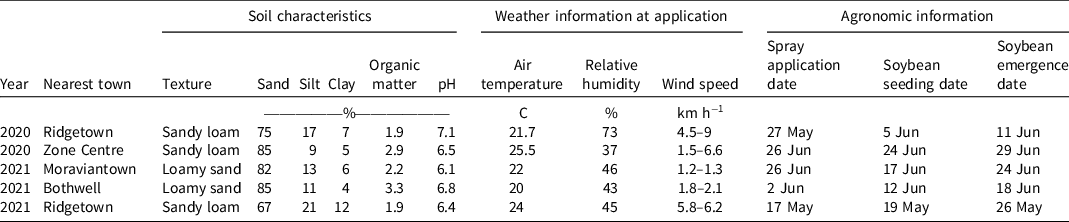
Experiments were established in farmers’ fields with confirmed GR horseweed in 2020 (two trials) and 2021 (three trials). Each site’s geographic information, including soil information, is included in Table 1.
Year, location, soil characteristics, weather information at application timing, and agronomic information for five experiments conducted in Ontario, Canada, in 2021 and 2021.
The experimental design was a randomized complete block design with three to four replications. Replications were separated by a 2-m alleyway. Treatments included a weed-free control, a nontreated (weedy) control, dicamba (600 g ae ha−1), 2,4-D ester (528 g ae ha−1), halauxifen-methyl (5 g ai ha−1), dicamba + 2,4-D ester (600 + 528 g ae ha−1), dicamba + halauxifen-methyl (600 + 5 g ai/ae ha−1), 2,4-D ester + halauxifen-methyl (528 + 5 g ai/ae ha−1), dicamba + 2,4-D ester + halauxifen-methyl (600 + 528 + 5 g ai/ae ha−1), and dicamba + saflufenacil (600 + 25 g ai/ae ha−1). Glyphosate at 900 g ae ha−1 was included in all treatments. Adjuvants used with each herbicide treatment are listed in Table 2. GR horseweed in the weed-free control was maintained weed-free with glyphosate (900 g ae ha−1) + saflufenacil (25 g ai/ae ha−1) + metribuzin (400 g ai/ae ha−1) applied PP followed by glyphosate/dicamba (1,800 g ae ha−1) applied POST.
Glyphosate-resistant horseweed control, density, dry biomass, and soybean yield when treated with various Group 4 herbicide combinations from sites near Ridgetown, Bothwell, and Thamesville, ON, in 2020 and 2021.a,b,c,d

a n = 5. All treatments included glyphosate (900 g ae ha−1). An asterisk denotes a significant difference of P < 0.05 between observed and expected values based on a two-sided t-test. Values with an asterisk are synergistic or antagonistic, whereas values without an asterisk are additive.
b Abbreviations: GR, glyphosate-resistant; PP, preplant; WAT, weeks after herbicide application.
c Expected values for herbicide combinations based on Colby’s equations (Equation 1 or 2) for GR horseweed control and soybean yield or based on Colby’s percent-of-control equations (Equation 3 or 4) for GR horseweed density or dry biomass are shown in parentheses following observed values.
d Means followed by a different letter within a column are significantly different according to a Tukey–Kramer multiple range test at P < 0.05.
e Included methylated seed oil (1% v/v).
f Included surfactant blend + solvent (1 L ha−1).
Each plot included three soybean rows spaced 0.75 m apart (2.25 m width) and was 8 m long, seeded with glyphosate/dicamba-resistant ‘DKB12-16’ soybean seeded at the rate of 400,000 seeds ha−1. Herbicide application dates and soybean seeding and emergence dates are included in Table 1.
Herbicide applications were made PP with a CO2-pressurized backpack sprayer (200 L ha−1 delivery at 240 kPa) when horseweed was approximately 10 cm in height/diameter. The boom (1.5 m wide) had 4 ULD 120-02 nozzles (Pentair, New Brighton, MN, USA) spaced 0.5 m apart producing a spray width of 2.0 m. Non-GR weed species were controlled with glyphosate (450 g ae ha−1) sprayed POST at V1 to V4 soybean growth stages.
Soybean injury was rated at 2, 4, and 8 wk after emergence and horseweed control was rated 4 and 8 wk after treatment (WAT) utilizing a scale of 0 to 100 (0 being no injury/control and 100 being total soybean/horseweed necrosis). Horseweed density was counted at 8 WAT from two 0.25-m2 quadrats placed at random within each plot. The aboveground portion of the horseweed plants in these quadrats was harvested and dried to a constant weight to determine aboveground dry biomass. Two soybean rows per plot were harvested with a small-plot combine at maturity, and yields were determined. All yields were adjusted to 13% seed moisture content.
Statistical Analysis
Data analysis was conducted using the GLIMMIX procedure in SAS (Statistical Analysis Systems, Version 9.2, Cary, NC, USA). The fixed effect in the generalized linear mixed model was herbicide treatment, and random effects were sites (environment), environment by treatment interaction, and replicate within environment. Soybean yield was analyzed using the Gaussian distribution. Visible control of GR horseweed was arcsine square root transformed before being analyzed using the Gaussian distribution, and GR horseweed density and dry biomass were analyzed using the lognormal distribution. The controls were excluded from the analysis because of zero variance. However, a contrast with the value of zero was possible by utilizing the P value of each mean in the LSMEANS output table. Treatments means were separated according to the Tukey–Kramer multiple range test at P < 0.05.
Combinations of the Group 4 herbicide treatments were checked for synergism, antagonism, or additivity by comparing expected values to the corresponding observed values using a two-sided t-test. A nonsignificant t-test indicated that the herbicide combination had an additive effect. If the observed visible percent control of GR horseweed or soybean yield was higher than expected or the observed GR horseweed density or dry biomass was lower than expected, the herbicide combination was deemed to have a synergistic effect. The herbicide combination was deemed to have an antagonistic effect if the converse was true. Expected values for GR horseweed visible control were calculated by replicate for each two-way herbicide combination using Colby’s (Reference Colby1967) equation:
 $$E = \left( {X + Y} \right) - XY/100$$
where E is the expected visible GR horseweed control for the two-way herbicide mixture and X and Y are the visible GR horseweed control with the two different Group 4 herbicides when applied individually. For the three-way combination, an extended version of Equation 1 was used:
 $$E = \left( {X + Y + Z} \right) - \left( {XY + XZ + YZ} \right)/100 + XYZ/10,000$$
where the parameters are identical to Equation 1 and Z is the visible GR horseweed control for the third Group 4 herbicide applied individually. Equations 1 and 2 were also used to calculate expected soybean yield, with the observed yield from the weed-free control and the same value squared substituted for the denominator values of 100 and 10,000, respectively.
For GR horseweed density and dry biomass, expected values were obtained based on a Colby’s modified equation:
 $${E_1} = {X_1}{Y_1}/W$$
where E 1 is the expected GR horseweed density or dry biomass with the two-way herbicide combination, W is the horseweed density or horseweed dry biomass from the nontreated control, and X 1 and Y 1 are the detected GR horseweed density and dry biomass, respectively, with the two different Group 4 herbicides when applied individually. The equation was extended for calculating expected values for the three-way herbicide combination:
 $${E_1} = {X_1}{Y_1}{Z_1}/{W^2}$$
where the parameters are identical to Equation 3 and Z1 is the measured GR horseweed density or dry biomass for the third Group 4 herbicide applied individually.
Results and Discussion
Soybean Injury
There was minimal soybean injury (≤4%) with the Group 4 herbicides applied PP alone or when co-applied in soybean (data not presented). Results are similar to other studies that have found no soybean injury in glyphosate/dicamba-resistant with dicamba, 2,4-D ester, and halauxifen-methyl (Byker et al. Reference Byker, Soltani, Robinson, Tardif, Lawton and Sikkema2013a, 2013b; Soltani et al. Reference Soltani, Shropshire and Sikkema2020a, 2020b). Similarly, Zimmer et al. (Reference Zimmer, Young and Johnson2018b) reported no soybean injury with glyphosate + halauxifen-methyl, halauxifen-methyl + dicamba, and halauxifen-methyl + 2,4-D.
Glyphosate-Resistant Horseweed Control
Dicamba, 2,4-D, and halauxifen-methyl controlled GR horseweed 92%, 76%, and 85% 4 WAT and 96%, 73%, and 89% 8 WAT, respectively (Table 2). This relative ranking of these three Group 4 herbicides is consistent with earlier research in Ontario (Dilliott et al. Reference Dilliott, Soltani, Hooker, Robinson and Sikkema2022; Quinn et al. Reference Quinn, Ashigh, Soltani, Hooker, Robinson and Sikkema2021; Soltani et al. Reference Soltani, Shropshire and Sikkema2020a, 2020b). The mixes of dicamba + 2,4-D, dicamba + halauxifen-methyl, and dicamba + 2,4-D + halauxifen-methyl controlled GR horseweed 97% to 99% 4 WAT and 99% 8 WAT, similar to dicamba applied alone. The mixture of 2,4-D + halauxifen-methyl controlled GR horseweed by 93% 4 WAT and 94% 8 WAT, which is higher than 2,4-D applied alone and similar to halauxifen-methyl applied alone. At 4 and 8 WAT, the commonly used treatment (industry standard) dicamba + saflufenacil controlled GR horseweed 98%. At 4 WAT, the co-application of dicamba + 2,4-D, dicamba + halauxifen-methyl, 2,4-D + halauxifen-methyl, and dicamba + 2,4-D + halauxifen-methyl caused an additive control of GR horseweed. Similarly, at 8 WAT, the mixtures of dicamba + 2,4-D and 2,4-D + halauxifen-methyl caused an additive control of GR horseweed. There was a slight reduction in the observed control of GR horseweed versus the expected value (99 vs. 100) 8 WAT with dicamba + halauxifen-methyl and dicamba + 2,4-D ester + halauxifen-methyl, indicating an antagonistic interaction. Similar antagonistic GR horseweed control was reported when saflufenacil or metribuzin was added to glyphosate + dicamba, glyphosate + 2,4-D ester, or glyphosate + halauxifen-methyl in soybean (Dilliott et al. Reference Dilliott, Soltani, Hooker, Robinson and Sikkema2022). Dilliott et al. (Reference Dilliott, Soltani, Hooker, Robinson and Sikkema2022) reported that GR horseweed was controlled 73% to 97% with dicamba, 73% to 88% with 2,4-D ester, and 77% to 91% with halauxifen-methyl when applied PP in combination with glyphosate. Byker et al. (Reference Byker, Soltani, Robinson, Tardif, Lawton and Sikkema2013b) observed that GR horseweed was controlled 68% with glyphosate + dicamba and 79% with glyphosate + 2,4-D in soybean. In contrast, other research has shown only 53% GR horseweed control with 2,4-D ester mixes with glyphosate in soybean (Soltani et al. Reference Soltani, Shropshire and Sikkema2020b). Zimmer et al. (Reference Zimmer, Young and Johnson2018b) reported 90% to 95% GR horseweed control with halauxifen-methyl applied alone or in a mixture with dicamba or 2,4-D ester. Quinn et al. (Reference Quinn, Ashigh, Soltani, Hooker, Robinson and Sikkema2021) observed 91% control of GR horseweed with glyphosate + halauxifen-methyl in soybean.
Glyphosate-Resistant Horseweed Density
Among the evaluated herbicide treatments, only dicamba-containing treatments reduced GR horseweed density to the extent that it was similar to the weed-free plots. Glyphosate mixture with dicamba alone, dicamba + 2,4-D ester, dicamba + halauxifen-methyl, and dicamba + 2,4-D ester + halauxifen-methyl decreased GR horseweed density 97%, 99%, 99%, and 98%, respectively, similar to the 98% density reduction with the industry-standard herbicides (dicamba + saflufenacil) (Table 2). Treatments of 2,4-D, halauxifen-methyl, and 2,4-D + halauxifen-methyl resulted in GR horseweed density that was similar to the nontreated control. The co-application of dicamba + 2,4-D, dicamba + halauxifen-methyl, and dicamba + 2,4-D + halauxifen-methyl gave an additive reduction in GR horseweed density; in contrast, GR horseweed density was significantly higher than the expected value (116 vs. 33 plants m−2) with 2,4-D ester + halauxifen-methyl, indicating an antagonistic interaction. Similar additive and antagonistic GR horseweed density reductions were reported when saflufenacil or metribuzin was added to glyphosate + dicamba, glyphosate + 2,4-D ester, or glyphosate + halauxifen-methyl in soybean (Dilliott et al. Reference Dilliott, Soltani, Hooker, Robinson and Sikkema2022). Dilliott et al. (Reference Dilliott, Soltani, Hooker, Robinson and Sikkema2022) observed that GR horseweed density was reduced by 80% with dicamba, 52% with 2,4-D ester, and 54% with halauxifen-methyl when applied PP. Zimmer et al. (Reference Zimmer, Young and Johnson2018b) reported a 76%, 86%, and 83% reduction in GR horseweed density with halauxifen-methyl, halauxifen-methyl + dicamba, and halauxifen-methyl + 2,4-D, respectively. Quinn et al. (Reference Quinn, Ashigh, Soltani, Hooker, Robinson and Sikkema2021) observed 97% GR horseweed density reduction with halauxifen-methyl.
.
Glyphosate-Resistant Horseweed Dry Biomass
Dicamba, 2,4-D, and halauxifen-methyl decreased GR horseweed dry biomass by 99%, 76%, and 93%, respectively (Table 2). This relative ranking of these three Group 4 herbicides is comparable to earlier research in Ontario (Dilliott et al. Reference Dilliott, Soltani, Hooker, Robinson and Sikkema2022; Quinn et al. Reference Quinn, Ashigh, Soltani, Hooker, Robinson and Sikkema2021; Soltani et al. Reference Soltani, Shropshire and Sikkema2020a, 2020b). The mixtures of dicamba +2,4-D, dicamba + halauxifen-methyl, and dicamba + 2,4-D + halauxifen-methyl decreased GR horseweed dry biomass by 99% to 100%, similar to a 99% dry biomass reduction with the industry-standard herbicides (dicamba + saflufenacil). The mixture of 2,4-D + halauxifen-methyl decreased GR horseweed dry biomass by 94% (Table 2). The co-application of dicamba + 2,4-D, dicamba + halauxifen-methyl, and dicamba + 2,4-D + halauxifen-methyl caused an additive reduction in GR horseweed dry biomass; in contrast, GR horseweed dry biomass was significantly higher than the expected value (16.4 vs. 5.4 g m−2) with glyphosate + 2,4-D ester + halauxifen-methyl, indicating an antagonistic interaction. Dilliott et al. (Reference Dilliott, Soltani, Hooker, Robinson and Sikkema2022) showed that GR horseweed biomass was decreased by 98% with dicamba, 81% with 2,4-D ester, and 89% with halauxifen-methyl applied PP. Quinn et al. (Reference Quinn, Ashigh, Soltani, Hooker, Robinson and Sikkema2021) observed as much as 98% GR horseweed dry biomass reduction with halauxifen-methyl. Similar antagonistic GR horseweed biomass reductions were reported when saflufenacil or metribuzin was added to glyphosate + dicamba, glyphosate +2,4-D ester, or glyphosate + halauxifen-methyl in soybean (Dilliott et al. Reference Dilliott, Soltani, Hooker, Robinson and Sikkema2022).
Soybean Yield
Soybean seed yield was decreased by 61% when GR horseweed was not controlled (Table 2). Reduced GR horseweed interference with dicamba, 2,4-D ester, halauxifen-methyl, dicamba + 2,4-D ester, dicamba + halauxifen-methyl, 2,4-D ester + halauxifen-methyl, dicamba + 2,4-D ester + halauxifen-methyl, or dicamba + saflufenacil, applied PP, resulted in soybean seed yield that was similar to the weed-free control; all interactions were additive. While some treatments resulted in more control, density reduction, and biomass reduction, these yield data indicate that all treatments made the horseweed noncompetitive with soybean. Similarly, Dilliott et al. (Reference Dilliott, Soltani, Hooker, Robinson and Sikkema2022) observed that uncontrolled GR horseweed decreased seed yield in soybean by 26% but that dicamba, 2,4-D, and halauxifen-methyl resulted in soybean yield that was identical to the weed-free control. Additionally, Zimmer et al. (Reference Zimmer, Young and Johnson2018b) observed that the control of GR horseweed with halauxifen-methyl, halauxifen-methyl + dicamba, and halauxifen-methyl + 2,4-D ester resulted in no decrease in soybean yield. In another study, a yield loss of 97% was reported due to noncontrolled GR horseweed in soybean (Eubank et al. Reference Eubank, Poston, Nandula, Koger, Shaw and Reynolds2008).
In conclusion, the Group 4 herbicides applied PP alone or in a mixture caused minimal to no soybean injury. Dicamba, 2,4-D, and halauxifen-methyl in mixtures with glyphosate applied PP controlled GR horseweed as much as 96%, 76%, and 89%, respectively. The mixtures of dicamba + 2,4-D, dicamba + halauxifen-methyl, and dicamba + 2,4-D + halauxifen-methyl provided excellent GR horseweed control, similar to dicamba applied alone and the industry-standard, dicamba + saflufenacil. The mixture of 2,4-D + halauxifen-methyl produced a GR horseweed control that was similar to halauxifen-methyl applied alone but greater than 2,4-D applied alone. Soybean yield was decreased by 61% when GR horseweed was left uncontrolled. Among the Group 4 herbicide mixtures with glyphosate, treatments that included dicamba, such as dicamba, dicamba + 2,4-D ester, dicamba + halauxifen-methyl, and dicamba + 2,4-D ester + halauxifen-methyl, applied PP, provided the greatest GR horseweed control in soybean. These herbicides can be a very effective tool in managing GR horseweed in soybean.
Acknowledgments
This research received financial support from the Ontario Ministry of Agriculture, Grain Farmers of Ontario, and the agricultural products companies. The authors declare no other conflicts of interest.


 Open access

