




Introduction
The pivotal transformation from forager to agricultural societies in South-west Asia is increasingly being re-conceptualised as a complex, protracted process characterised by significant local and regional variation. As a consequence, understanding of the roles of different geographic regions within South-west Asia is also shifting; moving away from a core-and-peripheries to a more multiregional model of agricultural origins. The Central Anatolian plateau was long considered more of a principal axis for dispersion of the ‘Neolithic package’ to Europe than a localised setting for agriculture (Gerard & Thissen Reference Gerard and Thissen2002; Düring Reference Düring2011; Özdogan et al. Reference Özdogan, Basgelen and Kuniholm2011–2012). Despite a sparse terminal Pleistocene/Early Holocene record (25 000–9000 BP), recent excavations of Early Neolithic sites in Central Anatolia (Baird Reference Baird2014; Baird et al. Reference Baird2018; Özbaşaran et al. Reference Özbaşaran, Özdogan, Basgelen and Kuniholm2018; Stiner et al. Reference Stiner, Özbaşaran and Duru2021) provide high-resolution data confirming a significantly more complex narrative (Figure 1). Research at Aşıklı Höyük in Cappadocia in particular, clearly documents early in situ emergence of animal management and plant cultivation lasting 1000 years (Stiner et al. Reference Stiner2014; Ergun et al. Reference Ergun, Tengberg, Willcox, Douche, Özbaşaran, Duru and Stiner2018). Excavations at contemporaneous central Anatolian sites also highlight significant variability in the formative conditions of Early Neolithic communities. Thus, the Konya plain residents of Pınarbaşı (c. 9000–8000 cal BC) never cultivated or managed plants or animals, while nearby Boncuklu (c. 8300–7900 cal BC) shows a limited uptake of managed cereals and, potentially, caprines (Baird Reference Baird2014; Baird et al. Reference Baird2018). Accordingly, Central Anatolia is a productive setting to investigate the rate, timing and character of plant and animal domestication in early agricultural settlements, and to further define local variability and regional distinctiveness as such communities arose across South-west Asia.
Location maps: A) Balıklı and key Early Neolithic sites in Central Anatolia and the northern Levant; B) Early Neolithic settlements and obsidian sources in Cappadocia (figure by Balıklı research project).

To delve further into the formative conditions of early agricultural communities, we must look to Early Neolithic and, ideally, Epipalaeolithic sites. Yet there is a dearth of terminal Pleistocene archaeological sites in Central Anatolia; other than Pınarbaşı, no significant late Upper Palaeolithic or Epipalaeolithic sites are documented. A few Epipalaeolithic cave occupations are found on the distant Mediterranean coast south of the Taurus (Otte et al. Reference Otte2003; Erek Reference Erek2010; Düring Reference Düring2011). Their rarity in Cappadocia and immediately adjacent areas (especially east of the Middle Euphrates) is hypothesised to reflect adverse environmental conditions for permanent terminal Pleistocene occupation (Asouti Reference Asouti, Benz, Gebel and Watkins2017; Roberts et al. Reference Roberts, Woodbridge, Bevan, Palmisano, Shennan and Asouti2018).
Nevertheless, obsidian found in many locales across the eastern Mediterranean does indicate long-term exploitation of Cappadocian sources. Obsidian artefacts from Göllüdağ-Kaletepe in Cappadocia are found approximately 700km away in the southern Levant by 10 000 BC (Khalaily & Valla Reference Khalaily, Valla, Bar-Yosef and Valla2013). Long-distance obsidian exchange increased and dispersion mechanisms became more complex during the Neolithic (Delerue Reference Delerue2007; Ibáñez et al. Reference Ibáñez, Ortega, Campos, Khalidi and Méndez2015). In Cappadocia, obsidian overwhelmingly constituted the raw material for lithic assemblages through to the end of the Neolithic.
Accordingly, and given Cappadocia's high elevation (>1000m above sea level (masl)), the year-round habitability of Central Anatolia during the Last Glacial Maximum (LGM) and its immediate aftermath, c. 19 000–9000 BC (including the Younger Dryas), is questionable (Roberts et al. Reference Roberts2016, Reference Roberts, Woodbridge, Bevan, Palmisano, Shennan and Asouti2018).
It is uncertain whether mobile groups from adjacent low-lying areas moved to the plateau only during summer months to exploit obsidian. Alternatively, smaller groups may have moved into Cappadocia towards the end of the LGM and its aftermath, initially settling in favourable locations and eventually coalescing into large Neolithic villages such as Aşıklı Höyük. The absence of terminal Pleistocene sites may also relate to poor preservation or low visibility of archaeological sites, whether through geomorphological processes, destruction by later inhabitants or the sparse archaeological signature left by highly mobile groups (Baird et al. Reference Baird2013). The evidence renders it difficult to compare the synchronicity of initial sedentism and domestication in Cappadocia with elsewhere in South-west Asia.
With these challenges in mind the Cappadocia Prehistoric Survey (CAP) was initiated in 2016 in the Melendiz Çay catchment area draining the Melendiz mountains northwest to the Tuz Göllü salt lake, conducting systematic stratified surveys for terminal Pleistocene and Early Holocene occurrences (Kayacan et al. Reference Kayacan, Goring-Morris, Duru, Özbaşaran, Nishiaki, Maeda and Arimura2022). Several potential sites were identified, most prominently the previously undocumented Early Neolithic site of Balıklı.
Balıklı (38°23′53.38″N, 34°22′23.30″E) is located 14km north-east of Aşıklı Höyük and is contemporary with levels 3–5 at that site, providing a rare opportunity for the comparison of adjacent Early Neolithic communities. Notwithstanding the overall distinctiveness of sites from Cappadocia compared to other parts of South-west Asia, initial excavations demonstrate significant differences in the longevity and organisation of these communities and their material culture despite undoubtedly knowing about and interacting with each other (Stiner et al. Reference Stiner, Özbaşaran and Duru2021). Here, we introduce Balıklı and provide initial comparisons with Aşıklı Höyük (Özbaşaran Reference Özbaşaran, Özdogan, Basgelen and Kuniholm2012; Özbaşaran et al. Reference Özbaşaran, Duru and Stiner2018) and sites on the Konya plain (Baird et al. Reference Baird2018 and references therein) to expand upon knowledge of the formative stages of agriculture and sedentism in Central Anatolia.
Balıklı
Balıklı was settled during the Early Holocene about 8200 BC (see online supplementary material (OSM) Table S1). The site (1175masl) covers roughly 1ha of a slight rise situated among wetlands fed by springs at the headwaters of Karasu Çay, a major tributary of the Melendiz River (Figure 2). The Nenezi and Göllüdağ obsidian sources lie 7km and 19km away, respectively. The abundance of freshwater resources and basalt flows around the extensive wetland undoubtedly attracted the Balıklı community to this locality.
Aerial view of Balıklı (upper-middle, lighter-coloured area) among wetlands and Nenezidağ (right background) (photograph by Balıklı research project).

Soon after discovery, three areas of Balıklı were illegally bulldozed, ultimately providing fortuitous pit sections that cross-cut the occupation enabling examination of the sequence. Salvage excavations began in 2019.
Radiocarbon dates
To date, 16 radiocarbon dates are available on charcoal and collagen that coherently cluster between 8200–7900 BC, indicating a short occupation at Balıklı (Table S1). Comprehensive dating at Aşıklı Höyük demonstrates that the basal layers (levels 4–5) at this site date to c. 8350–8050 BC (Quade et al. Reference Quade, Stiner, Copeland, Clark, Özbaşaran, Özbaşaran, Duru and Stiner2018), while the earliest settlement phase at Boncuklu spans 8300–8100 BC (Baird et al. Reference Baird2018).
Site deposits, layout and architecture
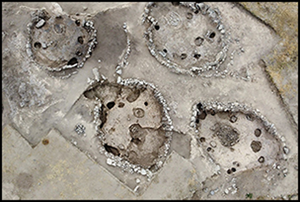
The illicit pits that were bulldozed revealed occupation to a depth of approximately 2m for structures and 0.6m in intervening spaces. Excavations focused on areal exposures to investigate spatial arrangements and on examining several buildings to determine construction histories. Thus far, 12 structures have been identified and six were excavated at least to the most recent floor (Figure 3).
Aerial view of structures and buildings at Balıklı (figure by Balıklı research project).

The structures at Balıklı are relatively uniform in size, orientation, form and arrangement of internal features, indicating a standardised architectural scheme (Figure 4). They are semi-subterranean oval pit houses, approximately 5–6m in diameter, dug almost vertically into the underlying marl with walls constructed of basalt stones and slabs cemented in place with rock-hard marl mortar and internal plaster wash. Most buildings feature an exterior apsidal projection on the eastern side, to create an alcove serving as a ventilation shaft, though differing in form from the ‘chimney/pipe type’ arrangements at Aşıklı levels 3–4 (Duru et al. Reference Duru, Güral and Özbaşaran2021). Repeated internal features include a series of substantial postholes, around 0.25m in diameter, as well as large, stone-built or moulded plaster hearths, inset basalt cup-mortars, clay boxes and potential storage pits. Buildings were often remodelled in the same locations over time; one preserves a succession of at least five living floors (Figure 5), while others appear to have no more than two. Floors were commonly renewed by placing the new floor immediately above the old, with little infilling, levelling or other clear signs of preparation. The absence of doorways indicates that buildings were entered through the roofs. Buildings were not prepared for closure at the end of their lives, but simply abandoned; the uppermost fills of some structures represent the collapse of thick roofs of branches, reeds, mud/marl and trash topped by midden deposits.
Plans of buildings 1, 6, 7 and 8 (figure by Balıklı research project).

Cross-section of building 1 showing sub-floor burial pits and cache (photograph by Balıklı research project).

Open areas between structures feature activity areas, roughly plastered with marl and indicated by pits, postholes, flimsy walls and other installations. There is little evidence for subsequent disturbance of sediments (e.g. rodent holes) except for intrusive burials.
Graves
To date, 23 burials from the main occupation have been recovered from inside and beneath the structures at Balıklı. One contracted primary burial was exposed under the earliest floor of building 1 by the bulldozing. Three additional pigmented skulls immediately underlay the skeleton in pits, together with a cubic ochre/cinnabar lump and a cache of two large obsidian rough-outs, ochred obsidian blades, microliths, polished greenstone axes and bone spatulae (Figure 5). Burials in other buildings (e.g. 8 & 9) were inserted in holes dug horizontally into the walls (Figure 6). All articulated burials were arranged in semi-flexed positions. A few complete primary burials, recovered within deep and narrow pits cut into several buildings, represent intrusive Chalcolithic and later activity, according to stratigraphy and 14C dates (see Table S1).
Burials in building 8, inserted in horizontal holes in walls (location shown with down arrows) (photograph by Balıklı research project).

Material culture
Chipped stone tools
The abundant Balıklı chipped stone assemblage (n = 2874) is almost exclusively obsidian. Based on macroscopic colour and texture analysis, the majority (93.7%) is a transparent obsidian known from Göllüdağ, 19km to the south-east (Table S2). The opaque and semi-opaque greenish obsidian from Nenezi, less than 7km away, is present but rare (Kayacan et al. Reference Kayacan, Goring-Morris, Duru, Özbaşaran, Nishiaki, Maeda and Arimura2022). The focus on the more distant Göllüdağ source echoes the lowermost Aşıklı assemblages.
All elements of the knapping process are present at Balıklı, including thick and thin flakes with natural (‘cortical’) surfaces, opening platforms, blades with natural surfaces and crested blades, as well as rejuvenation flakes, blades and tablets (Table S3). Knapping focused on producing blades and bladelets for modification, mostly into microliths. Small, exhausted blade or bladelet cores are common, often with cresting and ‘cortical’ surfaces on the back. Both uni- and bi-directional systems are evident, though none are naviform. The density and range of elements indicate intensive on-site knapping (Figure 7).
Obsidian artefacts from Balıklı: 1–3) blade and bladelet cores; 4–6) scrapers; 7–11) microburins; 12–14) Cafer points; 15 & 16) triangles; 17–19) obliquely truncated blades and bladelets (figure by Balıklı research project).

Tools (n = 567) are made predominantly on blades and bladelets (Table S4). Well-represented tool classes include burins (mostly on blades), flake scrapers, curved backed blades, pointed blades and perforators. Notched flakes and splintered pieces are also present but rare. Obliquely truncated and (usually) backed blades and bladelets are among the most frequent tool types. Notable are microliths including triangles and elongated lunates, though most are fragmentary. The relatively high microburin index indicates its widespread use in microlith fabrication (Figure 7, nos. 7–11).
Distinctive asymmetric, single-shouldered projectile points, most on bladelets and sometimes with a microburin technique (mbt) scar, a means of controlling the production of sharp oblique tips (Figure 7, nos. 12–14), are identified and include larger varieties, as occur at Sofular, on the Kizilirmak river, 65km to the north-east (Güngördü & Başoğlu Reference Güngördü and Başoğlu2019). These also characterise the lowermost levels (4–5) of Aşıklı and nearby Acıyer, although most are larger and more robust (Balkan-Atlı Reference Balkan-Atli, Gebel and Kozlowski1994) and two similar items were found in ninth-millennium BC early Pre-Pottery Neolithic B levels (XII–XIII) at Cafer Höyük, upper Middle Euphrates, 350km east of Balıklı, where they were defined as ‘Cafer points’ (Cauvin et al. Reference Cauvin, Aurenche, Cauvin, Balkan-Atli, Özdogan, Basgelen and Kuniholm2011).
Bone, groundstone tools and decorative items
The rich bone tool assemblage comprises elongated points, awls, spatulae and plaquettes. A distinctive grooved knife and two v-shaped antler sheaths are unusual (Figure 8). An abundant and varied array of shallow v-shaped cup mortars and distinctive, elongated querns/grinding slabs (usually with a cupule at one extremity) were recovered (Figure 9). Other items include pounding and grinding handstones, bowlets and anvils, mostly on basalt. Also notable are a few palettes, finely polished greenstone axes of various sizes (Figure 8) and a small, broken grooved shaft straightener. Small bone and red, black and green stone beads, as well as Tritia and Dentalium beads are present.
Worked artefacts from Balıklı: A) greenstone axes; B) grooved bone knife; C) antler sheath (figure by Balıklı research project).

Groundstone tools excavated at Balıklı (figure by Balıklı research project).

Plants and animals
Preliminary analysis of six archaeobotanical samples (78.57 litres total) indicates both carbonised and mineralised plant remains. The carbonised plant remains (n = 430) reflect local dryland and, to a lesser extent, wetland environments (Table S5). The majority of the charred assemblage is composed of possible crops (n = 391); mostly cereals (98%) and some pulses (2%). The pulses are not well preserved; only one seed could be identified as a possible lentil (cf. Lens sp.), while the others could only be categorised as large-seeded pulses (possibly including Lathyrus, Pisum and Vicia).
Cereals are primarily represented by chaff (94%) and less frequently by grains (6%), suggesting that cereal processing activities occurred in the settlement (Table S5). None of the grains could be identified to a more specific level due to preservation conditions so were grouped into ‘indeterminate’ glume wheat, wheat and cereal categories. Most cereal chaff represents glume wheats (94%) (glume bases and spikelet forks). Due to poor preservation, only 22 per cent of the glume wheat chaff assemblage could be identified as emmer (Triticum turgidum subsp. dicoccum/dicoccoides), while nine per cent is either emmer or ‘new glume wheat’ (Emmer/NGW type). The remainder (69%) was identified to broader indeterminate categories. NGW has recently been assigned to the Triticum timopheevii group (Czajkowska et al. Reference Czajkowska, Bogaard, Charles, Jones, Kohler-Schneider, Mueller-Bieniek and Brown2020). It is common throughout the occupation at Aşıklı Höyük (Ergun et al. Reference Ergun, Tengberg, Willcox, Douche, Özbaşaran, Duru and Stiner2018), a minor component at Boncuklu (Baird et al. Reference Baird2018) and an individually grown crop at the later Neolithic site of Çatalhöyük (Bogaard et al. Reference Bogaard, Charles, Filipović, Fuller, Kabukcu, Stroud, Vaiglova and Hodder2021). The presence of terminal spikelets (3%), the uppermost spikelets of tetraploid wheat ears, supports the identification of emmer and/or NGW at Balıklı.
Like at Aşıklı Höyük (Ergun Reference Ergun2018; Ergun et al. Reference Ergun, Tengberg, Willcox, Douche, Özbaşaran, Duru and Stiner2018), Pınarbaşı (Fairbairn et al. Reference Fairbairn, Jenkins, Baird and Jacobsen2014) and Boncuklu (Baird et al. Reference Baird2018) mineralised hackberry fruit stones are common at Balıklı (n = 249) (Table S5). Other than probable wild pistachio (cf. Pistacia sp.) and almond/prune (Amygdalus/Prunus sp.) remains, fruit and nuts are rare, fragmentary and mostly unidentifiable. Overall, fruit and nut exploitation at Balıklı reflects a Central Anatolian Neolithic tradition.
Carbonised wild plant seeds are also quite rare (n = 16), perhaps due to the small number of samples analysed to date (Table S5). Among them are seeds from the carnation (Caryophyllaceae) and sedge families (Cyperaceae), small-seeded legumes (Fabaceae) and large and small-seeded grasses (Poaceae). One large-seeded grass, the medusa-head grass (Taeniatherum caput-medusae), is represented by both grain and chaff. This taxon is also abundant at Aşıklı Höyük from at least the mid-ninth millennium BC (Ergun Reference Ergun2018). Possible remains of underground storage organs and fragments of reed stems have also been identified at Balıklı, but in small numbers. Larger samples need to be analysed before plant-based subsistence strategies, the scale and nature of cultivation, and the domestication status of potential crops can be determined.
The ongoing analysis of more than 1800 identifiable faunal specimens from Balıklı reveals a diverse fauna comprised of ungulates, small carnivores, notably fox (Vulpes vulpes) and wildcat (Felis silvestris), and small game taxa such as hare (Lepus capensis), freshwater turtle (Emys/Maurymys), tortoise (Testudo graeca), fish (mostly small Cyprinids) and birds (presently unidentified to taxon) (see OSM for sampling strategy and Table S6 for percentage and number of identified specimens of ungulate taxa). Using these diverse resources, at least one-third of which are smaller-bodied and less cost effective than ungulate taxa, maximised food extraction from the local environment. This would have offset human impacts on animal populations, allowing the community to reside for longer consecutive periods on site. The faunal sample from Balıklı shares some similarities with Aşıklı Höyük, levels 4–5, especially in the high representation of small game (Stiner et al. Reference Stiner2014, Reference Stiner, Munro, Buitenhuis, Duru and Özbaşaran2022). The exploitation of ungulate taxa at Balıklı also closely resembles Aşıklı level 5 (Figure S1), although equids are more than five times as common at Balıklı (26%) and cattle (32%) are also notably more abundant. This may hint at more engagement in hunting at Balıklı than at Aşıklı, where early caprine management is clearly attested even in the lowermost layers. Comparisons with the ungulate remains at other coeval sites in Central Anatolia (Table S6, Figure S1), further highlight the abundance of equids at Balıklı—two and a half times more common than in coeval levels at Pinarbaşı and Boncuklu (Baird et al. Reference Baird2018). Wild boar is less common at Balıklı (3%) than at all other sites, especially Boncuklu, where it dominates. Some of this variation may reflect environmental differences in specific site location, but it may also relate to site seasonality and shifting natural proportions of ungulate taxa on the landscape at different times of the year or, potentially, early forms of animal management. Larger caprine samples are needed from Balıklı to undertake detailed analyses and determine domestic status. Notably, very young equid teeth including from neonates at Balıklı indicate, at minimum, a late spring or summer occupation.
Discussion
The Balıklı record indicates that it was home to a small sedentary community for at least a few seasons a year. The dates and thickness of deposits indicate occupation for only a few hundred years, although its permanence remains debatable. The diverse faunal assemblage—including fast, small prey—reflects sustained exploitation of local resources. Seasonal indicators are sparse and, thus far, only indicators for spring/summer occupation are found. However, the residents invested significantly in both the construction and internal arrangement of the spaced semi-subterranean dwellings, which were rebuilt, sometimes multiple times.
In many ways, Balıklı fits the typical model of a ‘Late Epipalaeolithic’ village (cf. Bar-Yosef & Meadow Reference Bar-Yosef, Meadow, Price and Gebauer1995); particularly in its microlithic industry, site layout, comprising oval semi-subterranean houses, and exploitation of diverse wild resources. Larger samples are required to evaluate whether humans had begun to manage or domesticate plant and animal taxa at Balıklı; preliminary results indicate a primarily hunted and gathered wild economy.
Comparisons with Aşıklı Höyük and other Central Anatolian sites
Early interpretations indicate the Balıklı community differed significantly from their contemporaries occupying basal Aşıklı even though the sites are located less than 15km apart. The foremost indication is the architecture: building materials, plans, ventilation systems, internal features and spatial arrangements differ significantly from those at Aşıklı (Özbaşaran et al. Reference Özbaşaran, Duru and Stiner2018; Duru et al. Reference Duru, Güral and Özbaşaran2021; see Table S7). Modes of burial (Özbaşaran et al. Reference Özbaşaran, Duru and Stiner2018) and many aspects of the material culture, including stylistic aspects of the lithic (Kayacan & Altınbilek-Algül Reference Kayacan, Altinbilek-Algül, Özbaşaran, Duru and Stiner2018) and groundstone tool assemblages, also differ between the sites. Managed plants and animals are integrated into activities at Aşıklı from the beginning but used sparingly, if at all, at Balıklı. Thus far, Balıklı also lacks evidence for in situ animal dung and small-scale stabling deposits like those found in basal Aşıklı (Mentzer Reference Mentzer, Özbaşaran, Duru and Stiner2018). Nevertheless, there are indications that the residents of Balıklı and lowermost Aşıklı level 5 had some contact. They both accessed the same obsidian outcrops at Göllüdağ and Nenezi Dağ and both communities produced a few shared distinctive artefact types including Cafer points and bone plaquettes. This emphasises distinctions between the two communities, as they maintained their own traditions, identities and lifeways. The Aşıklı community's tendency for insularity has long been noted (Özbaşaran Reference Özbaşaran, Özdogan, Basgelen and Kuniholm2012; Stiner et al. Reference Stiner, Özbaşaran and Duru2021) and may also be valid at Balıklı as well as other Central Anatolian Early Neolithic communities.
Indeed, while Aşıklı residents fully engaged in the process of domestication, Pınarbaşı falls at the other end of the spectrum with an entirely wild resource base. Boncuklu features some uptake of non-local cereals and possible animal management, but on a much smaller scale than at Aşıklı, while Balıklı so far features only one of the non-local cereals—emmer wheat. Although domestic wheat may be present, further study is needed. These divergent agricultural investments indicate local variation in the timing, rate and character of the emergence of Central Anatolian agriculture. The differences between Aşıklı and Balıklı, while coevally occupying the same landscape, epitomise the importance of local decision-making and traditions in the emergence of agriculture, as highlighted by the multiregional agricultural origins model (Fuller et al. Reference Fuller, Willcox and Allaby2012).
Interactions between Central Anatolia and the rest of South-west Asia
During the Early Neolithic and even earlier, complex interaction webs including networking and exchange increased markedly, sometimes over 100s and even 1000s of kilometres throughout South-west Asia (e.g. Binder Reference Binder, Gerard and Thissen2002; Bar-Yosef Mayer Reference Bar-Yosef Mayer2007; Richter et al. Reference Richter, Garrard, Allcock and Maher2011; Ibáñez et al. Reference Ibáñez, Ortega, Campos, Khalidi and Méndez2015; Goring-Morris & Belfer-Cohen Reference Goring-Morris and Belfer-Cohen2022). Evidence from obsidian, other minerals and shells demonstrates inter-connectedness between communities across vast tracts of South-west Asia beginning c. 13 000 BC (late Epipalaeolithic) despite local variation in sociocultural trajectories. The Pre-Pottery Neolithic interaction spheres established by c. 9000 BC provided a pan-regional framework for developments (Bar-Yosef & Belfer-Cohen Reference Bar-Yosef, Belfer-Cohen and Hershkovitz1989; Bar-Yosef & Meadow Reference Bar-Yosef, Meadow, Price and Gebauer1995).
The insularity of the Central Anatolian sites is highlighted by their not participating in obsidian networks provisioning the middle Euphrates, Cyprus and the Levant, notwithstanding their proximity to the sources (Özbaşaran Reference Özbaşaran, Özdogan, Basgelen and Kuniholm2012). This is substantiated by technological studies and radiocarbon dating from obsidian extraction sites like Göllüdağ-Kaletepe (Binder Reference Binder, Gerard and Thissen2002; Balkan-Atlı & Binder Reference Balkan-Atli, Binder, Ozdogan, Basgelen and Kuniholm2012), and by the timing of the arrival of obsidian products at sites across the Fertile Crescent. That naviform products and technologies used at Kaletepe rarely, if ever, extended to the Central Anatolian sites is remarkable, especially given that the Early Neolithic residents also obtained the majority of their obsidian from Göllüdağ, albeit from different outcrops, namely Kayırlı and Kömürcü (Mouralis et al. Reference Mouralis, Aydar, Türkecan, Kuzucuoğlu, Kuzucuoğlu, Çiner and Kazanci2019). Given the proximity of Kayırlı, 10km away, and its contemporaneity with Kaletepe, these people must have known of one another. Nevertheless, residents of Balıklı and other Central Anatolian sites did not engage in this larger obsidian exchange network and maintained their own distinctive knapping techniques (Kayacan & Altınbilek-Algül Reference Kayacan, Altinbilek-Algül, Özbaşaran, Duru and Stiner2018; Stiner et al. Reference Stiner, Özbaşaran and Duru2021). Thus, not only were the communities of Central Anatolia quite independent of one another, they were also independent of Neolithic communities outside this region, notwithstanding evident opportunities to interact with other peoples from across South-west Asia. Indeed, recent genetic studies indicate that within-population diversity levels of Central Anatolian populations were low during the Early Holocene, with close genetic relationships between co-burials in presumed domestic structures at earlier Aşıklı and Boncuklu (though not between the two sites), as opposed to later at Çatalhöyük where co-burials in structures do not display close genetic similarities (Feldman et al. Reference Feldman2019; Yaka et al. Reference Yaka2021; Koptekin et al. Reference Koptekin2022).
These more limited interactions may also account for the slower pace of change in this region compared to the Levant and along the Middle Euphrates (Bikoulis Reference Bikoulis2013; Goring-Morris & Belfer-Cohen Reference Goring-Morris and Belfer-Cohen2016; Duru Reference Duru and Hodder2018). It is notable that, similar to Central Anatolia, within the upper Tigris region independent Epipalaeolithic-type microlithic techno-typological traditions also continued into the Early Holocene (Maeda Reference Maeda2018). However, the virtual absence of research in areas within and north of the Taurus/Zagros arc has created a ‘black hole’ that could mask other regional networks. Indeed, the numbers of Cafer points in some Central Anatolian sites compared to their absence elsewhere in south-east Türkiye, suggests that, while knowledge and materials flowed in multiple directions through exchange networks across South-west Asia, in some instances, communities differed in terms of what networks they engaged with and to what degree.
Despite the insularity of the Cappadocian communities, the presence of cultigens at Aşıklı Höyük, and minerals and notable artefacts—such as polished greenstone axes, Cafer points and marine molluscs—at Aşıklı Höyük and Balıklı, demonstrates that communities could and occasionally did utilise knowledge and materials circulating in other regional networks. Ultimately, observations about how information and materials including plants and animals circulated through these larger social networks and under what conditions they were selected by local communities are important for mapping out how, when and where agriculture emerged across South-west Asia.
Why and when the residents of Balıklı and other Anatolian sites tapped into these networks or interacted with one another was undoubtedly influenced by local circumstances—environmental settings, social connections and community traditions. Stiner and colleagues (Reference Stiner, Özbaşaran and Duru2021) argue that the Aşıklı Höyük inhabitants may have turned inward due to the intense economic and social investment required to manage and integrate the process of livestock domestication and community growth. Baird and colleagues (Reference Baird2018: E3084) conclude that Early Neolithic variability could be partly related to an interest in maintaining community identity by following “a tightly bound set of cultural practices” perhaps including foods and parts of landscapes.
Conclusion
Identifying the primary drivers of socioeconomic variability and community traditions at Balıklı remains an active focus of research. Nevertheless, we minimally conclude that Balıklı residents took advantage of their ecotonal setting, exploiting diverse resources both from the adjacent wetlands and neighbouring steppes. They engaged in unique cultural traditions reflected in burial practices and the lay-out and construction of their houses. Like other Early Neolithic communities in Central Anatolia, they used multiple local obsidian sources, but without participating in the obsidian trade networks to the Middle Euphrates and southern Levant that were fed by the same sources. Initial observations suggest that Balıklı fits comfortably into the current narrative of regional variability in Central Anatolia, while sharing characteristics that distinguish the local Early Neolithic from other parts of South-west Asia.
Acknowledgements
We are grateful to Jay Quade, University of Arizona, for running the 14C dates. We also thank Yusuf Altın, Director of the Aksaray Museum, the local workers of Gülağaç District and all the members of the Aşıklı Höyük Research Project for their support of our research. The reviewers' valuable comments are much appreciated.
Funding statement
Research was financially supported by the Istanbul University Scientific Research Projects Coordination Unit (Project No: SBA-2019-30127) and the Israel Science Foundation (Grant No. 471/17).
Online supplementary materials (OSM)
To view supplementary material for this article, please visit https://doi.org/10.15184/aqy.2024.100 and select the supplementary materials tab.


 Open access

