


INTRODUCTION
Across the world, candidates for most political parties are selected by national or local party elites (Aldrich Reference Aldrich2011; Gallagher and Marsh Reference Gallagher and Marsh1988; Hazan and Rahat Reference Hazan and Rahat2010). So, how do party elites select candidates? Three objectives feature prominently in the literature. First, they consider the expected public benefits of a given candidate conditional on getting elected (Crotty Reference Crotty1968; Stone and Abramowitz Reference Stone and Abramowitz1983), whether through their impact on policy formulation or its implementation in their constituency (Buisseret et al. Reference Buisseret, Folke, Prato and Rickne2022; Martinez-Bravo et al. Reference Martinez-Bravo, Miquel, Qian and Yao2022). Second, they assess other benefits of nominating an individual to candidacy, which might come through party-building or rent extraction (Besley et al. Reference Besley, Folke, Persson and Rickne2017; Galasso and Nannicini Reference Galasso and Nannicini2011). Third, they select candidates subject to an evaluation of the likelihood of their election (Casey, Kamara, and Meriggi Reference Casey, Kamara and Meriggi2021; Gulzar, Hai, and Paudel Reference Gulzar, Hai and Paudel2021).
The premise of much existing work, particularly in developed country settings, is that these other nonpublic benefits—whether to build the party or extract rents—drive a consequential misalignment between elites and voters. Stylistically, while party elites prioritize candidates’ characteristics associated with party loyalty and seniority, voters prioritize their human capital and representativeness (Cirone, Cox, and Fiva Reference Cirone, Cox and Fiva2021; Dal Bó et al. Reference Dal Bó, Finan, Folke, Persson and Rickne2017; Gulzar Reference Gulzar2021). This misalignment, in turn, potentially crowds out the supply of public benefits. At one extreme, elections in nondemocratic settings are often considered to be tools for the sharing of rents among elites with limited policy consequence (Boix and Svolik Reference Boix and Svolik2013; Miller Reference Miller2015). At the other, loosening elites’ grip over selection, such as through open primaries, is frequently argued to improve the representativeness of candidates and enhance the supply of public goods (Ichino and Nathan Reference Ichino and Nathan2022; Ting, Hirano, and Snyder Reference Ting, Hirano and Snyder2018).
Concluding that elites’ control over selection processes necessarily inhibits the supply of public benefits, however, rests on several latent assumptions: including, I argue, that voters equally understand the extent to which different candidate characteristics matter for their performance in office. While this is likely satisfied in developed democratic settings, it is less obvious in developing country settings where ideological competition is non-salient (Cruz and Keefer Reference Cruz and Keefer2015). Complementing prior work which highlights the beneficial consequences of elite-led selection for political stability (Giollabhuí Reference Giollabhuí2013; Morse and Suh Reference Morse and Suh2025), I develop a simple theoretical framework to delineate conditions under which, when elites enjoy informational advantages about candidates’ prospective performance in office, elite control instead facilitates the supply of public benefits. While these conditions—focused on the salience of patronage in selection processes and the nature of party-building incentives facing elites—are perhaps more easily satisfied in democracies, I argue they do not preclude nondemocratic electoral settings.
More broadly, existing work has struggled to establish a direct relationship between elites’ control over selection processes and policy outcomes in any setting (Dal Bó and Finan Reference Dal Bó and Finan2018; Gulzar Reference Gulzar2021). This is for three reasons. First, rather mechanically, it is often impossible to compare outcomes under a “selected” candidate to a “nonselected” candidate when only the former runs in, or can win, the election. Second, observing elites’ preferences across potential candidates is challenging when many selection processes are opaque. Third, estimating the effects of politician characteristics on policy remains fraught—whether in defining specific performance measures or in finding credible sources of exogenous variation, particularly when electoral competition is limited and few races are narrowly-decided.Footnote 1 Instead, the fact that party elites tend to prioritize different observable characteristics of candidates is often interpreted as evidence of their conflicting underlying priorities (Carnes and Lupu Reference Carnes and Lupu2023; Gulzar Reference Gulzar2021).
I study the legislative elections of early postindependence Tanzania which, I suggest, represents an appropriate but nontrivial case for assessing implications of the theoretical framework. In several respects, this is a case where we might expect party elites only weakly to consider candidates’ implications for the supply of public benefits: Tanzania had become a single-party regime under the Tanganyika African National Union (TANU) shortly after independence in 1961, with no ideological variation permitted across candidates; relatively small groups of local party elites selected candidates; and legislators had no substantive influence over policy formulation and only constrained influence on its implementation (Cliffe and Saul Reference Cliffe, Saul, Cliffe and Saul1972; Hopkins Reference Hopkins1970). However, while TANU’s initial organizational weaknesses generated incentives to select party loyalists and reward seniority (Bienen Reference Bienen1970), it also faced strong pressures to legitimate its rule by responding to voters’ pressing demands for local development (Samoff Reference Samoff, Carnoy and Samoff1990).
Several institutional features of the first single-party elections in 1965 and 1970 permit me, by overcoming the inferential hurdles described above, to assess the policy consequences of candidate selection. First, relatively urban local party elites voted across potential candidates to nominate two candidates per constituency to face each other in the general election. By constructing an original candidate-level dataset, I show these lopsided selection contests de facto pitted one candidate, “preferred” by party elites, against another candidate permitted to run. Second, national policy—which became strongly oriented toward rural development during this period (Carlitz et al. Reference Carlitz, Morjaria, Mueller and Osafo-Kwaako2025)—provides a clean measure of the extent to which elected candidates supplied public benefits by delivering salient local public goods to rural localities.
Third, a striking natural experiment generates exogenous variation in whether the “elite-preferred” candidate won office. In short, two ballot symbols were assigned to candidates orthogonally to their characteristics. These symbols, a house and a hoe, were intended to help voters recognize candidates in a low literacy setting and were initially expected to have little electoral consequence (Harris Reference Harris1965). However, one of them (the hoe) ultimately had dramatic effects on the electoral success of the candidate it was assigned to (Prewitt and Hyden Reference Prewitt, Hyden and Cliffe1967). The deterministic assignment of this symbol, which I thoroughly demonstrate is a valid natural experiment increasing the probability of the elite-preferred candidate’s election by 26 percentage points, has since been called “the best evidence on the impact of seemingly neutral candidate symbols in elections” (Reynolds and Steenbergen Reference Reynolds and Steenbergen2006, 567).
Combining rich administrative data on the establishment of different local public goods over time with archival electoral data, I find that constituencies in which the elite-preferred candidate was quasi-randomly elected experienced a significant increase in the provision of rural primary schools. These effect sizes are substantively large, representing an additional 8.7–10.6 primary schools over a five-year term. As I support using a wide range of sources, primary schools were a central demand of voters (e.g., Hyden Reference Hyden1980), at the core of the government’s rural development program (e.g., Samoff Reference Samoff, Carnoy and Samoff1990), and one of the few public goods which legislators could feasibly influence (e.g., Clark Reference Clark1978); their supply is therefore the cleanest measure of performance in office. This increased supply, I show, led to greater educational attainment and literacy among cohorts who were of primary school entry age during the two electoral cycles.
Party elites, then, were seemingly highly effective at selecting candidates based on their ability to supply public benefits—even in an exclusive system of candidate selection, with no ideological or party competition, and where the alternative candidate had still fared relatively well in the selection process. To understand what accounts for their improved performance, heterogeneity in the treatment effects highlights the importance of candidates’ national political prominence—comprising both their connections and prior experience—in securing discretionary capital allocations from the central government. This extends to other public goods, such as secondary schools, which were tightly controlled by the government’s central planning machinery and could only be influenced by the most senior government officials (Barkan Reference Barkan1984; Clark Reference Clark1978). But, while elites and voters both selected on the basis of candidates’ educational attainment, only the former prioritized their national prominence while the latter instead prioritized their local embeddedness.
Rather than these divergent preferences signifying a fundamental misalignment, the evidence is consistent with party elites more quickly understanding which characteristics would facilitate the flow of public resources in a new political system. Even if the selection of senior candidates simultaneously provided organizational benefits to TANU, these party-building benefits were, if anything, complements to the supply of public benefits demanded by voters likely due to the pressures to legitimate the regime through accelerating local development. Combined with the minimal evidence of patronage, I demonstrate, elite control over candidate selection then plausibly enhanced the flow of public benefits relative to voters having full control and selecting candidates along dimensions only weakly predictive of their subsequent performance. However, such informational advantages eroded over time: while party elites selected along similar margins in both elections, voters came to gradually favor nationally, over locally, prominent candidates as they learned about the determinants of resource distribution.
In so doing, this article contributes to two literatures. First, it contributes to work on the impact of candidate selection processes. The pervasive influence of elites has been considered especially problematic when candidate selection is exclusive or inter-party competition is weak (Galasso and Nannicini Reference Galasso and Nannicini2011; Hazan and Rahat Reference Hazan and Rahat2010; Ting, Hirano, and Snyder Reference Ting, Hirano and Snyder2018). Even in such a setting, the results suggest that elite-led selection did not undermine responsiveness to voters’ demands. The theoretical conditions explaining this result complement other benefits of elite-led selection processes in developing country settings, such as by limiting electoral clientelism or violence (Seeberg, Wahman, and Skaaning Reference Seeberg, Wahman and Skaaning2018; Weghorst Reference Weghorst2022). One implication is that, while elites might be poorly informed about candidates’ electoral popularity (Casey, Kamara, and Meriggi Reference Casey, Kamara and Meriggi2021; Gulzar, Hai, and Paudel Reference Gulzar, Hai and Paudel2021), in this setting, they possessed superior information about candidates’ ability to execute the demands of their job once in office. While reforms to loosen elites’ control over candidate selection might then enhance parties’ electoral prospects (Ichino and Nathan Reference Ichino and Nathan2022), how they shape policy outcomes depends on whether voters recognize, and select on, traits that also predict performance in office.
Second, it contributes to the literature on legislative elections in nondemocratic settings. Such elections have often been conceived as strategic tools to credibly share rents among elites with limited welfare consequences (e.g., Gandhi, Noble, and Svolik Reference Gandhi, Noble and Svolik2020). This is especially the case in sub-Saharan Africa, where Chazan (Reference Chazan1979, 136) called such elections “meaningless political rites performed to grant periodic legitimation for aspiring one-party regimes.” This article contributes to a recent literature reevaluating the impact of these restricted contests (e.g., Malesky, Todd, and Tran Reference Malesky, Todd and Tran2023; Morse Reference Morse2018; Opalo Reference Opalo2019). Prior work has emphasized how the partial liberalization of candidate selection supports regime stability by fostering party cohesion, reducing uncertainty, and ensuring loyalty (Giollabhuí Reference Giollabhuí2013; Field and Siavelis Reference Field and Siavelis2008; Morse and Suh Reference Morse and Suh2025). This article then provides unusually rich evidence that such elections both impact welfare-relevant outcomes and theoretically highlights how elite-led candidate selection can further contribute to stability because it is not, necessarily, inconsistent with responsiveness to citizens’ demands. While these conclusions are surely not universal across nondemocratic or postindependence African settings—a point to which I return in the conclusion—they are also unlikely to be unique to Tanzania. This article then contributes empirical evidence from a region and time period broadly underrepresented in recent work (e.g., Carnes and Lupu Reference Carnes and Lupu2023; Gulzar Reference Gulzar2021), but with broader implications.
THEORETICAL FRAMEWORK
In developing country settings, voters’ demands overwhelmingly relate to constituency service and, particularly in sub-Saharan Africa, the supply of local public goods (Barkan Reference Barkan2009; Bleck and Van de Walle Reference Bleck and Van de Walle2019; Grossman and Slough Reference Grossman and Slough2022). Voters, across regime types, prioritize those candidates likely to be responsive to local demands for public benefits (Casey Reference Casey2015; Morse Reference Morse2022; Weghorst and Lindberg Reference Weghorst and Lindberg2013; Weghorst Reference Weghorst2022). In such settings, where legislatures are often weak and political competition is broadly nonideological (Cruz and Keefer Reference Cruz and Keefer2015; Erdmann Reference Erdmann2004), legislators themselves view constituency service rather than lawmaking as central to their performance (Barkan et al. Reference Barkan, Mattes, Mozaffar and Smiddy2010; Lindberg Reference Lindberg2010).
Trade-Offs in the Liberalization of Candidate Selection
Parties face trade-offs when giving voters more say over candidate selection.Footnote 2 Regarding the benefits, such shifts are often held to increase the anticipated popularity of the party through three channels. First, more “democratic” modes of selection can enhance perceptions of party legitimacy by fostering a sense of procedural fairness (Carey and Polga-Hecimovich Reference Carey and Polga-Hecimovich2006; Giollabhuí Reference Giollabhuí2013). Second, giving voters more say might enhance the expected quality and popularity of the candidates themselves (Adams and Merrill Reference Adams and Merrill2008; Serra Reference Serra2011). Third, increasing the threat of deselection facing legislators could induce greater effort in office (Aragón Reference Aragón2014). Parties accrue additional benefits when broadening candidate selection enhances party cohesion (Carey and Polga-Hecimovich Reference Carey and Polga-Hecimovich2006). When intra-party factionalism is high, selection methods, such as primaries, provide a credible mechanism to limit the escalation of disputes (Kemahlioglu, Weitz-Shapiro, and Hirano Reference Kemahlioglu, Weitz-Shapiro and Hirano2009).
The costs of such shifts relate to their consequences for party-building and patronage. First, liberalizing selection undermines the party’s ability to reward loyalists likely to be responsive to the party rather than their constituency (Galasso and Nannicini Reference Galasso and Nannicini2011; Morse and Suh Reference Morse and Suh2025; Slough, York, and Ting Reference Slough, York and Ting2020). Selecting loyalists strengthens the party by incentivizing lower-level party officials (Cirone, Cox, and Fiva Reference Cirone, Cox and Fiva2021; Mattozzi and Merlo Reference Mattozzi and Merlo2015) and limiting threats to existing leadership (Besley et al. Reference Besley, Folke, Persson and Rickne2017). Second, loosening party elites’ control over selection inhibits their access to patronage (Galasso and Nannicini Reference Galasso and Nannicini2011; Gulzar, Hai, and Paudel Reference Gulzar, Hai and Paudel2021). Facing a relatively small selectorate, aspirants target party elites with clientelistic appeals (Ichino and Nathan Reference Ichino and Nathan2013). But, as the size of this selectorate expands, particularistic transfers become less attractive to aspirants and hence party elites lose access to valuable private rents (Ichino and Nathan Reference Ichino and Nathan2022; Ting, Hirano, and Snyder Reference Ting, Hirano and Snyder2018).
Candidate Selection and Responsiveness
In developed democratic settings, a broad implication of existing work is that voters’ and party elites’ interests are misaligned because elites’ selection of candidates on the basis of nonpublic considerations (whether party-building or patronage) comes at the cost of the public benefits of a candidate winning office (Buisseret et al. Reference Buisseret, Folke, Prato and Rickne2022). Consistent with this, parties select different candidates where electoral competition is greater (Dal Bó et al. Reference Dal Bó, Finan, Folke, Persson and Rickne2017; Galasso and Nannicini Reference Galasso and Nannicini2011; Hirano and Snyder Reference Hirano and Snyder2014). Delegating candidate selection to voters ought then to enhance responsiveness to voter demands (Ting, Hirano, and Snyder Reference Ting, Hirano and Snyder2018).
In developing country contexts, these implications are more ambiguous. On the one hand, parties are likely to face strong incentives to enhance their perceived legitimacy and inclusiveness in an effort to expand their social base (Carey and Polga-Hecimovich Reference Carey and Polga-Hecimovich2006; Field and Siavelis Reference Field and Siavelis2008) and party elites might otherwise be poorly informed about voters’ preferences (Casey, Kamara, and Meriggi Reference Casey, Kamara and Meriggi2021; Gulzar, Hai, and Paudel Reference Gulzar, Hai and Paudel2021). On the other hand, loosening elites’ control risks entrenching and decentralizing clientelism (Ichino and Nathan Reference Ichino and Nathan2013; Warren Reference Warren2022; Weghorst Reference Weghorst2022) and the outbreak of violence (Goldring and Wahman Reference Goldring and Wahman2018; Seeberg, Wahman, and Skaaning Reference Seeberg, Wahman and Skaaning2018). Responsiveness, moreover, might be limited regardless of selection method (Demarest Reference Demarest2022; Ofosu Reference Ofosu2019; Osei Reference Osei2022).Footnote 3
In nondemocratic electoral settings, while liberalizing candidate selection can build stronger ties with constituencies (Miller Reference Miller2015; Schedler Reference Schedler2013) and identifying high-quality representatives similarly mitigates opposition threats (Martinez-Bravo et al. Reference Martinez-Bravo, Miquel, Qian and Yao2022; Sulley Reference Sulley2022), these regimes face acute risks to regime survival if they permit the expansion of powerful local factions and lose their ability to purge leadership threats (Giollabhuí Reference Giollabhuí2013; Morse and Suh Reference Morse and Suh2025). Further, the fact that such shifts are often driven by imperatives to credibly incorporate rival elite factions might further attenuate any impact on responsiveness (Kjær and Katusiimeh Reference Kjær and Katusiimeh2021; Wilkins Reference Wilkins2019).
Informational Constraints Facing Voters
Consistent with these ambiguous implications, the empirical record is uneven: parties, for example, seem to enjoy quite varied electoral payoffs to giving voters more say over candidate selection (Giollabhuí Reference Giollabhuí2013; Ichino and Nathan Reference Ichino and Nathan2013; Wang and Muriaas Reference Wang and Muriaas2019). While existing work highlights how decentralized clientelism or political instability can undermine the benefits of liberalizing candidate selection for responsiveness, I outline an alternative set of conditions, grounded in a simple informational logic, under which elite-led selection might enhance the supply of public benefits—even, potentially, in nondemocratic regimes.
Suppose that voters care only about candidates’ performance once elected, which constitutes voters’ valuation of the public goods delivered through the candidate’s term in office. Performance is a function of a vector of the candidate’s characteristics, $ f({\mathrm{X}}_i) $
, and voters select a candidate from a fixed pool of potential candidates,
$ f({\mathrm{X}}_i) $
, and voters select a candidate from a fixed pool of potential candidates, $ i\in C $
, to maximize it. Two of the key, but potentially unobserved, dimensions of
$ i\in C $
, to maximize it. Two of the key, but potentially unobserved, dimensions of $ {\mathrm{X}}_i $
relevant to
$ {\mathrm{X}}_i $
relevant to $ f(\cdot ) $
among prospective candidates are their competence (which shapes their ability to secure resources or their efficiency in utilizing them) and their alignment (which shapes their allocation of these resources in line with voters’ preferences).
$ f(\cdot ) $
among prospective candidates are their competence (which shapes their ability to secure resources or their efficiency in utilizing them) and their alignment (which shapes their allocation of these resources in line with voters’ preferences).
Party elites, in line with the above discussion, select $ i\in C $
to maximize
$ i\in C $
to maximize $ (1-\alpha )f({\mathrm{X}}_i)+\alpha \eta ({\mathrm{X}}_i) $
, where they place weight
$ (1-\alpha )f({\mathrm{X}}_i)+\alpha \eta ({\mathrm{X}}_i) $
, where they place weight $ \alpha \in [0,1] $
on the nonpublic benefits of selecting a given candidate, which is a different function of the vector of candidate characteristics
$ \alpha \in [0,1] $
on the nonpublic benefits of selecting a given candidate, which is a different function of the vector of candidate characteristics $ \eta ({\mathrm{X}}_i) $
. The two key dimensions of
$ \eta ({\mathrm{X}}_i) $
. The two key dimensions of $ {\mathrm{X}}_i $
relevant to
$ {\mathrm{X}}_i $
relevant to $ \eta (\cdot ) $
constitute characteristics relating to private benefits through patronage (such as candidates’ willingness to pay for the nomination) and club benefits through party-building (such as candidates’ loyalty).
$ \eta (\cdot ) $
constitute characteristics relating to private benefits through patronage (such as candidates’ willingness to pay for the nomination) and club benefits through party-building (such as candidates’ loyalty).
In cases of complete information, in this simple framework, the delegation of candidate selection to voters straightforwardly improves their welfare. In the spirit of canonical models of political selection (e.g., Banks and Sundaram Reference Banks and Sundaram1998; Fearon Reference Fearon, Przeworski, Stokes and Manin1999), however, it is intuitive to think that voters lack information about $ f({\mathrm{X}}_i); $
further, that party elites are better informed.
$ f({\mathrm{X}}_i); $
further, that party elites are better informed.
This could take two forms. First, voters might lack information about $ {\mathrm{X}}_i $
—that is, they simply know less about the prospective candidates.Footnote
4 Due to voters’ high costs of information acquisition, such informational asymmetries are the premise of a large empirical literature in developing country settings (Casey Reference Casey2015; Pande Reference Pande2011). Voters often lack relevant information about candidates’ characteristics (Bidwell, Casey, and Glennerster Reference Bidwell, Casey and Glennerster2020; Bowles and Larreguy Reference Bowles and Larreguy2025; Dunning et al. Reference Dunning, Grossman, Humphreys, Hyde, McIntosh, Nellis and Adida2019), particularly relative to party elites who have more interactions with, and exposure to, aspiring candidates (Casey, Kamara, and Meriggi Reference Casey, Kamara and Meriggi2021; Platas and Raffler Reference Platas and Raffler2021).
$ {\mathrm{X}}_i $
—that is, they simply know less about the prospective candidates.Footnote
4 Due to voters’ high costs of information acquisition, such informational asymmetries are the premise of a large empirical literature in developing country settings (Casey Reference Casey2015; Pande Reference Pande2011). Voters often lack relevant information about candidates’ characteristics (Bidwell, Casey, and Glennerster Reference Bidwell, Casey and Glennerster2020; Bowles and Larreguy Reference Bowles and Larreguy2025; Dunning et al. Reference Dunning, Grossman, Humphreys, Hyde, McIntosh, Nellis and Adida2019), particularly relative to party elites who have more interactions with, and exposure to, aspiring candidates (Casey, Kamara, and Meriggi Reference Casey, Kamara and Meriggi2021; Platas and Raffler Reference Platas and Raffler2021).
Second, voters might lack information about $ f(\cdot ) $
—in other words, they do not understand the production function connecting candidates’ characteristics with their performance in office. Such a function is likely to be observed with significant noise in any setting; particularly so in incipient regimes when a short electoral history, or the limited observability of elected officials’ behavior, inhibits learning (Bowles and Marx Reference Bowles and Marx2023; Martinez-Bravo Reference Martinez-Bravo2014), or when candidates’ competence and alignment are substitutes in determining performance (Dal Bó et al. Reference Dal Bó, Finan, Folke, Persson and Rickne2017; Gulzar Reference Gulzar2021). Further, how specific observed characteristics contribute to their performance is likely to be institutionally contingent.Footnote
5 Party elites, by contrast, potentially better understand
$ f(\cdot ) $
—in other words, they do not understand the production function connecting candidates’ characteristics with their performance in office. Such a function is likely to be observed with significant noise in any setting; particularly so in incipient regimes when a short electoral history, or the limited observability of elected officials’ behavior, inhibits learning (Bowles and Marx Reference Bowles and Marx2023; Martinez-Bravo Reference Martinez-Bravo2014), or when candidates’ competence and alignment are substitutes in determining performance (Dal Bó et al. Reference Dal Bó, Finan, Folke, Persson and Rickne2017; Gulzar Reference Gulzar2021). Further, how specific observed characteristics contribute to their performance is likely to be institutionally contingent.Footnote
5 Party elites, by contrast, potentially better understand $ f(\cdot ) $
and adjust the weights they place on different candidate characteristics with experience (Rehmert Reference Rehmert2022).Footnote
6
$ f(\cdot ) $
and adjust the weights they place on different candidate characteristics with experience (Rehmert Reference Rehmert2022).Footnote
6
Conditions for Elite-Led Selection to Facilitate Public Benefits
Party elites enjoying informational advantages are, then, widespread in developing country settings and likely most acute in incipient regimes. Assuming such an asymmetry, elite control maximizing public benefits depends on some combination of (1) the limited magnitude of $ \alpha $
and (2) the relationship between
$ \alpha $
and (2) the relationship between $ f(\cdot ) $
and
$ f(\cdot ) $
and $ \eta (\cdot ) $
.
$ \eta (\cdot ) $
.
Regarding the former, several factors determine the weight party elites place on public relative to nonpublic considerations. First, institutional features, such as the private returns to office or the feasible extent of patronage, condition the salience of rent extraction in selection processes (Gulzar, Hai, and Paudel Reference Gulzar, Hai and Paudel2021; Ichino and Nathan Reference Ichino and Nathan2013; Slough, York, and Ting Reference Slough, York and Ting2020). Second, the institutionalization of the party shapes the influence of party-building incentives. Particularly among nascent or fragile parties, organizational incentives to foster loyalty and prevent defections are likely to increase the weight placed on $ \eta (\cdot ) $
(e.g., Field and Siavelis Reference Field and Siavelis2008; Kemahlioglu, Weitz-Shapiro, and Hirano Reference Kemahlioglu, Weitz-Shapiro and Hirano2009). By contrast, sufficiently dominant parties might be less concerned about incentivizing loyalty, compared to the incorporation of rival elites, in the absence of credible alternatives (Giollabhuí Reference Giollabhuí2013; Kjær and Katusiimeh Reference Kjær and Katusiimeh2021; Weghorst Reference Weghorst2022). Third, which party elites select candidates affects
$ \eta (\cdot ) $
(e.g., Field and Siavelis Reference Field and Siavelis2008; Kemahlioglu, Weitz-Shapiro, and Hirano Reference Kemahlioglu, Weitz-Shapiro and Hirano2009). By contrast, sufficiently dominant parties might be less concerned about incentivizing loyalty, compared to the incorporation of rival elites, in the absence of credible alternatives (Giollabhuí Reference Giollabhuí2013; Kjær and Katusiimeh Reference Kjær and Katusiimeh2021; Weghorst Reference Weghorst2022). Third, which party elites select candidates affects $ \alpha $
. While a closed clique of national party elites is unlikely to directly benefit from improved public benefits in a given constituency, local party elites living in those areas are more likely to do so (Hazan and Rahat Reference Hazan and Rahat2010).
$ \alpha $
. While a closed clique of national party elites is unlikely to directly benefit from improved public benefits in a given constituency, local party elites living in those areas are more likely to do so (Hazan and Rahat Reference Hazan and Rahat2010).
Regarding the latter, the correlation between the characteristics maximizing $ f(\cdot ) $
and
$ f(\cdot ) $
and $ \eta (\cdot ) $
is not, ex ante, obvious. Certainly, it is unlikely that characteristics related to candidates’ supply of private benefits through patronage to their selectorate should match characteristics prognostic of public goods delivery. However, those characteristics relevant for party-building club benefits could more plausibly act as complements. A more experienced or senior candidate, for example, might be important for maximizing party-building benefits in
$ \eta (\cdot ) $
is not, ex ante, obvious. Certainly, it is unlikely that characteristics related to candidates’ supply of private benefits through patronage to their selectorate should match characteristics prognostic of public goods delivery. However, those characteristics relevant for party-building club benefits could more plausibly act as complements. A more experienced or senior candidate, for example, might be important for maximizing party-building benefits in $ \eta (\cdot ) $
(as in Cirone, Cox, and Fiva Reference Cirone, Cox and Fiva2021, for example); the same might be true for
$ \eta (\cdot ) $
(as in Cirone, Cox, and Fiva Reference Cirone, Cox and Fiva2021, for example); the same might be true for $ f(\cdot ) $
(e.g., because senior party members have greater influence over public resources). Similarly, if parties seek to enhance their perceived legitimacy through the supply of public benefits, those characteristics maximizing
$ f(\cdot ) $
(e.g., because senior party members have greater influence over public resources). Similarly, if parties seek to enhance their perceived legitimacy through the supply of public benefits, those characteristics maximizing $ \eta (\cdot ) $
are likely to correlate with those maximizing
$ \eta (\cdot ) $
are likely to correlate with those maximizing $ f(\cdot )\hskip-0.35em $
. Parties’ broader policy priorities are therefore likely to condition the complementarity between candidates’ provision of public and nonpublic benefits.
$ f(\cdot )\hskip-0.35em $
. Parties’ broader policy priorities are therefore likely to condition the complementarity between candidates’ provision of public and nonpublic benefits.
Under such conditions—an informational wedge between party elites and voters, and either relatively low $ \alpha $
or some correlation between
$ \alpha $
or some correlation between $ f(\cdot ) $
and
$ f(\cdot ) $
and $ \eta (\cdot ) $
—elite-led candidate selection is potentially effective in promoting the supply of public benefits relative to voters having full control. While the relevant conditions are unlikely to be satisfied in stable developed democratic settings, primarily because informational asymmetries are likely to be small, they are more plausible in developing country settings. In these settings, divergent preferences between party elites and voters across candidates then do not necessarily imply conflicting underlying interests. Importantly, this implication relies on neither of the prospective downsides to the liberalization of candidate selection highlighted in prior work; indeed, it assumes that clientelism is higher under elite-led selection and does not consider the direct benefits of elite-led selection for regime stability (Giollabhuí Reference Giollabhuí2013; Ichino and Nathan Reference Ichino and Nathan2013; Morse and Suh Reference Morse and Suh2025).
$ \eta (\cdot ) $
—elite-led candidate selection is potentially effective in promoting the supply of public benefits relative to voters having full control. While the relevant conditions are unlikely to be satisfied in stable developed democratic settings, primarily because informational asymmetries are likely to be small, they are more plausible in developing country settings. In these settings, divergent preferences between party elites and voters across candidates then do not necessarily imply conflicting underlying interests. Importantly, this implication relies on neither of the prospective downsides to the liberalization of candidate selection highlighted in prior work; indeed, it assumes that clientelism is higher under elite-led selection and does not consider the direct benefits of elite-led selection for regime stability (Giollabhuí Reference Giollabhuí2013; Ichino and Nathan Reference Ichino and Nathan2013; Morse and Suh Reference Morse and Suh2025).
While elites’ control over candidate selection is ubiquitous (see Figure A1 in the Supplementary Material), the framework implies important scope conditions, beyond an informational asymmetry, determining whether this might facilitate responsiveness. First, this is more plausible in settings with a relatively limited scope for national-level rent extraction or clientelism (or at least where its influence is not too much more pernicious under elite-led, relative to voter-led, selection). In such settings, $ \alpha $
is likely to be lower and the positive correlation in characteristics maximizing
$ \alpha $
is likely to be lower and the positive correlation in characteristics maximizing $ f(\cdot ) $
and
$ f(\cdot ) $
and $ \eta (\cdot ) $
is likely higher. Second, it is more plausible where parties face organizational incentives at least weakly consistent with the supply of public benefits, and hence elites select on the basis of characteristics useful for both party-building and delivering public goods. In democracies, electoral competition can align these incentives with strong performance in office. In nondemocracies, this likely instead relies on ruling parties tying their own legitimacy—and hence justification for the regime more broadly—to policy priorities emphasizing the delivery of public benefits.Footnote
7
$ \eta (\cdot ) $
is likely higher. Second, it is more plausible where parties face organizational incentives at least weakly consistent with the supply of public benefits, and hence elites select on the basis of characteristics useful for both party-building and delivering public goods. In democracies, electoral competition can align these incentives with strong performance in office. In nondemocracies, this likely instead relies on ruling parties tying their own legitimacy—and hence justification for the regime more broadly—to policy priorities emphasizing the delivery of public benefits.Footnote
7
CANDIDATE SELECTION IN POSTINDEPENDENCE TANZANIA
Tanzania gained independence in 1961 under the leadership of Julius Nyerere and the TANU party.Footnote 8 Initially, TANU faced little organized political opposition, with few seats in the 1962 elections contested by non-TANU candidates (Morgenthau Reference Morgenthau1965). However, the incipient regime faced serious threats during this period, including a 1964 army mutiny (Bienen Reference Bienen1970). The Presidential Commission on the Establishment of a Democratic One Party State (1965) outlined the institutional compromise: TANU would permit limited within-party competition at the legislative level while banning all competition for the executive branch.Footnote 9
The electoral system aimed to support the stability of the TANU regime by enhancing its perceived legitimacy, increasing mass political participation, and fostering party cohesion (Kawawa Reference Kawawa and Cliffe1967). As Bienen (Reference Bienen1970, 381) summarizes, “All groups and individuals must be within TANU so that no group or individual can threaten it from outside,” while more broadly “The elections were meant to ratify the popularity of TANU.” TANU sought to accomplish these aims while retaining party elite control over candidate selection, excluding candidates unlikely to be loyal, and minimizing the risk of party fractures (Mushi Reference Mushi1974).Footnote 10
The candidate selection process for the legislative elections comprised three steps. First, citizens (who needed to be TANU members) announced their intention to run as aspirants in a given constituency, with an average of 9.2 aspirants seeking candidacy per constituency across the two elections.
Second, local party elites voted across aspirants for a given constituency in an Annual District Conference (ADC), which was held in each district.Footnote 11 The local elites participating in the ADC constituted a range of senior party figures from each district, including TANU district chairpersons, members of the district executive committee, regional officers resident in the district, leaders of party branches, and delegates from a set of TANU-affiliated agencies, including cooperatives and unions. These individuals were typically “older men with some independent political status in their home areas” (Cliffe Reference Cliffe1968, 210), and were more likely to hail from urban areas, be better educated, and wealthier than the broader population (Mwansasu Reference Mwansasu1974). The average ADC voted on aspirants from 1.9 constituencies and comprised 210 local party elites, equivalent to 0.3% of the electorate.
Third, the National Executive Committee (NEC), comprising a small set of national TANU leaders, selected two aspirants per constituency to run as candidates in the election. The NEC maintained the right to veto candidates nominated by the ADC (i.e., those receiving the most, and second-most, ADC votes).Footnote 12 In practice, this right was exercised infrequently, with the NEC advancing the first-ranked aspirant to candidacy in 96% of cases and the second-ranked aspirant in 77% of cases. The NEC then assigned ballot symbols to selected candidates, as discussed in detail below, before the candidates campaigned.
National Policy and Public Goods
Elected representatives played essentially no role in policy formulation, with the Tanzanian parliament considered a classic rubber-stamp legislature (Tordoff Reference Tordoff1967; Van Donge and Liviga Reference Van Donge and Liviga1986). Instead, they had a bidirectional role: both facilitating the implementation of national policy in their constituencies and conveying the demands of their constituencies which, overwhelmingly, pertained to public goods (Cliffe Reference Cliffe1967; Hopkins Reference Hopkins1970).
National policy came to strongly focus on rural development. Encapsulated by the Arusha Declaration of 1967, but effectively the policy priority from the publication of Nyerere (Reference Nyerere1962), ujamaa principles sought to foster a development model predicated on agrarian development. By the latter half of the 1960s, policies to target development toward rural communities had dramatically intensified (Abraham and Robinson Reference Abraham and Robinson1974). This included policies such as villagization, wherein rural citizens were induced to move to organized villages (Hyden Reference Hyden1980), and a push for universal primary education, which led to huge demand for rural primary schools (Court Reference Court1976).
The supply of primary schools was central to national policy (see Section A.1 of the Supplementary Material for further discussion). As highlighted in Nyerere’s Education for Self-Reliance, basic education underpinned three government priorities: developing human capital for modernization (Hyden Reference Hyden1980), fostering self-reliance (Samoff Reference Samoff, Carnoy and Samoff1990), and supporting Tanzanian socialism through villagization, with each organized village housing a primary school (Carlitz et al. Reference Carlitz, Morjaria, Mueller and Osafo-Kwaako2025). Expanding primary schooling constituted “a widespread popular demand and an independence promise of the nationalist movement” (Samoff Reference Samoff, Carnoy and Samoff1990, 231); therefore, “rapid expansion of schooling was commonly understood—by both leaders and the mass public—as a central element in the legitimization of the new government” (232). Primary education received an increasing share of government expenditures, including a fifth of all recurrent expenditures in the Second Five-Year Plan (1969–74) and capital allocations to build 1,900 new schools (Clark Reference Clark1978).
Representatives had some influence over the allocation of public resources; however, Tanzania’s centralized approach to development planning meant the extent of this influence varied starkly by type of public good (Clark Reference Clark1978; Cliffe and Saul Reference Cliffe, Saul, Cliffe and Saul1972). This variation is captured by the extent of discretion described in the First and Second Five-Year Plans (1964–69 and 1969–74) (see Section A.2 of the Supplementary Material for a full discussion). Discretion varied widely: for example, for secondary schools and hospitals, all subsequent capital expenditures are defined down to the facility level in the relevant Plan (Clark Reference Clark1978).Footnote 13 By contrast, there was far more discretion over funding for primary schools, which received significant capital allocations but had little specificity, in either Plan, regarding where the funds should be directed.
For some public goods, local authorities played roles in co-funding capital expenditures. Districts contributed some capital for primary education and all such expenditures for dispensaries (Cliffe and Saul Reference Cliffe, Saul, Cliffe and Saul1972). Finally, labor was generally provided by a combination of formal labor directed by government ministries and informal “self-help” labor from the communities themselves (Nye Reference Nye1963).Footnote 14 As Cliffe and Saul (Reference Cliffe, Saul, Cliffe and Saul1972, 312) write, “buildings were often built by self-help,” where “the actual implementers will be the peasants themselves, rather than employees subject to unmediated control by a government department.”
Legislators could, in principle, then shape the supply of public goods in three ways. First, legislators could make demands on central government capital allocations. This was particularly feasible for public goods with higher levels of discretion; otherwise, only the most senior and connected legislators had any influence (Barkan Reference Barkan1984). Attempts to do so are reflected in parliamentary activity: Cliffe (Reference Cliffe1967, 342) notes “the heightened intensity of interest articulation” reflecting an “overwhelming concern with economic development and the provision of social services—usually in the MP’s home area,” with 70% of parliamentary questions reflecting demands for public goods.Footnote 15 Second, legislators could influence district-level capital allocations. Districts, the main administrative unit of organization, contained overlapping institutions determining the spatial allocation of local expenditures (Cliffe and Saul Reference Cliffe, Saul, Cliffe and Saul1972; Dryden Reference Dryden1968). For those public goods subject to co-funding, legislators could then influence the share of resources being directed to their own constituency. Third, by understanding and communicating relevant policies, legislators could potentially shape the informal supply of labor to help build facilities (Hopkins Reference Hopkins1970).
Elite Incentives in Candidate Selection
The theoretical framework highlights considerations regarding whether party elites’ selection incentives were conducive to the supply of public benefits to voters. The content of the ADCs, which focused on soliciting information about the qualifications and competence of aspirants, provides some insight. Prewitt and Hyden (Reference Prewitt, Hyden and Cliffe1967) report that knowledge of TANU’s constitution was among the most common questions posed at the ADC debates, while Cliffe (Reference Cliffe1968, 243) states that they prioritized “the record and personalities of the candidates themselves and to local needs and grievances, such as demands for more schools and services.” Using data from six conferences, Mwansasu (Reference Mwansasu1974) reports that questions most often related to aspirants’ motivations (23% of questions), their qualifications and personal record (18%), evidence of their party history and loyalty (14%), and what they would provide for their constituencies (14%).
The frequency of questions about aspirants’ promises for local development highlights that public benefits likely played some role in selection decisions, particularly with respect to influencing central government capital allocations. As Mwansasu (Reference Mwansasu1974, 154) notes, “delegates wanted to establish whether a candidate was capable of getting, for his area, a large volume of resources or development projects from the centre [ $ \dots $
] by influencing the allocation of scarce resources.” While the composition of the ADCs was nonrepresentative of the electorate, the fact that its members generally lived locally meant that they also stood to gain, somewhat, from an improved supply of local public goods (Mwansasu Reference Mwansasu1974).
$ \dots $
] by influencing the allocation of scarce resources.” While the composition of the ADCs was nonrepresentative of the electorate, the fact that its members generally lived locally meant that they also stood to gain, somewhat, from an improved supply of local public goods (Mwansasu Reference Mwansasu1974).
There is substantial evidence of party-building considerations playing a large role in selection decisions. These incentives clearly tended toward the selection of party loyalists as a way to strengthen the cohesion of the party. Cliffe (Reference Cliffe1967), for example, describes several constituencies in which the ADCs prioritized aspirants’ TANU seniority when selecting between them. While the ADCs surely provided additional information about the aspirants, the number of questions per aspirant was often quite limited (Mwansasu Reference Mwansasu1974). As a result, despite low barriers to declaring an intention to run, “only those who were either in the TANU district oligarchy or on the periphery of it had a chance” (Bienen Reference Bienen1970, 398). On the other hand, the fact that TANU’s broader party platform emphasized rural development implies potential complementarity between elites’ incentives to legitimate the regime and voters’ demands for public goods.
Finally, private benefits relating to patronage were relatively non-salient. The overall scope for rent extraction was constrained due to the limited private returns to office and, more broadly, legislators’ lack of political power (Barkan Reference Barkan1984). The most senior party officials, however, were still able to cultivate such clientelistic ties—as Bienen (Reference Bienen1970, 338) writes, “The ‘pork barrel’ may be very small in Tanzania but it is not unknown.”
DESCRIPTIVE EVIDENCE ON CANDIDACY
Next, I assess how these mixed incentives translated into observed patterns of selection. I do this by creating an original candidate-level dataset relating to all selected candidates (i.e., the two aspirants per constituency who ultimately ran as candidates) in 1965 and 1970. I record data on selection stage outcomes (the number of ADC votes received by each candidate, which defines their overall rank), election stage outcomes (whether they won office), and candidates’ characteristics (including demography, education, occupation, and political experience). Section A.3 of the Supplementary Material discusses the data construction, including the range of archival sources it draws on (for data, see Bowles Reference Bowles2026).
Selected candidates, overall, were far from representative—not least, 96% were male.Footnote 16 Comparing to national statistics from the 1967 census, 34% of candidates had secondary education (1.5% in the broader population); 6% had university education (0.05%); 29% held a salaried bureaucratic job (5% of the economically active population); and candidates were on average 39 years old (36 in the broader population above 20 years old). Candidates were highly likely to have held roles in the local party and were generally long-standing members.
Party Elite Preferences across Candidates
Leveraging the selection stage outcome data, in Panel A of Table 1, I examine how selected candidates who had been “preferred” by local party elites (i.e., those who had received the most ADC votes and hence had been ranked first) differ from those ranked second.Footnote 17
Party Elite and Voter Preferences across Candidates

Note: Panel A presents descriptive statistics on candidates ranked first ( $ {\mu}_1 $
) and second (
$ {\mu}_1 $
) and second ( $ {\mu}_2 $
) by ADC.
$ {\mu}_2 $
) by ADC. $ {\beta}^{ADC}={\mu}_1-{\mu}_2 $
. Column 5 provides the p-value from regressing candidate covariate onto indicator for being ranked first with constituency-year fixed effects. Panel B presents descriptive statistics on candidates who won election (
$ {\beta}^{ADC}={\mu}_1-{\mu}_2 $
. Column 5 provides the p-value from regressing candidate covariate onto indicator for being ranked first with constituency-year fixed effects. Panel B presents descriptive statistics on candidates who won election ( $ {\mu}_{\mathrm{Winner}} $
) and lost (
$ {\mu}_{\mathrm{Winner}} $
) and lost ( $ {\mu}_{\mathrm{Loser}} $
).
$ {\mu}_{\mathrm{Loser}} $
). $ {\beta}^{\mathrm{Voters}}={\mu}_{\mathrm{Winner}}-{\mu}_{\mathrm{Loser}} $
. Column 9 provides the p-value from regressing candidate covariate onto indicator for winning election with constituency-year fixed effects. Column 10 provides the p-value from a seemingly unrelated regression to test
$ {\beta}^{\mathrm{Voters}}={\mu}_{\mathrm{Winner}}-{\mu}_{\mathrm{Loser}} $
. Column 9 provides the p-value from regressing candidate covariate onto indicator for winning election with constituency-year fixed effects. Column 10 provides the p-value from a seemingly unrelated regression to test $ {\beta}^{\mathrm{ADC}}={\beta}^{\mathrm{Voters}} $
. Sample restricted to constituencies in 1965/1970 with competitive selection stages (2+ aspirants). Differences in observations (column 1) due to variation in source accessibility (see Section A.3 of the Supplementary Material). *
$ {\beta}^{\mathrm{ADC}}={\beta}^{\mathrm{Voters}} $
. Sample restricted to constituencies in 1965/1970 with competitive selection stages (2+ aspirants). Differences in observations (column 1) due to variation in source accessibility (see Section A.3 of the Supplementary Material). * $ p<0.1 $
, **
$ p<0.1 $
, ** $ p<0.05 $
, and ***
$ p<0.05 $
, and *** $ p<0.01 $
.
$ p<0.01 $
.
The data suggest that the candidate selection process, on average, set up electoral contests between an elite-preferred candidate, enjoying substantially more support from party elites, and another candidate nonetheless permitted to run. Candidates who had been ranked first ( $ {\mu}_1 $
) were substantially preferred by their selectorate, receiving on average 49% of all ADC votes compared to 19% for second-ranked candidates (
$ {\mu}_1 $
) were substantially preferred by their selectorate, receiving on average 49% of all ADC votes compared to 19% for second-ranked candidates ( $ {\mu}_2 $
). Given the strength of this preference, which was implicitly shared by national party elites due to their infrequent vetoing of the first-ranked aspirant (McHenry Reference McHenry1983), the comparison between candidates reasonably approximates that between a candidate who would have been selected by party elites if they were only able to nominate one candidate to run in the election and a candidate who would not.
$ {\mu}_2 $
). Given the strength of this preference, which was implicitly shared by national party elites due to their infrequent vetoing of the first-ranked aspirant (McHenry Reference McHenry1983), the comparison between candidates reasonably approximates that between a candidate who would have been selected by party elites if they were only able to nominate one candidate to run in the election and a candidate who would not.
Considering the observable correlates of these preferences, party elites strongly selected along two margins: education and national prominence. Candidates who had been ranked first by their ADCs were much more likely to have secondary or university education, or to have completed educational courses overseas. They were also much more likely to be sitting MPs, ministers, or a high-level bureaucrats involved in central government administration. Other margins, whether demographic, occupational, or party-related, show fewer differences. These patterns are shared between the two elections (see Table A1 in the Supplementary Material).Footnote 18
Voter Preferences across Candidates
The degree to which party elites selected candidates on their ability to provide broad public benefits is cast into doubt by the election results themselves. After the selection process, the two candidates campaigned. Candidates appeared at the same campaign events and were not permitted to debate national policy issues in speeches or make racial, ethnic, or religious appeals (Cliffe Reference Cliffe1967; Election Study Committee 1974). Nyerere (Reference Nyerere1963, 110) described the aim of the elections as “the choice of the best individual for the job [ $ \dots $
] national policy being agreed upon.”
$ \dots $
] national policy being agreed upon.”
Instead, candidates campaigned almost entirely based on their ability to facilitate local development; even if, as noted above, their ability to actually do so was often quite limited. Mushi (Reference Mushi1974), in an analysis of 216 campaign speeches, finds that 43% emphasized rural development policies while 42% focused on the needs for local public goods. Often these campaigns were similar, reflecting relatively uniform local demands: Cliffe (Reference Cliffe1967, 169) comments that “both candidates tended to talk about the same things—especially the provision of local services.”
Voters sought candidates perceived as being more able to supply local public goods and, particularly, satisfy their demands for basic education. As Hyden (Reference Hyden1980, 90) writes, “Ability to influence the allocation of social and economic amenities was, in the eyes of the peasants, the most important sign of effective leadership,” which was “particularly true of the educational sector.” In survey data collected by Prewitt and Hyden (Reference Prewitt, Hyden and Cliffe1967), voters reported a candidate’s “ability to acquire things for this constituency” above all other factors as influencing their vote. The primacy of primary education is emphasized by Samoff (Reference Samoff, Carnoy and Samoff1990, 220), who highlights that the “popular pressure was for access to primary schools, which [ $ \dots $
] promised upward social mobility.” These campaign events were extensive, with an average of 35 campaign meetings per constituency in 1965, as much as half of the adult population attending one of them, and no reports of electoral violence (Cliffe Reference Cliffe1968).
$ \dots $
] promised upward social mobility.” These campaign events were extensive, with an average of 35 campaign meetings per constituency in 1965, as much as half of the adult population attending one of them, and no reports of electoral violence (Cliffe Reference Cliffe1968).
Despite the dissemination of the ADC rankings during campaigns, voters frequently disagreed and striking amounts of turnover occurred (Bienen Reference Bienen1970; Morgenthau Reference Morgenthau1965). As shown at the bottom of Panel A of Table 1, while elite-preferred candidates received 2.6 times as many ADC votes as those ranked second, their election vote share was only 1.2 times higher (54% vs. 46%) and they won election 60% of the time.
Leveraging the same data, in Panel B of Table 1, I compare selected candidates who went on to win their election ( $ {\mu}_{\mathrm{Winner}}\hskip-0.15em $
) to those who lost (
$ {\mu}_{\mathrm{Winner}}\hskip-0.15em $
) to those who lost ( $ {\mu}_{\mathrm{Loser}}\hskip-0.15em $
). Election winners appear different from losers along several dimensions. Like party elites’ preferences, election winners were much more educated than losers, but were not particularly more likely to have national political experience or prominence. Instead, winners were more likely to be “locals”: being much more likely to have been born in the district, a member of the majority local ethnicity, working in agriculture, or a bureaucrat involved in local service provision.Footnote
19
$ {\mu}_{\mathrm{Loser}}\hskip-0.15em $
). Election winners appear different from losers along several dimensions. Like party elites’ preferences, election winners were much more educated than losers, but were not particularly more likely to have national political experience or prominence. Instead, winners were more likely to be “locals”: being much more likely to have been born in the district, a member of the majority local ethnicity, working in agriculture, or a bureaucrat involved in local service provision.Footnote
19
While party elites selected on the basis of national prominence, voters instead selected individuals who were locally embedded and, to an extent, more representative. These differences between the preferences of party elites and voters are borne out by accounts of the electoral campaigns, which emphasize that voters strongly disliked candidates (particularly incumbents) perceived to have lost touch with their constituencies (Bienen Reference Bienen1970; Hyden and Leys Reference Hyden and Leys1972). Panel C, using a seemingly unrelated regression, confirms these distinct preferences.
The magnitude of this disagreement is consistent with two possibilities. The first possibility is that it signals essentially conflicting incentives—with voters electing local candidates better able to supply much-demanded public goods, while elites selected more senior party members better able to supply party-building benefits through the rewarding of loyalists (and, potentially, patronage as well). The second possibility is that the groups’ underlying incentives were relatively aligned but their prioritization of different candidate characteristics in pursuit of their objectives varied. This would be the case if elites weighted nonpublic benefits lowly or because more nationally prominent candidates were also those most able to supply public benefits, with voters instead believing that candidates’ local ties would contribute to their performance.
CANDIDATE BALLOT SYMBOLS
The setting therefore offers several unusually attractive features for evaluating the policy consequences of candidate selection. First, the selection process offers an intuitive measure of elites’ preferences across candidates. Second, the policy context focusing strongly on the supply of local public goods (especially primary schools) to rural localities, over which representatives held some influence, provides a natural measure of their performance. Third, differences in the characteristics valued by party elites versus voters allude to potentially misaligned selection incentives facing elites.
However, comparing outcomes in constituencies where the elite-preferred candidate was elected, to those where they were not, is likely to be confounded. This is true both in the cross-section (due to underlying differences between constituencies) but even in a panel setting (because candidates, especially incumbents, were precisely evaluated on their prior record of providing local public goods).Footnote 20 Worsening the situation, the relatively limited number of constituencies across the two elections provides few cases of sufficiently tight electoral victories to execute a regression discontinuity design.Footnote 21
Assignment of the Hoe Ballot Symbol
I therefore leverage an unusual natural experiment arising from the deterministic assignment of ballot symbols to candidates as a plausibly exogenous encouragement for the election of elite-preferred candidates. The NEC assigned ballot symbols—whether a hoe (jembe, J) or a house (nyumba, N)—to candidates when confirming the two running candidates per constituency between 1965 and 1980. Driven by concerns that low literacy rates would prevent voters from recognizing candidates’ names when casting their vote (Cliffe Reference Cliffe1967; Harris Reference Harris1965), the symbols were expected to be relatively neutral—as Hyden (Reference Hyden1967, 41) reports, “no one really seriously thought that the symbols which each candidate had been allotted [ $ \dots $
] would be of any major significance.”
$ \dots $
] would be of any major significance.”
Figure 1 depicts the prominence of these symbols on election materials, whether ballots (Figure 1a) or flyers (Figure 1b). Due to prescient concerns that the symbols could, nevertheless, confer electoral advantages, documentation relating to the 1965 and 1970 elections articulates a rule-based allocation to ensure that an equal share of first-ranked and second-ranked candidates received each of the symbols. I illustrate the deterministic assignment rule using the Shinyanga region from 1965 in Table 2. After obtaining ADC preferences (column 3), the constituencies were arranged alphabetically, and each candidate was assigned one of the two ballot symbols (column 4). The top-ranked candidate (per ADC selection stage outcomes) in the first constituency was assigned one of the symbols (here, N), while the second-ranked candidate was assigned the other (here, J). Then, in the next constituency, the top-ranked candidate was instead assigned J while the other was assigned N. Then, in the following constituency, this assignment reversed again, and so on. Candidates then campaigned, as discussed above, and voting took place (column 5).
Use of Symbols in Election Materials
Note: (a) 1965 ballot from Arusha Rural (Cliffe Reference Cliffe1967). (b) 1965 election flyer from Morogoro South (Morgenthau Reference Morgenthau1965). Printed text on each provides candidates’ names, home villages, and main occupations.

Ballot Symbol Assignment to Candidates in Shinyanga Region (1965)

Note: Restricted to top three aspirants per constituency, showing selection stage outcomes, ballot symbol assignment, electoral outcomes, and constituency-level instrument and treatment indicators.
Descriptive Evidence on Its Impact
Scholars immediately noticed the striking electoral benefits of the hoe symbol and that it didn’t seem to be disproportionately allocated to elite-preferred candidates (Bienen Reference Bienen1970; Cliffe Reference Cliffe1967; Election Study Committee 1974). Table 3, using data I digitize on the assignment of each of the symbols to all candidates in elections between 1965 and 1980, demonstrates this. Candidates assigned J won 61% of races in 1965 and 63% in 1970 (column 2). Consistent with the assignment rule, an equal share of candidates ranked first and second by party elites were assigned each of the symbols in these years (column 3).Footnote 22
Election Outcomes for J-Assigned Candidates

Note: Heteroskedasticity-robust p-values from testing each coefficient equal to 0.5 in brackets. * $ p<0.1 $
, **
$ p<0.1 $
, ** $ p<0.05 $
, and ***
$ p<0.05 $
, and *** $ p<0.01 $
.
$ p<0.01 $
.
After the electoral impact of the hoe ballot symbol was confirmed by its repeated influence on the 1970 elections, the symbols remained in use but the rule-based process was demonstrably ignored—with the first-ranked candidate receiving J nearly 80% of the time in 1975 and 1980. Such biased assignment past 1970 precludes its potential use as a natural experiment in those elections. By 1985, ballot photographs replaced the symbols (Reynolds and Steenbergen Reference Reynolds and Steenbergen2006).
At least in 1965 and 1970, then, why did the J symbol have such striking electoral consequences? Section A.4 of the Supplementary Material provides further supporting evidence, but three factors are relevant. First, given their inability to debate national policy issues or make ethnic or religious appeals, candidates’ campaign speeches frequently became dominated by reference to their symbols—even in 1970, when explicit references were prohibited (Election Study Committee 1974; Hyden Reference Hyden1967). Second, given the policy shift toward agrarian socialism, plus few other bases on which to make voting decisions in this new electoral system aside from candidates’ uniform promises to supply local public goods, the hoe symbol was often inferred by voters to indicate the more favorable candidate compared to the bourgeois western image of the house (Reynolds and Steenbergen Reference Reynolds and Steenbergen2006). Third, hoes had traditional symbolic value among Tanzania’s largest ethnic groups, the Nyamwezi and Sukuma (Jellicoe Reference Jellicoe and Cliffe1967).
RESEARCH DESIGN
Seeking to evaluate the consequences of electing elite-preferred candidates, the assignment of the hoe ballot symbol to the elite-preferred candidate in a given constituency (column 6 in Table 2) provides a potentially exogenous encouragement for their election (column 7). Conditional on its validity as an instrumental variable, this then enables me to provide unconfounded estimates of the impact of their election on policy-relevant outcomes.
Election Data
Beyond the candidate-level data described above (see Table 1), I construct a range of constituency-level variables relating to each election, including the number of aspirants seeking candidacy, ADC votes for each aspirant, voter registration, population, and turnout. This enables me to define the values of the potential instrumental variable and treatment, assess the validity of the research design using pre-election variables, and appropriately restrict the analysis sample of constituencies.
To ensure that party elite preferences over candidates are clearly defined, I restrict the sample of constituency-years to comprise those in which a competitive ADC selection stage occurred (i.e., more than 2 aspirants sought candidacy) and the two candidates received different numbers of ADC votes. This leaves me with a sample of 207 constituency-years out of the total of 227.Footnote 23 To assign pre-treatment covariates and post-treatment outcomes, I digitize archival constituency-level maps from the two elections (see Figure A4 in the Supplementary Material).
Policy Implementation Data
For outcomes, I draw on rich administrative data relating to the provision of various public goods, including the universe of primary schools, secondary schools, dispensaries, hospitals, and water points. For each, I observe its location at the ward level (the lowest administrative unit) and the year of its foundation (enabling its assignment after a given election). Because these wards are as defined in the 2012 census, I aggregate from the modern ward to the 1965 or 1970 constituency level using the constituency maps.Footnote 24 Figure A6 in the Supplementary Material underscores the ubiquity of primary schools and their rapid expansion during this period compared to other public goods. For the baseline measures, I exclude facilities in wards within the handful of “major towns” as defined in 1965 because policy implementation and local administration varied significantly in urban areas (Bowles Reference Bowles2024; Dryden Reference Dryden1968).Footnote 25
The main outcome measure uses the construction of primary schools. As discussed above, and further in Sections A.1 and A.2 of the Supplementary Material, this is for three reasons. First, the expansion of primary education constituted voters’ most frequent demand (e.g., Hyden Reference Hyden1980; Samoff Reference Samoff, Carnoy and Samoff1990). Second, legislators plausibly affected the allocation of capital expenditures relating to primary schools, compared to facilities like secondary schools or hospitals where they had very little influence (e.g., Barkan Reference Barkan1984; Court Reference Court1976). Third, primary schools were central to the government’s rural development program and so were much more salient for national policy than facilities like dispensaries, where the central government played little role (Clark Reference Clark1978), or water infrastructure, which only became a policy priority after 1975 (Maro Reference Maro1990).
Assessing effects on primary school provision therefore provides the clearest measure of performance while also being plausibly affected by legislators’ behavior. For the main estimates, I use the number of primary schools founded in a given constituency in the five years after an election (e.g., 1966–70 or 1971–75) versus “other local public goods,” pooling together the rest.Footnote 26 After the main results, I disaggregate this pooled group to speak to the mechanisms underpinning effects. Due to the dispersion of these count variables (see Figure A7 in the Supplementary Material), I take the log-transformed count for the baseline outcomes and show robustness to alternative measures below. Figure A8 in the Supplementary Material highlights substantial spatial and temporal variation in the outcomes.
Identification Assumptions
For the identification strategy to be valid, assumptions common to instrumental variables designs must be satisfied. First, violations of exogeneity could take two forms. For one, elite-preferred candidates assigned J might be different to those assigned N due to subtle manipulation, or accidental imbalance, in the assignment process.Footnote
27 In Table A5 in the Supplementary Material, both pooling across elections and estimating them individually, I show that elite-preferred candidates assigned J ( $ {\mu}_{1\to J} $
) appear statistically indistinguishable from elite-preferred candidates assigned N (
$ {\mu}_{1\to J} $
) appear statistically indistinguishable from elite-preferred candidates assigned N ( $ {\mu}_{1\to N} $
) on every dimension, including their ADC outcomes, prior incumbency, and education. For the other, the specific alphabetically sorted index of a constituency (odd or even, determining assignment to the instrument) could be somehow correlated with confounders. The ballot symbol assignment process means that equal shares of constituencies across regions were assigned to the instrument, implying that regional variation, such as relating to prior development level or colonial legacies, should be orthogonal to its assignment. To rigorously demonstrate this unconfounded assignment, in Table A6 in the Supplementary Material, I show that constituencies assigned to the instrument appear statistically identical on average—in terms of electoral characteristics, infrastructure, geography, and public goods access—to those not assigned. Further, due to the redistricting and renaming of constituencies, assignment to the instrument in 1965 does not predict its assignment in 1970.
$ {\mu}_{1\to N} $
) on every dimension, including their ADC outcomes, prior incumbency, and education. For the other, the specific alphabetically sorted index of a constituency (odd or even, determining assignment to the instrument) could be somehow correlated with confounders. The ballot symbol assignment process means that equal shares of constituencies across regions were assigned to the instrument, implying that regional variation, such as relating to prior development level or colonial legacies, should be orthogonal to its assignment. To rigorously demonstrate this unconfounded assignment, in Table A6 in the Supplementary Material, I show that constituencies assigned to the instrument appear statistically identical on average—in terms of electoral characteristics, infrastructure, geography, and public goods access—to those not assigned. Further, due to the redistricting and renaming of constituencies, assignment to the instrument in 1965 does not predict its assignment in 1970.
Second, the instrument must substantively affect the probability of the elite-preferred candidate’s election, which I demonstrate below. Third, monotonicity requires the absence of defiers, that is, unsuccessful elite-preferred J candidates who would have won with N. Reassuringly, there is little qualitative evidence that the J symbol disadvantaged candidates even in urban constituencies (Prewitt and Hyden Reference Prewitt, Hyden and Cliffe1967). Consistent with this, below I find that the predicted first stage is uniformly positive across the sample and that the instrumental variables estimates are robust to weighting by compliance propensities (which minimizes the weight put on those constituencies most likely to be defiers).
Fourth, the exclusion restriction requires that the instrument does not affect outcomes through channels other than by increasing the election of the elite-preferred candidate. One concern might be that the J symbol directly affected behavior in office. However, importantly, such effects are symmetric: in those cases where the elite-preferred candidate loses due to N, then the second-ranked candidate wins because of J (and hence any such channel, while unlikely to be substantively large, is also orthogonal to the constituency-level assignment of the instrument). Another potential violation would be if the instrument affected electoral competitiveness (Gulzar, Robinson, and Ruiz Reference Gulzar, Robinson and Ruiz2022). While rendered unlikely due to heavily regulated campaigning, I formally show in Table A7 in the Supplementary Material that the instrument’s assignment did not affect turnout or campaigning intensity.
EFFECT OF THE INSTRUMENT ON ELECTION OUTCOMES
To more formally assess the first stage, I estimate the following baseline specification at the constituency-year level:
 $$ \begin{array}{rl}{\mathrm{Preferred}}_{cy}={\beta}^{FS}{J}_{cy}+{\eta}_y+{\epsilon}_{cy},& \end{array} $$
where $ {\mathrm{Preferred}}_{cy} $
, an indicator for the election of the elite-preferred candidate in constituency c in year y (the treatment variable), is regressed onto
$ {\mathrm{Preferred}}_{cy} $
, an indicator for the election of the elite-preferred candidate in constituency c in year y (the treatment variable), is regressed onto $ {J}_{cy} $
, an indicator for their assignment to the hoe ballot symbol (the instrument), plus election year fixed effects. In auxiliary specifications, I add region fixed effects (
$ {J}_{cy} $
, an indicator for their assignment to the hoe ballot symbol (the instrument), plus election year fixed effects. In auxiliary specifications, I add region fixed effects ( $ {\mu}_r $
) to absorb all between-region variation and control for a vector of LASSO-selected predetermined covariates (
$ {\mu}_r $
) to absorb all between-region variation and control for a vector of LASSO-selected predetermined covariates ( $ {\mathrm{X}}_{icy} $
) following Belloni, Chernozhukov, and Hansen (Reference Belloni, Chernozhukov and Hansen2014).Footnote
28 Heteroskedasticity-robust errors are used.
$ {\mathrm{X}}_{icy} $
) following Belloni, Chernozhukov, and Hansen (Reference Belloni, Chernozhukov and Hansen2014).Footnote
28 Heteroskedasticity-robust errors are used.
Table 4 provides results. In the baseline specification (column 1), the assignment of the instrument increases the probability of the elite-preferred candidate’s election by 26 percentage points (pp), from 49% to 75% ( $ p<0.01 $
). This estimate is associated with an F-statistic of 15.5. The addition of controls (columns 2 and 4) or region fixed effects (columns 3 and 4) has little effect on the estimate of
$ p<0.01 $
). This estimate is associated with an F-statistic of 15.5. The addition of controls (columns 2 and 4) or region fixed effects (columns 3 and 4) has little effect on the estimate of $ {\beta}^{FS} $
or its precision. These effects are present with similar effect sizes across both 1965 and 1970 elections (see Table A8 in the Supplementary Material). Redefining the outcome variable to instead measure the selection stage vote share of the election winner, the instrument induces the election of candidates who, on average, had received 9 pp higher ADC vote shares. Consistent with the absence of outliers, Figure A9 in the Supplementary Material shows that
$ {\beta}^{FS} $
or its precision. These effects are present with similar effect sizes across both 1965 and 1970 elections (see Table A8 in the Supplementary Material). Redefining the outcome variable to instead measure the selection stage vote share of the election winner, the instrument induces the election of candidates who, on average, had received 9 pp higher ADC vote shares. Consistent with the absence of outliers, Figure A9 in the Supplementary Material shows that $ {\beta}^{FS} $
is stably estimated while excluding individual regions, or districts, from the estimating sample. The strength of the first stage implies that, in a relatively large share of constituencies, voters elected candidates on the basis of a characteristic assigned effectively at random.
$ {\beta}^{FS} $
is stably estimated while excluding individual regions, or districts, from the estimating sample. The strength of the first stage implies that, in a relatively large share of constituencies, voters elected candidates on the basis of a characteristic assigned effectively at random.
First Stage: Elite-Preferred Candidate Is Elected

Note: Outcome variable: elite-preferred candidate is elected. All specifications are estimated using OLS with election-year fixed effects. Even-indexed columns add LASSO-selected controls. DV Mean and SD correspond to constituencies not assigned to the instrument. Heteroskedasticity-robust standard errors in parentheses.
This strong overall first-stage relationship, nevertheless, masks heterogeneity. To more formally assess this, I estimate a causal forest to obtain predicted first-stage treatment effects for the full sample (Wager and Athey Reference Wager and Athey2018).Footnote 29 Figure A10 in the Supplementary Material documents a relatively bimodal distribution of first-stage treatment effects. Figure A11 in the Supplementary Material demonstrates that this heterogeneity is most strongly correlated with constituency variables relating to ethnic composition and rurality rather than candidates’ characteristics. This heterogeneity is consistent with the work of anthropologists, who noted that the hoe ballot symbol seemed to be particularly impactful in areas where the Nyamwezi and Sukuma ethnic groups resided due to local cultural associations between hoes and prosperity (Jellicoe Reference Jellicoe and Cliffe1967).
EFFECTS OF ELITE-PREFERRED CANDIDATE ON POLICY OUTCOMES
Combined with the evidence for the identifying assumptions, the first-stage estimates demonstrate that the exogenous assignment of the hoe ballot symbol to the elite-preferred candidate represents a valid instrument for their election. Leveraging this instrument enables me to causally identify the impact of electing elite-preferred candidates and solves confounding issues due to the possibility of constituency characteristics which might otherwise influence both the election of elite-preferred candidates and the supply of public goods.Footnote
30 I estimate effects on subsequent outcomes, $ {y}_{cy}^{post} $
, using Equation 2:
$ {y}_{cy}^{post} $
, using Equation 2:
 $$ \begin{array}{rl}{y}_{cy}^{post}={\beta}^{IV}{\hat{\mathrm{Preferred}}}_{cy}+{\eta}_y+{\epsilon}_{cy},& \end{array} $$
where $ {\hat{\mathrm{Preferred}}}_{cy} $
is predicted by Equation 1 and
$ {\hat{\mathrm{Preferred}}}_{cy} $
is predicted by Equation 1 and $ {\eta}_y $
again represents year fixed effects.
$ {\eta}_y $
again represents year fixed effects. $ {\beta}^{IV} $
identifies the local average treatment effect among compliers (i.e., constituencies induced to elect the elite-preferred candidate due to the ballot symbol assignment). For inference, I compute bootstrapped p-values following Young (Reference Young2022).Footnote
31
$ {\beta}^{IV} $
identifies the local average treatment effect among compliers (i.e., constituencies induced to elect the elite-preferred candidate due to the ballot symbol assignment). For inference, I compute bootstrapped p-values following Young (Reference Young2022).Footnote
31
In auxiliary estimations, I vary two dimensions of Equation 2. First, recent work demonstrates that first-stage heterogeneity can be leveraged to sharpen instrumental variables estimates by weighting observations according to their compliance propensities (Abadie, Gu, and Shen Reference Abadie, Gu and Shen2024; Coussens and Spiess Reference Coussens and Spiess2021).Footnote 32 In line with these papers, I therefore use the predicted first-stage treatment effects produced by the causal forest above to weight Equation 2. Second, I vary the inclusion of region fixed effects, as in the first-stage estimation, to absorb all between-region variation.Footnote 33
Main Results
Table 5 estimates Equation 2 where the outcomes are the log-transformed number of a given local public good category founded in a constituency in the five years following an election. As discussed above, I split these between “primary schools” (which were central to national policy and voters’ demands, and over which legislators held some influence) and “other local public goods” before disaggregating this grouping below.
Effects on Supply of Local Public Goods

Note: Dependent variables: log+1 number of primary schools/other local public goods founded in constituency in five years following 1965/1970. All specifications are estimated using 2SLS including election year fixed effects. The unit of observation is the constituency-election cycle. Weights based on predicted compliance propensities. DV Mean and SD correspond to constituencies not assigned to the instrument. Bootstrapped p-values in square brackets.
The estimates suggest that the exogenous election of the elite-preferred candidate had substantively large effects, with their election increasing the log of the number of primary schools by 0.72 units ( $ p=0.04 $
). The estimates of
$ p=0.04 $
). The estimates of $ {\beta}^{IV} $
are robust to weighting by compliance propensities (column 2) or including region fixed effects (columns 3 and 4). Depending on specification, the treatment induced the provision of between 8.7 and 10.6 additional primary schools in a given constituency over an election cycle (compared to a baseline average of 8.9 primary schools in constituencies not assigned to the instrument). Considering effects on other local public goods, which when pooled together are roughly as common as primary schools, the estimates of
$ {\beta}^{IV} $
are robust to weighting by compliance propensities (column 2) or including region fixed effects (columns 3 and 4). Depending on specification, the treatment induced the provision of between 8.7 and 10.6 additional primary schools in a given constituency over an election cycle (compared to a baseline average of 8.9 primary schools in constituencies not assigned to the instrument). Considering effects on other local public goods, which when pooled together are roughly as common as primary schools, the estimates of $ {\beta}^{IV} $
are positive, but both uniformly insignificant and substantively around one fifth of the standardized effect size of the primary schools estimate (columns 5–8). Disaggregating these other local public goods in Table A9 in the Supplementary Material, there is no consistent evidence of average treatment effects across any of them.
$ {\beta}^{IV} $
are positive, but both uniformly insignificant and substantively around one fifth of the standardized effect size of the primary schools estimate (columns 5–8). Disaggregating these other local public goods in Table A9 in the Supplementary Material, there is no consistent evidence of average treatment effects across any of them.
The estimates in Table 5 are robust to excluding particular districts or regions (Figure A12 in the Supplementary Material), including facilities located in urban centers within those constituencies containing major towns (Panel A of Table A10 in the Supplementary Material), excluding constituencies where the NEC vetoed the candidate ranked first by the ADC (Panel B), defining outcomes using the inverse hyperbolic sine transformation (Panel A of Table A11 in the Supplementary Material), non-transformed counts (Panel B), or per capita outcomes (Panel C).
Facility construction does not necessarily imply improvements in public goods provision, however: for example, if elite-preferred candidates were simply more effective at distributing construction rents or if school expansions were offset by reduced quality (e.g., Omari et al. Reference Omari, Mbise, Mahenge, Malekela and Besha1983). In additional analysis, I therefore evaluate effects on educational outcomes by leveraging newly-geocoded microdata from the Human Resource Development Survey (University of Dar es Salaam, Government of Tanzania, and World Bank 1993), Tanzania’s first large-scale survey of public goods utilization (Section A.5 of the Supplementary Material provides full details and analysis). I find that the quasi-random election of elite-preferred candidates in a constituency improves basic educational outcomes among respondent cohorts who were of primary school entry age during either of the electoral terms, who are more likely to subsequently report having any formal education or being able to read and write. These results underscore that the results in Table 5 imply meaningful improvements in public goods delivery.
UNDERSTANDING VARIATION IN PERFORMANCE
Why, then, were elite-preferred candidates able to supply more public benefits? I first provide evidence that candidates’ national prominence facilitated their influence over the allocation of central government expenditures. Then, drawing on the theoretical framework, I discuss how three factors—informational asymmetries between elites and voters, complementarities in candidates’ characteristics useful for public goods delivery and party-building, and the limited extent of rent extraction—underpin the relative effectiveness of elite-led candidate selection.Footnote 34
Influence over Central versus Local Government Resource Allocation
The context section highlighted that the supply of public goods relied on a combination of capital investments by central and local governments. I consider evidence regarding whether elite-preferred candidates enjoyed more influence over resource allocation at either of these levels.Footnote 35
First, I rule out that elite-preferred candidates’ improved performance owed to their influence over local governments. Districts typically contained multiple constituencies and managed some of their own capital expenditures (particularly for primary schools and dispensaries; see Section A.2 of the Supplementary Material).Footnote
36 At this level, legislators had to negotiate with centrally appointed party officials (such as regional and area commissioners) to secure resources given competing demands from other constituencies (Cliffe and Saul Reference Cliffe, Saul, Cliffe and Saul1972). If the results are driven by elite-preferred candidates enjoying preferential access to local resources, the district is therefore the clearest level at which such reallocation would occur. An alternative interpretation of $ {\beta}^{IV} $
, indeed, is that it reflects the substitution of resources from constituencies not electing the elite-preferred candidate to those that did (e.g., as a punishment for defying the party).
$ {\beta}^{IV} $
, indeed, is that it reflects the substitution of resources from constituencies not electing the elite-preferred candidate to those that did (e.g., as a punishment for defying the party).
Assessing this substitution implies testing for the presence of negative spillovers: that is, whether gains in treated constituencies come at the cost of losses in non-treated constituencies in the same district. I adopt twin approaches to this, with full details provided in Section A.6 of the Supplementary Material. For one, I aggregate to the district level and consider how variation in the share of constituencies electing elite-preferred candidates affected outcomes. If substitution was taking place, it would imply an attenuated, or even null, relationship at this level—however, I find no evidence of this (see Table A15 in the Supplementary Material). For another, applying recent advances in the estimation of general equilibrium effects (Egger et al. Reference Egger, Haushofer, Miguel, Niehaus and Walker2022; Muralidharan, Niehaus, and Sukhtankar Reference Muralidharan, Niehaus and Sukhtankar2023), I again find no evidence of spillovers consistent with substitution (see Table A16 in the Supplementary Material).
Second, I consider whether elite-preferred candidates’ improved performance owed to their influence over the allocation of central government resources. As discussed above, legislators could influence those public goods with greater discretion in capital allocations; for others, only the most senior and well-connected officials held any sway over the centralized machinery of development planning (Barkan Reference Barkan1984; Clark Reference Clark1978). Elites preferred candidates who, overall, were better educated and more nationally prominent (see Table 1). But, among elite-preferred candidates, those receiving a higher ADC vote share were only more nationally prominent (see Table A19 in the Supplementary Material).Footnote 37 In other words, the most lopsided ADCs were those where the most nationally experienced, and connected, aspirants sought candidacy.
This provides a source of variation to consider how the treatment effects vary between constituencies in which the elite-preferred candidate was strongly preferred (and hence more nationally prominent) and those in which they were only weakly preferred. I therefore estimate heterogeneous treatment effects with Equation 3:
 $$ \begin{array}{l}\hskip2.8em {y}_{cy}={\beta}_1{\hat{\mathrm{Preferred}}}_{cy}+{\beta}_2{\mathrm{ADC}}_{cy}^1\\ {}\hskip5em +{\beta}_3({\hat{\mathrm{Preferred}}}_{cy}\times {\mathrm{ADC}}_{cy}^1)+{\eta}_y+{\epsilon}_{cy},& \end{array} $$
where $ {\mathrm{ADC}}_{cy}^1 $
measures the standardized ADC vote share received by the elite-preferred candidate and the rest is as per Equation 2. For the first stage, I estimate an analogous version of Equation 1, and note that the first-stage relationship is not conditioned by
$ {\mathrm{ADC}}_{cy}^1 $
measures the standardized ADC vote share received by the elite-preferred candidate and the rest is as per Equation 2. For the first stage, I estimate an analogous version of Equation 1, and note that the first-stage relationship is not conditioned by $ {\mathrm{ADC}}_{cy}^1 $
(see Table A20 in the Supplementary Material).
$ {\mathrm{ADC}}_{cy}^1 $
(see Table A20 in the Supplementary Material). $ {\beta}_3^{IV} $
estimates the differential effect of electing more nationally prominent elite-preferred candidates.
$ {\beta}_3^{IV} $
estimates the differential effect of electing more nationally prominent elite-preferred candidates.
Table 6 shows that treatment effects on the supply of local public goods increase with the ADC vote share of the elite-preferred candidate. This effect appears both when considering the supply of primary schools (columns 3 and 4, $ p=0.09 $
) but also, only slightly more noisily, for the supply of other local public goods (columns 7 and 8,
$ p=0.09 $
) but also, only slightly more noisily, for the supply of other local public goods (columns 7 and 8, $ p=0.11 $
). Table A21 in the Supplementary Material disaggregates these latter effects. Consistent with the idea that only the most senior representatives could influence central government resource distribution, this positive interaction is only driven by public goods where the central government contributed the bulk of capital expenditures; further, it is strongest for secondary schools, for which very few politicians could influence distribution (Barkan Reference Barkan1984). Flexibly estimating the effects demonstrates that they are driven by the highest end of the ADC vote share distribution (see Table A22 in the Supplementary Material). These results highlight the central importance of a candidate’s national prominence—in principle, combining their connections and experience—in securing capital allocations from the central government to support facility construction.
$ p=0.11 $
). Table A21 in the Supplementary Material disaggregates these latter effects. Consistent with the idea that only the most senior representatives could influence central government resource distribution, this positive interaction is only driven by public goods where the central government contributed the bulk of capital expenditures; further, it is strongest for secondary schools, for which very few politicians could influence distribution (Barkan Reference Barkan1984). Flexibly estimating the effects demonstrates that they are driven by the highest end of the ADC vote share distribution (see Table A22 in the Supplementary Material). These results highlight the central importance of a candidate’s national prominence—in principle, combining their connections and experience—in securing capital allocations from the central government to support facility construction.
Heterogeneity by ADC Vote Share of Elite-Preferred Candidate

Note: Dependent variables: log+1 number of primary schools/other local public goods founded in constituency in five years following 1965/1970. ADC vote share measures the standardized ADC vote share received by the elite-preferred candidate. Table A27 in the Supplementary Material includes all coefficients. All specifications are estimated using 2SLS including election year fixed effects. The unit of observation is the constituency-election cycle. Weights based on predicted compliance propensities. DV Mean and SD correspond to constituencies not assigned to the instrument. Bootstrapped p-values in square brackets.
Informational Asymmetry between Voters and Elites
The theoretical framework highlighted voters’ often limited knowledge of the public goods production function $ f({\mathrm{X}}_i) $
—whether in observing candidates’ characteristics or in understanding the relevance of particular characteristics for their performance in office. Elites’ informational advantage regarding this function, in turn, is a prerequisite for their control of selection processes to facilitate responsiveness.
$ f({\mathrm{X}}_i) $
—whether in observing candidates’ characteristics or in understanding the relevance of particular characteristics for their performance in office. Elites’ informational advantage regarding this function, in turn, is a prerequisite for their control of selection processes to facilitate responsiveness.
In this setting, elites likely possessed a modest informational advantage regarding candidates’ characteristics due to their heightened exposure to, and interaction with, the candidates during the ADC selection stage debates. However, the intensity of campaigning meant that voters were typically highly informed about candidates’ backgrounds (Prewitt and Hyden Reference Prewitt, Hyden and Cliffe1967).Footnote 38
Instead, the evidence is more strongly consistent with elites possessing a consequential informational advantage regarding which characteristics would matter for candidates’ performance in office (i.e., regarding $ f(\cdot ) $
rather than
$ f(\cdot ) $
rather than $ {\mathrm{X}}_i $
). Voters, at least initially, favored more locally representative candidates due to their beliefs that such candidates would better represent their demands (Hyden Reference Hyden1980; Morgenthau Reference Morgenthau1965). In the language of the theoretical framework, this pattern is consistent with voters putting substantial weight on candidates’ alignment when choosing between them.
$ {\mathrm{X}}_i $
). Voters, at least initially, favored more locally representative candidates due to their beliefs that such candidates would better represent their demands (Hyden Reference Hyden1980; Morgenthau Reference Morgenthau1965). In the language of the theoretical framework, this pattern is consistent with voters putting substantial weight on candidates’ alignment when choosing between them.
Descriptive evidence suggests that voters shifted their preferences over time and came to favor more nationally prominent candidates. Constituency summaries reported in Election Study Committee (1974) for the 1970 election explain how “the campaign centered on claims that [one candidate] would be appointed to a prominent post if elected” (388); how “[one candidate] warned the voters that [the other candidate] would disappear to Dar es Salaam once elected. This was precisely what most people wanted—for [the other candidate] to become Minister of Education” (395); how “[one candidate] emphasized his local residence and familiarity with local issues, but most voters agreed with [the other candidate’s] campaign contention that they needed an MP who could participate in Parliament and help them with issues.” (429).
Figure 2 shows that the ADC vote shares received by an elite-preferred candidate correlate with their electoral support more strongly in 1970 than 1965, with the overall share of elite-preferred candidates elected increasing from 53% to 66%. Illustrating that this convergence is driven by voters’ updating, party elites selected on proxies of national prominence—prior incumbency, ministerial experience, and senior state employment—similarly in both elections (see Table A1 in the Supplementary Material). Voters, however, only did so in 1970, while not updating in line with ADC preferences across other characteristics between the elections (see Table A2 in the Supplementary Material).
Correlation between ADC Vote Share and Election Vote Share across Elections
Note: For comparability, ADC vote share conditions on the number of ADC votes received by two selected candidates. The same pattern holds when only considering races in which the elite-preferred candidate was not assigned J (see Figure A13 in the Supplementary Material).

This pattern of updating implies that voters, at least initially, were poorly informed about the determinants of public resource distribution. In what, especially in 1965, was a nascent political system, voters believed that alignment would determine candidates’ performance in office. Over time, however, such alignment was revealed to be relatively inconsequential for the supply of public goods; instead, the extent of their national prominence—which had already been prioritized by party elites—also came to be seen by voters as the key determinant of their competence and expected performance in office.Footnote 39 In this setting, the informational premium enjoyed by elites might have been especially large in the first election but then dissipated over time. Consistent with this idea, estimating the treatment effects separately by election demonstrates larger returns to electing the elite-preferred candidate in 1965 (see Table A23 in the Supplementary Material).
Complementarity in Candidate Characteristics and Evidence of Patronage
Elites’ selection of more nationally prominent candidates surely served party organizational purposes as well. Selecting these longstanding members rewarded party loyalties to TANU and deterred the risk of their defection, thereby strengthening the party (Bienen Reference Bienen1970). Further, having a more nationally prominent elected representative prospectively facilitated access to other, more narrow-based, demands from local party elites (Mwansasu Reference Mwansasu1974).
However, the results suggest that these considerations did not crowd out the supply of voter-demanded public goods. As discussed above, TANU sought to enhance its perceived legitimacy through delivering local development. While voters surely had other demands beyond primary education, Samoff (Reference Samoff, Carnoy and Samoff1990, 232) notes that “Providing clean water, or rural medical facilities, or paved roads, or electrification, or functioning agricultural extension centers was likely to take much longer.” Needed to stave off regime threats if TANU failed to deliver the promises of independence, as had occurred in several other nearby countries, further incentivized the party to invest in the primary education because “there could be new schools nearly everywhere in a relatively short period” (231). In the language of the theoretical framework and given the results, these party-building incentives to support regime stability through the delivery of public goods imply a positive correlation in the characteristics maximizing the $ f(\cdot ) $
and
$ f(\cdot ) $
and $ \eta (\cdot ) $
functions.
$ \eta (\cdot ) $
functions.
Finally, there is limited evidence that patronage-related benefits flowed to party elites in exchange for their support. While the limited scope for clientelism in this setting implies that such transfers are unlikely to have been large, legislators did possess some influence over local government employment, a classic form of patronage (Barkan Reference Barkan1984; Brierley Reference Brierley2021). To gauge the plausibility of such patronage, I digitize archival administrative data on the location and employment dates of bureaucrats in 1968 and 1972.Footnote 40 With this, I examine changes in local government employment shortly after the quasi-random election of the elite-preferred candidate (and before any changes are plausibly the result of more intensive policy implementation). The results, discussed in detail in Section A.7 of the Supplementary Material, provide no evidence that local government hiring was responsive to the election of the elite-preferred candidate.
CONCLUSION
This article has provided novel theory and evidence on the policy consequences of candidate selection. Combining institutional features of Tanzania’s initial single-party legislative elections with a striking natural experiment, the results suggest that, where elites’ preferred candidate won office, voters received more local public goods in the course of policy implementation. While prior literature highlights how such benefits are often crowded out by elites’ mixed selection incentives, especially when selection processes are exclusive or inter-party competition is lacking, the results are consistent with elite-led selection potentially enhancing responsiveness. This seems to be driven by an informational advantage enjoyed by local party elites: particularly, better understanding which candidate characteristics would matter in a new political system. Those characteristics associated with party-building benefits—through rewarding more senior, loyal members and seeking to legitimate the single-party regime—plausibly overlapped with those useful for enhancing the supply of public benefits through those candidates’ elevated access to central government resources.
Considering the broader relevance of these results, the specific characteristics that ultimately matter for politicians’ performance are likely to vary by context. But these underlying institutional features are not, by themselves, unique to Tanzania. Beyond the ubiquitous influence of party elites over candidate selection processes (Hassell Reference Hassell2016), systems combining local party delegate selection with national party approval are very common (Shomer Reference Shomer2014) and the observable correlates of elites’ (and voters’) preferences across candidates I find are shared with influential prior studies (Dal Bó et al. Reference Dal Bó, Finan, Folke, Persson and Rickne2017; Galasso and Nannicini Reference Galasso and Nannicini2011).
Using cross-national data drawn from the broad era of this study, Figure A2 in the Supplementary Material provides a heuristic empirical sense of the scope conditions: where corruption levels are relatively low, national policy is reasonably mass-oriented and redistributive, and lower-level politicians exert some influence over resource allocation. This highlights that several other cases from postindependence Africa, such as Kenya or Ghana, are unlikely to satisfy the relevant conditions. Interestingly, and perhaps alluding to some benefits from elites’ involvement, many of the highlighted potential cases—including Zambia and Malawi—featured almost identical candidate selection systems to Tanzania during this period (McHenry Reference McHenry1983); future work might usefully reevaluate the impact of selection processes in these other settings.
While we should therefore expect the distorting effect of patronage to undermine the benefits of elite-led selection in clientelistic settings (Barkan Reference Barkan1984), one broader implication of these results is that the persistent influence of party elites over candidate selection processes does not necessarily have negative welfare consequences, particularly where voters face substantial informational hurdles to casting their vote. Further, while the partial liberalization of candidate selection in nondemocratic settings is typically perceived to ensure regime stability by preventing the emergence of opposition threats and fostering party cohesion (Field and Siavelis Reference Field and Siavelis2008; Giollabhuí Reference Giollabhuí2013; Morse and Suh Reference Morse and Suh2025), these results imply that stability can also be fostered by facilitating responsiveness to voters’ demands.
In assessing normative implications, two points are worth noting. First, the evidence is consistent with the work of political scientists who conceived of these legislators as serving “linkage” roles between the central government and the periphery (Barkan Reference Barkan1984; Hopkins Reference Hopkins1970). That elite-preferred candidates facilitated the supply of local public goods is, to an extent, then a function of the progressive orientation of the national policy agenda at the time and the legitimating pressures facing the regime. From the mid-1970s, as national policy became increasingly coercive and the regime stabilized (Hyden Reference Hyden1980; Tripp Reference Tripp1989), it is plausible that the election of elite-preferred candidates could instead have facilitated the more intensive implementation of locally unpopular policies (Martinez-Bravo et al. Reference Martinez-Bravo, Miquel, Qian and Yao2022). That Tanzania maintains aspects of an elite-led candidate selection system, despite the likely erosion of any informational advantages for party elites, likely speaks to the benefits of such systems in preventing the emergence of a political opposition rather than promoting public goods delivery (Sulley Reference Sulley2022; Weghorst Reference Weghorst2022).
Second, the evidence suggests that party elites selected effectively among aspirants during this period. However, existing evidence from reforms to selection processes—which affect both who selects candidates and who seeks candidacy—has found that the latter channel can have large effects, for example, in the case of primaries or gender quotas (Besley et al. Reference Besley, Folke, Persson and Rickne2017; Ichino and Nathan Reference Ichino and Nathan2022). As such, while elites selected effectively on the intensive margin (holding fixed aspirants’ entry decisions), this remains consistent with the possibility that more inclusive systems of candidate selection might have affected policy performance by also shifting the extensive margin (by encouraging other potentially high-quality individuals to seek office). Within Tanzania’s single-party state, however, permitting voters’ participation in the electoral process at all represented a significant risk: as McAuslan and Ghai (Reference McAuslan and Ghai1966, 202) posited, “Contested elections in a state such as Tanzania are a gamble, and their success or failure can primarily be judged by reference to the question, did they contribute to, hinder, or leave undisturbed political stability?” TANU’s remarkable resilience, which (with its successor CCM party) has maintained power uninterruptedly from independence to the modern day, speaks to the effectiveness of this institutional gamble between party elites and voters.
SUPPLEMENTARY MATERIAL
The supplementary material for this article can be found at https://doi.org/10.1017/S0003055426101531.
DATA AVAILABILITY STATEMENT
Research documentation and data that support the findings of this study are openly available at the American Political Science Review Dataverse: https://doi.org/10.7910/DVN/CBZSMD.
ACKNOWLEDGEMENTS
With thanks to Leo Arriola, Kate Baldwin, Ameze Belo-Osagie, Augustin Bergeron, Ruth Carlitz, Kate Casey, Robert Harding, Soeren Henn, Torben Iversen, Horacio Larreguy, Evan Lieberman, Constantine Manda, Ben Marx, Isaac Mbiti, Elizabeth McGuire, Susanne Mueller, Carl Müller-Crepon, Michael Olson, Pia Raffler, Joan Ricart-Huguet, Steve Rosenzweig, and Dan Smith for comments, and audiences at the Africa Meeting of the Econometric Society, APSA, Boston-WGAPE, Bristol, the Economic and Social Research Foundation, Harvard, LSE, MPSA, Northwestern, NYU-Abu Dhabi, SPSA, Stanford, UCL, and WPSA; and to Mert Akan and Corinna Ha for research assistance. Funding support from the King Center on Global Development at Stanford, and archival assistance from staff at the Boston University African Studies Library, Hoover Institution Library at Stanford, and Tanzania National Archives, are gratefully acknowledged.
CONFLICT OF INTEREST
The author declares no ethical issues or conflicts of interest in this research.
ETHICAL STANDARDS
The author affirms this research did not involve human participants.


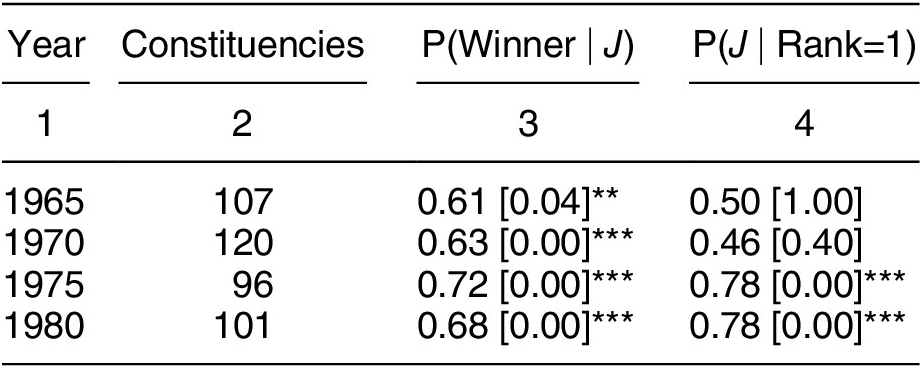


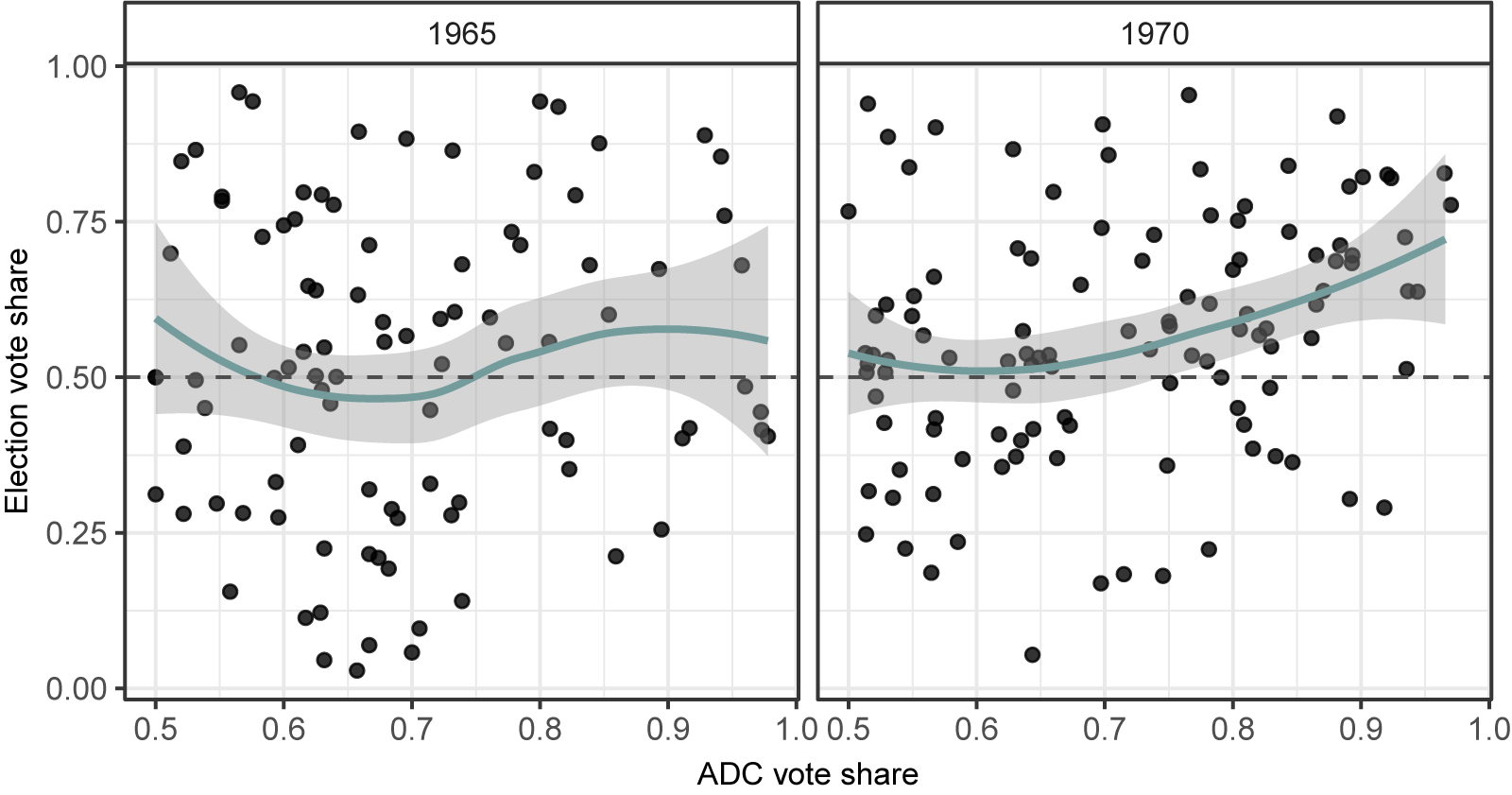


 Open access


Comments
No Comments have been published for this article.