


Bringing things to mind
Human mental life is profoundly situated. The human mind, for better or worse, has always been inextricably intertwined with the plasticity (or stability) of our changing socio-material environments. This process of metaplasticity applies to human ontogeny as it does to human evolution.Reference Malafouris1–Reference Malafouris3 Different academic disciplines, constrained by the theoretical assumptions, the time scales and the analytical units that they use, are able to observe, and would probably emphasise, different aspects of the relationship between mind and matter. Still, the underlying message is the same: our everyday material habits and forms of material engagement (past, present and future) are inextricably linked with our cognitive and emotional lives – the major dynamic being the plasticity of the brain linked to the affordances of our body and the action possibilities offered by the things we make and use. We cannot understand human intelligence (cognition and affect) in isolation from its changing material and social surroundings. Material things matter and need to be taken seriously.Reference Latour, Bijker and Law4, Reference Miller5
This realisation of the interrelatedness between human experience, affect and materiality has, potentially, major implications for how we approach and understand important issues of mental health. Yet, those implications are not well understood. The important question concerning the influence of materiality on mental health and human well-being has not been adequately addressed and requires work across disciplinary boundaries. Although the agency of thingsReference Knappett and Malafouris6–Reference Hicks and Beaudry8 and the vitality of matterReference Bennett9 have been central themes of research in the humanities and the social sciences, research in neuropsychiatry has, by and large, side-tracked the thorny issue of material engagement. Given what we now know about the importance of materiality in human social and cognitive life,Reference Malafouris, Renfrew, Malafouris and Renfrew10–Reference Ingold12 this form of epistemic neglect is unacceptable and needs to be overcome. I do not wish, and there is no space in this brief editorial, to discuss the reasons for that blind spot. Instead, I want to suggest a way forward. Suffice it to say that the main reason psychiatry avoided investigating (at least in a direct and systematic sense) the full variation of the interactions between cognition and material culture, and their effects on mental health, is not because it sees those interactions as unimportant or uninteresting. Rather, it is because some traditional assumptions about the mind (for instance, the view that anything mental must refer to, and is explained by, processes internal to the individual) make it hard to study them.Reference Röhricht, Gallagher, Geuter and Hutto13, Reference Fuchs14 Those assumptions are changing, replaced by the more productive idea that the boundaries of the mind ‘should not be set a priori, but should be responsive to the nature of the phenomena under study’.Reference Hutchins, Stewart, Gapenne and Di Paolo15 The boundaries of the human mind have always been a problem, but perhaps never so problematic as they are today.Reference Varela, Thompson and Rosch16–Reference Fuchs20
There is unrealised potential here for creating new approaches to care and intervention that can complement existing practices and broaden, or in some cases challenge, prevailing assumptions in mental health. However, in order for this potential to be realised, a more nuanced, case-specific and evidence-based understanding of the material dimensions of human mental health is needed.Reference Buse, Martin and Nettleton21 How can we measure the effects that different material ecologies,Reference Ingold12 practices and technologies have on human mental life? What constitutes evidence in that context? How can we best interpret existing evidence and use it to effect changes that could help improve our emotional and mental well-being? Largely, we still lack effective ways of answering those questions. Combined expertise and a range of specialisations are needed to develop both the theoretical and practical means that will allow us to make progress with these challenging issues.
The material engagement approach
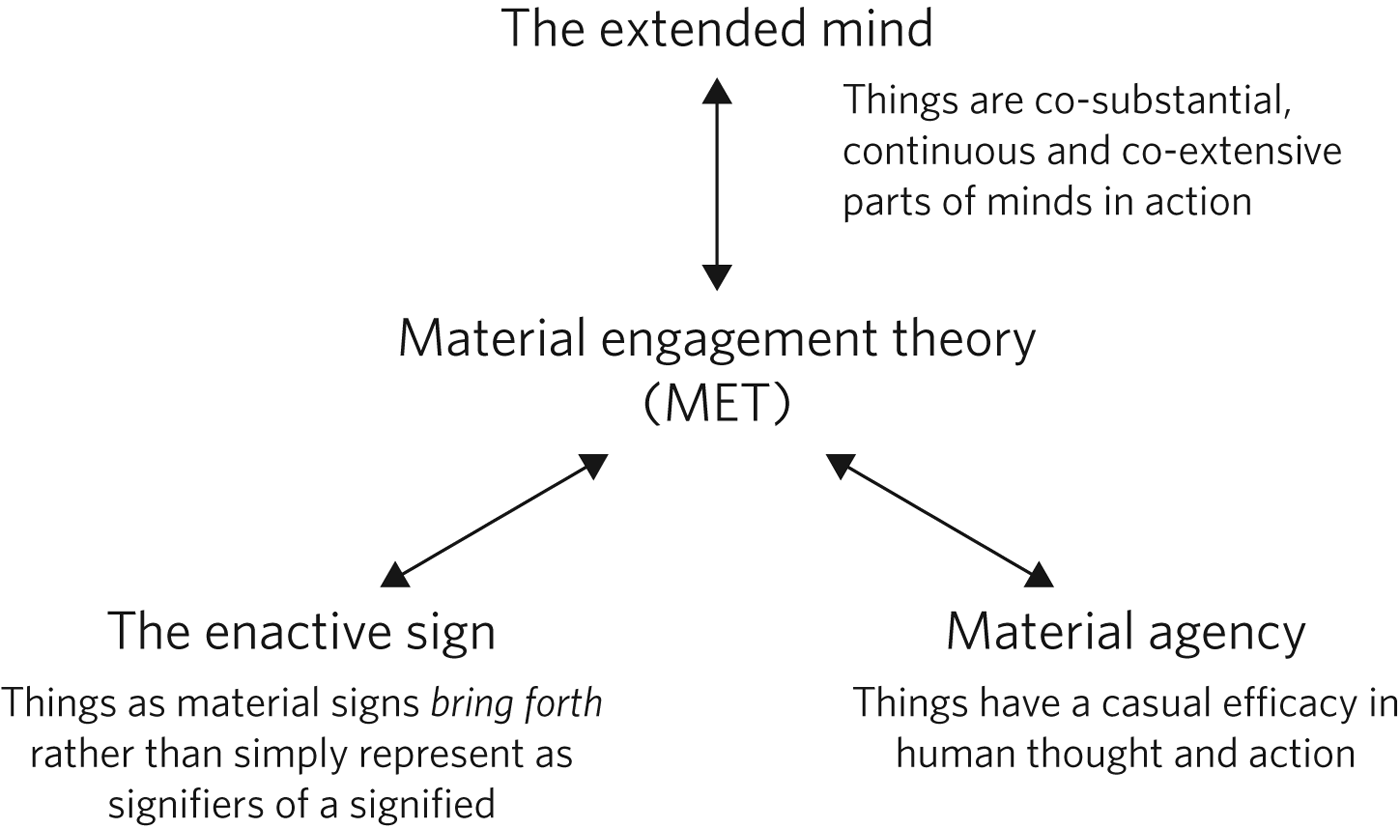
The aim of this essay is to propose one possible path to this end, a path that could lead to better integration of in-depth anthropological and philosophical qualitative analysis with the quantitative methods and measures of psychiatry and neurophysiology. Specifically, I propose a material engagement approach combining methods from anthropology and embodied cognitive science that allows us to observe, to record and to compare the actual processes by which different materials and forms of material culture affect the people who experience and use them.Reference Malafouris22–Reference Malafouris, Newen, de Bruin and Shaun24 The material engagement approach provides a theoretical framework tailored to facilitate a heightened responsiveness to the details of situated action and the affordance of the materials involved (the concept of affordance stems from Gibsonian ecological psychology, where it denotes the relational opportunities for perception and action between an organism and its environment).Reference Gibson25, Reference Gallagher26 The distinctive feature of the material engagement approach is the commitment to a view of thinking as a process that is distributed, enacted and situated, as well as assembled, from a variety of non-localisable mental resources spanning the boundaries of the individual brain and body. Material engagement theory as an explanatory path is based on three interrelated working hypotheses, which can be summarised as follows.Reference Malafouris22–Reference Malafouris, Newen, de Bruin and Shaun24 (a) The hypothesis of extended mind, which explores the constitutive intertwining of cognition with material culture; (b) the hypothesis of enactive signification, which explores the nature of the material sign not as a representational mechanism but as a semiotic conflation and cohabitation through matter that enacts and brings forth the world; and, finally, (c) the hypothesis of material agency, which explores agency not as a human property but as the emergent product of situated activity (Fig. 1).
Material engagement theory.
Taken together, these hypotheses enable us to restate the problem of cognitive boundaries, offering a cross-disciplinary relational basis for understanding the material ecology of mental health that integrates the ‘materiality turn’ in humanitiesReference Fox27 and social sciences with new embodied and enactive trends in philosophy and cognitive science.Reference Newen, De Bruin and Gallagher28 Traditional anthropological participant-observation combined with visual methods (e.g. photography/video capture and elicitation) and object interviews can be used for the study of everyday naturally occurring situated material activities and somatic modes of attention.Reference Goodwin29, Reference Woodward30 The creative methods of art and medical humanities are also needed to investigate how different forms of material engagement achieve their effects.Reference Van Lith31–Reference Beard33 Some of the key issues include: (a) the role of arts and creative industries in psychotherapy;Reference Beard33, Reference Cousins, Tischler, Garabedian and Dening34 (b) the development of evidence-based understandings of the therapeutic effects and qualities of different art materials and digital media; (c) the role of museums in mental healthReference Thomson, Lockyer, Camic and Chatterjee35–Reference Mangione38 as a space for creative interventions; and (d) the cross-cultural,Reference Mackenzie, Bartlett and Downs39 social and genderReference Bartlett, Gjernes, Lotherington and Obstefelder40 dimensions of mental health.
Such a cross-disciplinary anthropological understanding will allow us to harness the power of creative industries more effectively and to develop new tools that will not just meet current needs but also help to generate new ideas on how to design a landscape of creative affordances for future experimentation. There is currently a lot of emphasis on the ways technological innovation (e.g. digital media, internet of things, big data, self-tracking) can be fostered to benefit older people.Reference Gillespie, Best and O'Neill41–Reference Lorenz, Freddolino, Comas-Herrera, Knapp and Damant43 Still, there has been very little work trying to understand how these new innovations fit or compare with more traditional material ecologies and creative habits.Reference Buse, Martin and Nettleton44 Doing so could prove beneficial for all stakeholders involved.
To illustrate those claims, I will focus on the example of dementia.
The case of dementia
Dementia is one of the biggest mental health challenges modern society faces.Reference Livingston, Sommerlad, Orgeta, Costafreda, Huntley and Ames45 The profound changes in people's lives brought about by dementia and by long-term caregiving are well known. This process of self-transformation is often described as a diminishment of or loss of self.Reference Kontos46, Reference Caddell and Clare47 All people who live with dementia (patients and family/carers) are affected. It is common to see dementia solely as the product of brain pathology and to leave people's bodily interactions with the material world unattended. But perhaps it is also important to pay closer attention and try to understand better how dementia extends beyond the brain of the individual.Reference Fuchs20 The gradual loss of self is not solely the product of neurological factors. An impoverished material environment and the gradual loss of connection with significant others (humans and things) that provide a familiar, stable and comforting self-referential space also contribute to a diminishing capacity for memory, interaction and communication. One important question in this regard concerns how the evocative nature of material culture and its various cognitive, emotional and affective dimensions can be harnessed to guide the design of new care strategies and material settings that promote patients' agency, autonomy and ability in social interaction and communication. Are there ways to alter the person's material environment that can result in positive changes in embodied self-conceptualisation?Reference Buse and Twigg48, Reference Yatczak49
One way to answer that question could be by examining the changes in materiality experienced during periods of major transition, for instance, during the transition from home to ‘care home’. This is a challenging period, often marked by uncertainty, anxiety, confusion and distress, which can be explained in terms of changing cognitive ecology and the stripping away of personal possessions that help to constitute one's personal memories and self-identity.Reference Phenice and Griffore50 The philosopher Daniel Dennett, in his book Kinds of Minds (1996), describes this cognitive impairment when elderly people are in hospital, bereft of the usual contextual cues and affordances of their familiar home environments.Reference Dennett51 More recently, Shaun Gallagher,Reference Gallagher26 adopting an enactive perspective, proposes an affordance-based approach to therapy that places special focus on the changing physical, social and cultural environments. He argues that a variety of mental health problems and neurological and psychiatric disorders can be understood in terms of changes in a subject's ‘affordance space’ – which is the lived space defined relative to the capacities (sensorimotor, social, cultural, cognitive) of a specific agent.
Significant objects and personal possessions that have been acquired and accumulated over the life course constitute material memories and material anchors of self-identity. The powerful affective linkage of material possessions to one's identity explains the positive association between memorabilia and mood, as well as their observed influence on how elderly individuals achieve a sense of continuity. To lose these objects, often abruptly and unwillingly, owing to changes in residential circumstances, such as the transition from independent living to a nursing home, can be a ‘major cause of loss and grieving for elders’.Reference Phenice and Griffore52 Understanding the cognitive life of things and the importance of object memories can allow us to develop strategies of care for the things that can actively enhance or even create a sense of continuity, stability, and comfort, especially during those transitional stages when one moves from home to a long-term care facility.Reference Wapner, Demick and Redondo53
Interestingly, in many care homes and hospices nowadays, residents are allowed to bring their own furniture and personal objects. One could track what they choose to take with them and how they actually use it.Reference Lovatt54 Are there any preferred types of objects? Do the objects carried along retain their original meaning and usage or do they become something different? Do individuals always keep what they want to remember? Do they always remember what they keep? What is the evidence that personal objects can facilitate patients' transition to their new and often alienating surroundings (e.g. providing cognitive and emotional support)? Can we provide informed guidance on how objects can be used more efficiently and appropriately in personal memory practices? There have been a number of studies looking at how old people moving into long-term care engage with their new material surroundings,Reference Cipriani, Kreider, Sapulak, Jacobson, Skrypski and Sprau55 but few of them have focused specifically on how dementia and other cognitive impairments may affect residents' ability to think and to feel with, through and about things. For instance, Buse and Twigg explored the potential of material objects to evoke narratives and elicit memories through the sensory and material dimensions of dress. The study focused on three main dimensions, i.e., kept clothes, discarded clothes and absent clothes, and used ethnographic methods to explore everyday experiences of clothing and their influence on maintenance of personal identity and biographical continuity. The study nicely illustrates the significance of dress, often unnoticed, in supporting personal identity in dementia care.Reference Buse and Twigg56, Reference Phillipson and Hammond57
Combining traditional anthropological methods of participant observation with in-depth phenomenological analysis could help to answer questions of how different people experience this radical shift in their material ecology. Ethnographic attention to patients’ changing bodily engagements, habits and material attachments during their transition to institutional care could provide a thorough first-hand examination of that. CognitiveReference Hutchins58 and visual ethnographyReference Banks and Zeitlyn59 offer particularly apt methods to record and analyse everyday episodes of situated action and distributed intelligence, paying attention to the details of specific contexts. To investigate those processes, an analytical vocabulary cutting across brain–body–world divisions is required. Focusing primarily on non-verbal aspects of the dyadic or triadic interactions between patients, carers and things, one could analyse the sequential organisation of those interactions using a combination of pictures, written commentaries and graphic elements to illustrate features of material engagement such as movement, direction, eye-gaze, gesture, attention and action coordination.
It is important to recognise that every person's experience of dementia is different. People with dementia have their own unique life histories and actively make meaning of their lives through their attachments to and interactions with specific places, objects and people. People should be encouraged to spend time with the objects of their attention, to observe closely and with all their senses, and to draw what they observed or find other ways to voice their opinion.Reference Bartlett60, Reference Woodward61
One could look specifically at self-narratives evoked and constructed through shared discussions of artefacts and objects. Also of interest is to explore, more specifically, the role of biographical objects as memory scaffolds and affective probes of autobiographical memory through their attachments to family histories and self-identity, offering perhaps a complementary pathway to non-verbal facilitation of communication, promotion of independence, and rediscovery of personal identity. Communication is one of the major problems in dementia care, and participatory ethnography offers an appropriate means of interaction. To study people with dementia, it is essential to give them a voice. Material engagement interventions facilitate and support complex interactions, offering alternative non-verbal avenues of expression and communication. People with dementia may understand, do and express with and through things far more than they can express with language.
What would be important to clarify in this connection is the extent to which memory loss in dementia and other neurodegenerative diseases might be partially compensated by the use of selected biographically salient objects and material scaffolds for self-narrative and autobiographical memory. For instance, studies on bodily and object ownership have shown that owned objects can trigger a strong memory trace and are often treated as psychological extensions of self.Reference Cunningham, Turk, Macdonald and Macrae62 One could explore the effects that such strong associations between self and owned objects may have in the context of dementia.
Another promising avenue of research could be to investigate the cognitive mechanisms activated when people with dementia think with and through things in an embodied, performative manner, and to compare them with the cognitive mechanisms activated when they think about things in the internalist representational manner. Understanding those processes is important, because whereas most forms of dementia seem to affect the latter capacities for thinking about the world (in the sense of abstract recollection, self-narrative, communication and language use), the former enactive capacities remain largely intact and could be re-used and developed to compensate for the lost ones. For instance, memory interventions in the form of memory books, photo albums and so-called memory boxes have repeatedly demonstrated their effectiveness as external memory aids and powerful communicative means.Reference Caddell and Clare63 The precise cognitive function of those external memory prompts and cues remains largely unknown, but it has been suggested that they work precisely because they do not require conscious cognitive effort in order to trigger retrieval of related semantic information from memory storage, effecting positive changes in the conversational behaviours of people with a wide range of severity of cognitive impairment.Reference Bourgeois, Camp, Rose, White, Malone and Carr64 There is little doubt that things and material objects evoke and trigger memories through associations with important life experiences and events, although exactly how that happens and how best those forms of material memory should be described is less understood. Beyond the widely recognised memories of objects, we should be considering also the possibility of object memories. Objects embody memories in their forms, life histories and uses that can provide powerful media for recollection, self-expression and self-identification. The mundane things we own constitute memories of our past, material traces available to be re-enacted through our bodily engagements with the material world. In that sense, things provide a durable network of material signification, transposable dispositions and bodily habits which can be harnessed to enhance cognitive abilities or compensate for memory loss when biological memory is damaged. Like a blind's person stick, mundane things and media can help people to re-orient and re-structure their cognitive landscape (neural and extra-neural) in a variety of ways.Reference Malafouris and Koukouti65 A material engagement approach could help us to explore whether there are ways we could structure and adapt the material ecology of any given environment in order to create scaffolds, material anchorsReference Hutchins66 and action affordancesReference Gallagher26, Reference Rietveld and Kiverstein67 able to effect a more efficient utilisation of brain networks or stimulate the person's ability to recruit alternate brain networks that could enhance cognitive reserve.Reference Stern68 A broader but related question in this regard could be whether different forms of material engagement can dynamically influence and mediate the relationship between brain damage and its clinical outcome. Here, one could refer to similar findings on collective remembering and cognitive reserve in old couples.Reference Harris, Barnier, Sutton and Keil69
Conclusion
In this essay, taking the example of dementia, I sketched the outline of a material engagement approach to mental health. I proposed that a collaboration of archaeology, anthropology, philosophy and neuropsychiatry could help us understand how people with dementia are actually engaging with their local material environments and the effects that the latter has on people's agency, cognitive abilities and selfhood across the full dementia care pathway. Such a collaboration could also form the basis of a longitudinal mixed method exploratory investigation of the possibilities for action and interaction that different objects and forms of material culture provide for people with dementia in common everyday situations and in different care settings (their homes and residential care).
Ultimately, the objective is to broaden recognition of the material aspects of dementia. That is, understanding better the ways by which different forms of material engagement can help people with dementia to: (a) remember and/or forget; (b) enact, express their agency and preserve their self-identity; and (c) communicate and interact with others, especially family members and care providers. Hopefully, this will stimulate further cross-disciplinary research and broader engagement with material culture studies, which, in the context of current dementia and mental health research, are often seen as marginal and of limited value (despite the success of well-established tradition in art-based and occupational therapies).
Achieving these aims requires concerted action from a wide variety of organisations, collaboration and cooperation from the public. This exchange between practitioners, researchers and the public would generate further awareness, promoting new evidence-based cross-disciplinary research on the role of creative practices and material culture in mental health. It could also create transferable insights into the influence of creative practices in mental rehabilitation and in psychotherapy that could be used as alternative/additional solutions to traditional treatments of mental illness across the life course. The benefits of the proposed material engagement approach could be broad, offering important insights and practical recommendations for the well-being and long-term care of the aging population, with dementia or not.
Understanding how different forms of material engagement affect people's cognitive abilities and selfhood across the full dementia care pathway would also lead to specific evidence-based recommendations for designing interventions, material scaffolds and assistive techniques that could help people maintain and improve their mental well-being. This could also inform and facilitate safe and responsible design of healing environments, offer suggestions on how their effects should be measured, and suggest policy changes to provide a mental healthcare environment fit for the future.
Fostering deeper understanding of the ecology of mental health and developing simple interventions enabling people to improve their psychological well-being is increasingly important in today's environment, with mental health leaders seeking innovative and cost-effective ways to optimise the quality of care. Concerted action and cross-disciplinary research is required to ensure that all gaps in research are filled. Understanding how different forms of material engagement affect people's mental health presents us with such a challenge.
Acknowledgements
I thank Shaun Gallagher, Jonathan Cole and Frank Rohricht for their valuable feedback in formulating the ideas presented in this paper. The writing of this article was assisted by the John Templeton Foundation Grant, Self-Bound: The Making of Human Consciousness (ID 60652), and the European Research Council Consolidator Grant, HANDMADE (No 771997 European Union Horizon 2020) awarded to Lambros Malafouris.
About the author
Lambros Malafouris is a senior research fellow at Keble College and the Institute of Archaeology, University of Oxford, UK.


 Open access


eLetters
No eLetters have been published for this article.