


Introduction
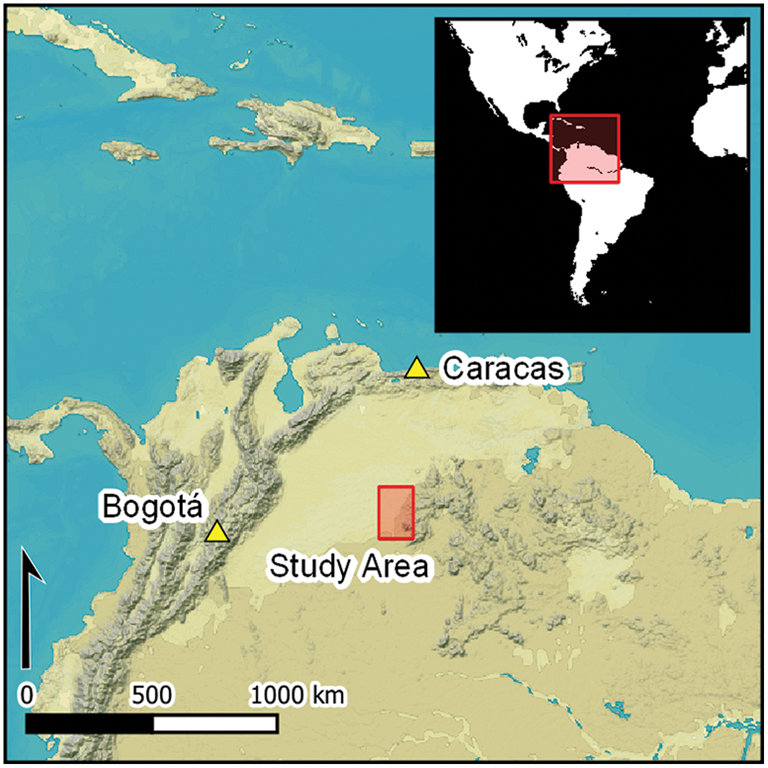
In this article, we report on a unique South American tradition of monumental rock art and link it to the extant archaeological and ethnographic knowledge of the Orinoco River in its regional context. In concert with a growing interest in pre-Columbian art across the lowland tropics more broadly, Orinoco rock art has seen a recent rise in research attention (Riris Reference Riris2017; Riris & Oliver Reference Riris and Oliver2019; Tarble de Scaramelli & Scaramelli Reference Tarble de Scaramelli and Scaramelli2021; Pérez-Goméz et al. Reference Pérez–Gómez, Antczak, Antczak and Brewer-Carias2022). Areas of focus include the role of rock art in the peopling of the Americas, connections between Indigenous myth and art production, and the historical ecological knowledge that the art can embody (Valle et al. Reference Valle, Lopez, Tuyuka and Munduruku2018; Castaño-Uribe Reference Castaño-Uribe2019; Pereira & Moraes Reference Pereira and Moraes2019; Castiblanco Muñoz Reference Castiblanco Muñoz2020; Morcote-Rios et al. Reference Morcote-Ríos, Aceituno, Iriarte, Robinson and Chaparro-Cárdenas2021; Villar Quintana Reference Villar Quintana2021). The number of motif types shared across large parts of northern South America has led scholars to suggest the existence of several, sometimes overlapping, traditions of Indigenous art production (Williams Reference Williams, Wendell and Close1985; Reichel-Dolmatoff Reference Reichel-Dolmatoff1987; Greer Reference Greer1995; Overing Reference Overing and Arnold1996; Pereira Reference Pereira, McEwan, Barreto and Neves2001; Valle Reference Valle2012; Castaño-Uribe Reference Castaño-Uribe2019).
The Middle Orinoco in particular hosts an exceptional quantity of petroglyph (rock engraving) and pictograph (rock painting) sites. The ‘hotspot’ status of our study area (Dubelaar Reference Dubelaar1986), together with a noteworthy diversity of motifs (Sujo Volsky Reference Sujo Volsky1975; Greer Reference Greer1995; Costas-Goberna et al. Reference Costas Goberna, Alvarez, Fernández, Costas Goberna and Hidalgo Cuñarro1996; Riris & Oliver Reference Riris and Oliver2019), allows rich comparisons with similar records from other areas in South America and the Caribbean (Riris Reference Riris2017). In this regard, the Orinoco River may be seen as pivotal in structuring cultural contact, exchange and interaction in northern South America (Ojer Reference Ojer1960; Morey & Morey Reference Morey and Morey1975; Arellano Moreno Reference Arellano Moreno1982; Zucchi et al. Reference Zucchi, Tarble and Vaz1984; Gassón Reference Gassón2000; Zucchi & Gassón Reference Zucchi and Gassón2002; Perera Reference Perera2003; Lozada Mendieta et al. Reference Lozada Mendieta2022). Rock art is, furthermore, prominent in Indigenous creation myths, notably in the symbolic reproduction of society through the practice of river voyages; a theme that is often intimately tied to major geographical features along rivers where engravings or paintings occur (Santos-Granero Reference Santos-Granero, Halbmayer and Mader2004; Anderello Reference Andrello2012; Wright et al. Reference Wright, González-Ñáñez, Leal, Hobart and Zarcone2017; Scaramelli & Tarble de Scaramelli Reference Scaramelli, Tarble de Scaramelli, Troncoso, Armstrong and Nash2018). We focus our analysis on monumental snake motifs that occur along the margins of the Upper and Middle Orinoco, whose production and placement we argue was key to memorialising myths in this landscape.
Rock shelters with archaeological deposits such as those in the La Lindosa and Chiribiquete regions (Colombia) and Cerro Gavilán 1–2 (Venezuela) have yielded evidence of human occupation associated with rock art that dates to the earliest Holocene (Gavilán: 9250±60 BP, 10 560–10 254 cal BP, Beta-252625; Tarble de Scaramelli & Scaramelli Reference Tarble de Scaramelli, Scaramelli, Pereira and Guapindaía2010, Reference Tarble de Scaramelli and Scaramelli2021; Castaño-Uribe Reference Castaño-Uribe2019; Morcote-Rios et al. Reference Morcote-Ríos, Aceituno, Iriarte, Robinson and Chaparro-Cárdenas2020). Connections between rock art and ancestral myths are also widespread among the Indigenous societies of northern South America, most frequently Arawakan-speaking peoples (González Ñañez Reference González Ñáñez1980), suggesting a profound time depth to such practices. The structure and content of Arawakan cosmogonic myths are shared with Sálivan and Tukanoan narrative sequences, implying a shared understanding of the purpose of rock art and its role in place-making (Hugh-Jones Reference Hugh-Jones2016; Wright Reference Wright2017). The extent of shared conventions across northern South American rock art, its apparent links to Indigenous cosmologies, and the region's long history of human occupation renders it comparable to other widespread traditions of prehistoric rock art on a global scale (e.g. Valdez-Tullet Reference Valdez-Tullett2021). This article highlights the unique qualities of monumental snakes in Orinoco rock art for broadening our understanding of the relationships between prehistoric artistic practice and Indigenous worldviews.
Rock art surveys along the Orinoco
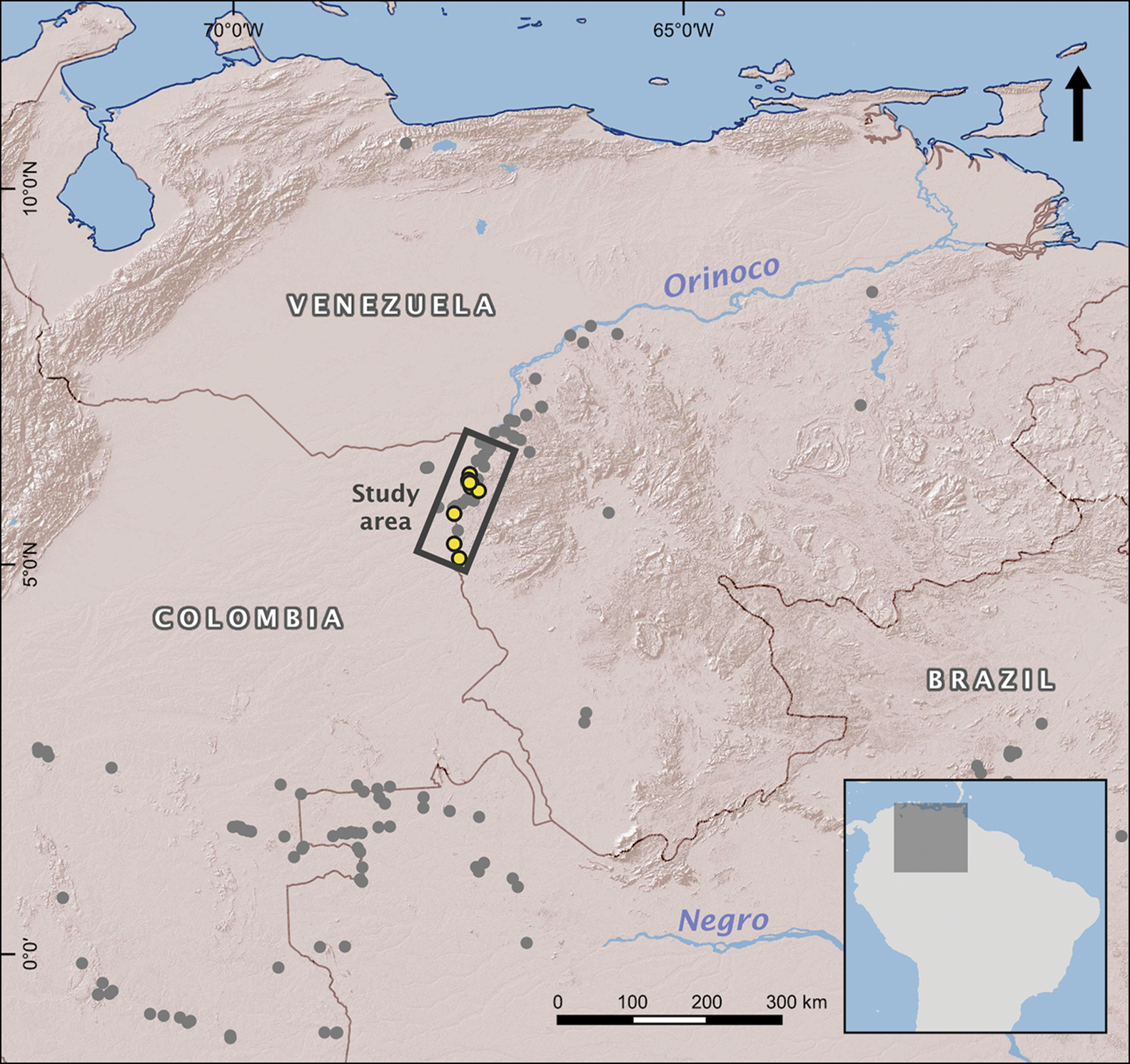
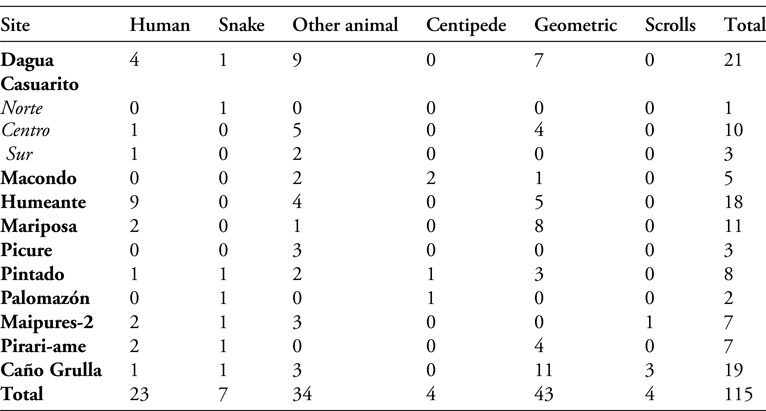
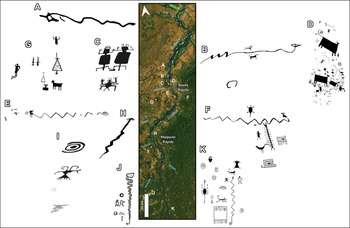
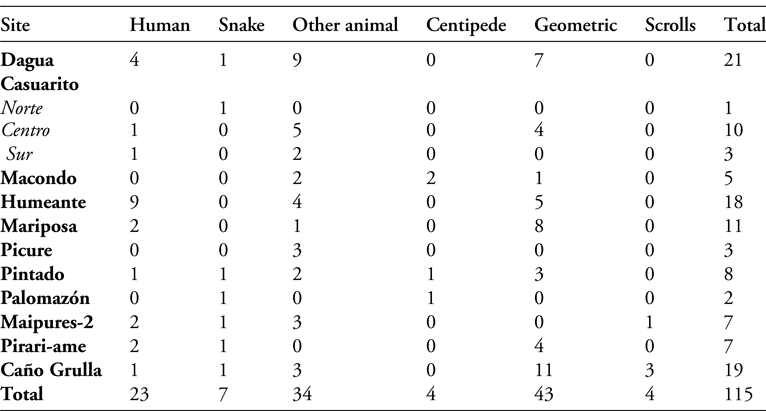
Our results are part of work to study the pre-Columbian settlement chronology of the Middle Orinoco. Systematic archaeological fieldwork on the Colombian and Venezuelan margins of the Atures Rapids in recent years has greatly enhanced the precision of regional cultural chronologies, providing new opportunities to view its rock art record in context (Scaramelli & Scaramelli Reference Scaramelli and Scaramelli2017; Riris et al. Reference Riris, Oliver and Mendieta2018; Lozada Mendieta Reference Lozada Mendieta2020, Reference Lozada Mendieta, Riris and Oliver2022; Lozada Mendieta et al. Reference Lozada Mendieta, Oliver and Riris2016, Reference Lozada Mendieta, Riris and Oliver2022; Oliver Reference Oliver2023). Since 2015, we have carried out five seasons of data collection centred on the Atures Rapids, ranging as far north as Puerto Carreño (Colombia) and as far south as the Maipures Rapids. We targeted rock art sites based on published information (Sujo Volsky Reference Sujo Volsky1975; Dubelaar Reference Dubelaar1986; Tarble de Scaramelli & Scaramelli Reference Tarble de Scaramelli, Scaramelli, Pereira and Guapindaía2010) and the expertise of local guides. Sites were also discovered opportunistically by visiting prominent outcrops, exposed boulders and rock faces along the river. We made full records of every site using DSLR cameras and metric scales, as well as airborne drones where necessary due to the exceptional size of some of the art (Riris Reference Riris2017). Co-ordinates were recorded on handheld GPS units. Furthermore, we collated the literature on Orinoco rock art from reports, theses, books and articles. Site locations were estimated from descriptions and published maps to produce a comprehensive site inventory, resulting in a sample of 157 rock art locations in the Middle and Upper Orinoco (Figure 1). We classify 13 of these as ‘monumental’ (Figure 2); defined here as prominently located in the landscape and at least twice as large as an adult human (>4m) in vertical and/or horizontal dimensions (Table 1).
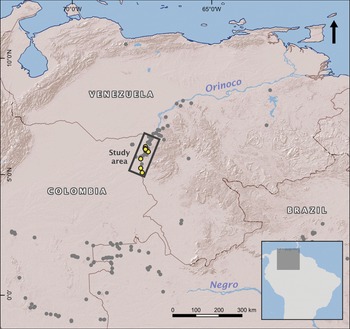
Regional overview of the Upper-Middle Orinoco study area and its geography. Highlighted study area corresponds to the area shown in the map/aerial image on Figure 2. Yellow dots indicate the locations of monumental rock art sites, grey dots show the locations of other non-monumental rock art sites (figure by authors).
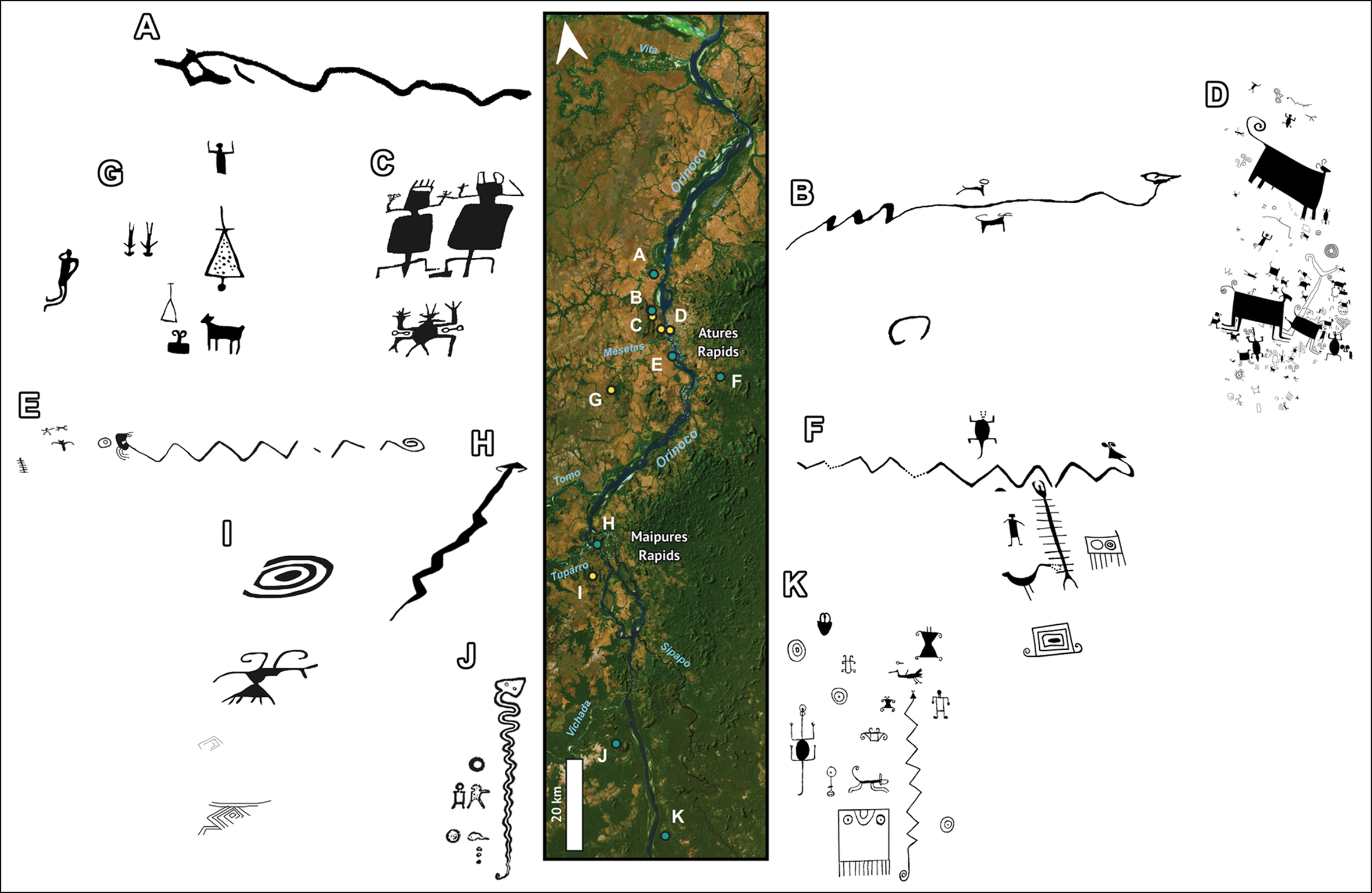
Monumental rock art sites in the Upper-Middle Orinoco study area: A) Cerro Dagua; B) Cerro Casuarito Centro & Sur; C) Cerro Casuarito Norte; D) Picure; E) Cerro Palomazón; F) Cerro Pintado; G) Cerro Humeante; H) Maipures-2; I) Cerro Mariposa; J) Cerro Pirari-ame; K) Caño Grulla. Common motifs include gigantic snakes (green points on map/aerial image), humans, animals and a restricted set of geometric motifs. The locations and plans of Cerro Pirari-ame (redrawn from Tavera-Acosta Reference Tavera-Acosta1956) and Caño Grulla (J.C. García, pers. comm.) are estimated. Macondo (immediately west of Picure, point D) does not have an accurate photographic record, and is not presented. Plans not to scale. Some sketches have unavoidable parallax due to site accessibility and viewing angle in the original field observations (figure by authors).
Motif counts for 13 monumental rock art panels among 11 sites in the Middle Orinoco. Non-monumental motifs are not included in the count.
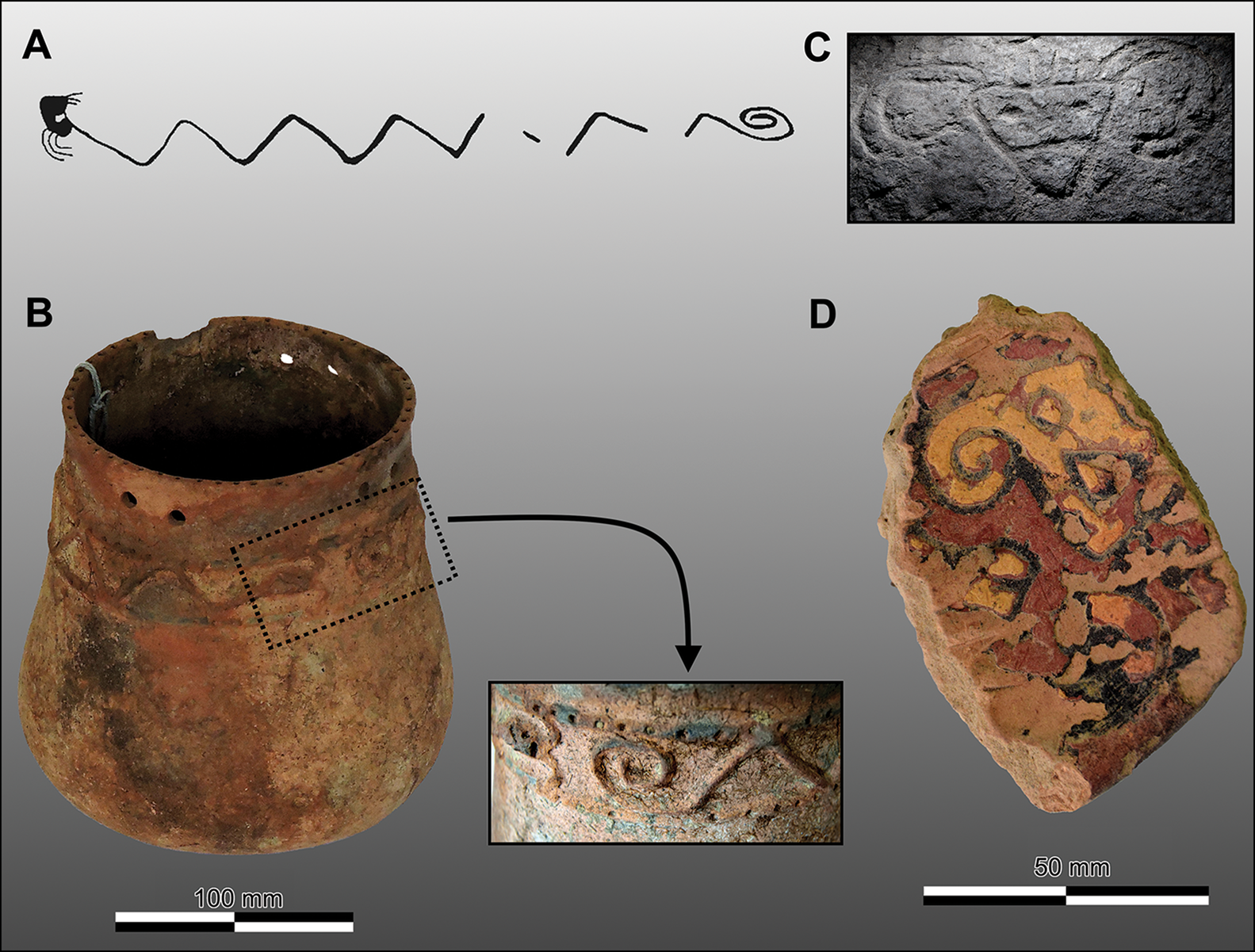
Separately, we have carried out excavations, material culture analyses and chronometric dating on pre-Columbian settlement sites in and around the Atures Rapids. This work has documented a succession of cultural complexes that span two main periods: an early occupation period ranging from 100 BC–AD 620 (Saladoid-Barrancoid and Cedeñoid ceramics, Early Picure complex) and a late occupation period from AD 1030–1480 (Arauquinoid, Valloid and Nericagua ceramics; Late Picure/Late Rabo de Cochino complexes). Following ephemeral initial occupations, settlements grew over time, culminating in the establishment of several multi-ethnic communities before the Conquest (AD 1500) (Lozada Mendieta et al. Reference Lozada Mendieta2022). Although not directly dated, a small number of petroglyph motifs are paralleled in archaeological ceramic decoration (Riris & Oliver Reference Riris and Oliver2019; Figure 3). The few samples of ceramics collected from rock shelters are techno-stylistically late pre-Columbian (Arauquinoid and Valloid series; Lozada Mendieta Reference Lozada Mendieta2022; Oliver Reference Oliver2023). Throughout the region, virtually every known ceramic series/tradition of the Orinoco region is documented at rock shelters bearing rock art (Perera & Moreno Reference Perera and Moreno1984; Greer Reference Greer1995), indicating a long history of repeated visits from at least the Formative period onwards (starting c. 3000 BP in the Middle Orinoco). Although we cannot rule out earlier (Preceramic/Archaic, starting c. 10 000 BP in the Middle Orinoco) phases of production (Scaramelli & Scaramelli Reference Scaramelli and Scaramelli2017), there is likely broad contemporaneity between the archaeological phases of settlement around the Atures Rapids and our sample of rock art sites.
Material culture parallels to Orinoco rock art: A) snake motif recorded in Cerro Palomazón (Colombia); B) a similar snake motif in appliqué with horned head and spiral tail (inset) on a Valloid vessel from a burial in Cueva Osario (Colombia), currently held at the Museo Etnológico de Amazonas Monseñor Enzo Ceccarelli, Puerto Ayacucho, Venezuela; C) a widespread triangular head motif with spiral appendages from the Picure site; D) surface-collected Arauquinoid series sherd from the Rabo Cochino site (Venezuela), showing a partial painted decoration that resembles C, currently held in the Instituto Venezolano de Investigaciones Cientificas, Caracas, Venezuela (figure by authors).
Snakes in monumental rock art and myth
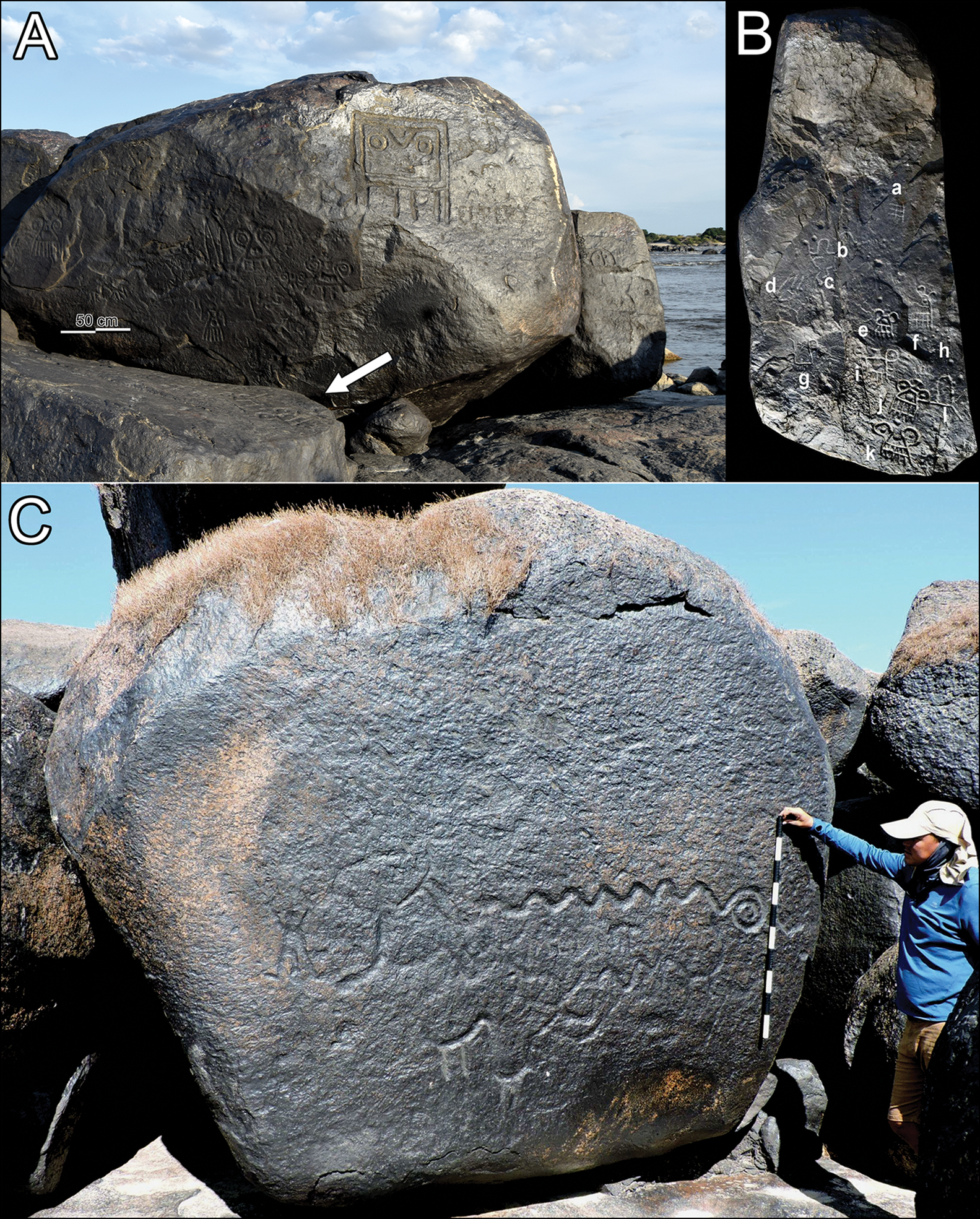
Monumental rock art panels, which appear exclusively in the Upper and Middle Orinoco and where individual motifs are often more than 10m2 in size, have been known for over a century (von Humboldt & Bonpland Reference von Humboldt, Bonpland and Williams1821: 594–600; Chaffanjon Reference Chaffanjon1889; Cruxent Reference Cruxent1955; Tavera-Acosta Reference Tavera-Acosta1956; Padilla Reference Padilla1957; Greer Reference Greer1995). They are sporadically mentioned, possibly even in the first chronicles from the region (Rivero Reference Rivero1883; Riris Reference Riris2017). Sites with monumental petroglyphs are distributed from the northern edge of the Atures Rapids to the Vichada-Orinoco confluence, approximately 100km upstream. These open-air engravings are produced by abrading the surfaces of granite inselbergs that have been stained black by biofilms of cyanobacteria to expose the lighter underlying rock (Gorbushina Reference Gorbushina2007). The engravings are extremely shallow (<10mm) yet visible from a distance of several hundred metres due to their size, prominent placement and the contrast between the lighter, abraded granite surfaces and the black biofilm. The motifs are similar in design to art from non-monumental sites, indicating a shared symbolic vocabulary (Riris & Oliver Reference Riris and Oliver2019; see Figure 4), and include geometric shapes, human figures and a range of different fauna: mammals, arthropods (likely Scolopendra sp.; giant Amazonian centipede) and snakes (likely one of several extant Boidae; boas or anacondas).
Non-monumental motifs that also appear at monumental sites: A) anthropomorphic mask motif (known as ‘the television’) at Raudal Mesetas, see also Cerro Pintado and Caño Grulla (Figure 2F & K); B) flat boulder alongside A (arrow) with stylised anthropomorphic and double scroll motifs; C) snake, bird and human motifs at Raudal Palomazón. Note size of the snake relative to other motifs (figure by authors).
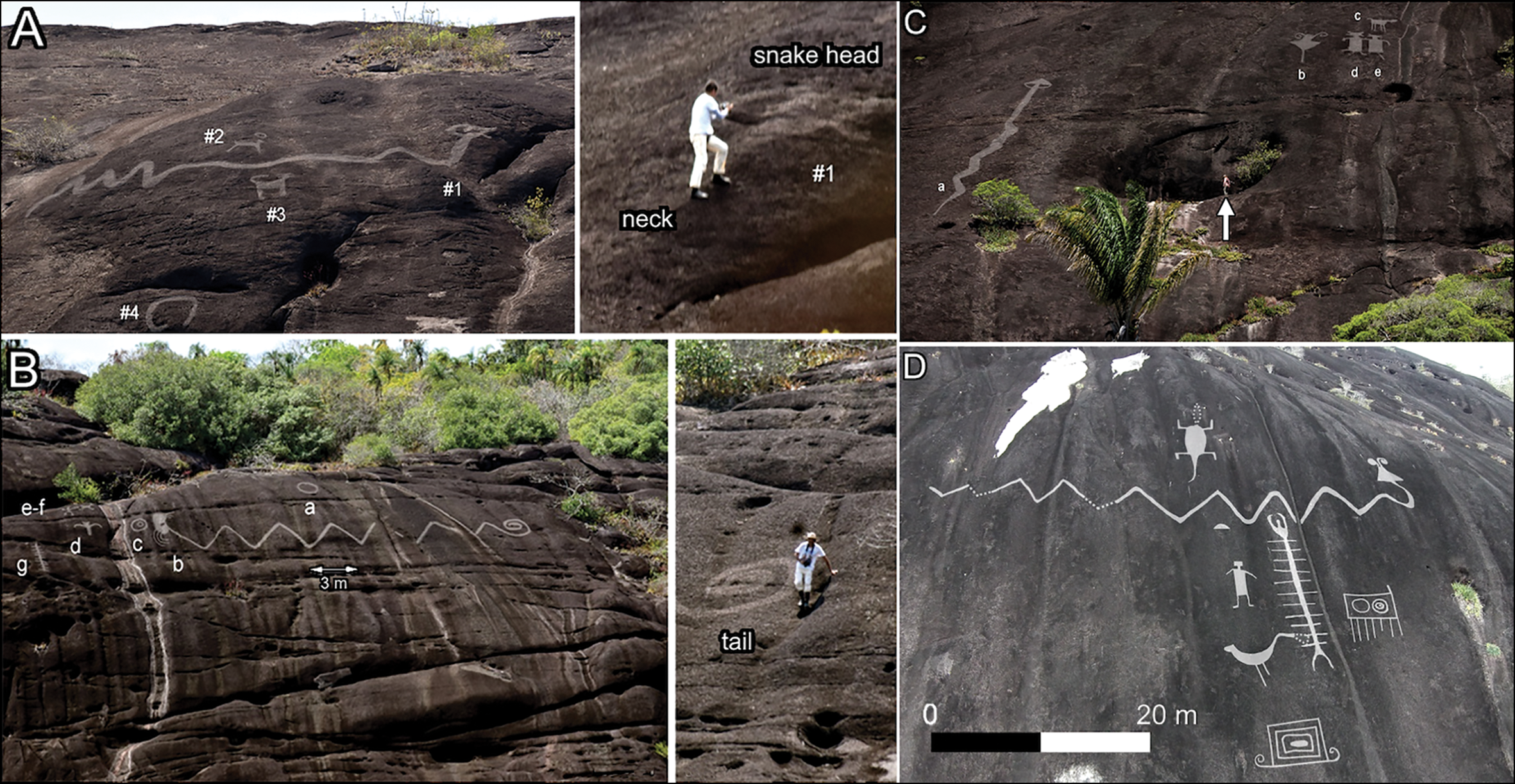
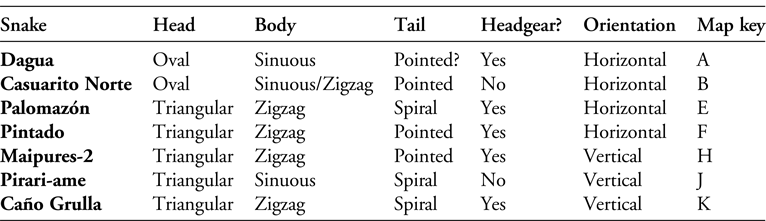
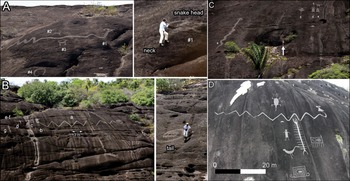
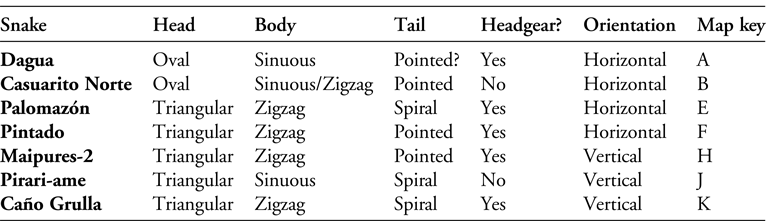
Gigantic snakes are the most widespread monumental motif, occurring at most monumental sites, and show consistent iconographic patterns in their depiction and composition. This may point to a shared understanding of their role and function, which we examine in detail here. In terms of iconographic convention, engravings of snakes are typically tens of metres long, with the largest (Cerro Pintado) measuring more than 40m in length (Figure 5). Considering the overall high diversity of motifs in Middle Orinoco rock art, gigantic snakes are depicted with unusual consistency (Table 2) and co-occur alongside a relatively restricted set of other motifs. Most commonly, these are quadrupeds and birds in profile, as well as human figures in plan, which may be located above or below the snakes, or in the case of vertical snakes, to either side. Less common, yet notable for their rarity otherwise, are depictions of giant Amazonian centipedes, which occur only in isolation or with snakes at our sample sites. Geometric shapes associated with giant snakes tend to be in the form of circles, concentric circles or rectangular shapes containing circles and occasionally have double scroll appendages—a widespread motif in the rock art of northern South America. Snakes consistently dominate the panels; they are disproportionately large and placed centrally in relation to other motifs, suggesting that they are key to the scenes. Horizontal snakes predominate north of the Atures Rapids and vertical snakes from the Maipures Rapids and upstream. It is unclear at present if this is due to different stylistic conventions, a remnant of a past cultural boundary or a different set of practices/roles being associated with gigantic snakes. All the panels bearing gigantic snake engravings are orientated towards the Orinoco River. The mean distance to the nearest riverbank is 2.02km, with a minimum of 46m (Maipures-2) and maximum of 4.157km (Cerro Pintado). Mean distance between snake motifs is 16.5km.
Monumental snake engravings (enhanced overlays): A) Casuarito Norte, approximately 26m long with animals in profile and geometric motif; B) Palomazón, approximately 23m long, note Scolopendra to the left; C) Maipures-2, approximately 15m long with animal and human motifs—compare to Casuarito Centro (Figure 2C); D) Pintado, approximately 42m long, note monumental Scolopendra and mask motif (Figure 4A). Note humans for scale. Pintado length estimated from remote-sensed imagery (adapted from Oliver (Reference Oliver2023), Riris (Reference Riris2017) & Juanita Escobar (C)).
Stylistic and iconographic summary of gigantic snake motifs in the study area, listed from north to south.
The snake depicted on a Valloid ceramic vessel collected from El Osario funerary cave mimics the formal characteristics (horns, spiral tail, well-defined zigzag) of the Cerro Palomazón snake, which is located on the same inselberg as the cave (Figure 3). Painted decorations on a surface-collected Arauquinoid sherd also resemble a human face motif that occurs throughout the Middle Orinoco. These examples suggest that either the rock art was produced relatively late in the pre-Columbian sequence or that later potters were incorporating rock art motifs into their ceramic repertoire.
Boas and anacondas are prominent actors in Indigenous cosmologies across northern South America, and the significance of serpents appears to cut across linguistic and ethnic boundaries. Snakes feature repeatedly in creation myths and are charged with potentially dangerous generative (often sexualised) forces (Boglár Reference Boglár1978; Drummond Reference Drummond1981). Snakes are said to unleash cosmic floods and are portrayed as cannibalistic predators (Hill & Wright Reference Hill, Wright and Hill1988: 78; Overing & Kaplan Reference Overing, Kaplan and Coppens1988: 398). The Piaroa (autonym: Wóthuha/De'aruwa) cosmogony recounts the primordial power struggle between the culture hero Wahari in his aspect as a tapir and the anaconda Cuämoi (or Kuemoi) as the archetype of hostile kin relations. Notably, Cuähua, wife of Wahari and daughter of Cuämoi, is responsible for the creation of rock art during her exile while travelling on the Orinoco River (Scaramelli & Tarble de Scaramelli Reference Scaramelli, Tarble de Scaramelli, Troncoso, Armstrong and Nash2018). Travel on rivers, the domain of Cuämoi, carries the risk of transporting one to a different or unknown territory, where rock art motifs are dangerous to approach or perceive. Another myth describes the slaying of a serpent by Wahari (Tavera-Acosta Reference Tavera-Acosta1956), while one of the principal dances of the Piaroa imitates the movement of anacondas (Morse & Frank Reference Morse and Frank1997). In Arawak and Tukanoan myths of the north-west Amazon, serpents emerged from chthonic headwaters, before creating the world's rivers and metaphorical waterways such as the Milky Way (Reichel-Dolmatoff Reference Reichel-Dolmatoff1987; Castaño-Uribe Reference Castaño-Uribe2019). Hence, serpent-canoes were containers of men and an analogue for feminine reproductive power (Garnelo Reference Garnelo2007; Hugh-Jones Reference Hugh-Jones2016; Castaño-Uribe Reference Castaño-Uribe2019). Through these myths, Tukano- and Arawak-speaking groups tie their origins to the emergence, travels and resting places of ancestral serpent-canoes, which serve to distinguish between kin and non-kin groups (Corrêa Reference Corrêa1980; Vidal Reference Vidal1999). In their cosmic travels, snakes are therefore also foundational characters, like culture heroes such as Nápiruli (or Iñapirríkuli) and Wahari among the Piaroa, whose journeys are metaphorically reproduced in historic times by communities establishing new settlements. Annual feasts, such as Warime among the Piaroa of the Orinoco and the Yuruparí among the eastern Tukano and Tariano Arawaks of the Vaupés and Pira-Paraná/Içana regions, commemorate these ancestral journeys.
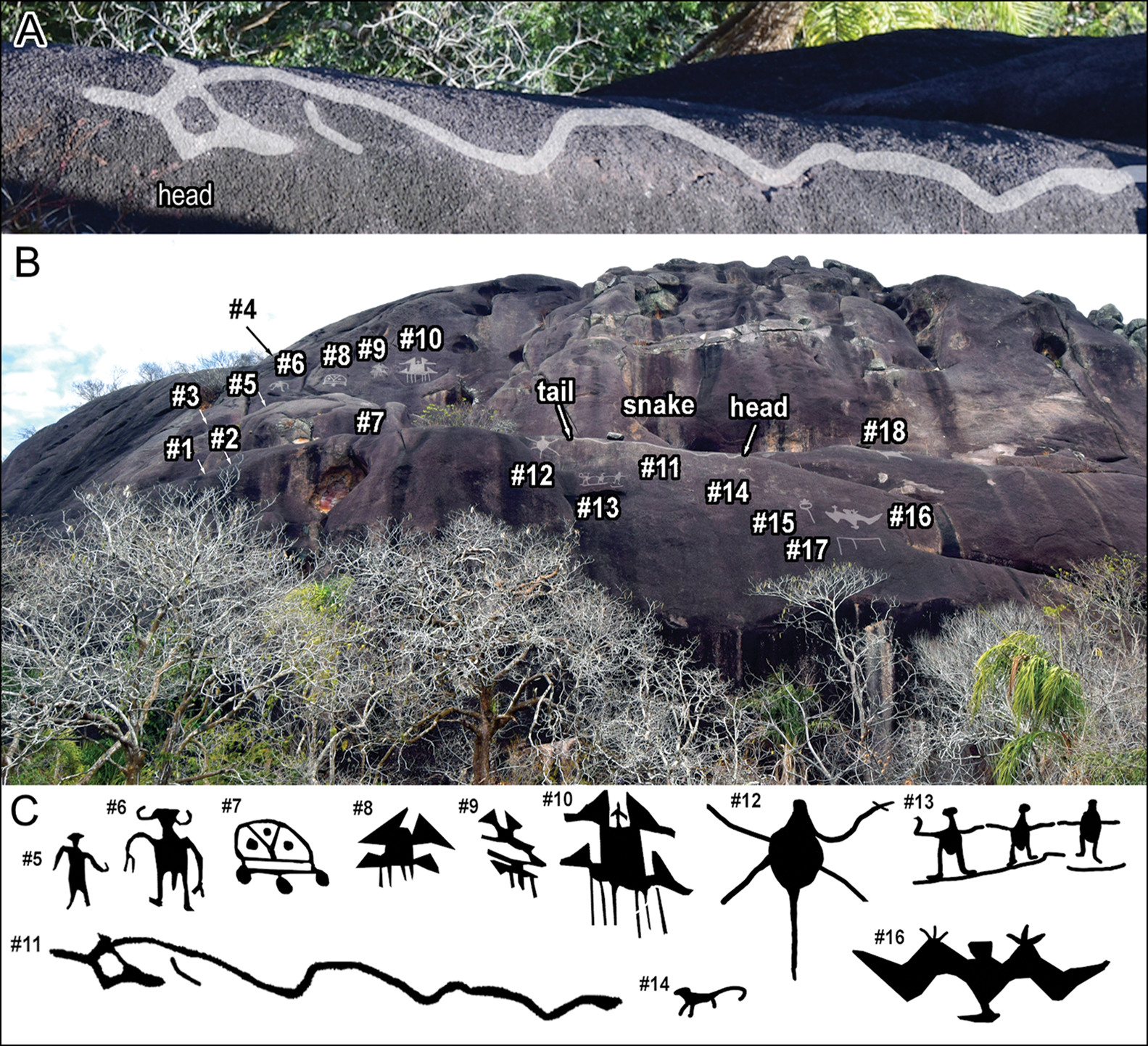
The diverse roles played by serpents highlight their importance to how Indigenous groups related to the environment, in particular the reproduction of society and the appropriation of landscapes through migratory voyages. We argue that the rendition of gigantic snakes in Orinoco rock art should be viewed in the context of these powerful and dangerous qualities. While any individual motif is unlikely to have a single function or meaning, the role of rock art strongly informs which locations are chosen to bear it (Boglár Reference Boglár1978; Greer Reference Greer1995; Overing Reference Overing and Arnold1996). We approach this issue with a geospatial analysis of the visual affordances of these sites against the backdrop of the broader Orinoco landscape. To appreciate this analysis, Figures 5 and 6 offer a sense of the scale of the snakes and their associated motifs.
Engravings at Cerro Dagua. A) top-down view of the approximately 16m-long monumental snake (#11) with enhanced overlay—the tail is not visible; B) a view of the south facade of Cerro Dagua showing the location of the monumental snake and 17 other figures, including (C) humans, mammals, reptiles and geometrics. The span of the bat-like figure (#16) is approximately 4m (figure by authors).
Landscape setting of gigantic snakes
The prominent placement of monumental panels indicates that they were intended to be seen from some distance (Figures 5 & 6); up close (<1m), the engravings are faint due to the shallow depth of the abrasions. The hills bearing monumental rock art are also visible from much further away than the rock art itself, and likely acted as reference points in the landscape. Our analysis focuses on this quality, aiming to 1) identify locations in the landscape from which these sites could be seen individually, 2) detect commonalities between panels bearing gigantic snakes and 3) map the positioning of snake motifs in relation to one another and the wider landscape.
Affordance viewsheds for the rock art sites bearing gigantic snakes were developed in the open-source geographic information system QGIS (v. 3.26). The precise locations of the Pirari-ame and Grulla snakes are awaiting confirmation; as such, we do not include them. Viewshed analysis is a geospatial method for modelling what can be seen from a given observer point, based on the input of an elevation model (Gillings Reference Gillings2015). Affordance viewsheds ask the opposite: from what proportion of the environment is a given point observable (Čučković Reference Čučković2016)? To answer this we use individual elevation model cells as potential observer points and project lines of sight through each neighbouring cell until blocked by a higher elevation cell. Here, we employ NASA shuttle radar topography mission 1-arc second data to generate observer points, offset by 1.7m to represent average observer height. The resulting viewsheds are summed and expressed as a proportion, where a cell value of 1 indicates a target is fully visible from all cells in a neighbourhood and a value of 0 represents no visibility. Following Gillings (Reference Gillings2015), we limit our analysis to viewpoints within 6880m of the gigantic snakes and correct for the Earth's curvature. We assume that dominant vegetation patterns—open savannas with riverine gallery forests—have remained stable over the last two millennia, the period in which most archaeological dates from the Middle Orinoco fall (Lozada Mendieta et al. Reference Lozada Mendieta2022). As noted, gigantic snake engravings are located high above the savanna and gallery forest on prominent inselbergs and will always have had commanding views regardless of the nature of vegetation cover at lower elevations. Inselbergs themselves do not have dense forest cover. Regional environmental reconstructions indicate an increase in fire activity despite a wetter climate over the last 3000 years, which would have suppressed forest expansion, except in the case of moriche palm stands in low-lying, wet terrain (Behling & Hooghiemstra Reference Behling and Hooghiemstra1998). If potential vegetation shifts towards forest have affected the reciprocal visibility of gigantic snakes in relation to their environment, these differences are likely to be minor.
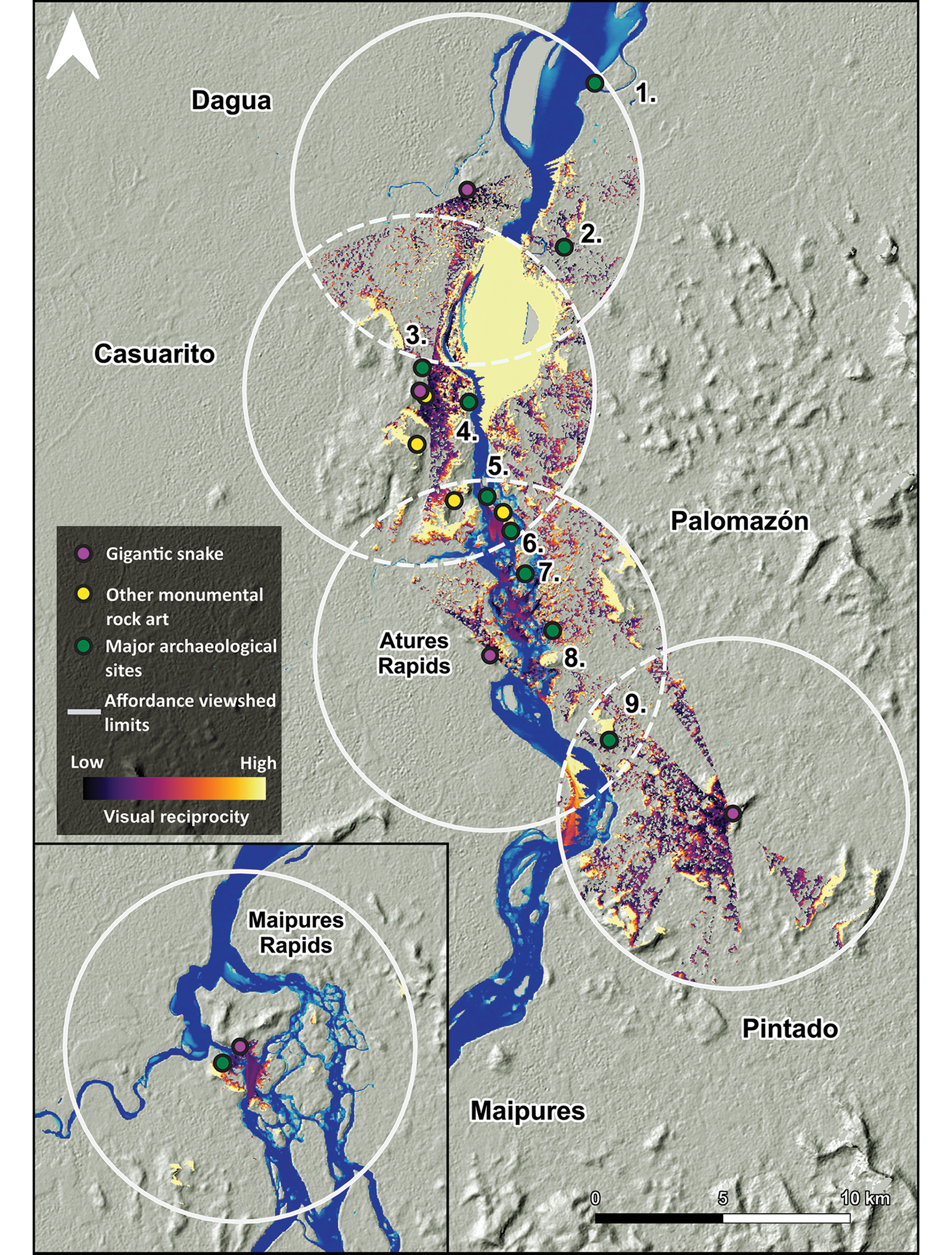
To investigate the visual reciprocity of the panels and the landscape, we intersect the affordance viewsheds with visibility maps generated from the snakes. Using the intersection as a mask, we extract the facing (expressed as an azimuth) of the original elevation map used to create the affordance viewsheds. We exclude flat areas with no facing, such as open water. In effect, our combined approach summarises: 1) the overall visibility of gigantic snake panels in their landscape setting (Figure 7); 2) the direction that observers face when viewing the snakes; and 3) the facings of the snakes towards the river (Figure 8).
Locations of gigantic snake motifs and their affordance viewsheds in relation to major archaeological sites and other monumental rock art. Sites: 1) Rabo Cochino; 2) Provincial; 3) Cueva 1; 4) Cueva 2; 5) Guayuco; 6) Picure; 7) Cucurital; 8) Cataniapo; 9) Cueva Ataruipe. The Maipures-2 snake (inset) is located approximately 50km to the south of the Atures Rapids (figure by authors).
Affordance viewshed analysis results. The circular histograms summarise the azimuths of observer points towards gigantic snakes (in 10° bins). Dashed red lines show the facing of the monumental panels bearing gigantic snake motifs outward across the landscape. In all cases there is visual reciprocity between the snakes and their environment (figure by authors).
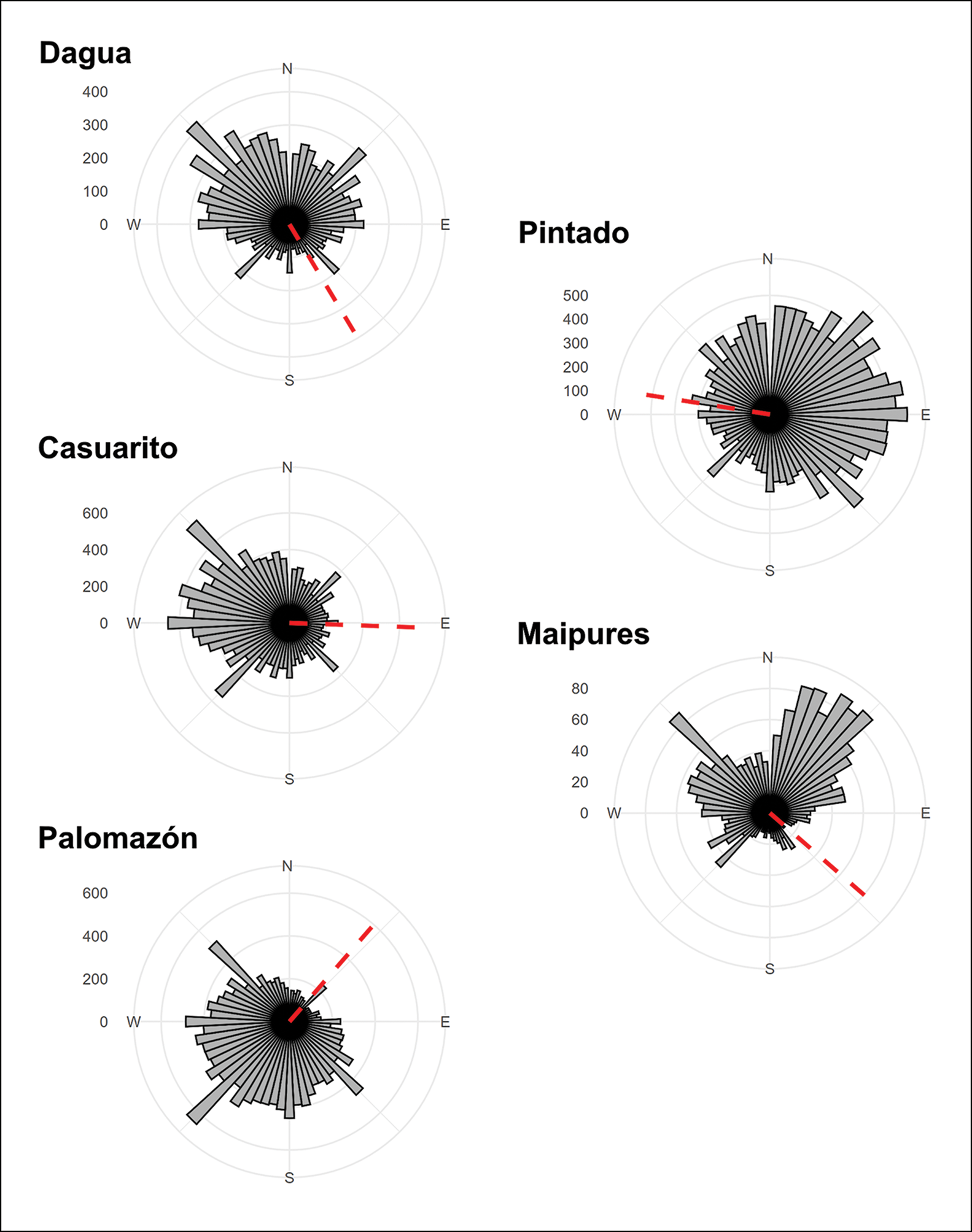
Our results show that, due to their elevation above the relatively modest relief of the riparian savannah in the study area, it is other prominent hills that provide the best viewing points for monumental engravings. Savannahs tend to have the overall lowest proportion of visibility, although sections of river provide views of snakes that are comparable to hills. Riverine areas of high visual affordance fall within and downstream of the Atures Rapids. The stretch of river adjacent to Dagua and Casuarito provides open views of these hills, while the southernmost snake in our sample (Cerro Maipures) has the most restricted visual catchment. Casuarito is notable for being mainly visible from the river. The Palomazón and Pintado panels appear to fall between these ranges, but still above the surrounding savannah values. In addition to prominent topographical features and the Orinoco River, other notable areas of high visual affordance include riverbanks. Major archaeological sites do not appear to coincide directly with areas of visual affordance but are more commonly located on the outskirts (Figure 7). In summary, the cultural significance and function of the rock art is likely connected to how these panels were experienced. Against this backdrop, the consistent visual association of gigantic snakes with the river, rapids and riverbanks is particularly noteworthy considering the aquatic and voyaging associations of large snakes in Indigenous myth.
The role of monumental rock art
Our results demonstrate the profound influence of artistic practices on pre-Columbian cultural landscapes. Even considering the exceptional diversity and size of many northern South American rock art sites (von Hildebrand Reference von Hildebrand1975; Castaño-Uribe Reference Castaño-Uribe2019; Morcote-Ríos et al. Reference Morcote-Ríos, Aceituno, Iriarte, Robinson and Chaparro-Cárdenas2021), Middle Orinoco monumental engravings represent a unique tradition of large-scale artistic production. Ethnohistorical and archaeological data illustrate the multi-ethnic character of Indigenous societies in the region (Rivero Reference Rivero1883; Morey & Morey Reference Morey and Morey1975; Arellano Moreno Reference Arellano Moreno1982; Gassón Reference Gassón2000), with recent work showing how symbolic material culture was key to negotiating identities in an environment of sustained cultural interaction (Lozada Mendieta et al. Reference Lozada Mendieta2022). The potential associations of these sites with Indigenous myths today underscore the central role of rock art in the appropriation of contested landscapes (Riris Reference Riris2017). With reference to the perilous connotations of gigantic snakes emphasised in, for example, Piaroa and Warekena (Arawak) myths alike, we suggest that pre-Columbian people perceived the gigantic snakes as an ever-present reminder of ancient conflicts and negotiations between supernatural beings and humans. As cultural agents, these motifs would need to be related to accordingly. Following Scaramelli and Scaramelli (Reference Scaramelli, Tarble de Scaramelli, Troncoso, Armstrong and Nash2018: 96), our analysis of monumental rock art suggests that panels likely acted as markers on the edges of group boundaries, and as a protective agent within domestic spaces. The visibility and prominence of gigantic snake outcrops from the river and riverbanks emphasises this notion.
Taken together, we argue the gigantic snake panels comprise a potential ‘multi-centric mythscape’ (Hugh-Jones Reference Hugh-Jones2016; Wright et al. Reference Wright, González-Ñáñez, Leal, Hobart and Zarcone2017), in which cosmological concepts and narratives were inscribed into the landscape to mark common understandings of how the world—lived in by humans—was shaped by powerful forces. Their repetition at regular intervals in the landscape and shared conventions of representation contributes a novel facet to our overall understanding of rock art in the Middle and Upper Orinoco. These panels were central to Indigenous placemaking along the rivers of lowland South America, and gigantic snakes were pre-eminent figures in the myths that can be tied to this artistic practice.
Separately, we note that these monumental engravings are also some of the largest individual rock art motifs in the world. Giraffe motifs of comparable size to Middle Orinoco monumental quadrupeds (between 1m and 5.4m) are known in Dabous, Niger (Coulson Reference Coulson, Clottes, Denyer, Durighello and Titren2007), while monumental-scale elk and whale motifs are reported in Nordland, Norway (Mandt & Lødøen Reference Mandt and Lødøen2005). To our knowledge, however, there are no motifs of comparable size—several tens of metres on a side—to the Orinoco monumental snakes anywhere in the world. Collectively, our extensive archaeological surveys, a wealth of ethnographic information and geospatial modelling shed additional light on the role of rock art among the pre-Columbian societies of the area, although the reasons and mechanisms behind the emergence of this distinct monumental tradition need further exploration.
Conclusion
We anticipate that future surveys will continue to encounter monumental rock art sites along the Orinoco River and its tributaries. The precise chronology of these sites remains unresolved, despite apparent artistic parallels in late pre-Columbian material culture. The representation of similar but smaller motifs in other rock art loci (Figure 4) likewise needs to be explored in relation to the monumental panels. Further characterisation of the range of variation within monumental sites will help to clarify how they were used and perceived, including in sites located further away from the Orinoco River that lack snakes, such as Cerro Humeante. Additional exploratory fieldwork is needed to determine their full geographical distribution, particularly in the Upper Orinoco, the Casiquiare and towards the Guiana Shield. We hypothesise an absence of monumental rock art in regions that are historically less characterised by ethnic pluralism, for example in Piaroa-dominated highlands immediately to the east of our study area. This would serve to affirm their role as markers of group identity along contested and variously negotiated stretches of the Orinoco River. The potential occurrence of gigantic snakes upstream of the Guaviare and Atabapo confluence with the Orinoco awaits confirmation. Future work must equally focus on engaging Indigenous groups to deepen our knowledge of their perspectives and understandings about the roles, significance and meanings of the images displayed in rock art sites. Concordantly, it is vital that monumental rock art sites are afforded protection under national and international legislative frameworks to ensure their preservation and continued study. The Indigenous peoples of the Orinoco region must be central to this process.
Acknowledgements
The authors thank the Instituto de Patriomonio Cultural and Instituto Venezolano de Investigaciones Científicas (Caracas, Venezuela) and the Instituto Colombiano de Antropología e Historia (Bogotá, Colombia) for their support of this research. In Colombia, Fernando Montejo expedited the permits to conduct archaeological research in the Department of Vichada (Authorisation Nos. 6796 to JRO, 6797 to PR and 8752 to NLM), which was greatly facilitated through an institutional collaboration with José Socarrás-Pimienta at the Universidad del Externado, Bogotá. The authors also thank Universidad de Los Andes, the Parque Nacional Natural El Tuparro and the collaboration of Fabian Quiceno, Sergio Estrada Villegas, Omar Ortiz, Mirte Korpershoek, Rosevel Rodríguez and Dumar Chávez. In Venezuela, Lilliam Arvelo, Rafael Gassón and Erika Wagner were crucial to acquiring permits and acted generously in support of our fieldwork and data collection. Juan Carlos García and Juanita Escobar are especially thanked for providing sketches from Caño Grulla and organising field logistics in Puerto Carreño and for giving access to photographs of key sites.
Funding statement
Fieldwork, data collection and analysis were funded by a Leverhulme Trust Research Grant (RPG-234-2014) and the Fundación de Investigaciones Arqueológicas Nacionales-Colombia (FIAN-Proyecto 505, 2018) to JRO, and a British Academy Postdoctoral Fellowship (PF2\180065) and Society of Antiquaries Research Grant awarded to PR. NLM was supported by funding from the Centro de Creación e Investigación de la Facultad de Artes y Humanidades de la Universidad de Los Andes. PR is funded by the Arts and Humanities Research Council (AH/X002217/1).




 Open access

