


The combination of camouflage colouration, slow movement, solitary habits and cryptic behaviour makes some species of snakes difficult to detect (Rocha & Silva, Reference Rocha and Silva2015). In addition, study areas are often extensive, trained observers are few, and survey time, effort and resources are limited. In combination, these factors contribute to a low detection rate of individuals and lack of data to assess their populations (Steen, Reference Steen2010).
These difficulties also apply in the case of two species of the genus Lachesis, which are commonly referred to as bushmasters (Wied-Neuwied, 1824). These are the largest neotropical venomous snakes, reaching up to 3 m in length (Zamudio & Greene, Reference Zamudio and Greene1997; Hamdan et al., Reference Hamdan, Sandro, Bonatto, Rödder, Seixas, Santos and Santana2024). They are terrestrial, nocturnal, oviparous vipers living at low population densities, employing ambush hunting strategies and using burrows as shelters (Campbell & Lamar, Reference Campbell and Lamar2004). Until 2024 they were considered to be two subspecies of Lachesis muta: L. muta muta and L. muta rhombeata (Zamudio & Greene, Reference Zamudio and Greene1997). However, a recent taxonomic review indicated they are actually two distinct species, with L. muta concentrated in the Amazon and L. rhombeata endemic to the Brazilian Atlantic Forest (Hamdan et al., Reference Hamdan, Sandro, Bonatto, Rödder, Seixas, Santos and Santana2024). Lachesis muta is categorized as Least Concern on the IUCN Red List (Gutiérrez-Cárdenas et al. Reference Gutiérrez-Cárdenas, Rivas, Caicedo, Ouboter, Hoogmoed and Murphy2021) but since being recognized as a separate species, L. rhombeata has not yet been assessed according to the criteria of the Brazilian and the IUCN Red Lists. However, when this taxon was considered a subspecies, the IUCN Red List (Martins & Marques, Reference Martins and Marques2000) and regional Red Lists in Brazil (for the states of Ceará, Rio de Janeiro, Minas Gerais, Espírito Santo, Bahia and Pernambuco) categorized it as Vulnerable (Martins & Molina, Reference Martins and Molina2008; Navega-Gonçalves & Porto, Reference Navega-Gonçalves and Porto2016; SEMA, 2022). Therefore, following its designation as a separate species, a reassessment of its conservation status is necessary.
Conducting systematic visual surveys for snakes involves considerable effort, requiring numerous hours in the field and/or large teams of researchers (Steen, Reference Steen2010). An alternative way to gather information is through citizen science, using observations made by non-specialists (Silva et al., Reference Silva, Colombini, Moura-Da-Silva, Souza, Monteiro and Bernarde2019a,Reference Silva, Corrêa, Gennari, Dias, Abrahão and Landrozb; Wangyal et al., Reference Wangyal, Bower, Tshewang, Wangi, Rinchen, Phutsho and Tashi2020). Here, we present citizen science as a valuable tool to improve L. rhombeata surveys compared to traditional visual censuses.
We conducted fieldwork in the Baturité Massif, in the north-eastern Brazilian state of Ceará, during 2021–2023. This area is an Atlantic Forest remnant with Amazonian influence within the semi-arid Caatinga Domain, at an elevation of 800–1,115 m (Silveira et al., Reference Silveira, Loiola, Gomes, Lima-Ver, Oliveira and Silva2020). It is characterized by mild conditions, with temperatures ranging from 13 °C to 27 °C throughout the year and > 1,200 mm of annual rainfall (Junior & Caracristi, Reference Junior and Caracristi2022).
We compiled data on L. rhombeata from the literature and online databases, and from specimens preserved at the Museu de História Natural do Ceará Prof. Dias da Rocha (MHNCE) and the Herpetological Collection of the Federal University of Ceará (CH-UFC). During May 2021–December 2023, we conducted searches using Google Scholar (Google, 2021), PubMed (NIH, 2021) and Web of Science (Clarivate, USA), without a time filter and using the following keywords: Lachesis, Lachesis muta, Lachesis muta rhombeata, north-eastern Brazil, and Ceará.
We conducted field studies during July–September 2022 and in February 2023. We selected these months because they cover the peak activity period of L. rhombeata, based on its reproductive cycle and the local environmental conditions, notably lower temperatures and increased humidity (Alves et al., Reference Alves, Argolo and Carvalho2014; Souza & Almeida-Santos, Reference Souza and Almeida-Santos2022). The species is an ambush predator that typically exhibits low movement rates but becomes more active during the breeding season as it searches for mates, increasing the probability of encounters (Campbell & Lamar, Reference Campbell and Lamar2004).
We surveyed four randomly selected plots at each of six sites (25 × 25 m; marked with coloured tape), totalling 24 plots and covering an area of 15,000 m2 (Fig. 1). Surveys were conducted by a team of four observers (TC, RFF, JAA, and LSL), who simultaneously scanned every possible microhabitat using herpetological hooks and torches. Vegetation was carefully parted, fallen logs were turned over, and cavities were inspected. During 8 days, two surveys were carried out per day in each plot: one in the morning, between 06.00 and 12.00, and another at night, between 18.00 and 00.00, with the four observers starting from the same side of the plot and returning while searching all possible microhabitats for individuals. The fieldwork was carried out over a period of 24 days, with a total sampling effort of 218 hours, including 62 hours of survey time per plot and 54 hours per observer. No evidence of Lachesis rhombeata was found during any of the surveys.
Location of the six survey sites and occurrence records of bushmasters Lachesis rhombeata in the Baturité Massif, Ceará, Brazil. Two of the historical records (Records 1 and 2; see Supplementary Table 1) are not distinguishable on the map because they are too close together and so overlap. (Readers of the printed journal are referred to the online article for a colour version of this figure.)

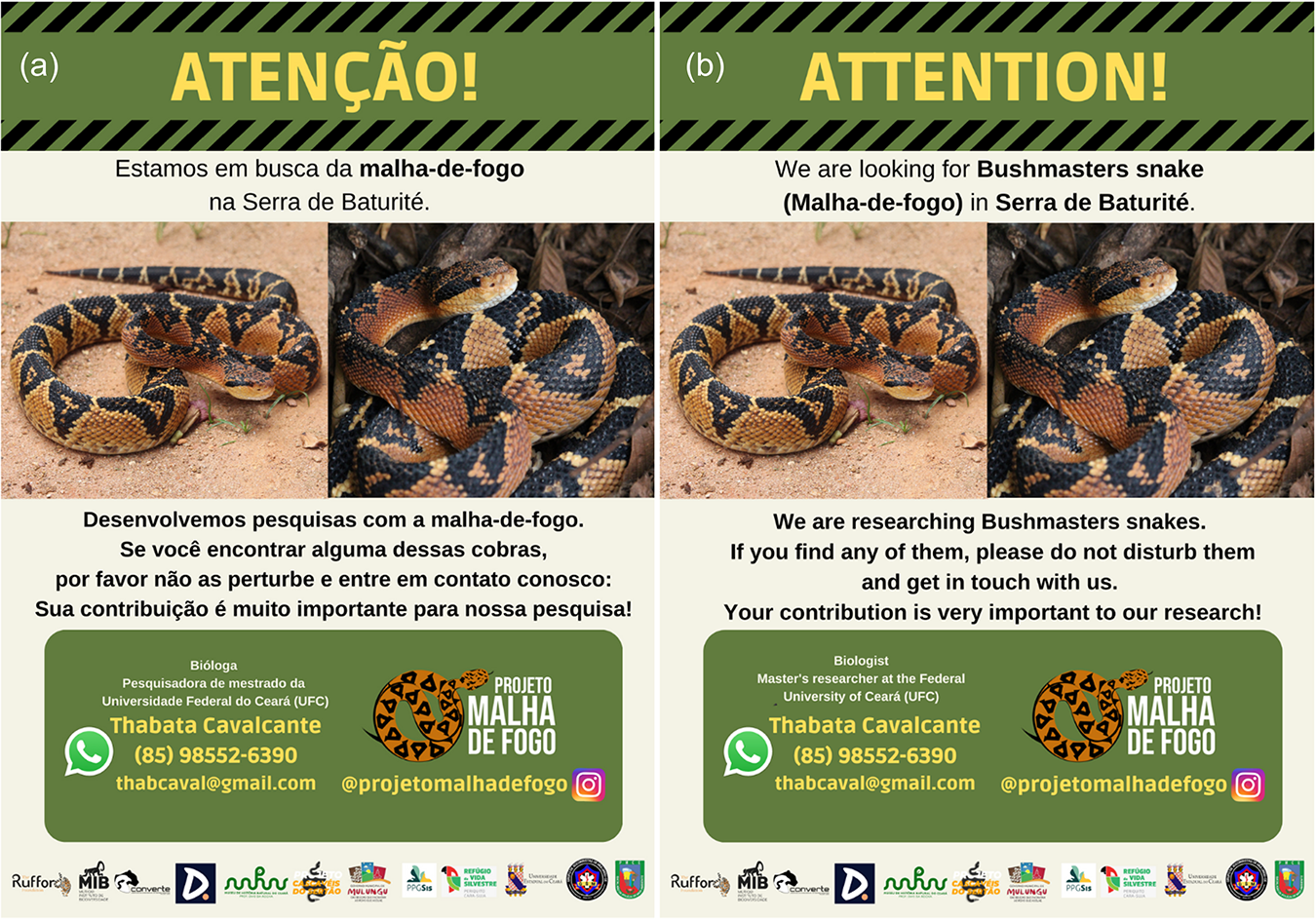
From October 2021 to February 2023, we engaged with local people by distributing posters featuring our research objectives, photographs of the snake and contact details (Fig. 2). We posted this material via social media channels (Instagram, 2021; WhatsApp, 2021). We also distributed posters in the four municipalities of Baturité Massif (Baturité, Mulungu, Pacoti, Guaramiranga) during May 2021–August 2023. We encouraged local community members to send us photographs and location details of any bushmaster snakes they encountered. Using this information, we recorded the geographical coordinates of the snakes and safely captured them for measurement.
Poster distributed to the communities of the Baturité Massif, Ceará, Brazil, regarding bushmasters Lachesis rhombeata: (a) original poster in Portuguese; (b) poster translated into English.

Our search of the literature and museum/university collections yielded 10 records of L. rhombeata dating from 1990–2020. We obtained 110 georeferenced records (photographs and videos) provided by 61 local people and we captured or collected 28 specimens (15 alive, 13 dead), including 15 adult males, 11 adult females and two juvenile females. WhatsApp was the most frequently used communication channel (n=95), followed by Instagram (n=8), phone calls and personal communications (n=7; Supplementary Table 1). The live individuals were transported to the MHNCE laboratory, where they were measured, sexed, photographed and sampled for biological material. Each snake was individually marked with a small cut on the ventral scales just above the cloacal scale to allow identification in case of recapture. After processing, the animals were released into the State Environmental Protection Area of the Baturité Massif, within the same municipalities where they had been captured. For each individual, we recorded snout–vent length, tail length, sex and body mass (kg) to assess the biological profile of the population, and collected tissue samples for genetic analysis. Specimens found dead were deposited in the MHNCE collection. The main causes of death were injuries inflicted by agricultural tools (e.g. knives, machetes and hoes) and vehicular collisions (cars or motorcycles).
We organized photo and video records of L. rhombeata individuals by location and date/time of sighting, counting multiple observations of the same individual on the same day as a single record. However, in some instances where a snake had been recorded by a citizen scientist but had not been captured for individual marking, we were unable to determine whether records from different dates and in different locations were of the same individual animal or distinct individuals.
Although the visual survey effort was adequate, the lack of sightings is unsurprising. Lachesis species are characterized by cryptic colouration, low mobility, low population density and a dispersed distribution, making them difficult to detect (Campbell & Lamar, Reference Campbell and Lamar2004). Few individuals have been documented since the first record of the species (Borges-Nojosa & Lima-Verde, Reference Borges-Nojosa and Lima-Verde1999), despite decades of research (Roberto & Loebmann, Reference Roberto and Loebmann2016). However, citizen science is a promising new source of data, yielding more records of this rare snake in its natural habitat as well as in anthropogenic environments, such as streets and avenues (Supplementary Plate 1), compared to historical records from the last 25 years (Roberto & Loebmann, Reference Roberto and Loebmann2016). Although the species is large and easily observable in open areas, we did not consider visual acuity to be a limiting factor in our field searches. Instead, we regarded the considerable movement of people and animals in and out of the forest fragments as the principal factor influencing the communities’ encounters with the animals, with a larger number of people increasing the chances of an encounter with the snakes.
Our findings underline the value of citizen science for gathering data on rare and elusive animals. The involvement of local communities enhanced our survey efforts through the largely increased number of observers operating in the study area on a daily basis (Goiran & Shine, Reference Goiran and Shine2019; Wangyal et al., Reference Wangyal, Bower, Tshewang, Wangi, Rinchen, Phutsho and Tashi2020). We were unable to locate any bushmasters using traditional ecological survey methods because of their sparse distribution and use of underground burrows (Barrio-Ámoros et al., Reference Barrio-Ámoros, Corrales, Rodríguez, Culebras, Dwyer and Flores2020). In contrast, snake encounters by local people carrying out agricultural activities are commonly reported across Brazil (Silva et al., Reference Silva, Fonseca, Silva, Amaral, Ortega and Oliveira2020). We were able to record such encounters by engaging directly with local communities, combined with the use of social media, resulting in a high number of records and captures of L. rhombeata. Furthermore, our citizen science approach also led to the first record of another viper species for Ceará state, the green jararaca Bothrops bilineatus (Cavalcante et al., Reference Cavalcante, Freire-Filho, Andrade-Oliveira, Lima, Cassiano-Lima, Fernandes-Ferreira and Gonzalez2022).
This included visits to locations where bushmasters had been sighted, the publication of regular sighting reports shared on the project’s Instagram page (Projeto Malha de Fogo, 2022), as well as quarterly reports on the website of The Rufford Foundation (Cavalcante, Reference Cavalcante2022), along with conversations with the local population to keep them informed and to respond to any questions. These included, for example, which procedures would be carried out with captured specimens, biological information (e.g. size, weight and sex) and issues related to envenomations. We also carried out environmental education activities using actions and educational materials focused on information about venomous snakes. These activities were conducted in both formal and non-formal spaces, such as schools, public squares and at tourism events (Supplementary Plate 2).
Through the involvement of local communities, we gained a clearer understanding of the distribution of L. rhombeata and the threats it faces, such as indiscriminate killing by locals. In the Baturité Massif, conflicts involving this species have been documented because of the risk it poses to humans and domestic animals (Fernandes-Ferreira et al., Reference Fernandes-Ferreira, Mendonça, Cruz, Borges-Nojosa and Alves2013). The use of L. rhombeata for food and ornamental purposes has also been reported, but only rarely (Fernandes-Ferreira et al., Reference Fernandes-Ferreira, Mendonça, Cruz, Borges-Nojosa and Alves2013). Moreover, the species is affected by roadkill as well as habitat loss and fragmentation as a result of ongoing deforestation. These factors contributed to the categorization of the species as Critically Endangered in the state of Ceará in 2022 (SEMA, 2022). We also used the collected data to improve the taxonomic knowledge of the population. In addition, the individuals collected during our work were used in other studies, such as a taxonomic review of the Brazilian populations of Lachesis (Hamdan et al., Reference Hamdan, Sandro, Bonatto, Rödder, Seixas, Santos and Santana2024), which recognized them as two different species by analysing molecular and morphological data. Citizen science also played a crucial role in the rediscovery of the Endangered tree boa Corallus cropanii in Brazil, which had not been sighted for 64 years (Silva et al., Reference Silva, Corrêa, Gennari, Dias, Abrahão and Landroz2019b). Importantly, community involvement in conservation projects has driven significant behavioural changes (Lewandowski & Oberhauser, Reference Lewandowski and Oberhauser2017). In this study, local communities adopted an alert system for animal rescues and the sharing of information. In this way citizen science can serve as an important bridge between conservationists and communities, raising awareness amongst local people about species often perceived as repulsive and improving our understanding of the challenges of human–wildlife coexistence.
Author contributions
Study design, data analysis, writing: TC, RCG, HF-F; data collection: TC, RF-F, JAA-O, LSL; revision: all authors.
Acknowledgements
We thank the local communities of the Baturité Massif for their help and support; and The Rufford Foundation (#37317-1), Log Nature and Doppel Store for financial support to Projeto Malha de Fogo. This research was developed through the post-graduate programme in Systematics, Use and Conservation of Biodiversity at the Federal University of Ceará. TC and RF-F were supported by Coordenação de Aperfeiçoamento Pessoal de Nível Superior (CAPES; #23067.047970/2021; #88887.801195/2023). RCG and HF-F were supported by Fundação Cearense de Apoio ao Desenvolvimento Científico e Tecnológico (FUNCAP; #11212233/2022; #08339530/2023).
Conflicts of interest
None.
Ethical standards
Fieldwork activities, procedures with animals and interviews with people were conducted with permission from Instituto Chico Mendes de Conservação da Biodiversidade (#79537), Secretaria do Meio Ambiente do Estado do Ceará (#11235460/2021), Comitê de Ética de Experimentação Animal (#7361210922) and Comitê de Ética em Pesquisa da Universidade Federal do Ceará (#5801754). As such, our research abided by the Oryx guidelines on ethical standards.
Data availability
The data supporting our findings are available in the Supplementary Material.



 Open access

