


INTRODUCTION
Theories of style variation—how a person varies their way of speaking from moment to moment—have viewed the individual in very different ways. Style was first cast in terms of attention paid to speech, with reduced attention corresponding to less self-conscious, less prestige-oriented speech (Labov Reference Labov1972). Later work critiqued this unidimensional focus and expanded models of style to include factors of audience, interpersonal dynamics, identity projection, and persona (e.g. Coupland Reference Coupland1980, Reference Coupland1985; Bell Reference Bell1984; Eckert & Rickford Reference Bowden, Steinhauer, Sanz; and Ullman2001; Schilling-Estes Reference Schilling-Estes, Chambers, Trudgill and Schilling-Estes2002; Eckert Reference Eckert2008). Audience- and speaker-design models are now sometimes seen as having ‘very largely supplanted the attention to speech explanation’ (Coupland Reference Coupland2007:54).
The present study proposes that interactionally oriented approaches should not lose sight of the cognitive basis of Labov's original model. The study shows that ‘both adaptation to different audiences and different degrees of audio-monitoring are involved in style-shifting’ (Labov Reference Labov2001:87). Indeed, multiple attentional targets are shown to be pervasive in routine interaction, affecting an individual's ability to consistently attend to style design and giving rise to an intricate interplay of audience, attention, and speaker design in real time. A first-learned variety may dominate in moments of heightened attentional load for some speakers due to ease of processing, a phenomenon I describe as style dominance, on a par with language dominance in bilinguals. The study highlights such effects in real-time style variation, but also investigates their intimate, reflexive relationship to agentive speaker choices in style design.
Style dominance is examined here through a close study of three dimensions of style variation in one individual: Fareed Zakaria, a prominent Indian American journalist and television personality. Zakaria is bidialectal, with a style repertoire that incorporates American English (AmE) and Indian English (IndE) lects, used variably with different audiences. First, the study shows a dramatic influence of audience in Zakaria's style choices—a prototypical case of audience design. However, close quantitative tracking of his style-shifts, along with speech-rate changes and multiple attentional targets, points to a second style dynamic, namely slightly greater cognitive ease of his IndE style at points of high cognitive demand, irrespective of audience. In the final analysis, I relate this style dominance to Zakaria's stance-taking choices in interaction.
The findings have several implications for understanding style variation. First, the study extends the notion of bilingual language dominance (Hamers & Blanc Reference Hamers and Blanc2000:8) to styles within an individual's native language, with similar effects of access, exposure, and use of different styles over their lifetime. Sociolinguists have long acknowledged variable access and control of styles or lects (e.g. Le Page & Tabouret-Keller Reference Le Page and Tabouret-Keller1985; Schilling-Estes Reference Schilling-Estes2004:186), particularly standard varieties (Romaine Reference Romaine2000:87). The notion of style dominance formalizes this as a general feature of lifelong style development in individuals. Second, style dominance calls for a better understanding of real-time attentional load during interaction, as the greater processing ease of a particular style may cause it to surface for reasons other than social meaning. The potential for discrepancy between an individual's subjective target and their actual production was noted in early Communication Accommodation Theory (Thakerar, Giles, & Cheshire Reference Thakerar, Giles, Cheshire, Giles and Clair1982) and underlines the importance of knowing an individual's biography of style acquisition. Finally, the study proposes a particular relationship between style dominance and agency. Rather than seeing style dominance simply as a cognitive constraint, I suggest that speakers may also reflexively exploit the primacy of their dominant style—through a process of biographical indexicality—to perform a range of unvarnished ‘real me’ stances in interaction.
In what follows, I first briefly review the literature on speech style and attention. I then introduce the case-study individual and the methodology used for real-time quantitative interactional analysis, followed by the three-part analysis of audience, attention, and speaker design.
STYLE AND ATTENTION
Labov's original treatment of style famously asserted that ‘styles can be ranged along a single dimension, measured by the amount of attention paid to speech’ (Reference Labov1972:208). When a person is more conscious of their speech, they may shift towards a more formal style, responding to prestige norms of their community. This led to the classic design of sociolinguistic interviews to elicit degrees of awareness, with narratives ideally triggering such great displacement of the speaker's attention as to render attention-to-speech minimal, allowing the vernacular to emerge.
Early critiques (e.g. Coupland Reference Coupland1980; Cheshire Reference Cheshire1982; Bell Reference Bell1984; Le Page & Tabouret-Keller Reference Le Page and Tabouret-Keller1985; Rickford & McNair-Knox Reference Rickford, McNair-Knox, Biber and Finegan1994) questioned the explanatory scope of this model, and Labov subsequently clarified that attention-to-speech effects should be seen more narrowly as ‘heuristic devices to obtain a range of behaviors within the individual interview, not as a general theory of style shifting’ (Labov Reference Labov2006:59; also Reference Labov1972:97, Reference Labov2001:87). Later models turned instead to factors such as audience (Bell Reference Bell1984, Reference Bell, Eckert and Rickford2001) and the presentation of self and persona (Coupland Reference Coupland1985, Reference Coupland2001; Eckert Reference Eckert2008).
Being ‘firmly rooted in social constructionist approaches’ (Schilling-Estes Reference Schilling-Estes, Chambers, Trudgill and Schilling-Estes2002:389), these models have moved away from a key tenet of Labov's original proposal, namely that some patterns of style-shifting are grounded in cognitive factors of acquisition and processing. The vernacular was argued to emerge with inattention because it is ‘the form of language first-learned, most perfectly acquired, which we use automatically and unthinkingly in conversation with family and intimate friends’ (Labov Reference Labov2013:3). The performative turn in style analysis has been crucial in expanding our understandings of style in interaction, but risks losing sight of these cognitive effects and implicitly assuming equal control of variants in an individual's repertoire.
Questions of ability and control of styles have been noted in the literature, in relation to creoles (Le Page & Tabouret-Keller Reference Le Page and Tabouret-Keller1985), second dialect acquisition and shift (e.g. Auer, Hinskens, & Kerswill Reference Auer, Hinskens and Kerswill2005; Tagliamonte & Molfenter Reference Tagliamonte and Molfenter2007; Siegel Reference Siegel2010; Smith & Durham Reference Smith and Durham2012; Fix Reference Fix2013; Nycz Reference Nycz2015), crossing, passing, and performative range (e.g. Cutler Reference Cutler1999; Piller Reference Piller2002; Sweetland Reference Sweetland2002; Coupland Reference Coupland2007:103; Guy & Cutler Reference Guy and Cutler2011; Zimman Reference Zimman and Babel2016), routine variation (Schilling-Estes Reference Schilling-Estes2004; Kendall Reference Kendall2013), perception (e.g. Babel Reference Babel2016), and dialect use in bilinguals (e.g. Poplack Reference Poplack1978; Zentella Reference Zentella1997). Work that looks closely at second dialect use in particular has often focused on ultimate attainment, perceptual awareness, or agentive use, with less focus on differential control of variants in ongoing interaction. Kendall (Reference Kendall2009) is an important exception; as in the present work, he advocated a renewed focus on the cognitive underpinnings of attention-to-speech in real time, invoking Chafe's (Reference Chafe1994) exploration of the ‘flow and displacement of consciousness’ in discourse. Hall-Lew, Starr, & Coppock (Reference Hall-Lew, Starr;, Coppock, Hernández-Campoy and Cutillas-Espinosa2012) also note that public speakers may revert to their default forms over time in speeches due to attentional shifts. Most recently, Abel & Babel (Reference Abel and Babel2017) have shown that, as the difficulty of a collaborative task increases, dyads accommodate less to each other's speech, pointing to an effect of attentional demand.
In psycholinguistics, processing and control have typically been examined by looking at language produced under increased cognitive or attentional load. Attention is a limited capacity resource (Kahneman Reference Kahneman1973; Allport, Styles, & Hsieh Reference Allport, Styles, Hsieh, Umilta and Moscovitch1994), and divided attention is well-known to disrupt monolingual speech production in many ways — recall, conceptualization, grammatical encoding, and articulation (e.g. Lively, Pisoni, Van Summers & Bernacki Reference Lively, Pisoni, Van Summers and Bernacki1993; Roelofs & Piai Reference Roelofs and Piai2011). In bilinguals, such effects may depend on how efficiently speakers can orchestrate attention to parallel processing when speaking (Robinson Reference Robinson, Doughty and Long2005), with greater proficiency in a language corresponding to greater ease of processing under high cognitive load (de Bot Reference de Bot1992; Sorace Reference Sorace2006).
Attentional multitasking could affect style-shifting in a similar way, particularly the control and execution of later-learned or less used styles.Footnote 1 Labov's characterization of the vernacular as the variety that emerges ‘automatically and unthinkingly’ certainly predicts such effects, as seen in narratives. This effect may be much more general: When a speaker's attention is significantly focused on some target other than speech design during interaction, this should put pressure on their ability to simultaneously control and design their stylistic output, as attested in Abel & Babel (Reference Abel and Babel2017). If an individual has a clear first-learned or dominant vernacular, this style might emerge at such moments. Part of the present analysis therefore looks at naturally occurring moments of increased attentional pressure in conversation.
Distinguishing between audience and attentional effects in style-shifting has been seen as a methodological challenge (Labov Reference Labov2001:87), but moments of high cognitive demand provide us with a useful testing ground: When a speaker is under pressure to persuade a skeptical audience, the audience design model might predict ‘mirror-image’ style choices with contrasting audiences, for example, more AmE with American audiences and more IndE with Indian audiences.Footnote 2 If these moments involve greater cognitive pressure to build a persuasive argument, a monitoring or attention model makes a different prediction, namely that an individual may default to their ‘easier’ style, irrespective of audience. The analysis uses such moments to explore the relative role of attentional load, audience, and speaker design in style variation.
DATA
The data for this study come from a single individual: Fareed Zakaria, host of a weekly public affairs show on CNN since 2008 and well-known in the United States as an author and media commentator on politics and international relations, and as an editor and columnist for many mainstream publications, including Newsweek International and The Washington Post.
Zakaria is of interest as a case study for style variation because of his sustained use of a wide bilectal range, spanning from IndE to AmE. (I use the term style for most alternations between variants in a repertoire and lect or dialect for more recognized or enregistered style clusters, e.g. AmE.) As I show below, Zakaria's use of these two lects is long-standing and proficient enough to represent a good test case for the absence of any underlying default vernacular. Furthermore, his status as a media personality means extensive video recordings of him are available with a range of American and Indian interviewers and audiences over a period of twenty years. As a native speaker of English who has expanded his English repertoire over his lifetime, Zakaria is similar to individuals who adopt an additional, often supralocal or standard, register in early adulthood (Eckert Reference Eckert and Coulmas1997:164; Rickford & Price Reference Rickford, McNair-Knox and Price2013). The findings may therefore apply not just to bidialectal speakers but to any individual with a history of sequential acquisition of styles.
Zakaria was born in Mumbai, India, in 1964 into a prominent upper-middle class family, his parents established figures in politics and journalism. He attended a prestigious English-medium private school and grew up as a native English-speaking multilingual. He migrated to the US immediately after school (aged seventeen), attended Yale University, and quickly became integrated into American political life, acting as President of the Yale Political Union and becoming managing editor of Foreign Affairs by the age of twenty-eight. He is married to an American, has American children, describes himself as an American, and commonly refers to the US as ‘we’ in political analysis. In an early 1998 broadcast interview, Zakaria used a well-established, comprehensive American accent (more American than his current style) that he likely developed soon after migrating as a teenager. At the time of this study, he had spent twice as long in the US (thirty-five years) as in India (seventeen years).
This biography attests to long-term immersion in his later-learned lect, and the analysis demonstrates substantial bilectal control. The few studies on a critical age for second dialect (D2) acquisition would tend to treat seventeen as outside the range for nativelike acquisition (e.g. Payne Reference Payne and Labov1980; but see Fix Reference Fix2013 on exceptions to age effects in D2 acquisition and Siegel Reference Siegel2010:84ff for an overview).Footnote 3 However, this study is not concerned with perfect ultimate attainment, but rather with Zakaria's real-time control of his variable phonetic forms. A second language can come to function like a first language in terms of brain behavior over time (Bowden et al. Reference Bowden, Steinhauer, Sanz; and Ullman2013), and this could in principle be true for second dialects as well.
The extracts to be analysed are taken from the extensive body of broadcast recordings of Zakaria in interviews and panel discussions in the US and in India over twenty years. They were retrieved from the public domain (charlierose.com, ndtv.com, youtube.com) and were selected based on their occurrence within a ten-year timespan (2003–2013), similarity in their format (public-panel discussions or one-to-one interviews for broadcast), and similarity in topics—almost exclusively foreign policy and international relations—to help control for topic effects.
METHODOLOGY
Style-shifting cannot be assessed for design, attention, and control phenomena by looking at overall rates of use. For example, if we find that Zakaria uses 60% AmE variants with American audiences and 75% IndE variants with Indian audiences, do we interpret the discrepancy in terms of design or ability? He may be choosing to affiliate more strongly with Indian audiences, he may be trying but failing to accommodate 100% in both settings, or he may be affiliating equally but with a more hybrid American style. So a more precise measure is needed to explore why style-shifts occur. The present analysis tracks real-time fluctuations in Zakaria's use of twelve AmE and IndE variants with different audiences and examines the contexts in which these fluctuations occur.
The metric used is Lectal Focusing in Interaction (LFI), a method developed to disentangle indexical meanings of variants (Sharma & Rampton Reference Sharma and Rampton2015). Focusing here refers to temporary, moment-to-moment convergence towards selected lects during interaction. The LFI metric tracks how much an individual alternates between styles or lects during a single interaction by reporting a simple proportional measure of fluctuation in the use of variants over time. In the present study, I use this metric to examine peaks in Zakaria's use of IndE and AmE.
In this analytic procedure, an extract is first segmented into units. For the quantitative tracking of variation, moderate-sized units are important. If too small, units will be skewed due to low N values, and if too large, averaging over the unit may obscure internal variation. Units therefore coincide with major clausal boundaries, and often also with natural-breath groups or intonational phrases. In the present study, the average denominator size per unit is 11.6 tokens, combining all variables. The segmentation of units also attends to turn-constructional units (TCUs) and footing shifts. Footing shifts are noted through marked changes in pitch, volume, voice quality, topic, addressee, voicing, and alignment, among other factors (Goffman Reference Goffman1981:128). These are secondary rather than primary criteria because relying exclusively on footing shifts can lead to very long units, which can obscure variation, and relying exclusively on TCUs can lead to many small units, skewing average values. Extracts are therefore first segmented into major clausal units, and then unit boundaries are added if these units include the end of a turn or a marked footing shift. Effects occurring at a larger scale, such as key or topic, can still be observed, as they appear as steady patterns maintained over consecutive groups of units.
Next, each unit is coded for a set of variables. For the present study, I classify variants according to two recognized lects: AmE and IndE. A similar metric could track individual variables; indeed, this would be a more data-driven approach, acknowledging that each variable may have a distinct indexical field (Eckert Reference Eckert2008). This might be preferable in situations where broad indexical values of variables are less clear. However, the particular interest here is a broad contrast between American and Indian style, relying on a conservative, indeed mostly enregistered, set of dialect contrasts.
Table 1 lists twelve variables that contrast in the two varieties. A total of 1,810 tokens were coded auditorily in extracts from several recordings for analysis.Footnote 4 The analysis only considers variables with clear lectal variants and the allocation of variants to lects was conservative. For instance, linking /r/ and flapping of word-final /t/ before a following vowel both participate in constructing Zakaria's AmE style, but as both are in principle possible (though not frequent) in IndE, they are not tracked. As intermediate or inter-dialect forms (e.g. /t/ with Indian retroflex articulation but American aspiration; partial rhoticity) are socially meaningful in such a situation, they were included and ascribed a value of 0.5 for both lects; this category accounts for less than 10% of all tokens.
Phonetic features coded.
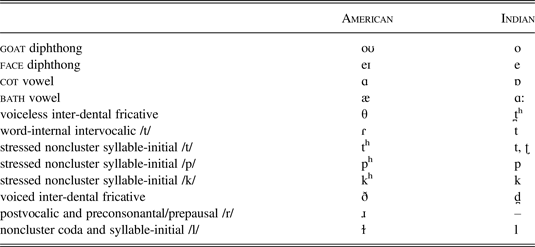
In the final step of the LFI procedure, a simple proportion is calculated for the balance of use of AmE and IndE, by dividing the number of variants coded for each lect in a unit by the total number of variants in that unit. In all of the extracts analysed, I report LFI values in terms of the proportion of AmE style used, simply for consistent comparison across extracts.
A sample analytic unit is shown in (1).Footnote 5 IPA is only used here to illustrate the coding; in all later transcripts, coded forms are simply underlined. Eighteen tokens of the twelve variables in Table 1 are instantiated in the unit. Of those, ten were uttered with AmE realizations and eight with IndE realizations. The overall proportion of AmE style is therefore .56 (56%).
-
(1) Proportion of American style = 10/18 (.56) and [d̪]e [kh]ombined C [o] [th]wo emissions of [d̪]e [eɪ]ght hundred and fifty [kh][oʊ][ɫ]-fi[-]ed [ph]owe[-] pl[æ]nts [ð]at china and india a[-]e bui[l]ding between now and twen[t]y twe[ɫ]ve ‘and the combined CO2 emissions of the 850 coal-fired power-plants that China and India are building between now and 2012’
In the analysis, LFI rates of this type are examined in relation to their unfolding discourse context, that is, interactional dynamics, corresponding embodied and prosodic cues of shifts in attention, and accompanying changes in speech rate.
Such close quantification of micro-variation inevitably faces many methodological challenges. First, how do we decide which variables to include in an analysis? Needless to say, with such a micro-quantitative procedure, the selective inclusion or exclusion of particular variables can significantly affect results. The decision was therefore taken to include all forms that could be reliably classified as AmE and IndE in an auditory analysis of Zakaria's speech, to avoid biasing the data in either direction.
Although this comprehensive approach helps to mitigate the risk of selective bias, it adds variability and noise. This is because the twelve variables do not have identical levels of alternation across contexts. The variables in Table 1 all vary across settings, but two are slightly skewed: Zakaria rarely uses an Indian [a] variant for the bath vowel—he favors either the AmE variant or an interdialect compromise form. Conversely, he favors the Indian [d̪] variant for the inter-dental fricative across recordings. These details may have their basis in salience, awareness, ease of articulation, or other factors (Trudgill Reference Trudgill1986; Siegel Reference Siegel2010; Nycz Reference Nycz and Babel2016). It is difficult to factor in fine imbalances of this type, and for the present analysis all twelve variables are tracked in the same way.
Another consideration is whether articulatory difficulty prevents lectal alternation within a word, in which case words rather than individual variants should be coded. However, intra-word lectal alternation turned out to be fairly common (e.g. in coal-fired and power in the sample unit in (1) above) and so no simple constraint on intra-word alternation was assumed.
Finally, the analytic approach cannot at present take into account the influence of linguistic factors on variables. This is somewhat compensated by the inclusion of twelve variables, all of which participate in clustered shifts: this reduces the likelihood of one internal factor in a single variable skewing the overall patterns. The one internal factor that was checked was whether carrier words were function or content words. As AmE style is associated more with content words in Zakaria's speech, discussed later in the analysis, I checked whether apparent shifts to IndE within this style were simply due to a higher proportion of function words. The proportion of function words coded in generic AmE units and in IndE-shifted units was 0.31 and 0.37 respectively. The latter set of units is too small to test for significance but, as many of them involved up to 80% IndE variants, the shifts are not simply due to the presence of function words.
Despite inevitable challenges, the LFI metric allows us to link variation to interactional moments and to explore the circumstances of style-shifts. The analysis that follows reports on three style dynamics and their inter-relatedness in Zakaria's speech: audience effects, attention effects, and speaker design.
AUDIENCE DESIGN
Zakaria uses strikingly different speaking styles with American audiences and Indian audiences. Table 2 lists details of six comparable recordings—three with American audiences, three with Indian audiences—to illustrate Zakaria's use of different lects or style clusters. Despite micro-fluctuations within speaking situations, we see a broad contrast in his speaking style with audiences in India and in the US. Even some proper nouns (e.g. ‘Afghanistan’) are realized with American or Indian pronunciation depending on the audience.
Zakaria's speech styles across American and Indian contexts.

Table 2 also shows that Zakaria produces hybridized versions of both AmE and IndE, indicating, among other things, possible attrition in his first dialect or D1, namely IndE (cf. Shockey Reference Shockey1984; Bowie Reference Bowie2000). We also see a slight skewing, such that his style with AmE audiences includes more IndE admixture than vice versa, likely reflecting his later acquisition of an AmE style. Nevertheless, he can maintain both styles throughout interactions, possibly indefinitely, suggesting robust control that is comparable to ‘language mode’ in bilingual speech (Grosjean Reference Grosjean and Nicol2001). Topic effects can arise too of course; for example, the more personal theme of Islam in the first Indian recording listed in Table 2 may have triggered more Indian style, but topic cannot explain the systematic contrast across audiences. In many places he touches on identical subtopics (e.g. emerging markets, global terrorism, Iran's nuclear capabilities) but uses different styles, depending on the audience.
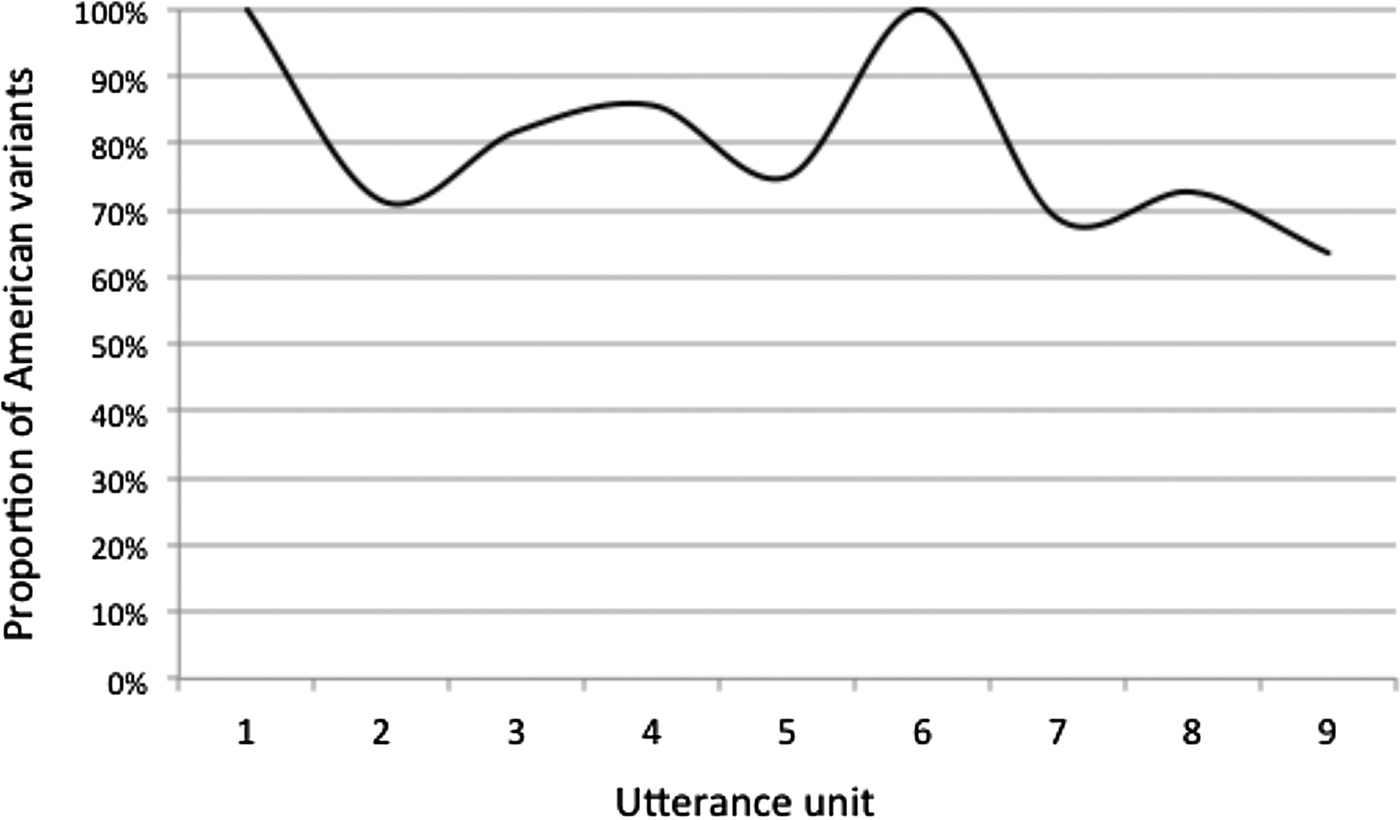
Figures 1 and 2 use the LFI metric to provide an initial snapshot of this broad difference in Zakaria's speech styles with American and Indian audiences. (Micro-fluctuations in his speech are examined later.)
AmE and IndE levels with American audience.
AmE and IndE levels with Indian audience.
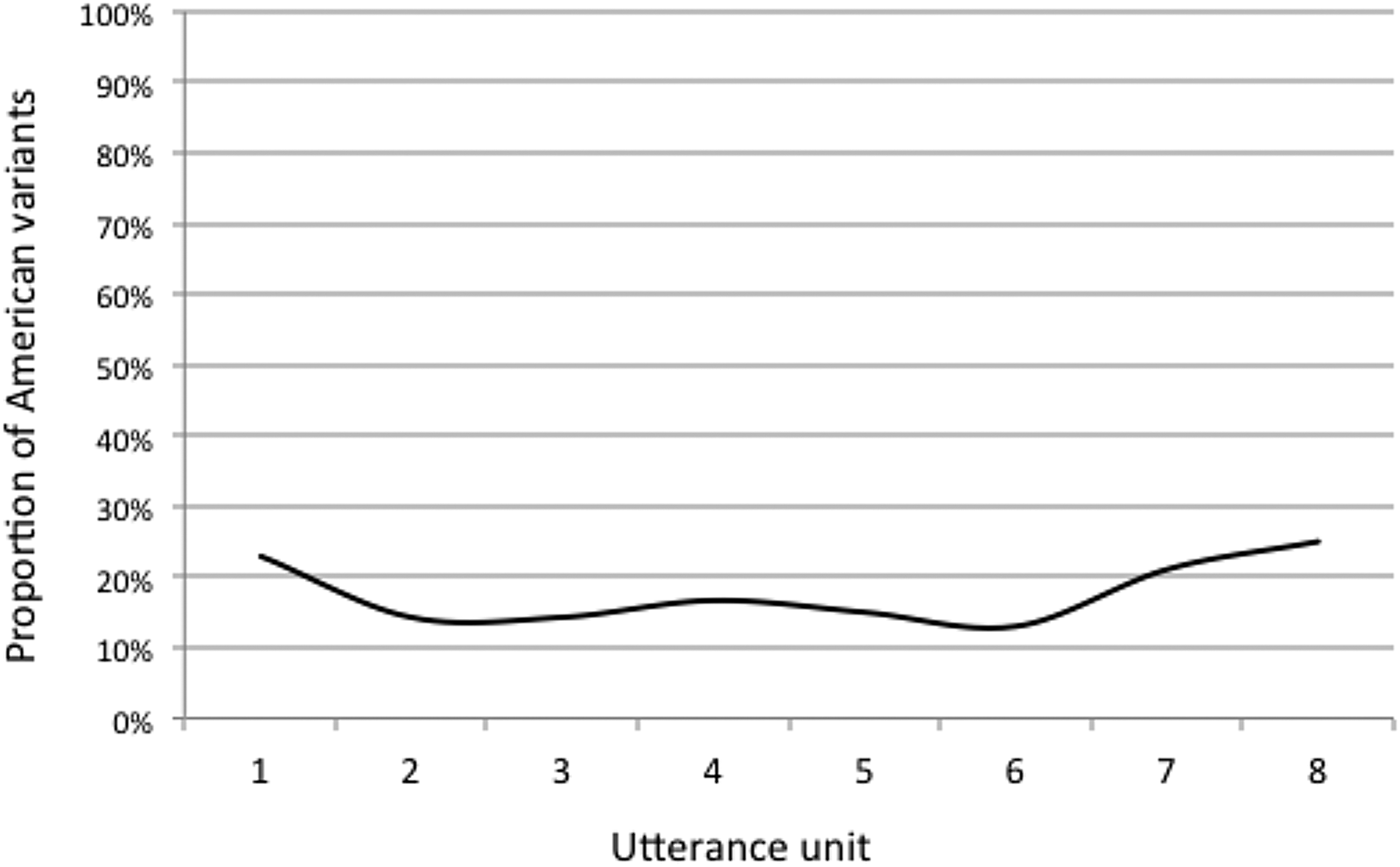
In the extract in (2), Zakaria responds to a question about the legacy of George W. Bush's foreign policy in the Arab world, posed by the American host of a panel discussion before a large audience at Yale University, recorded for broadcast in 2003. The corresponding Figure 1 shows a clear, sustained American speech style throughout this extract.
-
(2) Zakaria with American audience
-
1 er I think he’ll be remembered for a very energetic response to september eleventh
-
2 uhm and after that for taking a very uhm progressive attitude towards the issue of political reform in the Arab world
-
3 but because of his inability to bring the world along with him
-
4 because of his inability to forge truly deeper and lasting coalitions
-
5 er much of that work will not actually be co- consumated or completed
-
6 because the true fight against terrorism and against Al Qaeda
-
7 is a global fight in which every country will have to be involved
-
8 and indeed the countries that will provide the most help and the most information
-
9 are the ones that we sometimes alienate the most these days
-
This contrasts clearly with his speech in a broadcast interview on the leading television news channel in India (NDTV) in 2008. In extract (3), Zakaria responds to a question about US foreign policy in Afghanistan, a topic that is nearly identical to that of extract (2). Figure 2 shows that Zakaria maintains (in this response and across the interview) an Indian speech style for all twelve variables, with very little of the rhoticity, flapping, VOT, diphthongization, and l-velarization of extract (2).
-
(3) Zakaria with Indian audience
-
1 it's a skill that is political in nature and some you know-perhaps the way you do it is
-
2 know something about the country know something about the culture understand the history and don't fight that
-
3 in a sense you know it's a very American idea we have always wanted to recreate the world
-
4 Tom Paine has this wonderful line he says you can make the world anew
-
5 and it's an American line no non-American would believe that you can make the world anew and it's what gives America its optimism
-
6 but they go to a place like Afghanistan and they say
-
7 divided authority fractured state let's create a modern democratic you know responsible state
-
8 the problem is [hheh] you can't do that you have to deal with-
-
These two examples point to a robust bilectal repertoire. Most of Zakaria's phonetic system, not just an isolated variable or two, shifts from one lect to the other relative to audience. His active alternation of dozens of phonetic contrasts points to substantial acquisition and control of these two contrasting codes (not a case of ‘unbifurcated’ mixture; Hazen Reference Hazen2001), with clear evidence that he exploits this repertoire for audience design. The ‘attention-to-speech’ view of style appears rather irrelevant for such data.
To the contrary, I show in the next section that attentional effects arise routinely in these interactions, and that they too influence Zakaria's use of sociolinguistic variables. Despite his proficient sensitivity to audience, Zakaria shows subtle signs of dominance, in particular greater ease of processing, in his first-learned vernacular—Indian English.
ATTENTION AND ASYMMETRIC STYLE DOMINANCE
This section looks more closely at Zakaria's micro-level style-shifts in real time within individual interactions. Despite the powerful audience effects observed in the previous section, Zakaria also reveals a tendency to shift to IndE regardless of audience in moments when his attention is otherwise diverted from a focus on speech design, for example, when challenged, wrong-footed, or inserting a quick parenthetical.
The analysis starts with an extended segment of Zakaria in conversation with an American interviewer. The four points of noticeably increased IndE that occur during this segment are subjected to closer LFI analysis. In three of these instances, the analysis suggests a surfacing of IndE as an ‘easier’ mode of speech in situations of divided attention and increased speech rate. This is also supported by evidence that Zakaria shifts in the same direction, not the opposite direction, with an Indian audience when under similar pressure of attentional load.
Figure 3 presents the full 10.5 minute extract, taken from a one-hour 2008 interview with Charlie Rose that was broadcast on the American public broadcast channel PBS to an American audience. The overall LFI (solid line) is very variable. This is both because Zakaria uses a fairly hybrid style in the interaction, but also because the analysis ‘zooms in’ so close to the variation, and only tracks twelve variables (even though many additional finer phonetic details in Zakaria's speech, e.g. vowel nasalization, /æ/ tensing, and /r/ quality, co-vary with the twelve measured variables). Despite this variability, the overall trendline (dotted line) is steady at around 60%. Four of the IndE shifts that diverge noticeably and take his usage to around the 20% mark are circled in grey. These are analysed in detail in this section. (A longer stretch without IndE ‘troughs’ was omitted between lines 71 and 92.) Approximately twenty-five such IndE troughs occur during the full fifty-six-minute conversation, many very fleeting. Corresponding AmE ‘peaks’ are fewer and tend to occur when Zakaria is elaborating on a well-established point, unlike some of the functions described next for IndE.
Full segment of Zakaria's speech during Charlie Rose interview.
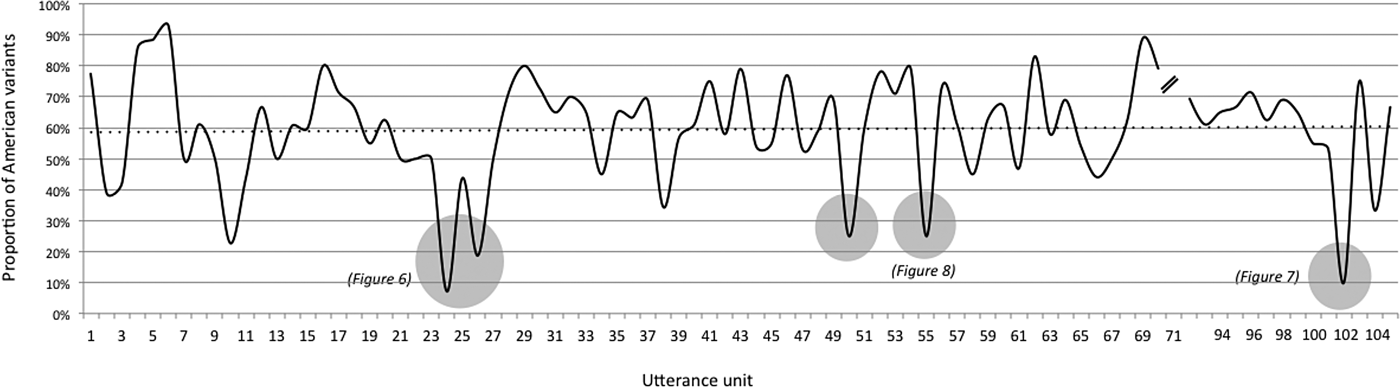
The majority of IndE shifts in the full interview fall into three categories, each of which is represented in Figure 3 and analyzed in detail next: Negative stance-taking (e.g. countering doubt, counter-arguing, introducing a negative or skeptical stance), parentheticals, and direct speech.
Attentional shift when countering doubt
In situations of disagreement, a speaker is under pressure to counter their interlocutor's skepticism or doubt by reorganising the content of their argument, while also managing the increased risk of face threat. As noted, an audience or accommodation-based model might predict that Zakaria will style-shift in opposite directions when trying to persuade American and Indian audiences respectively. By contrast, if these situations absorb added attention and make it more difficult to consistently attend to speech design, an attentional load model predicts that he may default to the same ‘easier’ style, regardless of audience.
The second of these predictions is supported in many of the IndE shifts seen in the data. I start with a pair of examples that show Zakaria defaulting to IndE when countering doubt, first with an Indian audience and then with an American audience (the first of the four IndE troughs in Figure 3).
Extract (4) is from a panel discussion with an Indian host, broadcast in India in 2012. Here, Zakaria is defending the controversial view that Iran developing nuclear weapons is not a serious concern. (Recall that lines are LFI units and coded variants are underlined.) In lines 2–3, he sets up a rhetorical question in order to dismiss it, shrugging, shaking his head gently, and increasing his overall pitch to downplay the seriousness of such a situation. In line 4, he seeks to further justify this stance, but initially produces a number of incomplete constructions and self-repairs, suggesting an unresolved search for the next conversational action (Ehrlich & Romaniuk Reference Ehrlich, Romaniuk, Podesva and Sharma2013:466). In line 5, he hits upon a new persuasive tactic to dismiss the hypothesized concern with a sequence of stance utterances (Du Bois Reference Du Bois and Englebretson2007) delivered in lines 5–7, marked in bold.
-
(4) Countering doubt (Indian audience)
-
1 a best case scenario would not- would be to not y'know start this kind of nuclear arms race
-
2 ↑but if they ended up with one or two crude nuclear devices without proper delivery systems like the North Koreans
-
3 is it really the end of the ↑world is it s- ↓no
-
4 I think it's something- they could be ↑contained they could be ↑deterred er- it would keep them- y'know
-
5 they would ↑ pay enormous ↓costs
-
6 and I think that's important to ↑maintain those ↓costs
-
7 because I think they should ↑realize they’re making a ↓choice
-
8 about whether or not they want to be you know a proper modern power
-
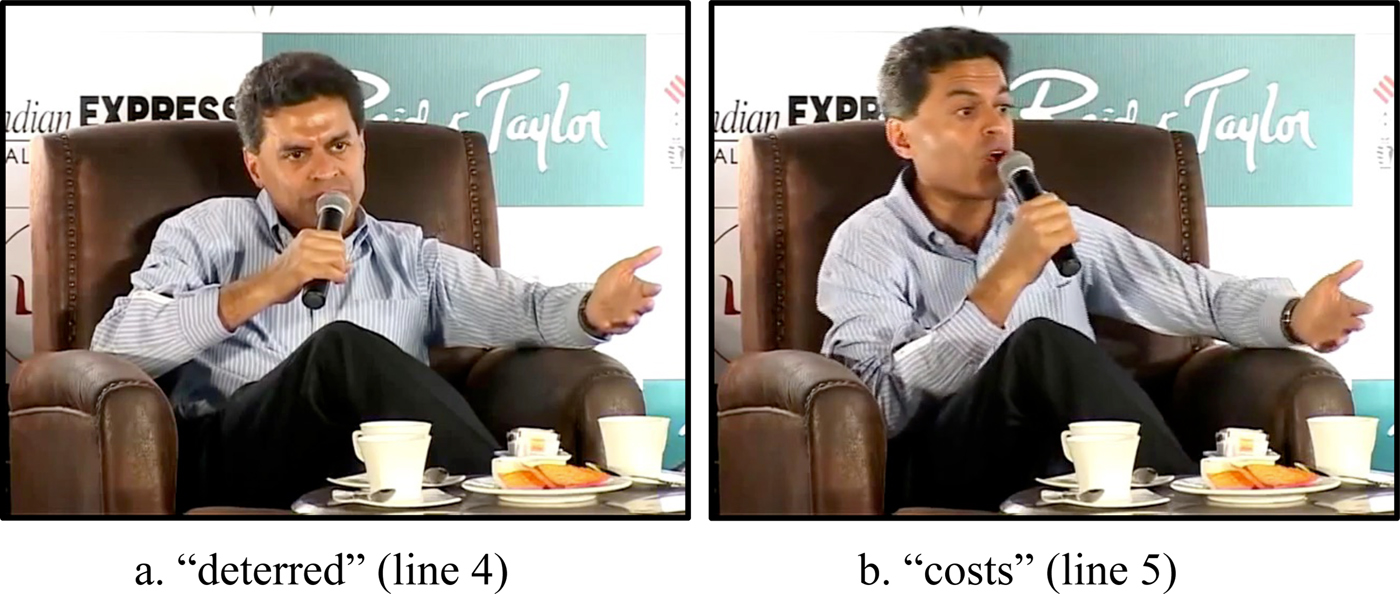
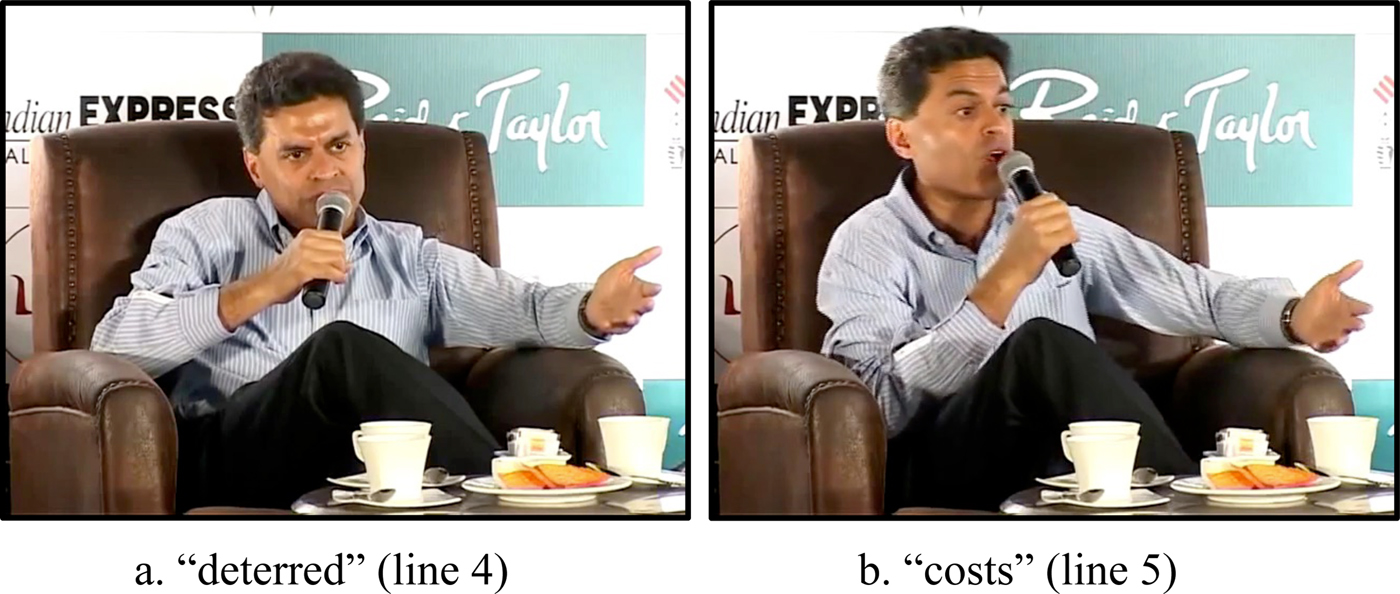
A number of embodied and prosodic changes accompany this tactical shift in lines 5–7, all pointing to an increase in attention to the new argument. The video stills in Figure 4 show changes in Zakaria's face and body as he introduces his new move. In the run-up to line 5, Zakaria's body has been positioned centrally, with a relaxed, thoughtful expression and unfocussed gaze (line 4 ‘deterred’). In the instant that he initiates the new persuasive move in line 5, Zakaria turns his body to more directly face an addressee, and changes his facial expression to wider eyes, raised eyebrows, direct eye contact, and a more confrontational expression (line 5 ‘costs’). Lines 5–7 are also accompanied by prosodic changes, including an increase in emphatic stress and a distinctive pitch contour, with the first emphatic word accompanied by a pitch rise and the second by a pitch fall, creating a striking melodic parallelism that sets the three lines apart from the surrounding utterances.
Most importantly for the present analysis, Figure 5 shows that Zakaria's rate of use of IndE variants increases to maximum levels during just these three lines.
Shift to IndE when countering doubt with Indian audience.
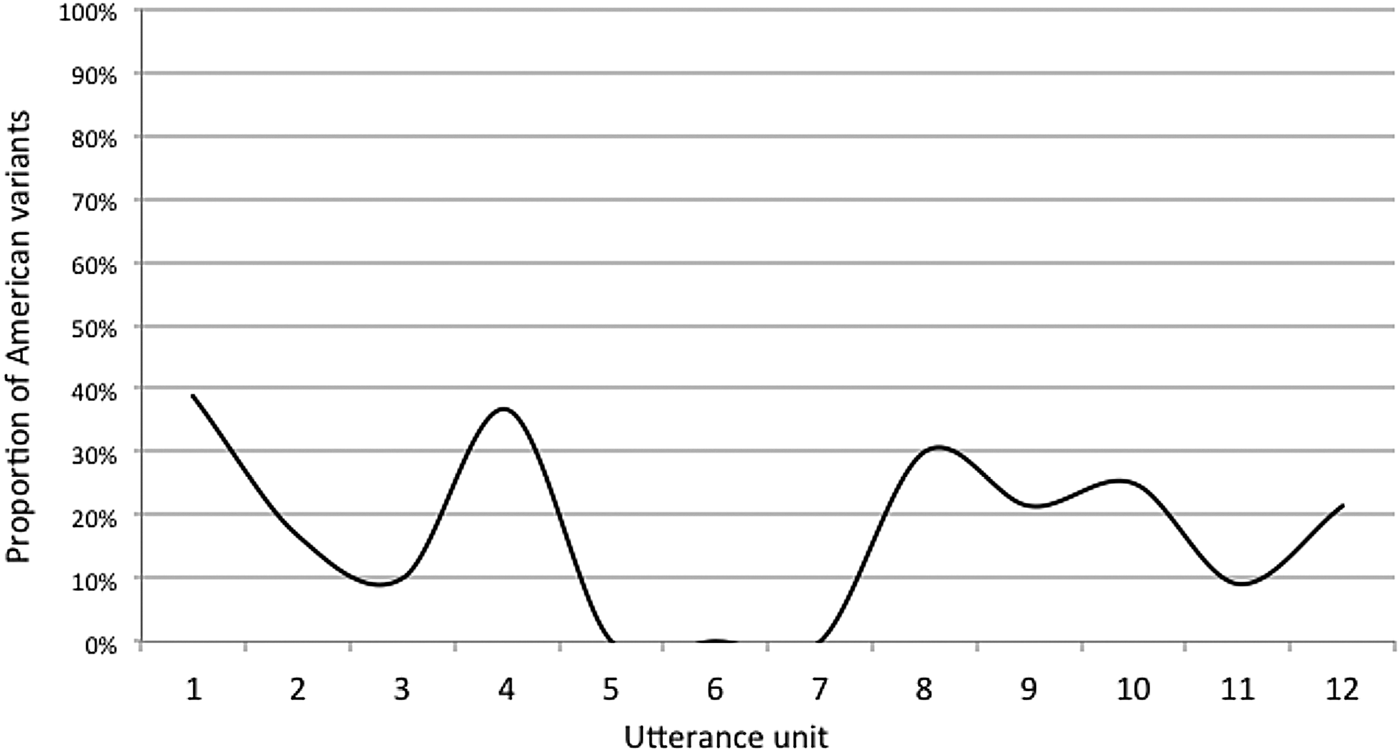
The extract ends, in line 8, with a shift back to his earlier linguistic and physical style: Zakaria returns his expression, posture, and gaze back to the earlier neutral setting and reinstates slower, calmer speech, re-introducing the smattering of AmE variants that was his default balance for this interaction, in particular with three preconsonantal /r/s in the three slow, final words of line 8.
Thus, as Zakaria's attention is drawn into designing a new persuasive move in lines 5–7, as indicated by embodied physical and prosodic changes, he shifts to slightly heightened use of IndE. (See Voigt, Podesva, & Jurafsky Reference Voigt, Podesva and Jurafsky2014 on the multimodal correspondence of movement amplitude, speaker engagement, and speech prosody.) One interpretation of this is that Zakaria is accommodating to his audience to maximize his effect; another is that the task of designing a new argument renders him slightly less able to simultaneously attend to speech design, leading him to ‘backslide’ briefly to his easier style.
These two interpretations make inverse predictions for what should happen in a similar situation with an American audience: The first predicts an increase in AmE, the second an increase in IndE. It is the latter that is repeatedly supported in the American context: Zakaria frequently shifts to IndE when devising new persuasive arguments, particularly countering doubt, disagreeing, and inserting parenthetical supporting material to build an argument. For reasons of space, I focus on linguistic and stylistic details in the remaining examples, with less coverage of accompanying embodied cues.
We can now return to the first of the IndE troughs in Figure 3, as a direct comparison to the Indian example. In lines 21–23 in extract (5), Zakaria sets out a view on the disadvantages of American monolingualism. This is challenged by Rose, and Zakaria responds in lines 24–26, indicated in bold. Once again, we see some initial disfluency in line 24, during his search for a counter-move, followed by a shift in his argument to incorporate Rose's counter-example into his own wider claim. By lines 27–28, he has succeeded in finding common ground and moves on.
-
(5) Countering doubt (American audience)
-
21 Zakaria: but here's the problem. a Chinese businessman speaks English so he can participate in our economy he can swim in our sea, as it were
-
22 but then he can penetrate the local Chinese market which is largely Mandarin speaking
-
23 we can only swim in one sea you go to Brazil those guys can now speak English and Portuguese
-
Rose: I don't know if that is true for the following reason most of the people that I know from the private sector their world is global General Electric and all of those companies they generate more than fifty percent of their revenues from business outside of the United States and they hire and put in place a lot of local people who do speak the language
-
24 Zakaria: and- and- and I ↑say in the book the people who get this new world best
-
25 are actually America's ↓multinationals because they are ↑ living it=
-
Rose: =that's right [and they li- and they learned it early=
-
26 Zakaria: [and they l- and they =they
-
↑ learned it early because it was a question of ↑survive adapt or ↑die=
-
Rose: =and opportunity=
-
27 Zakaria: =↓right now and I think you're absolut- GE by the way is a perfect example of the transformation
-
28 and it's a metaphor I think I use it in the book for American foreign policy
-
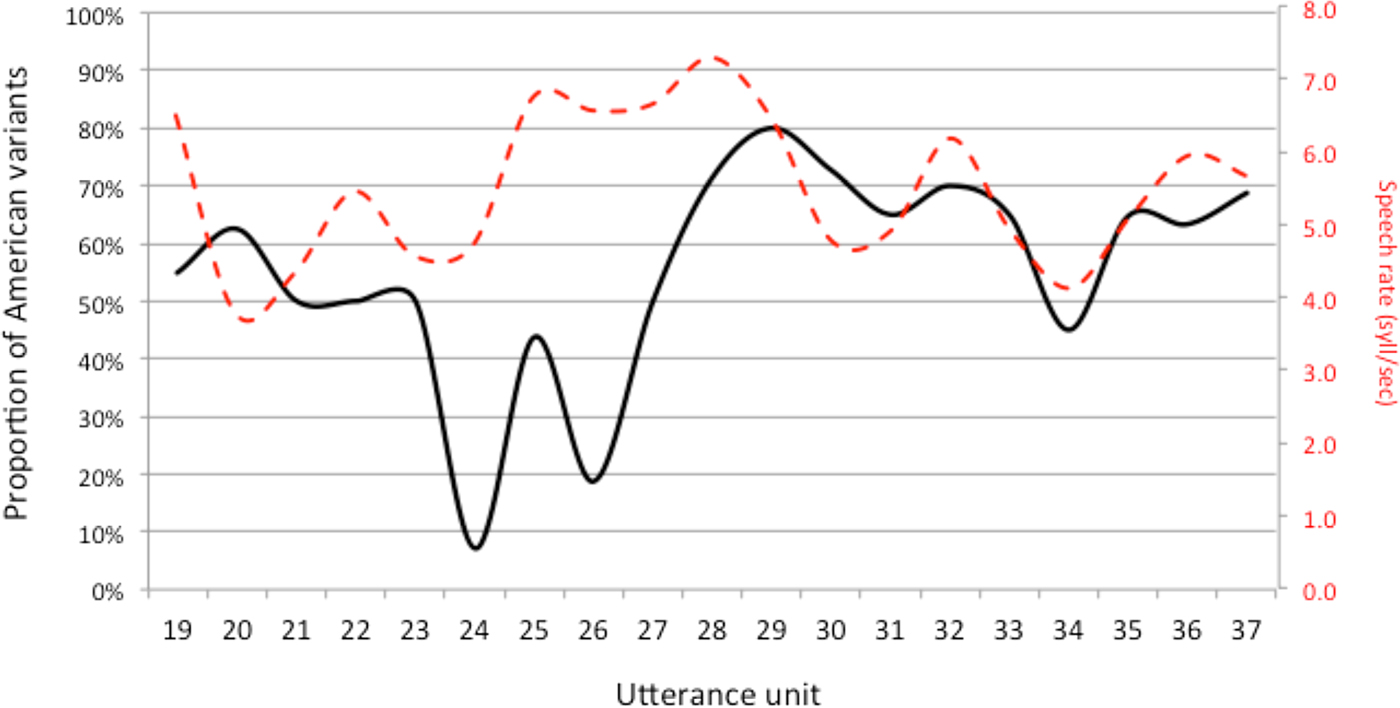
Figure 6 shows Zakaria's LFI profile for this segment. (The accompanying increase in speech rate is discussed later.) At the point of his persuasive shift in lines 24–26, Zakaria's use of IndE increases rather than decreases. He shifts in the same direction as he did with an Indian audience, as predicted by attention, not in the reverse direction, as predicted by audience design. The interpretation of this as an attentional effect is supported by a number of further details from the data, discussed next.
Shift to IndE when countering doubt with American audience.
Attentional shift in parentheticals
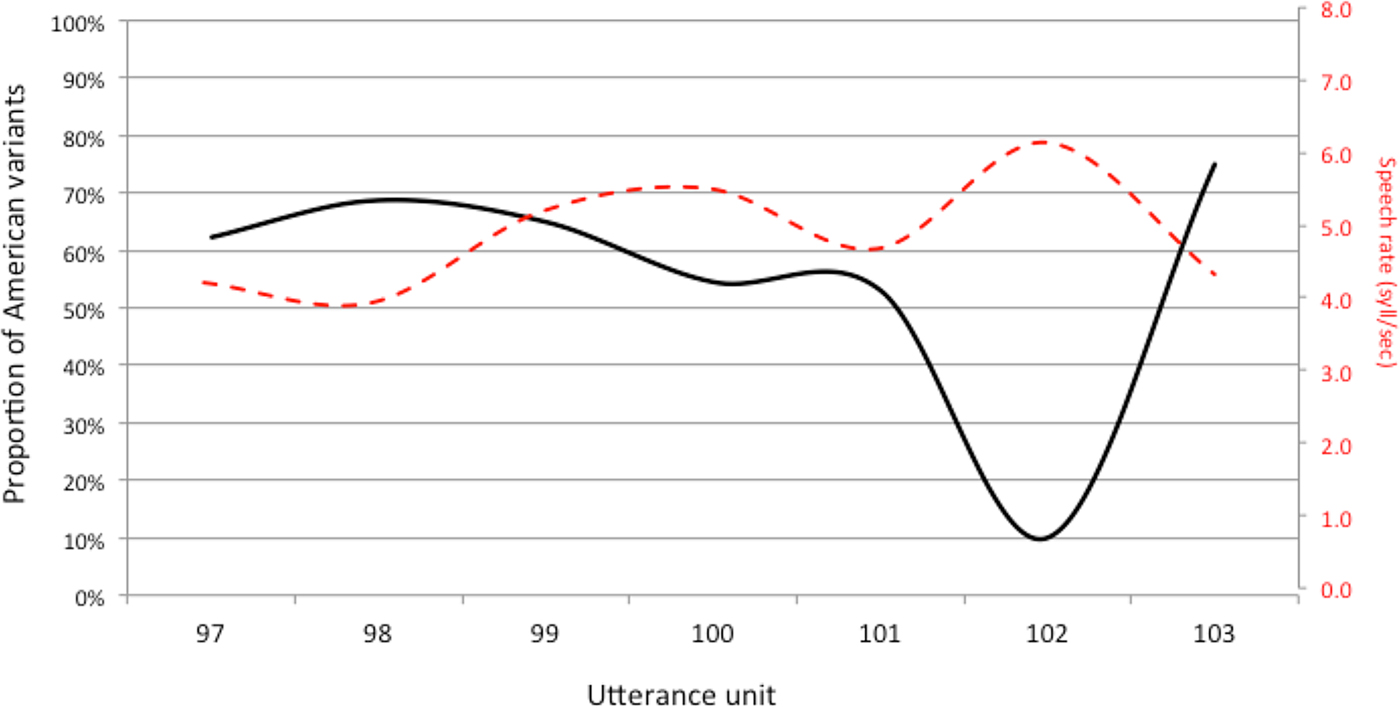
Parentheticals, or asides, temporarily interrupt an argument and are often marked off linguistically, including with faster speech rate (Local Reference Local, Auer and Luzio1992). These linguistic indicators can be argued to arise due to the secondary status of, and thus reduced attention to, the parenthetical with respect to the speaker's overall attention to their main point. One of the IndE troughs in Figure 3 involves a parenthetical, the transcript of which is given in extract (6).
-
(6) LFI towards IndE with a parenthetical (American audience)
-
99 I mean the American republic was founded to protect freedom from among other things the tyranny of the majority
-
100 the founders worried a great deal about that so when we say Iraq has democracy and it's a wonderful thing
-
101 well if what you have is majorities in southern Iraq for example which are imposing a theocracy in Iraq which is in many cases more extreme than that in Iran
-
102 you know in terms of the religious requirements in- some parts of southern Iraq are scary
-
103 I think to myself what have we gained if what we have created is kind of a majoritarian theocracy where people vote to suppress and oppress minorities
-
In extract (6), Zakaria is questioning the benefits of democracy when an elected government is a brutal majoritarian theocracy. In line 101, an if-clause is introduced, but its corresponding main clause appears in line 103, interrupted in line 102 by a parenthetical detail to reinforce the main point. Figure 7 shows that this quick insertion is marked by both an increase in the use of IndE and in speech rate (discussed later). This combination was seen in the earlier examples of counter-arguing too; both situations, in different ways, involve divided attention on the part of the speaker, with less attention to speech design, leading to the surfacing of a cognitively easier style.
Shift to IndE with parenthetical with American audience.
Direct speech and voicing
The two remaining shifts to IndE in Zakaria's longer American extract (Figure 3) involve direct speech and another instance of negative stance-taking, illustrated in more detail in extract (7) and Figure 8.
-
(7) LFI towards IndE with direct speech and with counter-argument (American audience)
-
49 Zakaria: exactly so the only solution it seems to me is that you say
-
50 okay let's in some way or the other subsidize clean energy for you
-
51 and if you accept that you know if you want the subsidies you will have to use clean energy
-
52 but imagine the American politician who's gonna go and tell American constituents
-
53 you know what we’re gonna have to take some of your tax revenues and divert it to China and India
-
54 but yet it's the only solution I mean sh-shorn of everything else that is the only thing that's gonna work
-
Rose: Do you think Senator Obama has an enlightened position on trade?
-
55 Zakaria: no I don't think either of the Democrats have an enlightened position on trade
-
56 and I think it is the great danger of the Democratic party the great danger of the Republicans
-
Shift to IndE with direct speech and skeptical stance with American audience.
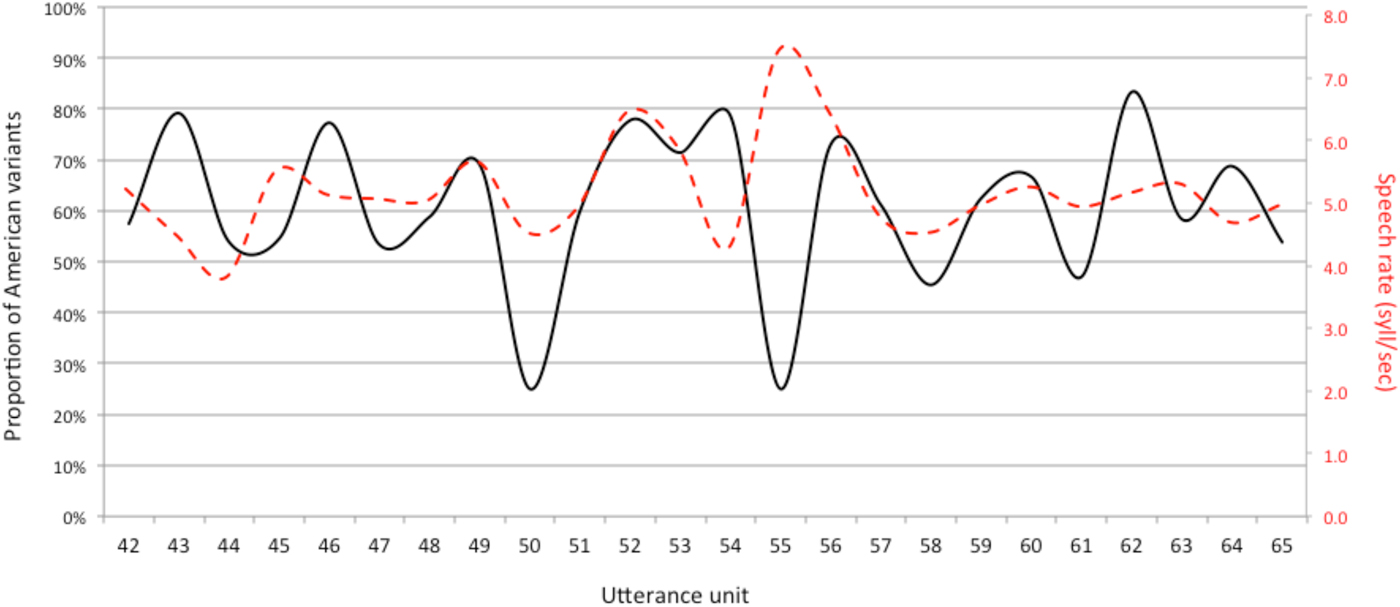
In lines 50–51, Zakaria introduces and aligns with a new stance using the rhetorical device of direct speech. He marks this out by stepping outside his main speaking voice for the interaction and shifting to IndE (this is unlike line 53, which involves the direct speech of an American politician). Interestingly, we do not see an increase in speech rate at lines 50–51, reminding us that many style-shifts do not involve situations of disrupted attentional load. Such cases are discussed in more detail in the final section.
Extract (7) and Figure 8 also show that the fourth and final IndE trough from Figure 3 is another instance of the earlier category of negative or skeptical stance-taking. In line 55, Zakaria offers a skeptical response to a question from Rose, uttered with a low falling intonation that conveys dismissiveness, and we again see an IndE trough where he initially stakes out this position. Once again, notice the accompanying rise in speech rate. I turn to this final detail of the attention analysis next.
Attention and speech rate
With the exception of direct speech, the major IndE shifts within Zakaria's AmE style extract were accompanied by small peaks in speech rate, a detail that further supports a divided attention analysis of these particular moments.
Speech rate was measured as syllables/second per utterance unit, and showed a very weak positive correlation with proportion of IndE overall in American and Indian recordings (r values of .13 and .14 respectively), indicating that Zakaria's IndE is very slightly faster than his AmE.Footnote 6 This positive correlation strengthens considerably in the extracts involving significant shifts to IndE, for instance, reaching a correlation coefficient (r value) of .81 in Figure 7.
Second-language speech has been noted in a few studies as slower and containing more pauses (Derwing, Munro, Thomson, & Rossiter Reference Derwing, Munro, Thomson; and Rossiter2009; Daller, Yıldız, de Jong, Kan, & Başbaĝi Reference Daller, Yıldız, de Jong, Kan and Başbaĝi2011). This may extend to second dialect speech, though this is very understudied. Rampton (Reference Rampton2013) mentions slower speech rate in one individual's second dialect style. Kendall (Reference Kendall2009:208) also speculates that the use of features that lie outside a speaker's usual or routine repertoire, for example, archaic or otherwise rare forms, could be associated with more hesitant speech and slower speech rate, because these forms might be ‘less integrated into speakers’ native grammars’. The bilingualism literature would support this contrast, both in terms of the lower processing efficiencies of later-learned languages (Robinson Reference Robinson, Doughty and Long2005) and the considerable effort of inhibiting native language systems to access and use less routine systems (Meuter & Allport Reference Meuter and Allport1999).
This offers us one interpretation of Zakaria's higher speech rate in IndE overall, and particularly the faster ‘islands’ of IndE in Figures 6–8. If attention to designing and maintaining a target speech style is partly suspended when constructing a counter-argument (lines 24–26), inserting a quick aside (line 102), or even simply being quickly dismissive (line 55), then the association of faster speech and IndE in these moments suggests it may still be Zakaria's underlying vernacular, the lect that emerges ‘automatically and unthinkingly’ (Labov Reference Labov2013:3). It is worth noting that causality can be bidirectional here: speeding up may cause Zakaria to favor IndE, and shifting to IndE may cause faster speech rate.
One final feature of the data further supports this cognitive asymmetry: Figures 6–8 all show a significant skewing of AmE variants towards content rather than function words (69% vs. 32%, Mann-Whitney test p < 0.001), a skewing that does not arise at all for IndE variants (49% vs. 51%). This too may reflect an exploitation of AmE primarily in those word classes where greater control is possible, with more automated retrieval or more deeply encoded phonetic forms in function words.Footnote 7
A typology of style dominance
Zakaria's shifts to IndE in moments of divided attention regardless of audience, and the observed speech rate and word class asymmetries between his styles, complicate a pure agentive or design-based account of his style-shifting. Certainly, agentive shifts are also pervasive in his speech, as we saw in the dramatic effect of audience. But the findings highlight the routine presence of cognitive factors—acquisition and attention—alongside more designed shifts, even in a highly audience-sensitive styler. In suggesting a lasting influence of a first-learned lect despite much longer exposure to a second, the findings could also add a factor of acquisitional order to exemplar models of sociophonetic variation (Foulkes & Docherty Reference Foulkes and Docherty2006).
Such effects may occur in many types of individuals, not only those who are bidialectal. In one sense, all individuals have ‘truncated’ or ‘partial linguistic repertoires’ (Blommaert Reference Blommaert2010:103) and incomplete control of some aspects of their style range. We might therefore think of style dominance in exactly the same terms as bilingual language dominance has been conceived, ranging from early simultaneous acquisition with little obvious asymmetry in control to sequential or partial acquisition with corresponding differences in use and control. Figure 9 sketches such a typology, with a few sample cases of South Asian English speakers.
Typology of dominance types for a given style in a repertoire.
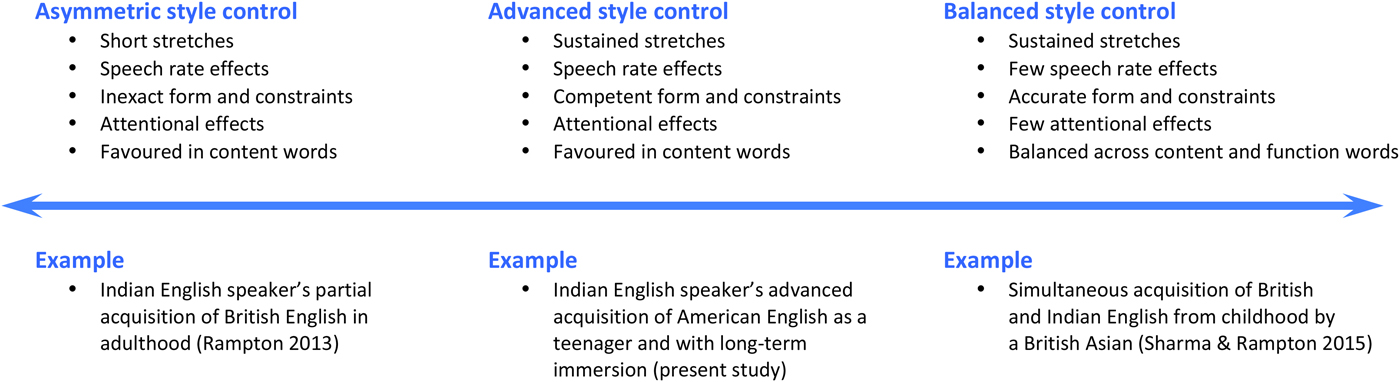
This typology does not aim to reify ‘authentic’ or accurate use, but rather to model the relative ease of processing of a given style or set of variants for a given a speaker. Cognitive control may depend on exposure to, access to, and entitlement to use (i.e. to practice) different styles over a speaker's lifetime. Certainly even very partial and superficially ‘inexact’ uses of a style or a form can involve agentive new indexicalities. But an approach to style that only deals with agency, seeing all variants as equal in terms of potential use, is difficult to reconcile with well-established understandings of both cognitive limitations on one's ‘ability to change one's behavior’ (Le Page & Tabouret-Keller Reference Le Page and Tabouret-Keller1985:186) and, equally important, ‘differences of access’ (Le Page & Tabouret-Keller Reference Le Page and Tabouret-Keller1985:184), often linked to social inequality, that influence the repertoires individuals acquire over time.
The typology opens up questions for further research, many paralleling questions in bilingualism: Do some individuals have no underlying vernacular, just a constellation of styles with equal cognitive ease of access and articulatory control? To what extent is dominance affected by factors of age of acquisition (Fix Reference Fix2013), frequency of use, aptitude (Wagner & Hesson Reference Wagner and Hesson2014), or attitude? Can a later-learned style become the cognitive default? Finally, this model has focused on broad, identifiable lects, or clusters of variables, but we know that individuals can achieve complex interactional work with just a few salient forms—how do more fleeting and isolated moments of style construction, performance, or identification relate to these cognitive dynamics, if at all?
BIOGRAPHICAL INDEXICALITY: STYLING THE ‘REAL ME’
This last question is addressed in this section: What is ‘the relation between the more and the less intentional uses of variables’ (Eckert Reference Eckert2001:123)? Are acquisitional asymmetries in control just constraints on agentive stance-taking?
Although style dominance does place constraints on agentive design, as shown in the previous section, the two may also be much more intimately and directly linked: I suggest that an individual can sometimes exploit their dominance in a particular lect for stance work, turning off other styles in order to display the ‘real me’.
The logic underlying this process, which I term biographical indexicality, is that a speaker is aware that a particular style or lect (D1) is easier or more native to them than other styles (D2… Dn). Particularly when they are confident that this knowledge is also available or inferable for the listener, the speaker may allow D1 to surface, with the effect of ‘pay attention, this is the real me speaking now!’. This may account in part for a very particular cluster of stances and acts that are often associated with vernacular voices: dismissing, rebutting, parentheticals, arguing, ridiculing, asides, teasing, irony, and generally telling it like it is (e.g. the set of stances associated with Austrian dialect in Soukup Reference Soukup2009:162–63).
The previous section focused on attentional demand effects in Zakaria's 2008 Charlie Rose interview, but stance work of the kind described above also arises in several of the twenty-five IndE shifts (shifts to Zakaria's D1), some with and some without accompanying attentional effects. I illustrate a few briefly here.
We have seen that Zakaria often uses direct speech as a rhetorical device. In his 2008 interview, most instances of direct speech that open with an explicit ‘frankness’ or ‘honesty’ stance marker also involve a shift to IndE style, as shown in (8).
-
(8)
-
a. So the only solution, it seems to me, is that you say, okay, let's in some way or the other subsidize clean energy for you. [from (7)]
-
b. You want to also draw some lines and say, look, if you want to be part of this order, you can't go around invading countries.
-
c. So what they are recognizing is, look, if you are going to try and apply this treaty on the world, you've got to apply both parts.
-
A few micro-shifts to IndE are also found with instances of ironic humor (9a), ridicule (9b), and dismissiveness (9c, d).
-
(9)
-
a. Yes. And often, by the way, this happens, when people criticize the West from outside, they are often using a western line.
-
b. We are discussing whether Hillary fifteen years ago did a corkscrew landing on a Bosnian- [Rose: Yes. And what somebody's minister says.] We are talking about whether McCain uses his wife's plane. Who cares?
-
c. [criticising an unsystematic, reactive foreign policy] You know, one issue comes up and we get outraged, we bash them on the head about it.
-
d. No. It's more complicated and interesting and challenging than that. Look, when people say the rise of Asia, as somebody who grew up in India, this is nonsense.
-
Finally, IndE shifts when introducing a negative, contrary, or skeptical stance can often also involve this type of ‘let's be honest’ voicing, as was seen in line 55 in extract (7).
What does this process of biographical indexicality—the agentive exploitation of a cognitively dominant style for frank, ‘real me’ stances—add to theories of style?
First, the meaning of these shifts derives from the speaker's personal biography, not shared community meanings, as in more widely-studied instances of indexical meaning. An upper-class person may use their first-learned upper-class style to enact exactly the same frank stances that a working-class speaker achieves with their vernacular, simply because in both cases it is the shift to a more personal code that is meaningful. So the notion of indexicality must encompass not just meanings generated ‘out there’, in social groups and interactional dynamics, but ‘in here’ too, within individual life trajectories and driven by personal rather than community history. Although not in relation to cognitive status, some earlier work has similarly emphasized the biographical in style analysis. Johnstone (Reference Johnstone1999, Reference Johnstone and Jaffe2009) proposed the notions of ethos of self and lingual biography as central to individual style and stance-taking. Giles, Coupland, & Coupland (Reference Giles, Coupland, Coupland, Giles, Coupland and Coupland1991:10–11) speculated that Noble Selves—a style of communicator proposed in early sociological work (Hart, Carlson, & Eadie Reference Hart, Carlson and Eadie1980)—might accommodate less in interaction, being ‘those straightforward, spontaneous persons who see deviation from their assumed “real” selves as being against their principles’. And Podesva, Reynolds, Callier, & Baptiste (Reference Podesva, Reynolds, Callier; and Baptiste2015) have shown that politicians’ speech is judged in part based on listeners’ knowledge of their style biographies, not just shared indexicalities of accent features.
Biographical indexicality also recalls the emphasis in early Communication Accommodation Theory on positions within a person's own repertoire as the target of style shifts, rather than literal convergence with an interlocutor (Thakerar et al. Reference Thakerar, Giles, Cheshire, Giles and Clair1982; Seltig Reference Seltig1985; Giles et al. Reference Giles, Coupland, Coupland, Giles, Coupland and Coupland1991:15). In their divergence from the interlocutor's speech style, ‘real me’ style-shifts may superficially seem to constitute a potential face threat and therefore be surprising in intimate interactions. But if they perform stances of honest frankness, they can achieve intimacy, through the implicature that social distance must be minimal for the device to be chosen at all, as with ritual insults among friends (Brown & Levinson Reference Brown and Levinson1987:229). Thus, some situations of divergence—dispensing with surface accommodation and reverting to one's natural default—can increase closeness and solidarity with the interlocutor. Although rarely addressed, ‘real me’ shifts arise routinely in interaction. When divergence as solidarity has been noted, it has been in terms of shared communal evaluation of the chosen variety (Wolfram & Schilling-Estes Reference Wolfram and Schilling-Estes1998:287). Biographical indexicality does not require any shared evaluation of the variety in question, just the potential for the listener to recognize that a speaker is shifting to their first-learned, default, or most personal style.
CONCLUSION
Individuals can of course reflexively perform and stylize vernaculars, exploiting knowledge of shared norms and wider indexical fields (e.g. Coupland Reference Coupland1980, Reference Coupland1985; Schilling-Estes Reference Schilling-Estes1998; Eckert Reference Eckert2001; Cutillas-Espinosa, Hernández-Campoy, & Schilling-Estes Reference Cutillas-Espinosa, Hernández-Campoy and Schilling-Estes2010). Such is the power of these findings in recent work, that it becomes tempting to see all style variation as the strategic execution of social stances.
This study has proposed that, alongside well-attested phenomena of audience and speaker design, attentional effects are also pervasive in interaction and can cause an underlying vernacular to surface for reasons other than social stance-taking. The analysis first focused on moments where vernacular use may not be socially driven, giving us a glimpse of a speaker's underlying dominance in one style, despite substantial bilectal control of two styles. Some speakers may have no such underlying style, just a range of performance styles, but for many, a first-learned style may have subtle cognitive primacy, leading to asymmetric style-shifting linked to attentional dynamics.
The final part of the study proposed that, among speakers with asymmetric style dominance, we can also observe moments of reflexive exploitation of this fact, constituting a further type of style dynamic. Speakers may occasionally choose to switch off the perceived artifice of accommodative styles and use their dominant or default style to reveal the ‘real me’, signalling stripped-down frankness and personal commitment. In this way, acquisitional history can function as a personal indexical field, and biographical indexicality can help account for accent divergence in routine interaction.