

How can an inside paper money be introduced into a financially underdeveloped barter economy? How can its value be maintained? Will it actually serve as money? Answers to these questions are explored using colonial Virginia's paper money. The British North American colonies were the first Western economies to emit sizable amounts of colony-specific paper monies that served as a circulating medium within each colony (Brock Reference Brock1975; Grubb Reference Grubb2016a).
Virginia had the second largest free population of the 13 colonies (Carter et al. Reference Carter2006, vol. 5, p. 652). In 1755, Virginia became the last of these colonies to emit paper money. The performance of Virginia's paper money is central to the history of the period; it was at the center of the conflict with the British Crown over colonial monetary powers and provided Parliament justification for passing the Currency Act of 1764 (4 Geo III c. 34). This conflict contributed to revolutionary sentiments. Virginia's paper money was a contentious point within Virginia politics due to irregular activities by Virginia's treasurer. Virginia's administrative structure was altered as a result, with the positions of Treasurer and Speaker of the House no longer allowed to be held by the same person (Brock Reference Brock1975, pp. 465–527; Ernst Reference Ernst1973; Greene and Jellison Reference Greene and Jellison1961; Labaree Reference Labaree1959–70, vol. 9, pp. 131–53; Mays Reference Mays1952, vol. 1, pp. 174–208, 358–85).
Virginia's legislature had paper money printed and placed in its treasury. It spent this money directly out of the treasury into public circulation. This was the only paper money in circulation. No banks issuing paper banknotes existed in colonial America (Hammond Reference Hammond1991, pp. 3–67). Prior to emitting paper money, Virginia's medium of exchange consisted of barter, typically involving book credit transactions and tobacco – often in the form of claims to tobacco or tobacco notes; personal bills of exchange and promissory notes; and foreign specie coins (Breen Reference Breen1985, pp. 94–7; Tillson Reference Tillson2010, pp. 36–8, 64). The composition of this medium is unknown, though specie coins were considered relatively scarce. Virginia referred to its paper money as treasury notes. Other colonies referred to their paper monies as bills of credit. While treasury notes were the same as bills of credit, I will refer to Virginia's paper money as notes in keeping with Virginia's terminology (Hening Reference Hening1969, vol. 7, p. 353).
The article proceeds as follows: Section i explicates the state of the modern debate over colonial paper money and why colonial Virginia provides a new and important contribution to our understanding of colonial paper money. Section ii presents the institutional and public finance structure of Virginia's paper money emissions, including yearly net new emissions, redemptions and amounts in public circulation. Section iii presents a decomposition model for inside monies and shows how the data are used to construct model components. Section iv presents the empirical application of the model and addresses historical episodes involving treasurer malfeasance and counterfeiting. Section v econometrically estimates the determinants of the model's components. Section vi concludes.
I
The modern analysis of colonial paper money has proven contentious. This is because theorists performed the analyses with the goal of championing favored monetary models using data found in the secondary literature – data gathered in the 1930s and 1940s. They had little interest in the actual financial history of individual colonies or in vetting and updating the data on colonial monetary accounts, prices and exchange rates. The assumptions needed to make their models yield the desired results were confused for observed facts, turning investigative exercises into hardened ideological positions that generated acrimonious debates.
It started with Roger Craig West (Reference West1978) testing a simple version of the quantity theory of money on colonial New York, Pennsylvania and South Carolina – the only colonies south of New England with price indices available in the secondary literature. For each colony, West found no relationship between that colony's paper money in circulation and that colony's price index. From here on, this finding became the core observed fact needing explanation. This failure of the quantity theory of money led to theoretical augmentations to that theory that could account for no relationship between paper money supplies and prices.
Theorists pursued two primary augmentations. The first used rational expectations and the laws requiring the removal of paper money to argue that citizens could undo the current price effects of current paper money increases. They could do this by adjusting their current behavior to the anticipated legally mandated future paper money decreases directly tied to the current paper money increases (Smith Reference Smith1985a, Reference Smith1985b, Reference Smith1988; Sumner Reference Sumner1993; Wicker Reference Wicker1985).
These studies do not sufficiently articulate the mechanism, or chart the behavioral dynamic, that led to no relationship between paper money supplies and prices. Within the quantity theory, the mechanism requires contemporaneous changes in the velocity of circulation perfectly to offset changes in paper money supplies thus leaving current prices unchanged, other things equal. Evidence for this behavior is scant, and the velocity changes needed to account for no relationship between paper money supplies and prices are too large to be credible (Cutsail and Grubb Reference Cutsail and Grubb2017; Grubb Reference Grubbforthcoming). The emphasis in this line of analysis is on the monetary theory and not on documenting the financial history of the colonies addressed. Oddly, the literature refers to this line of analysis as ‘backing’ theory.
The second theoretical augmentation used currency substitution theory to argue that changes in the supply of foreign specie coins via imports and exports of coins perfectly offset changes in local paper money supplies leaving the total money supply (assumed to be only paper and coins) constant and so prices unchanged. Currency substitution could produce no relationship between paper money supplies and prices, but only under particular conditions. These conditions are a functioning and defended fixed exchange rate, executed upon demand, between foreign specie coins and paper money, as well as between the separate paper monies of individual colonies, and a fully monetized economy. In addition, costless importing and exporting of foreign coins, no opportunity cost to using foreign coins for domestic transactions, and a sufficient reservoir of foreign coins in a colony perfectly to offset changes in paper money supplies are required (Grubb Reference Grubb2004; McCallum Reference Mccallum1992; Michener Reference Michener1987, Reference Michener1988, Reference Michener2015).
Direct evidence on these conditions is scant, and the preponderance of institutional structures, indirect evidence and rational behaviors speaks against the likelihood that these conditions are manifest in colonial economies (Cutsail and Grubb Reference Cutsail and Grubb2017; Grubb Reference Grubb2006, Reference Grubb2012, Reference Grubb2016a). Again, the emphasis in this line of analysis is on the monetary theory and not on documenting the financial history of the colonies addressed. Oddly, the literature refers to this line of analysis as ‘quantity’ theory even though it is currency substitution theory under an assumed fixed exchange rate regime.
The contentious acrimony in this scholarship comes from theorists taking the assumed conditions (A) needed for their favored model to yield the observed result of no relationship between paper money supplies and prices (B) and then conflating (A) with actual observed facts. Given the true proposition: if (A) is true, then (B) is true, these scholars slide into concluding: given that (B) is true, then (A) must be true. This conclusion is a classic error in logic because non-(A) conditions might also make (B) true. This error turns investigative empirical exercises into hardened ideological positions where (A) must be defended as observed fact at all costs to save the favored model even when there is little evidence that (A) is an observable fact (Grubb Reference Grubb2006, pp. 49–50). Again, the emphasis is on defending favored monetary theories and not on investigating the actual financial history of individual colonies. The history part of financial history is lost in the modern analysis of colonial paper money.
What follows breaks free from this narrow, stilted and stale modern debate and its emphasis on championing favored monetary models. Instead, I devise a new analytical and monetary modeling approach – one tailored to colonial economies and their institutional constraints and one that allows for an evaluation of the particular financial history of individual colonies. The emphasis here is on documenting various aspects of the actual financial history and public finance of the colony addressed as well as various financial behaviors exhibited by that colony's citizens when that colony emitted paper money. In addition, I use original sources to vet, update and expand the data on colonial monetary accounts, using much improved data over that gathered mostly in the 1940s and used by previous studies in the modern literature.
Each colony had their own separate budget and ran their own fiscal and monetary policy. Colonies did not coordinate their policies to any significant degree. Colonies had considerable latitude over and exercised considerable variation in how they designed their paper money systems. Unintended, uncoordinated and differentiated experimentation on a grand scale was afoot from colony to colony regarding how to run a paper money regime. While some commonality in institutional structures, British oversight, and so modeling approaches exist, the financial history of each colony differed substantially (Grubb Reference Grubb2016a). Comparing the results here for colonial Virginia with those for colonial New Jersey, Maryland and North Carolina shows the uniqueness of each colony's financial history regarding the performance of their paper money regimes (Celia and Grubb Reference Celia and Grubb2016; Cutsail and Grubb Reference Cutsail and Grubb2017; Grubb Reference Grubb2016b).
Colonial Virginia has not yet figured in any of the modern studies on colonial paper money. Thus, analyzing the financial history of colonial Virginia's paper money regime is a unique and new contribution in itself. In addition, several features of colonial Virginia's paper money regime, not easily studied in other colonies, can enlighten our general understanding of colonial monetary systems. These features include Virginia's restructuring of emission redemptions to yield commonality in maturity dates, Parliament's ban on legal tender paper money and the impact of the Seven Years’ War. In addition, two features of Virginia's paper money regime were unique major monetary events, namely a malfeasance episode committed by the colony's treasurer and a significant counterfeiting episode. How colonial Virginia handled these episodes is informative of how other colonies could have handled such traumatic events.
II
Budgetary crises caused by wars typically pushed colonies into paper money systems (Grubb Reference Grubb2016a). Virginia did not face such a crisis until the Seven Years’ War. The immediate and large spending demands of Virginia's participation in that war swamped Virginia's ability immediately to raise enough taxes to meet these expenses (Brock Reference Brock1975, pp. 466–9, 476).
Colonial governments faced standard budget constraints. Tax receipts had to match spending; when they did not, colonial governments had to adjust their borrowing and asset positions. Colonial governments did not have asset positions, such as stocks of gold and land. External markets where colonial governments could borrow were not adequately developed or accessible (Brock Reference Brock1975, pp. 467–9). Thus, when current tax receipts did not match current spending, colonial governments had to move tax receipts through time to balance budgets.
Virginia did this by issuing treasury notes as a paper money (M), see equation (1). These notes were a credit–debt mechanism that matched budget deficits with budget surpluses over a multi-year horizon. Colonial paper money Acts included concurrent tax legislation designed to redeem the notes emitted at their face value in the near future. Redeemed notes were to be removed from circulation and destroyed.
 $$0\; \lt \; (G_j - T_j){\rm} = M_j\; \le \sum\limits_{_{{\rm t = j + 1}}} ^{_N} {\lpar {Tm_t + T_t - G_t} \rpar \; \gt \; 0} $$
M j = new emissions of M (treasury notes) in year j
T = spendable revenue taxes not specifically created to redeem M
Tm = taxes specifically created to redeem and remove M from circulation
G = government spending
To maintain fiscal credibility, future taxes in excess of spending, (Tm t + T t – G t) > 0, had to be spread over numerous years, especially when M j was large. This process allowed a colony to marshal more resources immediately to throw into battle than what could be obtained by relying only on current tax receipts. For example, Virginia's paper money Acts passed during the Seven Years’ War (1755–62) stated:
And whereas, by reason of the long time allowed for collecting the duties imposed by this act, (Which, from the distressed circumstances of the people, and the great scarcity of gold and silver coin in this colony, could not be sooner done) the said duties will not be collected in time to answer the purposes [funding troops] hereby intended, Be it therefore enacted, That John Robinson, … treasurer of this colony, … is hereby authorized, and required to issue and emit so many treasury notes, as will be sufficient for the purposes aforesaid, … (from the March 1756 Act, Hening Reference Hening1969, vol. 7, p. 32, italics in original)
This process imparted a time-discounting dimension to the notes emitted. After 1756, Virginia's notes paid no interest. They were, in effect, zero-coupon bonds.
Several colonies south of New England, namely New York, New Jersey, Virginia, North Carolina and South Carolina, made their first paper money emissions interest-bearing notes. The initial thinking being that the notes were borrowings and so paying interest was justified and required to get citizens to use them as a transacting medium in the marketplace. All these colonies quickly shifted to making their paper monies zero-coupon notes within a few years after these initial interest-bearing emissions and for the most part made their paper monies zero-coupon notes thereafter (Grubb Reference Grubb2016a, pp. 215–21). Why they did this is not well articulated either by colonial writers at the time or in the modern secondary literature.
The best explanation seems to be that legislatures quickly realized that paying interest was not possible separate from the paper money's redemption tax structure. Colonial treasuries did not have revenue income with which to pay interest. What treasurers did was pay interest in the form of a discount off a citizen's tax bill. To redeem all the interest-bearing paper money emitted, they had to raise future tax bills to equal the face value of the paper money emitted plus the interest due on it. By doing this, the colony's citizens were in effect paying the taxes to pay themselves the interest, or were in effect borrowing from themselves and paying themselves back. As such, paying interest on notes was an unnecessary complication (Cutsail and Grubb Reference Cutsail and Grubb2017; Grubb Reference Grubb2016a, pp. 156–7).
For example, suppose the legislature prints and pays you a 1£ note this year and requires that note to be redeemed and removed from circulation via a tax payment by you next year. If the note is issued as a zero-coupon bond, the government would set next year's tax liability at 1£ and that would accomplish the redemption and removal as well as balance the intertemporal budget constraint. Now, suppose the note is an interest-bearing bond paying 6 percent annual interest. The government could accomplish the same balancing of the intertemporal budget constraint by setting next year's tax liability at 1.06£ instead of 1£. These two scenarios looked equivalent to colonial legislatures, with the zero-coupon bond scenario looking easier to execute. While zero-coupon notes necessitated time-discounting in the marketplace when using the notes as a transacting medium of exchange, the zero-coupon feature was chosen because it eased the public finance and budgetary execution of the paper money laws by the legislature and its treasury.
While tax revenue monies are fungible, Virginia kept segregated treasury accounts so that taxes created to redeem and remove notes from circulation (Tm) were not spendable revenue. Therefore, M j = ∑Tm t for years t = j+1 through N. Other taxes (T) were revenue taxes the government could directly spend. The legislature designed T to cover the ongoing everyday expenses of government, often called ‘support of government’ expenses. These expenses included the salaries of provincial government officer holders and assemblymen, the other expenses of running the assembly, e.g. printing costs, and the other standard expenses involved in running the apparatus of government. In essence, G was fully separated and segregated into normal everyday spending paid for by T, which was balanced in the budget on a yearly basis, and irregular and extraordinary spending related to war and warehouse fires paid by M, and so eventually paid for via Tm, and balanced in the budget on an intertemporal basis.
The laws for T and for Tm were separate and functioned differently. Tm were in each paper money emission Act. T were separate tax laws. Regarding T during the years covered by paper money emissions, Virginia's provincial government maintained import duties on liquor and slaves, and export duties on skins and furs. In what media these duties could be paid was not stated nor was what was used to pay them recorded in surviving documents. The main component of T, however, were tobacco taxes. Each county was responsible for collecting and paying its assemblymen so much tobacco as part of the assemblymen's salary and to cover assembly attendance expenses. The legislature also maintained a separate province-wide tobacco poll tax where each tithable was required to pay their respective county sheriff a legally established number of pounds of tobacco. The county sheriffs were required to gather and sell the tobacco and transfer the money to the colony's treasury. The law did not state in what media the tobacco could be sold. What media were actually transferred to the treasury is also unknown, not being recorded in the surviving documents (Hening Reference Hening1969, vol. 6, pp. 193–4, 470–1, 490–4, 496–9, 555–7; vol. 7, pp. 9–10, 56–7, 133–4, 135–6, 139–40, 265–73, 283–8, 290–2, 365–7, 386, 395–6, 405–6, 439–40, 476–7, 543–5, 585–6; vol. 8, pp. 38–41, 178–82, 190–2, 237–8, 273–5, 335–6, 336–8, 340–2, 529–32, 533–4).
Not all citizens could make tobacco or acquire tobacco to pay these taxes and the legislature received petitions to pay tobacco taxes in money instead. Periodically, the legislature allowed tobacco taxes and tobacco debts to be paid at a fixed rate in money, at the option of the payer. They initially set the rate at 1£VA = 200 pounds of tobacco = 1.25£S [£VA = Virginia paper pounds, £S = pounds sterling], but lowered it to 1£VA = 120 pounds of tobacco = 1.25£S in subsequent laws that allowed such payment substitutions (Hening Reference Hening1969, vol. 6, pp. 502, 568–9; vol. 8, pp. 381–5).
Throughout the period covered by paper money emissions, the wholesale price of 120 pounds of tobacco never averaged less than 1£VA in any year, and was often substantially more. Only in a few years in a few subregions of Virginia was it less than 1£VA (Carter et al. Reference Carter2006, vol. 5, pp. 682–4). When allowed in law, this legal rate gave citizens an incentive to pay tobacco taxes in money. However, it appears from the tenor of the acts that most citizens paid the tobacco taxes in tobacco. The relatively low amounts of per capita paper money and specie money, estimated below, is consistent with citizens often making tobacco tax payments in tobacco and thus the primacy of barter in tobacco for domestic transactions in the Virginia economy.
The treasury accounts of colonial Virginia have not survived or yet been found. Thus, a full explication of the T side of the public finance ledger is not yet possible. Fortunately, the portion of the treasury accounts that involved Tm were included in reports to the legislature and so recorded in the legislature's minutes. This information, given that T and Tm functioned as separate and segregated accounts, along with the paper money laws, allows a full accounting of the paper money side of the public finance ledger, both M and Tm.
The typical method of Tm tax-redemption was to set net new taxes to redeem M j to be an equal amount per year (Ŧm t) over an N-year redemption window, i.e. ∑Tm t/N = Ŧm t for years j+1 through N. The Virginia legislature took note redemption and its effect on controlling the value of its paper money seriously, as illustrated in the 1760 paper money Act that stated:
And whereas it is of the greatest importance to preserve the credit of the paper currency of this colony, and nothing can contribute more to that end than a due care to satisfy the publick that the paper bills of credit, or treasury-notes, are properly sunk, according to the true intent and meaning of the several acts of assembly passed for emitting the same; and the establishing a regular method for this purpose may prevent difficulties and confusion in settling the publick accounts, … Be it therefore enacted … That … are hereby appointed a committee, to examine at least twice in every year…all such bills of credit, or treasury-notes, redeemable … as have been or shall be paid into the treasury, in discharge of the duties and taxes imposed by any former act of assembly; and upon receipt of the said bills or notes, the said committee shall give to the treasurer for the time being a certificate of the amount thereof, which shall avail the said treasurer in the settlements of his accounts … : And the said committee are hereby required and directed, so soon as they have given such certificate, to cause all such bills or notes to be burnt and destroyed. (Hening Reference Hening1969, vol. 7, p. 353, italics in the original)
If Tm taxes were paid in M, then using the Ŧm t method removed M j from circulation at a constant amount over the N-year redemption window. If Tm taxes were paid by other means, e.g. in specie coins, then M j would continue in circulation until year N, when it would be redeemed at face value and removed from circulation using the accumulated non-note tax receipts in the treasury. The language in the 1756 paper money Acts illustrates this redemption structure.
That the several sums of money and tobacco to be collected, by virtue of this act, … shall be, … paid to John Robinson, esquire, treasurer of this colony, …That the money to be raised by the duties imposed by this act, shall stand, be, and remain as a security for the redemption of the said treasury notes so to be issued, and the said John Robinson, treasurer, … is hereby required to apply all such money, as shall come to his hands, by virtue of this act, for, and toward the redemption of such treasury notes, and to no other use or purpose whatsoever. (Hening Reference Hening1969, vol. 7, pp. 19, 29, 32)
All of Virginia's paper money Acts had this language.
The face value of the notes for redemption purposes, and for paying the Tm taxes imposed to redeem the notes and remove them from circulation, was fixed in law to be 1£VA = 200 pounds of tobacco = 1.25£S (Hening Reference Hening1969, vol. 7, pp. 9–10, 28–9). Initially the legislature set the tobacco equivalence at 240 pounds in 1755 before changing it to 200 pounds in 1756 and thereafter (Hening Reference Hening1969, vol. 6, pp. 461–2). Throughout the period covered, however, the price of 200 pounds of tobacco was always greater than 1£VA, and often by substantial amounts (Carter et al. Reference Carter2006, vol. 5, pp. 682–4). As such, there was a strong incentive not to pay the Tm taxes established in the paper money Acts and slated for note redemption in tobacco, but only in either notes or specie.
This was also a stronger incentive than that created by the option to pay T tobacco taxes in money. For citizens who possessed paper money or specie coins, the incentive was to pay Tm taxes in paper money or coin first and T tobacco taxes in paper money or coin second, if at all. Thus, while the preceding quotation mentioned Tm tax payments in ‘money and tobacco,’ non-note tax payments on the taxes enacted in the paper money Acts were likely only in specie. Why Virginia's legislature did this was not stated, but it would be consistent with trying to encourage tax payments into the note redemption accounts to be in notes or specie rather than in tobacco.
Table 1 compiles the paper money Acts passed by the Virginia legislature and lists the key features of each Act including the Tm taxes enacted. For a full accounting of the expected Tm revenues from 1755 to 1769, see Grubb (Reference Grubb2017, p. 10). Fifteen separate paper money Acts that involved net new emissions were passed, with a cumulative total of 484,963£VA in net new emissions made between 1755 and 1774. Notes issued under different Acts could be distinguished by the Acts’ emission dates printed on the notes (Newman Reference Newman2008, pp. 437–57).
Colonial Virginia's paper money (treasury notes) emissions based on statutory law, 1755–74

a Emissions nos.1, 2, 3 and 4 paid 5 percent annual interest. This interest was suspended by the Act creating emission no. 6. Emissions nos. 2, 3 and 4 were swapped for emission no. 6 notes. The accrued interest outstanding to June 1757 was paid by printing extra emission no. 6 notes. See Grubb (Reference Grubb2017).
b While statutory law only authorized 10,000£VA for emission no. 5, 12,000£VA was actually printed and emitted; see Grubb (Reference Grubb2017). Thus, 12,000£VA is used as the correct amount for emission no. 5 in all subsequent analyses.
c This Act was passed with a suspending clause. It was subsequently laid aside (suspended) by the Board of Trade, 4 February 1763 (Brock Reference Brock1975, pp. 488–9; Hening 1969, vol. 7. p. 466; Journal of the Commissioners for Trade and Plantations, January 1759 – December 1763 (1970), pp. 333–4).
Sources: Grubb (Reference Grubb2017); Hening (Reference Hening1969, vol. 6, pp. 461–81, 521–30; vol. 7, pp. 9–25, 26–33, 46–54, 69–87, 163–9, 171–9, 255–65, 331–7, 347–58, 357–63, 465–6, 493–502; vol. 8, pp. 342–8, 493–503, 647–51); Newman (Reference Newman2008, pp. 437–57).
Paper money Acts began with statements about why monies were required, and in what amounts. Thirteen of the 15 Acts stated that the money was required to cover military expenses. Paying for military expenses represented 90 percent of all net new paper monies emitted, and 98 percent of all net new paper monies emitted during the Seven Years’ War. Emissions nos. 5 and 15 were used to compensate citizens who lost their tobacco in public warehouse fires. This compensation represented 8 percent of all net new paper monies emitted. Emission no. 14 was used to pay the expense of negotiating and establishing a boundary with the Cherokee Nation. It represented 2 percent of all net new paper monies emitted.
Paper money Acts then elucidated the particulars of how the money would be spent, and how the money would be redeemed (removed). Regarding spending, these particulars involved such things as military recruitment, fortification construction and how tobacco losses would be assessed. Regarding how the money would be redeemed, these particulars established the type of taxes, the tax rates and the taxing period to be used to redeem the money spent under the Act.
Every paper money Act listed a single date after which the Act's notes could be redeemed for specie on demand at the treasury. Redemption was at face value. In each paper money Act, that redemption date and the end of the taxing period imposed to redeem the money issued by that Act are a close match. Taxing and redemption are clearly linked. Per Act, the amounts of taxes imposed were expected to generate the sums needed to redeem all the notes emitted.
Table 1 also identifies three rule changes that altered prior paper money Acts. Emission no. 6 included a clause that required all outstanding notes of emissions nos. 2, 3 and 4, along with their accrued interest to that point, to be swapped for emission no. 6 notes. This swap removed any future interest payments attached to these prior emissions and altered the redemption dates of these prior emissions to that of emission no. 6 notes. On 3 November 1761, the legislature changed the redemption date for all notes currently in circulation, lengthening the redemption period to 20 October 1769. This rule change, however, was passed with a suspending clause, and the Board of Trade laid it aside on 4 February 1763 (Hening Reference Hening1969, vol. 7, p. 466; Journal of the Commissioners for Trade and Plantations, January 1759 – December 1763, pp. 333–4). Finally, the legislature on 4 March 1773 replaced the notes still outstanding from emissions nos. 14 and 15 with new notes and changed their redemption date to 1 June 1774. This note swap was intended to thwart counterfeiters.
All three rule changes did two things. Notes currently in circulation from different emissions with different final redemption dates had different present values. The rule changes made all notes currently in circulation have the same expected present value by giving them the same final redemption date. The legislature gave the following reason for these rules changes, ‘it will be prejudicial to have notes of different value circulating at the same time’ (Hening Reference Hening1969, vol. 7, p. 81). All three rule changes were also an ex post facto altering of the expected present value of the notes affected, in most cases marginally reducing that present value from what it was under the original Act. The ex post facto reduction of the present value of notes in the 1761 rule change contributed to its suspension by the Board of Trade. The Virginia legislature was combining the need to maintain fiscal credibility, by holding per year taxes at feasible levels via spreading redemptions out over more years, with the benefit of making all individual notes currently in circulation have a common expected present value thus making them an easier transacting medium to use. The legislature took the mechanics of their paper money system seriously and worked to make it function as well as possible under the constraints they faced.
Evaluating the overall performance of Virginia's paper money requires knowing the amount of notes in public circulation each year and the amount of notes redeemed (removed) from the public each year. A forensic accounting exercise is required to sort out this evidence. It cannot just be copied down from surviving documents, but must be reconstructed painstakingly from incomplete and discordant records. The exercise is like putting together a complex jigsaw puzzle with not all the pieces available. Grubb (Reference Grubb2017) provides the details of this exercise. Table 2 reports the data outcome. Table 2 also reports Virginia's white population.
Reconstruction of colonial Virginia's paper money regime, 1755–75
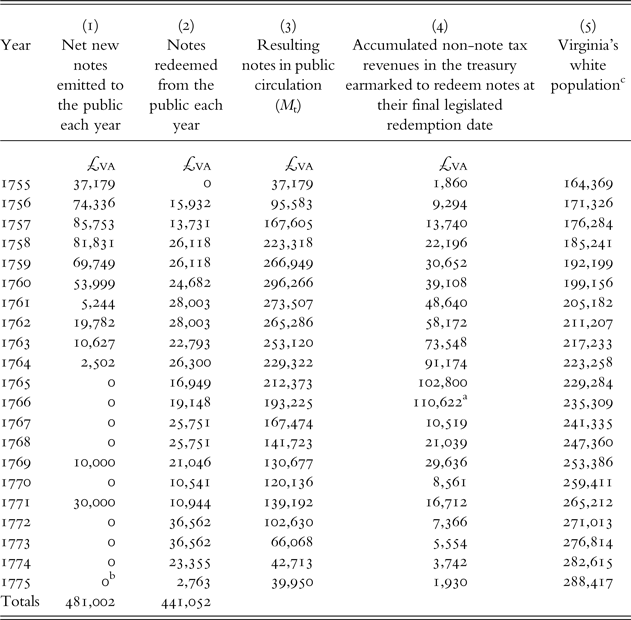
a The accumulated non-note revenues in 1766 are based on expected tax revenues, reduced by 12 percent to get the actual accumulated sum to account for accumulating tax arrears of about 3 percent over the period. These are also the sums removed from the treasury by John Robinson, which he loaned to his friends. Robinson died on 11 May 1766. Of the amounts Robinson removed from the treasury were 95,828£VA of accumulated taxes held for redemption of notes when said notes’ circulation time was at an end. In 1766, it was recorded that only 2,218£VA was left in the treasury to pass on to the new treasurer after Robinson's death. The closeness of the 95,828£VA figure to what would have accumulated in the treasury in 1766, namely (110,622£VA – 2,218£VA) = 108,404£VA, provides support for the data construction. See Grubb (Reference Grubb2017).
b Excludes net new emissions late in 1775. See Newman (Reference Newman2008, pp. 444–6).
c Interpolated values between decadal benchmarks are used. Derived from Carter et al. (2006, vol. 5, p. 652).
Sources: Table 1; Carter et al. (2006, vol. 5, p. 652); Grubb (Reference Grubb2017); Kennedy (Reference Kennedy1906a, pp. xi-xxv, 64–6, 108, 118–20, 124–8, 154–6, 283–5, 303; Reference Kennedy1906b, pp. 72, 217–18; Reference Kennedy1907, pp. 143, 171, 176–8, 356–7); McIlwaine (Reference Mcilwaine1908, pp. 15, 36–7, 115–16, 171–2, 249–50; Reference Mcilwaine1909, pp. 388, 458, 487–90); William and Mary College Quarterly Historical Magazine (1912), pp. 227–62.
The per white capita face value amount of notes in circulation peaked in 1760 at just under 1.5£VA. Before 1758 and after 1764 it was under 1£VA. The maximum amount represented only 3.1 to 4.1 percent, and at 1£VA per white capita only 2.0 to 2.6 percent, of the yearly compensation paid to free workers in Philadelphia in the early 1770s (Grubb Reference Grubb2011, pp. 260–1). The Tm payments are estimated to be between 60 and 75 percent in notes and the rest in specie coins (Grubb Reference Grubb2017, pp. 10–11), implying an even smaller per white capita amount of specie money than paper money. Thus, even with the emission of large amounts of paper money, the domestic economy was still under-monetized with transactions often executed through efficient barter structures such as with book and store credits and with tobacco.
Column 4 of Table 2 estimates the accumulated amount of non-note tax revenues, primarily specie coins, in the treasury that were to be used to redeem notes at their final legislated redemption dates. These amounts are needed, along with the amounts in column 2, to estimate the real-asset present value of the notes. The amounts in column 4 need to be adjusted further to account for the fact that John Robinson, the treasurer, removed the amount that had accumulated in 1766 by loaning these sums out to friends. This action was considered irregular and constituted possible malfeasance. It created a scandal and the possibility that notes could not be redeemed when they came due at the treasury. Suspicions that malfeasance was going on affected the expected real-asset present value of the notes in the years immediately prior to 1766.
When notes became redeemable at the treasury for the tax monies accumulated, they were not always immediately redeemed. The monies held in the treasury for their redemption continued to be held for that purpose. These notes continued in circulation and, at this point, took on a redeemable-upon-demand quality with 100 percent reserve-backing in the treasury.
For example, emission no. 5 was redeemable at the treasury at the end of 1757, but was not all redeemed until 1766. The tax monies received in 1757 for its redemption continued to be held in the treasury for future redemption of emission no. 5 notes (Grubb Reference Grubb2017). Robert Carter Nicholas, treasurer after 1766, observed similar behavior. In 1773, he noted, ‘Most of the Merchants as well as others, … preferred them [Virginia's notes] either to Gold or Silver, as being more convenient for transacting the internal Business of the Country’ (William and Mary College Quarterly Historical Magazine 1912, p. 235). Note the use of the term ‘internal’. Specie coins had a positive opportunity cost when used for domestic transactions. As such, domestic transactions typically used inside paper monies and efficient barter structures. Imported specie coins typically bought imported goods, thereby re-exiting the colony (Grubb Reference Grubb2012).
III
I apply a decomposition approach to evaluate Virginia's paper money performance (Celia and Grubb Reference Celia and Grubb2016, pp. 1148–9; Cutsail and Grubb Reference Cutsail and Grubb2017; Grubb Reference Grubb2016b, pp. 1217–18). The observable market exchange value (MEV) of this money is decomposed into its component parts; see equation (2). MEV equals its expected real-asset present value (APV - RD), i.e. its value as just another non-money barter asset, plus its transaction premium (TP) that measures its pure ‘moneyness’ value, i.e. its extra value as a transacting medium of exchange. Positive values for TP measure the willingness of the public to pay a premium above the notes’ expected real-asset present value, because the notes served as a more convenient transacting medium than the next best barter alternative. The expected real-asset present value is further separated into its pure time-discounting component (APV), and its default risk component (RD). All components in equation (2) are calculated as a percentage of face value to be in a comparable metric.
 $$MEV_t \equiv {\rm} (APV - RD)_t + TP_t$$
The legislature controlled APV and RD. It controlled APV by choosing the redemption structure, and it influenced RD by how it executed those redemption structures. TP was determined by the public through the structure of the economy in terms of how the public evaluated and used alternative media of exchange to execute domestic transactions.
Empirical measurement is the difficult part of applying this approach. While one can measure MEV using data on exchange rates to an outside money, RD and TP cannot be independently measured. In addition, measuring APV entails constructing a counterfactual value of the notes, namely their value when not used as money and when no risk of default is expected.
Fortunately, Virginia's treasury notes were structured as zero-coupon bonds, except for the 1755 and 1756 emissions which were structured as interest-bearing bonds (Grubb Reference Grubb2016a, Reference Grubb2017; Hutchinson and Rachal Reference Hutchinson and Rachal1962, vol. 1, pp. 305–6; Labaree Reference Labaree1959–70, vol. 11, pp. 13–15; Smith Reference Smith1937, pp. 310–12). The notes had legally defined maturity dates when they could be redeemed at face value in specie equivalents by Virginia's government, and they could be redeemed at face value for Tm tax payments due any time after initial emission. Given expected redemption time-paths, maturity dates, payoff values and an appropriate risk-free time-discount rate, the APV of these notes as risk-free non-money tradable bonds can be calculated independent of their MEV.
Moving the variables that can be independently measured to the left-hand side, and the variables that cannot be independently measured to the right-hand side, yields equation (3). In terms of proportions, the ratio APV t/MEV t shows how much of MEV t is accounted for by APV t with the residual share being accounted for by (TP – RD)t. The gap between MEV t and APV t, measures the magnitude of (TP– RD)t.
 $$(MEV_{\rm t} - APV_{\rm t}) \equiv {\rm} (TP - RD)_{\rm t}$$
The possibility that TP t and RD t are both greater than zero by large magnitudes at the same time is unlikely. Behaviorally, TP is likely to be a negative function of RD. Thus, as RD takes on positive values, TP is quickly driven to zero. An asset with a high default risk is unlikely to possess a transaction premium, i.e. be the preferred medium of exchange, relative to an asset with a low default risk. Therefore, I assume that when (TP – RD)t > 0, it is primarily due to TP t > 0; and when (TP – RD)t < 0, it is primarily due to RD t > 0.
To apply equation (3), two data sets are required. I compile the market exchange value (MEV) of Virginia's notes between 1755 and 1774, and I calculate the counterfactual expected real-asset present value (APV) of Virginia's notes as non-money low-risk bonds. I use the observed market exchange rates between Virginia's notes and bills of exchange paying pounds sterling in London to construct MEV. These exchange rates are primarily from merchant account books and are expressed as the face value amount of Virginia notes needed to buy, in Virginia, a 100 pound sterling bill of exchange drawn on London (McCusker Reference Mccusker1978, pp. 205–14).
I adjusted these exchange rates to account for the cost of getting a bill of exchange to London and getting it liquidated into specie usable in Virginia. I estimated that cost to be 7.09 percent (Grubb Reference Grubb2016a, p. 179). Thus, the realized par exchange rate of a Virginia note is 116.14£VA = 100£S compared with the legal par exchange rate of 125£VA = 100£S (Hening Reference Hening1969, vol. 6, pp. 478–83). MEV is calculated by dividing this adjusted number (116.14) by the observed exchange rates in McCusker (Reference Mccusker1978, pp. 211–12). MEV measures the spot-market conversion in Virginia of Virginia paper pounds into a silver commodity outside money expressed as a percentage of the face value of Virginia paper pounds.
Virginia's paper money had a bearer-bond quality that required an explicit redemption exercise to extinguish the principal expressed on the note's face. Virginia's citizens are assumed to act as if they understood their paper money to be interest-bearing bonds in 1755 and 1756, and zero-coupon bonds thereafter, requiring time-discounting to ascertain their present value (their APV), and to know how to calculate this value (Labaree Reference Labaree1959–70, vol. 11, pp. 13–15; Ricord Reference Ricord1892, vol. 17, p. 159; Smith Reference Smith1937, pp. 310–12). The public is also assumed to know the quantity of notes in circulation (M j) and the amounts redeemed (RED t) each year as shown in Table 2. RED t includes the amount of funds (specie) in the treasury that could be used for redemption at face value at the end maturity dates of the notes as shown in Tables 1 and 2.
For the most part, the evidence does not record what notes from which emissions were redeemed when, but lumps redeemed notes from all emissions currently outstanding together (Grubb Reference Grubb2017). For this reason, I assume that the public responded only to the expected redemption of the average note currently outstanding. Because the MEV data only measure the current market value of the average note in circulation, and do not distinguish between the notes of different emissions, APV is calculated to be a comparable measure to MEV.
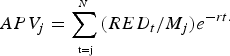
Equation (4) shows how I calculate the expected APV of the average note in circulation. It is adapted from the basic continuous discounting present value formula (PV = FVe −rt), where PV is present value, FV is face value, r is the discount rate and t is the time to maturity. In Equation (4) the amount of Virginia paper money outstanding in a given year is assumed to be redeemed by all notes actually redeemed in the immediately following years, including the potential redemption at the end maturity date using accumulated specie in the treasury, until the year when that original amount is fully redeemed. These yearly redemption amounts are divided by the initial amount outstanding from the chosen year to assign a yearly weight to its contribution in the redemption process. The time discounts between the initial year and the redemption year are multiplied by the contribution-weights for their respective years. The time-discount-weight values for each year are summed to get the expected present value of a representative note outstanding for that chosen year. The APV calculation is adjusted for 1755 and 1756 to account for the interest actually paid (Grubb Reference Grubb2017).
 $$APV_j = \sum\limits_{\; _{{\rm t = j}}}^{_N} {\lpar {RED_t/M_j} \rpar e^{ - rt.}} $$
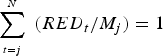
Where r = the risk-free time-discount rate or opportunity cost of capital, M j = the face value amount of Virginia paper money outstanding in year j, RED t = the face value amount of Virginia notes redeemed and retired from circulation each year, including the amount of funds (specie) in the treasury that could be used for redemption at face value at the end maturity dates of the notes, with RED N being the amount in the last year N that satisfies:
 $$\sum\limits_{_{t{\rm} = {\rm} j}} ^{_N} {\; \lpar {RED_t/M_j} \rpar {\rm} = {\rm} 1} $$
No time-series of market-generated interest rates for any class of assets currently exists for colonial America. Therefore, I use the r considered normal by colonial contemporaries for assets with relatively low default expectations. This rate is a proxy for what in modern analysis is the risk-free rate. In 1748, the Virginia assembly set the legal interest rate for the colony at 5 percent, where it stayed for the rest of the colonial period. However, the legislature indicated that the market rate was above this legal rate (Hening Reference Hening1969, vol. 6, pp. 101–4). In 1764, Benjamin Franklin stated that the rate for discounting well-funded legislature-issued zero-coupon bonds was 5 or 6 percent (Labaree Reference Labaree1959–70, vol. 11, pp. 13–15). The interest rate mentioned most often for the middle colonies in the second half of the eighteenth century was 6 percent (Grubb Reference Grubb2016a, pp. 163–4). Given uncertainty over the exact rate, an r from 5 through 7 percent is used, with 6 percent being my best guess. A risk-adjusted r* rate for Virginia's treasury notes will also be imputed, namely a rate that can range above the risk-free rate (see Figure 2 below).
IV
Figure 1 compares the levels of MEV and APV over time, when APV is discounted at 5, 6 and 7 percent. MEV could be within a couple of percentage points of that drawn due to measurement error, and while 6 percent is my best-guess discount rate, uncertainty over that rate means that 5 or 7 percent could also be used. Considering the range of possible measurement errors, the hypothesis that MEV is predominantly comprised of APV cannot be rejected given the data in Figure 1. Little (TP – RD) figures in to MEV. Virginia treasury notes were not a fiat currency. They were predominantly real barter assets.
MEV versus APV, 1755–74
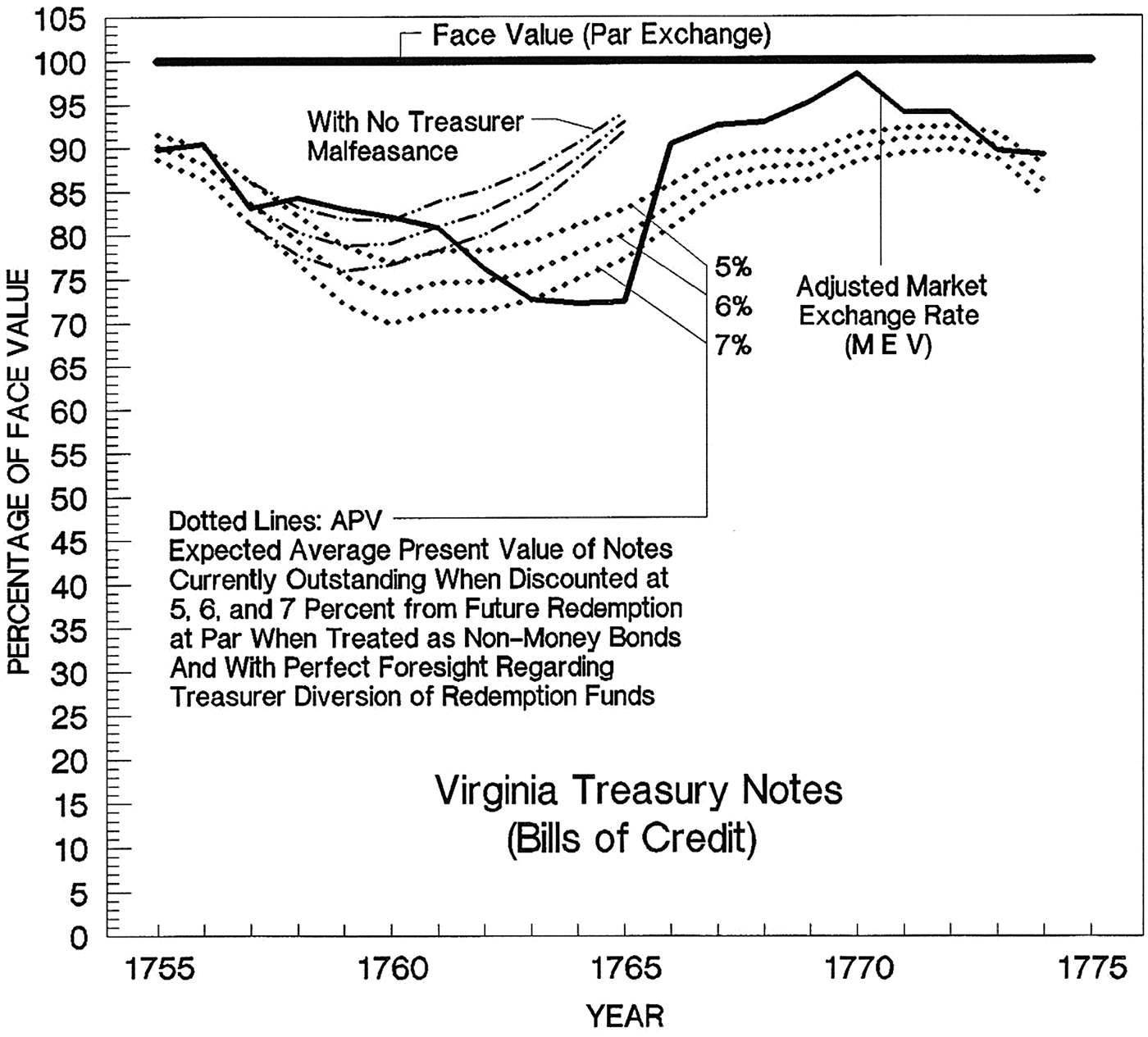
Using MEV as drawn and the best-guess 6 percent discount rate over the entire period covered by colonial Virginia's paper money regime APV accounts for 97 percent of MEV, leaving TP to account for 3 percent of MEV. Within this overall span, four subperiods can be identified. MEV ≈ APV from 1755 through 1757, implying that (TP – RD) ≈ 0 during the initial three years of Virginia's paper money regime. Being a new endeavor for Virginia, the notes possessing no TP in these initial years is not surprising.
By comparison, MEV > APV, implying that RD ≈ 0 and TP > 0, in the years 1758–62 and 1766–74. The years 1758–62 and 1766–72 appear to be normal in that no specific financial crises are identifiable. In these years, APV accounts for 93 to 94 percent of MEV leaving TP to account for 6 to 7 percent of MEV. While relatively small, this TP was enough to make Virginia's treasury notes the preferred medium of exchange for executing domestic trades. This 6 to 7 percent can be considered a measure of the transaction cost gains from using notes, compared with using book credit, tobacco claims, or specie, to execute domestic trades.
In the subperiod 1763–5, MEV < APV, implying that TP ≈ 0 and RD > 0. This period is associated with a financial crisis that preoccupied Virginia politics. John Robinson, Treasurer and Speaker of the House from 1738 until his death in early 1766, had been suspected of diverting funds accumulating in the treasury, funds earmarked for redeeming notes at their end maturity dates. He loaned these funds, without specific authority to do so, to his friends. In 1766, after his death, just over 95,000£VA of these funds were discovered to have been so diverted. Given the large amount diverted, the suspicions expressed at the time that malfeasance was happening seem credible (Ernst Reference Ernst1973, pp. 177, 183, 188; Lee Reference Lee1825, pp. 22–3; Mays Reference Mays1952, pp. 175, 181). The evidence in Figure 1 is consistent with the public becoming suspicious of improprieties around 1761, judging by the shrinking TP that starts after 1760. (TP – RD) does not become negative until 1763, which is consistent with the public definitely responding to something being amiss at the treasury regarding potential note non-redemption.
Given that a substantial amount of notes in circulation in the early 1760s had their end maturity dates between 1765 and 1769, see Table 1, the public had to be concerned in the early 1760s that the accumulating tax funds in the treasury earmarked to redeem these notes would not be there when so required for redemption. A letter in the Virginia Gazette, 17 October 1766, remarked that ‘Many of us, to our great detriment, have had money paid to us whose day of redemption was elapsed, and which some of our creditors refused to receive from us again, alleging it was no currency; this money, when carried to the Treasury has frequently been refused to be redeemed, under the pretense that the Treasury was empty …’ Fear of delayed redemption led the public to eliminate any TP and then add a positive RD to the notes by 1763. The data in Figure 1, using the best-guess 6 percent discount rate, indicate that the RD in 1763–66, assuming TP ≈ 0, accounted for an average of 7.5 percent of MEV. In other words, MEV = (APV – RD) in these years. The notes in this period functioned like risky barter assets.
Figure 1 illustrates what the APV would have been if there was no diversion of treasury funds, with those funds remaining in the treasury to execute note redemption as legislated. Between 1763 and 1765, using the best-guess 6 percent discount rate, APV would have been 11 percentage points higher with no treasurer diversion of redemption funds. I construct a counterfactual MEV for the years 1763–5 using this alternative higher APV by assuming MEV = (APV + TP), where the TP is taken from the prior normal years of 1758–62, and RD is assumed to be zero. In the absence of treasurer malfeasance, MEV would have averaged 96 percent of face value in 1763–5 as opposed to its actual 72 percent of face value – a 24 percentage point effect on MEV. The treasurer's diversion of redemption funds fully accounts for the exchange rate crisis of the early 1760s (Ernst Reference Ernst1973, p. 194).
After Robinson died in early 1766 and his actions were fully documented, MEV and APV rapidly returned to normal patterns. Robinson's estate was required to repay the sums diverted. The repayment of these funds, and the resumption of normal tax payments and use of the specie portion to redeem notes, meant the return to normal expected redemption processes.
Early in 1773, notes of the 1769 and 1771 emissions were discovered to have been counterfeited ‘in so ingenious and dangerous a manner that it is difficult to distinguish the forged from the good bills’ (Hening Reference Hening1969, vol. 8, p. 648; Kennedy Reference Kennedy1905, pp. viii-xi, 7, 9–10, 26–7). The assembly moved swiftly to mitigate the impact. They required all notes from emissions nos. 14 and 15 still outstanding to be swapped for new notes in 1773, and hunted down the counterfeiters (Hening Reference Hening1969, vol. 8, pp. 647–51; Kennedy Reference Kennedy1905, pp. viii-xi, 7, 9–10, 15–16, 18–20, 23–4, 27, 29–32, 35, 264). If the public expected the actions of the assembly to be ineffectual, they would have discounted the notes severely, i.e. generated a RD > 0, to account for the risk that not all notes could now be redeemed as legislatively promised (Ernst Reference Ernst1973, pp. 331–4).
Figure 1 shows that this counterfeiting scare, while a topic of public discussion and legislative action, had little impact on the value of the notes in circulation. Using the best-guess 6 percent discount rate, MEV exceeds APV in 1772 and 1774 by the normal TP amounts. In 1773, MEV ≈ APV, thus leaving (TP – RD) ≈ 0. No significant RD > 0 appears in this period. At best, a 4 to 6 percentage point dip and then return in TP occurs from 1772 to 1773 to 1774.
This result is important because stories of counterfeiting have given the impression that colonial bills of credit were problematic paper monies or even worthless monies (Ernst Reference Ernst1973, pp. 331–4; Scott Reference Scott1957). The evidence in Figure 1 indicates that counterfeiting had a minor and temporary economic impact on the value of Virginia's paper money. While this is the first systematic quantitative measure of the impact of a significant counterfeiting episode on the value of colonial paper monies, it raises the possibility that counterfeiting is an over-dramatized topic. Colonial governments had the tools to mitigate the impact of counterfeiting quickly and almost completely, and they employed these tools when necessary.
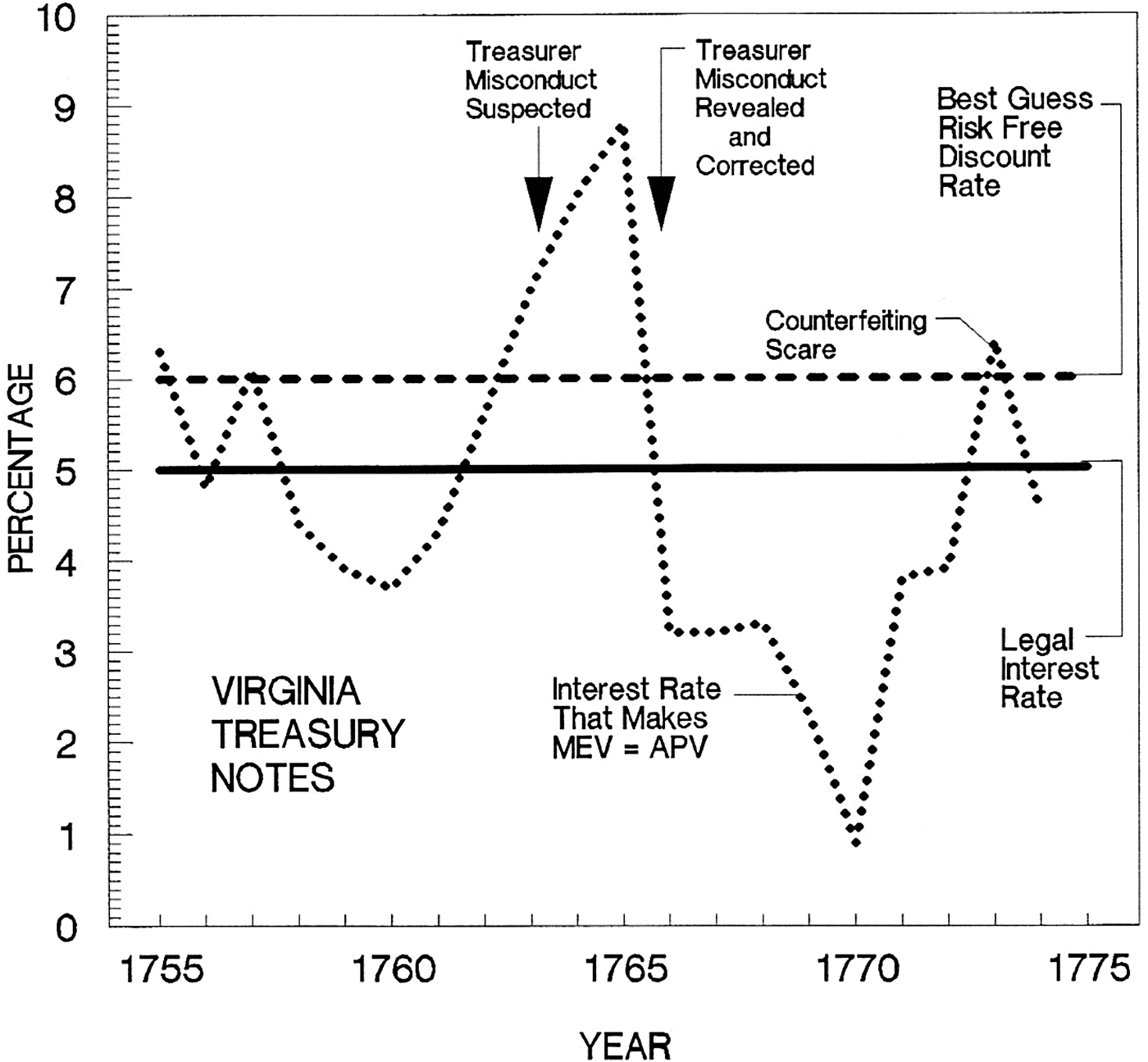
I employ an alternative risk-adjustment method to get at the same issues. If TP = 0, then MEV measures the current spot market value of these notes as non-money bonds. Given the expected redemption structure, the interest rate r* that makes MEV = (APV - RD) is calculated, i.e. select r* such that MEV j = ∑t = jN (RED t/M j)e −r*t. If in fact TP = 0, then r* would be the first time-series of market-generated interest rates for any class of assets in colonial America.
If r* is within the normal range of risk-free discount rates, then the proposition that the notes are simply non-money barter assets with no special ‘moneyness’ value or fiat currency attributes cannot be rejected. If r* is above this range, then the notes are risky non-money bonds. If r* is below this range, then the proposition that RD ≈ 0 and TP > 0, namely that the bills have some ‘moneyness’ value, cannot be rejected. The magnitude by which r* is outside the normal range of risk-free interest rates measures the extent that RD > 0 when r* is above that range, and the extent that TP > 0 when r* is below that range.
Figure 2 displays r* from 1755 through 1774 along with the legal interest rate and my best-guess normal risk-free rate of 6 percent. In the first three years of the paper money regime, 1755–7, r* is around the normal range of risk-free discount rates, implying that the notes’ MEV is largely determined by APV. The notes are primarily a low risk barter asset in these years.
The imputed r* drops well below the risk-free discount rate from 1758 through 1762, and again from 1766 through 1772. These below-normal r* rates do not represent the normal market rate being driven down by an increased emission of paper money. No contemporary writer or any other evidence indicates that normal interest rates were as low as r* in these years, and in the second period the amount of notes in circulation experienced substantial contraction not expansion; see Table 2. In other words, the proposition, TP > 0, cannot be rejected in these years.
Figure 2 also shows the periods when RD > 0 due to suspicion of potential non-redemption. The malfeasance suspected and then revealed at the treasury between 1763 and 1766 appears as a spike in r*, reaching 9 percent by 1765 before returning to its typical non-crisis range thereafter. Because no evidence indicates that risk-free discount rates were ever in the 9 percent range in this period, this finding implies that TP ≈ 0 and RD > 0 in these years. The notes were risky barter assets in these years. Figure 2 also shows the relatively minor nature of the counterfeiting scare in 1773. While the scare briefly eliminated any TP > 0 attached to the notes, their use remained in the range of free-risk barter assets, rather than risky barter assets.
r* through time, 1755–74
The results in Figures 1 and 2 also indicate that the Seven Years’ War (1755–62) had a limited effect on Virginia's public finances in terms of its paper money performance. The Seven Years’ War disrupted Virginia's transatlantic trade and led Virginia to emit massive amounts of paper money to fund its participation in that war; see Table 1. In spite of this, Virginia was able to manage its paper money regime reasonably well (Wicker Reference Wicker1985). The massive expansion in paper money occasioned only a 10 percentage-point decline in Virginia's paper money value during the war, roughly from 90 to 80 percent of face value. The paper money's value recovered thereafter, especially when netting out the treasurer's malfeasance via the counterfactual exercise employed here. Virginia was able to achieve this outcome by the way in which they structured and executed the future redemptions of their wartime paper money emissions. In 1760, Virginia began to substantially contract the amount of paper money in circulation via redemption in excess of new emissions; see Table 1. The public assisted this outcome by adding ‘moneyness’ value (TP) to the paper money's time-discounted asset present value as part of the public's response to Virginia's under-monetized economy.
V
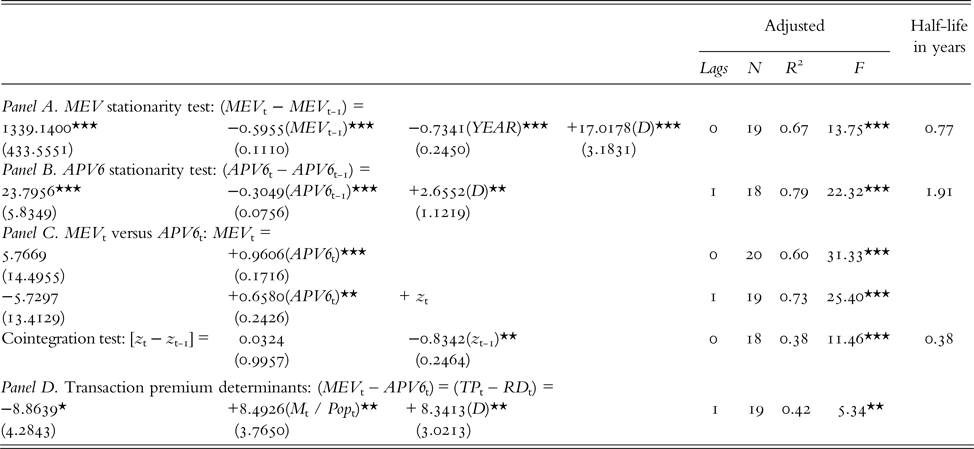
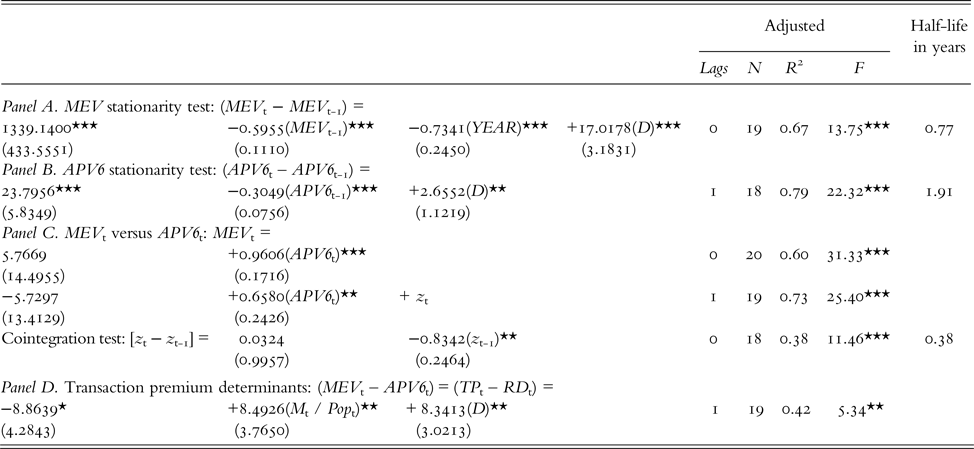
Table 3 reports the time series statistical properties of MEV and APV, using the best-guess 6 percent discount rate for APV. MEV is a trend stationary series, with a structural break at 1766. APV is a stationary series with a structural break at 1766. Both have short half-lives to shocks. MEV and APV are also cointegrated. Thus, estimating APV’s effect on MEV over time is a valid exercise. Panel C in Table 3 reports that effect. APV t has a statistically significant positive effect on MEV t with a relatively large coefficient magnitude. Statistically, APV and MEV are closely associated. ΔMEV tracks ΔAPV through time.
Statistical properties and determinants of MEV and APV, 1755–74
Notes: Data are annual. Standard errors are in parentheses under their respective coefficients. Lags refers to lagged dependent variables included to removal serial correlation. APV6 =APV when discounted at 6 percent. D is a structural break dummy variable capturing the change in treasurers and so the end of the diversion of redemption funds, see the text. D = 1 for years 1766–74 and zero otherwise. z t = regression error term. Dickey–Fuller critical values are used for the (t-1) independent variables in panels A, B and C; see Enders (Reference Enders1995, p. 419). For panel A, Durbin's Alternative Tests for autocorrelation failed to reject the hypothesis of no serial correlation above the 0.1 level. For the regression in panels B, C and D, serial correlation was corrected by including one lag of the dependent variable. These corrected regressions were tested with Durbin's Alternative Test for autocorrelation which failed to reject the hypothesis of no serial correlation above the 0.1 level. OLS provides unbiased and consistently estimated coefficients, but biased-low standard errors when serial correlation is present. Adding lagged values of the dependent variable eliminates serial correlation for better assessment of standard error-statistical significance, but biases the coefficients on the other independent regressors (Maddala Reference Maddala1977, pp. 147, 281–3; Pindyck and Rubinfeld Reference Pindyck and Rubinfeld1998, pp. 159, 235). Thus, for panel C the OLS regression is used for coefficient accuracy and the regression corrected for serial correlation is used to assess statistical significance. The half-life to shocks are calculated using the following equation: [-ln(2)/ln(1 + a1)], where a1 is the coefficient on the (t-1) independent variable in panels A, B and C. See Mark (Reference Mark2001, p. 32).
*** Statistically significant above the 0.01 level.
** Statistically significant above the 0.05 level.
* Statistically significant above the 0.1 level.
Source: Figure 1. See text for variable definitions and construction.
The unbiased coefficient on APV6 t in Table 3 panel C, namely uncorrected for serial correlation with no lags of the dependent variable included, is 0.96, which is close to 1.0 indicating a tight relationship between MEV and APV6, namely APV6 explains 96 percent of MEV. The constant term in the regression is (TP – RD), derived from equation (2). The unbiased coefficient on the constant term is a positive 5.8. This indicates that over the entire sample TP > 0 and explains close to 6 percent of MEV, close to that derived from the raw data in Figure 1.
I estimate the determinants of TP in Table 3 panel D. (TP – RD)t is measured by (MEV –APV)t, see equation (3). Because (TP – RD) cannot be decomposed empirically, careful interpretation of the independent variables is required to assess ∆TP versus ∆RD. Because TP is likely to be a negative function of RD, with TP quickly driven to zero when RD takes on positive values, positive independent variables are capturing positive movements in TP.
The 1766 structural break is significantly associated with higher TP thereafter; see also Figure 1. The structural break captures the shift from the old treasurer, John Robinson, who was suspected of malfeasance, to a new treasurer, Robert Carter Nicholas. This transition removed the RD that arose in the early 1760s caused by suspicions that Robinson had misappropriated specie in the treasury that was to be used to redeem notes.
This result is important for assessing the impact of the 1764 Currency Act that removed legal tender status from new issues of colonial paper money. The Parliamentary removal of legal tender status of colonial paper monies did not reduce the TP Virginians placed on their own treasury notes. Legal tender status apparently was not necessary for the notes to be the preferred medium of exchange in local transactions. Moving the structural break one year back or one year forward from 1766 reduces the regression fit, i.e. 1766 is a local maximum. The 1764 Currency Act was a non-issue regarding the value of Virginia's notes (Grubb Reference Grubb2016a). It was more a political than an economic issue (Brock Reference Brock1975, pp. 465–527; Ernst Reference Ernst1973).
The most interesting result in Table 3 panel D is the positive and statistically significant effect of the amount of paper money per capita on (TP – RD). Placing more paper money in circulation regardless of which treasurer was in charge increased the strain on executing redemptions as promised. As such, RD should not fall, and so increases in TP must account for this positive association. More paper money in circulation per capita increased its ubiquity and familiarity of usage, which in turn led the public increasingly to treat this money as fiat-like currency. This process was accomplished by the public not time-discounting these notes when used in trade as much as would be required if they were just non-money zero-coupon barter bonds. As more notes were put into circulation, they increasingly displaced other means for making domestic transactions, such as barter, book credit, tobacco claims and specie coins.
Because the transaction premium was positively associated with the quantity of paper money in circulation, it absorbed the pressure to reduce the value of the paper money that sprang from increases in the quantity of paper money. Within the limits of an under-monetized economy, increases in the quantity of paper money increased its ‘moneyness’ value by increasing its usefulness as an internal medium of exchange within that economy. This explains why the classical quantity theory of money performs poorly when used to assess the value and performance of colonial paper monies (Grubb Reference Grubbforthcoming).
VI
Barter is when real goods or real assets directly, or ultimately, pay for real goods or real assets without using an intervening and easily transferable store-of-value instrument that is itself not a real good or real asset. Real assets include claims to specific future real goods or real value obligations. Money's definition must be separate from, or independent of, the non-money real goods or real asset value of the object identified as money. If it is not, then everything and anything traded is money, and we have a useless and meaningless definition of money. The model of money employed here achieves that separation and measures the ‘moneyness’ value versus real value portions of objects identified as money.
Virginia's paper money was mostly a barter asset. It functioned as a zero-coupon bond and not a fiat currency. It traded below face value due to time-discounting, not depreciation. Scholars have habitually confused time-discounting for depreciation. It had a small transaction premium, i.e. a small ‘moneyness’ value, enough to make it the preferred medium of exchange for domestic transactions. This transaction premium was positively related to the quantity of paper money in circulation. As the quantity increased, it gained ubiquity and familiarity of use, leading citizens to pay a premium above its real-asset present value. In effect, citizens reduced the time-discounting they applied to the notes, thereby beginning a transition from barter asset toward having fiat currency characteristics. This identifies one mechanism by which real asset claims can transition into fiat currency. This association, given the under-monetized economy, siphoned off price inflation pressures coming from increases in the paper money supply, leaving little association between the quantity of paper money and prices (Grubb Reference Grubbforthcoming). The small transaction premium is also consistent with the minor output gains associated with increases in paper money supplies found in some colonies (Rousseau Reference Rousseau2007; Rousseau and Stroup Reference Rousseau and Stroup2011). In years with monetary troubles, i.e. asset redemption worries, the paper money did experience a moderate risk discount. Counterfeiting, however, was not a major worry, at least for Virginia. The Virginia legislature had the tools and used them effectively to mitigate the effects of counterfeiting on the value of its paper money.
On these general patterns of assessment and performance, colonial Virginia's paper money was similar to that recently found for the paper money regimes of colonial New Jersey, colonial North Carolina and post-1764 colonial Maryland (Celia and Grubb Reference Celia and Grubb2016; Cutsail and Grubb Reference Cutsail and Grubb2017; Grubb Reference Grubb2016b). What differs across colonies are the magnitudes and timing of these performance outcomes, the particular causes underlying the public finance dynamics controlling their systems, as well as the type and timing of shocks hitting their paper money systems. The history part of financial history matters. Virginia's actual financial history, namely the magnitudes of the effects, the dynamic path of values and the legislative reactive controls, was unique, as it was for other colonies. The model used here allows identifying, tracking and analyzing that uniqueness and its causes.