

The Ashmolean Latin Inscriptions Project (AshLI) is a three-year collaboration between the universities of Warwick and Oxford, and the Ashmolean Museum. Its remit comprises, aside from photographing, cataloguing and translating the Museum's collection of more than 350 Latin-inscribed objects, a wide-ranging programme of public- and schools-engagement: as well as the epigraphers (inscriptions specialists), imaging experts and digital encoders, Professor Alison Cooley's team also includes a PGCE-qualified Classics teacher and blogger, and a trained podcast producer. Their aim is to tell stories of Roman life, using inscriptions as a starting point, through INSET days, free teaching resources, short films and regular podcasts made available through the project's blog ‘Reading, Writing, Romans’. In 2015, the team organised the first in a series of large-scale, direct public engagement events, when it staged a Roman funeral procession in the Ashmolean Museum.
The Call from Beyond
‘The Oxford Centre for the Humanities (TORCH) sent out a call in September 2015, encouraging any university research groups working on ‘deathly’ subject matter to submit proposals to take part in the Ashmolean Museum's DEADFriday, an open-doors event designed to coincide with the Hallowe'en weekend. Since much of the Ashmolean's corpus of stone inscriptions is funerary, from engraved ash-urns to tombstones, death and burial in the Roman world is one of the core interests of the AshLI team. We have found that one of the key challenges in teaching with these funerary objects has been giving a sense how they were originally displayed and used. Cleaned white marble urns, tastefully displayed in high-ceilinged galleries, do much to evoke the country houses of eighteenth century collectors, but little to conjure the sights and smells of Roman tombs, or the sound and bustle of the processions that delivered a Roman's remains to their final resting place. With this kind of contextualisation in mind, we had recently unveiled a new display of columbarium plaques (from communal tombs with individual urn-niches) in the Museum's subterranean Reading and Writing Gallery (Figure 1). Armed now with both Roman urns and a Roman tomb, we felt the staging of a Roman funeral and procession was the very best way of bringing the objects to life.
| New Ashmolean display of columbarium plaques and funerary urns beneath niches hand-painted by Claire Venables. The urn of Abascantianus stands bottom right.

The Cast
Our designation of roles and the sequence of events were largely dictated by the ancient sources, including Juvenal, Suetonius, Cicero and Polybius (a useful nineteenth-century digest of the literary evidence for Roman funerals can be found in William Smith's Dictionary, online at http://bit.ly/1LfzET6). It quickly became apparent that the AshLI team could not muster the necessary numbers on its own, and so we appealed for volunteers from Warwick and Oxford Universities, and were delighted by the enthusiastic response. The eventual cast comprised members of Oxford's Classics Faculty and postgraduates, a team of Warwick Classics postgraduates, and a small number of alumni.
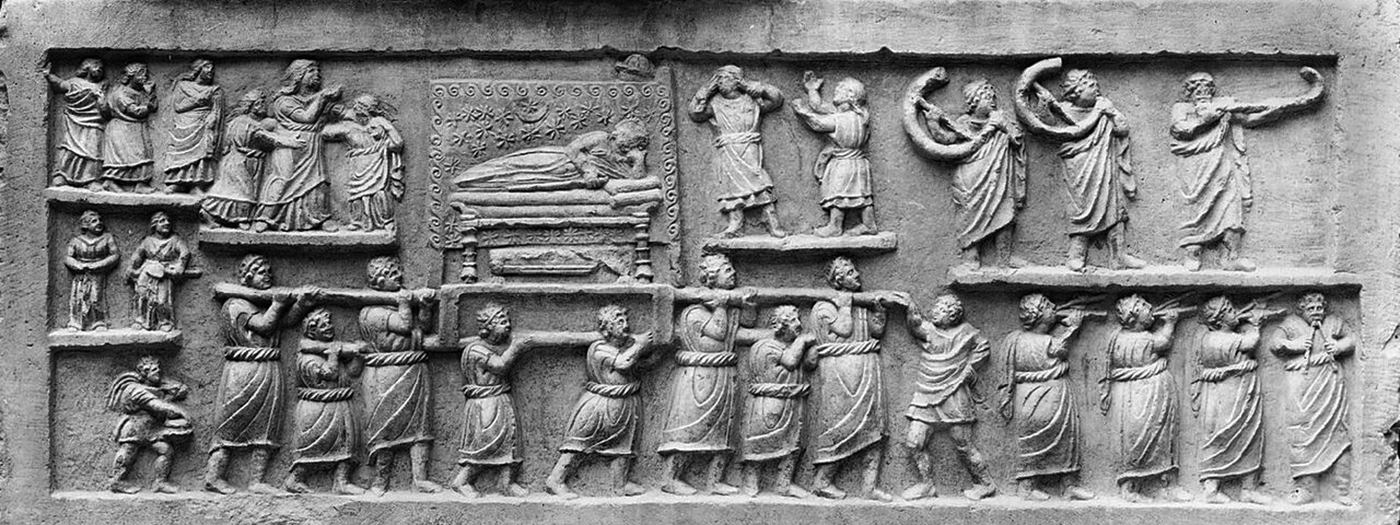
Even with these additional helpers, the cast threatened to be a large one. We thought it best that the various different roles should all be at least represented, even if the overall number of individuals performing that role had to be limited. So it was that we settled on a cast which we hoped would give the right impression of size and variety: a dominus funebris (funeral director), the wife and eldest son of the deceased, two freed slaves, two imago carriers (processing with the wax images of the deceased’ ancestors), one Archimimus (sending-up the deceased), two lictors, four professional mourners, one bucina player, one aulos player, two couch bearers, and a priest. While we would have loved to have had the full panoply of musicians, sourcing the instruments, and finding those able to play them naturally curbed our ambitions. In the end, my husband and I (erstwhile trumpeter and clarinettist respectively), took on the roles of bucina and aulos player, embarking on three months of rehearsals that must have confounded our neighbours. We allowed ourselves some licence in matching the gender of our modern volunteers and their ancient roles. While we cast men in the role of eldest son, funeral director, couch-bearer and priest, and women in the role of the widow and professional mourners, we found it unproblematic to cast women as imago holders and musicians. Our primary aim was to evoke the spirit of a Roman funeral, with its varied participants, and demonstrate its key features. Finally, with our cast of 18 in place, and with the first-century relief from Amiternum as our guide (Figure 2), we set to work preparing our programme and props.
| Amiternum relief, first century BC, showing a Roman funeral procession, in the Museo Nazionale d'Abruzzo, L'Aquila, Italy.
Designing the Programme
We followed a conservative funeral programme, beginning with the laying out of the corpse at home, processing to the place of cremation, a eulogy for the deceased, and the transportation of the urn to the family mausoleum. In the lower-ground floor of the Ashmolean, we took over the Jameel Eastern Art space as our Roman home. Rather than simply launch into the funeral, we decided to use the character of the dominus funebris, played by Dr Llewelyn Morgan, as a way to introduce the spectators to some of the participants and explain their roles. To form the procession, he called up each cast member up in turn, reminding them what they should be doing. Before the procession was allowed to move off, it was admonished with an adapted reading from the funerary legislation laid out in the Twelve Tables, the early Roman law code of the fifth century BC, which contains gems such as ‘never smooth the ashes of pyre with an axe’, ‘no more than ten aulos players’ and ‘never put gold on a pyre, unless it's part of the corpse's dental work’. This opening act from the dominus funebris allowed us to set the scene for the museum visitors, as well as highlight some of the more unfamiliar elements of Roman funerary tradition (Figure 3).
| Dr Llewelyn Morgan, as the dominus funebris, admonishes the procession not to smooth the pyre with an axe.
With our lictors clearing a path ahead of us, we processed through to the large Ashmolean Atrium, to the sounds of the instruments and our wonderful team of mourners, led by Dr Helen Slaney, crying ‘eheu!’ and ‘vae vae!’ as they beat their breasts and pulled at their hair. Here we stopped, in an open area where more spectators could look down on us from the stairwell and the upper balconies, for the eulogy and cremation. For obvious reasons, we could not stage a real cremation and so, while Dr Matt Hosty, as the eldest son, delivered a moving eulogy for his father, half of the funeral cortege moved off, and returned with the filled urn as a fait accompli. Dr Ed Bispham, as the bolshy freedman, was then able to tell the assembled crowd, in the best Greek tragic tradition, about the events which had occurred off-stage, and give a sense of what a Roman cremation involved. After setting off once more, we moved noisily though more galleries, until we reached our priest, anointing us with an olive branch and dismissing us with the traditional cry of ‘ire licet!’
Looking the Part
In preparing for the funeral, AshLI benefited from three pieces of good fortune: that one of the AshLI Research Fellows, Dr Hannah Cornwell, is an experienced costume-maker; that we were able to supplement our own costumes with those from Oxford's most recent Greek Play; and that a student from Cherwell School, Amy Chaplin, came to us for work experience in the week leading up to the event. Hannah was able to fashion togas and tunics from bought fabric and adapt existing costumes. Amy and I worked together on a replica of a Roman funerary urn which stood in the new columbarium display, and which was dedicated to the memory of a man named Tiberius Claudius Abascantianus. We laid printed photographs over a cardboard core to create a model urn which could be carried in the procession – even if the museum had ignored all conservational best-practice by allowing us to use the real thing, its weight of 140 kg would have been no small obstacle.
The wax masks held by the imago holders in antiquity are likely to have been death masks, cast in plaster from the face of the recently deceased. Without this option to hand, our imagines were cast from the faces of AshLI team members. Using plaster bandages, and wax tinted with cream-coloured dye, we produced three good masks, each with a wooden spoon embedded (a necessary deviation from ancient practice) to provide a handle (Figure 4). The team produced a short video showing how they made these masks, which is available online: http://bit.ly/1WhVYTe.
| Emma Searle and Dr Enrico Prodi channelling Abascantianius’ ancestors with wax imagines.
The plaster mould of my own face was used a second time to cast a red-blotched face for our own corpse. This face was bound to a cloth body constructed from coat-hanger shoulders and a body of cushions, using crepe bandages. The corpse was then dressed in a toga and gold wreath and had a replica Roman coin affixed to its mouth. The funeral couch was constructed in the form of a table, with a plywood surface, four shapely legs made from stair spindles and a reclining headrest from a defunct sun-lounger. Two long carrying poles were attached horizontally; the whole was then sprayed gold and upholstered with heavy curtain fabric. Once the corpse was in place, he was secured to the couch with ties, and covered with a brocade blanket. The Roman ideal, of having the corpse recline on one elbow as if still alive, was beyond our capabilities, but we were nonetheless pleased with the result.
The Deceased
Given the nature of our source material, we chose to commemorate a wealthy male Roman. Not only are aristocratic funerals better documented than others, but the public role of Roman men allowed us to tailor our script towards the commemoration of a well-known public servant. Having chosen the urn we wished to use, that of Tiberius Claudius Abascantianus, we decided to construct the dead man's biography to suit the cast we had assembled. As the youngest members of our cast were postgraduates, we took a few liberties with his age and identity. The real Abascantianus was only 22 years old, and was commemorated by his parents following his death in the south of France. For the purposes of the funeral, Abascantianus became an elderly Roman knight, who had served, amongst other places, in ‘rain-swept Britannia’. By creating a new character, Matt Hosty, who composed and delivered the eulogy, was able to work in details of the Roman cursus honorum and give a sense of the kinds of posts that a successful Roman might have held. Anyone who would like to hear more about the ash urn and the life of the real Tiberius Claudius Abascantianus can hear a recording of the short talk that Alison Cooley gave on the night, complete with images, now online at http://bit.ly/1KbfcVg.
Unexpected Finds
In preparing for the DEADFriday event, the AshLI team were required to dabble in a variety of ancient skills, from wax casting, to public speaking, clothes making and playing ancient instruments, and it was interesting to discover how challenging each was, according to its similarity to skills we already possessed. But it was the process of performing the funeral twice, in an Ashmolean packed with over 4,000 visitors, which produced the most unexpected result. The wailing and thrashing of the mourners, the bawdy behaviour of the Archimimus, the discordant music, the low-lighting and the deep crowds of the spectators, all contributed to a sensation of barely contained chaos. In a public environment where onlookers did not keep strict silence, and pressed curiously around the cortege, it became clear that participants in a Roman funeral must have relied on firm plans and on following the person immediately ahead of them (Figure 5). Voices and even line-of-sight were easily lost beyond a few paces, and we found ourselves relying on our lictors, armed with their fasces, to carve a path through the crowds. It was easy to imagine something of the feeling of a Roman funeral, not as a solemn march in good order, but an emotional outpouring at the very limits of decorum. This transformation we only felt once the Museum was full, which made our funeral the noisy, crowded affair that, we hope, would have made any Roman proud. A video of the funeral, shot by the Oxford Classics Media Team and edited by AshLI, is available online on our blog, ‘Reading, Writing, Romans’: http://bit.ly/1LvPRzd.
| The AshLI funeral cortege in close formation.
Ashmolean Images are © Ashmolean Museum, through Claire Venables, Masterstroke and IWPhotographic. The Amiternum relief is in Public Domain.
For other articles on the value of re-enactment, see:
Dickey, E. (2015). An Immersion Class in Roman Education. Journal of Classics Teaching, 31, pp. 38-40.
Access is available through http://journals.cambridge.org/action/displayIssue?decade=2010&jid=JCT&volumeId=16&issueId=31&iid=9790151
Parker, A. (2012). The Gullibility of Teenagers. Journal of Classics Teaching, 25.
Access is available through www.arlt.co.uk


 Open access

