





Early childhood is a vulnerable period for growth and development, during which dietary behaviour and disease risk are shaped profoundly(Reference Manohar, Hayen and Do1). Socio-economic factors may decisively affect this process, with ample evidence showing that exposure to low socio-economic status (SES) is associated with a diet conducive to lifestyle-related diseases(Reference Iguacel, Fernández-Alvira and Bammann2). Unhealthy early childhood dietary practices may progress into adulthood(Reference Mikkilä, Räsänen and Raitakari3) and result in obesity and related comorbidities(Reference Weihrauch-Blüher and Wiegand4). This may increase an individual’s lifelong risk of disease and premature mortality(Reference Abdelaal, le Roux and Docherty5), which is already elevated due to SES disadvantages as such(Reference Stringhini, Carmeli and Jokela6). Addressing SES-related dietary shortcomings in the early life stages therefore is of paramount importance.
Previous representative studies from Germany demonstrate clear associations between SES and food consumption in both older children and adults. A cross-sectional analysis of 12- to 17-year-olds found that children with low SES consumed more soft drinks, with girls also consuming more meat and boys more juice compared with their higher SES peers(Reference Brettschneider, Lage Barbosa and Haftenberger7). Among adolescents and adults aged 14–80 years, lower SES was linked to higher consumption of meat, soft drinks and beer and lower intake of fruit, vegetables, fish and water(Reference Heuer, Krems and Moon8), indicating that higher SES is linked to better, albeit still incomplete adherence to dietary recommendations.
Although studies provide evidence linking socio-economic characteristics to diet quality in preschool-aged children(Reference Vilela, Oliveira and Pinto9–Reference Pereira-da-Silva, Rêgo and Pietrobelli12), data on the relation between SES and early childhood diet are scarce(Reference Anstruther, Barbour-Tuck and Vatanparast13). Given the considerable impact of nutrition in this phase of life(Reference Manohar, Hayen and Do1), the large amount of time spent in parental care and the associated extent of exposure to the household SES environment, such as parental food choices(Reference Anstruther, Barbour-Tuck and Vatanparast13), toddlerhood and preschool age are of particular relevance.
The objective of this analysis is therefore to assess SES differences in food consumption in children 1–5 years of age and to identify SES-related shortcomings in diet quality at this stage of life. Analyses are based on the most recent representative food consumption data for Germany, collected within the Children’s Nutrition Survey to Record Food Consumption (Kinder-Ernährungsstudie zur Erfassung des Lebensmittelverzehrs, KiESEL)(Reference Nowak, Diouf and Golsong14).
Subjects and methods
KiESEL is a cross-sectional study, carried out from 2014 to 2017 by the German Federal Institute for Risk Assessment (Bundesinstitut für Risikobewertung). The study is a module of the German Health Interview and Examination Survey for Children and Adolescents Wave 2 (Studie zur Gesundheit von Kindern und Jugendlichen in Deutschland Welle 2, KiGGS Wave 2), which is part of the national health monitoring by the Robert Koch Institute(Reference Nowak, Diouf and Golsong14). KiESEL received approval from the Berlin Medical Association (Eth 28/13) and the German Federal Commissioner for Data Protection and Freedom of Information. For each child participating in the study, written informed consent was sought from the primary caregiver. To ensure compliance with quality standards in health research reporting, the STROBE-nut guidelines were followed during the writing of this manuscript(Reference Lachat, Hawwash and Ocké15) (online Supplementary Table S1).
The KiESEL sample was drawn at random from the gross sample of KiGGS Wave 2, which in turn was selected based on official residency registries of 167 representative German cities and municipalities(Reference Golsong, Nowak and Schweter16). The KiESEL sample comprises a total of n 1104 children aged 0·5–5 years(Reference Nowak, Diouf and Golsong14). For the present analyses, a subsample of n 887 children aged 1–5 years was used after applying the following exclusion criteria: no or less than 3 d of food record completed (n 96), age < 1 year (n 118) or missing SES data (n 3) (see online Supplementary Figure S1). Note that the sample also includes n 62 children 6 years of age, accounted for by the time lag between recruitment and the commencement of data collection. For the purpose of analysis, these children were considered as 5-year-olds. Details on the KiESEL study design are reported elsewhere(Reference Nowak, Diouf and Golsong14,Reference Golsong, Nowak and Schweter16) .
The present analysis is based on SES categories determined within KiGGS Wave 2. Briefly, a multidimensional SES index was calculated, comprising the three equally weighted dimensions of parental education, occupational status and net household income (equivalised disposable income). First, each dimension was assigned a score from 1 (low) to 7 (high)(Reference Lampert, Hoebel and Kuntz17). Next, an index was calculated from the sum of these individual values, resulting in SES scores ranging from 3 to 21. If educational and occupational status differed among a child’s parents, the higher-scoring parent was considered. The so-derived metric SES index was segmented into three categories: low SES (1st quintile), medium SES (2nd to 4th quintile) and high SES (5th quintile), referring to the total KiGGS Wave 2 sample(Reference Lampert, Hoebel and Kuntz17). For details on the index, see Lampert et al. (Reference Lampert, Hoebel and Kuntz17).
Food consumption was assessed using a parent-performed food record, completed on three consecutive days and a fourth day scheduled 2–16 weeks thereafter. During a home visit, trained nutritionists provided instructions on how to document food consumption and distributed kitchen scales and a journal with pre-printed log pages for further assistance. By default, food quantities were determined by weighing. If unfeasible, e.g. in the context of out-of-home consumption, quantities were estimated based on package labels, household measures or a KiESEL customised picture book. For child day-care facilities, a simplified food record was applied. Following data collection, food records were screened for ambiguities and if identified, parents were contacted for clarification(Reference Nowak, Diouf and Golsong14).
The foods consumed were classified into food groups using a modified version of the food classification scheme applied in the German food-based dietary guidelines for children and adolescents, referred to as the Optimised Mixed Diet recommendations(Reference Kersting, Kalhoff and Lücke18), drawing on work by Spiegler et al. (Reference Spiegler, Jansen and Burgard19). For instance, food groups were expanded to include foods intended for infants and young children (e.g. human milk and commercial complementary foods). Besides, the food groups eggs and fish were not considered separately, but together with the food group meat/sausages for reasons related to linear model assumptions (high proportion of non-consumers). For similar reasons, nuts were classified as fruit and not considered as a separate food group. For more detailed information on the food classification scheme, see online Supplementary Table S2. Dishes composed of several food groups (e.g. lasagna, curries or stews) were generally broken down into their ingredients, which were then grouped as such. An exception was made for sweet foods and dishes (e.g. cake, sweet semolina pudding or pancakes), bread, bread rolls, pasta, potato products, as well as commercial complementary foods, all of which were assigned as a whole.
Data for SES were collected in KiGGS Wave 2, while body weight and height were assessed during the KiESEL home visit. Energy intake was calculated by linking the protocol entries with the German Nutrient Database (Bundeslebensmittelschlüssel) version 3.02(Reference Hartmann, Heuer and Hoffmann20) or the database LEBTAB(Reference Sichert-Hellert, Kersting and Chahda21), the latter being a food composition database explicitly including foods intended for infants and young children.
Studies suggesting a relationship between low SES and higher rates of under-reporting(Reference Grech, Hasick and Gemming22,Reference Lioret, Touvier and Balin23) prompted an assessment of energy misreporting. This was conducted using the Goldberg cut-off method as updated by Black, in which the ratio of reported energy intake to estimated basal metabolic rate is compared with predetermined cut-off values (online Supplementary Table S3)(24). To avoid unknown bias, under- and over-reporters were not excluded.
Statistical analyses were performed using SAS version 9.4 (SAS Institute, Inc.). Descriptive measures include arithmetic mean, standard deviation and 5th and 95th percentiles (hereafter P5 and P95, respectively). Regarding the sample characteristics, significant differences for metric data were identified if the 95 % CI of arithmetic means did not overlap. For categorical characteristics, χ 2 tests (α = 0·05) were performed.
Data on food consumption were derived from individual values, computed as the arithmetic mean of all food record days per child. Non-consumers were not excluded from the analysis. To investigate differences in food consumption between the SES categories, a two-step generalised linear model adjusted for age and sex was used: In the first step, a linear model on food consumption as a function of age was performed. To avoid masking possible sex effects, as found in previous KiESEL analysis on food consumption(Reference Spiegler, Jansen and Burgard19,Reference Burgard, Jansen and Spiegler25) , this was conducted separately for boys and girls. In a second step, a Welch ANOVA was performed to compare the means of the residuals (i.e. the difference between actual and predicted consumed amounts by age and sex) derived in the previous step.
Assumptions of normality of residuals and homogeneity of variances/heteroscedasticity were checked for each food group through visual inspection using QQ plots and Levene’s test, respectively. The two food groups ‘unfavourable foods’ and its subgroup ‘sugar-sweetened beverages’ (SSB) failed to meet the assumption of homogeneity of variances, which led to the choice of Welch ANOVA.
To account for the small number of children in the low SES category compared with the other SES categories, bootstrapping techniques were applied to enhance the robustness and reliability of the statistical inferences made. Bootstrap samples (n 1000) were drawn by unrestricted random sampling, with sample sizes matching the original sample. For bootstrap hypothesis testing involving P values, a second, fictitious SES variable with randomly assigned values was added to the bootstrap dataset to model a scenario in which the null hypothesis (H0) holds, stating that the mean values of food consumption do not differ across the three SES categories. The test statistics, i.e. the Welch ANOVA F tests and post hoc tests, were then calculated for each bootstrap sample. Next, the proportion of bootstrap samples was computed for which the test statistic was greater than or equal to the statistic in the original sample in the direction of the alternative hypothesis (H1). This proportion is reported as the bootstrap P value (hereafter referred to as P Boot). Significant differences in food consumption between SES categories were identified if the P Boot was below the significance level set at α = 0·05, based on four decimal places. Throughout all analyses, Bonferroni correction for multiple testing was applied to prevent α-error inflation in post hoc testing.
Results
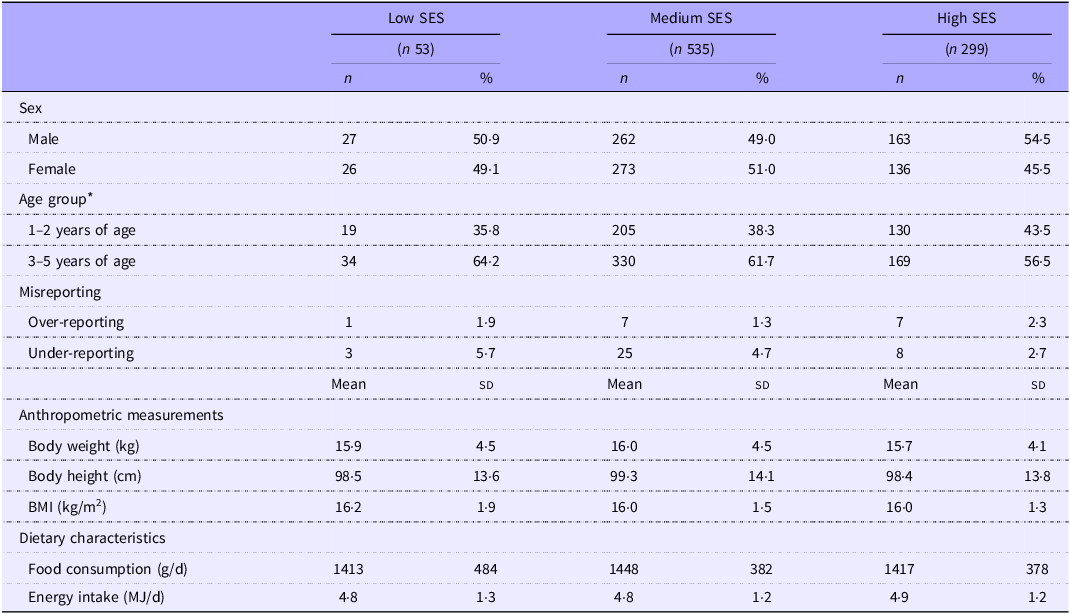
The characteristics of the KiESEL sample are shown in Table 1. 6·0 % of the children were assigned to the low, 60·3 % to the medium and 33·7 % to the high SES category. No significant differences were found between the SES categories for the characteristics displayed in Table 1.
Characteristics of KiESEL children (n 887) aged 1–5 years stratified by SES (Numbers and percentages; mean values and standard deviations)
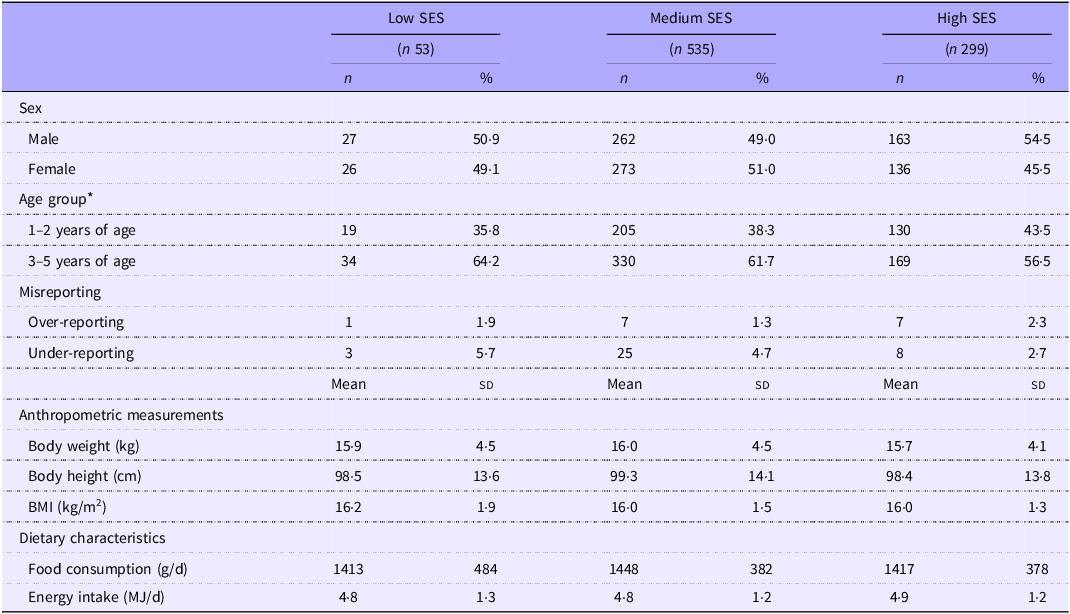
Note that all age specifications refer to completed years of life, e.g. the age group ‘1–2 years’ refers to children aged 1·0–2·9 years. KiESEL, Children’s Nutrition Survey to Record Food Consumption; SES, socio-economic status.
* Incl. 62 children 6 years of age.
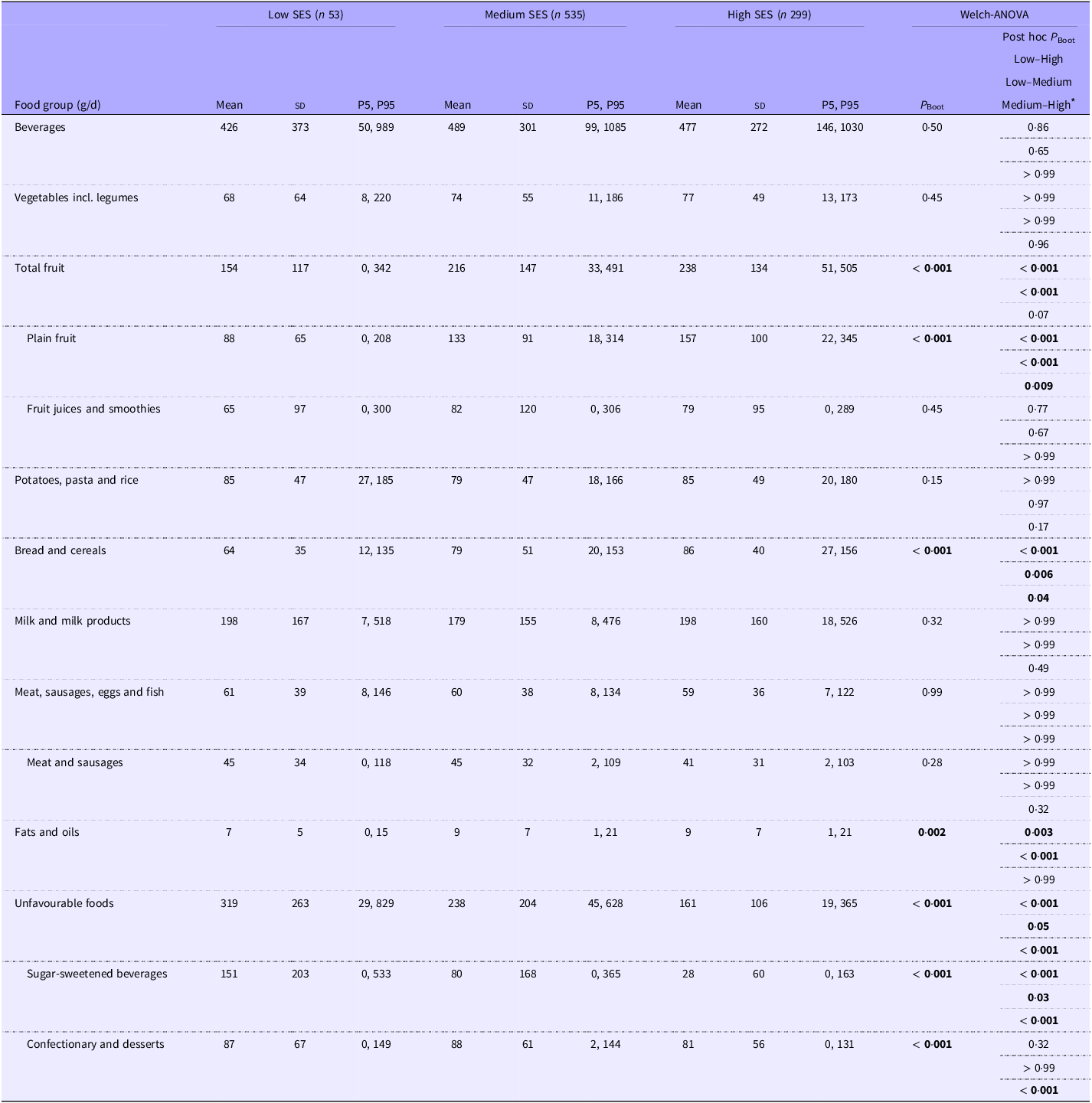
Daily food consumption stratified by SES and the respective Welch ANOVA statistics are depicted in Table 2. The descriptive statistics are derived from the original sample, while the Welch ANOVA statistics display age- and sex-adjusted bootstrap values.
Daily food consumption in KiESEL children (n 887) 1–5 years of age stratified by SES (original sample descriptive statistics and age- and sex-adjusted bootstrap Welch ANOVA test statistics) (Mean values and standard deviations; percentile values)
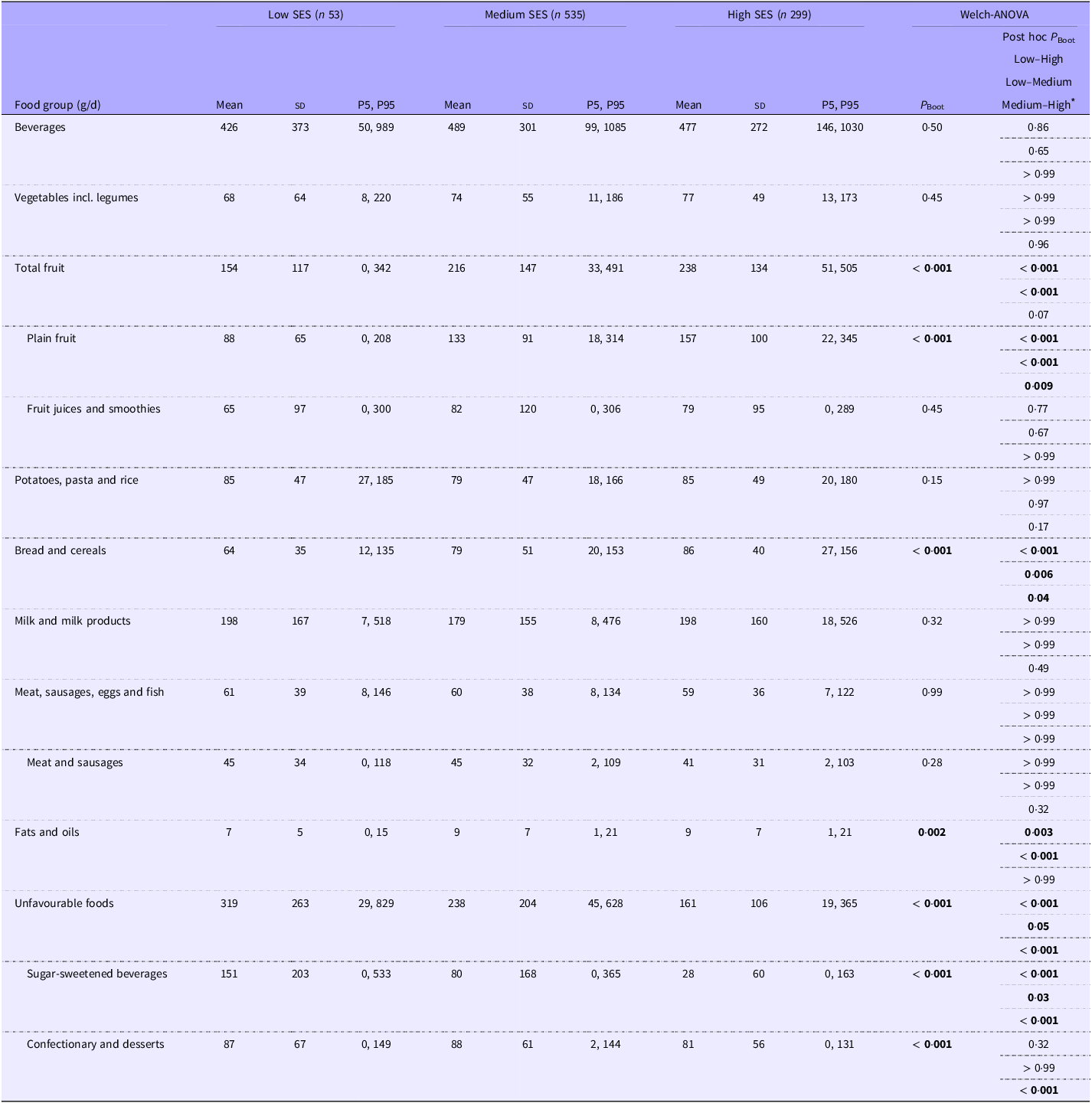
KiESEL, Children’s Nutrition Survey to Record Food Consumption; sd, standard deviation; P, percentile; SES, socio-economic status.
Note: Significance was determined based on P values rounded to four decimal places. As only selected subgroups are presented, the sum of subgroups does not necessarily correspond to the amount of the superordinate group.
The bootstrap confidence interval of the differences in means displayed in Figure 1 and the bootstrap P values slightly differ in terms of the interpretation to be derived. This is due to the different methodological approaches required for bootstrapping.
* Bonferroni corrected. Boldface is used to highlight statistically significant P values (P < 0.05).
Differences in food consumption among the SES groups were found for total fruit and its subgroup plain fruit, bread/cereals, fats/oils and the group of unfavourable foods and its subgroups SSB and confectionary/desserts. However, only for the food groups plain fruit, bread/cereals, unfavourable foods and SSB, post hoc tests revealed differences for all between-group comparisons (i.e. low v. high, medium v. high and low v. medium SES).
Regarding the direction of differences detected as significant, consumption of the group of unfavourable foods (as a whole as well as its subgroups SSB and confectionary/desserts) was higher in the group with the respective lower SES. Conversely, consumption of the remaining food groups (i.e. total fruit, plain fruit, bread/cereals and fats/oils) was higher in the group with the respective higher SES.
Figure 1 displays differences in mean consumption between the high- and the low-SES group: Among children in the low-SES group, mean daily food consumption was 84 g lower for total fruit, 69 g lower for plain fruit, 22 g lower for bread/cereals and 3 g lower for fats/oils compared to their peers with high SES. On the other hand, children in the low-SES category on average consumed 158 g more unfavourable foods per day (thereof 123 g more SSB) compared with the children in the high-SES category. An analysis of mean consumption differences between the low- and high-SES groups by age group revealed no significant differences between 1- to 2- and 3- to 5-year-olds (online Supplementary Figure S2).
Differences in food consumption of 1- to 5-year-old children with low (n 53) compared to high (n 299) socio-economic status (displaying difference of original mean values with bootstrap 95 % CI, positive differences indicate a higher consumption in the low-SES group, while negative differences indicate a higher consumption in the high-SES group). Differences are considered significant if the CI of the means do not overlap with the null line. SES, socio-economic status.

Discussion
This study identified more adverse diets in toddlers and preschoolers with lower compared with higher SES in Germany, particularly characterised by a higher consumption of unfavourable foods – first and foremost SSB – and a lower consumption of fruit.
Previous KiESEL analyses have highlighted non-attainment of Optimised Mixed Diet recommendations, predominantly marked by an excess consumption of unfavourable foods(Reference Spiegler, Jansen and Burgard19). The present analysis shows that the extent of this overconsumption is even greater in children of lower SES background.
Having a considerable amount of unfavourable foods in children’s diets not only promotes weight gain, obesity and non-communicable diseases but may also result in healthier food options being displaced from the diet(Reference Malik, Schulze and Hu26,Reference Elizabeth, Machado and Zinöcker27) . Unfavourable foods may furthermore increase vulnerability to micronutrient deficiencies by decreasing overall nutrient density. This is of particular importance for young children due to their high nutrient requirements in relation to body weight(Reference Alles, Eussen and van der Beek28).
In KiESEL, SSB accounted for a substantial proportion of the unfavourable foods(Reference Spiegler, Jansen and Burgard19). A body of literature links SSB consumption to overweight/obesity and dental caries in children(Reference Bleich and Vercammen29). A USA longitudinal study, for instance, found a dose-dependent positive association between SSB consumption and BMI z-scores in a birth cohort followed over the course of 17 years, even after controlling for SES, overall diet quality and energy intake(Reference Marshall, Curtis and Cavanaugh30). An inverse relationship between soft drink consumption and SES among children and adolescents in Germany has been shown in a previous cross-sectional study of 12- to 17-year-olds(Reference Brettschneider, Lage Barbosa and Haftenberger7) and a longitudinal study of 0- to 17-year-olds(Reference Schneider, Mata and Kadel31). Looking across Europe, an analysis of nationally representative data from twenty-three countries in the WHO European region (COSI 2015/2017) found low parental education and family-perceived wealth, both potential pointers to low(er) SES, to be associated with a higher frequency of SSB consumption in children aged 6–9 years(Reference Fismen, Buoncristiano and Williams32). The present finding of high SSB consumption among KiESEL children in families with low SES is particularly worrisome considering that low SES is already a risk factor for both obesity and poor oral health irrespective of SSB consumption(Reference Buoncristiano, Williams and Simmonds33–Reference Merino-De Haro, Mora-Gonzalez and Cadenas-Sanchez35). This is attributable to aspects such as restricted access to engage in regular physical activity(Reference Buoncristiano, Williams and Simmonds33) and diminished parental health literacy(Reference Stormacq, Van den Broucke and Wosinski36). Moreover, in KiESEL children, SSB consumption adds to an already high sugar intake from confectionary/desserts. As for oral health, findings from KiGGS Wave 2 point towards a positive relationship between SES and the frequency of brushing one’s teeth and attendance of dental check-ups(Reference Krause, Kuntz and Schenk37).
Also consistent with the present findings, a pooled analysis of COSI 2015/2017 data further identified European children aged 6–9 years with lower parental education and lower family-perceived wealth as being more likely to not eat fresh fruit every day than their higher-SES peers(Reference Fismen, Buoncristiano and Williams32). However, in a German nationally representative survey of 6- to 17-year-olds, a difference in fruit consumption by SES was found solely among boys(Reference Mensink, Haftenberger and Lage Barbosa38).
In contrast, the present data do not support a link between SES and vegetable consumption as previously described for children aged 5 years and above in COSI 2015/2017 and the Feel4Diabetes study, another Pan-European project(Reference Fismen, Buoncristiano and Williams32,Reference Papamichael, Karatzi and Mavrogianni39) . Apart from the notion that children generally prefer fruits over vegetables(Reference Worobey, Ostapkovich and Yudin40), one reason may be that fruits, rather than vegetables, serve as substitutes for unhealthy snack foods. Further, parents with higher SES prefer to offer fruits over unhealthy snack foods to their child(Reference Gallagher-Squires, Isaacs and Reynolds41), which is in line with the present data on fruit and unfavourable food intake.
According to the Global Burden of Disease Study in 2021, diets low in fruit and high in SSB each accounted for 43·8 and 3·61 million disability-adjusted life years worldwide as well as 1·680·000 and 75·700 premature deaths, respectively(42,43) . This highlights the overall importance of SES-related differences in consumption of these food groups and the need to counteract these adverse consumption patterns early on.
The finding that children with lower SES in KiESEL had lower consumption of bread/cereals and fats/oils might be related to differences in breakfast habits, as both cereals and bread are typical ‘breakfast foods’ in children in Germany(Reference Alexy, Kersting and Wicher44), with bread being commonly served with butter or margarine. Possible explanations may include a higher rate of breakfast skipping associated with lower SES, as previously reported for German school children(Reference Ober, Sobek and Stein45), and SES-related differences in breakfast quality, as observed in European adolescents(Reference Hallström, Vereecken and Labayen46). However, the extent to which these aspects play a role in the age group of toddlers and preschoolers remains to be investigated.
The dynamics between SES and food consumption are multifaceted with various explanatory approaches likely to interact: SES is positively linked to health literacy and health consciousness(Reference de Buhr and Tannen47,Reference Wardle and Steptoe48) , which translates into parents’ ability to understand health- and nutrition-related information such as package labels and act in a health-promoting manner(Reference Papamichael, Karatzi and Mavrogianni39). Besides, higher parental education has been associated with better adherence to dietary guidelines and recommendations(Reference Papamichael, Karatzi and Mavrogianni39), and health promotion initiatives tend to achieve greater effectiveness in adults with higher SES(Reference van Meurs, Oude Groeniger and de Koster49). Drewnowski and Darmon noted that foods of lower nutritional value and lower-quality diets generally cost less per calorie than more nutritious foods and higher quality diets(Reference Darmon and Drewnowski50). Thus, it is likely that limited financial resources restrict the ability of lower-SES households to afford healthy diets. Underlining this, a modelling study on food expenses by Hohoff et al. found the German social welfare allowance rate for food insufficient to cover food costs of toddlers and preschoolers except for 1- to 3-year-olds who are female and/or vegetarian(Reference Hohoff, Zahn and Weder51). When non-food reward options (e.g. leisure activities, sports club memberships and books) are difficult to afford, parents may further turn to unfavourable foods as a relatively cheap compensatory measure to treat their child(Reference Pescud and Pettigrew52). Furthermore, SES was found to be inversely related to screen time in preschoolers(Reference Määttä, Kaukonen and Vepsäläinen53). With increased screen time comes increased exposure to child-targeted food marketing and advertising campaigns, which in the vast majority of cases promote foods high in fat, sugar or salt(Reference Effertz54). In addition, there are studies from the USA and Sweden pointing towards a higher density of advertisements for unfavourable foods in low-income neighbourhoods(Reference Lucan, Maroko and Sanon55,Reference Fagerberg, Langlet and Oravsky56) . Moreover, emotional and psychological hardship due to socio-economic disadvantage may increase parental prevalence of ‘comfort eating’ to ease distress. Such coping mechanisms may eventually translate into unhealthy child feeding practices(Reference Schuler, Vazquez and Kobulsky57). Lastly, with breast-feeding being linked to healthier diets in toddlers and preschoolers, possibly facilitated by early-on accustoming to a range of flavours through breast milk(Reference Spaniol, da Costa and Bortolini58,Reference Borkhoff, Dai and Jairam59) , and breast-feeding rate and duration in Germany being higher with increasing SES(Reference Brettschneider, Weikert and Abraham60), some of the differences may be attributable to differences in breast-feeding.
The key strength of this study is the high level of data accuracy provided through the application of weighed food records. Another strength is that the multidimensionality of SES is accounted for, as the SES categories used in this analysis capture not only parental education but also income and occupation. The small number of children in the low-SES group and the slightly differing age distribution between the SES groups do principally pose limitations, yet these were vastly attenuated by the statistical methodology. Although a weighting factor exists for the total KiESEL sample(Reference Spiegler, Jansen and Burgard19,Reference Burgard, Jansen and Spiegler25) , its use in the present analysis was contraindicated. Since the weighting factor incorporates SES dimensions, its application may introduce bias into analyses of SES-related differences. Furthermore, the statistical analyses conducted are primarily inferential. To control for age and sex differences within the SES groups, residuals were calculated and used in the model. Despite the attempts to improve generalisability, further studies are required to confirm the present results. With regard to the dietary assessment method applied, weighed food records involve a considerable amount of effort on the part of respondents, possibly leading to changes in dietary behaviour(61), and they may be biased by social desirability(Reference Bailey62). Multiple testing was corrected for the SES comparisons but not for the number of food groups due to the lack of independence of food groups as well as the explorative nature of this study.
Even among the youngest, there is indication of a social gradient in diet: lower SES in children aged 1–5 years in Germany is linked to a lower diet quality, particularly characterised by high consumption of SSB and low consumption of fruit. In view of the substantial repercussions of early-life diet on food preferences and lifelong risk of lifestyle-related diseases, the particularly high unfavourable food consumption observed among children with low SES ought to be addressed before adverse trajectories become entrenched. Considering the many ways in which a low SES may compromise healthy eating, a comprehensive set of structural prevention measures (e.g. taxation of SSB and sugary foods, tax incentives to promote the purchase of fruit and vegetables, free provision of drinking water at day-care centres and schools, restrictions on advertisements of unfavourable foods and breast-feeding promotion(Reference Fidler Mis, Braegger and Bronsky63)) is necessary. Further, engagement from various stakeholders is needed to effectively reach families affected by low SES. Given the high day-care attendance rates in Germany – over one-third of children under 3 years of age and more than 90 % of those aged 3–6 years(64) – mandatory preventive measures in day-care settings should be implemented to systematically improve diet quality for the majority of children. Lastly, more research is needed to determine the most effective strategies for improving diet quality of children, particularly those coming from socially disadvantaged families. Future research should also address how measures can be integrated into support systems commonly accessed by these families, such as early childhood support programs, routine paediatric health check-ups or food banks.
Supplementary material
For supplementary material/s referred to in this article, please visit https://doi.org/10.1017/S0007114525103991
Acknowledgements
Special thanks go to the German Federal Institute for Risk Assessment for providing the KiESEL data and in particular to Dr. Oliver Lindtner, Nicole Nowak and Anna Holy for sharing their rich expertise with the KiESEL study data. Furthermore, we are most grateful to all participating families for their time and commitment.
The Children’s Nutrition Survey to Record Food Consumption (KiESEL) was funded by the German Federal Institute for Risk Assessment. The present analysis was funded by the Max Rubner-Institut, Federal Research Institute of Nutrition and Food. Both institutes are financed by the German Federal Ministry of Agriculture, Food and Regional Identity. The German Federal Ministry of Agriculture, Food and Regional Identity had no role in the decisions about conceptualisation of the study, analysis and interpretation of the data or the preparation, review and publication of the manuscript.
L. B.: Writing – original draft, conceptualisation, methodology and formal analysis; C. S.: writing – review & editing, conceptualisation, methodology and formal analysis; M. D.: writing – review & editing, methodology and formal analysis; A. S., T. H.: writing – review & editing, conceptualisation, methodology and project administration; S. J., A-K. B., R. E.: writing – review & editing; S. S. g. B.: writing – review & editing, conceptualisation, methodology and supervision.
The authors declare no conflicts of interest.
Data described in the manuscript (in aggregated form), code book and analytic code will be made available upon request pending application and approval. Requests to access these datasets should be directed to Thorsten Heuer, thorsten.heuer@mri.bund.de.
During the preparation of this work, the authors used ChatGPT-4-Turbo (OpenAI, www.chatgpt.com) and DeepL (DeepL se, www.deepl.com) in order to support the development of code for data analysis and to assist with English language refinement, particularly given the authors’ non-native speaker status. After using these services, the authors reviewed and edited the content as needed and take full responsibility for all aspects of the publication.



 Open access

