




Introduction
Who chooses new technology? In this article, we explore the diffusion of agricultural science and technology in Galicia (NW Iberian peninsula) and the ways in which farmers adopted innovations from 1880–1940 within the Atlantic Iberian agricultural context of small farms. We study two cases in particular: (1) the creation of a new cattle breed, the ‘Galician Blond’ and (2) the adoption and diffusion of threshing machines. Who benefited from these technological choices? We focus on innovations, actors, and beneficiaries. Clearly, farmers, technicians, the state, companies, and rural elites had different interests and roles during this historical process. We explore how farmers were able to discover, choose and adopt new technologies from the second wave of industrialisation. This is the main question we have asked ourselves for the period in question, a time in which we try to show that there was a singular and extended model of innovation in small-scale European agriculture involving farmers themselves, new state innovation systems and markets.
We focus on innovation as a social and networked process, as is proposed from the philosophy of science where scientists only create reference systems (Laotur, Reference Latour2001). We consider the construction of new rural knowledge as a communicative action, overcoming the neoclassical cost-benefit approach, the concept of two cultures, and the diffusionist model. We especially discuss the strictly economistic interpretations of agrarian technical change that deny any capacity for endogenous social and peasant agency (Swolo, Reference Solow1957; Schultz, Reference Schultz1964; Federico, Reference Federico2005). Our approach is fundamentally indebted to Olson (Reference Olson1971), Scott (Reference Scott1987), and Thompson (Reference Thompson1993) to understand the rationality, action, and resistance of peasant communities. As in Actor Network Theory (hereafter ANT), we share the intention of entering the black box of technological change, in Rosenberg’s sense (Reference Rosenberg1994) of overcoming the classic Shumpeterian orientation of the entrepreneur as an individual actor and old-fashioned economic theory about the invention as a finished product.
On the contrary, we will look for the connections between different actors and understand the knowledge in the rural world and the transformation for scientists, farmers, and other actors. As Iturra (Reference Iturra1993) shows, or more recently in Jones (Reference Jones2016), and in a practical way O‘Flynn et al. (Reference O‘Flynn, Macken-Walsh, Lane and High2018), we identify and recognise the knowledge of farmers and the pitfalls of not recognising it. We address innovation from a farmer’s point of view, considering how long-term peasant knowledge was applied to agrarian systems and to the evolution of agroecosystems in terms of productivity and sustainability. Thus, we are also interested in the approaches of Fitzgerald (Reference Fitzgerald2003), Hartwood (Reference Harwood2013), as well as Burton (Reference Burton2019), who rightly points out that on-farm demonstration was an important component of contemporary agricultural knowledge systems, but little is known about its origins or drivers.
Our hypothesis is that the adoption of specific innovations by farmers (genetics, machinery, chemical) is linked not only with state diffusion efforts but with the accuracy of these techniques and with the way in which people had managed the agroecosystem in previous centuries. However, it is true that these innovations were not without limitations, opposition, and resistance. Despite this, these resistances inform us rather of the logic of peasant family production and reproduction (Fitzgerald, Reference Fitzgerald2003; Barca, Reference Barca2020). This research also aims to show that some limitations, such as price, were easy to overcome. However, much more difficult to overcome was the inadequate fit in the organisation of family work, or the social cost of ridicule or innovative failure. Precisely, to overcome these social effects, we will see how scientific, commercial and peasant networks worked.
In this framework, we propose a case of study focused on Galicia to illustrate how the intensification process took place in the context of mixed farming Atlantic agriculture. Furthermore, this case demonstrates how innovations adopted in the twentieth century were linked to previous changes in crop rotations introduced by the mixed farming system since the eighteenth century. We connect scientific technological innovations in the long term, which resulted in the development of the mixed farming system throughout different regions of Europe (Bouhier, Reference Bouhier1979; Villares, Reference Villares1982; Fernández-Prieto, Reference Fernández-Prieto1992). However, mixed farming had its own limits, mainly related to nutrient availability for soil. Consequently, the whole process of intensification, combined with other factors that we will not examine in this article, triggered a process of socio-ecological transition (Soto-Fernández, Reference Soto-Fernández2006; Corbacho, Reference Corbacho2017).
In this article we analyse, first, the construction of mixed agriculture since the eighteenth century. Secondly, we analyse, in the 1880–1936 framework, the construction of the modern Spanish system of agricultural innovation in Galicia. We lay out three innovation networks: scientific, the market, and the peasant unions. Third, we analyse two cases of innovation (animal genetics and agricultural machinery). Finally, we analyse the actors of innovation in a specific agricultural region, rather than in the innovation system, and their capacity to transfer technology. We propose to explain how the production, diffusion and transfer process occurred in a specific region. We expect to identify and explore how knowledge networks work and how farmers interact with scientists and the market. In doing so, we will access the black box of rural knowledge.
1. The beginnings of mixed farming and farming innovation (1750–1880)
The increases in the productivity of Galician agriculture during the nineteenth century reflect the spread of new techniques. We will briefly describe changes in crop rotations, and the management of organic fertility during the eighteenth and nineteenth centuries (the First Agricultural Revolution). For this purpose, we will introduce the cases of two municipalities that show two patterns of intensification in Galicia in that period: Ribadavia and A Fonsagrada (see Figure 1). Ribadavia is a case of intensification through market-oriented specialisation in vineyards, whereas A Fonsagrada is a more extensive model mainly aimed at self-sufficiency. Both cases exemplify the innovations that farmers developed to achieve a more productive agriculture.
Location of Galicia (in red) in Western Europe. Location of A Fonsagrada and Ribadavia in Galicia.
Source: Prepared by the authors.

The case studies of Ribadavia and A Fonsagrada illustrate how the innovations of the First Agricultural Revolution developed in Galicia, a region of Atlantic agriculture in the north-west of the Iberian Peninsula. These cases exemplify the process of agricultural intensification in the countryside from the middle of the eighteenth century until the end of the nineteenth century. We have used fiscal sources such as cadastres and land registries and have analysed changes in crops and rotations as well as productivity and fertiliser availability (Corbacho, Reference Corbacho2017). Intensification in this region differs from other processes across the Peninsula, namely from those that have been studied in Andalusia and Catalonia (Mediterranean territories), where rotations are not as intense as the ones described in this article, and water is also a very important limiting factor (González de Molina et al., Reference González de Molina2010).
One key element for agrarian intensification is fertiliser, which conditions the possibilities and limits of this process. When dealing with an Atlantic agriculture such as that of Galicia, we need to talk about monte (scrubland) since that is the area that provides cropland with nutrients. In this case, shrub is mostly composed of gorse (Ulex Europaeus), a leguminous plant that was once planted on monte surfaces throughout the northwest region of the Iberian Peninsula. It was used as bedding for animals in stables, where it fermented along with their excreta and produced high-quality manure. Gorse was also used as green manure in certain cases or even to feed cows, in the case of tender, young gorse. Different types of shrubs were collected along with gorse, but this plant was the main protagonist in the intensification pattern that agriculture followed in this region due to its high nitrogen content (Iglesias Pérez, Reference Iglesias Pérez1985).
In the 1960s around 75 per cent of the agrarian surface of Galicia was composed of scrubland, which provided the remaining 25 per cent of cropland with the required nutrients (Bohuier, Reference Bouhier1979). Although this ratio might have been different in previous centuries, it illustrates the dependence on a large part of the territory in order for nutrients to be replenished in cultivated soils. This dependence has therefore conditioned peasants’ decision-making processes all through the period of study. The case studies of Ribadavia and A Fonsagrada allow us to take a closer look at these determinants.
1.1. Intensification through specialisation in Ribadavia
Ribadavia is the capital of the Ribeiro region, in the inner province of Ourense. The municipality has a surface of 25 km2 and is located at the edge of the continental climate region. Ribeiro benefits from a southern position with less rainfall and higher average temperatures than the rest of Galicia. Winters are cold and droughts are quite common in summer. This weather is very appropriate for vineyard cultivation, one of the most important crops in the Ribeiro region, where southern-oriented slopes were terraced to avoid soil erosion and provide grapes with the most convenient sun exposure.
In 1752, apart from wine, the main crops in Ribadavia are millet, rye, and flax. The first quality soil is cultivated in a two-year rotation, whereas the second and third types of soil are left to lie fallow for the second year. By 1860, maize, beans and wheat have been introduced in a more intense rotation and fallow has been eliminated. The mixed farming system has started to spread in the region. By 1888 wheat has also been eliminated but the rest of the rotations remain the same. These changes are summarised in Table 1.
Ribadavia: changes in cereal rotations (1752–1888)
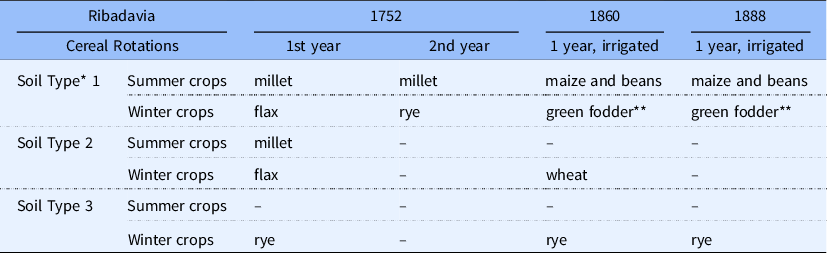
Note:* Soil Type refers to the quality of the soil, which is distinguished in fiscal documents according to productivity in order to set proportional taxation.
**Green fodder: cereal and legumes collected before drying so that they can be stocked and used as feedstuff for livestock during winter. Source: (Corbacho, Reference Corbacho2017).
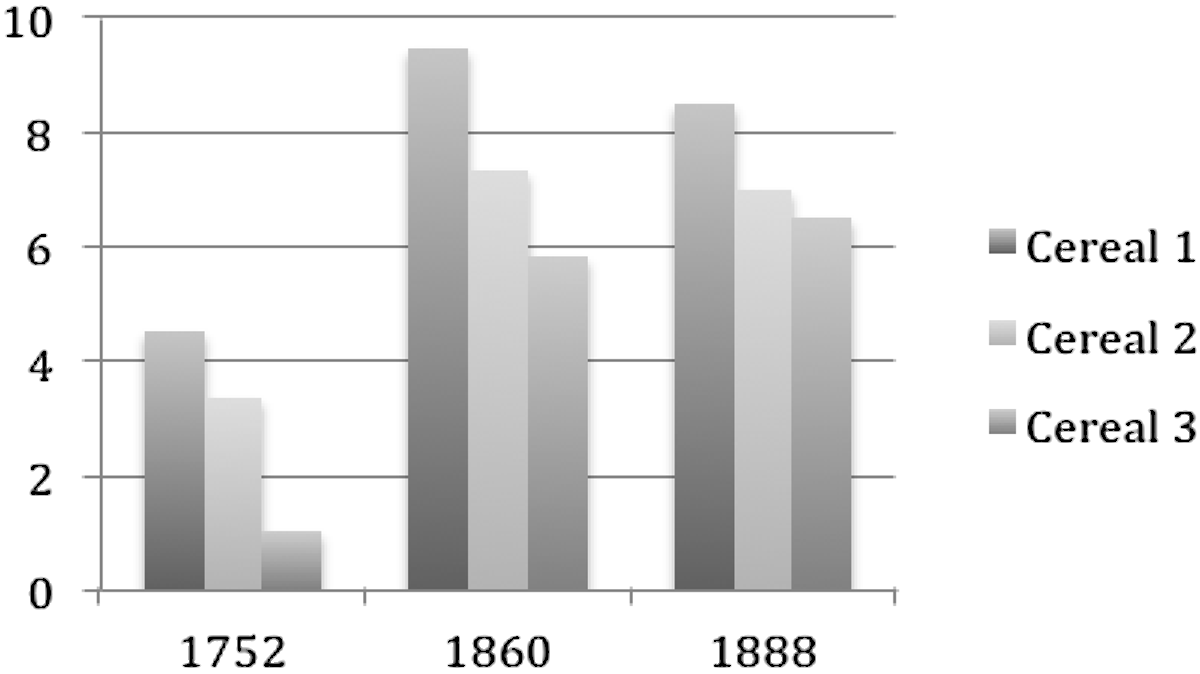
Such adaptations in the management of rotations enabled productivity to increase, as we can see in Figure 2. The production of cereal in first quality soil rises from about 3,800 kilograms of dry matter per hectare and year to 7,500, and similar increases occur in soils of second and third quality as well. This process was intentionally driven in order to meet the dietary needs of the region’s growing population and the livestock that would provide crops with manure. But this increase had a limit, which starts to constrain this intensification process towards the end of the nineteenth century. The resulting stagnation involves not only a decline in yields in the more intensive rotations, but also in less demanding ones: wheat disappears from Soil Type 2 and only non-irrigated rye remains in the third type, which shows a relative increase in productivity due to its historically less intensive cultivation.
Ribadavia. Changes in land productivity in cereal rotations: 1764, 1860, and 1888 (dry matter, sub products included).
Source: (Corbacho, Reference Corbacho2017).
The vineyards show the same trend in productivity as cereal, but with one peculiarity that aggravates the stagnation of intensification towards the end of the century. After the 1850s, grapevines start to be affected by oidium, a fungus from America that reaches Europe in 1845; towards the end of century, they are affected by mildew and phylloxera as well (Domínguez Castro, Reference Domínguez Castro1995). The main consequences are that fertilisation could not be replenished within the boundaries of the valley where Ribadavia is located, thus breaking the nutrient cycle, and that the dietary needs of the population could not be met with local production.
The case of Ribadavia thus shows that the limits to both intensification and specialisation were in the shrubland zones, which from at least the mid-nineteenth century could no longer supply cropland with the necessary nutrients. In addition, the fact that most cropland surface was cultivated with grapevines left Ribadavia’s population with insufficient food production. However, wine exportation provided the population with money to buy the nutrients that had to be imported into the agroecosystem, both for the soils and for society and livestock. Wine specialisation is highly market-oriented in the Ribeiro region, which exported wine to France and England as far back as the fifteenth century (Huetz de Lemps, Reference Huetz de Lemps1967). Therefore, this market-oriented production is simultaneously the cause and the solution to nutrient scarcity, thus closing the vicious circle that broke the nutrient cycle in the agroecosystem and triggered the exportation of unsustainability to other nearby regions that had to provide Ribadavia with nutrients. This implies that Ribadavia subordinated surrounding economies to its market-oriented agriculture, the former being a case of a bourgeois medium-property system, and the latter a peasant smallholding economy.
1.2. Intensification through livestock in A Fonsagrada
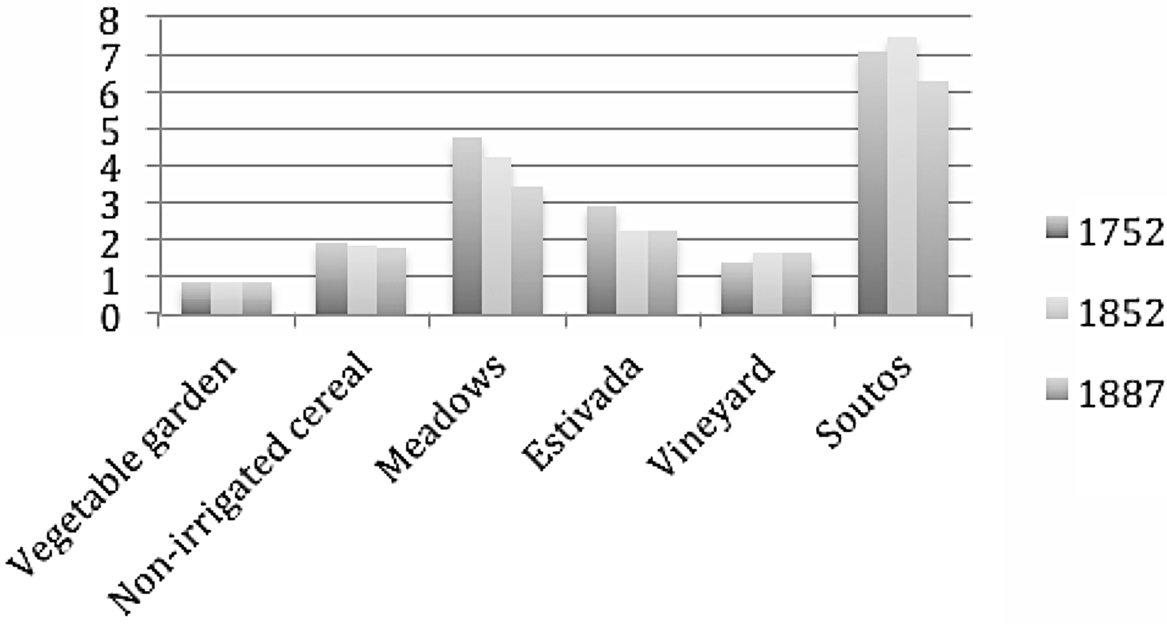
A Fonsagrada, in the inner region of the province of Lugo, is a much bigger municipality (443 km2) and has a completely different form of agriculture. The market does not play such an important role as in Ribadavia, and production is mainly intended for self-sufficiency. Cereal is the main crop, namely rye, and intensification here involves the introduction of potatoes and turnips and the expansion of cropland, especially pastureland, at the expense of shrubland area. This allowed productivity to increase, albeit with a trend towards stagnation at the end of the nineteenth century, as in Ribadavia. This can be seen in Figure 3.
A Fonsagrada: cropland productivity in 1752, 1852, and 1887 (t/ha, dry matter).
Source: (Corbacho, Reference Corbacho2017).
The increase in cultivated surface and land productivity was the result of adaptations in agricultural management. Linked to the introduction of new crops such as potatoes and turnips, these adaptations required that animals be kept in stables in order to produce more manure.
The case of A Fonsagrada is an example of highly productive agriculture, fitting in the general trend for mixed farming intensification that was taking place across Europe during this First Agricultural Revolution.Footnote 1 Innovation in this period was driven by a peasant smallholding logic, which would later connect with the innovations of the second wave of agrarian change from the 1880s to the 1930s. In section 4 these innovations will be discussed. First, we present the institutional, social, and economic framework in which innovations took place.
2. Farming innovation in Galicia (1880–1940): a framework of networks
This section examines a model of change in intensive, small-scale solar-based organic agriculture in the context of socio-ecological transition before the Green Revolution as well as changes in farming innovation. This change allowed a significant increase in land and labour productivity with only a minimum amount of external energy subsidies.
The period of 1880–1940 was one of accelerated technological change in agriculture, with important innovations linked to the second wave of industrialisation and powerful scientific advances in agricultural chemistry and animal and plant genetics.Footnote 2 These included the commercial development of mineral and chemical fertilisers, improvements in agricultural machinery and equipment with new designs and materials, new varieties of seeds, new livestock breeds and improvements in crop rotation, cultivation systems and irrigation. All this occurred in the aftermath of the agricultural crisis in Europe and offered new possibilities for increasing production and productivity, reducing costs, improving efficiency, and increasing the competitive capacity of agriculture. By the end of the nineteenth century, the mixed farming model of the eighteenth century had been exhausted and defeated by competition from New Europe, which flooded the markets with agricultural products and livestock from abroad.Footnote 3 Turn-of-the-twentieth-century agriculture still required handling nature in a paradigm that could neither master nor disregard it. Innovations were closely linked to the social and physical context. Technological advances in these decades impacted five essential physical-biological processes: energy use through mechanisation; bio-geochemical processes related to fertilisation; breeding practices, due to improved genetic material; hydrologic uses, based on new pumps and irrigation systems; and biotic regulation, thanks to new rotation schemes. Until 1945, no technology existed for transporting or using large amounts of energy to recreate homogeneous environmental conditions. The productivity of an agro-ecosystem was still determined by its own capacity to produce biomass (González de Molina, Reference González de Molina2001).
Given the scientific complexity of making new chemical, genetic or biological progress, it was no longer possible to wait for the usual process of local imitation and word-of-mouth propaganda. The key words were applicability, adaptation, and implementation. Farming innovation required the transfer of technology, and greater state intervention was necessary. In fact, the new role of the state in innovation was an important outcome of the political and agronomic debates regarding the agricultural crisis at the end of the nineteenth century and specific policy attempts to overcome it. Until then, the liberal state had left technological change in the hands of innovative landowners, but at this juncture the state took on a more proactive role.Footnote 4 In the aftermath of economic and social crises, turn-of-the-century Europe became a space in which farmers and tenants demanded and obtained recognition as voters and political subjects. With universal male suffrage (1890 in Spain) and peasant demands for ownership of the land they cultivated, farmers became the subject and object of public policy. They replaced idealised landowners as the new targets for innovation. Accordingly, a state institution led by scientists and technical experts was envisioned and constructed to facilitate training, experimentation, and demonstration. It sought to develop an apparatus that could expose farmers to innovations and help them adapt to new technologies. Precedents in Germany and the United States dating from the mid-nineteenth century inspired the European phenomenon of creating state innovation systems for these purposes.Footnote 5 In the decades before the Civil War, the scientific contribution to agricultural innovation in Spain was facilitated by the creation of a state apparatus for innovation. The institutional development of the inputs and outputs market coexisted with the logic of an organic system in which farmers could accept or reject innovations. At the same time, farmers began to organise in unions, societies, and cooperatives, through which they intervened in the market and innovation processes.
This period combines the logic of organic agriculture and farmers’ knowledge with the potential for science-based intensification without disrupting the organic domain or the farmers’ agency. Contrary to the standard assumptions, this stage cannot be considered as an antecedent to or part of an inevitable teleological transition to hyperintense agriculture after the Second World War.
We identify three key areas or spaces for the action of the innovating agents and for creating a kind of hybrid spaces of dialog between farmers’ and technicians’ knowledges: spaces for the connection between interests that did not always coincide and were even contradictory among technicians and scientists in possession of knowledge they considered new and superior; merchants and sellers of machinery, seeds or fertilisers that had to provide new inputs (beyond the experimental period); and farmers as the only possible adopters and, therefore, sole, and final agents of innovation. These three spaces function as three networks of knowledge, which are in fact connected to each other. First, the national innovation system acted to facilitate the adaptation or adoption of scientific and industrial innovation. For innovative agents, the state innovation model was decisive, with its network of research and innovation facilities, regional farms, and local demonstration camps. Second, companies fulfilled the role of supplying the mentioned innovations. Third, farmer associations were essential for the reception, selection, and adoption of technology, connecting farmers with the system and state innovation markets, but also developing other types of roles and values, as will be seen.
2.1. A network of scientists and technicians: national agricultural innovation system
The agricultural innovation system gained new significance in Galicia in 1888. That year, the Regional Experimental Agricultural Farm for agricultural research was established outside the city of A Coruña, and with the Demonstration Fields that were installed in successive years throughout the territory, the institution would become the centre of a strategic knowledge network in Galicia. In the 1930s, the system included a phytopathology station attached to the A Coruña Experimental Farm, a pest laboratory at the University of Santiago de Compostela, the Provincial Agronomic Service, the Provincial and local Veterinarian Service and 20 Demonstration Fields that served much of Galicia. The system also incorporated private initiatives, including those of new organisations such as the Expansion Board of Studies, which founded a high-level research centre, the Biological Mission of Galicia, established in 1921, and also benefited from the participation of large groups of Galician emigrants in the Americas with the creation of several model farms.Footnote 6 This network was directed by agricultural technical experts of various sorts, including ten to twelve engineers and around another ten researchers at the Farm and the Mission along with veterinarians and mid-level agricultural experts in the Demonstration Fields. During its peak years of activity, in the years of the Second Spanish Republic, several other projects were planned for new centres and stations, which were linked to the development of the regional statute of autonomy. The increase in network facilities was understood as a political triumph of the farmers and a visible demonstration of the importance of agricultural interests and Galician agriculture and livestock.Footnote 7
The main research centres (Regional Farm and Mission) functioned as governing bodies for the network of innovation centres. Although connected to the central organs of the state, they were endowed with considerable autonomy to define lines of research and scientific connections, in relation to the improvement of agricultural and livestock activities and cultivation systems. The A Coruña regional farm in the north developed a main focus on livestock and fodder crops, while in southern Galicia the Mission emphasised food crops and animal genetics, mainly pigs. Both corresponded to the productive characteristics of the areas they served. Both also addressed fertilisation, offered recommendations on the use of new products, and tried to limit fraud.
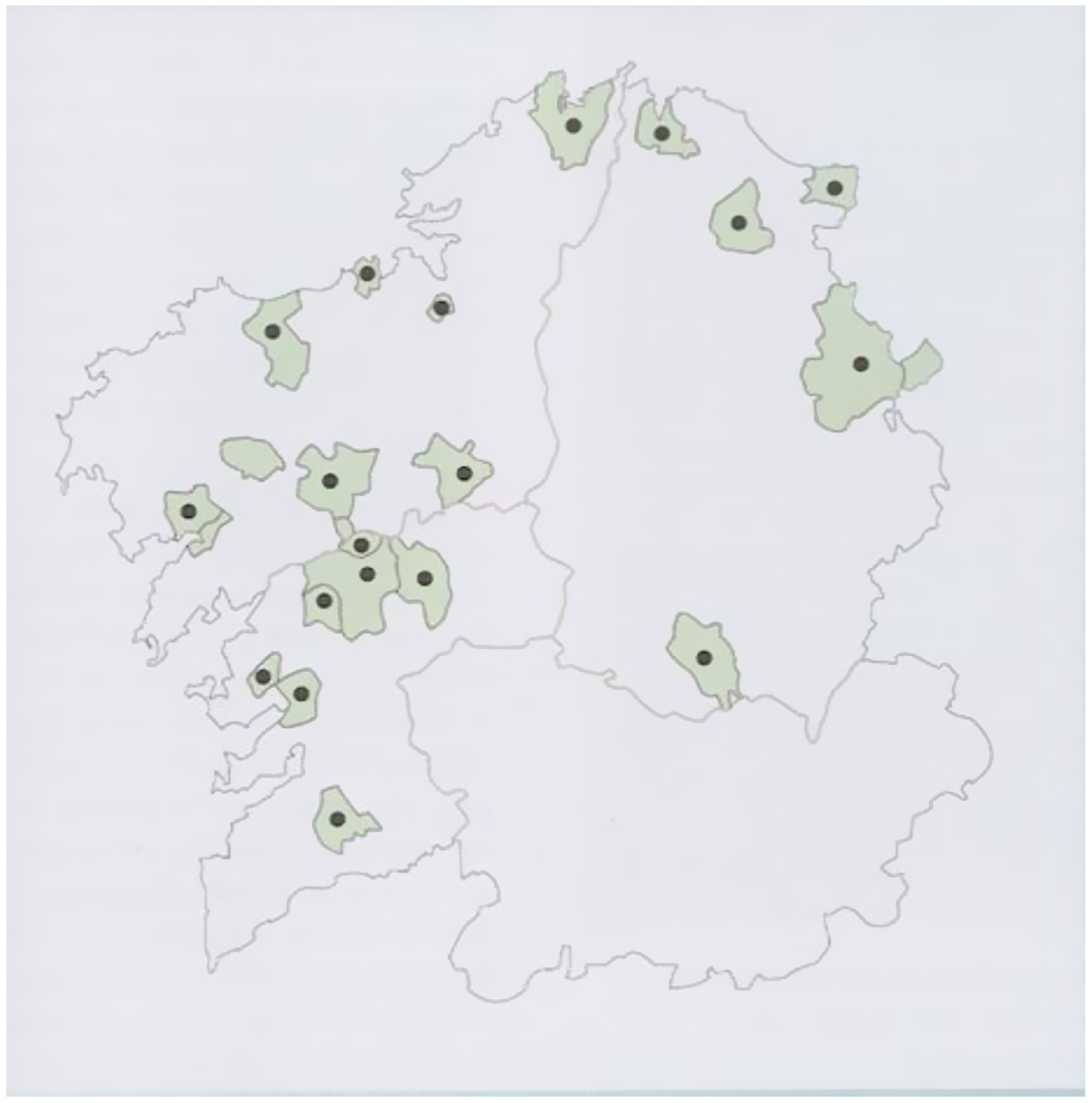
Efforts at reaching the target audience involved regular Bulletins (scientific journals) and pamphlets, periodicals, and regular agricultural sections in the regional press, as well as new broadcasting systems: radio programmes, travelling teachers with film projectors and other vehicles for public relations in the 1920s. Direct links between the Farm, the Demonstration Fields and technicians who demonstrated innovations locally facilitated farmer access to new technology. Ongoing relations with supply companies served at times as the main channel for the penetration of innovation, though relations between institutions and companies were always kept quite professional. More important was cooperation with locally organised agricultural or livestock societies and cooperatives, or even the creation of new associations with the help of technical experts from the Farm or Demonstration Fields (Figure 4).
County Agricultural Demonstration Fields (1900–39).
Source: (Fernández-Prieto, Reference Fernández-Prieto1992: 127).
The Biological Mission was even involved in organising a Seed Producers Trade Union for experimenting with and disseminating hybrid maize (Fernández-Prieto and Cabo Villaverde, Reference Fernández-Prieto and Cabo Villaverde1997; Esperante, Cabo Villaverde and Fernández-Prieto, Reference Esperante, Cabo Villaverde and Fernández-Prieto2020).
2.2. A dense network of merchants and sellers
In this same period, from 1900 onward a commercial network of hardware stores spread through Galicia, providing new inputs (machinery, fertilisers, seeds …) and following the same structural hierarchy of hamlets and villages (Fernández-Prieto, Reference Fernández-Prieto1992). The density of that network was essential for the supply mechanism to work. In addition, to understand the decisive importance of this network, it is necessary to consider the complex structure of population centres in Galician territory. Galicia had and continues to have a very dispersed and aged population, but with a well-defined hierarchy from the village to the city, passing through the parish and the town as a regional nucleus. A revealing fact in this sense is that the territory of Galicia accounts for no less than 50 per cent of the population entities included in the Spanish gazetteer.
The construction of this network of companies was part of the technological offer of the second wave of industrialisation. It begins with the experimentation centres themselves, which were part of the agricultural innovation system, and which connected suppliers and foreign commercial houses with farmers’ societies, fulfilling a function that Rasmussen assigned to the companies themselves in the American case (Reference Rasmussen1962). Thus, from the First World War, the supply model at the regional level worked with the interrelationship of industries and merchants, farmers’ societies and federations, local blacksmiths, and technicians from regional experimentation centres. This is confirmed in several counties such as A Coruña or Ribadeo (Fernández-Prieto, Reference Fernández-Prieto1988), but also in Ortegal county, where the Ortigueira Agrarian Federation established a direct contract with the French company Societé Lyonaise de Construction des Machines Agricoles in 1924 (Rosende, Reference Rosende1988: 116–18).
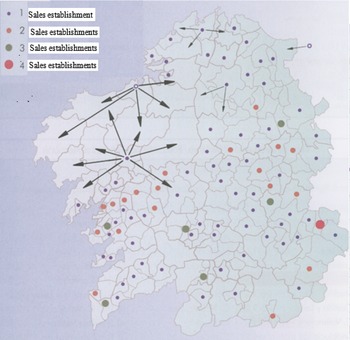
The main support of the network will be the hardware stores, about whose expansion and growth we have relevant data. The 1903 Galician Guide censuses, or the Bailly-Bailliery yearbooks reveal that in the first decade of the twentieth century, the number of municipalities in Galicia that had a hardware store tripled, reaching half of the 313 municipalities (Fernández-Prieto, Reference Fernández-Prieto1992: 234). The main concentration of these establishments (which supplied machinery and fertilisers) was located on the coast and at inland county capitals. Coinciding with the Great War, and with demand consolidated, some Spanish houses, such as the Basque Ajuria in 1914, established themselves directly in the inland Galician cities of Lugo and Ourense, and many hardware stores specialised in the selling of machinery, especially mechanical threshers. Entrepreneurs such as Villaverde in Santiago, Félix Vilas in Lugo, Torres and Sáez in Coruña, sold machines and implements in their area of influence.
One interesting example was the Ajuria company (established in 1910 at Alava, Basque Country), the most important network among those producing and distributing new ploughs, threshing machines, and commercial tools (Martínez Ruíz, Reference Martínez Ruíz2000). Integrated by several delegations and local stores that represented the firm, this network was a widespread commercial system that brought products to the most remote places, and it was directly linked with the huge expansion of new ploughs and threshing machines all through Galicia in this period. In addition, the products themselves required frequent supplies and repairs, and in the case of engines in threshing machines, a fuel supply (Figure 5).
Commercial network: stores selling Ajuria Co. products in 1930.
Source: (Fernández-Prieto, Reference Fernández-Prieto1992: 238).
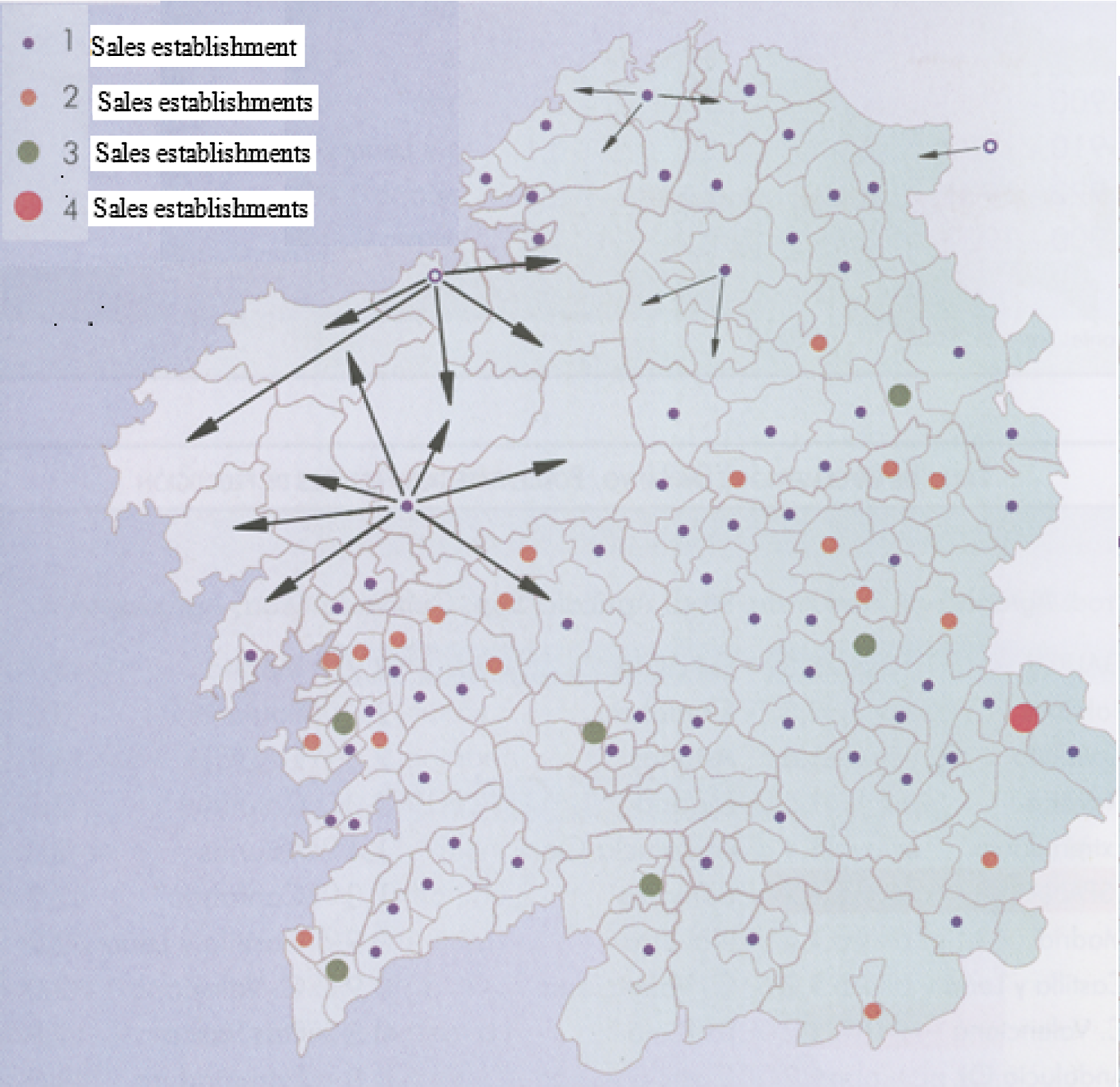
The distribution of points of sale of the Ajuria company is known from the register of sellers prepared by the managers of the Ajuria house in Lugo. The Carballeira brothers had run the Ajuria plant in Galicia since 1924. Other wholesalers and construction companies were also concentrated in Lugo. The reason for this concentration was the location of the city. From there they served a large agricultural area of inland Galicia. In addition, it was the Galician city with the best and fastest rail link with the production centres in the Basque city of Vitoria and other peninsular manufacturers. In the case of fertilisers, the main sales centres were concentrated in the port cities of Coruña and Pontevedra (Fernández-Prieto, Reference Fernández-Prieto1992).
2.3. A network of farmers’ unions
Peasant society was defined by entrenched forms of community organisation. After 1900, new kinds of associations were developed at the village level, driven by political leaders, religious leaders, returned emigrants from the Americas or technicians and other local elites, who then also connected at the regional level. These farmers’ unions were developed throughout the Galician countryside from 1895 onward with three main objectives: the struggle for absolute land ownership, thus overcoming the traditional land lease (‘forum’); a more favourable relationship with the market in relation to its products (livestock and other agricultural products) as well as inputs (fertilisers, tools, machinery); and the promotion of innovation through the adoption of new methods and technologies. The unions established preferential relationships with the innovation centres and their technicians, who relied on the farmers as spokespeople, acting as pioneers of innovation at the local level. This also helped overcome the shame of innovation through the socialisation of hypothetical failure, as well as the monetary costs of the first purchases. The estimated number of local farmers’ societies established between 1895–1936 was more than 2000. The biggest organisation known as the CRAG (Galician acronym of Galician Regional Confederation of Agriculturists) consisted of 419 societies and around 62,000 members in 1923 (Fernández-Prieto, Reference Fernández-Prieto1992; Cabo-Villaverde, Reference Cabo Villaverde1998).
3. Adoption of technologies (1890–1940): the what, how and why
In the next paragraphs we will briefly present two key technological developments in small-scale Galician farming that exemplify the direct connections and interactions between farmers and scientific knowledge, between the farmers’ unions and the innovation system. We focus on two specific innovation process: changes in breeding practice and the creation of the new Galician Blond cow, and the general adoption of threshing machines in an agrarian economy centred mainly on livestock. We will discuss how these innovations reinforced the existing agricultural system and the growing capacity of small-scale farms to intervene in the market, without questioning family productive, reproductive, and mercantile logics. They demonstrated and improved the social and political status of farmers who also became independent owners of their land (Villares, Reference Villares1982; Balboa, Reference Balboa1990).
3.1. Changes in breeding practice and the creation of the Galician Blond cow
The issue of improving national cow breeds was a major concern of the innovation system in Galicia. Producers, intermediaries, and exporters had successfully commercialised Galician cattle to the English market in the second half of the nineteenth century. Until then, the cattle breeding, improvement and local crossbreeding were relied exclusively on the practice of trial-error and peasant know-how. However, it was the loss of the English market in the context of the agrarian crisis at the end of the nineteenth century, which precisely stimulates the collaboration between farmers and veterinarians to develop a breed that would improve the existing ones. The objective was to compete in the new globalised conditions of the cattle market (Carmona, Reference Carmona1982; Carmona and De la Puente, Reference Carmona and De la Puente1988; Martínez López, Reference Martínez López1995). With the creation of the Regional Farm (founded in 1888), and the development of the veterinary profession (Escuela Especial de Ciencias Veterinarias founded in 1882), the debates went from economic problems to zootechnics related to crossbred cattle (with Swiss Simmental) versus Galician purebreds. The option of acclimatising foreign breeds was even considered. Agronomists and veterinarians tried to make breeds more productive by improving their diet, since ‘food makes the breed’. They finally opted for the selection of a pure Galician breed, based on criteria very well expressed by the director of the Galician Regional Farm: improve the breed according to the functions it fulfils in the agricultural economy.
It could be believed that in order to adequately cover so many and such heterogeneous demands (work, meat and milk), it is necessary to create a breed, but such demands – which have existed for so long – were born because there was a cattle breed capable of solving them … precisely the Galician … which was almost weakened and finished.Footnote 8
The innovation efforts involved many actions and instruments, both institutional and social. Discussions between engineers, veterinarians and other experts in newspapers and local and regional journals were key, and some publications such as Prácticas Modernas had an important influence on final decisions. Although their diffusion as a whole was considerable, inevitably their influence did not go beyond the interested elites.
Cattle competitions were the decisive instrument for establishing a ‘scientifically directed selection’ through the recovery and pure selection of the native breed. Incorporating zoometric methods of objective assessment, they followed the method of the Austrian veterinarian August Lydtin for measuring the morphological and dynamic conditions of cattle, which enables the assignment of a weighted numerical grade for each specimen. Galician competitions were held from 1902, and from 1905 the holding of regional competitions was extended, organised by farmers’ unions, but above all by Regional Agricultural Federations. Staff from the Regional Agricultural Farm of A Coruña, the new provincial veterinary services and the Veterinary School of Santiago participated in these competitions as jurors. Between 1905 and 1921 the staff of the Regional Farm participated in 121 competitions held in more than twenty locations within the northern half of Galicia. Given that the cattle entering these competitions typically came from no further than 20 km away, the organisers soon expanded such competitions to different regions in order to involve the entire territory.
Another key improvement was the establishment of stud farms in all regions, which featured specimens selected in the competitions. Sometimes, these farms were linked to the farmers’ unions, and in experimental fields they were always dependent on the Regional Agricultural Farm. The combination of official establishments for experimentation, competitions and stud farms allowed for the establishment of herd breed books, essential to purity selection.
The relationship between competitions and regional livestock improvement is highlighted by numerous contemporary observers. But one of the keys to success can be found in a technical conclusion, aptly expressed by the veterinarian Rof Codina: zootechnical improvement could not be achieved only through experimental farms; because of its eminently economic nature, it would have to be achieved together with farmers and according to their living conditions and location.Footnote 9 An economist and politician summarised the results decades later:
Livestock made even more progress than agriculture. The numerous cattle competitions, the best and most practical ones in Spain, convinced the peasants of the advantages of selection, and today all the Agricultural Federations are acquiring the best studs (in the same amount of time, a working animal can double in weight, and therefore in value, depending on whether it comes from a good or bad stud). This improvement of the breed … translates into an increase in meat and milk production, the origin of the dairy and cheese industries that are beginning throughout Galicia.Footnote 10
It was the farmers who determined the Galician Blond to be the ideal breed, due to its triple aptitude in providing meat, traction power for agricultural work and milk products for family consumption and for the nearby urban markets that began to expand at the beginning of the twentieth century. In 1906, the Rof Codina veterinary reference register included blonde, brown and red original bovine Galician breeds, but the selected Galician Red breed was dominant in Galician herds by 1940, alongside similar breeds derived from crossbreeding with Swiss ones such as Simmental or Schwitz cows.
Bovine breed selection was the main innovation implemented by farmers in Galicia before 1936. It supported the physical evolution of agriculture, with important growth rates. The monetary production of the crops in the province of A Coruña grew by 273 per cent between 1900 and 1933, and physical production (home extraction) also grew from 3.7 to 5.8 tonnes of dry matter by ha. Total live livestock weight in A Coruña province increased by 160 per cent, in contrast with a 39 per cent increase for crops. This is not surprising given that livestock specialisation drove the development of that period (Soto, Reference Soto-Fernández2006).Footnote 11
Livestock improvement was linked to the production and reproduction conditions of small farm agriculture, but it also responded to the fertilisation needs of intensive polyculture farming, being consistent with the patterns of the physical evolution of agriculture since the eighteenth century. Livestock specialisation and the resulting availability of fertiliser are also central to explaining the agronomic possibilities for growth in land productivity.
Changes in livestock farming were also linked to the introduction of chemical fertilisers, playing a central role in explaining how such high physical land productivity rates could be maintained (Table 2). Almost all European agriculture began to use phosphate fertilisers earlier and more heavily than nitrate fertilisers, which were the key to agricultural industrialisation after the Second World War. This can be explained in part by technological and supply factors. However, there are also agronomic causes for this process in Galicia. Cereals and legumes were combined in the intensive crop rotation and mixed farming of Galicia from the mid-eighteenth century, which maximised the use of nitrogen but not of phosphorous. However, the increase in livestock farming constituted the most important nitrogen-replenishing element in Galician agriculture at that time. Chemical nitrogen played a minor role compared to phosphorous. Though the supply of phosphorous through manure also increased, dependence on industrial sources grew from 18 per cent in 1922 to 43 per cent in 1933 (Fernández-Prieto, Reference Fernández-Prieto1992; Soto-Fernández, Reference Soto-Fernández2006).
A Coruña: evolution of livestock farming and fertiliser availability
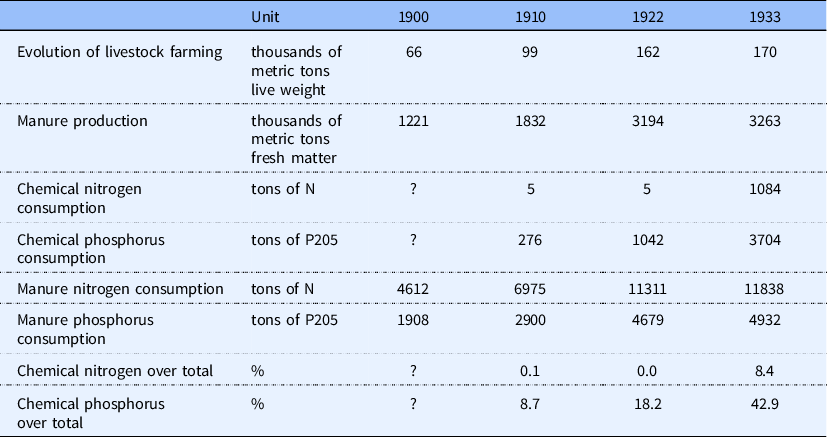
Source: Authors’ own elaboration based on Soto (Reference Soto-Fernández2006) and Domínguez García and Soto (Reference Domínguez García and Soto2012).
This process of livestock specialisation was at the core of the farmers’ collective strategy of innovation. As we have tried to explain, it was the farmers who ultimately defined concrete forms of bovine improvement. This is not surprising considering that in 1917, the price of a six-month-old calf in A Coruña was around 125 pesetas,Footnote 12 while a third-class ticket to Havana and New York cost 329, and to Buenos Aires, 283 pesetas (Vázquez-González, Reference Vázquez-González2000).
3.2. The introduction and widespread use of threshing machines in an agrarian economy centred mainly on livestock
Unlike cattle breeding innovations, with a longer history throughout the nineteenth century, mechanical innovations such as threshing machines had a more accentuated character of ‘revolutionary scientific invention’. In part, due to the idealisation of the ‘redeeming machine’ in the imaginaries of European industrial societies. Its presence in machinery exhibition fairs, and newspaper advertisements, can be traced back to the last years of the nineteenth century. However, its widespread dissemination did not occur until the 1920s and 1930s of the twentieth century. Therefore, the threshing grain was a manual work, with the predominant use of the mallet, and in a timely manner of some handlebar machines, or later by the first pioneer internal combustion engine machines. Since then, threshing machines symbolised the mechanisation of European agriculture before tractors became extensively used (Collins, Reference Collins1972; Macdonald, Reference Macdonald1975; Grigg, Reference Grigg1992). In many areas of Galicia before 1936 they represented the most complete innovation due to their widespread diffusion and characteristics, which integrated the most modern machinery and engines. The most popular models were manufactured by Ajuria Aranzabal (Vitoria, Basque Country), and worked with Dion-Button model gasoline engines, and to a lesser extent with diesel engines (Fernández-Prieto, Reference Fernández-Prieto1997). The incorporation of threshing machines revalued the productive strategies of family farms and was – despite the seeming contradiction – directly related to livestock specialisation.
Along with the threshing machine, new ploughs and other tools were also adopted. The connection between the innovation system (farms and demonstration fields), commercial networks and farmers (whether associated or not) was essential. Thus, threshing machine technology was rapidly incorporated into Galician mixed farming, which was increasingly specialised in livestock, in contrast with the weak mechanisation of some of the grain farming that was dominant in Mediterranean Spain. It reaffirmed the decision-making capacity of farmers who prioritised mechanical innovation linked to the continuity of the family farm over market production. The threshing of cereal coincided seasonally with the obtaining of fodder, with families dividing their work between both tasks. The increased efficiency in producing food for humans, (bread: a basic necessity) made it possible to produce more animal feed: hay, grass, maize, beets and turnip, for example. The machinery saved time, necessary for those other tasks that are increasingly important and that compete for time with the cereal harvest (wheat/rye) and enabling them to be completed sooner. It also ensured the harvest of bread by minimising the risk of unforeseen rains and improving the product. Community participation in manual threshing was transferred to mechanical threshing. Finally, organisation and collective adoption of mechanised innovation allowed the community to face both the high monetary cost of machinery and the social cost of ridicule if their innovation failed (Fernández-Prieto, Reference Fernández-Prieto1997).
Collective adoption of innovation was often fostered by local farmers’ societies, a new form of voluntary association that became key to facilitating and leading technological innovation on behalf of farmers. Community relations and logic underpinned the movement towards associations and the collective adoption of innovation. Many societies had their own threshing equipment after 1910. For farmers willing to innovate, collective purchasing was the only way to access mechanised equipment. More importantly, it was the only socially viable way to risk innovating in rural communities. Associational involvement in innovation was a relatively safe means of collective experimentation that reduced risks and the potential for embarrassment. If the innovation underperformed, the collective social and economic setbacks would be more manageable. This may be seen as a display of necessary prudence. The financial means for purchasing such expensive machinery typically came from cattle sales or remittances from emigrants abroad (Villares, Reference Villares1982).
Collective innovation implied the purchase of equipment for shared use and helped explain both the rapid diffusion and updating of the first machines. The shift from winch- to gasoline-powered machines took place in the second and third decades of the twentieth century. Contemporary forms of informal cooperativism associated with rural communities have also been observed in areas of Denmark, Sweden, and Holland (Grigg, Reference Grigg1982). Shared use of machinery was a regular practice in Galicia, even if purchase was not collective or involved other means. Machinery could be purchased by groups of farmers not affiliated with societies or in mountainous areas with no organised associations. In other cases, more affluent individual farmers would purchase machinery and rent it out in the surrounding areas. Individual purchase for exclusive use appears to be very rare. Communities used machinery more intensively and extensively, all the while forming and propagating work groups adapted to the new system, which weakened the continuity of manual systems (Balboa, Reference Balboa1990).
4. Selecting new technology: actors and spaces. Connections between knowledge networks and actors
The network of scientists and technicians (including experimental and demonstration centres) and the network of farmers’ unions were the ideal spaces for connections between technicians and peasants, favouring the exchange and synergetic fusion of knowledge. The dynamic construction of these hybrid spaces of communication enabled the selection of innovation that eventually occurred in these two linked networks.
This selection depended to a large degree on the ability of technical experts to understand and interact within the logic of the existing agrarian economy. In Galicia, an alliance was formed that merged new science-based knowledge with peasant farming knowledge in a process that we call tchaianovization, referring to scientists’ will and ability to understand farmers’ knowledge.Footnote 13 This alliance provided an opportunity for agronomists to understand the practices and knowledge of the dominant peasant agriculture, and was the best way for them to connect their knowledge with that of the farmers, enabling them to develop practical knowledge accepted by the communities and useful for the improvement of real existing agriculture. Agronomists studied and understood the social and productive conditions of agriculture in order to propose practical solutions that would be acceptable to farmers, recognised as the true agents of innovation. The fusion of scientific or educated agronomy with illiterate agrarian knowledge was the task of technical experts and led to better results.
Leopoldo Hernández Robredo, born in Valencia, engineer, and director of the A Coruña Regional Farm (1904–28), wrote in 1913:
For years… it has been easier to translate than to experiment on our own soil … So what I tell you will be Galician in its essence and practical in its development … In my very modest work, experimentation takes priority over what is written. (Fernández-Prieto, Reference Fernández-Prieto2007).
Cruz Gallástegui, born in Vitoria (Basque Country), was the first director of the Biological Mission of Galicia (1921–60). He had worked closely with D. F. Jones in experiments that led to the first double-cross hybrid maize at the Connecticut Experiment Station in 1919 in the United States (Esperante, Fernández-Prieto and Cabo-Villaverde, Reference Esperante, Cabo Villaverde and Fernández-Prieto2020). Later on, Gallástegui and his team tested and adapted hybrid corn for the first time in Europe, achieving the introduction of cutting-edge technology in Iberian Atlantic small-scale farming. The Mission was successful in developing a double-cross hybrid maize adapted to Galician agro-ecosystems. He was the co-founder also of the Seed Producers Trade Union for experimenting in various areas and producing larger quantities of hybrids. This case illustrates the ideal linking of scientist knowledge with specific local agricultural knowledge. Gallástegui studied first the local forms of corn cultivation, and then mixed large doses of realism with a vocation for innovation and trust in the farmers’ capacity to incorporate something as sophisticated and beneficial as hybrid maize:
Here I remind you of a dilemma … Should we develop a maize seed that produces maximum harvest for maximum intensity cultivation or should we … provide farmers with a variety that is best adapted to a deficient and impoverished agricultural system? There is no seed that can do both things at once. Only one can be chosen. In a region as densely populated as Galicia, there can be no doubt about the answer: maximum performance for maximum intensity agriculture. This seed is the double-cross hybrid. (Gallástegui-Unamuno, Reference Gallástegui Unamuno1934)
Good rapport between the innovation apparatus and farmers meant that these innovators could influence the selection of technology according to the needs of their agro-ecosystems. In other words, farmer involvement in the selection of innovations favoured the process of technological change because it was based on their needs and their farms. Agronomists from the research, experimentation and demonstration centres became interpreters and translators of the needs of the farming community. To address the farmers, these scientists needed to understand their agricultural and economic needs. Afterwards, farmers became part of a wider network. The cattle competitions area a good example of this.
Conclusions
These two examples of innovation in Galician agriculture illustrate the fusion of science-based and practice-based agriculture. Farmers themselves selected and implemented innovations in line with their intensification needs, which involved both commercialisation and family reproduction. Technology did not threaten community or family equilibrium; instead, it empowered processes that were already operative in affirming small-scale farming, such as land ownership, agricultural intensification, and commercialisation.
Parallel processes were likely taking place in other European territories that shared a similar climate and conditions for strengthening peasant agriculture. In the case of Galicia, it was due to: (1) a moment of productive intensification in the Galician agricultural system; (2) the region’s capacity to produce surplus for the market without putting family subsistence at risk; (3) the social dominance of farmers who were becoming landowners; and (4) the capacity of the agrarian population to organise into associations that provided their local communities with access to markets, politics and innovation.
The main examples that we have selected, breeding changes and threshing machines, are in line with previous trends related to the growing importance of livestock due to the need for manure, and the increased introduction of maize for its higher yields and versatility as food for both animals and humans. The nineteenth century saw the rise of an intensification process that required more livestock to produce manure and to serve as labour. In this context, the motives for developing the Galician Blond breed become clear. On the other hand, innovations ingrain threshing made it possible to better identify and classify the model of technological change, the extent to which this innovation met the needs of farmers, and how farmers’ productive and reproductive needs influenced their adoption of this innovation. This type of mechanisation was different with the specialisation logic imposed by the post-Second World War technological paradigm.
Three connected networks with hybrid spaces for the interaction of knowledge and interests explain the dissemination of second-wave industrial innovations: (1) the national innovation network of research, experimentation, and demonstration centres; (2) the commercial network; and (3) the network of local farmers’ unions. That technological change tailored to the needs and interests of small-scale farming is easy to demonstrate in Galicia but has not generally been understood in the traditional interpretation, anthropology, or historiography of this type of agriculture. What we discover is a connection between farmers and agronomists, who engage with empathy in the productive context and with understanding towards their productive and reproductive logics. Technicians discover that the only way they can develop their mission to innovate and improve agriculture is by understanding household logic and the needs of farmers’ families. They realise this in the same way and at the same time as Alexander Tchaianov and others.
As can be seen in the results of this type of innovation, perhaps the most significant aspect was that it addressed the needs of existing agriculture as expressed by the farmers themselves, in a bottom-up way rather than by following arbitrary tradition: an elitist and interventionist tradition that scientists and technicians themselves, working in the field and with the farmers, identified and recognised as ineffective. This new generation of ‘modern’ agronomists and veterinarians of the early twentieth century broke with the practices of the nineteenth century. And they identified both themselves and their knowledge as modern.
In our search for actors, we found that this kind of Tchaianovian scientist shaped the rural economy in Galicia between the two World Wars, making the transfer of technology possible and bringing innovation to small-scale farming. And in addressing the question of who selected and who benefited from new technology in this space and time, we found the farmer in the role of protagonist. Thus, ‘cui prodest new technology?’: farming households and their productive and reproductive logics. Peasant knowledge has historically developed land management techniques that would ensure resilience and sustainability in the long term. How unsustainability irrupted in agroecosystems once this knowledge was eliminated is a question for further papers.
Acknowledgements
We would like to thank the anonymous reviewers and the journal’s editors for their suggestions and comments, which helped to significantly improve this article. We also want to thank Beatriz Corbacho-González and the Histagra research group for their support and contributions to this article. This article was cofunded by the ‘ECOPASADOFUTURO’ PID2020-112686GB-I00, and also by the project ‘AGROECOLAND’ PID2021-123129NB-C41, both funded by the Spanish Ministry of Science and Innovation. Shortcomings are our responsibility alone.




 Open access

