

Introduction
Participating in parliamentary debates is a crucial aspect of MPs’ work in representative democracies. Parliamentary debates are more than “cheap talk”; they tend to “influence the policy-making process in a significant manner,” “generate decisions that are better reasoned and informed,” and they can act as vehicles of communication with voters and signal representatives’ policy positions (Bäck, Debus, and Fernandes Reference Bäck, Debus, Fernandes, Bäck, Debus and Fernandes2021a, 2). Moreover, speeches not only help legislators increase their “visibility and voice in the legislative process” (Osborn and Mendez Reference Osborn and Mendez2010, 910), but also allow them to satisfy competing principals, namely the parties and the constituents (Alemán, Ramírez, and Slapin Reference Alemán, Ramírez and Slapin2017).
While parliamentary debates play a key role in representative democracies, not all MPs engage in them equally. Gender bias molds the political careers of female politicians in diverse ways, including in their work within the parliament (Erikson and Verge Reference Erikson and Verge2022, 4). Studies show that women tend to participate less frequently in debates in parliaments around the world and deliver shorter speeches than their male counterparts (Bäck, Debus, and Fernandes Reference Bäck, Debus, Fernandes, Bäck, Debus and Fernandes2021b). While this trend is quite prevalent in democratic parliaments, crosscutting regions and institutional differences, it is not ubiquitous: in a handful of legislatures, no significant gender bias was found in terms of floor access (Murray Reference Murray2010; Pearson and Dancey Reference Pearson and Dancey2011; Unal Reference Unal2021; Wang Reference Wang2014).
Scholars have tested different theories to explain gender bias in participation in debates but attained mixed results. Some studies show that the increased feminization of institutions results in more women taking the floor (Yoon Reference Yoon2011), whereas others find that the higher the share of women, the fewer the opportunities to access the floor (Bäck and Debus Reference Bäck and Debus2019). MPs’ political careers also play a role in shaping gender bias. Holding leadership positions is beneficial for floor access; while in some parliaments this often results in adverse outcomes for female MPs in these positions (e.g., Sanches and Dias Reference Sanches, Dias, Bäck, Debus and Fernandes2021; Sanjaume-Calvet et al. Reference Sanjaume-Calvet, Vallbé and Muñoz-Puig2023), in others women in power positions take the floor more than their male counterparts (Wang Reference Wang2014). Such contrasting results highlight how seemingly similar conditions may result in gains or losses for women depending on the context. This study seeks to contribute to this debate by examining three related questions: Does gender influence speech levels? How does the feminization of political institutions (parliament and parties) shape gender bias in participation in debates? Which MP characteristics, when interacting with gender, narrow (or amplify) the gender bias?
To answer these questions, we start by developing an explanatory account that builds on feminist institutionalist perspectives emphasizing the role of institutional norms, rules and practices, and the extent to which they foster or hinder gender equality (Krook and Mackay Reference Krook, Mackay, Krook and Mackay2011). This approach is especially fitting for the current study, given its increasing application in African countries (Gouws Reference Gouws and Madsen2021, Reference Gouws and Gouws2022; Madsen Reference Madsen2021).
We investigate gender bias in speechmaking by testing three types of effect. Building on evidence from existing research (for a review, see Bäck, Debus, and Fernandes Reference Bäck, Debus, Fernandes, Bäck, Debus and Fernandes2021b) as well as case study features (Walsh Reference Walsh2011, Reference Walsh, Franceschet, Krook and Piscopo2012), the first (direct effect of gender) expects female MPs to deliver fewer speeches than their male peers. The second effect (access effect) claims that the feminization of institutions (parliaments and parties) affects gender bias in speech levels. Political institutions, notably parliaments and political parties, are gendered, i.e. their daily culture is influenced by embedded gender norms that tend to reward codes of masculinity and therefore penalize women (Lovenduski Reference Lovenduski2005; Kenny and Verge Reference Kenny and Verge2016). Historically, women have been underrepresented within political institutions. As these institutions become increasingly feminized, an apparently counterintuitive outcome is expected, namely, an increase in gender bias in speech levels. This expectation and its underlying mechanisms are supported by findings of previous research on gender bias in speechmaking (Bäck and Debus Reference Bäck and Debus2019; Bäck, Debus, and Fernandes Reference Bäck, Debus, Fernandes, Bäck, Debus and Fernandes2021a), related research on parliamentary work, as well as the specificities of the South African case.
Finally, we posit a genderized career effect, whereby female MPs in positions of power – i.e. seniors and members of the parliamentary party group (PPG) leadership – are penalized in their access to the floor vis-à-vis male peers holding similar positions. Women have less access to positions of power in parliament as seniority and appointment systems are still very much male dominated (Muriaas and Stavenes Reference Muriaas and Stavenes2024). One of the mechanisms, potentially, in place here is that, when women hold such positions, they may refrain from adopting a more agentic role to avoid a backlash for displaying behavior that may appear incongruent with their gender (on role congruity theory, see Back and Debus Reference Bäck and Debus2019; Brescoll Reference Brescoll2011).
These effects are examined in the context of South Africa, which is an interesting case study for testing existing theories given its high level of parliamentary feminization alongside features that can hinder women’s participation in debates. On the one hand, it is a stable democracy and a leading country in terms of female representation, almost reaching parity in parliament in 2019. On the other hand, it is characterized by strong party control over who takes the floor as well as formal and informal institutions that undermine gender equality (Gouws Reference Gouws and Madsen2021, Reference Gouws and Gouws2022; Walsh Reference Walsh2011, Reference Walsh, Franceschet, Krook and Piscopo2012). Therefore, it offers a compelling case for testing how open political institutions are to changes in norms and practices that have been deeply embedded over time, within a context of high feminization.
The empirical analysis draws on over 140,000 speeches made to the parliament between 1999 and 2024 complemented by career and party-level data. The study produces three key findings. First and in line with most existing literature, female MPs speak less compared to their male counterparts. Second, the feminization of parties is associated with a more marked gender difference in access to the floor: women speak significantly more when there is a small share of women in their party leadership but they speak less as this share increases. Third, we confirm gendered career effects for PPG Leaders but not for senior MPs: female MPs in PPG leadership roles not only speak significantly less than male MPs in the same position, but also less than female MPs who do not hold such roles. This suggests that career progression serves as a bonus for men but as a penalty for women.
Overall, the results of this paper indicate that the growing feminization of institutions and the appointment of women MPs to powerful positions are not sufficient to reverse formal and informal norms and patterns of functioning that are historically and deeply biased toward men. These findings contribute to research on feminist institutionalization in South Africa, which has shown how state capture, women’s exclusion from informal networks, and women’s compliance with patriarchy all help reproduce gender bias within parliaments (Gouws Reference Gouws and Madsen2021, Reference Gouws and Gouws2022; Makhunga Reference Makhunga2014, Reference Makhunga2015; Walsh Reference Walsh2011, Reference Walsh, Franceschet, Krook and Piscopo2012). In doing so, this study also helps to narrow a geographic gap in the field of parliamentary and legislative studies, which has neglected countries in the Global South (Martin, Taylor-Robinson, and Crewe Reference Martin, Taylor-Robinson and Crewe2022). Furthermore, these findings have important implications beyond South Africa, particularly for contexts characterized by high levels of feminization in political institutions, as they reveal the need to go beyond the politics of presence—even in powerful positions—and emphasize the importance of a Gendered Workplace Approach that addresses the informal practices shaping institutional dynamics.
Gender and Parliamentary Debates: Theory and Effects
The Direct Effect of Gender
Although parliamentary speeches are important tools for attaining several goals, such as representation, law and policymaking, oversight, self-promotion, and career advancement, the opportunity to take part in debates is not equally distributed among all MPs. A number of studies over the past decade have increased our knowledge of the constellation of individual-level factors that ease access to the floor, most notably gender. It has been shown that women take the parliamentary floor less often than men do. That is the case, for instance, in the UK House of Commons (Blumenau Reference Blumenau2021), as well as the Spanish (Sanjaume-Calvet et al. Reference Sanjaume-Calvet, Vallbé and Muñoz-Puig2023), Estonian, Finnish, German, Norwegian, and Swedish parliaments (Bäck and Debus Reference Bäck and Debus2019; Bäck, Debus, and Müller Reference Bäck, Debus and Müller2014).
Nonetheless, gender bias in speechmaking is not universal. A systematic overview of 31 legislatures by Bäck, Debus, and Fernandes (Reference Bäck, Debus, Fernandes, Bäck, Debus and Fernandes2021b) concludes that in 21 legislatures “women elected as representatives either speak less often or give shorter speeches than their male counterparts, even when controlling for further important determinants that influence speechmaking in legislatures” (p. 832). However, no significant gender effect was found in the remaining cases. The absence of significant gender differences had already been found in previous research, namely in Uganda (Wang Reference Wang2014), France (Murray Reference Murray2010), Turkey (Unal Reference Unal2021), the US (Pearson and Dancey Reference Pearson and Dancey2011), to name but a few examples. The unclear results could be in part owed to the fact that some of these studies use different metrics of speechmaking; however, reference studies in the field have used the same dependent variable across a wide range of cases and still found differences (Bäck, Debus, and Fernandes Reference Bäck, Debus, Fernandes, Bäck, Debus and Fernandes2021a, Reference Bäck, Debus, Fernandes, Bäck, Debus and Fernandes2021b).
Studies on the South African parliament find gender bias in both nominations to committees and the substantive focus of questions that male and female MPs ask in parliament. Female MPs tend to be nominated more to “feminine committees” (Saaka and Yayah Reference Saaka and Yayah2024) and tend to ask more questions on soft policy issues, though less so when they are in electorally vulnerable positions (Espírito-Santo, Sanches, and Kartalis Reference Espírito-Santo, Sanches and Kartalis2024). There is also evidence that female MPs face more constraints on taking the floor. In the case of the country’s ruling party, the African National Congress (ANC), female MPs are not only controlled by the party but, more importantly, by the ANC Women’s League, which is an influential gatekeeper in parliament and often complicit with patriarchal norms (Hassim Reference Hassim2014; Makhunga Reference Makhunga2014, Reference Makhunga2015; Walsh Reference Walsh2011, Reference Walsh, Franceschet, Krook and Piscopo2012). Based on this, we test the most widely supported hypothesis that:
H1: Female MPs have lower speech levels than their male counterparts.
The Access Effect
The institutional context in which MPs act is one of the factors that may account for the variation in the gender bias in parliamentary speechmaking across countries. Political institutions are not gender neutral. In fact, the historical male dominance within politics meant that the institutional “rules of the game” were established exclusively by men (Lovenduski Reference Lovenduski2005, 27). Therefore, both national parliaments and political parties are marked by conventional, and often implicit, gender norms that tend to disadvantage women (Kenny and Verge Reference Kenny and Verge2016, 365) and produce gendered outcomes. In addition to formal norms, gendered workplaces such as parliaments are also significantly influenced by informal rules, including practices related to behavior within the chamber, norms dictating political leadership roles, and standards associated with political competence (Erikson and Josefsson Reference Erikson and Josefsson2021, 21). Although it is beyond the scope of this article to delve into a Gendered Workplace Approach (Erikson and Josefsson Reference Erikson and Josefsson2021; Erikson and Verge Reference Erikson and Verge2022), we affirm the crucial significance of both the work environment in parliament and its informal institutionalized gendered norms.
As a consequence of these gendered formal and informal political norms and practices, women who enter politics are often hindered in various ways that prejudice their parliamentary work (Lovenduski Reference Lovenduski2005; Kantola and Agustín Reference Kantola and Rolandsen Agustín2019; Krook Reference Krook2016; Swers Reference Swers2005). We argue that the feminization of political institutions, particularly national parliaments and political parties, may influence how these norms operate in practice. We focus on national parliaments because they are the home of political representation par excellence, and the place where parliamentary debates take place. On the other hand, political parties are not only political gatekeepers but also wield significant influence over parliamentary activities (Saalfeld and Strøm Reference Saalfeld, Strøm, Martin, Saalfeld and Strøm2014). In fact, parties “contribute to establishing parliaments’ organizing principles” (Erikson and Verge Reference Erikson and Verge2022, 14) and hence enable or limit MPs’ access to the floor. In this paper, feminization is understood to refer to the presence of women within political institutions.
Drawing on both theoretical and empirical research, it is likely that women’s presence in parliaments and political parties has either positive or negative effects on the gender share of the parliamentary floor. On one hand, increasing women’s representation in politics could lead to favorable changes in norms and conduct within political parties and parliaments. Analyzing South Africa’s parliament, Britton (Reference Britton2005, 126) demonstrates that “the institution’s hours, calendar, and climate have all changed to reflect the massive increase of women into the previously male-dominated domain.” Examining the case of Malawi, where the presidency changed hands from a man to a woman through an exogenous shock, Wahman, Frantzeskakis, and Yildirim (Reference Wahman, Frantzeskakis and Yildirim2021) show that women MPs increased their speechmaking significantly under the female president. Similar results were found for the UK House of Commons with Blumenau’s research demonstrating that “when a female cabinet minister is appointed, other female legislators become more active and central participants in parliamentary debate than is the case under male ministers” (Blumenau Reference Blumenau2021, 19). The author observes that two mechanisms are likely to influence the results: female cabinet ministers serve as role models for other female parliamentarians, and they foster a debating culture that is more supportive of female MPs (Blumenau, Reference Blumenau2021). Some other studies find no effect at all. For instance, an analysis of Spanish political parties by Sanjaume-Calvet, Vallbé, and Muñoz-Puig (Reference Sanjaume-Calvet, Vallbé and Muñoz-Puig2023) identified a consistent and significant gender gap in floor access, with findings suggesting that the degree of party feminization played no role in this pattern.
Notwithstanding, a stronger presence of women in parliament can also lead to an apparently counterintuitive outcome, namely a decrease in the access to power or visibility of female parliamentarians. One line of research analyzing committee assignment suggests that the growing feminization of parliaments actually accentuated the over-representation of women in social issue committees (Barnes Reference Barnes2014; Espírito-Santo and Sanches Reference Espirito-Santo and Sanches2020; Heath, Schwindt-Bayer, and Taylor-Robinson Reference Heath, Schwindt-Bayer and Taylor-Robinson2005; Towns Reference Towns2003). In addition, Bäck, Debus, and Fernandes (Reference Bäck, Debus, Fernandes, Bäck, Debus and Fernandes2021b, 834), synthetizing findings from several case studies that focus specifically on parliamentary debates, note that women tend to participate more in debates in parliaments where they are poorly represented. Similarly, a comparative study of seven countries by Bäck and Debus (Reference Bäck and Debus2019) shows that the larger the share of women in the parliamentary party groups, the fewer speeches female MPs gave in parliament.
This seemingly counterintuitive phenomenon may occur for several reasons, which are not mutually exclusive. One involves a backlash from male MPs. As women’s presence in the political sphere grows, “to protect their power, male elites may attempt to limit the authority of female entrants and sideline women as a group” (O’Brien and Rickne Reference O’Brien and Rickne2016, 115). A common strategy employed by male MPs is to strengthen their power within informal networks, from which women are usually excluded and where, in practice, significant decisions are made (Kenny and Verge, Reference Kenny and Verge2016).
A second possible reason involves the stigmatization of elected women, particularly those entering parliament through quota policies, as is the case in South Africa where the largest party has voluntary party quotas. After elections, various actors within parliament may deploy a range of tactics aimed at undermining quota women’s capacity and legitimacy as legislators and reinforcing the perception that they are not effective politicians (Krook Reference Krook2016: 12). Although subsequent research in several European countries (Allen, Cutts, and Campbell Reference Allen, Cutts and Campbell2016; Besley et al. Reference Besley, Folke, Persson and Rickne2017; Murray Reference Murray2010) and in Uganda (O’Brien Reference O’Brien, Franceschet, Krook and Piscopo2012) has demonstrated that women elected through quotas are in no way inferior to either non-quota women or male MPs, stigma surrounding quota policies still persists. This stigma is often found among citizens (Clayton, O’Brien, and Piscopo Reference Clayton, O’Brien and Piscopo2025; Kim and Kweon Reference Kim and Kweon2022) and, in Africa, it is present among both citizens and political elites (Clayton Reference Clayton2015; Clayton, Josefsson, and Wang Reference Clayton, Josefsson and Wang2014). This stigmatization may undermine female representatives’ capacity to fully engage in parliamentary work.
A third possible explanation lies in the observation that women may feel less marginalized as the number of women in parliament increases and, as a result, engage less frequently in certain parliamentary activities. For instance, several studies have shown that female parliamentarians are more likely than their male counterparts to engage in collaborative legislative behavior, such as cosponsoring legislation (e.g., Barnes Reference Barnes2016; Wojcik and Mullenax Reference Wojcik and Mullenax2017). However, this tendency is often interpreted as a response to the marginalization of female MPs; indeed, in legislative chambers where women are less excluded, female collaborative behavior tends to decline (Swift and VanderMolen Reference Swift and VanderMolen2021). A reduction in such intra-gender collaborative networks may also contribute to the lower-profile participation of women in parliamentary debates.
This discussion highlights the complexity of unravelling the role of the feminization of parliaments and parties on women’s access to the floor. The networks of power are complicated and often invisible. The existing research on South Africa reveals that the increasing presence of women in parliament, mainly via the largest party’s quota, has not improved debate conditions for women (Walsh Reference Walsh2011, Reference Walsh, Franceschet, Krook and Piscopo2012). The political environment remains deeply sexist (Makhunga Reference Makhunga2015), largely due to state capture by the ruling elite, which has undermined efforts toward gender equality (Gouws Reference Gouws and Madsen2021, Reference Gouws and Gouws2022; Hassim Reference Hassim2014; Makhunga Reference Makhunga2014, Reference Makhunga2015). Therefore, we posit that:
H2: A higher feminization of both parliaments and parties is associated with a greater gender difference in speech levels.
The Career Effect
Now focusing on MPs’ characteristics, a series of factors other than gender determine access to the floor. Two in particular stand out for their relevance and for being commonly tested, namely MPs’ seniority and holding leadership positions in parliament (e.g. being a PPG Leader). Seniority is an important asset for several parliamentary activities including participation in debates. The rationale behind its importance is straightforward. First, we must consider political socialization and professionalization, i.e. the fact that MPs with longer parliamentary careers might have a better understanding of the rules of the game (and be perceived as such) and are therefore more often allowed to take part in debates (Bäck, Debus, and Müller Reference Bäck, Debus and Müller2014, 508). Second, experience may signal “expertise” and facilitate floor access (Bäck, Debus, and Fernandes Reference Bäck, Debus, Fernandes, Bäck, Debus and Fernandes2021b, 835). Finally, it is easier to allocate MPs to the “right” debate based partly on their level of loyalty to the party, but also on their skills, familiarity with the party leaders, and so on. Similarly, concerning PPG Leadership, the systematic analysis of 31 parliaments by Bäck, Debus, and Fernandes (Reference Bäck, Debus, Fernandes, Bäck, Debus and Fernandes2021b, p. 838) revealed that in most legislatures the representatives “who belong to the party leadership give more speeches than other politicians” and 50% of them deliver lengthier speeches.
While the impact of MPs’ seniority and PPG Leadership on floor access seems clear, that is, being a PPG leader or holding a senior position implies a bonus in terms of floor access, the interaction of these factors with gender is a more complex topic that is less explored in the existing literature. It is well established that women have less access to powerful positions in parliament (Alemán et al. Reference Alemán, Barnes, Micozzi and Vera2025; Muriaas and Stavenes Reference Muriaas and Stavenes2024); it is also widely acknowledged that they must exert greater effort than men to attain equivalent positions, regardless of the field. Specifically concerning party leadership, comparative research showed that “prospective female leaders are playing by a different (and often more demanding) set of rules than their male counterparts” (O’Brien Reference O’Brien2015, 1036). Therefore, it could be expected that the (few) women who attain top political positions or who manage to remain in politics long enough to reach seniority have the resilience that allows them to perform on a par with men in equivalent positions.
On the other hand, some studies highlight that female politicians may change their behavior when in positions of power because they are expected to behave differently. This points to the so-called role congruity theory, according to which a “perceived incongruity between traditional female gender roles and leadership roles leads to prejudice and bias against women in leadership positions” (Bäck and Debus Reference Bäck and Debus2019, 580). The process is as follows: if women occupy leadership positions and adopt a more agentic behavior, this is likely to be considered incongruent with their gender. Hence, in order to avoid a backlash from their peers, women may choose to take a more low-profile approach (see Brescoll Reference Brescoll2011, 625–626 for a review of this literature). This reaction by female MPs is driven by demand-side pressures coming from parties and male politicians. In addition, several of the mechanisms we highlight above to justify H2 are also expected to play a role here. In fact, backlash from male MPs and the stigmatization of women elected through quota policies may be even stronger when those women occupy positions of power.
A sample of studies offers interesting though inconclusive results on the relationship between female speechmaking and seniority. Fernandes, Lopes da Fonseca and Won (Reference Fernandes, da Fonseca and Won2023) observe that the gender bias in floor access in Portugal is stronger among rookie MPs than seniors. A study on the case of France shows that there are no significant gender differences in speechmaking along seniority levels (Alke, Brouard, and Rozenberg Reference Alke, Brouard, Rozenberg, Bäck, Debus and Fernandes2021). In contrast, a recent longitudinal study of parliamentary speeches in 24 democracies finds that female MPs shift toward a more masculine communication style the longer they remain in office (Castanho Silva, Pullan, and Wäckerle Reference Castanho Silva, Pullan and Wäckerle2025). Also in the case of Ghana (Sanches and Dias Reference Sanches, Dias, Bäck, Debus and Fernandes2021) and Spain (Sanjaume-Calvet, Vallbé, and Muñoz-Puig Reference Sanjaume-Calvet, Vallbé and Muñoz-Puig2023), legislative experience is a major aspect hindering women’s access to the floor.
The results are more consensual for PPG Leadership. Most studies suggest that gender inequality is “more severe for the top positions than for the lower ones” and this is even the case in Sweden despite its long history of women’s political representation (Folke and Rickne Reference Folke and Rickne2016, 569). Using real data from the US Senate and experimental data, Brescoll (Reference Brescoll2011) demonstrates that power has a different effect on men’s and women’s volubility, i.e. the total amount of time spent talking in group contexts: “while power has a strong, positive effect on volubility for men, no such effect exists for women” (Brescoll Reference Brescoll2011, 622). In the case of Ghana, Sanches and Dias (Reference Sanches, Dias, Bäck, Debus and Fernandes2021) found that gender bias in access to the floor was particularly evident among PPG leaders, with women in these positions speaking less than men. In contrast, Wang (Reference Wang2014, 366) demonstrates for the case of Uganda that “female MPs who hold parliamentary leadership positions speak significantly more than any other group.” It is interesting to note that whereas Ghana has no formal quota, Uganda has reserved seats for women.
Overall, this body of literature justifies exploring the interactions between gender and both seniority and PPG leadership to gain a deeper insight into the broader pattern of gender bias in the level of MPs’ speechmaking and their career prospects. Building on findings from the literature—particularly the observation that stronger gender inequality is more commonly found in top positions than the reverse—and taking into account the specific idiosyncrasies of South Africa regarding gender equality, we expect the following career effect:
H3: The gender difference in speech levels is greater among MPs holding positions of power—i.e. seniors and parliamentary party group (PPG) leaders.
Before detailing how we empirically test each of these hypotheses, the following section offers a contextualization of the South African case.
The South African Context
South Africa is an interesting case study as its high level of parliamentary feminization coexists with sexist features that undermine women’s participation on the parliamentary floor. In this sense, it can improve our understanding of the contextual determinants of speechmaking within and outside Africa.
South Africa transitioned to democracy with the 1994 general elections, following a period of turmoil and struggle that led to the end of more than four decades of racial minority rule (the Apartheid). Since then, relatively free and fair elections have been held in the country. The members of the 400-seat National Assembly are elected under a closed list proportional representation system,Footnote 1 while members of the National Council of Provinces (upper chamber) are nominated by delegates of the Provincial Legislatures. The African National Congress (ANC), winner of the founding 1994 elections, has been able to consolidate power by winning all general elections held in the country ever since. However, from the mid-2000s it has experienced stiff competition from new opposition parties such as the Democratic Alliance (DA) and Economic Freedom Fighters (EFF) (Kotze and Bohler-Muller Reference Kotze and Bohler-Muller2019; Paret Reference Paret2018), resulting in the unprecedented loss of the majority of seats in parliament in the most recent polls in 2024.
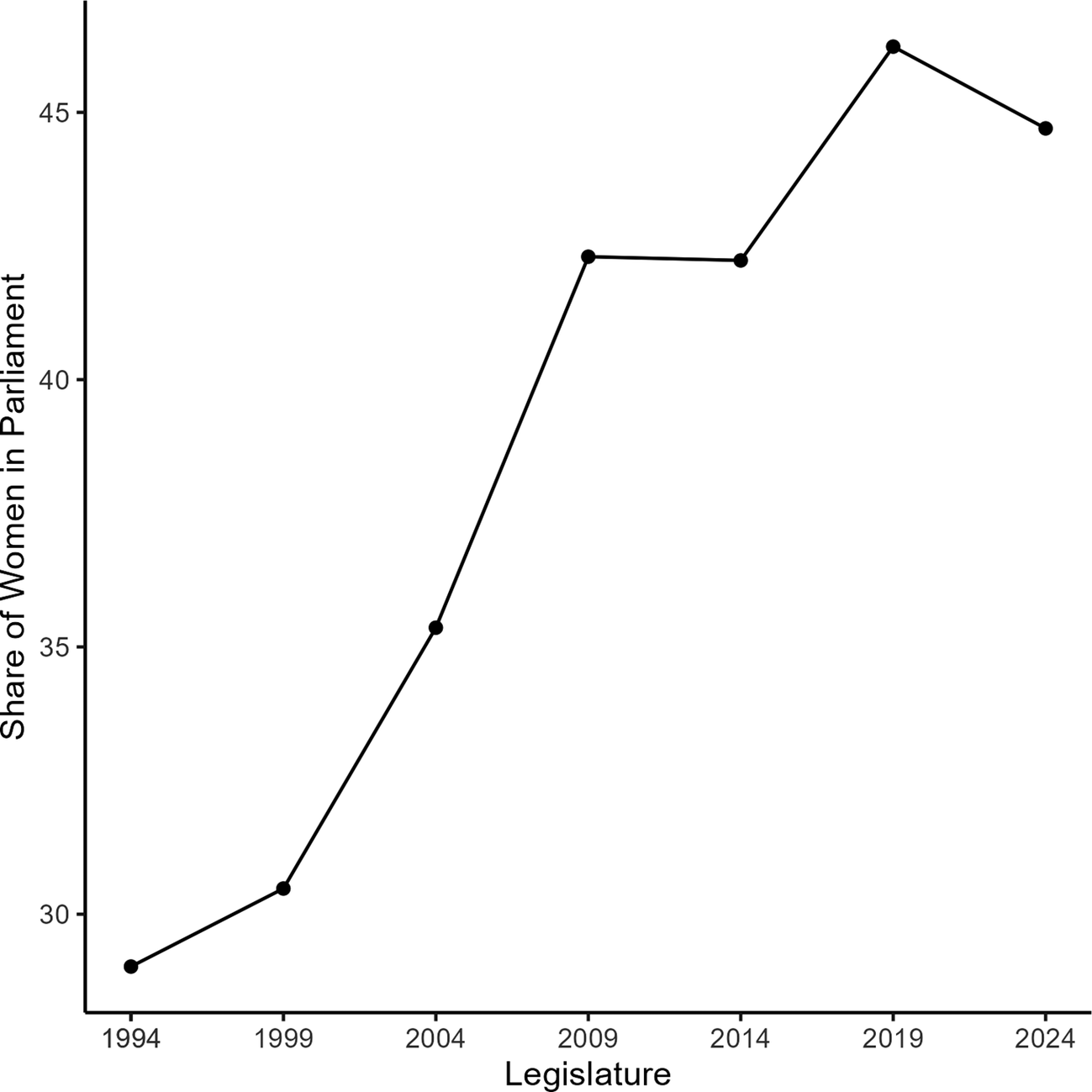
South Africa’s parliament is one of the strongest and most resourceful in Africa (Barkan Reference Barkan and Barkan2009) and has seen a steady growth in female representation (Figure 1). On average, the percentage of women has risen from 29% in the first legislature (1994–1999) to almost parity since 2019 (44%–46%). The country is one of the leading African countries not only in terms of women’s representation in parliament (ranking 16 in IPU global ranking), but also in gender parity in cabinet positions (UN Women dataFootnote 2) as well as women taking the role of Speaker of Parliament (seven out of eight Speakers since 1994 have been women). Several factors explain the increased female presence in the state; these include the implementation of the National Gender Machinery (NGM), a multi-layered structure adopted during democratic transition in 1994 following the work of feminist activists and women’s organizations, and also the work of the ANC Women’s League (ANCWL), which fought for the implementation of gender quotas (Gouws Reference Gouws and Madsen2021, Reference Gouws and Gouws2022; Hassim Reference Hassim2014; Makhunga Reference Makhunga2014). The ANC is currently the sole party to adopt zebra-list quota on its party candidate list and the 50/50 quota policy in practiceFootnote 3; moreover, as the largest party in parliament, it is also the major contributor to its feminization. The EFF has not yet formalized a quota policy but guarantees high representation of women in the parliamentFootnote 4; this is also the case for the DA, even though it subscribes to “the notion of ‘equal opportunity,’ whereby natural attributes such as gender and race are disregarded.”Footnote 5
Share of women in South Africa’s Parliament (1994–2024).
Note: Since annual percentages vary, we plotted the average share of women per legislature. Source: IPU praline (https://data.ipu.org/).

While often hailed as a success story in terms of gender representation, the political environment in South Africa is marked by state capture, informal patronage networks dominated by men and co-opted gender institutions, all of which have far-reaching effects on women’s participation both in number and kind (Gouws Reference Gouws and Madsen2021, Reference Gouws and Gouws2022; Hassim Reference Hassim2014; Makhunga Reference Makhunga2014, Reference Makhunga2015).
According to Makhunga (Reference Makhunga2015, 174), the 117 women who entered the parliament in 1994 “encountered a harsh, sexist environment with an entrenched dominant masculine culture.” Nevertheless, women’s presence in parliament fostered collective action which was crucial for advancing women’s rights and developing policies and laws promoting gender equality (Albertyn Reference Albertyn, Dobrowolsky and Hart2003; Britton Reference Britton2005; Makhunga Reference Makhunga2015; Walsh Reference Walsh2011). From the second legislature on (1999–2004), women’s issues became less prominent in parliament due to growing tensions between women in civil society and the state (Albertyn Reference Albertyn, Dobrowolsky and Hart2003; Britton Reference Britton2005; Walsh Reference Walsh2011). Moreover, as the parliament became more professionalized, female MPs with a disadvantaged educational and occupational background began to leave the parliament, and were replaced by a new generation of female MPs seeking “research support to actualize their professional goals and to excel in debates and committees” (Britton Reference Britton2005, 150). This generational change coincided with more limited debate conditions in which governing elites favored “privileged, professional women with career ambitions,” but “disciplined independent and outspoken MPs, undermining the openness of debate conditions” (Walsh Reference Walsh2011, 211). While party control over speechmaking became stronger as women accessed parliament, female MPs were less able to exert their roles and advance their agendas (Walsh Reference Walsh, Franceschet, Krook and Piscopo2012).
With time, the NGM, which had been set up to avoid the marginalization of women’s issues, was “captured” by the state, contributing to a gap between women’s organizations and the state; whereas, the ANCWL became a gatekeeping institution with a strong influence on women’s access to positions of power and a key supporter of the ruling party (Gouws Reference Gouws and Madsen2021, Reference Gouws and Gouws2022; Hassim Reference Hassim2014; Makhunga Reference Makhunga2014, Reference Makhunga2015). Thus, gendered outcomes in South Africa’s parliament should be understood in the context of the elite patriarchal bargains that women negotiate alongside the opportunities and constraints offered by political parties and the parliamentary institution (Makhunga Reference Makhunga2015).
While research on gender and speechmaking in South Africa is still limited, studies on question-asking highlight the role of parties and intraparty competition in understanding MPs’ access to the floor. First, parliamentary party groups play a pivotal role in screening MPs’ questions and making sure they align with the party policies and stances (Espírito-Santo, Sanches, and Kartalis Reference Espírito-Santo, Sanches and Kartalis2024; Sanches and Kartalis Reference Sanches and Kartalis2024). Second, there are gender patterns in the substantive focus of questions: while women tend to focus more on the so-called “soft policy domains,” they turn their attention to “hard policy domains” when facing stiffer intraparty competition, that is, when they are electorally vulnerable and as elections draw closer (Espírito-Santo, Sanches, and Kartalis Reference Espírito-Santo, Sanches and Kartalis2024). This study contributes to this debate by exploring gender bias in access to the floor while taking institutional and individual-level explanations into account.
Data and Methods
To test the hypotheses outlined above, the empirical analysis draws on longitudinal data on legislative debates in South Africa dating from the first information available (Kartalis, Sanches, and Conduto Reference Kartalis, Sanches and Conduto2024). The data covers the period from 1999 to 2024 including the 2nd (1999–2004), 3rd (2004–2009), 4th (2009–2014), 5th (2014–2019), and 6th (2019–2024) parliamentary terms. After cleaning the data by excluding session chairs (e.g. all interventions by the speaker) and MPs for whom we could not match biographical data, we ended up with a total of 142,206 speeches delivered by 2148 MPs over this period. However, in the regression analyses these numbers drop due to missing values in party-level variables (as explained below).
A count variable measuring the number of speeches each MP made in each parliamentary term (total speeches) is the dependent variable used in this study. Total speeches can vary greatly depending on several factors, namely the functioning of the access and career effects indicated above. As shown in the Appendix (Figure A1 and Table A1), the count dependent variable has a right-skewed and over-dispersed distribution (with variation much higher than the mean). Some MPs are visibly more active, delivering more than 2000 speeches; in contrast, others are much less so and some deliver as few as one speech. The negative binomial regression is the most fitting modelling strategy in such cases as it adjusts to these conditions (Green Reference Green2021). Additionally, given the hierarchical structure of the data, all models estimated include fixed effects for legislative term and robust standard errors clustered at the MP level.
Taking MPs’ gender (1 = female, 0 = male) as the main independent variable, we estimate several explanatory models of participation in debates. Gender enters the models alone to test its direct effect on total speeches (H1) and in interaction with the feminization of institutions and MPs’ other characteristics to test H2 and H3, respectively. H2 claims that the level of feminization of parliaments and parties increases gender bias in participation in debates; to test this, we interact gender with two variables operationalizing feminization. The first is the share of women in parliament measured as the percentage of women elected to parliament (from IPU Parline). The second is the share of women in party leadership, which is drawn from the V-Party Dataset (variable v2pagender) and takes into account national-level positions outside parliament (from 0 = none to 4 = balanced, about 40% or more). As the V-Party Project only codes parties with 5% of the vote share at a given election (Lindberg et al. Reference Lindberg2022), we lose some observations in the regression analysis, more specifically 263 MPs from 30 smaller parties.
H3 anticipates that male and female MPs in similar positions of power in parliament will exhibit unequal levels of speechmaking. To test this, we first interact gender with seniority, measured by the number of terms an MP has previously served; we then interact gender with parliamentary party group leader (PPG Leader), a dummy variable assuming the value 1 when the MP is leader of either the majority or the minority parliamentary group, and their respective whips.
The models include several controls. At the individual-level, we consider whether the MP is a minister (1 = yes, 0 = no) as this has been found to have an effect on floor access (Sanches and Dias Reference Sanches, Dias, Bäck, Debus and Fernandes2021; Bäck, Debus, and Fernandes Reference Bäck, Debus, Fernandes, Bäck, Debus and Fernandes2021b). At the party-level, we consider the party’s position on the economic left-right scale (0 = far-left to 6 = far-right) and the party gender policy, which expresses party support for the equal participation of women in the labor market (0 = Strongly opposes to 4 = Strongly supports). Both these variables are also drawn from the V-Party Dataset (variables v2pariglef and v2pawomlab, respectively) and were included in light of studies linking parties’ ideologies to women’s presence and activism within parliaments (Caul Reference Caul1999; Unal Reference Unal2021; De Vet and Devroe Reference De Vet and Devroe2023). Party’s seat share in parliament, which is a conventional control in this kind of studies, could not be included in its original format due to high multicollinearity with the share of women in party leadership. It was therefore recalculated as an ordinal scale that takes the value 0 for micro parties (0%–10% seats), 1 for small parties (10%–20% seats), 2 for medium-size parties (20%–40% of seats), and 3 for large parties (>40% seats). The VIF values for all variables in the model are below 5, indicating low multicollinearity (see Appendix, Table A2).
Ideally other factors such as age, expertise (e.g. education, occupation), as well as other career-level variables (committee or party positions) would have been included in the models in order to fully account for factors that are likely to shape MPs’ floor access. However, this information was not accessible (in part or totally) at the time of writing.
Main Results
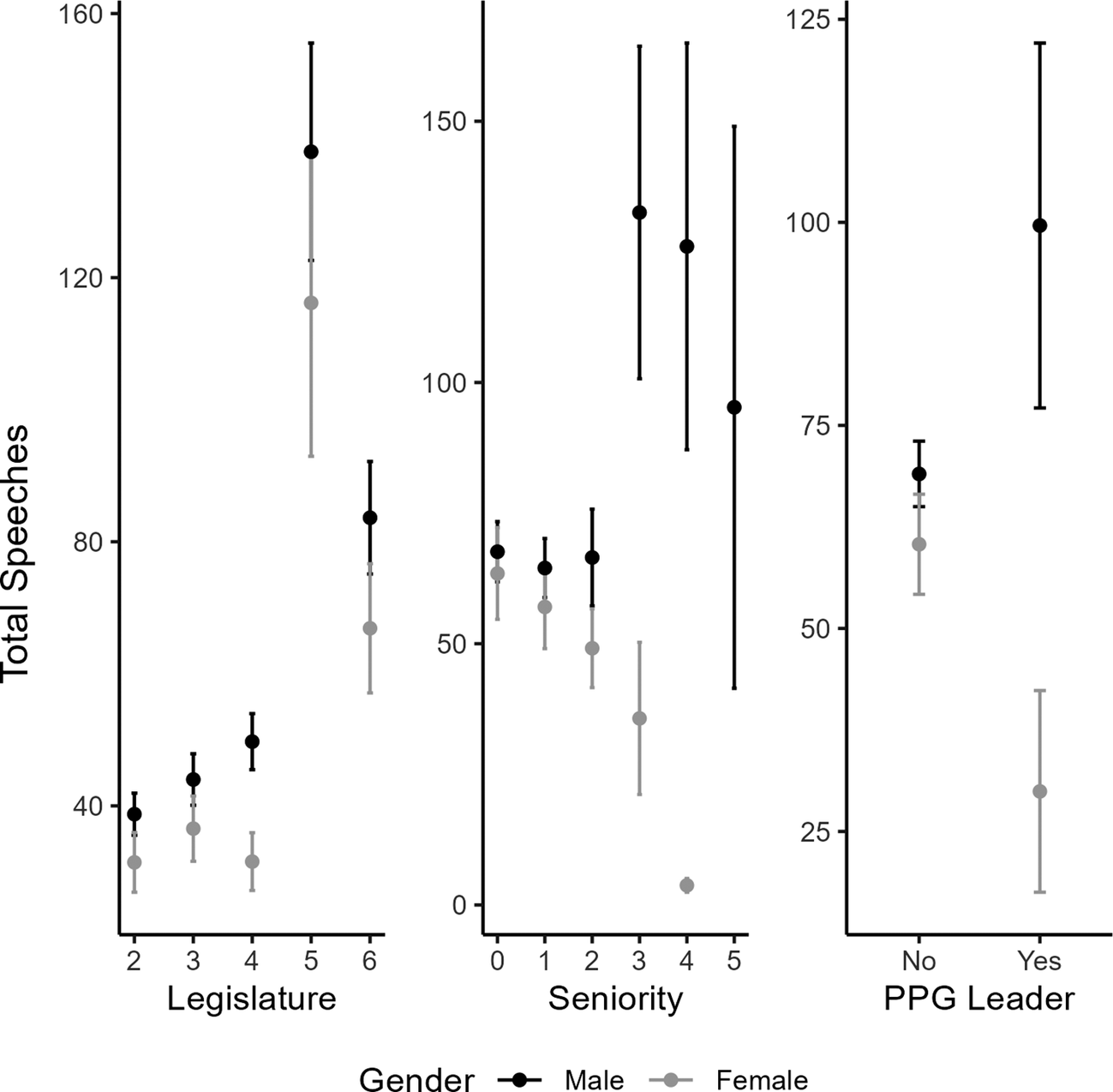
Before analyzing the results of the regression models, we plot descriptive statistics on key individual-level variables (Figure 2); the full descriptive statistics tables are presented in the Appendix (Tables A7 and A8). As shown in Figure 2 (left-hand panel graph), female MPs participate less in debates than men. This is clear when we look at trends across legislatures, particularly the 4th legislature (2009–2014) when the gap between the number of speeches made by male and female MPs is higher. The 4th legislature is intriguing, not only because women’s representation reached 40% for the first time but also because it is the only legislature to have a male Speaker of Parliament (Max Sisulu); previously, all Speakers had been female and most had held leadership roles within the ANCWL (e.g. Frene Ginwala, Thandi Modise, Baleka Mbete, Nosiviwe Mapisa-Nqakula).
Speech levels by gender, legislature, seniority, and as a PPG leader.
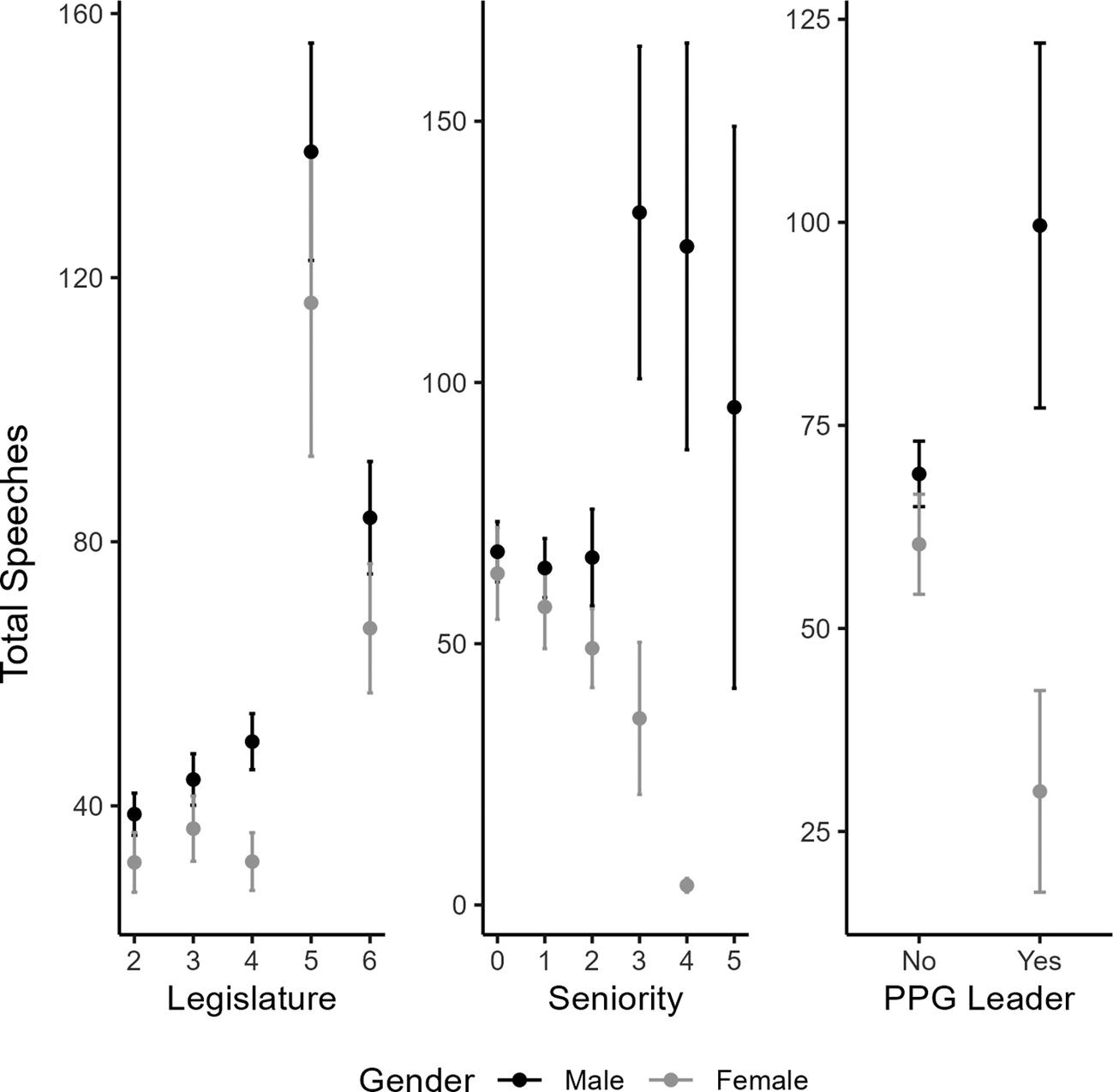
Figure 2. Long description
A multi-panel figure with three vertical plots sharing a y-axis labeled Total Speeches. A legend at the bottom indicates black dots for Male and gray dots for Female.
Panel 1, Legislature. The x-axis ranges from 2 to 6. For legislatures 2, 3, and 4, speech counts are low, under 50, with males slightly higher than females. At legislature 5, there is a massive spike, with males near 140 and females near 115, both with large vertical error bars. At legislature 6, counts drop to approximately 85 for males and 65 for females.
Panel 2, Seniority. The x-axis ranges from 0 to 5. From seniority 0 to 2, speech counts are stable between 50 and 80. At seniority 3 and 4, male speech counts jump significantly to over 100 with very wide error bars, while female counts drop below 40. At seniority 5, only a male data point is visible near 95 with a very large error bar.
Panel 3, P P G Leader. The x-axis has two categories, No and Yes. For non-leaders, both genders are close, between 60 and 75. For P P G leaders, there is a stark divergence. Males average 100 speeches with a large error bar, while females average approximately 30 speeches with a smaller error bar.
Another important trend noted in the data is the jump in the absolute number of speeches between the 4th and the 5th legislature. Further examination of the data reveals changing debate dynamics within the parliament (see Appendix, Tables A4 to A6). The 5th legislature has the largest number of speeches, clustering 40% of the speeches covered in the study; and this is mainly driven by a newcomer in parliament—the EFF—which is responsible for about 39.45% of the speeches. Furthermore, EFF MPs are among the most active in the 5th legislature, with some delivering more than 1000 speeches; whereas MPs from the DA and other smaller parties are also quite active, the vast majority of MPs from the ANC, the ruling party, deliver fewer than 39 speeches. The overall speechmaking activity declines in the 6th legislature, but it remains above the levels observed in the 2nd, 3rd, and 4th legislatures.
Figure 2 presents two other graphs that examine the relationship between gender, positions of power (seniority and being a PPG Leader) and the number of speeches. Before delving into the results, two cautionary notes are required. First, levels of seniority within the South African parliament are relatively low (see Appendix, Tables A7 and A8) due to the high turnover in parliament (Sanches, Kartalis, and Siachiwena Reference Sanches, Kartalis and Siachiwena2024). This trend is not exclusive to South Africa and has been observed in other African countries such as Malawi (Frantzeskakis, Wahman, and Yildirim Reference Frantzeskakis, Wahman, Yildirim, Bäck, Debus and Fernandes2021). In addition, female MPs are less senior than male MPs: no female MP has served more than 4 times in parliament. Second, the number of MPs who are PPG Leaders is arguably low when compared to the wider sample, and women have had fewer opportunities to serve as PPG Leaders; thus, we are dealing with very small samples (see Appendix, Table A8). Nonetheless, as previously discussed, the opportunities male and female MPs in these positions have to speak in parliament can be different.
Going back to Figure 2 (middle and right-hand panel graphs), we find that whereas female MPs tend to speak less as they become more senior in parliament (noting that there is a small number of experienced female MPs in the sample), senior male MPs benefit from a significant bonus. The same trend is observed as regards being a PPG Leader: male MPs who are PPG Leaders speak more than both female MPs in the same position and male backbenchers who are not PPG Leaders. In contrast, female PPG Leaders are the most underrepresented group in parliamentary debates.
The institutions observed in the study display a moderate to high level of feminization (see Appendix, Table A8). Women’s representation in parliament is around 39% (on average) and women’s representation in party leadership scores 2.7 out of 4 (i.e. between 25% and 39% of women’s representation). These initial descriptive results offer an interesting insight into gender and speechmaking inside the South African parliament and lay the ground for subsequent analysis.
To test the study’s hypotheses, we estimate five negative binomial regression models, the results of which are displayed in the Appendix. Table A9 presents Models 1 to 3, which test H1 and H2; and Table A10 presents Models 4 and 5 testing H3. For robustness check, we estimated the same models excluding the MPs from the EFF as their high speech level since entering the parliament contributed to a jump in the absolute number of speeches, particularly in 5th legislature (see Figure 2). However, the results, as reported next, remain unchanged (see Appendix, Tables A11 and A12).
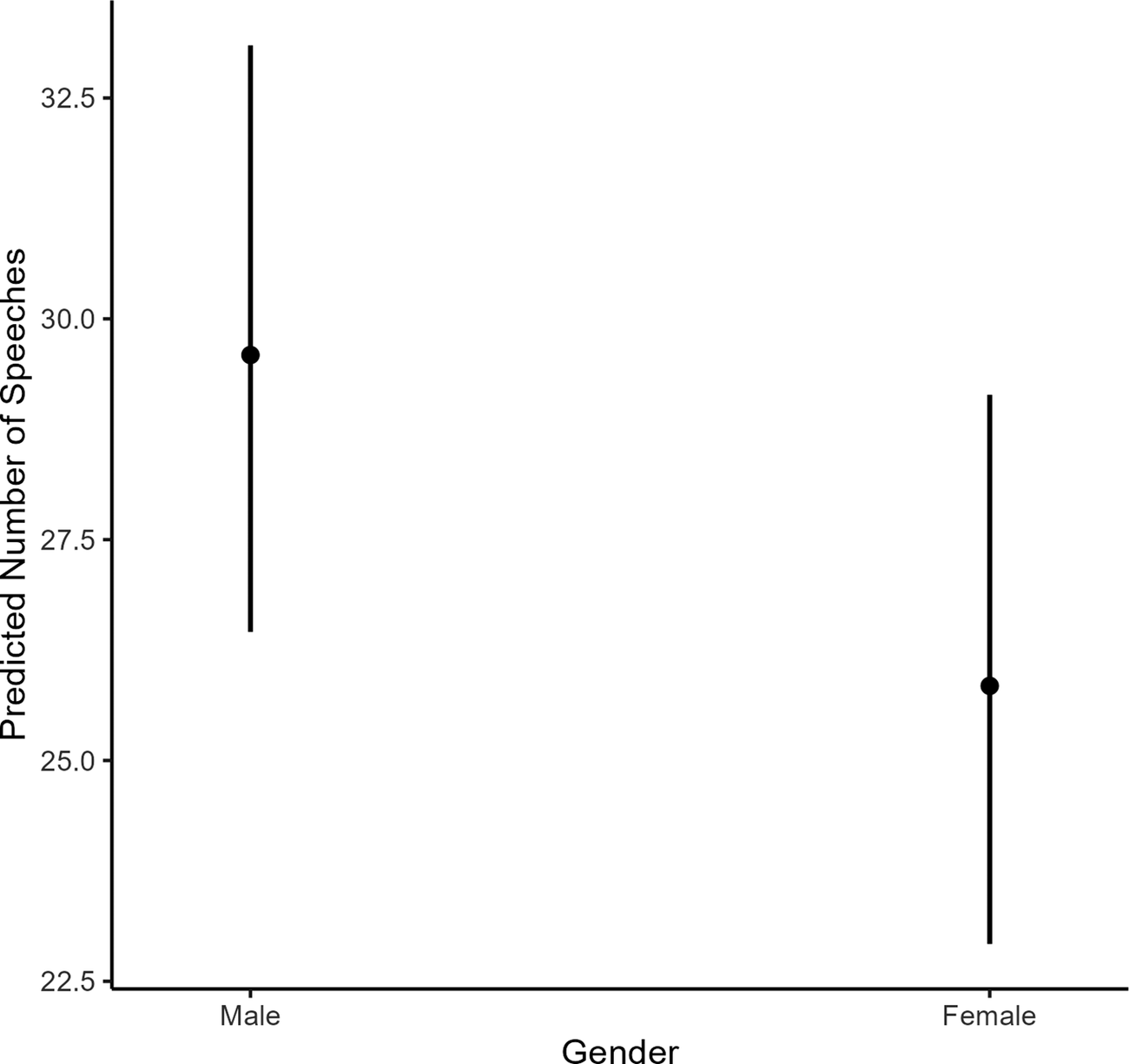
Starting with H1 (direct effect of gender), the results confirm the existence of gender bias in speechmaking in the South African Parliament, with male MPs speaking significantly more than their female counterparts (see Figure 3, and the Appendix, Table A9, Model 1). Hence, the case of South Africa aligns with trends observed in both comparative studies of European countries and single case studies with similar levels of women’s representation in parliament such as Sweden (Bäck and Debus Reference Bäck and Debus2019; Bäck, Debus, and Müller Reference Bäck, Debus and Müller2014; Blumenau Reference Blumenau2021; Sanjaume-Calvet et al. Reference Sanjaume-Calvet, Vallbé and Muñoz-Puig2023). However, it deviates from cases such as Uganda (Wang Reference Wang2014), Ghana (Sanches and Dias Reference Sanches, Dias, Bäck, Debus and Fernandes2021), and Malawi (Frantzeskakis, Wahman, and Yildirim Reference Frantzeskakis, Wahman, Yildirim, Bäck, Debus and Fernandes2021), where gender differences are weaker or non-existent. The contrasting findings, in studies using similar measures of speechmaking, are noteworthy as they indicate the need for more contextualized analysis to better understand the mechanisms behind these trends. For South Africa, these findings suggest that gender norms are not being challenged despite the fact that more women are entering the parliament.
The effect of gender on speech levels.
Note: The effect of gender is significant at p <0.05.

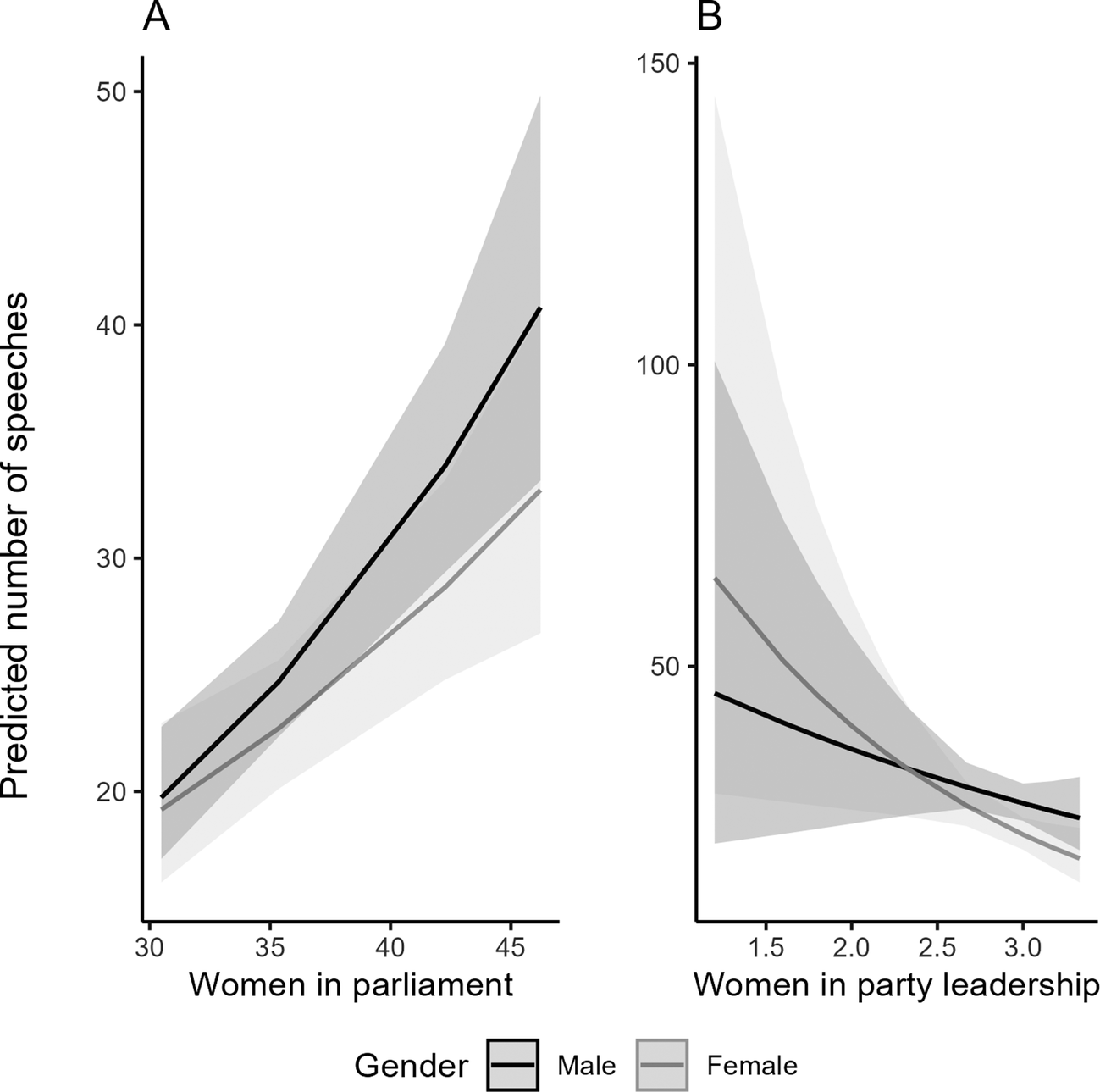
The access affect (H2) posits that gender bias in participation in debates is influenced by the level of feminization of parties and parliaments. The results partly confirm our expectations with only one of the two tested interactions attaining statistical significance (see Appendix, Table A9, Models 2 and 3). In fact, we do not find significant gender differences in the speech levels of MPs as the percentage of women increases in parliament (see Figure 4A); the increased feminization of the parliament raises speech levels for both male and female MPs. The increase is slightly higher for male MPs but is not significant as previously mentioned. In contrast, the share of women in the party leadership seems to play an important role in speech activity (see Figure 4B): female MPs speak significantly more than their male counterparts when the women in the party in national leadership are in the minority (1 = about 1%–15%). However, as the parties incorporate more women in party leadership (3 = large minority of about 26%–39%), women have fewer opportunities to speak in parliament. In fact, when the share of women in party leadership is more balanced (4 = balanced, about 40% or more), the pattern reverses with male MPs delivering more speeches than female MPs.
The effect of gender on speech levels, by the feminization of institutions.
Notes: The interaction between gender and women in party leadership is significant at p <0.01. Graph A is shown for clarity but the interaction between gender and the share of women in parliament is not significant.

Figure 4. Long description
A two-panel line graph with a shared y-axis labeled Predicted number of speeches and a bottom legend identifying Male as a black line and Female as a gray line, both with shaded confidence intervals.
Panel A
* The x-axis is labeled Women in parliament ranging from 30 to 45.
* Both genders show a positive linear increase in predicted speeches as the share of women in parliament increases.
* The Male line starts at approximately 20 and rises more steeply to about 41.
* The Female line starts slightly lower and rises to approximately 33.
Panel B
* The x-axis is labeled Women in party leadership ranging from 1.5 to 3.0.
* Both genders show a downward trend as leadership feminization increases.
* The Female line starts high at nearly 70 and drops sharply to below 20.
* The Male line starts lower at approximately 45 and declines more gradually to about 20, with the two lines intersecting at the 2.5 mark on the x-axis.
Taken together, the results do not support the view that gender outcomes become more equal when institutions are more feminized; in fact, increased feminization can either maintain or deepen existing gender bias. Similar findings observed in European countries have mainly been interpreted as the result of the backlash female MPs face within parliament from their male peers (Bäck and Debus Reference Bäck and Debus2019). However, what is distinctive in the South African case is that it is not so much the presence of women in parliament that makes a difference but rather their presence within national party structures (outside parliament). This echoes research on the South African parliament that points to a disconnect between access and voice, whereby women enter the parliament but are unable to voice their substantive views due to two-party control mechanisms: the selection of women who toe the party line, and the disciplining of more independent and vocal female MPs (Walsh Reference Walsh2011, Reference Walsh, Franceschet, Krook and Piscopo2012). Ultimately, these results call attention to the role of political parties, namely how they may constrain or incentivize women’s activities within parliament.
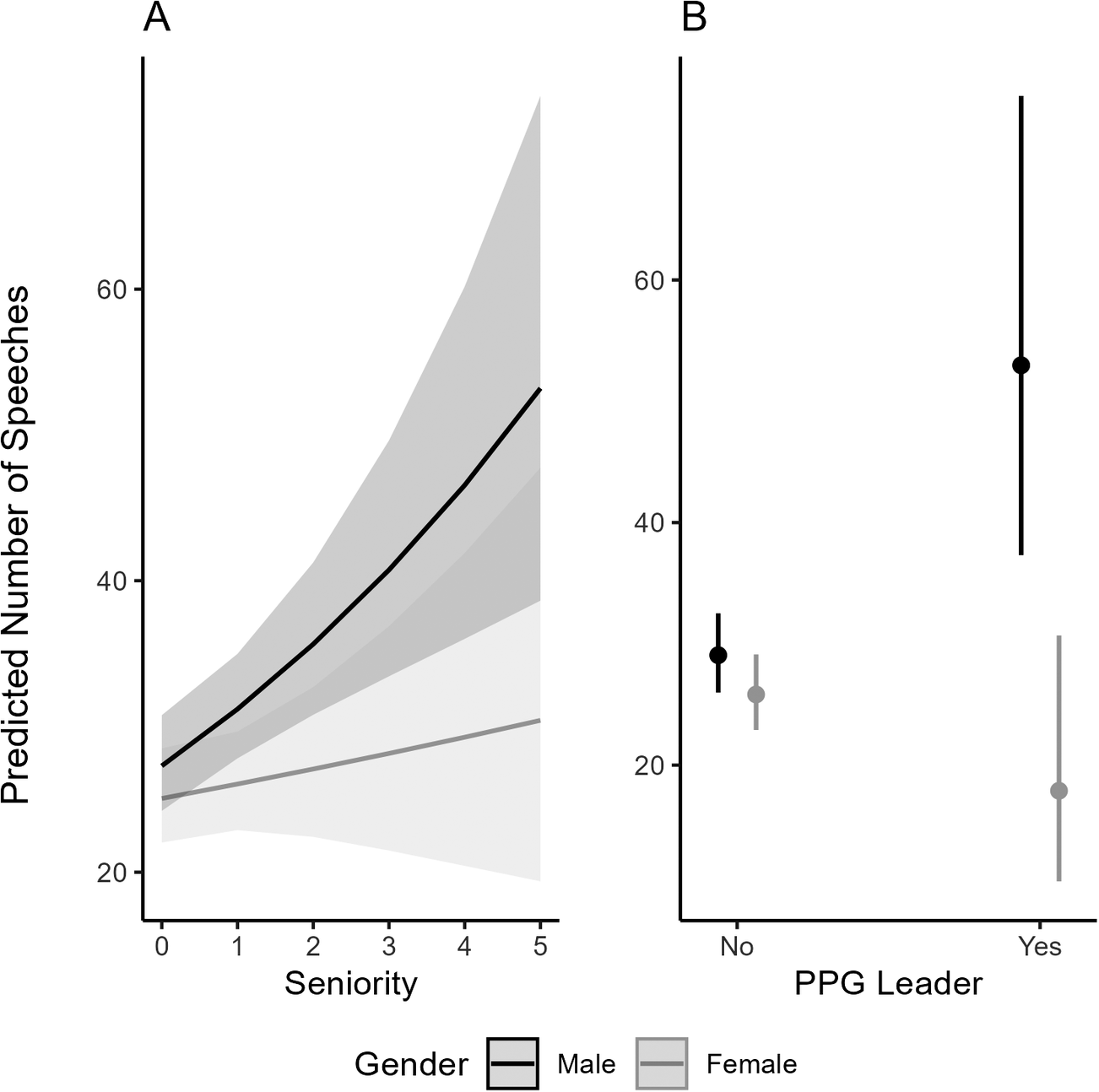
Finally, the career effect (H3) predicts that male and female MPs in positions of power—seniors and members of PPG leadership—will exhibit different levels of speechmaking, favoring the former. This hypothesis is partly confirmed since the interaction with gender is only significant for one of the career variables—being a PPG Leader (see Appendix, Table A10, Models 4 and 5). In Figure 5, we plot the two respective interactions. Female MPs in PPG leadership not only speak significantly less than their male peers in similar positions but also less than female MPs who do not hold such roles (see Figure 5B). While the results are not significant for seniority, the effect is the one we expected: male MPs tend to speak more than female MPs, as they become senior (see Figure 5A).
The effect of gender on speech levels, by MPs’ career level.
Notes: The interaction between gender and PPG Leader is significant at p <0.05. Graph C is shown for clarity but interaction between gender and seniority is not significant.

Figure 5. Long description
The image consists of two panels, A and B, sharing a common y-axis labeled Predicted Number of Speeches ranging from 20 to 60. A legend at the bottom identifies black lines and dots as Male and grey lines and dots as Female.
Panel A is a line graph with an x-axis labeled Seniority ranging from 0 to 5.
* The Male trend line starts at approximately 28 at seniority 0 and shows a steep upward curve reaching over 50 at seniority 5, with a wide shaded confidence interval.
* The Female trend line starts at approximately 25 at seniority 0 and shows a shallow linear increase reaching just under 30 at seniority 5, with a narrower shaded confidence interval.
Panel B is a point-range plot with an x-axis labeled P P G Leader with categories No and Yes.
* For No, the Male data point is at approximately 30 with a small vertical error bar, and the Female data point is slightly lower at approximately 26 with a similar error bar.
* For Yes, the Male data point rises significantly to approximately 53 with a very large vertical error bar extending from 38 to 75. The Female data point drops to approximately 18 with an error bar extending from 10 to 30.
The results we obtained for H3 suggest that career progression may act as a bonus for men but as a penalty for women, contrasting with findings from, for example, the Ugandan parliament, where women in positions of power speak more than any other group (Wang Reference Wang2014). As mentioned before, a possible explanation is that female MPs refrain from speaking when they are in leadership positions because they fear being agentic and, hence, not congruent with traditional gender roles as hypothesized by the congruity theory (Bäck and Debus Reference Bäck and Debus2019).
Although a more thorough analysis is required, an exploration of the literature on South Africa and a brief review of online media suggest that there may be a much more serious inhibiting factor for these women, namely violence against women in politics (Krook Reference Krook2020). Indeed, this violence may be acting as a highly effective deterrent for women holding prominent positions in South Africa’s parliament. For instance, in Makhunga’s (Reference Makhunga2015, 249) observation of plenary sessions in South Africa, she noted that women were regularly subject to “personalized attacks and exchanges.” She also referred to the fact that Lindiwe Mazibuko, at the time the PPG Leader of the DA, was the “proverbial punching bag of both the ANC and other opposition parties” (Ibid.) due to her leadership position. In an interview with the GuardianFootnote 6 following sexist comments about her hair and stature, Lindiwe Mazibuko said:
There’s certainly nothing nice about being treated that way in parliament but it strengthens my resolve to root out sexism in the house and also make sure I keep doing what I do to make sure a woman in a leadership position in a political party in parliament is no longer seen as some kind of aberration. It needs to be ground into dust.
Similarly, the online media search allowed us to find other ways in which several parties including the ANCFootnote 7 and the EFFFootnote 8 dismissed and disciplined women. For example, ANC MP Makhosi Khoza (elected in 5th parliament), who at the time was serving as chair of Parliament’s Portfolio Committee on Public Service and Administration, reported having received death threatsFootnote 9 for openly criticizing President Zuma’s administration and the party eventually removed her from the position.Footnote 10 In reaction to this, Makhosi Khoza accused the ANC of sexism:
We are tired of the bullies who do not understand the very instrument they are using to charge me, the ANC constitution …. There is a growing tendency to victimize women, because they assume we are weak and easily intimidated. They have entered the wrong movie.Footnote 11
Khoza later resigned from the ANC and launched a new party, the African Democratic Change. These are just some examples of the debate conditions in South Africa, but they are certainly not exclusive, as shown by research on gender and politics in other African countries (Madsen Reference Madsen2021).
Conclusion
This study has sought to analyze gender bias in speech levels by examining the extent to which it is shaped by the gender of the MPs (direct effect), the feminization of institutions (access effect), and MPs’ holding power positions in parliament (career effect). It follows a feminist institutional approach, which is based on the premise that institutions are gendered and that women entering politics are often hindered in ways that negatively affect their parliamentary work (Lovenduski Reference Lovenduski2005; Kantola and Agustín Reference Kantola and Rolandsen Agustín2019; Krook Reference Krook2016; Swers Reference Swers2005). The study focuses on the case of South Africa, a leading democracy in terms of women’s representation but one that is also marked by entrenched masculine norms. As such, it offers a compelling context for examining how open political institutions are to changes in their embedded gender norms over time, within a highly feminized setting. We arrive at three main findings, which are mostly in line with our expectations.
First, we find that female MPs speak less than their male peers, thus corroborating a significant research stream, including in contexts of high female representation in parliament (e.g. see Bäck, Debus, and Müller Reference Bäck, Debus and Müller2014, for the case of Sweden). The finding suggests that the strides made toward women’s representation have not yet resolved the unequal patriarchal gender relations that characterize the South African parliament (Makhunga Reference Makhunga2014).
Second, regarding the access effect, we observe a dampening effect in women’s speech levels that is associated with the feminization of parties rather than parliaments. Indeed, women speak less if they belong to a party with a larger share of women in the national leadership; however, the increased feminization of parliament has no effect. This finding is consistent with previous research on South Africa that highlights the role of parties in sustaining gender bias. In fact, the ruling party uses control mechanisms (candidate selection, job assignment, and discipline) to hamper women’s ability to take the floor (Walsh Reference Walsh2011, Reference Walsh, Franceschet, Krook and Piscopo2012). Adding to this, a wide array of institutions, including those seemingly committed to gender issues, are captured and repurposed by the state so as to sustain existing patriarchal rules (Gouws Reference Gouws and Madsen2021, Reference Gouws and Gouws2022; Makhunga Reference Makhunga2014, Reference Makhunga2015; Walsh Reference Walsh2011, Reference Walsh, Franceschet, Krook and Piscopo2012).
Finally, we observe a gendered career effect whereby male MPs benefit from greater access to the floor when they occupy positions of power, whereas women do not. While seniority is less determinant, it is still in keeping with the hypothesized behavior: as seniority increases, male MPs increasingly speak more than their female counterparts. On the other hand, being a PPG leader emerges as a key asset in the South African parliament, but only for male MPs. Indeed, female MPs in PPG leadership have no bonus in terms of floor access; on the contrary and in contrast to male MPs in the PPG leadership, they are the least represented group in debates. A better understanding of this entails going beyond formal institutional approaches; it is necessary to observe the informal mechanisms that continue to shape the rules of the game within the South African parliament.
One line of inquiry would be to examine the inner functioning of the PPG Leaderships as these institutions help shed light on gender biases within parliaments; we show this in the case of South Africa but it also matters elsewhere (Ahrens and Meier Reference Ahrens and Meier2024). Another line of inquiry involves exploring the mechanisms of career progression. For example, the careers of female MPs in the ANC are not only tied to the political party but also to the ANCWL, which is seen as an important gatekeeper both in women’s access to careers and in assuring that women’s behavior aligns with the party stances once in parliament (Hassim Reference Hassim2014; Makhunga Reference Makhunga2014). This institution is therefore heavily implicated in the unequal patriarchal relationships that mark the South African parliament (Hassim Reference Hassim2014; Makhunga Reference Makhunga2014). While we know much less about how this plays out within the main opposition parties, the results indicate the need to further pursue this line of inquiry.
Conducting this investigation in the case of South Africa revealed that the increased feminization of institutions and presence of women in position in powers are not enough to revert culturally entrenched biases against women. In fact, feminization and the appointment of women to powerful positions are even associated with higher levels of gender bias in speechmaking. These patterns may reflect the serious backlashes and stigmatization faced by women in parliament, as demonstrated by research and the difficult personal histories of female MPs in South Africa; on the other hand, they may also be related to how women adjust their roles (being less agentic) and prioritize tasks in parliament once they have more representation. Disentangling the mechanisms at play undoubtedly requires further examination and qualitative data.
On the theoretical front, the findings have implications beyond South Africa, namely for countries with high representation of women in parliament and strong party control over who takes the floor. Overall, the study’s findings highlight the need to go beyond the politics of presence and to make a thorough analysis of the mechanisms that hinder women from performing their roles to the full, even when occupying positions of power. For instance, adopting a Gendered Workplace Approach (Erikson and Josefsson Reference Erikson and Josefsson2021; Erikson and Verge Reference Erikson and Verge2022) may offer valuable insights as it focuses on the informal mechanisms that shape institutional behavior. This is not to say that a high level of feminization in parliaments and parties, and placing women in powerful positions, is not absolutely necessary and a sine qua non condition for gender equality in politics. Not at all. It is simply a recognition that changing embedded norms and practices requires additional—and likely proactive—complementary strategies. For example, the violence against women in politics and its impact on their behavior and careers is an issue that warrants further study and regulation.
On the empirical front, we note some caveats, namely that other personal characteristics (e.g. age, education, occupation) and career-level variables (committee membership and party positions) should have been included in our analysis; however, these were either limited or completely absent at the time of writing. Finally, more qualitative work should be conducted, including semi-structured interviews and participant observation. Qualitative work would shed light on the inner motivations that make women more prone to speaking or shying away from speechmaking, help clarify the impact of women’s speech contributions, and how the parliamentary work environment shapes their behavior.
Supplementary material
The supplementary material for this article can be found at http://doi.org/10.1017/S1743923X25100494.
Acknowledgements
The authors are grateful to three anonymous reviewers and the Editor Mona Lena Krook for the careful reading of our paper and for the excellent feedback provided. Thanks are also owed to Yani Kartalis for data collection and preparation; and to all those who offered valuable comments to prior iterations of this paper in particular, João Cancela, Vicente Valentim, António Valentim and Nelson Santos. This work was conducted under the framework of the project “How Members of Parliament in Africa Represent their Constituencies (HOME),” funded by the Portuguese Foundation for Science and Technology, Ref. PTDC/CPO/4796/2020 (https://doi.org/10.54499/PTDC/CPO-CPO/4796/2020).