




1. Background, motivation and goals
The paradigm of biologically inspired design espouses the use of biological systems as analogues for inspiring the design of technological systems as well as standards for evaluation of designs (French Reference French1994; Benyus Reference Benyus1997; Vogel Reference Vogel2000; Vincent & Mann Reference Vincent and Mann2002; Turner Reference Turner2007; Bhushan Reference Bhushan2009; Gebeshuber, Gruber & Drack Reference Gebeshuber, Gruber and Drack2009; von Gleich et al. Reference von Gleich, Pade, Petschow and Pissarskoi2010; Bar-Cohen Reference Bar-Cohen2011). Although nature has inspired many a designer in history, including Sushruta in ancient India, Leonardo da Vinci in renaissance Italy, and the Wright brothers in modern America, over the last generation, the paradigm has evolved into a design movement. This transformation is pushed by the perennial desire for creativity in design (e.g., Vincent et al. Reference Vincent, Bogatyreva, Bogatyrev, Bowyer and Pahl2006; Baumeister et al. Reference Baumeister, Tocke, Dwyer, Ritter and Benyus2012) and pulled by the growing need for environmentally sustainable designs (e.g., Benyus Reference Benyus1997; Vincent & Mann Reference Vincent and Mann2002). The revolution is manifested through an exponentially expanding literature including both patents (Bonser & Vincent Reference Bonser and Vincent2007) and publications (Lepora, Verschure & Prescott Reference Lepora, Verschure and Prescott2013).
However, despite the proliferation of the literature, our understanding of biologically inspired design remains modest. For example, much of the literature on biologically inspired design makes several, often unstated and largely unexamined, assumptions: that the design process is independent of the domain as well as the scale of the biological source of inspiration (e.g., Benyus Reference Benyus1997; Vincent & Mann Reference Vincent and Mann2002; Vincent et al. Reference Vincent, Bogatyreva, Bogatyrev, Bowyer and Pahl2006; Baumeister et al. Reference Baumeister, Tocke, Dwyer, Ritter and Benyus2012; Goel et al. Reference Goel, Tuchez, Hancock and Fraser2016c); that the process results in designs that are efficient or multifunctional or both (Benyus Reference Benyus1997; Vincent & Mann Reference Vincent and Mann2002; Vincent et al. Reference Vincent, Bogatyreva, Bogatyrev, Bowyer and Pahl2006; Baumeister et al. Reference Baumeister, Tocke, Dwyer, Ritter and Benyus2012; Goel et al. Reference Goel, Hancock, Fraser and Tuchez2016b; Svendsen & Lenau Reference Svendsen and Lenau2019); that it leads to design fixation (e.g., Fu et al. Reference Fu, Moreno, Yang and Wood2014); and that it produces designs that more creative or more sustainable or both (as indicated in the above paragraph). But are these assumptions valid? And if the assumptions indeed are valid in some design contexts, then what conditions circumscribe their validity? In this paper, we look at two of these assumptions in detail – domain independence and multifunctionality of biologically inspired design – although we will also briefly consider three of the other assumptions – sustainability, scale independence and design fixation.
Answering these questions about biologically inspired design is important from several perspectives: theoretical, pedagogical as well as technological. From the theoretical perspective, a strong information-processing theory of biologically inspired design should not only make its assumptions explicit, but it should also capture both the generality of the design process as well as its specializations under different contexts, conditions and contingencies. From the viewpoint of pedagogy, effective teaching of the paradigm of biologically inspired design entails learning not only about its true power, but also its characteristics and limitations under different conditions. Finally, from the vantage of technology, effective computational tools for supporting biologically inspired design in practice should provide different kinds of supports for different kinds of design contexts.
However, examining the assumptions of biologically inspired design is fraught with methodological issues. An obvious way of examining the validity of these assumptions is to analyse case studies of biologically inspired design. Unfortunately, there exists no complete or exhaustive library of biologically inspired design case studies, and the libraries that do exist often contain information that is too anecdotal to be reliable and/or too sparse to be analysable. Analysis of small libraries is prone to manifest the well-known selection bias in which the sample under study is not representative of the whole population of case studies. These methodological issues notwithstanding, we posit that it is important to conduct meta-analysis on well-documented libraries, while also qualifying any conclusions based on the analysis because of the sample size and selection bias.
In a previous meta-analysis of biologically inspired design, Vattam, Helms & Goel (Reference Vattam, Helms and Goel2007) analysed 77 case studies of biologically inspired design. The case studies in that research were taken mostly from the design literature without well-defined criteria. Nevertheless, the previous work resulted in several findings that are now commonly accepted in the design research community. For example, the previous study established that biologically inspired design is characterized by two core design methods (Helms, Vattam & Goel Reference Helms, Vattam and Goel2009): The problem-driven process starts with a target design problem, finds a biological source case relevant to the problem and then transfers selected design knowledge from the source case to the target problem; and the solution-based process begins with a biological source case, finds a target design problem the source case can help address and then transfers design knowledge from the source case to the target problem.
In this paper, we describe a new meta-analysis of 83 case studies of biologically inspired design organized in the Design Study Library (DSL; Goel et al. Reference Goel, Zhang, Wiltgen, Zhang, Vattam and Yen2015). The case studies were collected over 2006–2013 from extended collaborative projects in a senior-level interdisciplinary class at the Georgia Institute of Technology (Georgia Tech). The paper is organized as follows. In Section 2, we summarize related research relevant to our work. We also characterize the meaning of ‘domains’ of biologically inspired design as well as the assumptions of domain-independence, scale-independence and multifunctionality of biologically inspired design processes. In Section 3, we provide a brief overview of the DSL, illustrate two case studies from the digital library and present a brief summary of prior analysis of the environmental sustainability of the case studies in the library. Whereas Section 4 presents a high-level analysis of the case studies in the DSL, Section 5 presents a detailed analysis of the domain and scale independence of the case studies in the DSL, and Section 6 presents a detailed analysis of the multifunctionality and design fixation in the DSL case studies. In Section 7, we discuss the current work from a methodological perspective, describe its limitations and indicate directions for future work. Section 8 draws preliminary conclusions from this study.
2. Biologically inspired design
The growth of biologically inspired design movement has led to a proliferation of information-processing theories, pedagogical techniques and computational tools supporting its practice.
2.1. Information-processing theories
Some information-processing theories of biologically inspired design are descriptive. Design Spiral (Baumeister et al. Reference Baumeister, Tocke, Dwyer, Ritter and Benyus2012), for example, derives from observations of biologically inspired design in practice. Shu et al. (Reference Shu, Ueda, Chiu and Cheong2011) provide an alternative descriptive account. Some theories are normative: BioTRIZ (Vincent et al. Reference Vincent, Bogatyreva, Bogatyrev, Bowyer and Pahl2006), for example, applies the well-known TRIZ design methodology (Altshuller Reference Altshuller1984) to biologically inspired design; Nagel & Stone (Reference Nagel and Stone2010) provide an alternative normative method. Some theories are explanatory in that they provide a decomposition of the design task, characterize the observed behaviours in terms of information processing and show how the information processing composes the subtasks into accomplishing the high-level task. Chakrabarti and colleague’s GEMS model (Srinivasan & Chakrabarti’s Reference Srinivasan and Chakrabarti2010) and Goel et al.’s (Reference Goel, Vattam, Wiltgen, Helms, Goel, MaAdams and Stone2014b) task model are examples of explanatory theories of observed biologically inspired design practices. As noted in the introduction, Helms, Vattam & Goel (Reference Helms, Vattam and Goel2009) identified two fundamental processes of biologically inspired design: problem-driven design and solution-based design. Goel, McAdams & Stone (Reference Goel, McAdams and Stone2014a) provide a recent anthology of several information-processing theories of biologically inspired design; Fayemi et al. (Reference Fayemi, Wanieck, Zollfrank, Maranzana and Aoussat2017) provide a recent review from a different perspective. A reading of these papers indicates that these descriptive, normative and explanatory theories assume, if only implicitly, that the process of biologically inspired design is both domain-independent and scale-independent, and that it results in more multifunctional designs.
2.2. Pedagogical techniques
Many educational programs around the world offer opportunities for learning about biologically inspired design. In the United States, for example, Arizona State University offers a variety of courses and programs on biomimicry for professional and student designers (http://biomimicry.asu.edu/). The University of Akron (https://www.uakron.edu/bric/) and James Madison University (Nagel, Nagel & Eggermont Reference Nagel, Nagel and Eggermont2013; Pidaparti et al. Reference Pidaparti, Graceraj, Nagel and Rose2020), among several other universities, offer sequences of courses in biologically inspired design (https://www.uakron.edu/bric). Georgia Tech too offers a sequence of undergraduate courses that leads to a certificate in biologically inspired design (http://www.cbid.gatech.edu/). Arizona State University’s educational programs generally use the Design Spiral (Baumeister et al. Reference Baumeister, Tocke, Dwyer, Ritter and Benyus2012) as the design methodology as do the University of Akron’s courses. James Madison University’s courses are based on the Functional Basis model (Stone & Wood Reference Stone and Wood2000) and the C-K theory (Hatchuel & Weil Reference Hatchuel and Weil2009) of design. Goel et al.’s (Reference Goel, Vattam, Wiltgen, Helms, Goel, MaAdams and Stone2014b) task model both derives from cognitive analyses of design practices in the Georgia Tech ME/ISyE/MSE/PTFe/BIOL 4740 course on biologically inspired design and has influenced the teaching in the class (Yen et al. Reference Yen, Weissburg, Helms, Goel and Bar-Cohen2011, Reference Yen, Helms, Goel, Tovey, Weissburg, Goel, McAdams and Stone2014). These pedagogical techniques make the same assumptions about the domain independence and multifunctionality of biologically inspired design.
2.3. Computational tools
Many computational tools are now available for supporting biologically inspired design. For example, the Biomimicry Institute’s pioneering, popular, free and public AskNature web portal provides access to a functionally indexed digital library of textual and visual descriptions of biological systems (Deldin & Schuknecht Reference Deldin, Schuknecht, Goel, McAdams and Stone2014; AskNature 2021). IDEA-INSPIRE (Chakrabarti et al. Reference Chakrabarti, Siddharth, Dinakar, Panda, Palegar and Keshwani2017) and the free and public Design by Analogy to Nature Engine (DANE; Goel et al. Reference Goel, Vattam, Wiltgen and Helms2012; Design by Analogy to Nature Engine 2021) provide access to functionally indexed digital libraries of multimodal structured representations of biological and technological systems. Vincent et al. (Reference Vincent, Bogatyreva, Bogatyrev, Bowyer and Pahl2006) developed BioTRIZ, a biomimetic version of the famous TRIZ system for supporting engineering design (Altshuller Reference Altshuller1984). Nagel (Reference Nagel, Goel, McAdams and Stone2014) has developed a thesaurus for mapping functions from engineering to biology. Goel et al. (Reference Goel, Anderson and Belknap2016a) have used IBM’s Watson cognitive system (Ferrucci et al. Reference Ferrucci, Brown, Chu-Carroll, Fan, Gondek, Kalyanpur, Lally, Murdock, Nyberg, Prager, Schlaefer and Welty2010) as a research assistant for biologically inspired design. Wanieck et al. (Reference Wanieck, Fayemi, Maranzana, Zollfrank and Jacobs2017) provide a recent review of computational tools for biologically inspired design. Again, these computational tools assume the domain independence (and scale independence) of biologically inspired design in that the tools are uniform across different domains and scales.
2.4. Domains of biologically inspired design
Before we go further, we need to characterize what we mean by scale and domain independence of biologically inspired design. Biological phenomena occur at scales ranging from nanometres to megametres, and from nanoseconds to gigaannums. Similarly, biological phenomena occur in a variety of domains ranging from bacteria to archaea to eukaryotes. To be specific, let us consider Weiler & Goel’s (Reference Weiler and Goel2015) experimental design of a mechanical device for harvesting water from fog inspired in part by the design of mitochondria. There are two scales of interest here: (i) the scale of mitochondria (micrometre) and (ii) the scale of the mechanical device (metre). In this paper, we are interested in the scale of the biological phenomenon (mitochondria in this example). Thus, by scale independence, we mean independent of the scale of the biological source of inspiration.
Similarly, there are two domains in biologically inspired design: the domain of the biological phenomenon (mitochondria in this example) and the domain of the design problem (a mechanical device for water harvesting). As with scale, in this paper, we are interested in the domain of the biological source of inspiration. We note that this focus on biological domains is different from that common in architecture (which talks of, say, building architecture and landscape architecture) or prevalent in engineering (which talks of, say, civil engineering and mechanical engineering, or of automotive engineering within mechanical engineering). To be precise about the meaning of a domain, we adopt the epistemic characterization of a domain common in the AI literature on design (e.g., Brown & Chandrasekaran Reference Brown and Chandrasekaran1989; Chandrasekaran Reference Chandrasekaran1990; Chandrasekaran, Josephson & Benjamins Reference Chandrasekaran, Josephson and Benjamins1999; Dym & Brown Reference Dym and Brown2012): A domain is characterized by knowledge of the kinds of objects, relations and causal processes that occur in it. Thus, various biological domains, such as, say, sensory organs and physiological systems, are characterized by knowledge of the different kinds of objects, relations and processes that occur in them. The question then becomes: Are the processes of biologically inspired design are independent of biological domains?
2.5. Multifunctionality of biologically inspired design
Our characterization of multifunctionality too builds on the design literature. Suh (Reference Suh2001) characterizes multifunctional design as a design with multiple intended independent functions. Both intention and independence are important: The multiple functions need to be intrinsic to the design (not ascribed by a user) as well as orthogonal to one another (not subfunctions). Generation of multifunctional designs is both much desired and very difficult to achieve (Hubka & Eder Reference Hubka and Eder1987; Pahl, Beitz & Wallace Reference Pahl, Beitz and Wallace1996).
In the context of biologically inspired design, we need to add another dimension to the above characterization. Suh’s axiomatic theory pertains to original design in which all the intended independent functions are designed from first principles. As an example, from the DSL itself, consider the case study of designing a surfboard to deter shark attacks (Helms, Vattam & Goel Reference Helms, Vattam and Goel2008). By Suh’s definition, the surfboard design is multifunctional: It is streamlined for moving quickly through water, and it also deters sharks. However, the basic design of the surfboard already exists; biological inspiration in the case study (the snapping claw of a pistol shrimp) is used for only one function (scaring sharks away). Therefore, we do not view this as an example of biological inspiration resulting in a multifunctional design. From the perspective of studying the information processing in biologically inspired design, we characterize a design process as resulting in a multifunctional design only if it transfers more than one function from a biological analogue to a technological system. The question here is whether the processes of biologically inspired design result in the transfer of multiple functions from the biological source case to the target design problem.
3. The Design Study Library
The DSL is a web-based, interactive library of 83 case studies of biologically inspired design (Goel et al. Reference Goel, Zhang, Wiltgen, Zhang, Vattam and Yen2015). Each case study in the DSL consists of one or more documents describing a design project, and is indexed by Function, Structure, Domain Principle and Operating Environment; the Operating Environment here refers to the external environment in which the device is intended to operate. The DSL supports multiple methods for users to access these documents.
All 83 case studies in the DSL come from open-ended extended collaborative design projects from 2006 to 2013 in the Georgia Tech ME/ISyE/MSE/PTFe/BIOL 4740 class. This is a yearly, interdisciplinary, project-based class taken mostly by senior-level students. During 2006–2013, the class was co-taught jointly by various biology, engineering and design faculties led by Professor Jeannette Yen in Georgia Tech’s School of Biological Sciences. During these years, the classes were composed of students from a variety of other science and engineering disciplines. The precise composition of the class varied from year to year, but, in general, the class consisted of a majority of engineers.
In the Georgia Tech ME/ISyE/MSE/PTFe/BIOL 4740 class, students typically work in teams of 4–5 on extended, open-ended, self-selected design projects. Instructors ensure that each team has at least one student majoring in biology and a few from different engineering and other design disciplines. Each team develops a conceptual design that can address a technical problem based on one or more biological analogues. Each team has one or more faculty mentors. During 2 years from 2006 to 2013, students in the class were encouraged to follow the process of solution-based design; in other years, they were free to select the process of their choice, problem-driven design or solution-based design. The advantage of self-selected projects from our perspective is that they cover a wider range of design problems, domains and processes. Yen et al. (Reference Yen, Weissburg, Helms, Goel and Bar-Cohen2011) discuss the pedagogical challenges in teaching the class; Yen et al. (Reference Yen, Helms, Goel, Tovey, Weissburg, Goel, McAdams and Stone2014) trace the evolution of the class from 2006 to 2012. As we mentioned earlier, Vattam, Helms & Goel (Reference Vattam, Helms and Goel2007) previously analysed 77 case studies of biologically inspired design. While 60 of the case studies in the previous meta-analysis were reported in the design literature, 17 were taken from the same Georgia Tech ME/ISyE/MSE/PTFe/BIOL 4740 course and are now also a part of the DSL digital library.
Preliminary analysis of the original 83 case studies in the DSL showed nine to be incomplete, because they were not well documented, and thus we removed them from further analysis, leaving 74 cases for detailed analysis.
3.1. Two illustrative examples from the DSL
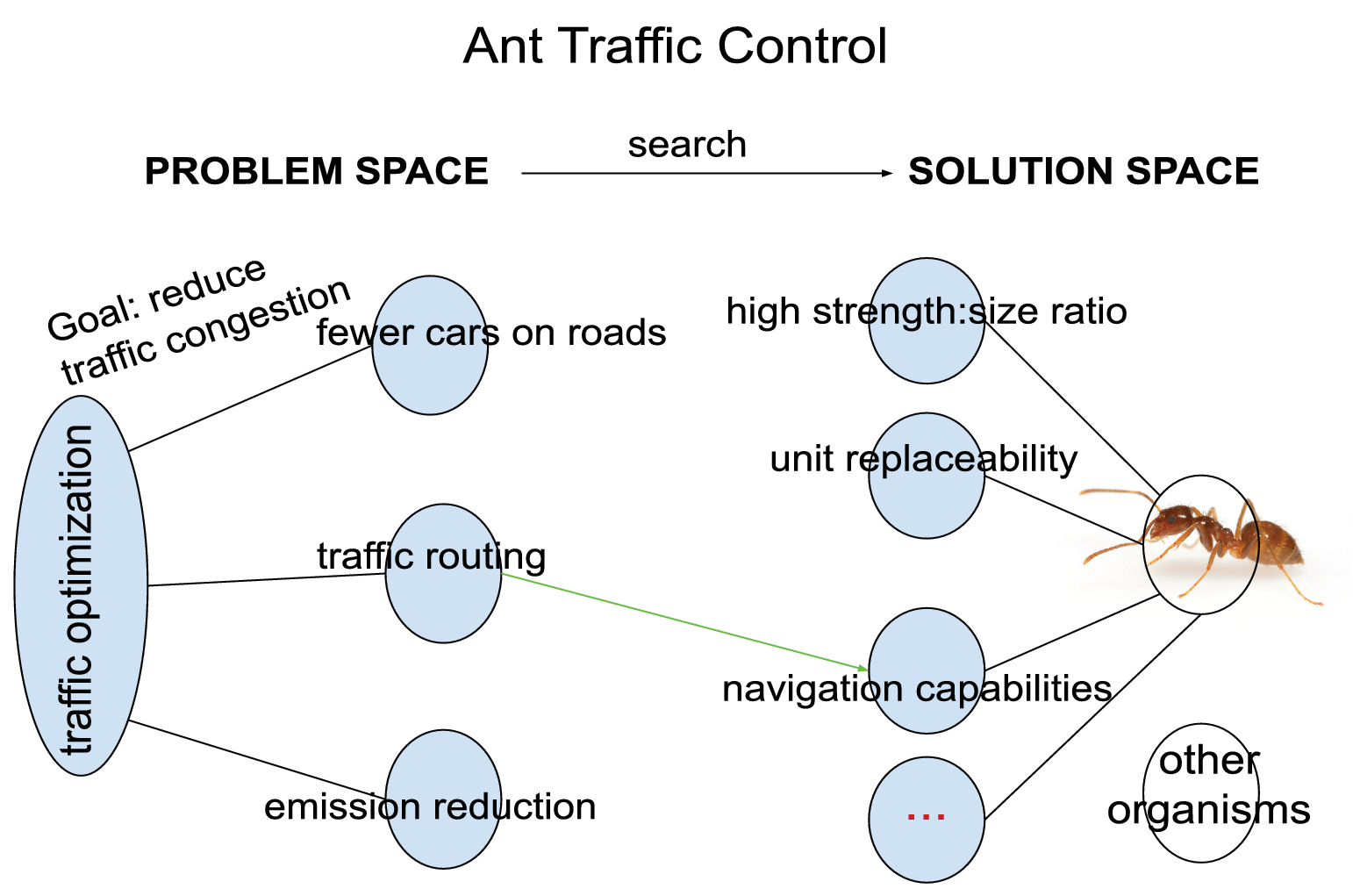
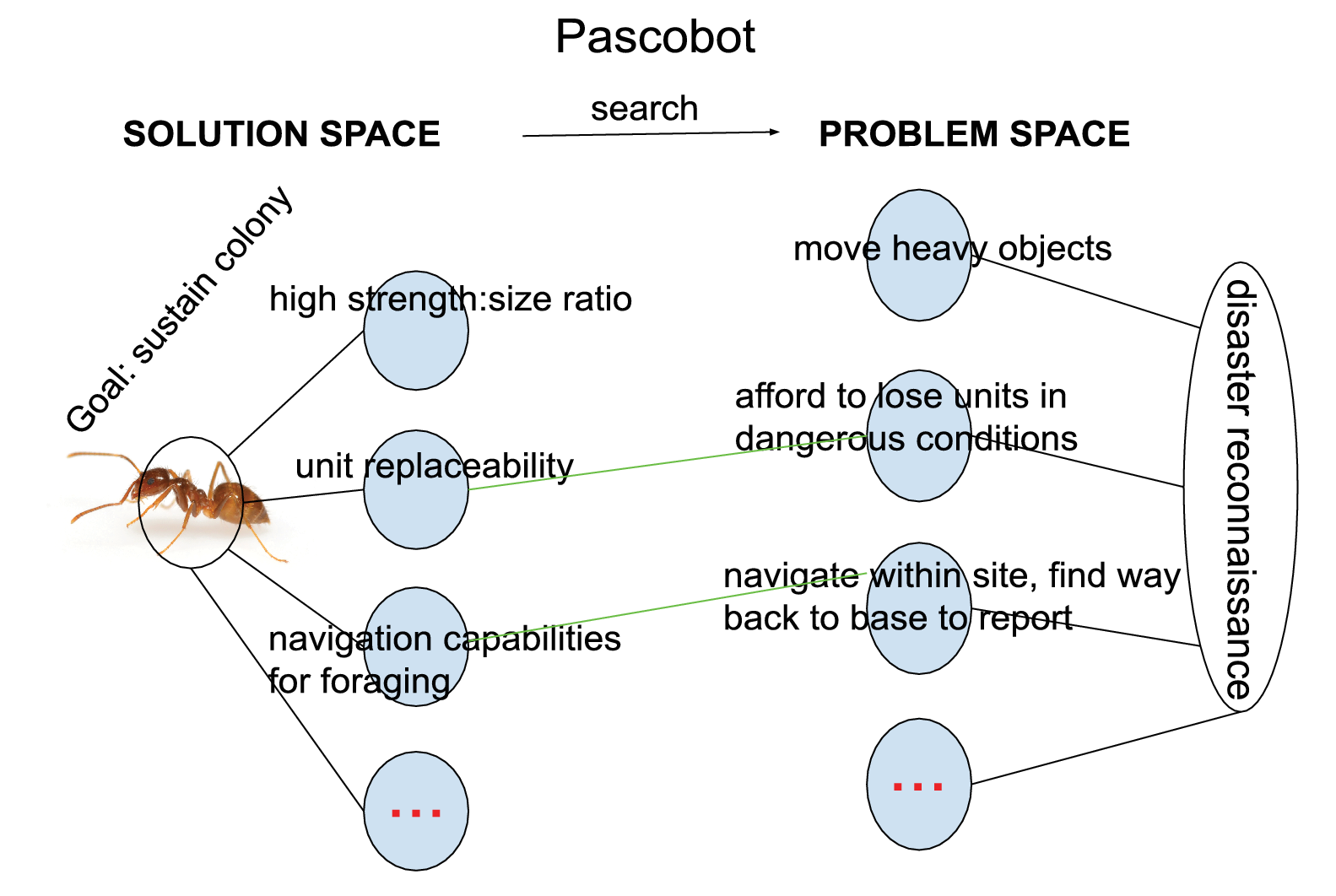
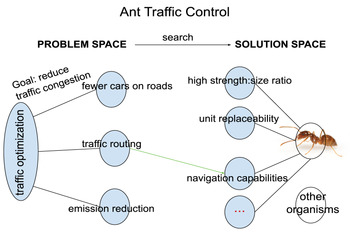
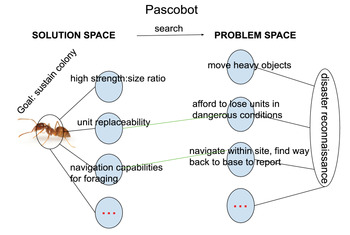
Figures 1 and 2 illustrate two case studies from the DSL: ‘Ant Traffic Control’ and ‘Pascobot’. We chose these two case studies for illustration here, because both are focused on designs inspired by ants, but while ‘Ant Traffic Control’ is an example of the process of problem-driven design, ‘Pascobot’ exemplifies the solution-based design process. Furthermore, while the latter is an example of a multifunctional design, the former does not result in a biologically inspired multifunctional design.
An example of problem-driven design. The green line between the problem space and the solution space indicates the function that is transferred from the former to the latter; the single green line indicates that this is not an example of multifunctional design.
An example of solution-based design. As in Figure 1, the green lines between the problem space and the solution space indicate the functions that are transferred from the former to the latter; the two green lines indicate that this is an example of multifunctional design. It should be noted that both ants as well as the proposed robot have the capability to move heavy objects. However, our analysis did not consider this as a transferred function, because the design document did not explicitly mention this function transfer.
The first project, ‘Ant Traffic Control’ illustrated in Figure 1, aims to optimize traffic flow by using ideas from swarm navigation behaviours of some ant colonies. As documented in the design report, the design process in this project is problem-driven, because the designers lead with an initial investigation of the problem and an overview of possible biological organisms that address it. The design solution is based on the insight that carbon dioxide concentrations can be treated similarly to pheromones: While ants detect high concentrations of pheromones to navigate, vehicles might do the same with carbon dioxide. Local vehicle routing may then avoid high levels of carbon dioxide, and thus reduce traffic congestion. The proposed design results in the transfer of only one function from the biological design – ant navigation – to the design solution.
The second case, ‘Pascobot’ illustrated in Figure 2, provides a study on building a disaster reconnaissance robot inspired by ants. The project aims to create a robot that can search disaster sites and perform reconnaissance. The design process in the project is solution-based due to its initial analysis of desert ants, Cataglyphis, and their abilities. The ‘Pascobot’ project transfers two functions from biological systems to the design solution, swarm navigation as well as replaceability of individual units, and thus is an example of a biologically inspired multifunctional design. The accompanying design report is explicit about the transfer of multiple functions: (i) ‘Which comes from each individual unit being almost disposable, yet capable of being reused several times; deploying hundreds of cheap robots would cover more ground than two or three expensive robots’; and (ii) ‘by mimicking the ants’ cheap and fast navigation techniques and behaviours, we can quickly and effectively deploy a system to collect large amount of information’.
3.2. Prior analysis of the DSL
Prior analysis of the case studies in the DSL pertained to the relationship between biologically inspired design and environmental sustainability. Goel et al. (Reference Goel, Zhang, Wiltgen, Zhang, Vattam and Yen2015) found the design reports in the case studies mentioned environmental sustainability as an explicit goal of about one-fourth of the case studies; they called this intentional sustainability, because the designers specifically noted sustainability as a design requirement in their reports. As an example, the documentation for the case study ‘Seal Skin Passive Heat Flow System’ states: ‘The criteria for determining ideal materials for each application included numerous data inputs: unit cost, …, sustainability, …’. From the designers’ perspective, the resulting design accomplishes this goal: ‘Our system is designed to work in conjunction with existing systems to reduce power consumption’.
Goel et al. (Reference Goel, Zhang, Wiltgen, Zhang, Vattam and Yen2015) also found that in some case studies, although sustainability was not an explicitly noted initial design requirement, the designers’ detailed analyses indicated that the designs would be more sustainable than conventional designs noted in the design reports. As an example, the design ‘Fog Collection System (FoCoS)’ aims to build a localized water collection system in areas with low rainfall but high humidity. The design report for the FoCoS study states: ‘The surrounding villages lack unified systems for water provision, and most potable water is delivered on trucks’. The design analysis indicated that localized collection would forgo transport requirements and thereby require less fossil fuel consumption; thus, we deemed this design to be serendipitously sustainable. Goel et al. (Reference Goel, Zhang, Wiltgen, Zhang, Vattam and Yen2015) found this kind of serendipitous sustainability – in which sustainability was not an explicit design goal at the start of the design process, but the process resulted designs that environmental impact analysis showed to be more sustainable that currently available designs – in about 8% of the case studies. Taking this kind of serendipitous sustainability into account, sustainability was a factor in about one-third of the case studies.
In the present meta-analysis, neither ‘Ant Traffic Control’ (Figure 1) nor ‘Pascobot’ (Figure 2) was deemed to be either intentionally or serendipitously sustainable. The goal of ‘Ant Traffic Control’ was to reduce traffic congestion that merely resulted in lower travel time and not necessarily fewer cars on the road. The ‘Pascobot’ study did not consider sustainability either in its goal to perform disaster site reconnaissance or in its analysis of the design. Thus, we did not deem this to be an intentional or a serendipitous case of sustainability.
4. High-level analysis of the case studies in the DSL
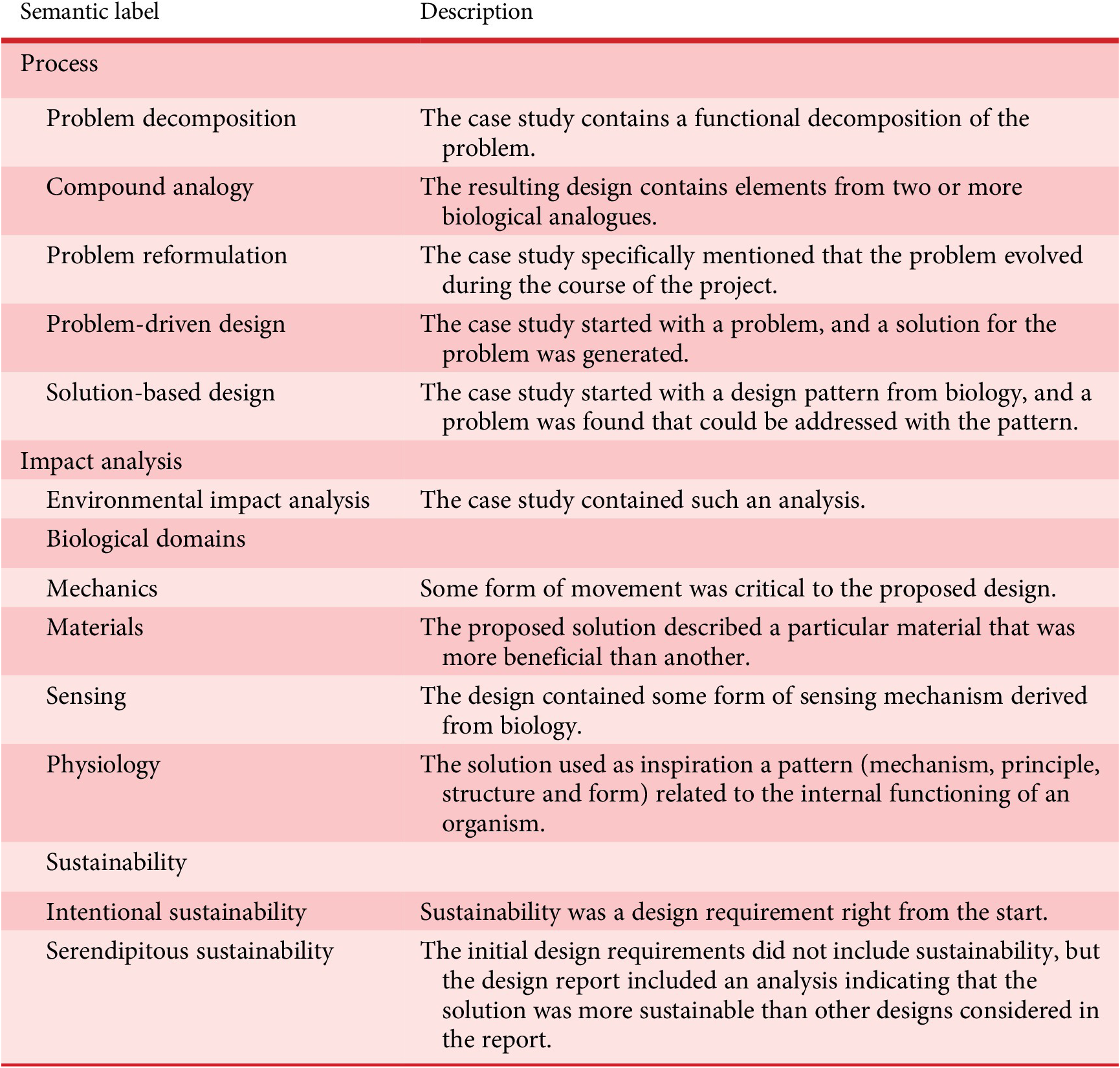
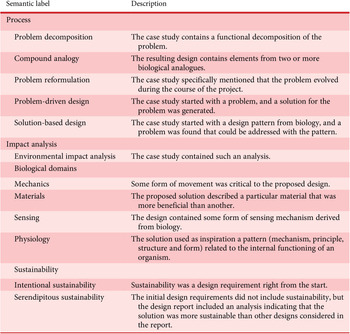
Our analysis of the domain independence of biologically inspired design makes use of a dozen categories for classifying the case studies in the DSL in addition to Function, Structure, Principle and Operating Environment that apply to all 74 case studies. First, five labels were obtained from Goel et al.’s (Reference Goel, Vattam, Wiltgen, Helms, Goel, MaAdams and Stone2014b) task model of biologically inspired design: problem decomposition, compound analogy, problem reformulation, problem-driven design and solution-based design. These labels are not independent of one another, and thus one project may be tagged by more than one. Second, cases that contained ‘environmental impact analysis’ were tagged as such. Third, four labels for classifying biological domains were prescribed to the class by the instructors of the Georgia Tech ME/ISyE/MSE/PTFe/BIOL 4740 course: physiology, mechanics, materials and sensing. While the domains of mechanics, materials and sensing are straightforward, we note that ‘physiology’ is a broad domain: ‘Physiology’ here covers the form, structure, principle or mechanism of the functioning of a biological organism. Finally, the DSL case studies were classified and labelled as ‘intentionally sustainable’ or ‘serendipitously sustainable’. Table 1 provides brief characterizations of the 12 categories including the four domains.
Description of the semantic labels on the case studies
The coding of the case studies in the DSL was done by two researchers in our laboratory. As an example, consider the label ‘materials’. The case study ‘Shell Phone’ was labelled as ‘materials’. This design project aimed to construct a case for a mobile phone that could withstand impacts from drops. The project considered biological inspiration from several sources, including elephant tusk, arthropod shells, spider silk and mollusc shells. The designers finally elected to focus on mollusc shells as the biological source of inspiration: ‘The plan for manufacturing these new cellular phone cases will utilize properties of biomineralization similar to those which molluscs themselves utilize in building their shells’.
In contrast to the example of the phone case, the project ‘Sand Surfers’ that aimed to develop shoes that aid locomotion in sandy environments inspired by camel feet was not labelled as ‘materials’. This is because the focus of the design project was primarily on the physics of locomotion in sand and the accompanying documentation did not mention the benefits of one particular material over another. Neither ‘Ant Traffic Control’ (Figure 1) nor ‘Pascobot’ (Figure 2) was labelled as ‘materials’, because neither case emphasized specific materials.
4.1. Word cloud analysis
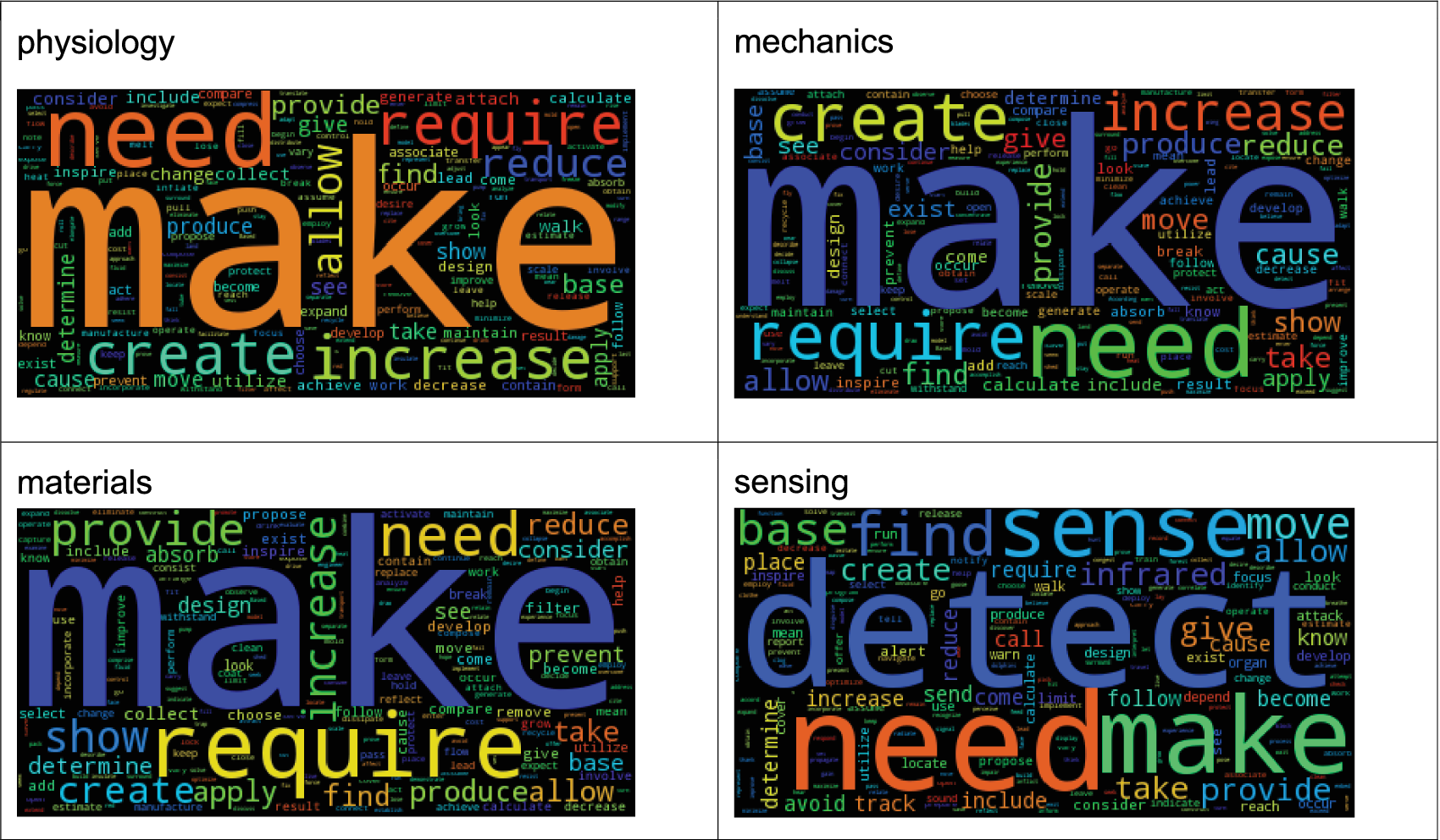
We generated word cloud images to visualize patterns in the documents of each of the 74 case studies. We then aggregated the word clouds for each of the four domains – physiology, mechanics, materials and sensing – to see if we could discover any domain-specific patterns. As Figure 3 illustrates, sensing shows a higher relative frequency of the verb ‘detect’ as well as ‘need’ compared with the other three domains. This does not seem surprising.
Verb clouds for the four biological domains.
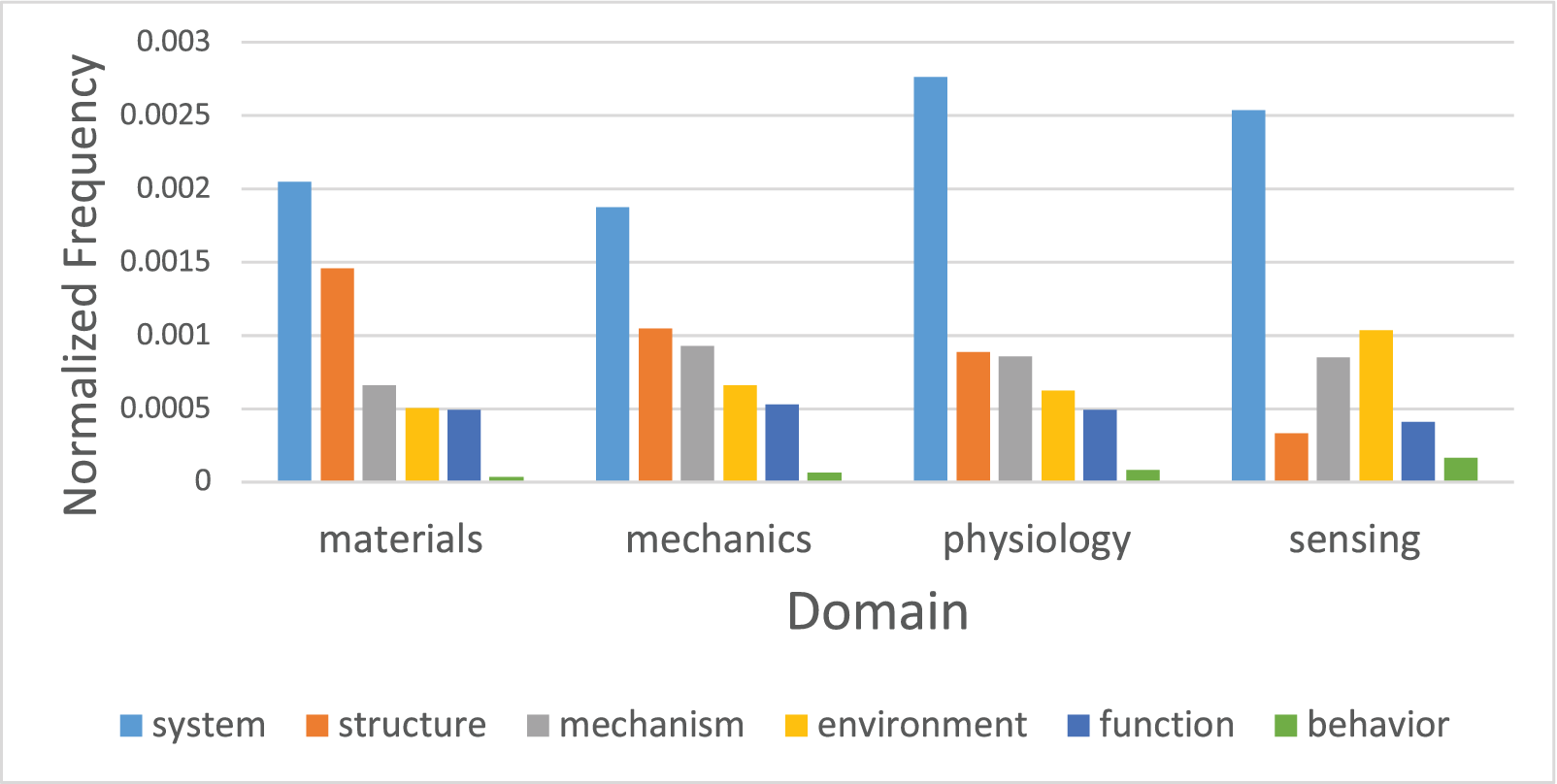
In addition, we compared the frequencies of six nouns for the four domains: system, function, structure, behaviour, mechanism and environment based on the structure–behaviour–function (SBF) modelling (Goel, Rugaber & Vattam Reference Goel, Rugaber and Vattam2009). Figure 4 illustrates the normalized frequency of these words for the four domains. Note that the case studies in the domains of physiology and sensing have a higher occurrence of noun ‘system’. Furthermore, sensing has a higher frequency of ‘environment’ and a lower frequency of ‘structure’ compared with the other three domains. This too does not seem very surprising: As mentioned earlier, physiology here refers to the system comprising the form, mechanism and function of a biological organism or organ.
Normalized Frequency of selected words in the four domains.
5. Is biologically inspired design domain independent?
As mentioned above, preliminary analysis revealed that nine case studies in the DSL were too short or vague to be tagged with consistency, and thus were deleted from further analysis The 74 case studies were categorized independently by two graduate students in Georgia Tech’s Design & Intelligence Laboratory. Both coders were computer scientists generally familiar with biologically inspired design through observation of the Georgia Tech ME/ISyE/MSE/PTFe/BIOL 4740 class. The two coders initially labelled the case studies independently, then negotiated about the precise characterizations of the categories, and next relabelled the case studies independently. Cohen’s kappa coefficient was used to measure the degree of agreement between two coders: The kappa score was 0.88, corresponding to a 94% agreement between the coders, which is commonly considered to be very accurate.
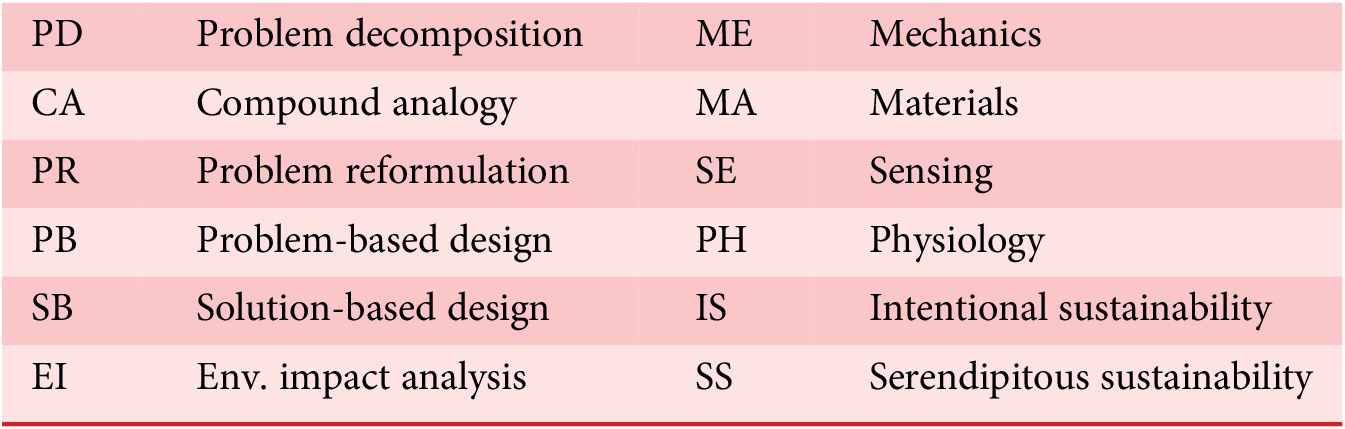
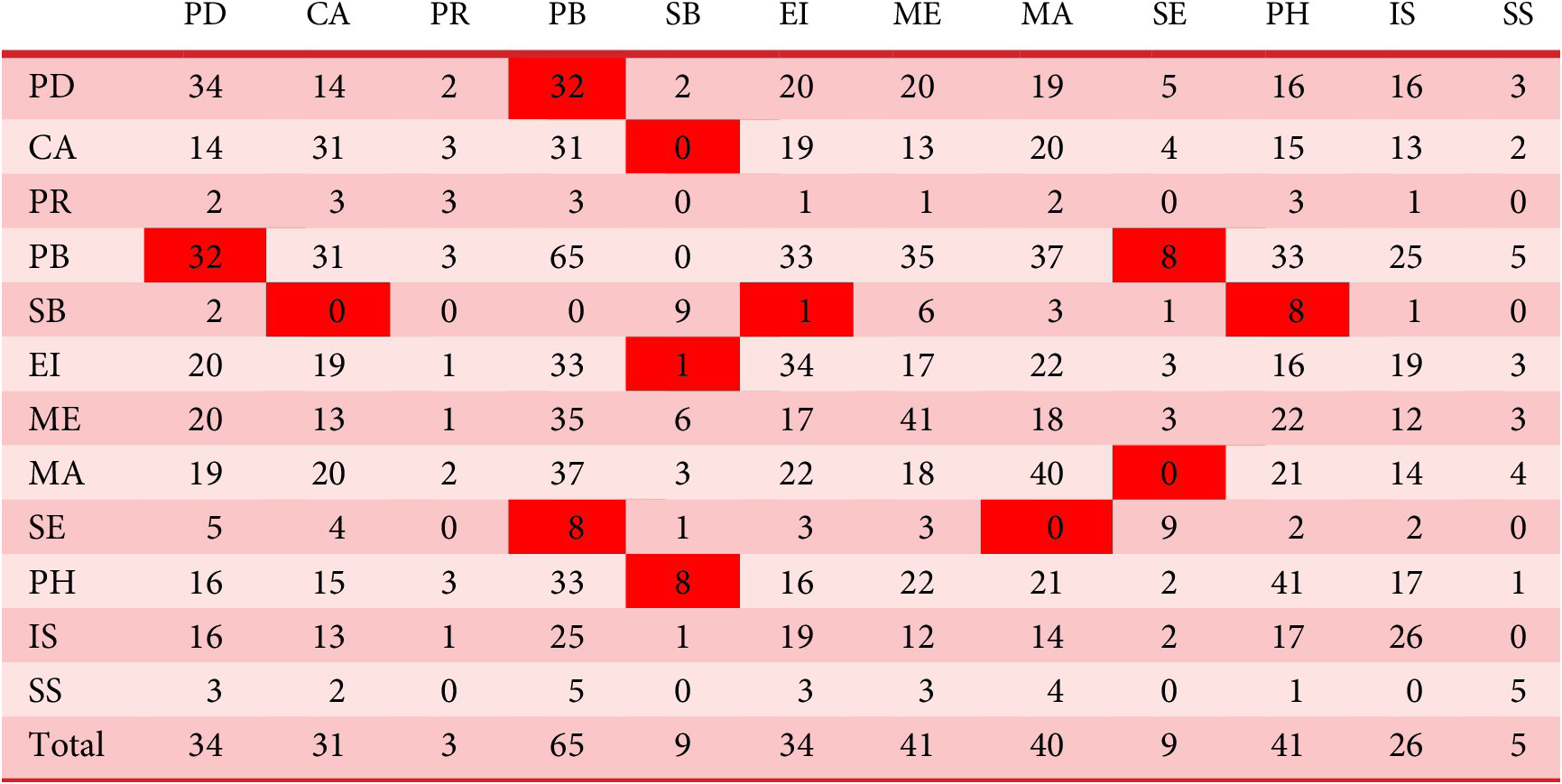
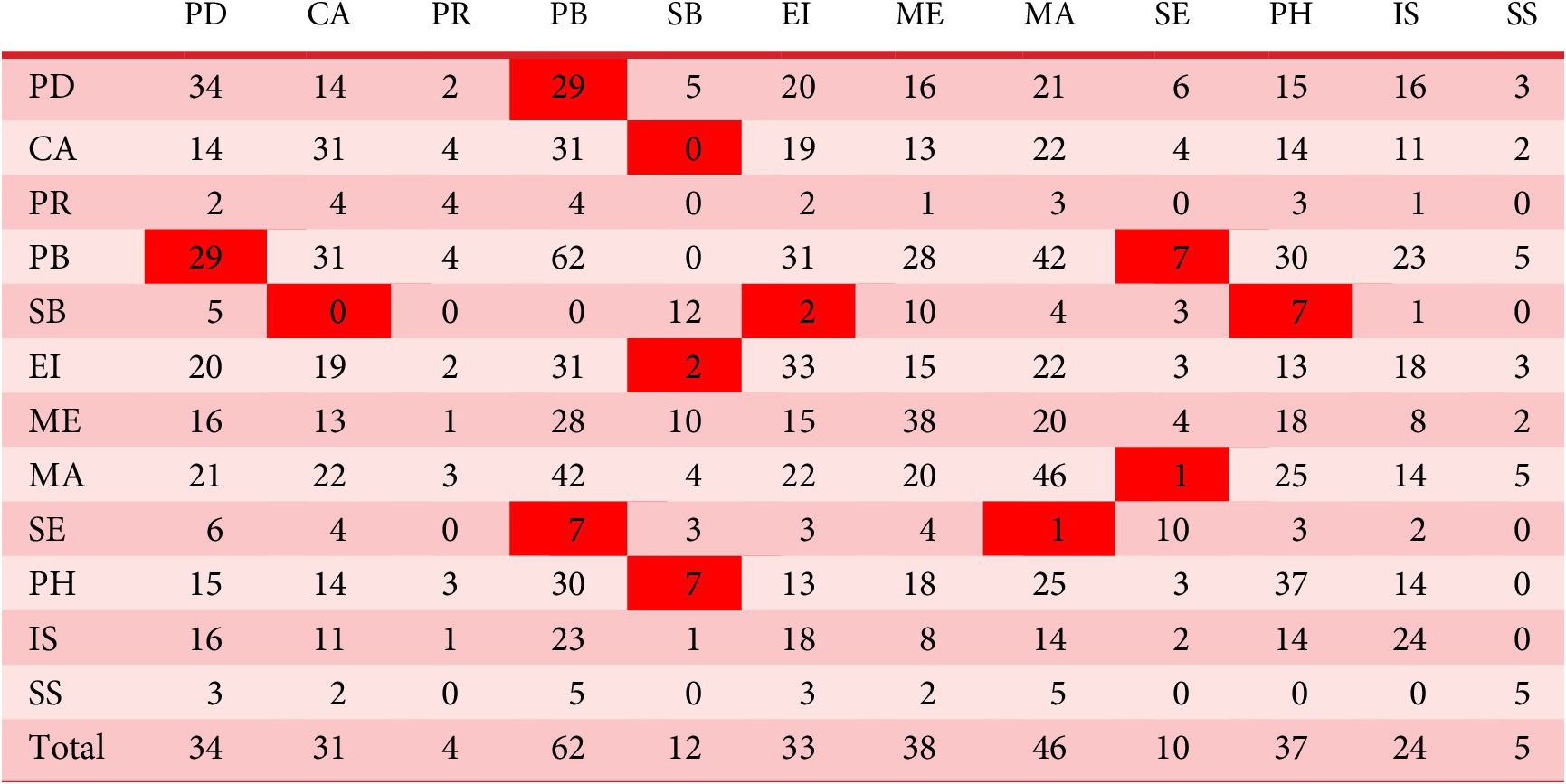
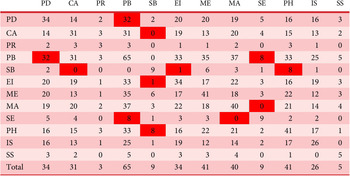
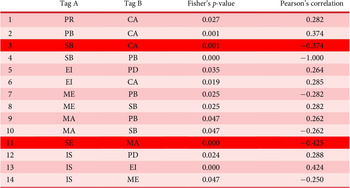
Table 2 shows the legend used in Tables 3 and 4; the latter two tables show the association matrices for the two coders. Highlighted cells in Tables 3 and 4 indicate instances of six initial findings of interest (p. 14). Thus, the first row in Table 3 says that 34 case studies (out of the total 74) were labelled as problem decomposition, 14 had the labels problem decomposition and compound analogy, and so on.
Association matrix for Coder 1
Association matrix for Coder 2
5.1. Initial findings
The above analysis reveals six patterns common to the association matrices shown in Tables 3 and 4:
(P1): Compound analogy is rare with solution-based design. A possible explanation for this pattern is that in the solution-based approach, designing typically starts with a design principle in a single biological system, and then a problem that can be solved using the principle is identified. This leaves little room for compound analogy, because it requires drawing inspiration from more than one biological analogue. A corollary of this hypothesis is that solution-based design may lead to fixation on a single analogue.
(P2): Problem decomposition is likely to be found when problem-driven design too is found. An explanation for this pattern directly follows from the characterizations of problem-driven design and problem decomposition.
(P3) Physiological designs tended to be solution-based; other domains were more biased towards problem-driven design. This pattern initially was a surprise to us; insofar as we know, it has not been previously discussed in the literature. As highlighted in Tables 3 and 4 through colour coding, Coder 1 found that eight out of the nine case studies that used solution-based design were in the domain of physiology; Coder 2 found the same for 7 out of 12 case studies. One possible explanation is that the domain of ‘physiology’ affords system-level design principles and mechanisms that trigger solution-based design more commonly than the other three domains of mechanics, materials and sensing. This is consistent with our characterization of the real domain of interest here, namely, the mechanism of internal functioning of a system, and thus at least partially validates our characterization of the domain.
(P4): Sensing commonly uses problem-driven design, not solution-based design. Again, insofar as we know, this pattern has not been previously discussed in the literature. However, Coder 1 found that eight out of nine case studies in sensing used problem-driven design; Coder 2 found the same for 7 out of 10 case studies. Biologically inspired design in sensing mostly begins with a problem and not a solution, perhaps because the domain presents relatively well-defined problems.
(P5) Materials and sensing rarely occur together. We do not presently have a good explanation for this hypothesis.
(P6) Environmental impact analysis is seldom done with solution-based design. Again, we do not presently have a satisfying explanation for this hypothesis.
5.2. Detailed analysis
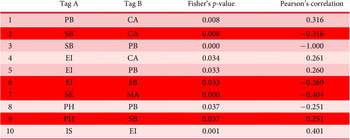
We measured associations between the labels of Tables 3 and 4 using Fisher’s exact test and the Pearson correlation coefficient. Fisher’s exact test is a well-known statistical significance test for analysing association tables such as Tables 3 and 4. Fisher’s test is appropriate for this study because of the categorical nature of data in the two tables. Pearson correlation coefficient is a standard measure of the linear correlation between two variables X and Y, giving a value between +1 and −1, where 1 is total positive correlation and −1 is a total negative correlation.
As Tables 5 and 6 indicate, the two-tailed test with p < 0.05 does not confirm patterns P2 and P4. P2 refers to problem decomposition in problem-driven design: Problem Decomposition is likely to be found when problem-driven design too is found. In retrospect, the reason for the failure to confirm this pattern is clear: While the numbers in the relevant cells in Tables 3 and 4 are fairly large (32 for Coder 1 and 29 for Coder 2), the proportions are relatively small compared with the number of the case studies with problem-driven design (65).
Coder 1’s significant correlations
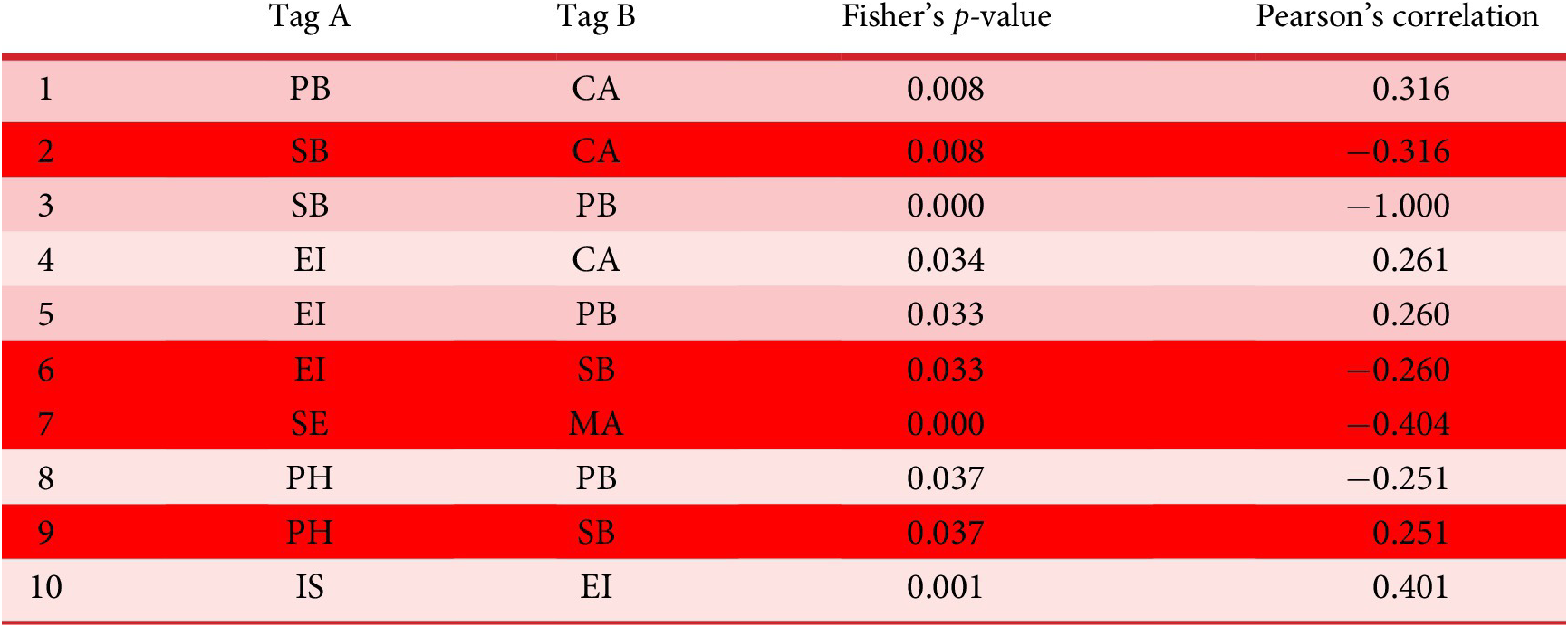
Note: Highlighted rows correspond to significant instances of the six initial findings.
Coder 2’s significant correlations
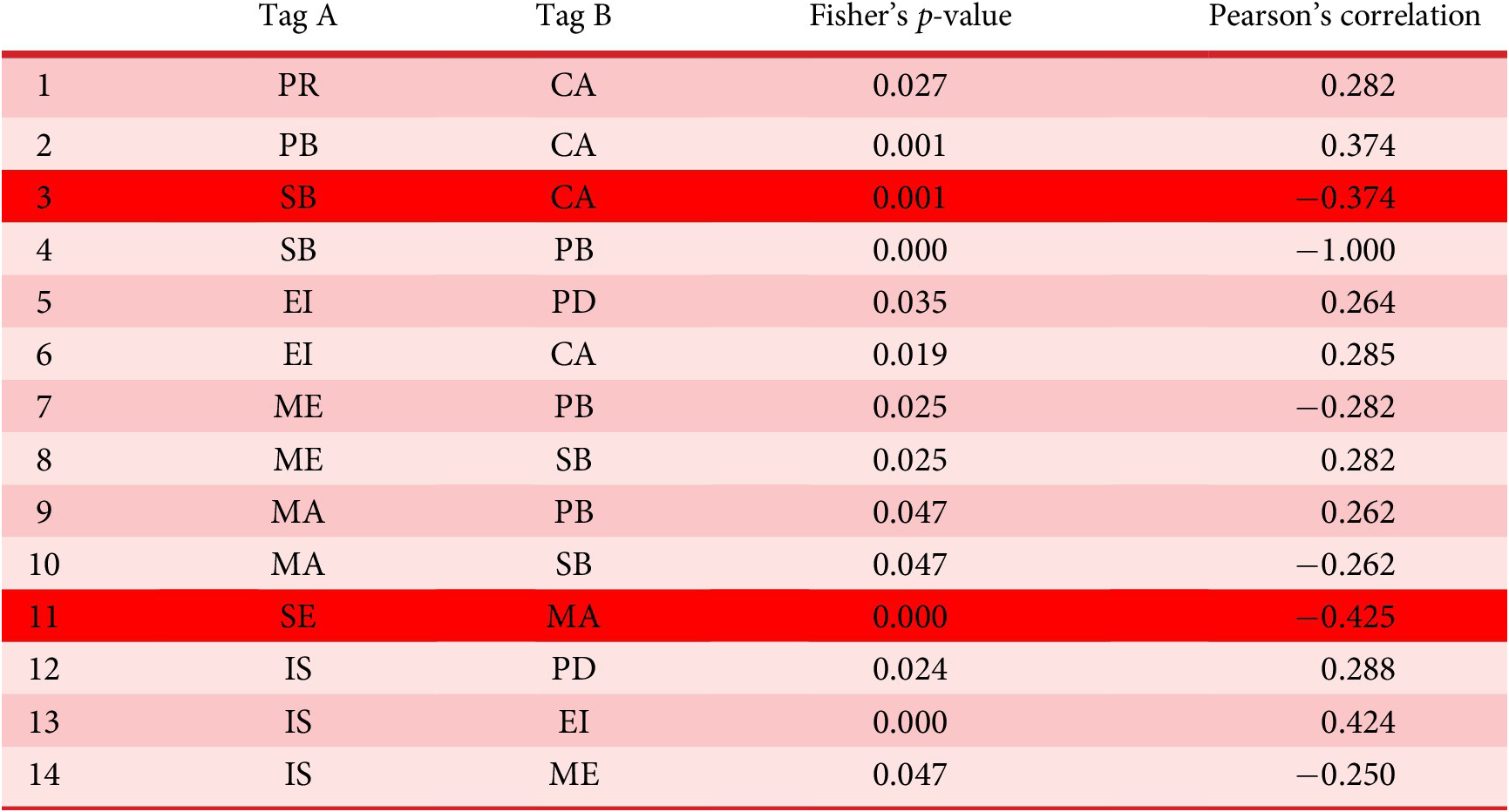
Note: Highlighted rows correspond to significant instances of the six initial findings.
Pattern P4 pertains to the domain of sensing: (P4) Sensing commonly uses problem-driven design, not solution-based design. The small sample size (10) of the case studies pertaining to the sensing domain makes drawing conclusions difficult. We note that the word cloud analysis provides additional evidence that the domain of sensing is different from the other three domains. However, this hypothesis requires additional investigation.
6. Does biologically inspired design result in multifunctional designs?
The previous meta-analysis (Vattam, Helms & Goel Reference Vattam, Helms and Goel2007) suggested that (i) the solution-based process of biologically inspired design results in more multifunctional design, and (ii) the solution-based process leads to more fixation than the problem-driven process. The second part of the present analysis investigates these two hypotheses.
Let us consider two examples from the DSL for clarity and precision. The Garden Veins case study in the DSL is inspired by the thorny devil lizard. In this case study, the thorny devil’s water collection abilities as well as its colour changing abilities were transferred to the design solution. We consider this biological inspiration as resulting in a multifunctional design, because two independent functions (water collection and changing colours) come from the same biological source (thorny devil). In another case study from the DSL (Balloon Fog Collectors), only the water collecting capabilities of the thorny devil (specifically hydrophilic skin) were transferred to the design solution, and we do not consider this biological inspiration as multifunctional.
Our definition of design fixation too builds on the design literature. Jansson & Smith (Reference Jansson and Smith1991) characterize design fixation as blind adherence to a limited set of ideas in conceptual design. Again, we use a conservative view of design fixation in analysing the DSL case studies: We view a design process as leading to fixation only if the design process results in the transfer of the structure of the biological analogue for greater than half of transferred functions. In the DSL case study of Balloon Fog Collectors, the design process transferred the structure of the thorny devil’s skin to the design solution, and thus we deemed this process to be structurally fixated. In the DSL Garden Veins case study, however, two functions were transferred: water collection and colour changing. While the function of water collection engaged transfer of a corresponding structure, the function of colour changing did not. Given that only 1/2 of the transferred functions also involved transfer of corresponding structures, we deemed this study not to be fixated, because our definition requires a clear majority.
6.1. Initial findings
We analysed the case studies in the DSL with two standards for assessing a case study as using the solution-based design process. In Assessment 1, we tagged our data with a very conservative standard that required the design documentation to explicitly state that it was solution-based. In Assessment 2, we realized some other cases studies in the DSL clearly also used solution-based design even though this fact was not explicitly mentioned in the design report. This additional set includes case studies that focus on only one biological source of inspiration, with no mention of any other biological sources (Assessment 2). Tables 2–6 show the results using both assessments.
Interestingly, the results are much the same irrespective of the method of assessment: There is strong evidence in favour of the hypothesis about the solution-based design resulting in more multifunctional designs than problem-driven design; and there is little evidence supporting the hypothesis about solution-based design leading to more design fixation than problem-driven design.
6.2. Detailed analysis
As Tables 7 and 8 indicate, we tagged 36 of the 74 case studies in the DSL as multifunctional (48.6%). Twenty-seven of the 74 case studies were classified as solution-based design (36.5%), and 19 of them showed evidence of fixation. We measured association between the multifunctional and fixation tags and solution-based design using Fisher’s exact test and the Pearson correlation coefficient. Fisher’s exact test is a statistical significance test for analysing association tables such as Tables 3 and 4. Fisher’s test is appropriate for this study because of the categorical nature of data in the two tables. The Pearson correlation coefficient is a standard measure of the linear correlation between two variables X and Y, giving a value between +1 and −1, where 1 is total positive correlation and −1 is a total negative correlation. As Table 9 indicates, we found a strong correlation between multifunctionality and solution-based design (p < 0.05) using both the newly reclassified solution-based design and the previous solution-based design. However, no correlation was found between structural fixation and solution-based design.
Assessment 1

Assessment 2

Significant correlation between solution-based design and multifunctionality

7. Discussion
In this section, we discuss this work from the perspectives of research methodology, design theory and limitations of the current study and some directions for future work.
7.1. Research methodology
Whereas biologically inspired design is a well-known paradigm, systematic research of the design paradigm is relatively new. Much research on biologically inspired design is based on informal retrospective analysis of a small number of skeletal and anecdotal case studies. Thus, there is a need for more rigorous analyses of well-documented case studies of biologically inspired design. A related methodological point is about the importance of building digital libraries of case studies of biologically inspired design such as AskNature (Deldin & Schuknecht Reference Deldin, Schuknecht, Goel, McAdams and Stone2014), IDEA-INSPIRE (Chakrabarti et al. Reference Chakrabarti, Sarkar, Leelavathamma and Nataraju2005), DANE (Goel et al. 2012) and the DSL, because they enable systematic documentation and analysis; this research would be much harder to conduct without the DSL.
Of course, the results of one study in this research methodology are more reliable when confirmed by other studies. As an example, based on an earlier meta-analysis, Vattam, Helms & Goel (Reference Vattam, Helms and Goel2007) hypothesized that compared with problem-driven design, solution-based design results in multifunctional design but runs the risk of fixation on the design structure. However, the present meta-analysis confirms only the first part of their hypothesis (solution-based design results in multifunctional design) but not the second (solution-based design leads to fixation on design structure). This is the advantage of repeating meta-analyses with different case studies: They help confirm, revise or refine earlier hypotheses. We conjecture that the latter finding – that the solution-based design process does not necessarily lead to design fixation – could be the result of the effective teaching practices in the Georgia Tech ME/ISyE/MSE/PTFe/BIOL 4740 class, but this hypothesis needs to be validated.
Digital libraries of case studies of biologically inspired design are growing in number, size and variety. Examples include AskNature (Deldin & Schuknecht Reference Deldin, Schuknecht, Goel, McAdams and Stone2014; AskNature 2021), BioM (Jacobs, Nichol & Helms Reference Jacobs, Nichol and Helms2014) and DANE (Goel et al. 2012; Design by Analogy to Nature Engine 2021). Each of these libraries has its own advantages such as size, variety, documentation, degree of automation and reliable histories of embodiment and/or commercialization. Meta-analysis of the case studies in these libraries is growing in number and variety as well. For example, recently, Bhasin & McAdams (Reference Bhasin and McAdams2018) conducted an analysis of 188 case studies in AskNature. They found that almost all of the cases were at a scale visible to the human eye, and that materials and structure were two most common domains. We expect that the case studies in the Biomimicry Global Design Challenge (2021) offer an especially ripe opportunity for the kind of meta-analysis described in the present paper.
7.2. Design theory – domain independence
There long has been a debate about the domain independence of design tasks and methods (e.g., French Reference French1985; Brown & Chandrasekaran Reference Brown and Chandrasekaran1989; Chandrasekaran Reference Chandrasekaran1990; Simon Reference Simon1996; Eastman, Newstetter & McCracken Reference Eastman, Newstetter and McCracken2001; Cross Reference Cross2006; Dym & Brown Reference Dym and Brown2012). On the one hand, design disciplines such as architecture, engineering and computing have developed many domain-specific design theories. Within computing, for example, computer software and interfaces have developed their own domain-specific design theories. Yet there also is a degree of generality to many design tasks and methods across various domains. Indeed, the search for this design generality is one of the motivations for the Design Science Journal.
Kannengiesser & Gero (Reference Kannengiesser and Gero2015) have argued that their SBF framework for design captures the generality of design processes across the domains of engineering, software and service design. However, Vermaas (Reference Vermaas2013) has enumerated several meanings of ‘function’ within engineering itself, and Goel (Reference Goel2013) has described the evolution of the meaning of ‘function’ within the SBF theory of system modelling: As the scope of SBF modelling evolved from problem solving to memory to learning, so did its characterization of ‘function’. Nevertheless, it is interesting to search for levels of abstraction for capturing the generality of a design paradigm. The organizing principle of using analogies to nature for inspiring the design of technological systems and evaluating technological designs captures the unity of biologically inspired design across domains and scales.
While it is interesting to search for a level of abstraction for capturing the unity of many design processes, it is also important to search in the opposite direction of domain specificity of many design methods. We posit that current assumptions about the domain independence of biologically inspired design processes may have obscured important differences between domains. Given the importance of mechanics and materials in engineering, the focus of much research on biologically inspired design has been on biomechanics and biomaterials. For example, the Georgia Tech undergraduate certificate in biologically inspired design is comprised of a sequence of courses starting with ME/ISyE/MSE/PTFe/BIOL 4740 and continuing with courses on biomechanics and biomaterials. However, as we conduct systematic analysis of case studies of biologically inspired design from different domains, we are beginning to find domain-specific characteristics. In particular, the present meta-analysis suggests that the problem-driven process is more common in some domains, such as sensing, and the solution-based process is more common in others, such as physiology.
7.3. Design Theory – multifunctionality
At first, the hypothesis that the process of solution-based design results in more multifunctional designs may seem counterintuitive. By definition, the solution-based design process starts with only one biological source of inspiration, and therefore only one chance to transfer multiple functions. The process of problem-driven design, however, may engage multiple (n > 1) biological sources, and therefore n > 1 opportunities to transfer multiple functions. Our data indicate (Pattern 1 in Section 5) that these kinds of compound analogies are rare with solution-based design. Yet, our analysis of the case studies in the DSL found that the process of solution-based design results in more multifunctional designs than the problem-driven design process.
We posit two reasons for this finding: The nature of problem decomposition and constrained search inherent to problem-driven design limits the complexity of analogical transfer (Altshuller Reference Altshuller1984), and solution-based design affords analogical transfer of multiple functions from the biological source to the design solution (AskNature 2021). Let us again consider the two case studies ‘Ant Traffic Control’ and ‘Pascobot’ illustrated in Figures 1 and 2, respectively. In the case of ‘Ant Traffic Control’, the problem-driven process starts with a design goal and focuses on the transfer of the function it needs for addressing the current design goal. For the problem-driven process to lead to a multifunctional design, it would need to decompose the design problem into subproblems each with a design goal, retrieve multiple biological sources relevant to the design goals, transfer functions from the multiple biological sources to achieve the design goals and compose the transferred functions from into a coherent design. Vattam, Helms & Goel (Reference Vattam, Helms and Goel2008) called this complex process compound analogical design, because it relies on analogical transfer from multiple sources. In the ‘Pascobot’ project, we posit that before the solution-based design process starts, the designer constructs a mental model of the entire biological source of inspiration (ant navigation including its multiple functions). When the designer begins the process of solution-based design, she uses the model to transfer as much of the biological source with its multiple functions to the design solution as is useful to address the design problem (distributed navigation and replaceability of units in case of ‘Pascobot’) resulting in a multifunctional design. Thus, we conjecture that the solution-based design process leads to serendipitous multifunctionality in that multifunctionality of the design emerges from the very nature of the solution-based design process.
Following Vattam, Helms & Goel (Reference Vattam, Helms and Goel2007), we initially hypothesized that the process of solution-based design would lead to more fixation on the structure of the biological analogue. Based on our analysis of the DSL case studies, we posit an alternative hypothesis: The solution-based design process leads to more fixation on the problem decomposition in the biological analogue. Vattam, Helms & Goel (Reference Vattam, Helms and Goel2010) found that biologically inspired design transfers not only causal mechanisms for achieving specific functions, but also problem decompositions. We hypothesize that while the problem-driven design process dynamically decomposes the problem, the process of solution-based design may lead to fixation on the problem decomposition available in the biological analogue. Verifying this hypothesis is part of future work.
Two organisms feature in multiple case studies in the DSL. Furthermore, there are both problem-driven as well as solution-based designs for each, making these cases interesting for comparing and contrasting the design methods. Four cases feature the thorny devil, and all four deal with water collection. Of the four, one is solution-based, and the other three are problem-driven. The solution-based design was found to be multifunctional, whereas only one out of the three problem-driven designs were found to be multifunctional. Two of these were detailed previously in Section 6 (Balloon Fog Collectors and Garden Veins). Furthermore, two designs featured ants as their biological source (Ant Traffic Control and Pascobot illustrated in Figures 1 and 2, respectively). The solution-based design (Pascobot) was found to be multifunctional, whereas the problem-driven design (Ant Traffic Control) was not. These sets of cases are interesting, because they illustrate the two design processes – problem-driven and solution-based – under question operating on the same organism but resulting in different design solutions: They help validate our finding that multifunctionality can vary across design methodologies given the same source organisms. We postulate that multifunctionality of the design solution is also dependent on the quality of the mental model that a designer has of the biological source of inspiration; however, this hypothesis still needs to be validated.
7.4. Limitations of present work and future research
Although this study deals with a fairly large sample size, it does have a few limitations. One limitation pertains to possible selection bias: As noted earlier, all case studies in the DSL come from extended collaborative design projects from 2006 to 2013 in the Georgia Tech ME/ISyE/MSE/PTFe/BIOL 4740 class. Thus, this sample likely is not representative of all case studies of biologically inspired design. For example, if the teachers of a different class in biologically inspired design are not careful about sensitizing the designers to the problem of design fixation, a different library of case studies from the different class might indicate that solution-based design does lead to design fixation.
Another potential limitation pertains to the expertise of the designers in the present study. Although each design project had a faculty mentor, the students in the class were not professional designers. Although it is true that the students in this class are not expert designers, it is also true that designers, in general, are not necessarily experts at biology, and similarly, biologists, in general, are not necessarily experts at design. Thus, it is not clear how to characterize expertise in biologically inspired design or exactly who is an expert in it, and thus the results of this study might be more general than appears at first glance. Nevertheless, it is important to replicate this study with larger samples of biologically inspired design case studies acquired from different groups of subjects such as the professional and student designers participating in the Biomimicry Institute’s Design Challenges (https://biomimicry.org/design-challenges/).
Yet another limitation of the present study is that although the two coders in the study were familiar with biologically inspired design, neither had much formal background in biology. Coders with deeper expertise in biology may, in principle, code some of the case studies a little differently. It might be useful to replicate this study with a different set of coders with stronger backgrounds in biology.
Perhaps the most important limitation of the present meta-analysis pertains to the classification of biological domains. As noted earlier, the four labels for classifying biological domains were prescribed by the instructors of the Georgia Tech ME/ISyE/MSE/PTFe/BIOL 4740 course. The instructors’ rationale behind this classification is that leading biology journals, such as the Journal of Experimental Biology and the Journal of Bioinspiration and Biomimetics, use it. We have retained these labels to maintain the integrity of our data and analyses. However, as we noted earlier, ‘physiology’ here really refers to the form, structure, principle or mechanism of the internal functioning of a biological organism or organ. It is possible, perhaps likely, that a revised or refined classification of ‘physiology’ and other biological domains may reveal finer-grained domain-specific differences.
These limitations notwithstanding, we submit that this study raises interesting and useful questions about some of the basic assumptions of all current theories of biologically inspired design, namely that the design processes are domain independent. Thus, this study represents a necessary first step. Now, that it has raised the question and proposed a novel hypothesis, it can be replicated and tested, and revised and refined through additional studies.
Finally, although our analysis thus far has primarily addressed the question of domain independence of the processes of biologically inspired design, it also pertains to the issue of scale independence. As we noted in the introduction, the example of a mechanical device for water harvesting inspired by the design of mitochondria has two scales of interest: the micrometre scale of mitochondria and the metre scale of the mechanical device. We note that the design pattern for water harvesting in the Weiler & Goel (Reference Weiler and Goel2015) example evidently is scale-invariant (or analogical transfer from mitochondria to the mechanical device would not be feasible). Thus, we conjecture that biologically inspired design processes likely are scale-independent. This counterintuitive hypothesis calls for analysis and testing in future work.
8. Conclusions
Current information-processing theories of biologically inspired design make several, typically unstated and largely unexamined, assumptions. For example, they assume that the design processes are domain-independent and lead to multifunctional designs. Current pedagogical techniques and computational tools for supporting biologically inspired design too make the same assumptions. In this paper, we examined these assumptions by analysing the DSL library of 74 cases of biologically inspired design collected from a senior-level interdisciplinary class at Georgia Tech over 2006–2013. We discovered that some of the parameters in the domains of physiology and sensing are different from the more common domains of mechanics and materials. In particular, we discovered that the process of solution-based based design is commonly found in the domain of ‘physiology’ (which here refers to the domain of internal functioning of biological organisms) and not as much in other domains. Although our study did not fully validate the additional finding that sensing commonly uses problem-driven design and not solution-based design, there is strong evidence in favour of this pattern as well. We also found that solution-based design leads to more multifunctional designs than problem-driven design.
Of course, it is important to replicate these preliminary studies with larger samples of biologically inspired design case studies acquired from different groups of subjects and using refined classifications of domains. If these hypotheses about the differences between the parameters of the various domains hold, then they likely will have implications not only for building new, more detailed information-processing theories of biologically inspired design, but also for developing pedagogical techniques for teaching the design paradigm as well as developing computational tools for supporting its practice. As just one example, new computational tools may want to support the solution-based design process more than the problem-driven process when there is a special need for multifunctional designs.
Acknowledgments
Much of this research was done when the second author, Hancock, was a graduate student at Georgia Tech’s Design & Intelligence Laboratory. Some parts of this paper pertaining to the question of domain independence of biologically inspired design have appeared earlier in Goel et al. (Reference Goel, Tuchez, Hancock and Fraser2016c); similarly, some parts relating to the issue of multifunctionality of biologically inspired design have appeared in Goel et al. (Reference Goel, Hancock, Fraser and Tuchez2016b). We are grateful to Swaroop Vattam, Bryan Wiltgen, Gongbo Zhang and Yuqi Zhang, who helped develop the Design Study Library; to Keith Fraser and Christian Tuchez, who helped analyse the case studies in the DSL; and to Professor Jeannette Yen, the Director of Georgia Tech’s Center for Biologically Inspired Design and the primary instructor of the Georgia Tech ME/ISyE/MSE/BME/BIOL 4740 class from 2006 to 2013. We sincerely thank anonymous reviewers of an earlier draft of this paper for their thoughtful, detailed and constructive critiques. Of course, we alone are responsible for the conjectures and conclusions described here.





 Open access

