


Introduction
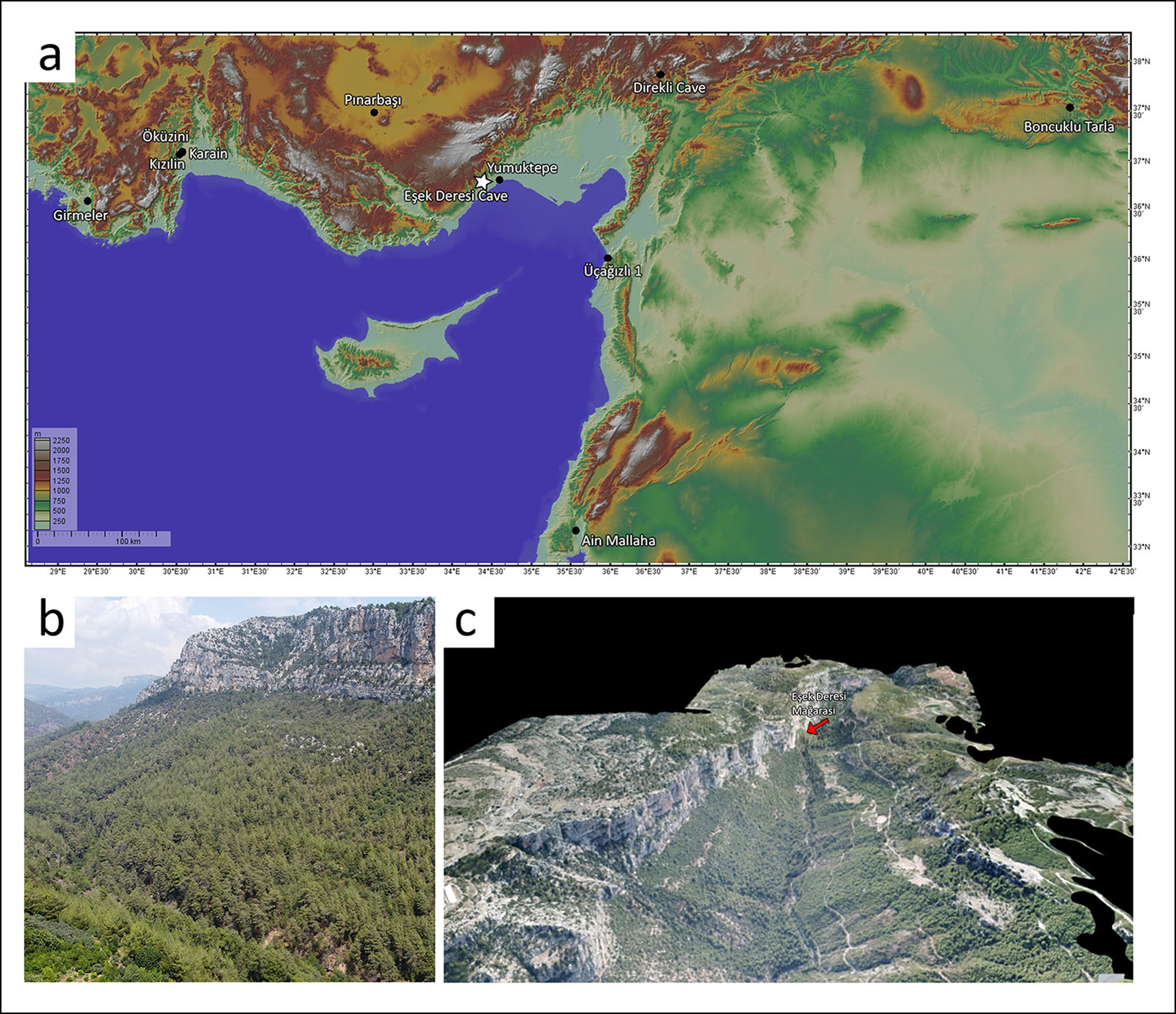
The prehistory of the Central Taurus Mountains and Cilicia remains underexplored due to a dearth of data on the Palaeolithic and Pre-Pottery Neolithic periods. Initiated in 2019, the Central Taurus Prehistoric Research Project discovered new Palaeolithic and Neolithic sites in areas north of the Tarsus and Erdemli Districts (Mersin/Türkiye). These include open-air, cave, rock shelter, quarry and workshop sites (Kayci Reference Kayci2019; Altınbilek-Algül et al. Reference Altınbilek-Algül2021) and rock art panels (Kayci et al. Reference Kayci, Tümer and Ünlü2020). Eşek Deresi Cave, located in the Eşek Deresi Valley close to the Doğu Sandal village, 12km north of the Mediterranean is presented here (Figure 1a & b).
a) Location of Eşek Deresi Cave; b) the general landscape around the cave; and c) an orthophoto of the Eşek Deresi Valley (images from the Eşek Deresi Cave Photo Archive).

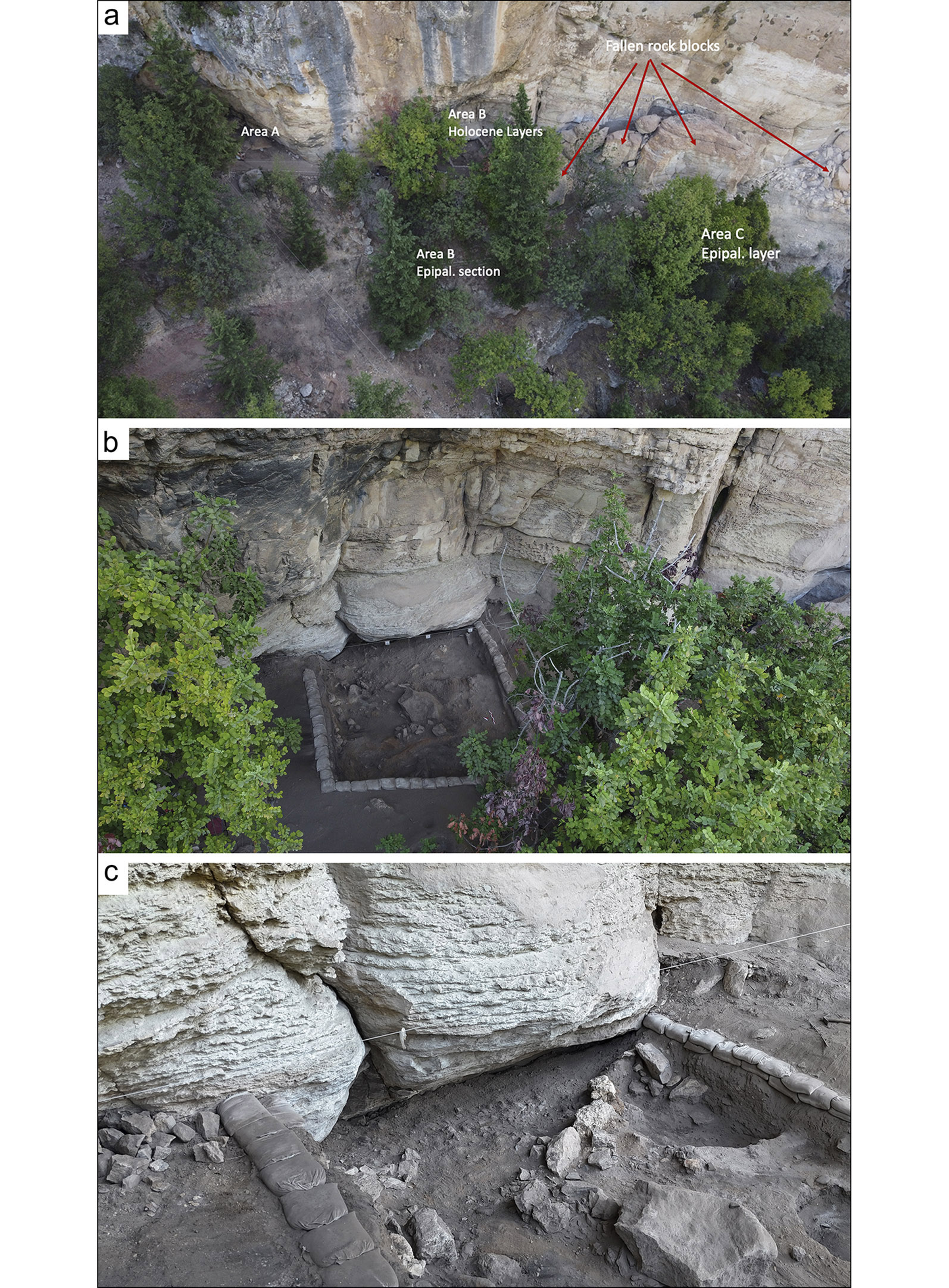
Situated on the eastern slope of a deep canyon, the cave is approximately 50m above the present valley floor (Figure 1c). It has two chambers (areas A and B) and two front terraces (areas B and C). Rockfall damaged the terrace, blocking the cave entrance (Figure 2a).
a) Excavation areas, with cliff and rockfall; b) excavation area B (note inclination of cave wall to the east); and c) Holocene layers of area B, section of the cliff (images from the Eşek Deresi Cave Photo Archive).

Excavations at the site started in 2021 and took place each year since then. In the terrace of area B, the Epipalaeolithic stratigraphic column reaches 2.5–3m and is followed by a major rock collapse (Figure 2a). Post-collapse layers reveal a sequence of Holocene human occupations from the Pottery Neolithic (Figure 2b–c), Chalcolithic, Bronze Age, Iron Age and Classical period to more recent dung layers. Undamaged Epipalaeolithic sediments will hopefully be reached below this sequence near the cave wall, which inclines to the east into what seems to be a cave chamber (Figure 2c). Identification of these sediments would allow Eşek Deresi to be viewed as a ‘cave and terrace’ site.
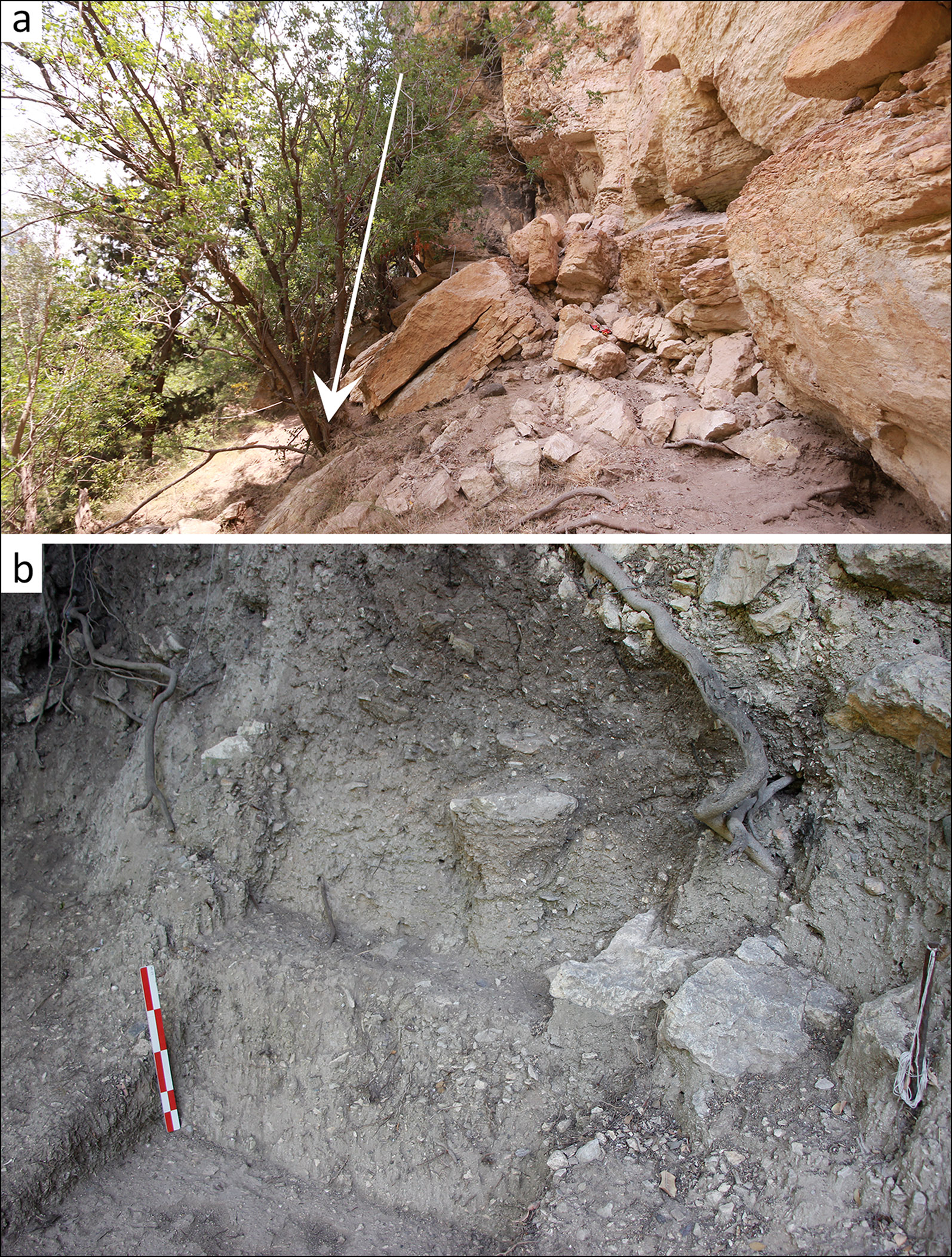
Epipalaeolithic terrace deposits were excavated in a ‘step-section’, 1m in width below the main excavation of area B, and below the collapsed stones (Figure 3a & b). In area C, also under collapsed rock, a narrow, 2m-long area was excavated.
a) Epipalaeolithic section below area B; b) close-up of sediments with small angular stones (images from the Eşek Deresi Cave Photo Archive).

Epipalaeolithic sediments in area B are light grey to beige in colour and show thin levels of small (< 10mm), angular limestone pieces, probably weathered from the cliff by the elements in alternating short cycles with human deposits (Figure 3b).
Faunal remains comprise a variety of medium-sized wild ungulates, small animals, tortoises, birds, fish and micromammals. Botanical remains extracted by floatation in 2023/2024 await analysis.
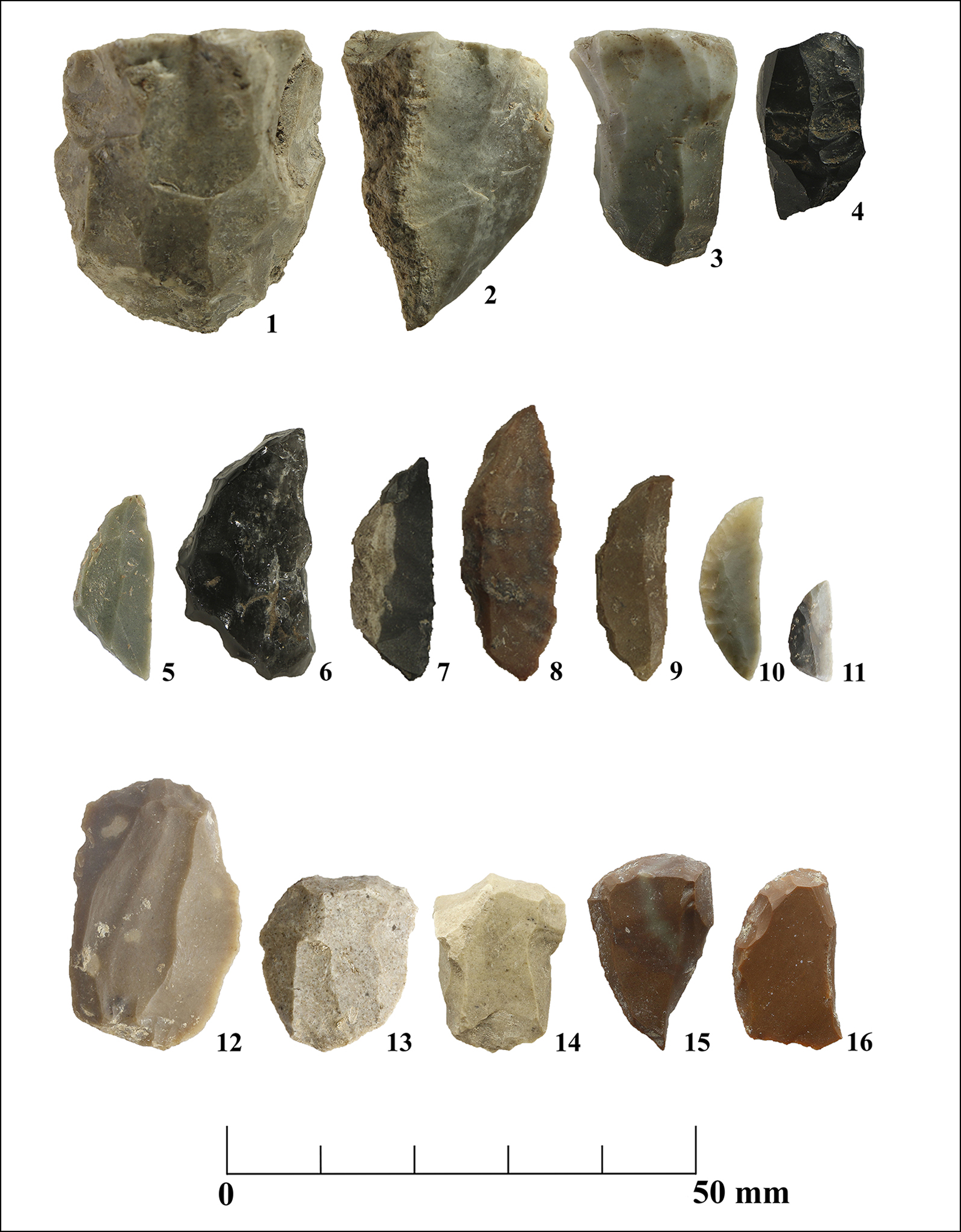
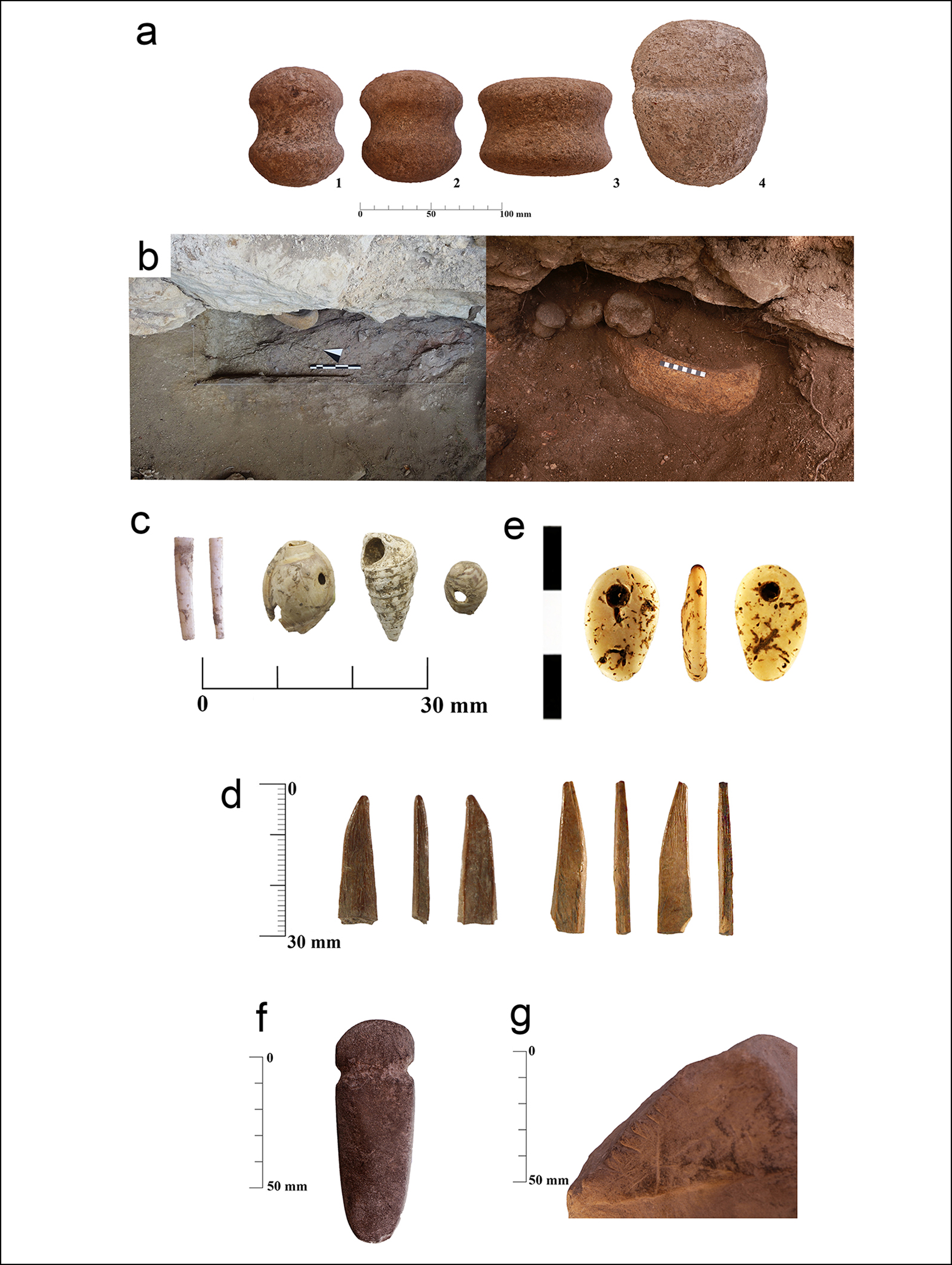
Lithics include items of various raw materials. Conspicuous are red-orange-brown opaque, brown-green, grey, black and some beige-coloured translucent flints. The assemblage includes a few flint cores (unipolar bladelet cores on flint and obsidian) (Figure 4, nos. 1–4) and debitage (bladelets, blades and flakes). The tool assemblage consists of microliths (Figure 4, nos. 5–11) and end-scrapers on flakes (Figure 4, nos. 12–16), retouched flakes and blades, and obliquely truncated blades. The most conspicuous tool type is the lunate; most lunates are backed and small (averaging 16mm in length), with one larger item (24mm in length) and a few Helwan lunates (Figure 4, nos. 10 & 11). Central Anatolian obsidian is present as small chips, some laminar items, a single possible core fragment (Figure 4, no. 4) and two lunates (Figure 4, no. 6). Pounding and grinding tools made of a variety of raw materials were also found (Figure 5a), including squat (spool-like) grooved mauls and pestles (Figure 5a, nos. 1–3). Twelve groundstone tools were cached under the rockfall in area C (Figure 5b).
Chipped stone finds: 1–4) cores (4 is obsidian); 5–11) lunates; 12–16) end scrapers (images from the Eşek Deresi Cave Photo Archive).

a) Groundstone tools; b) in situ groundstones (ophiolite); c) marine shells; d) bone tools; e) stone pendant; f) stone object (possibly a figurine); g) incised stone (images from the Eşek Deresi Cave Photo Archive).

Marine shell finds include dentalia of various types and sizes—most probably of Mediterranean origin—as well as a few Nasarius and a single large Glycymeris (Figure 5c). Other finds include a small number of bone tools (Figure 5d)—one a long fragment with a short series of horizontal incisions—and two whitish-coloured stone pendants (Figure 5e). Another stone object, probably a figurine (Figure 5f), and several incised stones (Figure 5g) were found on the surface.
Discussion
The Epipalaeolithic of Eşek Deresi is a new feature in the prehistory of the Central Taurus region and Cilicia as a whole. With a deep stratigraphic column, radiocarbon dated to between 13 200 and 10 700 cal BC (a series of five dates, the oldest, 13 324–13 040 cal BC, 95.4% confidence, and the youngest, 10 771–10 631 cal BC, 95.4% confidence, TÜBİTAK MAM), the site holds potential for widening our understanding of diachronic variation within the regional Epipalaeolithic.
Eşek Deresi joins a handful of excavated Epipalaeolithic sites in Türkiye and, in a broader Near Eastern view, the possible ‘Natufian connection’ at the site is inescapable. Although differing from southern Levant examples in raw material use and techno-typological details, the presence of lunates is demonstrative. While the abundance and variety of pounding and grinding tools is also a ‘Natufian’ element, the shape of the pestles is unique to Eşek Deresi (but see another item from Epipalaeolithic Boncuklu Tarla, south-eastern Türkiye; Kodaş Reference Kodaş2023). The dominance of dentalia in the marine shells accords with other Epipalaeolithic sites in Anatolia and is typical of homeland Natufian sites in the southern Levant. The stone pendants are also similar to Natufian bone pendants (Belfer Cohen & Goring Morris Reference Belfer-Cohen and Goring-Morris2020). Finally, Central Anatolian obsidian is present at Eşek Deresi, as is the case for Natufian Ain Mallaha/Eynan in northern Israel (Khalaily & Valla Reference Khalaily, Valla, Bar-Yosef and Valla2013). This may suggest the participation of Esek Deresi in the Levantine-Central Anatolia obsidian exchange system—a late Epipalaeolithic koine of sorts that will be further explored in future research.
While assigning a ‘Central Taurus Natufian’ based on the preliminary finds from Eşek Deresi is perhaps premature, and we would not recommend viewing these new finds as Natufian per se, placing the finds in this context would not be a stretch. Future work will tell. The image of the southern Levantine Natufian is based on datasets from relatively large base camps with dense architecture, heavy stone facilities and numerous burials; it is not rich in the small, ephemeral ‘satellite’ sites that accompany such base camps. The features of Eşek Deresi do not seem to reflect a base camp in Natufian terms. Rather, it looks like a repeatedly occupied ephemeral site where a small hunter-gatherer community subsisted on the rich resources of the surrounding Mediterranean zone. Thus, it is (for now) quite free of the southern Levant ‘Natufian paradigm’ that Baird and colleagues (Reference Baird2013) were rightly trying to avoid imposing, given the backdrop of various local Epipalaeolithic facies known from Central Anatolia.
Funding statement
This research was supported by the Ministry of Culture and Tourism of the Republic of Türkiye, Turkish Historical Society (TP-4-1569) and Istanbul University Scientific Research Projects Unit (Project ID 37741). We thank both for their support.
Author contributions: using CRediT categories
Avi Gopher: Conceptualization-Equal, Data curation-Equal, Formal analysis-Equal, Investigation-Equal, Methodology-Equal, Resources-Equal, Software-Equal, Supervision-Equal, Validation-Equal, Visualization-Equal, Writing - original draft-Equal, Writing - review & editing-Equal. Çiler Altınbilek Algül: Conceptualization-Equal, Data curation-Equal, Formal analysis-Equal, Funding acquisition-Equal, Investigation-Equal, Methodology-Equal, Project administration-Equal, Resources-Equal, Software-Equal, Supervision-Equal, Validation-Equal, Visualization-Equal, Writing - original draft-Equal, Writing - review & editing-Equal. Orkun Kayci: Conceptualization-Equal, Data curation-Equal, Formal analysis-Equal, Funding acquisition-Equal, Investigation-Equal, Methodology-Equal, Project administration-Equal, Resources-Equal, Software-Equal, Supervision-Equal, Validation-Equal, Visualization-Equal, Writing - original draft-Equal, Writing - review & editing-Equal. Semra Balcı: Conceptualization-Equal, Data curation-Equal, Formal analysis-Equal, Funding acquisition-Equal, Investigation-Equal, Methodology-Equal, Project administration-Equal, Resources-Equal, Software-Equal, Supervision-Equal, Validation-Equal, Visualization-Equal, Writing - original draft-Equal, Writing - review & editing-Equal.

 Open access

