




Introduction
The Acheulean culture represents one of the most enduring phases in the history of human evolution. The earliest Acheulean stone tools in South Asia date to c. 1.5 Ma at Attirampakkam (Pappu et al. Reference Pappu, Gunnell, Akhilesh, Braucher, Taieb, Demory and Thouveny2011) and the latest— marking the youngest Large Flake Acheulean in Eurasia—are from the Middle Son Valley at 140–100 ka (Shipton et al. Reference Shipton, Paddayya and Deo2014). The Son Valley (Figure 1), with its unique archaeological record preserved in Quaternary sediments, is crucial for understanding the Acheulean culture and its environmental history in South Asia. Situated along Pleistocene hominin dispersal routes, the valley holds global significance for studies on early human dispersal into South Asia (Field et al. Reference Field, Petraglia and Lahr2007).
a) Map of South Asia showing major dated Acheulean sites along potential hominin dispersal routes during the Pleistocene (adapted from Field et al. Reference Field, Petraglia and Lahr2007); b) distribution of Acheulean sites on lithology map of the Upper Son Valley: 1) Silpahari; 2) Chichgohna; 3) Dhanuhari; 4) Mahuda; 5) Kasa; 6) Agriyanar; 7) Semarpakha; 8) Chilhari (figure by authors).

Pleistocene climatic fluctuations, both regionally and temporally, have been recognised as key factors influencing hominin dispersal and population dynamics in India (Jha et al. Reference Jha, Sanyal and Philippe2020). Since the 1960s, extensive archaeological research in the Son Valley has focused on its middle (Jones & Pal Reference Jones and Pal2009; Haslam et al. Reference Haslam2011) and lower reaches (Mehra Reference Mehra2018 and references therein), revealing Acheulean culture in the valley. However, the Upper Son Valley remains largely under-researched (Ahmad Reference Ahmad1966), despite its potential to address key questions related to hominin evolution in South Asia.
To fill this gap, we investigated the lithic diversity, raw material composition, preservation state, stratigraphy and depositional environment of Acheulean sites in the Upper Son Valley, aiming to better understand hominin dispersal, technological adaptation and regional palaeoenvironmental variability.
Methods
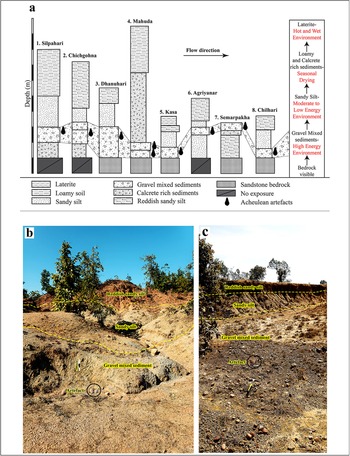
The Upper Son Valley was systematically surveyed in 2022–2023 from its source (Figure 1) at Amarkantak Hill, Pendra, Chhattisgarh to Bansagar Lake, Madhya Pradesh. Intensive pedestrian surveys along the river channel, terrain, cliff sections, gullies and tributaries were conducted to locate archaeological sites (handheld GPS; ±3m) and understand their lithological and geomorphological contexts. The collected GPS data were integrated into the open-source geographic information system QGIS (v.3.32) to generate a spatial distribution of Acheulean sites on a lithological map of the Upper Son Valley (Figure 1). The composite stratigraphy (Figure 2) of each locality, uncovered by gully erosion and associated with Acheulean occurrences, was prepared using Adobe Illustrator (v.27.9.3) to understand the depositional history. Stone artefacts were collected through systematic random sampling using 10m-wide pedestrian transects. A team of four walked straight lines across the site, scanning approximately one metre on each side. Transects were spaced 200m apart and covered approximately five per cent of the total survey area. Artefacts observed within this interval were collected and recorded. Typo-technological and lithic raw material characterisations were conducted to understand lithic diversity, composition and landscape utilisation.
a) Stratigraphic logs highlighting the depositional environment of the Upper Son Valley, showing archaeological strata across the sites, and field photographs showing stratigraphy of the Dhanuhari (b) and Chilhari (c) localities (figure by authors).

Results
The survey identified eight open-air Acheulean sites associated with the Quaternary sequence of the Upper Son Valley, which overlies the sandstones of the Gondwana Supergroup and a complex gneiss bedrock (Figure 1). These lithological formations (e.g. outcrops) likely served as important sources of raw materials for tool production in the Upper Son Valley. The Quaternary sequence is characterised by several depositional units, and the stratigraphy across the eight studied localities is broadly consistent, with only minor lateral variations, indicating a stable fluvial depositional environment (Figure 2). The exposed depositional units primarily consist of sandy silt and gravel mixed sediment, with interspersed layers of loamy soil and reddish sandy silt forming the uppermost layer, while calcrete and laterite are infrequent. The archaeological layers were mostly found in gravel-mixed sediment (Figure 2), composed of sub-rounded to sub-angular gravels and cobbles made of quartz, sandstone and quartzite, underlain by sandy silt, reflecting a transition from high- to low-energy depositional environments. Most of the artefacts are therefore associated with high-energy depositional conditions in the Upper Son Valley.
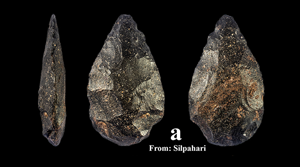
A total of 1348 lithic artefacts were collected from the newly identified Acheulean sites. Handaxes were particularly prevalent, with a wide range recorded at Mahuda on the left bank of the river, while cleavers were present in smaller quantities at most sites. Large or medium-sized flakes were frequently used as blanks for bifacial shaping, resulting in thin handaxes and cleavers (Figures 3 & 4). Preliminary observations of cores from Chilhari and Semarpakha demonstrate Levallois technology. Artefacts were prepared from quartzite, sandstone, quartz and chert (Figures 3 & 4), with fine- to medium-grained quartzite being most predominant—possibly due to its outcrop availability in the region. Raw materials were predominantly sourced from fluvial cobbles and pebbles, except at Chilhari, where a clear preference for coarse-grained sandstone—likely sourced from a nearby outcrop—is shown in the production of Acheulean bifaces.
Characterisation of handaxes and their raw materials in the Upper Son Valley: a & b) chert; c) quartz; d–f) quartzite; g) sandstone (figure by authors).

Characterisation of cleavers and their raw materials in the Upper Son Valley: a–d) quartzite; e & f) chert; g) sandstone; h) quartz (figure by authors).

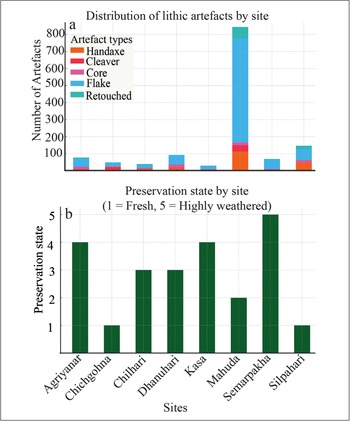
The Upper Son Valley assemblage primarily consists of flakes (65.8%), handaxes (14.9%) and cleavers (4.3%), along with choppers (0.5%), retouched tools (7.8%) and cores (6.3%) (Figure 5). Notably, 47 handaxes but no cleavers were unearthed at the Silpahari site highlighting inter-site variability in tool composition and providing clues to understanding landscape utilisation.
a) Stacked bar plot showing distribution of lithic artefacts; b) bar plot highlighting preservation state (figure by authors).

Lithic components from Chichgohna and Silpahari are unabraded, while those from Semarpakha are highly weathered and abraded, and artefacts from Chilhari, Dhanuhari, Kasa and Mahuda range from fresh to moderately abraded, reflecting variable preservation in high-energy depositional environments (Figure 5).
Conclusion
The documentation of eight open-air archaeological sites, with consistent stratigraphy and evidence of Acheulean tool production, underscores the importance of the Upper Son Valley for studying hominin evolution during the Pleistocene. The assemblage ranges from Early to Late Acheulean, except at Silpahari, where the presence of smaller, thinner handaxes and the absence of cleavers indicate a later Acheulean phase. This supports the observation by Shipton and colleagues (Reference Shipton, Paddayya and Deo2014) that Late Acheulean bifaces in South Asia are, on average, thinner than their earlier counterparts.
The association of Acheulean artefacts with high-energy depositional environments suggests that the Upper Son Valley offered favourable water-rich conditions during the early dispersal of Pleistocene hominins in South Asia (Field et al. Reference Field, Petraglia and Lahr2007), particularly highlighting the connectivity between the west-east region through the Narmada-Son River corridor (Figure 1). The use of locally sourced raw materials, such as exposed bedrock and river pebbles and cobbles, reflects hominin adaptability and landscape utilisation. The strategic use of landscape materials with a preference for high-quality raw materials, such as fine- to medium-grained quartzite, along with the production of well-shaped, symmetrical bifaces, highlights the cognitive awareness of the Acheulean population in the Upper Son Valley and contributes to our understanding of the Acheulean culture in South Asia.
Acknowledgements
We thank Ritesh Tamrakar and Manish Vaishnav for assistance with fieldwork and Gopesh Jha for discussion.
Funding statement
HKV was supported by a University Grants Commission National Fellowship (ref. no: 210510827924) and DKJ acknowledges funding from the Max Planck Society.
Data availability statement
The data of this study are available from the corresponding author upon request.




 Open access

