


Introduction
On 20 September 1674, the States General of the Republic of the United Provinces of the (Northern) Netherlands voted to dismantle the West India Company (WIC), a joint-stock company that had enjoyed a monopoly in the Netherlands on Atlantic trade and colonization. In its stead it was decided to establish a second WIC with the same privileges as the first company. This reform was necessary because the first WIC, which had been founded upon the resumption of war with the Habsburg kingdoms of Spain and Portugal in 1621, had become weighed down by a tremendous debt burden incurred during a quarter of a century of war waged in an attempt to wrest control of Brazil from Portugal. When the directors, shareholders, and bondholders of company-issued debt proved unable to reach a satisfactory solution, the States of Holland proposed the solution that was approved by the States General in September 1674 with near-unanimity. The only province to reject the motion was Friesland, which was not represented in the WIC and had, therefore, long opposed its monopoly.Footnote 1
The failure of the first WIC and the formation of the second company provides historians with a fascinating insight into the ways in which large-scale business failure was dealt with in the Dutch Republic. But the WIC was no ordinary business. One of the world's first joint-stock companies, the WIC had been founded in 1621 with the double aim of making profits through trade and colonization, while also combating the Hapsburg foes of the Republic: Spain and Portugal. The WIC was therefore much more than merely a business; instead, it was envisaged also as an organizationally distinct, self-financing organization for overseas warfare. To back up these aims, the company received a number of important privileges in its charter. As well as being the sole Dutch firm operating in the Americas and the African coast (south of the Tropic of Cancer), it received support from the Dutch admiralty boards (in the form of guns and ships), while the Generality itself also agreed to invest a substantial sum in the company, and the company's directors were endowed with limited liability.Footnote 2 How, then, did the Dutch state respond to the failure of this by its very nature explicitly political company? This article will briefly detail why the company was in such dire straits by the late 1660s and early 1670s, and how its failure and subsequent reformation into a new company was arranged. Were shareholders and bondholders compensated for their losses, and, if so, how? How was new capital acquired for the new company when its immediate predecessor had failed so spectacularly? What prompted new investors to invest, and how does this reflect on the nature of the new company as a political venture backed by the States General? Why indeed was a new company set up at all, when the previous one had failed and few other states in Europe at that time sought to establish companies for the entire Atlantic basin?Footnote 3
Ultimately, this article aims to understand the bankruptcy procedures of the WIC in both business and political terms, with potentially important ramifications to the ways in which the Dutch chartered companies are perceived. The question of the WIC's bankruptcy has so far been very poorly covered in the English-language historiography,Footnote 4 while even in the Dutch-language historiography few works have paid much attention to it. With the exception of the studies by Henk den Heijer and P. J. van Winter, few authors have given much consideration to the failure of the first company and the creation of the second.Footnote 5 The most in-depth studies on the founding of the second company were in fact published by Norbert Schneeloch in German in the 1970s and 1980s.Footnote 6 The lack of research in Dutch publications reflects the relatively sparse attention devoted to the WIC compared to the more successful United East India Company (VOC), as well as the divided historiographies of the WIC. Within the literature on the WIC, research has traditionally tended to focus either on specific colonies, such as New Netherland or Suriname,Footnote 7 or on specific trades, most notably the trans-Atlantic trade in enslaved Africans. More recent contributions have tended to focus either on the first WIC's attempt to capture Brazil and its consequences, or on the role of various Dutch traders, raiders, and colonists in the Caribbean from around the 1680s onwards.Footnote 8 This article will fill the need for an English-language summary of the process through which the bankruptcy of the WIC was managed. By highlighting the conflicts of interest between stockholders, bondholders, and company directors, it will add to a broader understanding of relationships between stakeholders and Early Modern chartered companies, while also stressing the importance of the political context of the WIC's bankruptcy. Indeed, the fact that a new company was founded largely along the lines of its predecessor shows that this was no simple business failure.
Towards Bankruptcy: The Old WIC, 1621–1668
To understand the procedures surrounding the company's bankruptcy in 1674, it is crucial to have an understanding of the organization of the first company at home and overseas, as well as the causes of its failure. The first WIC was founded in early 1621, when the States General passed an act transferring the sole rights to trade, settle, and conduct warfare in the entire Atlantic basin, the entire American continent, on the West Coast of Africa below the Tropic of Cancer to the Cape of Good Hope, and in the Pacific Ocean to the westernmost point of New Guinea to a new, as yet to be founded organization. The internal organization of this new company was regulated in the charter itself, which was to a great extent influenced by the charter that had been drawn up in 1602 for the VOC. While the WIC charter contained some important changes compared to the earlier company's charter, in one crucial aspect the new company followed the VOC by being organized in chambers. Rather than operating from one port only and being managed by a single board of directors, both the VOC and the WIC were organized in regional chambers.Footnote 9 This type of organization was typical for the Republic and indeed mimicked the structure of the Dutch state itself. Both the state and the companies made provision for a strong representation of local interests, which the central management had to take into account. In the Republic, the power balance between the Generality and provinces varied over time, with the centre being at times more powerful, at times less powerful in relation to the individual provinces.Footnote 10
The activities of the company at home—including shipbuilding, recruiting soldiers and sailors, organizing auctions, and purchasing supplies and goods for trading—were thus spread over the five regional chambers, which were expected to raise the capital necessary to fund these activities. These regional chambers were led by a group of directors who were responsible for overseeing the company's day-to-day activities. Each chamber delegated a set number of directors to the meeting of the company's central board of management. This board was named the Heeren XIX, or “Nineteen Gentleman” (XIX, or the Nineteen, for short), after their number of votes on the board. The Nineteen was responsible for setting general strategy and the tasks for the various chambers, which then took care of day-to-day activities. Obviously, the voting balance in the Nineteen was of the utmost importance. The various regions had somewhat competing regional interests in the charter area and, as time would show, very different ideas on implementing the monopolies granted. Figure 1 shows the chambers and their initial investments in the company, as well as their voting shares on the central board of management, and immediately makes clear the marked mismatch between the chambers’ capital contributions and the voting balance in the Nineteen. While the chamber of the Meuse, representing interests from the cities in the south of Holland (most notably Delft, Dordrecht, and Rotterdam), invested more than twice as much as the chamber of the Northern Quarter [Noorderkwartier] of Holland (covering Hoorn, Enkhuizen, Medemblik, and Alkmaar), both had only two votes in the Nineteen.Footnote 11 More significantly, Amsterdam had invested roughly 2.7 times as much in the company as the chamber of the Meuse, yet had eight times as many votes. This was because the voting balances were set before rather than after capital was actually invested in reflection of the company's relative importance to the various regions. This, again, was a result of the company's internal organization being a political rather than a business decision. Amsterdam was the most powerful city in Holland and would not accept being granted fewer than eight of the nineteen voting shares, while Zeeland would never accept Amsterdam to outvote the other chambers by itself.
Organization of the first WIC in chambers, initial capitalization, and votes in the central management.
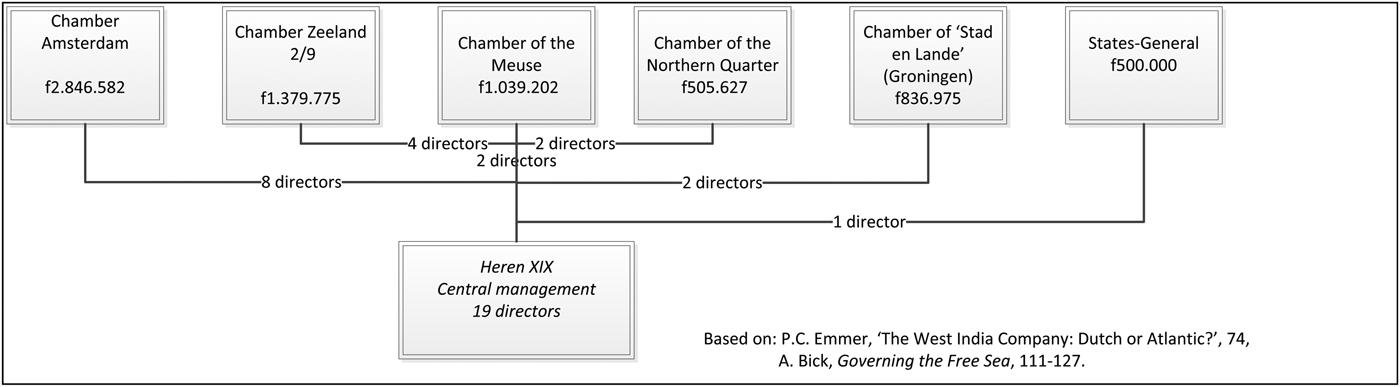
Figure 1 and the mismatch between investment and votes in the company reflect another fundamental problem that dogged the WIC immediately after its founding: a profound lack of interest. Rich merchants from Amsterdam appear to have been reluctant to invest in the new company, as the share of investment that this city contributed to the WIC was lower than when the VOC's shares were floated in 1602, even though, by 1621, the city was much richer. Furthermore, the figure for Amsterdam is flattered by the fact that cities without a chamber of their own could still obtain a directorship in a chamber if they invested at least 100,000 guilders in that chamber. In this way, Leiden, Haarlem, and Deventer all obtained a directorship in the Amsterdam chamber. The States General ultimately invested half a million guilders in the company, not in the form of a grant, but rather as a direct investment, and consequently acquired the privilege to send a delegate to the meetings of the Nineteen.Footnote 12
The chambers themselves were organized along similar lines, with some minor differences from case to case. This section briefly describes the cameral organization, focusing primarily on the relationships between shareholders and directors, as these proved to be of great importance in the eventual bankruptcy procedures. In early 1621, the States General stipulated that a general West India Company would be founded. The document recording this decision stated that at least four chambers would be established: in Amsterdam, Zeeland (with the head office in Middelburg), on the Meuse (split between Delft, Dordrecht, and Rotterdam) and the Noorderkwartier (the northern part of the province of Holland, with the head office split between Hoorn and Enkhuizen). In addition, if the northern provinces of Friesland and Stad en Lande (Groningen) were able to muster at least 500,000 guilders in investment capital, they, too, could establish chambers. While Groningen succeeded in raising this amount, Friesland failed to muster the necessary funds, thus making this province an inveterate opponent of the WIC from the start. After this initial period, the States General issued a charter in June 1621 setting out all the details of the company's complex internal organization. Individuals and organizations (such as city councils or orphan boards) could now invest deposit money with the chambers to buy shares, with the value of an investor's block of shares also determining that investor's status. Investors were divided into two groups: regular shareholders (participanten) and main shareholders (hoofdparticipanten). Qualifying as the latter required the investment of a certain minimum sum: at least 6,000 guilders in the case of Amsterdam, and 4,000 guilders in the case of the other chambers.Footnote 13
Accession to the body of main shareholders was significant because the directors were chosen from these shareholders. Significantly, the relevant urban or provincial authorities were entitled to make this choice. The main shareholders nominated three candidates for every position, and the magistrates then elected the director from these three individuals, thus clearly showing the degree of political involvement in the new company.Footnote 14 In contrast to the earlier VOC, the WIC had a number of important regulations intended to protect the interests of shareholders and allow them to influence company policy-making. In each chamber, the main investors regularly met to debate policy and the position of the company. To this end, they had the right to inspect the books, and the directors had to produce general accounts every six years.Footnote 15 This is significant as, during the bankruptcy proceedings, the investors claimed that the directors were untrustworthy because they had not been able to prepare proper six-year accounts. The main shareholders in Amsterdam, Zeeland, and the chamber of the Meuse also had the right to nominate a director from among their own. This main shareholder-director (hoofdparticipant-bewindhebber) was allowed to attend the meetings of the chamber and the Nineteen and to cast a vote.Footnote 16 Although these protections of investors’ rights may seem feeble from today's perspective, these rights were protected much more comprehensively than those accorded to investors in the VOC. An escalating debate between VOC directors and investors in the years immediately before the WIC's formation is likely to have led to the improved protection of shareholder rights in the WIC's charter.Footnote 17 In some cases, the minutes of the main shareholders’ meetings have been preserved, and these provide a crucial addition to our knowledge of the workings of the WIC, given that the minutes of the meetings of the directors themselves have only been preserved patchily. The WIC started its operations with a total of seventy-four directors in the five chambers. As one-third of the directors were supposed to step down every three years, the composition of the WIC's boards changed much more rapidly than in the case of the VOC.Footnote 18 Directors received fees amounting to one percent of the value of outgoing and incoming goods, as well as one-half of one percent of the value of incoming gold and silver. This money was intended as compensation both for the directors’ time and for the fact that they themselves had to pay the many clerks and assistants working for the company.Footnote 19 These fees caused much contention when circumstances later changed and new, previously unforeseen activities were deployed. In the 1640s, therefore, a debate arose as to whether the directors should simply be salaried; however, any such plans to this effect were never put into practice.Footnote 20
Even with the more elaborate protection of shareholder rights, enticing enough people to invest in the WIC proved difficult. It was not until 1623, two years after being founded, that the company had raised capital of 7,108,161 guilders and was able to commence operations. For these operations, the Nineteen had prepared a plan (“The Great Design”), with the idea being to take on what was seen as the weaker half of the Iberian Union: Portugal. By conquering Portugal's South Atlantic empire of Brazil along with Angola and the Gold Coast forts, the company could, at a stroke, become the major producer of sugar in the world. While it would go beyond the scope of this article to delve into the WIC's Brazilian adventure in any great detail, it was the two attempts to conquer Brazil (1624–1625 and 1630–1654) that were primarily responsible for the rapid deterioration in the company's finances. Though Bahia, the capital of Portuguese Brazil, was captured in 1624, it was lost the next year, and it was only thanks to the windfall resulting from the capture of the “Silver Fleet” in the Bay of Matanzas that the WIC was able to be saved at this stage. Between 1623 and 1639, the capital invested in the WIC was increased to just over seventeen million guilders in order to secure sufficient resources to fund the company's operations. This happened in various stages, with investors being requested each time to increase their invested capital by a certain percentage. The first occasion was as early as 1624, when a 50 percent increase was requested.Footnote 21 Although the request to increase the initial investment was, in principle, nonbinding, the Nineteen persuaded the States General to call on all investors to make the additional funds available. This was presented as an opportunity, a privilege even, and was made transferable to others.Footnote 22
Throughout the 1630s and 1640s, the company maintained large armies and costly naval squadrons in Brazil, and the higher capital consequently never lasted for long. Increasingly, therefore, the company came to rely on Generality grants (made available by the States General, but payable by the provinces) and the issuing of short-term debt.Footnote 23 But even the grants, which were made available because the WIC was considered important in the war against the Habsburg foe, proved difficult. Though they were awarded by the Generality, they had to be paid by the provinces individually, and most provinces proved increasingly reluctant to part with their money, none more so than Friesland, which did not have a chamber itself and so opposed the WIC at every turn. While issuing short-term debt by taking out loans on the money market meant that the company's trading activities could at least continue with some regularity, the company's long-term prospects showed no signs of improving. As a result, new loans were taken on to service older borrowings and, in this way, the company became increasingly burdened by debt. By 1649, five years before the fall of the final strongholds in Brazil, and as stated by Den Heijer, the WIC was indebted to the tune of thirty-six million guilders.Footnote 24 This figure, taken from Aitzema's Saken van Staet en Oorlogh, is stated to comprise the original capital investment of just over seven million guilders and, one supposes, the later increases in the capital as well. That would leave some nineteen million guilders of debt; however, this amount is difficult to reconcile with the debtors who eventually chose to convert their bonds into stock of the new company. Either Aitzema's figures are unreliable, the WIC had managed somehow to repay some of its debts, or large numbers of bondholders simply chose not to bother converting their bonds into shares in the new company in the 1670s. Regardless of the exact figures, the WIC was in dire financial straits as early as the 1640s. Yet even the end of the empire in Brazil in 1654 did not dent the prospects for the company's continued existence.
In the second half of the 1650s, Amsterdam, followed by the other chambers, reached agreements with its creditors on deferring debt repayments in return for the company agreeing to pay interest of 4 percent on these debts.Footnote 25 And while the merger with the VOC promoted by the WIC directors in the mid-1640s did not go ahead, the WIC's charter was at least extended in 1647 for twenty-five years. Though the company was in financial difficulties, it thus maintained a privileged position until 31 December 1671. But as the shareholders were then expected to take the opportunity to address their grievances to the States General, the company's directors requested in 1663 that the charter should be extended well ahead of time, in the hope that the renewal process would be smooth. In cherishing this hope, however, the directors would be sorely disappointed.
Recapitalization or Reform? 1663–1674
The request by the Nineteen in 1663 to renew the charter well ahead of time set in motion the chain of events that led to the bankruptcy of the company and its rebirth in the second West India Company in 1674. This request was placed just as the Republic was about to enter into war with England again, a war in which the WIC would lose its North American colony of New Netherland. Although the directors again drew their request to the attention of the States of Holland in 1666, the financial situation of the WIC had in the meantime deteriorated to such a point that it could not continue to fund the trade with Africa by itself. In April 1668, therefore, the directors took the step of offering shareholders the opportunity to invest new money, amounting to up to 5 percent of the nominal value of their shares, in a fund that would finance the trade with “the Gold-Coast in Guinea, as well as Ardra, Popo and Benyn.”Footnote 26 These invested funds would be kept separate from the rest of the company's capital and, more importantly, its debts. These funds would be used solely to fund the African trade, with the profits being shared between the company (for two-thirds) and the investors (for one-third).Footnote 27 Some seven hundred thousand guilders were deposited in the fund, and this sum would at least enable the WIC to continue its operations on the Gold Coast. In the same year (1668), the Nineteen requested the States General to finally pay an estimated five to six million guilders of grants that had been awarded in the 1630s, ’40s, and ’50s, but had never in fact been paid. These funds had originally been granted to support the war in Brazil. Now that there was no hope of the colony being recovered, the provinces proved as intractable as ever and the money remained unpaid. Although the settlement with Portugal had included amounts to cover the losses suffered by the WIC in Brazil, Portugal had refused to pay these amounts, claiming that the VOC had captured Cochin and Cannanore in India after the cease-fire. In 1668, therefore, the WIC tried instead to persuade the States General to make the VOC pay the WIC three million guilders, an effort that also proved futile.Footnote 28
Finally, in September 1668, the States of Holland responded to the directors’ request of some five years earlier concerning the charter renewal. This response, however, was most unpleasing to the WIC's directors as it largely addressed the concerns of the shareholders and creditors at the expense of the position of the directors. The following three years saw a continual debate between directors, shareholders, and bondholders over the best ways to reorganize the company. One of the main concerns was the need to find a million guilders to form a fund to finance the African trade. While the shareholders were unwilling to provide this money, the directors were unable to do so and also rejected an innovative scheme devised by the bondholders to lease the gold trade to the VOC. Under this scheme, the bondholders had proposed leasing the trade in gold to the VOC for 150,000 guilders a year, which would cover the costs of operating the forts on the coast. In return, the bondholders then promised to buy one million guilders worth of WIC stock. However, since the WIC directors did not agree to this, the plan was shelved.Footnote 29
It is noteworthy that, in these discussions, the idea to wind up the company and auction off its assets was quickly rejected because it simply was not feasible to sell the overseas possessions, and the income generated by a sale would be too meagre to make much of a dent in the mountain of debt anyway. Continuing the company in one form or another was seen as providing a better opportunity to salvage at least something.Footnote 30 In addition, it was clear by mid-1671 that the Republic would soon face a war with France. In the event of war, private merchants would not be able or willing to invest in risky long-distance trade, and only the WIC was able, however deficiently, to provide some manner of protection for the Dutch interests on the African coast. Tellingly, no one ever seems to have proposed opening up trade for all citizens of the Republic and bringing the WIC's possessions under control of the Generality. As a result, however, of the declaration of war by France, England, Cologne, and Münster in June 1672, the debates concerning the WIC's future were put on hold and, after expiring in January 1672, the charter was subsequently renewed for short periods only.Footnote 31 By March 1674, however, the situation was stable enough for the States of Holland to present a draft charter for a new company. This draft charter clearly made the case for an Atlantic company in its opening statement:
That we [the States General] have found by experience that the prosperity of these lands is markedly advanced by the commerce and navigation of its good inhabitants. Also, that this navigation and commerce can but very problematically be maintained and protected on far-off lands and districts without the general support and mutual assistance of various considerable inhabitants, associated to this end… . Footnote 32
Bankruptcy
The draft charter of March 1674 proved to be a turning point. By acknowledging many of the complaints of the shareholders and bondholders, it forced the WIC directors onto the defensive and made them articulate why they thought the existing company structure should be maintained. The investors (participanten) in particular complained that the directors had refused them access to the company's accounts, a claim which the directors vociferously denied. These tensions are clearly reflected in the minutes of the meeting of the Amsterdam Chamber's directors on 14 June of that year:
And especially that some main shareholders [hoofdparticipanten] have unfaithfully accused Directors behind their back, saying that these had refused access to the books to the main shareholders and the accountants [reeckenmeesteren, accountants charged with controlling the books]. On the contrary (as they very well know) the aforementioned Director as well as other Directors, his colleagues, had been expressly authorized to make the necessary orders and help perfect these books and that the aforementioned accountants [reeckenmeesteren] were not only given access to them, but have worked in them at all hours to show their contents to all the world (often helped by strangers against their duty).Footnote 33
A month later, the new charter was discussed at the meetings of the main shareholders in Amsterdam, who, although voting to accept the proposed charter, requested the States General to reconsider the procedures for appointing new directors, as well as the proposed mandatory “activation fee” of 4 percent of the nominal value of old stocks.Footnote 34 By this time, the shareholders and bondholders had overcome their earlier differences: the bondholders had previously argued that they should be compensated ahead of the shareholders if it was decided to wind up the company. A plan had even been mooted to split the WIC into two companies: one for the northern coast of Africa up to and including the Coast of Guinea, which would be brought under the shareholders’ control, and the other being responsible for managing the interests and trade in the rest of Africa and the Caribbean, which would be brought under the creditors’ control.Footnote 35
With the idea of continuing the company as a whole in some way or other, the shareholders and bondholders joined forces to oppose the directors, demanding that the company should be made more efficient, with fewer directors and with the directors’ powers being markedly curtailed. In addition, the existing body of directors should be replaced by members representing the shareholders and bondholders. In response to the draft charter for a new company, the directors meanwhile published a special pamphlet giving point-by-point arguments against the provisions in the new charter with which they especially disagreed. The directors were particularly displeased by the fact that while the States General had previously stated that the WIC's current structure should be maintained, it now suddenly favoured a new organization. Among other things, the directors argued that recruiting new directors from the body of shareholders and bondholders would not result in better management as it was likely that those elected from the body of the main shareholders “would not be the most capable, but those who have the most friends.”Footnote 36
However, the state of the company was such that the shareholders and bondholders were naturally in the more advantageous position. As a result, the draft charter was amended to address their concerns and the new company received its charter on 20 September 1674. But how exactly did the new charter manage the financial transition from one company to the next?
Converting Stocks and Debts
The charter for the new company followed word-for-word the description of the reason for establishing a new company that had already been given in the draft charter drawn up by the States of Holland:
The affairs of the same Company have gone to such a state through various disasters that its Participants are unwilling to continue the aforementioned Company; through which we … have approved … to dissolve and destroy the West-Indian Company.Footnote 37
As argued before, this “destruction” should be taken with a pinch of salt: none of the old company's goods or possessions would be sold at auction, no employees would be fired, and the new charter even allowed the directors to continue enjoying their privileges. The shareholders and bondholders, however, were treated differently: their old investments and bonds were simply converted into stock in the new company. Shareholders received shares amounting to a nominal value of 15 percent of their old shares, while bondholders received bonds with a nominal value of 30 percent of their old bonds. It is important to mention that not all the latter had actually lent money to the company. Many bondholders were in fact former employees of the company who had never received their wages, but had been given company bonds instead. These included many former ministers of the Dutch Reformed Church in Brazil, as well as mighty men like Johan Maurits van Nassau-Siegen, the WIC's former governor-general in Brazil, who claimed no less than 350,000 guilders in back wages.Footnote 38
While Henk den Heijer argues that the nominal stock of the new company was 4,505,863 guilders,Footnote 39 N. H. Schneeloch, in his 1971 article on the financing of the new WIC, presented a final figure of 6,332,361:18:8 guilders. This difference is attributable to the various creditors left unnamed in the charter itself, and who were only later mentioned in an addendum of October 1674. Interestingly, though the pre-1656 creditors received only 30 percent worth of new stock, creditors who lent money to the WIC after 1656 received new stock for a nominal value of 100 percent of the sums they were owed. This was their reward for lending money to the company when it was already in dire straits. In addition, some creditors who were still owed interest on credit they had provided to the company also received new stock amounting to 100 percent of the nominal value of their old stock.Footnote 40 These creditors explain the difference of some 1.8 million guilders between the sums mentioned by Den Heijer and Schneeloch. The new nominal capital of the second WIC is shown in Table 1. The actual capitalization of the new company was quite different from the nominal value of the issued stocks, however.
New Nominal Capital of the Second WIC, Final Calculation of 1710. N. H. Schneeloch, “Das Grund- und Betriebskapital der zweiten Westindischen Compagnie,” 326.
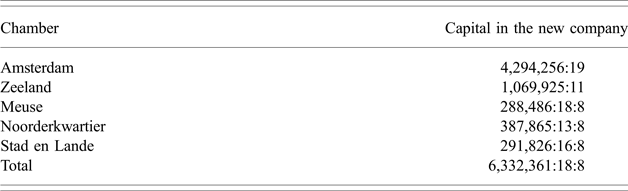
The invested capital resulting from the conversion of old stock and bonds was purely fictional capital as it was created not by auctioning assets or new contributions, but instead by converting old stock and debts into new stock; in other words, a paper exercise only. This also qualifies the statement that the creditors of the company were paid in full.Footnote 41 Some of the company's creditors were admittedly compensated for the full amount of their outstanding credit by being given stock in the new company. But this, too, was a paper promise as the new company's stock never traded above par except during two brief periods of speculative fury in 1688 and 1720.Footnote 42 However, the value of the stock on the Amsterdam market was only one issue. To maintain its operations on the African coast and the Caribbean islands, the new company needed ready cash to pay its garrisons and employees and to buy products for trade.
To acquire cash for new working capital, the new shareholders were required by a provision in the new charter to deposit 4 percent of the nominal value of their stock and credit with the company's treasuries in the chamber cities. While those happy few who were compensated for the full nominal value of their credit were exempt from this requirement, the company's new management required old bondholders to deposit 8 percent of the value of their credit. If these payments were not made, the old stock or bonds were deemed “dead” and holders could not make any claims on these instruments. Shareholders and bondholders thus had to take a risk if they wanted to convert their old stock and bonds into new company stock. Although the charter had initially set strict deadlines for those wishing to convert to new stock, these deadlines were later extended and, by 1695, the new company had acquired the sum of 1,240,490:3:8 guilders in cash. This was, in many ways, a much more important sum than the nominal value of some 6.3 million guilders in new stock, as the 1.2 million in cash represented capital actually invested in the new company, rather than the paper value of the stock. This also makes the contrast between both iterations of the WIC clear: the first company had an initial invested sum of some seven million guilders, which was quickly increased, while the second company's capital amounted to just over one million guilders. This was in effect the fund for the African trade that had been proposed in the 1660s, but without the old debts attached.
In terms of capital and debt, therefore, there were significant differences between the first and the second companies, but did the organization change in any meaningful ways? The new charter did not change the most important characteristic of the company; in other words, it maintained its five-chamber structure, even though the number of company directors was reduced to fifty, with the central board of management of nineteen (the Nineteen) reduced to ten (X, or the Ten, for short). But the same division that had regulated the voting balance in the Nineteen remained in effect, with each chamber's share simply being reduced by half, and the States General retaining its single vote. The powers of the new company's directors, however, were pared back in relation to the powers of their predecessors. A frequent complaint of the shareholders in the late 1660s and early 1670s had been that the directors had not fulfilled their obligation to present clear financial results for years. The new directors, by contrast, were required to present clear figures on the new company's financial situation every three years (the driejaarlijkse rekening). In addition, the composition of the body of the directors was changed in certain important ways: the new (reduced) body of directors consisted of one-third of directors of the old company, while one-third were to be elected from among the shareholders and one-third from among the bondholders. This, to a large extent, broke the power of the old directors, who had formed a tightly knit group.
In the winding-down of the first company's affairs, therefore, all the interested groups got something, while also at the same time losing something. The most serious losses were, of course, borne by the shareholders and bondholders, who lost much of the capital that they had invested in or that was owed to them by the company. In return for depositing more money (the 1.2 million guilders referred to above) to enable the new company to start its operations, they were granted stock amounting to 15 or 30 percent of their original investment. Why, then, did so many still agree to pay these additional sums and convert their old stock into new stock? Why did they not simply write off these funds as lost? A simple calculation may help to shed some light on this question. If investors had originally held 1,000 guilders in the old WIC, they (whether they were individuals or the orphan boards and city councils who had invested) could recoup 150 guilders (i.e., 15 percent) worth of new shares in return for paying a sum of 40 guilders (i.e., 4 percent) to “activate” the stock. These new stocks were not actually worth 150 guilders in the market, but, to improve on their starting position, investors simply needed to be able to trade the new stocks at above 40 guilders. By the 1670s, many stockholders were also not likely to have paid the nominal value for their old WIC stocks either, but would instead have bought them on the market at a discount, thus making their potential losses from the conversion less daunting. This scenario highlights the importance of the decision made to convert old stock into new rather than terminating the business. Since the assets of the WIC would not be auctioned off, the only way for shareholders and bondholders to recoup some of their losses was to go along with the plans and hope that they would ultimately be able to sell their new stock to cover the costs of the “activation fee” of 4 or 8 percent. If the company had gone bankrupt in a more straightforward manner and its assets had been sold off to repay (as much as possible) shareholders and bondholders, the dynamics of these choices would have been very different indeed. The bankruptcy of the first WIC was thus in many ways simply a paper exercise, with a limited impact on operations. As far as we can tell, no ships were sold, no personnel laid off, and overseas activities (such as they were) continued much as before. This was likely to have been the States General's intent in choosing this route as a means of dealing with the first company's debt burden.
The directors (who, it must be remembered, were themselves also investors) were affected by the bankruptcy, too. Although their personal assets were protected by their liability being limited, their numbers were much reduced because two-thirds of the remaining directorships were assigned to former shareholders and bondholders, thus changing the social composition of the group significantly.
Consequences of the Collapse
In many ways, the bankruptcy of the WIC was a paper exercise. Share values were reassessed and new capital was drawn in. But the operations in the Atlantic itself, such as they were, continued. The forts on the Gold Coast, for example, were still manned and continued to act as centres for the trade in gold, ivory, and enslaved Africans, even though trade in the latter did not show any marked increase until the Spanish asiento was subcontracted to the WIC in the 1680s. Nevertheless, the reform of the WIC was important for Dutch overseas expansion. Coming at the time it did, in the middle of a costly war with France and England that almost caused the Republic to collapse in 1672, the looming failure and uncertainty over the future of the WIC meant a vacancy in long-distance maritime warfare. This was all the more significant as, with the exception of the earlier Dutch–Portuguese conflict, the war of the 1670s was perhaps the first moment at which coalition wars in Europe had major effects overseas. The conflicts in the Caribbean in the 1670s, and along the coasts of Ceylon and southern India, presaged the colonial conflicts of the eighteenth century. The period of the 1670s was also the last period in which the Dutch Republic could seriously consider increasing the size of its Atlantic holdings. But while the decade actually saw a greatly increased presence of Dutch warships and ventures in the Atlantic, none of these was a WIC expedition. In November 1672 the States General passed a resolution that allowed ships of the Admiralty of Amsterdam to operate within the charter areas of both companies at will,Footnote 43 with company officials being ordered to provide all the necessary support. And though the VOC was included in this resolution, it was clearly the WIC that was the target. Indeed, from 1673 onwards, ships from the Admiralties of Amsterdam and Zeeland (which had also gained the privilege) operated in the Americas. New Netherland was then recaptured, although the colony was lost at the negotiating table the next year. Meanwhile a large-scale attempt by Admiral de Ruyter to conquer Martinique, with a fleet of forty-eight ships and an army of three thousand men, failed in 1674. French Acadia was briefly captured in 1675, and the WIC still claimed the area as late as 1678, even though by then it had already been retaken by the French. Jacob Binckes was sent to the Caribbean in 1676 with a small squadron from the Admiralty of Amsterdam after the notorious Hendrik Carloff led the admiralty board to believe that it could capture the French colony of Cayenne and recapture the island of Tobago, which had previously been a Dutch colony, the rights of which had been bought by the States of Holland in 1674.
However, while this period saw the capture, or recapture, of Cayenne, Tobago, St. Maarten and Marie-Galante, these gains did not endure and only St. Maarten remained a Dutch colony. These expeditions and conquests all have in common the fact that they were the result of improvisation and spur-of-the-moment action. It is significant that, in the mid-1670s, the admiralty boards suddenly started becoming actively involved in colonial ventures in the Atlantic. However, colonial ventures had always been difficult to fit in with the admiralty boards’ regular tasks. What was needed for stable colonial governance was a body that could adequately provision and govern Atlantic colonies, with the financial power to defend them or the political clout to force assistance from the admiralties. The lack of such a body meant that there was no coherent strategy or plan for the newly won colonies and that these colonies would quickly be negotiated away during peace treaties. What the Republic lacked, therefore, was an “Atlantic interest” that could clearly voice its opinion (not beset by infighting) and had the political clout to protect its interests. The old WIC had been such an organization, once. But the failure and bankruptcy of the first WIC left a void that was not filled either by the new organization of the same name, nor indeed by the Dutch state itself, and this had significant implications for the role of the Netherlands in the Atlantic. Although recent scholarship has heralded the Dutch as the “middlemen” and “brokers” of the Atlantic, one cannot help but feel that this in some ways glosses over the fact that the seventeenth-century Republic was surprisingly bad at retaining possession of its Atlantic colonies.Footnote 44
Conclusion
The bankruptcy proceedings of the Dutch West India Company present a fascinating case study for researching the ways in which Early Modern joint-stock companies actually worked (or did not work) in practice. They highlight the crucial importance of politics in the management of the Dutch companies, thus making it impossible to study them from a business perspective alone. The WIC's failure was perhaps the most significant business failure in the seventeenth-century Republic, gauged both in terms of the sums involved and the political and geopolitical stakes. This bankruptcy was clearly no ordinary business failure, as the political stakes involved were simply too high. The first WIC collapsed under the weight of its failed bid to conquer Brazil. Weighed down by debt and unpaid grants, it had proved unable to guarantee the continuation of operations. Internecine struggles between various interested parties (directors, stockholders, bondholders) then made it difficult to find a satisfactory solution to the problem posed by the bankruptcy. Yet no-one seriously considered simply letting the company go bankrupt and opening the Atlantic up to free trade. All the actors involved, even those most fiercely opposed to the management of the old company, agreed that only a chartered company could successfully protect the commercial and political interests of the Netherlands in the Atlantic. At no point was it suggested that the state itself should bear the responsibility for colonial governance and defence. Problematically, the new company had only a little over one million guilders in cash at hand, while its immediate predecessor in the early 1620s had had more than seven million guilders. This makes it somewhat puzzling as to why the area covered by the charter was described in exactly the same way in the new charter as in the old charter. However, the new charter did introduce a significant innovation by dividing the charter area into two parts. On the one hand, there was the coast of Africa and the Caribbean islands, especially Curacao, which remained the company's exclusive domain. On the other hand, the other parts of the charter area were opened up to private enterprise in return for payments to the new WIC. This meant that the new company would not act in the same way in all respects as the first WIC or indeed the VOC.
The WIC's bankruptcy is also interesting in that it exposes something remarkable about Dutch colonial expansion in this period. Despite the spectacular failure of the WIC, no-one advocated a different institutional model for managing the Dutch interests in the Atlantic. Although, in practice, most activities in this period took place outside either the old or the new company (i.e., the admiralty boards’ expeditions or the management of the colonies on the Wild Coast), none of the interested groups advocated doing away with the idea of a chartered company as the best way to manage trade and govern the Dutch possessions. This was likely to have been the result of a lack of strong executive authority in the Dutch “central” state. The Generality could grant privileges to a company, but these would be acceptable only if the company itself was a careful representation of all, or most, of the interests of the various provinces at stake. It is telling that, despite its costly nature, the new charter did not do away with the company's chamber-based structure. The organization of the Dutch interests in the Atlantic after the bankruptcy of the first WIC is at least a partial refutation of Arthur Weststeijn's thesis that the debates on trade with Dutch Brazil sparked the beginning of a “free trade ideology.”Footnote 45 Pieter de la Court, who is accorded a central role in formulating this “free trade ideology,” even became a main shareholder in the new company and attended the meetings of the Ten as an observer.Footnote 46 If there indeed was such an ideology on free trade, it is at least interesting to note that at no point during the debates on what to do with the WIC was the idea of simply opening up the Atlantic trades mooted. The Dutch state needed a federalized, chartered company to take care of colonial governance and defence, which could not easily be taken care of by the Dutch state itself at a federal level. The failure of the second WIC to fill these shoes explains the slow deterioration of its position in the Netherlands after the granting of its charter in 1674.
Finally, the bankruptcy proceedings are telling in themselves. While the shareholders largely got what they wanted, thus making them the “winners” in their dispute with the old directors as to how the company should be wound down, the proceedings are also extremely revealing in the way that they show the relationship between state and company. The Dutch state did not take on the debt incurred by the WIC, as it would do in 1791 and again in 1795, when the second WIC and VOC respectively were nationalized. But neither did it ever contemplate opening up the Atlantic trade or simply letting the WIC go bankrupt and allowing it to sell its assets to the highest bidder. The resolution of the conflict between the shareholders and bondholders, on the one hand, and company directors, on the other hand, was such that the continuity of the operations in which the WIC was most active—the trade in gold, ivory, and enslaved Africans—was never threatened. This, perhaps more than anything else, shows that the WIC was a very unusual company, protected to some degree by the state, and that its bankruptcy was an unusual, highly politicized affair.


 Open access

