


1. Introduction
Conventional Life Cycle Assessment (LCA) has been recognized as a comprehensive instrument for measuring the environmental impacts of products across their life cycles, from resource extraction to end-of-life disposal (TISO, 2006a; ISO, 2006b). Despite its robustness, traditional Life Cycle Assessment (LCA) encounters considerable obstacles in early-stage product development, such as its intrinsic complexity, time-consuming procedures, and elevated costs, which make it impractical for numerous small and medium-sized enterprises and industries (Reference Hetherington, Borrion, Griffiths and & McManusHetherington et al., 2014; Reference Witczak, Kasprzak, Klos, Kurczewski, Lewandowska and LewickiWitczak et al., 2014). Streamlined Life Cycle Assessment (SLCA) was developed as a practical alternative, providing simpler but comprehensive assessments. SLCA enables quick and economical decision-making by narrowing the analytical scope, using qualitative data, or focusing on key environmental indicators (Reference Hunt, Boguski, Weitz and & SharmaHunt et al., 1998; Reference Rebitzer, Ekvall, Frischknecht, Hunkeler, Norris, Rydberg, Schmidt, Suh and WeidemaRebitzer et al., 2004). These qualities are especially vital during the initial design process, since early choices greatly affect a product's total environmental impacts. Initial design choices are expected to influence as much as 80% of a product's environmental impacts (Reference Tischner, Schmincke, Rubik and PröslerTischner et al., 2000). Therefore, providing designers with tools that include environmental factors is crucial.
This research proposes an SLCA approach that seeks to bridge the gap between traditional LCA methodologies and the dynamic requirements of product development processes. This approach aims to enable designers to systematically identify and address environmental hotspots throughout the design process, hence promoting more sustainable outputs, based on current methods and commercial applications (Reference Hauschild, Rosenbaum and & OlsenHauschild et al., 2018). The development of the SLCA approach aligns with widespread initiatives to include sustainability into design methods. Design for Sustainability (DfS) promotes techniques that prioritize environmental issues, shifting from reactive mitigation to innovative design methods that tackle impacts at their origin (Reference Ceschin and & GaziulusoyCeschin & Gaziulusoy, 2016).
The integration of SLCA into product development processes has effects that extend individual products. Its use in industries like construction, packaging, electronics, and waste management illustrates its adaptability and efficacy in facilitating rapid environmental assessments (Reference Andrae and & VaijaAndrae & Vaija, 2017; Verghese et al., Reference Verghese, Horne and & Carre2010; Wang et al., Reference Wang, Levis and & Barlaz2021; Wu et al., Reference Wu, Duan, Wang, Wang and Wang2015). Recent advances in machine learning and artificial intelligence provide novel opportunities for optimizing LCA approaches. These technologies may automate data acquisition, optimize material flows, and improve predictive modeling, therefore considerably reducing the time and resource requirements of conventional methods (Reference Ghoroghi, Rezgui, Petri and & BeachGhoroghi et al., 2022). The effective integration of these technologies requires rigorous adherence with data quality and transparency, guaranteeing that methodological rigor is maintained (Reference Horne, Grant and & VergheseHorne et al., 2009; Heijungs & Dekker, Reference Heijungs and & Dekker2022).
Nonetheless, achieving the ideal balance between practical efficiency and accuracy remains a challenge. Over-simplification compromises the accuracy and reliability of results, requiring the integration of validation methods such as sensitivity analyses and benchmarking (Andrae & Vaija, Reference Rebitzer, Ekvall, Frischknecht, Hunkeler, Norris, Rydberg, Schmidt, Suh and Weidema2017; Rebitzer et al., Reference Rebitzer, Ekvall, Frischknecht, Hunkeler, Norris, Rydberg, Schmidt, Suh and Weidema2004). The primary objective of this study is to propose an SLCA approach that balances accuracy with practical efficiency, facilitating its use in different product development scenarios. The research question underlying this study is: How can a streamlined life cycle assessment (SLCA) approach be designed to balance accuracy with practical efficiency, enabling its effective use in early-stage product development? The approach differentiates itself from current SLCA methodologies, which usually focus on qualitative evaluations, limited impact categories, or product-specific applications, by incorporating AI-driven process selection, 3D model-based inventory generation, and automated data collection. The scope of the study is to align with traditional LCA standards while optimizing processes to reduce time-spent and input requirements maintaining accuracy. The approach was developed for broad application across several sectors with modular steps that can be tailored to diverse product development contexts.
2. Development
2.1. Literature review
Across sectors, certain patterns emerge in the application of SLCA. These include leveraging existing Full LCAs (FLCA), which refers to the traditional methodology with no simplification, to inform streamlined models, focusing on major environmental flows, and employing sensitivity analyses to validate results. Niemistö et al., (Reference Niemistö, Myllyviita, Judl, Holma, Sironen, Mattila and Antikainen2019) proposed the concept of LCA clinics, which tailor the SLCA process for small and medium-sized enterprises by relying on secondary data and limiting the scope to key impact categories, such as climate change. While these approaches enhance accessibility, they often raise concerns about the comprehensiveness and accuracy of the assessments.
Another challenge lies in balancing practical efficiency with accuracy. Over-simplified methodologies risk omitting critical environmental impacts or introducing significant uncertainties. For example, discrepancies observed in the eco-rating of mobile phones highlight the potential trade-offs between speed and precision in SLCA (Reference Andrae and & VaijaAndrae & Vaija, 2017). To address this, researchers have advocated for the use of reliability checks, such as sensitivity and uncertainty analysis. (Reference Horne, Grant and & VergheseHorne et al., 2009).
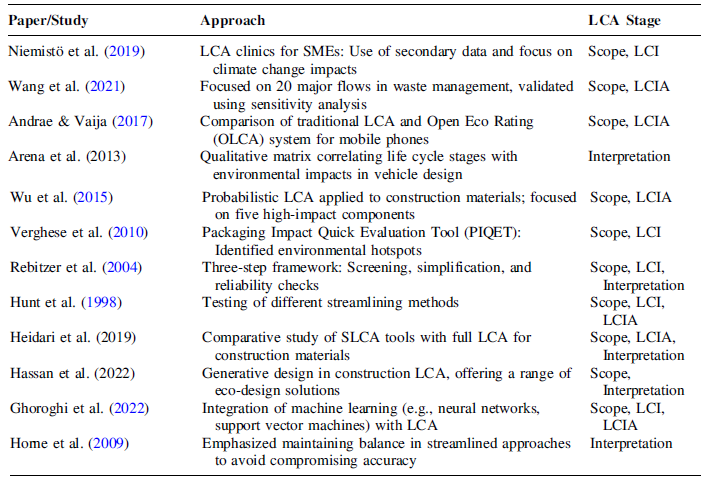
Table 1 synthesizes the reviewed studies and their methodologies, structured across the key stages of LCA: Scope, Life Cycle Inventory (LCI), Life Cycle Impact Assessment (LCIA), and Interpretation. This structure facilitates understanding of how each approach contributes to streamlining the LCA process and the stages at which these strategies are applied.
Literature review

2.2. Benchmarking
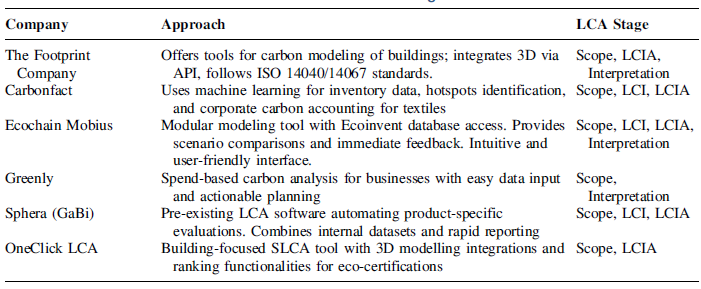
To identify strategies addressing user challenges with LCA methodologies, this research undertook a benchmarking analysis of SLCA-based business models. As highlighted by Camp (1989), benchmarking serves as a critical method for identifying industry best practices and developing solutions that have been tested in real-world scenarios. Companies were selected based on two key criteria: (1) the extent to which their tools streamline LCA processes (e.g., automation, predefined datasets, or simplified workflows) and (2) their applicability across different industries (products in general, electronics, construction, consumer goods and packaging). The analysis prioritized companies that demonstrated innovation in SLCA methodology, such as AI integration, modular modelling, or rapid impact assessment. Table 2 presents the benchmarked companies, their approaches, and the stages of LCA at which these strategies are applied—Scope, Life Cycle Inventory (LCI), Life Cycle Impact Assessment (LCIA), and Interpretation.
Benchmarking

2.3. Summary
The integration of LCA into product development is critical for achieving sustainable design, yet it faces significant challenges that limit its practicality. LCA methodologies are often too complex, requiring specialized skills that many designers and engineers lack, making them inaccessible during the critical early design phases where 80% of a product's environmental impacts are determined (Reference Tischner, Schmincke, Rubik and PröslerTischner et al., 2000). Additionally, traditional LCA is time-consuming, costly, and unsuitable for industries with rapid development cycles, as acquiring and analyzing accurate life cycle data often demands considerable resources and expertise (Reference Koller, Fischer and & HungerbühlerKoller et al., 2000; Reference Witczak, Kasprzak, Klos, Kurczewski, Lewandowska and LewickiWitczak et al., 2014). Early-stage development further complicates this process due to the uncertainty and iterative nature of design concepts, making it difficult to apply conventional LCA tools effectively (Reference Hetherington, Borrion, Griffiths and & McManusHetherington et al., 2014).
To overcome these barriers, LCA tools must be reimagined to align with the needs of product developers, prioritizing simplicity, speed, and cost-effectiveness. The challenges were identified through empirical studies in the literature that analyse barriers to LCA adoption across various industries. The needs were derived directly from these challenges, representing the essential requirements to improve LCA accessibility and applicability in product development. Finally, the strategies were developed based on benchmarking of existing SLCA tools and methodologies, as well as insights from relevant literature. Table 3 presents an integrated table of challenges, needs, and strategies to address product development.
Challenges, needs, and strategies

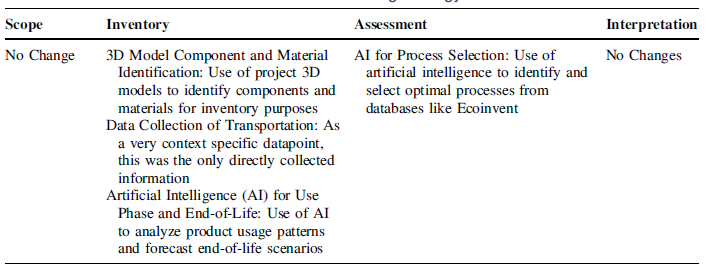
Through iterations with design specialists and LCA practitioners and recognizing that many of the aforementioned strategies do not lead to immediate changes in LCA results—thus neither affecting accuracy nor necessitating reliability checks—those strategies with the potential to address the research question were prioritized for selection. Therefore, strategies were selected based on their capacity to influence the outcomes in terms of time spent, number of inputs, and accuracy. This decision to focus on these three parameters was informed by discussions with LCA practitioners, who highlighted the need for a approach that reduces complexity and time requirements while maintaining acceptable accuracy. This directly addresses the research question: How can a streamlined life cycle assessment (SLCA) approach be designed to balance accuracy with practical efficiency, enabling its effective use in early-stage product development? Table 4 presents the streamlining strategy developed.
Streamlining strategy

2.4. Modelling approach
Developing a Streamlined Life Cycle Assessment (SLCA) approach requires a comprehensive FLCA as a baseline for comparison. The FLCA provides a detailed evaluation of the environmental impacts across all stages of a product’s life cycle, offering a reliable framework for benchmarking streamlined strategies. As emphasized in the literature (Reference Rebitzer, Ekvall, Frischknecht, Hunkeler, Norris, Rydberg, Schmidt, Suh and WeidemaRebitzer et al., 2004; Reference Hetherington, Borrion, Griffiths and & McManusHetherington et al., 2014), this baseline ensures that the streamlined approach maintains sufficient accuracy and captures key environmental hotspots, despite its simplified approach. Figure 1 presents the process.
Modelling approach

For the streamlined approach, the scope remains unchanged to align with the FLCA's boundaries and objectives. In the inventory phase, the approach integrates 3D models and material identification libraries, such as Granta software from Ansys (Ansys, 2024), to automate and streamline data collection, reducing manual input and improving accuracy by extracting weight and geometric data directly from models and assigning material properties automatically. It also uses secondary data to determine the use and end-of-life scenarios and directly collects the data regarding transportation. The modelling phase leverages artificial intelligence (OpenAI, 2024) to select the most suitable processes from databases like Ecoinvent (Ecoinvent, 2024), supporting reproducibility and transparency through consistent input data, selection patterns and documentation. The assessment phase also remains unaltered to maintain the robustness of result analysis, using ReCiPe 2016 as the assessment and normalization method as it uses impact mechanisms that have global scope(Pré-Sustainability, 2024). Following assessment, the streamlined results are compared with the FLCA, such comparison was based in three major aspects: time spent, number of inputs and accuracy of the results.
-
Time spent; Calculated based on the beginning of the LCA practitioner activity in the scope phase.
-
Number of Inputs; Individual data entry points used specifically for the LCA modelling (e.g travel distance, material weight, energy usage).
-
Accuracy; Based on the average percentual proximity to the FLCA.
2.5. Study case: electronic device
To develop and validate the Streamlined Life Cycle Assessment (SLCA) approach, a case study was conducted on an electronic device currently available on the market. The assessment follows a cradle-to-grave approach, encompassing all life cycle stages from raw material extraction to the end of life. The functional unit defined for this study is 'five years of usage of the electronic device,' reflecting the typical usage period and ensuring a consistent basis for comparative analysis. This period was selected based on industry standards and product lifespan data for similar electronic devices. While shorter or longer usage periods could alter the environmental impact distribution, five years was chosen to balance representativeness and comparability with existing LCA studies. Although the identity of the product cannot be disclosed, nor the inventory data, this limitation does not affect the validity of the approach or the study. The product is manufactured and primarily sold within Europe, with its use phase involving energy consumption, and its end-of-life management modeled on the average practices for electronic devices within the region.
The FLCA was conducted in alignment with ISO standards (ISO, 2006a; ISO, 2006b) to ensure methodological consistency and accuracy. Inventory data was collected directly through detailed measurements, including the weighting of individual components, analysis of manufacturing processes, and supplier specifications. This comprehensive approach allowed for an in-depth understanding of the environmental impacts associated with the product's life cycle.
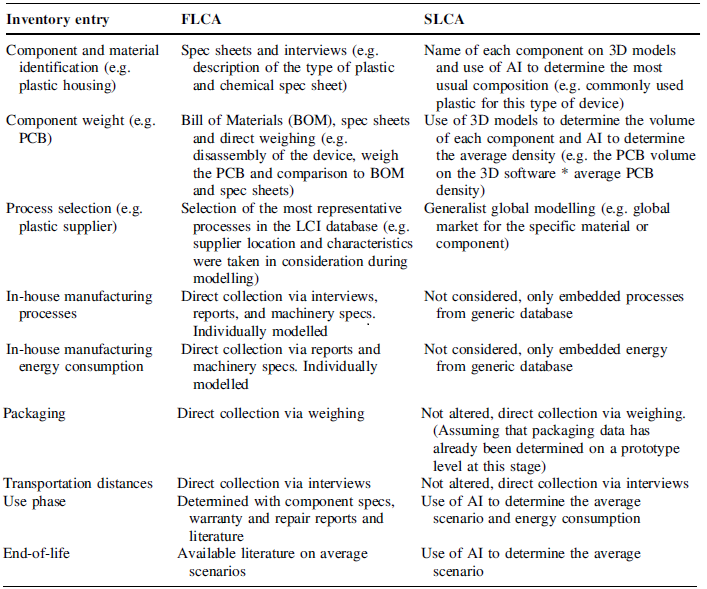
For the SLCA, the same functional unit and overall scope were maintained to ensure comparability with the FLCA. However, certain data typically unavailable during early design stages was intentionally suppressed. For example, instead of relying on detailed supplier specifications, simplified assumptions and generic datasets were utilized. The inventory process for the SLCA was tailored to rely on readily available tools, such as 3D models material libraries, artificial intelligence, and the use of pre-existing databases. This process reflects realistic constraints during product development while maintaining alignment with the streamlined strategy defined earlier. By systematically omitting detailed, hard-to-acquire data, the SLCA aims to mirror the practical limitations faced in real-world applications. Table 5 presents the approach for each inventory entry that determines the inputs.
Inventory entries

3. Results
The FLCA and SLCA assessments demonstrate differences in input requirements, time investment, and resulting accuracy. The FLCA, completed over three months, required 86 unique data inputs, offering a comprehensive evaluation of the product's environmental impacts, which, for this comparison, will be considered 100% accurate. In contrast, the SLCA reduced the number of inputs to 26 and required one week for completion, achieving 90.05% of the accuracy of the FLCA. Table 6 presents an overview of the comparison.
Overview of the comparison

The SLCA reduces the number of inputs by 69.77% and decreases the time required by 91%. However, this efficiency comes with a trade-off in overall accuracy, which is reduced by 9,95%. It is interesting to note that there are different ranges of variation depending on the environmental impact. Figure 2 presents in detail the impacts based on ReCiPe 2016 (Pré-Sustainability, 2024).
Results and comparison of environmental impacts

The table provides a comparative analysis of the FLCA and the SLCA across various environmental impact categories. It evaluates the accuracy of SLCA results against the FLCA, treating the latter as the reference standard. The SLCA demonstrates an average accuracy of 90.05%, with deviations ranging from 79.00% (terrestrial ecotoxicity) to 97.61% (ionizing radiation). The differences observed in specific impact categories highlight areas where SLCA methodologies may oversimplify or diverge from the FLCA. Categories with lower accuracies suggest greater sensitivity to data reduction. Conversely, categories like ionizing radiation and land use maintain higher accuracies with less than 3% of variation, reflecting their robustness to streamlining.
The histograms, Figure 3, depict the results of a Monte Carlo simulation conducted for the global warming impact category, chosen due to its significant relevance as a contemporary environmental challenge (IPCC, 2023). The results show that the FLCA achieves a mean value of 1.588 with a standard deviation of 0.069, while the SLCA has a mean value of 1.393 with a lower standard deviation of 0.063, indicating reduced variability but a slight underestimation compared to the FLCA. Notably, the median values (1.586 for FLCA and 1.396 for SLCA) align closely with their respective means, emphasizing consistent outputs.
Monte Carlo simulation, global warming

Given the importance of global warming as a trending topic in sustainability and public policy discussions (IPCC, 2023), these findings highlight the SLCA's utility in approximating high-accuracy outcomes with significantly reduced complexity. In terms of normalized results, figure 4 presents a hierarchical, from lower to higher, comparison of results between the FLCA and the SLCA in impact categories and magnitudes. Notably, most categories are consistent between the two approaches. This alignment is particularly advantageous for product development, as it enables the identification of critical environmental hotspots early in the design process, even with a simplified approach.
Normalized results and comparison

In contrast, ozone formation and terrestrial ecosystems were inverted hierarchically in their relative importance between the FLCA and SLCA, reflecting the influence of simplifications in the streamlined approach. Minor discrepancies are observed, suggesting some methodological variations but overall alignment. The results demonstrate that the SLCA provides a practical and efficient approximation of the FLCA while significantly reducing complexity and time requirements. These findings emphasize the need to balance efficiency with accuracy, opening a broader discussion on the potential and challenges of streamlined methodologies in sustainable product decision-making.
4. Conclusion
The primary objective of this research was to develop a streamlined life cycle assessment (SLCA) approach that balances accuracy with practical efficiency, making it applicable in diverse product development contexts. By analyzing existing LCA and SLCA methodologies, this study identified critical gaps and opportunities for innovation. The SLCA approach was iteratively developed and applied to a case study, achieving an average accuracy of 90,05% compared to a Full LCA while significantly reducing time and input requirements. These findings validate the approach's potential to provide actionable insights for designers, fostering sustainability in product development. By enabling early identification of environmental hotspots and supporting more efficient decision-making processes, this research contributes to promoting a culture of sustainability within industries and aligns with broader global sustainability objectives. This study introduces several key innovations that distinguish it from existing methodologies, including AI-assisted process selection, 3D model-based inventory generation, and automated impact assessment using market-average datasets.
This study, while demonstrating promising outcomes, is limited by its application to a single product, potentially restricting the generalizability of its findings across diverse product types. The reliance on one LCA practitioner for both Full LCA and SLCA introduces potential bias and does not account variability in user experience and familiarity with LCA tools. The focus on a single SLCA strategy limits the exploration of alternative approaches and user-centric aspects such as intuitiveness. The study also does not look at the risks that come with new technologies like artificial intelligence, which can make the SLCA process easier but also create new problems. Future research aims to expand the approach's applicability by testing it on diverse products, evaluating alternative approaches, defining acceptable error margins, improving user experience, and exploring the implications of AI integration for accuracy, transparency, and usability.
In conclusion, while this research has demonstrated the potential to develop a SLCA tool to support sustainable product development efficiently, it also highlights the need for further refinement and testing to achieve a comprehensive, reliable, and user-friendly solution. By addressing these gaps, future studies can enhance the utility of SLCA in fostering sustainable practices and advancing its applicability.





 Open access

