





Introduction
A large number of studies have shown that, when bilinguals produce or understand a message in a language, the representation of the non-required language is activated in parallel (Costa, Miozzo & Caramazza, Reference Costa, Miozzo and Caramazza1999; Kroll, Bobb, Misra & Guo, Reference Kroll, Bobb, Misra and Guo2008; Marian & Spivey, Reference Marian and Spivey2003; Sadat, Martin, Magnuson, Alario & Costa, Reference Sadat, Martin, Magnuson, Alario and Costa2015). Bilingual production models postulate that the conceptual representations of the intended message spread activation to the corresponding lexical representations of the two languages. Hence, bilingual speakers need not only to select the lexical node corresponding to the target concept, but also the lexical representation that corresponds to the intended appropriate language (Costa, Reference Costa, Kroll and de Groot2005; Costa et al., Reference Costa, Miozzo and Caramazza1999; Green, Reference Green1998; Hermans, Bongaerts, de Bot & Schreuder, Reference Hermans, Bongaerts, de Bot and Schreuder1998; La Heij, Reference La Heij, Kroll and de Groot2005; Poulisse & Bongaerts, Reference Poulisse and Bongaerts1994). In addition, bilingual comprehension models (e.g., Bilingual Interactive Activation Plus - BIA+ model; Dijkstra & van Heuven, Reference Dijkstra and van Heuven2002) postulate that bilinguals have a unified orthographic lexicon with lexical nodes for words in both languages. Thus, the visual presentation of a word would lead to the coactivation of associated orthographic and phonological representations of the words in the two languages, which in turn would activate their semantic representations (Dijkstra & van Heuven, Reference Dijkstra and van Heuven2002; Lemhöfer & Dijkstra, Reference Lemhöfer and Dijkstra2004).
Much of the evidence of bilingual language coactivation derives from the study of cognate words; this type of word shares phonological–orthographic representations across languages (e.g., piano in both English and Spanish), and they are easier to process during production (e.g., Broersma, Carter & Acheson, Reference Broersma, Carter and Acheson2016; Christoffels, Firk & Schiller, Reference Christoffels, Firk and Schiller2007; Gollan & Acenas, Reference Gollan and Acenas2004; Linck, Hoshino & Kroll, Reference Linck, Hoshino and Kroll2008; Strijkers, Costa & Thierry, Reference Strijkers, Costa and Thierry2010) and word recognition tasks (e.g., Dijkstra, Miwa, Brummelhuis, Sappelli & Baayen, Reference Dijkstra, Miwa, Brummelhuis, Sappelli and Baayen2010; Lemhöfer & Dijkstra, Reference Lemhöfer and Dijkstra2004; Peeters, Dijkstra & Grainger, Reference Peeters, Dijkstra and Grainger2013; van Hell & Dijkstra, Reference Van Hell and Dijkstra2002). Language coactivation has also been observed through interference phenomena with interlingual homographs (e.g., Martín, Macizo & Bajo, Reference Martín, Macizo and Bajo2010); with this type of word, the orthographic representation is analogous between the two languages, but the meaning is different (e.g., pie means foot in Spanish, but type of dessert in English). Interlingual homographs are slower to process in both production and comprehension tasks due to the activation of two competing meanings from the two coactivated languages (Jared & Szucs, Reference Jared and Szucs2002; Lagrou, Hartsuiker & Duyck, Reference Lagrou, Hartsuiker and Duyck2011; Lemhöfer & Dijkstra, Reference Lemhöfer and Dijkstra2004; Martín et al., Reference Martín, Macizo and Bajo2010; Smits, Martensen, Dijkstra & Sandra, Reference Smits, Martensen, Dijkstra and Sandra2006).
Therefore, simultaneous activation of the two languages in bilingual populations may facilitate or interfere with word processing (e.g., Costa, Colomé, Gómez & Sebastian-Gallés, Reference Costa, Colomé, Gómez and Sebastian-Gallés2003; Poulisse & Bongaerts, Reference Poulisse and Bongaerts1994). According to Gollan and Kroll (Reference Gollan, Kroll and Rapp2001), facilitation and interference effects are due to the interplay between activation and selection processes during word retrieval. On the one hand, facilitation can be interpreted as a cross-linguistic activation of both languages including an effective selection of the correct representation (Kroll, Bobb & Wodniecka, Reference Kroll, Bobb and Wodniecka2006). On the other hand, interference can also be interpreted as coactivation of the two languages, but in this case, reflecting more difficult selection processes where the competition between representations may not be effectively resolved (e.g., Hermans, Reference Hermans2004; see Santesteban & Schwieter, Reference Santesteban, Schwieter, Heredia and Cieślicka2020 for a review).
Language coactivation has been shown to involve all linguistic levels: conceptual, lexical, or sublexical levels (Jacobs, Fricke & Kroll, Reference Jacobs, Fricke and Kroll2016; Kroll et al., Reference Kroll, Bobb and Wodniecka2006). Although speech production models assume that activation at the conceptual level spreads to the lexical level (e.g., Caramazza, Reference Caramazza1997; Dell, Reference Dell1986; Levelt, Reference Levelt1989), there is still no agreement about how this activation propagates between lexical and sublexical representations (Muscalu & Smiley, Reference Muscalu and Smiley2018). Discrete processing models (Levelt, Reference Levelt1989; Levelt, Roelofs & Meyer, Reference Levelt, Roelofs and Meyer1999; Levelt, Schriefers, Vorberg, Meyer, Pechmann & Havinga, Reference Levelt, Schriefers, Vorberg, Meyer, Pechmann and Havinga1991) posit that activation occurs in a top-down direction so that lower levels are activated only after higher levels have been activated and selected. Thus, according to these models, activated lexical representations that are not finally selected do not spread activation to their corresponding sublexical (orthographic–phonological) elements. In contrast, cascade models (Caramazza, Reference Caramazza1997; Dell, Reference Dell1986; Navarrete & Costa, Reference Navarrete and Costa2005; Rapp & Goldrick, Reference Rapp and Goldrick2000; Starreveld & La Heij, Reference Starreveld and La Heij1996) assume that any activated lexical representation propagates activation to its sublexical segments even if they have not been selected. In addition, these models assume that activation spreads both top-down and bottom-up, so that selection at the lexical level could also be influenced by the activation of their corresponding semantic and phonological representations (MacKay, Reference MacKay1987; Morsella & Miozzo, Reference Morsella and Miozzo2002; Perfetti, Bell & Delaney, Reference Perfetti, Bell and Delaney1988) or orthographic representations (Lambert, Alamargot, Larocque & Caporossi, Reference Lambert, Alamargot, Larocque and Caporossi2011; Paap & Noel, Reference Paap and Noel1991).
Current knowledge about the processing architecture underlying language production in bilinguals is considerable; however, this knowledge comes mainly from studies on spoken language (e.g., Butterworth & Hadar, Reference Butterworth and Hadar1989; Dell, Reference Dell1986; Garrett, Reference Garrett and Bower1975; Kuipers & Thierry, Reference Kuipers and Thierry2010; Levelt, Reference Levelt1989), and far too little attention has been paid to written production. Given the relevance of writing in professional and social productivity (Graham, Struck, Santoro & Berninger, Reference Graham, Struck, Santoro and Berninger2006), it is important to also understand how bilingual coactivation affects activation and selection at different linguistic levels during writing.
Previous writing studies have used spelling-to-dictation paradigms due to their high sensitivity to sublexical variables (Bonin, Méot, Lagarrigue & Roux, Reference Bonin, Méot, Lagarrigue and Roux2015) and have measured latencies from the onset of the spoken target word until the first stroke as the main measure to capture all the processes involved in this time window (Levelt, Reference Levelt2002; Sternberg, Reference Sternberg2001), including spoken word recognition and lexical access. Once the first letter is typed, sublexical processes and response execution are assumed to begin and proceed until the complete word is typed. Hence, the latency to initiate writing is assumed to capture lexical access (lexical latency), indicating that the participant accessed the complete lexical word representation of the target before starting to write it. In contrast, the duration of each writing response would be capturing sublexical processing (sublexical latency) because it indicates the time to retrieve orthographic segments from the target word and the time to produce it (see Muscalu & Smiley, Reference Muscalu and Smiley2018 for a similar approach). These two stages of processing (lexical and sublexical) are also associated with the proposal of Logan and Crump (Reference Logan and Crump2011) that there are two distinct processing loops of typewriting: the outer loop is related to the generation of a lexical representation (first key performance), and the sublexical inner loop is related to keystroke production (rest of the word performance).
However, similar to spoken production and comprehension in bilinguals, there is no consensus on the temporal dynamics between lexical and sublexical processing during writing. Thus, although lexical effects are assumed to appear at the first letter typing latencies, and the sublexical effects at whole word typing times, there are numerous reports of both lexical and sublexical effects on writing latencies that show different patterns. For example, a sublexical effect such as orthographic regularity has been reported for first letter latency, where only lexical effects are assumed to occur (Bonin et al., Reference Bonin, Méot, Lagarrigue and Roux2015; Bonin, Chalard, Méot & Fayol, Reference Bonin, Chalard, Méot and Fayol2002; Bonin, Peereman & Fayol, Reference Bonin, Peereman and Fayol2001), while a lexical property such as lexicality has been reported in whole word writing times where only sublexical effects are assumed to occur (Delattre, Bonin & Barry, Reference Delattre, Bonin and Barry2006; Roux, McKeeff, Grosjacques, Afonso & Kandel, Reference Roux, McKeeff, Grosjacques, Afonso and Kandel2013), and therefore much more research is needed to clarify the effects, especially in bilinguals for which the research on writing is very scarce.
One of the few studies exploring coactivation in bilingual writing and the time course of lexical and sublexical processing in typing production was reported by Muscalu and Smiley (Reference Muscalu and Smiley2018). In their experiment, Romanian–English bilinguals with a medium- to a high-level of English translated cognate and noncognate words from L2 (English) to L1 (Romanian) and typed their word translations. Stimuli were presented either in visual or in visual and auditory modalities, and participants were asked to type the first letter or the entire Romanian translation (depending on the instructions in different experimental conditions). They recorded the time to initiate writing (first letter latency) and the duration of each writing response (the writing offset for the rest of the word) with the purpose of capturing lexical access and sublexical processing, respectively. The results showed shorter lexical latencies (latency to initiate writing) for cognate in comparison with noncognate words, suggesting that lexical access in producing the first letter was facilitated by the lexical cognate status of the words, in line with previous findings in bilingual comprehension and production (Costa, Caramazza & Sebastian-Galles, Reference Costa, Caramazza and Sebastian-Galles2000; Dijkstra et al., Reference Dijkstra, Miwa, Brummelhuis, Sappelli and Baayen2010; Gollan & Acenas, Reference Gollan and Acenas2004; Kroll & de Groot, Reference Kroll, de Groot, de Groot and Kroll1997; Macizo & Bajo, Reference Macizo and Bajo2006). In contrast, they observed longer writing offset latencies (sublexical) for cognate words, indicating that orthographic overlap interfered with the typing response of the overall word, a measure that is considered to capture sublexical processes. They interpreted this pattern of results by considering that facilitation and interference operate serially during retrieval and production, in contrast to cascade models which would have predicted that orthographic (sublexical) conflict would also affect lexical processing in a bottom-up manner (Dell, Reference Dell1986). Thus, in accordance with discrete processing models (Levelt, Reference Levelt1989; Levelt et al., Reference Levelt, Roelofs and Meyer1999; Levelt et al., Reference Levelt, Schriefers, Vorberg, Meyer, Pechmann and Havinga1991), facilitation and interference occur at distinct stages, and lexical and sublexical levels are hierarchically influenced.
Because the study by Muscalu and Smiley (Reference Muscalu and Smiley2018) was the first study reporting this dissociation, and lexical and sublexical effects do not always behave in a consistent manner, more evidence including different tasks and stimuli is needed to support this lexical–sublexical hierarchical influence. This is especially important since the critical cognate versus noncognate condition in the study by Muscalu and Smiley (Reference Muscalu and Smiley2018) involves a lexical more than an orthographical (sublexical) manipulation. In their procedure, easier access to the first letter of cognate words in comparison with noncognates could be due to either faster comprehension of the presented words or to faster retrieval of the lexical information of the translated word since participants in their procedure could start writing before the end of the presented words. Thus, the observed interference effects for cognate versus noncognate words in the word offset might be due to the incongruences in the access of the complete orthographical representation, but also to the contrast with the easiness of the first-word selection.
One way of clarifying and extending these findings is to use a procedure that more clearly separates between comprehension and production and to introduce a manipulation that is clearly sublexical. For the latter, it is possible to explore coactivation effects in language combinations where specific single-letter orthographic incongruences can be manipulated. For example, the presence of polyvalent graphemes in Spanish makes it possible to introduce single-letter incongruencies in writing tasks involving Spanish–English bilinguals. Polyvalent graphemes correspond to a within language property in which a phonological representation could have two orthographic specifications (e.g., in Spanish the grapheme v and b share the same phonological representation / b /; Afonso, Álvarez & Kandel, Reference Afonso, Álvarez and Kandel2014), and the selection of the appropriate segments can therefore be difficult to accomplish (Burani, Arduino & Barca, Reference Burani, Arduino and Barca2007). Previous studies in the monolingual domain have shown that words with orthographically inconsistent segments are read more slowly and written with less precision than consistent words (Defior, Jiménez-Fernández & Serrano, Reference Defior, Jiménez-Fernández and Serrano2009; Kreiner & Gough, Reference Kreiner and Gough1990; Mulatti & Job, Reference Mulatti and Job2003). This type of orthographic manipulation has not been widely studied across languages in the bilingual population, although it can be a relevant tool to study bilingual orthographic coactivation and the time course of lexical and sublexical activation during writing production.
Current study
The main aim of this study was to analyze whether the non-selective coactivation of the bilinguals’ two languages also extends to writing production in L1 and L2. Following Muscalu and Smiley (Reference Muscalu and Smiley2018), we included two reaction times measures: first key latencies and rest of word latencies. The first measure reflects lexical level processing and the second measure reflects sub-lexical processes, in order to explore the time course of these two types of activation. We examined the mechanism of language selection through a spelling-to-dictation task (Bonin, Collay, Payola & Méot, Reference Bonin, Collay, Payola and Méot2005), and manipulated whether the presented word contained polyvalent graphemes. In a meta-analysis including several writing production tasks (copying, spelling-to-dictation, picture naming), Bonin et al. (Reference Bonin, Méot, Lagarrigue and Roux2015) pointed out that the spelling-to-dictation task was the most appropriate task for capturing sublexical information. Because we wanted to focus on language selection during writing production and aimed to dissociate this process from the comprehension of the presented word, participants were asked to listen to the auditorily presented words, and not to start writing until a space bar appeared on the screen. In addition, and differently from Muscalu and Smiley (Reference Muscalu and Smiley2018) who employed a translations task involving two languages, we used an experimental task in which the stimuli and responses involved the same language. By using this procedure, we tried to avoid the direct activation of the non-intended language.
We took advantage of the orthographic features of the Spanish and English languages and of the presence of polyvalent graphemes in Spanish to create experimental conditions where we introduced congruent and incongruent stimuli to induce between-language interference. Spanish and English orthographies share 26 graphemes, but only 14 of these graphemes represent the same sound in both languages (Sun-Alperin & Wang, Reference Sun-Alperin and Wang2008). The congruent condition consisted of words whose translations contained the same grapheme of the polyvalent pair (e.g., “v” in English and Spanish, for example, movement–movimiento). The incongruent condition consisted of translations that had different graphemes of the polyvalent pair (e.g., “v” in English and “b” in Spanish, for example, governor–gobernador).
We hypothesized that bilingual language coactivation would be evident in writing, and therefore, the participants’ performance for words with congruent polyvalent graphemes would be faster and more accurate than their performance for words with incongruent polyvalent graphemes. We expected that this manipulation would have an effect on the rest-of-word latencies. Note that the orthographic congruency is a sublexical manipulation and because of that it should have effect on the sublexical measure. In addition, we also aimed to explore the time course of lexical and sublexical processing – that is, if lexical and sublexical processing occurs sequentially or simultaneously in bilingual writing. If lexical processing precedes sublexical processing, and it is not affected by it, the sublexical consistency condition (congruent vs. incongruent) should not be evident in the latency of the first key (lexical latency). In contrast, if lexical access is influenced by sublexical information, the difference between conditions should also be evident in the performance of the first key, suggesting that coactivation in bilingual writing occurs in cascade and includes both lexical and sublexical elements from the very first steps of writing.
Method
Participants
Twenty-four Spanish–English bilingual students from the University of Granada (Spain) participated in the study in exchange for partial course credit. They were native Spanish speakers, with high proficiency in English (a minimum level of B2 in the European Language Framework, and a self-reported score greater than 7 for speaking, reading, and understanding), but Spanish-dominant. Two participants were excluded from the study; the first because English was not his primary L2; the second because his data were not recorded due to equipment failure. The remaining 22 participants (8 were male), had a mean age of 22.5 (ranging from 19 to 27 years of age, SD: 2.43). It is important to note that, although the bilinguals had high L2 proficiency and used their L2 daily, they were not balanced bilinguals, and they were immersed in their L1 environment for many of their activities.
In addition, 22 Spanish monolinguals from the University of Granada (7 males, mean age: 22.05, SD: 3.22) and 23 English monolinguals from Pennsylvania State University (State College, PA, USA; 3 males, mean age: 21.86, SD: 2.62) were recruited as control groups for the selection of the experimental materials. Participants did not have any type of hearing or uncorrected visual impairments, and they did not report language or neurological deficits. All the participants in this study had typing skills and were able to type using all 10 fingers (assessed visually).
A minimum sample size of 22 was required to obtain 95% power to detect a moderate effect of Cohen's f = .40 (Cohen, Reference Cohen1977) and a η2p = .14 based on a priori calculation with the G*Power program for F tests (Test family) specifying repeated measures analysis of variance (ANOVA) with two (congruent vs. incongruent) conditions (Erdfelder, Faul & Buchner, Reference Erdfelder, Faul and Buchner1996). In addition, Muscalu and Smiley (Reference Muscalu and Smiley2018), following a procedure similar to that used in the present study, also included 22 participants in the bilingual group. As our data were implemented in mixed-effects regression analysis, we performed an a posteriori analysis of our sample size based on Markov Chain Monte Carlo (MCMC) sampling (Brysbaert & Stevens, Reference Brysbaert and Stevens2018) in order to check that the number of participants that we included was enough for the analysis with the subject and items as random effects. We used the data of our first 10 participants as pilot data. The simulation analysis using the SIMR package was implemented with the software R statistics (Green & MacLeod, Reference Green and MacLeod2016; R Core Team, Reference Team2017). With 100 randomizations, the simulation showed that a sample size of 21 would be needed to accomplish 80% power (95% confidence interval).
The three groups of participants (bilingual and two monolingual controls) completed the Language Experience and Proficiency Questionnaire (LEAP-Q; Marian, Blumenfeld & Kaushanskaya, Reference Marian, Blumenfeld and Kaushanskaya2007). Table 1 summarizes the participants’ language proficiency characteristics. The questionnaire provides ratings for comprehension, reading, and speaking in L2. In this questionnaire, the item Reading contribution to learning (measured on a scale of 1 to 10 points) reflects the degree of formal language education of the bilingual, which is thought to be an important requirement for correct learning of orthography (Elley, Reference Elley1991; Elley & Mangubhai, Reference Elley and Mangubhai1983; Hafiz & Tudor, Reference Hafiz and Tudor1990; Mason & Krashen, Reference Mason and Krashen1997). All participants reported high scores (>6) in this item, ensuring a high degree of L2 formal education. The experiment was conducted in accordance with the ethical standards approved by the University of Granada Ethical Committee.
Mean scores (with SD in parenthesis) for English language experience in the Spanish–English bilingual group and in the Spanish and English monolingual control groups. Scores refer to English language.

Materials
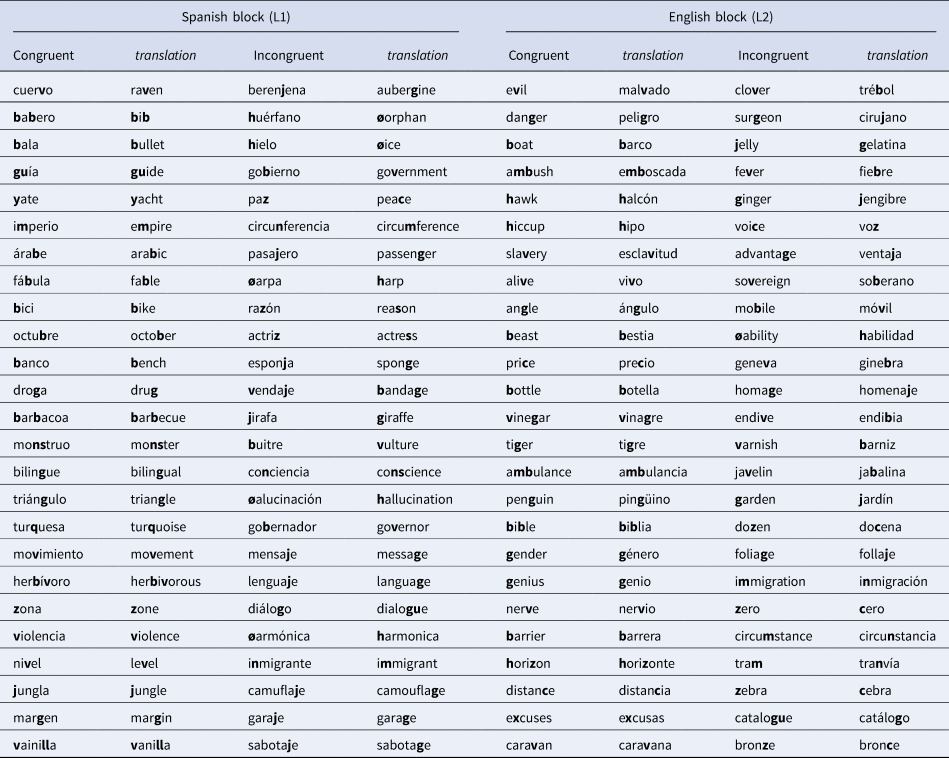
We selected 50 nouns (see Appendix 1 for the complete list of the stimuli) in English and 50 in Spanish. For the purpose of the study, we used the Oxford Advanced Learner Dictionary (Hornby, Ashby & Wehmeier, Reference Hornby, Ashby and Wehmeier2000) to search for words that contained polyvalent graphemes. All the polyvalent graphemes present in Spanish (b/v; j/g; h/without h; q/c; z/c; ll/y; gu/g; x/s; m/n in the vowel-V-consonant-C structure) were included. As a result, we created materials for the two experimental conditions (congruent and incongruent) with 25 words per condition and language: a) congruent condition – words and their translations shared their orthographic representation in critical polyvalent graphemes (e.g., G–G; triangle–triángulo); b) incongruent condition – words that did not share orthographic representations with their translations in the critical polyvalent graphemes (e.g., G–J; garage–garaje).
Items in congruent vs. incongruent conditions were matched for Spanish and English relative lexical frequency (Guasch, Boada, Ferré & Sánchez-Casas, Reference Guasch, Boada, Ferré and Sánchez-Casas2012), English: t (24) = –.16, p = .877, Spanish: t (24) = –.73, p = .474; number of letters (length) (Guasch et al., Reference Guasch, Boada, Ferré and Sánchez-Casas2012), English: t (24) = –1.58, p = .128, Spanish: t (24) = –1.81, p = .083; age of acquisition (AoA) (Alonso, Díez & Fernandez, Reference Alonso, Díez and Fernandez2015; Kuperman, Stadthagen-Gonzalez & Brysbaert, Reference Kuperman, Stadthagen-Gonzalez and Brysbaert2012), English: t (24) = –1.64, p = .115, Spanish: t (24) = –1.04, p = .307; concreteness (Brysbaert, Warriner & Kuperman, Reference Brysbaert, Warriner and Kuperman2014; Duchon, Perea, Sebastián-Gallés, Martí & Carreiras, Reference Duchon, Perea, Sebastián-Gallés, Martí and Carreiras2013), English: t (24) = .63, p = .537, Spanish: t (24) = –.83, p = .417; orthographic neighbors (Marian, Bartolotti, Chabal & Shook, Reference Marian, Bartolotti, Chabal and Shook2012), English: t (24) = 1.29, p = .209, Spanish: t (24) = 1.58, p = .128, summed bigram frequency (BiF) (Marian et al., Reference Marian, Bartolotti, Chabal and Shook2012), English: t (24) = –.42, p = .676, Spanish: t (24) = –1.65, p = .112, and the relative position of polyvalent grapheme (dividing the specific position of polyvalent grapheme and the word length), English: t (24) = −1.15, p = .260, Spanish: t (24) = −.940, p = .356.
Finally, orthographic similarity (OS; van Orden & Goldinger, Reference Van Orden and Goldinger1994) and Normalized Levensthein Distance (NLD; Levenshtein, Reference Levenshtein1966; Schepens, Dijkstra & Grootjen, Reference Schepens, Dijkstra and Grootjen2012) between the selected words and their nonresponse language translations were controlled (Guasch et al., Reference Guasch, Boada, Ferré and Sánchez-Casas2012); t (24) = .58, p = .565 (OS, English target language); t (24) = .10, p = .922 (NLD, English target language); t (24) = –.26, p = .798 (OS, Spanish target language); and t (24) = –.85, p = .401 (NLD, Spanish target language). Based on the OS score (Schwartz, Kroll & Michele Diaz, Reference Schwartz, Kroll and Diaz2007), the experimental material was composed mainly of cognate words with low OS between languages (between 0.7 and 0.3; 60% of the stimuli), with the remaining 40% divided between high OS (greater than 0.7; 20% of the stimuli) and noncognates (lower than 0.3; 20% of the stimuli).
In addition, the proportion of words that shared the first letter with the translation was similar across the congruent and incongruent conditions: English: t (24) = 1.28, p = .212; Spanish: t (24) = 1.55, p = .134.
The stimuli for the spelling-to-dictation task were presented in the auditory modality. The words were recorded with a neutral emotional tone, in mono, in 26 bits and with a frequency of 44.100 Hz, and filtered from environmental sounds. Furthermore, we controlled the sound file duration (ms), intensity (db), and fundamental frequency (F0) across conditions. Additionally, and in order to control for the influence of the speaker's gender on lexical access (Casado, Palma & Paolieri, Reference Casado, Palma and Paolieri2017), we introduced a masculine and a feminine voice that appeared randomly and equally across conditions. The t-test performed on these physical variables did not show significant differences between conditions, t (24) = –.87, p = .391 (English intensity); t (24) = –.43, p = .674 (English F0); t (24) = –1.75, p = .092 (English duration); t (24) = –.09, p = .931 (Spanish intensity); t (24) = –.91, p = .370 (Spanish F0); and t (24) = –1.21, p = .237 (Spanish duration). Table 2 shows descriptive statistics for the experimental material.
Characteristics of the experimental stimuli (mean scores with standard deviation in parenthesis).

Note. AoA = age of acquisition; BiF = bigram frequency; P.G = polyvalent grapheme (specific position of polyvalent grapheme/word length. Closer to 0 meant that polyvalent grapheme was in initial positions, and closer to 1 meant final positions); OS = orthographic similarity; NLD = Normalized Levensthein Distance; F0 = fundamental frequency.
Procedure
After reading and signing the informed consent form, participants were asked to fill out the LEAP-Q questionnaire (Marian et al., Reference Marian, Blumenfeld and Kaushanskaya2007) to control for their proficiency in English.
The presentation of the stimuli for the spelling-to-dictation task was conducted on a laptop computer using E-Prime version 2.0 (Psychology Software Tools, Pittsburgh, PA, USA). Each trial started with a fixation point which remained on the screen until the audio stimulus finished. Participants heard the target spoken word by headphones, and they were asked to write it as quickly and as accurately as possible in the same language in which they heard it. Participants were asked to start writing at the end of the audio and only after the space bar appeared on the screen. We used this procedure to ensure that the effect that we were capturing was due to the production processes after comprehension had taken place (see Bonin, Fayol & Gombert, Reference Bonin, Fayol and Gombert1998; Chua & Rickard Liow, Reference Chua and Rickard Liow2014 for a similar approach). Thus, the delay was introduced in order to isolate the writing execution processing of the first letter from the spoken word recognition during spelling-to-dictation (McRae, Jared & Seidenberg, Reference McRae, Jared and Seidenberg1990; Savage, Bradley & Forster, Reference Savage, Bradley and Forster1990).
The response was recorded using a QWERTY keyboard, and the letters appeared on the computer screen as they were typed (12-point Verdana font on a black background). The trial finished when the participants pressed the space bar. There was then a black inter-trial screen for 1.000 ms. The participants were instructed to press a random set of keys if they did not know the response, and then go to the next stimulus. An example of the procedure can be seen in Figure 1.
An example of an experimental trial.

For the bilingual participants, the experiment was composed of an English and a Spanish block. The order of these language blocks was counterbalanced across participants; the presentation of the stimuli within each language block was random; the participant listened to a word in Spanish or English (depending on the block) and had to write this word in the same language. Each block began with 8 practice trials, followed by a block of 50 experimental words. They had a 5 min break between the two blocks. The experimental session lasted approximately 20 min. For the two monolingual groups, the experiment consisted of a single block in which they performed the dictation task in their corresponding native language (English or Spanish).
Following Muscalu and Smiley (Reference Muscalu and Smiley2018), two latencies were recorded: 1) from the onset of the signaling stimulus to the first keystroke (lexical latency) and 2) from the first keystroke to the space bar keypress, signaling the final response (sublexical latency). As opposed to Muscalu and Smiley (Reference Muscalu and Smiley2018), the two latencies were measured in the same experiment by using two overlapping slides in the e-prime script: the first slide was used to record the first letter and the typing start time, while the second slide was used to record responses for the rest-of-word. The [response.RESP] e-prime attribute was implemented to register the participant's response from the previous slide automatically and to continue recording the participant's response until the end. This procedure produced an illusion of continuity (see Figure 1) and participants typed the whole word unaware that there were two different slides for the lexical and sublexical latencies.
Results
For analyses, we calculated the mean response times (RTs) for correct responses (CRs) and accuracy (ACC) for each participant and condition for both the first keystroke and the rest-of-word. Response times above or below 2.5 SD from the participants’ mean were eliminated from the analysis. A within-subject data trimming (e.g., Sullivan, Poarch & Bialystok, Reference Sullivan, Poarch and Bialystok2018) was performed for each monolingual group (2.58% from the Spanish monolingual group, and 2.87% from the English monolingual group) and for each language block in the bilingual group (2.76% of the Spanish block items from the bilingual group; 3.23% of the English block items from the bilingual group).
A mixed-model analysis using the lme4 package (Bates, Mächler, Bolker & Walker, Reference Bates, Mächler, Bolker and Walker2015) was implemented with the software R statistics (R Core Team, Reference Team2017) by using the ANOVA function with a Kenward–Roger modification for F-tests (Halekoh & Højsgaard, Reference Halekoh and Højsgaard2014). As mentioned, performance of the two monolingual groups were used as controls to test for the experimental material. Note that the critical effect of the polyvalent graphemes should only be present in the bilingual group, since this is assumed to be the result of language coactivation. Analyses on the latencies for these two groups indicated that there was no effect of condition (congruent vs. incongruent) for the Spanish group: first key F(1, 49.35) = 0.69, p = .411 (congruent mean = 453; incongruent mean = 438) and rest-of-word F(1, 40.34) = .02, p = .90 (congruent mean = 1522; incongruent mean = 1541), nor for the English group: first key (lexical) F(1, 45.28) = .64, p = .428 (congruent mean = 418; incongruent mean = 440) and rest-of-word F(1, 48.03) = 2.82, p = .099 (congruent mean = 1194; incongruent mean = 1300). The analyses performed for the accuracy data indicated no effect of condition for either the Spanish group: first key F(1, 48.2) = .21, p = .646 (congruent mean = 0.93; incongruent mean = 0.94) and rest-of-word F(1, 47.20) = .004, p = .95 (congruent mean = 0.91; incongruent mean = 0.91), or the English group: first key F(1, 49.26) = .42, p = .521 (congruent mean = 0.93; incongruent mean = 0.94) and rest-of-word F(1, 48.24) = .35, p = .556 (congruent mean = 0.95; incongruent mean = 0.92).
In the bilingual group, each ANOVA was conducted with the fixed factors, Language (L1 vs. L2), and Condition (congruent vs. incongruent), and with the random effects, participants, and items. The likelihood ratio test was used to assess the significance of each variable (the code we used in R was as follows: (data <- lmer (RT or ACC ~ Condition * Language + (1|Subject) + (1|Items), data, REML = FALSE). When a significant interaction was found, this was further explored using post hoc t-tests with Tukey's multiple comparison correction using the “lsmeans” function. In addition, in order to explore whether the errors were specific to polyvalent graphemes in the bilingual group, we performed additional analyses where we coded as specific grapheme error when the error was in a specific polyvalent grapheme, and as non-specific grapheme error when the error involved other graphemes in the word (surrounding letters caused by erroneous finger movements by pressing adjacent keys). For this analysis, each ANOVA was conducted with the same fixed and random effects (typeoferror ~ Condition*Language + (1|Subject) + (1|Items), data, REML = FALSE).
First key latency
There were significant effects of Condition, F(1, 84.21) = 4.61, p = .034, and Language, F(1, 84.27) = 96.21, p <.001, and an interaction between Condition and Language, F(1, 84.19) = 4.84, p = .03 (see Figure 2). Thus, when bilinguals did the dictation task in their L2, congruent words (mean = 861) were typed faster than incongruent words (mean = 1203), t (85.97) = –3.03, SE = 72.04, p = .003. However, in L1, the difference between congruent (mean = 599) and incongruent (mean = 596.82) conditions was not significant, t (82.39) = .04, SE = 69.98, p = .969.
Visual representation of results for the bilingual group. The upper part shows the results for the English block (L2) and the lower part the results for the Spanish block (L1). This represents the data obtained for the RT in ms, accuracy, and specificity of the error for each condition. The left half of the figure shows the data related to lexical processing (first key performance). The right half shows the data related to sublexical processing (rest-of-word performance).

First key ACC
Analysis showed a significant effect of Language, F(1, 99.46) = 15.48, p <.001, with more accurate responses for L1 (mean = 0.97) than for L2 (mean = 0.85). However, the main effect of Condition, F(1, 99.46) = 1.58, p = .212, and the interaction between Condition and Language, F(1, 99.46) = .004, p = .98, were not significant (see Figure 2). Related to the specificity of errors, there was a main effect of Language, F(1, 71.57) = 5.14, p = .003. The errors in the Spanish block (mean = 0.66) were more specific than the errors in the English block (mean = 0.34). There was no main effect of Condition F(1, 69.95) = .02, p = .898 or the interaction between Language and Condition, F(1, 69.65) = 2.59, p = .11.
Rest-of-word latency
There was a main effect of Condition, F(1, 96.50) = 11.46, p = .001, with faster responses for the congruent (mean = 1411) than for the incongruent condition (mean = 1745). However, the effect of Language, F(1, 96.73) = .05, p = .83, and the interaction between Condition and Language, F(1, 96.43) =.45, p = .51, were not significant (See Figure 2).
Rest-of-word ACC
The analysis yielded significant main effects of Condition, F(1, 97.66) = 5.64, p = .02, and Language, F(1, 97.67) = 61.74, p <.001, and a significant interaction between Condition and Language, F(1, 97.65) = 5.45, p = .02. Thus, when the bilinguals were typing the rest-of-word in L2, responses were more accurate for the congruent (mean = 0.70) than for the incongruent condition (mean = 0.49), t (97.31) = 3.317, SE = .06, p = .001. In contrast, for L1 typing, the difference between congruent (mean = 0.94) and incongruent (mean = 0.94) conditions was not significant, t (98.01) = .03, SE = .06, p = .977 (see Figure 2). Related to specificity of error, there was a main effect of Language, F(1, 75.47) = 5.14, p = .02. The errors in the Spanish block (mean = 0.58) were more specific than the errors in the English block (mean = 0.12). The effect of Condition, F(1, 75.32) = 3.02, p = .09, and the interaction between condition and Language, F(1, 75.59) = 2.59, p = .96, were not significant.
To make sure that the orthographic effect in the first key could be interpreted as lexical in nature, we performed an additional (a posteriori) analysis where we eliminated the items in which the polyvalent graphemes were in the first key, and only analyzed the data from words with polyvalent graphemes in any other position of the wordFootnote 1. If RTs of the first key reflected lexical and sublexical processing the obtained pattern would be present even when the words did not have polyvalent graphemes in their first position. As predicted, the results of this analysis showed exactly the same pattern as when all the words were included, so that all significant effects and their interactions remained unchanged (see Table 3).
The main effects and their interactions in the first key (lexical) and rest-of-word (sublexical) performances in the bilingual group with the list of stimuli without polyvalent graphemes in the first letter.

Note. *p < .05, **p < .01.
In addition, because previous studies including cognates have shown that some effects are restricted to cognate words with high OS between languages (Comesaña, Sánchez-Casas, Soares, Pinheiro, Rauber, Frade & Fraga Reference Comesaña, Sánchez-Casas, Soares, Pinheiro, Rauber, Frade and Fraga2012; Dijkstra et al., Reference Dijkstra, Miwa, Brummelhuis, Sappelli and Baayen2010; Duyck, Van Assche, Drieghe & Hartsuiker, Reference Duyck, Van Assche, Drieghe and Hartsuiker2007; Schwartz et al., Reference Schwartz, Kroll and Diaz2007; Van Assche, Duyck & Hartsuiker, Reference Van Assche, Duyck and Hartsuiker2011), we performed an additional (a posteriori) analysis in the bilingual group. OS was included as a fixed factor, with 3 levels (Schwartz et al., Reference Schwartz, Kroll and Diaz2007): cognates with a high OS (>0.7), cognates with a low OS (from 0.7 to 0.3), and noncognates (<0.3), along with the previously fixed factors: Language (L1 vs. L2), and Condition (congruent vs. incongruent), participants, and items as random effects. The results showed a significant main effect of OS in the lexical (first key) latency and the sublexical (rest-of-word) latency. Tukey's multiple correction t-test indicated that, for the first key latency, cognates with high OS (mean = 598) were typed faster than cognates with low OS (mean = 761), t (112) = –2.625, SE = 74.8, p = .041, but the differences between cognates with high OS and noncognates (mean = 672, t (113) = –.767, SE = 95.3, p = .724, and between cognates with low OS and noncognates, t (114) = 1.181, SE = 75.6, p = .467, were not significant. Tukey's test for the rest-of-word latency indicated that cognates with high OS (mean = 1879) were typed slower than cognates with low OS (mean = 1544), t (112) = 2.407, SE = 139, p = .046, and slower than noncognates (mean = 1461), t (106) = 2.344, SE = 178, p = .052. The differences between cognates with low OS and noncognates were not significant, t (102) = .776, SE = 144, p = .833. In summary, the OS had a differential effect over lexical (first key) latency and sublexical (rest-of-word) latency (Muscalu & Smiley, Reference Muscalu and Smiley2018). During the lexical access, the high OS produced facilitation (cognates with high OS were typed faster than cognates with low OS). On the other hand, during sublexical processing, high OS produced interference (cognates with high OS were typed slower than cognates with low OS). More importantly, however, there were no significant interactions with any other factor, and we obtained the same pattern of significant effects and interactions as in previous analyses (see Table 4), indicating that the congruency effect related to our polyvalent graphemes’ manipulation was independent of the cognate status of the words.
The main effects and their interactions in the first key (lexical) and the rest-of-word (sublexical) performances in the bilingual group including OS as fixed factor classifying the items in 3 levels (Schwartz et al., Reference Schwartz, Kroll and Diaz2007): cognates with high OS, cognates with low OS, and noncognates.

Note. *p < .05, **p < .01.
Discussion
Writing can be a challenging skill to master (Berninger & Niedo, Reference Berninger, Niedo, Mascolo, Flanagan and Alfonso2014), so that even for skilled writers, producing an orthographically accurate word string can sometimes be demanding (Bourdin & Fayol, Reference Bourdin and Fayol2002). Knowledge of two or more languages could be an additional challenge for accurate writing since differences in the letter–sound mappings of the two coactivated languages might produce interference (e.g., Escamilla, Reference Escamilla2006; Gildersleeve-Neumann, Peña, Davis & Kester, Reference Gildersleeve-Neumann, Peña, Davis and Kester2009). In this study, we aimed to: 1) examine whether non-selective coactivation effects were evident in cross-linguistic orthographically inconsistent segments in a writing production task; and 2) investigate the time course of lexical and sublexical activation in order to conceptualize bilingual writing production as a cascaded interacting process (e.g., Bonin et al., Reference Bonin, Méot, Lagarrigue and Roux2015; Delattre et al., Reference Delattre, Bonin and Barry2006) or as a discrete serial type of processing (e.g., Muscalu & Smiley, Reference Muscalu and Smiley2018). With this purpose, we asked bilinguals to perform a spelling-to-dictation typewriting task in their L1 and L2, and we introduced between-language orthographic incongruences (polyvalent graphemes) to index coactivation. We looked at accuracy and writing times to the first letter of the word, and to the accuracy and times for the rest-of-word as a way of indexing lexical and sublexical coactivation. Although, we used the dictation task instead of translation and the blocked design instead of intermixing languages across trials to avoid the direct activation of the non-intended language, it could still be argued that the use of both languages in the same experimental session could have enhanced language co-activation. However, recent studies have shown that language co-activation occurs even under very stringent single-language contexts, and even when language use is limited to the dominant language (Shook & Marian, Reference Shook and Marian2019; Bobb, Von Holzen, Mayor, Mani & Carreiras, Reference Bobb, Von Holzen, Mayor, Mani and Carreiras2020). In the following subsections, we will discuss the evidence regarding language coactivation, the time course of lexical and sublexical activation, and finally, some issues regarding language differences.
Language coactivation in written production
Regarding the question of whether language coactivation occurs in bilingual written production, our results showed evidence supporting the presence of cross-linguistic orthographic effects in bilingual typing. Thus, for the English–L2 block, the retrieval of the first keystroke, and the time to write the rest of the word were faster in response to congruent than to incongruent stimuli. In addition, participants committed fewer errors with congruent stimuli than with incongruent stimuli. Importantly, these differences were not evident in the monolingual groups, indicating that these effects were not an artifact due to an inappropriate selection of the experimental materials. Hence, these results clearly suggest that language coactivation is also present in bilingual typing production (Muscalu & Smiley, Reference Muscalu and Smiley2018). Overall, this pattern provides evidence supporting the assumption that language coactivation influences the two typewriting loops proposed by Logan and Crump (Reference Logan and Crump2011): the outer loop related to the generation of a lexical and graphemic representation (first key performance), and the inner loop related to keystroke production (rest of the word performance). In our study, the incongruent condition was based on the orthographic difference in a critical polyvalent grapheme between Spanish and English, so the results suggested that the letters of both languages might be coactivated and influence the two loops of writing.
However, the obtained pattern also suggested that these orthographic coactivation effects are asymmetrical and different for L1 and L2. Thus, whereas L2 typing showed congruency effects in first letter latency and rest-of-word latency and ACC, congruency effects in L1 were only observed in typing latencies for rest-of-word. This differential pattern suggests that, similar to spoken production, L1 might be less susceptible to language coactivation than L2 (Kroll et al., Reference Kroll, van Hell, Tokowicz and Green2010). Thus, the greater susceptibility to coactivation effects for L2 was evident in the lexical and sublexical measures for the English block (L2) where there were differences between congruent and incongruent words in ACC and/or RTs, whereas coactivation was only evident in reaction times to sublexical processes (rest of word) for the Spanish block (L1). Note that participants in this experiment were late bilinguals and dominant in Spanish. Hence, the differences between L1 and L2 could be explained in terms of changes in the associative relationship between languages depending on proficiency and AoA (Blumenfeld & Marian, Reference Blumenfeld and Marian2007; Silverberg & Samuel, Reference Silverberg and Samuel2004). Thus, lexical access in L1 seems to be more resistant to sublexical influences from L2, supporting the assumption of some models that L1 has direct access to meaning, whereas L2 seems to require L1 mediation (Kroll & Stewart, Reference Kroll and Stewart1994). Both the revised hierarchical model (RHM; Kroll & Stewart, Reference Kroll and Stewart1994) and the BIA+ (Dijkstra & van Heuven, Reference Dijkstra and van Heuven2002) postulate that L2 words are directly connected to their L1 translation equivalents in less proficient bilinguals (Duyck & Warlop, Reference Duyck and Warlop2009; Witzel & Forster, Reference Witzel and Forster2012), thus increasing the effect of coactivation in L2 in comparison with L1. Thus, it is possible that these differential language effects and the possible mediation of L1 over L2 might be reduced in experiments involving early bilinguals immersed in dual contexts (English–Spanish environment) (see van Hell & Tanner, Reference Van Hell and Tanner2012 for more details about the modulation of L2 proficiency during cross-language coactivation).
The first key latency indexing speed of lexical access was critically different for L1 and L2. Thus, while latencies to L2 showed a clear polyvalent grapheme congruency effect, this effect was not evident in L1. This suggests that L1 and L2 are activated in parallel during L2 generation of a lexical representation for writing (outer loop; Logan & Crump, Reference Logan and Crump2011), and that specific incongruences between L1 and L2 slow down this process. This effect is similar to the orthographic similarity effect shown by Muscalu and Smiley (Reference Muscalu and Smiley2018) where orthographically similar words (cognates) facilitated first-letter performance, but it is important to note that, in our study, the polyvalent grapheme effect was sublexical in nature, and different from the lexical cognate effects in their experiment. Interestingly, in our experiment, this L2 effect was evident in RTs, and not in ACC, suggesting that the presence of incongruent graphemes interfered with and slowed down the generation of the lexical information needed for correctly typing the first letter of the word. The fact that a sublexical variable such as the presence of incongruent polyvalent graphemes was evident in a lexical measure such as first key latency suggests that the outer and inner loops are connected so that the access to the lexical representation (outer loop) is affected by the orthographic sublexical inconsistencies between languages (for a more encapsulated view of the two loops in skilled typewriting see Logan & Crump, Reference Logan and Crump2011).
Regarding rest-of-word, the presence of incongruences slowed down typing responses, although these inconsistencies only led to erroneous responses when the bilinguals typed in their L2 language. This pattern suggests again that the two languages of the bilingual are coactivated during actual implementation of the typing response (inner loop), although the selection of the appropriate graphemes was correctly performed in L1. In contrast, the stronger activation of L1 while writing in L2 was not always correctly solved leading to an increase in erroneous L2 writing responses. According to various typing models, all the letters in a word are activated in parallel and sequenced by a competitive process of inhibitory connections to allow the execution of the correct pulse (Logan & Crump, Reference Logan and Crump2010; Rumelhart & Norman, Reference Rumelhart and Norman1982; Snyder, Ashitaka, Shimada, Ulrich & Logan, Reference Snyder, Ashitaka, Shimada, Ulrich and Logan2014). Thus, errors in L2 incongruent condition might be due to failures in lateral inhibition processes needed to reduce the activation of alternative competitive graphemes (Rumelhart & Norman, Reference Rumelhart and Norman1982) – in this case, the graphemes of the non-used language.
Thus, interference effects of the incongruent condition (polyvalent graphemes) support the idea that inconsistent L1 and L2 orthographic representations slow down the typing of words (Bonin et al., Reference Bonin, Peereman and Fayol2001; Dijkstra & van Heuven, Reference Dijkstra and van Heuven2002). In general, orthographically inconsistent segments are written more slowly and with less precision than orthographically congruent segments (Defior et al., Reference Defior, Jiménez-Fernández and Serrano2009; Kreiner & Gough, Reference Kreiner and Gough1990; Mulatti & Job, Reference Mulatti and Job2003) even when the inconsistency is cross-linguistic. Importantly, although our analysis of OS had to be taken with caution (it was not planned in advance, and it included an unequal number of items across conditions), it showed that the polyvalent grapheme effect was independent of overall orthographic similarity. It suggests that the effect of orthographic congruency was not restricted to highly similar cognates. The effect was evident even when the overlap between languages was minimal (Conrad, Alvarez, Afonso & Jacobs, Reference Conrad, Alvarez, Afonso and Jacobs2014).
In addition, the results of this a-posteriori analysis replicated the OS effects obtained in previous studies (Comesaña et al., Reference Comesaña, Sánchez-Casas, Soares, Pinheiro, Rauber, Frade and Fraga2012; Dijkstra et al., Reference Dijkstra, Miwa, Brummelhuis, Sappelli and Baayen2010; Duyck et al., Reference Duyck, Van Assche, Drieghe and Hartsuiker2007; Schwartz et al., Reference Schwartz, Kroll and Diaz2007; Van Assche et al., Reference Van Assche, Duyck and Hartsuiker2011) as well as the results of Muscalu and Smiley (Reference Muscalu and Smiley2018) in their writing experiments. That is, for first key latencies (lexical), we found that a high similarity between languages facilitated performance, whereas for rest-of-word (sublexical), high similarity produced interfering effects, with longer times for high than for low OS between languages. Despite the differences between our study and the study by Muscalu and Smiley, that included differences in the tasks (spelling-to-dictation vs. translation task), modality of presentation of the stimuli (visual and auditory vs. auditory), and time parameters (participants could not start writing until the word presentation had ended), the pattern of OS effects was very similar in both studies. However, as we will next discuss, the fact that we introduced a sublexical manipulation (polyvalent graphemes) that had an effect in a lexical measure (first key) thus made our interpretation of the time course of lexical and sublexical variables differ from the serial account proposed by Muscalu and Smiley (Reference Muscalu and Smiley2018).
Time course of lexical and sublexical processing in bilingual writing
The fact that L2 congruency effects were evident from the very beginning of lexical access (during first key production) and extended to rest-of-word suggests that L2 lexical and sublexical orthographic representations are automatically activated from the very beginning of the writing process as proposed by cascade models (Dijkstra et al., Reference Dijkstra, Miwa, Brummelhuis, Sappelli and Baayen2010; Pattamadilok, Perre, Dufau & Ziegler, Reference Pattamadilok, Perre, Dufau and Ziegler2009; Perre, Pattamadilok, Montant & Ziegler, Reference Perre, Pattamadilok, Montant and Ziegler2009). Thus, regarding the time course of lexical and sublexical activation, our results indicate that the onset of writing is delayed when phonological–orthographic inconsistencies appear (Sadat, Martin, Costa & Alario, Reference Sadat, Martin, Costa and Alario2014), thus evidencing sublexical influences during lexical processing. This pattern supports the assumption of cascade models of spoken (e.g., Navarrete & Costa, Reference Navarrete and Costa2005; Sternberg, Reference Sternberg2001) and written (Bonin et al., 2001; Delattre et al., Reference Delattre, Bonin and Barry2006) production, as applied to bilingual L2 processing.
Studies on spoken word production and word comprehension have already shown evidence of the early influence of orthographic information (Dich, Reference Dich2011; Dijkstra et al., Reference Dijkstra, Miwa, Brummelhuis, Sappelli and Baayen2010; Frost & Ziegler, Reference Frost, Ziegler and Gaskell2007; Grainger, Reference Grainger2018; Hallé, Best & Levitt, Reference Hallé, Best and Levitt1999; Pattamadilok, Morais, Ventura & Kolinsky, Reference Pattamadilok, Morais, Ventura and Kolinsky2007; Perre et al., Reference Perre, Pattamadilok, Montant and Ziegler2009; Seidenberg & Tanenhaus, Reference Seidenberg and Tanenhaus1979; Ventura, Morais, Pattamadilok & Kolinsky, Reference Ventura, Morais, Pattamadilok and Kolinsky2004; Ziegler, Ferrand & Montant, Reference Ziegler, Ferrand and Montant2004; Ziegler, Petrova & Ferrand, Reference Ziegler, Petrova and Ferrand2008). In fact, previous evidence has shown that the position of the manipulated sublexical elements may influence the time for lexical access in reading tasks (diverging letter effect; Mulatti, Peressotti & Job, Reference Mulatti, Peressotti and Job2007). Thus, our results extend the evidence of interactions between lexical and sublexical levels in reading and naming to bilingual writing production. Theoretical proposals assume that orthographic knowledge “contaminates” phonology during the process of learning to read and write, thus altering the very nature of phonological representations (Muneaux & Ziegler, Reference Muneaux and Ziegler2004; Ziegler & Goswami, Reference Ziegler and Goswami2005) and creating unstable lexical representations. The idea is that orthographically consistent words develop better and more detailed phonological representations than inconsistent words in the course of learning to read, and this, in turn, creates more stable lexical representations (Caplan, Rochon & Waters, Reference Caplan, Rochon and Waters1995; Hickok & Poeppel, Reference Hickok and Poeppel2000; Petersson, Reis, Askelöf, Castro-Caldas & Ingvar, Reference Petersson, Reis, Askelöf, Castro-Caldas and Ingvar2000; Scott & Wise, Reference Scott and Wise2004). Note that the different pattern that we obtained for L1 does not necessarily mean that lexical and sublexical processing in L1 proceeds in a discrete serial manner, but, as suggested above, that L1 written production is less vulnerable to orthographic incongruences due to language coactivation and that, therefore, our indexes of lexical and sublexical processing might not be able to capture these processes and their interaction during L1 writing. Future studies with other manipulations might shed some further light on this issue.
Language differences
In our study, the bilinguals made more specific errors in Spanish than in English. During the typing task, the participants could generate both non-specific typographical spelling errors (caused by erroneous finger movements by pressing adjacent keys) and specific cognitive errors (caused by specific orthographic features; Kukich, Reference Kukich1992). We observed that, relative to the type of errors, bilinguals made more errors with letters with polyvalent Spanish graphemes than with any other type of letter. This pattern is probably due to the different orthography–phonology mapping between the two languages (Rapp, Epstein & Tainturier, Reference Rapp, Epstein and Tainturier2002). English is an opaque language, with many phonographic and orthographic inconsistencies that would encourage lexical processing (following the orthographic depth hypothesis; Katz & Frost, Reference Katz, Frost, Frost and Katz1992). Therefore, in this case, the diversity of inconsistent grapheme-phoneme mappings would induce a more generalized type of error, which could affect different graphemes. In contrast, Spanish is a more transparent language with fewer inconsistencies that encourage phonological–orthographic processing (Seymour, Aro & Erskine, Reference Seymour, Aro and Erskine2003). Thus, more specific errors, affecting the critical polyvalent graphemes are to be expected. Also, different degrees of consistency between phonology and orthography may lead to different strategies when developing lexical representations, with less specific phonological–orthographic processing in opaque languages (Ziegler & Goswami, Reference Ziegler and Goswami2005).
In sum, the current study was the first exploring the proposal of two-loop of typewriting (Logan & Crump, Reference Logan and Crump2011) in bilingual typing production involving a single-language task (spelling-to-dictation). An inconsistency in the orthographic representation between languages appeared to affect the inner loop in L1 and L2 typing production. If a bilingual had to type a word with inconsistent polyvalent graphemes between languages, the inconsistency of the key mapping and, therefore, of the orthographic representation hindered performance with more errors, and resulted in longer RTs in writing rest-of-word. However, the outer loop related to the generation of the word–lexical representation only was affected in the L2 language block; the interference caused by the orthographic inconsistency spread from one loop to the other in the weakest language. Although the results of the present study show a clear pattern, it is not without limitations. First, this is the first study aiming at exploring the effect of orthographic incongruence between languages due to the presence of critical polyvalent graphemes during writing. One of the advantages of the polyvalent phoneme manipulation is that the presence of orthographic inconsistency is very specific and affects individual phoneme–grapheme mappings; however, the interaction of this specific inconsistency with more global orthographic similarity effects was not directly manipulated, and although a posteriori analysis suggested that they are independent, future research should include orthogonal manipulations of the two variables. Second, our study included highly proficient late L2 learners, and their coactivation pattern might differ from that for early bilinguals. Future studies should include different groups of bilinguals for a deeper understanding of the dynamics in which two languages interact during writing production.
Additionally, despite the usefulness of our experimental paradigm to study lexical and sublexical processing during typing production (Muscalu & Smiley, Reference Muscalu and Smiley2018), our spelling-to-dictation task might also have some limitations. First, although we tried to solve the possible overlap between comprehension and production in our procedure by delaying the participants’ typing response to the appearance of a space bar, it is still possible that difficulties in comprehension might affect the first letter typing response. In addition, our sublexical latency measure (rest-of-word) was the average of the times from first key to the end of the word typing response, and therefore, tracking the performance of individual graphemes was not possible. This might be important since the presence of visually presented information on the screen as writing proceeded might have been used as feedback to correct possible errors, and it might have influenced the final typing response. Future research tracking individual letter typing and exploring the role of visual feedback is needed to clarify this issue. In addition, this study focused on the impact of orthographic congruence between languages as a sublexical property. Future research should also focus on the role of phonology in language coactivation during written production.
Finally, this study focused on typewriting while writing production involves typewriting and handwriting. Although some research indicates similar processing (Pinet, Ziegler & Alario, Reference Pinet, Ziegler and Alario2016; Yamaguchi & Logan, Reference Yamaguchi and Logan2014), future research should also directly compare the pattern of orthographic activation in typing and handwriting production.
Conclusions
Writing and typing can be complex competences to master, and the production of an orthographically accurate text can be difficult, especially in a second language with all the difficulties associated with the parallel coactivation of two languages which may facilitate but also hinder language selection (Costa et al., Reference Costa, Colomé, Gómez and Sebastian-Gallés2003; Poulisse & Bongaerts, Reference Poulisse and Bongaerts1994). Our findings add to other attempts to conceptualize the processing architecture underlying writing production in the bilingual population. The findings of our study, which included cross-linguistic polyvalent graphemes in a spelling-to-dictation task, showed that the cross-linguistic orthographic effects in bilingual writing production resulted in better performance for between-language congruent spelling than for incongruent spelling, supporting the idea of a unified orthographic lexicon (Dijkstra & van Heuven, Reference Dijkstra and van Heuven2002). Words with inconsistent spellings across languages were typed slower and with more errors, even in a task in which only one language was employed, although these errors were especially evident in the English L2 block. This pattern reflects that the non-used language (Spanish) orthography was hindering the selection of the correct spelling of the word (e.g., garaJe instead of the correct spelling garage), so that orthographic inconsistencies between languages may make the already difficult writing processes even more difficult for bilingual writers.
In addition, our results showed that orthographic retrieval effects are evident from the very beginning of L2 lexical access, suggesting a cascade-type of processing for writing production (Olive, Reference Olive2014). When a bilingual participant is typing in L2, the presence of orthographic incongruences between languages introduces difficulties in the generation of the lexical representation of the to-be-written word. Thus, conflicting information at the sublexical level makes access to the word representation more difficult.
Acknowledgments
The current research was completed thanks to financial aid provided by the doctoral research grant FPU16/01748 to AI and grants from the Ministerio de Ciencia, Innovación y Universidades-Fondos Feder to MB (PGC2018-093786-B-I00) and DP (PCIN-2015-165-C02-01), and A-CTS-111-UGR18-Feder.Andalucía. We wish to acknowledge Filip Andras for his assistance in data collection.
Selected targets and their respective translations for each experimental condition in both language blocks (Spanish and English). The words (Congruent and Incongruent columns) were included in a dictation task, so the translation column is referred to as non-required language.


 Open access

