

Introduction
Although research on mass violence and on corporeality is extensive within the social sciences and humanities (see Knüsel & Smith Reference Knüsel and Smith2014; Martin et al. Reference Martin, Harrod, Pérez, Martin, Harrod and Pérez2012, for bioarchaeological developments in violence research), the complexity of dead bodies in the context of mass violence is largely unexplored, despite the fact that the treatment of corpses strongly impacts society and helps understand the process of mass violence (Anstett & Dreyfus Reference Anstett, Dreyfus, Anstett and Dreyfus2014). In this article, I aim to connect strands of theory concerning mortuary rituals with those of violent death in order to create a theoretical framework that enables an exploration of the possible social implications of corpses from past mass violence. Specifically, this is done by combining the theoretical framework developed here with osteological empirical analysis and contextual analyses from the Iron Age ringfort Sandby borg, where the dwellers were killed and left unburied. In previous articles, the biological materiality of the dead in Sandby borg was investigated. This led to the conclusion that the corpses were not manipulated following the massacre, but seemingly left where they died (Alfsdotter et al. Reference Alfsdotter, Papmehl-Dufay and Victor2018; Alfsdotter & Kjellström Reference Alfsdotter and Kjellström2018; Reference Alfsdotter and Kjellströmin preparation). In this article, I investigate the social response to the deaths in order to understand the contemporary implications of the Sandby borg corpses.
I present the context of Sandby borg and customary regional Iron Age mortuary practice. Thereafter, I discuss social responses to death and introduce the concept of postmortem agency in general, and in relation to lethal inter-group conflict in particular. Throughout the exposition I discuss the theories in relation to the human remains encountered inside the Iron Age Sandby borg ringfort.
The Sandby borg ringfort
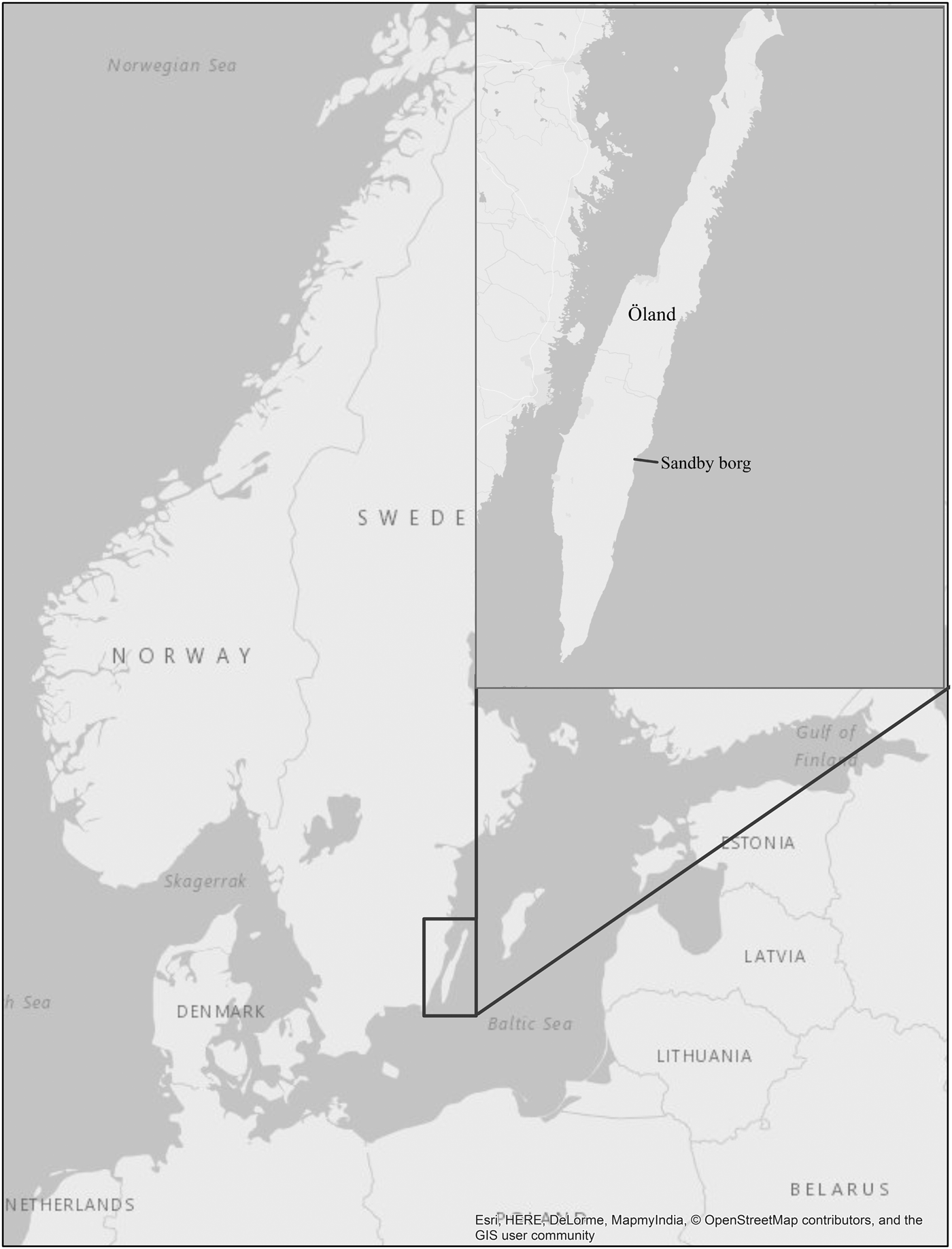
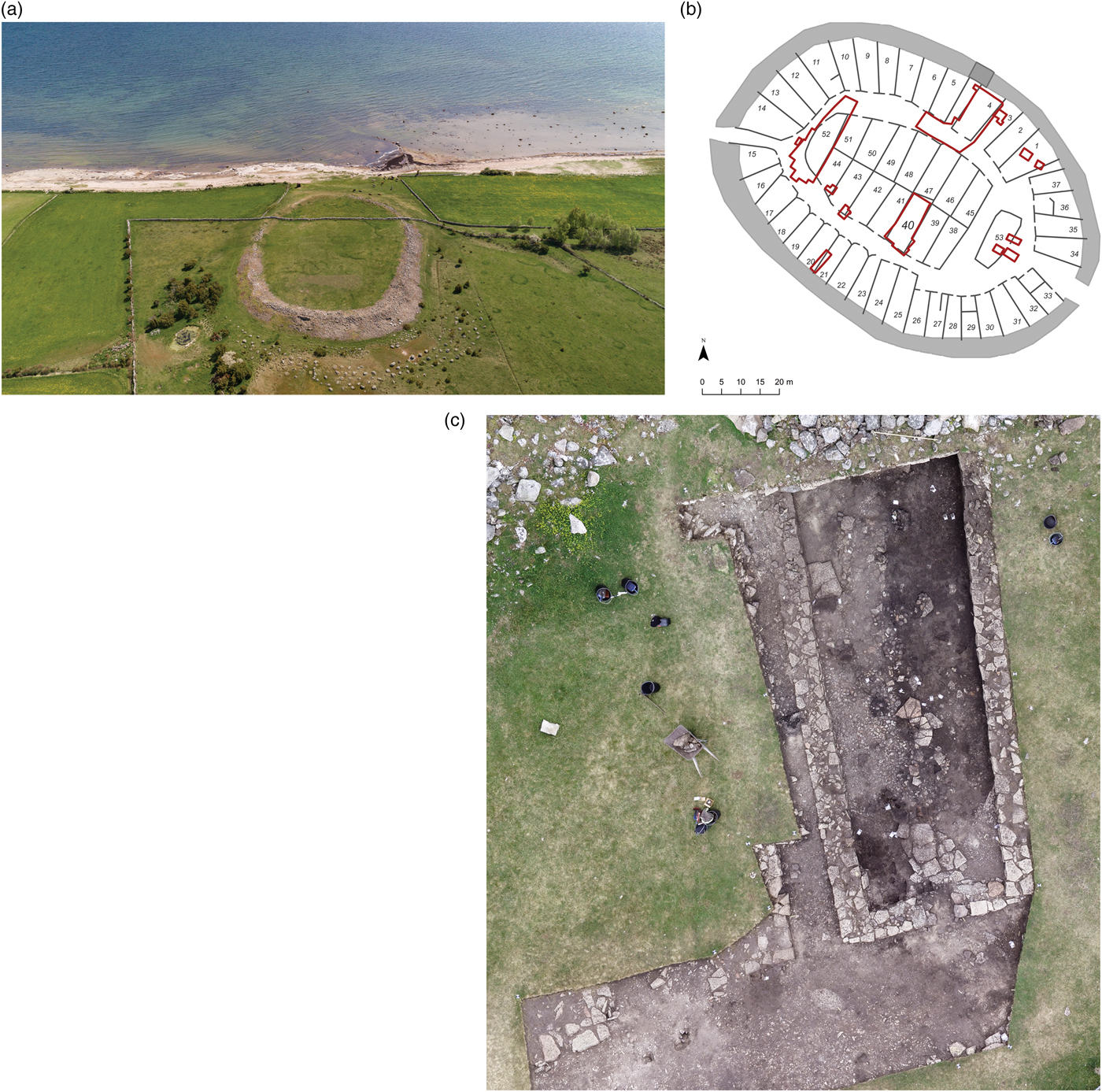
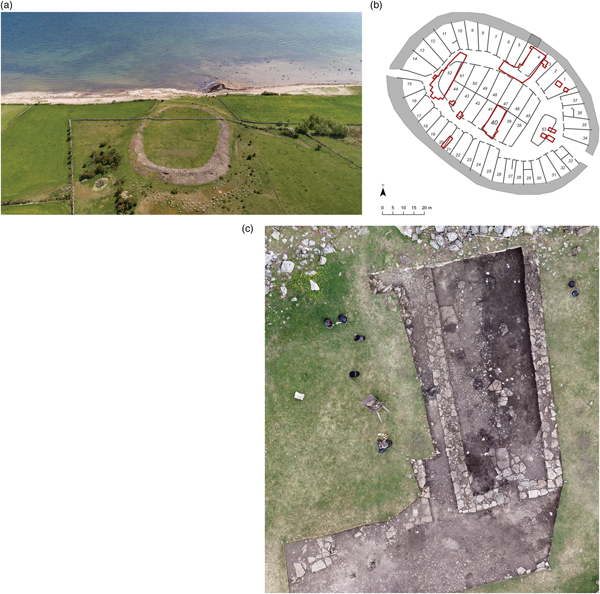
The ringfort ‘Sandby borg’ is located on the Baltic island of Öland, present-day Sweden (Fig. 1). During the early and middle Iron Age (Table 1), several ringforts were erected on the island; the remains of 16 are still visible today (Wegraeus Reference Wegraeus, Borg, Näsman and Wegraeus1976). Several Öland ringforts, Sandby borg included, were seemingly used as fortified villages, with houses enclosed by a high circular limestone wall (Fig. 2; Skarin-Frykman Reference Skarin-Frykman1967; Stenberger Reference Stenberger1933; Wegraeus Reference Wegraeus, Borg, Näsman and Wegraeus1976). There is no consensus regarding whether the ringforts were used throughout the year, seasonally, or just occasionally, but the fully excavated ringfort ‘Eketorp’ appears to have been in continual use (e.g. Skarin-Frykman Reference Skarin-Frykman1967; Wegraeus Reference Wegraeus, Borg, Näsman and Wegraeus1976). The Öland ringforts were mainly inhabited during the Iron Age, but in some cases use extended into the early medieval era (e.g. Borg et al. Reference Borg, Näsman and Wegraneus1976; Fallgren Reference Fallgren and Tegnér2008; Herschend Reference Herschend, Näsman and Lund1988; Näsman Reference Näsman and Aldestam2001, 93; Näsman & Wegraeus Reference Näsman and Wegraeus1979; Stenberger Reference Stenberger1933).
Scandinavia, with Öland and Sandby borg indicated. (Basemap © OpenStreetMap contributors, modified by Helena Victor.)
(a) The remains of Sandby borg as visible today. (Photograph: Sebastian Jakobsson); (b) Plan of Sandby borg based on excavations, aerial photographs and geophysical surveys (Viberg Reference Viberg2012). Three complete houses, minor parts of another six houses and sections of the street surrounding the central block have been excavated between 2011 and 2017 (Dutra Leivas & Victor Reference Dutra Leivas and Victor2011; Gunnarsson et al. Reference Gunnarsson, Victor and Alfsdotter2016; Papmehl-Dufay & Alfsdotter Reference Papmehl-Dufay and Alfsdotter2016; Victor Reference Victor2012; Reference Victor2014; Victor et al. Reference Victor, Emilsson and Frisk2013). Excavated areas are indicated (Figure: Helena Victor); (c) During excavations in 2016 house 4 and part of the adjacent street were investigated. The gables of houses 5 and 6 are visible in the left of the picture. Houses 4 and 5 are separated by a narrow alley leading up to a small gate. Human remains were encountered both indoors and outdoors (Photograph: Sebastian Jakobsson).
Schematic chronology of the Swedish Iron Age Periods.
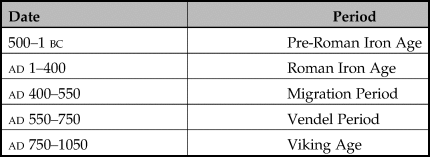
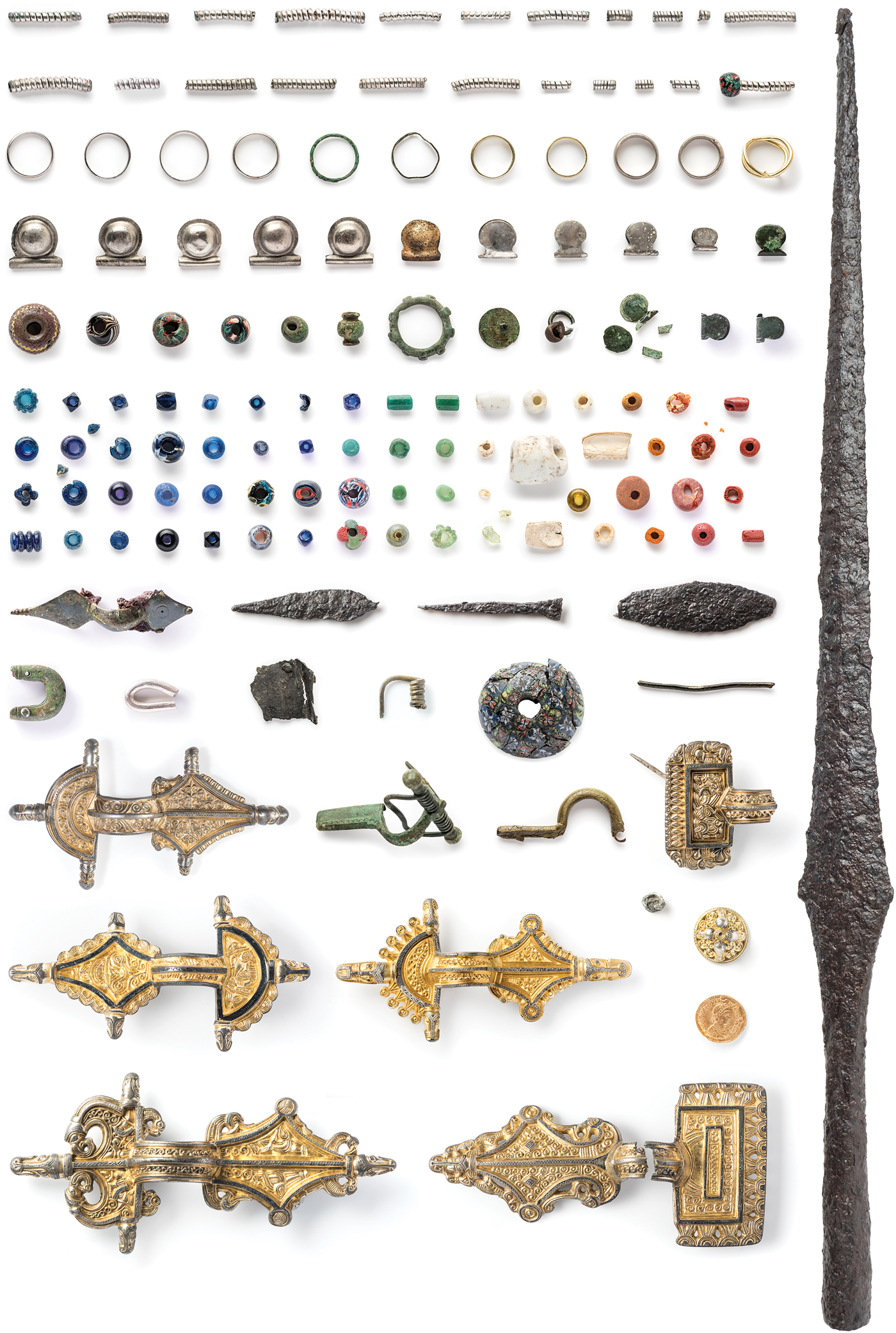
Sandby borg has been subject to small-scale excavations by Kalmar County Museum since 2011. The area investigated covers a modest 9 per cent of the entirety of the ringfort interior (Fig. 2b). The character of the finds does, however, allow insights into the ringfort's history. The artefacts encountered in Sandby borg have been typologically dated to the end of the fifth century, the so-called ‘Migration period’ (Fig. 3; Table 2). Traces of domestic life, such as the remains of craft items, remnants of cooking, food that was prepared but not consumed, and the (occasionally articulated) skeletons of domestic animals that died inside the ringfort have been uncovered (Dutra Leivas & Victor Reference Dutra Leivas and Victor2011; Gunnarsson et al. Reference Gunnarsson, Victor and Alfsdotter2016; Papmehl-Dufay & Alfsdotter 2016; Victor Reference Victor2012; Reference Victor, Arnell and Papmehl-Dufay2015; Victor et al. Reference Victor, Emilsson and Frisk2013). Valuable artefacts were also discovered, including silver relief brooches, glass beads, gold and silver finger rings, silver pendants and gold solidi (Fig. 3; Victor Reference Victor, Arnell and Papmehl-Dufay2015). The artefacts are of both local and foreign manufacture, demonstrating regional and long-distance networks that include present-day Poland, the Baltic states and the Western Roman Empire (Fallgren & Ljungkvist Reference Fallgren and Ljungkvist2016; Victor Reference Victor, Arnell and Papmehl-Dufay2015). There are strong regional similarities between the Sandby borg material culture and architecture and other Öland settlements, indicating that the people who inhabited Sandby borg were no strangers to the region. The artefacts found in Sandby borg imply that its inhabitants were influential actors in the local community (Victor Reference Victor, Arnell and Papmehl-Dufay2015).
A selection of valuable artefacts encountered in Sandby borg, including relief brooches, glass beads, silver and gold finger rings, solidi and silver pendants. (Photograph: Daniel Lindskog.)
The table presents human remains that constitute unique individuals encountered in Sandby borg up to 2017 and based on analyses made by the author between 2014 and 2017. Bones that can derive from several individuals are not presented. Preservation of skeletons, demographic distribution, trauma and spatial context are accounted for (AT = antemortem trauma; PT = perimortem trauma).
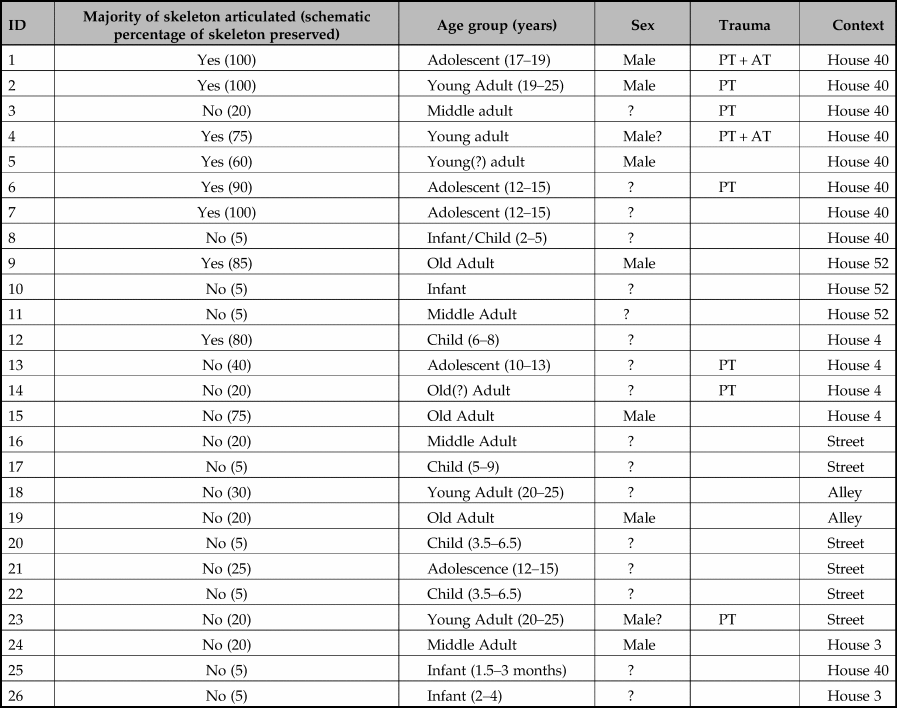
Human remains from a minimum of 26 individuals have been recovered, both from inside the remnants of houses and from the surrounding streets (Figs. 2 & 4). Traces of lethal interpersonal violence (sharp, blunt and penetrating trauma) have been identified on several skeletons (Alfsdotter & Kjellström Reference Alfsdotter and Kjellström2018). The remains comprise individuals of all age groups, the youngest being less than three months old (Table 2). Although remains of an infant and finds of jewellery typical for the regional female attire have been discovered, the skeletons sexed so far do not display female sexual traits (Gunnarsson et al. Reference Gunnarsson, Victor and Alfsdotter2016; Alfsdotter Reference Alfsdotter, Papmehl-Dufay and Victorin press). The reason behind the absence of identified female remains is unknown. As half of the remains of individuals encountered were subadult, and many skeletons fragmentary (Table 2), there are several skeletons that have not been subject to osteological sex determination.
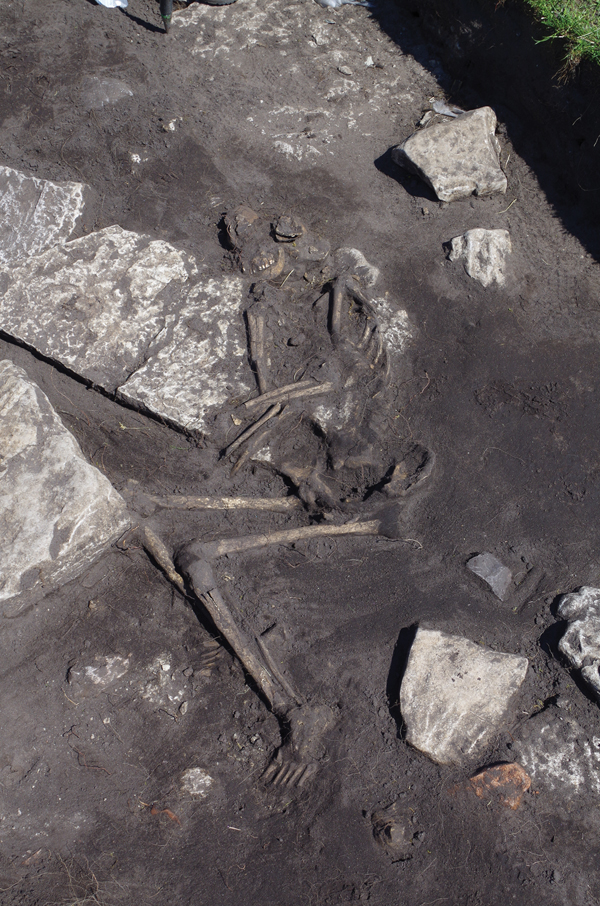
The skeleton of a young teen (ID7) during excavation, one of nine individuals whose remains were exhumed inside house 40. (Photograph: Kalmar County Museum.)
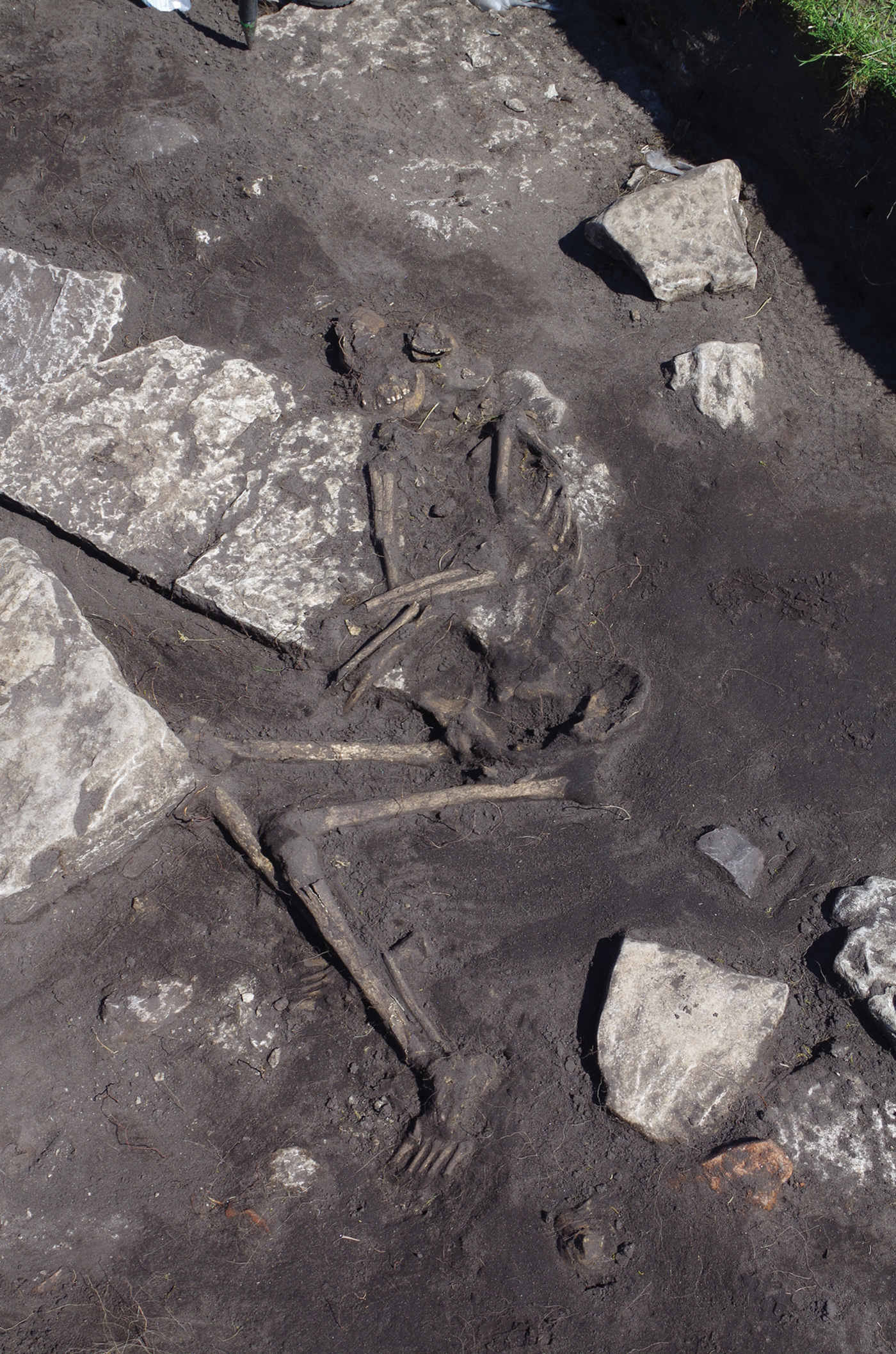
The handling of the dead in Sandby borg has been studied through taphonomic methods which led to conclusions of their peri- and postmortem fate (Alfsdotter & Kjellström Reference Alfsdotter and Kjellström2018; Reference Alfsdotter and Kjellströmin preparation). The skeletal remains show differences in taphonomy; the majority were partly or fully articulated inside the houses and disarticulated on the street. The archaeothanatological analysis (Alfsdotter & Kjellström Reference Alfsdotter and Kjellströmin preparation) indicates that no manipulation of the remains took place following soft-tissue decomposition. The random positions of the skeletons (once corpses) suggest that the dead were left where they died without postmortem manipulation. One case is particularly indicative of a body being left where it fell. The articulated remains of an elderly man were found face down across the central hearth of one house. Parts of the frontal hip region of the skeleton were charred, indicating that the man fell across the hearth while the hearth was still smouldering, and that his body was not moved thereafter (Alfsdotter et al. Reference Alfsdotter, Papmehl-Dufay and Victor2018; Papmehl-Dufay & Alfsdotter 2016). The trauma pattern indicates that the victims were killed in an efficient manner, with a minimal amount of force (that is to say, with a few lethal blows, often directed to the cranium). There are no signs of excessive violence, i.e. mutilation (Alfsdotter & Kjellström Reference Alfsdotter and Kjellström2018). No defence injuries have been encountered. The victims seem to have been taken unawares and were ill prepared to defend themselves (Alfsdotter & Kjellström Reference Alfsdotter and Kjellström2018). The attackers were numerous, judging from the repeated pattern of lethal attacks evident in every house excavated so far. The dead bodies were neither heaped together nor buried. There are no indications that human trophies were taken. The minimum number of individuals per area excavated in Sandby borg is extensive and suggests that a majority of the dwellers (maybe all) were killed and left inside the ringfort without mortuary treatment (Victor Reference Victor, Arnell and Papmehl-Dufay2015).
A sudden end to the activity inside the ringfort is demonstrated by still-articulated skeletal and macrobotanical remains (Alfsdotter et al. Reference Alfsdotter, Papmehl-Dufay and Victor2018; Heimdahl Reference Heimdahl, Papmehl-Dufay and Alfsdotter2016). In contrast to other Öland ringforts, Sandby borg does not show traces of resettlement after the Migration period. The archaeological context shows that the material record in Sandby borg is contemporary with the assault that led to the deaths of the inhabitants (Alfsdotter et al. Reference Alfsdotter, Papmehl-Dufay and Victor2018).
The combination of considerable riches left in the Sandby borg dwellings, animals left behind, and the effective and indiscriminate killing (with regard to age) led to the hypothesis that the main objective of the attack was to kill, rather than to plunder (although the two are not mutually exclusive) (Alfsdotter et al. Reference Alfsdotter, Papmehl-Dufay and Victor2018; Alfsdotter & Kjellström Reference Alfsdotter and Kjellström2018; Victor Reference Victor, Arnell and Papmehl-Dufay2015). Analyses of the archaeological context and human bones led to the conclusion that a massacre took place inside the ringfort, and that noone came to bury the dead (see Alfsdotter et al. Reference Alfsdotter, Papmehl-Dufay and Victor2018 for a more thorough discussion of the massacre hypothesis). The term ‘massacre’ is used in its broadest sense, referring to an act of intentional killing of a large number of people who were not prepared for battle, and the attack being carried by a group.
Migration period Öland: land use and mortuary practice
There are strong indications that the population of Öland grew during the early Iron Age, and that the island was densely populated in the Migration and Vendel periods (Beskow-Sjöberg Reference Beskow-Sjöberg1977; Reference Beskow-Sjöberg, Beskow-Sjöberg and Arnell1987, 404; Fallgren Reference Fallgren2006, 139-40; Herschend Reference Herschend, Näsman and Lund1988; Reference Herschend, Fabech and Ringtveg1991, 43; Näsman Reference Näsman, Näsman and Lund1988; Reference Näsman and Stjernquist1994). During the latter Iron Age periods, even the poorest agricultural land was cultivated and the whole island colonized (e.g. Beskow-Sjöberg Reference Beskow-Sjöberg, Beskow-Sjöberg and Arnell1987, 108, 415; Fallgren Reference Fallgren2006, 139-40,185; Näsman Reference Näsman1978).
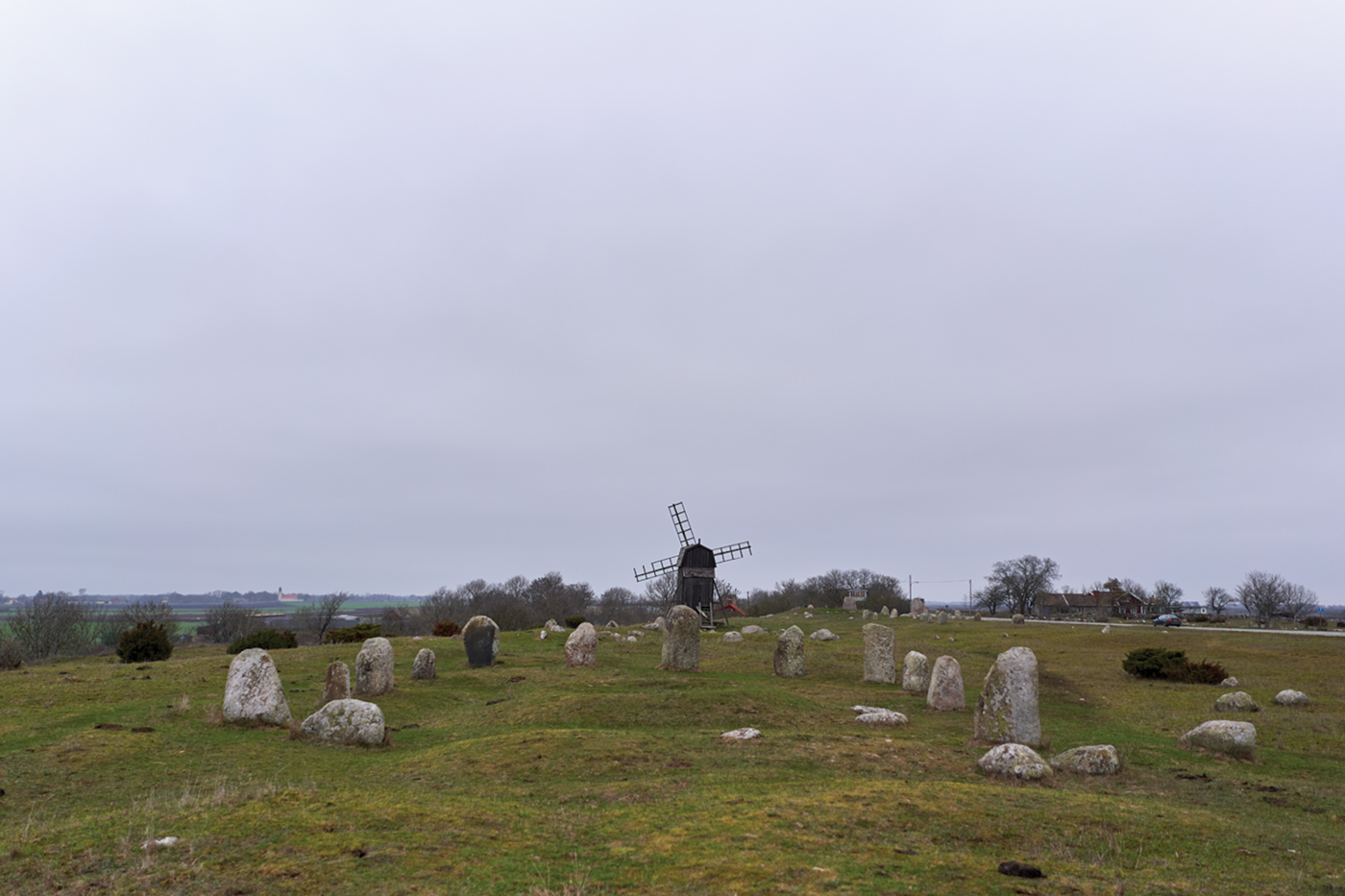
Grave fields have a long continuity on Öland, not seldom spanning the entire Iron Age (c. 500 bc–ad 1050: Table 1) (e.g. Näsman Reference Brink1994; Räf Reference Räf2001; Wilhelmson Reference Wilhelmson2017, 59). They are often marked with large erected stones and placed in clearly visible places in the landscape (Fig. 5). The grave fields were located in proximity to the settlements but away from the domestic sphere. Often, they were situated on the outskirts of a settlement, adjacent to the next village. The larger the settlement, the further away the grave field was situated (Fallgren Reference Fallgren2006, 120f). Öland graves seem to have been strong territorial markers in the landscape (Fallgren Reference Fallgren2006, 120, 137). Fallgren (like other researchers before him, cf. Brink Reference Brink1994; Sundquist Reference Sundquist2002; Zachrisson Reference Zachrisson1994, for discussions on the Swedish mainland) further discusses the Öland Iron Age marked grave fields as monuments through which land ownership, inheritance and genealogies were manifested (Fallgren Reference Fallgren2006, 137).
Gettlinge grave field, one of many Öland Iron Age grave fields with standing stones still visible today. (Photograph: Daniel Lindskog.)
Many of the excavated Öland Iron Age graves are dated to the early periods (e.g. Wilhelmson Reference Wilhelmson2017) (Fig. 5; Table 1). A decline of dated burials from the Migration and Vendel period is contrasted by increased land use (Fallgren Reference Fallgren2006, 139, 179). What was earlier interpreted as a population decrease during the Migration and Vendel period (Stenberger Reference Stenberger1933), based on the few typologically dated graves, is now believed to be the result of a change in burial customs (e.g. Beskow-Sjöberg Reference Beskow-Sjöberg, Beskow-Sjöberg and Arnell1987, 108, 415; Fallgren Reference Fallgren2006, 139,179; Näsman Reference Brink1994). Fallgren (Reference Fallgren2006, 139) suggests that this change might be connected to intensified land use on Öland during the middle Iron Age. A fully colonized island would not have permitted new territorial expansion (as in the early Iron Age), restricting the capacity, opportunity and demand for new grave monuments. Subsequently, old graves may have been regularly re-used during the middle Iron Age, collective burials common, and the demand for new monumental structures decreased (Fallgren Reference Fallgren2006, 138-40 Näsman Reference Brink1994).
The normative treatment of the dead and mortuary beliefs
Since the treatment of a corpse can only be understood in relation to the prevailing conceptions of the world, the normative regional treatment on Öland during the Iron Age is briefly presented (e.g. Robb Reference Robb, Nilsson Stutz and Tarlow2013; Verdery Reference Verdery1999; Weiss-Krejci Reference Weiss-Krejci and Murphy2008; Reference Weiss-Krejci, Agarwal and Glenncross2011; Reference Weiss-Krejci, Nilsson Stutz and Tarlow2013). Inhumations of complete bodies and cremains were practised concurrently during the Iron Age (e.g. Beskow-Sjöberg & Arnell Reference Beskow-Sjöberg and Arnell1987; Beskow-Sjöberg & Hagberg Reference Beskow-Sjöberg and Hagberg1991; Reference Beskow-Sjöberg and Hagberg1996; Rasch Reference Rasch, Fabech and Ringtveg1991; Reference Rasch2001; Wilhelmson Reference Wilhelmson2017). Inhumed human remains were often placed in stone or wooden cists, or in pits (often covered with stone slabs), and cremains in urns or unenclosed in pits or in cists (e.g. Rasch Reference Rasch, Fabech and Ringtveg1991). Both types of burials were sometimes set in larger outer structures such as cairns, mounds or stone paving (e.g. Rasch Reference Rasch, Fabech and Ringtveg1991; Reference Rasch and Stjernquist1994; Wilhelmson Reference Wilhelmson2017, 59). It is common to find several graves in the same outer stone structure surrounding the ‘central grave’, particularly cremains (e.g. Wilhelmson Reference Wilhelmson2017, 58). Burials were either individual or collective (e.g. Räf Reference Räf2001, 18; Rasch Reference Rasch, Fabech and Ringtveg1991; Sjøvold Reference Sjøvold and Stjernquist1994). Secondary manipulation of skeletons is common, as evidenced by commingled, reduced and scattered remains (e.g. Rasch Reference Rasch, Fabech and Ringtveg1991; Sjøvold Reference Sjøvold and Stjernquist1994; Wilhelmson Reference Wilhelmson2017, 63), indicating a prolonged interaction with human remains. The burial customs are recognized from the southern Scandinavian mainland, but with a higher presence of complete body inhumations on Öland (e.g. Sjøvold Reference Sjøvold and Stjernquist1994). Artefacts and animal remains occur in many graves, and are thought to be grave goods (e.g. Räf Reference Räf2001; Rasch Reference Rasch, Fabech and Ringtveg1991; Sjøvold Reference Sjøvold and Stjernquist1994). Iron Age grave goods can possibly be understood as a means to ease the journey to the next state of being (e.g. Johansson Reference Johansson, Fahlander and Oestigaard2008; see also Van Gennep Reference Van Gennep1960). Looking at early medieval written sources about the Scandinavian Iron Age beliefs, there are strong indications that reincarnation after the earthly life was expected (e.g. Gansum Reference Gansum, Fahlander and Oestigaard2008; Nordberg Reference Nordberg2003; Rudebeck Reference Rudebeck, Jennbert, Andrén and Raudvere2002).
The treatment of the dead in Sandby borg
The normative treatment of the dead in Migration period Öland included some kind of handling of the body during its liminal phase (predominantly cremation) and subsequent burial away from the domestic sphere. The non-handling of the bodies in Sandby borg presents a strong contrast to this. The absence of body processing is unique in the regional context as we know it. Interaction with the dead after skeletonizing was common practice during the Iron Age, but no such interaction is evidenced in Sandby borg. The corpses were left to decay in the domestic sphere. They were never recovered, nor given a burial or corporeal treatment. If one accepts that the moral obligation to perform passage rites for the dead extends beyond the most intimately bereaved, it would be expected that inhabitants of neighbouring villages would have felt obliged to tend to the dead, even if all Sandby borg inhabitants were in fact killed. Since Migration period Öland was densely populated (Fallgren Reference Fallgren2006, 139, 179) it is unthinkable that the mass killing in Sandby borg went by unnoticed. The human remains left in Sandby borg seem to be the result of non-action and possible prevention of prescribed ritual. Had the ringfort inhabitants been killed during a raid by a foreign group, it would seem unlikely that the dead were not tended to, and that the land was not re-inhabited. Abandoning the ringfort seems to have been a conscious action, possibly a power demonstration by the (probably local) perpetrators (see also Alfsdotter et al. Reference Alfsdotter, Papmehl-Dufay and Victor2018; Victor Reference Victor, Arnell and Papmehl-Dufay2015). In order to explore what the unburied corpses might have meant, and if they played a part as agents in the contemporary social transformation following the violent event, the social and emotional implications of the corpse is discussed below.
Social response to death and postmortem agency
Death always evokes emotions in the living, but the nature of these emotions varies in different cultures, as do the responses to the emotions (Tarlow Reference Tarlow1999, 183). Although corpses and death are perceived in different ways, they universally require some form of action (Bloch & Parry Reference Bloch, Parry, Bloch and Parry1982; Nilsson Stutz Reference Nilsson Stutz2003; Reference Nilsson Stutz, Fahlander and Oestigaard2008; Robb Reference Robb, Nilsson Stutz and Tarlow2013). The handling and management of corpses is connected to social order and disorder and thus changes the social structure (e.g. Pérez Reference Pérez, Martin, Harrod and Pérez2012; Robben Reference Robben, Suárez-Orozco and Robben2000). It is suggested that rituals related to someone's death need to be material, separate from the emotional and social crisis of someone's passing, in order to ‘heal’ the society (e.g. Aries Reference Aries1981, 559–60). Through rituals connected to death, the corpse is often redefined by the mourners from a subject to an object that they can detach from, thus reinstituting social order through the construction of a ‘proper death’ during the liminal phase of the corpse (Hertz Reference Hertz, Needham and Needham1960; Nilsson Stutz Reference Nilsson Stutz2003, 23; Reference Nilsson Stutz, Fahlander and Oestigaard2008; Nilsson Stutz & Tarlow Reference Nilsson Stutz, Tarlow, Nilsson Stutz and Tarlow2013; Van Gennep Reference Van Gennep1960, 147). There is commonly a long period of interaction with the dead before the transition between different stages of being is complete (Robb Reference Robb, Nilsson Stutz and Tarlow2013; Tarlow Reference Tarlow1999; Reference Tarlow2000; Van Gennep Reference Van Gennep1960; Weiss-Krejci Reference Weiss-Krejci, Agarwal and Glenncross2011; Reference Weiss-Krejci, Nilsson Stutz and Tarlow2013).
Nilsson Stutz argued (Reference Nilsson Stutz2003; Reference Nilsson Stutz, Brandt, Prusac and Roland2014) that the human corpse is always handled in some culturally significant way. However, the choice not to handle the corpses in Sandby borg contrasts this supposition but is culturally significant as a negligence towards them. Since the dead in Sandby borg were not given a normative treatment during their liminal phase, it can be argued that the corpses never transitioned into objects that could be detached from the living society. A ‘proper death’ according to normative funeral practice was denied the Sandby borg inhabitants. As no proper deaths were given to the Sandby borg victims, the social order was likely disturbed by that disregard for the corpses.
Postmortem agency
What might be the reasons for not granting someone a proper death? An essential question is what social impact a corpse may induce. Crandall and Martin (Reference Crandall and Martin2014) discuss ‘postmortem agency’ as an important aspect of the holistic understanding of how corpses affect their surroundings. The corpse is, by some scholars, seen as a ‘secondary actor’—an object that only extends the agency of other (living) actors (e.g. Harper Reference Harper2010; Tung Reference Tung2014). Others claim that the corpse can be a ‘primary actor’ that through its very presence can affect the emotions of the living (e.g. Crandall & Harrod Reference Crandall and Harrod2014; Gell Reference Gell1998; Novak Reference Novak, Knüsel and Smith2014). In line with the latter, Robb (Reference Robb, Gosden, Renfrew and DeMarrais2004; Reference Robb, Nilsson Stutz and Tarlow2013) argues that dead bodies can exercise agency because they initiate actions. Human remains primarily affect their surroundings during their liminal phase (e.g. Hertz Reference Hertz, Needham and Needham1960). If the mortuary treatment is properly conducted, the potential power of the human remains as agents in society is often reduced. The grief and emotional crisis of the missing subject does not necessarily end with the completion of a ‘proper death’ through the prescribed rite of passage, but the agency of the corpse (or skeleton) as both a primary and secondary actor is in many belief systems limited following a proper death. Given that the success or failure of rites of passage is not only dependent on the materiality of the corpse (as a primary actor), but also on the performance of the living collective (those who must live with the outcome of the passage rite), both the potential primary and secondary postmortem agencies seem to be closely connected. Analysing the Norse sagas, Gansum (Reference Gansum, Fahlander and Oestigaard2008) argues that the dead could hold agency in the Scandinavian Iron Age, and that potential postmortem agency was closely connected to social (dis)order. Revenants had their own agenda, often contrasting with that of the living. One example was a man who died with a grudge in his home, after which he had to be carried out through a hole in a wall to prevent him coming back through the door. Nevertheless, he came back to the living to claim lives of individuals that would accompany him in death. In order to stop the revenant, the grave was reopened after a year to move the deceased to another location, only to find the body of the man undecayed (Gansum Reference Gansum2004; Reference Gansum, Fahlander and Oestigaard2008). The sagas cannot be read as objective truths about the Scandinavian Iron Age, but this example illustrates the complexity built into how postmortem agency could be perceived. The agency of dead spirits seems to have been connected to the dead body, and thus the ability to interfere with living society was connected to the corporeal fate (Gansum Reference Gansum, Fahlander and Oestigaard2008).
Postmortem agency is evident in many different settings, due to various causes and with different outcomes. The agency is often powerful in cases where human remains have not been given a proper death, and thus never turn into objects that can be detached from living society (cf. Hertz Reference Hertz, Needham and Needham1960). The dead can be left in the liminal phase on purpose, like Lenin in his mausoleum, or unintentionally, such as human remains not being relocated after lethal catastrophes. Individuals left in the liminal phase are not necessarily controversial or problematic in living society. An example of such a case is the relics of saints. Other forms of postmortem agency are unwished for by the collective. One historic example is that if people believed that the dead might rise again as vampires, the rite of passage needed to be altered to prevent them from doing so (Betsinger & Scott Reference Betsinger and Scott2014). A third form of postmortem agency is when the agency of human remains is used for the benefit of one group in society at the expense of another. The latter is common in conflicts, where human remains can exert agency both by their presence and by their absence. Contemporary examples are political conflicts where corpses ‘disappear’ (for example in Argentina: e.g. Brysk Reference Brysk1994; Robben Reference Robben, Suárez-Orozco and Robben2000), or when burials are not the result of proper mortuary rites, such as mass graves following genocides or civil wars (e.g. Klintenberg Reference Klintenberg2001; Renshaw Reference Renshaw2011; Wagner Reference Wagner2008). Thus, a burial does not necessarily mean that a proper death has taken place. The dead can be buried but still be in the liminal phase due to insufficient mortuary treatment. One example illustrating this is the recent exhumations of the Spanish civil war victims that were buried in mass graves. Even though the killings took place c. 70 years prior to the exhumations, the main rationale behind the excavations was that the dead, and the treatment of their remains, still affected the living through a perceived bond with them (Renshaw Reference Renshaw2011, 31).
The advantage of corpses as meaning-bearers over living bodies is that corpses have no agenda of their own. There is symbolic power in the ambiguity of the corpse and thus it is able to evoke different understandings. Dead bodies are ideal as conveyors of meaning, since they influence kinship, death and life, history, authority, identity, proper death, morality, territory and time (Verdery Reference Verdery1999). The materiality of the body or the skeleton is crucial to its symbolic power. They can be moved and displayed in ways that intangible notions cannot. Corporeality is important when claiming territory and supremacy (Verdery Reference Verdery1999, 27–33, 109–10), as can be seen in archaeological examples where geographical entitlement is often claimed through ancestral burials and reburials (e.g. Artelius Reference Artelius2004; Fahlander Reference Fahlander2016; Fallgren Reference Fallgren2006; Hållans Stenholm Reference Hållans Stenholm2012; Holtorf Reference Holtorf1996; Pedersen Reference Pedersen, Andrén, Jennbert and Raudvere2006; Thäte Reference Thäte2007; Zachrisson Reference Zachrisson1994).
The dead body is easy to relate to emotionally since everyone is (or has) a body (Verdery Reference Verdery1999). Even those long dead and unknown to living humans can evoke emotional responses, likely a result of the connection with personal losses or identification with parts of the deceased person's biography (Verdery Reference Verdery1999). Given that corpses are effective agents, they are potentially an important means of bringing ‘symbolic capital’ to social transformation. Verdery (Reference Verdery1999) explored the corpse as a political symbol from an anthropological perspective. She argues that the fear and anxiety invoked by death, and the essential question of the meaning of life, makes corpses perfect to use as agents in times of major social disruption. Not only can the politicization of corpses be applied to transform the future of a society, but also to rewrite the past (e.g. Renshaw Reference Renshaw2011, 27, 32–4; Verdery Reference Verdery1999, 28–31).
Postmortem agency in relation to lethal inter-group conflict and ‘bad death’
The theoretical concept of ‘politicization of the dead’ was introduced to bioarchaeology by Pérez (Reference Pérez, Martin, Harrod and Pérez2012). The theories presented by Pérez are in line with those discussed by Verdery (Reference Verdery1999). Essential to the politicization of the dead is the corpse as a transitional object for both the perpetrators and the defeated (Pérez Reference Pérez, Martin, Harrod and Pérez2012; Robben Reference Robben, Suárez-Orozco and Robben2000, 85). Inspired by Robben (Reference Robben, Suárez-Orozco and Robben2000), Pérez (Reference Pérez, Martin, Harrod and Pérez2012) argued that collective violence involves complex socio-cultural factors that interlink political, economic and psychological elements. Hence, collective lethal violence does not ‘only’ cause corporeal deaths and physical trauma, but it also affects the psyche and the future of the society in which it takes place (e.g. Daniel Reference Daniel1996; Feldman Reference Feldman1991; Nordstrom & Martin Reference Nordstrom and Martin1998; Pérez Reference Pérez, Martin, Harrod and Pérez2012; Robben Reference Robben, Suárez-Orozco and Robben2000; Suárez-Orozco & Robben Reference Suárez-Orozco, Robben, Robben and Suárez-Orozco2000). Violence can work as both a stabilizing and a destabilizing social tool (e.g. Galtung Reference Galtung1990; Kurtz & Turpin Reference Kurtz, Turpin, Turpin and Kurtz1997; Sluka Reference Sluka, Nordstrom and Martin1992) and can even facilitate social cohesion through the creation and destruction of ‘the other’ (Krohn-Hansen Reference Krohn-Hansen1994; Rappa Reference Rappa1999; Osterholtz Reference Osterholtz2012; Schmidt & Schröder Reference Schmidt and Schröder2001). In order to analyse and understand the performance of violence better, the perspectives of the perpetrator(s), the witness(es) and the victim(s) all needs to be incorporated (Krohn-Hansen Reference Krohn-Hansen1994; Riches Reference Riches1986; Whitehead Reference Whitehead and Whitehead2004; Reference Whitehead2005). Osterholtz (Reference Osterholtz2012) drew on this line of research when contextualizing osteological evidence of torture and hobbling from the Sacred Ridge Site, Colorado (for other examples of bioarchaeological research incorporating politicization of corpses, see Novak Reference Novak, Knüsel and Smith2014; Tung Reference Tung2014). Osterholtz (Reference Osterholtz2012) discussed how social control can be gained over both witnesses and victims of direct violence by exercising performative violence against only a limited number of individuals. This is because the threat of violence is equally as powerful as direct violence (Ferguson Reference Ferguson2008; Krohn-Hansen Reference Krohn-Hansen1994; Parsons Reference Parsons2007). Consequently, social control can be imposed on a large number of people by a relatively limited number of enforcers, if one establishes a credible threat of violence (Osterholtz Reference Osterholtz2012). Osterholtz concludes that:
When expressed physically, structural violence is a group performative action where the impact is greater than the actual action perpetrated. Witnesses are invisible in the archaeological record, but the fact that this deposition [the human remains showing traces of torture] occurred near or at the time of abandonment of the site may suggest that the act had long-reaching consequences for the area. (Osterholtz Reference Osterholtz2012, 134)
Applying this line of reasoning to the Sandby borg site, the ‘witnesses’ would mainly have been the inhabitants of neighbouring settlements (and any potential survivors from Sandby borg). It is, however, unlikely that people that lived in the surrounding area witnessed the actual attack on Sandby borg. Whitehead (Reference Whitehead and Whitehead2004) argued that ‘witnesses’ to violence are all those to whom the violence is reproduced or retold. It is reasonable to interpret the negligence to conduct proper rites of passage for those that died in Sandby borg and the abandonment of the settlement as a manifestation of the social control exercised by the perpetrating group. The violent performance could have served as a form of deterrent, or example serving to reinforce social control over the local populace.
Most mass killings, both modern and in the distant past, are followed by some form of inhumation of the corpses, whether in mass graves dug by the assailants to prevent the spreading of diseases, or combined with mortuary practices by supporters in order to produce a proper death. Manipulation of corpses connotes political symbolism and thus impacts both contemporary and future societies and the creation of spatial and collective memory (Douglas Reference Douglas1966, 115; Pérez Reference Pérez, Martin, Harrod and Pérez2012; Renshaw Reference Renshaw2011, 27; Verdery Reference Verdery1999, 3). Viewing what transpired in Sandby borg in the light of these perspectives, the unburied corpses may have functioned as playing pieces in a pursuit of outcomes beyond the actual attack itself, such as a change of the collective memory, territorial conquest and a stigmatization of the victims. Returning to the suggestion by Fallgren (Reference Fallgren2006, 120, 137), that the Öland Iron Age graves carry symbolic power as landscape markers for territory and inheritance, it is reasonable to argue that an active decision not to bury the dead in Sandby borg could have been a means to break the genealogy of the Sandby borg inhabitants, and thus their territorial claim. A discontinuation of their grave field and the killing of the settlers might have granted the attackers a possibility to expand, make new territorial claims and increase their local influence.
Denial of proper passage rites is often inflicted on those who have suffered a ‘bad death’ (e.g. Weiss-Krejci Reference Weiss-Krejci, Nilsson Stutz and Tarlow2013). Inspired by Thomas (Reference Thomas1975, 192), Bloch and Parry (Reference Bloch, Parry, Bloch and Parry1982) defined a ‘bad death’ as a death not leading to regeneration due to the lack of social control. Drawing on anthropological research, Weiss-Krejci wrote that:
Improper or disrespectful treatment can serve as a means to punish or destroy a person, demonstrate religious and political power, or simply to avert the dangerous dead. In this sense, the unburied dead are often deviant social personae, political enemies, and people who have died a bad death. (Weiss-Krejci Reference Weiss-Krejci, Nilsson Stutz and Tarlow2013, 281)
Given the indiscriminate killing in Sandby borg, all the victims were probably not social outcasts in Migration period Öland. Based on the discussion put forward here, a more likely explanation is that a local political conflict was the cause for the killing. People who die violently are often refused mortuary treatment (Tylor Reference Tylor1903, 27–8). Deprivation of proper mortuary treatment of enemies commonly brings shame and humiliation to the conquered (Houston et al. Reference Houston, Taube and Stuart2006, 203). In many belief systems, corpses of people that are not given proper rites of passage haunt the living and are refused entry into the afterlife, their souls condemned to live on the margins between this life and the next as some form of malignant spirits (Hertz Reference Hertz, Needham and Needham1960; Tylor Reference Tylor1903, 27–30; Van Gennep Reference Van Gennep1960, 160–61; Weiss-Krejci Reference Weiss-Krejci, Nilsson Stutz and Tarlow2013). Relating back to the Norse sagas and the lack of normative treatment of the dead in Sandby borg, the fact that the corpses were left in their homes without mortuary treatment makes a strong case for possible postmortem agency and a bad death.
Discussion
As Robb (Reference Robb, Nilsson Stutz and Tarlow2013) pointed out, deprivation of burial is stigmatizing only if a culture believes that the body is important in death, and since Migration period deaths often involved extensive rites of passage, the body was indeed an important aspect in contemporary death rituals. Given the non-handling of the Sandby borg victims, it is reasonable to argue that they suffered a bad death. If a bad death is in fact inflicted on those who are killed beyond social control, perhaps the violence in Sandby borg was not uniformly sanctioned by society, but was the result of actions conducted by a rebelling group. Perchance neighbours were either prevented from burying the dead, or the very fact that they suffered a bad death led to an unwillingness to handle the corpses. The deprivation of a proper death probably led to shame, disgrace, prevention of regeneration and thus an eternal separation from the living. Leaving the Sandby borg victims unburied can be seen as an aggressive social action, a final act of violence and punishment against the dead.
Leaving the corpses unburied would have made it easy to manifest certain aspects of the biography and memory of the once living (Verdery Reference Verdery1999). Their bad deaths likely came to dominate their entire remembrance (whereas funerary rites often commemorate several aspects of the once living). A proper death will turn the dead into something new (i.e. ancestors), but the unburied dead are left stranded in this world, without regeneration. Indeed, even today, as the remains of Sandby borg are unearthed after 1500 years, the biography of the Sandby borg dwellers is still dominated by their deaths.
Returning to Verdery and the political lives of dead bodies, corpses can be used as instruments to achieve various political goals, such as the justification of certain actions, territorial claims, asserting jurisdiction, or disputing the authority of others (Verdery Reference Verdery1999). These considerations might have been key factors in the event that occurred in Sandby borg. The assault was likely part of a local power play during the politically turbulent Migration period (cf. Alfsdotter et al. Reference Alfsdotter, Papmehl-Dufay and Victor2018; Victor Reference Victor, Arnell and Papmehl-Dufay2015; for Migration period context, cf. Fagerlie Reference Fagerlie1967; Hedeager Reference Hedeager1992; Reference Hedeager2011, 170; Herschend Reference Herschend1980; Høilund Nielsen Reference Høilund Nielsen2005; Stenberger Reference Stenberger1933). Metaphorically speaking, the dead bodies bore witness to the end of life inside the ringfort and thus the extinction of networks, wealth, land and power connected to Sandby borg. With regard to the corpse as secondary actor—extending the agency of living actors—the unburied corpses can be explored through the perspective of the perpetrators and the witnesses. On the premise that the inhabitants of Sandby borg were in some position of power, killing them and denying their corpses mortuary treatment would have granted their conquerors power and dominance in the area. The death of the ringfort community would have changed both the physical and the mental landscape, perhaps allowing the enemy to redraw the political landscape as part of a social transformation achieved through violent dominance. The massacre was likely a means to spread terror and manifest power among the witnesses.
The stigmatization of the Sandby borg inhabitants might soon have led to a taboo in contemporary society due to their bad deaths. Perhaps the reason that Sandby borg was not re-inhabited was the stigmatization that changed both past and future perceptions of Sandby borg, along with a change in territorial claims. The sensory response of possible visitors, or simply the knowledge of the presence of the unburied dead within the ringfort, would have made the corpses primary actors through their mere existence (e.g. Crandall & Harrod Reference Crandall and Harrod2014; Gell Reference Gell1998; Novak Reference Novak, Knüsel and Smith2014; Robb Reference Robb, Nilsson Stutz and Tarlow2013). The denial of rites of passage might have resulted in the inhabitants of Sandby borg being eternally trapped in a liminal phase of existence, a condition which exerted agency among witnesses in contemporary society.
Conclusion
The inclusion of social theories in the investigation of human remains from violent encounters makes it possible to move beyond merely recording the remains of the dead in terms of their demography, their skeletal trauma and clues about life history, and generate a deeper understanding of how collective violence can be organized to achieve consequences beyond the violence itself. With the Sandby borg massacre as a case study, I have investigated how the perspective of the perpetrators, victims and witnesses can be explored in relation to postmortem agency in cases of lethal inter-group violence. This paper demonstrates an example of how socially transformative outcomes of proper and bad death can be studied in the deeper past.
The corpse carries strong political and symbolic capital and is therefore useful in the process of social change. Corporeal death commonly demands a social response. The response in the case of the Sandby borg massacre, where the victims were not cared for, was probably one of horror. The gain for the perpetrators was likely political power through a redrawing of the biography of the victims, the political landscape and the spatial memory, thus changing both the past and the future. The denial of rites of passage might have led to eternal separation between the dead and their sympathizers and the end of regeneration for the defeated. Sandby borg was seemingly left as a monument of terror.
Acknowledgements
I am very grateful to the editor and to the anonymous reviewers for their help in improving this paper. Many thanks to Anders Högberg, Liv Nilsson Stutz and Cornelius Holtorf for constructive feedback on previous versions of the manuscript. Thank you Delia Ní Chíobhaín Enqvist and Dejan Gajic for revising the English. For help with figures and pictures, I thank Helena Victor, Daniel Lindskog, Jhonny Therus and Sebastian Jakobsson.





 Open access

