




Introduction
Krzyż Wielkopolski 7 is one of the few Mesolithic peatbog sites of the North European Plain that has the necessary conditions for outstanding preservation of organic materials, due to the slow infilling of a succession of heavily calcareous peats and gyttjas (organic sediments). Discovered in 2003, the site has yielded thousands of Preboreal and Boreal faunal remains and rich assemblages of artefacts, including adzes made of red deer antler or aurochs/elk metapodials, antler chisels, bone perforators, wooden shafts and handles, and portable art (Kabaciński et al. Reference Kabaciński2008, Reference Kabaciński, Hartz and Terberger2011; Kabaciński Reference Kabaciński2009, Reference Kabaciński and Kabaciński2016; Makowiecki Reference Makowiecki and Kabaciński2014; Winiarska-Kabacińska & Kabaciński Reference Winiarska-Kabacińska and Kabaciński2016). These rich accumulations indicate an enduring occupation and varied activity by groups of hunter-gatherers within this rich Early Holocene environment, as well as the intensive procurement and processing of bone, antler, wood and plant material.
The present article focuses on a well-preserved artefact from Krzyż Wielkopolski 7: a composite implement formed of a short point made from osseous material and attached to a wooden shaft. It is partially coated by a black, pitch-like substance that probably represents an adhesive. The artefact embodies a series of specific interactions between animal and plant resource management systems, and enables discussion of the types of technology and organic materials used by Mesolithic hunter-gatherers in the production of composite artefacts. Specifically, we consider how some steps in the chaîne opératoire suggest a certain level of expedience in the selection and working of materials, while others point, nonetheless, towards the use of methods to ensure the efficacy of the final product. The analysis of such implements requires a multidisciplinary approach in order to: (i) identify the materials used; (ii) reconstruct the manufacturing processes involved; and (iii) assess their function. Our analyses combine methods including X-ray analysis, technological and functional examination at both macro-and microscopic scales, wood and fibre analyses, radiocarbon dating and gas chromatography-mass spectrometry (GC-MS). For a description of the methods employed and detailed results, see online supplementary material (OSM) 1.
Palaeoenvironmental and archaeological contexts
Krzyż Wielkopolski 7 is located in western Poland, on the lower northern terrace of the river Noteć within the Toruń-Eberswald ice-marginal valley, which runs from the river Vistula in the east to northern Brandenburg in the west (Figure 1). The site extends along a palaeochannel that formed during the Younger Dryas, which gradually filled with biogenic and mineral deposits since the beginning of the Holocene. The first Early Mesolithic activity at the site dates to the second half of the Preboreal period (after c. 11 000 cal BP); intensive hunter-gatherer use of the banks of the palaeochannel continued for approximately 2000 years (Winiarska-Kabacińska & Kabaciński Reference Winiarska-Kabacińska and Kabaciński2016).
Location of the Krzyż Wielkopolski site (figure by J. Kabaciński).

Palynological data and macro-remains from the biogenic sediments at the site record the major environmental dynamics of the Preboreal/Boreal transition—namely the development of broad-leaved forests at the expense of birch/pine, which is emblematic of the Preboreal period in this area, and the growth of open meadows dominated by grasses (Poaceae) (Lityńska-Zając Reference Lityńska-Zając and Kabaciński2014; Okuniewska-Nowaczyk Reference Okuniewska-Nowaczyk and Kabaciński2014). The terminal Preboreal and Boreal periods saw a marked increase in hazel (Corylus avellana), as well as elm (Ulmus), oak (Quercus) and poplar (Populus). Throughout the site's occupation, willow (Salix spp.) grew within its vicinity, and marsh and water plants were present both within and around the palaeochannel.
This diverse environment was populated by a varied fauna, as reflected in the remains of hunted animals found at the site (Makowiecki Reference Makowiecki and Kabaciński2014; Kabaciński Reference Kabaciński and Kabaciński2016). Large species are represented by elk (Alces alces), horse (Equus ferus ferus), aurochs (Bos primigenius) and red deer (Cervus elaphus), accompanied by smaller species, such as roe deer (Capreolus capreolus), wild boar (Sus scrofa), beaver (Castor fiber), hare (Lepus europaeus) and turtle (Emys orbicularis). The wetlands would also have been highly attractive to hunter-gatherers as a source of fish and birds. Their heavy reliance on such species is reflected in the presence of goose (Anser spp.), duck (Anas spp.), common crane (Grus grus), grey heron (Ardea cinerea) and Eurasian bittern (Botaurus stellaris) (Makowiecki Reference Makowiecki and Kabaciński2014; Kabaciński Reference Kabaciński and Kabaciński2016). Identified fish species include pike (Esox lucius), common bream (Abramis brama), tench (Tinca tinca), crucian carp (Carassius carassius), roach/rudd (Rutilus rutilus/Scardinius erythrophthalmus), perch (Perca fluviatilis), pikeperch (Sander lucioperca), catfish (Silurus glanis) and eel (Anguilla anguilla) (Zabilska et al. Reference Zabilska-Kunek, Makowiecki and Kabaciński2015).
The site's stratigraphy, combined with a series of radiocarbon dates, indicates two main phases of occupation, which have been attributed to the late Preboreal/early Boreal (11 050–9700 cal BP at 95.4% confidence) and Boreal (10 150–9000 cal BP at 95.4% confidence) (see OSM 2). Within the context of the chrono-cultural divisions of the North European Plain (Kabaciński Reference Kabaciński and Kabaciński2016), both phases form part of the Duvensee/Komornica Culture, with elements of the Maglemose Culture also clearly present during the Boreal period.
The artefact
The composite artefact was recovered in 2013 from a gyttja layer attributed to the late Preboreal/early Boreal period. It was located approximately 1.6m below the current ground surface, at an elevation of 27.3m asl. The artefact measures 131mm in length, with a maximum width of 14.5mm, and consists of a long, straight point made from osseous material and an elongated wooden shaft (Figure 2).
Photographs of the composite point. Scale in cm (figure by É. David).
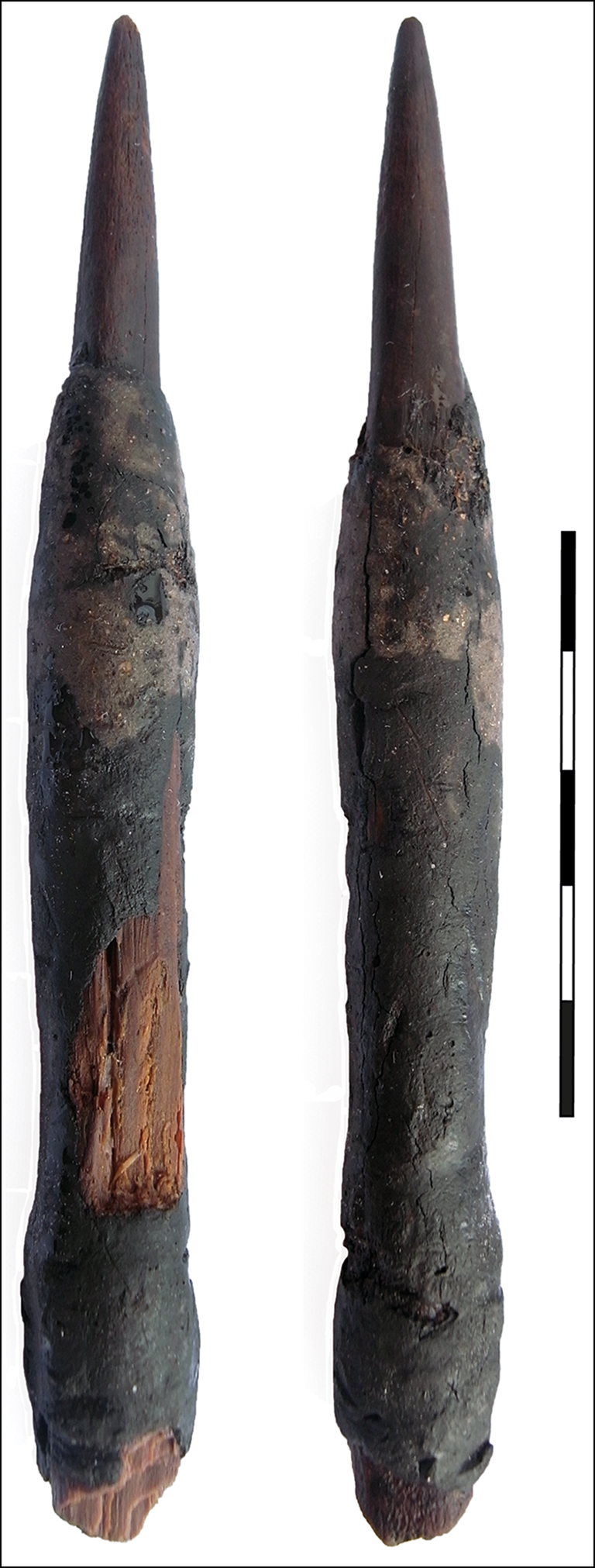
Two thirds of the composite implement (approximately 95mm of its length) is covered by a thin, black amorphous layer measuring up to 700μm in thickness. The visible uncoated, osseous point is complete and has a flat-oval cross section of 7 × 10mm. It is approximately 30–35mm long, with a maximum width of 10mm and a maximum thickness of 7mm, while the base is 8mm wide and 7mm thick.
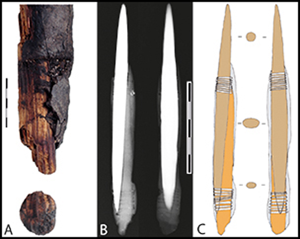
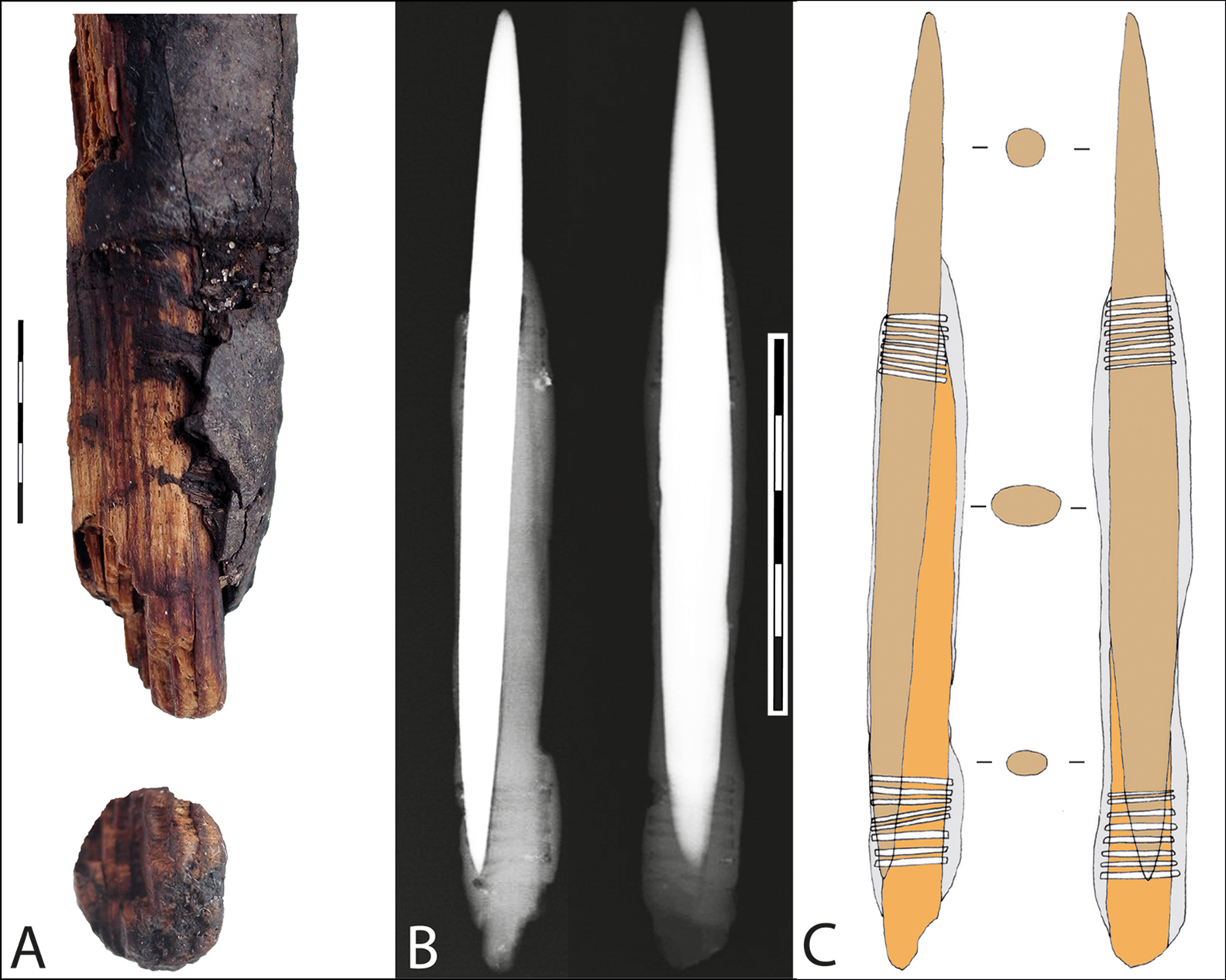
The point is fitted asymmetrically against the wooden shaft, with two thirds of the point's length set with its straightest side parallel to the shaft (Figure 3). The wooden shaft, which measures 7.5 × 10.5mm in cross section and does not vary across its length (Figure 3B & 3C), is broken near the base of the point. X-ray analysis reveals the presence of two sets of ligatures beneath the black layer. These bind the two component parts together at the proximal end of the wooden shaft and distal end of the point (Figure 4).
A) Photograph with details of the shaft; B) X-ray photograph; C) reconstruction drawing of the composite point. Scales in cm (A and C by J. Kabaciński; B made by NZOZ Klinika Promienista, Poznań).
Details of the black layer and ligatures. The black frame shows the sampling area for the ligature analysis; the black arrow points to a modern root that grew over the artefact (figure by J. Kabaciński).

Results of the multi-proxy analysis
Detailed observations of the osseous point suggest that it is made of bone (Laroche Reference Laroche2002) (Figure 5A). It appears to have been produced from an elongated splinter, possibly extracted using a wedge to split the shaft, which is referred to as the ‘shaft-wedge-splinter’ technique (David Reference David and Ramseyer2004). It was then worked lengthwise (Figure 5B) to shape and/or sharpen it to a point. A coarse-grained stone tool was first used to work the bone, and the centre of the point's surface might also have been scraped using a flint burin (Figure 6A–B). Part of the point, especially the tip, was possibly smoothed with a fine-grained polisher (Figure 6E). There are also several elongated cuts visible on the tip, which appear to be of post-depositional origin (Figure 6C–D). A triangular split is visible at the tip, accompanied by minor damage (Figure 6F). The superimposed sequence of splits observed on the very tip of the point does not seem to have resulted from one single episode but from repeated impacts (Pétillon et al. Reference Pétillon2009; Gauvrit Roux et al. Reference Gauvrit Roux, Cattin, Yahemdi and Beyries2020), suggesting that the point was used multiple times before the wooden shaft was broken and the tool abandoned (Buc Reference Buc2011; Bradfield Reference Bradfield2015).
Photograph of the composite point's surface, displaying the characteristic bone structure (A) and manufacturing traces (B) (figure by É. David).

Photographs of manufacturing traces (A & B), post-depositional depressions (C & D), smoothing (E) and damage to the tip (F) (figure by M. Winiarska-Kabacińska).

The microscopic analysis of the wooden shaft indicates that it was made of Pinus subg. Pinus, most probably Scots pine (Pinus sylvestris), and produced using straight-grained wood of a larger diameter, from which a quadrangular rod was extracted—possibly radially—following the direction of the fibres. This quadrangular rod was then bevelled at its distal end to fit against the bone point (Figure 3A & Table 1; see also OSM1). The break at the base appears to be ancient and could have been caused by use. Given this quite simple fabrication process, the acquisition of a suitable material (straight-grained, sound pine wood that is easy to work) would probably have represented a greater investment of time than the manufacture itself. The shaft and the bone point are bound together by bast fibres of a taxon with libriform fibres (a type of woody fibre), elongated with simple, small pits (Figure 7A–D). These small, oval pits, which are present in poplar (Figure 7E), are also characteristic of other broad-leaved taxa. The degree of preservation of the bast fragments does not allow a more precise determination.
SEM micrographs of the ligature sample (A–D) and reference poplar bast (E) (figure by C. Cheval, A. Henry and F. Orange).

Objects from north and central European Mesolithic sites with tar analyses.

GC-MS analysis of the black material covering part of the point and shaft indicates that its chemical structure is characteristic of birch bark tar (Figure 8). It is well preserved and chemically similar to the ‘first bark exudate’ collected during gentle heating (i.e. progressively increasing the temperature and not exceeding 350°C). This first exudate produced by us experimentally during previous works is a liquid with low viscosity, which does not solidify quickly after removal from the heating source (Rageot et al. Reference Rageot2019, Reference Rageot2021). The implement from Krzyż could therefore have been simply dipped in the tar, or the tar could have been poured over the artefact while slowly rotating it.
Chromatogram of the reference sample of birch bark tar (a) and archaeological sample from Krzyż (b) (figure by M. Rageot, A. Mazuy and M. Regert).

A sample of the birch bark tar was AMS radiocarbon dated at the Poznań Radiocarbon Laboratory, providing an uncalibrated date of 8930±50 BP (Poz-60253). Calibration in OxCal (v4.4) using the IntCal20 calibration curve (Bronk Ramsey Reference Bronk Ramsey2009; Reimer et al. Reference Reimer2020) gives the following ranges: 10 188–9915 cal BP (at 68.3% confidence) and 10 220–9898 cal BP (at 95.4% confidence). This places the manufacture of the implement at the Preboreal/Boreal transition (Figure 9).
Radiocarbon calibration curve of the birch tar sample from the Krzyż composite point (Poz-60253) calibrated in OxCal (v4.4.4) using the IntCal20 calibration curve (Bronk Ramsey Reference Bronk Ramsey2009; Reimer et al. Reference Reimer2020) (figure by J. Kabacinski).

Discussion
A variety of both barbed and barbless bone points were produced by Early Mesolithic foragers in the European lowlands, as illustrated by the unique and rich collection from Friesack in Brandenburg, Germany (Gramsch Reference Gramsch2011), the closest site to Krzyż both chronologically and geographically. Our bone point is clearly barbless. Such points are relatively frequent elements of the basic hunting equipment of the Early Holocene on the North European Plain (Galiński Reference Galiński2013). They are, however, only rarely found as part of composite tools. Contemporaneous finds are known from Friesack IV–III (Gramsch Reference Gramsch2011) and Ulkestrup-II in Zealand, Denmark (Andersen et al. Reference Andersen, Jørgensen and Richter1982), the latter with a single indented barb. Such barbed points were manufactured exclusively using fine-grained tools and, in these cases, employing the groove-and-splinter technique, where a deep groove allows for pre-shaping of the material before splitting it (David Reference David2009). In contrast, we observed that the barbless point from Krzyż was made with a slightly different technique, involving coarse-grained tools to produce a straight bone point, using the shaft-wedge-splinter technique, which illustrates the existence of different techniques to make a variety of tools in the context of the North European Mesolithic.
The latest research into the use of this technique in combination with coarse-grained stone tools to produce bone implements suggests that this technology derives from the eastern regions of the Baltic Sea; in south-western Scandinavia it dates to c. 9500 cal BP at the earliest (David & Kjällquist Reference David, Kjällquist, Knutsson, Knutsson, Apel and Glørstad2018). The AMS radiocarbon date for the Krzyż artefact, taken on the birch bark tar, pre-dates this by approximately 500 years.
Although the bone point is asymmetrical and asymmetrically attached to the wooden shaft, the composite implement appears symmetrical when considered as a whole. It is possible that the birch bark tar was applied to achieve a degree of symmetry, thus ensuring the necessary ballistic properties of the implement. Indeed, the nature of the tar (the first exudates) would have made it unsuitable as a strong glue for hafting the point to the shaft, which explains the presence of the bast ligatures. Nonetheless, the relatively thick tar coating would have reinforced the binding between wood, bone and fibres. The fact that this protective layer is also waterproof might have played an important role in adapting the implement for use in wetland environments.
The results suggest that the artefact was used as a non-detachable weapon head—that is, a projectile point that remained fixed to its wooden shaft during impact. As the total length of the implement's shaft is unknown and its weight of 17g (close to a dry state) overlaps that described in the ethnographic record for fishing implements and for arrow/spearheads, its use cannot be determined in this way (Cattelain Reference Cattelain and Knecht1997). The relatively short, exposed tip and the pronounced thickening before the tip suggest that the implement was not meant to penetrate entirely into an animal's body. For this reason, and because the point displays evidence of crushing and damage due to direct impact, the piece probably relates to prongs or spiked weapons, such as straight, thrusting or hand-thrown spearheads. The latter are easier to use against close, moving targets than to spear and carry fish, which would instead necessitate the use of barbed points (David et al. Reference David2009). It is therefore unlikely that the Krzyż implement was used for fishing, which, at Krzyż, was mostly of small- to medium-sized catfish and pike, along with some larger individuals (up to 1m in length) (Zabilska-Kunek et al. Reference Zabilska-Kunek, Makowiecki and Kabaciński2015). On the other hand, such a weapon could also have been used to hunt birds or even kill mammals that were already injured or trapped, for example small, fur-bearing animals such as martens, evidence for which has been recovered from the site.
Our results also reflect the importance of plants in the daily life of Mesolithic groups occupying the European lowlands, as manufacturing the Krzyż implement required the acquisition of three distinct elements from three different taxa: pine wood for the shaft; birch bark for the tar; and an unidentified angiosperm for the bast ligatures. This reflects, to some extent, the reliance on Scots pine and birch, species which were widespread within continental Europe during the Preboreal/Boreal transition (e.g. Lamentowicz et al. Reference Lamentowicz, Obremska and Mitchell2008; Boettger et al. Reference Boettger2009; Milecka et al. Reference Milecka, Kowalewski and Szeroczyńska2011). In addition, the use of bast fibres during the Early Mesolithic is evidenced at sites such as Friesack IV, where willow and possibly poplar bast was used to produce strings and nets (Kernchen & Gramsch Reference Kernchen and Gramsch1989; Gramsch Reference Gramsch and Coles1991, Reference Gramsch, Baales and Pasda2019), as well as at north-eastern European sites, such as Nizhne Veret'e, Vologda Oblast’, Russia (Ošibkina Reference Ošibkina2007). Thus, the analysis of the Krzyż find provides further direct evidence for the importance of plant fibres during the Mesolithic.
Even though there are still few exhaustive analyses of wooden artefacts from the Early Mesolithic, pine was commonly used for woodworking, to produce handles, shafts, bows, arrows, domestic implements and dug-out canoes (Mordant & Mordant Reference Mordant and Mordant1987; Gramsch Reference Gramsch and Coles1991, Reference Gramsch2016; Beuker & Niekus Reference Beuker and Niekus1997; Mertens Reference Mertens2000; Ošibkina Reference Ošibkina2007; Junkmanns Reference Junkmanns2013). This also seems to be the case at Krzyż, where around 90 per cent of the worked or possibly worked wood fragments identified so far are of Scots pine. The woodworking technology used appears relatively standard across different types of objects. Our observations of approximately 80 worked Scots pine-type fragments from Krzyż reveal that quadrangular rods of different gauges were produced. In some instances (e.g. fragments of suspected arrow shafts), the rods are rounded in section and exhibit recurrent traces of transversal to longitudinal shaping—similar to those obtained by using coarse-grained stone on hard animal materials. The use of coarse-grained tools to shape wood, especially in the production of arrow shafts, is also suggested by the evidence from Friesack, where stone grinders have been interpreted as having had such a function (Gramsch Reference Gramsch2016).
The chaînes opératoires for the shaping (with cutting tools) and finishing (with coarse-grained stone tools) of both wooden and bone artefacts would have followed identical steps. The flint tools used for processing wood/plant and animal materials, respectively, appear always to be different at Krzyż; even within a typological group, different end-scrapers, blades, burins or flake-axes would have been used in the production of wooden or bone artefacts (Winiarska-Kabacińska Reference Winiarska-Kabacińska and Kabaciński2014; Winiarska-Kabacińska & Kabaciński Reference Winiarska-Kabacińska and Kabaciński2016). In other words, specific tools had specific functions at Krzyż, but the way in which different materials such as long bones or wood were worked lengthwise seems to have been performed in a similar manner, suggesting relationships between the techniques used to work these materials. This hypothesis can, however, only be tested through a wider experimental approach aimed at investigating the relationships between technologies for processing animal and plant products, for instance through the analysis of coarse-grained stone tool techno-traceology. The impression gained by our analysis of the bone and wood technologies employed at Krzyż is of a succession of simple operational steps, which nevertheless reflect a deep knowledge of the mechanical, physical and structural properties of the raw materials used.
Similar conclusions can be drawn from the molecular profile of the birch bark tar. The exceptional degree of molecular preservation in the hafting adhesive allows us to infer that the production of this material relied on the carefully controlled use of heat. The technological implications are that the tar would have been liquid and that, in order to obtain a homogeneous coating, the composite implement may have simply been dipped in the liquid tar and left to dry, or that tar may have been gently poured over it. Even though such procedures may appear quite basic, constant monitoring and precision in the temperature would have been necessary to achieve the required viscosity. The Krzyż implement provides additional evidence for the mastery and possible variability of Mesolithic tar fabrication processes, implying a much wider functionality than previously assumed. While birch bark tar is well known as a hafting material, our results show that it was also used as a ‘coating’ agent—used for its adhesive and hydrophobic properties, to protect and to reinforce the cohesion of a composite implement—while also probably playing an important role in achieving the balance required for ballistic purposes.
Data from northern and central European Mesolithic sites point to the widespread presence of chewing materials, sometimes associated with composite implements: in certain contexts, composite artefacts, such as arrowheads, have been found with well-preserved hafting adhesive (e.g. Gramsch Reference Gramsch2000; Pétillon et al. Reference Pétillon2011; Larsson et al. Reference Larsson, Sjöström and Heron2016) alongside stray lumps of tar, some of which bear teeth marks (Gramsch Reference Gramsch and Coles1991; Aveling & Heron Reference Aveling and Heron1998, Reference Aveling and Heron1999). Analyses of these adhesives are, however, still limited (Table 1). Pollen analysis and infrared spectrometry can provide some clues regarding these substances (Sulgostowska Reference Sulgostowska, Brzeziński and Piotrowski1997; Vahur et al. Reference Vahur, Kriiska and Leito2011), but the resolution of such techniques is lower than that provided by GC-MS analyses (Aveling & Heron Reference Aveling and Heron1998, Reference Aveling and Heron1999). Although other substances, such as collagen-rich animal materials, were possibly already known for their adhesive properties, all of the GC-MS analyses so far conducted on north European and Scandinavian Mesolithic sites point to birch bark tar as the only substance used to produce adhesive at that time. This could be explained by the poorer preservation potential of animal glues or plant resins, as well as cultural factors resulting in a preference for birch bark tar. In addition to the medicinal value of birch bark tar and its properties as a hafting adhesive, the coating of the Krzyż implement suggests that Mesolithic groups were not only aware of its waterproofing properties but could also have used first bark exudates to improve ballistic properties.
Conclusions
The multidisciplinary approach applied to the analysis of the Krzyż composite implement provides unique insights into Early Mesolithic technology (Figure 10). While X-ray analysis, macro- and microscopic examination, wood and fibre analyses, radiocarbon dating and GC-MS have been conducted here, further investigations, for example aDNA analysis of the birch tar, might shed still further light on the artefact. Our results demonstrate how the chaîne opératoire involved a number of technical steps in the processing of animal and plant resources—the latter being particularly difficult to address in most archaeological contexts. Several methods and techniques of processing plant materials have been identified, including the careful selection of straight-grained wood associated with few simple operational steps for the production of the shaft and the use of bast ligatures to secure the bone point. The purpose of the tar coating was probably to make the weapon more resistant but may also have provided a waterproof layer to help protect the artefact and its bast binding during use in the wetlands surrounding Krzyż. This final step gave a more symmetrical, balanced form to the implement, which would have been indispensable if used as a projectile.
Synthesis of the techniques, function, environment and activity deduced from the Krzyż point (figure by A. Henry and J. Kabacinski).

This method of production, and specifically this last step, could have allowed composite implements to be made expediently, without the need to balance them during the initial stages of production. Indeed, several of the steps used in the fabrication of the composite implement could be considered as ‘expedient’, meaning that the technical investment to create the entire implement may have been relatively low. This does not imply that the finished implement was intended for one-time-only use. This is illustrated by the damage to the point, suggesting that it had been used several times before being discarded. Furthermore, while the individual methods used may be considered expedient, the high degree of technical skill and knowledge involved in combining each element in a time-saving manner to produce a long-lived implement can be considered as efficient. In sum, our study of the Krzyż implement demonstrates that a set of simple technological steps can result in a complex object intended for long-term use, and emphasises that expediency is not necessarily at odds with complexity in the manufacture of prehistoric artefacts.
Acknowledgements
Research on the site of Krzyż is an ongoing project supported by numerous people and institutions. First, we would like to thank the landowners, Mrs and Mr Mąka, for continuous goodwill towards prolonged fieldwork on their land. We are grateful for the organisational and financial help of the County of Krzyż Wielkopolski, the Institute of Archaeology and Ethnology, Polish Academy of Sciences, and Poznań Prehistoric Society. The authors also want to thank Toomai Boucherat (Lampéa Laboratory, France) for providing the reference bast fibres.
Funding statement
The research at Krzyż was made possible by the Polish Ministry of Science and Higher Education (grant no. N N109 181340). Birch bark tar analyses were carried out within the project ARCHEOPLANTES, funded by the IDEXJEDI, the MSHS Sud-Est, the Institute of Ecology and Environment of the CNRS and the CNRS-UMR 7264 CEPAM. Auréade Henry's fieldwork at Krzyż benefited from contributions by the CNRS-UMR 7264 Cultures et Environnements Préhistoire, Antiquité, Moyen Âge (CEPAM). Éva David's fieldwork at Krzyż benefited from contributions by the CNRS-UMR 7055 Préhistoire & technologie (PRETECH). Electron microscopy equipment at the Centre Commun de Microscopie Appliquée (CCMA) was funded by the Région Sud, Provence-Alpes-Côte d'Azur, the Conseil départemental des Alpes Maritimes, and the Groupement d'Intérêt Scientifique-Infrastructures en Biologie Santé et Agronomie (GIS-IBiSA).
Supplementary materials
To view supplementary material for this article, please visit https://doi.org/10.15184/aqy.2023.3.


 Open access

