


Aders’ duiker Cephalophus adersi was referred to over 10 years ago as one of the most threatened antelope species (East, Reference East1999) and since then as Africa’s most threatened antelope (Baldus, Reference Baldus2004). The species is categorized on the IUCN Red List as Critically Endangered, primarily because of habitat loss and hunting (Finnie, Reference Finnie2008). Formerly considered widespread in the coastal forests of Kenya and Unguja Island, Zanzibar (Kingdon, Reference Kingdon1982; Swai, Reference Swai1983), by the mid 1990s Aders’ duiker was thought to be restricted to a small number of forest patches on Unguja Island and one site in Kenya, the Arabuko-Sokoke Forest National Reserve (Finnie, Reference Finnie2008). The coastal forests of east Africa have high species richness and endemism (Burgess & Clarke, Reference Burgess and Clarke2000; Mittermeier et al., Reference Mittermeier, Gil, Hoffman, Pilgrim, Brooks and Mittermeier2005). The continuing threats to east African coastal forests are deforestation and habitat fragmentation from clearance for agriculture and unsustainable use of forest resources, such as for charcoal production (CEPF, 2005). Less than 10% of the original coastal forest vegetation remains in pristine condition (Mittermeier et al., Reference Mittermeier, Gil, Hoffman, Pilgrim, Brooks and Mittermeier2005).
Since 1999 research on Aders’ duiker in Kenya has concentrated on the population in Arabuko-Sokoke forest (Kanga, Reference Kanga1995, Reference Kanga2002; Table 1). These studies did not produce robust data on population density or habitat requirements because of the difficulty of studying such a rare, cryptic animal. However, infrequent sightings confirm the presence of Aders’ duiker and the first camera-trap pictures of this species were taken in 2006 (Anon., 2007). Similarly, in Zanzibar little is known about the species’ ecology (Finnie, Reference Finnie2002) but population estimates indicate a steep decline (Williams et al., Reference Williams, Mwinyi and Ali1996; Kanga & Mwinyi, Reference Kanga and Mwinyi1999).
Camera-trapping results for Aders’ duiker Cephalophus adersi in Kenyan coastal forests (Fig. 1). Digital and film camera results are shown separately as different trigger speeds and settings may affect trap rate. The results presented for Boni–Dodori forest do not include the single camera deployed in Witu. See text for details of calculation of capture rate.
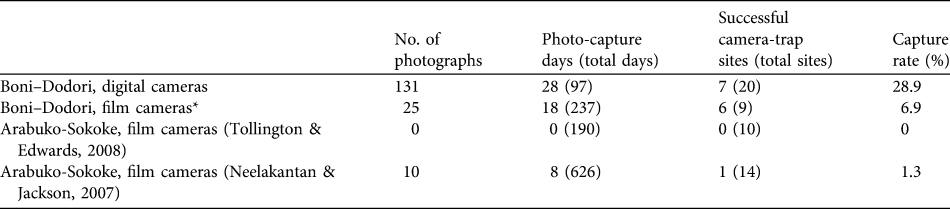
* Two sites were surveyed with digital and, subsequently, film cameras (in one case both models captured Aders’ duiker, in the other case only the film camera did so)
A single sighting of Aders’ duiker from the edge of the Dodori National Reserve (c. 250 km north of Arabuko-Sokoke forest) was reported in 2004 (Andanje & Wacher, Reference Andanje and Wacher2004), raising the possibility that populations may exist outside the known distribution on the mainland. Whilst conducting other surveys in Boni–Dodori forest in 2008 further sightings were reported to GWN. These sightings prompted us to attempt to confirm the presence of Aders’ duiker in these little studied northern coastal forests of Kenya.
Nineteen cameras were deployed within and around the Boni and Dodori National Reserves (1,339 and 877 km2, respectively; Fig. 1) between 15 September and 21 October 2008 for a total of 334 camera-trap days. The habitat comprises a mosaic of forest, dry thicket and savannah, with small-scale farms near villages. Detailed descriptions are given by Kuchar & Mwendwa (Reference Kuchar and Mwendwa1982) and Andanje et al. (Reference Andanje, Agwanda, Ngaruiya, Amin and Rathbun2010). A single camera-trap was also deployed in Witu forest (2°22’ S, 40°30’ E) from 28 September to 22 October 2008 (24 trap-days).
Camera-traps were set along prominent tracks or animal trails under closed canopy forest or thickets. Locations were selected to maximize the probability of detecting medium to large forest mammals using trails to traverse dense vegetation. Cameras were set at a height of 30–60 cm and positioned at a distance from, and angle to, trails with the aim of obtaining full body lateral images of small antelopes. We used Stealth Cam STC-1590IR (Stealth Cam LLC, Grand Prairie, USA) digital cameras, set to take two pictures per trigger followed by a 1-minute delay, for our initial fieldwork (15–27 September 2008). We also used a combination of CamTrak (CamTrak South Inc., Watkinsville, USA), DeerCam DC300 (Non Typical Inc., Park Falls, USA) and Stealth 35 mm Game Surveillance cameras. Film cameras were set to take pictures 24 hours per day on 400 ASA colour print film, with a 1-minute delay between exposures.
Camera-trap capture rate was calculated as the number of days 0n which Aders’ duiker was photographed divided by number of trap-days, multiplied by 100. This measure was employed rather than calculating independent photo-capture events per trap day (Bowkett et al., Reference Bowkett, Rovero and Marshall2008) to allow us to combine and compare data from different camera models including the Stealth 35 mm cameras, which do not have the option to record time in addition to date. We also noted any opportunistic sightings of Aders’ duiker.
From an overall total of 465 animal photographs (358 trap-days including Witu), 156 pictures of Aders’ duiker were obtained from in and around the Boni and Dodori National Reserves (Fig. 1, Table 1), confirming the existence of a population of Aders’ duiker (Plate 1) in northern coastal Kenya. No photographs of the species were obtained from the single camera in Witu forest. In addition to photographs, we sighted Aders’ duiker three times (Fig. 1). Community surveys revealed that the species is well known to the local Awer people (also known as Boni) who were able to describe it accurately prior to recognizing it in an illustrated field guide (Kingdon, Reference Kingdon1997). In the Kiawer language Aders’ duiker is called guno, distinguishing it from the two other commonly encountered small antelope species: wadimoi (Harvey’s duiker Cephalophus harveyi) and chale (suni Neotragus moschatus). No information was obtained on local names for blue duiker Cephalophus monticola or bush duiker Sylvicapra grimmia.
Location of all camera traps used to survey Aders’ duiker Cephalophus adersi in September–October 2008, showing where photographs were obtained, and locations of our sightings of the species in the Boni–Dodori forest area in 2004 and 2008. Rectangle on the inset indicates the location of the main map in south-east Kenya.

Aders’ duiker photographed on 26 September 2008 in the Boni National Reserve (Fig. 1).

Camera-trap rates for Boni–Dodori forest were higher than from pilot studies using similar opportunistic camera-trap methods in Arabuko-Sokoke forest (Table 1). This result should be treated with caution as methodological differences between sites, including season, trap-site selection and camera-trap model, make comparisons difficult. However, the large difference in trap-rate between areas, and the comparative ease of seeing the species, indicates a greater population density in Boni–Dodori forest, especially given the positive relationship between density and camera-trap rates demonstrated for other duiker species (Rovero & Marshall, Reference Rovero and Marshall2009). Given the rarity of Aders’ duiker observations in Arabuko-Sokoke forest and the small size of the remaining populations on Zanzibar, the Boni–Dodori forest may be the largest surviving population of Aders’ duiker.
The geographical extent of this newly confirmed population is unknown. Forest areas inland of Boni National Reserve and north into Somalia may be suitable for Aders’ duiker. Southwards, Witu forest and the privately owned Nairobi Ranch merit further investigation, although opportunistic camera-trap surveys failed to record Aders’ duiker in Nairobi Ranch in 2004 and 2007 (T. Wacher & S.A. Andanje, unpubl. data, 2004; Tollington & Edwards, Reference Tollington and Edwards2008). Similarly, no photographs of the species were obtained in several small forest patches south of Mombasa in 2007 where it seems highly unlikely that Aders’ duiker survives (Tollington & Edwards, Reference Tollington and Edwards2008). The discovery of a population of Aders’ duiker north of the Tana River suggests that future surveys should also be made in the zone between Boni–Dodori forest and the Arabuko-Sokoke forest, specifically in coastal habitats between the Galana/Sabaki and Tana rivers.
While these results improve the conservation prospect for Aders’ duiker, we caution against reassessing the species’ Red List status until further research has been undertaken. The populations in Arabuko-Sokoke forest and Zanzibar remain under severe threat from hunting and habitat disturbance. The evolutionary relationship between Aders’ duiker from Kenya and Zanzibar also requires investigation, as suggested by Cotterill (Reference Cotterill and Plowman2003).
Confirmation of the presence of Aders’ duiker highlights both the importance and the poor state of current knowledge of the Boni–Dodori forest and the wider ecosystem. Several other mammal species of conservation concern occur in this area (S.A. Andanje et al., unpubl. data; Githiri et al., Reference Githiri, Njeri, Muthoni, Yego, Muchane, Njoroge and Giani2007), including a potentially new elephant shrew (Andanje et al., Reference Andanje, Agwanda, Ngaruiya, Amin and Rathbun2010) and African wild dogs Lycaon pictus (Githiri et al., Reference Githiri, Njeri, Muthoni, Yego, Muchane, Njoroge and Giani2008), and the biodiversity value of this area appears, therefore, to have been underestimated.
To document this biodiversity and promote conservation of the northern coastal area Kenya Wildlife Service and partners are undertaking further surveys in the Boni–Dodori forest, including camera-trapping with standardized methodologies (O’Brien, Reference O’Brien2010) to establish the extent of occurrence and relative abundance of Aders’ duiker. This will create a standardized index of conservation status for this Critically Endangered antelope and the associated mammal community, a key tool to monitor progress and support implementation of a conservation strategy for the species across its range.
Acknowledgements
This study was funded and supported by the Kenya Wildlife Service, Whitley Wildlife Conservation Trust and Zoological Society of London. Additional funds were donated by the European Association of Zoos and Aquaria. We would like to thank everyone who assisted in the fieldwork, and particularly Chief Mahazi Ware and Mohamed Cheka of Mangai.
Biographical sketches
Sam Andanje has extensive research experience in Kenyan forest and savannah ecosystems, particularly with rare species of antelope, including Aders’ duiker and hirola. Andrew Bowkett coordinates overseas conservation programmes for Whitley Wildlife Conservation Trust (WWCT) and is studying the genetics of East African duiker species. Bernard Agwanda specializes in the taxonomy and distribution of Kenyan mammals. Grace Ngaruiya previously studied the distribution of Kenyan giant elephant shrews and is now studying ecosystem services in the Amboseli Basin. Amy Plowman oversees conservation and research for WWCT and has worked on duiker ecology in Zimbabwe, Zanzibar and Kenya. Tim Wacher specializes in conservation and research programmes for antelopes and desert ecosystems. Rajan Amin has an interest in African and Asian grassland and forest ecosystems and in developing long-term conservation projects for threatened species.



