


Introduction
The older adult population is one of the fastest-growing demographics globally, yet this growth has been accompanied by a decrease in the care-giving resources directed towards them (Lutz et al. Reference Lutz, Sanderson and Scherbov2008; Dostálová et al. Reference Dostálová, Bártová, Bláhová and Holmerová2022). At the same time, there is a preference among older adults to ‘age in place’, a concept that may be defined in multiple ways, depending on whether the discussion is academic, policy-related or advocacy-based (Forsyth and Molinsky Reference Forsyth and Molinsky2021). Older adults are at increased risk of reduced mobility, social isolation and loneliness when living alone (Victor et al. Reference Victor, Scambler, Bond and Bowling2000; Gerlach et al. Reference Gerlach, Solway and Malani2024). To counteract these risks when ageing in place, family members and care-givers may suggest the use of passive monitoring technologies, that is, technologies that are placed in the home or worn by the individual to collect data on their behaviours without requiring any action by the individual to work (Read et al. Reference Read, Gagnon, Donelle, Ledoux, Warner, Hiebert and Sharma2022). Examples of such technologies include in-home motion sensors, geolocation monitoring via mobile phones and smartwatches, and in-home web cameras. While the use of such technologies enables older individuals to stay relatively independent, they can be privacy-invasive (Berridge and Wetle Reference Berridge and Wetle2020).
There is a varying understanding of the privacy concerns that older adults have when using passive monitoring technologies. Studies on the acceptability of passive monitoring technologies often identify privacy as a concern in their adoption (e.g. Essén Reference Essén2008; Fritz et al. Reference Fritz, Corbett, Vandermause and Cook2016; Cao et al. Reference Cao, Erdt, Robert, Naharudin, Lee and Theng2022), yet take different approaches to identifying what this means. Privacy and privacy concerns are context-dependent (Nissenbaum Reference Nissenbaum2010) but typically involve concern about the misuse of gathered information, gathering of information on highly sensitive or intimate activities, or feelings of surveillance (e.g. Garg et al. Reference Garg, Camp, Lorenzen-Huber, Shankar and Connelly2014; Schomakers and Ziefle Reference Schomakers, Ziefle, Gao and Zhou2019). This scoping review is intended to synthesize the findings and identify potential gaps in the understanding of the privacy concerns held by older persons in the use of passive monitoring technologies, adopting a perspective grounded in privacy studies. Our primary research question, therefore, is: what are the privacy concerns and considerations regarding passive monitoring technologies for older adults?
To address this question, we defined the following objectives: (1) identify current research on older adults’ privacy perceptions regarding passive monitoring technologies; (2) assess the conceptual frameworks and measurement of older adults’ privacy concerns and attitudes towards passive monitoring technologies; and (3) distinguish factors related to the contexts of passive monitoring and the types of data gathered that are relevant to privacy considerations of older adults.
Ageing in place
Ageing in place generally refers to the idea of residing in one’s home and/or community as one ages, delaying relocation to a long-term care setting (Bigonnesse and Chaudhury Reference Bigonnesse and Chaudhury2020). For one person, this might mean staying in the home that they have occupied for decades, albeit possibly with additional assistive technologies and support services. For others, it may mean remaining in the same community or neighbourhood, but in a smaller, more manageable residence. Nevertheless, a common aspect of ageing in place is that older adults choose this option for several reasons, including housing, health, proximity to local services, social interactions, safety and security, family and financial status (Ahn et al. Reference Ahn, Kwon and Kang2020).
Many older adults prefer ageing in place because it enables a level of independence, connection to partners and the ability to stay close to friends and family members, which improves their overall health (Keeling Reference Keeling1999; Lawler Reference Lawler2001; Wiles et al. Reference Wiles, Leibing, Guberman, Reeve and Allen2012). However, because ageing is associated with increased functional disability and morbidity (Jindai et al. Reference Jindai, Nielson, Vorderstrasse and Quiñones2016), ageing in place also raises concerns about an older person’s safety and security. Passive monitoring technologies, such as motion sensors, wearable devices like smartwatches, and web cameras, can be utilized by family members, care-givers and health-care practitioners to assist in providing care and support (Kaye Reference Kaye2017). Such devices and their related applications often provide information on an older person’s activities and actions, which can then be used by family members and care-givers to assist with navigation and assess the movement and eating patterns of the subject (Ibarra et al. Reference Ibarra, Baez, Cernuzzi and Casati2020). These technologies are highly beneficial in reporting warning signs that could affect older adults’ lives, such as in relation to fall detection or changes in eating habits, including potential problems of which the older person may not be fully aware, such as atrial fibrillation (Carver and Mackinnon Reference Carver and Mackinnon2020). Monitoring technologies for older adults serve not only to protect their overall health and safety but also to provide reassurance to their family care-givers, helping them fulfil their role in assisting their parents or loved ones, and ensuring their wellbeing (Peek et al. Reference Peek, Wouters, Van Hoof, Luijkx, Boeije and Vrijhoef2014; Jaschinski and Ben Allouch Reference Jaschinski and Ben Allouch2019). While the use of such technologies is increasingly common, their privacy implications are frequently under-examined (Knight et al. Reference Knight, Yuan and Gayle2023).
Often overlooked are the privacy considerations for everyday activities such as changing clothes, making phone calls or texting, using the bathroom or watching television (Epstein et al. Reference Epstein, Aligato, Krimmel and Mihailidis2016). Additionally, there is a risk of data leaks related to the information gathered, an issue that has not received adequate attention (Zadereyko et al. Reference Zadereyko, Trofymenko, Prokop, Loginova, Dyka and Kukharenko2022). It is noteworthy that some adults do not fully grasp the implications of these technologies or, in extreme cases, are even unaware of being monitored, which raises significant ethical considerations (Cimperman et al. Reference Cimperman, Brenčič, Trkman and Stanonik2013). However, there is also an underlying tension between the health and wellbeing of older adults and the responsibilities felt by their care-givers (Berridge and Wetle Reference Berridge and Wetle2020). Thus, older adults often are faced with a potential trade-off between values of privacy and independence, while taking into account their relational needs and physical safety (Garg et al. Reference Garg, Camp, Lorenzen-Huber, Shankar and Connelly2014; Kirchbuchner et al. Reference Kirchbuchner, Grosse-Puppendahl, Hastall, Distler and Kuijper2015; Alkhatib et al. Reference Alkhatib, Kelly, Waycott, Buchanan, Grobler and Wang2021).
Technology acceptance
The decision-making involved with older adults and passive monitoring technologies can best be described as a process of technology acceptance. The technology acceptance model (TAM; Davis et al. Reference Davis, Bagozzi and Warshaw1989) is one of the most widely utilized frameworks for understanding the reasons and factors behind people’s adoption of new technologies (Shin et al. Reference Shin, Um, Yoon, Choi, Shin, Lee and Kim2023). The model identifies two primary external variables that shape how individuals accept technology: perceived usefulness (PU) and perceived ease of use (PEOU). It defines PU as the degree to which a person believes that a technology can enhance their quality of life. On the other hand, PEOU refers to the extent to which a person perceives a technology to be easy to use and requiring minimal effort (Davis Reference Davis1989). Chen and Chan (Reference Chen and Chan2014) extended this model specifically for older adults, with the senior technology acceptance model (STAM), recognizing that older persons have unique factors influencing their acceptance of technology, such as health conditions and cognitive ability (Chen and Chan Reference Chen and Chan2014). What differentiates STAM from the original TAM is its emphasis on characteristics unique to older adults, including the physical and psychological aspects of ageing, which influence their perceptions of technology. A key element that influences older adults’ PEOU and PU is gerontechnology self-efficacy, which refers to the extent to which older adults believe that technology can provide them with independence, autonomy, safety and comfort (Mostaghel and Oghazi Reference Mostaghel and Oghazi2017). Gerontechnology anxiety, which describes the level of anxiety older adults experience when using technology, is also a well-established factor in older adult technology acceptance (Holden and Karsh Reference Holden and Karsh2010; Kadylak and Cotten Reference Kadylak and Cotten2020; Moxley et al. Reference Moxley, Sharit and Czaja2022). Additionally, self-reported health conditions, including physical and cognitive functioning, play an essential role in technology acceptance (Shin et al. Reference Shin, Um, Yoon, Choi, Shin, Lee and Kim2023). Research indicates that better health and functionality positively correlate with PU and PEOU, suggesting that individuals with better health conditions are more inclined to accept and utilize technology (Shin et al. Reference Shin, Um, Yoon, Choi, Shin, Lee and Kim2023). Notably, privacy concerns are not specified in STAM (Lin et al. Reference Lin, Moxley, Sharit and Czaja2025), yet research has demonstrated that these are a major consideration in the acceptance of both technologies for older persons (Peek et al. Reference Peek, Wouters, Van Hoof, Luijkx, Boeije and Vrijhoef2014) and passive monitoring technologies (e.g. Martín-García et al. Reference Martín-García, Redolat and Pinazo-Hernandis2022; Long et al. Reference Long, Casey, Bhar, Al Mahmud, Curran, Hunter and Lim2022).
Privacy and technology
Advances in computing, sensing and monitoring technologies have significantly extended and enhanced the capacity and capability to collect, process and store data in ways that were previously unavailable, raising concerns about how they compromise privacy. Individuals often engage with what may be considered privacy-invasive technologies because they offer benefits such as time management, security and convenience (Tavani Reference Tavani2007). Privacy scholars refer to this trade-off as the privacy calculus. Privacy calculus theory argues that individuals make decisions about disclosing information by weighing potential risks and costs against anticipated benefits. In the privacy calculus framework, perceived costs are understood to comprise privacy concerns, specifically the degree to which individuals are concerned about their personal information and how it is collected, shared and used (Min and Kim Reference Min and Kim2015). The utility they receive represents perceived benefits (Laufer and Wolfe Reference Laufer and Wolfe1977; Culnan and Armstrong Reference Culnan and Armstrong1999; Dienlin Reference Dienlin2023). According to the privacy calculus model, individuals are more likely to disclose information if they believe that the benefits outweigh the risks associated with disclosures (Dinev and Hart Reference Dinev and Hart2006).
The privacy calculus assumes that the individual possesses complete information about the privacy decision-making process and that their decision-making is fully rational, despite evidence that it is often biased and illusory (Dienlin Reference Dienlin2023). In addition, the privacy calculus also does not account for affective heuristics, such as the desire to maintain good relationships with family members or the fear or anxiety associated with safety or security concerns. Thus, this model can be seen as limited for describing the privacy decision-making that older adults experience with passive monitoring technologies, despite its frequent use as an explanatory framework.
A further limitation of the privacy calculus lies in its lack of privacy’s dimensionalization. As society has become increasingly datafied and data collection devices have proliferated, there has been a growing call to distinguish between vertical and horizontal forms of privacy to distinguish the privacy considerations associated with data collection practices (Bazarova and Masur Reference Bazarova and Masur2020; Epstein and Quinn Reference Epstein and Quinn2025). Horizontal privacy refers to concern about privacy among one’s social connections or other individuals. Alternatively, vertical privacy refers to privacy threats posed by information being collected, monitored and used by institutional agents, such as governments, private companies and platform providers. Both types of privacy are difficult to manage when using digital devices and technologies.
In the case of horizontal privacy, individuals may face significant risks from information leaking to those around them, including family members and friends who have access to or can share their personal data (Alkhatib et al. Reference Alkhatib, Kelly, Waycott, Buchanan, Grobler and Wang2021). This risk is heightened when users interact with complex technologies that they may not fully understand or trust (Frik et al. Reference Frik, Nurgalieva, Bernd, Lee, Schaub and Egelman2019), as native privacy controls are often difficult for an older person to navigate (McNeill and Coventry Reference McNeill, Coventry and Garschall2016; Brandtzæg et al. Reference Brandtzæg, Lüders and Skjetne2010). On the vertical level, permission to collect, use and disseminate personal information is often granted by individuals when they agree to digital terms and conditions of the technology provider, often without their full understanding of what these processes might entail (Baruh and Popescu Reference Baruh and Popescu2017). With respect to vertical privacy, older adults, like most individuals, often have little to no control over how their personal data is collected, managed or used by institutional actors (Baruh and Popescu Reference Baruh and Popescu2017). They may feel obligated to accept privacy trade-offs in exchange for the convenience or safety that the technology offers (Kirchbuchner et al. Reference Kirchbuchner, Grosse-Puppendahl, Hastall, Distler and Kuijper2015). They may not fully comprehend how their data may be used (Baruh and Popescu Reference Baruh and Popescu2017). These concerns become particularly relevant when older adults are asked to sign consent forms or agreements they do not fully comprehend, leaving them unaware of how their data will be used or shared (Oeldorf-Hirsch and Obar Reference Oeldorf-Hirsch and Obar2019). The lack of transparency makes privacy boundaries unclear, particularly when it comes to sensitive information.
Finally, privacy concerns are often used as a proxy construct by privacy researchers to measure the perceptions, attitudes and beliefs about privacy with older adults (Knight et al. Reference Knight, Yuan and Gayle2023). Privacy scholars have developed several frameworks to conceptualize privacy with respect to digital technologies and personal information. These frameworks include Solove’s (Reference Solove2006) privacy taxonomy, which describes the activities of information collection, information processing, information dissemination and invasion as being relevant to privacy concerns in a digital society, as well as Westin’s (Reference Westin1967) privacy states. Many of the instruments used to measure this construct quantitatively are unidimensional with a focus on the vertical aspects of information privacy (Bartol et al. Reference Bartol, Vehovar and Petrovčič2023). Others include dimensions related to concerns about the collection and control of information, such as the internet users’ information privacy concerns scale (IUIPC; Malhotra et al. Reference Malhotra, Kim and Agarwal2004). Importantly, individuals’ concern for privacy is a field that is receiving increasing attention as digital technologies proliferate and information collection activities intensify (Baruh and Popescu Reference Baruh and Popescu2017; Bartol et al. Reference Bartol, Vehovar and Petrovčič2023).
Method
Scoping reviews are a method of systematic review that enables researchers to broadly map knowledge of a research topic, provide conceptual clarity and identify gaps in existing literature (Davis et al. Reference Davis, Drey and Gould2009). They utilize a rigorous approach to clarify concepts and scope evidence (Arksey and O’Malley Reference Arksey and O’Malley2005; Mak and Thomas Reference Mak and Thomas2022). This study examined literature indexed by nine major bibliographic databases up to 12 March 2024, to scope research relevant to the ways in which older adults perceive privacy issues around passive in-home monitoring technologies.
Information sources and eligibility criteria
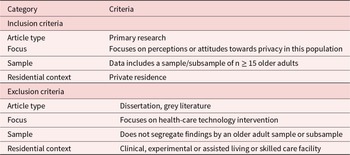
The primary investigator and a co-investigator, who is an information specialist, conducted informal searches in two databases using terms selected to reflect the target population of older adults, concerns with privacy and monitoring technologies. To be included, articles must have reported primary research. Inclusion and exclusion criteria are summarized in Table 1. From the informal search results, a preliminary list of relevant studies was selected and confirmed with the third investigator. The information specialist then analysed the subject terms in titles, abstracts and indexing in the preliminary list of articles to develop initial search strings. The information specialist then used the UlrichsWeb International Periodicals directory to identify nine databases where the journals of the target studies were indexed. Initial searches were conducted in each database to confirm whether the relevant studies from the preliminary searches were included in the results. If not, additional terms were added from the specific database subject headings until the relevant studies were retrieved. Final searches were conducted on 12 March 2024. The lists of databases, search strings and search parameters are included as supplementary materials in Appendix A.
Inclusion and exclusion criteria

Our search strategy was intentionally designed to centre privacy concerns, which is the primary organizing construct in privacy research (Smith et al. Reference Smith, Dinev and Xu2011; Xu and Zhang Reference Xu and Zhang2022), while allowing for conceptual variation in how privacy concerns were expressed and operationalized across studies. Accordingly, the term privacy was combined with experiential descriptors such as concerns, views, considerations, feelings and preferences to capture variation in how privacy is articulated and conceptualized in existing studies.
Study selection process
The initial searches resulted in a sample of n = 1,351 articles. These results were de-duplicated using Zotero and uploaded into the Covidence systematic review platform (Covidence Reference Covidence2025). A further five duplicates were identified through Covidence. In addition, during the title and abstract screening phase, described later, team members reviewed references included with each potentially relevant article for additional literature. An additional 47 studies were identified through this mechanism.
Screening process
After a calibration exercise (Mak and Thomas Reference Mak and Thomas2022) with 15 randomly selected articles, the abstract and title information for the remaining 1,390 articles were each screened by two members of the research team to ensure consistency and accuracy. Proportionate agreement between the rater dyads ranged from 0.90 to 0.97. Conflicts in screening were resolved by the third investigator. A total of 1,291 articles were found to be irrelevant at this stage, leaving 99 articles for full-text review. At the full-text review stage, two investigators identified a further 65 irrelevant studies by consensus screening, leaving 34 studies for data extraction. Figure 1 illustrates this screening process.
PRISMA flow diagram illustrating the study selection process.

Data charting
Data charting was conducted through the Covidence platform. Charted information included author(s), publication details, the study research question(s), privacy theories grounding the study, stated privacy definitions, study population and sample details, country of data collection, study methodology, privacy concerns measurement instruments (if applicable), study-related monitoring technologies and data collection types, duration of the study monitoring period (if applicable), key findings relating to privacy concerns (including vertical and horizontal privacy concerns, if specified), monitoring technologies and collected data. Data was extracted by the first author, reviewed by a second investigator and discussed until consensus was reached.
Results
Our sample includes 34 articles selected for the scoping review, each of which is listed in the References section of this article and marked with an asterisk. In the reporting that follows, although our sample included n = 34 studies, some studies contributed more than one data point. For instance, certain studies employed multiple methods (e.g. combining interviews and surveys) or were conducted across more than one geographic location. As a result, the percentages in some categories may exceed 100 per cent.
Sample characteristics
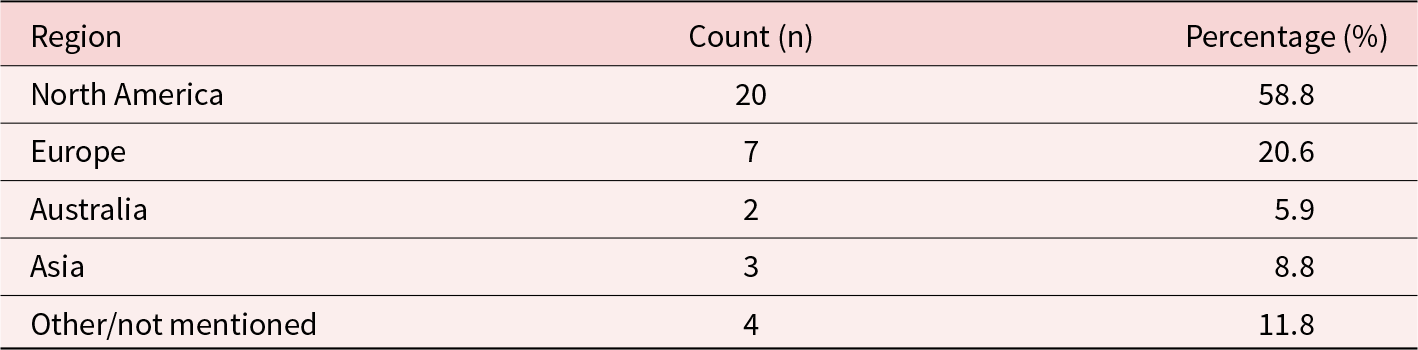
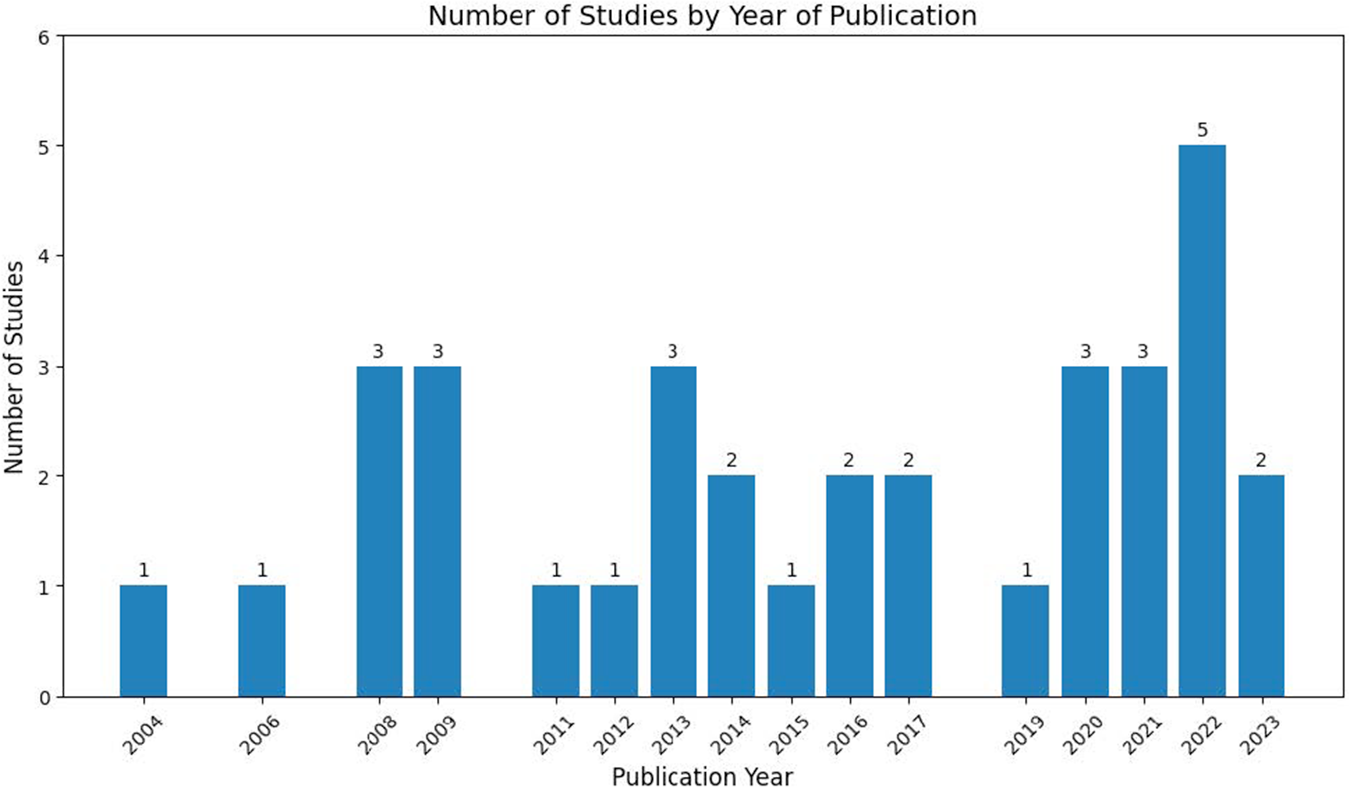
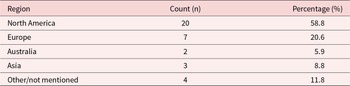
Research on older adults’ perceptions of the privacy implications of passive monitoring technologies is limited but a growing field, as evidenced by a steady increase from 2004 to 2022 (see Figure 2). In terms of the age of study participants, ‘older adults’ were classified as 65 years and older in a small subset of studies (n = 5, 14.7 per cent) and as 60 years and older in a few others (n = 2, 5.9 per cent). The remaining studies (n = 27, 79.4 per cent) did not specify an age-based definition. Most studies were conducted in North America (United States and Canada) (n = 20, 58.8 per cent), followed by Europe (n = 7, 10.6 per cent) and Australia (n = 2, 5.9 per cent). A small number of studies were conducted in Asian countries (n = 3, 8.8 per cent), while several did not specify a geographic location (n = 4, 11.8 per cent). See Table 2 for a summary.
Distribution of dataset by year of publication.

Regional distribution of studies
Finally, to examine disciplinary representation, we utilized the subject headings of the publications from the Ulrichsweb International Periodicals Directory (UlrichsWeb 2025). The journals in the sample were primarily concentrated in three disciplinary perspectives: medical sciences; gerontology and geriatrics, which is a subspecialty of medical sciences; and computer sciences.
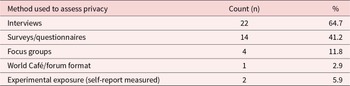
Several approaches were used to assess the privacy considerations of passive monitoring technologies. Interviews were the most commonly used (n = 22, 64.7 per cent), followed by surveys (n = 14, 41.2 per cent) and focus groups (n = 4, 11.8 per cent). One study employed a World Café/forum-based format (n = 1, 2.9 per cent). In addition, two studies employed experimental methods to investigate the response of older adults to different monitoring conditions (n = 2, 5.9 per cent). Nevertheless, privacy concerns were measured using a follow-up self-report instrument in both studies to understand the participants’ perspectives, rather than relying solely on the experimental manipulation. For example, Caine et al. (Reference Caine, Šabanovic and Carter2012) examined the responses of older adults under three conditions: a stationary camera, a mobile robot and no monitoring. They observed privacy-enhancing behaviours such as avoiding specific spaces, turning away or covering the camera. They then followed up with a questionnaire to understand participants’ privacy concerns regarding the monitoring technologies. See Table 3 for a summary.
Distribution of research methods by count and percentage

Note: Counts exceed 34 because some studies used more than one method.
The reporting of demographic characteristics varied across the 34 studies. All studies reported participants’ age (n = 34, 100 per cent). Nearly all reported gender (n = 27, 96.4 per cent), while fewer included information about income (n = 20, 71.4 per cent) and race or ethnicity (n = 19, 67.9 per cent). Though cognitive status is an important factor in ensuring the reliability of data in older adult studies (Schmidt et al. Reference Schmidt, Wahl and Plischke2014), 20 papers (58.8 per cent) did not report any cognitive evaluation of the study participants. Among the studies that did, most did not conduct clinical assessments; instead, the researchers simply noted whether participants had any disabilities or diagnosed conditions. Reporting and documenting cognitive function is essential when investigating technology use among older adults, due to the significance of these factors in technology acceptance and use (e.g. Moxley et al. Reference Moxley, Sharit and Czaja2022; Shin et al. Reference Shin, Um, Yoon, Choi, Shin, Lee and Kim2023)
Types of technology and data
The studies in the sample reported on a wide variety of monitoring mechanisms, prototypes and proposals. More familiar technologies included automated fall detection systems, smart home sensors with motion detection, smart wearable devices, robots, cameras, wrist-worn activity trackers and smartwatches. In contrast, some technologies were less commonly well-known. For example, gesture pendants are wireless devices that allow older adults to control connected technologies (e.g. household appliances or assistive systems) through gestures without physically performing the task (Melenhorst et al. Reference Melenhorst, Fisk, Mynatt and Rogers2004). Another example is the telepresence robot, a device that can be remotely positioned by care-givers and placed in an older adult’s home, allowing them to virtually monitor the older adult in real time (Wu et al. Reference Wu, Nix, Brummett, Aguillon, Oltman and Beer2021).
The types of data collected in the studies were classified into four categories. Technologies that collected visual data, static photos or continuous video recordings were prevalent (n = 15, 44.1 per cent) and mainly included cameras that recorded older adults in various parts of their homes, such as while walking in the kitchen to prepare food or moving towards the bedroom. Visual data often enables care-givers and family members to monitor the older adults’ activities throughout the day and identify emergencies. Motion detection logs (n = 25, 73.5 per cent) are generated using in-home sensors that capture movement patterns, such as door openings or closings. Activity logs (n = 26, 76.4 per cent) are generated by devices such as smartwatches and wristbands equipped with sensors, which track daily routines, including sleeping and walking. These devices often included fall detection features and could transmit data about movement within the home. Some wearable devices also include GPS capabilities to provide real-time geographical location, allowing those monitoring to know where the older adult is at any given time. Finally, sound-recording data (n = 9, 26.4 per cent) consists of audio captured by microphones and contains information such as alarms.
Most studies did not specify the location of the monitoring technologies within the home (n = 24, 70.6 per cent). Among those that did, the most commonly reported placements were living rooms (n = 4, 11.8 per cent), bedrooms (n = 3, 8.8 per cent), bathrooms (n = 3, 8.8 per cent), kitchens (n = 3, 8.8 per cent) and hallways (n = 2, 5.9 per cent). Some studies evaluated robots (e.g. Caine et al. Reference Caine, Šabanovic and Carter2012; Beach et al. Reference Beach, Schulz, Matthews, Courtney and Dabbs2014) which served multiple purposes, for example collecting video footage and detecting falls. Although robots are often portrayed as active technologies, their use in these studies was passive. They operated within the environment to collect information without requiring older adults to actively engage with them. Interestingly, more than half of the papers (n = 26, 76.5 per cent) reported findings on multiple data types, as many of the studies in the sample had the objective of determining acceptance for technologies under development.
Disciplinary representation
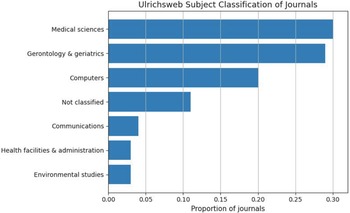
A disciplinary analysis was conducted by examining the subject categories listed in the UlrichsWeb International Periodicals Directory. Some journals were assigned to multiple subject categories. In such cases, we selected the category that best reflected the journal’s disciplinary focus. For example, journals listed under both gerontology and geriatrics, as well as medical sciences, were classified under gerontology and geriatrics. Most of the journals in which the studies were published were classified under medical sciences (31 per cent), followed by gerontology and geriatrics (29 per cent) and computers (20 per cent). Approximately 11 per cent of journals lacked a specified classification. The remaining journals were categorized under communications (3 per cent), health facilities and administration (3 per cent) and environmental studies (3 per cent) (see Figure 3).
Ulrichsweb subject classification of journals included in the dataset.

Theoretical frameworks
Given this study’s research question and the large number of studies from disciplines associated with computer science, the conceptual and theoretical frameworks related to both technology acceptance and privacy were examined. In relation to technology acceptance, unsurprisingly, given the large number of studies examining the acceptability of devices and sensors, over half of the papers (n = 18, 52.9 per cent) reported using technology adoption frameworks in their samples. Of these, six papers utilized TAM (n = 6, 17.16 per cent), but only one paper (n = 1, 2.9 per cent) explicitly employed STAM.
Privacy is notoriously difficult to define in a research context (Trepte and Masur Reference Trepte, Masur, Trepte and Masur2023); therefore, it is perhaps unsurprising that only ten papers (n = 10, 29.4 per cent) provided definitions of privacy. Of these, several offered a unique and distinct understanding of what privacy entails. For example, Fritz et al. (Reference Fritz, Corbett, Vandermause and Cook2016) concluded that privacy emerged as modesty, which involves the concept of being watched while undressed; nature, referring to a lifestyle in which individuals seek to maintain their personal and private lives; normed, meaning that societal norms dictate what is considered appropriate or inappropriate in one’s private space; and American, which describes privacy as it is conceptualized within American cultural values. Melenhorst et al. (Reference Melenhorst, Fisk, Mynatt and Rogers2004) provided a definition of privacy invasion, which they described as the undesirable disclosure of someone’s personal information. Finally, Wang and Lin (Reference Wang and Lin2023) defined privacy as having two main attributes: visual privacy, or the protection of an individual’s visual appearance, and behavioural privacy, or the protection of an individual’s actions, routines and habits.
In contrast, others focused on the individuals’ rights to their personal information. For instance, several studies described privacy as the right of individuals to control their data. Only one study employed the privacy calculus, arguing that users weigh perceived barriers to technology adoption against its potential benefits when disclosing information; however, an additional six (17.6 per cent) studies mentioned a ‘privacy trade-off’ in their findings. While several studies indicated that older adults were willing to sacrifice some autonomy for safety (n = 5, Alkhatib et al. Reference Alkhatib, Kelly, Waycott, Buchanan, Grobler and Wang2021; Fritz et al. Reference Fritz, Corbett, Vandermause and Cook2016; Lie et al. Reference Lie, Lindsay and Brittain2016; Berridge and Wetle Reference Berridge and Wetle2020; Choi et al. Reference Choi, Thompson and Demiris2020 ), at least one study has also suggested that participants questioned this trade-off (Street et al. Reference Street, Barrie, Eliott, Carolan, McCorry, Cebulla, Phillipson, Prokopovich, Hanson-Easey and Burgess2022).
Privacy concerns
When examining privacy considerations and behaviours, researchers often rely on the construct of privacy concerns (Dinev et al. Reference Dinev, Xu, Smith and Hart2013). Despite the prevalence of this construct in research, most of the quantitative studies in this sample did not use validated measures to measure privacy concerns. Of the quantitative studies in the sample (n = 14, 41.2 per cent), many created their own survey questions tailored to the study context (e.g. Beach et al. Reference Beach, Schulz, Matthews, Courtney and Dabbs2014; Schomakers and Ziefle Reference Schomakers, Ziefle, Gao and Zhou2019). Some studies used Likert scales to rate privacy-related constructs, such as concerns about the intrusiveness or obtrusiveness of technology (e.g. Beach et al. Reference Beach, Schulz, Downs, Matthews, Barron and Seelman2009, Reference Beach, Schulz, Matthews, Courtney and Dabbs2014; Melenhorst et al. Reference Melenhorst, Fisk, Mynatt and Rogers2004), comfort with online data storage (e.g. Puri et al. Reference Puri, Kim, Nguyen, Stolee, Tung and Lee2017), concerns about data misuse (Kirchbuchner et al. Reference Kirchbuchner, Grosse-Puppendahl, Hastall, Distler and Kuijper2015) or the willingness/perceived risk of sharing data (e.g. Garg et al. Reference Garg, Camp, Lorenzen-Huber, Shankar and Connelly2014; Choukou et al. Reference Choukou, Sakamoto and Irani2021). Typically, these studies did not examine the construct of privacy concerns with a nuanced view of how or why the concerns were present. Of the studies that utilized standardized measurement instruments (n = 3, 8.8 per cent), Spangler et al. (Reference Spangler, Driesse, Lynch, Liang, Roth, Kotz, Fortuna and Batsis2022) adapted items from the IUIPC (Malhotra et al. Reference Malhotra, Kim and Agarwal2004) and Caine et al. (Reference Caine, Šabanovic and Carter2012) and Wu et al. (Reference Wu, Nix, Brummett, Aguillon, Oltman and Beer2021) utilized questions adapted from Westin’s privacy values studies (Margulis et al. Reference Margulis, Pope, Lowen, Zureik, Stalker, Smith, Lyon and Chan2010).
In contrast, qualitative studies (n = 10, 29.4 per cent) often explored privacy constructs by using open-ended questions related to concerns about technology (e.g. Caine et al. Reference Caine, Fisk and Rogers2006) through interviews and focus groups. Fewer than half (n = 4, 11.8 per cent) applied established privacy frameworks to guide the coding of qualitative data. Alkhatib et al. (Reference Alkhatib, Kelly, Waycott, Buchanan, Grobler and Wang2021) and Schomakers and Ziefle (Reference Schomakers, Ziefle, Gao and Zhou2019) used Solove’s taxonomy of privacy harms (Solove Reference Solove2006). Demiris (Reference Demiris2009) used Bellotti and Sellen’s (Reference Bellotti and Sellen1993) framework for information control in ubiquitous computing environments. McNeill et al. (Reference McNeill, Briggs, Pywell and Coventry2017) employed Pedersen’s privacy functions (Pedersen Reference Pedersen1997), which are an extension of Westin’s privacy states (Westin Reference Westin1967).
Analysis of the findings in this sub-sample revealed that several themes related to privacy concerns predominated. Generally, older adults feared losing autonomy, data breaches and a lack of confidentiality when using passive monitoring technologies (e.g. Alkhatib et al. Reference Alkhatib, Kelly, Waycott, Buchanan, Grobler and Wang2021; Choukou et al. Reference Choukou, Sakamoto and Irani2021). The studies often indicated that older adults had some degree of comfort with passive monitoring, as long as it did not capture them in private situations, such as going to the bathroom or taking a shower, as protection of dignity and bodily functions was a priority (e.g. Caine et al. Reference Caine, Šabanovic and Carter2012; Lie et al. Reference Lie, Lindsay and Brittain2016). In one case, older adults favoured human monitors over technological monitoring, feeling that humans would present less of an invasion to their privacy (Caine et al. Reference Caine, Šabanovic and Carter2012). Control over monitoring technologies was an important factor, with greater control diminishing feelings of privacy compromise (Wild et al. Reference Wild, Boise, Lundell and Foucek2008; Wu et al. Reference Wu, Nix, Brummett, Aguillon, Oltman and Beer2021). Finally, one study found that privacy concerns were disputable in their sample, neither completely rejected nor agreed upon (Schomakers and Ziefle Reference Schomakers, Ziefle, Gao and Zhou2019).
Examination of the study sample also revealed that older adults’ concerns about privacy varied with different technologies, and not all passive monitoring technologies were viewed as equivalent. For example, concerns about cameras and visual data were raised in many studies (n = 15, 44.1 per cent), particularly in contrast to other forms of data and data collection devices. Two studies (5.9 per cent) found that activity sensors were more acceptable than cameras, resulting in less concern about privacy with their use (Ehrari et al. Reference Ehrari, Ulrich and Andersen2020; Fritz et al. Reference Fritz, Corbett, Vandermause and Cook2016). One study indicated that gathering data on the use of a home’s existing infrastructure (plumbing and electrical systems) to monitor an older person’s activity was preferable to installing sensors and cameras because attention would be focused on utility use and not the individual (Demiris Reference Demiris2009). Trust was also a factor influencing whether older adults had privacy concerns, as they were more likely to accept monitoring technology and had fewer privacy concerns if someone they trusted managed their data (Cao et al. Reference Cao, Erdt, Robert, Naharudin, Lee and Theng2022).
Several studies raised a concern regarding the lack of nuanced understanding by older adult users of the privacy implications of some passive monitoring technologies, in both direct and indirect ways (e.g. Lorenzen-Huber et al. Reference Lorenzen-Huber, Boutain, Camp, Shankar and Connelly2011; Harris et al. Reference Harris, Blocker and Rogers2022; Spangler et al. Reference Spangler, Driesse, Lynch, Liang, Roth, Kotz, Fortuna and Batsis2022). For instance, two studies reported that older adults had fewer concerns with monitoring technologies because they incorrectly believed that activity trackers collected information only about their movements (Puri et al. Reference Puri, Kim, Nguyen, Stolee, Tung and Lee2017; Chung et al. Reference Chung, Brakey, Reeder, Myers and Demiris2023). Another study noted that its participants may have been initially naive about the risks of others having access to their personal information and observed that they experienced increased privacy concerns about passive monitoring technologies over the course of the study as a result of their participation (Boise et al. Reference Boise, Wild, Mattek, Ruhl, Dodge and Kaye2013).
Discussion
Families and care-givers frequently request the use of passive monitoring technologies to ensure the safety and security of older persons as they age in place (Berridge and Wetle Reference Berridge and Wetle2020), but privacy is often a consideration (Kakulla et al. Reference Kakulla, David, Skufca, Boothe and Garrett2025). This study explicitly examined the privacy considerations raised by older adults in studies related to the acceptance and use of passive monitoring technologies, and explored the factors contributing to their concerns. It contributes to research on ageing and privacy in two important ways. First, these findings underscore the need to incorporate privacy into established models of older adult technology acceptance in ways that acknowledge the role that concerns about privacy play in decision-making. Second, they emphasize the importance of employing more nuanced privacy conceptualizations and theories when examining older adults’ privacy decision-making, such as by incorporating privacy’s horizontal and vertical dimensions or by introducing relational approaches in research efforts.
Theoretical frameworks, concepts and systems are essential for directing and solidifying the findings of research (Gioia and Pitre Reference Gioia and Pitre1990), as they help explain the three main elements of research: the ‘what, how, and why’ of any emerging phenomenon (Whetten Reference Whetten1989). Models such as TAM and STAM are essential for understanding how and why people, and specifically older adults, adopt passive monitoring technologies because they help identify key factors influencing these decisions, such as their ease of use, perceived usefulness, social influence, technological anxiety and self-efficacy. Our findings demonstrate that older adults consistently raise privacy as an important consideration in their perceptions of passive monitoring technologies, as it is a crucial concept in determining the related risks and potential harms associated with their use. Moreover, such risk is presented by both the technology and its related data collection infrastructure. These findings highlight the need for further research and development to expand models of technology acceptance to incorporate privacy and privacy concerns as specific elements within these frameworks, and to further clarify the role that these play with respect to the technology, the data collection infrastructure and the practices of monitoring.
Second, examination of these studies revealed that established and emerging privacy frameworks for understanding the privacy considerations of older adults regarding the use of passive monitoring technologies are often not utilized. This may be a function of the predominance of literature originating in fields such as the medical and computer sciences, but it may also reflect a focus in these studies on the acceptability of technology.
In terms of the use of standardized instruments, few quantitative studies in this sample utilized standardized and validated measures of privacy concern. The use of accepted, valid and reliable instruments extends the relevance of research findings by enabling multiple levels of comparison, between individuals, as well as for accurately comparing studies across contexts and identifying meaningful changes over time (Clark and Watson Reference Clark, Watson and Kazdin2016). Our study revealed privacy concerns, as well as measures that were often created ad hoc or relied on superficial questions. The former does not permit comparison across studies or across various technologies, while the latter offers weak construct validity. Merely offering that privacy is a concern with respect to a passive monitoring technology does not advance the understanding of the processes related to its acceptance, or how potential privacy concerns might be overcome. Moreover, the use of unnuanced measures of privacy concern, especially those that do not distinguish between horizontal and vertical dimensions, reveals little about the true privacy concerns that older adults have when contemplating the acceptance of a technology, as they do not distinguish whether such concerns relate to the technology itself, the data collection infrastructure or the individuals monitoring the data. The more widespread use of validated measures will advance our understanding of what types of passive monitoring technology will be more or less acceptable to older adults, as well as how such concerns might be addressed.
Regarding horizontal and vertical privacy, many of the studies in our sample conceptualized privacy from a horizontal or social perspective, focusing on the privacy implications of interactions between individuals and their social contacts, such as family members, care-givers and health-care providers. This unidimensional approach to privacy overlooks the very real vertical privacy risks of providing data to technology providers and the platforms that support data collection efforts. Privacy risks today often result from the aggregation and use of data by technology manufacturers and platforms (Baruh and Popescu Reference Baruh and Popescu2017; Quinn and Epstein Reference Quinn and Epstein2023). Older adults face unique risks related to the collection and aggregation of data due to lower levels of digital and privacy literacy (Olsson et al. Reference Olsson, Samuelsson and Viscovi2017). It is imperative for researchers to give more consideration to the vertical dimensions of privacy in exploring passive monitoring technology acceptance, as these present a different level of privacy risk and potential harm for older persons (Huang and Bashir Reference Huang and Bashir2018).
Concerning the privacy trade-off, an advantage of qualitative studies is that they can offer insight into the subtleties associated with privacy concerns within and across various technological contexts. Few of the studies in this sample grounded conceptions of privacy theoretically, and those that did utilized frameworks such as Westin’s (Reference Westin1967) privacy states and the privacy calculus. These privacy conceptualizations place an emphasis on individuality and autonomy (Masur, Reference Masur2020); however, an examination of the privacy findings in this sample reveals that such an emphasis may not be as directly relevant to older persons. In other words, characterizing privacy decision-making as a calculus or trade-off may be an over-simplification.
For an older person, and especially for an individual facing challenges with living independently, reliance on friends and family becomes essential to daily living (Morely, Reference Morley2012). Concern for security and safety is often perceived as a barrier to successful ageing in place (Brim et al., Reference Brim, Fromhold and Blaney2021). The decision to permit the utilization of passive monitoring technologies is embedded in these relationships and safety concerns, yet existing models for technology acceptance or privacy decision-making are limited in their ability to capture these everyday realities.
Our analysis revealed that researchers sometimes concluded that older adults may have perceived a trade-off between privacy and safety in accepting the use of passive monitoring technologies, although it was not always their desired outcome. Older adults accepted being monitored because they felt that they had no other choice and believed that they gained safety in return for its presence (e.g. Garg et al. Reference Garg, Camp, Lorenzen-Huber, Shankar and Connelly2014). Other studies noted that older adults accepted monitoring technologies to reduce family members’ anxiety or to ‘keep the peace’ in relationships with relatives or care-givers (e.g. Boise et al. Reference Boise, Wild, Mattek, Ruhl, Dodge and Kaye2013; Beach et al. Reference Beach, Schulz, Matthews, Courtney and Dabbs2014; Berridge and Wetle Reference Berridge and Wetle2020). In Western liberalism, the concepts of privacy and autonomy are inherently centred on individual agency and rationality (Crowley Reference Crowley2017; Mackenzie Reference Mackenzie, Armstrong, Green and Sangiacomo2019; Bazarova and Masur Reference Bazarova and Masur2020). Such ideas reinforce the perception that as people age, they may lose control over the choices they can make (Lorenzen-Huber et al. Reference Lorenzen-Huber, Boutain, Camp, Shankar and Connelly2011). Alternatively, feminist and non-Western relational approaches to privacy and autonomy place greater emphasis on the social embeddedness of the individual, acknowledging the significance of relational bonds, material or physical contexts and the inherent complexities of social determinants like support structures, the home and neighbourhood environment and economic stability. Conceptions such as relational privacy (Bannerman Reference Bannerman2019; Ma Reference Ma2019) and relational autonomy (Mackinzie and Stoljar Reference Mackenzie, Stoljar, Mackenzie and Stoljar2000) acknowledge the role that family dynamics play in decision-making and offer more appropriate models for understanding the privacy concerns and privacy decision-making processes of older adults.
With respect to passive monitoring technologies, relational approaches acknowledge the interdependency of individuals and emphasize the relationships and structures that make values such as privacy and autonomy possible. For example, the concept of relational autonomy emphasizes the value of self-determination, while simultaneously acknowledging that an individual’s identity and sense of self are shaped by their social relationships and the context of their social reality (Mackenzie Reference Mackenzie, Armstrong, Green and Sangiacomo2019). In other words, rather than regarding the acceptance of passive monitoring as an abandonment of independence, a relational approach would acknowledge that such decision-making for an older person recognizes their interdependence, and that factors such as family and care-giving dynamics, as well as the individual’s needs for physical or social assistance, shape these decisions.
With this grounding, relational approaches would not consider the decision to use passive monitoring technologies as a trade-off between safety, privacy and autonomy. Rather, they would highlight that choices in favour of such technologies may reflect a balancing of values, such as privacy and freedom, with a desire to maintain important relationships and ensure trust and security. The themes revealed through this analysis support such a relational approach.
Limitations
Findings from this scoping review have several limitations. While the inclusion and exclusion criteria were deliberately designed to filter studies relevant to our focus, they may have unintentionally excluded research that would lend insight into older adults’ views on passive monitoring technologies, particularly studies conducted in assisted living or institutional settings.
In addition, a methodological limitation of this review relates to decisions regarding the search strategy and the use of privacy concerns as the primary organizing concept relating to privacy. Concerns surrounding passive in-home monitoring technologies often extend beyond privacy to include related constructs such as safety, dignity, autonomy and surveillance, which are not always explicitly labelled as privacy concerns in the literature. As a result, this review may not capture concerns in these domains that can be associated with passive monitoring technologies. Rather, the analysis focuses specifically on how privacy is defined, framed and discussed within existing studies. Moreover, despite attempts at comprehensive retrieval, the vocabulary utilized in the search strings may not have captured all relevant studies. Furthermore, excluding non-English publications may have limited our ability to capture more diverse or nuanced perspectives on privacy concerns among older adults in different cultural and geographic contexts.
Conclusion
This study examined the privacy perceptions of older adults regarding in-home passive monitoring technologies through a scoping review of 34 studies. It assessed the frameworks and methods used to explore privacy concerns and attitudes, as well as the contextual factors that influence privacy considerations. Findings revealed that, while privacy is an important consideration for older adults in their use of passive monitoring technologies, it is often overlooked in conceptualizations of technology acceptance. Privacy concerns are often generalized by researchers, too, failing to distinguish between privacy concerns that are horizontally oriented and those that are vertically oriented, and thereby provide little insight into how such concerns might relate to the technology itself, the data collection processes or the individual(s) monitoring the data and activities of the subject. Finally, this data suggests that traditional conceptualizations of privacy, which emphasize individuality and autonomy, may not fully capture the decision-making processes of older adults. Instead, relational approaches, which emphasize relationships and subjectivity, may be more relevant. Findings from this study can serve as guidance for researchers and practitioners when exploring the use of passive monitoring technologies to enable ageing in place. They will also be useful for policy makers focused on designing interventions to enable older individuals to remain independently in their homes for longer.
Supplementary material
The supplementary material for this article can be found at https://doi.org/10.1017/S0144686X26100701
Financial support
Funding was provided by the University of Illinois Chicago’s Office of the Provost and Office of the Vice Chancellor for Faculty Affairs. All relevant data are included in the manuscript.
Competing interests
None declared.


 Open access

