


Introduction
The practice of using online crowdfunding to raise funds from individual donors has grown rapidly in recent years. Through various platforms such as GoFundMe, Fundly, GiveSendGo and JustGiving, individuals can start a campaign to finance their basic needs related to healthcare, travel, severe weather or disaster recovery and housing, among many others. Medical needs are the most common motivation for crowdfunding, and this form of fundraising has garnered the most scholarly attention (Paust, Reference Paust2021). However, this alternative form of financing is also increasingly used to pay for politicized activities including political activism and campaigning (Elmer and Ward-Kimola, Reference Elmer and Ward-Kimola2021), political extremism (ADL Center on Extremism, 2023; Wade et al., Reference Wade, Baker and Walsh2023) and politically motivated mis- and disinformation (Elmer and Ward-Kimola, Reference Elmer and Ward-Kimola2023).
Just as many individuals around the world have utilized crowdfunding to finance their basic needs and altruistic causes, political extremists, hate groups and fringe groups have also effectively raised funds on these “open” platforms. In recent years, critical inquiry and political debate have targeted the potential role of crowdfunding platforms in enabling hateful rhetoric, extremism and the exploitation of vulnerable persons (Snyder and Zenone, Reference Snyder and Zenone2023; Wade et al., Reference Wade, Baker and Walsh2023). Social media platforms have long contributed to the expression of controversial and hateful ideological stances, which may be particularly persuasive among a network of likeminded potential donors (Su, Reference Su2021). However, crowdfunding platforms have the distinctive and powerful ability to mobilize ideological discourse into action by raising funds to directly facilitate these controversial and sometimes outright dangerous causes. While some research has examined the potential of crowdfunding to finance and encourage political mobilization and extremism in the US, this phenomenon is not well understood in the Canadian context (Elmer and Ward-Kimola, Reference Elmer and Ward-Kimola2023). This study explores the role and current landscape of crowdfunding in financing political mobilization in Canada.
Background
The Anti-Defamation League (ADL) Center on Extremism reported that USD $6.2 million was raised through crowdfunding by political extremists between 2016 and 2022, thus demonstrating the real-world impact of this practice (ADL Center on Extremism, 2023). Across the ideological spectrum, extremists have employed crowdfunding to rally supporters, advance their agendas, finance legal battles and spread hateful rhetoric and online propaganda (The Financial Action Task Force, 2023; Wade et al., Reference Wade, Baker and Walsh2023). In particular, January 6 insurrectionists in the US used crowdfunding to organize and fund the raid of the US Capitol in addition to financing legal battles and medical expenses resulting from this action. Other extremists have utilized crowdfunding platforms, including Unite the Right rally participants in Charlottesville, Proud Boys, white supremacists, anti-semitic groups such as the Goyim Defense League, QAnon extremists and neo-Nazis. Crowdfunding platforms are faced with the complex challenge of confronting their role in the spread of hate and violence while simultaneously competing for users. In response to public concerns about the spread of mis- and disinformation through crowdfunding, some platforms have implemented restrictions on the nature of campaigns they will host. For example, GoFundMe disabled campaigns that encourage hate and discrimination or raise funds for the legal defense of violent crimes (Snyder, Reference Snyder2023)Reference Snyder and Zenone. This controversial decision by GoFundMe is significant because crowdfunding platforms function as a gateway for moderating the transfer of funds, access to engagement opportunities and the spread of potentially harmful messages.
The restrictive moderation approaches of GoFundMe and some other “Big-Tech” companies radically differ from “Alt-Tech” platforms. “Alt-Tech” crowdfunding platforms such as GiveSendGo are rooted in ideologies of individual liberty and free speech and denounce censorship and political bias, particularly toward far-right or conservative perspectives (Wade et al., Reference Wade, Baker and Walsh2023). GiveSendGo is self-branded as the Christian freedom-fundraising platform that utilizes a “hands off” approach to campaign content moderation. Although GiveSendGo’s official policy prohibits users from employing the platform to violate any law or promote hate, violence or racial intolerance, this policy is not effectively enforced (Bergengruen and Wilson, Reference Bergengruen and Wilson2022). The platform hosts campaigns littered with bigotry, racism, discrimination, anti-semitism and xenophobia (ADL Center on Extremism, 2023). Thus, crowdfunding platforms unveil their fundamental ideological values variously through their tolerance, restriction or removal of campaigns that spread and finance political extremism (Wade et al., Reference Wade, Baker and Walsh2023).
GiveSendGo was founded in 2015 by siblings Heather Wilson and Jacob Wells. It receives revenues from voluntary contributions from campaign donors and was originally designed to finance missionary trips, medical expenses for needy families and other charitable causes (Bergengruen and Wilson, Reference Bergengruen and Wilson2022). However, the platform’s laissez faire moderation, direct tolerance of hate and violence and position as an alternative to “Big-Tech” companies has made it a leading choice for extremists to use for crowdfunding. In this role, GiveSendGo alone has raised more than USD$5.4 million for extremists, bigots and hate groups (ADL Center on Extremism, 2023). This platform’s tolerance for extremism was endorsed by the cofounders themselves during testimony before the Canadian Parliament in March 2022. Wells stated that their platform reviews every single campaign and recipient and was aware of campaigns supporting the January 6 Insurrection and some Proud Boys (ADL Center on Extremism, 2023). Further, in an interview Wells stated that GiveSendGo would tolerate the Ku Klux Klan to use their platform if it was seeking funding for legal activities and that “[he] would consider it an honor to have them use the platform and share the hope of Jesus with them” (Lavin, Reference Lavin2021).
The radical difference in ideological and content moderation stances between crowdfunding platforms GoFundMe and GiveSendGo are exemplified by their role in the events during the Freedom Convoy in Ottawa, Canada. On January 22, 2022, a group of truckers from northern British Columbia set out for Ottawa to protest the Canadian Government’s public health policy that required vaccination against coronavirus disease 2019 (COVID-19) to partake in cross-boarder travel to the United States (Gillies et al., Reference Gillies, Raynauld and Wisniewski2023). This public health measure impeded the ability of some non-vaccinated truck drivers to work, causing outrage and leading to protests and blockades across Canada. The Freedom Convoy quickly morphed into a broader political movement against the Canadian government and its COVID-19 mandates such as lockdowns, mask mandates, social distancing and vaccination campaigns. The convoy to Canada’s capital city rapidly grew in size as hundreds of semitrucks and other vehicles flooded the streets of Ottawa. This unprecedented protest movement was spearheaded by a group known as Canada Unity and gained substantial support across Canada by those opposing public health measures implemented by Prime Minister Justin Trudeau’s Federal Government (Gillies et al., Reference Gillies, Raynauld and Wisniewski2023). Protestors called for dissolution of the government and vilified Trudeau as authoritarian, treasonous and corrupt.
The Freedom Convoy protest was labelled as “the middle-class fight for freedom” and garnered support from many Canadians in addition to politicians, elected officials and other notable figures (Gillies et al., Reference Gillies, Raynauld and Wisniewski2023). Using their trucks and other vehicles, protesters set up blockades, blared horns and produced diesel fumes from idling trucks, leading to disruptions and health concerns for local residents (Wade et al., Reference Wade, Baker and Walsh2023). Concerns escalated about the potential for violence as comparisons were made with the Insurrection at the US Capitol on January 6, 2021. These concerns were intensified by the ties between convoy organizers and “far-right interests, troubling imagery, symbolism, and rhetoric” (Wade et al., Reference Wade, Baker and Walsh2023). Crowdfunding platforms were pivotal to mobilizing the Freedom Convoy and magnifying its impact by gathering funds to support protesting efforts including fuel costs, food and shelter. The success of Freedom Convoy fundraisers created a virtuous cycle for organizers where the large fundraising totals raised through crowdfunding created increased media coverage which in turn encouraged giving and financed the protest activities.
The tense 3-week occupation mobilized significant condemnation of pandemic response efforts and disrupted the city of Ottawa, the Canadian economy, and the borders between provinces and the US. GoFundMe terminated convoy campaigns on their platform and returned most of the $10.1 million in donations raised there to the original donors (Fraser, Reference Fraser2022). In response, many protest organizers moved their campaigns to the less-restrictive GiveSendGo platform. Law enforcement eventually dispersed protestors following the controversial and unprecedented decision of Trudeau to invoke the Emergencies Act, giving the government temporary powers to restore and maintain public order. The invocation of the Emergencies Act enabled the Federal Government to require financial entities, including crowdfunding platforms, to halt services for persons engaged in prohibited activities, thereby disrupting the flow and access to some funds and disrupting the financial backing of the protests (Cumyn, Reference Cumyn2022). Therefore, financial assets of those involved in the protests could be frozen to prevent the use of crowdfunding donations supporting illegal activities. These extreme measures highlighted the need for stricter oversight of crowdfunding platforms. A commissioned paper by the Public Order Emergency Commission reported that the use of crowdfunding for political purposes is a growing phenomenon that often crosses jurisdictional boundaries, thus reflecting the need for a framework that ensures transparency and accountability (Cumyn, Reference Cumyn2022). GiveSendGo initially failed to comply with orders to freeze convoy campaigns and facilitated the more than $12 million raised for the Freedom Convoy. Eventually, the GiveSendGo founders said during a court appearance that donations would be returned to donors. However, of the $12 million of donations, $4.25 is being held by payment processing and the remaining $7.75 million is unaccounted for (Fraser, Reference Fraser2022).
In the US, right wing extremism is associated with nationalism, anti-globalism, individual liberties including gun rights and low taxes, hostility toward central authorities and xenophobic concerns that one’s way of life and traditions are under threat (Adamczyk et al., Reference Adamczyk, Gruenewald, Chermak and Freilich.2014). While Canadian extremist movements have similarities to their US cousins, prior research suggests that they may deemphasize certain themes in favour of a general tenor of racial-, ethnic- and sexually based nationalism (Perry and Scrivens, Reference Perry and Scrivens2016, Reference Perry and Scrivens2019). Right-wing extremism within the Canadian context is shaped by the sociopolitical landscape within the country and by ideological frames of ethnonationalist xenophobia and anti-political establishment populism (Hutchinson et al., Reference Hutchinson, Amarasingam, Scrivens and Ballsun-Stanton2023). In today’s digital age, Canadian right-wing extremist groups utilize social media platforms to build support networks and engagement and mobilize themes related to the movement’s national sociohistorical context. Hashtags such as #CanadaHasFallen are used to rally and interact with likeminded individuals and radicalize social or political movements (Chen, Reference Chen, Lewis, Govender and Holland2024). Analyses of extremist right wing social media and online influencers finds that they tend to include themes of criticizing elites and the political establishment, immigrants, media corruption and dishonesty, LGBTQ groups and environmentalists while advancing tropes of white victimization, leftist violence, a homogenous Canadian identity under threat and biological determinism (Momani and Deschamps, Reference Momani and Deschamps2021). Collective action is driven by a shared identity and commitment towards social change, and involves resource mobilization to gather the resources necessary to participate in social conflict (González-Cacheda and Outeda, Reference González-Cacheda and Outeda2021). Political crowdfunding aimed toward social and political change acts as a tool to mobilize financial resources for collective action. In this way, political crowdfunding can mobilize extremist messages through crowdfunding campaigns, increase the visibility of these messages through media coverage and directly finance the activities of extremist groups.
Most studies that have explored the connection between political extremism and mobilization and crowdfunding have been set in US contexts. The Freedom Convoy, however, illustrates that the resurgence of far-right ideologies and political activism is also prevalent in Canada, with strong links to and support from online crowdfunding. This exploratory study will shed light on the underexplored ecosystem of politically motivated crowdfunding within Canada using qualitative thematic analysis inspired by Normal Fairclough’s critical discourse analysis (CDA). This study draws on Canadian crowdfunding campaigns on the GiveSendGo crowdfunding platform intended to fund politicized activities. We use CDA to explore the discourse in these campaigns in the context of existing research on politically extremist crowdfunding campaigns in the US and the high-profile Freedom Convoy campaign in Canada. Our objective in doing so is to contribute to the existing literature on crowdfunding and political mobilization by better understanding whether and how Canadian crowdfunding campaigns for politicized activities replicate and engage in politically extremist discourse in light of findings from other political contexts.
Methodology
This study explores the ecosystem of crowdfunding campaigns for politicized activities in Canada using CDA. CDA is a social scientific theory and methodology that examines the use of language and discursive practices within the context of wider social and cultural structures to investigate how events or practices arise from ideologically shaped power relations (Locke, Reference Locke2004). CDA adds value to analysing Canada’s politically motivated crowdfunding ecosystem because the methodology sheds light on power dynamics, ideological perspectives and attitudes, and patterns of communication that shape crowdfunding campaigns on GiveSendGo. We have chosen this “Freedom Fundraising” crowdfunding platform given its role in financing the Freedom Convoy and because GiveSendGo refrains from restricting most political campaigns and controversial topics. Wade et al. (Reference Wade, Baker and Walsh2023) confirmed the value of CDA in exploring political crowdfunding by conducting an analysis on news media coverage of the Freedom Convoy to explore how crowdfunding platforms navigate their complicity in harm while hosting fundraisers for political movements.
The GiveSendGo platform does not display the campaigner’s location but does list fundraising requests and totals in the campaigner’s home country currency. Using Canadian dollars as a proxy for campaigners located in Canada, we collected information from all active campaigns using the Canadian dollar in the legal, current events and political categories on GiveSendGo. These three categories were selected as they commonly host campaigns that touch on legal and political issues, including the Freedom Convoy in Canada, campaigns related to COVID-19 pandemic restrictions and the US January 6 insurrection. On March 4, 2024, we collected each Canada-based campaign’s URL, title, amount raised, goal, number of donations, text description, updates, image URL, estimated start date and donor comments. The GiveSendGo platform does not indicate the campaign start date. However, using the date of the first donation of each campaign, we estimate that the campaigns within our sample were initiated from February 2022 to February 2024.
The authors reviewed the 60 campaigns that met our inclusion criteria, and after discussion, created five categories of crowdfunding campaigns: (1) COVID-19-related topics, (2) alternative media and free speech movements, (3) climate change skepticism and opposition to prevention efforts, (4) other political and (5) non-political. The authors independently coded each campaign into the five categories. To ensure strong intercoder reliability, the authors then met to discuss the four campaigns which were coded differently by the authors and came to unanimous agreement to resolve the discrepancies. Next, the authors collaboratively performed thematic analysis guided by CDA on each campaign’s content, primarily the title, images, text description and donor comments. Following the steps outlined by Mullet (Reference Mullet2018), the authors analysed the text for overarching themes in the context of Canada’s current social and political landscape. The external and internal relations in the text were analysed to interpret the data in depth. Ethics approval was not required for this study as the data were posted publicly and without an expectation of privacy.
Findings
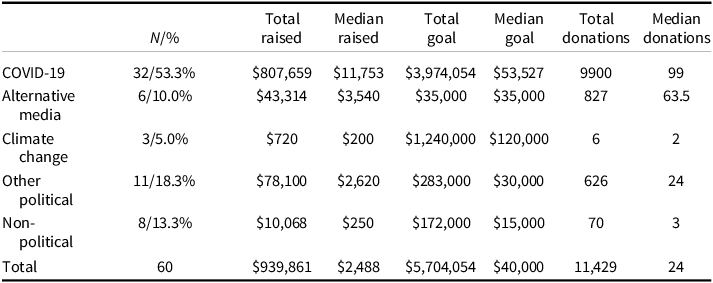
The 60 campaigns in our sample raised a total of CAD$939,861 (median CAD$2,488) from 11,429 (median 24) donors. In addition, 53.3% (n = 32) of the campaigns fell into COVID-19-related topics, which raised CAD$807,659 (median CAD$11,753) out of a total requested goal of CAD$3,974,054 (median CAD$53,527) from 9,900 (median 99) donors; 10.0% (n = 6) fell into the alternative media and free speech movements category, which raised CAD$43,314 (median CAD$3,540) out of a total requested goal of CAD$35,000 (median CAD$35,000) from 827 (median 63.5) donors; 5.0% (n = 3) fell into the climate change skepticism and opposition to prevention efforts category, which raised CAD$720 (median CAD$200) out of a total requested goal of CAD$1,240,000 (median CAD$120,000) from 6 (median 2) donors; and 18.3% (n = 11) fell into the other political campaigns category, which raised CAD$78,100 (median CAD$2,620) out of a total requested goal of CAD$283,000 (median CAD$30,000) from 626 (median 24) donors. Finally, 13.3% (n = 8) fell into the non-political campaigns category, which raised CAD$10,068 (median CAD$250) out of a total requested goal of CAD$172,000 (median CAD$15,000) from 70 (median 3) donors (see Table 1). The remainder of this section presents thematic analysis guided by CDA of the four political categories of campaigns.
Crowdfunding Campaign Fundraising by Category

COVID-19-Related Topics
This category accounted for more than half of the campaigns within our sample and raised the most total money from the largest total number of donors. Within this category, several campaigns had a common theme of advocating for bodily autonomy and individual freedoms in response to perceived government overreach. Public health measures such as requiring vaccination against COVID-19 to continue their employment, enter certain public spaces, travel cross-border and participate in recreational sports leagues are often framed as an attack on self-governance and freedom of choice regarding one’s body in receiving medical care. Many campaign hosts and donors were outspoken about empowering civil liberties, often citing “God given rights” and describing the Canadian government’s public health measures as tyrannical, corrupt or authoritarian. The sentiment of infringement upon personal freedoms in these campaigns reflects conservative political attitudes in the Canadian context, as many campaigners strongly believe that Liberal Prime Minister Trudeau and the Canadian Government is becoming too involved in enforcing excessive rules, which one donor describes as “draconian societal handcuffs.”
Within several COVID-19-related crowdfunding campaigns, there is a deep distrust toward public health measures and figures. This skepticism is fueled by the perception that COVID-19 vaccines are ineffective and outright dangerous, paired with the belief that COVID-19 is not a significant threat to public health. Statements such as “they are trying to gaslight society,” reflects the deeply rooted mistrust of Canada’s public health figures and what are perceived as “inefficient and harmful public health practices.” These crowdfunding campaigns shed light on the power imbalance within Canadian society between authority figures such as government or health figures and citizens who have been misguided by false claims lacking scientific basis. These false claims are evident within our sample of crowdfunding campaigns, including a statement in a campaign description which suggests that polymerase chain reaction (PCR) COVID-19 testing kits can cause cancer. Alongside the distrust of public health, there is a strong sentiment of perceived media bias in the reporting of COVID-19 events, which further exacerbates widespread skepticism. Several campaigns in this study advocate for media accountability, while some promote conservative alternative media outlets and call for defunding mainstream media platforms including the Canadian Broadcasting Corporation (CBC).
A reoccurring topic within COVID-19-related campaigns is the hardships and negative outcomes arising from their protest against public health measures. Many campaigns describe a similar narrative of termination of employment due to their vaccination status, resulting in declines in their quality of life and financial crisis. For example, one campaign host who experienced job termination claims “my income has gone from about 55K a year to 15K. I am classified as homeless, though I do live on a sailboat.” Another individual describes their struggles with mental health, detailing the impact of job termination including “financial ruin, bankruptcy, losing my house… and the depression that (shamefully) led to my serious attempt to take my own life.” Among many of these similar experiences, there is a widespread perception that pandemic restrictions are motivated by a desire for retaliation and struggles for power and control rather than genuine public health concerns. Moreover, many individuals use campaigns to describe the legal hardships resulting from litigation against termination and criminal charges related to the Freedom Convoy and other protests. In an effort to share their story and raise funds for their litigation, several campaign hosts note what they view as the unjust and substantial costs associated with legal representation and proceedings. These exorbitant legal fees further burden many political protesters and strengthen the sentiment of perceived retaliatory, unfair and persecutory actions of the government.
Crowdfunding campaigns against COVID-19 public health measures frequently rally a sense of unity among campaign donors and supporters. Donors actively engage with campaign hosts not only financially, but also in the form of supportive messages in comments. Several donors express support, prayers, gratitude and praise for prominent figures of the Freedom Convoy movement and for others who have experienced job termination and other hardships from their protest efforts. The attitudes are highlighted by emotive language such as “tyranny,” “political prisoners” and “freedom fighter.” The donor comment boards in these campaigns act as an interactive virtual space for dissemination of ideological stances and shared experiences, thereby fostering a strong sense of allyship and community. The large sums raised for hardships related to protest of public health measures and the supportive messaging strengthens a collective spirit of resilience, inspiration and defiance against perceived government tyranny, overreach and injustice.
Alternative Media and Free Speech Movements
This category of crowdfunding campaigns reflects fundraisers that support alternative media outlets that vocally oppose mainstream media due to a perceived bias toward politically conservative viewpoints. A common theme among these campaigns is a goal of shedding light on news, current events and “political scandals and corruption,” thus combatting the perceived shortcomings of mainstream reporting. The underlying sentiment within the campaign text and donor messaging is a deep-seated belief that current news reporting is inaccurate, deceptive and failing to adequately educate Canadians on key issues. There is a call for unification among allies and supporters to band together to “educate, enlighten and provoke meaningful conversations.” The campaigns define two main objectives for raising funds via crowdfunding. First, one campaign noted the inability to “generate enough revenue from standard means to keep doing the news in Canada,” thus highlighting the need for donations via crowdfunding. Bill C-18, the Online News Act, was described as a causal factor in their inability to raise sufficient revenue due to Alphabet and Meta online search and social media platforms removing links to Canadian news sources.
The second objective for raising funds via crowdfunding in this category is to cover legal fees associated with their news reporting. One campaign outlined the legal trouble resulting from a defamation lawsuit from a political insider they reported on. The campaign aims to give them the opportunity to continue “publishing quality investigative journalism on topics other publications would not touch.” In addition to raising funds, crowdfunding offers these alternative media outlets the ability to grow a community of loyal supporters through an interactive discourse between donors and campaigners. Donors to these campaigns claim that specific alternative media outlet figures are a “true hero” and a “warrior” and often show their appreciation for “speak[ing] the truth and stand[ing] up for our freedoms.” In this way, crowdfunding holds a dual purpose for these alternative media outlets, as a unified and inspired group of loyal supporters help these outlets continue to give their take on current events and offer an alternative to mainstream viewpoints.
Climate Change Skepticism and Opposition to Prevention Efforts
The campaigns within this category demonstrate a skepticism toward and denial of climate change as a real and significant threat. According to a campaign host, climate change is not a crisis, but the policies and efforts to combat climate change are a real threat. There is distaste toward climate change policies and programs including the net-zero policies and the carbon tax. One campaign host writes “It’s simple, the CARBON TAX is driving people into the ground.” The goal of these campaigns is generally to raise funds and awareness toward their coalitions and alternative media platforms that question the scientific consensus related to climate change through newspapers, podcasts and presentations. Within each campaign, the host advertises other resources, links or social media sites for potential donors and supporters.
According to a campaign host, climate change is a “scare” and a “hoax” and “is not based on reliable science.” The attitudes shown within the discourse suggest a strong belief that mainstream scientists and the government are ill-informed and biased. The campaign validates these claims by suggesting there are “many experts” who support this point of view. It is evident that there is a deep-seated belief that climate change is simply a scare tactic or theory based on myths and false claims. These false theories are then used to place power in the hands of experts and government officials through climate policy. Thus, a strong resentment exists toward climate change prevention efforts as campaign hosts aim to build a loyal community to spread this message.
Other Political Campaigns
A total of 18.6% of the campaigns in our sample did not fit into the other categories but were still political in nature. These campaigns covered a range of topics, including providing winter gear for Israeli Special Forces for military action in the Gaza Strip, political protest of China’s enactment of the National Security Law in Hong Kong, issues with municipal government regarding property disputes and conflict between citizens and elected officials, a criminal case involving extradition of a Canadian Army veteran to Thailand and parents opposing the teaching of gender ideology and equity, diversity and inclusion in schools. Within the vast range of topics, there is a commonality in the presence of politically contentious or controversial topics or issues. At the core of the range of politicized topics is an ideological clash toward individual rights and freedoms, which may reflect the broader political and social context of Canada.
These campaigns highlight the range of political and ideological perspectives among Canadians and the use of political activism and unifying collective action to raise funds, mobilize resources and gain support among likeminded individuals for political and social causes. Similar to the other categories, donors to these campaigns demonstrated a widespread use of the comment boards to share supportive messaging and agreeance with ideological stances described in the campaign’s text description. The campaign comment boards include several messages thanking the campaign host for their efforts, wishing luck to the host, sharing blessings and prayers and other encouraging statements such as “keep fighting the good fight! You are not alone—we have your back!”
Discussion
The four categories of political crowdfunding campaigns within our sample provide a comprehensive look into the role of crowdfunding in political mobilization on the GiveSendGo crowdfunding platform. We chose to examine campaigns housed on the GiveSendGo platform for its lack of moderation and restriction toward financing politicized activities. Because this platform is popular among far-right perspectives and conservative ideologies, we expected that many of the campaigns within our sample would be rooted in right-wing perspectives. These campaigns were examined in the context of extremist right wing online discourse in Canada, including criticizing elites and the political establishment, perceived threats to individual freedom, anti-immigrant language and concerns regarding a loss of white-dominated Canadian identity, charges of media corruption and dishonesty, bias against LGBTQ groups and mobilization against environmentalists and policies working to fight climate change (Perry and Scrivens, Reference Perry and Scrivens2019; Momani and Deschamps, Reference Momani and Deschamps2021; Preston, Reference Preston2023). Although the political mobilization within our sample included elements of right-wing political extremism including individualism and anti-authoritarianism, anti-environmentalism and critiques of media and the scientific establishment, our Canadian campaigns did not include ethnic and religious nationalism as in previous studies.
Our sample was dominated by campaigns related to the COVID-19 pandemic, which underscores the impact of the Freedom Convoy movement in influencing the use of crowdfunding to target social and political issues within Canada. These campaigns included discourse associated with political extremism in Canada, with campaigns charging that public health policies engaged in “tyranny” that created “political prisoners” and “freedom fighters.” These campaigns were not only the most common within our sample, but also had the highest median fundraising and donor totals. The emergence of Freedom Convoy protests signalled a turning point in political activism as Canadians turned to crowdfunding as a means of supporting and mobilizing political expression and activism against perceived injustices. During this time, the crowdfunding platform GiveSendGo gained usage and notoriety for its role in supporting campaigns deemed politically contentious and controversial by other platforms, including GoFundMe (Snyder and Zenone, Reference Snyder and Zenone2023). The Freedom Convoy movement sets a precedent for future campaigns in demonstrating that crowdfunding has the potential for ordinary individuals to partake in political activism, share their grievances and express their ideological stances with likeminded individuals. This mobilization takes place through campaigner and donor messages expressed and shared in crowdfunding campaigns and the direct financing for these activities provided by donors. Ultimately, the number of COVID-19-related campaigns within our sample reinforced the idea that the Freedom Convoy was a critical event for boosting the popularity of crowdfunding as a means for financing political protest and extremism within Canada.
The crowdfunding campaigns within our sample illustrate the presence of diverse and opposing ideological and political viewpoints among Canadians. The Freedom Convoy movement and climate change reflect divisive issues that place Canadians along ideological spectrums. Although many Canadians acknowledged the need for public health restrictions during the COVID-19 pandemic, several campaigns within our sample shed light into the segment of the population that holds deep scepticism toward the actions of the government and authority such as the police, the legal system and scientists and other experts. These themes are consistent with right-wing extremist ideology as it has been studied in Canada and the US (Perry & Scrivens, 2015), and also more generally populist viewpoints (Budd, Reference Budd2021; Elmer and Ward-Kimola, 2021). The size, scope and widespread support of the Freedom Convoy illustrates that far-right discourse around political beliefs and ideological values such as personal freedom and individual liberty are influential in Canada. Crowdfunding campaigning played a crucial role in the success and visibility of the Freedom Convoy movement and offers a deep insight into these political and ideological perspectives.
All categories of political crowdfunding campaigns in this study exhibited a strong sentiment of defending individual rights and freedoms amid perceived government overreach, themes common within right wing political extremism in Canada (Preston, Reference Preston2023; Momani and Deschamps, Reference Momani and Deschamps2021). Many campaigns express concern regarding a perceived shift toward authoritarianism and tyranny within Canada’s political environment. The COVID-19 pandemic appears to be the catalyst in this perceived shift, as several campaigns critique public health measures, promote civil liberties, champion individual freedoms and encourage others to make informed and autonomous decisions regarding their health. This widespread sentiment offers a look into the wider social and political landscape of Canada, where individuals are frustrated with decisions made by authoritative figures and desire transparency, personal choice and the ability to make informed decisions for oneself. Similarly, campaigns supporting alternative media platforms use government involvement within mainstream media as a way of demonstrating the need for alternative platforms intended to shift power from existing media and scientific elites. Prior research has shown limited use of the GoFundMe crowdfunding platform to support right wing extremist media platforms in Canada (Elmer and Burton, Reference Elmer and Burton2022). Our findings build on this research by identifying substantial numbers of extremist media crowdfunding campaigns on the GiveSendGo crowdfunding platform.
These campaigns also frequently exhibited other themes common among politically extremist groups involving distrust toward authority, particularly the government and mainstream media. This sentiment builds upon and is fueled by the perceived need to defend individual liberties amid government overreach. The public health measures and restrictions during the COVID-19 pandemic led many Canadians to lose trust in the government, scientists and other experts and the healthcare system, as many individuals felt that their personal freedom and bodily autonomy were infringed upon. In these campaigns, this distrust stems from a complex web of factors including concerns about lack of transparency from the government, skepticism toward the effectiveness and necessity of vaccines and other interventions and frustration toward the restrictions which limited the ability of Canadians to access certain public spaces. The distrust toward authority is also fuelled by mis- and disinformation that circulates through traditional and alternative media sources including social media and crowdfunding platforms (Iosifidis and Nicoli Reference Iosifidis and Nicoli2020; McKay and Tenove Reference McKay and Tenove2021). Several campaigns note a distrust toward mainstream media due to a perceived bias in media coverage and thus turn to alternative sources for information. The distrust is catalyzed by the perception that mainstream media aligns with government and left-wing narratives. Similar to COVID-19-related campaigns, campaigners and donors to campaigns that deny the threat of climate change use alternative media platforms as a way to discover and share information they believe to be accurate. The use of these alternative media outlets is rooted in the lack of trust in the ability of mainstream media to report accurate information and call upon credible scientists and experts.
Within our sample of crowdfunding campaigns, there is clear evidence of a strong sense of community and solidarity mobilizing political protest and activism. In the context of Canadian right-wing extremist groups, this solidarity has typically followed nationalist and ethnic lines (Perry and Scrivens, Reference Perry and Scrivens2016). The interactive nature of crowdfunding provides additional avenues for building a collective and supportive environment among individuals with similar viewpoints. Crowdfunding campaigns rally around a shared belief, cause or purpose whether raising funds for legal representation in an unjust job termination lawsuit or fundraising for film production of a documentary outlining the negative economic impacts of climate change prevention efforts. This shared purpose fosters a sense of unity and belonging as individuals collectively support causes they believe in. Crowdfunding platforms, particularly GiveSendGo, allow donors to send prayers, financial donations and supportive comments that are publicly visible. This level of participation and engagement allows donors to become invested in the campaigns and thus builds a loyal and supportive following among likeminded individuals. This engagement empowers individuals with a tangible way to contribute to and support the causes they believe in and the people who reflect their political and ideological beliefs. Interactive comment boards within the campaign allow the community of supporters to network with each other and share their opinions and beliefs. Thus, donating to these crowdfunding campaigns performs a symbolic act where individuals publicly show their allegiance to a particular political or ideological belief or movement. By offering financial support and supportive messaging, this concretely reinforces one’s solidarity to the community of collective action for a particular cause.
There are many far-reaching implications of politically extremist crowdfunding within the current Canadian context. Political crowdfunding reflects evolving trends toward political activism and anti-authoritarian or anti-expert sentiments within Canada and worldwide (Head and Banerjee, Reference Head and Banerjee2020; Lawrence, Reference Lawrence2023; van Dijck and Alinejad, Reference Dijck and Alinejad2020). One key implication is the political mobilization and amplification of political viewpoints through crowdfunding. Campaigns, which can be shared widely among social media platforms, amplify the voices of likeminded individuals with a specific shared identity and perspective toward social change. Financial donations act to mobilize these views through various means, including organizing protests, fighting legal battles and funding alternative media platforms. Therefore, crowdfunding campaigns are a catalyst for sharing political and ideological views and turning them into collective action. Following the Freedom Convoy, crowdfunding is likely to play a critical role in how Canadians express their political beliefs, participate in protest and enact change.
While much of the literature about politically extremist crowdfunding draws on the US context, our study provides insights into the Canadian ecosystem of political, including politically extremist, crowdfunding. The campaigns in this study share similar sentiments to their US counterparts. In fact, some political campaigns within our sample received donations from individuals who are self-described as Americans who supported their cause and shared similar viewpoints and values. Our sample of political campaigns mostly focused on the COVID-19 pandemic, Freedom Convoy protests, climate change and alternative media platforms. Reports by the ADL and others have demonstrated that GiveSendGo hosts campaigns in the US that support white supremacism, anti-semitism, Islamophobia and xenophobia (ADL Center on Extremism, 2023; Dickinson, Reference Dickinson2023). Notably, our sample of Canadian campaigns does not include these themes. This could be due to the relatively smaller number of Canadian campaigns, the different political environment in Canada, fundraisers with these aims being hosted elsewhere or because they have been removed following increased political and media attention on the GiveSendGo crowdfunding platform. This is an important contribution of this exploratory study and highlights the need for additional, comparative study of political crowdfunding across crowdfunding platforms and between different political contexts. The design of this study does not allow for direct comparisons between Canadian and non-Canadian crowdfunding campaigns but does add a Canadian context to the existing literature on politically extremist crowdfunding.
Our study offers important insights into political mobilization and politically extremist crowdfunding in Canada but does have limitations. First, our sample of campaigns reflects a snapshot of the current published campaigns available on GiveSendGo. These campaigns are transient, as some are unpublished and new ones appear. Our sample, however, does give insights into the current state of the ecosystem. Our sample only includes certain categories of campaigns on GiveSendGo. We chose categories that appear to have the most potential for political content. However, it is possible that our sample missed out on some campaigns with a political nature, particularly if the campaign host deliberately chose a category that would avoid attention or public scrutiny. Extremist rhetoric in the Canadian context and elsewhere can overlap with less fringe populist rhetoric such as critiques of perceived government overreach and growth (Budd, Reference Budd2021). Therefore, additional study of discourse in Canadian crowdfunding is needed.
Conclusions
This study examined the current ecosystem of political crowdfunding in Canada in the context of politically extremist discourse. Our thematic analysis of political campaigns on GiveSendGo revealed cross-cutting themes that reflect the political narratives, viewpoints and ideological beliefs of Canadians following the impact of the Freedom Convoy. Discourses between campaigners and donors also revealed the critical role of crowdfunding in political protest and extremist activism. Campaigns garner a loyal supporting of likeminded individuals who collectively mobilize protest efforts through financial donations, supportive messaging and networking. At the core of many of the politically extremist campaigns within our sample was a strong sentiment of distrust toward authority, fueled by perceived attacks on individual rights amid government overreach. Our study shows that political, including politically extremist, crowdfunding on interactive platforms such as GiveSendGo cultivate solidarity and community among donors who financially support these campaigns on the basis of shared beliefs, experiences and concerns.
Our study is the first, to our knowledge, to examine the current landscape of politically extremist crowdfunding in Canada on the GiveSendGo platform while providing insights into prevailing themes that reflect the current political and social climate of the country. The size and scope of the Freedom Convoy underscores the significance of examining politically extremist crowdfunding, particularly in the Canadian context, as it demonstrates how crowdfunding plays a pivotal role in mobilizing collective action and protest in the digital age. Our findings have broad implications and applications to other fields, such as digital communication and political science, while contributing to a well-rounded understanding of crowdfunding’s role in activism and political protest. Unlike most existing literature, which focuses on US contexts, our study examines the unique dynamics and sentiments of Canadians engaging in political protests through organizing or supporting crowdfunding campaigns. Future studies should further explore the differences between political crowdfunding in Canada and the US and why these differences exist. Studies should also examine the ecosystem of political crowdfunding in Canada, including leftist activism, on other crowdfunding platforms such as GoFundMe.
Competing interests
The author(s) declare none.

 Open access

