





Children learn emotion words in their native language (L1) from an early age, and the development of language is intricately related to the acquisition of emotional concepts (Lindquist, Reference Lindquist2017). Individuals continue to update their knowledge in adulthood, and language supports the development of emotional understanding across the lifespan (Lindquist et al., Reference Lindquist, MacCormack and Shablack2015). Importantly, words in L1 often feel more emotional than those in a later-learned, weaker second language (L2) (Pavlenko, Reference Pavlenko2012). Emotional valence has been shown to facilitate the processing of abstract words in children (Ponari et al., Reference Ponari, Norbury and Vigliocco2018), underscoring the tight coupling between emotion and language early in development.
However, bilingual language experience is heterogeneous. Individuals who learn a second language later in life and through more artificial environments (e.g., classroom learning) may not form strong emotional associations with words in that language. On the other hand, heritage bilinguals (i.e., individuals exposed to a minority home language early in life but educated primarily in, and often become increasingly dominant in, the societal majority language) often show shifts in language dominance (Valdés, Reference Valdés2005, Reference Valdés, Peyton, Ranard and McGinnis2014) and potential uneven emotional grounding across languages. This raises the question of how bilinguals’ emotional responses to second-language words are shaped by age of acquisition (AoA) and proficiency, and what mechanisms drive these effects.
Previous research suggests that emotional words are acquired differently from other types of words in L2 (Altarriba & Basnight-Brown, Reference Altarriba and Basnight-Brown2012). Bilinguals often show stronger emotional responses to L1 than L2 words, a pattern sometimes labeled as both an L1 effect and L2 attenuation (Colbeck & Bowers, Reference Colbeck and Bowers2012; Pavlenko, Reference Pavlenko2012; Puntoni et al., Reference Puntoni, De Langhe and Van Osselaer2009). Because these are relative comparisons, it’s often unclear whether the difference reflects increased emotional salience in L1, decreased resonance in L2 or both. These effects seem to depend on how early and how well the language was learned. Thus, the current study explores how bilingual language background, particularly proficiency and AoA, relates to emotion processing in both L1 and L2 (Altarriba & Canary, Reference Altarriba and Canary2004; Pavlenko, Reference Pavlenko2008).
1. Emotion, cognition and bilingualism
A growing body of work has examined how emotion and cognition interact in bilinguals. Recent work has highlighted the complex interface between language and emotion in monolinguals, showing bidirectional influences of emotional content on language processing and vice versa (Ferré et al., Reference Ferré, Fraga and Hinojosa2025). This literature further documents variation in emotional salience across languages and modalities within bilinguals, reflecting both proficiency and acquisition histories (Aguilar et al., Reference Aguilar, Ferré and Hinojosa2024). In general, emotion words are more salient and more memorable than neutral words, but this effect varies depending on whether the words appear in L1 or L2 (Altarriba, Reference Altarriba2003; Anooshian & Hertel, Reference Anooshian and Hertel1994; Ayçiçeǧi & Harris, Reference Ayçiçeǧi and Harris2004). Language emotionality has been shown to affect language choice (Pavlenko, Reference Pavlenko2008), with messages often perceived as more emotional in L1 than L2 (Puntoni et al., Reference Puntoni, De Langhe and Van Osselaer2009). Pavlenko (Reference Pavlenko2012) highlights that bilinguals demonstrate stronger affective and physiological responses to emotion words in L1 than L2 – suggesting that emotion processing may be less automatic in a later-learned language and less straightforward in heritage bilinguals whose early exposure and later language dominance do not align.
Emotion processing also interacts with cognitive systems. Emotional content can interfere with or facilitate performance depending on task demands, as emotion draws on attentional and working memory resources (Pessoa et al., Reference Pessoa, McKenna, Gutierrez and Ungerleider2002). For instance, emotionally salient stimuli can trigger emotional interference by competing with task-relevant information, whereas emotion regulation recruits cognitive control mechanisms to resist such distraction (Dolcos et al., Reference Dolcos, Iordan and Dolcos2011; Ochsner & Gross, Reference Ochsner and Gross2005). These dynamics are particularly relevant in bilinguals, whose language control processes may modulate how emotional information is processed and regulated.
There is ongoing debate about whether bilingualism confers advantages in executive function (EF), which underlies many of these processes. While some studies suggest enhanced EF in bilinguals (Bialystok, Reference Bialystok2007, Reference Bialystok2017), others find inconsistent or null results (de Bruin et al., Reference de Bruin, Treccani and Della Sala2015; Lehtonen et al., Reference Lehtonen, Soveri, Laine, Järvenpää, de Bruin and Antfolk2018; Paap et al., Reference Paap, Johnson and Sawi2015). Importantly, bilingualism is not monolithic, and individual variation in L2 proficiency, usage and AoA appears to influence EF outcomes (Singh & Mishra, Reference Singh and Mishra2013; Kałamała et al., Reference Kałamała, Drożdżowicz, Szewczyk, Marzecovã and Wodniecka2018). Thus, bilingual experience may impact emotion processing via changes in cognitive control mechanisms.
Although the current study does not include neuroimaging, the literature suggests an overlap in the neural systems involved in language, emotion and cognitive control. Emotional word processing engages the amygdala (Hamann & Mao, Reference Hamann and Mao2002; Kanske & Kotz, Reference Kanske and Kotz2011), while emotional valence is associated with activity in the orbitofrontal cortex and ventral anterior cingulate cortex—regions also implicated in decision-making and cognitive conflict resolution (Citron, Reference Citron2012; Lewis et al., Reference Lewis, Critchley, Rotshtein and Dolan2007). Other aspects of emotional processing, including regulation, rely on the dorsolateral prefrontal cortex and dorsal anterior cingulate cortex (Ochsner & Gross, Reference Ochsner and Gross2005). These overlapping systems suggest that bilingualism may shape emotional interference through interactions between language, emotion and executive control.
2. Bilingual language background
Findings across studies suggest that bilinguals’ language background, such as proficiency and AoA, plays a critical role in how emotional information is processed. In highly proficient bilinguals, emotional interference appears to be similar across languages (Eilola et al., Reference Eilola, Havelka and Sharma2007; Grabovac & Pléh, Reference Grabovac and Pléh2014), but in unbalanced bilinguals, interference is often stronger in the dominant language (Fan et al., Reference Fan, Xu, Wang, Xu, Yang and Lu2018; Winskel, Reference Winskel2013). These findings support the theory of language embodiment (Pavlenko, Reference Pavlenko2006), which posits that early learned languages are integrated into sensory and emotional experiences and encoded into autobiographical memory, making them more strongly linked to personally experienced emotions and thus more likely to elicit interference. However, heritage bilinguals do not fit neatly into early–late or balanced–unbalanced distinctions, complicating predictions based solely on AoA or dominance.
These effects may also reflect broader cognitive differences in how early and late bilinguals process language. According to the sensorimotor hypothesis (Hernandez & Li, Reference Hernandez and Li2007), early bilinguals acquire language through procedural memory systems and subcortical regions, while late learners rely more on explicit, executive-based systems. Neuroplasticity research supports this idea, suggesting that bilingualism is associated with dynamic structural changes in brain regions linked to both cognitive control and emotion, such as the anterior cingulate cortex and prefrontal cortex (Pliatsikas, Reference Pliatsikas2020). These findings suggest that language background may affect how bilinguals process emotional stimuli at both behavioral and neural levels.
3. Cognitive tasks with emotional stimuli
Cognitive processing of emotional stimuli has been examined using a range of behavioral paradigms, including lexical decision, emotional Stroop-like task (hereafter simply referred to as the Stroop task for brevity) and emotional N-back tasks. These tasks vary in terms of the cognitive processes they tap into (i.e., semantic access, conflict resolution and working memory) and can be used to examine emotional interference across modalities (words vs. faces) and difficulty levels.
Lexical decision tasks require participants to quickly decide whether stimuli are real words or nonwords. Emotional words, particularly in L1, tend to be processed faster than neutral words (Kousta et al., Reference Kousta, Vinson and Vigliocco2009; Vinson et al., Reference Vinson, Ponari and Vigliocco2014). For L2-learners-bilinguals, this advantage appears stronger in L1 and more variable in L2, depending on proficiency and AoA (Incera et al., Reference Incera, Tuft, Fernandes and McLennan2020; Ponari et al., Reference Ponari, Rodríguez-Cuadrado, Vinson, Fox, Costa and Vigliocco2015). Some studies found that L2-learners-bilinguals or early simultaneous bilinguals are faster in L1 and more accurate in L2, suggesting a speed–accuracy trade-off (Conrad et al., Reference Conrad, Recio and Jacobs2011; Ferré et al., Reference Ferré, Anglada-Tort and Guasch2018).
Emotional Stroop tasks examine emotional interference during conflict resolution. Participants must name the ink color of emotional or neutral words, or identify expressions in face-word combinations. These tasks consistently show longer response times (RTs) for emotional trials (Okada et al., Reference Okada, He and Gonzales2019; Pereira et al., Reference Pereira, Roberts and Tamayo2023), but findings vary across groups. Monolinguals tend to show stronger interference from emotional words, while L2-learners-bilinguals may be less affected, particularly in L2 or among those with higher proficiency. Some studies, however, show no group differences or consistent valence effects (Eilola et al., Reference Eilola, Havelka and Sharma2007; Smith et al., Reference Smith, Leung, Crane, Parkinson, Toulopoulou and Yiend2018).
Emotional N-back tasks assess working memory under emotional distraction. Some versions use emotional faces as distractors while participants remember letters; others require participants to remember emotional faces or words directly. Findings suggest that early simultaneous bilinguals may be slower but more accurate than monolinguals (Barker & Bialystok, Reference Barker and Bialystok2019; Janus & Bialystok, Reference Janus and Bialystok2018), and that bilinguals’ accuracy is less disrupted by emotional interference. Proficiency and AoA are again key factors in modulating these effects, especially in L2-learners-bilinguals (Ma et al., Reference Ma, Ma, Li and Liu2020). However, these effects are not always consistent, and some studies report null differences between groups or across languages.
4. The current study
Taken together, the literature reveals conflicting findings regarding how bilingualism shapes cognitive processing under emotional interference. These inconsistencies may reflect differences in task demands, participant language background or the specific cognitive domain being tested. Emotional stimuli can facilitate lexical access, interfere with conflict resolution or modulate working memory – but these effects are not uniform across studies or populations. Moreover, relatively little work has examined these effects in heritage bilinguals; their unique language histories may produce different patterns of emotional processing than those observed in typical L2 learners.
The current study addresses these gaps by examining emotional interference across multiple cognitive domains in the same individuals. By comparing monolingual and bilingual young adults across six task paradigms, including lexical decision, emotional Stroop and emotional N-back, we ask whether emotional effects are consistent across tasks, whether they differ between language groups and how they vary across languages within heritage bilinguals. Importantly, we examine whether bilingual language background (e.g., L2 AoA, proficiency, usage) is associated with task performance.
This study focuses on three primary research questions (RQs):
RQ1. Are emotional effects consistently observed across cognitive tasks in the same participants? Prior research suggests that emotional content may enhance lexical retrieval and support working memory maintenance but may also interfere with conflict resolution or increase cognitive load. Thus, emotional stimuli may facilitate or disrupt task performance depending on task demands.
RQ2. Do emotional effects vary between monolinguals and heritage bilinguals? That is, do participants with different language backgrounds show different patterns of emotional interference or facilitation across tasks involving emotional words and faces?
RQ3. Do emotional effects vary between languages within heritage bilinguals? In other words, does emotional interference change depending on whether bilinguals complete tasks in their first or second language? Additionally, are these effects related to bilingual language background (e.g., L2 AoA, language proficiency)?
By integrating cognitive, emotional and language dimensions within the same sample, this study aims to clarify when and how bilingualism affects emotional interference and how individual language experience may shape that process.
5. Method
5.1. Participants
The final sample included 75 monolinguals and 74 bilinguals (Table 1). Participants were recruited from the University of Houston’s SONA pool and compensated with extra credit. Eligibility was determined via a prescreen survey. Participants had to be between 18 and 45, have normal or corrected-to-normal vision and have no history of psychiatric, neurological or developmental disorders. Monolinguals were functionally monolingual English speakers, with no meaningful exposure to a second language (i.e., had not undertaken a language course for more than two years or within the past five years, had exposure to a home language for less than 25% of the time and comprehended less than 25% of that language). Bilinguals spoke only English and Spanish.
Demographic and language information by group (N = 149)

Table 1. Long description
Beginning at the top, the table lists variables in the first column, monolingual group data in the second, bilingual group data in the third, and statistical comparisons in the fourth. Gender: monolinguals are 58 female (78.4 percent), 15 male (20.3 percent), 1 non-binary (1.35 percent); bilinguals are 65 female (90.3 percent), 6 male (8.33 percent), 1 non-binary (1.39 percent). Chi-squared test for gender is chi-squared (1) equals 3.31, p equals .069. Handedness: monolinguals are 66 right-handed (88.0 percent), 7 left-handed (9.3 percent), 2 ambidextrous (2.7 percent); bilinguals are 67 right-handed (90.5 percent), 7 left-handed (9.5 percent). Chi-squared (1) less than .001, p equals 1. Race: monolinguals are 10 Asian (13.3 percent), 29 Black (38.7 percent), 16 White (21.3 percent), 13 Hispanic (white) (17.3 percent), 2 Hispanic (non-white) (2.7 percent), 5 Others (6.7 percent); bilinguals are 1 Asian (1.4 percent), 49 White (66.2 percent), 22 Hispanic (non-white) (29.7 percent), 2 Others (2.7 percent). Chi-squared (5) equals 84.07, p less than .001. Immigration status: monolinguals are 72 native (98.6 percent), 1 international student/NA (1.4 percent); bilinguals are 50 native (73.5 percent), 16 immigrant (23.5 percent), 2 international student/NA (2.9 percent). Chi-squared (2) equals 20.15, p less than .001. Age: monolinguals mean 19.8, standard deviation 1.49; bilinguals mean 20.3, standard deviation 1.77. t (142.23) equals 2.16, p equals .03. Household income: monolinguals mean 7.25, standard deviation 3.12; bilinguals mean 5.99, standard deviation 2.35. t (118.69) equals minus 2.64, p equals .009. Mother education: monolinguals mean 3.99, standard deviation 1.01; bilinguals mean 3.01, standard deviation 1.04. t (142.44) equals minus 5.71, p less than .001. Father education: monolinguals mean 3.87, standard deviation 1.03; bilinguals mean 2.70, standard deviation 1.11. t (140.86) equals minus 6.53, p less than .001. L2 AoA: bilinguals mean 5.09, standard deviation 3.78. Proficiency (MiNT): English, monolinguals mean 0.90, standard deviation 0.05; bilinguals mean 0.79, standard deviation 0.09. t (109.15) equals minus 9.49, p less than .001. Spanish, bilinguals mean 0.61, standard deviation 0.14. t (199) equals 6.50, p less than .001. Efficiency (MiNT): English, monolinguals mean 0.50, standard deviation 0.13; bilinguals mean 0.34, standard deviation 0.11. t (142.95) equals minus 7.91, p less than .001. Spanish, bilinguals mean 0.19, standard deviation 0.14. t (73) equals 9.82, p less than .001. Self-report proficiency (LHQ): English, monolinguals mean 0.94, standard deviation 0.10; bilinguals mean 0.86, standard deviation 0.13. t (136.19) equals minus 3.90, p less than .001. Spanish, bilinguals mean 0.76, standard deviation 0.14. t (72) equals 5.50, p less than .001. Notes clarify coding for household income and parent education, and scales for proficiency and efficiency.
Note: Bold: p < .05.
Household income: 1 = Less than $10,000; 2 = $10,000 to $14,999; 3 = $15,000 to $29,999; 4 = $30,000 to $44,999; 5 = $45,000 to $59,999; 6 = $60,000 to $74,999; 7 = $75,000 to $89,999; 8 = $90,000 to $104,999; 9 = $105,000 to $119,999; 10 = $120,000 to $134,999; 11 = $134,000 to $149,999; 12 = $150,000 and above.
Parent education: 1 = Elementary school; 2 = Middle school; 3 = High school; 4 = College (Bachelor); 5 = Graduate school (Master); 6 = Graduate school (Doctor).
MiNT proficiency and LHQ self-report are on a scale of 0–1.
a Comparison analyses did not include non-binary and ambidextrous.
b Comparison between Spanish and English proficiency within bilinguals. Efficiency is calculated as total correct / time.
Sample size justification. The sample size was determined based on resource constraints (Lakens, Reference Lakens2022), specifically the recruitment capacity of the University’s SONA pool during the designated data collection period. Because a primary goal of this study was to address conflicting findings in the existing literature across multiple cognitive paradigms, there were no consistent a priori effect sizes available to conduct a formal power analysis for the complex higher-order interactions modeled (e.g., group-by-task-by-valence). However, our final sample (N = 149) exceeded or was comparable to the sample sizes typically reported in research examining bilingualism and emotional interference (e.g., N ≈ 30–60 per group; Eilola & Havelka, Reference Eilola and Havelka2011; Okada et al., Reference Okada, He and Gonzales2019). Given the high trial counts per condition in our within-subject designs and the use of linear mixed-effects modeling, which provides greater statistical power than traditional ANOVA by accounting for trial-level variance, this sample size was deemed sufficient to provide a robust characterization of the observed task and language effects.
5.2. Measures and procedures
The study involved one in-person and one online session for monolinguals and two in-person sessions plus one online session for heritage bilinguals. The first in-person and online sessions were identical across groups. In in-person session one, participants completed the Multilingual Naming Test (MiNT; Garcia & Gollan, Reference Garcia and Gollan2022) as an objective measure of language proficiency. Monolinguals completed it in English; bilinguals completed it in both languages. Next, participants completed six computerized tasks (described below), followed by a demographic and handedness survey and the Language History Questionnaire 3 (LHQ3; Li et al., Reference Li, Zhang, Yu and Zhao2020), which assessed subjective proficiency, usage and dominance. Bilinguals completed their second-language set of tasks in in-person session two (language order counterbalanced). In the online session, all participants provided affective and psycholinguistic ratings (e.g., familiarity, imageability) for the words and faces that had been used as stimuli in the in-person sessions.
Participants completed six computerized tasks (Table 2) in a sound-attenuated, dimly lit booth, seated approximately 60cm from the display. Tasks were programmed in MATLAB R2023a (Update 5) using Psychtoolbox 3.0.19 (https://psychtoolbox.org/; Brainard, Reference Brainard1997; Kleiner, Reference Kleiner2007; Pelli, Reference Pelli1997). Stimuli were presented on a DELL 21-inch LCD monitor with a resolution of 1920×1080px and a refresh rate of 60Hz. The intertrial interval was 500ms, and stimuli remained onscreen until a response was made. Task order was pseudo-randomized (using MATLAB’s random number generator with a shuffled seed), with bilinguals receiving the same order across languages. Monolinguals completed all tasks in English; bilinguals completed them in English and Spanish on separate days to avoid language-switching effects (order counterbalanced). Valence trials (positive, negative, neutral) were mixed within blocks. Practice trials preceded each task; participants were required to achieve 100% accuracy for the lexical decision and color Stroop tasks and ≥75% for the face–word Stroop and N-back tasks to proceed.
Summary of cognitive tasks with emotional stimuli
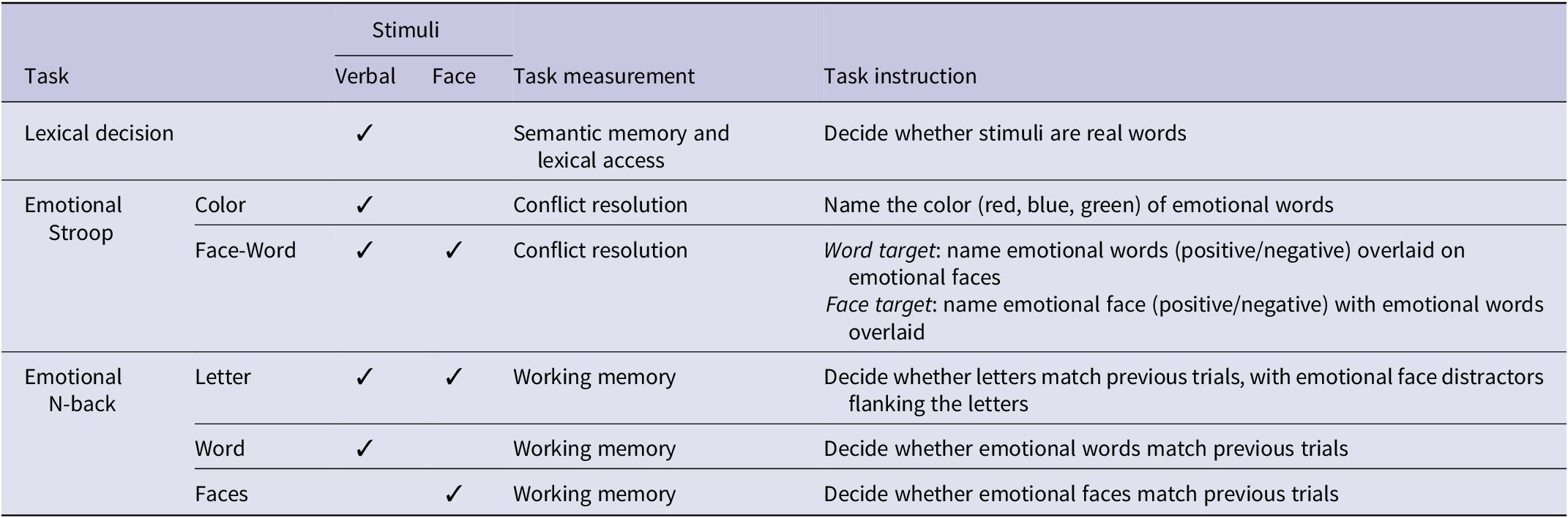
Table 2. Long description
The header spans two rows, with columns for Task, Stimuli (Verbal and Face), Task measurement, and Task instruction. The first row describes the Lexical decision task, marked with a check under Verbal stimuli, measured by semantic memory and lexical access, with instructions to decide if stimuli are real words. The next two rows detail Emotional Stroop tasks: Color, with a check under Verbal stimuli, measured by conflict resolution, instructing to name the color of emotional words; Face-Word, checked under both Verbal and Face stimuli, also measured by conflict resolution, with instructions to name emotional words overlaid on faces or to name emotional faces with words overlaid. The final three rows cover Emotional N-back tasks: Letter, checked under both Verbal and Face stimuli, measured by working memory, instructing to decide if letters match previous trials with emotional face distractors; Word, checked under Verbal stimuli, measured by working memory, instructing to decide if emotional words match previous trials; Faces, checked under Face stimuli, measured by working memory, instructing to decide if emotional faces match previous trials. All task instructions are provided verbatim as in the table.
5.3. Stimuli
Emotional words were drawn from the Affective Norms for English Words (ANEW; Bradley & Lang, Reference Bradley and Lang1999) and Spanish adaptations (Redondo et al., Reference Redondo, Fraga, Padrón and Comesaña2007; Sarli & Justel, Reference Sarli and Justel2022), matched across languages on length, syllables, class, neighbors and affective (i.e., valence, arousal, dominance) ratings. There were 26 words per valence category. For the face–word Stroop, only positive and negative words were used. Face stimuli were selected from the racially diverse affective expression (RADIATE) face stimulus set (Conley et al., Reference Conley, Dellarco, Rubien-Thomas, Cohen, Cervera, Tottenham and Casey2018), with 26 faces per valence (happy, angry, neutral). Face–word Stroop used happy and angry faces; face and letter N-back tasks included all three valences.
5.4. Tasks
5.4.1. Lexical Decision
Participants decided whether visually presented letter strings were real words. The task included 78 real words and 78 matched nonwords generated using Wuggy: A multilingual pseudoword generator (https://github.com/WuggyCode/wuggy; the chosen nonword had the smallest summed deviation from the base word selected for each item), for a total of 156 trials (see final list of stimuli on https://osf.io/ypd9z/). Thus, the nonwords were also categorized into one of three valences based on the valence of the associated word: positive, negative or neutral. Responses were made by pressing either M or Z on the keyboard using index fingers to indicate “word” or “nonword” (key-mapping counterbalanced across participants). No trials were excluded due to word unfamiliarity, as the task was designed to assess lexical access independent of subjective word knowledge. Conditions modeled included word valence × lexicality.
5.4.2. Color Stroop
In this Stroop task using manual instead of verbal responses, participants identified the color (red, green or blue) of emotional words (n = 78) across three valence categories. Stimuli were evenly distributed across positive, negative and neutral valence categories. Responses were made by pressing B, N or M on the keyboard, using the right index, middle or ring fingers to indicate the ink color (red, green or blue; key-mapping counterbalanced across participants). Trials using words rated as unfamiliar by more than 10% of participants during the subsequent online session were removed. The primary within-subject factor modeled in the analyses was word valence.
5.4.3. Face–word Stroop Task
This task included two blocks: a face block and a word block. Prior research has yielded conflicting findings, with some suggesting words are more automatically processed than faces (Ovaysikia et al., Reference Ovaysikia, Tahir, Chan and DeSouza2010) and others the opposite (Beall & Herbert, Reference Beall and Herbert2008). To address this, we included both response types. In the face block , participants selected the emotion of the face (positive or negative) while ignoring the word distractor; conditions included word distractor valence × congruency. In the word block , they selected the emotion of the word while ignoring the face distractor; conditions included face distractor valence × congruency. Responses were made by pressing either M or Z on the keyboard using index fingers to indicate “positive” or “negative” emotion (key-mapping counterbalanced across participants). Each block had 52 trials, for a total of 104. Within each block, positive and negative stimuli were equally represented, and congruent and incongruent trials occurred in equal proportions. Participants with any conditions with a mean accuracy below 0.6 were excluded. An across-block analysis included distractor valence × congruency × block (face vs. word target). In within-bilingual analyses, interactions between block and language background variables (English proficiency, Spanish proficiency, L2 AoA) were included.
5.4.4. Emotional N-back Tasks
All N-back tasks included 1-back and 2-back blocks and consisted of match, nonmatch and lure trials (items that appeared recently, i.e., one or three trials earlier, but did not match the target position). Across N-back tasks, positive, negative and neutral stimuli were equally distributed, and the proportions of match, nonmatch and lure trials were held constant across valence categories. In the 1-back block, participants responded whether the current item matched the one immediately before; in the 2-back block, whether it matched the item two positions prior. Each N-back task had 130 trials. In word and face versions, stimuli were centered; in the letter version, a central letter (B, F, H, K, M, Q, R, X) appeared flanked by identical emotional faces. Responses were made by pressing either M or Z on the keyboard using index fingers to indicate “match” or “nonmatch” (key-mapping counterbalanced across participants).
In the word N-back task, trials using words rated as unfamiliar by more than 10% of participants were removed. Participants with any conditions with a mean accuracy below 0.6 were excluded. For the word and face blocks, analyses included stimulus valence × block (1-back vs. 2-back). For the letter N-back task, analyses included distractor face valence × block. Across N-back tasks, analyses included stimulus valence × block × task type (word, face, letter). In within-bilingual analyses, interactions between task type and language background variables were included.
5.5. Statistical analyses
5.5.1. Data preprocessing and diffusion modeling
Tasks, data, and analyses can be found at https://osf.io/ypd9z/. The tasks shared similar structures, stimuli and outcome measures and were therefore examined using a unified analytic framework. Outcomes included accuracy and RT, with RT calculated from correct trials only. For each task, extreme RTs (outside the middle 99% of all trials) were excluded. In addition, participants’ drift rates (ν) were estimated using the EZ-diffusion model (Wagenmakers et al., Reference Wagenmakers, Van Der Maas and Grasman2007), which computes drift rate (ν), boundary separation (α) and nondecision time (t0) from accuracy and RT data (including RT for incorrect trials). In general, drift rate reflects how efficiently task-relevant information is accumulated to support a decision. In practical terms, drift rate provides a single measure of task-processing efficiency, reflecting how effectively participants extract and use task-relevant information to generate a correct response. Higher drift rates reflect more efficient processing of task-relevant information and are typically associated with faster and more accurate decisions, whereas lower drift rates indicate less efficient processing and are often associated with slower or more error-prone responses. This approach allowed us to examine task performance while accounting for potential speed–accuracy tradeoffs. Drift rates were estimated for each task for the task-relevant conditions (except for the color Stroop task, due to it having three response choicesFootnote 1). All continuous predictors (English proficiency, Spanish proficiency and L2 AoA) and covariates (household income and highest parental education) were standardized (z-scored) prior to analysis to reduce multicollinearity and improve model convergenceFootnote 2.
5.5.2. Task-specific analyses
Accuracy was analyzed using generalized linear mixed-effect models for binomial data; RT and drift rate were analyzed using linear mixed-effect models. Because the color Stroop task involved three response alternatives, diffusion parameters were not estimated for this task; therefore, only accuracy and RT were analyzed.
We first compared bilingual and monolingual participants on English-language task performance, controlling for objective English proficiency, household income and parental education. For each task, we conducted mixed-effects models as follows:
Task performance
~
group*task condition + group*English proficiency + household income + highest parental education + (1|IDFootnote
3)
We then examined within-group differences among bilinguals completing tasks in English versus Spanish, additionally controlling for objective Spanish proficiency and L2 AoA. For each task, we conducted mixed-effects models as follows:
Task performance
~
language*task condition + language*English proficiency + language*Spanish proficiency + language*L2 AoA + household income + highest parental education + (1|ID [see footnote 3])
Across-task analysis. Finally, we conducted analyses comparing task performance across tasks. Specifically, we examined whether the valence effect on cognition varied across tasks for monolinguals and bilinguals. From the task-specific drift rates, we computed a
drift cost (Δν)
score, defined as the difference between drift rates in the less challenging and more demanding conditions:
$ \Delta \nu ={\nu}_{less\ demanding}-{\nu}_{more\ demanding} $
 .
.
To allow comparisons across tasks with different difficulty scales, these drift-cost scores were standardized within each task (z-scored) prior to analysis. This standardization expresses each participant’s cost relative to the task-specific distribution, enabling direct comparison across tasks. Drift cost captures the cognitive cost associated with increased task demands. In practical terms, drift cost reflects how efficiently participants process task-relevant information when task demands increase, with larger values indicating greater reductions in processing efficiency under more demanding conditions. An advantage of this approach is that it allows comparison of cognitive processing efficiency across tasks that differ in nondecision demands (e.g., sensory and motor processes) and boundary separation (evidence thresholds required to commit to a response).
For interpretability, drift-cost values used in visualization were expressed relative to the task-specific standard deviation without mean-centering. In this scaled metric, zero reflects no cost, positive Δ ν indicates greater difficulty under high-demand conditions while negative Δν indicates relatively better-than-expected performance in the harder condition. Positive drift-cost values indicate slower evidence accumulation under higher task demands, whereas negative values reflect faster accumulation in the harder condition, which may result from practice effects, limited trial numbers or random variability. In other words, positive Δ ν means participants struggled more under high-demand conditions while negative Δν means they performed unusually well or faster than expected in the harder condition.
For the lexical decision task, drift costs corresponded to the difference between word and nonword trials. In the face–word Stroop task, the difference was computed between congruent and incongruent trialsFootnote 4. For the N-back tasks, the cognitive cost was defined as the difference between 1-back and 2-back conditions. The color Stroop task was excluded due to the absence of clearly defined easy and hard conditions. Similar mixed-effect models as the individual task analyses were conducted for these comparisons, with cognitive cost as the outcome. Specifically, valence remained a main factor of interest while task conditions (i.e., lexicality, memory load) were replaced with the task type in the model. Because income and parental education had minimal impact on task outcomes (see Results), they were omitted from these analyses.
We explored whether group moderates the valence effect and whether this differs by task. In addition, we also explored whether group moderates the effect of English proficiency on English task cognitive cost and whether this varies by task. The following analysis was conducted using a linear mixed-effect model:
drift cost (Δν)
~
group*valence*task + group*English proficiency*task + (1|ID [see footnote 3])
We then examined within-group differences among bilinguals completing tasks in English versus Spanish, exploring whether the effect of valence, English proficiency, Spanish proficiency and L2 AoA varies by task language and task demand. The following analysis was conducted using a linear mixed-effect model:
drift cost (Δν)
~
language*valence*task + language*English proficiency + language*English proficiency*task + language*Spanish proficiency*task + language*L2 AoA*task + (1|ID [see footnote 3])
6. Results
In the current study, participants included English monolinguals and heritage Spanish–English bilinguals, who differed in racial/ethnic background, immigrant status and socioeconomic factors (Table 1). Monolinguals reported significantly higher family income, parental education and English proficiency than bilinguals. Monolinguals also had higher objective English proficiency than bilinguals. Within the bilingual group, participants were more proficient in English than Spanish, and those with higher English proficiency tended to have lower Spanish proficiency (r = −0.34). Most bilinguals were heritage speakers who acquired both languages before age five, with Spanish typically acquired first. L2 AoA ranged from 0 to 15 years (M = 5.09, SD = 3.78). Language dominance scores indicated that most bilinguals were English-dominant (M = 0.68, SD = 0.21). For the full correlation between language scores and participant language background, see Supplementary Figures S1 and S2.
6.1. Task-specific performance
Detailed task-specific results are provided in the Supplementary Materials; here, we emphasize higher-order interactions involving emotional valence, task demands and language background. Unless otherwise noted, the results reported in the main text focus on drift rate as the primary outcome measure, while analyses of accuracy and RT are provided in the Supplementary Materials; the color Stroop task is an exception, for which results are reported using accuracy and RT due to the absence of a two-choice response structure required for diffusion modeling.
6.2. Lexical decision
6.2.1. Summary
Drift rate analyses showed that bilinguals processed nonwords more efficiently than monolinguals, while both groups performed similarly for real words. Emotional valence effects differed across words and nonwords but did not vary by language group. Within bilinguals, lexical processing was generally more efficient in English than in Spanish, particularly for real words. Language background variables further showed that Spanish proficiency predicted more efficient processing in Spanish, whereas English proficiency did not differentially influence efficiency across languages. Accuracy and RT analyses showed broadly similar patterns to the drift rate results. Full results are reported in Supplementary Tables S1 and S2 and Supplementary Figures S3 and S4.
6.2.2. Between groups
We examined whether bilingual and monolingual participants differed in task performance as measured by drift rates (ν) across lexical categories (word vs. nonword) and word valence (positive, neutral, negative) in English trials (n = 135; see Supplementary Table S1 and Figure S3). Bilinguals showed higher drift rates than monolinguals for nonwords [t(153) = 3.135, p = .002], whereas both groups performed similarly for words [t(153) = 0.84, p = .402], indicating a group-by-lexicality interaction, F(1, 665) = 15.86, p < .001, η2 = 0.02 (Figure 1, top row left panel). This pattern indicates that bilinguals processed nonwords more efficiently than monolinguals, while both groups showed similar efficiency when processing real words. Emotional valence influenced words and nonwords differently, F(2, 665) = 63.23, p < .001, η2 = 0.16 (Figure 1, top row right panel). For words, positive trials were processed most efficiently, followed by negative and then neutral trials, whereas for nonwords, both positive and neutral trials were processed more efficiently than negative trials. Participants with higher English proficiency also showed a higher drift rate, F(1, 129) = 8.12, p = .005, η2 = 0.06. This indicates that participants with stronger English skills processed the task stimuli more efficiently, and the effect is consistent across language groups. Accuracy and RT analyses showed similar patterns to the drift rate findings, except that the effect of English proficiency was not significant for RT.
Lexical decision drift rate.

Figure 1. Long description
Top row, left panel: Y-axis is Drift Rate (v), x-axis is nonword to word. Two groups, Bilingual (green) and Monolingual (orange), are plotted with error bars. Bilinguals show higher drift rates for both nonwords and words, with a larger group difference for nonwords. Top row, right panel: Y-axis is Drift Rate (v), x-axis is nonword to word. Three word valence categories are plotted: negative (black), neutral (purple), positive (teal). Positive words have the highest drift rates, especially for words, while negative and neutral are lower and closer together. Bottom row, left panel: Y-axis is Drift Rate (v), x-axis is nonword to word. Two task languages, English (blue) and Spanish (orange), are plotted for bilinguals. Both languages show higher drift rates for words than nonwords, with Spanish slightly higher overall. Bottom row, middle panel: Y-axis is Drift Rate (v), x-axis is Spanish Proficiency (0 to 1). English (blue) shows a flat trend, while Spanish (orange) shows a strong positive slope, indicating higher proficiency increases drift rate in Spanish but not English. Bottom row, right panel: Y-axis is Drift Rate (v), x-axis is L2 Age of Acquisition (2 to 16). English (blue) shows a negative slope, Spanish (orange) shows a positive slope, with shaded confidence intervals. Earlier L2 acquisition is associated with higher drift rates in English, later acquisition with higher rates in Spanish.
6.2.3. Within bilinguals
We examined bilingual participants’ performance by task language (English vs. Spanish) and additionally explored the effect of language background on task performance (n = 68; see Supplementary Table S2 and Figure S4). Drift rates were generally higher for words than nonwords in both languages, indicating more efficient processing of real words. However, this lexicality advantage varied across languages, F(2, 734) = 48.58, p < .001, η2 = .12 (Figure 1, second row). Specifically, the difference between words and nonwords was greater in English [t(734) = 12.61, p < .001] than in Spanish [t(734) = 8.35, p < .001]. Drift rates for words were also slightly higher in English than in Spanish [t(734) = 2.35, p = .019], whereas nonword processing did not significantly differ across languages (p = .058). This pattern suggests that bilingual participants processed real words somewhat more efficiently in English than in Spanish, while nonword processing was similar across the two languages. The three-way interaction between task language, word valence and lexicality on drift rate was marginally significant, F(2, 734) = 2.99, p = .051, η2 = .008. The valence-by-lexicality interaction showed a similar pattern to the between-group findings. Accuracy and RT analyses showed broadly similar patterns; however, the three-way interaction between task language, word valence and lexicality was significant in those models.
English proficiency did not differentially influence processing efficiency across languages, F(1, 734) = 0.25, p = .615, η2 = .0003. However, accuracy and RT analyses showed a significant interaction between language and English proficiency (see Supplementary Materials). This suggests that proficiency-related differences across languages were reflected primarily in response behavior rather than in the efficiency with which participants processed task-relevant information. In contrast, there was a significant language-by-Spanish proficiency interaction, F(1, 734) = 47.52, p < .001, η2 = .06 (Figure 1, bottom row left panel). Specifically, Spanish proficiency positively predicted drift rates in Spanish trials (b = 0.023, p < .001) but not in English trials (p = .705). Finally, there was a language-by-L2 AoA interaction for drift rate, F(1, 734) = 6.22, p = .013, η2 = .008 (Figure 1, bottom row right panel). Although L2 AoA did not significantly predict drift rates within either language individually (ps > .30), the difference between languages was significant, t(734) = 2.49, p = .013, with earlier L2 acquisition associated with slightly higher drift rates in English (b = −0.0002) but lower drift rates in Spanish (b = 0.0001). RT analyses showed a similar interaction pattern, whereas accuracy did not show a significant effect of L2 AoA.
6.3. Color Stroop
6.3.1. Summary
Color Stroop performance showed little evidence of emotional interference. Bilinguals responded faster than monolinguals overall, although accuracy did not differ between groups. Word valence did not significantly influence performance, and emotional effects did not vary by language group. Within bilinguals, participants responded faster and more accurately in English than in Spanish. Language background variables showed limited influence overall, although English proficiency interacted with task language in predicting accuracy. Full results are reported in Supplementary Tables S3 and S4 and Figures S5 and S6.
6.3.2. Between groups
We examined whether bilingual and monolingual participants differed in performance on the color Stroop task across word valence (positive, negative, neutral) in English trials (n = 135; for full results, see Supplementary Table S3 and Figure S5). There was a main effect of group for RT, F(1,129) = 5.04, p = .026, η2 = 0.04, and bilinguals were faster than monolinguals, but there was no group difference in accuracy. There was no main effect of valence nor a significant group-by-valence interaction for either accuracy or RT. There was no effect of English proficiency on accuracy, but there was a significant group-by-English proficiency interaction for RT, F(1,129) = 4.47, p = .036, η2 = 0.03. Specifically, in monolinguals, higher English proficiency was associated with faster RTs (b = −0.84, p = .005), but no effect was observed in bilinguals (p = .39).
6.3.3. Within bilinguals
We next examined bilinguals’ performance by task language (English vs. Spanish), along with the effects of language background (n = 68; for full results, see Supplementary Table S4 and Figure S6). There were no main effects or interactions involving word valence. There was a main effect of language for both accuracy [χ2(1) = 4.67, p = .031] and RT [F(1,9014.1) = 4.33, p = .037, η2 < .001], such that bilinguals were faster and more accurate in English than in Spanish. Notably, an interaction emerged between language and English proficiency for accuracy [χ2(1) = 4.46, p = .035]. The relationship between English proficiency and color Stroop accuracy differed significantly by task language, z = 2.112, p = .035. Specifically, higher English proficiency was associated with better accuracy in Spanish (OR = 10.1) but lower accuracy in English (OR = 0.042), although these slopes were not significant (ps > .15).
6.4. Face–word Stroop
The face–word Stroop consisted of a block of face targets with word distractors and a block of word targets with face distractors. We first analyzed the results of each block (see the Supplementary Materials for the full results of the between- and within-group analyses within each block). We focus here on effects that differed by block type (face vs. word target), as these capture differences in how emotional information is prioritized across modalities. Specifically, we examined whether participants’ performance differed by block type. While both blocks involved conflict between face and word valence, one required participants to focus on the face and ignore the word, whereas the other required them to focus on the word and ignore the face.
6.4.1. Summary
Face–word Stroop performance showed modality-specific emotional interference effects. Positive word distractors modulated congruency when faces were targets, whereas negative facial distractors modulated congruency when words were targets. These patterns were consistent across bilingual and monolingual participants, indicating no reliable group differences. Within bilinguals, similar modality-specific effects emerged, but the impact of conflict on processing efficiency varied by task language: word distractors interfered more strongly with face judgments in English, whereas facial distractors interfered more with word judgments in Spanish. Additionally, bilinguals showed greater processing efficiency in English than in Spanish in the word-target block. Accuracy and RT results showed broadly similar patterns. Full results are reported in Supplementary Tables S5–S10 and Figures S7–S12.
6.4.2. Between groups
We examined whether bilingual and monolingual participants differed in performance on the face–word Stroop task across word valence (positive, negative, neutral) and task type (face target vs. word target) in English trials (n = 103; for full results, see Supplementary Table S9, Figure S12). There was a small-to-medium three-way interaction between distractor valence, congruency and block, F(1,705) = 31.71, p < .001, η2 = .04 (Figure 2, top panel). In the face block, congruency effects were only significant for positive word distractors (b = .006, p < .001), while the opposite is true for the word block, where congruency effects were only significant for negative face distractors (b = .004, p < .001). The findings for accuracy and reaction time are consistent with these results (Supplementary Figure S11), suggesting that emotional distractor effects depended on stimulus modality: positive words produced stronger facilitation and interference when words served as distractors, whereas negative faces more strongly modulated performance when faces served as distractors.
Face–word Stroop performance.

Figure 2. Long description
The top panel plots Accuracy on the y-axis and Distractor Valence (negative, positive) on the x-axis. The left half is labeled Face Block (ignoring words), the right half Word Block (ignoring faces). In both blocks, congruent (red) and incongruent (blue) conditions are shown with error bars. Accuracy is highest for congruent-positive in Face Block and lowest for incongruent-positive in Face Block. In Word Block, congruent conditions are generally higher than incongruent, with less separation between valence types. The middle panel shows Response Time (seconds) on the y-axis, with the same block and valence structure. Congruent trials are faster than incongruent, especially for positive valence in Face Block. The bottom panel plots Drift Rate (v) on the y-axis. Congruent-positive in Face Block has the highest drift rate, while incongruent-negative in Word Block is lowest. Across all panels, congruent trials outperform incongruent, and Face Block shows greater differences by valence.
6.4.3. Within bilinguals
We next examined whether the effects of language background differed by block type, given that language background effects emerged in the word block but not the face block (n = 47; for full results, see Table S10). A similar three-way interaction emerged between distractor valence, congruency and block for all outcomes, echoing between-group trends (Figure 2, middle panel). There was a marginally significant three-way interaction between task language, congruency and block for drift rate, F(1,681) = 3.71, p = .05, η2 = .005 (Figure 2, bottom panel). In English trials, the congruency effect was only significant for the face block (b = 0.004, p < .001); however, in Spanish trials, the congruency effect was only significant for the word block (b = 0.003, p = .003). These findings indicate that conflict affected processing efficiency differently across languages, with English word distractors disrupting face judgments in English trials, whereas facial distractors disrupted word judgments in Spanish trials. In addition, there was a significant language-by-block interaction, F(1,681) = 5.25, p = .022, η2 = .008, showing participant being more efficient in processing English than Spanish trials only in the word-target block, b = 0.002, p = .009.
While there was no proficiency effect in drift rate and accuracy, there was a two-way interaction between task language and English proficiency for RT, F(1,8808.4) = 6.68, p = .01, η2 = .001, such that higher proficiency was associated with faster RT for English trials (b = -0.02) and slower RT for Spanish trials (b = 0.02), although neither slopes were statistically significant (ps > .57). There was a three-way interaction between task language, block and Spanish proficiency for RT, F(1,8808.7) = 25.52, p < .001, η2 = .003. Specifically, greater Spanish proficiency was associated with faster RT only in the word block for Spanish trials (b = -0.18, p < .001). Finally, there was a three-way interaction between task language, block and L2 AoA for RT, F(1,8809) = 5.42, p = .02, η2 = .001. Similarly, later L2 AoA acquisition was associated with slower RT only in the word block for Spanish trials (b = 0.11, p = .009).
6.5. N-back
Participants completed three N-back tasks using emotional words, emotional faces or letters with emotional face distractors. Although each task was analyzed separately (see the Supplementary Materials for the full results within each task; Supplementary Tables S11–S16 and Figure S19), the primary analyses examined performance across block types (face, word and letter) to assess how stimulus domain modulated working memory demands.
6.5.1. Summary
N-back performance showed robust effects of memory load and task type, with higher load associated with reduced processing efficiency and the letter condition showing lower efficiency than face and word conditions. Bilinguals demonstrated generally higher processing efficiency than monolinguals across conditions, although this difference was not uniform across all task combinations. Task differences between face and word conditions were minimal in drift rate but more differentiated in RT, particularly under higher memory load. Language background effects further indicated that proficiency influenced performance in task- and language-specific ways, with English proficiency benefiting monolinguals’ performance and Spanish proficiency supporting efficiency in specific conditions within bilinguals. Full results are reported in Supplementary Tables S17–18 and Figures S20–S22.
6.5.2. Between groups
See Supplementary Table S17 and Figure S20 for full results (n = 134). There was not a significant three-way interaction between group, memory load and block type on drift rate, F(2,2108.5) = 2.34, p = .097, η2 = .002, although there were significant main effects of group, F(1,127) = 6.96, p = .009, η2 = .05, memory load, F(1,2108.5) = 2311, p < .001, η2 = .52, and block, F(1,2122.72) = 48.2, p < .001, η2 = .04. Simple effect analyses showed that bilinguals had higher efficiency in task processing than monolinguals in all conditions except for the 1-back memory load in the face N-back (Figure 3, top row right panel). Across groups and memory load, participants had similar drift rates between the face N-back and the word N-back, and both tasks showed higher drift rates than the letter N-back task. RT results largely mirrored drift rate patterns; however, RT revealed clearer separation between face and word N-back blocks in the 2-back memory load and more variability in the 1-back memory load, especially among bilinguals (Supplementary Figure S20). There was also an interaction between group and English proficiency, F(1,126.21) = 4.70, p = .032, η2 = .04 (Figure 3, top row left panel). Specifically, English proficiency was associated with better efficiency in task processing, but only for monolinguals (b = 0.003, p = .008) and not for bilinguals (p = .57). Accuracy results revealed that a similar effect where greater English proficiency was associated with better task accuracy for monolinguals was only present for word and letter N-back blocks and not for the face N-back block (Supplementary Figure S20).
N-back performance across task type.

Figure 3. Long description
Top-left panel plots drift rate on the y-axis against English proficiency on the x-axis, with two lines: green for bilingual and orange for monolingual, showing a steeper increase for monolinguals. Top-right panel contains three scatterplots for face, word, and letter n-back tasks, each with drift rate on the y-axis and task block (1-back, 2-back) on the x-axis. Green points represent bilinguals, orange points monolinguals; drift rates decrease from 1-back to 2-back in all tasks, with monolinguals generally lower. Bottom-left panel shows drift rate versus English proficiency for English (blue) and Spanish (orange) task language, with a positive slope for Spanish and a flat or negative slope for English. Bottom-right panel contains three line graphs for face, word, and letter n-back, plotting drift rate against Spanish proficiency, with blue for English and orange for Spanish task language. For face and word n-back, drift rate decreases with Spanish proficiency in English tasks but increases in Spanish tasks; for letter n-back, lines cross, showing an interaction.
6.5.3. Within bilinguals
We also examined whether the effects of language background varied by task type, given differences observed across individual tasks. See Table S18 for full results (n = 67). There was a significant two-way relationship between task language and English proficiency for drift rate, F(1,2079.61) = 31.01, p < .001, η2 = .01 (Figure 3, bottom row left panel). Interestingly, higher English proficiency was associated with better efficiency in processing tasks in Spanish only (b = 0.002, p = .003) but not in English (p = .912). On the other hand, there was a three-way interaction between task language, block and Spanish proficiency in drift rate, F(2,2079.61) = 4.21, p = .015, η2 = .004, such that greater Spanish proficiency was only associated with greater efficiency in processing the letter N-back task when the instruction was in Spanish (Figure 3, bottom row right panel). However, RT results showed a somewhat different pattern, with higher Spanish proficiency associated with slower RT in English for the word and letter N-back blocks (Supplementary Figure S22).
7. Comparison across cognitive tasks
7.1.1. Between groups
We examined whether bilingual and monolingual participants differed in performance across tasks and valence (positive, negative, neutral) in English trials (n = 149; see Table S22 for full results). A significant two-way interaction emerged between valence and task, F(8, 2152.72) = 11.61, p < .001, η2 = .04 (Figure 4). In the lexical decision task, both positive and negative valence were associated with negative drift cost, whereas neutral valence showed near-zero drift cost, suggesting a facilitation effect for emotional words when distinguishing nonwords from words. In the face-distractor-word-target-Stroop task, negative distractors produced greater cognitive cost than positive distractors (b = 0.37, p < .001). In contrast, the word-distractor-face-target-Stroop task, distractor emotion did not affect cognitive cost (b = 0.07, p = .51). Valence effects were absent in all N-back tasks.
Cognitive cost (Δν) between monolingual and bilingual in English tasks.

Figure 4. Long description
Top panel: Scatter plot with y axis labeled delta nu from minus 1.0 to 1.5, x axis lists tasks from left to right: Lexical Decision, Word Stroop (face distractor), Face Stroop (word distractor), Word n-back, Face n-back, Letter n-back. Each task has three points for negative, neutral, and positive valence, color-coded black, purple, and teal. Lexical Decision and Word Stroop (face distractor) show lower delta nu, especially for negative valence. Word n-back, Face n-back, and Letter n-back cluster near delta nu equals 1 for all valence types. Middle panel: Scatter plot with y axis delta nu, x axis lists same tasks, points color-coded for monolingual (green) and bilingual (orange). Lexical Decision shows lower delta nu for bilinguals, while n-back tasks show higher delta nu for both groups, with bilinguals slightly higher. Text below notes group by task interaction not significant, main effect of group significant, F(1,147.38) equals 7.62, p equals 0.007. Bottom panel: Two line plots, left for monolingual, right for bilingual. Both plot delta nu on y axis from minus 1 to 2, English proficiency on x axis from 0.6 to 1.0. Each line represents a task, color-coded as in legend. For monolinguals, delta nu increases with proficiency for most tasks, especially n-back tasks, while Lexical Decision decreases. For bilinguals, n-back tasks show little change, Lexical Decision decreases, and Stroop tasks remain flat.
We did not observe a significant two-way interaction between group and task, although there was a main effect of group, F(1,147.38) = 7.62, p = .007, η2 = .05 (Figure 4). Overall, for tasks with positive drift cost, bilinguals exhibited a greater drift cost than monolinguals, indicating a larger performance drop when moving from easy to hard conditions. In lexical decision, both groups showed negative drift cost for emotional words, indicating some facilitation under higher demands (i.e., performance in the harder nonword condition was better than expected). Monolinguals showed larger negative Δν, reflecting greater improvement in the nonword condition, whereas bilinguals’ smaller negative Δν suggests their performance was more stable, with less variation between word and nonword trials. Finally, a significant three-way interaction emerged among group, cognitive task and English proficiency (Figure 4). For bilinguals, English proficiency was unrelated to cognitive cost across all tasks. In contrast, for monolinguals, English proficiency was positively associated with drift cost in every N-back task, meaning that individuals with higher proficiency experienced a larger performance drop when moving from easy to hard conditions, reflecting greater slowing of evidence accumulation under higher task demands. These findings suggest that verbal proficiency was more strongly related to working memory demands in monolinguals than in bilinguals.
7.1.2. Within bilinguals
In addition to the language condition effects for bilinguals (English vs. Spanish), we additionally explored whether the effect of language background varied by task, since these effects were observed in some but not others (n = 72; see Table S23 for full results). A similar trend was observed for the task-by-valence interaction in the between-group findings. In addition, there was a marginally significant two-way interaction between task language and valence, F(2, 2106.05) = 2.91, p = .05, η2 = .003 (Figure 5); the only significant effect was in positive-valence trials, where bilinguals showed a higher drift cost in Spanish than in English (b = −0.17, p = 0.012), suggesting that it was more effortful for them to accumulate information in their native but less-dominant language under increased task difficulty.
Cognitive cost (Δν) and language background within bilinguals.

Figure 5. Long description
The top panel plots Delta nu on the y-axis from 0.4 to 1.2 against valence categories negative, neutral, and positive on the x-axis. Blue points represent English, orange points represent Spanish. English shows lower Delta nu for negative and positive, higher for neutral; Spanish is higher overall, especially for neutral. The legend confirms blue for English, orange for Spanish. Below, a line graph plots Delta nu from 0.7 to 1.3 on the y-axis against L2 AoA from 2 to 16 on the x-axis. English (blue) shows a slight increase, Spanish (orange) shows a steeper increase. The legend repeats color coding. The bottom row has two panels: left for English, right for Spanish. Both plot Delta nu from -1 to 2.5 on the y-axis against English proficiency from 0.5 to 1 on the x-axis. Six colored lines represent Lexical Decision (red), Word Stroop with face distractor (green), Face Stroop with word distractor (yellow), Word n-back (blue), Face n-back (cyan), and Letter n-back (purple). In English, Face n-back and Word n-back increase most with proficiency; Lexical Decision remains flat. In Spanish, all tasks except Lexical Decision increase with proficiency, with Face n-back and Word n-back showing the steepest slopes. Legends below each panel clarify task colors.
There was a significant two-way interaction between task language and L2 AoA, F(2, 2122.92) = 6.77, p = .009, η2 = .003 (Figure 5). Later L2 acquisition was associated with higher drift cost in Spanish (b = 0.128, p = .015) but not English trials, suggesting that bilinguals who learned the L2 later experienced greater cognitive cost only in Spanish. A three-way interaction among task, English proficiency and task language was also observed (Figure 5). Specifically, higher English proficiency was linked to greater cognitive cost in face N-back (b = 0.17, p = .047) and letter N-back (b = 0.25, p = .007) for Spanish trials, but to lower cognitive cost in word N-back during English trials (b = -0.184, p = .028). These findings tentatively indicate that stronger English proficiency could be linked to greater cognitive load in Spanish working memory tasks with face stimuli, but lower load in English working memory tasks with word stimuli.
In sum, we examined cognitive cost across tasks to assess how emotional valence affected performance depending on task type, participant group and language. Cognitive cost varied with task demands, valence and language experience: bilinguals showed higher costs in Spanish in positive-valence condition and certain working memory tasks, modulated by L2 AoA and English proficiency, whereas some effects – such as the link between English proficiency and drift cost in N-back tasks – were observed only in monolinguals. These findings indicate that both task context and individual language background shape how efficiently participants accumulate information under increased cognitive demands.
8. Discussion
This study examined how emotional valence affects task performance across different cognitive paradigms, comparing heritage bilingual and monolingual young adults. Valence effects were task-dependent, emerging somewhat more reliably in tasks that required semantic evaluation or emotional conflict resolution (lexical decision, face–word Stroop, letter N-back) but not in tasks with less emotional or semantic involvement (color Stroop, word N-back, face N-back). Beyond these general effects, group differences and within-bilingual language effects emerged selectively under higher cognitive demands and depending on whether emotional information served as a target or a distractor, indicating that emotional influences on cognition are shaped jointly by task structure and language experience rather than by bilingual status alone.
8.1. Lexical access, conflict resolution and working memory
Across groups, lexical decision showed the expected lexicality effect, with faster and more accurate responses to real words than nonwords, confirming typical lexical access mechanisms. Emotional facilitation effects were observed for English words, replicating prior evidence that emotionally valenced words are processed more efficiently than neutral ones (Kousta et al., Reference Kousta, Vinson and Vigliocco2009; Ponari et al., Reference Ponari, Rodríguez-Cuadrado, Vinson, Fox, Costa and Vigliocco2015), while negative nonwords were associated with reduced accuracy. These valence effects did not differ by language group, consistent with reports that emotional facilitation during lexical access can emerge independently of bilingual status (Ferré et al., Reference Ferré, Anglada-Tort and Guasch2018). A notable divergence from prior work was that bilinguals showed more efficient processing of English nonwords than monolinguals despite lower English proficiency, contrasting with studies reporting monolingual advantages in L1 lexical decision (Hernandez et al., Reference Hernandez, Ronderos, Bodet, Claussenius-Kalman, Nguyen and Bunta2021; Incera et al., Reference Incera, Tuft, Fernandes and McLennan2020; Mandera et al., Reference Mandera, Keuleers and Brysbaert2020). This pattern should not necessarily be interpreted as a bilingual advantage and may instead reflect task- or sample-specific factors related to the heritage bilingual profile. Within bilinguals, language background further shaped performance: lexical processing was somewhat more efficient in English than Spanish, particularly for real words, higher proficiency in each language supported performance in that language, and earlier acquisition was weakly associated with more efficient processing in English but slightly less efficient processing in Spanish, consistent with more automatic lexical processing in early bilinguals (Ponari et al., Reference Ponari, Rodríguez-Cuadrado, Vinson, Fox, Costa and Vigliocco2015). Taken together, lexical decision results align with established lexicality and valence effects while underscoring that language dominance and acquisition history, rather than bilingualism per se, shape emotional lexical processing efficiency. Importantly, the relative advantage observed for heritage bilinguals in nonword processing highlights the need for future work directly contrasting heritage speakers with late L2 learners, whose acquisition trajectories and lexical representations differ substantially.
Emotional interference effects in conflict resolution tasks were strongly task-dependent, with minimal evidence emerging in the color–word Stroop but more pronounced effects in the face–word Stroop. The absence of group differences in emotional interference in the color Stroop diverges from studies reporting emotional interference (Eilola & Havelka, Reference Eilola and Havelka2011; Okada et al., Reference Okada, He and Gonzales2019), suggesting that when emotional information is not semantically integrated with the task, its impact may be limited. In contrast, the face–word Stroop yielded congruency and valence effects that varied by block, with additional language-related differences in processing efficiency. Importantly, these effects cannot be unambiguously attributed to emotional interference alone, as congruency effects in this task may also reflect semantic or response-level facilitation and interference (Parris et al., Reference Parris, Hasshim, Wadsley, Augustinova and Ferrand2022). When faces were targets, positive word distractors produced stronger congruency overall (Agustí et al., Reference Agustí, Satorres, Pitarque and Meléndez2017; Citron, Reference Citron2012). When words were targets, negative facial distractors were more disruptive than positive ones, aligning with evidence for heightened processing of negative facial expressions (Bayer & Schacht, Reference Bayer and Schacht2014; Chechko et al., Reference Chechko, Kellermann, Zvyagintsev, Augustin, Schneider and Habel2012). Across blocks, bilinguals and monolinguals did not differ reliably, indicating no general group differences in emotional conflict resolution. Instead, task language modulated how conflict influenced processing efficiency: word distractors interfered more strongly with face judgments in English trials, whereas facial distractors disrupted word judgments in Spanish trials. These findings suggest that the relative automaticity of lexical versus facial processing differed across language contexts, such that English word distractors competed more strongly with face judgments, whereas facial information exerted greater influence during Spanish trials. Overall, these findings suggest that emotional interference in Stroop tasks is driven more by task structure and semantic overlap than by bilingual status, and that language dominance modulates which stimulus dimension most strongly disrupts processing efficiency.
Working memory performance declined with increasing load across word, face and letter N-back tasks, confirming expected capacity effects, while emotional valence exerted little influence across tasks. In addition, face and word conditions showed comparable processing efficiency, whereas the letter condition was consistently less efficient. Although bilinguals generally showed higher processing efficiency than monolinguals across conditions, these effects were modest and inconsistent, offering limited support for bilingual cognitive advantages (Grundy & Timmer, Reference Grundy and Timmer2017). For instance, English proficiency predicted accuracy only in monolinguals, indicating that proficiency-related variability was more strongly reflected in monolinguals than in bilinguals (Brito et al., Reference Brito, Murphy, Vaidya and Barr2016; Yang & Yang, Reference Yang and Yang2017). Notably, emotional valence did not reliably modulate performance in any N-back variant, including the letter N-back where emotional faces served as task-irrelevant distractors, suggesting minimal emotional interference under working memory demands. Moreover, task differences between face and word conditions were minimal in drift rate but more pronounced in reaction time, suggesting that these differences were reflected more in response dynamics than in the efficiency of information processing. These modest group differences likely reflect task demands rather than emotional interference, underscoring a more limited role of valence in working memory under load. Within bilinguals, performance was strongly shaped by language background: English dominance was reflected in more efficient processing in English, particularly in specific task contexts; Spanish proficiency showed more limited and task-specific effects, and cross-language effects emerged even across different task types, highlighting the pervasive role of language context. Later L2 acquisition showed differential associations with performance across languages, consistent with dominance-related shifts rather than generalized control benefits. Taken together, these results indicate that in emotional working memory tasks, individual differences in language experience played a larger role than emotional valence and showed more consistent effects than bilingual–monolingual group differences, reinforcing the importance of accounting for bilingual heterogeneity when interpreting cognitive control findings.
Collectively, these findings indicate that emotional influences on processing in bilingual and monolingual adults are highly task- and language-dependent. Proficiency, dominance and L2 AoA shaped performance more consistently than simple group membership, although some task-specific group differences were observed, highlighting the importance of considering individual language experience when interpreting cognitive and emotional processing.
8.2. Task-dependent effects
Given the inconsistent findings in prior research regarding bilingual cognitive processing in the presence of emotional interference or facilitation, a central goal of this study was to examine these effects across a range of task types within the same participants. We compared monolinguals and bilinguals across six cognitive paradigms that varied in cognitive demands, emotional stimulus roles (target vs. distractor) and modality (verbal vs. facial). By examining emotional and cognitive effects both between and within participants, we aimed to determine whether group differences, task structure, language of testing and language background characteristics (e.g., proficiency, L2 AoA) modulate emotional influences on cognition. A summary of findings across tasks is provided in Table 3 (between-group effects) and Table 4 (within-bilingual effects).
Task outcomes between groups

Table 3. Long description
From top to bottom, the table has columns: Task, Group, Valence, and English proficiency. Row 1, Lexical decision: For nonwords, bilinguals outperform monolinguals. For words, positive and negative valence outperform neutral; for nonwords, negative is worse than positive or neutral in drift rate and accuracy. Higher proficiency is associated with higher accuracy. Row 2, Color Stroop: Bilinguals outperform monolinguals in response time. No valence effect. Higher proficiency is associated with faster response time in monolinguals only. Row 3, Face-target-word-distractor Stroop: No group effect. Congruency effect only for positive valence. No proficiency effect. Row 4, Word-target-face-distractor Stroop: No group effect. Congruency effect only for negative valence. In monolinguals, higher proficiency is associated with lower accuracy and higher proficiency is associated with faster response time. Row 5, Word N-back: For 2-back, bilinguals outperform monolinguals in response time. No valence effect. In monolinguals, higher proficiency is associated with higher drift rate and accuracy. Row 6, Face N-back: For 2-back, bilinguals outperform monolinguals in response time. For 1-back, negative is slower than positive in response time for monolinguals only. No proficiency effect. Row 7, Letter N-back: No group or valence effect. In monolinguals, higher proficiency is associated with higher accuracy. Table notes define symbols: drift rate, accuracy, response time, positive, neutral, negative, proficiency. Greater than means better performance, less than means worse. Up arrow means increased performance, down arrow means decreased performance.
Note: ν, drift rate; acc, accuracy RT, response time; Pos, Positive; Neu, Neutral; Neg, Negative; prof, proficiency.
When unspecified, the effects were present for all outcomes.
‘>’ = better performance (higher ν, better acc and faster/smaller RT)
‘<’ = worse performance (lower ν, lower acc, slower/larger RT).
↑ = increase in performance (increase in ν and acc and decrease in RT [faster]);
↓ = decrease in performance (decrease in ν and increase in RT [slower])
Task outcomes within heritage bilinguals

Table 4. Long description
Beginning at the top row, the table lists seven tasks: Lexical decision, Color Stroop, Face-target-word-distractor Stroop, Word-target-face-distractor Stroop, Word N-back, Face N-back, and Letter N-back. For each task, columns display outcomes for language (English versus Spanish), valence effects, English proficiency, Spanish proficiency, and L2 age of acquisition. Lexical decision shows English greater than Spanish for drift rate and response time, with valence effects favoring positive and negative over neutral for words, and positive and neutral over negative for nonwords in English; Spanish shows positive greater than negative greater than neutral for words, and positive greater than negative or neutral for nonwords. Higher English proficiency is associated with increased accuracy in English, while higher Spanish proficiency relates to increased performance in Spanish. Higher age of acquisition leads to decreased drift rate and response time in English, and increased drift rate in Spanish. Color Stroop shows English greater than Spanish, with higher English proficiency linked to decreased accuracy in English and increased accuracy in Spanish. Face-target-word-distractor Stroop and Word-target-face-distractor Stroop display Spanish-only effects, with positive greater than negative accuracy, and proficiency effects limited to respective languages. Word N-back shows English greater than Spanish for one-back response time, with proficiency effects varying by language. Face N-back and Letter N-back show English less than Spanish for drift rate and response time, with proficiency and age of acquisition effects detailed for each language. Dashes indicate no effect or not applicable in some cells. The table footnotes define abbreviations: acc is accuracy, RT is response time, Eng is English, Span is Spanish, AoA is age of acquisition, Pos is positive, Neu is neutral, Neg is negative, prof is proficiency. Greater than means better performance, higher drift rates, better accuracy, and faster response times; less than means worse performance. Up arrow indicates increased performance, down arrow decreased.
Note: acc, accuracy; RT, response time; Eng, English; Span, Spanish; AoA, age of acquisition; Pos, Positive; Neu, Neutral; Neg, Negative; prof, proficiency. When unspecified; the effects were present for all outcomes.
‘>’ = better performance, meaning higher drift rates, better accuracy and faster/smaller RT and vice versa for ‘<’ = worse performance.
↑ = increase in performance, meaning increase in drift rates and accuracy and decrease in RT (faster) and vice versa for ↓ = decrease.
Regarding initial task outcome, bilinguals showed relatively better performance than monolinguals in some cognitively demanding conditions, particularly for nonword processing and higher memory load conditions, but these effects were task-dependent and did not consistently interact with emotional valence. Across tasks, these patterns were most consistently reflected in drift rate, indicating differences in processing efficiency rather than response speed alone. Emotional effects emerged primarily when valence was task-relevant and were otherwise limited or inconsistent across tasks. Group differences in valence were minimal, and bilingual–monolingual performance patterns largely reflected language dominance and proficiency, which were often group- or language-specific rather than uniform across participants. Within this heritage bilingual sample, performance generally reflected English dominance in several tasks, although this pattern varied across task types. Specifically, bilinguals were often more efficient in English than Spanish, particularly for lexical processing tasks. Emotional valence effects varied by language and task, and while proficiency in each language generally supported performance in that language, the relationship between English proficiency and Spanish task performance further highlights the complexity of bilingual cognitive costs. Specifically, higher English proficiency predicted higher overall drift rates in Spanish N-back trials, yet was also linked to a greater drift cost – the drop in efficiency from 1-back to 2-back – during those trials. This indicates that while more proficient English speakers may be more efficient in their nondominant language, they may also be more sensitive to increasing cognitive load within that language, potentially reflecting a greater recruitment of resources to manage cross-linguistic interference. Finally, L2 AoA further shaped performance, with earlier AoA generally associated with more efficient English processing and differing patterns in Spanish, illustrating complex interactions between task demands and bilingual experience.
A strength of the current study is the explicit comparison of cognitive cost using the diffusion model, allowing standardization of performance across tasks. The use of drift cost/cognitive cost (Δν) allowed us to directly compare changes in processing efficiency across tasks with different cognitive demands. The cognitive cost varied with task type, participant group, language and valence, rather than following a simple hierarchy across task domains.
Between groups, bilinguals and monolinguals differed in how cognitive costs relate to task demands and proficiency. Monolinguals showed consistent proficiency-related effects, with higher English proficiency linked to greater drift cost in N-back tasks, indicating a larger performance drop under increased working memory demands. For bilinguals, patterns of cognitive cost were more variable across tasks than for monolinguals, suggesting that their decision efficiency is more context-dependent. In N-back tasks, bilinguals showed larger positive drift costs than monolinguals, indicating greater reductions in processing efficiency from easier to more demanding conditions. Importantly, this pattern did not necessarily reflect poorer overall performance, as group differences varied across specific task conditions and outcome measures. Indeed, in the raw task outcomes, bilinguals responded faster than monolinguals in 2-back (word and face N-back), suggesting that their task engagement and performance were not impaired. Together, these patterns indicate that bilinguals may adopt adaptive strategies that stabilize performance across difficulty levels, even when cognitive cost metrics suggest greater sensitivity to task demands. In lexical decision, both groups showed facilitation under more demanding conditions (negative drift cost). However, monolinguals exhibited larger negative Δν, reflecting greater improvement in nonword processing, whereas bilinguals’ smaller negative Δν suggests more stable performance across conditions. These patterns highlight that apparent advantages in RT or accuracy do not always translate to greater evidence accumulation efficiency, emphasizing that bilingual performance may be best characterized as flexible and adaptive rather than uniformly superior or inferior.
Within bilinguals, cognitive cost was task- and language-dependent: Spanish trials were associated with higher drift cost in specific conditions, particularly for positive valence and some working memory tasks, reflecting greater effort in the native but less-dominant language. Drift cost was further modulated by English proficiency and L2 AoA, with higher English proficiency reducing cognitive cost in English word N-back but increasing it in Spanish face and letter N-back, and later L2 acquisition associated with higher cognitive cost in Spanish trials. Emotional valence influenced cognitive cost selectively, facilitating or hindering evidence accumulation in lexical decision and face–word Stroop tasks, but showing minimal impact in most N-back tasks.
Overall, these diffusion model findings provide a more nuanced picture of cognitive efficiency than RT or accuracy alone. Rather than reflecting a uniform bilingual advantage or disadvantage, the patterns indicate flexible, context- and language-dependent strategies: bilinguals’ performance is shaped by task demands, language dominance and individual language experience, whereas monolinguals show more consistent proficiency-linked effects in verbal tasks. Thus, the diffusion results complement the raw behavioral data, clarifying that apparent advantages in RT or accuracy do not always translate to higher decision efficiency under cognitive challenge.
8.3. Implications, limitations and future directions
This study aimed to explore how emotional interference or facilitation affects cognitive processing in young adults, focusing on bilingualism. Using six cognitive paradigms with the same participants, we examined whether bilingualism or emotional valence effects appear consistently. Results showed that task demands strongly shaped performance. Bilinguals often matched or outperformed monolinguals in harder tasks (e.g., nonwords, 2-back), while emotional valence effects varied by task and rarely differed by language group. This explains why bilingual effects in the literature are sometimes inconsistent: it depends on task nature and emotional or linguistic demands.
A key contribution was examining bilingual language background in detail. English proficiency related to better accuracy in English tasks but sometimes to slower responses, suggesting deeper processing. English proficiency also sometimes benefited Spanish task performance, suggesting that dominant-language resources can scaffold performance in a less-dominant language context. Spanish proficiency consistently improved accuracy and reduced RTs in Spanish trials, especially in tasks needing semantic access or distractor inhibition, though it was also linked to slower RTs in some English conditions. L2 AoA effects varied by task and language. While earlier acquisition generally supported English efficiency, later L2 acquisition was associated with higher cognitive costs in Spanish. These findings emphasize the importance of individual bilingual experience in cognitive outcomes.
Limitations include that the bilingual sample consisted primarily of heritage speakers who are English-dominant, differing from L2 learners in other studies; thus, results may not generalize across bilingual types. Future research should replicate these results with more varied bilingual groups. Also, the face–word Stroop used a larger, more varied emotional word set than typical, possibly increasing proficiency effects. Future work could compare this with standardized word sets. Lastly, valence effects appeared in several tasks, but only the letter N-back showed group differences: monolinguals showed valence-based accuracy differences; bilinguals did not. This may reflect the English dominance of our bilingual sample; less-dominant bilinguals might show different patterns.
Overall, emotional and cognitive processing depend on task type, language of testing and individual language background. Some findings align with prior research, especially regarding language differences in bilinguals, while others differ when considering proficiency and AoA. Rather than a uniform bilingual advantage or disadvantage, this study highlights the need to consider language experience and task demands. Future work should investigate how bilingualism interacts with cognition and emotion in more diverse populations and varied task and language contexts.
Supplementary material
The supplementary material for this article can be found at http://doi.org/10.1017/S1366728926101461.
Data availability statement
Tasks, data and analyses can be found at https://osf.io/ypd9z/.
Competing interests
The authors declare no conflict of interest.
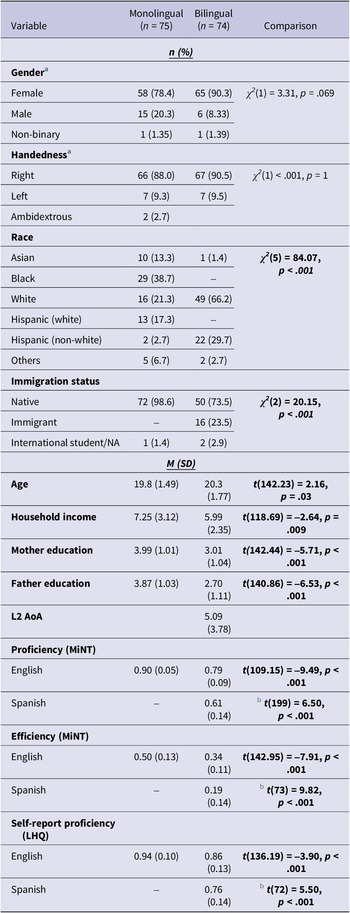

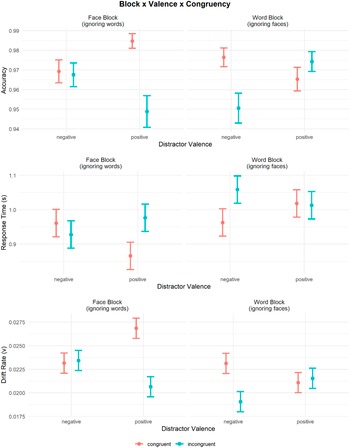
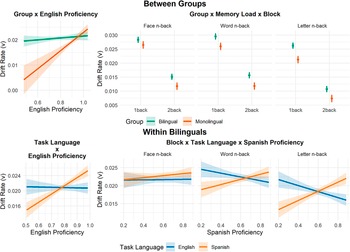
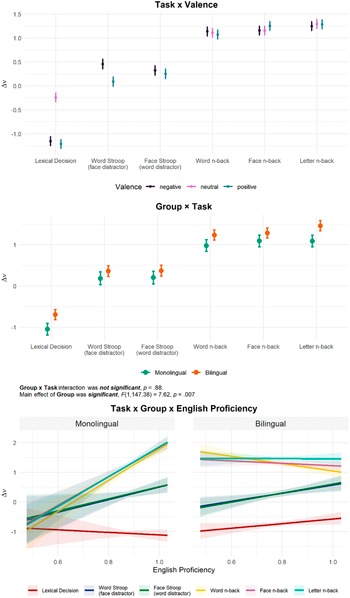
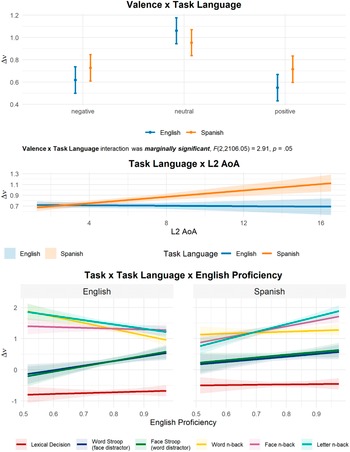
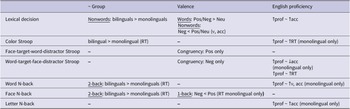


 Open access

