


Vitamin D, a family of fat-soluble secosteroids, has crucial roles in the intestinal absorption of calcium, iron, magnesium, phosphate and zinc, and is responsible for regulating calcium and phosphate homeostasis in man. Vitamin D additionally regulates insulin secretion and glucose tolerance(Reference Garbossa and Folli1).
Vitamin D deficiency is highly prevalent in the general population worldwide. In particular, vitamin D deficiency is common in the USA. Overall, 5 % of the general population has serum 25-hydroxyvitamin D (25(OH)D) concentration below the traditional cut-off of 27·5 nmol/l (11 ng/ml)(Reference Yetley2). In adults, the Black and Hispanic populations present an especially high prevalence(Reference Forrest and Stuhldreher3). Among children and adolescents, approximately 9 % of the population is 25(OH)D deficient(Reference Kumar, Muntner and Kaskel4). Vitamin D deficiency is reported to be associated with several disorders. Kunutsor et al. found that high serum vitamin D concentration reduced the risk ratio for hypertension(Reference Kunutsor, Apekey and Steur5). Inverse associations between vitamin D concentration and metabolic syndrome(Reference Ford, Ajani and McGuire6), dyslipidaemia(Reference Skaaby, Husemoen and Pisinger7) and CVD(Reference Grandi, Breitling and Brenner8) have been reported in adults. In contrast, 25(OH)D is positively correlated with insulin sensitivity(Reference Lips, Eekhoff and van Schoor9), as well as reductions in colon, prostate and breast cancer risk(Reference Holick10). Supplementation with vitamin D and its analogues can effectively remediate such disorders, as shown in several randomized controlled trials(Reference Carrillo, Flynn and Pinkston11,Reference Schleithoff, Zittermann and Tenderich12) .
Many studies have focused on vitamin D deficiency in relation to obesity and metabolic syndrome in adults and suggested its significance in that population(Reference Pereira-Santos, Costa and Assis13,Reference Wimalawansa14) . Because of the differences between adults and children, three main manifestations have been observed: (i) children consume less vitamin D than do adults; (ii) children and adults have different criteria for obesity outcomes; and (iii) some mechanisms affecting vitamin D and obesity are different, such as inflammatory markers, intestinal absorption function and sun exposure. These factors are considered to be the possible causes of low vitamin D and obesity. Additionally, due to gender-specific differences in glucose homeostasis and energy balance(Reference Mauvais-Jarvis15) and vitamin D status(Reference Lucas, Ponsonby and Dear16), gender may contribute to the associations between vitamin D deficiency and obesity and metabolic indicators. In children, Moore and Liu found that low serum 25(OH)D concentration was associated with elevated systolic blood pressure in the National Health and Nutrition Examination Survey (NHANES) 2007–2010(Reference Moore and Liu17). Total vitamin D intake among boys was higher than that among girls in the NHANES 2007–2010(Reference Moore, Radcliffe and Liu18). The higher vitamin D-intake population had a lower prevalence of overweight or obesity among children in the NHANES 2005–2008(Reference Keast, Hill Gallant and Albertson19). In the USA, the obesity prevalence among children and adolescents is 18.4 and 20.6 %, respectively(Reference Hales, Carroll and Fryar20). Moore et al. observed that 5 % of US adolescents suffer from metabolic syndrome(Reference Moore, Clark and Bachand21). However, evidence indicating whether circulating vitamin D concentration has the same protective effects in children and adolescents as in adults is insufficient. Therefore, a large cross-sectional study was conducted to investigate whether vitamin D deficiency was associated with obesity and metabolic indicators in children, providing clues for future randomized clinical and animal studies.
In the present study, we aimed to investigate the association of serum 25(OH)D with BMI, waist circumference (WC), waist-to-height ratio (WHtR) and metabolism-related parameters, such as serum lipids, fasting glucose concentration and homeostasis model assessment of insulin resistance (HOMA-IR), in a nationally representative sample of US children and adolescents from the NHANES. These results may be the first to provide evidence supporting relationships between serum 25(OH)D and obesity and associations between serum 25(OH)D and HDL-cholesterol (HDL-C) and insulin resistance in girls.
Methods
Study population
NHANES is a cross-sectional study that uses a stratified, multistage sample representative of non-institutionalized civilians in the USA. The data from the NHANES 2001–2006 were selected because of the availability of simultaneous measurements of serum 25(OH)D and metabolism-related parameters. The population studied in the present work consisted of children aged 6–18 years who participated between 2001 and 2006 and had available data on serum 25(OH)D concentrations, body measurements, total cholesterol (TC), HDL-C, LDL-cholesterol (LDL-C) and TAG. A subgroup of adolescents aged 12–18 years who had fasting glucose and insulin measurements were included. Those who had diabetes or took insulin or antidiabetic pills to lower blood sugar (n 36) were excluded, as were those who were pregnant (n 106).
Anthropometric and laboratory measures
The weights of the children and adolescents were measured mostly on a Toledo digital scale. Standing height was measured using a fixed stadiometer with a vertical floor and movable headboard(22). BMI was calculated as weight divided by height squared (kg/m2). WC was measured by professionals according to a standardized protocol. First, a skeletal landmark, the lateral boundary of the iliac bone, was located and marked. Then, while standing on the right side of the children and adolescents, the operator placed a measuring belt around the trunk on the horizontal plane marked on the right side of the trunk(22). Serum TC and HDL-C were measured with a Hitachi 704 analyser in 2003–2004 and with a Hitachi 717 or Hitachi 912 analyser in 2005–2006. Specifically, TC was measured enzymatically in serum or plasma in a series of coupled reactions that hydrolyse cholesteryl esters and oxidize the 3-OH group of cholesterol(23). Absorbance was measured at 500 nm, with the colour intensity proportional to the cholesterol concentration. HDL-C(24) and glucose(25) were directly determined in serum using reagents purchased from Roche Diagnostics by detection at absorption wavelengths of 600 and 340 nm, respectively. TAG concentrations were detected by a timed end-point method with the Beckman Synchron LX20. The system monitors variation of the absorption wavelength at 520 nm within a fixed time interval(26). The Friedewald equation was used to calculate the LDL-C concentration based on the concentrations of TC, TAG and HDL-C. Serum insulin concentrations were determined by RIA in 2001–2002(27), by two-site immunoenzymometric assay in 2003–2004(28) and by ELISA with a Mercodia insulin assay in 2005–2006(29).
The data on serum 25(OH)D concentrations from the NHANES 2001–2006 were originally measured at the National Center for Environmental Health with the DiaSorin RIA kit. The excessive methodological bias and imprecision in the methods to measure 25(OH)D have been discussed in many publications in the field of vitamin D research, as have quality control issues for the RIA data from the NHANES. The detailed procedure is presented on the NHANES website. Until October 2015, portions of sera from children and adolescents with available 25(OH)D RIA data from the NHANES 2001–2006 were reanalysed using LC–MS/MS for a bridging (crossover) study to develop regression equations to predict a NHANES participant’s LC–MS/MS-equivalent concentration from his/her previously measured unharmonized (original) RIA value(Reference Dalhoff, Dancey and Astrup30). Thus, a model based on RIA quality-control pooled data was selected because the results should be independent of any empirical trend in the sample participant data. As a result, the 25(OH)D data from the NHANES 2003–2004 were generally adjusted to lower values, and the 2005–2006 data were generally adjusted to higher values.
According to the cut-off points in the report issued by the Institute of Medicine(31), we classified the children and adolescents into the following three categories: (i) those who had adequate vitamin D concentration (serum 25(OH)D ≥ 50 nmol/l); (ii) those who had inadequate vitamin D concentration (serum 25(OH)D ≥ 30 nmol/l but < 50 nmol/l); and (iii) those who were deficient in vitamin D (serum 25(OH)D < 30 nmol/l).
Definitions of outcomes
Children and adolescents were classified as obese according to cut-off points based on sex and age(Reference Cole, Bellizzi and Flegal32). In addition, the 85th and 95th percentiles of BMI adjusted for age and gender were calculated based on the 2000 Centers for Disease Control and Prevention growth curves(Reference Kuczmarski, Ogden and Guo33). We defined two tiers of abnormal WC according to the 75th and 90th percentiles based on children’s age and gender(Reference Fernandez, Redden and Pietrobelli34). The WHtR, calculated as WC divided by height, was used to assess central adiposity; when the value was equal to or greater than 0.5, the individual was considered to have a high level of central adiposity. According to National Cholesterol Education Program guidelines(Reference Skinner, Perrin and Moss35), abnormal serum TC, serum HDL-C, serum LDL-C, fasting TAG and fasting plasma glucose concentrations, and abnormal HOMA-IR score, were defined as follows: TC ≥ 200 mg/dl, HDL-C ≤ 35 mg/dl, LDL-C ≥ 130 mg/dl, TAG ≥ 150 mg/dl, glucose ≥ 100 mg/dl and HOMA-IR ≥ 4.39(Reference Lee, Okumura and Davis36).
Covariates
Serum cotinine was divided into zero, low and high exposure to reflect the severity of exposure to environmental cigarette smoke. Drinking status was defined by whether an individual consumed alcohol. The poverty:income ratio (PIR), the ratio of family income to the poverty threshold after adjusting for inflation and family size, was used as an index to evaluate socio-economic status.
Statistical analysis
We used multinomial logistic regression models to estimate adjusted OR and 95 % CI for the associations of obesity status and WC as distinct outcomes with categories of vitamin D status. The adequate condition (>50 nmol/l) was used as the reference value. We controlled the unadjusted models and adjusted the models testing the associations of 25(OH)D concentration with BMI and WC for age, race/ethnicity, gender, alcohol use, PIR and serum cotinine concentration. We also used these models to explore the relationships between 25(OH)D concentration and serum metabolites. As gender is an extremely important variable, we conducted separate analyses stratified by gender. All statistical analyses were performed using the statistical software package SAS version 9.2. A P value of 0.05 was designated as the cut-off for statistical significance. The study was approved by the National Center for Health Statistics Research Ethics Review Board.
Results
The participants in the present study included 6311 children and adolescents aged 6–18 years. Table 1 presents the baseline characteristics of the groups stratified by serum 25(OH)D concentration category. Children and adolescents who had diabetes or were taking insulin or antidiabetic pills to lower blood sugar (n 36) were excluded, as were those pregnant (n 106). Among the children and adolescents with 25(OH)D deficiency, the incidence rates were 35.9 % in boys and 64.1 % in girls. Girls were more susceptible than boys to serum 25(OH)D deficiency (64.1 v. 35.9 %, P < 0.001). In addition, the proportions with low 25(OH)D concentration in the non-Hispanic Black (76.2 %) and relatively poor (54.9 %) populations were significantly elevated (P < 0.001). Notably, the subset of individuals with low serum 25(OH)D was older than the overall population (P < 0.001).
Selected characteristics of the study sample by serum 25-hydroxyvitamin D (25(OH)D) category: children and adolescents aged 6–18 years (n 6311), National Health and Nutrition Examination Survey, 2001–2006

WC, waist circumference; WHtR, waist-to-height ratio; TC, total cholesterol; HDL-C, HDL-cholesterol; LDL-C, LDL-cholesterol; HOMA-IR, homeostasis model assessment of insulin resistance; LOD, limit of detection; PIR, poverty:income ratio.
* Weighted percentage.
Comparing the variables indicating obesity and metabolic status between categories of 25(OH)D deficiency, we found that the proportions of children and adolescents with high BMI, WC, WHtR and HOMA-IR score were all markedly increased (P < 0.001) in the low 25(OH)D group, while the percentage of individuals with high fasting TAG concentration was decreased (P = 0.004). When we compared other metabolism parameters among these three groups, no statistically significant differences in HDL-C (P = 0.804) or fasting glucose (P = 0.43) were found.
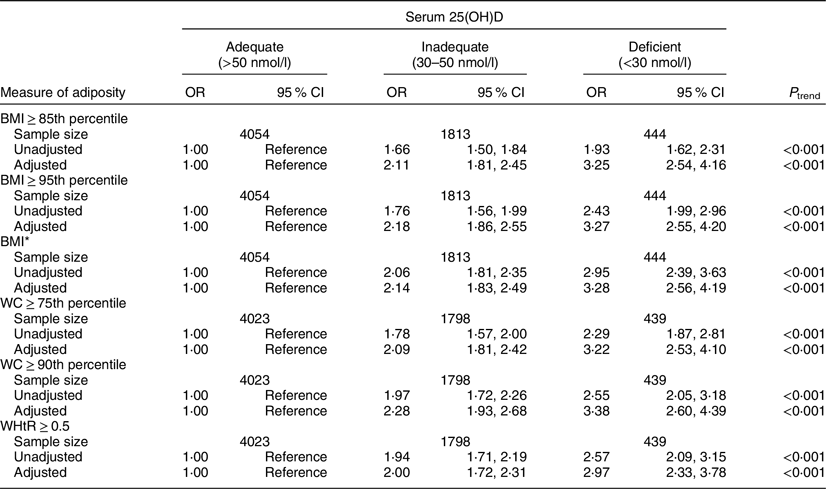
The overall unadjusted OR for serum 25(OH)D and the OR after adjustment for either the factors of age, race/ethnicity and gender, or the factors of age, race/ethnicity, gender, alcohol intake, PIR and serum cotinine concentration from the multinomial logistic regression models, are shown in Table 2. Strong inverse associations between serum 25(OH)D and obesity or WC were found in children and adolescents. Remarkably, serum 25(OH)D deficiency was associated with obesity status (when defined by BMI ≥ 85th percentile: OR = 3.25; 95 % CI 2.54, 4.16; P trend ≤ 0.001; when defined by BMI ≥ 95th percentile: OR = 3.27; 95 % CI 2.55, 4.20; P trend ≤ 0.001), as well as WC (≥90th percentile: OR = 3.38; 95 % CI 2.60, 4.39; P trend ≤ 0.001) and WHtR (OR = 2.97; 95 % CI 2.33, 3.78; P trend ≤ 0.001).
OR for the associations between serum 25-hydroxyvitamin D (25(OH)D) concentration and measures of adiposity: children and adolescents aged 6–18 years (n 6311), National Health and Nutrition Examination Survey, 2001–2006
WC, waist circumference; WHtR, waist-to-height ratio; LOD, limit of detection.
Adjusted for age (continuous), gender (male, female), race and ethnicity (Mexican American, other Hispanic, non-Hispanic White, non-Hispanic Black, Other), poverty:income ratio (<1, ≥1), alcohol use (yes or no) and cotinine concentration (<0.01 ng/ml (LOD), 0.01–10 ng/ml, >10 ng/ml).
* ≥30 kg/m2v. <30 kg/m2.
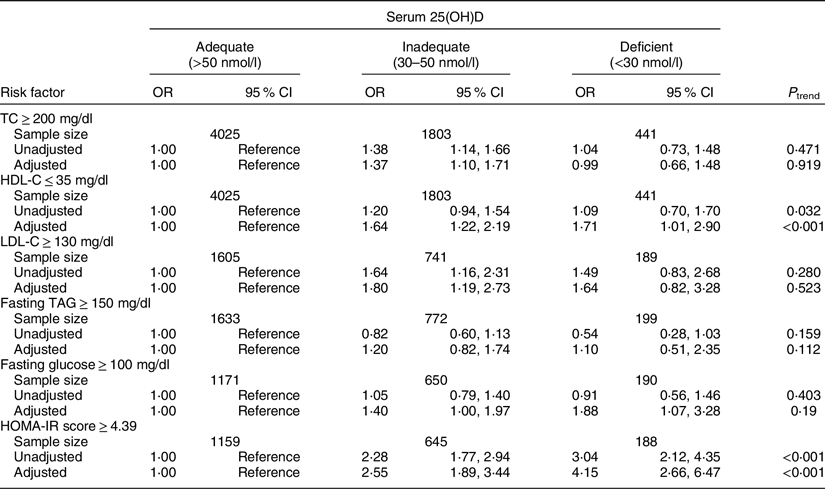
In exploring the relationships between serum metabolism parameters and 25(OH)D deficiency, we found higher odds of HDL-C ≤ 35 mg/dl with inadequate serum 25(OH)D concentration than with adequate concentration (OR = 1.64; 95 % CI 1.22, 2.19) and higher odds with deficiency than with adequate concentration (OR = 1.71; 95 % CI 1.01, 2.90; Table 3). In addition, we found increased odds of HOMA-IR score ≥ 4.39 with inadequate serum 25(OH)D v. adequate concentrations (OR = 2.55; 95 % CI 1.89, 3.44) and with deficient v. adequate concentrations (OR = 4.15; 95 % CI 2.66, 6.47). No association was found between 25(OH)D deficiency and the other parameters, including TC, LDL-C, fasting TAG and fasting glucose.
OR for the associations between serum 25-hydroxyvitamin D (25(OH)D) concentration and serum metabolic disorder risk factors: children and adolescents aged 6–18 years (n 6311), National Health and Nutrition Examination Survey, 2001–2006
TC, total cholesterol; HDL-C, HDL-cholesterol; LDL-C, LDL-cholesterol; HOMA-IR, homeostasis model assessment of insulin resistance; LOD, limit of detection.
Adjusted for age (continuous), gender (male, female), race and ethnicity (Mexican American, other Hispanic, non-Hispanic White, non-Hispanic Black, Other), poverty:income ratio (<1, ≥1), alcohol use (yes or no), and cotinine level (<0.01 ng/ml (LOD), 0.01–10 ng/ml, >10 ng/ml).
Boys and girls differ in physical composition, hormonal biology, weight-gain patterns and sensitivity to certain genetic, environmental, social and racial factors(Reference Wisniewski and Chernausek37). Additionally, previous research has shown gender differences in vitamin D intake(Reference Moore, Radcliffe and Liu18). Our analysis was further performed after stratification by gender. We found that low concentration of 25(OH)D was related to an elevated risk of obesity in boys (OR = 3.57; 95 % CI 2.40, 5.31), as well as with low HDL-C (OR = 2.84; 95 % CI 1.38, 5.85) and high HOMA-IR score (OR = 4.00; 95 % CI 2.19, 7.30) in girls (Fig. 1).
Odds of obesity (BMI ≥ 95th percentile for age and sex), low HDL-cholesterol (HDLC ≤ 35 mg/dl) and insulin resistance (homeostasis model assessment of insulin resistance (HOMA-IR) score ≥ 4.39) for the vitamin D deficient group (serum 25-hydroxyvitamin D (25(OH)D) < 30 nmol/l) compared with the adequate group (25(OH)D > 50 nmol/l): children and adolescents aged 6–18 years (n 6311), National Health and Nutrition Examination Survey, 2001–2006. Results are presented as OR (•), with their 95 % CI represented by vertical bars

Discussion
In the present study, we used data on serum 25(OH)D concentrations from the National Center for Environmental Health released recently in October 2015. The results provided the first evidence of associations between low serum 25(OH)D concentration and obesity (indicated by BMI), WC and WHtR in a large-scale, nationally representative sample of US children and adolescents. Furthermore, we found inverse associations between serum 25(OH)D and serum HDL-C concentrations as well as with HOMA-IR. Interestingly, among children and adolescents with serum 25(OH)D deficiency, boys were prone to be obese, while girls had increased risks of abnormal HDL-C concentration and insulin resistance.
Several covariates may mediate mechanisms affecting the relationship between serum 25(OH)D and obesity, and we adjusted for them in the logistic regression model. For example, smoke exposure may induce inflammation and oxidative stress(Reference Makadia, Roper and Andrews38), alcohol intake likely adds energy to a meal and also stimulates food intake(Reference Traversy and Chaput39) and socio-economic status seems to be associated with an increased appetite(Reference Cheon and Hong40). These variables and molecular mechanisms may contribute to a greater BMI among children.
We found that vitamin D deficiency was highly prevalent in older children, girls and the non-Hispanic Black population. Concentration of 25(OH)D is widely known to decline with age(Reference de Jongh, van Schoor and Lips41). Here, we showed similar changes in both children and adolescents. The gender difference may be due to reduced intake of vitamin D in girls(Reference Moore, Murphy and Keast42). Girls may stay in indoor settings such as school or the library longer than boys, and insufficient sun exposure can result in 25(OH)D deficiency(Reference Schoenmakers, Goldberg and Prentice43). Genetic predisposition may be responsible for low 25(OH)D in the non-Hispanic Black population(Reference Christakos, Dhawan and Verstuyf44).
Our results are similar to but not completely consistent with those of previous studies reporting the association between serum 25(OH)D and adiposity in different regions and populations. Cediel et al. reported that serum 25(OH)D was inversely associated with insulin resistance in Chilean children(Reference Cediel, Corvalan and Aguirre45). Lee et al. found that low vitamin D concentration was associated with TAG in Korean children(Reference Lee, Kim and Park46). Obese Turkish children and adolescents were more commonly diagnosed with vitamin D deficiency(Reference Gul, Ozer and Yilmaz47), suggesting that vitamin D is linked to obesity status. The results of case–control studies indicated that obesity is associated with vitamin D deficiency in Danish(Reference Plesner, Dahl and Fonvig48) and Chinese children and adolescents(Reference Liu, Xian and Min49). Obesity plays a critical role in metabolic syndrome parameters. Associations between vitamin D level and components of metabolic syndrome were also found in Korean children and adolescents(Reference Kim, Hwang and Song50,Reference Kwon, Lee and Lee51) , Iranian adolescents(Reference Mellati, Sharifi and Faghihzade52) and Chinese adolescents(Reference Fu, Han and Zhao53). Here, we observed elevated risks of decreased HDL-C and impaired insulin resistance in US children and adolescents with vitamin D deficiency, especially in girls. In contrast to previous findings among adults(Reference Ford, Ajani and McGuire6), only obesity and a few markers of metabolic syndrome in children and adolescents were observed to be significantly associated with vitamin D deficiency. However, the current study did not examine whether any gender difference was present in adults.
Previous publications have used the NHANES database to investigate the associations between serum 25(OH)D and metabolism disorders(Reference Kumar, Muntner and Kaskel4,Reference Ford, Ajani and McGuire6,Reference Reis, von Muhlen and Miller54,Reference Ganji, Zhang and Shaikh55) . With the use of unadjusted data from the NHANES 2001–2004, Reis et al.(Reference Reis, von Muhlen and Miller54) reported associations between serum 25(OH)D and both hypertension and hyperglycaemia in youths aged 12–19 years. Because of high methodological bias and inaccuracy in the measuring methods, the previous publications using non-updated data may report false-positive results and ignore false-negative results. Thus, portions of the serum samples from participants with available 25(OH)D data from the NHANES 2001–2006 were selected by the National Center for Environmental Health for additional analyses. Significant relationships between obesity, WC, HDL-C and HOMA-IR score and low 25(OH)D concentration in children and adolescents aged 6–18 years were found in the current analysis. Furthermore, girls may be more susceptible to deficiency than boys and may need greater vitamin D intake. However, no relationship between vitamin D status and fasting glucose could be found in our analysis, contradicting significant results from a previous study(Reference Reis, von Muhlen and Miller54).
We carried out many statistical tests; thus, adjustment for multiple comparisons was necessary in the present study. Methods such as Bonferroni correction or the false discovery rate were not suitable as these methods treat all P values as equivalent. Considerable structure exists in the NHANES data. Therefore, P for trend was tested to examine the trend in 25(OH)D concentration and supporting evidence for a real association was found. If only a test with logistic regression models is performed and P for trend is not tested, significant values may be expected by chance. In the present study, the P values of the logistic regression and the trend test, which were both <0.05, were treated as positive results.
Little evidence is available to support a direct causal relationship between vitamin D and obesity and metabolic parameters. Inflammation may be one of the mechanisms that explain the associations between vitamin D and obesity and metabolic parameters. Vitamin D has been reported to inhibit the concentration of 25(OH)D as an acute-phase reactant in inflammation(Reference Waldron, Ashby and Cornes56). Obesity is now widely recognized as a chronic, low-grade systemic inflammatory state(Reference Ahima and Flier57,Reference Zhang, Proenca and Maffei58) . Improvements in 25(OH)D concentration have been reported to enhance the beneficial effects of weight loss, which may be attributed at least in part to the anti-inflammatory effects of vitamin D(Reference Zittermann, Frisch and Berthold59,Reference Ghashut, Talwar and Kinsella60) . Although a meta-analysis of randomized clinical trials showed no effects of vitamin D supplementation on inflammatory biomarkers among overweight/obese adults(Reference Zuk, Fitzpatrick and Rosella61), more research evidence is needed. Recently, vitamin D supplementation was shown to decrease inflammatory biomarkers (i.e. IL-6 level) in adults with metabolic syndrome(Reference Salekzamani, Bavil and Mehralizadeh62). More randomized clinical trials of obese children and adolescents are needed to elucidate the mechanism.
The present study has some limitations. First, the different ethnicities and dietary habits of the children and adolescents prevented us from comparing results between the present study and previous ones. Second, some confounders, such as sun exposure level and genetic susceptibility, may influence the associations reported herein. In addition to common covariates, we analysed other covariates that may affect obesity and metabolic indices, such as PIR, drinking status and serum cotinine concentration. Performing this ANCOVA ensured that the present results reflected true circumstances. Because of the cross-sectional nature of the present study, whether 25(OH)D affects obesity or vice versa cannot be determined. However, some evidence from in vivo studies(Reference Sergeev and Song63) and randomized controlled trials(Reference von Hurst, Stonehouse and Coad64) suggests that vitamin D supplementation may prevent obesity by mediating the apoptotic pathway in adipose tissue in mice and may improve insulin resistance and sensitivity in South Asian women.
Conclusions
Our findings suggest the need for longitudinal analyses to elucidate temporal relationships between low 25(OH)D concentration and the development of obesity and serum metabolism markers in children. Although the exact mechanism by which 25(OH)D contributes to obesity, HDL-C and insulin resistance remains unclear, the present results may contribute to a better understanding of obesity from an epidemiological perspective.
Acknowledgements
Financial support: This work was supported by funding from the National Key Research and Development Program of China (grant numbers 2017YFC1308105 and 2016YFC1101001); the Maternal and Child Health Research Project of Jiangsu Province (grant number F201755); the China Postdoctoral Science Foundation (grant number 2018M630585); the Science and Technology Development Project of Nanjing (grant number 210723008); and the Key Project of Science and Technology Development Fund of Nanjing Medical University (grant number 2017NJMUZD060). The funders had no role in the design, analysis or writing of this article. Conflict of interest: None declared. Authorship: Z.F. and C.X. contributed equally to the present study and should be regarded as joint first authors. X.M. and C.X. conceived and designed the study, analysed and interpreted the data, and wrote the manuscript. Z.F. and Y.S. conducted data collection and statistical analyses. Z.X. and C.L. reviewed the manuscript. All authors read and approved the final manuscript. Ethics of human subject participation: This study was conducted according to the guidelines laid down in the Declaration of Helsinki and all procedures involving human subjects were approved by the National Center for Health Statistics Research Ethics Review Board. Written informed consent was obtained from all subjects.



