

8.1 Introduction
The English language does not contain a native word to express the more violent forms of wind. We have borrowed a great many since we became the great merchants of the East, but hurricane and tornado are Spanish, typhoon, we believe, Chinese, though dictionaries derive it from the Greek, simoom Arabic, and cyclone pure Greek, with a conventional meaning imposed upon it by science. […] Storm is the only native word of any force, and an Englishman’s idea of a storm does not tempt him to sympathize greatly with the sufferers from its violence. Accustomed only to the winds of the north, which bring catarrh and consumption, but leave wooden houses standing for years, which seldom last many hours, and are never destructive except at sea, his power of imagining wind is limited, and he reads a story like that of the catastrophe at Calcutta with a feeling of pity in which there is just a trace of something like contempt. People out there must be very weak or arrangements very bad for a mere wind to work all that destruction, throw ‘Lloyds into a panic, and impede the systole diastole of Her Majesty’s foreign mails.’
On 5 October 1864, as the monsoon winds were retreating from the littorals of the Bay of Bengal, a devastating cyclone struck, killing 80,000 people, drowning the city of Calcutta and washing away large swathes of coastal villages. Thirty-six ships were lost in the storm, and of the 195 ships docked at Calcutta point, 182 were damaged, with an estimated combined loss of approximately 1 million pounds sterling (Reference Gastrell and BlanfordGastrell and Blanford 1866: 145). While the loss of life, cattle and property were staggering, the coasts of the Bay of Bengal were no stranger to the cyclonic battering. Moreover, meteorology as a public science had also gained a solid footing in England and its colonies (Reference GolinskiGolinski 2007; Reference AndersonAnderson 2010; Reference CarsonCarson 2019). Yet, surprisingly, The Spectator wrote that the English language did not have the capacity to narrate what happened on that fateful October day. How do we then understand and historicize the semiotic confusion expressed in the opening epigraph by the anonymous writer of The Spectator? The focus of the question should not be the English language, but perhaps the narrative and representational possibilities and crisis produced by the storm under consideration itself.Footnote 1 While one may ascribe some of the writer’s confusion to the ‘blinkered’ vision of colonial writings about colonized environments and climate, a deeper engagement with the writer’s lament that science has merely imposed a ‘conventional meaning’ upon the fury of the wind is necessary.Footnote 2
By the sixteenth century, we can witness the emergence of a scientific curiosity about storms by Iberian theologians and lawyers investigating hurricanes in the Caribbean. One of the most noteworthy among them was López Medel, who was a high court judge and served in the appellate courts in Santo Domingo, Guatemala and New Granada from 1540 to 1550, overseeing shipping and trading disputes (Reference SchwartzSchwartz 2015: 17). He wrote about buracanes, which he defined as a ‘meeting and dispute of varied and contrary winds’, later recognized as circular winds and defined as cyclones by the president of the Marine Court of Enquiry in Calcutta, Henry Piddington (1797–1858), almost three centuries later. What kinds of science did these men of law in the colonies produce? How did the legal search for plausible narratives influence a particular narrative science of storm forecasting?
Tropical storms in the Bay of Bengal emerged as a problem of knowledge as the East India Company was expanding its trade in Britain’s eastern colonies. Turning to Piddington’s cyclone research allows us to historicize his new science of ‘cyclonology’, which was a product of Victorian science, but also of the colonial legal and trading world in which he found himself. This science, as he wrote, was not meant to be conducted ‘in the state room of science, but in the cabin-table’ of ships and docks (Reference PiddingtonPiddington 1848: xiv). In the process, he narrativized historical storms in his works. This chapter argues that through his storm narratives and the accompanying visualization of the storm card, he shaped the very object – the cyclone – as a scientific category of investigation. His science used conversational language to conceptualize, for the sailors, the phenomenal world of the storms as wind movement in which one can discern patterns and tendencies through rigorous training of the eye and use of the storm card itself.Footnote 3 He began writing storm memoirs in 1839 and continued to write them until he died in 1858. His storm writings were geared towards achieving a discernible order in the stormy skies with the purpose of predicting the direction of the storm and plot its track. This was meant to help both mariners and jurors. In Mary Morgan’s definition, what Piddington’s narratives did, was ‘create a productive order amongst materials with the purpose to answer why and how questions’ (Reference MorganMorgan 2017: 86).Footnote 4 By organizing the patterns of historical cyclones from ships’ logs, reports and court depositions, he wanted to understand why and how cyclones formed. A narrative science of cyclones, replete with storm memoirs and a diagrammatic representation in the storm card, ordered the interpretation of winds to make cyclones both trackable and predictable in the service of the marine insurance market. Storms became a problem of knowledge precisely because these ‘violent forms of winds’ created panic among underwriters in the colony and metropole, and as the epigraph wonderfully captures, they ‘impede[d] the systole diastole of Her Majesty’s foreign mails’. If fire, capture and piracy were known risks associated with maritime routes, tropical storms became the ‘unknowns’ of the expanding insurance markets.Footnote 5 As we saw, the 1864 cyclone devastated the very sinews of global trade and credit that, by the nineteenth century, tightly stitched together far-flung geographies from the Caribbean, Coromandel, Malacca and Bengal to the ports of England.Footnote 6
Through the eighteenth century, the process of interpreting the skies and understanding the causes of storms navigated a terrain between providential design, folk traditions and emerging science about geological, chemical and meteorological phenomena. Scholars have documented this as a historical transition from Aristotelian astrometeorology, through the ascendance of Renaissance observational sciences and what was known as ‘rustic’ weather knowledge, to nineteenth-century dynamic climatology (Reference GolinskiGolinski 2007; Reference AndersonAnderson 2010; Reference CoenCoen 2018). Yet there was a parallel tradition of knowledge production that sometimes intersected with Victorian science, and other times remained firmly locked within the worlds of trade, insurance and legal spheres. Oftentimes this parallel world could be found along the ports, docks and observatories spread across the globe: Barbados, Mauritius, Bengal, Madras and Manila. Indeed, it was narrative storm memoirs written by colonists engaged in a range of professions from planters to shipmasters or legal actors who would shape both the form and content of weather science as well as frame the diagrammatic representation of the storm as a circular image. This parallel body of knowledge followed the routes of imperial capital and was sustained by a nautical marketplace.
The search for scientific cyclone forecasting emerged from narratively ordering accounts of historical storms, which were converted into a diagrammatic tool to depict, plot and track tropical winds. This, in turn, created laws of predictable wind patterns, which would allow one to read cyclonic motions that deviated from wind tracks. Indeed, for Britain’s expanding empire in the east, the problem of estimating risks of trade and administering compensation following shipwrecks created Piddington’s new science of cyclonology. Faced with the exigencies of global trade, the Bay of Bengal became a laboratory for nineteenth-century weather science. Turning to Piddington’s writing and the curious scientific tool – the storm card – allows us to document how a narrative science of cyclone forecasting emerged from the interstices of imperial trade. It shows how in the process of narrativizing memories of tropical storms, the cyclone as an object of knowledge came into being in the texts and the diagrams. The meaning-making and meaning-conveying process of narrating the science of storms was shaped by the traffic in language, imaging and metaphors between weather observers and shipmasters’ logbooks as they brushed with the colonial marine and admiralty courts through the nineteenth century.
8.2 The Nautical Marketplace
Piddington’s legal and scientific world was embedded in the nautical marketplace. Throughout the eighteenth century, the East India Company lost nearly one-quarter of its ships sent to Asia.Footnote 7 For instance, between 1760 and 1796, it lost 20 per cent of its ships to shipwreck on their way to Asia (Reference Bowen, McAleer and BlythBowen, McAleer and Blyth 2011: 118). A Select Committee on Shipwrecks reported to the House of Commons in 1836 that England was losing nearly 3 million pounds sterling per annum (£ 2,836,666) and had lost 894 lives to shipwrecks.Footnote 8 This report was prepared with the help of the accounting books of Lloyds and so only reflects cases of ships insured by Lloyds. The report gives details of the reasons the ships were wrecked or floundered and crew drowned. Among the many causes for wrecks, two bore the highest responsibility. First, the committee wrote that often instruments of navigation (namely depth recorders, barometers and chronometers) were either faulty or absent, or the crew was not sufficiently trained to use them (Reference JenningsJennings 1843). Second, they pointed out that the widespread use of premium-based marine insurance might mean that shipmasters and merchants were indulging in risky voyages in stormy seas, and as a result there was a higher incidence of shipwrecks. While there is no existing data that links the use of premium-based marine insurance to increased numbers of shipwrecks, the report indexes some of the assumptions prevalent within the expanding nautical marketplace of the early nineteenth century. The specific concern for this Committee, widely reflected in the world of nautical writing too, was that the expansion of marine insurance had allowed shipmasters to transfer the risk of shipwreck to the underwriters, which ultimately transferred the risk to the British public (Nautical Magazine (1836): 593). The result was fierce battles in the imperial admiralty courts adjudicating liability over wrecked ships and ultimately flinging blame for the wrecks onto ‘the plainest sailor’, to use one of Piddington’s oft-used descriptors, who routinely failed to navigate the cyclonic and turbulent waters of the Indian Ocean.
The British Indian Navy and their hydrographers had been charting the oceanic currents and coastal tides in the Indian Ocean since the 1760s. In order to make long-distance shipping safer, Piddington furthered the project by developing a usable science of storm forecasting for sailors. Piddington, who grew up in south-east England, worked his way up to command ships to India. He settled in Bengal in 1824 and remained there till his death, serving as the foreign secretary to the Agricultural Society of India, a secretary to the Asiatic Society of Bengal, curator to the Museum of Economic Geology (a first of its kind in the world) and, more importantly for this chapter, as the president of the Marine Court of Enquiry in Calcutta from 1830 to 1858. Following his death, he became famous for his meteorological pursuits and was known for coining the term ‘cyclone’. He described the storms which he saw in the Bay of Bengal as ‘coiled snakes’, for their circular motions, and came up with the name cyclone to distinguish them from trade winds, which blew in straight lines (Reference MarkhamMarkham 2015: 35–37).
Piddington’s scientific pursuits into storms emerged out of his life as a shipmaster, but the scaffold of his storm narratives was shaped by his work in the Marine Court. In the 1830s, the Marine Court was a simple affair. The Calcutta court was housed in a small room that served as a court once a week or less, depending on the availability of a mariner’s jury (which, prior to the coming of steam, depended on the monsoon winds), and this same room served as the meeting room or exchequer on other days. It was only in 1836 that a special court of enquiry was set up in England and its imperial ports, dedicated to establishing the ‘fact of the wreck’ and to creating mechanisms to ‘censure owners or commanders of vessels’ or acquit them honourably from charges of having caused the wreck. It was also tasked with suspension of certificates or licences should shipmasters be found to be incompetent. These courts were to be funded from the ship registration fees (Nautical Magazine 1836: 596–597). Piddington’s presidency over the Marine Court of Enquiry in Calcutta was during this moment of transition, when government oversight was increasing and standardization of practices and the pedagogy of mariners were being discussed within both the East India Company in India and the House of Commons in London.Footnote 9 He was familiar with the legal arguments and counter arguments made to establish the fact and narrative of the wreck during the onset of a cyclone. He not only heard mariners, pilots and witnesses narrate the sighting of storms, but he collected their barometric readings and read their logs documenting disputes about how to steer the ship in a cyclone. Apart from this, he was simultaneously poring over the archive of prior cases as he sought to lend structure to the procedure of settling disputes. What emerges is the way he used these multiple different narrative accounts in order to distinguish the contingent wind patterns from their predictable movements, thereby developing scientific taxonomies of various kinds of winds and a law of storms in the Indian Ocean.
Michael Reidy’s work on the development of British marine science has already documented how the imperial imperatives to sail unencumbered and safely through the littorals of England drove tidal science in the nineteenth century. The Admiralty, he shows, turned to science to advance its overseas empire (Reference ReidyReidy 2008: 5–7). Along with the Royal Navy, the rise of marine insurance conglomerates like Lloyds of London from the latter half of the eighteenth century was coterminous with British imperial expansion in the east and the rise of scientific storm forecasting. That some colonial legal actors, who were busy adjudicating on trading issues, were also obsessed with reading patterns in storms should elicit further investigation. Storms were documented and narratively ordered in ships’ logs and shipmasters’ diaries. The physical sites that enabled such documentation – often understood as the field and laboratory of weather science – have been documented by historians of science as floating observatories (ships) and weather stations spread across the empire (Reference ReidyReidy 2008; Reference NaylorNaylor 2015). If ships were floating observatories, they were also carrying bundles of letters, queries and texts across the empire, which were exchanging, plotting and tracking information about the very winds that carried them on the vast oceanic expanse. Knowledge of the atmospheric world was stabilized at multiple sites and through various genres – memoirs, barometric tables, diagrams, legal writings. Along with the scientific work from ships and observatories, a curious scribal culture emerged from the late eighteenth century in the British Empire, similar to the epidemiological narrative cultures documented by Engelmann in this volume (Chapter 14). This curious narrative outpouring saw planters and lawyers write storm narratives and cyclone memoirs. Apart from navigators who needed to understand the wind infrastructure that fuelled their trade, underwriters, lawyers and financiers took an active interest in those elemental phenomena that had the ability to disrupt the imperial financial machinery. The amateur scientific writings about storms and legal petitions and court decisions about wrecks formed a polyphonous world that laid the groundwork for nineteenth-century storm science.
Many of the wrecks occurred in the Bay of Bengal, especially in the last stretch of the journey as the ships navigated from the tip of the Bay to the port in Calcutta, the then capital of the British India. It was a rain-fed, tidal and changeable landscape. Mariners’ and hydrographers’ early attempts at control began with sketching the coasts of the Bay of Bengal.Footnote 10 From 1753, the East India Company began employing an official hydrographer, Alexander Dalrymple. Under Dalrymple’s oversight the official process of systematizing coastal charts began. Navigating into the port of Calcutta, which was situated almost 100 miles from the Sagar Islands in the Bay of Bengal, was difficult as the ships would have to sail through a network of mangrove islands, tidal sand flats and seasonal salt marshes, which annually changed shape, disappeared or sometimes suddenly reappeared especially during the summer months of tropical cyclones. Logs of ships warned that when storms and ‘hurricanes’ occurred at the mouth of the river Hooghly (or Hughli), sailing can become disastrous because the sea inundates the low-lying alluvial lands and ships often founder (Reference ReidReid 1838: 284). Rudyard Kipling, who considered this stretch among the most dangerous as far as navigability was concerned, wrote about the River Hughli thus: ‘Men have fought the Hugli for two hundred years, till now the river owns a huge building, with drawing, survey, and telegraph departments, devoted to its private service, as well as a body of wardens, who are called the Port Commissioners’ (Reference KiplingKipling 1923: 28).
8.3 Storm Science in the Courts
Two representative shipwreck cases debated in the Marine Court in Calcutta reveal how the legal ‘fact of wreck’ was established and show the legal imperatives that drove Piddington’s science. The first case was debated following the founding of the Marine Court and almost half a century prior to Piddington’s term. A sloop, Betsey Galley, wrecked at the mouth of Bay of Bengal as it was reaching the port of Calcutta on a stormy evening on 25 April 1778. The Betsey was wrecked upon the Long Sand in the Bay of Bengal at the mouth of the delta, with 13 members and its cargoes going under water before reaching the port of Calcutta.Footnote 11 Betsey’s wreck was fiercely debated in the Marine Court in Calcutta over four months. The petitioners were Capt. John Raitt and Mr. Weller (the merchant invested in the sloop), who claimed to the Court that Thomas Broad, the master attendant in charge of the pilot schooner to the Betsey Galley, did not offer any assistance and must be held responsible for the wreck. The Committee of Insurance deposed in the Marine Court and supported the claim against Thomas Broad, deeming him the negligent master of the pilot schooner, responsible for the wreck and seeking to debar him from future navigational duties. As the petitioners pointed out, it was a dark summer’s night and the ship was sailing fast through the waters of the Hughli, and Broad’s pilot boat failed to keep ahead of the Betsey Galley.Footnote 12 Moreover, Broad also rendered no assistance after the wreck, although it was no more than a few leagues ahead. However, the one-sided incriminations of a shipmaster against his attendant should hardly surprise anyone or be enough to establish the reason for the wreck.
Broad’s deposition, on the other hand, pointed out that the storm during the months of April can wreak havoc in these areas. April is the nor’wester season and is marked by sudden storms and coastal surges which can make riverine travel and navigation tricky in the Bengal delta. Caught in the turbulent waters of the Hughli, Broad pointed out that he steered the boat based on the direction of the incoming gales, which he had successfully done many times, yet the winds changed course and Betsey foundered before Broad could do anything. Following the adversarial interrogation of the admiralty courts, Broad was called for questioning, which consisted of questions about the usual role of the pilot schooner during storms and about whether he felt that he performed his duties. Like a well-honed defendant, he answered questions about the usual duties and responsibilities mostly thus: ‘It is sometimes usual and sometimes not’. And for questions where they tried to assess his opinion, he offered stock answers. For instance, to the question: ‘How come the ship [was] lost?’ Broad’s answer was: ‘If you put any particular questions to me I shall answer them’. Thereafter he demurred and the interrogation remained inconclusive.
Yet, the mariner’s jury and the judge concluded that Broad’s ‘obstinacy and misconduct’ were to blame. How did they reach this conclusion? The Committee of Insurance and the merchant’s jury turned to another source to ascertain the truth about the wreck, namely Broad’s prior mistakes of navigation. The committee in whose interest it was to locate blame on the negligence of the master attendant or the pilot navigator offered depositions in the court documenting prior instances when Thomas Broad failed in his duties while attending other ships.Footnote 13 Turning to precedence made the wreck appear to be caused not by the cyclone, but instead due to Broad’s habitual navigational misconduct. As legal historians have pointed out, reputation and credibility were deeply entangled in courtroom decisions through the eighteenth and nineteenth centuries, especially prior to the arrival of expert evidence and forensic criminology (Reference GolanGolan 2009: 5–51). Even then, and to an extent now, credibility performs a critical role in establishing the plausibility of the narratives offered.
Upon hearing all the testimonies, the judge decided that the total loss of the vessel was owing to an error in judgement on Broad’s part, and was not due to the nor’wester that suddenly set in. Such legal decisions were often based not on the availability of the evidence such as the ships’ logs, charts of depth sounding and barometric pressure, a studied understanding of wind direction or testimonies about the unnavigability of the channel, but rather character assessments of those steering the ship or pilot boats. Indeed, in multiple cases, the moment of wreck is often reconstructed by turning to other instances of failure of the shipmaster’s or pilot’s duty, including character assessments – such as ‘wanting in attention’ or ‘given to liquor’.Footnote 14 These character deficits also defined the ability to develop a studied understanding of the laws of storms. What bothered Piddington’s scientific temper was the excessive role the personal character, social standing, or networks of credibility, and the ability of the defendant to draw upon powerful witnesses, played in establishing the depth and nature of human error. Within the space of the Marine Court, trying to separate human miscalculation from unavoidable natural disaster was complicated.
By the time Piddington began presiding over the Marine Court, the ability to forecast natural disaster remained mostly poor and the nature of adjudication of wrecks navigated a terrain not very different from the one we witnessed in the case of the Betsey Galley. The Barge Amherst was partially wrecked in October 1838, mid-way on its voyage from Myanmar (Burma) to Calcutta.Footnote 15 Dalrymple’s work as the Company’s official hydrographer had transformed the landscape of navigation prints, with official charts in circulation by the last decade of the eighteenth century. He was followed soon after by James Horsburgh, who served the Company from 1810 to 1836, keeping extensive records of the tides of the Bay of Bengal coasts. Horsburgh also introduced the need to take extensive depth soundings to detect shoals and shifts in the coastline, while regularly updating those surveys.Footnote 16 By 1832, the Royal Navy recognized that the tidal charts for India were more complete and detailed than the ones pertaining to the English coasts.Footnote 17 The arrival of Horsburgh and his diligent publication of official nautical charts introduced a new standard of judgement. In cases of accidents, ships which were found to be in possession of non-official charts could be penalized. However, given that the route from Burma to Calcutta was so treacherous, Horsburgh’s directions were considered insufficient. A mariner under the pseudonym ‘Nautics’ suggested that ‘Should ships frequenting Rangoon, attend only to Mr. Horsburgh’s directions, without waiting for a pilot (which at times they may be compelled to do from stress of weather) they will surely run aground and suffer considerable damages’ (Reference PhippsPhipps: 1832: 145).
The Amherst was supposed to set sail from Kyaukphu one early October morning in 1838. However, the ship was delayed due to low winds. When the ship finally set sail, it reached a rock face then known to sailors as the Terribles. Unable to stay on course, the Amherst hit those rocks on the night of 22 October and was damaged, but managed to reach Calcutta, half-damaged, with its logbooks intact. In this instance, the logbook, the detailed notes of arguments and conversations kept by both Captain Bedford and attendant Captain Jump, would have allowed the Marine Court to establish that the swinging barometric pressure and winds veered the ship off its course. The notes, the witness depositions and the log show that Jump disagreed with Capt. Bedford’s directions, who insisted that the ship should have continued to sail in the direction it was headed. Had he followed Jump’s chart, the ship might have been saved from hitting the rocks.
There is a twist in this case. The day after Amherst dropped anchor in Calcutta following this fateful journey, Capt. Jump deposited his papers with the port authorities as Piddington had required all sailors to do. Thereafter, Jump quietly slipped out of Calcutta that very afternoon, boarding a ship to Bombay and then London and in the process forfeiting part of his pay. The court spent a considerable time deciphering Jump’s sudden disappearance and gathering evidence of his prior conduct in their attempt to piece together his character. The court ultimately decided his fate in absentia. It ruled that Jump could not man another Company ship or ship in his Majesty’s service as he was deemed too incompetent. His incompetence, the court declared, was not his ability to decipher winds, but in his inability to be judicious enough, first, to disregard his master’s misreading and veer the ship in the right direction, and, second, not to stay back in Calcutta to offer witness in the court of law. The archival trail breaks off here, and we do not know if, along with barring Jump from Company duty, the merchants invested in Amherst were duly compensated for their partial loss.
What these court minutes reveal is how the multiple iterations and reconstructions of the wreck in the courtroom were embedded within the socio-political hierarchies of the world outside. According to the court’s decisions, ships sank or foundered more often because of human error stemming from altercations between master and pilot, inexperienced pilots or drinking and ‘rottenness of native crafts’ than because of the turbulence of the seaboard. Legal decisions, as we know, are a product of ‘social, political, epistemic struggle’, and these struggles set the background for discerning the nature of wind patterns and the causes of wrecks (Reference Raman, Balachandran and PantRaman, Balachandran and Pant 2018: 2). This narrative reconstruction of the moment of wreck, which made human character central, was crucial to adjudicating damage claims throughout the first half of the nineteenth century. These resources left Piddington, with a vast set of storm narratives, to construct his science in the service of the mariners. He wanted his science to act as a protection not just from cyclones but also wanted to protect sailors and pilots like Broad and Jump, who were being fleeced by the insurance agents and the mariner’s jury who shifted the liability for wrecks during cyclones onto them.
The legal disputes in the Marine Court were geared towards the search for plausible narratives about a shipwreck. One may divide Piddington’s legal archive into two sets of evidence: one was recalling the memory of the onset of the storms and the other was an observational set of evidence. The testimonies of shipmasters, pilots and sailors constituted the memory evidence, which would often include not just notes about the storm but also character judgements about the people involved. Observational evidence comprised that which was written down in the ships’ logs, like wind direction, daily logs, temperature and barometric pressure charts. They were descriptions of observed phenomena rather than recalled memory and were either verbal testimony or written petitions. Court decisions often emerged by pitting various storm and character narratives against one another to arrive at a plausible description of the facts of the wreck. If the legal enquiry was geared towards establishing a plausible argument about shipwrecks in order to locate the liabilities incurred in the damages, Piddington’s cyclonology attempted to standardize the narratives of storms through his scientific writings and the storm card.
8.4 From Memories to Prediction: The Making of the Storm Card
In the twenty odd years following his entry into the Marine Court in Calcutta, Piddington consulted on multiple cases and analysed 250 ships’ logs from mariners plying in the Bay of Bengal and collected storm observations from port masters in various ports in India. In 1839, Piddington published his first storm observations in the Journal of the Asiatic Society of Bengal. Between 1839 and 1851, he published 23 memoirs of cyclones, each one taking up between 11 and 100 pages. These memoirs were like working notes, where he collated logs from ships that were caught in the gales, along with observatory notes, reports in newspapers and notes from port masters to plot the movements of cyclones in the Bay of Bengal and to develop his hypothesis. Following the publication of his first cyclone memoir in 1839, he began to receive multiple logs and extracts that were then preserved at India House (which furnished him with accounts of storms from 1780 to 1841) and built his own ‘storm library’ (Reference PiddingtonPiddington 1848: 7). The accumulation of storm writings in the form of logs, observations, reports and his own collection of memoirs comprised his attempt to understand how winds in their interaction with the world around them – reacting to atmospheric heat, thermodynamics, oceanic currents – developed into cyclones. In his writings, storms, much like a narrative plot, had a beginning, a middle and an end. Akin to Darwin’s plants’ ‘life-histories’, which are considered by Devin Griffiths elsewhere in this volume (Chapter 7), the cyclone emerges as a scientific object through a ‘two-way traffic’ between representation and scientific discovery.
Unlike Darwin’s visual narratives, Piddington’s were primarily textual and tabular, tracing the transformation of regular winds into circular storms. This allowed him, among other things, to complete the puzzle that Medel ascribed to the indistinctive directions of the buracanes winds, laying the groundwork for the development of a rotational theory of winds.Footnote 18 He standardized the definition of a cyclone – which was far from the scientific imposition of a conventional meaning upon a strong gust of wind, as The Spectator claimed. In order to come up with a name for this wind, Piddington moved away from terminology expressing strength to those expressing direction. He clarified that ‘cycloidal’ was a known word expressing ‘a relation to a defined geometrical curve, and one not sufficiently approaching our usual views, which are those of something nearly though not perfectly circular’. He then proposed to use a single word ‘cyclone’, which would be used to express ‘the same thing in all cases; and this without any relation to the strength of the wind’ (Reference PiddingtonPiddington 1848: 11). This laid the foundation for his practical new science of cyclonology, which he developed over three books: The Horn-Book of Storms for the India and China Seas (Reference Piddington1844), an expanded version, published as The Sailor’s Horn-Book for the Law of Storms (Reference Piddington1848) and a textbook entitled Conversations about Hurricanes: For the Use of Plain Sailors (Reference Piddington1852).
His science was geared ‘to enable the plainest ship master, then, clearly to comprehend this science in all its bearings and uses’ (Reference PiddingtonPiddington 1848: i). Piddington’s goal was to ease adjudication and at the same time to instruct the seamen by developing a science of storms through his ‘thick narratives’ (Paskins, Chapter 13). Piddington wanted storm science to act as a form of insurance and protection against wreckage. If mariners were preparing their logs with an eye towards the centrality of the logbook in documenting navigational knowledge and for adjudicating potential settlement cases, then Piddington was prospectively archiving the same logs with an eye towards creating a database from which to develop a systematic way to discern the law of storms.
His practices for assembling an archive for the law of storms involved a process of acquiring and retrieving material, reconfiguring that material and then transcribing this body of information into a narrative interpretive framework. For Piddington’s new science of cyclonology it was the process of reconfiguration that drove the interpretive framework. Each storm that Piddington adjudicated upon, observed in situ, read about in logbooks and heard during deposition was situated in deep historicity.Footnote 19 The monsoon, the capability of the navigator, the observer, the reputability of the pilot all shaped his archive of storm writing. Piddington’s life narratives of winds with the storm as denouement can be understood as exemplifying colligation (Reference MorganMorgan 2017). Piddington wanted to produce ‘law like knowledge’ of storms that was based on cases but utilizing modes of inquiry and methods of organizing vast amounts of data that would be systematic enough to mimic the natural world and thereby produce knowledge that could become universal (Reference Creager, Lunbeck and Norton WiseCreager, Lunbeck and Wise 2007). Such a method would result in producing usable evidence within both the scientific and legal domains. In his attempt scientifically to order the storm he devised the storm card, a tool that would make storm tracks discernible and protect mariners against wrecks with the hope that it would also help in the adjudication of cases.
Piddington first introduced his storm card in the Sailor’s Horn-Book. It was meant to serve as a card of practical utility that he produced for the use of ‘plain sailors’. The storm cards were developed as a diagrammatic representation of wind pattern and direction during a storm that was circular, with the basic assumption that there were certain laws that governed the wind movement within this circularity. Thus, they were highly schematic visualizations of wind movements, which taught: ‘how to avoid Storms; how best to manage in Storms when they cannot be avoided; and how to profit by Storms!’ (Reference PiddingtonPiddington 1848: xiii). As can be seen in Figure 8.1, Piddington’s storm cards were translucent sheets which the sailor would place upon a map to understand the track of the storm and determine the direction to steer the ship. There were two separate cards for the two hemispheres, with the eye of the cyclone visualized vis-à-vis the wind direction. The sailor could plot the eye on the map and avoid it. The storm card was a perfect representation of the wind directions as the cyclone gathers strength, , and as such it sought to highlight the ‘sensory character of much natural language’ (Wise, Chapter 22).
Piddington’s storm card, Reference Piddington1848
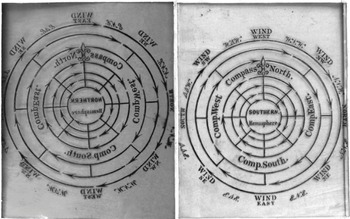
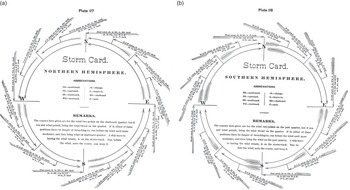
Through his work in the courts Piddington had deduced that there were three kinds of dangers to a vessel in a cyclone: ‘the veering of the wind; the excessive violence of it near the centre; and the sudden calms and shifts and awful sea at the centre’ (Reference PiddingtonPiddington 1848: 103). The biggest challenge was that while most seamen knew not to be in the centre of what mariners often called the ‘waterspouts’, there was no scientific ordering of their tacit knowledge. The lack of any science to govern their observations had to do with the fact that seamen were ‘not accustomed to consider the winds as tangent lines to a circle, and the bearing of the centre perpendicular to them, the consideration of “how the centre bears,” even with the aid of the Storm Card, may hence sometimes be found puzzling’ (Reference PiddingtonPiddington 1848: 105). Piddington’s storms cards were accompanied by a tabulated explanation of the wind depicted in the cards. Moreover, directions for using the storm cards – i.e., avoiding the centre, heaving with the direction of the wind, or profiting from it – were illustrated by ships’ logs elucidating how other ships managed or failed in cases of storms in the multiple oceans and coasts. His reasoning was that a sailor had more felicity with reading tables and logs than diagrams, and the accompanying narratives and tables will teach them how to use the storm card more successfully. Moreover, juxtaposing the logs which he had accumulated with the storm cards allowed him to reconstruct possible cyclone scenarios and devise ways to improve upon managing in these cyclones. The storm cards were widely used and reprinted in many sailing manuals and laid the groundwork for a prescriptive science of storms. Figure 8.2 shows a further development of Piddington’s storm cards, reproduced in a textbook for sailing, in 1891. The narrative directions on how to manage in a storm have been condensed and moved into the centre of the card. This recipe-narrative condenses the various scenarios for managing in cyclones. As these directives became part of the storm visualization, the storm card is transformed from a navigational into a pedagogical tool.
S. B. Luce’s recreation of the storm card, from The Textbook of Seamanship (1891)
Such a schematic visualization of the storm in advance of aerial and satellite photography should not be taken as a given.Footnote 20 For Piddington to plot this diagram of the storm, the science of cyclones had to move away from an understanding of storms as a meeting of disputed and contrary winds. This was no mean feat given that eighteenth- and nineteenth-century storm observers would have seen a storm from a single vantage point (for Piddington, who had worked as a sailor, this would have been the deck of a ship), so that tornadoes, waterspouts, hurricanes and tropical storms were often strong winds that violently changed directions and were accompanied by thick clouds (Reference WalkerWalker 1989: 483). A particular kind of ‘epistemic switch’ (Brian Hurwitz, Chapter 17) was necessary to move from visualizing and narrating tropical storms as contrary wind patterns to the bird’s-eye view of this neat and cycloidal representation.
Piddington’s work built upon accounts of hurricanes in the Caribbean Seas, ships’ logs and court cases involving coastal landfalls of cyclones in the Indian ocean. Gilbert Blane’s account of the 1780 hurricane that struck Barbados had confirmed for Piddington that there was a need for developing terminological specificity to distinguish between straight and rotatory winds, and that with some observation, tracking wind direction and training one’s eyes, one would be able to discern patterns in these rotatory winds well enough to predict the direction of the tropical cyclone. Apart from Blane, Piddington had access to accounts of storms in the Coromandel from the south-eastern coasts of the Indian peninsula given to him by the Master Attendant of Madras Port, Capt. Christopher Biden. He was simultaneously reading American meteorologist William Charles Redfield’s work, which had already described the storms of the north Atlantic Ocean as ‘progressive whirlwinds’, i.e., that they were always rotatory and that they moved in a plottable track (Reference PiddingtonPiddington 1848: 4). In 1838, William Reid, who was stationed as the governor of the Bermudas, published An Attempt to Develop the Law of Storms by Means of Facts, where he documented that the storms that struck the Caribbean coasts were storms that rotated clockwise in the southern hemisphere and anticlockwise in the northern (Reference PiddingtonPiddington 1848: 5).
Following on from these writings, Piddington announced both the reason for developing a law of storms and the two principles that made storms discernible and plottable. He declared that storms would gradually become understood as a trackable wind movement, which any good sailor could navigate in. The first principle laid down the wind motion and direction, and Piddington showed that winds circulate in two motions on two sides of the equator and that it was both a straight and a curved motion, which made the winds systems circulate as they were ‘rolling forward at the same time’ (Reference PiddingtonPiddington 1848: 8). The second principle proved that in the northern hemisphere wind moved from east to west, ‘or contrary to the hands of a watch’, while in the southern hemisphere the wind motion lay with the hands of the watch. These two central principles of Piddington’s ‘new science of cyclonology’ rendered the sky with discernible wind patterns. His storm science, visualized through the card, would allow sailors to train their eye to recognize deviations from the pattern and therefore cyclonology would ultimately act as a form of insurance and protection against wreckage: ‘to enable the plainest ship master, then, clearly to comprehend this science in all its bearings and use’ (Reference PiddingtonPiddington 1848: i). As someone presiding over the Marine Court in Calcutta, he worked with a very specific definition of law:
Theory and Law. The seaman may best understand these two words by his quadrant. As long as people who paid attention to these things supposed that light when reflected from a mirror was always so at a certain angle depending somehow on the direction in which the original light fell upon it, this was a theory. When it was proved by experiment that the angle of reflection was equal to the angle of incidence this became the Law of reflection, and when Hadley applied it to obtain correct altitudes, and to double the angle by the two reflections of the quadrant, he used it for a nautical object of the first importance and of daily practical utility. These are the three great steps of human knowledge and progress. The theory, or supposition that a thing always occurs according to certain rules, the proof or Law that it does and will always so occur, and the application of that Law to the business of common life.
For Piddington, the storm card is a distilled version of the law of nature applied to the business of common life – his science that should be conducted in the cabin tables of a ship. Piddington’s storm science was geared towards teaching sailors to recognize the centre of the cyclone and to devise methods to avoid it. According to him, the safest way of managing a vessel in a storm is by following the wind direction and sailing on its rotatory or circular course rather than straight through it. In order to do that a sailor had to see a particular kind of storm – not one where strong winds blew in multiple directions, but one where there was a circular pattern to it with a centre that one must, at all cost, avoid. However, he was quick to point out that what the sailor is discerning with the storm card are not tracks of storms, but the ‘tendency of the paths of the usual Cyclones’ (Reference PiddingtonPiddington 1848: 42). For this reason, his directives to use the storm cards were accompanied by excerpts of shipmasters’ logs which he meticulously collected from ships that docked at Calcutta and Madras.
Storm cards not only order the moments before the storm, but also make historical wind movements legible and transform them into a set of universal signs to be read and deciphered in order to avert a wreck. And given his role in the Marine Court, he also hoped that they would ease adjudication about wrecks. The storm card was a technical tool that helped the shipmaster verify the wind direction. By standardizing storm science, Piddington had also hoped to develop plausible narratives about the moment of the wreck were they to occur, and plot when and where mistakes were made. He was also fully aware of the difficulties of rendering the volatile tropical skies into a set of laws and diagrams. Therefore, Piddington recommended that mariners follow the storm card, but cautioned against ‘the mischievous and ignorant notion that there is any fixed law for the tracks of these terrific meteors, especially in narrow seas with volcanic islands or continents within, or near to, or limiting them’ (Reference PiddingtonPiddington 1848: 62). Moreover, Piddington saw his storm card as an evolving tool and he requested the sailors to offer feedback for improving upon the tool. Indeed, the storm card made the sailor’s tacit knowledge into a discernible evidence of his ability to read wind direction reflecting his capability as an experienced sailor. Thus, the storm card performed two functions: it was a critical tool of pedagogy for sailors and it sought to standardize the narrative science of cyclones.
8.5 Conclusion: Narrating Imperial Cyclonology
In the Bay of Bengal, the line between what was knowable in the ‘blooming, buzzing’ (Reference DastonDaston 2016: 60) world of storms and gales shaped the material practices of rowing, towing and navigating the seaboard and in the process was translated into empirical knowledge through storm narratives. As mentioned above, Piddington was not the first weather observer, nor was he the first to write about winds and hurricanes. What makes Piddington’s work stand out is the legal and imperial imperatives that drove his cyclonology. He was driven by a desire to bring order to the process of administering justice, protecting the plainest shipmaster against storms and equally from the wreckages of the inequitable justice system of the Marine and Admiralty courts.Footnote 21 Piddington’s cyclonology emerged out of what Morgan and Wise called a backward understanding of the event, whose narratological cognition and reconstruction happens after the fact, i.e., after he had listened to multiple accounts of the storm that wrecked ships. In that, he was very much the ‘confused and reflective participant’ who, ‘when confusion is resolved, [becomes] the narrator throwing explanatory light on the situation’ (Reference MorganMorgan and Wise 2017). For example, in Conversations about Hurricanes (Reference PiddingtonPiddington 1852), meant to be a book of dialogic pedagogy between three sailors, Capt. Wrongham, one of the fictive sailors, tries to understand if the storm card is a form of ‘prognostication’. He comments, ‘our knowledge then would all be fore-knowledge, both as to what happened and what in all probability was going to happen’ (Reference PiddingtonPiddington 1852: 93). With this form of foreknowledge acting as insurance against wreckage, the jury’s ability to judge and place liability for the storm would be resolved efficiently. The storm card, a product of his new science of cyclonology, was also a product born of an encounter with the legal world of the Marine Court.Footnote 22


 Open access