




1. Introduction
Between 2002 and 2005, archaeological excavations at Liye 里耶, Longshan county in the north-western part of Hunan province of the People's Republic of China, yielded more than 38,000 pieces of wood, nearly half of which carry writing applied with brush and ink.Footnote 1 Most were excavated from an ancient well inside of the remains of a fortress.Footnote 2 Beside very few bamboo pieces, which exhibit writing characteristic of the Warring States (403–221 bce) kingdom of Chu 楚, all others were made of woodFootnote 3 and show a type of script typically used in the kingdom and later empire of Qin 秦. Most can be classified as administrative documents or fragments of such documents, dating to the time of the Qin Empire or the year directly preceding its establishment – more precisely the years 222 to 208 bce. It has been proposed that the documents derive from the former archives of the Qin county Qianling 遷陵.Footnote 4
The two volumes of Liye documents published to date contain a general overview of the various shapes and measurements of the wood pieces, followed by a second categorization by content (Hunan sheng wenwu kaogu yanjiusuo Reference Hunan sheng wenwu kaogu yanjiusuo 湖南省文物考古研究所2012 and Reference Hunan sheng wenwu kaogu yanjiusuo 湖南省文物考古研究所2017: preface, 1–3). Despite the stunning variety in both categorizations, for some kinds of documents a correlation between shape and measurements of the writing support and content has been established, at least implicitly. For example, identical labels such as “register category” (buji lei 簿籍類) or “tallies” (quan 券), with different degrees of specificity, occur in both the “material” and the content categorizations. Although our understanding of the regulations that may have informed the production of administrative documents is still fragmentary, it has been argued that the frequent occurrence of particular lengths such as 23 or 46 cm suggests that certain underlying document standards must have existed (Liye Qinjian bowuguan et al. Reference bowuguan 里耶秦簡博物館2016: preface, 7).
After the military campaigns of the late Warring States period, the control and maintenance of the newly established Qin Empire depended on an efficient bureaucracy involving the production, processing, and archiving of an enormous number of administrative documents. In view of the Qin's overarching project of political and cultural “unification”, it does not come as a surprise that attempts at standardization seem to have extended into the administrative realm.Footnote 5 In addition, standardization of administrative documents likely also served practical purposes, for example increasing efficiency and facilitating the work of officials by screening out diversity.
The importance of standards for the workings of the administration is known from other ancient cultures. For example, the Assyriologist Cancik-Kirschbaum has not only stressed the significance of material – in addition to textual – features of clay tablet documents for the administration of the Middle Assyrian Empire (14th–10th c. bce), she also pointed to the fact that these features conformed to a “general standard”:
The physical nature of the document thus conveys important information to the clerk on a visual, material even haptic level. The “nature” of the text, even its “administrative level”, must have been largely clear from the outer appearance of the tablet. The format of the document […], the presence or absence of an envelope, the sealing practice and the textual layout are four of the major external (or extrinsic) features. […] The features mentioned convey a basic set of information to the user. Moreover, these external features conform to a general standard, a set of norms and rules, which were observed in scribal practice. (Cancik-Kirschbaum Reference Cancik-Kirschbaum and Devecchi2012: 26)
However, Cancik-Kirschbaum likewise points to related aspects that still deserve more attention:
A closer examination of the increasing documentation will perhaps allow one to understand how much leeway the individual scribe was allowed and to what extent his scribal habits were circumscribed by the adherence to centralized rules, and thus, to the institution behind them. (Cancik-Kirschbaum Reference Cancik-Kirschbaum and Devecchi2012: 29–30)
This shows that the exact scope as well as the pervasiveness of document standards in the Middle Assyrian Empire remain to be determined. In a similar vein, it has been acknowledged for the case of early imperial China that, despite the obvious existence of certain standards, it is an open question to which degree pragmatic considerations may have led to a certain flexibility with regard to the application of these document standards (Liye Qinjian bowuguan et al. Reference bowuguan 里耶秦簡博物館2016: preface, 7).
In order to approach this and other questions related to standardization, the present paper investigates the degree of standardization in Qin administrative documents with the help of two case studies. The first focuses on documents written on a particular type of tablet (du 牘, see part 2); the second discusses tallies (quan) produced in the context of grain disbursal (see part 3). The choice of these two groups of documents was based mainly on the availability of contemporary document standards. Together with Qin statutes discovered previously in the manuscripts excavated from Shuihudi 睡虎地 tomb no. 11, recently published Qin ordinances from the unprovenanced manuscript collection of Yuelu Academy provide the opportunity to compare the actual documents with “ideal documents” described in the former and to examine to what extent standards for the drafting of official documents were actually implemented in local administration.
Following up on earlier work that compared particular features of the Liye documents and traced them back to standards prescribed in Qin written law (Chen Wei Reference Chen2017: 27–81; Aoki Reference Aoki2017), the present study sheds light on the large grey zone between the two extremes of faithful adherence and complete neglect. As the case studies will show, some standards were followed more consistently than others, which is likely suggestive of the degree to which the respective standards “made sense” during daily administrative practice. In reality, certain features of documents seem to have been more important for a proper functioning of the administration than others. Identifying these features can help to reconstruct aspects of early imperial administration for which we might be lacking direct textual evidence. In addition, the present study indicates that actual administrative practice was always a compromise between different, often conflicting, factors. On the one hand, local officials were required to follow document standards set by the central government in order to unify the content and form of administrative documents; on the other, economic considerations must have obliged them to save material, manpower and time. Hence, the findings of the present paper also serve to exhibit the area of conflict between the design and the enforcement of Qin government policies.
2. Measurements and layout of du 牘-tablets
2.1. Defining the corpus
Although administrative documents written on individual wood tablets have long been known from finds dating to the Western Han (206 bce–9 ce), the Liye documents suggest that the practice of using such “single-piece manuscripts” – instead of “multi-piece manuscripts” consisting of tied-together slips – was more widespread in the previous Qin period (Sumiya Reference Sumiya2012; Takamura Reference Takamura2013).Footnote 6 The wood tablets that were used to produce single-piece manuscripts were usually called du by the Qin, as shown by a Qin ordinance found among the Yuelu Academy Qin manuscripts.Footnote 7 This ordinance includes detailed prescriptions for the format and layout of documents drafted on these tablets (see sections 2.2 and 2.3 below). As it was likely enacted around the Qin unification of 221 bce, it should pre-date at least a significant part of the Liye documents, produced between 222 and 208 bce.Footnote 8 Because the Yuelu Academy manuscripts were not archaeologically excavated, their exact provenance remains unclear.Footnote 9 However, judging from their various contents and a comparison with archaeologically excavated finds, the Yuelu Academy manuscripts likely stem from an ancient tomb rather than the site of a former administrative office or military post (Shi Reference Shi2016: 11–12).Footnote 10 In addition, the place names mentioned in some of the manuscripts further suggest that they might derive from the region that during Qin times was named “Nan commandery” (Nanjun 南郡), possibly the Jiangling 江陵 area (Chen Wei Reference Chen2017: 216–22; Mizuma Reference Mizuma2017: 662–3). At the time, Nan commandery was adjacent to Dongting 洞庭 commandery, where the county of Qianling was located (Hou Reference Xiaorong 后曉榮2009: 440–41).
In order to compare the document standards found in the Yuelu ordinance with the Liye documents, it was first necessary to collect all unfragmented pieces and to isolate those among them that qualified as du. To date, more than 6,000 pieces have been published with measurements provided or in a form that allows retrieval of this information by measuring the original-sized photographs.Footnote 11 Close observation of the photographs in these volumes reveals that only slightly more than 5 per cent (roughly 330 pieces) of the material published so far is in a state that enables us to draw conclusions on the original measurements and likewise falls into the category of flat rectangular shape – excluding other shapes usually used for more specific purposes such as tags, address labels, or sealing pieces. Pieces where, for example, only a corner is broken off, were included if the full length and width could still be ascertained. On the other hand, pieces that clearly contained writing exercises or partly deleted content were omitted, as they cannot be considered proper administrative documents. The same is true for pieces with non-administrative content.
From these around 330 pieces, I further subtracted those with a length of more than 27.5 cm (or one foot and two inches). The reason for setting this length limit is that the Qin ordinance with the prescriptions on format and layout of documents drafted on these tablets only mentions du of up to 27.5 cm length.Footnote 12 In addition to pieces above this length,Footnote 13 I also excluded two specimens (8-461 and 9-2282) with a rare “landscape format”, meaning that their “length” is much smaller than their “width”. This yielded overall 284 pieces with a remarkably uniform length between 22.2 and 23.9 cm (+/- 1 cm of one foot or 23 cm), which of course included many narrow pieces (die 牒) that were originally part of multi-piece manuscripts. After removing all pieces with only one (160 pieces) or two (33 pieces) columns of writing, to which the ordinance does not apply (see section 2.2), this left 91 pieces with three or more columns on at least one side that would potentially qualify as du.
Now the Yuelu ordinance regulating the layout and measurements of documents drafted on du, does not seem to be directed to all kinds of documents produced on such tablets. The beginning of the ordinance specifies its scope of relevance by referring to the “submission of answers [to enquiries or decisions], requests, or memorials” (shang dui, qing, zou 上對、請、奏) (Chen Songchang Reference Chen2017: 105, slip 112). It can be gathered that it was mainly – if not only – relevant for documents submitted to a superior (Staack Reference Staack2018: 267, n. 70). Some scholars in fact assume that the ordinance merely regulated documents submitted to the imperial court and stated that it is yet unclear to what extent documents produced during daily administrative work at lower levels were also supposed to adhere to it (Tsuchiguchi Reference Tsuchiguchi2018: 31; Zhou Reference Zhou and Jie 王捷2020: 131). At the same time, it has been correctly pointed out that the terms dui, qing, and zou, apart from submissions to the imperial court, were also used in Qin and Han administration to refer to three common types of documents submitted to superiors (Chen Reference Chen2020: 70). Although neither of the two possibilities can be ruled out entirely, it appears more likely that the ordinance is not merely pertaining to documents submitted to the imperial court but contains regulations of more general applicability. First, the supplement to the ordinance admittedly contains a proposal that clearly refers to “imperial du”, which might indeed mean du used for submissions to the imperial court. However, there is no reason to assume that all regulations concerning du in the preceding text, i.e. the part of the ordinance without the supplement, are relevant only for such “imperial du”. Rather, the latter may well be only one particular subset of all du discussed in the ordinance. Second, the ordinance also regulates the length of official tallies (Chen Songchang Reference Chen2017: 108, slip 121; Staack Reference Staack2018: 275), and the given length accords with the examples of actual tallies excavated at Liye (see part 3 below).
Among the Liye documents, upward communication is usually recognizable from the use of the formula gan yan zhi 敢言之 “to venture to report it”, which frames the actual content of the official correspondence. In contrast, the phrase gan gao 敢告 “to venture to inform”, marks communication on the same level, whereas gao 告 “to inform” or wei 謂 “to instruct” designate downward communication (Takatori Reference Yūji 鷹取祐司2015: 98–107). Of the remaining 91 pieces, at least 25 can be identified as reports of a subordinate office directed towards Qianling.Footnote 14 As the manuscripts were excavated at the former seat of Qianling county and many of the tablets also carry notes on the receipt and opening of these documents added by a different hand – likely an official working at Qianling – it can be assumed with some certainty that these are the “originals” that arrived at Qianling rather than copies produced for archiving.Footnote 16 For photographs of two example tablets, see Figure 1. For an overview of all 25 tablets, see Table 2.
Liye tablet 8-163 verso and recto; tablet 8-1517 verso and recto (left to right)Footnote 15

2.2. Width and number of columns
The Qin ordinance mentioned above stipulates the ratio between the width of the writing support and the number of columns supposed to be written on it (summarized in Table 1):
用牘者,一牘毋過五行。五行者,牘廣一寸九分寸八;四行者,牘廣一寸泰半寸;三行者,牘廣一寸半寸。 (Chen Songchang Reference Chen2017: 106, slips 115–16)
If du are used, one du shall not [contain] more than five columns [of writing per side]. For five columns, du shall have a width of one inch and eight ninths of an inch; for four columns, they shall have a width of one inch and two thirds of an inch; for three columns, they shall have a width of one and a half inches.Footnote 18
Prescribed width to number of columns ratio for du Footnote 17

According to the ordinance, tablets were supposed to contain between three and five columns of writing and to measure between 3.5 and 4.4 cm in width depending on the number of columns. Table 2 provides an overview on the du-tablets from Liye, and indicates their actual width, their prescribed width, and the deviation.
Complete du-documents, actual vs. prescribed width and number of columns (sorted according to deviation from prescribed width, low to high)Footnote 20

As many of the tablets contain later notes in addition to the writing applied by the official who originally drafted the document, it is important to distinguish between these two layers of writing. The choice of a tablet with a particular width would likely have depended on the amount of writing the original draft was supposed to contain; it would not necessarily have anticipated later additions. Hence, in Table 2, the column numbers without parentheses refer to the writing applied by the producer/sender of the document, the numbers in parentheses refer to writing added later by the recipient – in the present cases Qianling county.
With a view to the measurements of the tablets gathered in Table 2, there are a few things worth noting. First, not a single tablet exactly accords with the widths prescribed in the Qin ordinance. According to the relevant ordinance, a deviation of more than the accepted tolerance of merely 0.23 cm would already be fined:
不從令及牘廣不中過十分寸一,皆貲二甲。 (Chen Songchang Reference Chen2017: 107, slip 119)
If this ordinance is not followed or if the deviation in width of the du exceeds one tenth of an inch (i.e. 0.23 cm), this is in every case fined with two suits of armour.Footnote 19 (Staack Reference Staack2018: 273–4)
In fact, all of the 25 examples exceed the legally tolerated deviation, which means that the officials responsible for their drafting should have been fined according to law. The existence of a tolerance that grants the producers of administrative documents a certain leeway is certainly based on pragmatic considerations. Generally, stricter requirements with regard to measurements would increase the effort necessary to fulfil them – including measuring, more refined production techniques, etc.Footnote 21
Second, tablets are slightly or even significantly below the width specified for the particular number of columns. In fact, quite a few of the tablets are as narrow as pieces typically used to produce multi-piece manuscripts. Generally, the use of smaller pieces of writing support is economically reasonable because fewer resources are necessary for their production. Maybe the “reward” gained by such economic use of raw materials was – if not actually higher than the fines – at least considered a justification for a breach of regulations. It also has to be borne in mind that the comparatively small pieces of wood used as writing support were most probably produced from leftover wood that was not suitable as timber for construction (Staack Reference Staack2018: 289).
Third, the length of the tablets shows a much lower degree of deviation than their width. In fact, the length of all 25 tablets falls into a range of +/- 0.5 cm of the common standard length of 23 cm.Footnote 22 With regard to the three standard widths, the same degree of accuracy was only reached by less than a third of the tablets.Footnote 23 This could mean that in administrative practice adherence to the standardized length was considered more important than adherence to a particular width, for example due to the necessities of transport or storage. One decisive factor could be the shape and/or size of containers for documents. Sadly, we are lacking information on their properties as only the labels of such containers have been excavated at Liye.Footnote 24
A question that arises from the above discussion is whether the officials who drafted the text of administrative documents also produced the writing support themselves. Previous research has suggested that the act of “handling” (shou 手) a document, besides brushing the text probably also included actions such as carving the notches of a tally (Ma Reference Ma2017: 327–9). From a Qin stipulation excavated from Shuihudi tomb no. 11 that is labelled sikong 司空, “[Statutes of the] Controller of Works”, we know that counties (xian 縣) and metropolitan offices (duguan 都官) were supposed to organize the collection and processing of wood in order to produce writing support (Shuihudi Qinmu zhujian zhengli xiaozu 1990: 50 [transcription part], slips 131–2). In addition, a note stating yi ren fa du 一人伐牘 “one person cuts du[-tablets]” on a fragmentary document excavated at Liye, testifies to the fact that certain personnel were responsible especially for the production of stationery. It is likely that this fragment originally belonged to a “register of convict labourers” (zuo tu bu 作徒簿), which recorded the convicts working at a certain office as well as their tasks (Ma Reference Ma2017: 327, n. 102). The fact that the mentioned stipulation from Shuihudi seems to have been addressed towards the Controller of Works together with the fact that these registers were only produced at the offices of granaries (cang 倉) and of the Controller of Works, hint at the possibility that convicts who worked for the latter – i.e. hard labour convicts of the two most severe categories – may have been assigned to produce at least a part of the stationery used for administrative documents at various offices. Although we cannot rule out the possibility that officials produced tablets themselves if necessary, it does not seem likely that this was part of their everyday tasks.Footnote 25
2.3. Length and number of characters per column
Beside the ratio between width and number of columns, the same Qin ordinance from the Yuelu Academy collection also specifies maximum numbers of characters per column for tablets of different lengths:
尺二寸牘,一行毋過廿六字;尺牘,一行毋過廿二字。 (Chen Songchang Reference Chen2017: 106, slips 116–17)
On du [with a length] of one foot and two inches, one column shall not exceed 26 characters; on du [with a length] of one foot, one column shall not exceed 22 characters. (Staack Reference Staack2018: 271–2)
Obviously, the columns on du of about 23 cm length (i.e. one foot) should contain no more than 22 characters. Table 3 shows the number of characters per column for the complete du under discussion.
Complete du-documents, actual vs. prescribed number of characters per columnFootnote 26

As can be seen in Table 3, the maximum number of characters is exceeded on 14 tablets – more than half of the 25. Would the same fine of two suits of armour, which was imposed for significant deviations from the standard widths of du, also be due for such an excess of the character limit? The fact that the sentence stipulating that fine appears to fix the same fine for “not following this ordinance” (bu cong ling 不從令) in general (see above), speaks in favour of this.
There does not seem to be a discernible pattern with regard to the date of the documents, which could point to a year in which the restriction regarding the number of characters was implemented. The documents that deviate from the standard date to the years 221 through 212 bce, the largest possible range of dates in the sample under scrutiny here. There appears to be neither a clear correlation between a violation against the character restriction and particular offices. In most cases where at least two documents were produced at the same office, there are examples that exceed the character limit as well as ones that stay below it. See, for example, the five documents produced by Erchun 貳春 district (xiang 鄉): in two of them the limit is exceeded, in three others not. The fact that all the documents deriving from the offices of the armoury (ku 庫) and granary (cang 倉) exceed the character limit, should maybe not be overestimated as the sample only includes two documents for each.
A closer look reveals that on six tablets (8-173, 8-769, 8-1518, 8-1525, 9-450, and 9-452) the character limit is only exceeded in the very first column, whereas the following columns curiously stay below the limit, even though they are completely filled with writing. In line with this, there are nine other tablets (8-157, 8-163, 8-648, 8-767, 9-22, 9-48, 9-710, 9-1112, and 9-2284) on which the number of characters in subsequent columns is lower than in the first column, although the number of characters in that column was already below the maximum of 22. This seems to suggest that there was a general tendency for more spacious writing once the scribe was sure that he would be able to fit the whole text onto the tablet. In general, experienced and well-trained scribes should have been able to stay below the character limit without counting, but it seems that a significant number of scribes employed at Qianling lacked formal training.Footnote 27 This could explain why the character limit was exceeded on more than half of the tablets in at least one of the columns.
Generally, the fact that the Qin regulations link the measurements of a wood tablet to both the number of columns to be written on it as well as to the maximum number of characters per column, suggests that a great deal of planning would be necessary on the part of the officials drafting or copying documents in order to fulfil the legal requirements. Therefore, it seems in order to ask how this could have worked in actual practice. First of all, one could hypothesize that the scribes had normed exemplars of tablets with different measurements and appropriate amounts of columns and characters per column before their eyes for reference purposes.Footnote 28 But even in this case, they would have had to count in the text they were about to copy – or even merely envision, if they were drafting a new document – how many characters the text to be written would contain, at least roughly. Considering that tablets were normally 23 cm long, this overall number would then have had to be divided by 22, yielding the number of columns that would be needed. According to this number, the scribe would then have had to select an appropriate piece of writing support with the correct measurements. While this may have been possible in theory, the evidence from the extant documents does clearly not support the existence of such a clear-cut procedure. But even though reality seems to have been much more “chaotic” or “messy”, administration was obviously functioning. After all, the writing on the cited tablets is usually perfectly legible, even today. At least legibility is not seriously inhibited by the density of the writing on the tablets, although the spacing should have been more generous in quite a few cases, according to legal prescriptions. The reason behind these prescriptions probably was to ensure legibility, but there seems to have been a large grey zone between the “ideal” documents they described and documents that would not be suitable to fulfil their function.
3. Measurements and layout of grain disbursal tallies (quan 券)
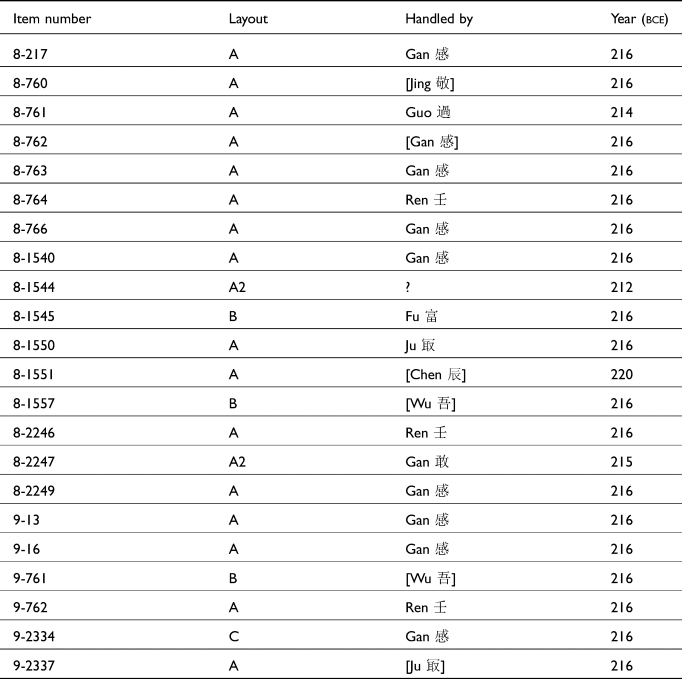
As noted by the Liye editors in their preface, tallies – bi- or tripartite certificates that were handed out to the parties involved in transactions – were usually about 37 cm long, which corresponds to the standard length probably established sometime between 220 and 217 bce.Footnote 29 Most but not all kinds of tallies had notches carved on their left or right side, which represented the amount of grain, cash, etc., also recorded on the tally in writing (Zhang et al. Reference Zhang, Toshitaka 大川俊隆 and Akira 籾山明2015: 54). According to extant examples, tallies were issued when cash or sacrificial goods were disbursed by government offices or when goods were bestowed by one person to another. However, judging from the tallies published to date, by far the most were produced in the context of grain disbursal.Footnote 30 The tallies excavated at Liye were apparently those parts of the certificates that were once kept in the county archive for later reference (Zhang et al. Reference Zhang, Toshitaka 大川俊隆 and Akira 籾山明2015: 61). In contrast to the corpus of du-tablets used in upward communication that was discussed above, the grain disbursal tallies are comparatively easy to identify on the basis of their particular form. In addition, many of them had already been collected by previous scholarship (Zhang et al. Reference Zhang, Toshitaka 大川俊隆 and Akira 籾山明2015; Xie Reference Xie2021). The following discussion is focused only on complete grain disbursal tallies, of which 22 specimens seem to have been published to date (see Table 4).
Complete tallies for grain disbursalFootnote 33

The grain disbursal tallies collected in Table 4 generally seem to conform to the standard length of 37 cm. While most tallies deviate from this length by less than 1 cm, one example (8-1551) shows a significant deviation of 2.4 cm, which might reflect a historical change in the underlying standards.Footnote 31 The text on the grain disbursal tallies is highly formulaic and usually comprises the following pieces of information:Footnote 32
1) grainstore;
2) type and amount of grain disbursed;
3) date of disbursal;
4) disbursing officials (Overseer of the responsible office, Assistant/Scribe, Grain-Disburser);
5) recipient(s);
6) supervising official;
7) official who handled the document.
The actual records as seen on the tallies closely match Qin prescriptions on how to record the entering or disbursal of grain in the corresponding register (ji 籍) (Kim Reference Kim2016: 563–4). An article of the “Statutes on Checking” (Xiaolü 效律) excavated from Shuihudi tomb no. 11 mentions at least items 1), 2), and 4) of the above list. It states:
入禾,[…]籍之曰:「某廥禾若干石,倉嗇夫某、佐某、史某、稟人 某。」[…]其出禾,有(又)書其出者,如入禾然。 (Shuihudi Qinmu zhujian zhengli xiaozu Reference Shuihudi Qinmu zhujian zhengli xiaozu 睡虎地秦墓竹簡整理小組1990: 73 [transcription part], slips 27–9)Footnote 34
[When] grain is entered [into a granary], […] make an entry in the register stating: “Grainstore X, so and so many bushels of grain, Overseer of the Granaries X, Assistant X, Scribe X, Grain-Disburser X.” […] In case grain is issued, also make a record about the disbursal, in the same way as when entering grain.Footnote 35
Although the cited formulaic expression is not labelled as a “model” (shi 式), it closely resembles known models from early imperial China, which provided forms to adhere to when drafting official documents.Footnote 36 It seems that the statutes occasionally quoted models or that at least some models were derived from statutes such as the one just cited. Another statute article that is found among the Yuelu Academy manuscripts and belongs to the “Statutes on Granaries” (Canglü 倉律) mentions that the entering and disbursal of grain have to be supervised:
縣官縣料出入必平,稟禾美惡相襍,大輸令、丞視,令史、官嗇夫視平,稍稟,令令史視平。 (Chen Reference Chen2015: 122, slips 163–4 [punctuation modified])
The issuing and entering of government grain at government offices must be fair.Footnote 37 When disbursing grain, excellent and inferior [qualities] shall be mixed. Major transports are overseen by the Magistrate or the Vice-Magistrate, while a Scribe Director and the Overseer of the responsible office oversee the fairness; for minor disbursals, a Scribe Director oversees the fairness.
This or a similar regulation likely provided the legal basis for the notes on the supervising officials – item 6) of the above list – which are found on the grain disbursal tallies from Liye. At least the Yuelu Academy manuscripts have been dated to the same period, which means that the statutes and ordinances found in the manuscripts were in all likelihood legally binding at the time the Liye documents were drafted.Footnote 38
As can be seen, the grain disbursal tallies are fairly standardized with regard to both their material features and the text inscribed on them. However, there are also differences, especially with regard to the layout of the writing on tallies, which clearly suggest that a certain leeway in the production of official documents was tolerated. As will be demonstrated, these differences seem to be connected to habits or preferences of particular individuals, whereas changes in the respective regulations or models over time can be ruled out as reasons for this phenomenon. The seven items that constitute the text of a grain disbursal tally are normally visually organized into only four larger text blocks separated by blank space on the writing surface:
Block 1: Grainstore + type and amount of grain disbursed
Block 2: Date of disbursal + disbursing officials + recipient(s)
Block 3: Supervising official
Block 4: Official who handled the document
Layout A
Table 5 illustrates the usual sequence of the four text blocks, which shall be called layout A. Of the 22 tallies, 16 show this layout (see Figures 2 and 3 and Table 8 below for an overview of the different layout types).
Arrangement of text blocks in the layout types A, A2, B, and C

Tallies 8-764 and 8-766 (layout A), 8-2247 (layout A2), 8-1545 (layout B) and 9-2334 (layout C) (left to right)Footnote 45

Tabular view of textual sequence on tally 8-766 (layout A)Footnote 39

In layout A, block 1 is placed on the top of the first (right) column, followed by block 2, which – depending on its length – might fill the entire remainder of the first column and even extend to the second (left) column. Blocks 3 and 4 are placed in the middle and bottom of the second column, respectively (see Figures 2 and 3). The layout on two further tallies (8-1544 and 8-2247) is similar, but stands out in so far as the scribe fitted all the writing into a single column. The blocks of text, however, come in the same sequence as in layout A – it shall therefore be called layout A2.Footnote 40 Layout A was employed by six individuals responsible for record keeping: Gan 感, Jing 敬, Guo 過, Ren 壬, Ju 冣, and Chen 辰. Layout A2 was used by Gan 敢 and an unnamed other (see the overview in Table 8).
Layout B
Two scribes by the names of Fu 富 and Wu 吾, however, employed a different sequence of the text blocks, which is illustrated in Table 6.
Tabular view of textual sequence on tally 8-1545 (layout B)Footnote 41

In comparison to layout A, blocks 2 and 3 traded places here (see Figures 2 and 3). Hence, the second column starts with the date of disbursal, directly to the left of the grainstore and the amount of disbursed grain at the top of the first column. It should be noted that the grain disbursal recorded on tally 8-1545 (layout B) was undertaken by the same team of officials as the disbursal recorded on 8-766 above (layout A), with the exception of the scribe – Assistant Fu, instead of Scribe Gan 感. The writing on two other tallies drafted by Wu 吾 (8-1557 and 9-761) also shows layout B.
Layout C
Now Scribe Gan 感 apparently is the only individual that – beside layout A – also used yet another layout at least once (see Table 7).
Tabular view of textual sequence on tally 9-2334 (layout C)Footnote 42

Complete tallies for grain disbursal, layout types and responsible individuals
The difference between this and layout A is that the text starts with the date of disbursal (block 2) instead of the amount of grain disbursed (block 1). The latter is placed at the top of the second column (see Figures 2 and 3).Footnote 43 When comparing the scribal hand on this tally 9-2334 with a tally exhibiting layout A and also handled by Gan 感 (8-766, both shown in Figure 3 below), it seems in fact possible that the writing on them was brushed by different individuals. Whether this may have been caused by the presence of two scribes of the same name at Qianling, or a different reason, remains a question to be explored.Footnote 44
With a view to numbers, layout A can certainly be considered as the standard for the grain disbursal tallies produced in the Qianling offices. This layout – as well as A2 – also seems to come closest to the form stipulated by the Shuihudi statutes, according to which text block 1 (grainstore + amount of grain disbursed) is directly followed by content belonging to block 2 (disbursing officials). Although this prescription concerns grain disbursal records in the registers rather than the corresponding tallies, it seems likely that the records made on tallies were supposed to follow the same sequence.
From a pragmatic point of view, layout A also seems most reasonable. Assuming that the amount of grain disbursed is the most crucial piece of information to be recorded on a tally (as this will be important for accounting),Footnote 46 it seems generally reasonable to put block 1 at the very beginning of the record (i.e. on the top right) in the direct vicinity of the notches also carved on the top left or right side.Footnote 47 As block 2 is usually the longest and therefore most difficult to fit entry, it makes sense to write it next. Starting block 2 at the top of the left-hand column – as in layout B – brings with it the general danger of block 2 not fitting into the left-hand column completely if it is too long. In that case, the scribe would have nowhere to continue except the verso of the tally in order not to go against the normal reading direction. A similar problem might occur in layout C, where block 1 is written on the very top of the left-hand column. If the text of block 2 is too long to fit into the first column completely, this would mean that block 1 has to be written further towards the bottom of the tally. As there is only one instance in which layout C was used, one could speculate that this is the result of a scribal mistake. If Gan (on 9-2334) accidentally started the record with block 2 (instead of block 1, as usual), the present layout may have been a viable alternative in which block 1 was still easily visible at the very top – albeit on the left rather than on the right side. In layout A, the scribe can continue block 2 on the top of the left-hand column, if the space after block 1 in the right-hand column is insufficient.
Block 4, with the note on the scribe who drafted the tally, would naturally be written last and hence be placed on the bottom left side.Footnote 48 This leaves the relatively small block 3, with the note on the supervising official, which is written on the opposite side of the longest block 2. It so happens that block 3 is frequently written directly beside the part of block 2, where the – usually three – disbursing officials are recorded. This actually enables the reader to view all officials involved at one glance as their names are written in direct proximity.
The reason why the scribes Fu and Wu consistently used a less reasonable layout than layout A can only be guessed. Perhaps it is not a coincidence that both individuals have the status of Assistants rather than formally trained Scribes, as can be gathered from the records on the respective tallies.Footnote 49 What seems clear is that: a) they deliberately employed this layout; and b) that it was obviously acceptable for the administrative apparatus. The fact that the layout types A, B, and C all occur on tallies produced in the same year (216 bce, see Table 8) shows that this clearly does not reflect changes in layout over time.
4. Conclusions
The above analysis has not provided a simple answer to the question of whether the detailed rules fixed in Qin document standards were actually followed for the production of administrative documents. Rather, it has shed some light on the large grey zone, or continuum, between the two extremes of faithful adherence and complete neglect. Whereas some standards appear to have been followed quite consistently, such as the length of wood tablets or the fixed pieces of information that had to be written on grain disbursal tallies, the persons involved in the production of the documents seem to have deviated more frequently and extensively from others.
But these observations help to complement our still fragmentary understanding of how the administration in early imperial China really worked at the grassroots level. After all, there are reasons behind the establishment of document standards by the central government. That local officials follow or disregard them likewise happens for a reason. Apparently, the imposition of fines alone did not lead to a universal acceptance of the document standards created by the central government. Therefore, it has to be assumed that the main reason for local officials to follow or disregard these standards was whether they “made sense” in daily practice. If the length of wooden tablets was much more uniform than their width – although both were in theory regulated by law – this probably indicates that the length had a significant influence on how well documents could be processed or handled. This in turn could have to do with storage facilities or containers, or with practices of tying multiple documents or pieces of writing support together, in other words the “compatibility” between documents. Multi-piece manuscripts may usually have required pieces with the same length – but not necessarily the exact same width.Footnote 50 If wood tablets were not only by default narrower but officials also regularly fit more writing on them than allowed by law, this probably served to save resources without necessarily asserting a negative influence on legibility. And exactly securing legibility was presumably at least one of the prime motives behind the establishment of standards for the number of columns per tablet as well as the maximum number of characters per column. From all we know, the named deviations were not a hindrance during administrative work at the former Qianling county and seem to have been regarded as acceptable, even in the face of imminent punishments. However, it should be kept in mind that violations would have to be reported in order to be punished. Other phenomena such as the significant variance concerning the layout of grain disbursal tallies – contrasting their very consistent measurements – suggest that certain features were not regulated and that a certain degree of variance was tolerated in favour of flexibility.Footnote 51
The different writing habits of individuals that are hence visible could go back to differences in scribal training. Most of the personnel seem to have come to newly conquered territories via state-induced migration from the Qin heartland, including areas that had been conquered earlier (Korolkov and Hein Reference Korolkov and Hein2021: 210–11). These individuals may already have been familiar with the Qin regulations for administrative documents. Others were probably recruited from the local population of the former kingdom of Chu. Hence, the scribes working in the Qianling administration may have had very different educational backgrounds, which would naturally have influenced the way they drafted administrative documents, if not even the format and shape of the pieces of writing support in cases in which these were not prepared by other persons such as convict labourers.Footnote 52
Generally, it seems that administrative practice as reflected by the Liye documents was always a compromise between different factors: on the one hand, numerous legal standards, which were informed by the central government's attempts to unify the content and form of administrative documents, and likely influenced by the ideology of the architects of the first unified empire; on the other hand, quite mundane economic considerations with regard to material and human resources as well as time. It seems likely that, based on previous experience with a large number of documents, the central government fixed general rules on document properties that were deemed “ideal”, without necessarily considering what an implementation of these requirements, if taken seriously, would mean for actual administrative practice: namely, a significant amount of planning, measuring, and calculating that would take away time from more important tasks. As other studies of the Liye documents have shown, there was a continuous lack of qualified personnel at Qianling,Footnote 53 which suggests that adherence to specific document standards may not have been one of the top priorities on the everyday agenda, with much more serious problems looming large. Whether the regulations were followed more or even less closely in other areas of the Qin Empire remains a question to be dealt with once additional materials hopefully come to light. For the time being, the extant documents clearly show the limits of standardization and suggest that the officials chose a pragmatic way influenced by both economic considerations informed by the local circumstances and the requirements imposed by the central government.Footnote 54
The present paper shows some of the possible benefits of this kind of analysis, which focuses on the materiality of administrative manuscripts. However, in order to complement further our picture of exactly how local officials conducted their everyday work and what factors influenced their production and use of documents in what ways, additional studies are needed. It would be worthwhile to conduct a more extensive analysis once the Liye documents have been published in their entirety. Especially with regard to aspects of administrative documents, for which no standards have been discovered yet, it could also be worthwhile to attempt a reconstruction of underlying standards through an inductive approach, only from the evidence of the extant documents.Footnote 55
Acknowledgements
An earlier version of this paper was presented to the 2021 annual conference of the Association for Asian Studies as part of the panel “Between evolving standards and persistent diversity: manuscripts and inscriptions in pre-imperial and early imperial China”. I would like to express my gratitude to the other participants of the panel, Enno Giele, Ondřej Škrabal, Olivier Venture, and Xiao Yunxiao 肖芸曉, as well as to the audience for their stimulating questions and comments. I would also like to thank Michael Friedrich, Ma Tsang Wing 馬增榮, and Tong Chun Fung 唐俊峰, as well as the anonymous reviewers whose criticism and suggestions helped further improve this paper. Special thanks are due to Tong Chun Fung also for his tireless help in supplying relevant literature that I had difficulties accessing at the time of writing. Finally, I would like to express my gratitude to Zhang Chunlong 張春龍, the archaeologist responsible for the excavation of the Liye 里耶 site, for permission to use some of the published photographs of the Liye documents in this paper.
The research for this paper was funded by the Deutsche Forschungsgemeinschaft (DFG, German Research Foundation) under Germany's Excellence Strategy – EXC 2176 “Understanding written artefacts: material, interaction and transmission in manuscript cultures”, project no. 390893796. The research was conducted within the scope of the Centre for the Study of Manuscript Cultures (CSMC) at Universität Hamburg.


 Open access

