





Polycystic ovary syndrome (PCOS) is a common and heterogenous endocrine disorder, affecting approximately 8–13% of females of reproductive age(Reference Teede, Misso and Tassone1). It is a multifaceted syndrome characterised by a broad range of clinical symptoms, exerting both physical and psychological health-related consequences over the lifespan(Reference Joham, Norman and Stener-Victorin2,Reference Teede, Deeks and Moran3) . Diagnosis of PCOS typically includes a combination of medical history, the exclusion of other conditions with similar symptomology, clinical examination and biological testing. The 2023 PCOS International Guidelines recommend that an adult diagnosis requires the presence of two of the three following features (with the exclusion of other causes); (1) oligo-/anovulation, (2) clinical or biochemical hyperandrogenism, (3) polycystic ovarian morphology identified via ultrasound or testing of anti-Mullerian hormone(Reference Teede, Laven, Dokras, Moran, Piltonen, Costello, Boivin, Redman and Boyle4). In contrast, the recommended diagnosis for adolescent girls requires both oligo-/anovulation and clinical or biochemical hyperandrogenism and excludes the testing of ovarian morphology(Reference Teede, Laven, Dokras, Moran, Piltonen, Costello, Boivin, Redman and Boyle4).
Underpinning many of the negative consequences of PCOS is a reduction in insulin sensitivity coupled with high levels of androgens(Reference Joham, Norman and Stener-Victorin2,Reference Teede, Deeks and Moran3,Reference Diamanti-Kandarakis and Dunaif5) . Women with PCOS are at an elevated risk of developing a range of health complications, including type 2 diabetes mellitus (T2DM), metabolic syndrome(Reference Joham, Norman and Stener-Victorin2,Reference Fauser, Tarlatzis and Rebar6) and cardiovascular disease (CVD)(Reference de Groot, Dekkers and Romijn7,Reference Zhao, Zhu and Lou8) . Beyond these health concerns, PCOS significantly affects reproductive health, manifesting in symptoms such as infertility(Reference Yadav and Malhotra9), irregular or absent menstrual cycles and adverse neonatal and pregnancy outcomes including gestational diabetes, miscarriage and pre-eclampsia(Reference Farland, Stern and Liu10–Reference Teede, Tay and Laven12). The syndrome also has a notable impact on psychological health and wellbeing with an increased prevalence of disordered eating behaviours, including binge eating(Reference Lee, Cooney and Saini13,Reference Tay, Teede and Hill14) as well as heightened rates of anxiety and depression which negatively impacts health-related quality of life and self-efficacy(Reference Tay, Teede and Hill14–Reference Deeks, Gibson-Helm and Teede17). Although the mechanisms associated with insulin resistance (IR) in PCOS are largely independent of body weight, IR is still exacerbated by excess body weight(Reference Diamanti-Kandarakis and Dunaif5,Reference Cassar, Misso and Hopkins18–Reference Stepto, Moreno-Asso and McIlvenna20) and central adiposity, further heightening clinical symptoms and cardiometabolic risks(Reference Deswal, Narwal and Dang21–Reference Lim, Norman and Davies23). Women with PCOS also have a greater propensity for longitudinal weight gain(Reference Deswal, Narwal and Dang21,Reference Lim, Norman and Davies23) . Therefore, weight loss and/or weight management is thought to be one of the most important therapeutic treatment strategies for the management of PCOS and is typically the focus of many lifestyle interventions(Reference Wolf, Wattick and Kinkade24). While weight loss improves many of the clinical features of PCOS(Reference Moran, Pasquali and Teede25), it is important to appreciate that IR also affects women with PCOS who present within a healthy-weight range (in accordance with normal BMI classifications)(Reference Williams, Mortada and Porter26). Therefore, as recommended in the international evidence-based guidelines for management of PCOS, lifestyle modifications which include adopting a healthy dietary pattern coupled with regular physical activity are considered first-line treatment for both weight management and better manage health outcomes associated with cardiometabolic disease risk, reproductive and psychological health(Reference Teede, Misso and Costello27). However, the optimal dietary approach remains controversial with limited high-quality evidence to support one specific dietary approach beyond traditional population-based dietary guidelines(Reference Kataoka, Tassone and Misso28–Reference Teede, Misso and Deeks30). Nevertheless, dietary interventions which promote healthy long-term behaviour change, without necessarily focusing on weight loss and caloric restriction, may assist in improving psychological health(Reference Clifford, Ozier and Bundros31), and help facilitate adherence and maintenance to longer-term lifestyle and behavioural change. Therefore, to accommodate individual patient needs and health goals, defining the optimal dietary approach (with or without caloric restriction) for the management of PCOS is of clinical interest.
A Mediterranean diet (MedDiet), which is often described as an anti-inflammatory or plant-based dietary pattern, is typically characterised by a high consumption of fruits, vegetables, legumes, wholegrains and liberal use of extra-virgin olive oil (EVOO); moderate consumption of fermented dairy, eggs and red wine (consumed with meals only); and a low and/or infrequent consumption of red meat and meat products, butter, vegetable oils and processed foods(Reference Willett, Sacks and Trichopoulou32). The traditional dietary pattern was first investigated among the people living in the olive-growing regions of the Mediterranean basin before the mid-1960s. Nevertheless, because of the variability in cuisine and dietary constituents which define traditional dietary behaviours of inhabitants of the Mediterranean basin, a singular MedDiet does not exist(Reference Noah and Truswell33). Nevertheless, despite potential differences in the operationalisation of a MedDiet, being predominantly plant-based, the dietary pattern is naturally low in ultra-processed foods, sugar and saturated fat and rich in several functional components, including vitamins and minerals, carotenoids, unsaturated fatty acids and phenolic compounds, depicted by antioxidant and anti-inflammatory properties(Reference Trichopoulou, Martinez-Gonzalez and Tong34).
There is substantial evidence supporting the efficacy of a Mediterranean diet (MedDiet) on cardiometabolic perturbations in other populations with similar risk profiles as those observed in PCOS. Specifically, adherence to a MedDiet is inversely associated with central obesity in epidemiological studies and is associated with weight loss, with or without caloric restriction, in dietary intervention studies(Reference Agnoli, Sieri and Ricceri35,Reference Bendall, Mayr and Opie36) . Moreover, adherence to a MedDiet has been shown to improve insulin sensitivity, glycemic control and attenuate depressive symptoms, particularly in patients with metabolic perturbations(Reference Ventriglio, Sancassiani and Contu37). Nevertheless, evidence from well-designed and robust clinical trials investigating the efficacy of a MedDiet to ameliorate PCOS symptoms is scant. However, evidence from well-designed and robust clinical trials investigating the efficacy of a MedDiet to ameliorate PCOS symptoms is scant. As such, this review aims to elucidate the proposed biological mechanisms underpinning the potential therapeutic benefits of a MedDiet for the management of features related to PCOS.
Features of PCOS
Cardiometabolic
The pathophysiology of cardiometabolic disease risk in PCOS is complex and multifaceted, involving interplays between hormonal imbalances, IR, chronic low-grade inflammation and obesity. IR is a hallmark feature of PCOS and occurs in at least 75% of cases, independent of body weight, resulting in impaired glucose metabolism(Reference Stepto, Cassar and Joham38). The proposed primary mechanism for IR in women with PCOS involves an increase in serine phosphorylation, causing post-binding defects in insulin signalling(Reference Anagnostis, Tarlatzis and Kauffman39). Alternate mechanisms of IR include decreased glucose transporter 4 (GLUT4) in subcutaneous adipocytes, decreased hepatic clearance of insulin, mitochondrial dysfunction and activation of serine kinases in the mitogen-activated protein kinase/extracellular signal-regulated kinases (MAP-K) pathway(Reference Anagnostis, Tarlatzis and Kauffman39). This subsequent hyperinsulinemia increases the risk of T2DM and is closely related to central obesity, dyslipidaemia and hypertension, forming a clustering of cardiometabolic abnormalities. Approximately 30% of women with PCOS have impaired glucose tolerance and 7.5% have T2DM(Reference Legro, Kunselman and Dodson40) with the degree of risk to the onset of T2DM varying from between three to five-fold, contingent upon obesity and ethnicity(Reference Kakoly, Khomami and Joham41). Women with PCOS also exhibit an insulin paradox whereby ovarian and adrenal tissues remain sensitive to the stimulatory effects of insulin, despite displaying metabolic IR(Reference Diamanti-Kandarakis and Papavassiliou42). Moreover, independent of IR, excess body weight, particularly central adiposity, also exacerbates metabolic and CVD risks by promoting dyslipidaemia, hypertension and a pro-inflammatory state, contributing to the formation and development of atherosclerosis and subsequent CVD risk(Reference Pereira and Alvarez-Leite43,Reference Maiorino, Bellastella and Giugliano44) . As such, the metabolic syndrome is also an important feature observed in PCOS(Reference Thomann, Rossinelli and Keller45).
Reproductive
The reproductive dysfunction observed in PCOS, encompassing irregular menstrual cycles, anovulation and subfertility, originates from an intricate interaction among hormonal dysregulation, IR and putative inflammatory pathways. Notably, PCOS emerges as the principal aetiology of anovulatory infertility across the lifespan of the female(Reference Balen and Rutherford46). Furthermore, infertility afflicts 70–80% of individuals diagnosed with PCOS(Reference Melo, Ferriani and Navarro47).
A common characteristic of PCOS is elevated levels of androgens(Reference Azziz, Carmina and Dewailly48). While the precise physiological pathways remain elusive, prevailing evidence suggests that the ovaries and adrenal glands constitute the primary androgen sources in females(Reference Nanba, Rege and Ren49,Reference O’Reilly, Kempegowda and Jenkinson50) . In the ovaries, the synthesis of androgens is predominantly regulated by the ovarian theca cells, with contributions from the mesenchymal cells(Reference Zeng, Xie and Liu51). However, PCOS is characterised by an abnormal androgen secretion, culminating in hyperandrogenism(Reference Alpañés, Fernández-Durán and Escobar-Morreale52). Hyperandrogenism can disrupt follicular growth and gene expression in oocytes, theca and granulosa cells, potentially contributing to folliculogenesis complications and anovulation(Reference Pierre, Taieb and Giton53–Reference Lim, Han and Lee55). In addition, IR and hyperinsulinemia can further escalate androgen levels, thereby intensifying hyperandrogenism and additionally impairing ovarian functionality.
Notably, the MAP-K insulin pathway remains unaffected by IR; rather, it is the compensatory hyperinsulinemia that augments androgen steroidogenesis in the thecal cells, thereby impeding follicular development(Reference Cadagan, Khan and Amer56,Reference Rice, Christoforidis and Gadd57) . The vicious cycle of obesity, IR and increased androgen production exacerbates hyperandrogenism(Reference Zeng, Xie and Liu51). Women with PCOS exhibit a higher volume of visceral adipose tissue compared to their non-PCOS counterparts, which is positively correlated with total androgen levels(Reference Jena, Choudhury and Mangaraj58). Comparative analyses reveal that women who are overweight exhibit significantly elevated androgen levels relative to their healthy-weight peers(Reference Lazúrová, Lazúrová and Figurová59). Increased body weight correlates with reproductive dysfunction and lower oocyte quality, affecting implantation rates and oocyte retrieval during assisted reproduction, particularly in cases of central obesity(Reference Bou Nemer, Shi and Carr60–Reference Rehman, Mehmood and Ali62).
Alterations in normal ovarian follicle development are also a hallmark feature in PCOS, with the ovaries developing numerous small, immature follicles that fail to progress to ovulation.(Reference Orisaka, Mizutani and Miyazaki63). This anomaly commonly termed ‘polycystic ovaries’, is observable via ultrasound and constitutes one of the diagnostic criteria for PCOS(Reference Teede, Laven, Dokras, Moran, Piltonen, Costello, Boivin, Redman and Boyle4). Disrupted folliculogenesis leads to irregular or absent menstrual cycles (oligomenorrhea or amenorrhoea), a defining feature of PCOS, and adversely affects fertility due to the lack of ovulation. This phenomenon is attributed to a dysregulated balance of pituitary gonadotrophins, with elevated luteinizing hormone (LH) to follicle-stimulating hormone ratio, resulting in an increase of androgens and decreased oestrogen expression, culminating in disordered folliculogenesis, immature follicles, thus promoting infertility(Reference Zeng, Xie and Liu51).
Chronic low-grade inflammation may also impair fertility by impeding oocyte maturation(Reference Gonzalez, Lane and Knight64,Reference Rostamtabar, Esmaeilzadeh and Tourani65) . Obesity, IR and hyperandrogenism are thought to collectively contribute to the pro-inflammatory state observed in women with PCOS(Reference Rudnicka, Suchta and Grymowicz66). The follicular microenvironment, pivotal for ovarian function, is adversely affected by the presence of pro-inflammatory cytokines including TNF-a, IL1-B, IL-6(Reference Silva, Lima and Souza67). This low-grade inflammatory state within the follicular microenvironment may disrupt folliculogenesis by inducing oxidative stress in the ovaries(Reference Qiao and Feng68,Reference Velez, Seldin and Motta69) which is likely magnified by the presence of obesity(Reference Velez, Seldin and Motta69).
Psychological
Women with PCOS have a heightened prevalence of depression (2.3-fold) and anxiety (4-fold) compared to those without PCOS(Reference Cooney, Lee and Sammel15). The aetiology of these psychological disturbances remains unclear, implicating a multifactorial interplay among biological, psychological and socio-environmental determinants.
Neurotransmitter dysregulation observed in PCOS, specifically reduced inhibitory neurotransmitters such as serotonin, dopamine, gamma-aminobutyric acid and acetylcholine, may disrupt the hypothalamic-pituitary-adrenal (HPA) axis and predispose individuals to depression(Reference Xing, Xu and Wei70,Reference Joseph and Whirledge71) . Concomitantly, an augmentation in neurotransmitters which elevate LH has been observed in PCOS, which could further precipitate depressive symptoms(Reference Joseph and Whirledge71,Reference Chaudhari, Dawalbhakta and Nampoothiri72) by causing the theca cells in the ovary to produce excessive androgen and exacerbate the progression of PCOS(Reference Xing, Xu and Wei73). Moreover, hyperactivity of the HPA axis, observed in approximately 50% of major depressive disorder cases, contributes to depression through hypercortisolemia(Reference Singh, Leslie and Packer74). Lastly, psychological stressors trigger an inflammatory response, increasing pro-inflammatory cytokines associated with depression and exacerbating PCOS symptoms(Reference Aboeldalyl, James and Seyam75–Reference Howren, Lamkin and Suls77).
Although the exact mechanisms remain unclear, IR is another potential mediator, independently associated with depression in PCOS(Reference Greenwood, Pasch and Cedars78). Specifically, higher Homeostatic Model Assessment of Insulin Resistance (HOMA-IR) scores correlate with a 2.3-fold increased risk of depression(Reference Greenwood, Pasch and Cedars78), possibly due to disruptions in insulin signalling affecting brain regions which influence mood(Reference Xing, Xu and Wei73).
Clinical manifestations of PCOS, including hirsutism, acne and alopecia, significantly impact self-esteem and body image(Reference Kolhe, Chhipa and Butani79), contributing to psychological distress such as depression, anxiety and social phobia(Reference Cooney, Lee and Sammel15,Reference Dokras, Clifton and Futterweit80–Reference Jones, Hall and Balen83) . Body dissatisfaction is also prevalent among women with PCOS, exacerbated by the high prevalence of obesity in this clinical population, which also correlates with disordered eating behaviours, such as binge eating(Reference Kerchner, Lester and Stuart84–Reference Thannickal, Brutocao and Alsawas86).
In addition, up to 70% of patients with PCOS experience infertility(Reference Skiba, Islam and Bell87), of which the clinical pregnancy rate using in vitro fertilisation and embryo transfer technology is low(Reference Feng, Guo and Ma88). Infertility treatments, such as in vitro fertilisation, can exacerbate psychological distress through hormonal interactions impacting serotonin levels(Reference Chen, Chang and Tsai89).
Given the established role of PCOS as a predominate factor in infertility, this condition presents significant challenges to reproductive health and psychological wellbeing, contributing to psychosocial distress(Reference Standeven, Hannan and Singh90) and negatively impacting health-related quality of life(Reference Karjula, Morin-Papunen and Franks91).
Potential benefits of a Mediterranean diet for the management of features related to PCOS. From evidence to proposed mechanisms
At present, the majority of the literature related to MedDiet adherence and features of PCOS are observational studies with relatively small samples (Table 1). Furthermore, many of these studies are conducted within Mediterranean populations where adherence to the diet is expected to be greater relative to non-Mediterranean populations, thus limiting the generalizability of the study findings. Nevertheless, there is evidence from Mediterranean populations showing low to moderate adherence to a MedDiet in recent years(Reference Obeid, Gubbels and Jaalouk95) However, whether this reflects a true decrease in adherence given the absence of a universally accepted adherence tool and the marked heterogeneity and psychometric properties of each of the available adherence tools is unknown(Reference Zaragoza-Martí, Cabañero-Martínez and Hurtado-Sánchez96). At present there are a number of diet quality indices used to quantify MedDiet adherence(Reference Milte and McNaughton97), therefore making comparisons between studies challenging. For example, dietary adherence tools such as the alternate Mediterranean Food Score or the original Mediterranean Diet Score are dependent on the usual dietary characteristics of the studied population and may not reflect true adherence to a traditional MedDiet, particularly in non-Mediterranean populations. Furthermore, adherence tools that are based on normative criteria and reflective of a traditional MedDiet, such as the Mediterranean Diet Adherence Screener are also not without limitations, particularly when applied in non-Mediterranean populations given that it was developed and validated for application in Spanish middle-aged and older adults (aged 55–80 years) at a high risk of coronary heart disease, thus potentially limiting its utility and generalizability(Reference Chiriacò, Tubili and Bo98).
Table 1. Characteristics of studies investigating the Mediterranean diet on clinical features of polycystic ovary syndrome
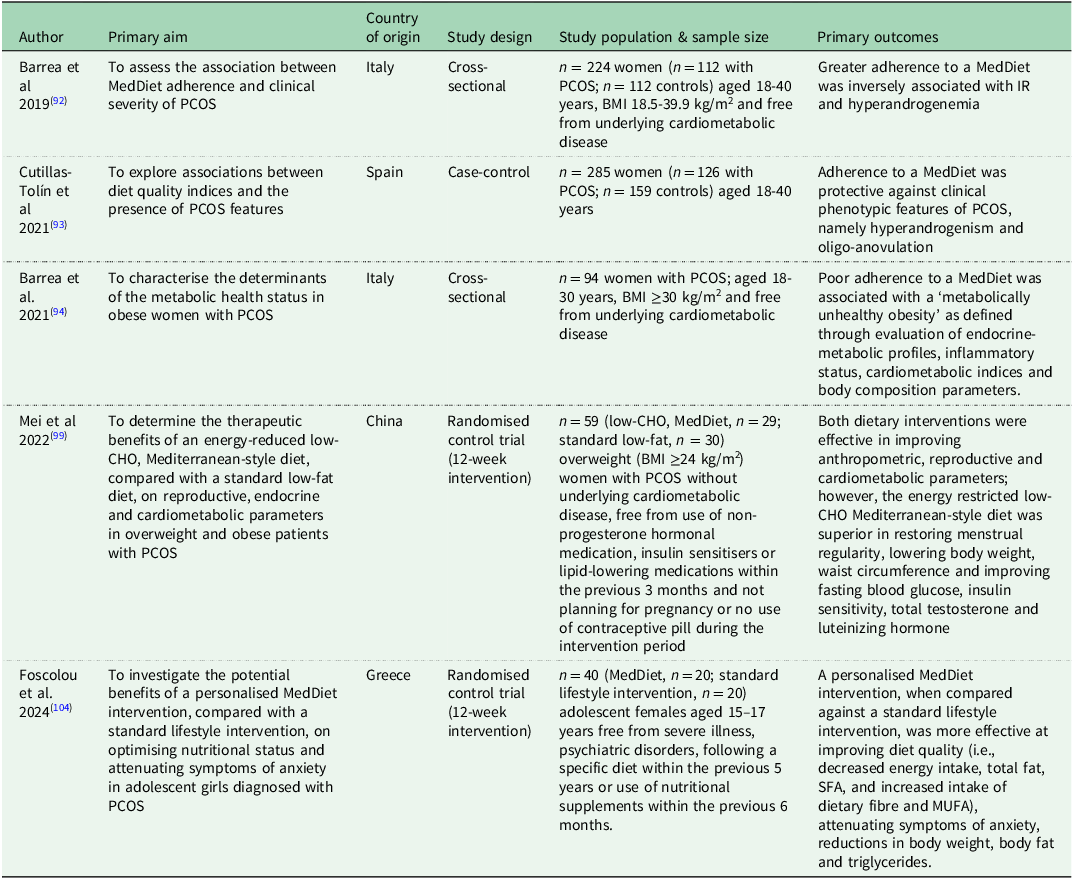
Abbreviations: MedDiet, Mediterranean diet; PCOS, polycystic ovary syndrome; IR, insulin resistance; CHO, carbohydrate; SFA, saturated fatty acid; MUFA, monounsaturated fatty acid.
Nevertheless, the absence of well-designed published clinical trials exploring the efficacy of a MedDiet intervention in women with PCOS represents an important gap in the research literature. In one of the only published randomised controlled trials, Mei et al(Reference Mei, Ding and Wang99) showed that an energy-restricted low-carbohydrate Mediterranean-style diet was superior in restoring menstrual regularity, lowering body weight, waist circumference and improving fasting blood glucose, insulin sensitivity, blood lipids, total testosterone and luteinizing hormone when compared against an energy-restricted low-fat diet in n = 59 Chinese women with PCOS and overweight or obesity. Although these results are indeed promising, irrespective of being identified as a Mediterranean-style diet, the dietary protocol described in the aforementioned study was not reflective of a Mediterranean-stye diet. For example, MedDiet principles (e.g., high intake of fruits, vegetables, legumes, nuts and EVOO) were combined with a low-carbohydrate diet, consisting of less than 100 g per day. Moreover, the dietary intervention was also calorie-restricted. As such, it is plausible that any potential benefits observed may have been attributable to the caloric-restricted, low-carbohydrate component of the intervention, thus diluting any potential mechanistic benefit of the MedDiet. In general, dietary interventions targeted for women with PCOS and overweight or obesity are typically designed to create a caloric deficit to elicit weight loss. However, achieving caloric restriction and weight loss targets in this cohort is challenging, when compared to women without PCOS(Reference Lim, Norman and Davies100). Although achieving clinically significant weight loss (e.g., ≥5% of body weight) over short intervention periods has been documented in PCOS, attrition rates are almost 50% suggesting difficulties with adhering to calorie-restricted diets(Reference Lim, Hutchison and Van Ryswyk101–Reference Moran, Noakes and Clifton103). Lastly, few studies investigate the potential benefits of a MedDiet on psychological outcomes in women with PCOS. Foscolou et al(Reference Foscolou, Papandreou and Gioxari104) showed that a personalised MedDiet intervention, when compared against a standard lifestyle intervention, attenuated symptoms of anxiety in adolescent females with PCOS; however, to the best of our knowledge, this has yet to be thoroughly investigated in adult women.
Individual food groups and /or biologically active dietary constituents consistent with a MedDiet and their potential impact on cardiometabolic, reproductive and mental health have previously been reviewed(Reference Abodi, De Cosmi and Parazzini105–Reference Winiarska-Mieczan, Kwiecień and Jachimowicz-Rogowska107). However, given the synergistic relationship of nutrients within the complex matrices of an existing dietary pattern, several physiological mechanisms connecting MedDiet adherence with clinical features of PCOS are likely. Therefore, the evidence related to MedDiet adherence and cardiometabolic, reproductive and psychological outcomes and their proposed mechanisms, will be summarised herein.
Evidence from cardiometabolic outcomes
In the PREvención con DIeta MEDiterránea (PREDIMED) study, Estruch et al(Reference Estruch, Ros and Salas-Salvadó108) reported a 30% risk reduction in major cardiovascular events over a 5-year period in patients at high risk of cardiovascular disease when assigned to either a MedDiet supplemented with EVOO (1 litre/week) or nuts (30 grams/day), compared to those assigned to a low-fat control diet. Furthermore, after 4 years of follow-up, participants assigned to either of the two MedDiets, without caloric restriction, had a 40% and 18% reduction, respectively, in the incidence of T2DM compared to those in the low-fat control diet(Reference Salas-Salvadó, Bulló and Estruch109). Investigators from the CORonary Diet Intervention with Olive oil and cardiovascular PREVention (CORDIOPREV) study assessed the effects of a MedDiet versus a low-fat control on endothelial function, as assessed by flow-mediated dilation (FMD), in patients with established coronary heart disease(Reference Delgado-Lista, Alcala-Diaz and Torres-Peña110). Yubero–Serrano et al(Reference Yubero-Serrano, Fernandez-Gandara and Garcia-Rios111) reported that patients assigned to the MedDiet intervention had higher FMD and endothelial progenitor cells and decreasing endothelial microparticles, regardless of the severity of endothelial dysfunction. Moreover, the investigators also showed that adherence to a MedDiet intervention decreased intracellular ROS production, cellular apoptosis and endothelial cell senescence and increased cellular proliferation and angiogenesis.
Using a randomised cross-over study, Galie et al(Reference Galié, García-Gavilán and Papandreou112) assessed changes in plasma metabolites after following a MedDiet compared to the consumption of a singular healthy food (nuts) within the context of a non-MedDiet among participants with the metabolic syndrome. The investigators showed that adherence to a MedDiet, rather than consuming nuts in the context of a non-MedDiet, was significantly associated with changes in circulating metabolites (in particular lipids, acylcarnitines, amino acids, steroids and tricarboxylic acid (TCA) intermediates); importantly these changes were also related to improvements in participants’ metabolic risk profile, independent of changes in body weight, including decreases in fasting glucose, insulin and HOMA-IR. Esposito et al(Reference Esposito, Marfella and Ciotola113) reported that after 2 years of follow-up, participants with the metabolic syndrome randomised to receive a MedDiet (without energy restriction) showed significant improvements in endothelial function and reduced markers of systemic vascular inflammation, independent of changes in body weight, compared to those randomised to a standard healthy diet congruent with dietary guidelines. In contrast, Salas-Salvado et al(Reference Salas-Salvadó, Díaz-López and Ruiz-Canela114) reported significant improvements in cardiovascular disease risk factors including waist circumference, fasting glucose, insulin sensitivity, triglycerides and HDL cholesterol in participants enrolled in the PREDIMED-Plus lifestyle intervention, aimed at evaluating the effect of an energy-restricted MedDiet intervention, physical activity promotion and behaviour modification in overweight and obese middle-aged adults with the metabolic syndrome.
Similar improvements in metabolic risk profiles have also been observed in people with existing T2DM. When compared against participants’ habitual diet, Itsiopoulos et al(Reference Itsiopoulos, Brazionis and Kaimakamis115) showed that a 12-week ad libitum MedDiet intervention was associated with significant reductions in HbA1c levels. In patients newly diagnosed with T2DM, Esposito et al(Reference Esposito, Maiorino and Petrizzo116) showed that a lower carbohydrate MedDiet resulted in greater reductions in HbA1c levels and delayed the need for diabetes medications by ∼2 years compared with a standard low-fat diet. Moreover, this effect was largely independent of weight loss. In sub-group analysis from the CORDIOPREV study, Gutierrez-Mariscal et al(Reference Gutierrez-Mariscal, Cardelo and de La Cruz117) reported that in newly diagnosed diabetic patients with coronary heart disease, long-term (5 years) consumption of a MedDiet intervention was associated with improved glycemic control and a higher probability of T2DM remission.
Evidence from fertility outcomes
Research shows that maternal preconception dietary behaviours may be related to fertility, as well as influence IVF outcomes, including oocyte and embryo quality, implantation and successful completion of pregnancy(Reference Stephenson, Heslehurst and Hall118). Nevertheless, there is a paucity of evidence to support specific dietary patterns or guidelines to improve fertility outcomes for women with much of the evidence linking diet to fertility largely based on studies of single nutrients, or individual food groups as opposed to whole dietary patterns, particularly for women undertaking IVF(Reference Gaskins, Nassan and Chiu119). Moreover, much of this evidence is limited to observational study designs. In a prospective cohort study of n = 244 women without obesity (aged 22–41 years) undergoing a first IVF treatment, Karayiannis et al(Reference Karayiannis, Kontogianni and Mendorou120) reported that greater adherence to a MedDiet was associated with ∼2.7 times higher likelihood of clinical pregnancy and live birth. Similar findings were also reported in a prospective cohort of women without obesity (n = 357) who underwent a total of 608 ART cycles, with the investigators reporting that women in the second and third quartiles of MedDiet adherence had higher probability of clinical pregnancy and live birth compared with women in the first quartile(Reference Gaskins, Nassan and Chiu119). In a further observational study of n = 700 Chinese women about to commence IVF, greater adherence to a MedDiet was positively associated with greater embryo yield(Reference Sun, Lin and Lin121). However, not all studies have described positive associations between MedDiet adherence and successful IVF outcomes, including clinical pregnancy, live birth, oocyte yield and embryo quality(Reference Noli, Ferrari and Ricci122,Reference Ricci, Bravi and Noli123) .
The menstrual cycle is also an important indicator of reproductive health and irregular menstrual cycles may indicate anovulation, and thus decrease the ability to conceive(Reference Barbosa, de Sá and Rocha124). In a cross-sectional analysis of n = 311 Spanish female university students, Onieva-Zafra et al(Reference Onieva-Zafra, Fernández-Martínez and Abreu-Sánchez125) reported that women with low adherence to a MedDiet had longer menstrual cycles than those with higher adherence. Moreover, upon further analysis of individual constituents of a MedDiet, women who consumed less than two pieces of fruit per day were more likely to suffer from menstrual pain; similar findings were also observed for women who infrequently consumed legumes (≤1 time per week)(Reference Onieva-Zafra, Fernández-Martínez and Abreu-Sánchez125).
Evidence from psychological outcomes
An increasing body of evidence has emerged suggesting that diet quality may be an important modifiable risk factor for mental health disorders. In particular, evidence from systematic reviews and meta-analyses suggests that adherence to MedDiet is inversely associated with a risk of depression or depressive symptoms in both younger and middle-aged adults(Reference Altun, Brown and Szoeke126,Reference Shafiei, Salari-Moghaddam and Larijani127) . In addition to the growing body of observational research, the SMILES(Reference Jacka, O’Neil and Opie128) and HELFIMED(Reference Parletta, Zarnowiecki and Cho129) studies were among the first two clinical trials to show that a MedDiet intervention can be effective at reducing depressive symptoms in adults with major depression or mild depressive symptoms. These findings have since been corroborated in a recent systematic review and meta-analysis of clinical trials(Reference Bizzozero-Peroni, Martínez-Vizcaíno and Fernández-Rodríguez130). Nevertheless, given the between-study heterogeneity, the investigators suggested a need for more robust, long-term randomised controlled trials (RCTs) in order to establish recommendations in clinical practice.
Potential therapeutic benefits of a Mediterranean Diet
Although the exact mechanisms by which a MedDiet exerts potential benefits on improving clinical features of PCOS remains to be elucidated, it is likely related to the anti-inflammatory potential of the dietary pattern, reductions in oxidative stress and a higher intake of antioxidants derived from the dietary pattern, as depicted in Fig. 1. The apparent anti-inflammatory benefits of a MedDiet have been shown in a number of clinical trials, including sub-group analysis of the PREDIMED study where adherence to both MedDiet intervention groups downregulated the expression of adhesion molecules on circulating T lymphocyte and monocyte surfaces, as well as inflammatory biomarkers (TNF-α, IL-6, MCP-1 and CRP) in serum(Reference Braga, Halpern and Setti131–Reference Moran, Tsagareli and Noakes135). As such, there is now a large body of evidence from observational and intervention studies that have identified an inverse relationship between plant-based dietary patterns and oxidative stress and pro-inflammatory biomarkers(Reference Chrysohoou, Panagiotakos and Pitsavos136–Reference Sureda, Bibiloni and Julibert139). This is not surprising given that the MedDiet is predominantly plant-based and contain numerous anti-inflammatory constituents which may displace other dietary or food components (e.g., saturated fat, sugar and ultra-processed foods) which are known to elicit chronic inflammation and chronic disease. For example, flavonoids are biologically active polyphenolic compounds ubiquitously found in plant-based foods with antioxidant and anti-inflammatory effects(Reference González-Gallego, García-Mediavilla and Sánchez-Campos140,Reference Yahfoufi, Alsadi and Jambi141) . Furthermore, carotenoids and polyphenols both act as potent scavengers of ROS, inhibit lipid peroxidation and modulate redox-sensitive transcription factors involved in the up-regulation of pro-inflammatory cytokines(Reference Fiedor and Burda142,Reference Liu143) . Specifically, they suppress pro-inflammatory molecules and modulate inflammatory pathways, including NF-κB, AMP-activated protein kinase (MAPK) and the arachidonic acid pathway(Reference Yahfoufi, Alsadi and Jambi141). For example, polyphenols from EVOO, the principal lipid source in a MedDiet, blunts pro-oxidant enzymes NOX-2 and NOX-4 and increases the expression of anti-inflammatory molecules including peroxisome proliferator-activated receptor-γ (PPARγ) mRNA(Reference Nani, Murtaza and Sayed Khan144). Moreover, EVOO polyphenols also attenuate TNF-α-induced NF-κB activation and thus elicits a protective function on the endothelium, therefore protecting against arteriosclerosis and major cardiovascular events(Reference Carpi, Scoditti and Massaro145). In addition, previous literature has shown that higher intakes of soluble fibre can modulate inflammatory responses in response to the production of short-chain fatty acids, in particular butyrate, which is involved in the activation of transcription factors which modulate the expression of genes encoding pro-inflammatory cytokines(Reference Bach Knudsen, Lærke and Hedemann146–Reference McLoughlin, Berthon and Jensen148). Dietary antioxidants, in particular vitamins C and E, are potent free radical scavengers where there is cross-sectional evidence showing an inverse association with pro-inflammatory cytokines(Reference Upritchard, Sutherland and Mann149,Reference Wannamethee, Lowe and Rumley150) . Moreover, several systematic reviews have been published regarding the role of omega-3 polyunsaturated fatty acids (n-3 PUFA), a key lipid source within a MedDiet(Reference Mantzioris, Muhlhausler and Villani151), on ameliorating inflammatory biomarkers in patients’ chronic diseases(Reference Natto, Yaghmoor and Alshaeri152,Reference Rangel-Huerta, Aguilera and Mesa153) . In particular, the long-chain marine n-3 PUFA fatty acids, eicosapentaenoic acid (EPA) and docosahexaenoic acid (DHA) partially inhibit a number of key aspects of inflammation including leucocyte chemotaxis, expression of adhesion molecules and leucocyte–endothelial adhesive interactions, production of eicosanoids and the up-regulation of pro-inflammatory cytokines, including TNF-α and IL-6(Reference Calder154,Reference Calder155) . Often interlinked, the proposed anti-inflammatory actions of marine n-3 PUFAs include altering the phospholipid fatty acid composition of cell membranes, inhibition of the pro-inflammatory transcription factor nuclear factor kappa B and activation of the anti-inflammatory transcription factor peroxisome proliferator-activated receptor γ(Reference Calder156).
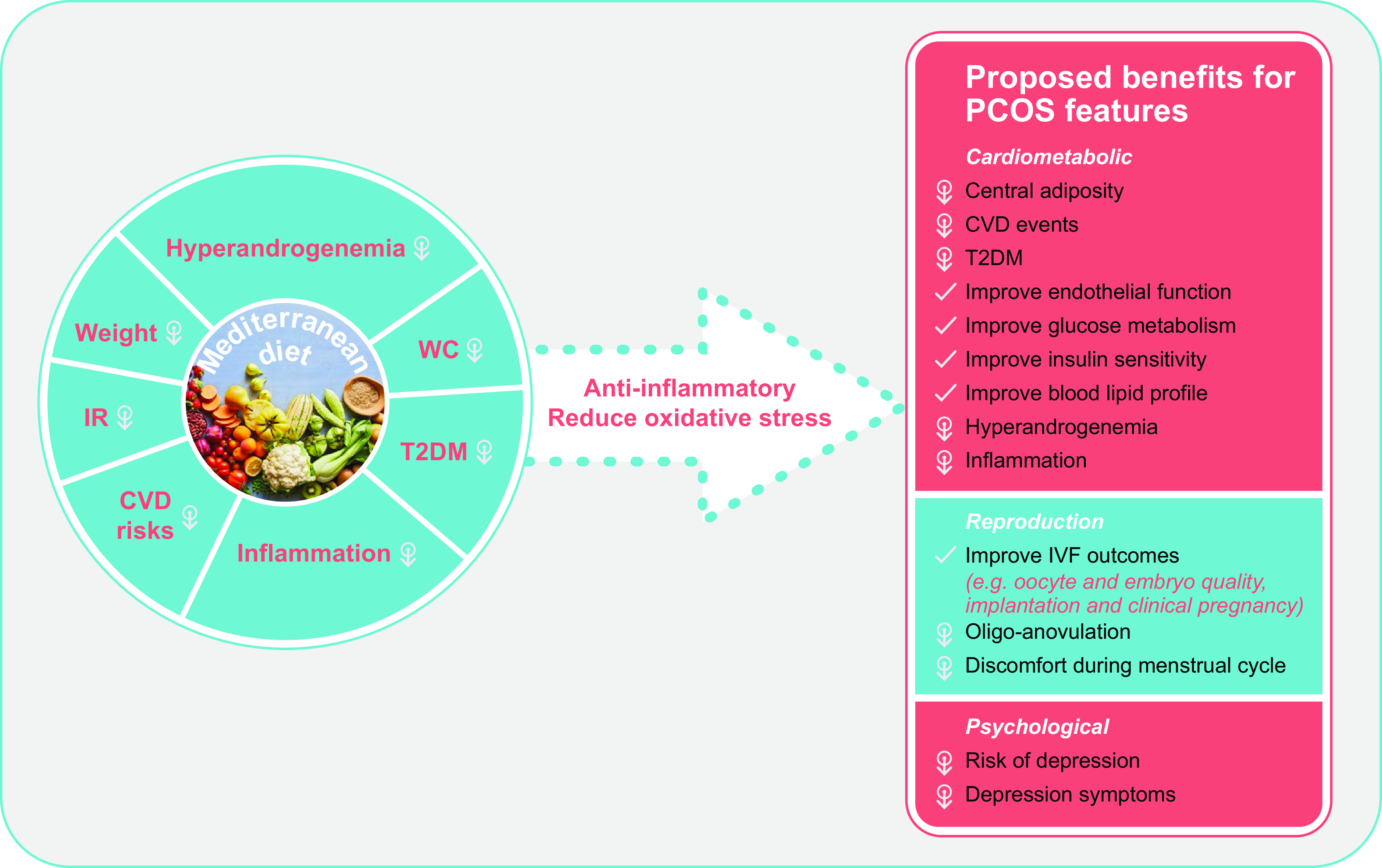
Fig. 1. The proposed mechanisms and benefits of a Mediterranean diet for features of polycystic ovary syndrome. IR: insulin resistance, CVD: cardiovascular disease, T2DM: type 2 diabetes mellitus, WC: waist circumference, IVF: in vitro fertilisation.
Higher intakes of unsaturated fats (e.g., EVOO, nuts and fatty fish) have been associated with increased insulin sensitivity and improved beta cell function(Reference Bhaswant, Poudyal and Brown157). Specifically, bioactive compounds from EVOO (e.g., polyphenols) and marine n-3 PUFAs (e.g. EPA and DHA) act in the gastrointestinal tract to improve postprandial insulin release and sensitivity through increases in glucagon-like-peptide-1 (GLP1) expression from endocrine L-cells, which stimulates insulin secretion and inhibits glucagon secretion(Reference Bhaswant, Poudyal and Brown157–Reference Thombare, Ntika and Wang159). Moreover, EPA and DHA have also been shown to increase insulin sensitivity by altering the concentrations of adipokines including leptin, adiponectin, resistin and visfatin; increasing the expression of GLUT-4 and producing anti-inflammatory effects to increase glucose uptake(Reference Bhaswant, Poudyal and Brown157). Lastly, it is well documented that dietary flavonoids present in plant foods, in particular quercetin, hesperidin and anthocyanins possess anti-diabetic properties including enhancing the function of glucose transporters, reducing metabolic stress in mitochondria, improved beta cell functioning and attenuation of oxidative stress in response to inflammation in tissues including muscle, liver and adipose(Reference Dhanya, Arya and Nisha160–Reference Hussain, Tan and Murtaza162).
The proposed mechanisms whereby anti-inflammatory properties of a MedDiet and the influence on outcomes related to fertility, although largely unclear, have previously been reviewed by members of our team(Reference Alesi, Villani and Mantzioris163). For example, excess ROS coupled with a low intake of dietary antioxidants results in oxidative stress. Chronic oxidative stress can cause lipid peroxidation of cell membranes and subsequent DNA damage in functioning cells of the reproductive system(Reference Al-Gubory, Fowler and Garrel164) which may help to explain how adherence to a MedDiet may enhances female fertility and IVF success rate. Moreover, a higher folate intake may increase the number of oocyte and embryo by facilitating DNA methylation(Reference Anckaert, Romero and Adriaenssens165). With respect to menstrual parameters, pro-inflammatory mediators including PGF2-α and PGE2, which are associated with inflammation, play a role in dysmenorrhoea(Reference Barcikowska, Rajkowska-Labon and Grzybowska166). These prostaglandins cause pain by increasing contractions in the uterus and are also involved in enhancing vasoconstriction, thereby controlling local hypoxia and smooth muscle contraction and the production of anaerobic metabolites(Reference Barcikowska, Rajkowska-Labon and Grzybowska166). It has been postulated that marine n-3 PUFAs can ease menstrual pain and dysmenorrhoea by inhibiting arachidonic acid metabolism and suppressing the production of pro-inflammatory prostaglandins that are implicated in dysmenorrhoea(Reference Trebble, Wootton and Miles167) with its potential efficacy supported by findings from systematic reviews and meta-analyses(Reference Mohammadi, Mirjalili and Faraji168,Reference Snipe, Brelis and Kappas169) .
A number of proposed mechanisms have been discussed to help explain the interplay between adherence to a MedDiet and risk of depression(Reference Marx, Lane and Hockey170). The most compelling related to the anti-inflammatory bioactive constituents of a MedDiet (e.g., carotenoids polyphenols and n-3 PUFAs) together with vitamins and trace minerals with antioxidant properties which can attenuate key biological mechanisms (e.g., oxidative stress and inflammation) related to depression(Reference Marx, Lane and Hockey170). Phenolic compounds in particular may play an important role due to their ability to protect neurones from oxidative stress and the interplay with nitric oxide to reduce inflammation and protect the vascular endothelium(Reference Bayes, Schloss and Sibbritt171,Reference Fazel Nabavi, Dean and Turner172) . Other plausible mechanisms include normalising neurotransmitter production, HPA axis function and glucocorticoid receptor signalling, all of which are altered with depression(Reference Holsboer and Ising173,Reference Miller, Maletic and Raison174) . Lastly, key dietary constituents of a MedDiet, namely nuts and legumes, which are rich in dietary fibre, unsaturated fatty acids and bioactive compounds (e.g., antioxidants and polyphenols), elicit a favourable prebiotic effect on the gut microbiota composition and the production of anti-inflammatory metabolites, such as butyrate(Reference Berding, Vlckova and Marx175).
Transferability and feasibility of a Mediterranean dietary pattern. Can it be followed in non-Mediterranean populations?
Whether the MedDiet, or at least principles of a MedDiet, can be followed in non-Mediterranean countries is up for debate and an emerging area of research. Nevertheless, due to its proposed health benefits, the translation of a MedDiet to non-Mediterranean populations is appealing and warrants ongoing research. Two previous feasibility studies conducted in Australia showed that participants generally felt confident in their capabilities of long-term adherence(Reference Davis, Bryan and Hodgson176,Reference Zacharia, Patterson and English177) . Similar findings have also been observed in the UK(Reference Appleton, McEvoy and Lloydwin178,Reference Lara, Turbett and Mckevic179) . Furthermore, members of our team have previously reviewed the literature on the efficacy and adherence of a MedDiet used as a dietary intervention in clinical trials conducted in Australia against primary outcomes related to cardiometabolic risk factors, glycaemic control, cognition, hepatic steatosis and depressive symptomology(Reference Mantzioris and Villani180). Although long-term adherence was achievable, this was not without the inclusion of one-on-one and frequent counselling sessions provided by trained Dietitians, provision of educational resources and key food items consistent with a MedDiet (e.g., EVOO, legumes and nuts). As such, it remains unknown as to whether long-term adherence is possible, especially in non-Mediterranean populations, without adequate educational resources and support to help facilitate compliance(Reference Arentz, Smith and Abbott181). Additionally, literature suggests a need for developing strategies aimed at enhancing skills related to goal-setting and self-efficacy for sustained dietary adherence(Reference Teede, Misso and Deeks30,Reference Arentz, Smith and Abbott181–Reference Lim, Smith and Costello183) . A previous cross-sectional analysis of n = 606 Australian adults identified a number of important barriers towards adherence and uptake to a MedDiet, including knowledge, motivation, affordability, time and suitability(Reference Scannell, Villani and Mantzioris184). In the context of PCOS, Moran et al.(Reference Moran, Grieger and Mishra185) used cross-sectional data from the Australian Longitudinal Study on Women’s Health and reported that women with PCOS were more likely to consume a dietary pattern consistent with MedDiet principles, suggesting there is potential for acceptability of a MedDiet in PCOS. Nevertheless, feasibility and acceptability studies exploring the adherence to a MedDiet in PCOS are scant.
Future direction and conclusions
Given the inherit complexity in the pathophysiology of PCOS, the precise mechanisms related to how a MedDiet attenuates cardiometabolic, reproductive and psychological features of PCOS remains in an enigma. At present, evidence from clinical trials is limited but emerging(Reference Scannell, Moran and Mantzioris186). Notably, ongoing studies, including those listed on clinical trial registries, investigating the efficacy of a MedDiet intervention on PCOS is scant. Our group is currently investigating the efficacy of a MedDiet intervention on hormonal, metabolic and anthropometric measures, without the need for caloric restriction, in women with PCOS and overweight or obesity(Reference Scannell, Moran and Mantzioris186). Given that IR is a prominent clinical feature in the pathophysiology of PCOS, a dietary approach based on key principles of a MedDiet, without the need for caloric restriction, may indeed represent a novel dietary intervention for women with and without obesity. Importantly, results from the aforementioned study will provide preliminary evidence which can be further explored using longer-term and adequately powered multimodal clinical trials investigating the feasibility of a MedDiet intervention, coupled with lifestyle-related behaviour changes on outcomes pertinent in PCOS including cardiometabolic parameters, inflammatory markers, menstrual cyclicity, fertility and depressive symptoms. Of further importance, this work will also aim to identify the acceptability and feasibility of a MedDiet in women with PCOS. Given that there is limited literature on the feasibility and acceptability of a MedDiet intervention in women with PCOS, it is unknown whether there are unique barriers that would impede uptake and adherence within this population of women. Being able to identify and address potential barriers is an important step for informing effective and acceptable dietary interventions specific to clinical practice.
In conclusion, we have highlighted some observational evidence to support an inverse relationship between MedDiet adherence and PCOS features (namely IR and hyperandrogenemia). Nevertheless, well-designed clinical trials are needed to elucidate these findings. We have also explored the potential mechanistic benefits of the MedDiet on improving clinical features of PCOS which are likely related to the anti-inflammatory potential of the diet, reductions in oxidative stress and a higher intake of antioxidants. Although much of the proposed mechanisms are largely founded on individual anti-inflammatory bioactive constituents of a MedDiet (e.g., carotenoids, polyphenols and n-3 PUFAs), it is important to appreciate the important and complex synergistic relationship of nutrients and bioactive compounds within an existing dietary pattern. Whilst the current evidence is not yet sufficiently available to inform clinical practice, following a healthy dietary pattern, such as the MedDiet, to attenuate short and long-term symptoms associated with PCOS has little known adverse consequences and may aid in reducing the longer-term risks associated with cardiometabolic diseases and reproductive and psychological dysfunction in women with PCOS.
Authors contributions
Conceptualisation and methodology, N.S., A.V., and E.M., writing – original draft preparation, N.S. and A.V., writing – review and editing, N.S., A.V., E.M., and L.M. All authors have read and agreed to the published version of the manuscript.
Financial support
This research received no specific grant from any funding agency, commercial or not-for-profit sectors.
Competing interests
There are no conflicts of interest.


 Open access

