


Introduction
The energy balance (EB) principle, that is, the first law of thermodynamics, states that energy can be neither created nor destroyed, but only transformed. The human body is considered an open system, where energy (kcal) is added in the form of food (‘calories in’) and transformed to combustion to produce heat (‘calories out’)(Reference Buchholz and Schoeller1). Thus, EB represents the relationship between energy intake (EI) and energy expenditure (EE). Any imbalance between EI and EE results in a shift in energy stores and a subsequent change in weight as fat mass (FM) and fat-free mass (FFM).
The EB equation provides the basis of weight-loss strategies currently implemented in clinical practice. The ‘3500-kcal rule’ is a guidance used in clinical weight management that advises that a reduction of 500 kcal/d will result in 1 lb (∼0.5 kg) weight loss per week(Reference Thomas, Gonzalez and Pereira2). This approach relies on the assumption that FFM accounts for 25% of total weight loss with the remaining 75% lost as FM. This represents a ‘static model of weight loss’, where weight is lost at a fixed rate, decreasing in a linear manner during periods of dynamic weight loss(Reference Hall and Guo3).
However, while the principle of EB appears straightforward, quantifying energy imbalance during periods of energy restriction is much more complex. The first inaccuracy of the 3500-kcal rule lies in the assumption that the proportion of weight lost as FM and FFM remains constant during the weight-loss phase(Reference Thomas, Gonzalez and Pereira2). In actuality, the fraction of weight lost as either component changes during the weight-loss phase ranges between 20–40% for FFM and 60–80% FM, respectively(Reference Gallagher, Kelley and Thornton4), resulting in dynamic shifts in energy imbalance.
Second, while traditionally assumed to be independent variables, the components of EB, that is, EI and EE, are in fact functionally interdependent, with changes in one side of the equation corresponding with alterations in the other side(Reference Casanova, Beaulieu and Finlayson5,Reference Nunes, Casanova and Francisco6) . The evidence is very clear that if you restrict calories, EE will decline simultaneously(Reference Muller, Enderle and Bosy-Westphal7). This typically occurs in two ways: (i) obligatory reductions in EE resulting from a loss of metabolic tissue and (ii) adaptive reductions in EE resulting from ‘adaptive thermogenesis’ (AT), defined as the underfeeding-associated fall in resting energy expenditure (REE) independent of changes in FFM and FM(Reference Muller, Enderle and Pourhassan8,Reference Dulloo and Jacquet9) .
Thus, a 500-kcal deficit per day does not directly translate into 1 lb (0.5 kg) weight loss as traditionally assumed, resulting in less-than-predicted weight loss(Reference Thomas, Martin and Lettieri10,Reference Hall, Sacks and Chandramohan11) .
To account for such shifts in EB during the weight-loss phase, various mathematical models(Reference Thomas, Scioletti and Heymsfield12) (also referred to as dynamic models) have been developed based on the EB principle, simulating the non-linear nature of weight loss by modelling the dynamic changes in EE resulting from FFM loss and AT. Such models vary in complexity depending on (i) the way EE is subdivided and (ii) the way body mass is compartmentalised. While accurate models do exist, they often require complex parameters that are unobtainable in a clinical setting, often limited to simple demographics (e.g. gender and age) and anthropometric measures (e.g. height, weight, waist circumference).
The aim of this study is to produce a working mathematical model of weight loss requiring only simple baseline parameters to more accurately describe the dynamic trajectory of weight loss over a given time. Subsequently, the model will be tested and refined using a large database of female clients enrolled on a commercial weight management programme (LighterLife, Essex, United Kingdom).
Methods
The present study describes a mathematical model of weight loss developed based on estimates of the components of EB and how these change during periods of weight loss. Values used in the development of the model are determined based on existing observational weight-loss data.
Model development
The proposed mathematical model uses baseline inputs of weight (kg), EI (kcal), and physical activity level (PAL) to predict weight loss over a specified time. The model subdivides total daily energy expenditure into resting energy expenditure (REE), physical activity energy expenditure (PAEE), and diet-induced thermogenesis (DIT), modelling each compartment independently. An energy conversion of 7700 kcal per kg is assumed to convert energy deficit to weight loss as described by Equation 1:
 $${{{\rm{dw}}} \over {{\rm{dt}}}} = {1 \over {7700}}\left[ {{\rm{EI}} - \left( {{\rm{REE}} + {\rm{PAEE}} + {\rm{DIT}}} \right)} \right]$$
Equation 1: Simple equation for weight loss. ${{{\bf{dw}}} \over {{\bf{dt}}}}$
represents the rate of weight change over a given time. Weight loss is assumed as the discrepancy between EI and EE. EI is energy intake in kcal/d. Energy expenditure is subdivided into REE, PAEE, and DIT. REE is resting energy expenditure in kcal/d, PAEE is physical activity energy expenditure in kcal/d, and DIT is diet-induced thermogenesis in kcal/d. An energy conversion of 7700 kcal/kg is assumed to convert energy deficit to weight loss.
${{{\bf{dw}}} \over {{\bf{dt}}}}$
represents the rate of weight change over a given time. Weight loss is assumed as the discrepancy between EI and EE. EI is energy intake in kcal/d. Energy expenditure is subdivided into REE, PAEE, and DIT. REE is resting energy expenditure in kcal/d, PAEE is physical activity energy expenditure in kcal/d, and DIT is diet-induced thermogenesis in kcal/d. An energy conversion of 7700 kcal/kg is assumed to convert energy deficit to weight loss.
Energy intake and energy expenditure
EI (kcal/d) is used as a model input and is assumed true to that reported. REE (kcal/d) is estimated using the Cunningham Equation based on FFM(Reference Cunningham13). Baseline FFM% is estimated using gender-specific expressions developed by our group as described by Equation 2:
 $$FFM{\left( \% \right)_{males}} = {{\left( {0.25{w_0} + 43.5} \right)} \over {{w_0}}}$$
 $$FFM{\left( \% \right)_{females}} = {{\left( {0.25{w_0} + 24.9} \right)} \over {{w_0}}}$$
Equation 2: Predictive equations for starting FFM (%). A linear relationship between starting body weight and FFM (kg) was assumed where starting values for FFM of a lean male and female were obtained from the literature and excess body weight was assumed to be composed of 75% FM and 25% FFM. This value was divided by starting body weight, allowing us to predict baseline FFM (%). FFM, fat-free mass; FM, fat mass; w 0 , weight (kg).
PAL index(Reference Black, Coward and Cole14) is used to account for PAEE (kcal/d), where TEE is calculated as REE multiplied by PAL (TEE = REE x PAL). Values range from 1.2 (chair-bound/bed-bound) to 2.4 (strenuous work or highly active leisure) and are self-reported to most accurately reflect the individual’s lifestyle. DIT (kcal/d) is assumed a direct product of EI and is estimated using a coefficient of 10% in a lean population and 5% in an overweight/obese population(Reference Egan and Collins15).
Obligatory changes in energy expenditure
FFM is modelled as a function of weight loss. An exponential increase in FFM% is assumed on the onset of weight loss, persisting until an overall weight loss of 10% is achieved at which point FFM% stabilises approximately 10 percentage points higher than baseline. The predicted value for FFM% is multiplied by body weight at any given time to produce a predicted value for FFM (kg), as described by Equation 3:
 $${\rm{FFM}}\;\left( {{\rm{kg}}} \right)\; = \left( {{\rm{c}} + 0.1\left( {1 - {{\rm{e}}^{ - {{\rm{w}}_0} + {\rm{w}}\left( {\rm{t}} \right)}}} \right)} \right){\rm{w}}\left( {\rm{t}} \right)$$
Equation 3: Original expression for FFM change.
FFM, fat-free mass; c, baseline fat-free mass (%); w 0 , starting weight; w(t), weight at any given time.
Adaptive changes in energy expenditure
AT is modelled as a function of weight loss. An exponential increase in AT is assumed during the weight-loss phase, persisting until a total weight loss of 10% is achieved, at which point AT stabilises at a value equivalent to 15% of REE(Reference Leibel, Rosenbaum and Hirsch16,Reference Weigle, Sande, Iverius, Monsen and Brunzell17) as described by Equation 4:
 $${\rm{AT}}\;\left( \% \right)\; = \;0.15\left( {1 - \;{{\rm{e}}^{ - 70\left( {1 - {{{\rm{w}}\left( {\rm{t}} \right)} \over {{{\rm{w}}_0}}}} \right)}}} \right)$$
Equation 4: Expression for adaptive thermogenesis.
AT, adaptive thermogenesis; w 0 , starting weight; w(t), weight at any given time.
Using the expressions above, a mathematical model of weight loss was assembled and defined as an ordinary differential equation as described by Equation 5:
 $$\matrix{ {{{{\rm{dw}}} \over {{\rm{dt}}}} = {1 \over {7700}}({\rm{EI}}\; - {\rm{PAL}}\left( {1 - 0.15\left( {1 - \;{{\rm{e}}^{ - 70\left( {1 - {{{\rm{w}}\left( {\rm{t}} \right)} \over {{{\rm{w}}_0}}}} \right)}}} \right)\;} \right)} \hfill \cr {(22.8\left( {\left( {{\rm{c}} + 0.1\left( {1 - {{\rm{e}}^{ - {{\rm{w}}_0} + {\rm{w}}\left( {\rm{t}} \right)}}} \right)} \right){\rm{w}}\left( {\rm{t}} \right) + 484} \right) - \beta \left( {\;{\rm{EI}}} \right))} \hfill \cr } $$
Equation 5: Original mathematical model of weight loss. ${{{\bf{dw}}} \over {{\bf{dt}}}}$
represents the rate of weight change over a given time, w0 is the starting weight, and w(t) is the weight at any given time. EI is energy intake in kcal/d. PAL is physical activity level, and a value of 1.6 is assumed representing a moderately active lifestyle(Reference Black, Coward and Cole14). This value is multiplied by REE to account for PAEE. REE is estimated using the Cunningham equation(Reference Cunningham13) based on FFM, adjusted for AT. An exponential increase in AT is assumed during the weight-loss phase, persisting until a total weight loss of 10% is achieved, at which point AT stabilises at a value equivalent to 15% of REE. The parameter c represents FFM% which is estimated using gender-specific expressions developed by our group and multiplied by w(t) to produce a value for FFM (kg). An exponential increase in FFM% is assumed during the weight-loss phase, persisting until a total weight loss of 10% is achieved at which point FFM% stabilises approximately 10 percentage points higher than baseline. The parameter
${{{\bf{dw}}} \over {{\bf{dt}}}}$
represents the rate of weight change over a given time, w0 is the starting weight, and w(t) is the weight at any given time. EI is energy intake in kcal/d. PAL is physical activity level, and a value of 1.6 is assumed representing a moderately active lifestyle(Reference Black, Coward and Cole14). This value is multiplied by REE to account for PAEE. REE is estimated using the Cunningham equation(Reference Cunningham13) based on FFM, adjusted for AT. An exponential increase in AT is assumed during the weight-loss phase, persisting until a total weight loss of 10% is achieved, at which point AT stabilises at a value equivalent to 15% of REE. The parameter c represents FFM% which is estimated using gender-specific expressions developed by our group and multiplied by w(t) to produce a value for FFM (kg). An exponential increase in FFM% is assumed during the weight-loss phase, persisting until a total weight loss of 10% is achieved at which point FFM% stabilises approximately 10 percentage points higher than baseline. The parameter $\beta $
represents DIT coefficient which is assumed a value of 0.05 in an overweight/obese population(Reference Wang, Strouse and Saunders18,Reference De Jonge and Bray19) . This value is multiplied by EI to account for DIT. An energy conversion of 7700 kcal per kg is assumed to convert energy deficit to weight loss.
$\beta $
represents DIT coefficient which is assumed a value of 0.05 in an overweight/obese population(Reference Wang, Strouse and Saunders18,Reference De Jonge and Bray19) . This value is multiplied by EI to account for DIT. An energy conversion of 7700 kcal per kg is assumed to convert energy deficit to weight loss.
Model validation
The proposed mathematical model is tested using weight-loss data from a large retrospective database of female clients provided by LighterLife UK Ltd (LL; Essex, UK). Relevant data was extracted from the client database and anonymised by LL personnel prior to sharing with the study investigators for analysis.
Dietary intervention: LL is a commercial weight management company that offers a very low-energy total-diet replacement (TDR) plan. Clients consume four food packs per day (e.g. soups, shakes, pots, and meals) replacing all conventional food, providing 600–800 kcal/d, >50 g protein, 50–75 g carbohydrate, ∼17 g fat, 14 g fibre and 22–28 essential micronutrients. Following the active weight-loss phase, clients follow a standardised protocol for food reintroduction where food packs are gradually decreased and replaced with conventional foods. Clients attend weekly group meetings delivered by trained LL counsellors consisting of weigh-ins and optional behaviour support.
Inclusion criteria: Individuals self-referring to a very low-energy TDR programme for 6–12 weeks from the years 2017–2021 were considered eligible for inclusion in the extracted data. Clients were considered ineligible if they had previously enrolled on a LL programme and/or gained weight during the programme. Once an appropriate study population was determined, clients were anonymised by LL personnel using a client ID. The anonymised data were then disseminated to the study investigators for analysis.
Data extraction: Demographic and anthropometric data from LL clients enrolled in TDR programme were extracted. Interventions 6–12 weeks in duration were examined to reflect a typical TDR programme duration. The proposed mathematical model was used to predict:
-
1.) End-weight and weight loss in LL participants enrolled on VLED programmes of different intervention lengths (6–12 weeks).
-
2.) End-weight and weight loss at 7-d intervals in a subset of LL participants with sequential weight measures.
Mean error, that is, the mean difference between actual and predicted end-weight expressed as a percentage of actual end-weight, was determined post-intervention and at weekly intervals.
 $${\it{Mean \ error}} (\delta)={{{\rm{actual}} - {\rm{predicted}}\;{\rm{end}}\;{\rm{weight}}} \over {{\rm{actual}}\;{\rm{end}}\;{\rm{weight}}\;}}\times{100}$$
Modelling energy intake: In the LL cohort, a step function was used to describe EI, where a one-step increase in kcal intake was assumed from week 10 to account for those in the food reintroduction phase and due to expected deviation from dietary prescription in the later stages of the intervention as described by Equation 6:
 $${\rm{EI}} = \;\left\{ {\matrix{ {800} & {{\rm{t}} \lt 70} \cr {1200} & {{\rm{otherwise}}} \cr } } \right.$$
Equation 6: Step function for EI consisting of two intervals of different constant values with a jump between the horizontal line segments. For dieting durations <10 weeks, an intake of 800 kcal/d is assumed. For dieting durations >10 weeks, an intake of 1200 kcal/d is assumed. EI, energy intake; t, time.
Statistical analysis: Data are presented as mean and standard deviation. The Shapiro–Wilk test was used to test the normality of the data. A two-way ANOVA multiple comparisons test was performed to evaluate differences in actual weight loss vs. predicted weight loss across several timepoints. A one-way ANOVA or non-parametric Kruskal–Wallis test was performed to evaluate weekly weight changes. P-value <0.05 was considered as statistically significant.
Results
A total of 983 females were included in the present analysis. Clients were on average 47 years old with a mean body weight of 93.31 ± 19.18 kg and BMI of 34.51 ± 6.52 kg/m2. The largest proportion of individuals enrolled in the programme for 8 weeks (n = 175), and the smallest proportion enrolled for 12 weeks (n = 84). The mean intervention length was 9 weeks.
Prediction of post-interventional weight loss
Across all intervention lengths, an overall mean weight loss of 7.90 ± 4.63 kg was observed. On average, participants lost 8.45 ± 4.55% of their starting body weight. Our mathematical model was associated with an average mean error of 0.75 ± 5.12% equivalent to 1.07 ± 4.52 kg. The best agreement between actual and predicted end-weight was observed in those enrolled on a 6-week intervention, with a mean error of –0.28 ± 4.22% (0.16 ± 3.65 kg). Mean error increased with intervention length, with the largest mean error observed in those enrolled on a 12-week intervention (2.36 ± 6.26% equivalent to 2.45 ± 5.57 kg). Table 1 summarises the post-intervention mean error of our mathematical model across all timepoints.
Post-intervention mean error of mathematical model in the LighterLife study

Data presented as mean (SD). Participants followed a very low-energy total-diet replacement intervention for 6–12 weeks providing 600–800 kcal/d. End-weight was predicted by our mathematical model and compared to that observed in LighterLife participants. δ, mean error ([actual-predicted end-weight/actual end-weight] × 100).
Prediction of weekly weight loss
Total weight loss increased with dieting duration (r = 0.96) ranging from 2.28 ± 1.56 kg at week 1 to 9.55 ± 4.92 at week 11. In contrast, a negative correlation was observed between the rate of weight loss and dieting duration (r = 0.75), decreasing from 2.28 ± 1.56 kg/week at week 1 to 0.74 ± 5.13 kg/week at week 12. Absolute weight loss (P <0.0001) and rate of weight loss (P < 0.0001) changed significantly over time as determined by one-way ANOVA.
Figure 1 summarises the mean error of our model at weekly intervals for 12 weeks ranging from –1.44 ± 2.52% (–1.13 ± 2.14 kg) at week 3 to 2.09 ± 6.07% (2.24 ± 5.39 kg) at week 12. The best agreement was observed in 7–9-week interventions, predicting end-weight within 0.50% (<0.50 kg) of that observed.
Mean error of mathematical model at weekly intervals. Data presented as mean (SEM). End-weight in LighterLife participants was predicted by our mathematical model and compared to that observed. Week 1, –1.14 ± 1.68%, n = 713; week 2, –1.41 ± 2.4%, n = 656; week 3, –1.44 ± 2.5%, n = 606; week 4, –1.30 ± 2.93%, n = 599; week 5, –1.30 ± 3.64%, n = 565; week 6, –1.82 ± 4.09%, n = 578; week 7, –0.46 ± 4.4%, n = 465; week 8, –0.40 ± 4.91%, n = 388; week 9, –0.26 ± 5.27%, n = 277; week 10, 0.43 ± 6.28%, n = 190; week 11, 1.06 ± 5.96%, n = 121; week 12, 2.10 ± 6.07%, n = 59. δ, mean error ([actual-predicted end-weight/actual end-weight] × 100).

When translated into predicted weight loss, our model underestimated weight loss in the first 7 weeks of the intervention and overestimated weight loss from week 8 onwards (Table 2).
Actual versus predicted weight loss at weekly intervals in females enrolled on the LighterLife study
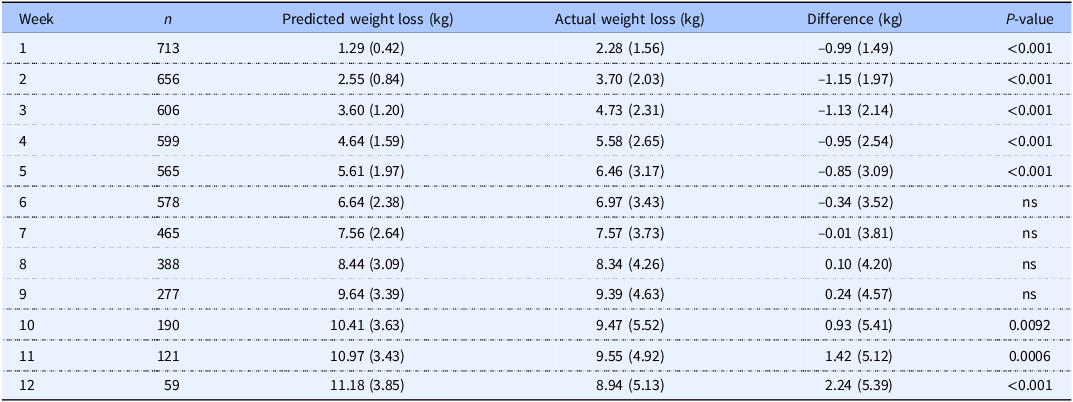
Data presented as mean (SD). Participants followed a very low-energy total-diet replacement intervention for 6–12 weeks providing 600–800 kcal/d. Weekly weight loss in LighterLife participants was predicted by our mathematical model and compared to that observed. The statistical significance of differences between actual and predicted weight loss was assessed using paired t-tests.
Actual weight loss can be compared with predicted weight loss using the Bland and Altman method as illustrated in Fig. 2. Mean bias between actual weight loss and weight loss predicted by mathematical modelling was 0.61 ± 3.19 kg. The 95% confidence interval for the difference was –5.65–6.86 kg.
Bland–Altman analysis to investigate the agreement between actual and predicted weight loss. Participants followed a very low-energy total-diet replacement intervention for 6–12 weeks providing 600–800 kcal/d. Average = (actual weight loss + predicted weight loss)/2. The dotted lines represent the upper and lower limits of agreement ( ± 2 SD). The solid line represents the average difference (kg).

Discussion
In the present study, a proposed mathematical predicted post-intervention end-weight within 0.75% of that observed in females enrolled on a 6–12 weeks TDR intervention, reflecting a mean weight-loss overestimation of 1.07 kg. Mean error increased with intervention length, from –0.28%, equivalent to 0.16 kg in 6-week interventions, to 2.36% equivalent to 2.45 kg in 12-week interventions.
The extraction of weekly weights allowed us to determine where our mathematical model was most and least accurate. Findings showed that our model underestimated weight loss in the first 6 weeks of the intervention, particularly in the first week where weight loss was 75% greater than that predicted. This is likely due to the rapid depletion of glycogen pools and associated water and electrolytes (stored in a proportion of 1:3 g, respectively) in the first 7–10 d equivalent to a total weight loss of 1.5–2.0 kg(Reference Buchholz and Schoeller1,Reference Heymsfield, Thomas and Nguyen20–Reference Heinitz, Hollstein and Ando22) .
Alternatively, mathematical modelling overestimated weight loss beyond week 8, possibly due to relaxed compliance in those enrolled on the programme for longer durations.
While data on the number of TDR products purchased per week were provided, this may not necessarily equate to TDR products consumed, particularly in participants enrolled on the intervention for over 8 weeks who may be using partial meal replacement or transitioning to a weight maintenance phase. Furthermore, the frequency of diet relapse is likely to increase with intervention length, particularly in those not participating in a gradual food reintroduction process, where rapid carbohydrate refeeding can result in a significant surge in hunger hormones and appetite. It is noteworthy that only 8.5% of the study population enrolled on the programme for 12 weeks, meaning relaxed compliance in one given participant will significantly impact mean weight loss.
Overall, our model was associated with a mean error of 0.60%, reflecting an average weight-loss overestimation of 0.27 kg. The best agreement between actual and predicted weight loss was observed from weeks 6–9 (ns p > 0.3827), representing the intervention length of ∼48% of study participants, where predicted end-weight was within 0.30% (0.35 kg) of the observed. Furthermore, this range encompasses the mean intervention length of 8.7 weeks suggesting our model can produce intervention end-weight with reasonable accuracy. Despite this, our weekly analysis identifies points of the weight-loss phase where our model requires further refinement.
Based on present findings, the following refinements were applied to our mathematical model: (i) new predictor equation for REE: REE is estimated using the Mifflin equation based on FFM(Reference Mifflin, St Jeor and Hill23), developed in a population with both lean and obese individuals, thus more reflective of our study population, and (ii) new formulation for FFM: FFM is modelled as a function of weight loss. A linear increase in FFM% is assumed during the weight-loss phase, persisting until a total weight loss of 20% at which point FFM% stabilises approximately 10 percentage points higher than baseline, as described by Equation 7:
 $${{FFM}}\;\left( {{{kg}}} \right)\; = \;\;\;\left( {\left\{ {\matrix{ {{{c}} + 0.1{{{{{w}}_0} - {{w}}\left( {{t}} \right)} \over {0.2{{{w}}_0}}}} & { \lt 20\% \;weight\;loss} \cr {{{c}} + 0.1} & {{{otherwise}}} \cr } } \right\}} \right){{w}}\left( {{t}} \right)$$
Equation 7: Refined expression for FFM change.
FFM, fat-free mass; c, baseline fat-free mass (%); w 0 , starting weight; w(t), weight at any given time.
Strengths and limitations
The proposed model requires only simple inputs of EI and PAL and thus can be used without expensive lab equipment. While several mathematical weight-loss models do exist, few rely only on clinically available anthropometric and demographic variables that are readily available in a clinical environment. Such a model may be used for (i) prescribing dietary intake in terms of energy deficit, (ii) setting target weights and timescales, (iii) monitoring dietary compliance, and (iv) patient/client motivation and self-management.
A key strength of the study is a large sample size strengthening the validity and reliability of our results. Individuals are self-referring and self-funding clients and thus are likely to be motivated and may exhibit higher levels of adherence.
The present study represents the nature of weight loss in free-living individuals, rather than study participants participating in a tightly regulated clinical trial. As such, the proposed mathematical model can be used to identify those deviating from the expected weight-loss trajectory who may require additional input. However, the accuracy of the proposed model is limited by the reliance on assumptions regarding EI and EE implemented to improve model applicability.
To quantify one side of the EB equation, that is, EE, it is important to keep the other side (EI) is as controlled as possible. Thus, to minimise potential error, our model is validated using weight-loss data from a TDR programme, using specially formulated food products of known energy content. If used as directed, TDR products are an accurate method of estimating EI.
However, it should be considered that there is likely much less variation in EI using TDR products than would be using food-based weight-loss programmes. Thus, it remains unclear if similar accuracy can be observed in food-based dietary interventions.
Predictor equations are developed using linear regression analysis which assumes a proportional increase in REE with increasing body weight. However, in morbidly obese subjects, excess weight is predominately FM rather than metabolic tissue. Furthermore, excess FFM is predominantly low-metabolic skeletal muscle rather than high-metabolic organs, for example, the brain, liver, and kidney(Reference Madden, Mulrooney and Shah24,Reference Heymsfield, Thomas and Bosy-Westphal25) . Thus, REE increases at a slower rate in a more curvilinear manner(Reference Forbes, Brown and Welle26–Reference Bosy-Westphal, Eichhorn and Kutzner28) rather than a linear increase as assumed by most predictive equations(Reference Madden, Mulrooney and Shah24).
Our model includes a term for AT based on observations from clinical weight-loss studies. While longitudinal studies support the existence of AT, significant between-individual variance is observed(Reference Hall and Guo3). AT is suggested to be biologically determined, whereby two existing phenotypes (‘thrifty’ and ‘spendthrift’) differ in their capacities to regulate EE in response to altered energy availability(Reference Muller, Enderle and Bosy-Westphal7,Reference Reinhardt, Thearle and Ibrahim29) . Subsequently, it should be considered that the term for AT assumed by our model may not be representative of all study participants. The proposed model assumes an immediate adaptive response to energy deficit. However, the onset time for AT is a matter of debate with a considerable amount of research suggesting AT takes weeks to develop(Reference Egan and Collins15).
Finally, the proposed model relies on the assumption that those purchasing over twenty-eight products per week are following the prescribed four products per day. Additional intake from conventional foods was not recorded and therefore our model relies on assumptions regarding programme adherence. Thus, despite the prescriptive nature of TDR, true values for EI remain uncertain.
Conclusion
Mathematical models have been used to simulate EB and weight dynamics for decades, yet application in clinical weight loss remains limited. The model proposed in the present study estimates energy deficit by simulating dynamic changes in EE using simple baseline parameters of gender, weight, and EI. In a large cohort of weight-reducing females, the proposed model was associated with a mean bias of 0.61 kg. Limitations of model assumptions need to be examined before clinical application; however, there is no doubt that mathematical modelling has a valuable place in the treatment of overweight and obesity.
Acknowledgements
We wish to express our gratitude to Prof Margaret Rayman, University of Surrey, for providing invaluable writing assistance and for reviewing and proofreading the manuscript. We would like to acknowledge Dr Kelly Johnston for offering her valuable input in the planning and development of the project. Finally, we would like to thank the team at LighterLife UK Ltd for their collaboration and financial support.
Financial support
This work was supported by the University of Surrey Doctoral College Studentship Award and LighterLife UK Ltd.
Declaration of Interests
None.
Authorship
AME and ALC designed and implemented the research. AME and JFR developed all expressions and functions and performed all calculations relating to the mathematical model. AME and ALC acquired funding and obtained the commercial data. AME processed the data and analysed and interpreted the results. AME drafted the manuscript with inputs from ALC and JFR.


 Open access

