





1 Introduction
The Erdős–Ko–Rado (EKR) theorem [Reference Erdős, Ko and Rado2] is a cornerstone result in extremal combinatorics. The theorem states that if n and k are positive integers with
$n \geq 2k$
 , then the maximum size of an intersecting family of k-element subsets of an n-element set is
$\binom {n-1}{k-1}$
, then the maximum size of an intersecting family of k-element subsets of an n-element set is
$\binom {n-1}{k-1}$
 . Furthermore, when
$n> 2k$
. Furthermore, when
$n> 2k$
 , the extremal families are precisely the ‘stars’, consisting of all k-element subsets that share a fixed common element.
Since its inception, the philosophy of the EKR theorem has blossomed into an active research field. The main goal is to characterise the size and structure of maximum intersecting families. This line of inquiry has been successfully ported to structures beyond set families. Analogous EKR-type theorems exist for vector spaces, permutations, orthogonal arrays and other algebraic structures. For a comprehensive overview of these generalisations, especially through algebraic graph theory and association schemes, we refer the reader to the excellent book by Godsil and Meagher [Reference Godsil and Meagher5]. There are also well-studied variations. These include r-wise intersecting families (any r members intersect at the same point), t-intersecting families (any two intersect in at least t points) or a combination of both.
In this paper, we focus on EKR-type questions for words. Let X be a finite alphabet of size
$q \geq 2$
 and let
$m \in \mathbb {N}$
and let
$m \in \mathbb {N}$
 . We consider the set
$X^m$
. We consider the set
$X^m$
 of all words of length m. Two words
$\mathbf {x} = (x_1, \ldots , x_m)$
of all words of length m. Two words
$\mathbf {x} = (x_1, \ldots , x_m)$
 and
$\mathbf {y} = (y_1, \ldots , y_m)$
and
$\mathbf {y} = (y_1, \ldots , y_m)$
 in
$X^m$
in
$X^m$
 are said to intersect if they agree in at least one coordinate, that is, if
$x_j = y_j$
are said to intersect if they agree in at least one coordinate, that is, if
$x_j = y_j$
 for some j with
$1 \leq j \leq m$
for some j with
$1 \leq j \leq m$
 . A collection
$T \subseteq X^m$
. A collection
$T \subseteq X^m$
 is an intersecting family if every pair of words in T intersects. The prototypical example of a large intersecting family is a star (or canonical intersecting family), which is defined by fixing a specific letter at a specific coordinate. All stars in
$X^m$
is an intersecting family if every pair of words in T intersects. The prototypical example of a large intersecting family is a star (or canonical intersecting family), which is defined by fixing a specific letter at a specific coordinate. All stars in
$X^m$
 have cardinality
$q^{m-1}$
have cardinality
$q^{m-1}$
 and it is well known that they have maximum size; for the sake of completeness, we provide a short proof in the following lemma.
Lemma 1.1. If
$T \subseteq X^m$
 is an intersecting family of words of length m on an alphabet X of size
$q\geq 2$
is an intersecting family of words of length m on an alphabet X of size
$q\geq 2$
 , then
$|T|\leq q^{m-1}$
, then
$|T|\leq q^{m-1}$
 .
.
Proof. Without loss of generality, X is given by
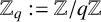
$\mathbb {Z}_q := \mathbb {Z}/q\mathbb {Z}$
 . For each
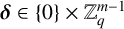
$\boldsymbol {\delta }\in \{0\} \times \mathbb {Z}_q^{m-1}$
. For each
$\boldsymbol {\delta }\in \{0\} \times \mathbb {Z}_q^{m-1}$
 , consider the set
$S(\boldsymbol {\delta })=\{\boldsymbol {\delta }, \boldsymbol {\delta }+\mathbf {1}, \ldots , \boldsymbol {\delta }+(\mathbf {q-1})\}$
, consider the set
$S(\boldsymbol {\delta })=\{\boldsymbol {\delta }, \boldsymbol {\delta }+\mathbf {1}, \ldots , \boldsymbol {\delta }+(\mathbf {q-1})\}$
 consisting of q words, where
$\mathbf {c}=(c, \ldots , c)$
consisting of q words, where
$\mathbf {c}=(c, \ldots , c)$
 represents a constant vector in
$\mathbb {Z}_q^{m}$
represents a constant vector in
$\mathbb {Z}_q^{m}$
 . As we vary
$\boldsymbol {\delta }$
. As we vary
$\boldsymbol {\delta }$
 , these
$q^{m-1}$
, these
$q^{m-1}$
 sets
$S(\boldsymbol {\delta })$
sets
$S(\boldsymbol {\delta })$
 partition
$\mathbb {Z}_q^m$
partition
$\mathbb {Z}_q^m$
 . Observe that for each
$\boldsymbol {\delta }\in \{0\} \times \mathbb {Z}_q^{m-1}$
. Observe that for each
$\boldsymbol {\delta }\in \{0\} \times \mathbb {Z}_q^{m-1}$
 , we have
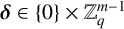
$|T \cap S(\boldsymbol {\delta })|\leq 1$
, we have
$|T \cap S(\boldsymbol {\delta })|\leq 1$
 since T is intersecting. Thus,
$|T|\leq q^{m-1}$
since T is intersecting. Thus,
$|T|\leq q^{m-1}$
 .
.
The Erdős–Ko–Rado phenomenon for words (equivalently, integer sequences or the Hamming scheme setting) has a rich history. Early extremal results on binary and integer sequences in Hamming-type spaces go back to Kleitman [Reference Kleitman7], and explicit EKR-type results for words were established in the 1980s by Livingston [Reference Livingston8], Frankl and Füredi [Reference Frankl and Füredi3], Moon [Reference Moon9], Gronau [Reference Gronau6], and Engel and Frankl [Reference Engel and Frankl1]. Later, Frankl and Tokushige [Reference Frankl and Tokushige4] resolved a conjecture from [Reference Frankl and Füredi3]. For a modern account of EKR-type results on words, see [Reference Godsil and Meagher5, Ch. 10].
Previous works on the subject have focused mostly on the case where
$q\geq 3$
 . In this range, the stars are the unique maximum intersecting families, a result first proved by Livingston [Reference Livingston8].
Theorem 1.2. Let X be a finite alphabet with
$|X|=q\geq 3$
 and let
$m\in \mathbb {N}$
and let
$m\in \mathbb {N}$
 . Every maximum intersecting family T of words of length m is a star.
Note that Theorem 1.2 fails when
$q=2$
 (that is, for binary codes). In fact, there are precisely
$2^{2^{m-1}}$
(that is, for binary codes). In fact, there are precisely
$2^{2^{m-1}}$
 maximum intersecting families. To see this, partition
$\{0,1\}^m$
maximum intersecting families. To see this, partition
$\{0,1\}^m$
 into
$2^{m-1}$
into
$2^{m-1}$
 complementary pairs, where each pair sums to the constant vector
$\mathbf {1}$
complementary pairs, where each pair sums to the constant vector
$\mathbf {1}$
 . Choosing one word from each pair yields an intersecting family of size
$2^{m-1}$
. Choosing one word from each pair yields an intersecting family of size
$2^{m-1}$
 and, therefore, a maximum intersecting family. Conversely, every intersecting family of size
$2^{m-1}$
and, therefore, a maximum intersecting family. Conversely, every intersecting family of size
$2^{m-1}$
 arises in this way, since the two words in each complementary pair do not intersect. By contrast, there are only
$2m$
arises in this way, since the two words in each complementary pair do not intersect. By contrast, there are only
$2m$
 stars in
$\{0,1\}^m$
stars in
$\{0,1\}^m$
 , so the vast majority of maximum intersecting families are not stars.
To the best of our knowledge, no previous work has further examined the case
$q=2$
 . One way to remedy the conclusion of Theorem 1.2 for binary words is to assume a stronger hypothesis on the intersecting family. A collection T of binary words is 3-wise intersecting if every three elements of T share at least one common bit at the same index. Our main result shows that this stronger condition is indeed sufficient to guarantee that the family is a star.
Theorem 1.3. Every maximum
$3$
 -wise intersecting family of binary words in
$\{0, 1\}^m$
-wise intersecting family of binary words in
$\{0, 1\}^m$
 is a star.
We prove Theorem 1.3 in Section 2. Inspired by the proof of Theorem 1.3, we also give a new proof of Theorem 1.2 in Section 3.
2 Proof of Theorem 1.3
We outline the strategy before giving the details. We argue by contradiction, assuming T is not a star. The key step is Claim 1, which shows that the
$3$
 -wise intersecting hypothesis forces each binary prefix of length k to appear exactly
$2^{m-k-1}$
-wise intersecting hypothesis forces each binary prefix of length k to appear exactly
$2^{m-k-1}$
 times in T. Applying this with
$k=m-1$
times in T. Applying this with
$k=m-1$
 yields two words
$\mathbf {x}$
yields two words
$\mathbf {x}$
 and
$\mathbf {y}$
and
$\mathbf {y}$
 in T sharing the same last bit u, and the
$3$
in T sharing the same last bit u, and the
$3$
 -wise intersecting condition then forces every word in T to have last coordinate u; this makes T a star, which is a contradiction.
Proof of Theorem 1.3
Let T be a maximum
$3$
 -wise intersecting family. By Lemma 1.1,
$|T|\leq 2^{m-1}$
-wise intersecting family. By Lemma 1.1,
$|T|\leq 2^{m-1}$
 . However, a star has size
$2^{m-1}$
. However, a star has size
$2^{m-1}$
 and, hence,
$|T|=2^{m-1}$
and, hence,
$|T|=2^{m-1}$
 . Assume for contradiction that T is not a star.
For each k with
$0\leq k\leq m$
 , we can partition T according to the first k bits. More precisely, given
$\boldsymbol {\delta }=(\delta _1, \ldots , \delta _k) \in \{0,1\}^k$
, we can partition T according to the first k bits. More precisely, given
$\boldsymbol {\delta }=(\delta _1, \ldots , \delta _k) \in \{0,1\}^k$
 , we define

When
$k=0$
 , we define
$T_{\boldsymbol {\delta }}=T$
, we define
$T_{\boldsymbol {\delta }}=T$
 . Then, T is partitioned as

Our key observation is the following claim.
Claim 1. Assume that T is
$3$
 -wise intersecting and not a star. For each k with
$0\leq k\leq m-1$
-wise intersecting and not a star. For each k with
$0\leq k\leq m-1$
 and each
$\boldsymbol {\delta } \in \{0,1\}^k$
and each
$\boldsymbol {\delta } \in \{0,1\}^k$
 ,
,

Equivalently, among the words of T, each prefix of length k appears exactly
$2^{m-k-1}$
 times.
Proof of the Claim
We prove the claim by induction on k. When
$k=0$
 , the assertion is trivial.
Fix
$k\geq 1$
 . First, we establish that
$T_{\boldsymbol {\delta }}\neq \emptyset $
. First, we establish that
$T_{\boldsymbol {\delta }}\neq \emptyset $
 for each
$\boldsymbol {\delta } \in \{0,1\}^k$
for each
$\boldsymbol {\delta } \in \{0,1\}^k$
 . Suppose, to the contrary, that
$T_{\boldsymbol {\alpha }}=\emptyset $
. Suppose, to the contrary, that
$T_{\boldsymbol {\alpha }}=\emptyset $
 for some
$\boldsymbol {\alpha }=(\alpha _1, \ldots , \alpha _k)$
for some
$\boldsymbol {\alpha }=(\alpha _1, \ldots , \alpha _k)$
 . By induction,

After decomposing the set above into a disjoint union

and using
$T_{\boldsymbol {\alpha }}=\emptyset $
 , we see that
$|T_{(\alpha _1, \ldots , \alpha _{k-1}, 1-\alpha _k)}| = 2^{m-k}$
, we see that
$|T_{(\alpha _1, \ldots , \alpha _{k-1}, 1-\alpha _k)}| = 2^{m-k}$
 and, thus,

Suppose

Pick
$(1-\alpha _1, 1-\alpha _2, \ldots , 1-\alpha _{k-1}, \alpha _k, y_{k+1}, \ldots , y_m) \in T_{(1-\alpha _1, 1-\alpha _2, \ldots , 1-\alpha _{k-1}, \alpha _k)}$
 . Then,

but

and

do not intersect, which gives a contradiction. Thus,

By a similar argument as above,

Since T is not a star, it is not the family of all binary vectors whose kth bit is
$1-\alpha _k$
 . Therefore, we can choose
$\boldsymbol {\rho } = (\rho _1, \ldots , \rho _k, \ldots , \rho _m)\in T$
. Therefore, we can choose
$\boldsymbol {\rho } = (\rho _1, \ldots , \rho _k, \ldots , \rho _m)\in T$
 , where
$\rho _k=\alpha _k$
, where
$\rho _k=\alpha _k$
 . However, the three elements,

are in T, but there is no coordinate in which all three words agree, which contradicts the hypothesis that T is a
$3$
 -wise intersecting family. This completes the proof that
$T_{\boldsymbol {\delta }}\neq \emptyset $
-wise intersecting family. This completes the proof that
$T_{\boldsymbol {\delta }}\neq \emptyset $
 for each
$\boldsymbol {\delta }\in \{0,1\}^k$
for each
$\boldsymbol {\delta }\in \{0,1\}^k$
 .
.
Second, we show that for each
$\boldsymbol {\delta }=(\delta _1, \ldots , \delta _k)\in \{0,1\}^k$
 ,
,

is intersecting. Given
$\widetilde {\mathbf {x}}=(x_{k+1}, \ldots , x_{m}), \widetilde {\mathbf {y}} = (y_{k+1}, \ldots , y_{m}) \in \widetilde {T_{\boldsymbol {\delta }}}$
 , pick an arbitrary element

Since T is
$3$
 -wise intersecting, the three binary words
$(\boldsymbol {\delta },\widetilde {\mathbf {x}}), (\boldsymbol {\delta }, \widetilde {\mathbf {y}})$
-wise intersecting, the three binary words
$(\boldsymbol {\delta },\widetilde {\mathbf {x}}), (\boldsymbol {\delta }, \widetilde {\mathbf {y}})$
 and
$\mathbf {z}$
and
$\mathbf {z}$
 intersect, that is, they agree in some coordinate. This shared bit must be in a position indexed by some
$j\in \{k+1, \ldots , m\}$
intersect, that is, they agree in some coordinate. This shared bit must be in a position indexed by some
$j\in \{k+1, \ldots , m\}$
 . In particular,
$\widetilde {\mathbf {x}}$
. In particular,
$\widetilde {\mathbf {x}}$
 and
$\widetilde {\mathbf {y}}$
and
$\widetilde {\mathbf {y}}$
 intersect; as a result,
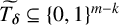
$\widetilde {T_{\boldsymbol {\delta }}}\subseteq \{0,1\}^{m-k}$
intersect; as a result,
$\widetilde {T_{\boldsymbol {\delta }}}\subseteq \{0,1\}^{m-k}$
 is intersecting. By Lemma 1.1,

Partition

By the inductive hypothesis,
$|T_{(\delta _1, \delta _2, \ldots , \delta _{k-1})}|= 2^{m-k}$
 . Combining (2.1) and (2.2) finishes the proof of the claim.
We now apply Claim 1 (which is valid since T is assumed not to be a star) to complete the proof by contradiction. Setting
$k=m-1$
 and
$\boldsymbol {\delta }=(0,0,\ldots ,0)\in \{0,1\}^{m-1}$
and
$\boldsymbol {\delta }=(0,0,\ldots ,0)\in \{0,1\}^{m-1}$
 , we get
$|T_{\boldsymbol {\delta }}|=1$
, we get
$|T_{\boldsymbol {\delta }}|=1$
 , so T contains a unique word of the form
$\mathbf {x}=(0,0,\ldots ,0,u)$
, so T contains a unique word of the form
$\mathbf {x}=(0,0,\ldots ,0,u)$
 for some
$u\in \{0,1\}$
for some
$u\in \{0,1\}$
 . Setting
$\boldsymbol {\delta }=(1,1,\ldots ,1)$
. Setting
$\boldsymbol {\delta }=(1,1,\ldots ,1)$
 , we similarly find a unique word
$\mathbf {y}=(1,1,\ldots ,1,v)\in T$
, we similarly find a unique word
$\mathbf {y}=(1,1,\ldots ,1,v)\in T$
 . Since
$\mathbf {x}$
. Since
$\mathbf {x}$
 and
$\mathbf {y}$
and
$\mathbf {y}$
 agree only at position m, and T is intersecting, we must have
$u=v$
agree only at position m, and T is intersecting, we must have
$u=v$
 .
.
Suppose some
$\mathbf {z}\in T$
 has last coordinate
$1-u$
has last coordinate
$1-u$
 . Then,
$\mathbf {x}$
. Then,
$\mathbf {x}$
 ,
$\mathbf {y}$
,
$\mathbf {y}$
 and
$\mathbf {z}$
and
$\mathbf {z}$
 share no common coordinate: any common coordinate would have to be position m (the only position where
$\mathbf {x}$
share no common coordinate: any common coordinate would have to be position m (the only position where
$\mathbf {x}$
 and
$\mathbf {y}$
and
$\mathbf {y}$
 agree), but
$\mathbf {z}$
agree), but
$\mathbf {z}$
 takes the value
$1-u\neq u$
takes the value
$1-u\neq u$
 there. This contradicts the
$3$
there. This contradicts the
$3$
 -wise intersecting hypothesis. As a result, every word in T has last coordinate u. Since the family of all binary words with last coordinate u is a star of size
$2^{m-1}=|T|$
-wise intersecting hypothesis. As a result, every word in T has last coordinate u. Since the family of all binary words with last coordinate u is a star of size
$2^{m-1}=|T|$
 , it follows that T equals this star; this contradicts our assumption that T is not a star.
3 A new proof of Theorem 1.2
We outline the strategy before giving the details. The proof proceeds by induction on m. The key idea is to partition T by the first letter to produce subfamilies
$\widetilde {T}_1, \ldots , \widetilde {T}_q$
 of
$(m-1)$
of
$(m-1)$
 -letter words. A double-counting argument, together with Claim 2 below, forces one of two scenarios for each set
$S(\boldsymbol {\delta })$
-letter words. A double-counting argument, together with Claim 2 below, forces one of two scenarios for each set
$S(\boldsymbol {\delta })$
 : either it is contained entirely in a single
$\widetilde {T}_i$
: either it is contained entirely in a single
$\widetilde {T}_i$
 or it meets each
$\widetilde {T}_i$
or it meets each
$\widetilde {T}_i$
 in the same singleton. In the first scenario, the hypothesis
$q\geq 3$
in the same singleton. In the first scenario, the hypothesis
$q\geq 3$
 allows us to propagate this containment to all of
$\mathbb {Z}_q^{m-1}$
allows us to propagate this containment to all of
$\mathbb {Z}_q^{m-1}$
 , showing that T is a star. In the second scenario, all subfamilies
$\widetilde {T}_i$
, showing that T is a star. In the second scenario, all subfamilies
$\widetilde {T}_i$
 coincide, and their common size and intersecting property let us apply the inductive hypothesis directly.
Proof of Theorem 1.2
We proceed by induction on m. The base case
$m=1$
 is trivial. We may assume, without loss of generality, that the alphabet X is given by
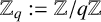
$\mathbb {Z}_q := \mathbb {Z}/q\mathbb {Z}$
is trivial. We may assume, without loss of generality, that the alphabet X is given by
$\mathbb {Z}_q := \mathbb {Z}/q\mathbb {Z}$
 .
.
Since T is a maximum intersecting family,
$|T|=q^{m-1}$
 by Lemma 1.1. For each i with
$1\leq i \leq q$
by Lemma 1.1. For each i with
$1\leq i \leq q$
 , we partition the words in T according to the first letter by defining

Given
$\boldsymbol {\delta }\in \mathbb {Z}_q^{m-1}$
 , consider the set of q words
$S(\boldsymbol {\delta })=\{\boldsymbol {\delta }, \boldsymbol {\delta }+\mathbf {1}, \ldots , \boldsymbol {\delta }+(\mathbf {q-1})\}$
, consider the set of q words
$S(\boldsymbol {\delta })=\{\boldsymbol {\delta }, \boldsymbol {\delta }+\mathbf {1}, \ldots , \boldsymbol {\delta }+(\mathbf {q-1})\}$
 , where
$\mathbf {c}=(c, \ldots , c)$
, where
$\mathbf {c}=(c, \ldots , c)$
 represents a constant vector in
$\mathbb {Z}_q^{m-1}$
represents a constant vector in
$\mathbb {Z}_q^{m-1}$
 . There are
$q^{m-1}$
. There are
$q^{m-1}$
 choices of
$\boldsymbol {\delta }\in \mathbb {Z}_q^{m-1}$
choices of
$\boldsymbol {\delta }\in \mathbb {Z}_q^{m-1}$
 . Since each set
$S(\boldsymbol {\delta })$
. Since each set
$S(\boldsymbol {\delta })$
 has q elements, this yields
$q^{m-2}$
has q elements, this yields
$q^{m-2}$
 distinct sets of the form
$S(\boldsymbol {\delta })$
distinct sets of the form
$S(\boldsymbol {\delta })$
 . Our key observation is the following claim.
Claim 2. For each such
$S(\boldsymbol {\delta })$
 ,
,

Moreover, the equality holds if and only if
$S(\boldsymbol {\delta }) \subseteq \widetilde {T}_i$
 for a unique i with
$1\leq i \leq q$
for a unique i with
$1\leq i \leq q$
 , or there exists
$\mathbf {k}=(k, \ldots , k)$
, or there exists
$\mathbf {k}=(k, \ldots , k)$
 such that
$S(\boldsymbol {\delta }) \cap \widetilde {T}_i=\{\boldsymbol {\delta }+\mathbf {k}\}$
such that
$S(\boldsymbol {\delta }) \cap \widetilde {T}_i=\{\boldsymbol {\delta }+\mathbf {k}\}$
 for all i with
$1\leq i \leq q$
for all i with
$1\leq i \leq q$
 .
.
Proof of the Claim
Fix
$\boldsymbol {\delta }\in \mathbb {Z}_q^{m-1}$
 . We consider two cases.
Case 1. There exists some i with
$1\leq i \leq q$
 such that
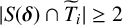
$|S(\boldsymbol {\delta })\cap \widetilde {T}_i|\geq 2$
such that
$|S(\boldsymbol {\delta })\cap \widetilde {T}_i|\geq 2$
 .
.
Take
$\boldsymbol {\delta }+\mathbf {c_1}, \boldsymbol {\delta }+\mathbf {c_2}\in S(\boldsymbol {\delta })\cap \widetilde {T}_i$
 with
$c_1\neq c_2$
with
$c_1\neq c_2$
 . If
$\boldsymbol {\delta }+\mathbf {c_3}\in S(\boldsymbol {\delta })\cap \widetilde {T}_j$
. If
$\boldsymbol {\delta }+\mathbf {c_3}\in S(\boldsymbol {\delta })\cap \widetilde {T}_j$
 for
$j\neq i$
for
$j\neq i$
 , then
$\mathbf {c_3}\neq \mathbf {c_1}$
, then
$\mathbf {c_3}\neq \mathbf {c_1}$
 or
$\mathbf {c_3}\neq \mathbf {c_2}$
or
$\mathbf {c_3}\neq \mathbf {c_2}$
 ; however,
$(i,\boldsymbol {\delta }+\mathbf {c_1})$
; however,
$(i,\boldsymbol {\delta }+\mathbf {c_1})$
 or
$(i,\boldsymbol {\delta }+\mathbf {c_2})$
or
$(i,\boldsymbol {\delta }+\mathbf {c_2})$
 does not intersect
$(j,\boldsymbol {\delta }+\mathbf {c_3})$
does not intersect
$(j,\boldsymbol {\delta }+\mathbf {c_3})$
 . This shows
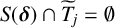
$S(\boldsymbol {\delta })\cap \widetilde {T}_j=\emptyset $
. This shows
$S(\boldsymbol {\delta })\cap \widetilde {T}_j=\emptyset $
 for each
$j\neq i$
for each
$j\neq i$
 . Therefore,

with the equality holding if and only if
$S(\boldsymbol {\delta })\subseteq \widetilde {T}_i$
 .
.
Case 2. For all i with
$1\leq i\leq q$
 , we have
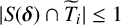
$|S(\boldsymbol {\delta })\cap \widetilde {T}_i|\leq 1$
, we have
$|S(\boldsymbol {\delta })\cap \widetilde {T}_i|\leq 1$
 .
.
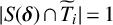
In this case, we have
$\sum _{i=1}^{q}|\widetilde {T}_i\cap S(\boldsymbol {\delta })|\leq q$
 , with the equality holding if and only if
$|S(\boldsymbol {\delta }){\kern-1pt}\cap{\kern-1pt} \widetilde {T}_i|{\kern-1pt}={\kern-1pt}1$
, with the equality holding if and only if
$|S(\boldsymbol {\delta }){\kern-1pt}\cap{\kern-1pt} \widetilde {T}_i|{\kern-1pt}={\kern-1pt}1$
 for
$1{\kern-1pt}\leq{\kern-1pt} i {\kern-1pt}\leq{\kern-1pt} q$
for
$1{\kern-1pt}\leq{\kern-1pt} i {\kern-1pt}\leq{\kern-1pt} q$
 . Suppose the equality holds. If these singleton sets
${S(\boldsymbol {\delta }){\kern-1pt}\cap{\kern-1pt} \widetilde {T}_i}$
. Suppose the equality holds. If these singleton sets
${S(\boldsymbol {\delta }){\kern-1pt}\cap{\kern-1pt} \widetilde {T}_i}$
 do not all coincide, then a similar argument as in the previous paragraph leads to a contradiction. Hence, we can find the same constant
$\mathbf {k}$
do not all coincide, then a similar argument as in the previous paragraph leads to a contradiction. Hence, we can find the same constant
$\mathbf {k}$
 for which
$S(\boldsymbol {\delta }) \cap \widetilde {T}_i=\{\boldsymbol {\delta }+\mathbf {k}\}$
for which
$S(\boldsymbol {\delta }) \cap \widetilde {T}_i=\{\boldsymbol {\delta }+\mathbf {k}\}$
 for
$1\leq i\leq q$
for
$1\leq i\leq q$
 .
.
We count triples
$(\boldsymbol {\delta },j,\mathbf {w})$
 with
$\mathbf {w}\in \widetilde {T}_j\cap S(\boldsymbol {\delta })$
with
$\mathbf {w}\in \widetilde {T}_j\cap S(\boldsymbol {\delta })$
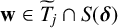 in two different ways. First, summing
$|\widetilde {T}_j\cap S(\boldsymbol {\delta })|$
in two different ways. First, summing
$|\widetilde {T}_j\cap S(\boldsymbol {\delta })|$
 over all
$\boldsymbol {\delta }\in \mathbb {Z}_q^{m-1}$
over all
$\boldsymbol {\delta }\in \mathbb {Z}_q^{m-1}$
 and all
$1\leq j\leq q$
and all
$1\leq j\leq q$
 counts these triples by fixing
$\boldsymbol {\delta }$
counts these triples by fixing
$\boldsymbol {\delta }$
 and j, and then counting the admissible choices of
$\mathbf {w}$
and j, and then counting the admissible choices of
$\mathbf {w}$
 . Second, for each fixed
$\mathbf {w}\in \widetilde {T}_j$
. Second, for each fixed
$\mathbf {w}\in \widetilde {T}_j$
 , there are exactly q choices of
$\boldsymbol {\delta }\in \mathbb {Z}_q^{m-1}$
, there are exactly q choices of
$\boldsymbol {\delta }\in \mathbb {Z}_q^{m-1}$
 for which
$\mathbf {w}\in S(\boldsymbol {\delta })$
for which
$\mathbf {w}\in S(\boldsymbol {\delta })$
 , namely
$\boldsymbol {\delta }=\mathbf {w}-\mathbf {c}$
, namely
$\boldsymbol {\delta }=\mathbf {w}-\mathbf {c}$
 with
$c\in \mathbb {Z}_q$
with
$c\in \mathbb {Z}_q$
 . Since
$\sum _{j=1}^q |\widetilde {T}_j|=|T|$
. Since
$\sum _{j=1}^q |\widetilde {T}_j|=|T|$
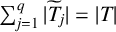 , it follows that

The outer sum has
$q^{m-1}$
 terms and each inner summand is at most q by Claim 2. Thus, for equality to hold, it must be the case that

for each
$\boldsymbol {\delta }\in \mathbb {Z}_q^{m-1}$
 . Therefore, by the ‘moreover’ part of Claim 2, for each
$\boldsymbol {\delta }\in \mathbb {Z}_q^{m-1}$
. Therefore, by the ‘moreover’ part of Claim 2, for each
$\boldsymbol {\delta }\in \mathbb {Z}_q^{m-1}$
 , either
$S(\boldsymbol {\delta })\subseteq \widetilde {T}_{i}$
, either
$S(\boldsymbol {\delta })\subseteq \widetilde {T}_{i}$
 for a unique choice of
$i\in \{1, 2, \ldots , q\}$
for a unique choice of
$i\in \{1, 2, \ldots , q\}$
 or there exists k (which might depend on
$\boldsymbol {\delta }$
or there exists k (which might depend on
$\boldsymbol {\delta }$
 ) such that
$S(\boldsymbol {\delta })\cap \widetilde {T}_{i}$
) such that
$S(\boldsymbol {\delta })\cap \widetilde {T}_{i}$
 consists of the same single element
$\boldsymbol {\delta }+\mathbf {k}$
consists of the same single element
$\boldsymbol {\delta }+\mathbf {k}$
 for all i.
Next, we consider these two cases separately.
Case 1: there exist i with
$1\leq i \leq q$
 and
$\boldsymbol {\delta } \in \mathbb {Z}_q^{m-1}$
and
$\boldsymbol {\delta } \in \mathbb {Z}_q^{m-1}$
 such that
$S(\boldsymbol {\delta }) \subseteq \widetilde {T}_i$
such that
$S(\boldsymbol {\delta }) \subseteq \widetilde {T}_i$
 .
.
We claim that
$\widetilde {T}_i = \mathbb {Z}_q^{m-1}$
 so that T is a star consisting of all words whose first coordinate is i.
Let
$\mathbf {u}\in \mathbb {Z}_q^{m-1}$
 . Since
$q\geq 3$
. Since
$q\geq 3$
 , we can find
$\mathbf {v}, \mathbf {v'}\in (\mathbb {Z}_q\setminus \{0\})^{m-1}$
, we can find
$\mathbf {v}, \mathbf {v'}\in (\mathbb {Z}_q\setminus \{0\})^{m-1}$
 such that
$\mathbf {u}=\boldsymbol {\delta }+\mathbf {v}+\mathbf {v'}$
such that
$\mathbf {u}=\boldsymbol {\delta }+\mathbf {v}+\mathbf {v'}$
 . Indeed, any element in
$\mathbb {Z}_q=\{0, 1, \ldots , q-1\}$
. Indeed, any element in
$\mathbb {Z}_q=\{0, 1, \ldots , q-1\}$
 can be expressed as a sum of two nonzero elements:
$j=1+(j-1)$
can be expressed as a sum of two nonzero elements:
$j=1+(j-1)$
 for
$j\neq 1$
for
$j\neq 1$
 and
$1=2+(q-1)$
and
$1=2+(q-1)$
 .
.
Observe that for each
$\mathbf {w}\in S(\boldsymbol {\delta })$
 and each
$j\neq i$
and each
$j\neq i$
 with
$1\leq j \leq q$
with
$1\leq j \leq q$
 , we have
$\mathbf {w}+\mathbf {v} \notin \widetilde {T}_j$
, we have
$\mathbf {w}+\mathbf {v} \notin \widetilde {T}_j$
 ; for otherwise,
$(i,\mathbf {w})$
; for otherwise,
$(i,\mathbf {w})$
 and
$(j, \mathbf {w}+\mathbf {v})$
and
$(j, \mathbf {w}+\mathbf {v})$
 are both in T but do not intersect. This shows that
$(S(\boldsymbol {\delta })+\mathbf {v})\cap \widetilde {T}_{j}=\emptyset $
are both in T but do not intersect. This shows that
$(S(\boldsymbol {\delta })+\mathbf {v})\cap \widetilde {T}_{j}=\emptyset $
 for each
$j\neq i$
for each
$j\neq i$
 and, thus, Claim 2 forces
$S(\boldsymbol {\delta })+\mathbf {v} \subseteq \widetilde {T}_i$
and, thus, Claim 2 forces
$S(\boldsymbol {\delta })+\mathbf {v} \subseteq \widetilde {T}_i$
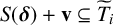 . Consequently,
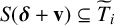
$S(\boldsymbol {\delta }+\mathbf {v})\subseteq \widetilde {T}_i$
. Consequently,
$S(\boldsymbol {\delta }+\mathbf {v})\subseteq \widetilde {T}_i$
 . Now, we apply the same argument with
$\boldsymbol {\delta }$
. Now, we apply the same argument with
$\boldsymbol {\delta }$
 replaced with
$\widetilde {\boldsymbol {\delta }}=\boldsymbol {\delta }+\mathbf {v}$
replaced with
$\widetilde {\boldsymbol {\delta }}=\boldsymbol {\delta }+\mathbf {v}$
 to deduce that
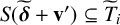
$S(\widetilde {\boldsymbol {\delta }}+\mathbf {v'})\subseteq \widetilde {T}_i$
to deduce that
$S(\widetilde {\boldsymbol {\delta }}+\mathbf {v'})\subseteq \widetilde {T}_i$
 . In particular,
$\mathbf {u}=\boldsymbol {\delta }+\mathbf {v}+\mathbf {v'}=\widetilde {\boldsymbol {\delta }}+\mathbf {v'}\in \widetilde {T}_i$
. In particular,
$\mathbf {u}=\boldsymbol {\delta }+\mathbf {v}+\mathbf {v'}=\widetilde {\boldsymbol {\delta }}+\mathbf {v'}\in \widetilde {T}_i$
 . Since
$\mathbf{u}\in \mathbb {Z}_q^{m-1}$
. Since
$\mathbf{u}\in \mathbb {Z}_q^{m-1}$
 is arbitrary, we have shown that
$\widetilde {T}_i = \mathbb {Z}_q^{m-1}$
is arbitrary, we have shown that
$\widetilde {T}_i = \mathbb {Z}_q^{m-1}$
 , as desired.
Case 2: for each
$\boldsymbol {\delta }\in \mathbb {Z}_q^{m-1}$
 , there is
$k=k(\boldsymbol {\delta })$
, there is
$k=k(\boldsymbol {\delta })$
 such that

It follows that
$\widetilde {T}_1=\widetilde {T}_2=\cdots =\widetilde {T}_q$
 ; write this common family as U. We claim that U is intersecting. Indeed, if
$\mathbf {u},\mathbf {v}\in U$
; write this common family as U. We claim that U is intersecting. Indeed, if
$\mathbf {u},\mathbf {v}\in U$
 , then
$(1,\mathbf {u})$
, then
$(1,\mathbf {u})$
 and
$(2,\mathbf {v})$
and
$(2,\mathbf {v})$
 are both in T, so since T is intersecting and these two words differ in the first coordinate, they must agree in one of the last
$m-1$
are both in T, so since T is intersecting and these two words differ in the first coordinate, they must agree in one of the last
$m-1$
 coordinates. Hence,
$\mathbf {u}$
coordinates. Hence,
$\mathbf {u}$
 and
$\mathbf {v}$
and
$\mathbf {v}$
 intersect. Moreover,
$|U|=q^{m-2}$
intersect. Moreover,
$|U|=q^{m-2}$
 . By the inductive hypothesis, U is a star in
$\mathbb {Z}_q^{m-1}$
. By the inductive hypothesis, U is a star in
$\mathbb {Z}_q^{m-1}$
 and, therefore, T is a star in
$\mathbb {Z}_q^m$
and, therefore, T is a star in
$\mathbb {Z}_q^m$
 .
.
In both cases, T is a star. This completes the proof.
Acknowledgements
We are grateful to Karen Meagher for helpful discussions. We are also grateful to the anonymous referee for their valuable comments. The second author also thanks Santa Clara University for its hospitality during his visit, during which this project was initiated.


 Open access

