


The revolution will not be televised.
American musician and spoken-word performer Gil Scott-Heron toured across the Nordics one year, almost to the day before his death in 2011. I have few regrets in life. Not attending his performance in Copenhagen with my friends is one of them.
Scott-Heron famously said, “The revolution will not be televised.” It can’t be captured on film, he explained, because the most meaningful revolution happens in the mind – when “all of a sudden, you realize I’m on the wrong page.”Footnote 1 The revolution represents a falling of scales from eyes, a new way of seeing.
Living, working, and researching in Denmark, Norway, Sweden, Finland, and Iceland during my twenties and thirties revolutionized my American mind.
In the Nordics, I encountered policies and practices often dismissed in the United States as “socialism” and viewed as threats to individual freedoms and incompatible with capitalism. Yet, my Nordic experiences revealed a very different reality.
The first aspect that challenged my American assumptions was encountering Nordic tax systems. I had grown up with the narrative that higher taxes inevitably meant restricted freedom and “socialism.” Nordic nations maintain tax revenues of approximately 42 percent of their GDP (compared with 28 percent in the US),Footnote 2 while achieving something remarkable: citizen satisfaction with their tax contributions.Footnote 3 This satisfaction stems from a comprehensive return on investment, including universal healthcare, education, paid parental leave, subsidized childcare, unemployment benefits, and substantial pensions. But the true revelation was not the higher taxes – it was how purposefully and efficiently those resources were deployed. Nordic tax revenues are invested in systems that deliver measurable improvements in quality of life and expand individual freedoms.
The prioritization of children and families is evident in public budgets and daily life. In parks and along city streets, it is common to see fathers pushing baby prams on weekday afternoons, a quiet testament to robust parental leave policies that support caregiving by both parents. Public parks, libraries, playgrounds, and transit systems are designed with children and families in mind, reflecting a societal commitment to shared responsibility for the next generation.
I was also struck by the fact that the wealthiest Nordic citizens pay significantly higher effective tax rates than their wealthy American counterparts, who commonly use legal tax shelters to reduce their tax burdens, often to levels below those of middle-income Americans. I had assumed that higher taxes on the wealthiest – often labeled the “job creators” in the US – would hinder economic growth and innovation. Yet, Nordic nations maintain robust economies with low unemployment and consistently rank among the global leaders in innovation.
My experiences in the Nordic countries reshaped my understanding of how regulation and capitalism need each other. I came to see that markets are not natural phenomena like gravity; they are built through deliberate public policies, including taxation, that define their scope and functionality. In the Nordics, I observed how taxes help create markets for sustainability by internalizing negative externalities such as carbon emissions. Finland led the way by introducing the world’s first carbon tax in 1990, quickly followed by Sweden, Norway, and Denmark in 1991 and 1992.Footnote 4 The Nordic region has become a hub for globally recognized sustainability leaders, enabled by markets that reward environmentally and socially responsible business models.
My experience in Corporate America, with its focus on maximizing shareholder profits, made my encounter with Nordic businesses especially striking. There, business leaders commonly saw themselves as stewards of society, the environment, and future generations. It felt more holistic, more humane. Nordic companies routinely collaborate with policymakers to shape sustainability policies through transparent, democratic processes – a sharp contrast to US business lobbies, which often prioritize tax cuts and resist policies perceived as limiting profits, no matter how sensible. The successes of the Nordic approach are drawing international attention, prompting The Economist in 2024 to ask, “Why are Nordic companies so successful?”Footnote 5
One of the most pronounced differences I observed was the high level of union membership, with approximately 70 percent of the working-age population across the Nordics belonging to labor unions.Footnote 6 Having witnessed the often adversarial relationship between business leaders and labor unions in the US, I was struck by the prevailing spirit of cooperation between Nordic unions and businesses. For the first time in my life, I joined a union. It offered firsthand insight into how these organizations empower workers – developing lifelong skills and securing fair wages through collective bargaining. Even the lowest-paid workers earn over $20 per hour, without minimum wage laws.
I also observed the critical role of labor unions in facilitating the green transition, helping workers transition from outdated and unsustainable industries to emerging green sectors, which represent good jobs for the future. Additionally, since healthcare is not tied to employment as it is in the US, Nordic workers face less anxiety when transitioning between jobs. These firsthand experiences challenged my American preconceptions about unions, which I had previously dismissed as necessarily inefficient and inherently linked to socialism. They also deepened my understanding of how universal social services, such as healthcare, are crucial in overcoming societal barriers and enabling the green transition.
The Nordic nations consistently rank high in holistic assessments of societal well-being, such as the Sustainable Development Goals (SDG) Index and the World Happiness Report, as well as in measures of economic prosperity. These outcomes reflect a model built deliberately for the many, not the few, demonstrating that societies grounded in a commitment to equality can also foster globally competitive economies.
These personal observations revealed a systematic difference in how Nordic societies organize their market economies. My Nordic experiences profoundly challenged my beliefs and underlying assumptions about American capitalism – and capitalism more broadly.
The Nordics have sparked similar revelations for other Americans. Supreme Court Justice Ruth Bader Ginsburg’s 1960s Nordic experience transformed her understanding of inequality. “My thought processes were stimulated in Sweden. I saw what was wrong and what needed to change in the U.S.A. … My eyes were opened up,” she remarked, noting how efficient Nordic universal systems fostered equality and efficiency, enabling more women to work outside the home prosperously.Footnote 7
Nordic capitalism has flaws and faces significant challenges – utopias do not exist in the real world, after all. This book addresses such critiques, including concerns about overconsumption, demographic pressures from aging populations, and questions about their relevance due to the region’s smaller size or relative homogeneity. Still, Nordic capitalism offers a compelling alternative to American capitalism and serves as a valuable benchmark. The analyses in this book aim to uncover lessons for improving American capitalism and advancing the ambitious goal of realizing sustainable capitalism.
What, then, are the key features that distinguish Nordic capitalism?
Nordic capitalism combines dynamic, market-driven economies with efficient, universal systems that support societal well-being, encompassing healthcare, education, and paid leave, all financed through higher personal income taxes. Innovation thrives through public and private investments, while cultural norms and institutions foster stakeholder cooperation and consensus-building.
A defining feature of Nordic capitalism is “flexicurity” – a blend of labor market flexibility and strong social security in the pursuit of full employment. This system protects workers through safety nets and retraining while enabling business adaptability, all anchored in tripartite cooperation between unions, employers, and the state.
Efforts to advance sustainability is also a feature of Nordic capitalism. Through democratically accountable processes, Nordic governments shape markets where sustainability and profitability are more likely to align, evident in their global leadership on carbon taxation and the transition to renewable energy. Overall, Nordic business leaders embrace a role as lobbyists for society first, and their companies second, to act as stewards rather than extractors, aiming to shape the rules of capitalism so that smart policies and sound governance can advance sustainable development. As a result, the Nordic region is home to a notable concentration of companies recognized globally for their sustainability performance. Nordic firms typically adopt a stewardship approach, grounded in the ideals of industrial democracy and meaningful stakeholder engagement.
At its core, Nordic capitalism represents democratic capitalism in practice, also commonly discussed as stakeholder capitalism. At the heart of Nordic capitalism lies a commitment to democracy, rooted in cooperation, consensus-building, and a dispersion of power. Compared to American capitalism, Nordic societies exhibit more equitable power distribution, robust democratic institutions, and effective governance, leading to greater shared prosperity and reduced inequality. These societies are also distinguished by their well-functioning democracies, characterized by high levels of civic participation and robust institutional trust.
The US, by contrast, has descended into oligarchic capitalism, increasingly rule by and for economic elites, where concentrated wealth fundamentally distorts democratic processes and market functioning. As power concentrates further, it continues undermining democratic governance and market efficiency.
The oligarchic trend in American capitalism was on stark display in early 2025. Elon Musk, the world’s wealthiest individual, gained unprecedented influence over US government functions after contributing more than a quarter of a billion dollars to the 2024 presidential campaign. This modern oligarchic trajectory can be traced back to the Reagan era’s embrace of neoliberalism and shareholder primacy, which set in motion decades of upward wealth concentration and widening inequalities. In the decades that followed, the advance of shareholder primacy and neoliberal ideology steadily accelerated the fusion of private wealth with public authority, thereby weakening democratic governance in the US.Footnote 8
This book contends that Nordic capitalism, with its democratic and stakeholder-focused approach, offers crucial insights for addressing contemporary sustainability challenges. While Nordic societies face significant shortcomings that demand critical examination, their successful integration of democratic principles with market mechanisms illuminates potential pathways for evolving American capitalism toward greater sustainability. The Nordic experience demonstrates that dispersing power through democratic institutions does not constrain capitalism – it enables markets to function more effectively while advancing social and environmental goals.
Milton Friedman’s influential 1970 article “The Social Responsibility of Business Is to Increase Its Profits” crystallized neoliberal ideology and shareholder primacy in American capitalism. Friedman contended that business leaders prioritizing concerns beyond profit maximization were “preaching pure and unadulterated socialism” – rhetoric reflecting the Cold War era – and eroding the free society’s foundations. Invoking Adam Smith’s “invisible hand,” he argued that society benefits most when corporations focus solely on profits and the state’s role is minimized.Footnote 9
Neoliberal ideology became a global force in the 1980s through policies championed by US President Ronald Reagan and UK Prime Minister Margaret Thatcher. Its influence extended beyond economics as American consumer culture became a global force.
However, today’s escalating sustainability crises pose a direct challenge to the neoliberal paradigm underpinning American capitalism. With seven of nine planetary boundaries now transgressed,Footnote 10 and 2024 marking the first year exceeding 1.5°C above preindustrial levels – decades ahead of most projections – Earth’s safe operating space for humanity is under serious threat.Footnote 11 Figure P.1, a cartoon originally published in the New Yorker, offers a satirical depiction of the widening gap between shareholder-driven capitalism and the planetary conditions that sustain human well-being. As one leading Earth scientist remarked, “What we’re witnessing now is unprecedented, akin to a massive asteroid striking the Earth.”Footnote 12 Concerned for their futures, younger generations have mobilized in protest. “I am doing this because you adults are shitting on my future,” declared Swedish activist Greta Thunberg.Footnote 13
Shareholder primacy meets planetary boundaries.
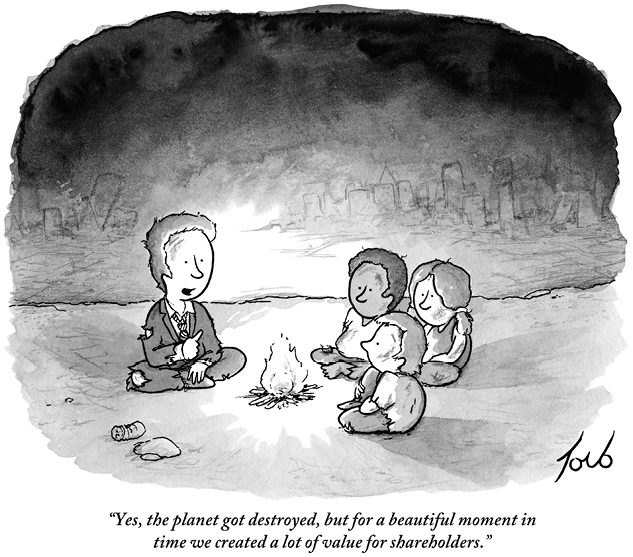
The growing disconnect between shareholder-focused capitalism and planetary realities suggests we may be witnessing a paradigm shift in American capitalism – one that mirrors the scientific revolutions Thomas Kuhn describes in The Structure of Scientific Revolutions. Kuhn’s theory of scientific revolutions outlines a period in which the foundational assumptions and narratives that have long explained the world no longer suffice or solve its pressing problems.Footnote 14 We appear to be in such a moment. This is increasingly apparent with American capitalism, which is now being vigorously challenged.
Without the Soviet Union to serve as a unifying threat, advocates of American capitalism must confront new challenges. Addressing contemporary challenges such as climate change, rising inequalities, healthcare access, biodiversity loss, job security, and the myriad challenges encapsulated by the SDGs offers a more compelling purpose than fighting the imagined ghosts of Soviet socialism.
This book draws on a suite of scholarly and theoretical perspectives, including varieties of capitalism, sustainable development, stakeholder theory, systems thinking, evolutionary theory, and conceptions of freedom and democracy. Its ten chapters are organized in three parts: First, an exploration of the foundational concepts of sustainability and capitalism, along with a comparative overview of Nordic capitalism vis-à-vis American capitalism (Chapters 1–4); second, a detailed examination of Nordic capitalism’s components and critiques (Chapters 5–8); and third, a focused analysis of the systemic failures of American capitalism and the changes needed to make sustainable capitalism possible, drawing on lessons from Nordic experiences (Chapters 9–10). In this final section, I advance the premise that democratic capitalism offers the most promising foundation for realizing sustainable capitalism.
I engage in what Andrew Van de Ven termed engaged scholarship – a tradition that invites researchers to recognize their own positionality and learn alongside those they study, not as detached observers but as participants in the process.Footnote 15 My experiences in both American and Nordic societies have shaped – and been shaped by – the ideas explored in these pages. Blending academic analysis with personal reflection drawn from everyday life, I aim to ground complex ideas in lived experience. As artificial intelligence rapidly transforms how knowledge is produced and consumed, I expect growing interest in this kind of lived experience scholarship – work connected to a human researcher’s own life – as it fosters a human connection with the reader that AI cannot easily replicate.
Today, the Nordics merit greater global attention as inspiration for improving the state of the world, just as they have attracted in the past. In the aftermath of the Great Depression, US journalist Marquis Childs published Sweden: The Middle Way. Struck by Nordic capitalism’s success in promoting shared prosperity, Childs observed, “Capitalism in the north has been modified and, in a sense, controlled; the profit motive in many fields drastically curbed … to serve the greatest good of the greatest number.”Footnote 16 These observations sparked widespread debate across American society, with President Franklin D. Roosevelt dispatching a presidential commission to investigate Nordic successes. As historian Mary Hilson noted, “The Nordic region’s relatively swift recovery from the crisis, and the apparent resilience of its democracies, convinced observers on both sides of the Atlantic that the Nordic countries offered a glimmer of hope in an otherwise gloomy world.”Footnote 17
Nordic capitalism offers crucial insights for contemporary challenges. While Thatcher’s 1980s declaration that, “There is no alternative,” positioned American-style neoliberal capitalism as the only viable economic system, today’s mounting sustainability crises demand a fresh examination of alternative approaches.Footnote 18 As stakeholder theorist R. Edward Freeman argues, “Our old models and ideas simply are not appropriate today. We need new scholarship that builds on past understandings yet offers the alternative of a world of hope, freedom, and human flourishing.”Footnote 19
This book examines how Nordic capitalism’s distinct features might inform the evolution of American capitalism toward sustainable development, offering both practical lessons and grounds for hope for realizing sustainable capitalism.
1 Gil Scott-Heron, The 90’s Raw: Gil Scott-Heron, interview by Skip Blumberg, The 90s, 1989, audio, 9:46, accessed September 20, 2025, https://mediaburn.org/video/the-90s-raw-gil-scott-heron/.
2 Organization for Economic Co-operation and Development (OECD), “Tax Revenue: Total % of GDP, 2022,” OECD Statistics, accessed January 21, 2025, www.oecd.org/en/data/indicators/tax-revenue.html.
3 Eric S. Einhorn, “Scandinavian Taxes and the Good Society,” Scandinavian Review 106, no. 2 (Summer 2019): 38–47.
4 Boqiang Lin and Xuehui Li, “The Effect of Carbon Tax on per Capita CO2 Emissions,” Energy Policy 39, no. 9 (2011): 5137–5146.
5 The Economist, “North Stars: Why Are Nordic Companies So Successful?” December 30, 2024.
6 Walter Galenson, The World’s Strongest Trade Unions: The Scandinavian Labor Movement (Westport: Praeger, 1998).
7 Petula Dvorak, “Ruth Bader Ginsburg Had to Leave America to See How Unfairly It Treated Women,” Washington Post, September 24, 2020.
8 David Harvey, A Brief History of Neoliberalism (Oxford: Oxford University Press, 2007); Robert B. Reich, The System: Who Rigged It, How We Fix It (New York: Knopf, 2020).
9 Milton Friedman, “The Social Responsibility of Business Is to Increase Its Profits,” New York Times Magazine, September 13, 1970.
10 Stockholm Resilience Centre, “Seven of Nine Planetary Boundaries Now Breached,” Stockholm Resilience, September 24, 2025, accessed September 28, 2025, https://shorturl.at/a1fJD.
11 World Meteorological Organization (WMO), State of the Global Climate 2024, WMO-No. 1345 (Geneva: WMO, 2025), March 19, 2025, accessed April 1, 2025, https://wmo.int/publication-series/state-of-global-climate-2024.
12 Sarah Kaplan and Simon Ducroquet, “Scientists Have Captured Earth’s Climate over the Last 485 Million Years. Here’s the Surprising Place We Stand Now,” Washington Post, September 19, 2024, accessed November 1, 2024, https://shorturl.at/YGWqq; Emily J. Judd, Jessica E. Tierney, Daniel J. Lunt et al., “A 485-Million-Year History of Earth’s Surface Temperature,” Science 385, no. 6715 (September 20, 2024), doi.org/10.1126/science.adk3705.
13 “Swedish 15-Year-Old Cutting Class to Fight the Climate Crisis,” The Guardian, September 1, 2018, accessed February 1, 2019, https://shorturl.at/Muqnw.
14 Thomas S. Kuhn, The Structure of Scientific Revolutions, 50th anniversary ed. (Chicago: University of Chicago Press, 2012).
15 Andrew H. Van de Ven, Engaged Scholarship: A Guide for Organizational and Social Research (Oxford: Oxford University Press, 2007).
16 Marquis Childs, Sweden: The Middle Way (New Haven: Yale University Press, 1936), xii.
17 Mary Hilson, “Consumer Co-operation and Economic Crisis: The 1936 Roosevelt Inquiry on Co-operative Enterprise and the Emergence of the Nordic ‘Middle Way,’” Contemporary European History 22, no. 2 (2013): 181–198.
18 Nick Romeo, The Alternative: How to Build a Just Economy (London: Hachette UK, 2024).
19 R. Edward Freeman, “Foreword,” in Stefan Sachs and R. Edward Rühli, Stakeholders Matter: A New Paradigm for Strategy in Society (Cambridge: Cambridge University Press, 2011), xvi.

 Open access