


Related Article:
Complex formation of the tetracycline-binding aptamer investigated by specific cross-relaxation under DNP.
V. Aladin, M. Vogel, R. Binder, I. Burghardt, B. Suess, and B. Corzilius: https://doi.org/10.1002/anie.201811941
Introduction
The study of ligand binding with magic-angle spinning (MAS) NMR is challenging, as biomolecules made of same building blocks suffer from spectral overlap. Moreover, NMR has the issue of very low sensitivity as a result of low thermal spin polarization. DNP is a technique that allows overcoming the sensitivity problem (Lilly Thankamony, et al., Reference Lilly Thankamony, Wittmann, Kaushik and Corzilius2017). Recently the effect of spontaneous 1H–13C polarization transfer via heteronuclear cross-relaxation due to fast reorientation dynamics in a 13C or 15N MAS direct polarization experiment under DNP was discovered (Daube et al., Reference Daube, Aladin, Heiliger, Wittmann, Barthelmes, Bengs, Schwalbe and Corzilius2016; Hoffmann et al., Reference Hoffmann, Bothe, Gutmann, Hartmann, Reggelin and Buntkowsky2017a, Reference Hoffmann, Bothe, Gutmann and Buntkowsky2017b; Park et al., Reference Park, Uluca-Yazgi, Heumann, Schlogl, Granwehr, Heise and Schleker2020). Further investigation showed that cross-relaxation-promoting methyl groups and the resulting Specific Cross Relaxation Enhancement by Active Motions under DNP (SCREAM-DNP) can be used as a tool for selective probing in biomolecules such as RNA (Aladin et al., Reference Aladin, Vogel, Binder, Burghardt, Suess and Corzilius2019) and proteins (Mao et al., Reference Mao, Aladin, Jin, Leeder, Brown, Brown, He, Corzilius and Glaubitz2019). This allows to overcome the drawback of typical unspecific DNP experiments such as cross polarization (CP) and direct polarization (DP), using dynamically active methyl groups as pinpoint sources of polarization.
Objective
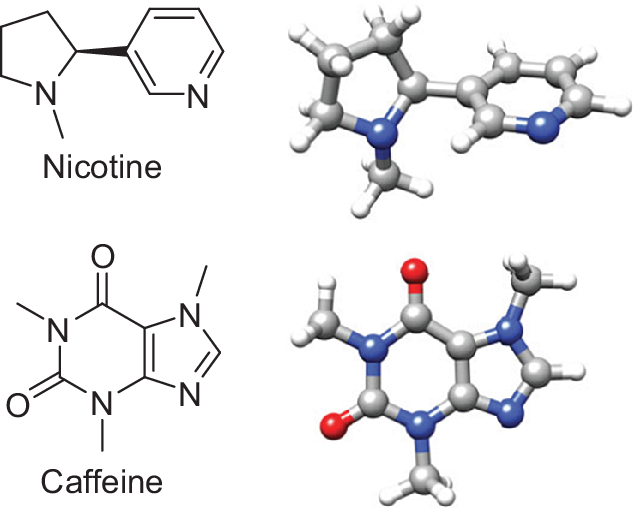
To further utilize SCREAM-DNP in biological systems and investigate receptor/ligand binding, suitable methyl groups have to be examined. Nicotine, mostly known as an agonist in acetylcholine receptors, and caffeine, which acts as adenosine receptor antagonist, are methyl-carrying ligands that could pose interesting targets for such binding studies (see Figure 1). Here, we explored the behavior of methyl group dynamics in nicotine and caffeine by SCREAM-DNP. As methyl reorientation is a temperature-activated process under typical DNP conditions, differences in rotational hindrance play an important factor in cross-relaxation efficiency (Aladin & Corzilius, Reference Aladin and Corzilius2019). Therefore, we investigated SCREAM-DNP in these two systems at 110 K and 155 K.
Structural formulas and ball-and-stick models of nicotine and caffeine.
Methods
Nicotine and caffeine (Sigma-Aldrich) in natural isotope abundance were dissolved in D8-12C3-glycerol (98% D, 99.95% 12C, Euriso-Top)/D2O/H2O mixture (60/30/10 vol.-%) containing 10 mM AMUPol (SATT Sud-Est, Marseille (Sauvée et al., Reference Sauvée, Rosay, Casano, Aussenac, Weber, Ouari and Tordo2013)) with final concentrations of 0.1 M and 1 M for caffeine and nicotine, respectively.
All experiments were performed on a Bruker AVANCE II DNP spectrometer (400.2 MHz 1H) and 263.4 GHz gyrotron microwave frequency under 8 kHz MAS. CP experiments were performed with 3 s polarization time. For each sample and temperature (110 and 155 K) DP as well as DP with proton saturation (DPsat) experiments were recorded for different polarization times. The mathematical subtraction of DP and DPsat spectra results in spectral contributions of magnetization stemming exclusively from cross relaxation (∆DPsat). The used pulse sequences and further experimental parameters are analogous as described elsewhere (Aladin et al., Reference Aladin, Vogel, Binder, Burghardt, Suess and Corzilius2019; Aladin & Corzilius, Reference Aladin and Corzilius2019).
Results
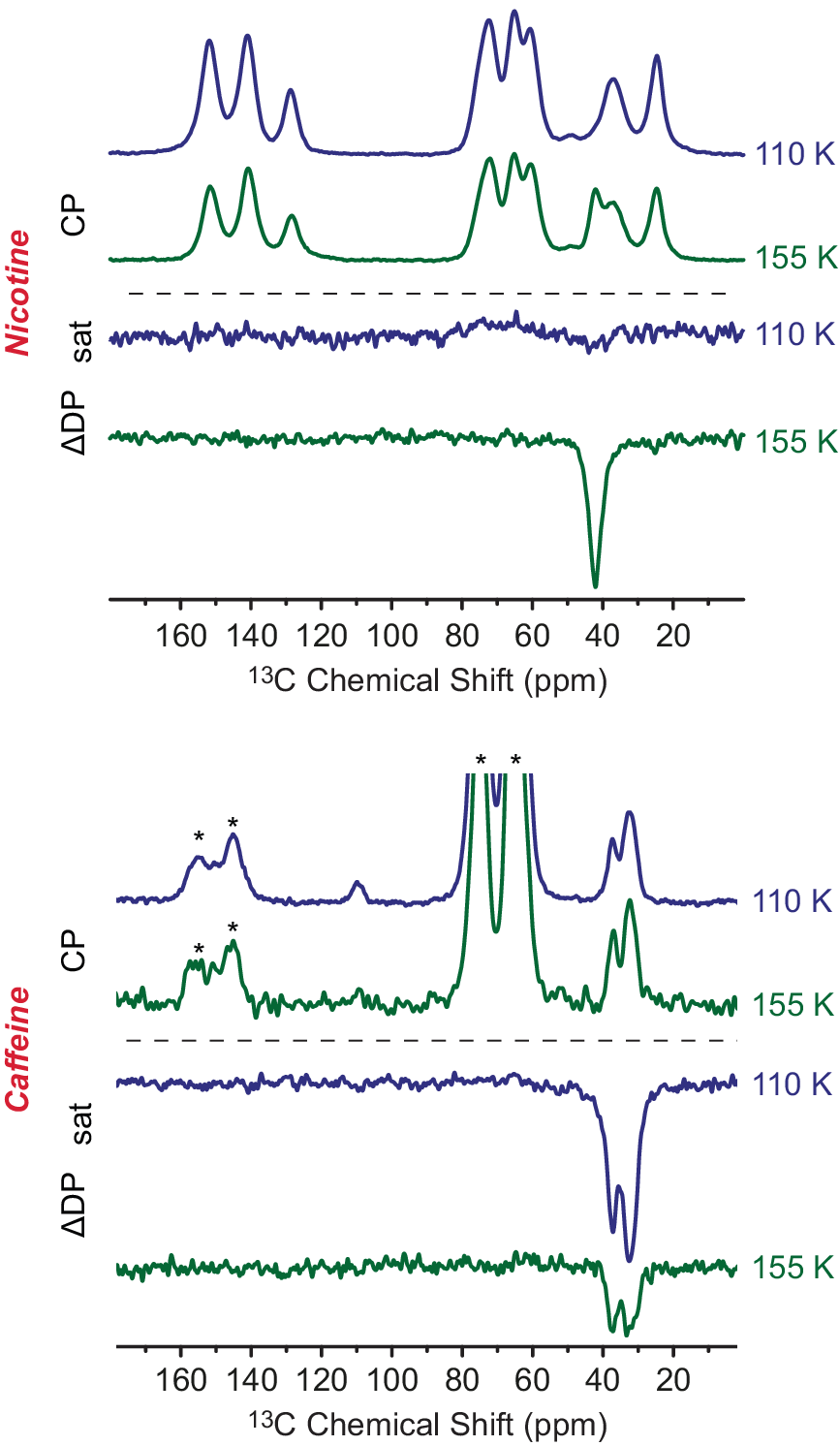
As seen in Figure 2 the sole CH3 resonance in nicotine is broadened at 110 K due to interference by dynamics (Ni et al., Reference Ni, Markhasin, Can, Corzilius, Tan, Barnes, Daviso, Su, Herzfeld and Griffin2017) and also does not show any significant SCREAM-DNP signal. By increasing the temperature to 155 K it now reveals both a distinct resonance in the CP as well as a strong SCREAM-DNP signal (∆DPsat) with a build-up time constant of 3.7 s (Figure 3). Here it is unclear, if the missing ∆DPsat signal at 155 K is due to broadening beyond detectability or inefficient SCREAM-DNP transfer.
DNP-enhanced CP (3 s polarization time) and ∆DPsat (6 s polarization time) spectra at 110 and 155 K of nicotine and caffeine. Resonances stemming from glycerol are marked with asterisks.
∆DPsat build-up curves of methyl resonances at 110 K in nicotine and at 110 and 155 K in caffeine. The signal intensity was determined by integration over the single methyl resonance in nicotine and over all three methyl resonances in caffeine (see Figure S1).
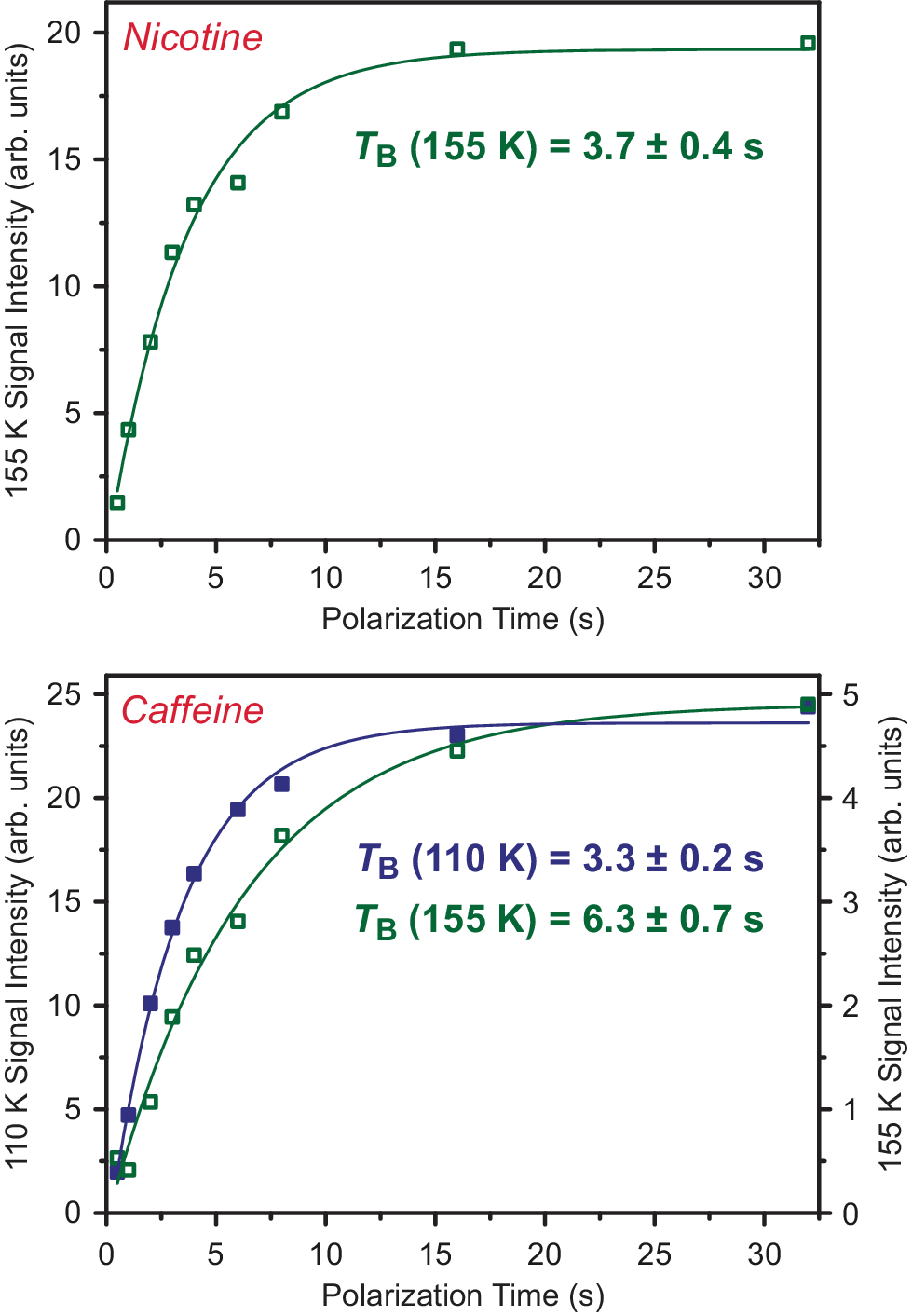
Contrary to this, all three methyl groups of caffeine show no significant broadening in CP and provide a strong SCREAM-DNP signal (∆DPsat) with a build-up constant of 3.3 s at 110 K. In this case, the signal intensity due to cross relaxation in ∆DPsat drops with higher temperature and the build-up time increases to 6.3 s at 155 K.
Discussion
In the case of nicotine the methyl reorientation is causing interference at 110 K, resulting in homogeneous broadening; furthermore, significant polarization transfer by cross relaxation seems to be prevented. By increasing the temperature to 155 K, this dynamic is accelerated and efficient cross relaxation occurs. The methyl dynamics in caffeine seem to be in the sufficiently fast limit regime already at 110 K in order to avoid interference and support efficient SCREAM-DNP. By increasing the temperature, the correlation time is shortened past the optimum ( $ {\omega \tau}_{\mathrm{c}}=1 $). This is supported experimentally by the extended build-up time and reduced signal intensity.
Conclusions
The contrast between nicotine and caffeine may be explained by structural differences. In nicotine, the sterically demanding pyridine group can affect the methyl dynamics. Moreover, the hybridization of the methyl-carrying N in nicotine is sp3, whereas the relevant nitrogens in caffeine are sp2 hybridized with a larger CNC bond angle. Therefore, the methyl groups in caffeine are less sterically hindered. As a result, caffeine has an efficient SCREAM-DNP effect at 110 K, while for nicotine a similar situation is only found at an increased temperature of 155 K. Both ligands further could be useful for biomolecular complex-specific studies by SCREAM-DNP.
Ethical Statement.
N/A
Funding Information
This work has been funded by the Deutsche Forschungsgemeinschaft through grants CO 802/2 and CO 802/4. We acknowledge support by the Center for Biomolecular Magnetic Resonance. (BMRZ, Frankfurt am Main).
Author Contributions
VA has designed all experiments, helped performing the experiments and has written the manuscript. PAT has performed all experiments. BC has supported the design of the experiments and has edited the manuscript.
Conflict of Interest
BC is a reviewing editor for Experimental Results. VA and PAT declare none.
Data availability statement
The NMR raw data as well as peak integrals used for build-up curves have been deposited at https://doi.org/10.5281/zenodo.3688628 under Creative Commons Attribution 4.0 International Public License.
Supplementary Materials
To view supplementary material for this article, please visit http://dx.doi.org/10.1017/exp.2020.17.


 Open access


Comments
Comments to the Author: This is the first time for me reviewing for “Experimental Results” and I understand that there are word limits for each section. Within these limits the authors present adequately some spectral results concerning dynamic nuclear polarization, a timely subject area that receives increasing attention in current research. It appears that the amount of data is indeed too small to get published in a regular “normal sized” journal article, but too important not to get published at all. All sections are clear and well written.My specific recommendation is a relatively minor one. I believe it is important to point out that there has been evidence also for motions other than methyl rotation that can be active under the low temperatures of DNP experiments. Besides PEG mentioned in the article included in the references, cyclohexane also show heteronuclear cross relaxation even though neither of these molecules possess a methyl group. (Hoffmann, M. M.; Bothe, S.; Gutmann, T.; Buntkowsky, G., Unusual local molecular motions in the solid state detected by dynamic nuclear polarization enhanced NMR spectroscopy. J. Phys. Chem. C 2017, 121, 22948-22957.)The authors might find also important to note that heteronuclear cross-relaxation has very recently been observed between 1H and 15N. (Park, H.; Uluca-Yazgi, B.; Heumann, S.; Schlogl, R.; Granwehr, J.; Heise, H.; Schleker, P. P. M., Heteronuclear cross-relaxation effect modulated by the dynamics of n-functional groups in the solid state under (15)N dp-mas DNP. J. Magn. Reson. 2020, 312, 106688.)