


England and France are neighbouring countries sharing similarities in their history and cultural heritage, but great differences in the development of distinctive culinary cultures. Their cuisines are popularly seen as offering striking contrasts, even though they have been in mutual contact and influenced each other for many centuriesReference Mennell1. This contact has been described historically as creating many tensions between the two nations in terms of their national identitiesReference Rogers2.
Food choice in humans is a complex process and its many determinants have been well documented over the last 60 yearsReference Lewin3, Reference Yudkin4. Food choice patterns differ throughout Europe and socio-cultural determinants are known to influence these patternsReference Meiselman5, Reference Frewer, Risvik and Schifferstein6. Culture has a major role in determining where and how foods are consumedReference Fischler7, Reference Mela8 and food is a way of expressing sociability and hospitalityReference Fieldhouse9, as mealtimes bring groups together, both physically and symbolicallyReference Mennell, Murcott and van Otterloo10, Reference Marshall11.
Traditionally, women are more likely to be responsible for the greater share of food-related activitiesReference Fieldhouse9 but there is a suggestion of change in this traditional housekeeping role as women are increasingly going out to work, leading to a ‘de-skilling’ of certain food preparation tasks, an increasing influence of convenience on food choice in the UKReference Tansey and Worsely12 and a movement towards simpler meals and recipes in FranceReference Gerber and Padilla13.
Food is a major source of pleasure for almost all humansReference Rozin14 and is known to play an essential role in France and Southern Europe in strengthening social tiesReference Volatier15. The kitchen in France has been described as a convivial room where everyone meetsReference Volatier15. In England, on the other hand, food may be regarded as a necessity by many, and this has been well documented since the early 1800sReference Wright, Nancarrow and Kwok16, Reference Burnett17.
Another important influence on food choice is the increasing availability of places to eat out. People eat away from the home either out of necessity or purely for pleasureReference Warde and Martens18. This is of particular relevance in England, where the population consumes more convenience food than any other European countryReference Schlosser19, and may be a factor in the nation's increasing prevalence of obesity. In France, on the other hand, food tends to ‘follow the flag’ and national traditions have held their own more than in EnglandReference Mennell1. This tradition seems to be shifting, however, with a rise in the popularity of American-style fast-food outlets in France. This is particularly the case for younger adults in Southern France, who have been shown to be moving away from the consumption of foods characteristic of a traditional Mediterranean dietReference Scali, Richard and Gerber20.
The present investigation evolved from a previous studyReference Holdsworth, Gerber, Haslam, Scali, Beardsworth and Avallone21 confirming that a population in a Mediterranean French region consumed a healthier diet than a Central England population; the contrasts shown in food consumption patterns between these two areas highlighted the need to investigate the reasons for these differences. Substantial differences in the attitudes to and beliefs about food and health have also been observed between these two populationsReference Pettinger, Holdsworth and Gerber22, with the French valuing the pleasurable and social aspects of eating whereas convenience, i.e. freedom from effort or difficulty, was an important factor influencing English respondents' food choices. Some aspects of the underlying food culture in these two nations are explored in the current paper, in particular eating together as a household, preparation of meals, food purchasing patterns, cooking practices and eating-out patterns.
Methods
Participants and recruitment
Self-administered postal questionnaires were distributed in April 2001 to 1000 males and 1000 females aged 18–65 years in Montpellier, France and Nottingham, England. Both stratified random samples were generated from the electoral register. The final samples comprised 826 subjects in England and 766 subjects in France, providing final adjusted response rates of 42.8% and 52.4%, respectively.
The following were considered to be important for optimising response ratesReference Oppenheim23, Reference Edwards, Roberts, Clarke, DiGuiseppi, Pratap and Wentz24: the questionnaire was kept as short as possible; the covering letter was written on headed notepaper, had an informal tone and was hand-signed; a stamped addressed envelope (SAE) was enclosed and a stamp used rather than industrial franking; the questionnaires were distributed during springtime and were posted to arrive just before the weekend; reminder letters were posted to those individuals who had not already responded one month after the initial mailing, with a further copy of the questionnaire and SAE; during the period of questionnaire distribution, the study was publicised by conducting interviews with local radio, television and newspapers, appealing to individuals to complete the questionnaire.
Questionnaire validity and reliability
The questionnaire items were deemed to have face and content validity by nine experts within the disciplines of psychology, anthropology, epidemiology and public health nutrition. Face-to-face meetings with these professionals were conducted, generating discussions on each of the proposed concepts and ideas for question inclusion. As a result, the construction of questions evolved, and wording and structure were modified and developed. Additionally, the questionnaire was piloted in each country in a population similar to the main sample to ensure that questions were properly understood. The questionnaire was initially translated into French by a bilingual speaker; subsequently both English and French versions were verified for language and cultural acceptance, the latter by 15 native French speakers.
Data processing and analysis
The data from the questionnaires were coded and inputted into SPSS. In order to reduce error rate, a 10% random sample of the questionnaires was verified to determine an error rate of < 1%Reference Meeuwisse, Hagel and Fick25. The actual error rate was 0.05% (English data) and 0.02% (French data) of keystrokes, so double data entry was deemed unnecessary. All data were analysed using SPSS26.
Variables were grouped according to the research question and cross-tabulations were carried out incorporating the chi-square test for independence. Frequency variables, for example, were regrouped so that analyses were carried out on three categories: ‘daily’, ‘at least once a week’ (grouped from 2–6 times per week and at least once a week) and ‘at least once a month or never’ (grouped from at least once a month, less often than once a month and never). Following this, nominal regression was carried out which adjusted the samples ensuring that any difference seen was not due to confounding variables such as age group, gender, body mass index (BMI), educational level or employment status.
Results
Sociodemographic profile
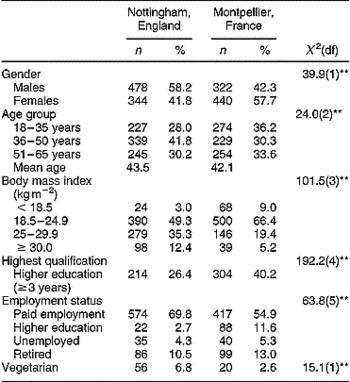
The sample generated a gender spread that was different from the populations from which they were drawn27, 28. A larger proportion of the French sample was aged < 35 years (Table 1), which may partly explain why there were more French than English respondents in full-time higher education. In terms of BMI, there were significantly more overweight/obese subjects in the English than in the French sample. More French than English respondents were better educated and more English than French respondents described themselves as vegetarian.
Sociodemographic characteristics of English (n=826) and French (n=766) samples
*P < 0.05; **P < 0.001.
Eating together as a household
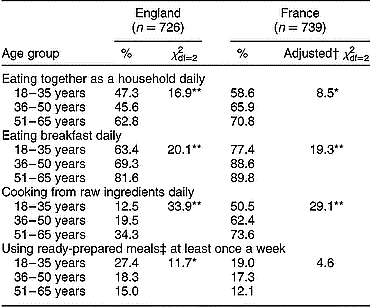
Nearly two-thirds of French (64.8%), compared with just over half of English respondents (51.0%), reported eating together as a household on a daily basis (χ2 = 43.6; df = 2; P < 0.001) (Fig. 1). However, younger adults were less likely to eat together in both countries (Table 2).
Frequency of eating together as a household in English and French samples

Age trends for components of meal patterns and cooking habits
*P < 0.05; **P < 0.001.
† Adjusted for gender, education level and body mass index group.
‡ ‘Ready-prepared meals’ defined as meals requiring re-heating, i.e. equivalent to ‘oven-ready’.
Food purchasing patterns
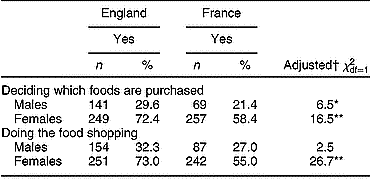
More females in both countries were responsible for food purchase but, in particular, more female respondents in England (72.4%) than in France (58.4%) reported deciding which foods to purchase. Similarly, more females in England (73.0%) than France (55.0%) reported doing the food shopping (Table 3).
Responsibility for food purchase by gender of English and French respondents
*P < 0.05; **P < 0.001.
† Adjusted for age, education level and body mass index group.
Cooking habits and food preparation
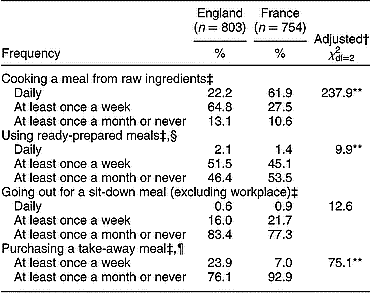
Almost two-thirds of French respondents (61.9%) reported cooking a meal from raw ingredients daily, compared with less than a quarter of English respondents (22.2%) (Table 4). Three-quarters of French females (74.0%) compared with less than half (44.8%) of French males reported cooking a meal from raw ingredients on a daily basis (χ2 = 66.2; df = 1; P < 0.001). On the other hand, there was no difference between English males (22.8%) and females (21.4%). When considering age, the pattern was similar for both countries. The overall trend showed that older age groups were more likely to cook from raw ingredients (Table 2).
Frequency of cooking-related activities, eating out and purchase of ready-prepared meals of English and French respondents
*P < 0.05; **P < 0.001.
† Adjusted for age, gender, education level and body mass index group.
‡ Missing data – cooking a meal from raw ingredients: n = 803 (England), n = 754 (France); using ready-prepared meals: n = 796 (England), n = 729 (France); going out for a sit-down meal: n = 812 (England), n = 737 (France); purchasing a take-away meal: n = 787 (England), n = 695 (France).
§ ‘Ready-prepared meals’ defined as meals requiring re-heating, i.e. equivalent to ‘oven-ready’.
¶ χ_{df=1}^2.
The finding that less English respondents cooked from raw ingredients was reflected in the fact that more English (53.6%) than French (46.5%) respondents reported using ready-prepared (i.e. oven-ready) meals at least once a week. In the English sample, younger adults used ready-prepared meals most often (Table 2), but in the French sample this trend was not apparent.
Eating out
More than three times as many English respondents (23.9%) than French (7.0%) reported purchasing a take-away meal at least once a week. However, there was no difference between the two countries in how often respondents went out for a sit-down meal (Table 4). There was no gender difference in the English sample, but in the French sample males (12.2%) were more than twice as likely as females (4.7%) to report going out for a sit-down meal at least once a week (χ2 = 16.6; df = 1; P < 0.05).
Mealtime structure
The majority of respondents in both France and England reported eating breakfast, lunch and an evening meal most days. However, differences were observed between countries for the frequency of eating breakfast and lunch, as more French (84.9%) than English (71.3%) respondents reported eating breakfast on a daily basis (χ2 = 42.5; df = 2; P < 0.001). Similarly, more French (91.3%) than English (77.5%) respondents reported eating lunch daily (χ2 = 56.6; df = 2; P < 0.001). Over 90% of French and English respondents reported eating their evening meal every day. Younger adults in both countries were more likely to skip breakfast (Table 2).
Snacking habits
Differences were seen between the countries for snack food consumption (Table 5), as over half (58.8%) of English respondents reported eating crisps/fried snacks at least once a week compared with only 6.0% of French respondents. More English (15.0%) than French (10.5%) respondents also reported eating peanuts/nuts at least once a week. There were no differences between countries for the consumption of confectionery. Almost two-thirds of English respondents (63.9%) reported eating cakes and biscuits at least once a week compared with just over half of the French (55.1%). Fruit was consumed as a snack on a daily basis by about half of the respondents in each country (Table 5).
Snack food consumption patterns in English and French samples
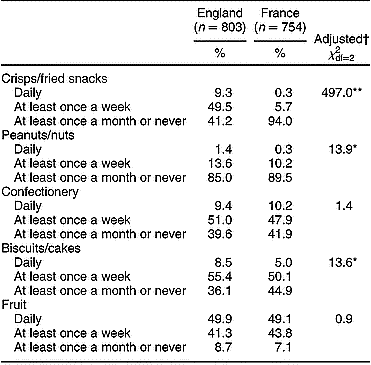
*P < 0.05; **P < 0.001.
† Adjusted for age, gender, education level and body mass index group using logistic regression.
Discussion
This investigation has examined patterns of food behaviour in both countries: cooking and food preparation, mealtimes and snacking habits. The findings confirm popular stereotypes of French and English food cultures, as the importance of the convivial aspects of eating, as well as more traditional practices such as cooking meals from basic ingredients and structured mealtimes, remain more prominent within the French population. On the other hand, the English cooked less from raw ingredients, relying more on ready-prepared (oven-ready) and take-away meals, and had less structured meals with more snacking on energy-dense snack foods such as crisps.
Nearly two-thirds of French compared with just over half of English respondents reported eating together as a household on a daily basis. Our findings support those of an earlier studyReference Volatier15 which reported that, in France and Southern Europe, ‘getting together’ was the first motivation for eating, and this region of France appears to share this value of the traditional Mediterranean lifestyle. This ties in with results from another component of this study, which found that the pleasurable and social aspects of eating were of greatest importance to the FrenchReference Pettinger, Holdsworth and Gerber22. However, the composition of ‘households’ has changed over recent years in the UKReference Beardsworth and Keil29. Although house sharing is common in the UK, this is less so in France, where one-person households are increasing30.
More female than male respondents in both countries reported being responsible for preparing meals, but particularly more English females than French. This was also the case for deciding which foods are purchased and doing food shopping. This suggests a persistence of the gender differentiation within the domestic setting with regard to food provisionReference Mennell, Murcott and van Otterloo10, Reference Rozin, Fischler, Imada, Sarubin and Wrzesniewski31. Women in the UK are spending more time than previously doing supermarket shopping and travelling to food suppliersReference Gershuny, Fisher, Halsey and Webb32. This may be due to their heavier reliance on convenience foods (foods that have been pre-prepared commercially and so require little preparation by the consumer). There is also recent evidence suggesting that children may exert significant control in the food provision decision-making processReference Dixon and Banwell33, although the current study did not collect data on this.
A staggering two-thirds of French respondents cooked a meal from raw ingredients on a daily basis compared with less than a quarter of English respondents, which supports the findings from the attitudinal component of this studyReference Pettinger, Holdsworth and Gerber22 that reported that the French were more prepared to make time for cooking and attached more value to cooking from raw ingredients. This is perhaps to be expected, given the great pride that the French associate with their national cuisineReference Monneuse, Bellisle and Koppert34 and perhaps accentuates the historical ongoing ‘battle’ between English and French cooking practicesReference Tannahill35. This is also supported by recent ‘social trends’ data in the UK, where it has been reported that time devoted to eating at meals and snacks at home has fallen in the last few decadesReference Gershuny, Fisher, Halsey and Webb32.
The gender division of cooking meals from raw ingredients was more defined in France, with far more females than males responsible for this task. One explanation could be the fact that a higher proportion of the English sample (including females) was in paid employment, therefore relying more on convenience foods. These findings concur with those of an earlier studyReference Schlosser19 reporting that the British population consumes more convenience food than any other European country. Younger adults used ready-prepared meals most often, particularly in England. This could be explained by the proposed transition in cooking skills described in the UKReference Caraher and Lang36, which clearly influences what people choose to prepare and eatReference Caraher, Dixon, Lang and Carr-Hill37, and in France that younger people are moving away from traditional models of eatingReference Scali, Richard and Gerber20. However, there is recent evidence examining domestic cooking skills which reports difficulties in discriminating between ‘cooking from scratch’ and ‘cooking with pre-prepared foods’Reference Short38 as it depends on the particular foods being used and the skills needed to prepare them. The apparent cultural shift in shopping habits, cooking skills and food preparation would not be an issue if pre-prepared and convenience foods conformed to recommendations for healthy eating. Moves are already afoot to reduce the salt and sugar content of many such foods, but shifting of responsibility is paramount and consistent messages need to be relayed to all partners concerned, i.e. food industries, marketing organisations, policy-makers as well as consumers.
The French had the most regular meal pattern as they were most likely to consume all three meals daily, skipping breakfast and lunch less frequently than the English. In both countries, younger respondents were more likely to miss breakfast. In Britain the main meal is traditionally in the eveningReference Marshall and Meiselman39. The fact that lunch was a more important meal for the French is characteristic of Mediterranean regions, although evidence of a swing towards the evening meal is emerging due to changing working patternsReference Padilla, Aubaille-Sallenave and Oberti40. However, the ‘de-structuration’ of French eating habits, reported in an earlier studyReference Poulain41, was not so evident and certainly does not yet equal that seen in the English study population. It appears that although English eating habits are less structured than traditionally, a new structure is emerging, based on convenience foods and households eating and preparing foods individually. This demise of long-established rules has led to a state that has been referred to as ‘gastro-anomy’Reference Fischler42.
Britons have been described as Europe's largest consumers of snacks43 and our results do not contradict this. Crisps in particular are one of the UK's most popular snacks, especially with young people, as they represent 60% of all savoury snacks sold in the UK44 and half of English respondents in our study ate crisps at least weekly. Research has highlighted confusion surrounding the precise definition of a ‘snack’: in BritainReference Chamontin, Pretzer and Booth45, ‘having a snack’ was reported as being perceived differently from ‘snacking’ or eating ‘snack food’. This ambiguity may be further accentuated by cross-cultural differences. We report on snack foods as being those eaten outside normal mealtimes. The different snacking patterns in Southern France have been reported previouslyReference Pettinger46, finding that snacking amongst nurses in Toulouse was rare, but when they did snack they chose bread, cheese, yoghurts and fresh fruit rather than cakes, sweet biscuits or confectionery. However, recent food surveys in France show that there has been an increase in the intake of ‘snack’ and ‘fast-food’ products, for both pleasure and convenienceReference Volatier47. These findings are alarming as energy-dense foods are known to be associated with promotion of weight gain and obesityReference Prentice and Jebb48. The way such foods are marketed and advertised is an area in need of special attention.
Although attempts were made to optimise response ratesReference Edwards, Roberts, Clarke, DiGuiseppi, Pratap and Wentz24, these were lower than expected and samples were not as representative of the populations as desired: our study over-sampled for males/older people and under-sampled for females/young people in Nottingham28, but was representative of population gender and age distribution in Montpellier27. However, analyses adjusted for sociodemographic differences between samples so that findings are due to French or English residency.
In conclusion, some of the findings from this study confirmed popular stereotypes of French and English food cultures. The convivial aspects of eating, as well as more traditional practices, such as cooking meals from basic ingredients, were found to be more prominent within the French population. The heavy reliance on convenience food in the form of ready-prepared meals, take-away and snack food items in the English population also confirmed current stereotypes. These cultural differences may partly explain the higher prevalence of adult obesity in England than France. Public health nutrition professionals are in the position to develop interventions and policies that take into account the different cultural contexts of the current obesity epidemic.
Acknowledgements
The authors are grateful to Professor Andrew Salter for his academic support and to both Sabrina Eymard-Duvernay and Vicki Owen for their invaluable statistical guidance.



