




Introduction
A growing body of palaeoenvironmental evidence suggests that the Eastern Desert of Egypt—in addition to the Nile Valley—may have acted as a dispersal corridor for human populations during interglacial periods, particularly during MIS5 (Henselowsky et al. Reference Henselowsky, Kindermann, Willmes, Lammerich-Long, Bareth and Bubenzer2022). However, little is known about Stone Age human occupation of this area (Vermeersch Reference Vermeersch, Barnard and Duistermaat2012; Kindermann et al. Reference Kindermann, Peer and Henselowsky2018; Beyin et al. Reference Beyin, Chauhan and Nassr2019). Here, we report on several Earlier Stone Age and Middle Stone Age findspots in the Wadi Abu Subeira (Eastern Desert of Egypt, Aswan region). The surveyed area is 15–25km east of the Nile Valley (Figure 1). Previous research in Wadi Abu Subeira identified a small Middle Stone Age site (Wendorf Reference Wendorf, Wendorf, Schild and Close1989) and several Late Palaeolithic rock art stations (Kelany Reference Kelany2014) but these are all located at the entrance of the wadi less than 10km from the Nile Valley. The 2022 survey builds on previous work by Wadi Abu Subeira Survey Project directed by Gwenola Graff, which focused on rock art (Graff et al. Reference Graff, Kelany, Bailly, Jimenez-Serrano and von Pilgrim2015).
Map of the research area showing the locations of Stone Age finds in Wadi Abu Subeira, Egypt (figure by authors).

Results from the 2022 survey in Wadi Abu Subeira
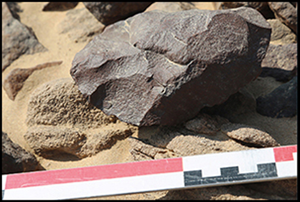
In total, 34 Stone Age occurrences were mapped in 2022. All are surface occurrences of three main types: isolated artefacts, artefact scatters and lithic workshops. They are found either on top of the plateaux or on the slope between the plateaux and the wadis. Isolated artefacts include one large symmetrical handaxe and one cleaver made from coarse ferruginous sandstone (Figure 2). Artefact scatters with no evident spatial patterns include one large example (>500m long, L613, Figure 1) with no clear delimitation between distinct concentrations of artefacts. At this site, artefact density was systematically recorded every 15m along a 300m-long line. Densities vary from 0 to 10 artefacts per square metre. Artefacts are made from various raw materials, including quartz, silicified wood, silicified (ferruginous) sandstone and chert, but there was no primary source for most of these raw materials at the site, with the exception of quartz. However, these raw materials may have been available from the wadi bed or on the nearby plateaux. Artefact types include those typical of the Earlier Stone Age (e.g. large handaxes) as well as the Middle Stone Age (e.g. Levallois core—a stone-knapping technique characteristic of the period; Figure 3B). It is likely that these artefact scatters represent a palimpsest of repeated occupations of the area over a long time and/or a secondary accumulation of artefacts driven by erosion (flooding and aeolian deflation).
Earlier Stone Age isolated finds: A & B) context and photograph of cleaver L652; C & D) handaxe L672 (figure by authors).

Artefact scatters in deflated context (L613). A) overview of the area; B) from left to right: handaxe, large blade with facetted platform, flake in fossilised wood, quartz core, Levallois core (figure by authors).

Five lithic workshops were identified, consisting of accumulations of artefacts found in association with outcrops of ferruginous sandstone of various types (from coarse to fine-grained sandstone). The workshop with the highest density of artefacts (>50 artefacts per square metre) is located on the ‘Leaf’ Plateau (L618–623, Figure 4). Blocks and large flakes were extracted from exposed outcrops of fine-grained red and yellow ferruginous sandstone and knapped onsite following diverse reduction strategies (ways of knapping stones). Based on the presence of centripetal recurrent and preferential Levallois cores (different types of Levallois methods), blade cores and a few retouched tools including two bifacial points (Figure 4E), this workshop is attributed to the Middle Stone Age.
Middle Stone Age lithic workshop (L618-623). Overview (A) and detail (B) of an area of the workshop; C) extraction face; D) Levallois core; E) bifacial point (figure by authors).

Around 800m east of the Middle Stone Age workshop, another workshop was found on an outcrop of a coarser type of ferruginous sandstone (Figure 5, L602–603). There, large flakes were produced from large centripetally flaked cores and several handaxes and preforms were observed. Along with the fact that all artefacts bear a dark desert varnish, this suggests an attribution to the Acheulean. This workshop may also relate to the isolated cleaver (L652) found 500m away (Figures 1 & 2). The north-eastern African Acheulean remains poorly known, especially from a technological point of view (Masojć et al. Reference Masojć2021; Leplongeon Reference Leplongeon2022), so this workshop represents a significant addition to the Earlier Stone Age record of the region.
Earlier Stone Age lithic workshop (L602–603). A) overview of the site with the two main concentrations of artefacts; B) detail of area 2; C) large centripetal core; D) handaxe preform (figure by authors).

All finds from the 2022 field season are attributed to the Earlier and Middle Stone Age. No artefact could be attributed to the Late Palaeolithic. Given the rich Late Palaeolithic record documented at the entrance of both Wadi Abu Subeira (Kelany Reference Kelany2014) and the nearby Wadi Kubbaniya (Wendorf et al. Reference Wendorf, Schild and Close1989), the absence of evidence for that period in this part of the wadi may be explained by the extreme arid conditions at that time (c. 20 000 years ago), hampering human occupation this far away from the Nile Valley.
The workshops likely represent repeated episodes of exploitation of the outcrops over a long timespan but show that different types of sandstones were exploited during the Earlier and Middle Stone Age. Earlier Stone Age workshops are associated with a coarser-grained ferruginous sandstone and Middle Stone Age workshops with finer-grained sandstone, which suggests the need for different raw materials in different periods. The comparison of the geological map of the Nubia Sandstone (Klitzsch et al. Reference Klitzsch, List, Pöhlmann, Handley, Hermina and Meissner1987) and the distribution of the Stone Age occurrences in Wadi Abu Subeira suggests that Stone Age occurrences are related to exposures of a specific formation, with probable higher-knapping quality: the Timsah Formation. The selective exploitation of localised exposures in the landscape attest to well-developed knowledge of the environment in this part of the desert by humans during the Earlier and the Middle Stone Age.
Acknowledgements
We wish to thank the Egyptian Ministry of Tourism and Antiquities for permission to conduct our research in Wadi Abu Subeira.
Funding statement
This project received funding from the French Institute for Research and Sustainable Development (GG), the University Aix-Marseille (MB) and from the Research Foundation in Flanders (AL, Grant #12U9220N).


 Open access

