




For several decades, English linguistics has discussed English as a pluricentric language that exists in numerous first (L1), second (L2) and foreign (FL) language world Englishes. Discussions of these varieties as well as of the use of English as a lingua franca (ELF) have largely been based on data obtained from what has been labelled ‘educated’ speakers, who have completed secondary education and often have an academic background. The International Corpus of English (ICE: Greenbaum Reference Greenbaum and Greenbaum1996; Universität Zürich 2023), the Vienna‑Oxford International Corpus of English (VOICE: ADHD‑CH n.d.) and the English as a Lingua Franca in Academic Settings corpus (ELFA 2008) almost exclusively represent the language of an upper‑middle class.
However, uses of English take place in societies characterised by social stratification, that is, by inequalities that exist between individuals and groups as regards the distribution of goods, rewards and life chances. In fact, how social stratification and language use correlate has been extensively researched in English sociolinguistics as well as in pidgin and creole studies: the relationship between language use and lower (particularly working) social classes has long been at the centre of sociolinguistic research on many L1 varieties of English from the early works of Labov (Reference Labov1963, Reference Labov1966). Social stratification also features in work on multilingual repertoires (Makukule and Brookes Reference Makukule and Brookes2021), code‑switching (McCormick Reference McCormick2002; Mesthrie and Hurst Reference Mesthrie and Hurst2013), the work of Rickford (e.g. Reference Rickford2000) and in Blommaert’s (Reference Blommaert2010) ‘sociolinguistics of globalization’, discussions of translanguaging (Makalela Reference Makalela2015), and linguistic landscapes (Stroud and Mpendukana Reference Stroud, Mpendukana, Gardner and Martin–Jones2012). Within development studies, research has investigated the socioeconomic value of individual languages in multilingual contexts and the potential of English for economic development and social mobility (e.g. Erling et al. Reference Erling, Hamid, Seargeant, Erling and Seargeant2013).
The focus on elites, which characterises L2 and FL Englishes from within English linguistics, including from within the world Englishes paradigm, may have been motivated by the fact that the use of English as L2 or FL often initially involved societal elites to whom it was formally taught by the British administrators (e.g. Brutt–Griffler Reference Brutt–Griffler2002; Schneider Reference Schneider2007). Even so, L2 and FL acquisition of English has always taken place outside of the elites, too, and English has spread to and at the lower strata of most societies around the world. Still, there seem to exist social differences in L2 and FL use, as Kachru already pointed out in his earliest programmatic publications (Reference Kachru1965), and in many societies there seems to exist a correlation between L2/FL use of English, education and socio‑economic status (SES).
However, the links are far from clear. While De Houwer (Reference De Houwer2021) points out that parental SES cannot easily be identified as a factor influencing early childhood bilingualism, formal acquisition of English has frequently been tied to SES in many nations. Particularly where education is (or was) neither free nor compulsory (in the past), individuals from lower social classes and families with lower SES have often received no or limited formal education. As UNICEF (2022) points out for primary education, ‘[g]lobally, only 3 per cent of children from the richest families were out of school, but 23 per cent from the poorest families were.’ The gap between children from poor households and those from rich families is particularly pronounced in West and Central Africa, but also significant in East and Southern Africa, in South Asia and in the Middle East and North Africa. As one way of acquiring English has typically been through formal education, this often results in lower proficiency in English for all those who have not been able to receive quality formal education. Meierkord (Reference Meierkord, Meierkord and Schneider2021) documents how this results in different uses of English by individuals from South Africa (where access to education was severely restricted for the Black African and the Coloured population groups during the Apartheid system) and in Uganda (where education has only recently become ‘free’).
Crucially, like any other generalisation, the correlation between high SES and high levels of educational achievements should be taken with a pinch of salt, especially in outer circle countries. It is possible for learners from a high SES to have low educational achievements, and vice versa, due to factors such as cognitive ability, self‑efficacy, motivation, engagement and determination, etc. (cf. Thomson Reference Thomson2018). Indeed, some studies have shown that low SES does not necessarily correlate with low educational achievements. For example, Ochwo (Reference Ochwo2013) found that pupils in rural schools (where pupils tend to have a low SES) had higher scores in mathematics than those in urban (where pupils tend to have a high SES) schools, while in English both groups performed more or less in the same way, though he admits that this was ‘surprising’ (p. 107–108), since it was against the popular narrative in the available literature. While such quantitative findings may indeed be isolated or fraught with statistical pitfalls, cases where individuals from low SES have resiliently leveraged their potential to attain higher levels of educational achievements have been documented (cf. Van Breda and Mokoena Reference Van Breda and Mokoena2022). For example, the Makerere Endowment Fund X Account (2025), while profiling the legacy of the late Prof. Khiddu Makubuya (a prominent Ugandan lawyer), indicates that he had very humble beginnings (meaning a low SES) as he earned his tuition fees by slashing compounds (a menial job that is normally only performed by low SES individuals in Uganda), but his brilliance made him become the first Ugandan to graduate with a first‑class degree in law in 1974 at Makerere University (Uganda), and eventually he obtained a PhD in the same discipline from the University of Edinburgh.
It thus follows that when a combination of cognitive ability, self‑efficacy, motivation, engagement, determination and self‑evaluation manifests itself favourably among individuals from a low SES, they may resiliently persevere (cf. van Breda and Mokoema Reference Van Breda and Mokoena2022) and may thus attain high levels of educational achievements. Specifically, as regards proficiency in English, the above factors are aided by the fact that there exist other loci (both physical and virtual) than formal educational institutions where English can be learnt, namely informal spaces. Isingoma (Reference Isingoma, Meierkord and Schneider2021) recounts how social capital (relationships) provides spaces for learning English at the grassroots in Uganda, not least in some churches and homes (see also, e.g. Syvertsen in this volume). Thus, we see some kind of resourcefulness and resilience in overcoming systemic barriers that would exclude individuals from a low SES from accessing or using English, which they need as linguistic capital for global mobility, business and social interactions, as well as for intra‑national communication in outer circle countries that lack an indigenous lingua franca, such as Uganda (cf. Isingoma Reference Isingoma, Meierkord and Schneider2021).
In recent publications (Meierkord Reference Meierkord2012, Reference Meierkord, Schreier, Hundt and Schneider2020; Meierkord and Schneider Reference Meierkord, Schneider, Meierkord and Schneider2021), the use of English in lower social strata has been referred to as English at the grassroots. For the context of this Special Issue, we adopt the definition in Meierkord and Schneider (Reference Meierkord, Schneider, Meierkord and Schneider2021, 8) and take English at the grassroots to be the Englishes used by non‑elite speakers, who ‘typically come from or find themselves at the lower walks of like; they are not wealthy nor powerful, nor are they members of the upper strata of societies’, and, strikingly, they represent a variety of trajectories of English acquisition and proficiency levels. As a result of the latter, and as Meierkord (Reference Meierkord, Schreier, Hundt and Schneider2020, 331–332) points out, ‘the Englishes used at the grassroots are highly heterogeneous as regards their form’, at times resembling learners’ interlanguage but approximating standard Englishes, but in other cases reflecting heavy restructuring and simplification.Footnote 1
Research so far has well documented how English is used and perceived at the grassroots in countries both with and without former British control and in migration and ELF contexts. Individual studies have also investigated the use of English in individual professions, such as domestic workers, airport ground staff, construction workers, taxi drivers, migrant counselling, and in informal work sectors. A concise overview of studies is available in Meierkord and Schneider (Reference Meierkord, Schneider, Meierkord and Schneider2021). Moreover, research has identified both differences and similarities between elite and grassroots sections of societies as regards their use of and attitudes and ideologies towards Englishes (Darvin Reference Darvin2017; Isingoma Reference Isingoma, Meierkord and Schneider2021; Ofori and Albakry Reference Ofori and Albakry2012; Toefy Reference Toefy2017; see also Mesthrie Reference Mesthrie2010 in comparison to Meierkord Reference Meierkord2012).
This Special Issue of English Today aims to contribute further to a better understanding of English at the grassroots. The individual contributions cover a wide range of geographical locations (Bali, India, Japan, Norway, Oman, Spain, Trinidad and Uganda) and users of English (domestic workers, informal business owners, office workers, refugees and tour guides).
Chandrika Balasubramanian describes signage and WhatsApp messages written by multilingual Indian grassroots users of English in urban India and in Oman, a country with a large migrant labour population from India. Her study shows how phonetic and phonological features that characterise their spoken English influence their orthography as phonemic spelling, which, however, only rarely impedes communication. In addition, her analyses identify grammatical and lexical features that characterise their writing. While many of these features have been attested in Indian English, generally, she finds that there is a high amount of inconsistent and idiosyncratic use of orthography and grammar by users at the grassroots and that frequently several features co‑occur within one utterance.
Ryan Durgasingh addresses the problem of English‑based creoles not being well integrated into models and theories of world Englishes, as pointed out by Meierkord and Schneider (Reference Meierkord, Schneider, Meierkord and Schneider2021). In a first attempt to remedy this issue, he describes the language situation in Trinidad, where Trinidadian English Creole and Trinidadian English interact and where English serves as what might better be called a second dialect. His paper compares previous findings on morphosyntactic features with data obtained through brief semi‑structured interviews conducted with speakers who can be described as ‘grassroots’. His findings indicate a regular, if not categorial, use of creole features in the speech of working‑class Trinidadians, for whom style‑shifting into standard English is often not an option, due to a lack of access and exposure to standard Englishes.
Sandra Issel–Dombert focuses on the role of English in the multilingual repertoires of Filipina domestic workers in the Spanish capital, Madrid. From within the paradigm of critical ethnographic sociolinguistics, she analyses narratives of Filipinas who migrated to Spain between 1971 and 2017. Employed in a low‑wage sector but commodified as Anglophone multilingual individuals who easily adapt to new environments, they often regard English as prestigious and valuable for upward social mobility. At the same time, however, English is also seen as a hindrance to the acquisition of Spanish, which, in turn, may lead to discrimination in and exclusion from social participation and at the workplace.
Yoko Kobayashi’s literature‑based paper investigates the causes behind investments made by non‑elite, underprivileged, young Japanese women to achieve upward mobility. Many of these study English in Western English‑speaking countries while participating in working holiday programmes as a result of their beliefs in the benefits of developing their English skills and gaining overseas work experience. She shows how these beliefs result from the misconception dominant in Japan’s corporate world that jobs requiring foreign language skills, such as interpreting, can be performed by anyone with self‑acquired proficiency in English and from related discourses perpetuated by, e.g. colleges and women’s magazines that even non‑elite young women can achieve career mobility by making these efforts.
Dorica D. Mirembe and Peace Yikiru focus on signage at small‑scale informal businesses in Gulu City and in its vicinities. Here, English stands out as the dominant language, used either singly or in combination with Acholi (the indigenous language in the area), while the exclusive use of Acholi is minimal. Addressing a wider readership is the main motivation behind the widespread use of English on the signage, given its status as an official language in the country and as a lingua franca for many Ugandans. The signage, which has often been produced by grassroots users of English themselves but at times involving professional artists and elite users of Ugandan English, displays both standard and non‑standard usage of English.
Examining investment in English by Balinese tour guides, Farah Ramathan and Jill Vaughan reveal three methods used by Balinese tour guides to learn English: formal, informal and a mix of the two, with some of the guides exclusively learning English in informal spaces as grassroots users of English. The authors show that the tour guides involved in the study present different linguistic biographies and learning trajectories, which are influenced by ideology, identity and capital in keeping with Darvin and Norton’s (2005) investment model. Their study demonstrates that, while systemic barriers had stood in the way of some of the participants’ trajectories of learning English, they resiliently overcame these by leveraging social and cultural capital to learn English in grassroots environments.
Ida Syvertsen looks at how forced migration led Congolese who have now settled in Norway to learn English while in transit in Uganda. The refugees use English as a lingua franca in Norway, as they learn Norwegian, given that many Norwegians can speak English. What is striking is the way the refugees learnt English in Uganda, which Syvertsen argues should be referred to as ‘grassroots learning’, since the learning is entirely initiated by the refugees themselves. Three main methods of this informal learning have been identified: (i) lingua franca interactions with fellow refugees, where English is the only language that can be shared; (ii) asking questions about English to Ugandans, which Syvertsen characterizes as initiating ‘English language awareness in the wild’; (iii) listening to English‑speaking radio programmes.
The individual contributions of this Special Issue draw on various paradigms and methods. Besides pursuing quantitative linguistic analyses and thematic analysis, contributors apply ethnographic sociolinguistics, migration linguistics and investment theory. We feel that, besides offering new insights into English at the grassroots, this variety of approaches enriches world Englishes research and wish readers enlightening inspiration to think out of the box.
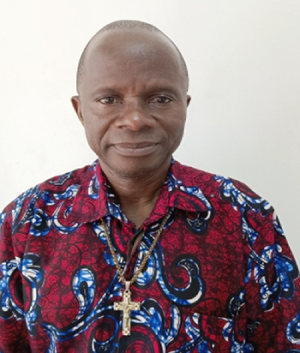 BEBWA ISINGOMA (PhD) is an Associate Professor of English Linguistics at the University of Bergen. He previously held the same position at Gulu University (Uganda), where he also served as Dean, Faculty of Education & Humanities. His research areas include World Englishes, syntax, variational pragmatics, variational sociolinguistics, African linguistics, and language in education. His latest publications (2025) include ‘Greeting and leave-taking in Ugandan English’, in I. Kecskes et al. (eds.), Pragmatics of African Varieties of English (De Gruyter) and ‘Trajectorial dynamics of English in Rwanda as a non-postcolonial Outer Circle country’ in English Today (CUP). In 2016, he co‑edited (with Christiane Meierkord and Saudah Namyalo) the volume Ugandan English: Its Sociolinguistics, Structure and Uses in a Globalising Post-Protectorate (Benjamins). Email: bebwa.isingoma@uib.no
 CHRISTIANE MEIERKORD holds the Chair of English Linguistics at the Ruhr‑University of Bochum and has previously taught at the Universities of Erfurt, Münster and Stockholm, where she was a visiting professor. She is author of Interactions across Englishes: Linguistic Choices in Local and International Contact Situations (2012) and co‑editor of Ugandan English. Its Sociolinguistics, Structure and Uses in a Globalising Post-Protectorate (2016, with Bebwa Isingoma and Saudah Namyalo) and World Englishes at the Grassroots (2021, with Edgar W. Schneider). She has published extensively on the use of English as a lingua franca as well as on the forms and functions of English in post-protectorates (with a focus on African nations, particularly Uganda, and the Maldives) and on the spread of English at the grassroots of societies. Email: christiane.meierkord@rub.de

 Open access

