




There is a Swahili proverb that reads: “Penye kuku wengi usimwage mtama.”Footnote 1 Literally translated “where there are many chickens, do not spill millet,” the proverb’s lesson is to be careful of what you say in front of people, who will eat up news like opportunistic chickens do spilled grain. In 1910, Carl Velten, a German linguist who taught Swahili at Berlin’s Seminar for Oriental Languages, published a Suaheli-Sprachführer für Postbeamte (Swahili Phrasebook for Postal Clerks). The book provided potential colonial postal officials with examples of the Swahili they might hear and use in their daily work, alongside German translations. The first section of the volume is a straightforward German-Swahili glossary. Comparatively multifaceted, the second half includes exemplary conversations and model notices; poetry and letters; and a series of short essays written by two of Velten’s Swahili teaching assistants — Muhammadi bin Akida and Mwinjuma Lamiri.Footnote 2 In one of these essays, the authors deployed a modified version of the aforementioned proverb to describe how some East Africans initially regarded the post office: “walipo kuku wengi, mtu haifai kumwaga mchele” (“where there are lots of chickens, a person would do well not to spill rice”).Footnote 3 The essay-writers interpreted the proverb as a caution against using the post because, in light of everything moving through the busy office, one’s message would certainly be lost in the shuffle — it would be swallowed up by busy chickens.
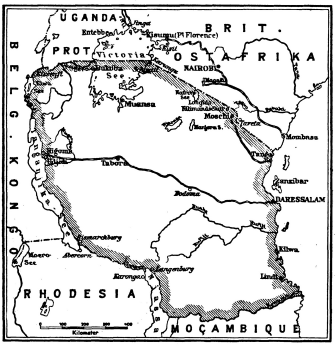
Map of German East Africa from 1914 including Central and Usambara Rail Lines, Deutsches Kolonialblatt 25, no. 23 (December 1914), 849.

I begin with this dual interpretation of the proverb because it highlights a strain of knowledge production not normally associated with bureaucracy and bureaucrats: information created in the process of running a bureaucratic system, that builds into powerful knowledge about that very system — what I call, for reasons outlined below, “studied bureaucratic knowledge.” Bureaucracy and knowledge are not, I admit, new bedfellows. The knowledge produced by bureaucracies has long been recognized as a source of state power: the organizational ability to create a synoptic view of formerly scattered, now standardized and consolidated information increased the “legibility” of the populace to the state, imbuing that state with the power to (attempt to) shape the lives of the perhaps-imagined but now-quantified populace.Footnote 4 As Bruno Latour put it, the power of bureaucracy stems from its ability to draw disparate information together, “until a few men consider millions as if they were in the palms of their hands.”Footnote 5 This kind of power-through-knowledge has been traced particularly clearly in colonial settings, where bureaucrats attempted to quantify and categorize indigenous populations, creating information to order their bureaucratic systems.Footnote 6 More recently, historians have begun paying careful attention to praxis, stressing “bureaucratic routines as knowledge producing processes.”Footnote 7 I start from this well-developed collective premise — that knowledge production is central to bureaucratic power — but shift the emphasis to examine knowledge about bureaucratic systems, produced by bureaucratic practice. The literature on bureaucracy, especially colonial bureaucracy, focuses largely on the creators of bureaucratic structures; I argue that we must also pay attention to the users of those structures, whose interactions with the system did much to define its power and limits.Footnote 8 The term “bureaucratic knowledge,” that is, can be used to describe two distinct things: in one sense, it is information collected by officials about the population being governed — knowledge deployed to impose order and control. The bureaucratic knowledge I try to uncover here is, in contrast, information about bureaucracy that could be observed by those who encountered its structures in their daily lives — and how that information in turned shaped their use of the bureaucratic system. I refer to this as studied bureaucratic knowledge, for it had be learned, often through close observation and at times with deliberate intention.
This essay focuses on studied bureaucratic knowledge in German East Africa. For if nineteenth-century Prussia, and later Germany, have been described by some historians and social scientists as the bureaucratic state par excellence, then, it seems to me, we must examine its influence in the colonies as well as the metropole, paying particular attention not just to German attempts to translate — linguistically, administratively, and culturally — one understanding of bureaucracy, but also the ways East Africans interpreted it on the ground, and how these interpretations found their way back into German bureaucratic practice.Footnote 9 This is what makes the Velten phrasebook so fascinating and why I will return to it: it preserves traces of what those translations may have looked like, from both the German and the Swahili linguistic side.
To explore these ideas, I use the case study of the colonial postal system. Why the post? First, its growth required infrastructure big (railroads and shipping lines) and small (envelopes and stamps) — material elements that the historian can trace. Bundled into the postal structure, moreover, were the telegraph and telephone services.Footnote 10 This meant that post offices were filled with words, making them a particularly compelling site to study quotidian translations of bureaucracy.
Second, according to Hermann Glaser and Thomas Werner, by the early nineteenth century postal networks facilitated new kinds of governmentality.Footnote 11 This included imperial governance: post offices, per Bernhard Siegert, acted as “network hookups for the colonial empires.”Footnote 12 Indeed, this is why the architects of the German colonial empire considered the postal system crucial to the endeavor: communication both with the metropole and within and between colonial territories was a sine qua non for the consolidation of military and administrative control over far-flung territories, the post an “indispensable and energetic helper in the work.”Footnote 13 At the same time, as Pedro Monaville argued for the Belgian Congo, the politics of the post “remained ambivalent throughout the whole colonial period,” facilitating at once colonial domination and potentially subversive connections between the colonized and with interlocutors abroad.Footnote 14 And yet, Monaville insisted, “what occasioned politics was the domestication of postal routines, not militant letters.”Footnote 15 That incorporation and appropriation of postal praxis, in this case by East African postal patrons, is also central to this study.
And finally, the post office was among the more publicly accessible of the bureaucratic structures put in place by the German colonial regime, open to any user, so long as he or she followed the regulations and could afford to pay. And its infrastructures were apparent on the landscape even to those who never entered a post office. In this piece, I trace the accumulation of studied bureaucratic knowledge by following three groups of East Africans through their interactions with the post: beginning outside of the post office with postal observers, the piece then moves inside with postal customers, and concludes with a look at the postal employees seated at their desks.
Standing outside: postal observers
In her examination of the widespread genre of vampire stories that circulated in colonial-era East Africa, Luise White insisted that such narratives — including rumor and gossip — are “the very stuff of history,” and that training careful attention on them expands the study of historical epistemology.Footnote 16 But rather than trying to pinpoint their “rationality,” White argued that the reality of widely shared stories rests in their very circulation; in their shaping of peoples’ actions and explanations about the world; and in the ways in which new technologies are intercalated with existing practices and procedures. Inspired by White, in this section I examine a small collection of stories that circulated among East African observers of the post and telegraph, as they appeared in the Phrasebook. These observations reveal a mixture of understanding and uncertainty, suspicion and enthusiasm, old and new.
In March 1909, Muhammadi bin Akida and Mwinjuma Lamiri began their two-year contracts as Swahili teaching assistants at the Seminar for Oriental Languages in Berlin. Bin Akida was a thirty-year-old teacher from Kilwa, and Lamiri a twenty-four-year old clerk from Tanga, both cities with longstanding connections to the cultural and linguistic continuum of the Swahili coast.Footnote 17 They were among a succession of East Africans who assisted German professors in teaching pronunciation and offered extracurricular speaking practice for students.Footnote 18 Carl Velten relied on these teaching assistants for his own publications, including the essays written by bin Akida and Lamiri which appeared in the 1910 Phrasebook.Footnote 19 The three essays, written in Swahili and translated into German, described pre-German methods of sending messages, the coming of the postal system to German East Africa, and the reception of the telegraph and telephone. The essays emphasized a transformation from a former state of “ujinga” (“ignorance”) to an enthusiastic embrace of these technologies.Footnote 20 But they also recorded a diversely-articulated set of observations about the post, the telegraph, and the telephone, expressed in an idiom quite apart from the narrative of German-led technological progress. Such stories reflect the studied bureaucratic knowledge collected by those who observed postal infrastructures, and hint at the ways in which observers’ hesitant engagement shaped those very infrastructures.
According to the essayists, “every day people had a new opinion” about the workings of the telegraph and telephone.Footnote 21 One theory described a telegraph constructed by “mashetani wawili” (“two demons”) posted in different cities, supernaturally shuttling voices back and forth; another postulated that an insect (“mdudu”) was inserted into the cable to carry messages.Footnote 22 Others rejected this idea, pointing out that insects can neither be controlled nor understand words. Perhaps, some observers posited, words were simply carried by the wind? Or maybe the postal clerk writes one’s message on a piece of paper, attaches it to an underground cable, and then “shakes the wire with force,” alerting the postal official on the other end that he should pull the wire with its message to the receiving station.Footnote 23
Such stories, which were reportedly “argued [about] for many months,” reveal much more than the “ignorance” attributed them by bin Akida and Lamiri. Rather, they incorporate these new technologies into existing explanatory frameworks. As Steven Feierman wrote in his work on “peasant intellectuals” among the Shambaa in northeastern Tanzania, inherited discourses are continually and actively made meaningful for the current moment, deliberately chosen and “[shaped] anew to explain current problems.”Footnote 24 In a similar way, East Africans observing and engaging with the postal service incorporated its material elements and their operation into existing discourses, including cosmological (demons), pathological (insects), and meteorological (wind). They also incorporated the post into existing understandings and methods of message sending and mobility — for long-distance communication was certainly nothing new in the region. Stephen Rockel’s research on the caravan trade, for instance, detailed a sophisticated system of movement involving coastal capital, inland professional porters, and networks of roadside communities — each demonstrating specialized knowledges and recognized expertise.Footnote 25 By the mid-nineteenth century, tens of thousands of people moved along these routes every year. The system of long-distance trade between coast and interior, moreover, built upon “well-trodden” regional networks established by the mid-eighteenth century, serviced by professional porters from the Yao, Nyamwezi, Kimbu, and Sumbwa communities.Footnote 26 These existing infrastructures and practices, what Andreas Greiner referred to as “vernacular infrastructure,” patterned the interventions of the early German colonial state: when Germany committed itself to consolidating control of its colonial territories in the 1890s and early 1900s, it “did not simply replace pre-existing structures but most often had to engage, coexist, and even compete with them.”Footnote 27 The first military posts were built beside the paths of trade caravans, and later administrative stations were founded in communities which had long served the trade.Footnote 28 Even after the fitful starts of roadbuilding and railway construction, the latter gaining momentum after the Maji Maji War of 1905–7, caravan porters continued to travel known routes in their thousands, combining stretches of travel by rail, government road, and known footpaths.Footnote 29
Vernacular infrastructure also included modes of long-distance communication: bin Akida and Lamiri wrote about “desturi za zamani za kupeleka barua” (“former customs of sending letters”), which included messengers traveling the same footpaths as the caravan porters. In the case of a death, for instance, the bereaved went to the baraza (a village meeting place) looking for a fleetfooted young person who could carry letters of notice to scattered relatives.Footnote 30 For non-urgent communication, a letter-writer simply waited until someone from the village was going in the direction of the letter’s intended recipient; if in a hurry, the composer went to the roadside to seek a passerby going in the right direction, sometimes paying for the letter to be carried.Footnote 31
The stories told about the post, telegraph, and telephone, then, were not simply supernatural explanations for unexplainable technological wonders; the storytellers introduced invisible messengers (demons, insects, underground wires) into the operation of the technology in order to incorporate it into their already complex and well-understood systems of communication. And rather than naiveté, people brought an experimental attitude to postal services. Bin Akida and Lamiri described one man, for instance, who sent a money order of five rupees to his brother, simultaneously dispatching a letter asking the brother to report if and when he received the money. After enough cases of successful receipt, the essayists insisted, “the reputation of the post grew, so that now there is no one who does not send his money with it.”Footnote 32
Besides explanations about how the post, telegraph, and telephone operated, observers also speculated about the purpose of these infrastructural interventions. Because even as users embraced the advantages of post and telegraph for the sending of their news and valuables, it seems that among some observers skepticism remained — particularly for those who did not partake of postal or telegraphic exchange, but who encountered its infrastructures in their daily lives. Some observers, for instance, interpreted the erection of telegraph poles as the marking of boundaries, insisting that “the Europeans are making the borders, sticking the poles in their land, so that they do not lose it.”Footnote 33 And, indeed, one could convincingly argue that the construction of the postal network was a kind of border-drawing — an attempt to consolidate colonial administration and mark territory as under German control (no matter, or perhaps in light of, the fact that armed resistance continued through the turn of the twentieth century). Other stories reflected an awareness that the colonial regime was, in a sense, always listening: officials gathered information about colonial subjects, and the telegraph in particular was a tool of military intelligence, reporting on the activities of potential and actual resistance movements. One finds in the correspondence of German postal officials during the Maji Maji War, for example, a constant concern to keep telegraph connections intact, and the roundabout ways in which mail was delivered to stations cut off from the coast.Footnote 34
One group of observers who seldom used the services of the post but encountered its infrastructures were women, and bin Akida and Lamiri related a combined sense of skepticism and danger from female observers of the telegraph:
And women who travel down the road that passes the telegraph say words like this to their children: my child, I advise you in the region of the Europeans, this path of the telegraph has many dangers. First: plug your ears with cloth, like your mother does, because the telegraph has many wondrous spirits, and if you get this spirit in your ears, you will never hear again. Second: here where we go, do not speak loudly, speak quietly, because if you speak loudly, the telegraph will hear your words, and if it hears it will take every word that we say and send it to the district official at the boma [fort]. And if you laugh, it will send the news to the boma and we will be penalized for nothing. Third: my child, do not touch the telegraph pole at all, because every pole is poisoned; if you touch the pole, you must know you will leave this world. Do not even approach it, my child, we request peace here on the path.Footnote 35
This passage depicts observers ruminating on the telegraph’s purpose: to listen in on conversations and report back to the boma. And the final warning, the poisonous poles, distilled a fundamental message: no matter how it worked or why it was erected, the telegraph — representing the region of the Europeans — was dangerous to life and limb.
Bin Akida and Lamiri included several examples of spying telegraph wires, stories which hearken to the opening proverb advising the listener to be careful about dropping grain around hungry chickens. Perhaps, despite the interpretation offered by bin Akida and Lamiri, the Swahili-speakers who used it actually meant what they said: be wary about using the services of the post office, not simply because it was a busy place, but because one should be sparing of the information made available to the colonial state. Concrete evidence for this hesitation is difficult to find; by the turn of the twentieth century, after more than a decade of German incursion and concomitant resistance, it was clear to many East Africans that military and administrative control went hand-in-hand, and that the infrastructures for these spheres overlapped. In his discussion of German colonial road construction, Greiner cited interviews conducted for the Maji Maji Research Project, a collection of oral histories carried out by scholars at the University of Dar es Salaam in 1968. According to some interlocutors, “opposition to road works was not only the result of unfree labour demands but also because of the alleged purpose of colonial highways … ‘Generally the clearance of roads was understood to make German government effective — more chainings, more beatings, more porterage and everything hateful. So that they hated clearing roads.’”Footnote 36 While interviews conducted in the 1960s naturally contained the hindsight of the proceeding decades of colonial rule, independence struggles, and decolonization, the explicit link between infrastructure and colonial incursion lines up well with the skepticism expressed by some of the postal observers in the Phrasebook’s essays. And while the essayists painted the stories of demons and insects, spying wires and poisonous poles as remnants of ignorance and superstition — a state to be overcome by German infrastructural intervention — a close reading reveals observers integrating these technologies into existing practices and understandings, or reflecting justified concerns about their purpose. It was knowledge won through the study of bureaucratic infrastructure, in this case produced by the observations of those standing, as it were, outside of the post office. In their essays, bin Akida and Lamiri insisted that this skepticism had been surmounted, that “today if you go to the post office, you can barely find a place, the way that people are so pleased with it.”Footnote 37 What, then, was the experience of these customers inside the post offices, and what kinds of studied bureaucratic knowledge might have been created in those spaces?
Inside the post office: postal customers
Most of the post offices in German East Africa were classified as Postagenturen (postal substations), with Dar es Salaam the first to be named a Postamt (a postal bureau) in 1892.Footnote 38 In 1899 there were a total of twenty-three post offices in the territory; before the outbreak of the First World War that number had risen to fifty-one.Footnote 39 The stations ranged from tiny, isolated outposts to bustling urban centers of business.
For the German colonial regime, the installation of postal and telegraph services was part-and-parcel with efforts to consolidate military and administrative control. Such lines of communication were also considered crucial for trade, particularly for German firms or settlers who desired contact with home and international markets. This means that the main users of postal services were Germans or other Europeans. Bin Akida and Lamiri also noted that the South Asian community contained early customers.Footnote 40 And yet the existence of a Swahili-language phrasebook indicates that postal officials also served the Swahili-speaking population, which by the turn of the twentieth century would have included not only urban coastal dwellers but also communities which had long been connected to the coast via the caravan trade. Indeed, German colonial rule itself facilitated the use of the language in more quarters, including government schools and offices.Footnote 41 There are also other indications, such as Swahili translations of postal regulations in the files of Heinrich Schnee, governor of German East Africa from 1912 until 1919, that point to Swahili-speaking users of the post.Footnote 42
The Gespräche (“Conversations”) section of the Phrasebook reveals some information about postal customers. These were exemplary conversations — in part based upon notes from current postal officials, in part invented by Velten and his teaching assistants — that were meant to prepare potential employees for the kinds of situations and corresponding language they might encounter in their daily work. The scenes covered everything from the process of unloading steamship deliveries, to mail distribution, to serving customers. Many of the customer names mentioned in the text point to Muslim individuals who likely were counted among the “Swahili” or “Arab” population within German racial categorizations: names like Muhamadi bin Ali, Abdallah bin Osmani, and Abdallah bin Saleh. One excerpt, describing the postal procedure on the day of a ship’s arrival, described how, “Indians, Swahili, Arabs, Banyans stand waiting for their letters.”Footnote 43 These racial categories were inflected by the tension between fluidity and classification present in both coastal and German racial thought at the turn of the twentieth century. But there is no doubt that the population of people using postal services would have had the ability to pay for long-distance communication, and in some cases to send significant amounts of money via the post.Footnote 44
There was, however, another constituency that appeared in post offices across German East Africa: the servants of European merchants and settlers, there to complete the postal business of their employers. There is little biographical information about these men; in one scene a servant named Hamisi offered that he was a Bondei, an ethnic group from Usambara in northeastern Tanzania.Footnote 45 Underneath the layers of racist depiction — these men are, for instance, uniformly referred to as “boys,” no matter their age — the phrasebook’s conversation section is filled with examples of them engaging with postal bureaucracy. They handed over packages with accompanying documents; moved between customs and post office collecting stamps; carried the account books of their employers; and purchased postage stamps and money orders.Footnote 46 One scene depicts two servants leaving the post office together, one telling the other: “Jusuf, imagine it, yesterday I received a postcard from Bagamoyo!”Footnote 47 An indication, if only a faint one, that these men, too, used the services of the post.
What would customers have learned about German colonial bureaucracy through such interactions? One lesson was the centrality of written documentation to any kind of official business: telegrams written down; money orders and other paperwork filled out and signed; and postal receipts read. For customers who couldn’t write, a Swahili-speaking postal worker would be called to assist. One telegram writer was chastised, first, for his poor handwriting and then, upon rewriting his message, for crossing out a word, an apparently “forbidden” practice.Footnote 48 This necessity for complete, properly-formatted documentation could be both a stumbling block and a useful tool for those who knew how to use it. The papers of Schnee, for instance, are filled with written testaments, borrower’s notes, bills of sale, and receipts of all kinds, written in Swahili.Footnote 49 Many users of the post would have been familiar with the written legal structure of Islam and pivoted to direct their claims toward the colonial state, capitalizing on the German propensity for paperwork to stake their title to property, debt repayment, land, and people.Footnote 50
But the procedures of the German postal system incorporated more than simple rules and regulations for the delivery of mail. They were also a set of customs and practices — the post had particular “desturi,” the Swahili word meaning customs or traditions. For German colonial officials, the post office was a place to exercise a bureaucratic “civilizing mission,” spaces regulated, á la Steven Shapin, by “stone and social convention.”Footnote 51 This more encompassing understanding of postal bureaucracy emerges from one of the model announcements included in the Phrasebook. The notice, written in both Swahili and German, reads:
It is not proper to make noise or argue in the post office. Whoever comes to the counter first, positions himself at the front. Whoever comes subsequently, situates himself behind. It is custom, if a European comes, that the European is let to pass to the counter first. Whoever has money to bring, takes a board from the crew member and counts his money, as is custom. When he then gives his money order to the postal official, he will be able to tally the money quickly and easily, because the counter official has lots of work and you may not exacerbate the work. It is also not custom for a person to deliver his mailings right before closing, because the letters might be left behind, if the steamer’s time of departure must be unexpectedly changed. One who knows this but does it anyway, of him it is said: he does not know the desturi. Footnote 52
The use of the Swahili term, even in the German version, seems pointed. To do these things, the passage implies, was more than just to break the rules of the post office — it was to display shameful ignorance of widely-known customs.
The study and documentation of East African “customs and traditions” had long interested Velten: in 1903 he published a volume on the Sitten und Gebräuche der Suaheli (Customs and Traditions of the Swahili) in both German and Swahili.Footnote 53 The Swahili version of the text was meant to expand the basis of literature for language study by those living in or going to East Africa; the German version aimed to give non-Swahili-readers “a means … to truly understand from the outset our black wards in their traditions and thereby be able to handle them.”Footnote 54 The goals of Velten’s ethnographic study were largely practical: to give colonial officials and other Germans in East Africa information that would supposedly ease their interactions with — and, ultimately, facilitate control of — the residents of the territory. It is a classic example of colonial knowledge production, of the type traced by historians across eighteenth-, nineteenth-, and twentieth-century colonial spaces. As Bernard Cohn wrote of British efforts to learn, categorize, and translate information about India: the “knowledge of the history and practices of Indian states was seen as the most valuable form of knowledge on which to build the colonial state.”Footnote 55 Velten’s study of East African desturi, translated into Sitten und Gebräuche, was just such an artifact of colonial knowledge production.
But if the postal system was a cultural complex with its own customs and conventions — desturi intended to replace users’ existing practices — then it could be studied by outsiders just like any other cultural constellation. And while the majority of the governed in any colonial regime were kept deliberately apart from the bureaucratic system (through separate legal, police, financial, and education structures), those who were able to observe colonial bureaucracy up close learned its ins and outs, its customs and practices, and its power. The interactions that customers had with the postal system, for instance, reinforced the centrality of written documentation to administrative functioning, and in some places infused daily life with the rhythms of mail arrivals and departures. And for those East Africans working in post offices, information about bureaucratic inner-workings was even closer to hand.
Seated across the desk: postal employees
The ideal turn-of-the-century bureaucracy was a system of impersonal efficiency and inflexible hierarchy, “a firmly ordered system of super- and subordination” built on files created and collected.Footnote 56 In the 1910s, Max Weber emphasized its rule-based nature, which fixed the jurisdiction and authority of bureaucrats.Footnote 57 But while the rules of any bureaucratic system “are more or less stable, more or less exhaustive, and [can] be learned,” Weber conceded that the “theory of modern public administration … does not entitle the bureau to regulate the matter by commands given for each case, but only to regulate the matter abstractly.”Footnote 58 And to apply abstract principles to specific cases demands a degree of interpretation and decision-making by the bureaucrat. Indeed, the preparatory handbooks for German postal officials, such as the Katechismus der Deutschen Reichspost and Velten’s Phrasebook, lay out necessary knowledge in the form of what Lorraine Daston has described as “thick rules.”Footnote 59 These were not exhaustive lists of procedures or regulations. Such guidelines, rather, “alerted practitioners to the details they must heed and the latitude needed to adjust the rule to the case at hand.… To enumerate all such cases would be impossible and also pointless; it was enough to flag their existence and model a few solutions. Experience would take care of the rest.”Footnote 60 Experience, that is, would produce the knowledge needed for the bureaucrat to apply the abstract rule to the specific situation. It was always a balance between fixity and flexibility, for German and East African postal employees alike. And the thick, situational interactions of daily postal business were shaped by multiple forces, including the ideals of German bureaucratic organization; the existing forms of bureaucracy in eastern Africa; and the challenges inherent in administrating a territory double the size of metropolitan Germany.Footnote 61 Within this matrix, the East African employees of the colonial postal service played a crucial intermediary role.Footnote 62 They also learned a great deal about the functioning of the system which depended upon their work.
What was the nature of the system into which East African bureaucrats were slotted? It was, at one level, a racialized style of colonial autocracy, where employees were divided not only between Beamte (“officials,” or “clerks”) and Unterbeamte (“sub-officials,” or “assistant clerks”), but where hierarchies between white and non-white employees were carefully maintained. East Africa was not, however, a bureaucratic blank slate. For decades prior to the arrival of the first German officials, the Zanzibari sultanate had been administering its island and mainland territories through a system of officials and representatives: maliwali (sing. liwali, governors) and qadi (Islamic judges) appointed by the Sultan interfaced with majumbe (sing. jumbe, village headmen) and maakida (sing. akida, magistrates) to collect taxes, keep order, and represent the Sultan’s interests from Pate in the north to Kilwa in the south.Footnote 63 By the mid-nineteenth century, then, there existed a class of elite, coastal bureaucrats experienced (if sometimes more and sometimes less successful) in administering populations of different religious, ethnic, economic, and social backgrounds. The German colonial regime essentially adopted this structure, at first relying on these coastal bureaucrats, and eventually inserting the office of the akida into a civil service career path that ended with the position of liwali.Footnote 64 These “local roots” influenced administrative structure even after the turn of the century, when the growing civil service began to include non-Muslim men from the interior who had been trained at German government schools. Footnote 65 As John Iliffe has argued, the systems of bureaucratic administration that emerged after the Maji Maji War were not simply the result of German officials “recruiting and training an administrative cadre of the type to which they were accustomed,” but rather stemmed from the converging interests of the colonial administration and a growing class of “men with western skills, anxious to reorganise their societies to face alien rule more effectively.”Footnote 66 In myriad ways, then, East Africans — from Zanzibari akidas to secondary-school graduates — influenced the shape of German colonial bureaucracy.
Preceding and parallel to the administrative ladder was the colonial military structure, with the boma at its center and filled out with East African, though rarely local, recruits known as askari.Footnote 67 These stations were, as Michael Pesek phased it, “islands of authority” for the first decades of German occupation.Footnote 68 Even after the halting transition from military to civilian rule, officials practiced a kind of peripatetic administration, lending an uneven quality to colonial control, vacillating between violent outburst, strict regulation, and absence.Footnote 69 But while the colonial regime in German East Africa may have been marked by its inability to exert even military and administrative control, scholars of bureaucracy have demonstrated that no bureaucratic system hovers above society, making and implementing decrees at will. Bureaucracies everywhere are, Shmuel Eisenstadt argued, inextricably intertwined with the societies around them. Numerous factors — from internal divisions, to competition for resources, to the level of reliance of the bureaucratic office on external parties — converge to shape bureaucratic systems and their influence on society.Footnote 70 “Thus from its inception,” Eisenstadt insisted, “a bureaucratic organization is in a state of constant interaction with its environment and has to develop different ways of maintaining a dynamic equilibrium in this environment.”Footnote 71 In East Africa, evidence of this equilibrium-seeking can be found, for example, in the German adoption of the shauri as a tool of administration. A Swahili word meaning “counsel” or “advice,” shauri meetings were regular practice between trade caravans and roadside communities, a symbolic and logistical mode of negotiation and relationship-building.Footnote 72 The German colonial administration adopted the shauri early on as a forum for public deliberation as well as judicial proceedings, building dedicated Schaurihütten (“shauri huts”), summoning individuals using a Schaurizettel (“shauri note”), and recording decisions in a Schauribuch (“shauri book”).Footnote 73 And while the German colonial interpretation of the shauri often differed from that of East African participants, the concession to this (mis)translation of German authority into existing terms and practices is indicative of the power of such practices to shape colonial administration.Footnote 74
Where that shaping information came from is a fundamental question. Pesek argued that German travelers encountered the shauri on the caravan trails, observing the “bricolage of cultural practices of different origins,” from Muslim representatives of the Sultan, to Indian firms organizing passage for European newcomers, to professionalized Nyamwezi and Yao porters, and the roadside communities with which they interacted.Footnote 75 Figures like Hermann von Wissmann, a participant in early expeditions and the territory’s first colonial governor, then incorporated the shauri into military and administrative practice.
German postal bureaucrats likewise leaned on the knowledge of their East African subordinates. According to one postal history, many of the initial clerical recruits came from among the Goan and Parsi communities of the coast, while the “simple work at the post stations” was accomplished by “Swahili, as well as half-Arabs, Comorians, etc.”Footnote 76 As the postal service expanded into the early years of the twentieth century, it incorporated graduates of the government schools established in places like Tanga, Dar es Salaam, and Bagamoyo, students who came from a slightly broader swath of the population.Footnote 77 Contemporary descriptions of East African sub-officials were unreservedly racist; they also reveal that these men did the bulk of the postal work. They labored inside and outside the post office, work encompassing rowing to meet steamships; carrying heavy mail sacks; customer service; inspecting telegraph lines; and carrying letters far and wide.
One type of knowledge essential to the functioning of the colonial postal system was information about people: in the absence of standardized addresses, the transmission of letters and packages, or the connection of phone calls, all depended upon knowledge about the human landscape of a given town. Many of the example conversations in the Phrasebook demonstrate subordinate officials supplying the personal knowledge necessary for the accomplishment of postal business. In one example, the akida Muhamadi bin Ulenge is called to the post office in Tanga, where the following scene ensues:
The scene contains three characters: Muhamadi bin Ulenge, an akida at the Tanga district office; a German postal official; and “Post-Juma,” a sub-official in the post office.Footnote 79 The German official begins by establishing Muhamadi bin Ulenge’s identity and querying his familiarity with Mashukura bin Mbwana, the man who sent him one hundred rupees. Although bin Ulenge supplied the desired information about bin Mbwana (“he lives here in Tanga, but he is not here now, the day before yesterday he went to Pangani”), the German official sought to verify his identity again, this time asking the sub-official if he knew the man. Only when “Post-Juma” answers in the affirmative, even commending bin Ulenge’s reputation (“he is a reputable man”), does the German official give the akida his money. As this scene indicates, the postal infrastructure was only as good as the knowledge of its bureaucrats — knowledge that often came to German officials from the indigenous sub-officials, who facilitated the post’s connection to the rest of the populace.
In this way, East Africans working within the German postal system were classic intermediary figures: clerks, interpreters, and other civil servants who straddled cultures, often put in the role of interpreting the one for the other, both linguistically and culturally. There is a great deal of literature about such intermediary figures in colonial African settings, work that pushes beyond the dichotomy of African employees of the colonial state as either “collaborators” or “resistors,” demonstrating instead the ways in which intermediaries “influenced colonial rule because they shaped the interactions of subject populations with European officials.”Footnote 80 This role required significant mastery of bureaucratic practice — it was something that had to be learned. The potential power of clerks, in other words, did not simply stem from an ability to speak multiple languages, but also from their capacity to understand and, albeit in a limited way, manipulate bureaucratic systems — it sprang from their studied bureaucratic knowledge.Footnote 81 This was as true in the relatively short-lived bureaucracy of German East Africa as it was in the more fully-developed systems of French and British colonial territories, the focus of the bulk of the historical literature on intermediaries. And the German colonial regime relied on these figures just as much as their French and British counterparts. There was an economy of information at work, and knowledge could be operationalized in multiple directions. Take the example of the postal system: at one level, East African postal workers supplied information that expedited the delivery of letters. Their knowledge also helped meet the German desire to categorize colonial subjects in order to more effectively rule. But the indigenous sub-officials did not only feed information into the German colonial knowledge-production-machine: they also learned a great deal about that machine and the people running it. Let me offer an example from the German postal archives.
Following the First World War, when Germany was forced to dismantle its colonial holdings, the Reich Postal Ministry created an office — the Abwicklungsstellte, or Liquidation Office — to deal with outstanding debts and backpay for postal workers who had stayed on duty during the war. Most of the cases brought to the attention of the office concerned German companies or individuals requesting compensation. But a part of the work also included sorting out what was owed to the indigenous personnel who had worked in East African post offices.Footnote 82
In March 1924, former colonial post director Wilhelm Rothe, who had been given charge of the Liquidation Office, compiled a list of thirty-eight individuals who were owed back pay. The list was necessarily incomplete, based upon documents that had made it out of the colony, and Rothe admitted that “the actual amount of the outstanding wages is roughly at least double so high” as the 3,884.17 rupees indicated.Footnote 83 A year later, the Foreign Office compiled a new list consisting of forty-three individuals owed a total of 4,340.30 rupees. “It surely needs no further debate,” the cover letter to this list noted, “that out of the resources made available, the indigenous employees of the colonial postal administration, who still during the war belonged to the military postal service, must also be compensated.” Footnote 84 The indigenous personnel, that is, were as equally entitled to compensation for wartime service as were their German counterparts.
Though the bulk of the Liquidation Office’s work was completed by 1925, the Foreign Office continued to field occasional claims. In February 1926 that office wrote to Rothe, reporting that 214 marks of remaining pay had been transferred to Muhamadi bin Juma, a telegraphist who had worked at the post office in Mwanza. Bin Juma in fact appeared in the Phrasebook, in a reprinted letter written in 1909. In the letter bin Juma sent greetings to “Takadiri and Ramazani and everyone at the post office in Dar es Salaam,” an indication that he began his career on the coast before arriving at the Lake Victoria station.Footnote 85 His letter described the new quarters rented for him and his co-worker, as well as the work they did, which included digging trenches to extend the telegraph cable to the newly-built postal building near the lakeside jetty. Recently, bin Juma reported, the telegraph connection between Tabora and Kilimatinde (west of Dodoma) had been broken, meaning that for many days they could not send or receive messages from Kilimatinde, let alone from Dar es Salaam. “We are exasperated,” he wrote, “because so much work has been delayed” by these “very many difficulties.”Footnote 86
Beyond backpay for his work, bin Juma also asserted entitlement to a further 150 rupees — money he insisted that he had deposited with his then-boss, field telegraph secretary Robert Schmidt. Schmidt had been killed during the war, making bin Juma’s claim difficult to verify. The Foreign Office requested Rothe’s assistance in the investigation of Schmidt’s estate, to see if he could find any paperwork attesting to the keeping of bin Juma’s money.Footnote 87 The request triggered an investigation by the Foreign Bureau of the Reich Postal Ministry, which found no relevant records in its own files except a submission dated January 1920 from Robert Schmidt’s brother, Otto, asserting that most of his brother’s papers had been lost during the war. The Foreign Bureau then contacted the post office in Dresden, where Otto Schmidt lived, to request that they contact him, to ascertain whether evidence of bin Juma’s deposit could be found in any of his brother’s remaining files.Footnote 88 Otto himself wrote to the post office in Dresden, explaining: “The East African pages out of the papers of my deceased brother I sent at the time to the Liquidation Office. In my hands is found only a private notebook with few diary-like entries, out of which does not emerge, that Muhamadi bin Juma deposited 150 rupees.”Footnote 89 Otto was loath to send the notebook itself to the ministry, it being “the last memento of my brother,” but in the end he complied with the request to make it available for inspection. The postal director in Dresden reported back to the Reich Postal Ministry on February 10 that nothing in the notebook indicated that Muhamadi bin Juma had left any money with Robert Schmidt, and it was sent back to Otto; less than two weeks after the investigation had started, news reached the Foreign Office that no evidence of bin Juma’s deposit had been found. And with that, the case was closed.
Muhamadi bin Juma’s appeal for compensation was unsuccessful; his request was buried by paperwork, or, more accurately, by the lack thereof. Without written evidence that he had deposited money with his former boss, the claim was considered unsubstantiated and perhaps even untruthful. The reliance on written documentation, and the strict adherence to procedure, no doubt hurt bin Juma’s appeal. But both were also essential conditions for his ability to bring the case to the attention of the postal administration in the first place. Through the procedures of the Liquidation Office, bin Juma had already received a degree of compensation for his work; and through the levers of the Foreign Office and the Reich Postal Ministry, he was able to appeal for the entire amount he believed he was owed. In the colonial setting, bureaucratic rights were both unequally applied and knowledge of them was kept deliberately concentrated. But figures like Muhamadi bin Juma, who worked within the bureaucratic system and were drilled in its processes and idiosyncrasies from their first day on the job, learned a great deal about how it functioned. This was studied bureaucratic knowledge, created in the course of daily activities. It was knowledge available to indigenous personnel, in contradistinction to the knowledge that would be produced about them and their communities through bureaucratic procedures like surveys and censuses. And it was knowledge that, in some limited cases, could be deployed to make claims within the bureaucratic system, to insist upon a modicum of equal consideration as a part of that system.
This is certainly not to argue that bureaucracy, and in particular colonial bureaucracies, were forces of democratization. As Weber described, bureaucracies enact a “leveling of the governed in opposition to the ruling and bureaucratically articulated group, which in its turn may occupy a quite autocratic position, both in fact and in form.”Footnote 90 And while the German colonial bureaucracy in East Africa was, as Juhani Koponen put it, “scarcely … a highly efficient bureaucracy singled out by its superior knowledge and guided by instrumental rationality à la Weber,” the administrative and military structures were also “the only institutions which covered the country as a whole and monitored events in all parts of it.”Footnote 91 Bureaucratic structures, then, were both potentially powerful tools of oppression and potential learning opportunities for intermediaries.
Conclusion
“Vyote uvionavyo vinaelea vimeundwa.” (“Everything that you see floating was created.”) Ali Hassan Mwinyi, the second president of Tanzania, used this Swahili proverb to introduce the memoirs of Rajabu Yusuf, a fifty-three year veteran of the East African postal service.Footnote 92 A distinct human failing, Mwinyi reflected, is the tendency to take for granted the things that we use every day.Footnote 93 The postal system is one of those structures that fades into the background of society’s consciousness, and Mwyini sought to remind readers that the post was created — and kept running — by effort, not inertia. Civil servants like Yusuf, the former president concluded, preserve important forms of knowledge: information borne as a camel carries its burden, “knowing that he has carried a truly heavy load.”Footnote 94
The literature on colonial-era intermediaries has demonstrated how figures like Yusuf, and Muhamadi bin Juma, straddled worlds, making their way in difficult situations, often tugged between competing interests. Intermediaries shaped the knowledge available to colonial officials at the same time as they reformulated social and economic structures in their home communities. This was an exercise of “agency in tight corners,” as John Lonsdale phrased it.Footnote 95 Some of these intermediaries, too, developed anticolonial, proto-nationalist, ideals. That those working closest to the colonial administration would undermine it is perhaps not surprising: Frederick Cooper among others has demonstrated how universalizing discourses surrounding notions of citizenship and modernity were deployed by, for example, labor organizations to assert entitlement to certain rights from the colonial state — and eventually for its ouster.Footnote 96 But what I hope to have made clear in this piece is that it was not only at the level of discourse that, in this case, East Africans manipulated bureaucratic structures and made claims against colonial systems. It was often, rather, at the level of practice that useful knowledge about colonial bureaucracies was produced: this was studied bureaucratic knowledge, accumulated through observation and engagement with the system.Footnote 97 One can follow the gatherers of studied bureaucratic knowledge from outside the post office, where observers folded the post into existing forms of communication, or cautioned against its potential dangers; to inside the postal lobbies where customers imbibed the rhythms of opening hours and mail delivery, adopting the written forms of the post for their own communicative purposes; to the desks of postal employees, the closest observers of all, who not only shaped the information available to German postal officials, but also learned how to effectively make claims against bureaucratic systems. The archival traces of this kind of knowledge production — information created through bureaucratic practice about bureaucratic systems — suggest that bureaucracy must be studied as more than an information-collecting machine. It was also a political, cultural, and intellectual complex that was subject to examination and interpretation by a wide variety of people, including observers, customers, and employees, from Berlin to Dar es Salaam to Lake Victoria and back again.
Acknowledgements
Many thanks to the journal editors as well as the anonymous reviewers for their careful engagement with this article from start to finish. I was lucky enough to spend a good bit of time working on this piece in Essen, Germany while an International Fellow at the Kulturwissenschaftliches Institut and I remain grateful to the intellectual community gathered there, as well as for the continued support of the Alexander von Humboldt Foundation.

 Open access

