





Introduction
Toxocara vitulorum is one of the deadliest ascarid nematode that lives in the small intestine of cattle, buffalo and other bovids (Biswas et al., Reference Biswas, Roy, Hasan, Ahmed, Dutta, Begum and Talukder2022). It has worldwide distribution but mostly found in bovids of tropical and subtropical regions (Dorny et al., Reference Dorn, Devleesschauwer, Stoliaroff, Sothy, Chea, Chea, Sourloing, Samuth, Kong, Nguong, Sorn, Holl and Vercruysse2015). This zoonotic ascarid causes visceral larval migrans (VLM) in humans (Toochukwu, Reference Toochukwu2017). In the young buffalo calves aged under 3 months, toxocariasis is one of the prime causes of morbidity and mortality (Rahman et al., Reference Rahman, Dey, Islam, Hossain, Talukder and Alam2018; Biswas et al., Reference Biswas, Roy, Hasan, Ahmed, Dutta, Begum and Talukder2022). The most common routes of receiving infection by this buffalo calves are transmammary and transplacental route while they can also get infection by consumption of larvated eggs contaminated forage (Rast et al., Reference Rast, Lee, Nampanya, Toribio, Khounsy and Windsor2013). In buffalo, the prevalence of T. vitulorum varied from 2 to 32% while 11 to 57% for buffalo calves in Bangladesh for last 12 years and it is still increasing with the course of time (Islam et al., Reference Islam, Rahman, Hossain, Chowdhury and Mostafa2005; Rahman et al., Reference Rahman, Dey, Islam, Hossain, Talukder and Alam2018). Previous reports also unveiled that the buffalo calves had 3 times higher odds of getting infection than dam buffalo (Rahman et al., Reference Rahman, Dey, Islam, Hossain, Talukder and Alam2018). It is assumed that if this parasitic infection is not controlled properly, the prevalence and mortality can be reached up to 100 and 50% in buffalo calves respectively (Radostits et al., Reference Radostits, Gay, Hinchcliff and Constable2006; Rast et al., Reference Rast, Lee, Nampanya, Toribio, Khounsy and Windsor2013). Continuous reporting of ineffectiveness of benzimidazole s against T. vitulorum from different buffalo rearing farms and Bathan (a vast waking marshy green grass land on the river bed) regions of Bangladesh have been recorded for last 12 years and developing resistance against some available benzimidazoles such as albendazole and levamisole (Biswas et al., Reference Biswas, Roy, Hasan, Ahmed, Dutta, Begum and Talukder2022). It is evident that parasitic nematodes are incredibly diverse and treatments rely on a limited arsenal of anthelmintic drugs with same drug classes, over-reliance and inappropriate use of these anthelmintics have placed strong selective pressures on parasites and caused the evolution of anthelmintic resistance (AR) to every drug class (Kotze et al., Reference Kotze, Gilleard, Doyle and Prichard2020). In many cases it has been proved that the evolution of AR to every drug class depend on genetics of resistant nematode, therefore phenotypic variation in anthelmintic responses that can be explained by genetic variation in a population (Evans et al., Reference Evans, van Wijk, McGrath, Andersen and Sterken2021). As of today, few studies were conducted to determine the prevalence and associated factors of transmission of T. vitulorum in Bangladesh, but interestingly no molecular based approach taken into consideration to characterize the ascarid which will be a tool to unveil resources for understanding the pathogen ecology, epidemiology and control (Halajian et al., Reference Halajian, Eslami, Salehi, Ashrafi-Helan and Sato2010; Sultan et al., Reference Sultan, Omar, Desouky and El-Seify2015). In pursuit of drawing the hidden relationship between AR and genetic makeup of T. vitulorum, we ought to unveil molecular data from the circulating T. vitulorum in Bangladesh as first step. Currently, a wide range of molecular techniques such as PCR, restriction fragment length polymorphism, randomized amplified polymorphism DNA and sequencing have been used widely to identify parasite species more precisely (Prichard and Tait, Reference Prichard and Tait2001; Ahmed et al., Reference Ahmed, Roy, Hasan, Zim, Biswas and Talukder2023). The nuclear ribosomal DNA (rDNA) particularly internal transcribed region 2 (ITS2) is a potential marker for identification of species because of its some distinct attributes such as easy amplification, integrity of conserved regions, fast evolution of variable nuclear loci, good number of rRNA clusters to unleash closely interlinked species (Li et al., Reference Li, Zhu, Gasser, Lin, Sani and Lun2006; Chen et al., Reference Chen, Zhou, Nisbet, Xu, Huang, Li, Wang and Zhu2012; Ahmed et al., Reference Ahmed, Roy, Hasan, Zim, Biswas and Talukder2023). The mitochondrial nicotinamide dehydrogenase subunit 1 gene (NAD1) and cytochrome oxidase 1 (COX1) genes have been used as candidates for studying diversity and finding out population structure for a long time (Jones et al., Reference Jones, Mitchell, Redman and Gilleard2009; Wickramasinghe et al., Reference Wickramasinghe, Yatawara, Rajapakse and Agatsuma2009a, Reference Wickramasinghe, Yatawara, Rajapakse and Agatsuma2009b). Therefore, we selected conventional PCR technique to amplify the ITS2, COX1, and NAD1 gene markers followed sanger sequencing to detect Toxocara nematode at species level and finding similarities and dissimilarities among the identified isolates and with other isolates detected from other parts of the world base on genetic P distance. The investigation also established population structure and phylogenetic link between the detected T. vitulorum isolate and additional T. vitulorum isolates, as well as congenerics from distantly related species.
Materials and methods
Study area
The study was conducted on multiple sites of 7 divisions such as Barishal (Charfassion, Bhola Sadar in Bhola district of Barishal), Chattogram (Sandwip and Anowara upazila in Chattogram), Khulna (Fakirhat, Mongla and Morelgonj in Bagerhat district), Rajshahi (Godagari and Paba in Rajshahi district and Sariakandi in Bogura district), Rangpur (Kurigram Sadar, Rawmari in Kurigram district and Kaligonj in Lalmonirhat district), Mymensingh (Trishal, Madargonj and Nokla in Myemsingh, Jamalpur and Sherpur district, respectively) and Sylhet (Gowainghat, Jaintapur and Kanaighat in Sylhet district) during July 2018 to December 2020 (Fig. 1). These selecting areas were highly prevalent for toxocariasis and the availability of different age groups buffaloes (Rahman et al., Reference Rahman, Dey, Islam, Hossain, Talukder and Alam2018).
Map of Bangladesh showing the 7 study areas as Barishal, Chattogram, Khulna, Rajshahi, Rangpur, Mymensingh and Sylhet division.

Parasite collection
Based on the coproscopic examination, we selected buffalo calves harbouring Toxocara worms. We gave them anthelmintic treatments such as Ivermectin @0.2 mg kg−1 BWT (Biswas et al., Reference Biswas, Roy, Hasan, Ahmed, Dutta, Begum and Talukder2022) and following treatment adult Toxocara worms were expelled with feces. Then these adult Toxocara worms were washed with normal saline and transported to the Department of Parasitology, Bangladesh Agricultural University for microscopic detection and then stored at −20°C for molecular investigation.
Isolation of genomic DNA
Genomic DNA was extracted from 84 adult Toxocara species (12 from each division) by using QIA amp mini kit (Original product by Qiagen AG, Hombrechtikon, Switzerland and provided by Qiagen India Pvt. Ltd. Jasola, Delhi) according to manufacturer's recommendations (Khademvatan et al., Reference Khademvatan, Rahim, Tavalla, Abdizadeh and Hashemitabar2013). The eluted DNA was stored at −20°C prior to PCR.
Amplification of ITS2, NAD1 and COX1 gene and gel electrophoresis
ITS2 (~625 bp)
ITS2 gene was amplified from genomic DNA by using the conserved oligo-nucleotide primer pair: 3S (forward: 5′-CGGTGGATCACTCGGCTCGT-3) and 28A (reverse: 5′-CCTGGTTAGTTTCTTTTCCTCCGC-3′) (Wickramasinghe et al., Reference Wickramasinghe, Yatawara, Rajapakse and Agatsuma2009a, Reference Wickramasinghe, Yatawara, Rajapakse and Agatsuma2009b; Mahdy et al., Reference Mahdy, Mousa, Abdel-Maogood, Nader and Abdel-Radi2020). PCR reaction with a final reaction volume of 25 μL was conducted. 5 μL of DNA extract, 12.5 μL of Taq® Green Master Mix, 5.5 μL of nuclease-free water, and 1 μL of each forward and reverse primer were used in the amplifications. The amplification programme was run in a MyCyclerTM heat cycler (BioRad, USA) with a 3 minutes initial denaturation at 94°C, 31 cycles of 30 s at 94°C, 30 s at 46°C, and 1 min at 72°C. For all primers, except the 12S and ITS2 primers, which were annealed at 50 and 53°C, respectively, there was a final 5 min of extension at 72°C (Mahdy et al., Reference Mahdy, Mousa, Abdel-Maogood, Nader and Abdel-Radi2020). The resultant gel was analysed and captured on camera using a transilluminator.
NAD1 (~370 bp)
During the conventional PCR, the primer pairs (forward: 5′-TTCTTATGAGATTGCTTTT-3′ and reverse: 5′-TATCATAACGAAAACGAGG-3′) were used (Li et al., Reference Li, Lan, Luo, Zhang, Liu and Zhang2016; El-Seify et al., Reference El-Seify, Marey, Satour, Elhawary and Sultan2021). 9.75 μL autoclaved, distilled water, 5 μL PCR buffer (10×), 0.25 μL Taq, 2 μL dNTPs (2.0 mm), 1 μL DNA, 3 μL MgCl2 (25 mm) and 2 μL of each forward and reverse primer (working concentration: 10 μmol L−1) were all included in the PCR mixture in a 25 μL reaction volume. After a heated start of 94°C for 5 min and concluding with 72°C for 5 min, each of the 40 PCR cycles included 94°C for 30 s, 50°C for 30 s, and 72°C for 1 min (Li et al., Reference Li, Lan, Luo, Zhang, Liu and Zhang2016; El-Seify et al., Reference El-Seify, Marey, Satour, Elhawary and Sultan2021). The PCR products were observed using a UV transilluminator after being separated on 1% agarose gels and stained with ethidium bromide.
COX1 (~446 bp)
A fragment of COX1 was amplified by PCR, yielding a 446 bp sequence using primers JB3 (5′-T TTTTTGGGCATCCTGAGGTTTAT-3′) and JB4.5 (5′-TAAAGAAAGAACATAATGAAAATG-3′), a final volume of 25 μL was used for the PCR, which contained 7.5 μL of sterile distilled water that was free of RNase and DNase, 10 μL of 5× MyTaq Reaction buffer, 1 μL of each primer (20 pmol), 5 μL of template DNA (100–200 ng), and 0.5 μL of TaqDNA polymerase (1.25 IU)4 (Wickramasinghe et al., Reference Wickramasinghe, Yatawara, Rajapakse and Agatsuma2009a, Reference Wickramasinghe, Yatawara, Rajapakse and Agatsuma2009b;Oguz, Reference Oguz2018). The following were the conditions for the PCR: 5 minutes at 94°C for initial denaturation, 35 cycles of 30 s at 94°C, 45 s at 50°C, 35 s at 72°C, and 10 min at 72°C for the final extension. The PCR products were observed using a UV transilluminator after being separated on 1.5% agarose gels and stained with ethidium bromide (Oguz, Reference Oguz2018).
PCR positive electrophoresis product purification
Purification of the ITS2, COX1 and NAD1 PCR electrophoresis products was accomplished with the use of SV Gel and PCR Clean Up System (Cat. No. A9281; Origin: Promega, USA). Purified products were sequenced using an Applied Biosystems automated DNA sequencer (3730 XL; Applied Biosystems, Foster City, USA) in accordance with manufacturer instructions from a commercial source (DNA Laboratories Sdn Bhd (736763-T), UKM-MTDC Technology Centre, Selangor, Malaysia through Invent Technology Ltd. Banani, Dhaka). The forward and reverse PCR primers orientation was same for both the forward and reverse reads.
Intra-population diversity parameters and phylogeny
Using BLAST (https://blast.ncbi.nlm.nih.gov/Blast.cgi), unique sequences for each marker (29 ITS2, 21 NAD1 and 24 COX1) generated in this study were compared with best hit scoring sequences available in GenBank (Supplementary Table S4). The Mega11 software was used to aligned the sequences using ClustalW program by using a gap opening penalty of 15.00 and gap extension penalty of 6.66 for both pairwise and multiple alignments as described by Nehra et al. (Reference Nehra, Kumari, Kundave, Vohra and Ram2022). Pairwise comparisons were made using the GenBank-retrieved sequences, and the BioEdit program (version 7.0.5.3) (https://bioedit.software.informer.com/7.2/) was utilized to determine similarities (%) (Ahmed et al., Reference Ahmed, Roy, Hasan, Zim, Biswas and Talukder2023). Haplotype diversity, the average number of nucleotide change, and nucleotide diversity were among the characteristics linked to intra-population diversity that were measured using DnaSP version 5.1 (Rozas, Reference Rozas, Ferrer-Mata, Sanchez-DelBarrio, Guirao-Rico, Librado, Ramos-Onsins and Sanchez-Gracia2017). After trimming every sequence at both ends, the phylogenetic analysis was carried out using the neighbor-joining method with the Tamura Nei parameter of evolution based on lowest BIC score (Bayesian Information Criteria) and AICc value (Akaike Information Criteria) in the Mega11 programme (Tamura et al., Reference Tamura, Stecher and Kumar2021). While MEGA v.11.0's default values were used to acquire the other settings, 1000 replicates were used to determine the bootstrap parameters for the definition of nodes statistical support (Tamura et al., Reference Tamura, Stecher, Peterson, Filipski and Kumar2013).
Population genetic structure by using mitochondrial COX1 sequences
Genetic differences were estimated using statistics based on haplotypes (Hs), nucleotide sequences (Ks) and some other parameters such as average number of nucleotide differences in pairs (Kxy), genetic differentiation index based on the frequency of haplotypes (Gst), nucleotide-based statistics (Nst), nucleotide substitutions per site (Dxy) and net nucleotide substitutions per site (Da) using DnaSP ver. 6.12.03 (Rozas et al., Reference Rozas, Ferrer-Mata, Sanchez-DelBarrio, Guirao-Rico, Librado, Ramos-Onsins and Sanchez-Gracia2017) the population pairwise genetic difference (Fst) to determine the genetic differentiation and population genetic structure.
Results
Morphological findings
Toxocara vitulorum is a large, robust worm up to 30 cm long with three large, prominent lips. The body was soft and translucent with clearly cuticle (Fig. 2A and B). The mean length of male and female parasite was 18.5 (±1.2 cm) and 24.20 (±6.2 cm) 29.11 cm) and mean width were 0.4 and 0.6 mm in respectively. The three well defined lips; two sub ventral and one dorsal lip were determined from the worms (Fig. 2C and D). The male worms had a posterior end curved ventrally and posterior end exhibited two spicules (Fig. 2E). While, in female posterior end was distinguishable a straight-tailed (Fig. 2F).
(A, B) Toxocara vitulorum collected from calves. (C, D) Anterior end of T. vitulorum showed 3 lips of male and female worm (lip), (E) posterior end of male showed coiled tail (black arrow) and showed spicules (sp) (F) posterior end of female showed short tail (st), and posterior end of female worm showed a straight tail end (long white arrow), (G) 30 cm long female T. vitulorum.

Species identification and genotyping
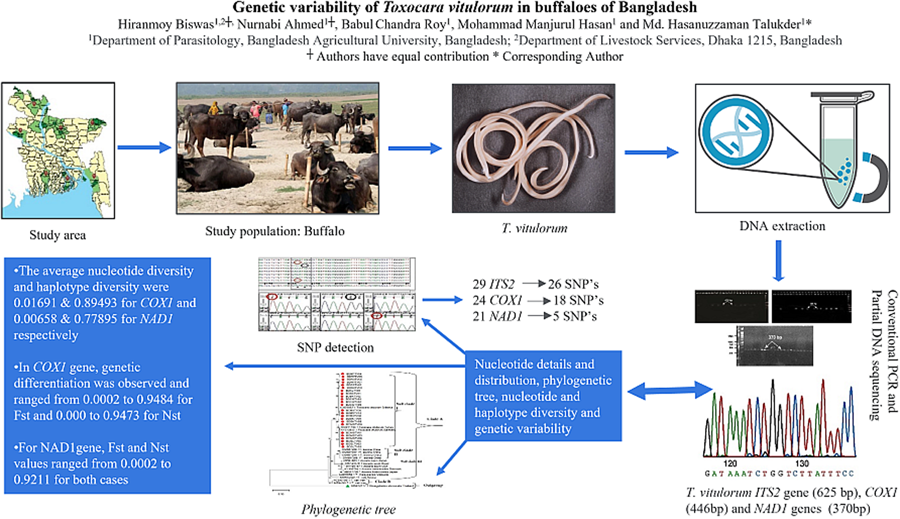
To validate the species of T. vitulorum, the ITS2, COX1 and NAD1 gene were amplified from 84 samples from seven divisions of Bangladesh and conventional PCR product showing T. vitulorum ITS2 gene (625 bp), COX1 (446 bp) and NAD1 genes (370 bp) in separate agarose gel (Fig. 3).
Conventional PCR product showing a. T. vitulorum ITS2 gene (625 bp), b. COX1 (446 bp) and c. NAD1 genes (370 bp) in separate agarose gel. [Lane M (Marker-1 kb), lane NC (negative control)].

From 84 positive PCR products, 84 ITS2, 79 for COX1 and 74 for NAD1 sequences were produced. Unfortunately, sequencing of 5 T. vitulorum isolates for COX1 and NAD1 was failed to generate. On the contrary, 5 sequenced data for NAD1 gene failed to generate due to numerous ambiguous nucleotides positioning. Among 84 ITS2 sequences, 29 distinct genotypes were identified while 79 COX1 and 74 NAD1 sequences, 24 and 21 distinct genotypes were found.
When compared to five ITS2 reference sequences of T. vitulorum (GenBank accession nos. MK100346.1, MG214152.1, FJ418784.1, MG214151.1 and KY442062.1), the newly generated ITS2 genotype similarities ranged from 97 to 100%. Pairwise nucleotidic genetic distances (p-distance model) were measured for the partial ITS2 sequences of T. vitulorum isolates in the present study with best hit scoring reference sequences of different countries retrieved from GenBank and genetic distances ranging from 0.000 to 0.0326 (Supplementary Table S1).
Twenty-six single nucleotide polymorphisms (SNPs) were found when 29 ITS2 genotypes were aligned with the reference sequence (MK100346.1 in India). These SNPs resulted from substitutions at nucleotide positions 60, 66, 116, 124, 130, 132, 133, 135, 150, 156, 158, 164, 177, 192, 205, 206, 234, 274, 275, 277, 298, 301, 308, 317, 319 and 331. In such substitutions, there were six transitions (three T˂-˃C and three A<->G) and twenty transversions (seven A˂->T, two G<->C, five A˂-˃C, and six G<->T) (Table 1). Table 2 shows that the total haplotype diversity and nucleotide diversity of T. vitulorum among its ITS2 sequences from seven divisions in Bangladesh were 0.83498 and 0.01530, respectively. Comparing the newly generated COX1 and NAD1 genotypes of T. vitulorum to the best hit scoring sequences from GenBank revealed matches ranging from 98 to 100% (Supplementary Tables S2 and S3). For the COX1 and NAD1 genes, respectively, 79 and 74 amplicons yielded 12 and 6 distinct haplotypes. When compared to the reference sequence (AJ920062.1) in the COX1 gene, 18 SNPs were observed at positions 104, 14, 149, 155, 185, 197, 218, 220, 227, 245, 284, 296, 314, 344, 362, 368, 376 and 389 (Table 3). Five SNPs were found in the NAD1 gene (T<->G, A<->T, and G<->A) (Table 4). SNP's were both transitions (A<->G, C<->T) and translations (<A->T, C<->G and G<->T) type in nature (Table 3). The T. vitulorum isolates from Bangladesh showed a high degree of diversity in the COX1 and NAD1 genes; for COX1, the average nucleotide diversity was 0.01691 and the haplotype diversity was 0.89493, while for NAD1, the average nucleotide diversity was 0.00658 and the haplotype diversity was 0.77895 (Table 2).
Nucleotide details and distribution of 29 ITS2 of T. vitulorum isolated from buffalo with reference sequence retrieved from GenBank (MK100346.1)

BD, Bangladesh; RP, Rangpur; RS, Rajshahi; CG, Chattogram; KL, Khulna; BS, Barishal; SL, Sylhet; MS, Mymensingh; TV, Toxocara vitulorum, the sur number was representative of isolate number.
Nucleotide diversity and haplotype diversity of ITS2, COX1 and NAD1 gene sequences of T. vitulorum isolated from 7 different topographic regions of Bangladesh

Nucleotide details and distribution of 24 T. vitulorum COX1 gene isolated from buffalo with reference sequence retrieved from GenBank (AJ920062.1)

BD, Bangladesh; RP, Rangpur; RS, Rajshahi; CG, Chattogram; KL, Khulna; BS, Barishal; SL, Sylhet; MS, Mymensingh; TV, Toxocara vitulorum, the sur number was representative of isolate number.
Nucleotide details and distribution of 21 T. vitulorum NADI gene isolated from buffalo with reference sequence retrieved from GenBank (AJ920062.1)

BD, Bangladesh; RP, Rangpur; RS, Rajshahi; CG, Chattogram; KL, Khulna; BS, Barishal; SL, Sylhet; MS, Mymensingh; TV, Toxocara vitulorum, the sur number was representative of isolate number.
Phylogeny
The phylogenetic tree has been constructed by 29 ITS2 genotypes was divided into two clades: A and B. Furthermore, clade A was divided into subclades I and II, where Strongyloides stercoralis was used as outgroup. The neighbour-joining (NJ) phylogenetic tree demonstrated that T. vitulorum isolates clustered together with the reference sequences of Sri Lanka, USA, Canada, Egypt & Germany that belong to the subclade I under the clade A without any distinct geographical boundaries (Fig. 4).
Neighbour-joining phylogenetic tree was constructed using partial ITS2 gene of T. vitulorum isolates from different hosts and geographical regions. Strongyloides stercoralis was used as an out group. Red dots were study generated sequences. Scale bar indicates the proportion of sites changing along each branch. [BD, Bangladesh; RP, Rangpur; RS, Rajshahi; CG, Chattogram; KL, Khulna; BS, Barishal; SL, Sylhet; MS, Mymensingh; TV, Toxocara vitulorum, the sur number was representative of isolate number].

In subclade II under clade A, the reference sequence of T. cati from China, India, Japan, Italy was clustered in same position of the tree, whereas, the reference sequences of T. canis from Egypt, India, Sri Lanka, Iran under clade B were grouped in same position. These findings unveiled that different species of Toxocara nematode has different genomic background and thus Toxocara species with same genomic background were clustered.
The phylogenetic trees were constructed using 24 COX1 and 21 NAD1 gene sequences of T. vitulorum collected from 7 divisions of Bangladesh (Figs 5 and 6). Neighbour-Joining (NJ), Maximum Parsimony (MP) and Maximum Likelihood (ML) were used to produce phylogenetic tree that illustrate same findings. Readers better understanding, only the neighbour-joining trees have been incorporated, visualized and explained here. The NJ phylogeny for COX1 gene generated with 1000 replicates showed two distinct clades A and B where clade A was further divided into three subclades. In subclade I, T. vitulorum isolates produced in this study were grouped together without any distinct boundary with Sri Lankan (AJ920062.1), German (KY313642.1), Turkish (MG911730.1) isolates and supported by strong bootstrap value (92%) (Fig. 5).
Neighbour-joining phylogenetic tree was constructed using partial COX1 gene of T. vitulorum isolates from different hosts and geographical regions. Strongyloides stercoralis was used as an out group. Scale bar indicates the proportion of sites changing along each branch. [BD, Bangladesh; RP, Rangpur; RS, Rajshahi; CG, Chattogram; KL, Khulna; BS, Barishal; SL, Sylhet; MS, Mymensingh; TV, Toxocara vitulorum, the sur number was representative of isolate number].

Neighbour-joining phylogenetic tree was constructed using partial NAD1 gene of T. vitulorum isolates from different hosts and geographical regions. H. contortus was used as an out group. Scale bar indicates the proportion of sites changing along each branch. [BD, Bangladesh; RP, Rangpur; RS, Rajshahi; CG, Chattogram; KL, Khulna; BS, Barishal; SL, Sylhet; MS, Mymensingh; TV, Toxocara vitulorum, the sur number was representative of isolate number].

In case of NJ phylogeny for NAD1 gene, two main clades A and B were also generated. In subclades I of clade A, T. vitulorum isolates were clustered with Japanese (FJ664617.1), Sri Lankan (AJ937266.1) and Chinese (KY825180.1 & KY825181.1) T. vitulorum isolates. The bootstrap value was 90% (Fig. 6).
Population genetic structure
To evaluate genetic divergence among the examined populations, Fst and Nst values of T. vitulorum populations were calculated in various topographic zones of Bangladesh. When evaluating the COX1 gene, genetic differentiation was observed and the pairwise Nst values ranged from −0.050 to 0.602 and Fst from −0.050 to 0.600. When compared populations from different topographic zones in Bangladesh, the T. vitulorum population of Barishal, Khulna and Rangpur exhibited rather substantial genetic divergence, with the greatest levels of Nst (0.602, 0.575, 0.559 to 0.9211) and Fst (0.600, 0.571 and 0.556) (Table 5).
Gene flow and genetic differentiation indices between T. vitulorum genotypes based on ITS2 region

Hs, Hudson's haplotype-based statistics; Ks, Hudson's nucleotide sequence-based statistics (Hudson et al., Reference Hudson, Boos and Kaplan1992); Kxy, Average proportion of nucleotide differences between T. vitulorum genotypes; Gst, Genetic differentiation index based on the frequency of haplotypes; Nst, Nucleotide-based statistics (Lynch and Crease, Reference Lynch and Crease1990); Fst, Tajima and Nei, pairwise genetic distance; Dxy, the average number of nucleotide substitutions per site between T. vitulorum genotypes; Da, the number of net nucleotide substitutions per site between T. vitulorum genotypes.
Discussions
Parasite genomics is essential for determining epidemiology and controlling parasitic infections in humans and animals. Toxocara vitulorum is one of the most prevalent gastrointestinal helminths infecting ruminants, especially in tropical areas. Toxocara vitulorum has been found in several places in Bangladesh; however, there has never been an investigation into its molecular makeup and evolutionary status (Islam et al., Reference Islam, Rahman, Hossain, Chowdhury and Mostafa2005; Rahman et al., Reference Rahman, Dey, Islam, Hossain, Talukder and Alam2018). In this study, the population genetic structure and phylogenetic of T. vitulorum was investigated for the first time in Bangladesh. The findings obtained from the isolates of 7 divisions in Bangladesh and other global locations were evaluated, and their correlation was ascertained.
The present findings by morphological and morphometric measurements of body length and width, presence of 3 lips, spicules in male and finger like projections and straight posterior end in female T. vitulorum parasite are strongly supported by previous reports (Mahdy et al., Reference Mahdy, Mousa, Abdel-Maogood, Nader and Abdel-Radi2020).
The variation of sequence identities among the T. vitulorum isolates was 3.0% in ITS2 gene sequences. The degree of variation (3.0%) is comparable to that of isolates of with the variation of T. vitulorum from India, Sri Lanka, Egypt and Germany (Sultan et al., Reference Sultan, Omar, Desouky and El-Seify2015; Venjakob et al., Reference Venjakob, Thiele, Clausen and Nijhof2017). Twenty-nine distinct ITS2 genotypes were detected among T. vitulorum isolates in present study, but the number of ITS2 genotypes of T. vitulorum isolates were higher than described in previously reported (Sultan et al., Reference Sultan, Omar, Desouky and El-Seify2015; Mahdy et al., Reference Mahdy, Mousa, Abdel-Maogood, Nader and Abdel-Radi2020). The number of polymorphic loci of T. vitulorum isolates also differed between countries for as (Rast et al., Reference Rast, Lee, Nampanya, Toribio, Khounsy and Windsor2013). Data obtained from this study confirmed the species as T. vitulorum.
The ITS2, NAD1 and COX1 genes were amplified from the genomic DNA of T. vitulorum species found in 7 divisions of Bangladesh in order to confirm the species' existence and investigate its molecular composition. The nucleotide BLAST search was used to retrieve best hit scoring ITS2, COX1 and NAD1 of T. vitulorum sequences with high identities (97–99%) from the GenBank and ClustalW program in Mega 11 was used to align all the sequences (Ahmed et al., Reference Ahmed, Roy, Hasan, Zim, Biswas and Talukder2023). For the COX1 and NAD1 gene sequences, a total of 12 and 6 distinct haplotypes were found respectively. Five SNPs were discovered in the NAD1 gene, while 18 SNPs were found in the COX1 gene. A great amount of gene flow of COX1 and NAD1 gene were observed among T. vitulorum species of Bangladesh and for COX1, the average nucleotide diversity was 0.01691 and haplotype diversity was 0.89493 for COX1 and for NAD1 average nucleotide diversity was 0.00658 and haplotype diversity was 0.77895 respectively. In comparison to previously published estimates of nucleotide diversity from T. vitulorum isolates in Sri Lanka, the recorded values for both cases are more scattered. (Wickramasinghe et al., Reference Wickramasinghe, Yatawara, Rajapakse and Agatsuma2009a, Reference Wickramasinghe, Yatawara, Rajapakse and Agatsuma2009b), India (Mahdy et al., Reference Mahdy, Mousa, Abdel-Maogood, Nader and Abdel-Radi2020), Egypt (Sultan et al., Reference Sultan, Omar, Desouky and El-Seify2015) and Turkey (Oguz, Reference Oguz2018).
The topology of the ITS2 phylogenetic tree showed two distinct clades, clade A and B. Clade A was again divided into subclade I and subclade II when compared with the isolates of this study with those of other countries. Subclade I representing all the 29 T. vitulorum genotypes showed little resolution and belonged to samples isolated from 7 districts of Bangladesh along with other T. vitulorum genotypes including India (MK100346.1 &KJ777159.1), Egypt (MG214151.1), Germany (KY442062.1), Canada (JQ083352.1), Sri Lanka (FJ418784.1), USA (KT3738.1) and T. cati from India (KJ777179), China (KY003088), Italy (MZ59634.1) and Japan (AB571303) that had been consistent with previously published reports (Wickramasinghe et al., Reference Wickramasinghe, Yatawara, Rajapakse and Agatsuma2009a, Reference Wickramasinghe, Yatawara, Rajapakse and Agatsuma2009b).
The NJ dendrogram for COX1 gene generated with 1000 replicates illustrates 2 definite clades A and B where clade A was further divided into 3 subclades. In subclade I, T. vitulorum isolates produced in this study grouped together without any distinct boundary with Sri Lankan (AJ920062.1), German (KY313642.1), Turkey (MG911730.1) isolates, were supported by the strong bootstrap value (92%) and documented the previously published reports (Oguz, Reference Oguz2018; Mahdy et al., Reference Mahdy, Mousa, Abdel-Maogood, Nader and Abdel-Radi2020). In case of NJ phylogeny for NAD1 gene, 2 main clades A and B were also generated. In subclades I of clade A, T. vitulorum isolates were clustered with Japanese (FJ664617.1), Sri Lankan (AJ937266.1) and Chinese (KY825180.1 & KY825181.1) T. vitulorum isolates. The results coincide with the same attributes that previously published (Li et al., Reference Li, Lan, Luo, Zhang, Liu and Zhang2016).
In order to ascertain genetic variation within the examined Toxocara populations, T. vitulorum populations' Fst and Nst values were calculated across various Bangladeshi topography zones. The pairwise FST values were recorded more than 0.5 when the population of Mymensingh compared with populations from all other 6 divisions. The highest Fst were seen between T. vitulorum populations of Mymensingh and Barishal zone followed by Mymensingh-Rangpur, Mymensingh-Khulna and Mymensingh-Chattogram zone. It was further bolstered by the presence of a very low level of gene flow between them. The low level of gene flow may in part be due to lack of prenatal and transmammary transmission in case of T. vitulorum infection. The horizontal gene flow occurs due to the movement of infected felids, whereas the vertical gene flow occurs due to transmammary transmission and limited gene flow between populations can expedite the process of genetic differentiation (Choy et al., Reference Choy, Mahdy, Al-Mekhlafi, Low and Surin2015). The results are consistent with previously published data for Nst (Oguz, Reference Oguz2018) whereas much higher than T. canis population isolated from different regions of Iran (Ozlati et al., Reference Ozlati, Spotin, Shahbazi, Mahami-Oskouei, Hazratian, Adibpor, Ahmadpour, Dolatkhah and Khoshakhlagh2016) and lower than T. cati populations in China (Venkatesan et al., Reference Venkatesan, Panda, Kumari, Nehra, Ram, Pateer, Karikalan, Garg, Singh, Shukla and Pawde2022). All the above results suggest that high genetic differentiation and low gene flow without clear geographical barriers and cross-infection between population of this certain area is not frequently occurred. We hypothesize that random movement of the buffalo calves act as the medium for genetic exchange. Thus, further investigations are warranted to take into account in the design of an effective control strategy.
Supplementary material
The supplementary material for this article can be found at https://doi.org/10.1017/S0031182024000842.
Data availability statement
Data will be available based on request.
Acknowledgements
The authors would like to convey their sincere gratitude to the Bangabandhu Science and Technology Fellowship Trust, the Ministry of Science and Technology, Govt. of Bangladesh and the officials of the local DLS, and buffalo owners, who willingly allowed the collection of samples from their buffalo calves. The abstract P-1041 (Poster session) was presented in the 15th International Congress of Parasitology (ICOPA 2022) through the DFC fellowship of travel grants, held in Copenhagen, Denmark during 21–26 August 2022.
Authors’ contributions
Hiranmoy Biswas: Review of literature, Resources, Methodology, Original Draft Preparation, Investigation, Writing-Review & Editing; Nurnabi Ahmed: Review of literature, Methodology, Formal analysis, Resources, Visualization, Original Draft Preparation, Validation, Software, Writing-Review and Editing; Mohammad Manjurul Hasan: Methodology, Investigation, Formal analysis, Writing-Review and Editing; Babul Chandra Roy: Co-supervision, Resources, Methodology, Formal analysis, Writing-Review and Editing; Md. Hasanuzzaman Talukder: Conceptualization, Methodology, Project Administration, Supervision, Validation, Visualization, Investigation, Resources, Writing-Review and Editing. Hiranmoy Biswas and Nurnabi Ahmed contributed equally to this work.
Financial support
This study was funded by the Bangabandhu Science and Technology Fellowship Trust, Ministry of Science and Technology, Bangladesh and partially funded by a project (BAU/586/2018) from Bangladesh Agricultural University Research System (BAURES), Bangladesh Agricultural University, Mymensingh.
Competing interests
The authors declare that they have no conflict of interests related to this work. They are solely accountable for the content and writing of the report.
Ethical standards
The study protocol was approved by the animal welfare and experimental ethical committee of Bangladesh Agricultural University (AWEEC/BAU/2018-11).


 Open access

