





Non-technical Summary
The Ediacara biota is a group of globally-distributed, soft-bodied organisms that lived between 575 and 538 million years ago. Many members of the Ediacara biota have been identified as animals, representing the earliest occurrence of animal life on Earth. The Ediacara Member of the Rawnsley Quartzite in the Flinders Ranges, South Australia, preserves thousands of Ediacaran organisms as they would have lived on the Ediacaran seafloor, providing essential insight into the paleobiological traits and paleoecological strategies of Earth’s earliest organisms. Funisia dorothea is the most commonly occurring organism within the Ediacara Member and has provided some of the first evidence for sexual reproduction in multicellular organisms in the fossil record. Importantly, Funisia is constructed of stacked, barrel-shaped modular elements that allow for the development of understanding of how they grew. This study analyzes the ways in which Funisia’s modular elements changed in size to develop a model for how the organism grew, providing further insight into the paleobiology of the Ediacara biota. Results demonstrate that, despite having a simple, hollow, elongate morphology, Funisia’s growth was highly regulated to maintain a broadly cylindrical body. This provides further evidence for the presence of relatively complex developmental patterns in Earth’s earliest animals that has been previously identified through the study of other Ediacaran organisms constructed of modular elements.
Introduction
The Ediacara biota (574−538 Myr) includes the oldest known communities constructed by complex macroscopic organisms, many of which likely represent early-diverging animals (Droser and Gehling, Reference Droser and Gehling2015; Evans et al., Reference Evans, Hughes, Gehling and Droser2020, Reference Evans, Droser and Erwin2021; Schiffbauer et al., Reference Schiffbauer, Selly, Jacquet, Merz, Nelson, Strange, Cai and Smith2020; Dunn et al., Reference Dunn, Liu, Grazhdankin, Vixseboxse, Flannery-Sutherland, Green, Harris, Wilby and Donoghue2021, Reference Droser, Evans, Tarhan, Surprenant, Hughes, Hughes and Gehling2022). The Ediacara Member (~555−550 Myr) of the Rawnsley Quartzite in South Australia preserves an exceptionally complete and extensive record of these early animal communities (Droser et al., Reference Droser, Gehling, Tarhan, Evans and Hall2019, Reference Droser, Evans, Tarhan, Surprenant, Hughes, Hughes and Gehling2022). Of the fossil genera known from the Ediacara Member, Funisia dorothea Droser in Droser and Gehling, Reference Droser and Gehling2008, an inferred metazoan-grade tubular organism characterized by its nonmineralized, hollow form constructed of serially repeating modular elements, is the most abundant by an order of magnitude (Droser and Gehling, Reference Droser and Gehling2008; Surprenant et al., Reference Surprenant, Gehling and Droser2020). Not only did the high abundance of Funisia Droser in Droser and Gehling, Reference Droser and Gehling2008 lead to limited available ecospace, thus shaping the ecosystems around it (Surprenant et al., Reference Surprenant, Gehling and Droser2020), but the common occurrence of Funisia in densely packed aggregates of similarly sized individuals is consistent with reproduction via spatfall, representing some of the earliest evidence of sexual reproduction in nonalgal multicellular organisms (Droser and Gehling, Reference Droser and Gehling2008). This population structure is a primary reason for the interpretation of Funisia as a metazoan-grade organism and not as a macroalga. When macroalgae occur in high abundance in the Ediacara Member, they are characterized by filamentous, nontubiform morphologies and populations of variably sized individuals (Xiao et al., Reference Xiao, Gehling, Evans, Hughes and Droser2020). Therefore, the characteristic size-similar aggregates of Funisia are inconsistent with known population structures of definitive macroalgae preserved in the Ediacara Member.
In addition to being a prominent member of the ecosystems preserved within the Ediacara Member, Funisia is also one of the most abundant members of the tubular morphogroup, a globally distributed group of inferred metazoan-grade organisms that share a hollow, elongate body plan that can be cylindrical, conical, ovular, or comprised of nested growth units (Droser and Gehling, Reference Droser and Gehling2008; Surprenant et al., Reference Surprenant, Gehling and Droser2020; Surprenant and Droser, Reference Surprenant and Droser2024). The tubular morphogroup is broadly significant because it is the most commonly occurring multicellular body plan in the Ediacaran Period and has been invoked as a partial driver of purported ecosystem changes that led to the extinction of the Ediacara biota at the Ediacaran-Cambrian boundary (Schiffbauer et al., Reference Schiffbauer, Huntley, O’Neil, Darroch, Laflamme and Cai2016; Darroch et al., Reference Darroch, Smith, Laflamme and Erwin2018).
The modular construction of Funisia makes it one of a few members of the Ediacara biota whose morphology lends itself to the analysis of growth processes. Other modular, soft-bodied Ediacaran taxa—e.g., Dickinsonia costata Sprigg, Reference Sprigg1947; Charnia masoni Ford, Reference Ford1958; and Wutubus annularis Chen et al., Reference Chen, Zhou, Xiao, Wang, Guan, Hua and Yuan2014—have been studied for the nature of their growth and have been placed within a unifying framework that describes their development via the relative contributions of insertional growth (i.e., the addition of new modular elements) and inflational growth (i.e., the expansion of existing modular elements into three-dimensional space) (Brasier et al., Reference Brasier, Antcliffe and Liu2012; Chen et al., Reference Chen, Zhou, Xiao, Wang, Guan, Hua and Yuan2014; Evans et al., Reference Evans, Droser and Gehling2017; Dunn et al., Reference Dunn, Liu, Grazhdankin, Vixseboxse, Flannery-Sutherland, Green, Harris, Wilby and Donoghue2021). Although current understanding of Funisia holds that its populations grew via synchronous aggregate growth, as is evidenced by its common occurrence in densely packed populations of similarly sized individuals (Droser and Gehling, Reference Droser and Gehling2008), the nature of growth in Funisia individuals is unknown.
This study develops a growth model for Funisia that is consistent with pre-existing growth models for modular Ediacaran taxa and allows for comparison of growth patterns between Funisia and Wutubus annularis, the only tubular organisms that share a modular constructional morphology.
Geologic background
Funisia dorothea is endemic to South Australia and is found only in the Ediacara Member of the Rawnsley Quartzite, within the Pound Subgroup (Fig. 1), where it is the most commonly occurring taxon by an order of magnitude (Droser and Gehling, Reference Droser and Gehling2008; Surprenant et al., Reference Surprenant, Gehling and Droser2020). The Ediacara Member is located 200−600 m below a basal Cambrian disconformity and is well-known for its preservation of the soft-bodied Ediacara biota as casts and molds on the bases of successive and discrete quartzarenite bedding planes (Droser et al., Reference Droser, Gehling, Tarhan, Evans and Hall2019). These fossils are best known from the Nilpena Ediacara National Park, located to the west of the Flinders Ranges (Fig. 1).
Geographic context of the Flinders Ranges, South Australia, with outcrop of the Pound Subgroup (Bonney Sandstone and Rawnsley Quartzite, including the Ediacara Member) denoted in orange and Nilpena Ediacara National Park denoted by the red outline. Funisia dorothea specimens used for this study were collected from the numbered localities: 1 = locality formerly known as Ediacara Conservation Park; 2 = South Ediacara Mine Site; 3 = original Nilpena National Heritage Site. Modified from Gehling and Droser (Reference Gehling and Droser2009).

Specimens used for this study are from three localities within Nilpena Ediacara National Park: (1) the former Ediacara Conservation Park and the original Ediacara fossil discovery site (Fig. 1, locality 1), (2) the South Ediacara Mine Site (Fig. 1, locality 2), and (3) the original Nilpena National Heritage Site (NNHS) (Fig. 1, locality 3). Funisia specimens from the Ediacara Conservation Park and the South Ediacara Mine Site that were used for this study are housed in the collections of the South Australia Museum (SAM); all of these specimens are preserved on small slabs that have been removed from their bedding plane context. Funisia dorothea specimens from NNHS are located both within SAM collections as small slabs as well as on excavated and reconstructed bedding planes of up to 40 m2 that remain in the field, including beds TB-S1, TB-BRW, WS-JDB, WS-MAB, and LV-FUN (Droser et al., Reference Droser, Gehling, Tarhan, Evans and Hall2019). NNHS houses 40 fossiliferous bedding planes, each of which represents a single depositional event that rapidly buried the matground and the associated macrobiota communities (Droser et al., Reference Droser, Gehling, Tarhan, Evans and Hall2019, Reference Droser, Evans, Tarhan, Surprenant, Hughes, Hughes and Gehling2022). The organisms that were buried by these depositional events were subsequently preserved as casts and molds on the bases of the burial sand bodies, which remain as discrete and excavatable bedforms due to the organic barrier created by pervasive organic matgrounds and early initiating precipitation of authigenic silica cements (Tarhan et al., Reference Tarhan, Hood, Droser, Gehling and Briggs2016, Reference Tarhan, Droser, Gehling and Dzaugis2017; Slagter et al., Reference Slagter, Tarhan, Hao, Planavsky and Konhauser2021, Reference Slagter, Hao, Planavsky, Konhauser and Tarhan2022, Reference Slagter, Tarhan, Blum, Droser and Valley2024). This has allowed for the systematic excavation and reconstruction of > 100 m2 of fossiliferous bedding planes that preserve Ediacara organisms within their facies and ecological context (Droser et al., Reference Droser, Gehling, Tarhan, Evans and Hall2019).
Materials and methods
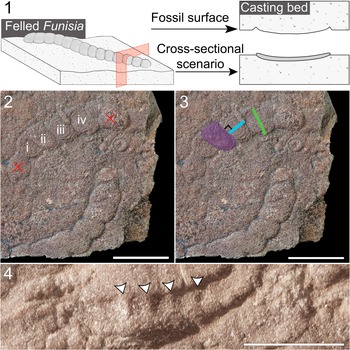
Funisia dorothea was reconstructed as a hollow, fluid-filled organism that was anchored to the seafloor with an innertube-shaped holdfast and stood upright in the water column (Droser and Gehling, Reference Droser and Gehling2008). As a result of its hollow morphology, Funisia is preserved under four distinct preservational modes that reflect the noncollapse, collapse, or sediment infill of the organism (see Surprenant et al., Reference Surprenant, Gehling and Droser2020 for a comprehensive overview). The preservational mode that reflects collapse of Funisia upon burial occurs as positive hyporelief external molds on the bases of bedding planes (Fig. 2.1–2.3). Specimens included in this study were limited to the collapsed preservational mode because it is the most commonly occurring type of Funisia fossil and is one of only two preservational modes that preserve modular elements. The other preservational mode that preserves modular elements is the negative hyporelief external mold, reflecting the noncollapse of Funisia and the molding of its external surface in negative relief on the base of the bedding plane (Surprenant et al., Reference Surprenant, Gehling and Droser2020; Fig. 2.4). Although this noncollapsed preservational mode is ideal for studying growth in Funisia, because the modular elements preserved via this pathway are not collapsed and are thus subject to the least amounts of deformation, it is too rare to be utilized for robust analysis.
(1) Schematic illustration of the preservational model for Funisia dorothea fossils preserved as positive hyporelief relief external molds (i.e., the collapsed preservational mode); the red shaded region in the left-most illustration denotes the location of the cross sections shown in the right-most illustration. Adapted from Surprenant et al. (Reference Surprenant, Gehling and Droser2020), not-to-scale. (2) Example of Funisia specimens and modular elements that were deemed suitable and not suitable for inclusion in this study (SAM P41508); the specimen at the bottom of the slab was not included due to a lack of well-defined modular elements, and the specimen at the top of the slab was included in this study, but not all of its modular elements were suitable for analysis because they show clear signs of deformation. Excluded modular elements are denoted by red x’s and included modular elements are labelled i−iv, denoting the order in which they were measured. (3) Demonstration of area (purple shaded region), length (blue line), and width (green line) measurements that were taken for all modular elements suitable for analysis. (4) Noncollapsed preservational mode of Funisia (i.e., negative hyporelief external mold) with arrows denoting modular element boundaries oriented orthogonally to the long axis of the organism. Scale bars = 2 cm.

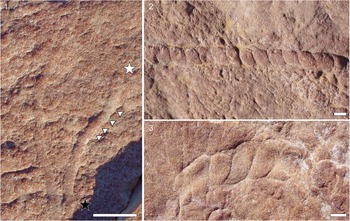
In contrast, modular elements of the collapsed preservational mode of Funisia are fundamentally impacted by soft-bodied deformation that has the potential to skew size data and obfuscate original morphology. For example, the modular element boundaries in some specimens do not appear to be orthogonal to the long axis of the organism but are instead at a high angle to the long axis (e.g., Fig. 3.2, 3.3). This is especially prevalent in Funisia specimens that are bent or curved (e.g., Fig. 3.3) and gives the appearance of a spiral that could be inferred to be an original morphological feature related to morphogenesis. However, specimens preserved under the noncollapsed preservational mode (i.e., those with minimal collapse- and compaction-related deformation) exhibit modular element boundaries that are orthogonal to the long axis of the organism (Fig. 2.4), indicating that high-angle modular element boundaries are taphonomic features related to the collapse and compaction of the organism (Droser and Gehling, Reference Droser and Gehling2008). Although such taphonomic features do not reflect original morphology, varying extents of collapse-related deformation does impact the shape of modular elements in Funisia specimens preserved under the collapsed preservational mode.
(1) The two smallest known Funisia dorothea specimens, the right-most specimen preserves an apical end (white star), an abapical end (black star), and four modular elements (arrows). (2) Intermediate-sized Funisia preserved with no bending. (3) Large Funisia with the widest known modular elements. All specimens preserved on bed LV-FUN at NNHS. Scale bars = 5 mm.

Therefore, a primary assumption of this study is that by using only one preservational mode (i.e., the collapsed preservational mode), biostratinomic overprint will be more or less equally imparted on all specimens. This allows for the comparison of modular element size across individuals despite the influence of collapse and compaction on the shape of modular elements. For this reason, only data pertaining to the size of modular elements in Funisia were collected. Shape data were not considered because this is more likely to represent collapse-related deformation, not morphogenesis. Biostratinomic overprint was additionally controlled by only measuring specimens that preserve at least three modular elements with clearly defined margins on all sides; modular elements that exhibited clear signs of stretching, tearing, bending, or folding were not included in this study (Fig. 2.2).
To create a dataset that could be used to assess growth processes in Funisia, thousands of specimens from the excavated beds at NNHS and the collections at SAM were reviewed. Based on the above specimen criteria, a total of 51 Funisia specimens were selected for analysis. These specimens include small (width, W = 2−6 mm; Fig. 3.1), intermediate-sized (W = 6−10 mm; Fig. 3.2), and large (W = 10−14 mm; Fig. 3.3) individuals. This wide range of sizes provides a useful dataset for comparing modular element size change throughout growth. On average, selected specimens preserved five modular elements, with a maximum of 12 modular elements per individual. A total of 237 modular elements were measured. Each specimen was photographed, and measurements were taken in ImageJ (Schneider et al., Reference Schneider, Rasband and Eliceiri2012). Data collected from each specimen included the total number of preserved modular elements as well as width, length, and area of each modular element (Fig. 2.3). Data analysis was conducted using R Statistical Software (v2022.02.1+461; R Core Team, 2021).
Although the number of specimens selected for this study was sufficient for testing hypotheses on growth, the relatively low number of specimens suitable for analysis compared to the total number of known Funisia fossils (N > 1,000) highlights the rare preservation of well-defined modular elements in Funisia (Surprenant et al., Reference Surprenant, Gehling and Droser2020). This is related to their hollow morphology and common collapse upon burial, as well as to the dense packing of individuals in Funisia populations, which results in high amounts of overlap. Both of these factors lead to lower resolution of fine morphological details, e.g., modular element boundaries (Surprenant et al., Reference Surprenant, Gehling and Droser2020).
In addition to the rarity of well-preserved modular elements, the preservation of complete Funisia, including an abapical end with a holdfast and a determinant apical end, is rare even in well-preserved individuals with clear modular elements. Therefore, assessment of the total length and the total number of modular elements preserved in an individual is not possible through direct observation of fossil material. Because of this, measured modular elements cannot be identified as ‘apical-most’ or ‘abapical-most’ and all results presented in this study represent an unknown portion of the specimen’s total body length.
To denote the relative placement of modular elements along the length of a single specimen, each modular element was assigned a number. This number reflects the location of the modular element along the length of the individual when the specimen is oriented horizontally. The left-most modular element was always measured first and is thus designated as modular element one. Subsequent modular elements are numbered two, three, and so on to encompass all well-preserved modular elements. For example, in Figure 2.2, the left-most modular element that is suitable for analysis (i.e., not deformed) is designated number one and the following intermediate elements are numbered two and three whereas the right-most element is numbered four. The left- and right-most modular elements are referred to as the first- and last-measured modular elements, respectively. These numerical designations are used solely to demonstrate the size variability in elements relative to their placement along the length of the individual and do not imply apical- or abapical-most placement.
In recognition of the limitations considered above, this study aims to assess the nature of growth in Funisia through the comparison of size ratios of modular elements within individuals and between small, intermediate-sized, and large individuals. The former addresses whether modular element size varies consistently along the length of an individual whereas the latter addresses the nature of modular element size change in different growth stages. Combined, these two lines of evidence provide a holistic view of Funisia growth processes.
Repositories and institutional abbreviations
Specimens examined in this study, including the type material and some figured specimens, are deposited in the South Australia Museum Palaeontological Collections (SAM), Adelaide, South Australia. Other specimens examined and figured are preserved on excavated bedding planes at Nilpena National Heritage Site (NNHS), Nilpena, South Australia.
Results
Modular element size within individuals
To test whether modular elements in Funisia dorothea are size-similar along their length or if they taper from one end to the other, the area of all well-preserved modular elements in 21 Funisia specimens was measured. This represents a subsample of the full dataset of 51 specimens because only specimens that were preserved with minimal to no bending were used for this analysis (e.g., Fig. 3.1, 3.2) whereas those with prominent bending were not used (e.g., Fig. 3.3). Use of only straight to minimally bent Funisia specimens allows for comparison of the area of modular elements in an individual without skewing the modular element area by localized soft-bodied deformation.
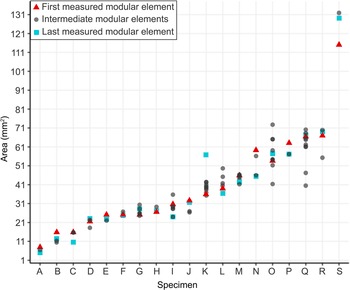
The distribution of modular element areas in the 21 selected individuals demonstrated a prominent clustering of modular element area values in all specimens, especially those within the small size classes (Fig. 4). However, several Funisia specimens have modular elements with substantially higher or lower areas than the modular elements that are clustered (e.g., specimens K, O, and Q; Fig. 4), showing some variability in modular element area within individuals. Importantly, this range of modular element areas is not correlated with the relative placement of the modular elements along the length of the individual. Most notably, the first- and last-measured modular elements do not consistently plot with the smallest or largest areas. Instead, area values are randomly distributed relative to their location along the length of an individual, with some of the first- and last-measured modular elements clustering with intermediate modular elements (e.g., specimens E−H, M, and Q; Fig. 4) and others plotting away from the clustered values (e.g., specimens L, N, and S; Fig. 4). Additionally, some of the area values that are notably smaller or larger than the other clustered values represent intermediate modular elements (e.g., specimens L, O, and Q; Fig. 4). Overall, this demonstrates that the range of modular element areas within individuals does not reflect a consistent variation in modular element size along the length of an individual, rather, the variability in modular element area appears to be random along the length of an individual and is most prominent in intermediate-sized and large individuals.
Area of individual modular elements by Funisia dorothea specimen. Modular elements located in the middle of a specimen (i.e., intermediate modular elements) are represented by gray circles; circles that are darker gray represent overlapping area values of two or more modular elements. See Appendix for the relative placement of intermediate modular elements in each specimen.

Although the relative placement of each modular element along the length of an individual cannot be used to designate apical- or abapical-most modular elements, if consistent tapering in size of modular elements was present along the length of Funisia, it should still be evident (i.e., the first- and last-measured modular elements should have the highest or lowest area values). However, the area of modular elements along the length of an individual is found to be either tightly clustered or randomly distributed (Fig. 4; Appendix). This provides no evidence for consistent size variation in modular elements along the length of an individual Funisia. The observed range of modular element areas within individuals is more consistent with small-scale size changes related to soft-bodied deformation during collapse. This is further supported by the fact that only specimens in intermediate to large size classes exhibit a wide range of modular element area values. Larger individuals would have necessarily had a higher amount of fluid in their hydrostatic skeleton and were thus likely more prone to deformation as a result of fluid loss and collapse. As such, the observed variability in modular element area is here interpreted as a result of taphonomic overprint, and the size of modular elements is considered to be consistent along the length of individual Funisia.
Modular element size across individuals
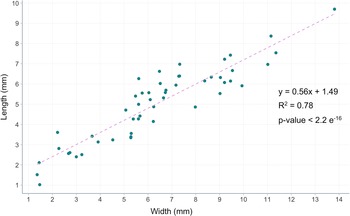
Funisia modular elements have a wide range of widths and lengths (W = 2.2−13.8 mm; L = 3.6−9.7 mm). To visualize the relationship between modular element length and width throughout different growth stages of Funisia (i.e., in small, intermediate, and large individuals), the length and width of all modular elements in the 51 selected specimens were measured to provide a mean modular element length to width ratio for each specimen (Fig. 5). The mean width of modular elements is found to increase linearly with mean length (N = 51; R2 = 0.78), and a linear regression model supports a statistically significant correlation between the two variables (p < 2.2 e-16). Notably, the length of modular elements does not increase equally with width, and the slope of the linear regression model is < 1, indicating that length of modular elements increases at a slower rate than width.
Mean length by mean width of modular elements in Funisia dorothea.

Insertional growth
The insertion of modular elements in modular Ediacaran organisms (e.g., Dickinsonia Sprigg, Reference Sprigg1947; Charnia Ford, Reference Ford1958, Wutubus Chen et al., Reference Chen, Zhou, Xiao, Wang, Guan, Hua and Yuan2014) has been well documented, and there is evidence to suggest that insertional growth was an independently achieved solution, through convergent evolution, to growth in simple organisms comprised of modular elements (Brasier et al., Reference Brasier, Antcliffe and Liu2012; Chen et al., Reference Chen, Zhou, Xiao, Wang, Guan, Hua and Yuan2014; Evans et al., Reference Evans, Droser and Gehling2017; Dunn et al., Reference Dunn, Liu, Grazhdankin, Vixseboxse, Flannery-Sutherland, Green, Harris, Wilby and Donoghue2021). Thus, even without direct evidence for insertional growth in Funisia, it is likely that it occurred. When considering the fact that the width of Funisia modular elements was demonstrated to increase more quickly than length, it is likely that modular element insertion occurred in addition to inflation to reach the considerable length of some specimens.
However, the rarity of complete Funisia specimens prevents direct testing of whether insertion of modular elements occurred, because the total number of modular elements in large and small individuals is unknown. That being said, one of the smallest known Funisia individuals was identified as a highly probable complete specimen, with clear apical and abapical ends (Fig. 3.1). Unfortunately, this small individual does not preserve well-defined modular elements along its entire length, again precluding direct assessment of the total number of modular elements. The complete preservation of this specimen, however, allows for an estimation of the total number of modular elements that it possessed by dividing the total length of the fossil by the mean length of the well-preserved modular elements. This is a viable method for estimating the total number of modular elements in an individual because results presented here demonstrate that the modular elements within individual Funisia are similarly sized (Fig. 4). Thus, the total number of modular elements in the small, complete individual—hereafter referred to as Specimen A—can be estimated by dividing the total preserved length of the specimen by the mean length of its preserved modular elements.
Specimen A has a total length of 34.55 mm and preserves four modular elements with a mean length of 2.81 mm (Table 1). When these mean length values were used to estimate the total number of modular elements in each specimen, including the portion of the organism with no well-preserved modular elements, the small specimen was estimated to have had a total of 12 modular elements (Table 1).
Number of modular elements preserved, mean modular element length (mm), and total specimen length (mm) data used to estimate the total number of modular elements in the smallest and the longest known Funisia dorothea specimens, labelled Specimen A and Specimen B, respectively.

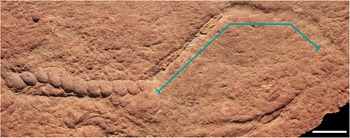
To address whether there is evidence for insertional growth in Funisia, the estimated total number of modular elements in Specimen A can be compared to the longest known Funisia fossil, hereafter referred to as Specimen B (Fig. 6). The longest specimen is used because the widest specimens within the dataset only preserve a small section of the total body length, so the closest estimate to the maximum number of modular elements present in Funisia is from the longest known specimen. Specimen B is incomplete, with no clear evidence of an apical or abapical end, and a little less than half of its total length preserves modular elements, after which the preservational mode changes and modular elements are no longer preserved (Fig. 6). However, the portion of the tube with clear modular elements preserves a total of 10 complete modular elements, only two fewer than that estimated for the total number of modular elements in Specimen A. Given that the portion of Specimen B that does not preserve modular elements makes up ~13 cm of the specimen’s total length, Specimen B had to have > 12 modular elements. This provides clear evidence for insertional growth in Funisia.
The longest known specimen of Funisia dorothea; note transition from preservation in positive hyporelief (left) to negative hyporelief (right, teal line) corresponding to the loss of preserved modular element preservation. Specimen located on bed LV-FUN at NNHS. Scale bar = 2 cm.

The extent to which insertional growth contributed to the overall height of Funisia cannot be directly addressed, but estimation of the total number of modular elements likely to have been present in Specimen B can provide an underestimate for the number of modular elements added through insertional growth when compared with Specimen A. The total number of modular elements present across the preserved length of Specimen B was estimated using the same formula as that used for Specimen A; the resultant estimate represents an underestimate because Specimen B is not complete. Specimen B preserves 10 modular elements with a mean length of 6.43 mm and a total preserved length of 202.86 mm (Table 1). Based on these values, Specimen B is estimated to have had 32 modular elements along its preserved length (Table 1). This is ~2.7 times the number of modular elements estimated to be present in Specimen A, suggesting that insertional growth contributed greatly to the height of the organism.
Discussion
Variation in the widths of Funisia dorothea included in this study demonstrates that there is a wide range of size classes within the dataset (Figs. 3–5), providing the opportunity to analyze how the dimensions of Funisia modular elements changed with size and allowing for the development of a growth model for this highly abundant tubular taxon. It is important to first note that the observed differences in size are not necessarily related to age of the organism (i.e., time elapsed after settlement of the Funisia individual), because there is no constraint on whether environmental factors (e.g., available ecospace, organic mat type and maturity, nutrient availability) might have limited or encouraged growth of Ediacaran taxa (Droser et al., Reference Droser, Evans, Tarhan, Surprenant, Hughes, Hughes and Gehling2022). Regardless of the reason for growth (e.g., age or resource availability), the nature of size change should be consistent across Funisia specimens, allowing for the testing of hypotheses on the relative contributions of inflational and insertional growth.
Inflational growth
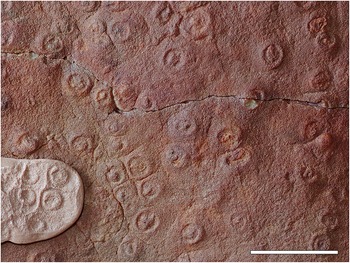
Results from this study demonstrate that inflation of modular elements (i.e., expansion into three-dimensional space) played an important role in the morphogenesis of Funisia (Figs. 4, 5). The wide range of modular element widths, lengths, and areas within the studied Funisia population (Figs. 4, 5) demonstrates that growth of Funisia did not proceed solely through the insertion of modular elements that had a consistent size from the time of initial establishment. The inflational growth of Funisia is additionally consistent with the morphology of their holdfasts (Fig. 7). When found in isolation, Funisia holdfasts are circular, but they are more commonly preserved as closely packed, subcircular structures exhibiting symmetrical flattening of shared edges, often appearing to have a honeycomb-like pattern. Not only is the symmetrical flattening of shared edges consistent with previously documented synchronous growth in Funisia clusters, it also indicates that Funisia expanded into the horizontal plane throughout growth. Further, the linear relationship observed between mean length and width of Funisia modular elements demonstrates that the inflation of modular elements was consistently regulated throughout morphogenesis so that width increased more quickly than length (Fig. 5). The maintenance of a consistent width to length ratio, with a greater width than length, of modular elements would have allowed Funisia to maintain an overall cylindrical and elongate morphology while ensuring the stability of the organism’s hydrostatic skeleton as it extended up into water column.
Cluster of Funisia dorothea holdfasts from the former Ediacara Conservation Park preserved on the base of a bedding plane and a putty mold of the holdfasts demonstrating what they would have looked like on the Ediacaran seafloor (bottom left) (SAM P55236). Note that the isolated holdfasts are circular, whereas the shared edges of closely packed holdfasts are symmetrically flattened. Scale bar = 2 cm.

Insertional growth
Although the data presented here provide evidence for insertional growth in Funisia, the generative zone of modular elements remains unclear due to the rarity of specimens with clearly preserved apical and abapical ends. Although the possibility of modular elements being added via the horizontal splitting of large modular elements in the middle of the tube can be disregarded due to the absence of partially split and variably sized modular elements, both apical and abapical generative zones for Funisia modular elements remain as possibilities.
Some insight is gained into this query from a single specimen of Funisia that exhibits dichotomous branching near one terminal end of the individual (Droser and Gehling, Reference Droser and Gehling2008, fig. 1H). In this specimen, the last common modular element (i.e., the last single modular element prior to the point of branching) is expanded in width and the two proceeding branches are tightly packed. Here, it is parsimonious to infer that the branched ends of the specimen are the apical-most ends of the specimen, therefore, this specimen provides supporting evidence for an apical generative zone in Funisia. This does not, however, preclude an abapical generative zone. Additionally, only a single specimen of Funisia displays branching. Although this could reflect standard growth processes, the morphology of this singleton could also be the result of nonlethal damage to the individual well before burial. Evidence of deformation, including modular element deformation and splitting of the longitudinal axis to form two posterior ends has been documented in Dickinsonia costata (see Ivantsov et al., Reference Ivantsov, Zakrevskaya, Nagovitsyn, Krasnova, Bobrovskiy and Luzhnaya (Serezhnikova)2020). With only a single branching Funisia specimen, a damage-related origin for this specimen cannot be discounted. Therefore, dichotomous branching is not included in the generalized growth model proposed for Funisia by this study. Ultimately, the branching Funisia specimen is informative in that it supports an apical generative zone but cannot conclusively be used to understand typical growth processes without the discovery of several more branching specimens.
Furthermore, results presented here cannot be used to directly test for determinate (i.e., growing to a set number of modular elements) or indeterminate (i.e., continual addition of modular elements) growth in Funisia because of the lack of complete specimens. However, the linear regression model for Funisia modular elements does not plateau (Fig. 5), indicating that there was not a maximum length to width ratio for Funisia modular elements. This is consistent with, but not direct proof of, indeterminate growth in Funisia.
Growth model: three stages of growth
To establish a holistic model for the growth of Funisia, the interplay of insertional and inflational growth processes must be considered. As demonstrated in Figure 4, Funisia modular elements were the same size along the length of the organism, but a suite of other fossil evidence suggests that Funisia individuals did grow, in part, via insertion of new modular elements (Figs. 3.1, 6; Table 1). The timing and nature of insertional growth in Funisia, however, remains unclear, but the fact that tapering of modular elements along the length of Funisia was not observed indicates that newly inserted modular elements temporarily inflated at a different rate than the modular elements preceding them. If all modular elements had a similar absolute rate of inflation regardless of the amount of time elapsed after insertion, they should be preserved as larger modular elements followed by progressively smaller modular elements, resulting in tapering toward the generative zone. This was not observed in Funisia. Therefore, although all modular elements likely experienced the same changes in their rates of inflation from their time of insertion to their larger growth stages (i.e., rapid inflation after insertion followed by slower inflation matching preceding modular elements), inflation of newly inserted modular elements and pre-existing modular elements in an individual had to occur at different rates, dependent on when they were inserted, to maintain a broadly cylindrical form.
This growth process is here proposed: to proceed via the initial insertion of a new modular element that then inflated at a higher rate relative to the rest of the modular elements comprising the tube until it reached the same size as the pre-existing modular elements, after which the inflational growth rate of the newly inserted modular element equalized with pre-existing modular elements to maintain the same size along the length of the organism. This would require a newly inserted modular element to briefly experience an elevated rate of inflational growth relative to the pre-existing modular elements and suggests that growth processes in Funisia were highly regulated to maintain a broadly cylindrical form.
The timing of ‘inflation rate equalization’ (i.e., when new modular elements started to grow at the same rate as pre-existing modular elements) relative to when new modular elements were inserted is unclear. For example, did a newly inserted modular element have to reach a size similar to the pre-existing modular elements and equalize its inflation rate prior to initiation of insertion of another modular element, or was the process more continuous? However, the timing between new modular element insertion and ‘inflation rate equalization’ with pre-existing modular elements had to be great enough to prevent tapering of the organism. If these newly inserted modular elements inflated at a high rate, the probability of the preservation of these smaller, newly added modular elements would likely be low, because the majority of Funisia specimens are incompletely preserved. Regardless, the presence of similarly sized modular elements along the length of Funisia and its cylindrical morphology indicates that the inflation rates of their modular elements were variable relative to the timing of their insertion.
Based on the evidence presented above, a growth model for Funisia is proposed. This growth model is based on this study as well as on the pre-existing understanding of Funisia reproduction, which holds that their occurrence in densely packed populations of similarly sized individuals is evidence for Funisia reproducing sexually via the fertilization of eggs in the water column followed by settlement of individuals on the organic mat (Droser and Gehling, Reference Droser and Gehling2008). The following subsections outline a three-stage growth model, beginning after fertilization, for Funisia.
Stage 1: establishment of individuals
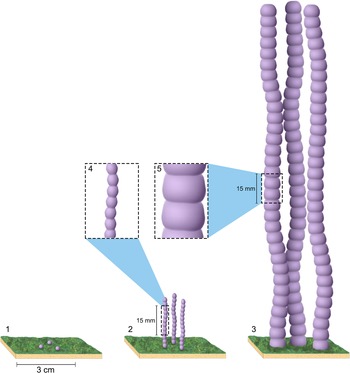
Fossil evidence for the first stage of growth in Funisia, representing the early stages of morphogenesis after initial settlement of individuals, is nonexistent, likely due to our inability to differentiate this growth stage from organic mat textures. As such, this stage is largely hypothetical. However, the presence of closely packed Funisia holdfasts with symmetrically flattened shared edges (Fig. 7), along with several other lines of evidence supporting inflational growth in Funisia (e.g., Figs. 4, 5), indicates that the circumference of Funisia at the time of settlement was smaller than in later growth stages. This demonstrates that, at the time of settlement on the seafloor, Funisia could not have had a wide circumference that only increased in height with growth, informing reconstruction of the newly settled Funisia as small spheres (Fig. 8.1).
Schematic illustration of the proposed three-stage growth model for Funisia dorothea: (1) hypothetical establishment of spheroid individuals on the organic mat; (2) the early growth phase of Funisia wherein modular elements are inserted with little or no inflation of modular elements; (3) later growth stage in which Funisia grew via combined insertional and inflational growth; (4) 15 mm length of a Funisia individual in the early growth stage; (5) 15 mm length of a Funisia individual in the later growth stage. Note that the Funisia in the later growth stage has increased substantially in width and in height of modular elements. The illustration is drawn to scale with the smallest and longest known Funisia specimens in the dataset.

Stage 2: insertion-dominated growth
The second proposed stage of growth for Funisia is characterized by the insertion of modular elements with little or no inflational growth. The smallest known Funisia specimens are relatively long and are comprised of many modular elements but remain very narrow (e.g., mean width of four modular elements from the smallest known individual = 2.27 mm, ~11.13 mm smaller in width than the largest known Funisia; Fig. 3.1, 3.3). Larger specimens have both a higher number of modular elements that are considerably larger than those in small individuals (Fig. 8.4, 8.5; Table 1). This indicates that early in Funisia’s morphogenesis, they likely had a phase wherein insertional growth was more prominent than inflational growth, with minimal to no inflation (Fig. 8.2, 8.4). This is consistent with models of Funisia as a suspension feeder (Droser and Gehling, Reference Droser and Gehling2008), because the addition of modular elements early in life would have elevated the organism above the mat-water interface to access more nutrients.
Stage 3: combined insertional and inflational growth
The third growth stage of Funisia is characterized by a consistent rate of inflational growth in pre-existing modular elements (Fig. 5) and the periodic insertion of new modular elements with temporarily higher rates of inflation (Fig. 8.3, 8.5). Once the size of the newly inserted modular element reached that of pre-existing modular elements, the inflation rate of the newly inserted modular element equalized to that of pre-existing modular elements to maintain a cylindrical, nontapered form. During this stage, inflational growth contributed strongly to expansion of the organism into the horizontal plane, with more minor contributions to expansion into the vertical plane, whereas insertional growth contributed most prominently to the height of the organism.
Comparative growth analysis
Funisia is one of only two Ediacaran tubular organisms that are comprised of uniserially repeating modular elements, with the second being Wutubus annularis (see Chen et al., Reference Chen, Zhou, Xiao, Wang, Guan, Hua and Yuan2014). Although Funisia is endemic to the Ediacara Member of South Australia, Wutubus occurs more broadly, with specimens found in South China, North America, Ukraine, and South Australia (Chen et al., Reference Chen, Zhou, Xiao, Wang, Guan, Hua and Yuan2014; Smith et al., Reference Smith, Nelson, Strange, Eyster, Rowland, Schrag and Macdonald2016; Gehling and Droser, Reference Gehling and Droser2018; Nestrerovsky et al., Reference Nesterovsky, Martyshyn and Chupryna2018). In the Ediacara Member of South Australia, Wutubus is known only from a single specimen that, notably, occurs on the same fossiliferous slab as Funisia (see Gehling and Droser, Reference Gehling and Droser2018).
Chen et al. (Reference Chen, Zhou, Xiao, Wang, Guan, Hua and Yuan2014) suggested that the shared modular construction of Wutubus and Funisia could be a homologous trait. However, homologies between the two taxa are not clear and are difficult to test because, prior to this study, all comparisons were limited to gross morphological differences and were not grounded in ontogeny. Previous research has analyzed the growth processes of Wutubus preserved in limestones of the Dengying Formation, South China (~541 Ma; Chen et al., Reference Chen, Zhou, Xiao, Wang, Guan, Hua and Yuan2014). Here, the growth strategies of Wutubus and of Funisia are compared to assess the potential homologous nature of a uniserial modular construction through an ontogenetic lens. This is further supplemented by comparisons of constructional and gross morphologies along with ecological strategies to provide a holistic comparison of the two taxa. This comparative analysis has broad implications for developing understanding of the nature of shared traits in the tubular morphogroup, which is generally inferred to be polyphyletic based on the high number of genera and range of morphological features but has yet to be tested using ontogenetic data (Surprenant and Droser, Reference Surprenant and Droser2024). The growth model proposed for Wutubus has two stages: (1) initial insertional growth to a set number of modular elements, and (2) isometric inflation of existing modular elements (Chen et al., Reference Chen, Zhou, Xiao, Wang, Guan, Hua and Yuan2014). Notably, both Funisia and Wutubus appear to have had an initial growth phase dominated by the insertion of modular elements that inflated at a later point. A key difference between Wutubus and Funisia is that Wutubus had a set number of modular elements established in an early growth phase whereas Funisia likely did not have a set number of modular elements and is found to have inserted new modular elements throughout its life, not just in early growth stages. Furthermore, variability in the rate of inflation of modular elements in Funisia relative to the timing of modular element insertion demonstrated here is distinct from the consistent isometric growth of Wutubus, resulting in an overall conical morphology in Wutubus and a cylindrical morphology in Funisia.
The differences in the nature of growth between these two taxa are further bolstered by their holdfast morphologies. Both Wutubus and Funisia are known preserved with associated holdfast structures, however, the morphology of these structures is distinct. In Wutubus, this structure is described as a smooth conical termination that is narrower in width than the remaining tube and has been hypothesized to be evidence of an embryonic test (Chen et al., Reference Chen, Zhou, Xiao, Wang, Guan, Hua and Yuan2014). In comparison, the holdfast of Funisia is a disk-shaped structure with a central circular divot (Fig. 7). If these holdfast structures are indeed relics of embryonic tests, the two taxa had drastically different embryonic morphologies.
Further differences between Funisia and Wutubus are made evident when comparing their paleoecological strategies. Wutubus has been reported to occur as multiple individuals of different sizes on the same bedding plane (Chen et al., Reference Chen, Zhou, Xiao, Wang, Guan, Hua and Yuan2014). This was presented as a common occurrence in Wutubus, but in Funisia, the occurrence of multiple, different-sized individuals on the same bedding plane is the exception, not the rule, and has only been observed on one bed at NNHS in which Funisia occurs in clusters spread across multiple square meters of bedding plane (Surprenant et al., Reference Surprenant, Gehling and Droser2020). In this case, Funisia within individual clusters are similar in size, but the size of Funisia between clusters is variable. Additionally, Funisia has been found to occur in very densely packed populations that can cover multiple square meters of fossilized bedding plane (Surprenant et al., Reference Surprenant, Gehling and Droser2020). This contrasts starkly with Wutubus, which occurs in more sparsely distributed populations (Chen et al., Reference Chen, Zhou, Xiao, Wang, Guan, Hua and Yuan2014). Although these observed characteristics of Wutubus from the Dengying Formation could be telling an incomplete story due to the lack of meter-scale bedding plane preservation, the isolated occurrence of Wutubus in South Australia bolsters the hypothesis that they did not occur in densely packed aggregates similar to Funisia.
Given that the common occurrence of Funisia in populations of densely packed, similarly sized individuals is invoked as evidence for sexual reproduction via spatfall, these paleoecological differences could indicate distinct reproductive processes in Wutubus and Funisia. Additionally, the differences in population structure of the two taxa demonstrate that they functioned differently within their environments. For example, the dense packing of Funisia individuals over multiple square meters of preserved seafloor has been demonstrated to preclude the establishment of other organisms, resulting in low diversity ecosystems (Surprenant et al., Reference Surprenant, Gehling and Droser2020). In comparison, Wutubus was more sparsely distributed across the seafloor and was preserved in association with abundant trace fossils (Chen et al., Reference Chen, Zhou, Xiao, Wang, Guan, Hua and Yuan2014). Therefore, the two organisms had drastically different impacts on the ecosystems in which they lived.
In synthesis, Funisia and Wutubus share the following characteristics: constructional morphology (i.e., tubular and modular), morphogenesis via inflation and insertion of modular elements, and an upright, sessile life habit. However, their differences include gross morphologies (i.e., cylindrical vs. conical), timing and nature of insertional and inflational growth, holdfast morphologies, population structures, ecosystem impacts, and geographic range of fossil occurrences. Most notably, the two taxa appear to have had disparate developmental patterns, with the only common feature between the two being morphogenesis via insertion and inflation of modular elements.
At face value, this commonality, in addition to the shared constructional morphologies and life habits of Funisia and Wutubus, could indicate a close phylogenetic relationship. However, differences in the nature and timing of modular element insertion and inflation, in holdfast morphology, and in population structure between the two taxa demonstrates distinct ontogenies and strongly suggests that their shared gross morphology is related to convergence and not phylogenetic similarity. This is supported by the fact that the shared characters of Funisia and Wutubus, including modular construction, growth of modular elements via inflation and insertion, as well as an upright and sessile life habit, are all also shared by a wide range of other Ediacaran taxa that are not thought to have close phylogenetic relationships.
Ontogenetic data thus provide the best proxy for similarity between Funisia dorothea and Wutubus. Here, it is found that the two taxa regulated their growth differently and, based on morphologies and spatial distributions, potentially reproduced via different mechanisms and had morphologically distinct embryonic tests. This suggests that their modular construction is not homologous. However, direct testing for homology between these two taxa is not possible in the absence of a phylogenetic framework, so this remains an outstanding question. At the very least, the disparity between developmental patterns and paleoecologies of the two taxa highlights the fact that shared gross morphology does not beget developmental or paleoecological similarity in the Ediacaran tubular morphogroup. As such, broad interpretations of the ecosystem impact of the total tubular morphogroup, without consideration of variability in the paleoecological strategies of individual tubular taxa, should be carried out with caution because, despite the similar simple form, certain tubular taxa functioned drastically differently within their environments.
Conclusion
This study details the nature of modular element size change in the tubular organism Funisia dorothea to inform a growth model. Description of the relative contributions of inflational and insertional growth in Funisia contributes to understanding of the paleobiology of the most abundant organism in the Ediacara Member of South Australia and allows for comparison of the nature of growth in other modular tubular organisms. Results demonstrate that the growth of Funisia modular elements was variably regulated in different growth stages and relative to the timing of modular element insertion to maintain a similar size of all modular elements within individuals and a broadly cylindrical form. This demonstrates that, although Funisia’s morphology is relatively simple, its growth was highly regulated. New insights into the nature of growth in Funisia and pre-existing understanding of its paleoecology are additionally compared to another modular tubular organism, Wutubus annularis, to assess similarity beyond constructional morphology. This comparative analysis reveals few other shared traits between the two taxa, highlighting the developmental and autecological disparity between members of the tubular morphogroup despite their shared morphologies.
Acknowledgments
We acknowledge that the Flinders Ranges lie within the traditional lands of the Adnyamathanha people and pay our respect to their Elders past, present, and emerging. We would like to thank J. and R. Fargher and South Australia’s Department of Environment and Water (DEW) (permit to MLD U27143-3) for access to the fossils at Nilpena National Heritage Site. This research was supported by a NASA grant (80NSSC21K1526 Future Investigators in NASA Earth and Space Science and Technology [FINESST]) to RLS and by a NASA Exobiology grant (80NSSC19K0472) to MLD. We are also grateful to G.T. Antell for providing helpful comments.
Competing interests
The authors declare none.
Appendix
Area of individual Funisia dorothea modular elements by specimen with information pertaining to relative placement of all modular elements retained. First and last measured modular elements (i.e., those modular elements located at the left-most and right-most ends of the specimen when it is oriented horizontally) are denoted by triangles and squares, respectively. Data points are numbered and color coded based on their relative location within the individual. Modular element number 1 always represents the first-measured modular element when the specimen is oriented horizontally and read from left to right; successive modular elements are designated as numbers two, three, and so on to represent the total number of modular elements within each individual. The maximum number of modular elements in an individual is 12, but most specimens preserved fewer than 12 modular elements, meaning that in some specimens, cooler colors, representing modular elements 9−12, are not present because the specimen preserves fewer than eight modular elements. For example, specimen S preserves only three modular elements, therefore its area values include two end-most elements (denoted by the triangle and the square) and one intermediate element (denoted by a red circle). In contrast, specimen O has ten modular elements, resulting in its first and last measured modular elements having a warm and cool color, respectively, whereas intermediate values are plotted as a gradient from warmer to cooler colors based on proximity to the first- and last-measured modular elements.




 Open access

