


Diabetes mellitus is a major global health concern with a projected rise in prevalence from 171 million in 2000 to 366 million in 2030(Reference Wild, Roglic and Green1). Diabetes mellitus is characterised by chronic hyperglycaemia and postprandial hyperglycaemia, both leading to enhanced micro- and macrovascular morbidity and overall mortality(Reference Balkau2–Reference Ceriello3). Amongst ethnic minorities, cultural beliefs about diabetes mellitus often differ and may compromise adherence to therapy(Reference Chia, Schlenk and Dunbar-Jacob4–Reference Ryan, Pick and Marceau6). Complementary and alternative medicine involves the use of herbs and other dietary supplements as alternatives to mainstream Western medical treatment. A recent study has estimated that up to 30 % of patients with diabetes mellitus use complementary and alternative medicine(Reference Ryan, Pick and Marceau6). Momordica charantia (MC), also known as bitter melon, karela, balsam pear, or bitter gourd, is a popular plant used for the treating of diabetes-related conditions amongst the indigenous populations of Asia, South America, India, the Caribbean and East Africa(Reference Grover and Yadav7–Reference Cefalu, Ye and Wang10). MC is a tendril-bearing vine belonging to the Cucurbitaceae family. It is a climbing perennial that usually grows up to 5 m, and bears elongated fruits with a knobbly surface. MC fruit has a distinguishing bitter taste, which is more pronounced as it ripens, hence the name bitter melon or bitter gourd.
Biochemical and animal model experiments have produced abundant data and hypotheses accounting for the anti-diabetic effects of MC. In comparison, clinical studies with human subjects are sparse and low quality in design. The authors reviewed the available data regarding the hypoglycaemic effects of MC in human subjects searching the PubMed and EMBASE for articles published in English with the following key words: ‘Mormodica’, ‘Momordica charantia’, ‘bitter melon’, ‘bitter gourd’, ‘hypoglycaemic’, ‘anti-diabetic’ and ‘human’.
Phytochemistry of Momordica charantia
Of the MC fruit, 93·2 % is composed of water, while protein and lipids account for 18·02 and 0·76 % of its dried weight(Reference Yuwai, Rao and Kaluwin11). On the contrary, nearly 45 % of the MC seed is composed of oils which contain 63–68 % eleostearic acid and 22–27 % stearic acid(Reference Chang, Conkerton and Chapital12). Several glycosides have been isolated from the MC stem(Reference Chang, Chen and Liao13) and MC fruit(Reference Harinantenaina, Tanaka and Takaoka14–Reference Tan, Ye and Turner16) and are grouped under the genera of cucurbitane-type triterpenoids. In particular, four triterpenoids have AMP-activated protein kinase activity which is a plausible hypoglycaemic mechanism of MC(Reference Tan, Ye and Turner16).
Animal studies of Momordica charantia
Various animal studies have repeatedly shown hypoglycaemic effects of the seeds, fruit pulp, leaves and whole plant of MC in normal animals(Reference Day, Cartwright and Provost17–Reference Jayasooriya, Sakono and Yukizaki21). In particular, MC improves glucose tolerance(Reference Leatherdale, Panesar and Singh22) and suppresses postprandial hyperglycaemia in rats(Reference Uebanso, Arai and Taketani23), and MC extract can enhance insulin sensitivity and lipolysis(Reference Chen, Chan and Li24, Reference Chen and Li25). Some studies also claimed that the hypoglycaemic effect of MC was comparable with oral medications such as tolbutamide(Reference Sarkar, Pranava and Marita20), chlorpropamide(Reference Ojewole, Adewole and Olayiwola26) and glibenclamide(Reference Virdi, Sivakami and Shahani27).
Abundant biochemical data have shed light upon possible mechanisms of the anti-diabetic actions of MC with the recurring theme being activation of the AMP-activated protein kinase system(Reference Miura, Itoh and Iwamoto28–Reference Cheng, Huang and Chang31). Other studies suggested a role of the α- and γ-peroxisome proliferator-activated receptors (PPARα and PPARγ) which are pivotal in lipid and glucose haemostasis and may mitigate insulin resistance(Reference Chuang, Hsu and Chao32–Reference Shih, Lin and Lin34). Recently, a Zn-free protein bearing insulinomimetic activities was isolated from MC(Reference Yibchok-Anun, Adisakwattana and Yao35) that echoed the idea of ‘vegetable insulin’ isolated by Baldwa et al. (Reference Baldwa, Bhandari and Pangaria36) some 30 years ago.
Clinical studies of Momordica charantia
Compared with animal studies, clinical studies regarding the hypoglycaemic effects of MC have been sparse and sporadic. Lakholia, a physician, was probably the first to document the therapeutic effect of bitter melon in 1956 using himself as the subject(Reference Lakholia37). As we reviewed the studies fulfilling our search criteria, we noticed that the majority lacked proper controls or suffered from poor methodologies without baseline characterisations(Reference Leatherdale, Panesar and Singh22, Reference Baldwa, Bhandari and Pangaria36, Reference Srivastava, Venkatakrishna-Bhatt and Verma38–Reference Dans, Villarruz and Jimeno48), as tabulated in Table 1. Amongst those, five have been selected for further discussion as follows. Four were designed as clinical trials and the fifth study, albeit a case series, was selected due to its large sample size.
Clinical studies of Momordica charantia (MC)
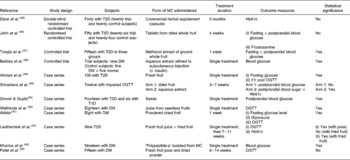
T2D, type 2 diabetes; DM, diabetes mellitus; OGTT, oral glucose tolerance test; T1D, type 1 diabetes.
John et al. study
John et al. (Reference John, Cherian and Subhash46) randomised fifty subjects (twenty-six trials and twenty-four controls) with type 2 diabetes (T2D) to receive either dried MC fruit or riboflavin. Clear inclusion criteria based on fasting blood sugar (FBS) and postprandial sugar (PPS) levels were adopted. Sample size was calculated using a targeted reduction of sugar level by 300 mg/l (30 mg/dl) for both FBS and PPS. Baseline characteristics of all subjects were all comparable. Dried MC fruit was administered at a dose of 2 g three times per d, and riboflavin was employed as the placebo. All subjects were instructed to maintain their pre-existing oral hypoglycaemic treatment and dietary patterns. FBS and PPS levels were measured with fructosamine levels at baseline before treatment, at 2 weeks, and at 4 weeks post-treatment. Results did not show a statistically significant effect due to intervention, for which the authors ascribed to the possible use of dried MC rather than fresh fruit, or due to a suboptimal dose. In this study, there was no mention of the randomisation protocol; nor was it a double-blind design due to the non-matching placebo. Also, the authors only mentioned the lack of adverse effects, but did not account for dropouts. The Jadad score(Reference Jadad, Moore and Carroll49) for this randomised study is, therefore, 1 (from a score of 0 to 5).
Dans et al. study
Dans et al. (Reference Dans, Villarruz and Jimeno48) conducted a randomised double-blind placebo-controlled trial with forty subjects who were either newly diagnosed or poorly controlled T2D having HbA1c levels between 7 and 9 %. Sample size was calculated using a targeted reduction of 1 % in HbA1c and estimated power of study at 0·88. Baseline characteristics of all subjects were not significantly different. A brand-name product containing a standardised dose of dried MC extract was given to the trial group at the dose of two capsules three times per d (exact amount per capsule unknown), for a period of 3 months. The control group followed the same protocol except taking a matching placebo. Baseline HbA1c and other biochemical tests were performed before initiating treatment. Subjects were then followed-up monthly for 3 months, where blood sugars were measured and compliance or adverse effects were noted. At the end of treatment, all baseline tests were repeated. Results showed a mean reduction of 0·217 % in HbA1c in the trial group, which was not statistically significant (P = 0·483) and not sufficient to reject the null hypothesis. As a conclusion, the authors suggested a repeat study with a larger sample size. Nevertheless, this study is merited for its proper design, adverse effects were clearly documented, and dropouts were individually accounted for. The Jadad score for this study is, therefore, 5.
Tongia et al. study
Tongia et al. (Reference Tongia, Tongia and Dave47) recruited fifteen subjects with T2D and divided them into three equal groups. Apart from diagnostic label and age, inclusion criteria were not defined. FBS and PPS levels were measured in subjects before intervention, and these data were then used as controls. The three groups then received metformin, glibenclamide, and metformin+glibenclamide, respectively, for 7 d before the FBS and PPS values were measured. In the next 7 d, subjects received oral hypoglycaemic medications at half dose, plus a standard dose of MC fruit extract twice per d (given in the dose of 200 mg twice daily) and FBS and PPS levels were measured again. Results showed reductions in both FBS and PPS levels after oral hypoglycaemics and a further reduction with MC extract. The quoted P values, although significant, have to be considered against the small sample size of fifteen subjects. Worth noting is that this study used a within-subject design and there was no clear mention of the inclusion criteria. In addition, there was no justification of the sample size and study power. As this study is not a randomised trial, it cannot be rated with a Jadad score.
Baldwa et al. study
Baldwa et al. (Reference Baldwa, Bhandari and Pangaria36) recruited fourteen diabetic subjects (type 1 diabetes (T1D) and T2D) with five healthy volunteers and investigated the effect of an insulin-like substance extracted from MC fruit that was coined the ‘vegetable insulin’. Nine diabetic subjects received subcutaneous injection of the ‘vegetable insulin’ according to a sliding scale (exact dosage not mentioned). Five other diabetic patients together with five healthy volunteers acted as controls and received a placebo injection (nature of placebo not mentioned). In the trial group, there was a 21·5 % reduction in blood glucose at 30 min, 49·2 % reduction at 4 h and 28 % reduction at 12 h, as compared with pre-injection levels. Those who received placebo showed a 5 % decrease in glucose level irrespective of whether they were diabetic or healthy controls. Despite the significant results, this study suffered methodological limitations. There was no clear randomisation protocol; investigators and subjects were not blinded; baseline characteristics of the subjects were not uniform, either in their pathology (both T1D and T2D in the trial group), or their severity (baseline glucose levels varied from 2100 to 2950 g/l (210 to 295 mg/dl)). In addition, the control arm was also heterogeneous (both healthy and diabetic patients). Again, this is not a randomised trial and cannot be rated with a Jadad score.
Ahmad et al. study
Ahmad et al. (Reference Ahmad, Hassan and Halder44) studied the effect of MC in a case series of 100 T2D subjects (fifty-eight males and forty-two females). The inclusion criteria were explicit and baseline characteristics of all subjects were statistically comparable. Subjects were instructed to stop their existing oral medications for 3 d before the trial as a washout. Fasting (s1) and postprandial blood sugar (s2) levels were measured on day 1. On day 2, fasting blood sugar was measured again (s3), and all subjects ingested a drink made from freshly blended MC fruit (dosage varied according to the body weight of subjects). Blood sugar was measured 1 h (s4) afterwards, followed by a postprandial measurement in another 2 h (s5). The control groups were s1, s2 and s3 as compared with the trial groups of s4 and s5. Results showed an 18 % mean reduction both in fasting and postprandial sugar levels across 86 % of all subjects. Despite the good sample size, this study used the same subjects as controls and trials. There was no mention of adverse effects or dropouts, although the authors did discuss limitations, such as lack of supervision for subjects to carry out instructions at home. Therefore, this study showed a flawed methodological design. Being a case series, it cannot be rated with the Jadad score.
It is evident that in these five studies, the forms of MC administration (from methanol extract, dried powder to fresh fruit), the actual dosage (timing and dose per kg body weight) and the outcome measures (from HbA1c, postprandial sugar levels to oral glucose tolerance test) differ widely. Therefore, it is impossible to do any meta-analysis or between-study analyses. For ease of administration, it would be best for MC to be taken in encapsulated powder; however, the available studies seemed to point to a better efficacy for MC when taken in fresh or juiced form(Reference Srivastava, Venkatakrishna-Bhatt and Verma38, Reference Welihinda, Karunanayake and Sheriff42, Reference Ahmad, Hassan and Halder44, Reference John, Cherian and Subhash46). Moreover, available data seem to support an acute or a single dose effect(Reference Baldwa, Bhandari and Pangaria36, Reference Khanna, Jain and Panagariya40, Reference Welihinda, Karunanayake and Sheriff42–Reference Ahmad, Hassan and Halder44) of MC rather than a long-term effect of longer than 4 weeks(Reference Patel, Dhirawani and Doshi39, Reference John, Cherian and Subhash46, Reference Dans, Villarruz and Jimeno48). In order to evaluate the hypoglycaemic effects of MC, the authors suggest a well-designed randomised controlled clinical trial with good sample size for sufficient power. It will employ multiple arms (fresh MC juice, dried MC powder and corresponding matching placebos) with cross-over and washout, to be conducted over a period of 6–12 months with interim analysis.
Toxicity and side effects
At the time of writing the present review, there were no large-scale studies found that examined the side-effects of MC, but the years of its consumption as a dietary supplement and ethnomedicine in various countries do suggest a high level of safety. Having said, there have been isolated reports of hypoglycaemic comas in children after drinking bitter melon tea(Reference Hulin50, Reference Raman51), and one report of death due to consumption of bitter melon fruit(Reference Heiser52). The MC seeds contain a lectin which can inhibit protein synthesis in the intestinal walls of an animal model(Reference Stepka53), but they produce no gastrointestinal symptoms in humans, except for a report of headache(Reference Raman51). MC seeds may also induce favism in humans with glucose-6 phosphate dehydrogenase deficiency(Reference Raman51), while in animals, MC fruit can lead to depressed fertility(Reference Stepka53–Reference Dixit, Khanna and Bhargava55) and induction of abortions(Reference Chan, Tam and Yeung56, Reference Leung, Yeung and Leung57). In the study by Dans et al. (Reference Dans, Villarruz and Jimeno48), gastrointestinal symptoms such as abdominal discomfort and diarrhoea have been reported.
Conclusion
The concept of food as medicine is a central theme in dietetic and nutritional sciences. MC has been used as dietary supplements and ethnomedicine throughout centuries for relieving symptoms and conditions related to what we know in modern days as diabetes. Despite the abundant data from biochemical and animal studies, available clinical data as reviewed in the present article are often flawed by small sample size, lack of control and poor study designs. The present review supports the need for better-designed clinical trials with sufficient sample size and statistical power to further vindicate the acclaimed efficacy of MC as a natural nutritional treatment for diabetes mellitus. In particular, MC may be a feasible option for ethnic minorities who have a high prevalence of diabetes but prefer treatment based on natural products according to their cultural beliefs.
Acknowledgements
The present study received no specific grant from any funding agency in the public, commercial or not-for-profit sectors.
L. L. wrote the manuscript. L. L., R. B. and S. C. discussed the draft. J. K and S. H. assisted in the literature search and final revision.
There has been no conflict of interest.



