


Introduction
Although craftsmanship – including ceramic and metallurgical production – and thus economic prosperity had reached its peak during the Archaic and Classical periods of the Amathous Kingdom (between the 8th c. BCE and the end of the 4th c. BCE), the city endured over a century of decline following the fall of the royal family. This downturn was exacerbated by the Antigonid takeover and the subsequent conquest by Ptolemy I, who abandoned the works undertaken by Antigonus and Demetrius – the construction of fortifications and piers – which ultimately led to the silting of the city’s port.Footnote 1 However, in the second half of the 2nd c. BCE, Amathous began to recover, largely due to renewed Ptolemaic interest in Cyprus after the loss of key ports in the Levant and the Aegean. Signs of economic and demographic revival are evident in the city’s architecture, like the stoa in the Doric order of the Temple of Aphrodite on the acropolis (dating, at the earliest, to the late 2nd c. BCE) and, more prominently, civic structures such as the aqueduct, fountains, baths, and the stoas of the Agora.Footnote 2
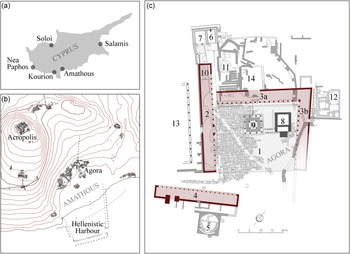
During the Hellenistic and Roman periods, Amathous emerged as one of the most significant and cosmopolitan urban and port centers in Cyprus, serving as both a commercial hub and a focal point for pilgrims and merchants (Fig. 1a). Studies on pottery trade, particularly of amphorae, indicate that in the Early Imperial period, Amathous was deeply integrated into eastern Mediterranean trade networks, especially those of Cilicia and northwestern Syria. In contrast, Nea Paphos, the island’s capital, maintained strong connections with western Mediterranean ports and Rome, functioning as the primary center for the redistribution of goods and the main stopover before Alexandria in the intense amphora trade originating from Rhodes. This pattern underscores the crucial role of regional exchange in shaping economic landscapes.Footnote 3 A broader review of material culture from this period in Cyprus reveals distinct regional characteristics, with Amathous and Kourion forming a cohesive zone marked by terracotta figurine workshops, intensified production of funerary cippi, the cult of Theos Hypsistos, and a congruent distribution pattern of pottery.Footnote 4 The regional distinctiveness of southern Cyprus is also evident in its architecture of this period, which reflects a dynamic synthesis of influences. The specificity of this architecture, apart from reflecting Alexandrian art, must also have been shaped by tradition and local environment,Footnote 5 as was the case in Nabatea,Footnote 6 Cyrenaica,Footnote 7 and Egypt itself.Footnote 8 This broader historical development of art in these regions largely resulted from the cultural legacy of the Ptolemies, which evolved under Roman rule. This phenomenon is also evident in Cypriot sculpture, where Alexandrian stylistic developments in marble sculpture – such as Aphrodite statues and royal portrait styles – were translated into local limestone, suggesting that these styles were not confined to court sculptors but were also executed by local artisans.Footnote 9
Location of the Agora of Amathous (counterclockwise from top-left): (a) map of Cyprus (S. Popławski); (b) plan of Amathous (after the Web SIG d’Amathonte, by L. Fadin et A. Cannavò; courtesy French School of Athens, https://doi.org/10.34816/efa.2e1b-da9f); (c) plan of the Agora (courtesy French School of Athens): (1) paved square of the Agora (2) Western Stoa, (3) L-shaped Stoa, consisting of the Northern (3a) and the Eastern (3b) porticoes, (4) Southern Stoa, (5) Hellenistic Baths, (6) Grand Fountain, (7) Cistern, (8) Temple in Antis, (9) Square Building, (10) banquet hall, (11) Building with an Apse, (12) Late Thermal Baths, (13) Peristyle with the presumed Temple of Arsinoe (14) Northern Building (S. Popławski, after Aupert and Flourentzos 2012, fig. 1, compiled by A. Kattos, T. Kozelj, and P. Aupert).

The city of Amathous was renowned for its sanctuary of Aphrodite Kypria (Aphrodite of Cyprus), with a temple towering over the urban landscape (Fig. 1b). The main building of the Temple of Aphrodite reached its most monumental form during the Flavian period and is one of the few known examples of Graeco-Roman-type temples in Cyprus.Footnote 10 There is a notable dissonance between the Roman-type plan of the temple and its architectural decoration, which reflects a blend of traditions – from Alexandrian to local. Particularly characteristic are the blocked-out capitals, Footnote 11 which may be considered a local reworking of the Corinthian capitals of the Alexandrian tradition. These capitals represent the most elaborate and monumental blocked-out form on the island. An analysis of the architectural decoration of this temple and that of Apollo in Kourion – both initiated during the Flavian period – reveals a discernible shift: architectural trends came to be shaped by local workshops closely associated with nearby limestone quarries rather than relying on craftsmen from Alexandria, as seems to have been the case during Ptolemaic dominance.Footnote 12 The gradual assimilation and reinterpretation of Alexandrian architectural traditions – combined with the dynamic interplay of indigenous stone-working practices and their intersection with a broader global architectural language, further shaped by Roman aesthetics – is often defined as the phenomenon of glocalization.Footnote 13
However, while detailed publications have extensively covered the architecture of Aphrodite’s sanctuary in Amathous,Footnote 14 an enormous wealth of limestone architectural fragments uncovered at the city’s Agora has been neither published nor reconstructed so far. An additional – and particularly compelling – reason for undertaking this study is the exceptional preservation of the decorative elements, which survive as cohesive assemblages. Their completeness provides invaluable insights into the original architectural compositions. The reconstructed decoration of the stoas in the Agora of Amathous reveals a coherent ornamental style across all porticoes, reflecting a seemingly local preference for the Doric order – shaped during Ptolemaic rule and amalgamated with cornices with modillions in the Alexandrian tradition. Notably, this particular combination has not been previously attested. Furthermore, this material represents a significant contribution to our understanding of architectural trends in Cyprus, where the fragmentary preservation of structures – combined with the limited state of research – continues to constrain our knowledge of public buildings, particularly from the Hellenistic and Early Roman periods.
The significance of the material found at the Agora of Amathous become particularly evident when considered against the backdrop of our very limited knowledge of architectural decoration in other agoras of Cyprus during the Hellenistic and Early Roman periods.Footnote 15 In Nea Paphos, the largest agora discovered in Cyprus to date encompasses a tetrastoon surrounding the agora square, covering an area exceeding 97 × 97 m. Unfortunately, only its plan is known, reconstructed from the discovered foundations of the crepidoma. It is presumed that the tetrastoon was in the Corinthian order, featuring white marble capitals and bases, along with gray granite monolithic column shafts.Footnote 16 Recent research has established that the origins of the agora should now be placed in the second half of the 2nd c. BCE. However, the Corinthian marble columns were added during a later rebuilding phase, dated to the 2nd c. CE.Footnote 17 It should also be emphasized that no architectural structures identified during the most recent investigations at the agora can be dated beyond the first half of the 2nd c. CE. As for the Early Hellenistic period, current research provides no evidence that an agora existed in the area before the mid-2nd c. BCE.Footnote 18 Moreover, it has been suggested that the limestone architectural elements reused in the foundations of the Roman agora – such as large Doric columns and blocks with fine white stucco – may have adorned earlier major public buildings.Footnote 19
At Kourion, three stoas belonging to the Roman agora were uncovered.Footnote 20 The stoa aligned along the southeast–northeast axis measured over 65.0 m in length and 4.5 m in width, while six marble column bases preserved in situ indicate that the colonnade likely consisted of more than 16 columns. Numerous fragments of Corinthian columns were found, including whitish and grayish marble capitals and bases, as well as monolithic blue-gray marble shafts stylistically dated to the Severan dynasty, though no parts of the entablature were recovered. Excavations in the Roman agora area also yielded two Doric capitals and two blocks featuring a triglyph-metope frieze, dated to the Hellenistic period.Footnote 21 These elements may have belonged to the architectural decoration of a monumental public building, plausibly the gymnasium or agora of the Hellenistic period.
At Salamis, despite extensive excavations revealing the gymnasium, theater, amphitheater, and other key urban structures, the agora remains undiscovered.Footnote 22 It is worth noting that earlier scholarship mistakenly identifies the monumental plaza in front of the temple of Zeus, flanked by colonnades, as the agora of Salamis.Footnote 23
Among other investigated Cypriot cities, aside from Amathous, relatively well-preserved architectural decorations of the agora have been documented only at Soloi. Canadian excavations conducted before the 1974 invasion uncovered a monumental paved agora together with a characteristic Roman thoroughfare – a colonnaded street leading from the East Gate to the agora.Footnote 24 Additionally, a partially excavated nymphaeum flanking the agora to the south yielded approximately 50 architectural fragments in an Asia Minor style, executed in marble. These included Ionic-Attic bases, column shafts, Corinthian capitals, intricately decorated architraves and friezes, and cornices with modillions adorned with acanthus leaves or alternating with ovals featuring figures. While the layout of the Soloi agora appears to have Hellenistic origins, its architectural remodeling is dated to the 2nd–3rd c. CE, with the nymphaeum specifically attributed to the Severan period. Unfortunately, excavations at the site were interrupted, leaving more than half of the nymphaeum unexplored and preventing any architectural reconstruction.
Given the current state of research on Cypriot agoras, the architectural decoration of the Agora of Amathous stands out for its good preservation. It is also important to emphasize that the architecture of the Imperial period in Cyprus can be divided into two distinct phases.Footnote 25 The first phase, lasting until the second quarter of the 2nd c. CE, saw the construction of major religious and civic buildings using local limestone, with workshops drawing on indigenous architectural traditions. In the second phase, increased marble imports into larger urban centers and the standardization of architectural forms led to the disappearance of local variations such as the Corinthian blocked-out capitals. In this context, the Agora of Amathous offers significant insights into the development of Cypriot public architecture, as it is the only agora to preserve Hellenistic and Early Roman architectural decoration executed in local stone. Ongoing research aims to establish connections between the abundant architectural elements scattered across the archaeological site and the remains of the stoas surrounding the Agora. The primary objective is a comprehensive reconstruction of the stoas’ decoration, with particular focus on the Western Stoa, the L-shaped Stoa (consisting of the Northern and the Eastern Porticoes), and the Southern Stoa, which were conceived as a unified architectural ensemble during the 1st c. CE.
State of research
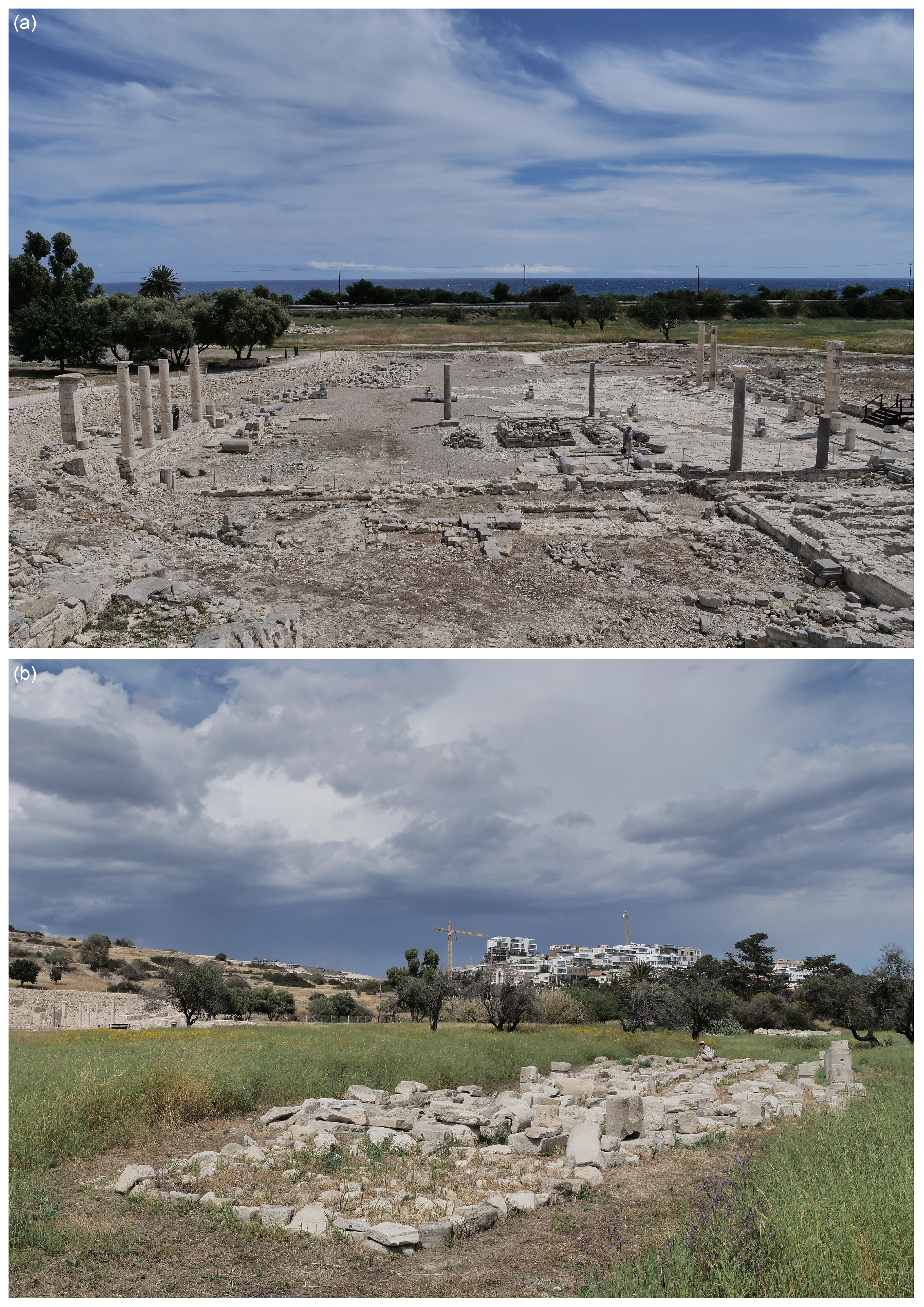
The Agora of Amathous (Figs. 1c, 2) was discovered and systematically excavated by Michael Loulloupis for the Department of Antiquities of Cyprus from 1977 to 1991. During this period, the large paved area (Fig. 1c: 1) was uncovered, along with several key structures, including the Western Stoa (Fig. 1c: 2), the L-shaped Stoa (Fig. 1c: 3), and the Southern Stoa (Fig. 1c: 4), all particularly rich in diverse architectural elements. Simultaneously, building phases spanning from the Early Hellenistic to Late Roman periods were reconstructed.Footnote 26 Regrettably, the untimely passing of Loulloupis in 2010 interrupted the publication of this valuable architectural material.
Agora of Amathous in April 2024: (a) view from the north; (b) open-air lapidarium in the proximity of the Agora where the majority of the 3D-documented architectural elements were stored. (Photographs by S. Popławski. Courtesy of the Department of Antiquities, Cyprus.)
A significant effort to further understand the plan, chronology, and functions of the Agora’s specific structures was undertaken as part of a subsequent research initiative conducted by the French School at Athens (EFA) between 2001 and 2003. The project was directed by Jean-Paul Prête, Isabelle Tassignon, and architects Tony Koželj and Manuela Wurch-Koželj.Footnote 27
Thanks to these investigations, it has been established that the earliest structures of the Agora are contemporaneous with the Hellenistic Harbor and the Hellenistic rebuilding of the Western Gate. These constructions cannot be dated earlier than the first quarter of the 3rd c. BCE, coinciding with building activity in the area by Demetrios Poliorketes and, after 294 BCE, by Ptolemy I Soter.Footnote 28 In the Hellenistic period, a building consisting of three consecutive rooms functioned at the heart of the Agora. Likely serving as a palaestra, it is dated to the 3rd c. BCE.Footnote 29 This building is believed to have formed a unified complex with the Hellenistic Baths (Fig. 1c: 5) to the south, which were accessed through the Southern Stoa.Footnote 30 The operation of these buildings can plausibly be linked to the Double Stoa (later phase in Fig. 1c: 2), which also dates to the beginnings of this monumental building program in the 3rd c. BCE, with a terminus ante quem at the beginning of the 2nd c. BCE.Footnote 31 At the northern edge of the Agora, a rectangular structure, referred to as the “Northern Building” (Fig. 1c: 14), was discovered. Likely a portico, it measures 20.7 m in length and dates to the early 3rd c. BCE.Footnote 32 It has been determined that the Grand Fountain (Fig. 1c: 6) and the Cistern (Fig. 1c: 7) situated at the northwestern edge of the Agora were built between 175 and 150 BCE.Footnote 33
In the Roman period, under the rule of Tiberius, significant architectural modifications were introduced to the Agora.Footnote 34 During that time, the presumed palaestra was buried beneath the paving slabs of the newly designed rectangular city square, surrounded by newly constructed porticoes. The reconfigured Double Stoa is from then onwards referred to as the “Western Stoa,” while the L-shaped Stoa, enclosing the Agora in the north and east, replaced the earlier Northern Building. Footnote 35 The Southern Stoa remained in place, although it likely underwent some modifications during this period – at the very least, the roof was repaired.Footnote 36 Archaeological exploration within the Agora also revealed the Temple in Antis (Fig. 1c: 8), featuring a podium and a pronaos with an entrance facing south. However, little can be definitively stated about the temple’s decoration, character, or precise dating, which is estimated to fall between 50 and 150 CE.Footnote 37 Hypothetically, this building may be linked to a dedication to Emperor Trajan found on the southern street of the Agora, suggesting it functioned as a sanctuary of the imperial cult.Footnote 38
Another structure within the Agora, the Square Building (Fig. 1c: 9), has been subject to various interpretations. It has been proposed that it was either a fountain with a canopy supported by four columns or a temple with a podium and peristyle, dating to the 3rd c. CE.Footnote 39 At the northern extension of the Western Stoa, a banquet hall (Fig. 1c: 10) was uncovered. This space was later converted into a chapel measuring 4.5 × 6.0 m, dated to 225–250 CE, and included a preserved statue base and an altar. Footnote 40 In the later phase, the Building with an Apse (Fig. 1c: 11) was constructed on the northern side of the Agora, built into the western part of the Northern Portico of the L-shaped Stoa. Architectural features of the Building with an Apse, such as access via a two-step staircase, arcaded side passages (evident from the preserved pillars), and a vestibule leading into the main space ending with an apse, suggest it either served a municipal function or reflected characteristics of early Christian architecture.Footnote 41
The gradual degradation of the Agora began the late 3rd c. CE, becoming evident after the construction of the Square Building. Through Late Antiquity, the Agora’s role shifted – from the civic heart of the city to a mere thoroughfare equipped with water conduits. Some of these conduits supplied the small Late Thermal Baths (Fig. 1c: 12), dated to the early 5th c. CE and located outside the northeastern corner of the Agora.Footnote 42 It is worth emphasizing that as the architecture of the Hellenistic and Roman public square gradually deteriorated in Late Antiquity, a significant portion of the architectural elements were repurposed in Late Roman installations (5th–7th c. CE). This reuse complicates efforts to determine their original contexts and the specific architectural decoration that once adorned the Agora.
Thanks to further research carried out by the Department of Antiquities under the direction of Pavlos Flourentzos in the sector of the Lower City – west of the Agora and the Western Stoa – the Peristyle Courtyard (Fig. 1c: 13) was uncovered. It is presumed that this structure belonged to the Temple of Arsinoe, sister and wife of Ptolemy II Philadelphus, which was later transformed into a sanctuary dedicated to Isis and Horus Harpocrates during the Roman period.Footnote 43 An alternative interpretation suggests that, in the Hellenistic period, this area – accessible from the Double Stoa – may have functioned as a gymnasium, incorporating spaces for various religious practices.Footnote 44 Furthermore, research conducted in the area between the Agora and the harbor uncovered additional evidence for the presence of a Lagid dynastic cult in the city, likely associated with the sanctuary of Arsinoe to the north.Footnote 45
Finally, the joint Cypriot-French research project produced an important edition of inscriptions found within the Agora. However, due to the lack of information regarding their original findspots and the numerous modifications to the Agora’s layout over the centuries, most of the structures mentioned in the inscriptions cannot be confidently identified at the current stage of research.Footnote 46
Methodology of research
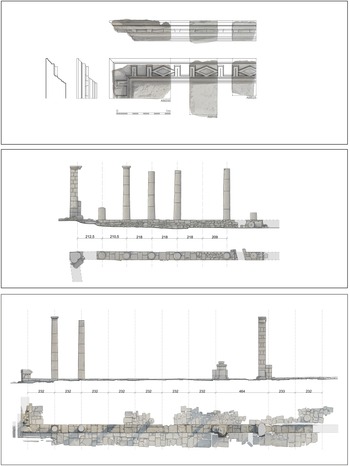
The methodology adopted for this study combined logical argumentation with parallel historical and interpretative research, supplemented by extensive use of available photogrammetric documentation. This documentation, prepared in May 2022 by Maksym Mackiewicz, encompassed approximately 230 architectural decoration elements, as well as two sections of the colonnades from the Western Stoa and the Eastern Portico of the L-shaped Stoa (Figs. 2b, 3).Footnote 47 Each scan was created by fusing 50–100 photographs, processed using the “structure from motion” technique in the Agisoft Metashape software.
Orthogonal renderings prepared based on the photogrammetric documentation (top to bottom): reconstruction of the decoration set: elements of cornice with flat grooved modillions and diamond motifs; Eastern Portico of the colonnade of the L-shaped Stoa; fragment of the colonnade of the Western Stoa. (S. Popławski and A. Kordas, with the use of 3D models prepared by M. Mackiewicz and B. Wojciechowski. Courtesy of the Department of Antiquities, Cyprus.)

The initial purpose of preparing photogrammetric documentation was to study the masons’ marks.Footnote 48 This objective, along with the specific field conditions under which the documentation was conducted, influenced the final results. Due to repeated relocations, the individual decorative blocks lack archaeological context. Their weight and the tight arrangement within the lapidarium prevented easy maneuvering, allowing documentation of only five out of the six block faces. Nevertheless, the advantages of the documentation that was generated are significant. The volume of data collected enabled observation of the techniques used in block manufacture.Footnote 49 Moreover, the metric data allowed precise comparisons of decorative elements.
The absence of stratigraphic context for the uncovered elements obscured the understanding of the masons’ marks carved on them, prompting efforts to identify their original placement within the Agora’s buildings. The study of the decoration began by sorting the elements according to their architectural function (architraves, friezes, cornices) and stylistic features (Ionic dentils, specific modillions, etc.). To support this work, orthogonal projections of individual blocks were created, forming the basis for linear drawings of decoration sets. Additionally, 3D models of the fragments enabled the fitting of broken blocks, offering insights into their original lengths and decorative patterns. This process led to the identification and preliminary reconstruction of at least 23 distinct sets of architectural decoration, each characterized by coherent ornamentation and dimensions.Footnote 50
The identification of the original provenance of the surveyed architectural decoration elements began with an investigation into the structures to which they may have belonged. Based on previous research,Footnote 51 the best-studied buildings – namely the stoas enclosing the Agora square – were selected for analysis. The attribution of specific decorative sets to these buildings was facilitated by the presence of long colonnades with coherent architectural embellishments.
This approach enabled a relatively confident reconstruction of the original architectural decoration of the stoas. A key principle guiding the reconstruction was the alignment between the triglyph-metope friezes and the intercolumniations. Additionally, it was possible to demonstrate the use of repeating lengths across different parts of the entablature. Given the need first to associate architectural elements with specific buildings, the analysis of masons’ marks from the Agora will be addressed in a separate publication. This study presents a description of the individual stoas of the Agora and the architectural elements initially assigned to them, primarily through metric analyses using photogrammetric techniques. To illustrate the reconstructed stoas, preliminary 3D-model drafts were also created, using Blender software.
The Western Stoa
The present layout of the Stoa developed in the second half of the 1st c. CE, evolving from the Hellenistic Double Stoa that originally occupied the western side of the Agora.Footnote 52 During the Roman period, the western portico of the Double Stoa was incorporated into the eastern colonnade of the Peristyle Courtyard, while the eastern portico was extended northward and formed what is now referred to as the Western Stoa.Footnote 53 This structure took the form of a rectangle, measuring 49.45 m in length and 5.25 m in width.Footnote 54 Nearly the entire longer side opened up onto the Agora with a colonnade. According to Prête’s research, the colonnade of the Western Stoa was 44.10 m long and featured 17 supports, with an intercolumniation of 2.32–2.33 m, except for a central double-width bay. This wider intercolumniation was framed by two elaborate pillars that emphasized a passage located in the rear wall of the Stoa, connecting the Peristyle Courtyard with the Agora.Footnote 55 The axis of this passage was placed asymmetrically within the portico, resulting in seven intercolumniations to the south and ten to the north. The columns, with smooth shafts measuring 0.56 m in lower diameter, lacked bases and were crowned with Doric capitals. They have been reconstructed to a height of 5.40 m, including the capitals.Footnote 56 The anastylosis led to the reconstruction of two capitals – one from a column and the other from a pillar – both featuring three anuli beneath the echinus. The column capital has more prominent anuli moldings and a fluted necking, although extensive weathering prevents closer examination.
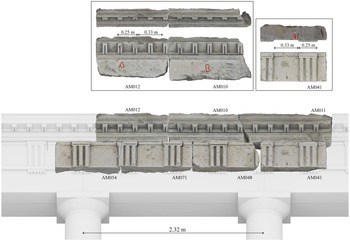
To date, the entablature elements of the portico have not been identified with certainty. The identification proposed below was made possible only through 3D documentation of a large number of decorative fragments, which revealed metrical and stonework correlations among them. The correspondence between the elements of the triglyph-metope frieze and the cornice with flat grooved modillions was established based on the known intercolumniation value of 2.32–2.33 m (Fig. 4). The abundance of frieze and cornice blocks, coupled with the complete absence of architraves, suggests that the latter may originally have been made of wood.
Reconstruction of the architectural decoration of the Western Stoa comprising the Doric frieze A, and the cornice with flat grooved modillions. (S. Popławski and A. Kordas, with the use of 3D models prepared by M. Mackiewicz and B. Wojciechowski. Courtesy of the Department of Antiquities, Cyprus.)

Doric frieze A Footnote 57
Thirteen pieces of a simple Doric frieze were identified, including seven complete blocks (AM041, AM048, AM054, AM067, AM070, AM071, and AM076) and six incomplete fragments (AM040, AM045, AM064, AM065, AM066, and AM069). These blocks average 0.38 m in height and 0.25–0.27 m in depth. The lengths of the complete elements range from 0.60 to 0.93 m.
The triglyphs are rectangular tiles – 0.25 m long, 0.33 m high, 0.025 m deep – with chamfered outer edges. They are divided into three fields by vertical grooves, triangular in cross section. Between successive triglyphs are metopes, rendered as empty, square-shaped spaces, measuring 0.33 m in length and height. The entire composition is crowned by a simple band, aligned with the rhythm of the triglyphs, measuring 0.05 m in height and 0.005 m in depth.Footnote 58
The back surfaces of the blocks could only be partially observed,Footnote 59 but it was immediately apparent that this side was the most neglected, often worked very roughly. Four of the blocks (AM040, AM041, AM067, and AM069) bear alphabetic masons’ marks on their upper surfaces.Footnote 60
Cornice with flat grooved modillions
Twenty-five fragments of cornice with flat grooved modillions were identified (AM001, AM002, AM003, AM005, AM006, AM007, AM008-AM156, AM009-AM153, AM010-AM011, AM012, AM015, AM016, AM017, AM022, AM026, AM027, AM139, AM142, AM143, AM154, AM155, and AM157),Footnote 61 most of which represent complete blocks, including one corner block (AM008-AM156). These blocks average 0.25 m in height and 0.55–0.57 m in depth, of which 0.25–0.30 m rested on the frieze blocks. The lengths of the complete elements reach up to 2.12 m.
The cornice projected approximately 0.31 m beyond the entablature. The upper section featured a taenia, a cyma recta, and a low corona. Midway down the block, a soffit section with flat grooved modillions was placed. The modillions average 0.078 m in width and were spaced 0.115 m apart. On the lower cornice, a cyma reversa and a listello were applied.
The function of these elements within the roof structure is difficult to determine due to limited access.Footnote 62 Fourteen fragments bear alphabetic masons’ marks on their bottom surfaces. Observation of these marks, along with differences in stone-working techniques, allowed for at least three sets of blocks to be distinguished. The two longest sets form uninterrupted decorative sequences measuring 4.20 m and 5.03 m, respectively.Footnote 63 Additionally, incisions were observed on the bottom surfaces of the blocks (Fig. 4a), most of which appear to be auxiliary guidelines. The spacing of these incisions corresponds to the positions of triglyphs and metopes in the frieze elements located directly below.
The Southern Stoa
The Southern Stoa was functionally associated with the Hellenistic Baths to its south, forming an extended entryway to the complex.Footnote 64 The Stoa had the shape of an elongated rectangle, 38.35 m in length and 6.00 m in width.Footnote 65 The colonnade of the portico opened onto the street leading to the Agora and only partially onto the Agora’s southern side. Despite the poor state of preservation of the remains in situ, individual stylobate blocks confirmed the existence of short side walls at the extremities of the front façade.Footnote 66 Additionally, the drums of the columns and architrave blocks, found in a collapsed position, made it possible to calculate the intercolumniation. Based on this evidence, the length of the Stoa’s colonnade is estimated at approximately 35.50 m, comprising 17 columns with an intercolumniation of 2.00 m.Footnote 67 The columns, with smooth drums and no bases, stood 3.265 m high, with a lower diameter of 0.507 m and an upper diameter of 0.40 m. The entire composition was crowned with Doric capitals, each 0.23 m high, with an abacus side length of 0.53 m. These capitals were decorated with four delicately executed anuli beneath the echinus and featured a fluted necking. The total height of the columns, including the capitals, was 3.495 m.Footnote 68
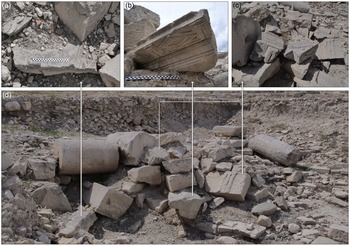
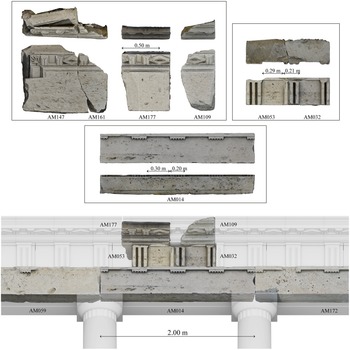
Among the collapsed remains of the Southern Stoa, Prête recognized complete and fragmented Doric architraves, as well as various cornice blocks with flat geisa, Ionic dentils, flat modillions, or combinations of flat modillions and diamond motifs. Some of the remains are still in situ (Fig. 5).Footnote 69 While he refrained from relating them to the adornment of the Southern Stoa due to uncertainty about their original placement, Prête noted that the discovery of five identical architrave blocks in a single location suggests a probable connection to the same structure.Footnote 70 Further identification of the entablature elements was facilitated by photogrammetric documentation. By calculating the intercolumniation – 2.00 m – based on observations of the architrave blocks, it was possible to estimate the total number of columns in the colonnade at 17. Moreover, a single frieze block and cornice elements with flat modillions with Y-shaped grooves and diamond motifs (Fig. 6) were identified as possibly belonging to this decorative scheme. Closer examination of the collapsed northwestern section of the Stoa, preserved along the street leading to the Agora, confirmed the identification of elements from the lapidarium. These include three additional cornice fragments and a single frieze block, consistent with those previously mentioned (Fig. 5).
Fragments of architectural decoration in the debris of the northwestern corner of the Southern Stoa, preserved in situ on the street leading to the Agora (clockwise from top left): (a–c) fragments of the cornice with flat modillions with Y-shaped grooves and diamond motifs, and the Doric frieze B block; (d) view of the rubble. (S. Popławski. Courtesy of the Department of Antiquities, Cyprus.)

Reconstruction of the architectural decoration of the Southern Stoa, comprising the Doric architrave with cylindrical guttae, the Doric frieze B, and the cornice with flat modillions with Y-shaped grooves and diamond motifs. (S. Popławski and A. Kordas, with the use of 3D models prepared by M. Mackiewicz and B. Wojciechowski. Courtesy of the Department of Antiquities, Cyprus.)

Doric architrave with cylindrical guttae
Eight elements of Doric architraves with cylindrical guttae were documented, comprising three complete blocks (AM014, AM059-AM060, and AM172), and four incomplete fragments (AM035, AM055, AM061, and AM137). These measured approximately 0.385 m in height and 0.26 m in depth. The lengths of the complete blocks range from 1.98 to 2.00 m. The consistent length of the architrave blocks, determined by their structural function, corresponds to the rhythm of the decoration, so that each architrave element always begins and ends at the midpoint of the regulae.
The rectangular regulae measured 0.20 m in length, 0.028 m in height, and 0.025 m in depth, and featured six evenly spaced cylindrical guttae below, each approximately 0.02 m in diameter. Subsequent regulae were spaced at intervals of 0.30 m. The entire structure was topped with a taenia measuring 0.05 m in height and 0.028 m in depth.
On the underside of the architrave blocks, along their rear edge, recesses 0.06 m wide were formed. These typically began 0.20 m from the end of the beam, where the block would rest on the column. Such decoration usually adorns the central band of the soffit of architraves placed between supports.Footnote 71 The placement of the recesses near the edge, rather than at the center of the blocks, indicates that the architraves of the Southern Stoa colonnade were composed of two elements.
Doric frieze B
One complete frieze block, composed of two fragments (AM032 and AM053), was identified (Fig. 5c–d), measuring approximately 1.08 m in length, 0.355 m in height, and 0.30 m in depth. The block begins with a full triglyph and ends with a triglyph cut off at two-thirds of its length. An additional frieze block, still located within the Stoa’s debris, was also recorded (Fig. 5 d). However, its association with this decorative set requires further measurements, as it was not precisely documented during the current project.
The triglyphs were rectangular tiles – 0.21 m long, 0.315 m high, and 0.035 m deep – with chamfered outer edges. Each was divided into three fields by vertical grooves of triangular cross section. Between successive triglyphs were metopes, appearing as empty spaces of almost square proportions, measuring 0.28 m in length and 0.315 m in height. The entire composition was topped with a simple band, aligned with the rhythm of the triglyphs, measuring 0.04 m in height and 0.005 m in depth.
Cornice with flat modillions with Y-shaped grooves and diamond motifs
Eleven cornice elements featuring flat modillions with Y-shaped grooves and diamond motifs were documented, each exhibiting slight variations in molding profiles and modillion spacing. Two of these, including one with a pediment corner, likely formed part of a wall decoration (AM147-AM161 and AM206). Another seven may have belonged to the entablature of a colonnade (AM074, AM109, AM119, AM120, AM177, and AM186), while the remaining two fragments preserve only small sections of decoration, precluding precise identification (AM136 and AM212). The complete blocks measured approximately 0.64–0.88 m in length, 0.265 m in height, and 0.64–0.88 m in depth. The block with the pediment corner was slightly larger. Additionally, three more cornice fragments were observed within the Stoa’s debris (Fig. 5), supporting the identification of this particular cornice type as part of the Southern Stoa.
The cornice moldings projected approximately 0.33 m from front face of the blocks. The upper cornice featured a taenia, a cyma recta, and a low corona. Midway down the block was a soffit section adorned with flat modillions bearing Y-shaped grooves and diamond motifs. The modillions measured 0.10–0.115 m in width and were spaced 0.07–0.085 m apart. Where diamond motifs were inserted between successive modillions, they were spaced 0.21–0.25 m apart. The lower cornice included a cyma recta with a listello. In the blocks forming the wall decoration, the lower molding was reduced to a prominent ovolo, while the upper molding consisted of a significantly lower corona and a simplified cyma. As with the cornice of the Western Stoa, the function of these elements in the roof structure has not yet been identified.
The L-shaped Stoa
The L-shaped Stoa was constructed in the northeastern corner of the Agora no earlier than the second quarter of the 1st c. CE.Footnote 72 Its construction combined with the pre-existing Western Stoa to form a Π-shaped portico enclosing the square. During the Hellenistic period, the northern side of the Agora had been enclosed by the Northern Building, which was demolished at the end of the 1st c. BCE. The newly built L-shaped Stoa consisted of the Northern Portico – approximately 38 m long and 4.5 m wide – extending from the Western Stoa to the corner column, and the Eastern Portico, 4.0 m wide, extending southwards from the corner column. Although only 11.5 m of the Eastern Portico survives, it certainly extended further – at least another 32 m – to enclose the square parallel to the Western Stoa.Footnote 73 The lower drums of five out of the six northernmost columns of the Eastern Portico are preserved in situ, allowing the intercolumniation to be estimated at 2.10–2.18 m. Traces of column foundations in the western part of the Northern Portico enabled Prête to estimate the probable intercolumniation there at 2.10 m.Footnote 74 However, the marble column shafts, adorned with Corinthian capitals installed during the anastylosis process, along with differences in the preservation level of the stylobate, suggest that this section was later incorporated into the Building with an Apse (Fig. 1c: 11), which may have altered the original intercolumniation.
Due to the uncertainty surrounding the original dimensions and dating of the reconstructed phase of the Northern Portico, as well as the considerable variation in the intercolumniation of the Eastern Portico, an accurate reconstruction of the number of columns remains difficult. The number of columns may have varied – between 17 and 18 for the Northern Portico, and at least 14 for the Eastern Portico. However, the appearance of the columns can be reconstructed with some confidence based on the anastylosis of the corner column.Footnote 75 The columns, with smooth drums and Doric capitals, stood 4.60 m high, with a lower diameter of 0.61 m and an upper diameter of approximately 0.50 m. The anastylosis resulted in the reconstruction of two capitals: one for the corner column and one for the regular column. However, the capital of the regular column is significantly smaller in diameter than the shaft and clearly originates from another context. The corner capital features three anuli beneath the echinus, executed in a style similar to that of the Western Stoa capitals. The lowest drums of the Eastern Portico columns, discovered in situ, had simple bases formed by an oblique band made of mortar.
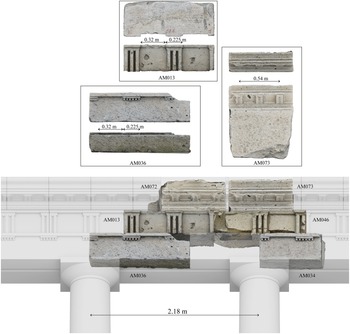
At the current stage of research, due to the limited number of decorative elements examined and their poor state of preservation, the identifications presented below should be considered preliminary. The dimensions of the decorative elements do not perfectly correspond to the reconstructed intercolumniation. To confirm this proposal, detailed examination of the remains in situ is necessary, along with the identification of additional decorative elements that could verify the suggested arrangement. The identification was based on observations of the stonework and the intercolumniation values, which most likely ranged from 2.10 to 2.18 m for the Eastern Portico. This analysis enabled the identification of the Doric architrave with trapezoid guttae, the Doric frieze with groove endings in the shape of semi-circular pendants, and the cornice with flat modillions with channel grooves as parts of a coherent decorative scheme that may have crowned the L-shaped Stoa (Fig. 7).
Reconstruction of the architectural decoration of the eastern colonnade of the L-shaped Stoa comprising the Doric architrave with trapezoid guttae, the Doric frieze with endings of the grooves in the shape of semi-circular pendants, and the cornice with flat modillions with channel grooves. (S. Popławski and A. Kordas, with the use of 3D models prepared by M. Mackiewicz and B. Wojciechowski. Courtesy of the Department of Antiquities, Cyprus.)

Doric architrave with trapezoid guttae
Six elements of the Doric architrave blocks with trapezoid guttae were documented, comprising one complete block (AM033-AM062-AM151) – likely reused at a later date – and three incomplete fragments (AM034, AM036, and AM209). These blocks measured approximately 0.38 m in height and 0.27 m in depth, with the longest block reaching 1.98 m in length. The structural divisions of the blocks were aligned with the center of the regulae.
All elements shared a consistent decorative style featuring trapezoid-shaped guttae. However, two distinct size variants were identified based on differences in the decorative rhythm. One block featured rectangular regulae, measuring 0.22–0.23 m in length and 0.025 m in height, spaced at intervals of 0.32–0.33 m. The other had regulae measuring 0.21 m in length and 0.025 m in height, spaced 0.26–0.27 m apart. Beneath each regulae, six evenly spaced trapezoid guttae were positioned, each approximately 0.025 m in height. The entire composition was topped by a taenia measuring 0.040 m in height and approximately 0.03 m in depth.
On the underside of the architrave blocks, along their rear edge, recesses 0.05 m wide were carved. These began approximately 0.32 m from the end of the block, leaving the space which would have rested on the column undecorated. As in the case of the Southern Stoa, the placing of the soffit decoration suggests that the architrave was composed of two elements.
Doric frieze with endings of the grooves in the shape of semi-circular pendants
Thirteen elements of triglyph-metope frieze with groove endings in the form of semi-circular pendants were identified (AM013, AM042, AM044, AM046, AM049, AM051, AM056, AM057, AM058, AM063, AM080, AM081, and AM202), most of which are complete blocks with an average height of 0.355 m. Based on the spacing of the triglyphs, two distinct sets of blocks can be identified. Those with wider spacing measured up to 1.20 m in length and 0.40 m in depth, while those with narrower spacing were generally 0.50–0.65 m long and up to 0.24 m deep.
The triglyphs were rectangular tiles with chamfered outer edges, divided into three fields by vertical grooves of triangular cross section, terminating in semi-circular pendants. Despite their shared stylistic features, the two sets of blocks differ in decorative rhythm. In the friezes with wider spacing, the triglyphs measured approximately 0.215 m in width and the metopes, 0.34 m in width. In the narrower set, both triglyphs and metopes measured approximately 0.24 m in width. In all examples, the triglyph-metope section, 0.315 m in height, was crowned by a simple band aligned with the rhythm of the triglyphs, measuring 0.04 m in height and 0.007–0.01 m in depth.
The rear surfaces of the blocks were finished differently depending on the spacing. In the narrower set, the back surfaces were roughly worked, whereas those in the wider set were smoothly finished. Many of the blocks bear alphabetic masons’ marks on their top surfaces.
Cornice with flat modillions with channel grooves
Six cornice elements with flat modillions with channel grooves were recorded (AM021, AM028, AM029, AM037, AM072, and AM073). These were nearly complete blocks, including one corner piece – likely from a pediment – inserted into the wall. The blocks measured between 0.50 and 1.00 m in length, with the corner piece reaching nearly 1.20 m in length. Their height was approximately 0.28 m and their depth extended up to 0.98 m, of which as much as 0.62 m rested on the frieze blocks.
The cornice moldings projected approximately 0.33 m from the front face of the blocks. Midway up their height, a soffit section was decorated with flat modillions featuring channel grooves. The modillions measured 0.13–0.14 m in width and were spaced 0.10–0.13 m apart. The upper cornice included a taenia, a cyma recta, and a low corona, while the lower cornice featured a cyma reversa and a listello. As with other elements of this structure, information regarding the precise function of these cornice blocks within the roof system remains limited.
Reconstructed architectural order
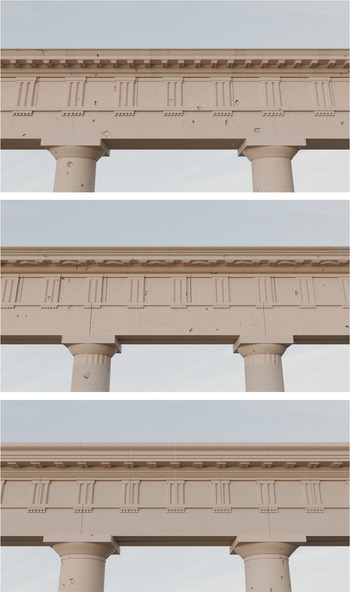
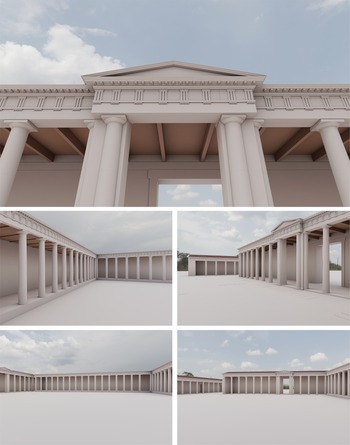
The reconstructed architectural decoration of the three stoas in the Agora of Amathous appears remarkably consistent across all the porticoes (Fig. 8). It is based on the Doric order, featuring plain columns, a Doric architrave, and a Doric frieze decorated with four triglyphs per intercolumniation, all crowned by a cornice with modillions in the Alexandrian tradition. Based on the available documentation and the architectural decorations identified above, a preliminary 3D reconstruction of the Western, Southern, and L-shaped stoas was prepared (Fig. 9). These illustrations aim to convey the character and spatial coherence of the Agora’s stoas; however, as tentative drafts, they should be regarded more as artistic interpretations than as definite architectural reconstructions.
Three-dimensional reconstructions of the architectural decoration of the stoas of the Agora of Amathous (top to bottom): Western Stoa; Southern Stoa; L-shaped Stoa. (S. Popławski.)

Three-dimensional reconstructions of the stoas of the Agora of Amathous: top: Western Stoa, central passage; middle left: L-shaped Stoa; middle right: Western Stoa, with the Southern Stoa in the background; bottom left: Π-shaped porticoes formed by the Western and L-shaped stoas; bottom right: Western Stoa, in the center, with the Southern Stoa to the left and the Northern Portico of the L-shaped Stoa to the right (S. Popławski.)

Due to the uniformity of the decorative elements but also the incomplete and fragmentary nature of their preservation, all the porticoes are discussed together, highlighting their significant similarities and differences. The Vitruvian canon serves as a fixed reference point, helping to visualize the logic behind the creation of architectural orders in antiquity, Footnote 76 particularly through the use of a module equal to the lower radius of the column.Footnote 77 The description below of the architectural decoration of the Agora’s stoas begins with elements reliably grounded in the archaeological record, followed by the proposed reconstructions.
The columns themselves have the greatest impact on the perception of the order. The lower diameters and reconstructed heights of the columns are as follows: 0.56 m and 5.40 m for the Western Stoa, 0.507 m and 3.495 m for the Southern Stoa, and 0.61 m and 4.60 m for the L-shaped Stoa. While these dimensions do not directly reflect the decorative style, they do determine the height of the entire order – and, by extension, the building. Notably, the proportions of column height to lower radius deviate both from those of other stoas and from Vitruvian norms. The column proportions in the Southern Stoa (13.78) and the L-shaped Stoa (15.08) are relatively close to the Vitruvian ideal (14), whereas the Western Stoa’s columns (19.28) deviate from it significantly. The unusual slenderness of the latter may result from an early reconstruction, as suggested by the misalignment of drum diameters following anastylosis. Furthermore, the diameter of the columns at the top, ranging from 4/5 to 5/6 of the diameter at the bottom, is close to the Vitruvian ideal tapering. However, these values do not refer to the abovementioned height of the columns as described by Vitruvius.
The Doric capitals cannot be identified with certainty due to a lack of sufficient documentation, and – aside from the regular capital of the Southern Stoa and the corner capital of the L-shaped Stoa – their current identification requires further study. Nevertheless, the observed capitals exhibit well-proportioned forms. The capitals of the Western and L-shaped stoas feature three simplified anuli beneath the echinus, while those of the Southern Stoa display four delicately carved anuli.
Other entablature elements also merit discussion. The height of the architrave relative to the module is 3:2 (1.52) in the Southern Stoa and 5:4 (1.25) in the L-shaped Stoa, in both cases exceeding the single-module height prescribed by Vitruvius. Meanwhile, the heights of the taenia, regulae, and guttae are only slightly below those in the Doric canon, where the taenia measures 1/7 and the guttae 1/6 of a module. Noteworthy are the differences in guttae execution: in the Southern Stoa, they are cylindrical, while in the L-shaped Stoa, they taper downward, resembling trapezoid or conical forms. It is also worth noting that no architrave elements from the Western Stoa have been preserved: they were presumably made of wood.
The largest group of assigned elements consists of blocks from the Doric frieze. For the Western Stoa, the triglyph dimensions – height and width – correspond to 7/6 and 8/9 of a module, respectively. In the Southern Stoa, these values are 5/4 and 8.5/10, while in the L-shaped Stoa, they are approximately 1 (1.03) and between 7/10 (0.705) and 8/10 (0.79). The metopes are generally square, with width-to-height ratios ranging between 8/10 and 1. Notable stylistic differences in triglyph decoration are also observable: in the Southern and Western stoas, the triglyphs are flat-topped, whereas in the L-shaped Stoa, the grooves terminate in the semi-circular pendants. According to the Vitruvian canon, triglyphs should measure 3/2 and 1 module in height and width, respectively, and be separated by square metopes.
Finally, attention must be given to the cornices with flat modillions – an uncommon feature in combination with the Doric order.Footnote 78 Although the rhythm of the modillions consistently aligns with the underlying triglyphs and metopes, the decorative treatment varies among the stoas. The most elaborate example is found in the Southern Stoa, where flat modillions with Y-shaped grooves are interspersed with diamond motifs placed between every second modillion. In contrast, the Western and L-shaped stoas feature only flat modillions. In the Western Stoa, the modillions are grooved and narrow, projecting clearly below the cornice soffit. In the L-shaped Stoa, the modillions are wider, more delicately shaped, and hang only slightly below the cornice soffit. Two pediment corner blocks, one from the Southern Stoa and one from the L-shaped Stoa, are decorated with palmettes.
The proportions of the cornices are also noteworthy. In the Western Stoa, the cornice overhang measures 11/10 (1.11) of a module; in the Southern Stoa, 13/10 (1.30); and in the L-shaped Stoa, 11/10 (1.08). These values are nearly twice the overhang prescribed in the classical Doric order, where it should be 2/3 of a module. Nevertheless, the use of a cornice with modillions, though non-canonical, harmonizes well with the otherwise austere Doric order, introducing a subtle and refined delicate crowning detail.Footnote 79
Decoration of Alexandrian origin?
Drawing upon the evidence presented above and the consistent decorative scheme observed across all three stoas of the Agora of Amathous – characterized by the application of the Doric order – the most intriguing and, as far as current knowledge suggests, unique feature in Cyprus is the combination within a single architectural structure of the Doric order with cornices featuring modillions in the Alexandrian tradition.
Doric order in Cyprus
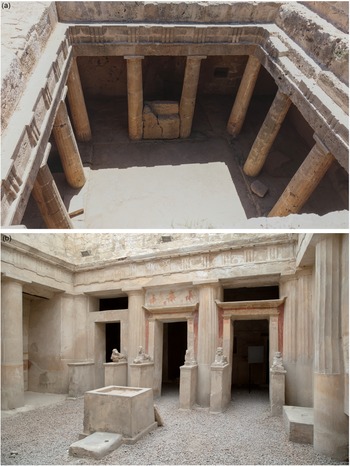
The adoption of the Doric order in various public buildings in Nea Paphos during the Early Hellenistic period has been interpreted by Leonardo Fuduli as a deliberate choice, likely intended to promote Ptolemaic royal propaganda by emulating Alexandrian models.Footnote 80 Key examples include the so-called Tombs of the Kings at Paleokastro (northwest of Nea Paphos), particularly Tombs 3 (Fig. 10a) and 7, which prominently feature the Doric order in the peristyles of their subterranean courtyards.Footnote 81 These tombs were modeled on Alexandrian prototypes, especially Tomb 1 at Mustafa Kamil Pasha (Fig. 10b).Footnote 82 Additional examples that may date to this period include a structure featuring a Doric colonnade situated on the southern slope of Fanari HillFootnote 83 – interpreted as a portico of the temple of Aphrodite – and large Doric columns and blocks with fine white stucco, reused in the Roman agora of Nea Paphos, which likely belonged to earlier monumental (probably Early Hellenistic) public buildings in the area.Footnote 84 Other relevant structures include the Doric stoa of the Temple of Aphrodite in Amathous and Doric architectural elements found in the Roman agora of Kourion, possibly associated with a Hellenistic gymnasium or agora.Footnote 85 However, the most significant parallel to the Agora of Amathous is the stoa located in the East Complex of the Sanctuary of Apollo Hylates at Kourion. It has been dated to the pre-Roman period and was most likely built in the Doric order, as evidenced by the preserved plain columns, a single Doric capital, elements of a triglyph-metope frieze, and a probable cornice.Footnote 86 According to Eleonora Gasparini, the traditional Doric capital was already being modified in Cyprus by the 1st c. CE: the three anuli beneath the echinus were replaced with fasciae to facilitate carving in local limestone.Footnote 87
Doric order in the sepulchral architecture of Cyprus and Alexandria (top to bottom): (a) Tomb 3, “Tombs of the Kings,” Paleokastro, Cyprus (A. Kordas. Courtesy of the Department of Antiquities, Cyprus); (b) Tomb 1, Mustafa Kamil Pasha, Alexandria, Egypt (© Bibliotheca Alexandrina Antiquities Museum (Alexandria, Egypt), photo by Mohamed Aly and Mirette Magdy).

The rock-cut tombs of Paleokastro remain exceptional, as they preserve the only nearly intact Doric decorative program known from Cyprus. These tombs offer a valuable point of comparison with the decorative style of the stoas in the Agora of Amathous. The tomb peristyles are executed in the Doric order, with lightly fluted columns (some fluted only at the top), capitals with simple echinus and abacus, and an entablature featuring triglyphs and metopes in the form of a projecting ledge that once supported a now-lost cornice. Documentation of Tombs 3 and 7, recorded by E. Markou in 1953,Footnote 88 shows that their column heights ranged from 3.09 to 3.02 m – approximately 12 modules – making them noticeably shorter than the 14-module height prescribed by VitruviusFootnote 89 and also shorter than the columns of the stoas in the Agora of Amathous. The triglyphs in these tombs are simple rectangular tiles with chamfered outer edges, divided into three fields by vertical grooves of triangular cross section, and paired with delicate cylindrical guttae. The Doric frieze of Tomb 3 includes two triglyphs in the intercolumniation, while that of Tomb 7 features three.
Although Alexandrian tombs differ from their Cypriot counterparts in several respects – such as the use of pillars and engaged half-columns instead of free-standing columns, and the introduction of heart-shaped corner columns – there are nonetheless important similarities. The design of the underground peristyle courtyard, decorated in the Doric order and accessed via a covered dromos, closely resembles Alexandrian sepulchral architecture. The closest parallel, and likely prototype for the Paphian tombs, as already mentioned, is found in the Alexandrian necropolis of Mustafa Kamil Pasha, particularly in Tomb 1.Footnote 90 The column heights in Tombs 1, 4, and 5, as well as the inner portico of Tomb 2, are approximately 11 modules, while the outer columns of Tomb 2 reach around 13 modules. Additionally, Achille Adriani notes that the burial chamber columns from Sidi Gaber share similar proportions, those from Chatby are more slender, and those from “Cape Zephyrion” are the most slender, approaching the 14-module height prescribed by Vitruvius.Footnote 91 The decorative features include simple triglyphs with chamfered outer edges, divided into three fields by vertical grooves of triangular cross section, along with guttae and mutuli reduced to flat tiles.Footnote 92 The Doric frieze of Tomb 1 includes four triglyphs per intercolumniation, while that of Tomb 3 features three.
Interestingly, a similar 12-module ratio was calculated for the canon of the Pseudo-Doric order used in the underground tombs at Marina el-Alamein.Footnote 93 Another relevant example is the remains of a stoa located at right angles to the main east–west street in Alexandria, where the surviving fragment allowed for the reconstruction of a Doric order with two triglyphs per intercolumniation.Footnote 94
These examples, while often shaped by their funerary function or the fact that they were mainly carved directly onto the rock, share certain architectural traits – such as squat column proportions – that are also evident in the stoas of the Agora of Amathous. It is also worth noting the general scarcity of preserved free-standing Doric structures in both CyprusFootnote 95 and Alexandria. Although the limited number of preserved buildings makes it difficult to identify overarching trends, some recurring features – such as the multi-triglyph intercolumniation or the squatness of the order – are nonetheless observable, among other examples, in the stoas of the Agora of Amathous. As in the funerary structures discussed above, a clear departure from Vitruvian principles is evident.
Mixing the Doric frieze into other orders
Although the combination of cornices with flat modillions and a relatively classical Doric order may seem surprising, the mixing of architectural orders – particularly the use of Doric friezes alongside Corinthian or Ionic columns – was a widespread practice in regions affected by Alexandrian architecture. This trend, observed across the Mediterranean since pre-Hellenistic times, intensified significantly during the Hellenistic period.Footnote 96
In Cyprus, this architectural fashion also left its mark. A notable example is the temple of Zeus in Salamis, believed to date to the second half of the 2nd c. BCE, possibly before 168 BCE, where a mixture of Alexandrian capitals and Doric friezes was likely employed.Footnote 97 Similarly, in Alexandria, such a decorative scheme has been reconstructed for the Serapeum, dating to the second half of the 3rd c. BCE.Footnote 98 Other examples can be found in Egypt, notably in the decoration of the Temple of Augustus at Philae, 13/12 BCE,Footnote 99 and in a funerary kiosk – likely of Hellenistic origin – located south of el-Alamein (Fig. 11a).Footnote 100 The combination of Doric friezes with the Corinthian and Pseudo-Corinthian orders, incorporating Alexandrian-style capitals and stylized forms such as the blocked-out “Nabatean” capitals, is also documented in Petra and dated to the 1st–2nd c. CE.Footnote 101
Architectural decoration mixing Doric frieze with modillion cornice (top to bottom): (a) funerary kiosk, south of el-Alamein (Czerner Reference Czerner2009a, 64, fig. 33 © BAR Publishing, photo by R. Czerner); (b) architectural decoration block from the House Alpha at Kom el-Dikka, Alexandria, featuring flat-grooved and square modillions combined with a Doric frieze (courtesy Polish Centre of Mediterranean Archaeology, University of Warsaw, by G. Majcherek).

The combination of Doric friezes and Ionic columns is likewise not unprecedented and was especially common in Cyrenaica. It is evident in the lower colonnade of the Great Portico of the Palazzo delle Colonne in Ptolemais, dated to the turn of the 2nd and the 1st c. BCE,Footnote 102 and in the House of the Semi-Circular Kline in Cyrene, dated between the 1st c. BCE and the 1st c. CE. Footnote 103 In Cyprus, a similar combination appears in the Western Courtyard of the so-called Hellenistic House in Nea Paphos, which features blocked-out capitals of Ionic origin.Footnote 104
Application of cornices with modillions in the Alexandrian tradition
It is the use of cornices with modillions in the Alexandrian tradition, combined with the Doric order in the stoas of the Agora of Amathous, that constitutes the most distinctive feature of the decorative program under study. Modern scholarship has documented the presence of such cornices throughout the Eastern Mediterranean within the Alexandrian sphere of influence.Footnote 105 However, only a few examples have thus far been contextualized within a broader architectural framework, decorative order, or specific building.
Of particular significance to this study are examples that confirm the combined use of cornices with modillions and Doric friezes, which demonstrate the harmonious alignment of modillions and triglyphs. This arrangement is evident in blocks that incorporate both a cornice and a frieze in a single element, as well as in some fully preserved architectural remains. The former type is represented in four blocks housed in the Graeco-Roman Museum in Alexandria and in the garden at Kom el-Shoqafa.Footnote 106 These blocks feature flat, grooved modillions, evenly spaced and closely resembling the decoration of the Western Stoa at Amathous. In this scheme, two modillions and a gap correspond to a triglyph, while two gaps and a modillion correspond to a metope. These blocks, mostly originating from unspecified locations in or near Alexandria, are broadly dated between the 2nd c. BCE and early 1st c. CE. Another notable example comes from House Alpha at Kom el-Dikka, where flat, grooved, square modillions are combined with a Doric frieze (Fig. 11b).Footnote 107 Particularly interesting is a cornice element from Plinthine, dated to the Hellenistic period, where modillions alternate with rosettes and mutuli, likely corresponding to the elements of the Doric frieze in the original decorative scheme.Footnote 108 Comparable architectural remains have been identified at Marina el-Alamein. These include the southernmost of two pillar tombs in the Western Necropolis,Footnote 109 dated between the 1st c. BCE and the 1st c. CE, as well as a hypothetically reconstructed monumental building – likely a temple – located in the center of the ancient city.Footnote 110 Similar decorative programs are also found in the previously mentioned Palazzo delle Colonne in PtolemaisFootnote 111 and House of the Semi-Circular Kline in Cyrene.Footnote 112 A well-dated example of the combination of a Doric frieze and a cornice with flat modillions is also seen in the upper order of the Corinthian Tomb at Petra, dated to approximately 40–70 CE.Footnote 113 All of these examples confirm the consistent proportional relationship between modillions and triglyphs.
Finally, the style of ornamentation deserves further attention. The flat modillions – characteristic for Alexandrian cornices – appear in three basic forms at the Agora of Amathous: 1) deeply grooved; 2) with Y-shaped grooves together with diamond motifs; and 3) with channel grooves. While flat, grooved modillions were widely used across the Eastern Mediterranean, Y-shaped and channel-grooved examples do not appear in Alexandria or elsewhere in Egypt, suggesting the development of a local Cypriot tradition.Footnote 114 Judith McKenzie describes the basic Alexandrian modillion as narrow, with a deep central groove running along its length, a flat lower surface, and splaying sides.Footnote 115 For the Cypriot cornices, Gasparini notes that the modillions and the spaces between them are joined to form a meander-like motif, with deep grooves connecting to perpendicular continuous grooves at the rear of the soffit.Footnote 116 In some cases, flat modillions were alternated with square modillions or diamond motifs. Cornices with flat modillions appear as early as the 2nd c. BCE,Footnote 117 with numerous examples documented in Egypt (Alexandria, Plinthine, Marina el-Alamein, and Marsa Matruh), Cyrenaica (Ptolemais and Cyrene), and Cyprus, all regions within the sphere of Ptolemaic influence. Particularly noteworthy are examples from Tomb 3 at Gabbari in Alexandria and from Houses H1 and H10 at Marina el-Alamein, which combine flat modillions with diamond motifs in a manner closely resembling the Cypriot examples.Footnote 118
Summary
The use of the Doric order in the stoas of the Agora of Amathous should not be surprising, given the arguments presented by FuduliFootnote 119 and the conclusion advanced by J. J. Coulton – that the Doric order was frequently employed in stoas, except in regions where the Ionic order was traditionally preferred.Footnote 120 However, its application at Amathous contrasts with the Corinthian order and marble decorations of the Asia Minor type that predominate in other known agoras in Cyprus. This distinction is likely related to the earlier dating of the Agora of Amathous, whose form and decoration remained unchanged in later periods, when urban investment likely shifted toward more representative buildings. Similarly, the Doric order was probably used in the Hellenistic agora at Nea Paphos, as suggested by Doric elements reused in the construction of Roman agora buildings, and in the stoa of the Apollo Hylates complex at Kourion. Altogether, these observations underscore the importance of further studies that could shed new light on the use and development of the Doric order in Cyprus.
While the use of the Doric order in the stoas of the Agora of Amathous is not unexpected, its combination with the cornices with flat grooved modillions is highly unusual. The current state of research does not allow for a definite conclusion as to whether this represents a uniquely Cypriot variation or a broader architectural trend. Patrizio Pensabene has noted the presence of such decoration in Roman houses at Kom el-Dikka in Alexandria;Footnote 121 however, his interpretation may be premature, as it appears to rely on associating a single block from House Alpha – featuring a cornice with modillions and the upper part of the Doric frieze – with remains of probable Doric columns of a peristyle from a different structure, known as “House FA.”Footnote 122 Although the evidence is fragmentary, it is reasonable to assume that the use of the Doric order with cornices featuring flat grooved modillions was more widespread in antiquity than the surviving examples suggest. To date, this combination has been identified only in the proscenium of the theater at Ephesus,Footnote 123 and in the Doric nymphaeum at Lake Albano.Footnote 124 Similar decoration, including the earliest known use of a modillion cornice, has been reconstructed for elite housing on Rhodes dating from the 3rd to 1st c. BCE.Footnote 125
The incorporation of Doric friezes into other architectural orders, and the broader practice of blending elements from different orders – such as combining Ionic dentils with a modillion cornice and Doric frieze – is a hallmark of Alexandrian architecture. These hybrid forms are observed throughout the Ptolemaic sphere of influence. It is believed that in Alexandria, within the intellectual environment of the renowned Mouseion, Greek architects felt less constrained by rigid conventions of the Classical orders.Footnote 126 This creative environment likely fostered the development of entirely new architectural solutions, blending traditional elements with innovative designs. Alexandrian influence is especially evident in the evolution of the Corinthian order, whose canon was still developing during Alexandria’s peak in the 3rd c. BCE, and for which distinctive local capital forms were invented.
Finally, it must be emphasized that cornices with flat modillions – an Alexandrian innovation – spread widely and were adopted in Cyprus, among other regions. While the variety of the modillion cornice decoration still requires further study, it is already possible to observe consistent proportional relationships between different parts of the entablature. High aesthetic value was achieved through the shaping of the modillions themselves, the insertion of diamond motifs between them, and the use of palmettes at the corners.
Conclusions
This research represents a significant contribution to the study of Cypriot architecture by providing detailed photogrammetric documentation and analysis of the architectural decorative elements found at the Agora of Amathous. Notably, the Agora of Amathous stands out among other Cypriot agoras due to its exceptionally well-preserved architectural decorations and its unique combination of ornamentation from the Hellenistic and Early Roman periods, crafted in local stone. Despite the abundance of preserved architectural elements, they have not been previously published, nor have attempts been made to reconstruct the architectural orders of the individual stoas. Thanks to the relatively rapid and accurate method of photogrammetric documentation and the subsequent creation of 3D models, it has been possible to precisely juxtapose elements to scale, enabling credible observations regarding their interrelationships. This approach has also provided insights into stone processing techniques and the tools used. As a result, the repetitive rhythm of the cornice modillions was, for the first time, matched with that of the triglyphs and metopes of the frieze, and these, in turn, with the intercolumniation of the individual colonnades of the stoas, as established in previous studies.
Based on the analysis presented here, it was determined that the Western Stoa was decorated with a Doric frieze (Doric frieze A) featuring cornices with flat grooved modillions and was most likely constructed with wooden architraves. The Southern Stoa features Doric architraves with cylindrical guttae, a Doric frieze (Doric frieze B), and cornices with flat modillions with Y-shaped grooves and diamond motifs. Finally, the L-shaped Stoa was reconstructed with Doric architraves with trapezoid guttae, a Doric frieze with groove endings in the shape of semi-circular pendants, and cornices with flat modillions with channel grooves. The architectural decorations of the stoas exhibit both similarities and notable differences in detail and craftmanship. The use of diamond motifs in the decoration of the cornices in the Southern Stoa may suggest an earlier, possibly Hellenistic origin. The use of cornices with flat grooved modillions in the Western and L-shaped stoas can be attributed to their similar dating – likely the first half of the 1st c. CE. At the same time, significant differences in the stonework and decorative details may indicate that they were executed at different times.
The remarkable consistency observed among matching elements formed the basis for producing the first reliable 3D reconstructions of the architectural orders of the stoas. The influence of the Alexandrian architectural tradition is clearly visible in the selection of a mixed order: Doric architraves and friezes combined with modillion cornices, a hallmark of Alexandrian architecture. However, the pairing of this combination with full Doric columns appears to be unique and has not yet been attested elsewhere. This style of architectural decoration seems to represent a distinctly Cypriot characteristic – a synthesis of regional cultural heritage and Alexandrian influences that emerged during the Hellenistic period. As evidenced by the reconstructed decoration of the stoas at the Agora of Amathous, this Hellenistic innovation was perpetuated by local workshops, which continued to produce ornamentation in local limestone well into the Early Roman period, spanning the 1st and early 2nd c. CE. This tradition ultimately declined with the increasing trade in prefabricated marble architectural decorations from Asia Minor in the Corinthian order, particularly during the Antonine and Severan periods.Footnote 127 A similar dynamic between local production and foreign imports is evident in Cypriot pottery during the Roman period.Footnote 128 Thus, the reconstructions of decorative styles presented here offer a valuable contribution to our understanding of the historical development of Cypriot architecture. They may also help bridge gaps in our knowledge of the lost architecture of Alexandria and the broader processes of cultural and architectural exchange in the region.
Finally, it must be emphasized that relatively few Cypriot architectural decorations – especially those from public buildings – have been subjected to in-depth study. Most existing analyses have focused on Nea Paphos, where architectural decoration has survived in a relatively fragmented state. Moreover, Nea Paphos held a prominent role as the island’s capital in the Hellenistic and Early Roman periods. The longstanding economic disparities between different regions of Cyprus significantly influenced the movement of goods, services, people, and ideas, which in turn shaped regional architectural patterns. This raises the question of whether the limited available evidence is sufficient to draw general conclusions about the typical features of local architectural decoration in Cyprus, and whether we can talk about local Cypriot architecture, or whether significant regional differences existed. Therefore, we consider it a priority for future research to employ modern documentation techniques to re-analyze previously discovered architectural elements and to examine their contexts thoroughly – particularly in relation to the remaining buildings of the Agora of Amathous not covered in this study. It should also be stressed that the current identification of the stoas’ decoration is preliminary and based primarily on photogrammetry. Nevertheless, we hope to have demonstrated the importance of our research and the value of the material preserved in the lapidaries.
Acknowledgments
We would like to express our sincere gratitude to Dr. Marina Solomidou-Ieronymidou and Eftychia Zachariou, former Directors of the Department of Antiquities of Cyprus, and to Dr. Giorgos Georgiou, the current Director of the Department of Antiquities, for granting permission and entrusting us with the publication of this rich architectural material. Our thanks also go to Dr. Anna Cannavò, Director of the French Archaeological Mission in Amathous, for her generous support of the study of Amathous’s architectural material and for her valuable feedback. We are also grateful to Prof. Monika Rekowska (University of Warsaw) and Prof. Demetrios Michaelides (University of Cyprus) for their attentive reading and insightful comments, which enriched the text, as well as to the anonymous reviewers and Associate Editor of the Journal of Roman Archaeology Prof. Mantha Zarmakoupi, whose thoughtful remarks contributed significantly to the final version of the article. Special thanks are due to Dr. Maciej Talaga for his language proofreading of this paper. Finally, we would like to give special recognition to the individuals who produced the documentation that made this research possible: Maksym Mackiewicz and Bartłomiej Wojciechowski.
Funding statement
This research was co-financed thanks to a Small Grant from the Centre for the Research on Ancient Civilizations, entitled “Preparation of photogrammetric documentation and 3D models of architectural elements for the publication Architectural decoration and masons’ marks of the agora of Amathous in Cyprus” and a Microgrant within the “Excellence Initiative – Research University” “IV.4.1 Comprehensive support program for doctoral students of the University of Warsaw,” both awarded to Anna Kordas in competitive programs at the University of Warsaw. Szymon Popławski was supported by the Foundation for Polish Science (FNP).
Supplementary Materials
The Supplementary Materials present orthogonal views generated from photogrammetric 3D documentation of architectural elements, which were used to identify the decoration of the Stoas of the Agora of Amathous discussed in this article. Documentation was prepared during the project conducted, with permission of the Department of Antiquities of Cyprus, by A. Kordas, M. Mackiewicz, and B. Wojciechowski, and compiled by A. Kordas and S. Popławski. Permission to use these images has been granted by the Director of the Department of Antiquities. To view the Supplementary Materials for this article, please visit https://doi.org/10.1017/S1047759425100524.


 Open access

