




1. Introduction
This article aims to explore past strategies in dealing with infectious diseases and pandemics, focusing on health legislation. It will examine the measures implemented in compliance with pertinent legislation and identify the level of decision-making responsible for these actions during the Influenza pandemic of 1918–1920 in Norway. The importance of public health regulations has been illustrated during the recent COVID-19 pandemic, which the national and local governments addressed using powers contained in the Infection Control Act of 1995.Footnote 1 Two other severe Influenza pandemics have occurred in modern times, one between 1889–1890 and the other between 1918–1920. Most research internationally as well as in a Norway on the 1918–1920 flu pandemic has focused on excess mortality, different risk factors, long term demographic effects and specific geographic outcomes.Footnote 2 There has been little research on the use of health policies and health legislation in dealing with the 1918–1920 Influenza pandemic, and the few published studies come mainly from the United States and Canada, focusing on non-pharmaceutical interventions (NPIs)Footnote 3 in US cities, or how influenza contributed to increase the focus on public health in different Canadian cities.Footnote 4 While focusing on Norway as a geographic case study, this article offers insights into the multifaceted challenge of combating epidemic diseases, and thus contributes to wider international debates.
The ‘severity’ of any disaster is commonly measured using two parameters: first, the numbers of cases affected (morbidity and mortality) and, second, the financial damage and cost to society.Footnote 5 Among historical pandemics, the 1918–1920 flu was one of the most severe on both parameters in modern times, both within Norway and internationally. For example the mortality rate was significantly higher than during the COVID-19 pandemic.Footnote 6 A recent study from 2021 compares excess mortality between Spain, Sweden and Switzerland in both COVID-19 and the 1918–1920 Influenza pandemic, showing higher monthly excess mortality during this last pandemic in all three countries.Footnote 7 In Norway, the Norwegian Institute of Public Health has estimated a total of 5,496 deaths related to COVID-19 between March 2020 and 7 May 2023, as reported in their weekly updates on airborne epidemic diseases.Footnote 8 The 1918–1920 flu has, however, been estimated to have caused 15,000 deaths between June 1918 and April 1920.Footnote 9 Despite about 100 years between the two pandemics (1918 flu and COVID-19), many of the measures being implemented during COVID-19 were known as preventive measures already in 1918–1920. These include isolation, quarantine, closing public places and hygienic measures, such as hand washing, use of facemasks, and anti-expectoration rules, especially relevant in the early twentieth century. Although the microbe acting as infective agent for the 1918 flu was still to be identified, it was known amongst most doctors that the most common response to epidemic diseases was quarantine and isolation of infected goods and/or persons.Footnote 10 However, while COVID-19 numbers of infected people could be viewed in real time, based on day to day updates by national and international epidemic surveillance systems, the severity of the 1918–1920 flu was only known in retrospect.
Despite this, the knowledge of epidemic diseases and effective responses was at a level where one could assume to find a variety of measures trying to stop influenza from spreading, to delay and lower the morbidity and mortality curves during the pandemic outbreak in 1918–1920.
‘Let us hope that our own country and our own city do not have to face death to the same extent as the residents of Gothenburg are doing these days. But if we manage to avoid it, it is certainly not thanks to our health authorities.’ Footnote 11
On 18 October 1918, as the most severe and deadliest phase of the Influenza pandemic swept through Norway, the editorial team of the national newspaper Dagbladet expressed their thoughts on such a manner. Did this expression reflect the general sentiment of the population or merely represented the fear expressed by a few newspaper employees? What made the newspaper express such distrust towards the health authorities during the pandemic crisis?
This article aims to analyse the application of health legislation during the Influenza pandemic, exploring decision-making factors and the implementation of specific measures outlined in these laws. These efforts proved insufficient in effectively combating the influenza outbreak due to various factors, like differences in medical expertise among health boards nationwide and their varying abilities to interpret and implement existing legislation. Additionally, the complexity in the administration of local health boards and the lack of sufficient and professional resources influenced these health board operations.
Firstly, we provide a brief overview of the Influenza pandemic in Norway, followed by an outline of the historical sources used, and then the contextualisation of the development of Norwegian health legislation. The article will then explore various approaches to understand how health legislation was used in the fight against the pandemic. The conclusion will offer final reflections and a summary of how different strategies in the use of this legislation depended on individual understanding of medical knowledge and various levels of decision-making. Norway was chosen due to the establishment of a professional health administration in the late nineteenth and early twentieth centuries, as well as its neutrality during World War I, ensuring independence from wartime adaptations. This paper offers valuable insights into the 1918–1920 pandemic from a public health perspective. It is hoped that this study will encourage further research into public health aspects and the complex factors surrounding pandemic mitigation strategies within the broader context of global historical pandemic studies. Given that there are few studies focusing on historical pandemics and the use of health legislation, this article offers valuable insights into the 1918–1920 pandemic.
2. The Influenza pandemic in Norway, 1918–1920
The Influenza pandemic hit Norway in three waves: the first during the 1918 summer, the second wave during autumn 1918, and the third in winter 1919.Footnote 12 Recent studies on indigenous people in Norway, however, indicate that there is a case to be made for a fourth wave extending into the winter and spring of 1920 among the Sami population in the northern regions of Norway.Footnote 13 All in all, about 2.1 million people were infected and about 15,000 people died out of a population of 2.4 million, and most died during the second wave in the autumn of 1918.Footnote 14
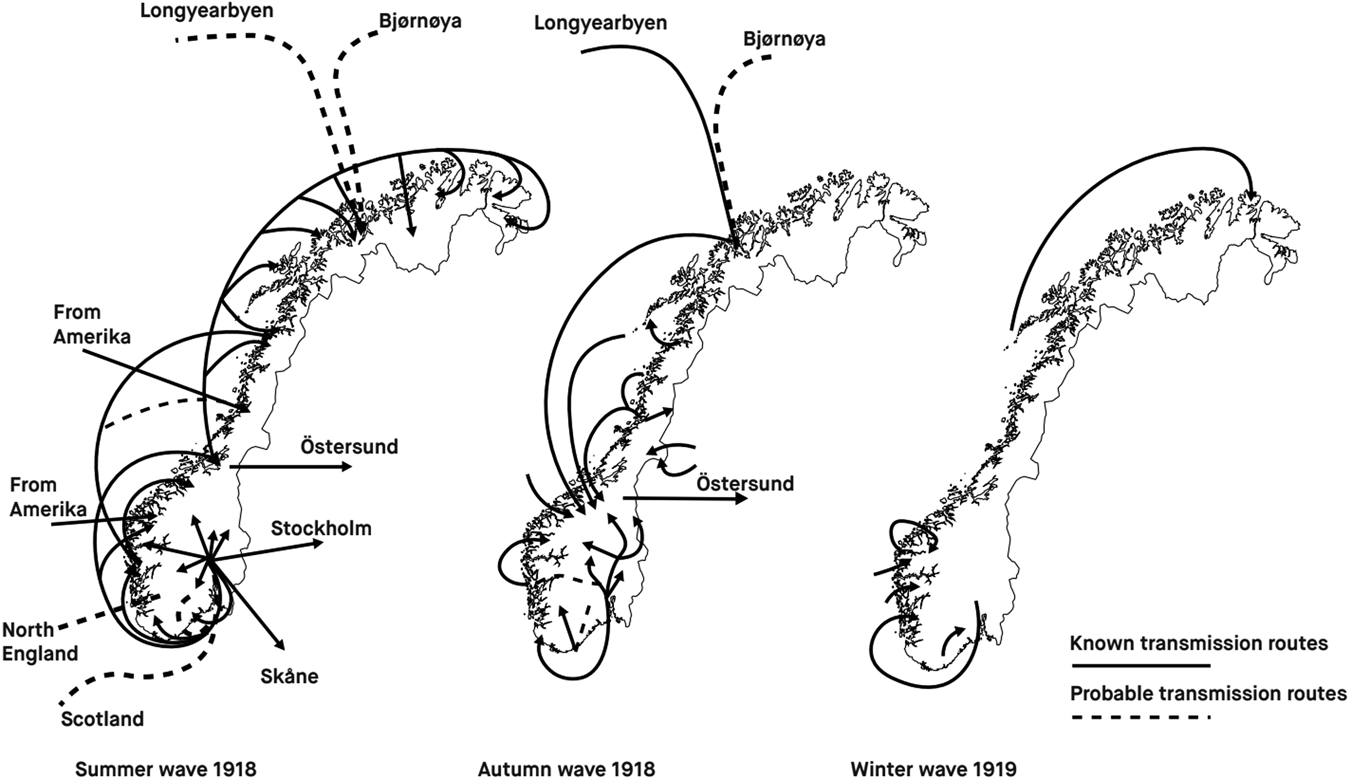
During the first wave, summer 1918, the virus spread rapidly from the capital Kristiania, and from Bergen on the west coast to Kirkenes in the north. The same pattern can be observed during the second wave in the autumn of 1918. During the third wave, in the winter of 1919, the disease both reappeared and spread more locally (see Figure 1).
Map of Norway showing the spread of the 1918–1920 Influenza pandemic in three waves, with known transmission routes (full line) and probable transmission routes (dashed lines). This map is reproduced with permission from Svenn-Erik Mamelund. S.-E. Mamelund, ‘Diffusjon av influensa i Norge under spanskesyken 1918–1919’, Norsk epidemiologi 8, 1 (2009, 50).
Svenn-Erik Mamelund, through several studies, teased out potential risk factors for morbidity and mortality differences among the Norwegian population, such as socio-economic status,Footnote 15 tuberculosis,Footnote 16 indigenous status,Footnote 17 and geography.Footnote 18 The Norwegian mortality curve follows the w-shaped curve known from most other countries in regards of the 1918–1920 flu pandemic, showing the unusual high excess mortality among young adults. Globally, this pandemic affected more adolescents or young adults, thus this was a significant risk factor to die from this flu.Footnote 19 The consequences of the high mortality amongst young adults, and especially men, was an increase in the number of widowers and orphans, a decrease in production of goods and lack of maintenance of crucial infrastructures in the public sector.Footnote 20 Despite numerous studies, there is a scarcity of comprehensive public health perspectives on the 1918–1920 Influenza pandemic in Norway. This area of research has recently gained greater interest, especially in the wake of the COVID-19 pandemic. Investigating historical pandemics can provide valuable insights into the intricate dynamics of public health decisions and their impact on pandemics.
3. Sources and historical records
A range of historical sources has been used to offer a thorough comprehension of this subject. While exploring the origins of Norwegian health legislation, particular attention has been given to records detailing the decision-making processes that led to the development of crucial acts such as the Norwegian Public Health Act of 1860, the Tuberculosis Act of 1900, and the Public Medical Service Act of 1912.Footnote 21 These sources include committee transcripts, white papers, and parliamentary records.
To investigate the implementation of these laws, annual medical records from the period 1918 to 1920 have been used. These last records summarise the work and reports from the locally-based health boards. These records shed light on the health conditions within their respective areas and provide important contextual information. A summarised version of these annual reports was printed by Statistics Norway.Footnote 22 These records provide insight into reported morbidity and mortality rates of all diseases, including influenza, within both the medical district and at a national level. For this paper, annual records from 1918, 1919, and 1920 have been utilised.
Relevant papers and discussions in the three existing medical journals in Norway by 1918 – Norwegian Magazine for Medical Science (Norsk Magazin for Lægevidenskaben), Journal of the Norwegian Medical Association (Tidsskrift den norske Lægeforening) and Medical Revue (Medicinsk Revue) – contributed with doctors’ perceptions about the pandemic while it was an ongoing disease, and what past experiences they drew from, when faced with such severe rates of morbidity and mortality in the population. From these journals, only papers concerning the Influenza pandemic and its compliance to health legislation and measures to fight it have been regarded as relevant.
As a supplement, chronicles, discussion papers, and editorial notices concerning the pandemic in four major national newspapers in Norway from April 1918 to March 1920 have been added as relevant sources.Footnote 23 Both doctors, the Director of Health,Footnote 24 and other segments of the population have expressed their opinions on decisions made during the Influenza pandemic. To maintain relevance, only documented viewpoints focusing on the interaction between the pandemic, legislation, and health policy in combating the flu have been included. After screening, only 30 articles were deemed pertinent to this paper's topic. Nonetheless, these 30 articles have offered valuable insight into the broader impact on the population as portrayed in the media.
Finally, an examination was conducted of public letters from the Director of Health's office to investigate the role played by national health authorities during this Influenza pandemic. Some letters have additional comments by the office of the Director of Health. The letters are preserved and made available through the National Archive in Norway (NAN) from the series RA/S-4165/B/Ba and RA/S-4165/B/Bb/.Footnote 25 These sources comprise nine volumes of transcribed letters and three volumes of registers containing journal numbers and references. Only letters relevant to matters of health legislation and health policy regarding the Influenza pandemic have been utilised in this article, totalling ten letters spanning from June 1918 to June 1920.
4. Context and content of the health legislation
In Norway, throughout the nineteenth century, various health laws were enacted to combat infectious epidemic diseases, aligning with advancements in medicine. The increasing capability to safeguard the population through preventive healthcare measures heightened the emphasis on controlling infectious diseases. Building a modern society created a need for the state to be more engaged in actions pointing directly towards severe health threats caused by infectious diseases. However, curative interventions were still not applicable to most of these diseases. Consequently, measures such as surveillance, compulsory treatment, institutionalisation of infected individuals, alongside an enhanced focus on professional health administration and personal hygiene, found their place in legislation and regulations.
I have considered three of the health laws implemented in Norway especially relevant to explore the aim of this article, The Norwegian Public Health Act (Sunnhetsloven) of 1860, the Tuberculosis Act (Tuberkuloseloven) of 1900 and The Public Medical Services Act (Lov om de offentlige lægeforretninger) of 1912.
To my knowledge, the relevant parts for facing epidemics and pandemics of The Norwegian Public Health Act of 1860 were in effect until the Infection control Act of 1994. The Public Health Act was deemed highly appropriate for fighting epidemic diseases during the late nineteenth and early twentieth century.Footnote 26 As in many other countries in Europe and North America, the emergence of public health and health legislation in Norway was forced out by the subsequent cholera epidemics during the early and mid-nineteenth century.Footnote 27 In the same way, The Tuberculosis Act (1900) was created because of the increasing cases of tuberculosis since the last decade of the nineteenth century.Footnote 28 Drawing on experiences from fighting leprosy, members of the Norwegian Medical Association recognised the importance of developing legislation strategically aimed towards infectious diseases. The Tuberculosis Act included the possibility of extreme interventions towards individuals and was both in the present and later regarded as radical in its design and individual costs to the benefit of society.Footnote 29 The Public Medical Services Act of 1912, enacted shortly before the Influenza pandemic outbreak, greatly influenced the organisation of health administration in Norwegian municipalities. This legislation sought to improve healthcare accessibility and ensure the availability of professional doctors for all residents, especially in remote areas. Additionally, it aimed to enhance administrative resources within the healthcare system and establish coordination between local municipalities and the Director of Medicine (national level) on medical and health-related issues. Infectious diseases were a key focus across all aspects of this legislation.
Internationally, one can observe similar developments. The early precursor to the World Health Organization began in 1851 when representatives from 12 European countries convened in Paris for the first international sanitary convention.Footnote 30 Just a decade before the onset of the Influenza pandemic in 1907, the Office international d'hygiène publique (OIHP) was established. OIHP utilised the most advanced contemporary methods for disease surveillance and reporting, and disseminated new health policies internationally, with the goal of preventing the spread of epidemic diseases.Footnote 31 Historians have studied the health of the population in different countries, from multiple perspectives, to understand the emphasis on public health across various European countries during the same period. Despite this, the impact on public health and health legislation during pandemic outbreaks has not reached the attention of historians until recently. This is the case both in Norway and internationally.Footnote 32
The Public Health Act (1860) was built on the same principals as the 1848 Public Health Care Act for England and Wales. Both emphasised locally-based health boards and democratic approaches to decision making together with professional management by a doctor.Footnote 33 In the Public Health Act, the democratic principles are built into the first chapter, which is entirely devoted to the work and composition of the health boards (Sunnhetskommisjoner and renamed in 1912 helseråd).Footnote 34 In Section 1, the Act outlines the combination of locally-based democratic approaches with professional management by doctors: ‘In every market town, there shall be a health board consisting of the respective municipal medical officer or another doctor appointed by the medical board as the chairman, the city magistrate or, the member appointed by the King for that purpose, the city engineer if such an officer exists, and three other members elected in an meeting by chairpersons and representatives.’Footnote 35
The entirety of the first chapter of this Act focuses on the organisation and democratic principles concerning the scope, decisions, and responsibilities of the health boards. Distinctions between rural and urban areas in the country are highlighted in various paragraphs concerning the organisation of work within the health boards. Sections 8, 10 and 11 specifically mention the work and responsibilities of health boards in remote areas.Footnote 36 The divided view on how to deal with health issues in remote versus urban areas was additionally strengthened by two different guidelines, one for the citiesFootnote 37 and one for remote areas.Footnote 38 Both of these guidelines are issued by the office of medicine (medicinalvæsenet) within the Department of National Affairs (Departementet for det Indre). The intention of the office was clear, to place the responsibility of health-related issues on locally elected citizens, as stated in the Act, section 7, ‘Decisions lawfully made by the health boards could only be repealed or amended by the relevant government department or, if necessary, by the King.’ Footnote 39
The Tuberculosis Act (1900) was based on the hard work of the Directors of Medicine Michael Holmboe and Klaus Hanssen. The two doctors highlight the contagious nature of tuberculosis in their white paper, stressing the importance of exercising caution when dealing with infected individuals, their belongings, and their household.Footnote 40 This led to a more invasive thinking when it came to the responsibilities of the health boards. An example is section 6 where it is stated that if the health board chair found someone with symptoms of tuberculosis or living in inadequate housing conditions, the case must be presented at the health board to take necessary actions.Footnote 41 Furthermore, if an infected or sick individual failed to comply with the decisions made by the health board, the board could legally admit them to a hospital for treatment. Thus, the Tuberculosis Act underscored the importance of well-functioning health boards nationwide, as well as the need to protect the healthy from the sick. However, individual rights and personal freedoms were jeopardised in the name of the well-intentioned measures outlined in these laws, as debated in the Parliament. The medical community struggled to reach a consensus on the most effective approach to reconcile the conflict between safeguarding society when infectious diseases threatened public health and respecting individual freedoms. Many doctors were sceptical about state interventions targeting individuals in this situation.Footnote 42 In the Society of Doctors of Kristiania (Det Medicinske Selskab i Kristiania), white paper was discussed thoroughly during different meetings that took place in December 1896, January and February 1897.Footnote 43 Although the doctors did not reach a consensus on all issues within the proposal, the law was approved after voting in the Parliament with few amendments. Despite individual costs for part of the population in the past, these new laws contributed to several positive changes in society, as explained by historians from different angles.Footnote 44 And most importantly, the role and responsibility of the local health boards was confirmed and strengthened.
Both laws assigned doctors a central role within health boards: they were given the responsibility of actively registering and supervising individuals infected with epidemic diseases. Furthermore, the laws empowered local health boards to determine preventive measures to curb the spread of infectious diseases within their jurisdictions. The preventive measures were, firstly, mandatory hospitalisation for individuals unable to receive adequate treatment at home and, secondly, regulations prohibiting impoverished individuals from being cared for by private families if they suffered from infectious diseases. Additionally, practices such as isolation and quarantine, which were effective in combating diseases like cholera and leprosy, were considered vital for preventing the spread of infectious diseases. However, a significant constraint on health board efforts was the requirement for funding within each medical district. Therefore, any reluctance to implement public measures or intervene in individual lives should be understood within the context of financial constraints within each district.
The Public Medical Services Act of 1912 aimed to improve the administration of national health policy and enhance public recognition of doctors as experts. Section 1 of this act established the division of the country into medical districts, with Section 2 specifying that each district must have a qualified doctor who chairs the health boards. Additionally, the act increased the number of medical districts and introduced the role of county doctor (amtslæge), who oversaw medical and health-related matters within the county and attended health board meetings, as outlined in Section 7.Footnote 45 In this regard, the 1912 Act builds on the Act from 1860, where the commission in their white paper stated the following: ‘If anything is to come of this new law, the physician must be given an active encouragement and moral impulse to grasp an initiative for hygienic improvements, he must be in the first line. To put a juridical official first and give the physician a second place will contribute to nothing in the case of such improvements’,Footnote 46 recognising the importance of the professional doctor as the individual authority with the knowledge to safeguard the aim of a healthy population, based on the work in local health boards.
Collectively, these laws underscore the authoritative role of experts, positioning doctors at the apex of the healthcare hierarchy within Norwegian society. Despite certain limitations in economic resources, all three laws empowered local health boards to take necessary actions when the Influenza pandemic struck in the summer of 1918.
5. Medical knowledge, medical development, and medical policy towards 1918
During the late nineteenth century, there was a rapid progression in medical development and understanding of the relationship between microorganisms and disease, particularly due to the contribution of Pasteur and Koch to the field of bacteriology.Footnote 47 In Norway, the work of Gerhard Armauer Hansen and the discovery of the Mycobacterium leprae that causes leprosy in 1873 fits well into this breakthrough in medicine and understanding of disease.Footnote 48 These developments are clearly evident in the work with all health legislation prior to 1918. However, by the turn of the twentieth century, competing paradigms within medicine were still prevalent, and the scientific revolution in medicine can be understood more as a gradual shift than a rapid transformation. By the time of the Influenza Pandemic outbreak several germ theories existed, the miasma theory and bacteriology being two of them.
Ole Georg Moseng has recently argued that the epistemological shift in medicine did not fully permeate the entire community of doctors until well into the twentieth century. His arguments are based on a study of tuberculosis, illustrating how various theories concerning the transmission of tuberculosis coexisted well after the discovery of bacteria as a pathogen.Footnote 49 In turn, Michael Worboys illustrated how various germ theories were applied across different health professions and how the interplay between theories and medical practices unfolded in nineteenth-century Britain.Footnote 50 Worboys presents compelling arguments regarding the diverse understandings of the etiology of epidemic diseases around the turn of the century, as well as how disparities in knowledge, age, medical practice, and personal beliefs were crucial in comprehending the causes and potential cures for any disease.Footnote 51 In Norway, these competing paradigms not only sparked discussions and disagreements within the medical community but also impacted politics and society at large. The differing theories prompted various approaches to disease prevention, particularly relevant in the context of the Tuberculosis Act.Footnote 52
Olav Hanssen's work on the 1918–1920 Influenza pandemic presents valuable and intriguing insights into the evolving understanding among many doctors regarding influenza as an infectious disease, building on the experiences from earlier influenza pandemics.Footnote 53 Hanssen wrote ‘As known, influenza all the way until the influenza of 1889–1890, was regarded a miasmatic disease; the first experiences from this great epidemic, gave a more certain basis for the perception that this disease, that still deserves the name “morbus omnium maxime epidemicus” must be attributed to the contagious diseases.’Footnote 54 Olav Hanssen was supported by other doctors who claimed the same. Doctor Klaus Hanssen, one of the pioneers in fighting tuberculosis in Norway argued for a change in viewing influenza as a contagious disease.Footnote 55 In a paper in Medical Revue in 1890, Klaus Hanssen wrote that he initially had little inclination to believe in the theory that infection between people could occur. However, after the experiences of the 1889–1890 flu pandemic he reached the opposite conclusion, getting the impression that direct infection between people occurred too frequently, and that the more uncertain miasma theory was unnecessary in this case.Footnote 56 The influenza pandemic in 1889–1890 can thus be seen as an eye opener for many doctors regarding the transmission of infection between individuals. However, historical records from the period 1918–1920 suggest that some reservations persisted regarding the acknowledgement of contagion and transmission between individuals in relation to influenza.Footnote 57 A good example can be the following three different but contemporary explanations for the causes of influenza. All occurred during 1918, emphasising that different strategies were argued to effectively combat the influenza pandemic in Norway.
In a notification in the Journal of the Norwegian Medical Association from March 1919 there is a reference to a Danish doctor who had made an experiment to prove his theory that the flu was not transmitted between people. ‘By experiment I have now succeeded in proving that my theory regarding the Spanish disease, that it does not affect directly by droplet infection(!!), but is transmitted from the sick to the healthy by fleas – the same way as another war infection, typhus, is transmitted by lice.’ Footnote 58
In Medical Revue, we find notifications from a doctor in a military recruit company trying to explain why different troops got infected at various times. Doctor Blich Holst, sets up sufficient arguments for why the flu could not be regarded a miasmatic disease, as different troops had been accommodated under the precise same conditions, but only one of the troops got infected.Footnote 59 Although Holst concluded that the flu cannot be attributed to miasma, his comprehensive argument suggested that it was still needed to persuade people to consider explanations other than those provided by the miasma theory.
Finally, in the newspaper Morgenbladet, in October 1918, we find the notification from doctor Johan Oluf Olsen, who changed his name to Olav Fungus in 1907,Footnote 60 explaining that the Spanish flu was not an influenza at all, but a new disease, caused by fungus, and the development of the disease was related to what kind of host it found in the body and how it manifests itself. Doctor Fungus was convinced that to fight the pandemic, every doctor needed to start thinking mycological and not contagion.Footnote 61
In the same way, Moseng argued that the fight against tuberculosis involved diverse germ theory approaches, these three contemporary sources suggest a similar scenario some decades later during the flu pandemic. Like Moseng, it is noted that varied perspectives were not solely about medical strategies but also influenced policymaking. Divergent germ theory interpretations directly shaped the development of health legislation and the government's ability to enact preventive measures.Footnote 62 Consequently, different health boards, led by doctors adhering to different theories, made varied decisions on implementing influenza-fighting measures within the existing legislative framework.
In the historical sources, we also discover that although some doctors acknowledged contagion as a mode of flu transmission, they believed the disease spread too rapidly to be halted by any measures. Instead, they recommended people to maintain a high degree of personal hygiene, as seen in the case of the appointed city doctor and chair of the health board in Christiania.Footnote 63 It is important to understand these choices in the context of their distinct perspectives on both the transmission of disease, societal challenges within their jurisdiction, and their respective beliefs in what was best for the entire community.
6. The role of the local health boards during the pandemic flu
When the Norwegian Public Health Act came into use after 1860, the concept and structure of the local health boards were derived from experiences gained in preventing the spread of leprosy.Footnote 64 Amendments to the 1860 act were made several times and caused discussions regarding the administrative organisation of the local health boards together with diversity in measures on how to keep the healthy away from the sick.Footnote 65 An important but often overlooked principle crucial to fostering a healthy society was the establishment of local health boards, chaired by doctors. This played a vital role in promoting good health and combating the transmission of infectious diseases, including during the 1918 influenza outbreak. However, in certain municipalities, the positions of district doctors remained unfilled for decades. Some districts and communities lacked access to any doctors, as reported in annual medical reports from Statistics Norway.Footnote 66 The impact of this shortage, particularly in remote areas, on healthcare development has been extensively discussed in previous research.Footnote 67 For this article, it is of importance to note that, in the absence of a doctor, minimal progress was made in addressing medical issues outlined in health legislation.
Although the act of 1860 mandated all medical districts to enforce the monitoring of all health care issues and act in accordance with the law's intention, this requirement was not fully implemented by 1918. Six years prior, in 1912, during a parliamentary debate regarding The Public Medical Service Act, representatives from the most remote areas of Norway argued that the significance of these local health boards had been greatly exaggerated, as there could go many years between their meetings.Footnote 68 In reality, doctors and many local health boards lacked the resources to fulfill the requirements outlined in various laws for effective monitoring and prevention of infectious diseases. It is important to note that between 1860 and 1918, doctors and health boards were burdened with additional responsibilities imposed by national authorities, introducing the concept of public health as a comprehensive framework. This included tasks such as overseeing sewage systems, ensuring drinking water safety, monitoring food supply, managing livestock population relationships, and more. The evident discrepancy between the operations of local health boards and the intentions of the 1860 law significantly influenced the changes introduced by the 1912 Act. New requirements were implemented to improve administrative practices, enhance infectious disease control, and ensure better healthcare access, particularly for rural populations.
A reorganisation of medical districts, as part of the 1912 Act, resulted in going from 161 to 372 districts, each led by a district medical officer, the doctor.Footnote 69 However, as can be drawn from the statistical yearbook from 1918, only 310 of the suggested 372 medical districts operated in accordance with the act of 1912 by 1918.Footnote 70 The expansion of public-employed doctors, accompanying the rise in the number of medical districts, aimed to enhance medical access for the entire population. Emphasis was placed on the pivotal role of doctors and the implementation of a new hierarchical model for organising public and preventive medicine within the districts. This new administrative structure in medicine was overseen by the Director of Medicine, supported by appointed county doctors, and facilitated by an increase in district doctors across the newly established medical districts.Footnote 71
Drawing from pre-1918 developments, one might anticipate a substantial increase in the ability of any district or appointed city doctor to undertake necessary actions when the influenza pandemic struck. It was also expected that any actions taken would be supported by the county doctor and the Director of Medicine. However, as evidenced by annual medical records, significant disparities persisted in the roles and actions of local health boards during the flu pandemic. These disparities were evident in terms of meeting frequency, doctors’ understanding of infection, as discussed earlier in this article, and the feasibility of implementing measures to prevent the disease from spreading.
A comprehensive analysis of the annual medical records from 1918, 1919 and 1920, reveals substantial disparities in the response of the local health boards. These differences likely stem from limited access to doctors and inadequate resources, hindering the establishment of effective and functional health boards aligned with national health authorities’ objectives and policies. For instance, in 1918, during both the first and second waves of the pandemic, 132 out of the 310 medical districts had one or fewer meetings, indicating potential challenges in implementing national legal structures and legislation at local level. Although the frequency of meetings does not necessarily correspond with the severity of the influenza pandemic within the district, it suggests difficulties in decision-making processes regarding NPIs in districts where meetings were infrequent. Additionally, the reports reveal disparities among the health boards in terms of measures implemented and the duration of such interventions (see Table 1).
Overview of the medical districts that mention decisions regarding NPIs in their annual reports
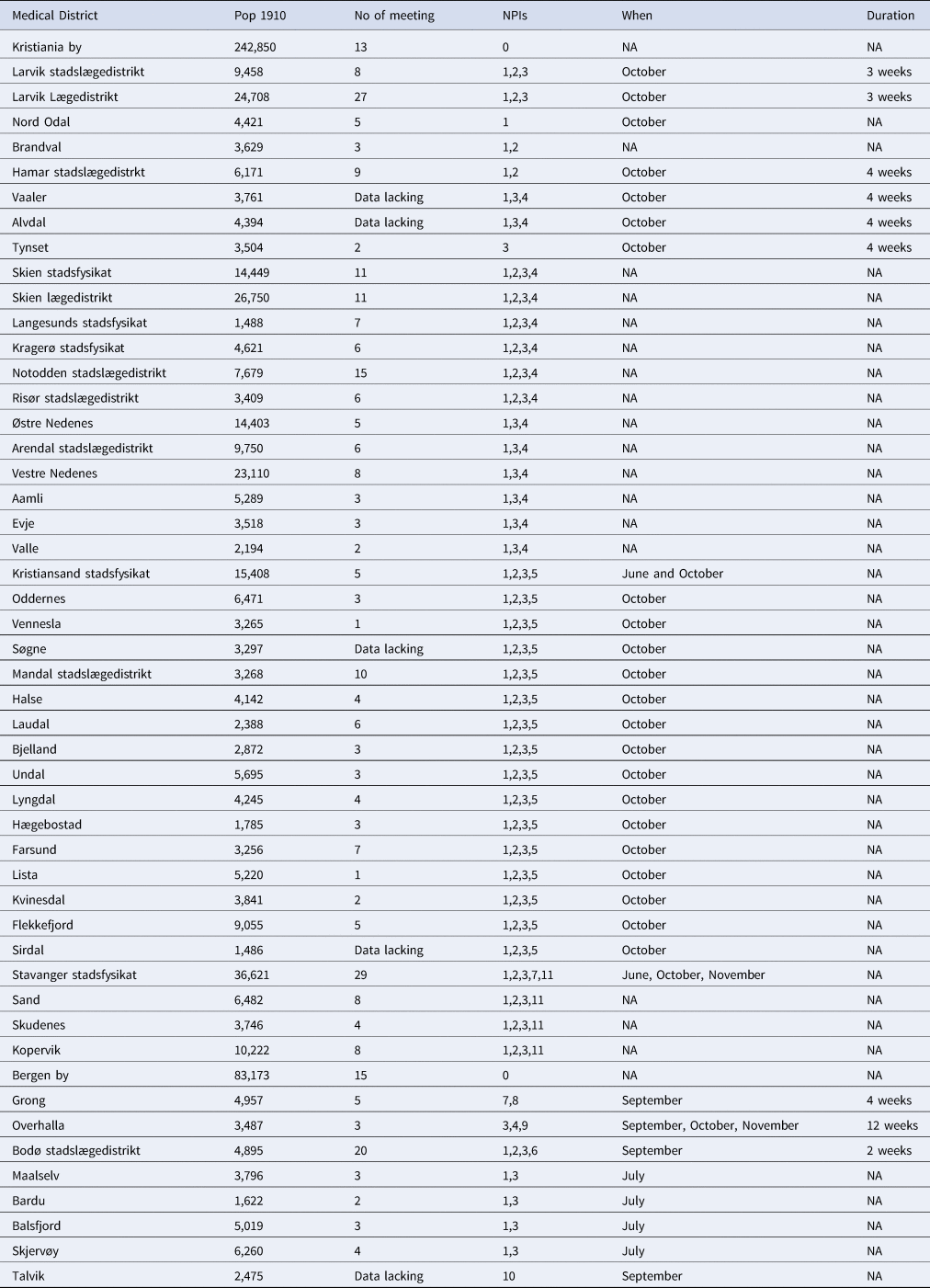
Notes: For each medical district, the table includes the population census on 1 December 1910 (Pop 1910), numbers of meetings in 1918 in health boards, NPIs, when NPIs were implemented, and duration.
No NPIs = 0, School closure = 1, Cinema closure = 2, ban of public gatherings = 3, ban of private gatherings = 4, library closure = 5, church closure = 6, isolation of sick = 7, quarantine = 8, Increased hygienic focus = 9, marked closed = 10, ban of meeting = 11.
Source: All information is collected from the annual printed medical record from 1918, available in https://www.ssb.no/a/histstat/nos/nos_vii_058.pdf.
The local health boards had the duty to report any case of epidemic and infectious diseases to the Director of Medicine, and they continued and strengthened this work during the flu pandemic. This task was emphasised during the first wave of the pandemic. In July 1918, the Director of Medicine, Michael Holmboe, issued a specific directive to all state-employed doctors, urging them to provide detailed reports on any cases of influenza occurring within their respective areas of responsibility.Footnote 72 However, due to the absence of doctors in many medical districts and the failure of numerous health boards to convene during the pandemic, it is likely that data might be missing from some reports. Therefore, the numbers and figures we rely on may be biased toward districts with adequate medical personnel and established reporting systems. Additionally, underreporting of both morbidity and mortality is expected in most districts, with some experiencing more significant discrepancies than others. Consequently, districts without doctors altogether impeded the boards from fulfilling their duties as outlined in various acts. The impact of not implementing any measures on the spread of influenza, can only be speculated upon, but the high morbidity and mortality rates suggest that adequate measures could have potentially mitigated the situation, as demonstrated by research from the United States.Footnote 73 In these papers from the United States, researchers conclude that implementing NPIs early and sustaining them for a long time contributed to delay and lower the mortality curves.
7. Non-pharmaceutical interventions (NPIs) implementation and significance
The medical records reveal variations in the approach to apply NPIs on the population during the influenza pandemic. NPIs were the sole measures available during the pandemic since vaccines and pharmaceutical treatments for flu or other respiratory diseases were non-existent. Bacteria and their potential to cause disease had only been discovered a few decades earlier, and the identification of the virus as a pathogen was still pending.Footnote 74 Consequently, the ability to fully understand the etiology of influenza was limited, and the ability to combat virus-based diseases was not feasible. The only measures possible were to implement various NPIs, such as hygienic interventions, closing public areas where people met, isolating the sick and quarantining the infected persons. Table 1 demonstrates the diverse scales at which NPIs were employed in the medical districts, and the extent of these measures during the flu pandemic. One limitation of the records is that we only find sufficient data on decisions regarding NPIs in 50 of the well-functioning 310 medical districts. For the other 260 medical districts no such measures are specifically mentioned or reported.
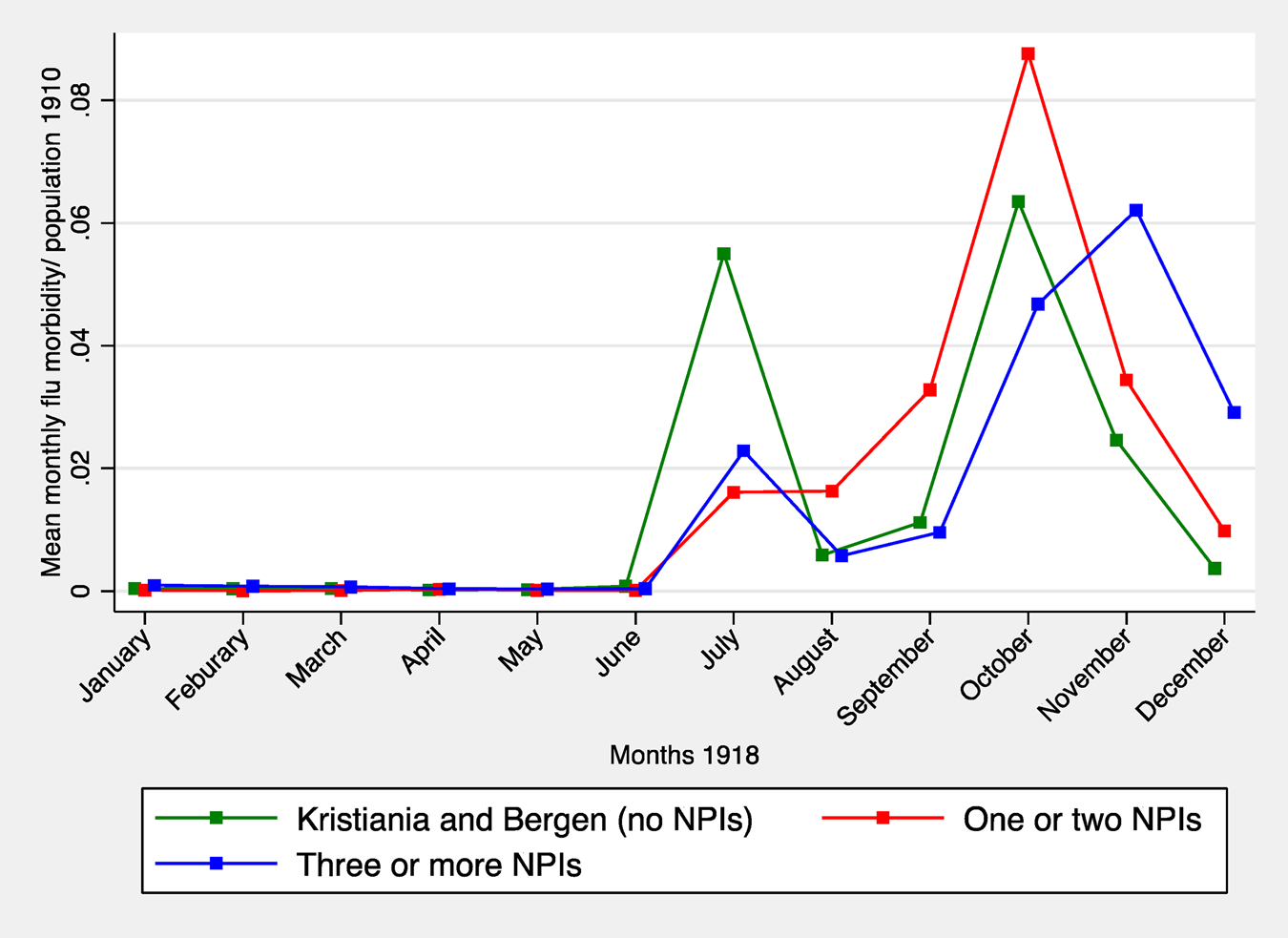
The medical records reveal insight into what kind of, if any, NPIs were implemented in the different medical districts, in some cases how long they lasted, and who made the decision of implementation. We have only identified the implementation of measures during 1918, encompassing the first two waves of the pandemic (June–July 1918 and September-November 1918). There are no data of such interventions in the annual records for 1919 and 1920.Footnote 75 This can be partly explained by the severity of the pandemic in the first two waves (1918), with only smaller, localised outbreaks identified thereafter.Footnote 76 Other explanations could be that the health boards did not witness any noticeable impact from the NPIs implemented during the two first waves, leading to reluctance in enforcing such measures later. However, our analysis of medical records indicates that implementing three or more NPIs had a flattening and delaying effect on the morbidity curve (see Figure 2).Footnote 77 Based on the available records, the implemented NPIs had short durations, typically lasting two to three weeks, with the majority introduced during the second wave from September to November 1918. It is, as mentioned before, worth noticing that most medical districts do not have detailed records of their decisions regarding NPIs. Nonetheless, it is evident that certain health boards consciously chose not to implement any measures, citing the imperfect nature of the proposed actions.Footnote 78
Mean monthly flu morbidity according to 1910 population census across no NPIs, one or two NPIs, and three or more NPIs.
Source: V.N. Nyborg, Orderud, S.-E. Mamelund, paper in progress (2023).
The annual records provide scarce information regarding the disagreement on the effectiveness of NPIs. Therefore, we need to look into other sources, such as newspapers and medical journals for further insight into these discussions.Footnote 79 As Larsen has argued, the local health boards possessed some authority to temporarily shut down businesses and make intrusive decisions in acute situations if they deemed necessary. However, their ability to sustain such measures in the long run was hindered by lack of political support and general public cooperation, making it challenging to effectively prevent the flu from spreading.Footnote 80 This led to various conflicts, as local health authorities sought to balance infection rates and high mortality against individual freedom and economic considerations related to trade, import, and production. Consequently, many of the implemented NPIs had relatively short duration and required compelling arguments from the representatives in the health boards to be effective.
Notably, none of the health laws specifically addressed NPIs, other than isolation and quarantine, nor did they mention recommended durations for such interventions. Furthermore, measures that impacted the economy, such as reduced income and increased costs for individuals, were only permissible under extreme circumstances. Both the Norwegian Public Health Act (1860) and the Public Medical Services Act (1912) placed the responsibility of local health boards to propose regulations specific to their locality in collaboration with the municipality.Footnote 81 However, in many medical districts local regulations had not yet been established. There are no indications that various NPIs were included in these local regulations, as the adherence to local democratic principles were challenging also before the pandemic struck in 1918. A pertinent question arises: would it had been easier for local authorities to take actions if they had the support of the national health authorities, such as the Director of Medicine or the Ministry of Social Affairs?
The Director of Medicine received a letter from the county governor in Tromsø, which included a statement from the county doctor advocating to include the influenza pandemic as a recognised aspect of public healthcare eligible for compensation under the 1860 Act. In his response, the Director of Medicine stated that influenza was not regarded as an extreme case, not even during the second wave, with peaking mortality rates. The influenza was therefore not to be treated like other contagious diseases.Footnote 82 The county doctor's inquiry and the Medical Director's responses both reflect a concern about the economic costs of implementing effective measures to mitigate the flu. Local and national health authorities were reluctant to invest in hygiene and treatment due to the ongoing spread of the flu. Despite county doctors’ inquiries, national health authorities maintained that decisions regarding interventions and their duration were the responsibility of local authorities.
8. Criticism coming to the surface
The consideration of the healthy and preventive health care was set up against liberal ideology, and the value placed on individual freedom. Economic considerations, such as import of goods and cross-border commerce, further complicated the situation. The lines of conflict were not new but have been observed throughout history. It was the case during the introduction of smallpox vaccination in 1810–1811, in both cholera epidemics between 1830 and 1860, on ongoing debate regarding treatment and isolation of individuals with leprosy, and again in the fight against tuberculosis.Footnote 83 These lines of conflict were represented both within the community of doctors, as have been argued earlier, but also between politicians and the community of doctors, as shown in the 1860 Act. Firstly, the democratic and local principles are enshrined in the first section, and the concern of epidemic outbreaks are reflected in the second section, as stated already in the heading ‘Regarding specific measures against epidemic and infectious disease.’ Secondly, the knowledge of doctors is viewed as valued for the work in the local health boards, as legislation emphasises that a doctor must be the chair of these boards.Footnote 84 However, the knowledge and power of doctors in these matters, also caused some concern, as was clearly expressed in the white paper of the act. ‘However, the main element of the Commissions must always be assumed to be the Doctor, and the favorable outcome of the case will therefore depend on his zeal and competence.’ Footnote 85 This way we can assume that decisions regarding measures in case of epidemic and infectious diseases were dependent on the knowledge and willingness of the doctor in every local health board. When the flu pandemic hit Norway, it was through predetermined legislation that medical districts would respond differently, as they differed in terms of geographical conditions, local adaptions, access to professional doctors and functional health boards. Despite this being the case, when the second wave came in the autumn of 1918, the lack of coordinated measures coming from the state, represented through the office of the Director of Medicine, and many of the local based health boards, were so striking that the national newspaper Aftenposten had several articles regarding the issue.
On October 20, we find a notice from Doctor Haakon Sæthre criticising both national and local medical authorities. The notice refers to a decision in the local health board of the capital Christiania. The decision stated that despite the high levels of both morbidity and mortality of the flu, the effect of measures, such as closing of public areas, isolation and quarantine, will not be proportionate towards the practical disadvantages.Footnote 86 Sæthre is scathing in his criticism, finding it difficult to accept that neither the local health board in the capital nor the Director of Medicine took any action to prevent the disease from spreading further, resulting in more fatalities. ‘Something must be done!’ he exclaims, suggesting that implementing measures could also reduce panic among the population, instilling a sense of security because medical authorities in the country were taking action.
On October 25, we can read from Doctor Nils B. Koppang: ‘Under such circumstances, it would seem highly necessary to implement such measures that could slow down the rapid spread of the epidemic, and undoubtedly the closure of schools and the aforementioned establishments is a reliable means to achieve this. This consideration has, among other things, been decisive for the Danish Ministry of Justice, which on October 23 has mandated the closure of theatres, variety shows, movie theatres, dance halls, and similar establishments.’ Footnote 87 The fact that national newspapers posted a critique concerning a lack of national and local involvement clearly shows that, despite having national legislation emphasising the need to control infectious diseases locally and by democratic principles, both national and local authorities were reluctant to act when it came to intrusive implementations. This reluctance was confirmed by the Director of Medicine in a public statement on October 17 stating that despite the highly contagious nature of influenza, traditional plague interventions such as isolation, quarantine, hospitalisation, and disinfection would not be used as they were believed to be ineffective. Instead, he advocated for hygienic measures and cleanliness of individuals, households, and utilities such as knives and forks as the most effective means of protecting the healthy from the sick.Footnote 88
The statement by the Director of Medicine emphasises that national health authorities had no intention of contributing to implement national measures or urge any local health boards to implement measures. This was in line with the health legislation, stated clearly in the 1860 Act and confirmed by the Acts of 1900 and 1912. The national health authorities had no intention of walking away from these decisions. However, given the critique in national newspapers and a specific urge by some doctors to reconsider this strategy (who also pointed out measures taken in neighbouring countries such as Denmark and Sweden), the hesitancy regarding national actions to close down schools and other public establishments, seems more like a disclaimer than trying to cope with an ongoing epidemic disease.Footnote 89
During the nineteenth century, the Norwegian government published laws concerning health, based on an ideology emphasising the importance of a healthy population to modernise society. At the same time, the government left to locally-based powers, primarily the district doctors and appointed city doctors, to enhance these laws through their work in the health boards.Footnote 90 The gap between locally-based and national authorities can be seen as playing an important role during the 1918 influenza pandemic and, to some extent, can be argued to have prevented national and coordinated actions to stop the spread of the disease.Footnote 91 The laws explicitly define that health boards were the preferred body for decisions with an impact on people's everyday life. There was no willingness to change these responsibilities during the pandemic, despite the fact that neighbouring countries such as Sweden and Denmark were taking other decisions.Footnote 92
9. Conclusions and reflections
This article has explored the application of national health legislations in combating the 1918–1920 flu pandemic in Norway. A key focus of this article has been to develop a comprehensive understanding of the underlying principles upon which these legislations were built and how their intended goals translated into practical measures to mitigate the spread of influenza. The Norwegian Public Health Act from 1860 addressed challenges in rural and urban areas, while the 1912 Act aimed to further address these issues. However, these changes only partly enabled local health boards to respond effectively to the pandemic. Disparities persisted, especially in access to doctors and the ability of each board to act in line with legislative intent. Additionally, this study reveals how varying medical knowledge, and perceptions of pathogen transmission influenced decisions on implementing NPIs to prevent the influenza from spreading.
National health authorities aimed to create local health boards nationwide, led by professional doctors. Their main goal was to improve public health, seen as a national priority. However, a comprehensive national health policy was not fully implemented by 1918, and public health responsibility largely fell on local boards and democracy. Trust in local governance and democracy was evident in the legislation and regulations following the 1860 Act, but proved to be insufficient without support and coordinated measures from the national level of health authorities.
The 1912 Act's emphasis on establishing a robust health administration was largely successful, yet it did not equip health boards to effectively combat the pandemic flu outbreak. Records show limited intervention from national health authorities during the critical first two waves of the pandemic, despite requests from local district doctors and media criticism. The Director of Medicine maintained the principle of local responsibility. This underscores the complex dynamics between national and local health authorities during the pandemic, revealing the significant burdens on local health boards in managing the crisis effectively.
Before the onset of the pandemic flu, the unification of health challenges, regardless of geographical location, had not been fully achieved across the country. Consequently, the variations in approach and activity among the health boards can be attributed to differences in medical resources and diverse understanding of the threat posed by the influenza. The pandemic caught most countries off guard and, despite significant medical advancement leading up to 1918, most countries lacked effective measures to combat the flu pandemic. Furthermore, some doctors, deemed the measures outlined in the legislation concerning leprosy, tuberculosis, and general health legislation to be irrelevant. Statements from the local health boards in Bergen and the capital Christiania reflect this sentiment.Footnote 93 The rapid spread of the influenza made it difficult to halt its progression. While some doctors were willing to set aside concerns such as individual freedom, to minimise mortality rates, others saw such interventions as intrusive violation of individual rights. However, as research from the United States suggests, as a mitigation strategy, implementing NPIs seem to successfully delay mortality peaks and show a lower excess mortality rate if implemented in the early stage and with a duration of five to six weeks.Footnote 94
The objective of the health law was explicit: ‘the duty of the State is to keep the family and the individual healthy. The State shall prevent that disease occur.’Footnote 95 However, historical evidence supports that good intentions of the implemented health legislations, strengthened administrative health support, medical advancements and improved hygiene were not enough to fight an unknown pathogen such as the influenza virus evolving into a pandemic. Only coordinated measures and well-established NPIs have proven effective in protecting the healthy from the sick before effective vaccination strategies were developed.
Acknowledgements
I wish to express my heartfelt appreciation to my colleagues at The Centre for Research on Pandemics & Society (PANSOC), OsloMet. Their encouragement, reflections, and constructive criticism have been most valued throughout the process. Furthermore, I would like to acknowledge the preliminary findings from this paper that were presented at the ESHD2022 Conference in March 2022, during the PANSOC webinar series in May 2022, and at the ESSHC conference in Gothenburg in April 2023. My gratitude extends to the participants for their invaluable feedback on the work. A special mention goes to Hilde Orderud for her collaborative efforts in handling figures and numerical data from the historical records, crafting tables and figures. I also extend my gratitude to Benjamin Schneider for his insightful comments on an early and final draft. Lastly, I express my sincere thanks to the reviewers for their perceptive remarks, which have significantly enhanced the quality of the paper. The research from which this paper is derived is funded by The University of South-Eastern Norway.
Competing interests
None.


 Open access

