


1. Introduction
This paper explores how a design-driven approach can advance the Technology Readiness Level (TRL) of a potentially sustainable technology using a case study of Soluble Gas Stabilization (SGS) technology. The aim is to enable SGS’s transition from laboratory-scale concepts to practical industrial applications. TRL, developed by NASA in the 70s, assesses a technology’s matureness through a level system from 1-9 (Reference MankinsMankins, 2009). SGS is a food preservation method that uses controlled CO2 diffusion to extend the shelf life of muscle foods, potentially reducing food waste and achieving more sustainable packaging and processing solutions (Reference Esmaeilian, Rotabakk, Lerfall, Jakobsen, Abel, Sivertsvik and OlsenEsmaeilian et al., 2021). While the fundamental physics of SGS has been established (Reference Esmaeilian, Rotabakk, Lerfall, Jakobsen, Abel, Sivertsvik and OlsenEsmaeilian et al., 2021; Reference Rotabakk, Rognstad, Jakobsen and LerfallRotabakk et al., 2023; Reference Rotabakk, Rognstad, Jakobsen and LerfallSivertsvik & Jensen, 2005), there is a need to translate this knowledge into tangible, industry-ready processes. Recent efforts have focused on SGS diffusion phenomena and product quality, often compared to widely used Modified Atmosphere Packaging (MAP) (Esmaeilian et al., Reference Esmaeilian, Rotabakk, Lerfall, Jakobsen, Abel, Sivertsvik and Olsen2021; Jakobsen et al., Reference Jakobsen, Gabrielsen, Johnsen, Rotabakk and Lerfall2022; Rotabakk et al., Reference Rotabakk, Birkeland and Sivertsvik2008). However, limited attention has been given to the systematic design and prototyping activities essential for elevating SGS toward higher TRLs.
A design approach can play an important role by utilizing innovative design and developing higher-fidelity prototypes, thus establishing a foundation for thorough validation (Auflem, Reference Auflem2023; Ebert & Aganovic, Reference Ebert and Aganovic2022). By focusing on the development and initial testing of a prototype, key aspects of engineering design, this paper aims to advance SGS from its current research-oriented state toward a level of readiness suitable for pilot-scale industry demonstrations, laying the groundwork for subsequent iterations and refinements (Reference Jensen, Özkil and MortensenL. S. Jensen et al., 2016). This design perspective bridges the gap between basic research (low TRL) and scalable industry solutions (high TRL). This is especially relevant as this case study covers multidisciplinary topics (Reference Tobi and KampenTobi & Kampen, 2018). This work emphasizes the importance of design-driven experimentation for advancing TRLs in a research field where prototypes are rare. Previous research has looked at integrating prototypes with TRL (Reference Rehberg and BremRehberg & Brem, 2024), and this study aims to apply prototyping and TRL to sustainable technology through a case study. Single case studies, such as this paper, are used to develop better hypotheses, similar to hypotheses-driven research (Reference EisenhardtEisenhardt, 1989).
This paper, therefore, presents the development of a CO2 gas flow chamber prototype designed for testing and verifying SGS under conditions that could mimic industrial environments. Proper industrial application should be a topic of future studies. SGS can transition from an emerging technology to one that thoroughly supports the United Nations Sustainable Development Goals through more resource-efficient, waste-reducing food processing systems (United Nations, 2024). The structure of the paper is as follows: First, a brief context and theoretical background of SGS and related food science concepts is provided. Then, design requirements for creating the CO2 flow chamber are presented, followed by detailed descriptions of the prototype’s design, the experimental methods employed, and the resulting performance data. Finally, the paper discusses the implications for advancing the TRL of SGS technology and considers broader lessons for the engineering design community’s role in supporting sustainable innovation.
1.1. Soluble Gas Stabilisation (SGS) technology
Food safety and security are basic human needs, yet industrial food production and processing contribute considerably to the negative environmental impact and climate change. By 2050, the world population is estimated to be 9.7 billion, with an anticipated 60% increase in food demand (United Nations, 2017). Despite this increasing demand, about 1.3 billion tons, or one-third of foods intended for humans worldwide, are wasted or lost in different stages in the food value chain, according to the Food and Agriculture Organization of the United Nations (Reference WiebenWieben, 2017). Current research suggests that not enough effort has been focused on technological solutions to target the causes of food waste in households, including the role of packaging (Reference Brennan, Langley, Verghese, Lockrey, Ryder, Francis, Phan-Le and HillBrennan et al., 2021). We are left with the paradox of needing to feed a growing population while wealthy countries discard a lot of food (Poyatos-Racionero et al., Reference Poyatos-Racionero, Ros-Lis, Vivancos and Martínez-Máñez2018; Stenmarck & Graham Moates (IFR)., Reference Stenmarck2016; Wieben, Reference Wieben2017). Short shelf life and excessive packaging contribute significantly to food waste, transport costs, and pollution.
Soluble gas stabilization (SGS), used as a pre-step process before Modified Atmosphere Packaging (MAP), emerges as a promising technology for solving these issues. SGS treatment, similar to MAP, yields longer shelf life by dissolving CO2 into food products during processing (Reference Sivertsvik and JensenEsmaeilian et al., 2021; Reference Jakobsen, Gabrielsen, Johnsen, Rotabakk and LerfallJakobsen et al., 2022; Reference Rotabakk, Birkeland, Jeksrud and SivertsvikRotabakk et al., 2006, Reference Rotabakk, Birkeland and Sivertsvik2023; Reference Sivertsvik and BirkelandSivertsvik & Birkeland, 2006; Reference Rotabakk, Rognstad, Jakobsen and LerfallSivertsvik & Jensen, 2005). Ways of increasing shelf life have previously been explored with the development of MAP, commonly used for consumer-friendly commercial food products today (Reference BlakistoneBlakistone, 2012; McMillin, Reference McMillin2008; Rotabakk et al., Reference Rotabakk, Birkeland and Sivertsvik2008). MAP yields maximum bacteriostatic effect approximately 48 hours after packaging. However, comparable bacteriostatic properties have been obtained in an SGS experimental setup with gas under constant pressure in a pressure vessel after around three hours (Reference Esmaeilian, Rotabakk, Lerfall, Jakobsen, Abel, Sivertsvik and OlsenEsmaeilian et al., 2021; Reference Sivertsvik, Jeksrud, Vågane and RosnesSivertsvik et al., 2004). However, this setup for batch production in industrial applications is still impractical when production volumes are several tonnes of food per hour. The present paper aims to contribute to resolving this discrepancy. In addition, combining SGS with vacuum packaging means reducing packaging material usage and volume, as MAP requires a package structure to support a 3:1 headspace (Reference Jakobsen, Gabrielsen, Johnsen, Rotabakk and LerfallJakobsen et al., 2022; Reference Sivertsvik, Jeksrud and RosnesSivertsvik et al., 2002). The processing of salmon fillets is used as a case study in the present paper; however, the technology can also be utilized to decrease the environmental impact of other muscle food processing as well (Reference Sivertsvik and JensenSivertsvik & Jensen, 2005).
1.2. Prototype development and validation rationale
Building a physical prototype was essential for verifying the findings suggested by prior computational models and static tests. While simulations can predict the influence of pressure, flow, and temperature on CO2 dissolution, a tangible system allows for rapid iterative testing and refinement of process parameters. This hands-on approach also enables the assessment of practical aspects such as ease of operation, robustness under industrial conditions, and adaptability to different product formats.
The prototype developed in this study was designed to test whether the theoretical improvements predicted by simulations and earlier experiments under constant pressure could be realized in practice. Specifically, it aimed to demonstrate that continuous high-pressure CO2 flow, elevated pressure, and controlled low temperature could increase the speed of CO2 dissolution, thus bridging the gap between lab-scale theory and industrial applicability. A potential industrial scenario involves integrating the SGS step into a production line: placing salmon fillets into trays, subjecting them to a brief, high-flow CO2 treatment, and then sealing them with top film before proceeding to subsequent packaging or storage steps (Figure 1). By refining and optimizing these parameters, the resulting process could feasibly reduce the time needed to achieve the desired bacteriostatic effect from hours to minutes. This improvement would be transformative for large-scale food processing operations.
Illustration showing how the SGS pre-treatment would work in a line processing (Reference Esmaeilian, Rotabakk, Lerfall, Jakobsen, Abel, Sivertsvik and OlsenEsmaeilian et al., 2021)

2. Methodology
2.1. From previous SGS research to design requirements
Prior work on SGS has primarily focused on understanding CO2 diffusion dynamics and bacteriostatic efficacy, with limited exploration of how to apply these findings in an industrial context. Since the novel concept of expediting the CO2 dissolution process had already been developed, this research focuses on critical function prototyping since this study is the first to test it experimentally (Reference Freyer, Christensen, Olsen and SteinertFreyer et al., 2022). Concurrent engineering was considered, but testing remained the main focus since the concept was already developed. The concept involves creating a CO2 flow within a chamber, resembling impinging flow conditions in applications like rapid freezing (Reference Salvadori and MascheroniSalvadori & Mascheroni, 2002). These insights led to the following core design requirements for the physical prototype:
-
Create a pressurized chamber that minimum holds 2 barG and up to 8 barG
-
Create flow speeds over the sample up to 50m/s.
-
Salmon sample of Ø65mm
-
The flow pipe diameter is the minimum sample size, i.e., 65mm.
-
Have a fully developed flow—Therefore, a pipe over the main chamber must be around ten times the pipe diameter.
-
Valves to control input and output pressure
-
Temperature control down to 1°C
-
Get data on flow speed, force due to gas flow on sample, temperature, and pressure.
The flow speeds were easily attained in the simulation; however, in practice, using a CO2 pressure difference would consume around one tonne of CO2 per hour. Therefore, a fan is used in the prototype made in this paper because that would work in a sealed environment.
2.2. Experiment design
A modular, cost-effective prototype was developed to test the effectiveness of the proposed flow concept. The setup, which consists of modular Tri-Clamp components, pipes, pneumatics, and electronics, provides experimental data to contribute to the further development of the SGS technology. This subsection details the final design, which is later evaluated in a comparative experiment discussed in Section 2.2. Specific design details can be found in (Reference ØvrebøØvrebø, 2023).
The experimental setup involves placing a salmon sample on a 3D-printed stand inside the main chamber (Figure 2). Then, the chamber atmosphere is modified by pressurizing with 100% food-grade CO2. To recirculate CO2, 2-inch circulation pipes are connected instead of using a continuous external supply of CO2. A fan comprising a brushless ECO II Series 2207 2400KV DC motor from Emax, USA, with a blade is mounted in the 3-inch tee with the 3D-printed stand shown below (Figure 2). An Arduino controls the motor, and an 18A electronic speed controller (ESC) from Turnigy, Hong Kong, is placed inside the electronic speed controller (ESC). The fan blows the gas through the system, hitting the sample before entering the recirculation loop. The tee closer is used to divert airflow from the side part of the tee.
Key 3D-printed components used in the experimental flow setup, including the sample placement funnel (left), fan holder (top right), and the tee closer (bottom right)

Tri-Clamp components, made of 304 stainless steel manufactured to EN4825 standard (Hygienic Stainless Steel, 2023) from Dernord, China, provide structural rigidity to the chamber to hold pressure while being modular. Each Tri-Clamp component is fastened to the adjacent component with specialized clamps (Figure 3). Over the main chamber, a 60 cm long 3-inch pipe is used to fully develop the flow from the fan. The setup is fastened to a stand with wheels for mobility. The components in the prototype are the parts typically used for brewing chosen because of their suitability for food science research, as these can withstand up to 97 bar depending on the pipe diameter (Hygienic Stainless Steel, 2023).
Digital render, photo and Tri-Clamp component overview of the flow setup

A SodaStream CO2 canister is placed next to the pneumatics. The pneumatics are connected using an 8mm nylon tubing between the pressure vessel and the valves. A SodaStream connector is used to supply prechilled CO2 gas to the supply valve, and an R72G-2GK-RMN valve from Norgren, UK, is set to the desired downstream pressure of 2 barG. The exit valve is a pressure relief valve (PRV) from SMC, USA, connected in parallel with a pressure gauge. The pneumatic components and the process’s piping and instrumentation diagram (P&ID) are shown below (Figure 4).
Photo of the pneumatic components and PFD of the process

2.3. Evaluation experiment method
The comparative experiment evaluates the difference between a traditional laboratory-scale SGS setup with static pressure (Reference Jakobsen, Gabrielsen, Johnsen, Rotabakk and LerfallJakobsen et al., 2022) and the experimental flow setup, highlighting the differences between the static and flow concepts. The method overview is shown below (Figure 5).
Overview of the experiment conducted to evaluate the SGS flow concept

Freshly slaughtered Atlantic salmon was transported to the lab on the day of the experiment before the fillets were portioned to the experiment sizes of Ø 65 mm and a height of 20mm with two custom-made cutters. For each experimental repetition, one fillet was used for the flow SGS system, one for the static SGS treatment, and one in the fridge as a control sample. Each experiment was repeated three times (n=3) in parallel. Experimental samples were placed inside the two prechilled flow and static chambers before supplying 100% food-grade CO2 and venting out for 2 minutes to make the concentration as close to 100% CO2 as possible. Since only one temperature and pressure sensor (EBI 11 Series, Ebro, Germany) was available, it was placed inside the flow experiment for the first repetition. Then, the sensor was transferred to the static chamber for the next experiment repetition before being transferred back to the flow experiment for the third repetition. During all experiments, 2 barG of CO2 pressure was applied. After one hour, the samples were removed and packed in MAP by using a Webomatic tray sealing system (TL250, Webomatic, Germany) in 230 ml semi-rigid crystalline polyethylene terephthalate trays (C2125-1A, Færch Plast, Denmark) with 60% CO2 and 40% nitrogen measured with MAP Mix 900 gas mixer (Dansensor, Denmark) before the buoyancy was tested at regular intervals up to 190 hours. A gravimetric analysis was performed to measure the CO2 dissolution in the samples. The CO2 concentration change (mg CO2/kg) was measured by submerging the packed salmon in water and measuring the buoyancy of each sample with a texture analyzer (Stable Micro System Ltd, TA-XT plus, Godalming, UK). The post-experiment analysis proposed by (Reference Rotabakk, Lekang and SivertsvikRotabakk et al., 2007), modified by (Reference Abel, Rotabakk, Rustad and LerfallAbel et al., 2018) and (Reference Jakobsen, Gabrielsen, Johnsen, Rotabakk and LerfallJakobsen et al., 2022) involves determining the final dissolution of CO2 into a product at equilibrium time by calculating the final total CO2 (ppm) absorbed by the product, $C_{CO^2 }^{t = \infty }$
.
$C_{CO^2 }^{t = \infty }$
. $C_{CO^2 }^{t = \infty } $
is calculated based on the buoyancy (ΔVg ), molecular weight of CO2 (Mw
CO2), product weight (W), temperature (T), gas constant (R) and pressure (P) according to Rotabakk et al., Reference Rotabakk, Lekang and Sivertsvik2007:
$C_{CO^2 }^{t = \infty } $
is calculated based on the buoyancy (ΔVg ), molecular weight of CO2 (Mw
CO2), product weight (W), temperature (T), gas constant (R) and pressure (P) according to Rotabakk et al., Reference Rotabakk, Lekang and Sivertsvik2007:
 $$C_{CO@}^{t = \infty } = {{(1000 \cdot P(V_g^{t = 0} - V_g^{t = \infty }) \cdot M{w_{CO2}})} \over {R \cdot T \cdot W}}$$
3. Experimental results
Figure 6 shows the measurements of dissolved CO2 in the salmon samples after the control and SGS-treated samples were packed in MAP.
The development of average product CO2 concentration after being packaged in a modified atmosphere as a function of pre-treatment. Error bars show the standard deviation for each measurement (n=3)

Since no CO2 was initially present in the control samples, the gradient of dissolution of CO2 from the headspace into the food is higher than for the samples pre-treated using flow and static SGS. Likewise, more gas volume is needed to saturate the same amount of fish without pre-treatment. The negative dissolution values at t=0 are due to CO2 escaping from the SGS-treated samples back to the headspace based on the concentration difference immediately after packaging. The standard deviation (error bars on the plot) is based on three repetitions for each experiment. The pre-treated samples show a slightly higher standard deviation than the control samples.
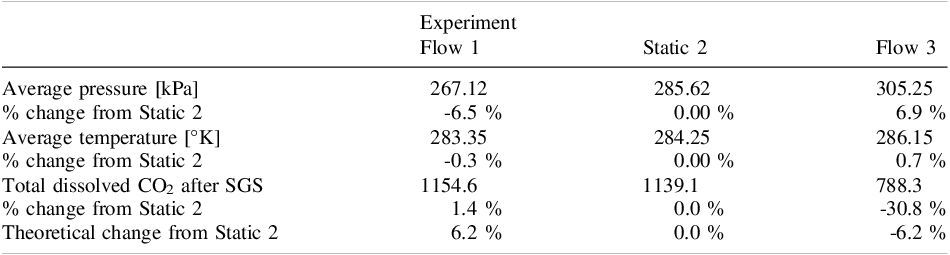
As explained in Section 2.3, the temperature and pressure sensors were moved before each repetition of the SGS treatment. Table 1 shows the corresponding experiments’ average pressure, temperature, and total dissolved CO2. The relative percentage changes for the flow experiments (Flow 1 and Flow 3) are compared to those in the static experiment (Static 2). The results show that flow experiment 3 (Flow 3) had 6.9% higher pressure, 0.7% higher temperature, and 30.8% lower CO2 dissolved after SGS compared to Static 2. In addition, flow experiment 1 (Flow 1) had 6.5% lower pressure, 0.3% lower temperature, and 1.4% higher CO2 dissolved after SGS compared to Static 2. Using these relative changes in pressure and temperature in Equation 1 yields a 6.2% decrease in absorbed CO2 for Flow 3 and a 6.2% increase for Flow 1.
Average conditions for experiments flow 1, static 2 and flow 3 and their relative deviation from experiment static 2.

4. Discussion
4.1. Experiment evaluation
The experiment results show little difference in CO2 concentration between flow and static SGS experiments on average, as seen in Figure 6. However, looking at the relative differences in Table 1, there is a considerable absorption difference between flow experiment 3 and static experiment 2. An increase in pressure and temperature by 6.9% and 0.7%, respectively, would yield a theoretical 6.2% lower CO2 dissolution in MAP storage. However, the observed dissolution is 30.8% lower, i.e., better, meaning there is a potential to further develop a design for an SGS chamber with CO2 flow.
In addition, the standard deviation and different starting points for the samples in Figure 6 indicate an inhomogeneous dissolution of CO2 into the food sample during the SGS treatment. Another problem experienced during the experiments was that the average temperature was higher than the required 1°C (Table 1). In the case of static SGS treatment, the CO2 gas pumped into the chamber had a higher temperature than planned. In the case of flow experiments, the gas was chilled, but the fan generated excessive heat.
The next iteration for the SGS flow chamber has been made based on lessons learned; however, it remains untested. The electronics are developed with a real-time pressure sensor to ensure accurate pressure measurements between experiments. The used gauge had too little resolution to accurately show the pressure between experiments, as illustrated by the difference in experiment pressure in Table 1. A flow speed transducer is also developed using a pitot tube and a differential pressure sensor. In addition, a live temperature sensor is incorporated to monitor the temperature continuously. These improvements are implemented to get better data for a similar experiment on the current setup.
4.2. Case-specific design insights
The designed prototype, however, also suggests pivoting to new designs to improve performance and reliability. Firstly, creating flow via pressure difference proved impractical due to excessive CO2 consumption. The potential CO2 savings using SGS technology would be negligible compared to the footprint of venting high amounts of CO2. This could be captured; however, that is also a technical challenge. The numerical model from previous research was made with a disregard for this fact, making this an unknown unknown (Reference Jensen, Elverum and SteinertM. B. Jensen et al., 2017). A compressor concept was developed by recycling the CO2 in the setup when external gas addition was ruled out (Reference ØvrebøØvrebø, 2023). However, no compressors can have the volumetric flow required by the flow setup (Linquip Team, 2023). Using the highest volumetric flow compressor available, one can develop a discrete flow concept where gas is circulated and flushed at high pressures instead of a continuous setup, as presented in this paper. Pivoting to this discrete SGS flow concept is an insight gained through the prototyping done in the present paper. A fan was integrated to keep the flow continuous, as per the requirements of the simulation. This implementation, however, generated a heat problem. In addition, the fan generated more heat in the low-temperature experiment conditions than in room-temperature prototyping conditions. The heat problem is a known unknown, and these conditions lead to unequal experimental conditions for the static and flow experiments. The authors have also tried different methods to eliminate the heat problem, like water cooling and heat exchangers. These solutions brought other challenges related to pressure and heat. Finally, when the setup with the fan was tested, achieving the speeds required by the simulation was challenging because of real-world effects like the friction obtained in a pressurized environment.
4.3. Design insights
Raising the TRL of emerging technologies like SGS often proves challenging due to unforeseen practical constraints. In this study, addressing these challenges by simply “overengineering” the existing prototype would amount to optimizing a fundamentally suboptimal solution. Instead, a more sustainable and effective approach is integrating continuous insights from physical testing into the simulation models, mirroring an agile product development process (Reference Carvalho and MelloCarvalho & Mello, 2011).
This iterative feedback loop between virtual and physical prototypes enables developers to explore a broad design space in simulations while swiftly testing critical parameters in real-world scenarios. Although physical prototyping provides more realistic data, it also demands additional time and resources. Conversely, modifying a simulation is quicker and less costly yet inherently limited by its underlying numerical models. For this case study, such a process would consist of designing an outline of the concept, e.g., a digital prototype or a sketch, before making a low-fidelity prototype with critical parameters incorporated. Next, a numerical simulation could be developed based on physical constraints from the physical prototype. This simulation could inform about optimal process parameters like flow speed, etc.. Data gathered from the following physical prototype, such as temperature fluctuations, pressure variations, and CO2 dissolution rates, could then be fed back into the simulation models to refine assumptions and parameters. By moving fluidly between these two realms, designers may reduce design fixation, as the literature on virtual prototyping shows conflicting reports regarding its influence on creativity (Reference Coutts and PugsleyCoutts & Pugsley, 2018). This design workflow is similar to (Reference Post and KendallPost & Kendall, 2022), and is shown in Figure 7 . This case study exemplifies how leveraging both virtual and physical prototyping can accelerate learning, foster more sustainable solutions, and ultimately guide emerging technologies like SGS toward higher TRLs.
Workflow of combined virtual and physical prototyping

4.4. Aligning technology development with sustainable innovation
The SGS technology and its supporting research embody the broader challenge of turning fundamental research into tangible, sustainable solutions. Currently, SGS has a low TRL, meaning it remains far from widespread industrial adoption (Reference Ebert and AganovicEbert & Aganovic, 2022). This research aims to bring SGS closer to industrial adoption by elevating the TRL. However, it does not aim to industrialize the technology. By deliberately incorporating engineering design and prototyping methodologies, researchers can more effectively translate basic science into workable, impactful solutions.
This case study demonstrates that advancing technology requires physical prototyping for practical design implications while also utilizing simulations as a tool for process optimization. Designers can continuously pivot concepts toward better solutions by framing the development process as a hypothesis-driven, iterative “wayfaring” (Reference Steinert and LeiferSteinert & Leifer, 2012). Designing with more flexible requirements, this study shows that if one can avoid optimization of suboptimal designs, one can move devices and systems closer to a TRL that can actually reduce resource use, waste, and environmental impact. These efforts help ensure that academia does more than generate knowledge; it steers that knowledge toward sustainable industrial applications, ultimately contributing to global sustainability goals.
5. Conclusion
This research demonstrates how a design-driven approach can help advance Soluble Gas Stabilization (SGS) technology from laboratory concepts toward industrial-scale implementation. The paper uncovered the challenges and opportunities for accelerating the TRL of emerging sustainable food preservation methods by integrating insights from computational models, physical prototyping, and controlled experimentation. Although the initial experiments with a continuous CO2-flow chamber encountered practical hurdles, such as heat buildup and limited flow speed, these setbacks serve as valuable feedback. They reveal critical parameters that must be addressed through agile design pivots, refined simulations, and the adoption of discrete flow or recirculation concepts.
Beyond the specifics of SGS, the lesson for sustainable innovation is clear: transitioning from scientific theory to industrial practice demands iterative, hypothesis-driven workflows that fluidly connect physical testing with virtual modeling. Rather than “overengineering” suboptimal designs, this approach allows for rapid course corrections and guides emerging, in this case, environment-friendly technologies toward more practical applications faster. As the food industry faces mounting pressures to improve resource efficiency and extend product shelf life, SGS exemplifies how deeply integrated design and engineering practices can convert fundamental knowledge into tangible, higher TRL solutions that support global sustainability goals.
Acknowledgement
The Research Council of Norway financially supports this work through the research project “Concept development of full-scale soluble gas stabilization (SGS) technology for seafood” (project number 294641). The authors would also like to thank Professor Trygve M. Eikevik, Department of Energy and Process Engineering, NTNU, for contributing to developing the SGS flow concept.




 Open access

