




Introduction
Substantial social and political transformations took place in the middle and lower Yellow River valley in China during the third millennium BC. Settlements of the Late Neolithic Longshan culture (c. 4500–3900 BP) became increasingly competitive and hierarchical, with evidence for craft specialisation, long-distance trade and exchange and inter-polity warfare eventually giving rise to state-level societies (Liu Reference Liu2004; Underhill et al. Reference Underhill, Feinman, Nicholas, Fang, Luan, Yu and Cai2008). Due to its crucial role in the development of early states, substantial archaeological research has been conducted to understand the processes of social change occurring during this period.
Animals have played key roles in the social, economic and ritual systems of China since the Early Neolithic. During the Longshan period, pigs became the focus of animal husbandry in the Central Plains and provided the main source of dietary protein (Cucchi et al. Reference Cucchi2016; Dong & Yuan Reference Dong and Yuan2020). Sheep and goats were newly introduced from western Eurasia; their arrival revolutionised land-use patterns and diversified food production (Flad et al. Reference Flad, Yuan, Li, Madson, Chen and Gao2007). The hunting of wild animals, including some large species such as water buffalo, was still a significant activity in some Longshan settlements (Liu Reference Liu2004: 56–61; Yang et al. Reference Yang, Liu, Chen and Speller2008). Both domesticated and wild animals played an integral part in household and mortuary rituals: they were sacrificed for ritual ceremonies, offered as feasting food and made into items of ritual paraphernalia. Together with millet and rice farming, animal husbandry supported significant population growth and contributed to the development of craft specialisation in the Late Neolithic (Brunson Reference Brunson2015).
Yet our understanding of animal management practices in the Longshan period remains limited. Previous studies have used stable isotope analysis to identify general patterns in domesticate diets: pigs and dogs relied heavily on C4 plants, such as millet, while sheep and goats had mixed C3/C4 diets, likely based on millet byproducts for part of the year and grazing C3 pastures outside of the main agricultural zones (Pechenkina et al. Reference Pechenkina, Ambrose, Xiaolin and Benfer2005; Lanehart et al. Reference Lanehart2011; Chen et al. Reference Chen2016). Although these studies offer important information about animal subsistence, stable isotopes can provide only a broad view of diet that includes all assimilated foods. Carbon isotope analyses, for example, differentiate between C3 or C4 resources but do not determine the specific plant components that constitute each group. Elevated nitrogen isotope values may indicate feeding on human waste or meat-rich table scraps, but they can also result from the consumption of plants grown in manured soils (Bogaard et al. Reference Bogaard, Heaton, Poulton and Merbach2007).
Microfossil analysis of dental calculus offers an alternative method to study animal diets and foodways. Dental calculus (plaque) forms during the lifetime of an animal when food and other organic particles are mineralised and become firmly attached to the surface of the teeth. These deposits survive well in archaeological contexts. Plant microfossils such as phytoliths and starch are commonly incorporated into dental calculus, providing direct evidence of plant consumption by individual animals. Compared to stable isotope analysis, phytoliths and starch offer two major advantages. First, they often have higher levels of taxonomic specificity, some allowing identification of particular plant families or genera. Second, starch granules are susceptible to damage when exposed to different food processing techniques. Some techniques, such as cooking and fermentation, produce distinctive morphological changes to the granules, allowing archaeologists to identify evidence of food processing (Henry et al. Reference Henry, Hudson and Piperno2009; Wang et al. Reference Wang, Liu, Georgescu, Le, Ota, Tang and Vanderbilt2017). Therefore, the starch granules and phytoliths recovered from calculus provide a direct record of the plant foods ancient humans and animals consumed (e.g. Henry et al. Reference Henry, Brooks and Piperno2011; Weber & Price Reference Weber and Price2016).
This article presents new data from animal tooth samples from Kangjia (c. 4500–4000 BP), a late Longshan culture site in the Central Plains. First, we use microfossils from dental calculus to infer the diet of domestic pigs, dogs, sheep/goats and wild animals including deer and water buffalo. Second, we use these results to demonstrate that animal management practices at Kangjia were closely linked with agricultural and other social practices. By comparing our findings to previously published stable isotope data from Kangjia and other related sites (Pechenkina et al. Reference Pechenkina, Ambrose, Xiaolin and Benfer2005; Lanehart et al. Reference Lanehart2011; Liu & Jones Reference Liu, Jones, Boyle, Rabett and Hunt2014), we demonstrate that dental microfossil analysis is a reliable, minimally destructive technique that can provide highly detailed information about animal subsistence. Our case study, therefore, serves as an example of how dental microfossil analysis effectively complements stable isotope data, making it applicable to tooth remains from diverse archaeological sites. Furthermore, by integrating the microfossil data with archaeological evidence, we can explore the broader implications for social transformations during the Longshan culture.
Archaeological background
The Kangjia site (c. 4500–4000 BP) in Lintong, Shaanxi, was excavated in the 1980s and 1990s (Figure 1). The excavation in 1990 included a 10 ×10m unit (T26) that yielded 33 house foundations, 18 pits, nine human skeletons and numerous bones, ceramic remains, implements and ornaments (Liu Reference Liu2004: 48–51). All faunal remains found during the excavation were collected and 28 taxa were identified, including both domesticated (pig, sheep/goat, dog and possible chicken) and wild animals (sika deer, water buffalo, water deer, hare, cat, raccoon dog, tiger and bear) (Yang et al. Reference Yang, Liu, Chen and Speller2008). The age compositions of pigs and sheep/goats point to a kill-off pattern for meat consumption (Liu Reference Liu2004: 57–60). Evidence for ritual activities involving feasting, divination and human sacrifice has been discovered at the site.
Map showing the location of Kangjia (figure by authors).

Non-random patterns in the deposition of faunal remains in several pit features at Kangjia indicate ritual practices and special social activities. For instance, pit H71 contained large quantities of animal bones, divination implements such as oracle bones and turtle shells and a dismembered human skeleton (probably a young adult female; Liu Reference Liu2004: 68). Located close to the door of a house, the pit appears to have been filled quickly, likely the result of a house ritual feast. To examine human-animal relationships and their relevance to other social activities at Kangjia, we analysed specimens from both ritual and non-ritual contexts.
Material and methods
We collected samples of dental calculus from six pigs (Sus), four dogs (Canis), two sheep/goats (Ovis/Capra), two deer (Cervus) and one wild water buffalo (Bubalus) (Table 1). We also collected four control samples of mandibular bone to test for any potential microfossil contamination introduced either during burial from the surrounding soil matrix or during the curation process (Table 1; Figure 2).
Faunal samples from Kangjia.

Examples of animal tooth and control samples analysed in this study: a) pig; b) dog; c) deer; d) sheep; e) wild water buffalo. Dotted red circles indicate the areas from which control samples were taken (figure by authors).

Recovery of microfossils from dental calculus is best conducted without the use of direct chemical treatments on teeth, as these treatments can potentially damage starch granules and alter tooth surface morphology (Piperno Reference Piperno2006: 100; Piperno & Dillehay Reference Piperno and Dillehay2008; Kucera et al. Reference Kucera, Pany-Kucera, Boyadjian, Reinhard and Eggers2011). Therefore, we used sonication and EDTA (ethylenediaminetetraacetic acid) decalcification, a method that has been shown to be effective in extracting microparticles from dental calculus (Tromp et al. Reference Tromp, Buckley, Geber and Matisoo-Smith2017; Radini et al. Reference Radini2019). To obtain the calculus samples, we first rinsed each animal specimen with running distilled water to remove any loose surface debris or soil contaminants. Dental calculus samples were then collected from each specimen, placed in individual sterile polyvinyl bags with distilled water, and the bags were then placed into an ultrasonic bath for six minutes to disrupt the calculus structure and facilitate the release of microfossils. After sonication, microfossils were extracted using EDTA as a decalcifying agent (Tromp et al. Reference Tromp, Buckley, Geber and Matisoo-Smith2017), followed by heavy liquid separation using sodium polytungstate at 2.35g/ml density. Control samples were obtained by sonicating the non-tooth-bearing parts of four specimens and following the same microfossil extraction procedure (Figure 2).
The processed samples were mounted on slides and examined using a Zeiss Axioscope 5 microscope at 400× and 200× magnifications, equipped with polarising filters and differential interference contrast lenses. Microfossil identifications were made through comparison with a reference collection of more than 1000 economically important plant specimens from Asia. All phytoliths and starch granules were counted and recorded. Wherever possible, phytoliths were identified taxonomically and described using the International Code for Phytolith Nomenclature 1.0 (Madella et al. Reference Madella, Alexandre and Ball2005). Starch granules exhibiting signs of cooking damage were identified through a comparison with our experimental data and published literature (Babot Reference Babot, Hart and Wallis2003; Henry et al. Reference Henry, Hudson and Piperno2009; Wang et al. Reference Wang, Liu, Ball, Yu, Li and Xing2016).
Results
Our analyses revealed that animals at Kangjia consumed both C3 and C4 plants, including millets (Panicum miliaceum, Setaria italica and Echinochloa sp.), rice (Oryza), Triticeae (a grass tribe that includes wheat), reeds (Phragmites) and unidentified underground storage organs (USOs). The control samples yielded an absence of starch granules and substantially lower amounts of phytoliths than the calculus samples, eliminating the possibility of post-depositional or laboratory contamination. Complete counts and descriptions of microfossils are displayed in Figures 3–5 and Tables S1–S3. We summarise the primary results by animal species below.
Phytoliths recovered from Kangjia animal teeth: a) η-type (broomcorn millet inflorescence); b) Ω-type (foxtail millet inflorescence); c) β-type (barnyard grass inflorescence); d) dendritic elongate skeleton (cf. Triticeae inflorescence); e) opaque perforated platelet (cf. Asteraceae inflorescence); f) Phragmites bulliform (common reed); g) rondel (Poaceae); h) Oryza-type bulliform (rice leaf); i) double peak (rice husk); j) scooped parallel bilobate (Oryzeae leaf); k) cross (Panicoideae). White scale bars are 50μm for all images except g (10μm), j (20μm) and k (20μm) (figure by authors).

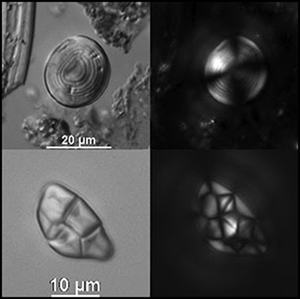
Starch granules recovered from Kangjia animal teeth under bright field (left) and polarised light (right): a) millet; b) Triticeae; c) unidentified underground storage organ; d) rice; e) gelatinised starch (cf. Triticeae); f) a cluster of gelatinised starch granules; g) cracked starch granule; h) pitted and cracked starch granule (figure by authors).

Summary of microfossil results from Kangjia animals. a) identification of starch and phytoliths from different types of animals; b) starch and c) phytolith quantity from calculus (figure by authors).

Pigs and dogs
The microfossil assemblage indicates that both pigs and dogs were fed with household refuse and agricultural fodder. The phytolith assemblage includes morphotypes from crops, such as η-type (broomcorn millet inflorescence) (Figure 3a), Ω-type (foxtail millet inflorescence) (Figure 3b), β-type (barnyard grass inflorescence) (Figure 3c), double peak (rice husk) (Figure 3i) and Oryza-type bulliform (rice leaf) (Figure 3h). Other diagnostic types include opaque perforated platelet (cf. Asteraceae inflorescence) (Figure 3e) and dendritic long cell (cf. Triticeae inflorescence) (Figure 3d). Starch granules are less numerous than phytoliths, but they indicate the consumption of USOs (Figure 4c), whose granules are characterised by extremely eccentric hilum and bright extinction crosses. Other identified starch granules include millet (Figure 4a), Triticeae (cf. wheat) (Figure 4b) and rice (Figure 4d), thus consistent with phytolith data (see Table S2 for starch identification criteria).
Thirty-eight starch granules exhibit evidence of damage, characterised by pitting, cracking and swelling (Figure 4e–h). Some of the pitted and/or cracked granules are likely the result of chewing or bacteria degradation during food consumption, but 13 show gelatinisation damage consistent with that caused by cooking (Henry et al. Reference Henry, Hudson and Piperno2009; Wang et al. Reference Wang, Liu, Georgescu, Le, Ota, Tang and Vanderbilt2017). The presence of cooked starches provides strong evidence that pigs and dogs were provisioned with or scavenged kitchen scraps.
Sheep/goats
Compared to pigs and dogs, sheep/goats had herbivorous diets with a smaller contribution of starchy foods. The two examined specimens revealed abundant phytoliths but only two starch granules. One granule was classified as belonging to the Triticeae tribe, the other lacked diagnostic features. The phytolith assemblage included η-type phytolith skeletons and double-peak phytoliths, indicating the consumption of millet and rice grains. The presence of Phragmites bulliforms from one specimen suggests that reeds may also have been part of their diet. Overall, the starch and phytolith data suggest a mixed diet of C3 and C4 plants.
Deer and water buffalo
Deer and water buffalo primarily consumed wild plants from the local environment but also had access to domesticated crops. Calculus sampled from these animals includes phytoliths from grass inflorescences, leaves and stems. Among these, elongate dendritics (cf. Triticeae) are relatively high in quantity, suggesting consumption of Triticeae grasses such as Agropyron sp. and Elymus sp., indigenous to northern China (Chen & Zhu Reference Chen, Zhu, Wu and Raven2006: 386–444), or domesticated wheat, which had been introduced into China during this period (Liu et al. Reference Liu2017). Unexpectedly, microfossils of rice husk and millets were also found in the two deer samples, and bulliform phytoliths from rice leaf were found in the water buffalo (see Discussion).
Comparing microfossil data with stable isotope analysis
Previous stable isotope analysis from Kangjia revealed that C4 plants composed a substantial proportion of the diets of pigs and dogs, whereas ruminants such as deer, sheep/goat and water buffalo had mixed diets of C3 and C4 plants (Pechenkina et al. Reference Pechenkina, Ambrose, Xiaolin and Benfer2005). Our microfossil results support these findings and provide three new contributions. First, our results reveal some of the specific plants consumed by animals, moving beyond the general C3/C4 plant categories. For example, the high δ13C value from bone collagen from Kangjia dogs, indicating a heavy reliance on C4 plants (Pechenkina et al. Reference Pechenkina, Ambrose, Xiaolin and Benfer2005), is supported by the presence of millet starches and phytoliths in the dental calculus of dog 3 in this study, along with microfossils from some C3 plants such as rice and USOs. Second, the presence of gelatinised starch granules in calculus from pigs and dogs provides the first direct evidence of the consumption of cooked plant foods by domestic animals in Neolithic China, most likely household refuse. Finally, the discovery of millet and rice microfossils in deer and water buffalo indicates that wild animals had access to domestic crops. These findings highlight how the Kangjia people actively managed domestic animals and influenced the subsistence of wild animals.
It is also important to note that interpreting microfossil data for ancient diets can be complex due to taphonomic issues, especially given the small sample sizes (Raviele Reference Raviele2011; Henry Reference Henry, Marston, d'Alpoim Guedes and Warinner2014). While our microfossil data reveal the presence of millet (C4), rice (C3) and Triticeae (C3) remains in pig and dog teeth, it is difficult to determine the relative contributions of these plant foods to the overall diets. Here, stable isotope data provide a useful complement to our findings. The high δ13C values for pigs and dogs at Kangjia suggest that C4 plants comprised about 65–85 per cent of their diet (Pechenkina et al. Reference Pechenkina, Ambrose, Xiaolin and Benfer2005: 1184). By combining the two sources of data, we can suggest that pigs and dogs were primarily provisioned with millet foods, with smaller contributions from other grasses such as rice and Triticeae.
Discussion
The late Longshan society underwent a diversification in food production technology. Wheat was introduced from western Eurasia and gradually integrated into local millet-dominated foodways (Liu et al. Reference Liu2017). Rice arrived in the Central Plains as early as 8000 years ago (Liu et al. Reference Liu2019; Zhao Reference Zhao2019; Zhong et al. Reference Zhong, Xinwei, Wang, Yang and Zhao2020) and its cultivation intensified during the Longshan period (Weisskopf Reference Weisskopf2016; Deng & Qin Reference Deng and Qin2017). Microfossils of millets, rice and Triticeae in animal calculus show that all these crops were also part of domestic animal diets (Figure 5a).
Ethnographic records indicate two arrangements of pig: intensive and extensive (Albarella et al. Reference Albarella, Dobney, Ervynck and Rowley-Conwy2008; Price & Hongo Reference Price and Hongo2020). Pigs under extensive management are allowed to forage their food and range freely around settlements, while pigs under intensive management are provisioned with household refuse or fodder and kept near or within households (Halstead & Isaakidou Reference Halstead, Isaakidou, Albarella and Trentacoste2011). Isotopic values from Early Neolithic pigs excavated from settlements in the Central Plains are indicative of high C3 plant consumption, suggesting the extensive form of pig husbandry (Dong & Yuan Reference Dong and Yuan2020). The Kangjia pigs, however, which consumed primarily crops and cooked foods, indicate an intensive husbandry system. This practice may have been widely adopted in the late Longshan. Pig remains from other contemporary settlements also show elevated carbon isotopic values consistent with C4 plant food consumption, almost certainly millets (e.g. Wu et al. Reference Wu2007; Chen et al. Reference Chen2016).
The transition from extensive to intensive pig husbandry coincides with the rise in social inequality in the Yellow River region. Beginning around 7000 BP, settlements become increasingly segmented, with houses showing differential storage capacity and disparity in resource accumulation (Peterson & Shelach-Lavi Reference Peterson, Shelach-Lavi, Bandy and Fox2010). Elite households, differential mortuary practices and competitive feasting appear together around 6000 BP. At Xipo, high concentrations of pig bones were recovered from pits associated with medium-sized houses (5800–5500 BP), suggesting pig feasting (Ma Reference Ma2005: 102). Such large-scale pork feasts probably provided a means for emergent elites to gain social prestige and status. Competitive feasts, as recorded in ethnographic studies, may facilitate the shift from extensive to intensive pig husbandry (Dwyer Reference Dwyer1996; Price & Hongo Reference Price and Hongo2020).
Among our analysed pig samples, pig 6 was recovered from feature H71—a pit associated with ritual feasting. Compared to other pigs, the calculus of pig 6 contained the highest quantity of starch granules but a relatively low quantity of phytoliths (Figure 5b & c). The identified starch granules include millets, USOs and Triticeae grasses, of which 25 per cent exhibited evidence of gelatinisation. This suggests that pig 6 had a starch-rich diet, primarily consisting of cooked and dehusked grains. It is possible that this pig was specifically raised for sacrificial purposes such as ritual feasting, thus receiving special treatment. A similar pattern has been found at Xipo, where stable isotope analysis suggests that pigs were fed primarily with millet grains rather than stalks and leaves (Ma Reference Ma2005; Pechenkina et al. Reference Pechenkina, Ambrose, Xiaolin and Benfer2005). These intensive feeding practices would have promoted faster weight gain, providing a greater supply of pork and facilitating more frequent or larger feasts (Noblet & van Milgen Reference Noblet and van Milgen2004).
Ethnographic and ethnohistoric studies document that pigs served important roles beyond subsistence, including ritual performance and feasting associated with the consolidation of social prestige (e.g. Rappaport Reference Rappaport1968; Volkman Reference Volkman1985; Feil Reference Feil1987). At Kangjia, most pits did not contain substantial quantities of animal bone, suggesting that meat was not a regular dietary component. Pork likely functioned as a private household resource primarily reserved for special occasions. The human–pig relationship at Kangjia likely held both biological and symbolic significance: humans provided pigs with fodder, while pigs provided humans with nutrition and served as a medium for social activities such as ritual feasting (Kim et al. Reference Kim, Antonaccio, Lee, Nelson, Pardoe, Quilter and Rosman1994).
Dogs at Kangjia had a starch-rich diet similar to pigs, as indicated by the presence of millet, rice and tuber starches on their teeth. This dietary behaviour can be traced back at least several thousand years, with genetic analysis suggesting that genes related to starch digestion evolved in dogs over 30 000 years ago (Wang et al. Reference Wang2013). Dogs likely developed their ability to digest starch through scavenging human food waste, which played a crucial role in their domestication and cohabitation with humans (Axelsson et al. Reference Axelsson2013). Early evidence of dog starch consumption in China comes from the Dadiwan site (7900–7200 cal BP), where the isotopic signatures of some dogs suggest that they consumed millet in quantities that could only have been provisioned for them by humans (Barton et al. Reference Barton, Newsome, Chen, Wang, Guilderson and Bettinger2009). While the origins of dog domestication in China remain unclear, sites such as Nanzhuangtou, Jiahu, Cishan and Dadiwan all reveal evidence of dog domestication between 6000 and 10 000 years ago (see summary by Liu & Chen Reference Liu and Chen2012: 98). Notably, all these sites show evidence of millet and/or rice cultivation, suggesting a long-standing connection between dogs and humans in their shared consumption of starchy crops in ancient China.
Besides animal husbandry, hunting and consumption of wild animals were significant in the Kangjia community. The presence of domestic crop microfossils in deer and water buffalo calculus suggests two possible scenarios. First, as human settlements grew and agriculture expanded, shrinking animal habitats compelled wild animals to forage closer to human settlements and agricultural fields, making them more vulnerable to human capture (Lander & Brunson Reference Lander and Brunson2018). Second, some deer were likely captured and subsequently raised within human-controlled environments. The microfossil assemblage from Kangjia deer shares similarities with that of sheep/goats, suggesting access to domestic fodder. Among the age-identifiable specimens (n = 21), only five were categorised as adults (23.8%; Liu Reference Liu1994). This pattern is similar to that found at Jiangzhai, a Middle Neolithic site in the same region, indicating human control (Qi Reference Qi, Museum, Institute and Museum1988). Deer was the most frequently consumed wild animal at Kangjia, with their bones discovered in sacrificial pits, residential structures and human burials. Deer scapulae, along with those from pigs and sheep/goats, were also used as oracle bones for divination purposes (SAIKT 1988, 1992; Liu Reference Liu2004). The Kangjia people probably fostered a close relationship with deer due to their economic and symbolic value. Similar human-deer relationships have been identified at other prehistoric sites in the region (Liu et al. Reference Liu, Jones, Zhao, Liu and O'Connell2012; Dai et al. Reference Dai2016).
Conclusions
Data presented here highlight the effectiveness of dental microfossil analysis in providing detailed information about animal diets, complementing stable isotope analyses. Animal teeth are among the most well-preserved, ubiquitous archaeological remains and dental calculus offers a protective structure for the preservation of food residues (Jin & Yip Reference Jin and Yip2002). Therefore, this method can be applied to a wide range of both recently recovered and legacy collections of archaeological fauna, expanding our understanding of ancient animal management and dietary practices.
Our study of Kangjia indicates that animal management, agricultural production and ritual life were closely intertwined and played significant roles in shaping the social and economic landscape of the late Longshan period. As Figure 6 demonstrates, domestic animals such as pigs and dogs relied heavily on plant foods from agricultural production and household food preparation, indicating active human management of these species. Meanwhile, other animals such as deer, sheep/goat and water buffalo also had some access to agricultural crops, likely influenced by factors such as human settlement expansion and changes in land-use practices. These animals were served as food and offerings in ritual sacrifice, feasts and divination activities, providing a means for certain families or individuals to negotiate for power and social prestige.
Hypothesised relationship between agricultural production, animal management and human economic and social activities at Kangjia based on microfossil analysis (figure by authors).

This research also contributes to the broader understanding of the role of animals in the emergence of social inequalities. Animals have been actively involved in various social contexts throughout history, integrated within diverse cultural systems (Arbuckle Reference Arbuckle2012). Human communities have utilised animals to generate economic surplus, establish status hierarchies and create symbolic significance through practices such as sacrifice and feasting (deFrance Reference deFrance2009). Our analysis of Kangjia animals adds to this picture, demonstrating that the emergence of social inequalities in the late Longshan was accompanied by intensive pig husbandry, possible control of wild animals and ritualised uses of animals. These practices gradually evolved into an elaborate ritual system, eventually setting the stage for the formation of Bronze Age states (Fiskesjö Reference Fiskesjö2001; Campbell Reference Campbell, Arbuckle and McCarty2014).
Supplementary material
To view supplementary material for this article, please visit https://doi.org/10.15184/aqy.2024.43.


 Open access

