

I. Conversions
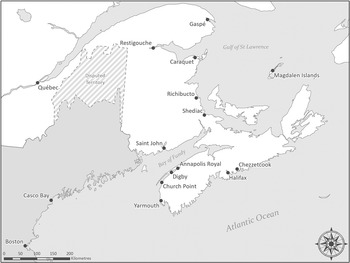
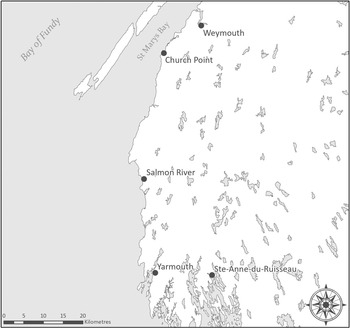
On a winter morning in early 1800, fifty-year-old Mary Doane prepared herself to be baptized a Roman Catholic.Footnote 1 To do this, she needed to abjure – or ceremonially renounce – the Congregationalist theology in which she was raised in Massachusetts. As a young woman, Doane and her family had migrated to Nova Scotia, where she met her future husband, the Catholic Acadian Pierre Lanoue.Footnote 2 The couple contracted a civil marriage and had several children. Doane had not intentionally waited until the age of fifty years to formally convert to her husband’s faith. Rather, the region of St. Mary’s Bay in southwestern Nova Scotia (see Figs. 1 and 2), where the couple established themselves, had no resident Catholic priest until the summer of 1799. A mature Mary Doane – then a wife, mother, and grandmother – thus made an active choice to pursue a Catholic baptism within the first six months of this clergyman’s presence in the district.
Canadian Maritime region, early 1800s. Cartography by Garett Gaudet.

St. Mary’s Bay region of southwestern Nova Scotia. Cartography by Garett Gaudet.

As she kneeled that February morning in the small church at St. Mary’s Bay before the French émigré priest Jean-Mandé Sigogne, Doane must have reflected on her life and her Protestant origins in Massachusetts. She was born in March 1750 in Chatham on Cape Cod. Her grandfather, Hezekiah Doane (who died before her birth), had been a deacon at the nearby Congregationalist meeting house.Footnote 3 To become a Roman Catholic, Mary needed to renounce the Reformed faith of her father and grandfather. Sigogne then conferred the Catholic sacrament upon Doane, “having no certitude of the validity of the baptism that she received in one of the Protestant communions which she abandoned this day.” Likely baptized by Calvinist rites as a girl, Mary later “follow[ed] the ceremonies prescribed in the [Catholic] Rituel du Diocèse” to renounce Protestantism, binding herself more fully to her husband’s spiritual tradition.Footnote 4 Having “profess[ed] the Catholic, Apostolic, and Roman faith” in Sigogne’s presence, Doane’s abjuration was also witnessed by Amable Doucet, the local Acadian magistrate, and by the two Acadians also of the Doucet family – each approximately Mary’s age – who became her godparents.Footnote 5 Prior to this ceremony, Mary and her husband had already brought their three youngest daughters (aged between five and nine years) to Sigogne for baptism. All three girls had previously received a lay baptism by fellow parishioner and Acadian layman Jean Melanson.Footnote 6 Seven months after her abjuration, Mary also brought her five-year-old grandson for a Catholic baptism.Footnote 7
Mary Doane signed the records of her abjuration and the baptisms of all three of her daughters because her husband could not sign. Her signature represents one of a very small number of women in the Nova Scotian parish capable of signing their names.Footnote 8 Signatures themselves are not necessarily reliable indicators of literacy, as some people simply learned to reproduce the letters of their names and otherwise could not read or write. Considering Doane’s Congregationalist origins, however, it is likely that she was fairly literate and capable of reading. Schooling was more readily available in Massachusetts due to a greater and denser colonial population, and personal literacy was a key dimension of Calvinistic theology in which biblical literacy was an expected aspect of religious life within families.Footnote 9
Doane was not the only adult female convert that year. Just weeks after Sigogne’s arrival at St. Mary’s Bay, another Protestant woman abjured: Mary Eagle from Georgia, “aged around twenty three years.”Footnote 10 Like Doane, she was the wife of an Acadian whose family had been deported to the Thirteen Colonies and later returned to Nova Scotia. Eagle’s abjuration was also witnessed by Doucet, the Acadian magistrate, and otherwise followed the same script as Doane’s. Eagle, however, could not sign her name and rather placed her mark – an “x” – on the act of her conversion.Footnote 11 While the experiences of Doane and Eagle do not represent those of the majority of Roman Catholic women in Nova Scotia in 1800, their abjurations demonstrate the local importance of a rite such as conversion and reflect the personal meanings Catholicism had accrued for these women in relationships to Catholic kin. With their conversions, Doane and Eagle formally entered a spiritual community of fellow Catholic women who were leaders of everyday affairs both within their homes and within the public spaces of the parish.
In this article, I argue that some rural Catholic Acadian women were builders of their spiritual experiences – whether those spiritual experiences unfolded in the lay context of the home and in relationship to the family and local community or in the clerical environment of the church and in relationship with the ecclesiastical hierarchy. Amid sparse resident clergy, these laywomen were spiritually, socially, and commercially active through the everyday contexts of what I call their devotional labor. I examine closely the records of one particular parish – the parish into which Doane and Eagle converted – while also anchoring my interpretations in the contexts of religious sources describing the wider Maritime region of the time. First, I examine the feminine meanings of Catholic devotions for Acadian women, the domestic dimensions of their faith, and the nature of their morality. I then use the model of devotional labor to study parish women’s daily work of material production and health care. To conclude, I interpret shifting representations of devout Catholic women in the two decades before Canadian Confederation.
II. Sainte-Marie and Sainte-Anne: Acadian Women, Kin, and Lived Religion
As observed by Phyllis LeBlanc, women did not figure centrally in Acadian historiography for much of the twentieth century.Footnote 12 Acadian histories that have featured women have focused on nuns and the various Roman Catholic sisterhoods established in the Maritimes during the period of Confederation (1860s–1870s) and later.Footnote 13 By focusing on an earlier period, and by looking predominantly at Acadian laywomen, this article makes a critical intervention in the historical scholarship.Footnote 14
As primary sources from Catholic women’s own perspectives (and Acadian perspectives generally) are not available from this time and place, I have had to think expansively about how to examine their historical religious experiences.Footnote 15 Here, I combine methods from two well-established, cross-disciplinary subfields: women’s history and lived religion.Footnote 16 The intersections of these subfields can help illuminate the lives of rural Catholic laywomen in the Canadian Maritimes.Footnote 17 In one of the few volumes devoted to Atlantic Canadian women broadly, historians Janet Guildford and Suzanne Morton argue that the separate spheres model of gender history that would perceive women solely in the private contexts of the home and family has “obscured the ways in which some women used the separate spheres ideology to claim moral and spiritual authority within the household and in the public domain.”Footnote 18 The Acadian women I examine indeed exerted authority, at times, across both realms. Let us turn first to the frameworks of gender, kinship, and domestic spirituality embedded in the experiences of Acadian women via the titular saints of their parishes.
St. Mary’s Bay gained its name in 1604 during the French De Monts expedition that charted the Bay of Fundy and eventually established the settlement of Port-Royal (later to become Annapolis Royal).Footnote 19 Yet, no European settlements were made at St. Mary’s Bay until the 1760s, when Acadians and New England Planters began establishing communities there. The bay’s Marian name was then given to the Catholic parish established for the Acadians, with its first church constructed in the village of Church Point in 1786. Meanwhile, the region’s other Acadian parish, opposite the English town of Yarmouth and also served by the missionary Sigogne, was named Sainte-Anne-du-Ruisseau. These parishes – Sainte-Marie and Sainte-Anne – were named, respectively, for important female saints of the “Holy Kinship”: the mother and grandmother of Jesus. Historical scholarship on these female figures of the early Christian tradition points out that not only have these figures provided devout women with models of spiritual virtue and moral authority over the centuries but also the mother–daughter relationship between Anne and Mary served as a symbol of female literacy and a vehicle for “valiant” womanhood, particularly in medieval Christianity and in early modern Catholicism.Footnote 20
While early modern Catholic devotionalism prominently featured Mary and Anne as saintly images to whom women could turn in their personal prayer lives and as models to guide their moral behavior, the sacraments of the church were also ways in which women could tend their relations within the family and within the larger community. In addition to being religious ceremonies, the Catholic sacraments were social institutions that inscribed and reenforced relationships between individuals and families through the rites of baptism, communion, and marriage. Each generated forms of local spiritual kinship. These social dimensions of church life were especially significant in the colonial contexts of early North America, where European settlers were establishing new communities. Before the Acadian deportations of 1755–63, there were some Catholic priests stationed in Acadian settlements of the Bay of Fundy, enabling early Acadians to participate in the sacraments. Meanwhile, during clerical absences, Acadians resorted to lay baptisms – known as ondoiement – performed by male elders or by midwives.Footnote 21 Historian Naomi Griffiths noted, “the ease with which an Acadian household incorporated matters of faith into its daily life.” She pointed to the journal of Robert Hale, a physician from New England, who, in 1731, visited several Acadian villages. Hale observed that “just about Bed time wee were surprized to see some of ye family on their Knees paying yr Devotions to ye Almighty, & others near them talking and Smoaking &c. This they do all of them … every night and Morning.”Footnote 22 Acadian families were clearly accustomed to performing lay religious activities in the domestic setting of their homes.
French Roman Catholic clerics, while present (although never numerous) in early eighteenth-century Nova Scotia, were eventually removed by the British colonial administration by the end of the Seven Years’ War – during which the Acadians were also removed and sent to the Thirteen Colonies. Catholicism was then replaced in Nova Scotia by the Church of England, established in 1758 as the state religion of the colony.Footnote 23 While some Acadians would return to the colony in the later eighteenth century, an organized Catholic clerical presence would not be reinstated in Nova Scotia until the 1780s.Footnote 24 Several generations of Catholic laypeople thus lived in the province with no direct ecclesiastical oversight. By necessity, Acadians relied on lay practices to maintain their faith. Terrence Murphy, a historian of Atlantic Canada, noted that by the end of the eighteenth century, “a large portion of the Catholic inhabitants were unaccustomed to ecclesiastical regulations. Newly arrived missionaries … saw an urgent need to impose discipline. But what the clergy considered necessary rules, the people often regarded as interference with their established traditions.” Social and moral issues concerning clerics included “excessive drinking, riotous behaviour, and undue familiarity between the sexes.” Still, some spiritual cohesion remained and “the long absence of priests had in this sense engendered lay initiative.”Footnote 25 These initiatives included lay baptisms and marriages (as the Acadians had occasionally practiced before the deportation), as well as trusteeships to oversee the construction and maintenance of parish buildings and cemeteries.Footnote 26
In the years before Sigogne’s appointment to St. Mary’s Bay, a leading Acadian family of the district had developed a favorable relationship with one of the few clergymen in the colonial capital of Halifax and used this connection to keep pressure on ecclesiastical authorities to find an available priest for their remote and isolated parish. In 1787, an Irish Capuchin, James Jones, had been appointed overseer of Nova Scotia’s Catholic missions, and the St. Mary’s Bay Acadians sent several requests to Jones asking for a priest, but with no success. The Acadian merchant captain Pierre Doucet even personally met with Jones during a visit to Halifax in 1790. Doucet returned home with “new testimonies of the goodwill” with which Jones continued to “honor” the Acadian mission.Footnote 27 In the summer of 1791, Jones visited the Sainte-Marie parishioners to assess their needs. A local account of this pastoral visit, as it was remembered within the community several generations later, recalled that, “Although there was a chapel …[Jones] said Mass, according to tradition, in the home of Captain Pierre Doucet.”Footnote 28 As Captain Doucet was away on a voyage to the West Indies in the summer of 1791,Footnote 29 his wife, Marguerite Leblanc, would have been managing the household at the time of Jones’s visit and the Mass celebrated in the family home. The following year, Jones wrote back to the parishioners, updating them curtly on the delayed status of their request for a priest. Jones addressed his letter to “Mrs. Doucet.”Footnote 30 With this personal correspondence and the use of the Doucet-Leblanc home for a special Mass, it is clear that Marguerite and Pierre were considered the lay leaders of this community, and they served as liaisons between their mostly illiterate fellow parishioners and the mission superior stationed in Halifax. I will return to Marguerite Leblanc’s devotional activities in the section that follows, but first I wish to discuss in more general terms the feminine dimension of early modern Catholic households and popular worship.
For historian Amanda Porterfield, feminine spirituality has long been associated with the home; indeed, early Christian women conducted their devotions and ministries within the home. “Feminine spirituality,” writes Porterfield on early America, “has involved the creation and maintenance of ‘home life’ as much as it has involved the capacity to receive authority.”Footnote 31 Marguerite Leblanc – or “Mrs. Doucet” in Jones’s eyes – both created and received spiritual authority when the mission superior traveled to the distant parish and celebrated Mass in her home. As Captain Doucet was a successful merchant, the family’s house was known to be one of the largest in St. Mary’s Bay, and, at times, it accommodated community events such as wedding feasts and a special session of the peace.Footnote 32 Marguerite was thus accustomed to exerting a personal influence across private and public domains.
Considering the dearth of sources written by Acadians at this time, we must turn to (often problematic) outsider accounts to glean information about Acadian popular worship. The centrality of the domestic sphere to Acadian religiosity can be glimpsed in an early nineteenth-century account by the British Methodist missionary Joshua Marsden. Evincing a Protestant bias toward Catholicism, Marsden condescendingly accused the Acadians of being mired in “superstition.” This is evident in his description of a community in southeastern New Brunswick: “On the banks of this river many families of the old Acadian French reside …. Their habitations are despicable huts, consisting of one large room, where they sleep, cook, eat, and perform their devotions.” To Marsden, the Acadians’ simplicity was a result of their allegiance to “priestcraft.”Footnote 33 In the eyes of a Catholic cleric around the same time, however, Acadian simplicity was construed instead as a virtue and a marker of spiritual humility. On a pastoral tour of the Atlantic provinces in the summer of 1811, Bishop Plessis from Quebec observed that the Catholic women of the Magdalen Islands wore “a simple and modest hairstyle, with a dress they make themselves of homespun linen, or else of plain indienne [an imported cotton cloth].” According to Plessis, the average Acadian daughter on the islands “knows no more elegant manner of dress than that of her mother, and this limits her vanity. We do not see among these women the sinful emulation of outdoing one another, of inventing equally ridiculous and indecent fashions, of depriving oneself of the necessary in order to obtain the superfluous.”Footnote 34 Describing an Acadian family in Gaspé, Plessis similarly drew attention to the simple, daily labor of the wife who “had the care of the house and the little neighboring field of potatoes.” Here, Plessis lauded, amid the rustic, bare necessities of living: “these poor people live happily!”Footnote 35 For the bishop, hailing from an urban residence, Acadian women had the potential to exhibit domestic Christian virtue, even in the absence of resident clergy. Still, maintaining virtuous comportment was a challenge in impoverished and isolated rural communities.
Unlike the women Plessis observed on the Magdalen Islands, those female Catholics in the Restigouche and Caraquet regions on the Bay of Chaleur were apparently succumbing to “the luxury that has grown among the women.” While a “good number” of women took communion in this area, “but few men, and a very small number of boys were admitted to confirmation.” Plessis said this dissipation in faith was due to “the far too free manners of the young people among themselves and in the church.”Footnote 36 For precisely this reason of flirtatious exchanges between the sexes, Sigogne was compelled at St. Mary’s Bay to segregate the congregation by gender. In 1815, Plessis visited the parish church and noted that Sigogne “had placed all the men on one side and all the women on the other,” following, the bishop said, the model of the Counter-Reformation cardinal, Charles Borromeo. These measures were intended to “prevent an infinity of irreverences in the holy place.”Footnote 37 A priest stationed in southeastern New Brunswick in 1819 also observed behavior in church he considered “very indecent.” He reported to Plessis that Acadian women “bring their breastfeeding children to church … where it sometimes happens that their breasts are seen uncovered.” This custom was so accepted by the parishioners that the priest feared to stop it as it would “upset” the community.Footnote 38
Concern for the potentially morally corrupting influences of an increasingly liberalized commodity culture pervaded much clerical correspondence. Some priests feared that market commodification produced an inactive, sentimental, and feminized society prone to the questionable extravagances of luxury and moral decline.Footnote 39 An oral account of an event in the Sainte-Marie parish that likely occurred in the 1820s or 1830s elucidates well what was perceived to be the threat of vanity and the corruption of luxury. Two young Acadian women whose brothers made regular trade voyages across the Bay of Fundy to Saint John, New Brunswick, decided on one occasion to accompany their brothers. At the city’s market, the girls each “left their [modest] kerchiefs behind and exchanged them for an [extravagant] hat.” When they returned home, their transformation “made a commotion” in the parish, which was “hitherto foreign to fashion revolutions.” Pierre-Marie Dagnaud, the priest who later recorded this account, recalled that “[t]he two bold young women decided …to appear with their hats” at church the following Sunday. Sigogne, conservative in his appraisal, “quickly saw in the ranks of the women the two culprits who were unable to conceal their proud forms.” Holding his censure until the end of the Mass, the priest reprimanded the young women for their disrespect to the plain black kerchiefs worn by their female forebears. “The lesson was severe,” and Dagnaud remarked that the story had lingered in the community to warn young women not to “succumb to the same temptation of vanity.”Footnote 40 The girls with their fancy hats, and the moral decline implied, echoed aspects of Plessis’s anxious observations about the modesty of the women of the Magdalen Islands. From a clerical perspective, these examples demonstrated, respectively, the failings and the virtues of Catholic women amid an increasingly Protestant and commercially driven colonial society. As late as 1860, a French visitor among the Acadians of southwestern Nova Scotia observed such tension between Catholic tradition and current fashions by noting that “some of the wealthiest [parishioners] wore clothes made of merchant cloth, but they were few in number.” More common were women who donned “a large black headscarf.”Footnote 41 Dressed in traditional garb, many Acadian women continued to maintain a mode of dress that honored the reserved, austere styles of their foremothers.
III. Religion in Women’s Lives
As luxury and moral decline often carried feminine valences in this society, women were simultaneously seen as important instructors of virtue and upright moral behavior who could ensure that the spiritual teachings proclaimed in the public space of the church were being implemented in the private space of the home. For this reason, Sigogne prioritized catechism and first communion for young married women during his first months in Nova Scotia. Among the ~120 families that made up the Sainte-Marie parish, the priest confided to the Bishop of Quebec in early 1800 that there were plenty of people aged twenty-five to thirty years “who had never confessed before coming to me.”Footnote 42 Due to several decades of clerical absences, Sigogne was faced with the task of instructing a predominantly illiterate community that had long practiced their own popular rites and pragmatic rituals. The missionary would have to guide the Acadians back to clerical standards.
At St. Mary’s Bay in September 1799, a month after arriving at his mission posting, the priest’s first cohort of first communicants was entirely female. Comprising eleven “married women,” this initial administration of communion drew forward a group of young adult women who were also wives and new or expectant mothers.Footnote 43 It was these women who, after their catechetical education and first communion, could then provide domestic religious instruction, spreading devotional pedagogies (such as the Lord’s Prayer and the Rosary) at the level of the family – to their husbands, children, and other householders, possibly including servants. The following summer, Sigogne’s second cohort of first communicants at St. Mary’s Bay was mixed-gender, comprising sixty-six persons, the majority female: eight married women and thirty-five girls, with six married men and seventeen boys.Footnote 44
Nova Scotia’s Acadians were living in modest to poor conditions similar to those described by Marsden in New Brunswick. In 1815, Bishop Plessis commented on the disparity between the Acadian families of St. Mary’s Bay and their Anglo-Loyalist neighbors. In contrast to the “clean” dress and lodging of the “English farmer,” the Acadian, “his neighbor, lives poorly in a rough house, often unclean and neglected as with his wife and children, who lack food, has almost no animals, little hay, even less grain on land of the same quality and the same extent as the other.”Footnote 45 This comment implies the Acadians were perceived by outsider observers as deficient in their knowledge of industry and their use of land. In the region of Richibucto, Acadian families ate meals of only fish and potatoes – they consumed bread “not six times in a year.”Footnote 46 This rarity of bread on Acadian tables made the popular religious custom of pain bénit – or blessed bread – all the more potent. At Shediac, the bishop observed among the Acadians “the extraordinary manner by which they presented the bread to be blessed on Sunday.”Footnote 47 Pain bénit, prepared and baked by women from local families, served as a substitute for the Eucharist among a people who (unlike the small cohort of first communicants described above) were largely unconfirmed and unconfessed and were thereby unprepared to take communion. The Acadians thus used the occasion of an episcopal visit to generate a supply of pain bénit for distribution among the congregation as a lay rite. Plessis reported that near the end of the Mass,
three young men accompanied by three young women, approached the baluster, each holding in his hands the bread to be blessed. As the bishop stood to make the blessing, each [man] handed the bread to his companion who took it sideways on her chest, holding it on both sides with cloths which they brought for this purpose. The blessing made, the loaves were given to the three men who brought them, who immediately set about cutting them and distributing them to the people, while the three women took the collection throughout the church.Footnote 48
Plessis admitted that “this ceremony, foreign to our custom, was performed …with remarkable decency.”Footnote 49 Women were central to this rite as they prepared the bread and presented it to the bishop for blessing.
The Acadians also had a tradition of collecting holy water for ritual use. In the absence of a priest to bless the water, l’eau bénite – known also as l’eau de Pâques – was spring water collected at dawn on Easter morning and considered to have healing qualities.Footnote 50 Women would have overseen the uses of this holy water in their homes and in other family contexts. A late-nineteenth-century account of an old Acadian burial demonstrates the ritual roles of women and the uses of l’eau bénite. In the funeral cortege, “the men gathered behind the coffin …[and] the women, with faces half covered by the large black shawls that fell on their shoulders, recited their rosaries for the deceased as one of them carried the small vase filled with eau bénite and an evergreen branch taken from a tree of the forest.” At the cemetery, someone “sprinkled holy water on the body and the grave dug to receive it.” The branch, “plunged in the water font was passed from hand to hand as each person prayed and gave testimony to the memory of the deceased.”Footnote 51 In collecting l’eau bénite from local streams on Easter morning, or by baking the loaves to become pains bénits, Acadian women gathered and generated the material elements needed for community-driven rituals of blessing and mourning.
Just as Marguerite Leblanc had hosted the priest James Jones for a special Mass in her home in 1791, there is further evidence of her prominent role as a leading laywoman of the Sainte-Marie parish. In June 1801, roughly three years after her husband’s death, the widowed Marguerite served in a peculiar godparenting role that clearly demonstrates her esteemed social position. Marguerite became the godmother to a church bell that had been uncovered after being buried in a farmer’s field near the town of Annapolis. Sigogne recorded in the parish register that he “blessed the bell that was presented by Jacob Troop, an Englishman and inhabitant of the area of Annapolis,” who found the bell while plowing one of his fields. Troop believed the bell had “earlier belonged to the Catholic church of Port Royal” and had been buried at the start of the Acadian deportations. Troop, a Protestant, recognized the significance of his find to the region’s Catholic community and so delivered the bell to Sigogne and the Acadians at St. Mary’s Bay. At the baptism ceremony, Marguerite and the priest himself were “chosen” by the congregation to be the bell’s godparents. They dedicated the bell to the parish’s titular saint, giving it “the name of Marie.”Footnote 52 The bell was installed in the small church that stood on a point of land along the coast known simply as Church Point. Hearing the long-silent bell that had called their ancestors to worship in the era before the deportation, the Acadians must have felt profound emotions as it sounded again in the summer of 1801.Footnote 53 Marguerite’s important position in the parish was reflected by her role as the godmother of this sanctified object, carrying such deep community significance.
IV. Women’s Devotional Labor
While women were not eligible to hold the primary lay offices in the parish, such as positions on the fabrique (the council of elected laymen who oversaw the parish’s temporal affairs), women could yet influence public experiences of worship by literally creating or obtaining the materials required for liturgical observances. This dynamic reflects what the Jesuit historian and theorist Michel de Certeau called the everyday tactic of “making do.”Footnote 54 During their period of cultural reconstruction that followed the deportation, Acadian women made do with their less-than-perfect circumstances, pulling together the materials necessary to reconstruct their community’s spiritual integrity. Many of the leading women of the Sainte-Marie parish in 1800 had spent their childhoods in exile in New England before returning to Nova Scotia as young women with husbands and children of their own in the 1770s.Footnote 55 By 1800, some of these women modeled devout Catholic womanhood through their devotional labor to support the local church.Footnote 56
It is evident that among the Acadians of the Maritimes, on such special occasions as Catholic feasts or clerical visits, women organized the work needed to prepare the physical spaces of worship. When Bishop Plessis visited Restigouche in 1811, he observed that everyone “rushed eagerly to offer him their service.” Eight to ten women came to clean the presbytery at the bishop’s arrival – they “wash[ed] the floors” and “brought firewood, some herbs and meat, set a fire” and began to prepare a meal. Two “intelligent” women took charge of the workers, and soon “butter, milk, bread, [and] sugar” abounded for a feast. The bishop noted that “the good people consider the acceptance that is made of their offerings to be an honor.” Plessis only wished the parishioners carried out “the same ardor” in “the reception of the sacraments.”Footnote 57
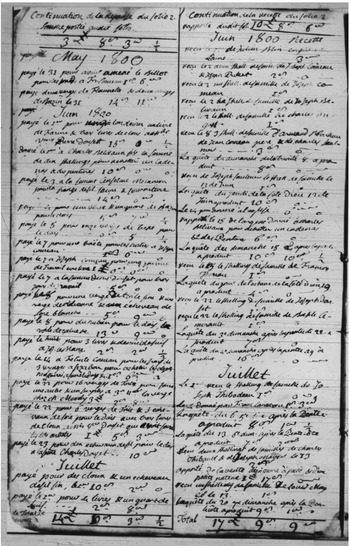
While the people’s observance of the sacraments – their performance of “official” religion, including communion and confession – did not satisfy the bishop, we can clearly see the meaning that laypeople – women especially – accorded their own devotional labor. Although many people may not have felt properly prepared to confess or take communion during Plessis’s pastoral visit, they understood the “honor” of having one’s “offering” of labor or goods in kind accepted for the purposes of holy worship. Throughout the year, some leading women were responsible for producing or procuring many of the materials of sacramental religion: wine, bread, wax, linen, lace, and silk. With this lens of devotional labor, we can analyze the work that went into supplying goods and fashioning embroidered textiles for the Church feast of Fête-Dieu at St. Mary’s Bay. Otherwise known as Corpus Christi, this feast of the Holy Sacrament provided Catholic laywomen an opportunity to participate directly in an auspicious event of the liturgical calendar. The register of the parish’s financial transactions recorded these women’s contributions in detail (see Fig. 3).
Register of accounts, Sainte-Marie parish fabrique, May–July 1800. Image courtesy of the Nova Scotia Archives.

Amid preparations for the inaugural celebration of Fête-Dieu at Church Point in June 1800, Marguerite Leblanc, who had inherited the running of her late husband’s store, supplied Sigogne with materials for the religious feast.Footnote 58 These goods were stocked from the recently deceased captain’s West Indian and American imports. Marguerite was referred to in the register of transactions as “Widow Pierre Doucet” or, by turns, “Madame Widow Doucet,” and she was the woman most referenced in the early years of the parish bookkeeping. On one occasion, the priest purchased from her “a gallon of wine, one pound of flour & three pounds of nails.” On another occasion, “a gallon of wine” and more nails – Sigogne used the nails to construct a baptismal font and to fix the cemetery fence, among other repairs.Footnote 59 In addition to the flour to bake the loaves that would become pains bénits and the gallons of wine for Mass, Marguerite also supplied the parish with plenty of imported cloth. Leading female parishioners were busied stitching and embroidering textiles that would become key visual liturgical elements, seen and experienced by all parishioners at the feast. Embroidery skills in particular gave some Acadian women the opportunity for their work to be on public display in pivotal ritual moments.Footnote 60 Several women crafted banners that would be carried in the Fête-Dieu procession, including an ornate canopy to shelter the Holy Sacrament as it was carried through the village.Footnote 61 Felicité Leblanc, wife of the churchwarden François Comeau, was paid “for the cost of 3 voyages [to the village of Weymouth] to buy items necessary to make the canopy.” Marguerite Leblanc’s daughter Monique (“wife of Anselm Melanson”) was paid “for making & supplying the fringed trim.” Her mother sold the priest more materials to complete the work: “6 yards of Cloth & 3 skeins of silk for the canopy.” Françoise Leblanc, wife of the sacristan Charles Doucet, was paid “for [several] spools of thread.” Together, these women, including a mother–daughter pair, supplied the materials required for public worship. Other goods purchased included: “16 yards of Cloth to make an alb & surplice [vestments to be worn in the procession]”; a “yard of fine linen & a yard of indienne & skein of white silk”; “two yards of Flannel & two yards of Bazin [a damask cloth]”; some “ribbon for the canopy, [and] the veil for the chalice.” Widow Doucet’s two sons also contributed directly to supplying liturgical materials. In August 1800, nineteen-year-old Anselm Doucet, who was “going to Boston,” likely with one of his uncles, was paid “the sum of £2 to purchase wine & wax to make candles.” The following year, Anselm was paid for “a yard and a quarter [of] Scarlet cloth for the Lining of the Tabernacle.” In March 1801, Marguerite’s other son, Olivier Doucet, was paid for building supplies and some windows he purchased in Saint John, New Brunswick. Meanwhile, Marguerite sold the priest another “8 and a half yards of ribbon for the altar facing.”Footnote 62 She was evidently comfortable and confident carrying on commercial affairs, as was common for widows of merchants. When alive, her husband had been routinely away for most of the year on trading voyages. Marguerite had thus, from necessity, assumed a leadership position in her family and parish during the captain’s many absences – absences that were themselves lucrative to the Acadian community’s economic development.Footnote 63
Sigogne also favored the artisanship of Praxède Belliveau, “wife of Denis Doucet.” He paid her “for three days of work” producing banners and vestments in 1800. In December 1802 and January 1803, the priest paid her again “for 6 days of work” making several “small Dalmatics” [a kind of vestment, often embroidered, in this case, likely for boys] and “for the laundering of some linens, an altar cloth, rochet” and “an alb” [the latter two items being white, laced vestments].Footnote 64 Leading local women were thus responsible for the designing, producing, embroidering, and washing or cleaning of the church vestments, banners, and altar cloths. While they used imported materials, the finished products were of the women’s own creation. According to embroidery historian Rozsika Parker, the quality of a woman’s textile work in the early modern era “showed the embroiderer to be a deserving, worthy wife and mother.”Footnote 65 Such careful, patient, and diligent labor carried the aura of virtue and indicated many women’s commonly held or shared domestic values and priorities. It is also clear that a network of wives and widows of the interconnected Doucet and Leblanc families occupied leading positions of moral and spiritual authority in the parish.
Many women of Sainte-Marie supported their spiritual community when they contributed to a parish fundraising project to purchase a new chalice for the church, which had otherwise inherited an old chalice from the French colonial regime.Footnote 66 It is likely that many of the contributors to the fund toiled specially to set aside the amounts of money they gave. Of 247 total donations made over the summer of 1801, seventy were made by women and girls. Of these women, twenty-five were identified as wives, three as widows, twenty-seven as girls, seven as young children, and one as the servant of the priest. Most donations made by girls and women ranged between one and two shillings. “Madame Widow Doucet” – that is, Marguerite Leblanc – gave the largest single donation: seven shillings, six pence. The second greatest contribution made by a woman was from Françoise Leblanc, who gave five shillings alongside her husband, who also contributed five shillings. Several other women gave independent donations, including the wives of Amand Lanoue, Hilarion Thériault, and Amable Doucet, all men of the parish fabrique. Most male heads of household donated between two and five shillings. In total, parishioners raised just over £36 to purchase the new chalice.Footnote 67 As with the recovered bell, Marguerite exerted a strong influence over the matter of the sacred objects of the Sainte-Marie church in a way that distinguished her from other women of the parish. Something Marguerite held in common, however, with several other Acadian women in her community was the practice of health care.
V. Healers and Midwives
While many laywomen in early North America did not play major roles in the official structures of the Catholic Church, some women exerted significant local authority as healers. In July 1799, six months after her husband perished in a shipwreck, Marguerite Leblanc (identified as “Margaret Doucet”) published in a Halifax newspaper an advertisement for her healing practice and “a cure for Cancers.” Perhaps in an effort to sustain her income, she stated that, “at Clare [the Acadian township], in the County of Annapolis,” Marguerite “undertakes to cure persons afflicted with this dreadful disease, in all its various stages, with the most trifling pain, and without injuring in the smallest degree, the flesh surrounding the parts affected. Within a few years past, she has performed a great number of cures, in cases considered almost desperate, as can be testified by many respectable persons.”Footnote 68
John Taylor, a Loyalist colonel and Anglican residing in nearby Weymouth, endorsed Marguerite’s healing practice, writing “that the above mentioned Margaret Doucet, has to my knowledge cured a great number of persons afflicted with that dreadful disorder the Cancer.”Footnote 69 Taylor was well acquainted with the Doucets – he co-signed several petitions alongside male heads of the Doucet family (including Marguerite’s husband and sons) requesting government support for public infrastructure in the region.Footnote 70 While the Halifax advertisement made no reference to any spiritual dimension in Marguerite’s healing work, spiritual meaning would undoubtedly have been a part of Marguerite’s own understanding of her healing skills as a devout Catholic laywoman, active in her parish. She was nevertheless careful to market her practice in secular, pseudo-medical language to appeal to the widest audience in a Protestant-majority colony.
The source of a Catholic laywoman’s healing power, much like the source of the Virgin Mary’s intercessory power, was in experiences of suffering and in the endurance of physical, emotional, and spiritual pain. Historian of American Catholicism, Robert Orsi, has observed that in early twentieth-century urban parishes, personal experiences of “suffering and pain made women beloved, graceful, [and] capable of healing and helping.”Footnote 71 From her study of women and healing in the late eighteenth and early nineteenth centuries, historian Kathleen Brown argues that the domestic work performed by wives and mothers came to include aspects of “the healing arts – alleviating the pain of sufferers and attempting to cure their ailments.”Footnote 72 This could include the (alleged) curing of tumors, as with Marguerite Leblanc, who, as a recent widow of a merchant, was well-positioned to inhabit the profession of healer with her access to imported trade goods such as medicines. Furthermore, having lost her husband and two children of her own, and having herself as a child experienced the uncertainties of deportation from the largest Acadian settlement, the widowed Marguerite was “a Grand-Pré exile,”Footnote 73 who had undergone her share of loss and suffering.Footnote 74
Historians cannot know the identities of the individuals whom Marguerite healed, but sufferers from cancer were known in the Acadian parishes. In March 1807, for instance, Anne Mius, a widow, died and was buried in the Sainte-Anne-du-Ruisseau cemetery. She passed away, “aged about 70 years after long suffering with a cancer of the lip that devoured the lower portion of her face.”Footnote 75 According to Orsi, Catholics viewed cancer with “moral repugnance” and generally perceived that “disease bore the added shame of moral stigma in Catholic culture.”Footnote 76 If Anne Mius had ever pursued healing, it would have been unsuccessful. She carried her affliction through much of her adult life as she raised many children, most of whom were married at the time of her death.
The parish registers also provide glimpses into the work of Acadian midwives, or sage-femmes. These women, who had already acquired local reputations for skills in childbirth, swore an oath before the priest Sigogne in late 1799, based on the script given in the manual of the diocese – that they would assist at births in a Christian manner and not practice abortion or infanticide. However, if the life of the infant was at risk, Catholic midwives were authorized to bless (with l’eau bénite) the infants they ushered into the world.Footnote 77 While a blessing from a midwife required a later solemnization by a priest, the laywoman’s baptism was considered sufficient to keep the child’s soul from entering purgatory in the frequent cases of infant death before a clerical blessing was possible. After administering the diocesan oath to one Acadian midwife, Sigogne wrote in the Sainte-Anne register that she had been “elected by the women of the said township.”Footnote 78
In a series of three baptisms in one Acadian family, we can see the important role grandmothers sometimes played in the fate of the souls of their grandchildren by giving baptismal blessings when no priests were available to attend births. Between 1795 and 1799, Madeleine Robichaud, wife to Jacques Deveau of Salmon River, baptized three of her newborn grandsons. She did this not only as the boys’ grandmother, but also in her role as the village midwife. All three Deveau children were later baptized in an official capacity by Sigogne, who recorded that each boy had been previously blessed by “the midwife, his grandmother.”Footnote 79 More examples reveal the identities of other midwives in the Sainte-Marie parish, if only obliquely, through the names of their husbands. One child was baptized “in the absence of priests by [Marie Daigle] the wife of Casimir LeBlanc, midwife,” another was baptized by Marie-Josèphe Comeau, “the widow of Joseph Bastarache, midwife.”Footnote 80 In other instances, the names of such laywomen were not given in the register. Rather, the children were noted only as baptized by an anonymous “sage-femme.” Of the 171 backlogged baptisms Sigogne performed during his first six months at St. Mary’s Bay, twenty-three of the children had previously been blessed by midwives and were aged between just weeks to approximately ten years. In the smaller Sainte-Anne parish, laywomen baptized a greater proportion of the community’s children: of the ninety-seven baptisms the priest conducted in Sainte-Anne in 1799, forty-two (or nearly half) were cases in which the child had already been blessed by a midwife. When births had been attended by a male elder of the parish, he performed the blessing. Indeed, there was an identifiable cadre of laymen who served in such roles in both Acadian parishes. Still, the authority of the rural midwives complemented, and possibly challenged, laymen, clerics, and physicians alike.
VI. Whither Pious Evangeline?
The parish registers also provide some glimpses of female literacy and instruction. Aged approximately forty-five, Marguerite Leblanc assumed legal authorities as the “administratrix” of her late husband’s estate in September 1798.Footnote 81 In the absence of public schools, she upheld his value for education by keeping the French tutor, Pierre-Louis Bunel, privately employed, instructing the junior children of her family.Footnote 82 In May 1800, when Marguerite’s seventeen-year-old daughter Rosalie was married, Sigogne described Rosalie in the marriage act as “under the tutelage of her mother.” This referred to the state of legal guardianship, as well as the moral guidance, spiritual instruction, and domestic training Marguerite provided her daughters. The tutor Bunel was one of four witnesses at Rosalie’s nuptials, indicating he had developed a trusted relationship with her as her educator.Footnote 83 As the Doucet sons, Anselm and Olivier, were also literate, it is evident that Marguerite ensured that her children were well-educated in the context of their larger community. Her other daughter, Monique, had, after all, been one of the eleven married women who constituted the initial cohort of communicants at St. Mary’s Bay. This indicates Monique had already possessed a degree of spiritual literacy. Besides the adult convert Mary Doane, who abjured in early 1800, the only other female signatures contained in the register were those of an adopted girl from Boston and Marguerite’s daughters Rosalie and Monique, who each signed their respective marriage acts that same year.Footnote 84
While resources for female literacy were sparse at the time of Sigogne’s arrival in Nova Scotia, some Acadian mothers had provided their daughters with a rudimentary education and preliminary spiritual instruction to become virtuous young women. To this end, by the final years of his career in the early 1840s, Sigogne had established an informal, secular sisterhood at Church Point called the Maison de Sainte-Marthe. According to a late-nineteenth-century biographer, Sigogne had established these women “in a house built on his property and where they lived a long community life.”Footnote 85 In 1834, the priest had donated a portion of the ecclesiastical lands to two Acadian sisters, Scholastique and Marguerite Bourque, “in consideration of the long Services, kind and constant attention … and of some wages due unto them by me.” The Bourque sisters remained unmarried and were to hold this land “during their Natural lives” and to use the land to support postulants “retiring from the world to keep a life of Celibacy of the same sex as the grantees.”Footnote 86 The Bourque sisters farmed their plot of land, kept livestock, and performed charitable deeds in the community, evidently drawing inspiration from the biblical story of Martha and her ministry of practical service. Such an informal sisterhood was possible considering the remote rurality of Clare, far from any large, formally organized Catholic institutions. The Maison de Sainte-Marthe followed a secular rule likely similar to that established in seventeenth-century France for the Daughters of Charity.Footnote 87 Such a rule would have permitted the Acadian women to live together, yet remain un-cloistered and keep a public ministry. In 1840, seven women and girls resided in the small convent, including an elderly Acadian widow of a former churchwarden, and the eleven-year-old daughter of Sigogne’s nephew, who had settled in Nova Scotia, coming from France.Footnote 88 Little other documentation of this Acadian sisterhood has survived.
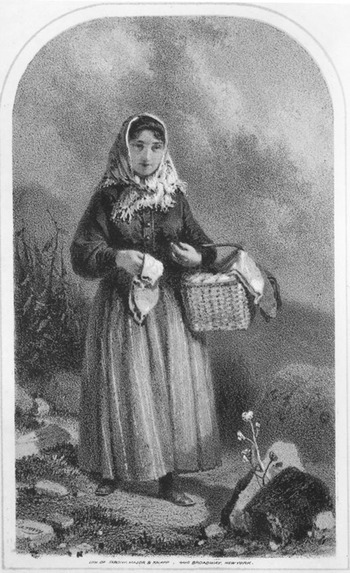
Also in the 1840s, when the Massachusetts poet Henry Wadsworth Longfellow was writing his epic verse, Evangeline, A Tale of Acadie, he devised a pious female title character – an exiled Acadian, Evangeline Bellefontaine – who, after years searching for the lost love of her youth, became a Sister of Mercy in the city of Philadelphia, spending the rest of her days tending the sick.Footnote 89 While Longfellow’s fictional Catholic heroine became immensely popular in the nineteenth century, she had little basis in fact. Still, travel writer Frederic Cozzens’s account of Chezzetcook, a coastal Acadian village near Halifax, gives an early reference to the “Evangeline phenomenon” – a cultural product of the commercial success of Longfellow’s poem. Cozzens anchored his story in personal experience, having traveled through Chezzetcook in the late 1850s. He became intrigued by the Acadians and sought to document their culture through photography. In 1859 Cozzens published “the first, the only likenesses of the real Evangelines of Acadia” (see Fig. 4). In his description of the Acadian women who frequented the Halifax market, he focused on their timorousness, piety, and virtue: “The women of Chezzetcook appear at daybreak in the city of Halifax, and as soon as the sun is up, vanish like the dew. They have usually a basket of fresh eggs, a brace or two of worsted socks, a bottle of fir-balsam to sell. These comprise their simple commerce. When the market-bell rings you find them not.”Footnote 90
Acadian woman of Chezzetcook, from Cozzens’s Acadia; or a Month with the Bluenoses (1859). Image courtesy of the Nova Scotia Archives.

Only “by constant attention” was Cozzens able to become “acquainted with a pair of Acadian women, niece and aunt.” He then “proposed the matter to them: ‘I want you to go with me to the daguerreotype gallery …. To have your portraits taken.’” At first, the demure Acadian women declined the invitation to have their likenesses made and sent to New York “[t]o be put in a book.” Persistent, Cozzens then “wrote to the priest of the settlement of Chezzetcook, to explain the ‘what for’” of the request.Footnote 91 With the priest’s subsequent endorsement, the Acadian women changed their minds and visited the studio on their next journey to Halifax.
In 1867, the year of Canadian Confederation, the first convent school at St. Mary’s Bay – St. Mary’s Academy – was established for Acadian girls.Footnote 92 Female education could then progress in a systematic fashion among the region’s Roman Catholics. Before this, however, Cozzens’s account from the late 1850s indicates that rural Acadian women, such as the aunt and niece from Chezzetcook, still cautiously adhered to their foremothers’ apprehensions about vanity and what was perceived to be the morally questionable influences of luxury. Such apprehension motivated some Acadian women to recall the folly of girls who came to church in what was seen as superfluous fashions. And spiritual apprehension motivated other Acadian women to contribute devoutly to the parish – giving of their labor and resources to shore up their community’s faith in the wake of an eighteenth-century period of upheaval and eventual resettlement. Amid the many labors of resettlement, the moral dissipation of young people was a grave concern of parents and of the region’s sparse clergy alike. The women presented here participated in Catholic sacramental activity across domestic and public domains, not necessarily because of deep personal faith – although it is entirely possible. Rather, such activity enabled them to oversee their family structures while also inhabiting gendered roles long embedded within the Church.Footnote 93 In performing lay baptisms, preparing for feasts, and educating their daughters in the absence of clerical instructors, the Acadian women saw that their families and communities would survive. The task of building a functioning parish for the new Acadian generation was indeed a task readily engaged by valiant women who were also mothers and godmothers, daughters, widows, midwives, and healers.
Acknowledgments
The author would like to thank the anonymous reviewers for their constructive critiques of an earlier version of this article. The author would also like to thank Carly Daniel-Hughes for providing her insights about the history of Christian women and dress.

 Open access

