


Introduction
Dogon society in Mali is characterized by independent villages without overarching political structures or centralized institutions. Also, the landscape of their heartland is divided into three distinct ecological zones – sandy plains and a rocky plateau separated by a cliff area – and the people speak a wide range of different though closely related tongues.Footnote 1 What binds these villages and zones together further are a similar ecological adaptation, a shared history, and a range of cultural commonalities. Important among the latter are common traditions of origin – such as the migration from the legendary point of origin Mande and the subsequent founding of the villages at the cliffside – the system of village-based surnames, and the ritual ascendancy of some villages, all leading to a clear sense of common identity.
One specific cultural element that links the villages is the tradition which we present here, the prophet-cum-poet called Abirè Goro, a historical figure whose fame easily transcends the distances and differences between Dogon villages in the wider region. As a poet he stands at the cradle of the major mourning songs in the Dogon funeral, while his various prophecies are widely cited. Yet in his time he was only an itinerant singer, and a blind one at that (see Figure 1). In this article we zoom in on this Abirè Goro, the era in which he lived, the various strains of legacy he left behind, and his importance in Dogon society today. Our interest is not just in Dogon history, since in present-day Mali the Abirè traditions, and especially his prophecies, are increasingly quoted in the ongoing conflict in Central Mali and used as a charter in the recent Dogon migrations towards southern Mali. The current use of this legacy raises the question whether, in his time, when the Dogon were dominated by the Fulbe, his texts formed a “weapon of the weak,” a hidden transcript against a fiendish state.Footnote 2 Was this the reason that he achieved such a great renown in the region as a singer and prophet?
Abirè and his time
Important figures tend to evoke legendary tales about their birth, childhood, and death, and Abiré fits this profile. Elsewhere, we have elaborated on these stories.Footnote 4 Though he is surrounded by such legends, we have no reason to doubt the historicity of Abirè, viewing the many historical details that together paint a convincing picture. The tales tell us that he was born in Domuno Soy on the Seeno plains, to a mother who was initially barren. She conceived in the bush from an unknown sire, and her baby sang already in its mother’s womb. He was blind from birth but knew everything around him. When an adult, he was helped by a Fulbe chief to start a career of singing, gathered a troupe around him, and spent his life singing and prophesying in the Seeno plains and the villages of the Bandiagara cliff. These origin tales thus indicate: the presence of Jamsay speaking Dogon in the Seeno plains, a thriving singing tradition, dependency on a Fulbe chief, and close relations between plains and cliffside. In addition, each village has its own tales of its encounter with Abirè, and at the end of his life in the cliffside village of Guimini. We combine these three sources – oral traditions, songs, and prophecies – for our interpretation of his legacy, but the first task is to put tentative dates to his life.Footnote 5
Some estimates of our informants are vague (“Abirè lived when the cliff was still humid and when the Tellem were present”), others are very precise (1329 to 1429 ce)Footnote 6. These dates are extremely ancient, and there is indeed a tendency to assign very early ones, like the Islamic date of AH 934 (meaning 1514 ce), or “exactly 240 years in the past” (1760 ce).Footnote 7 In our view, this tendency can be read as a testimony to Abirè’s fame more than as an attempt at establishing a feasible historical period. Age is an expression of authority among the Dogon, so assigning an ancient date to a renowned person comes easily.
Anyway, most of our informants place the prophet in the early nineteenth century, as does Éric Jolly.Footnote 8 Abirè certainly lived under the lordship of the Fulbe, and considering the evidence from all three sources mentioned above, we situate the prophet’s performative life between 1820 and 1867, at the time of the Macina under Seku Amadu, before the start of the Tucolor reign,Footnote 9 and before the arrival of the Europeans. In two songs given below, we will find such clues. Although he never sang about these red anasara, as they are called in Dogon, some prophecies do hint at them.
In the nineteenth century the Dogon country was wedged in between Macina in the Inner Niger Delta and Yatenga,Footnote 10 a Mossi kingdom to the east, just across the border of present-day Burkina Faso.Footnote 11 Viewing their proximity, the two realms inevitably clashed. Macina waged three major campaigns against Yatenga, reacting on varying types of incidents, but always officially in support of the Jelgobe Fulbe who were uneasy vassals of the Mossi kingdom; one was in 1834–37, the second between 1853 and 1861, while a third clash took place between 1864 and 1867; the latter followed the takeover of the Macina capital by the Tucolor of El Hadj Umar.Footnote 12 These events resound throughout the texts,Footnote 13 the first campaign in particular. This particular war matches the places mentioned in the songs, while the lyrics reflect the shock of the violent exposure of the Dogon to the Yatenga kingdom and its allies, as it involved a new kind of warfare with firearms. Some songs resound with horror at this new phenomenon.
The Tireli singers of the baja ni maintain that at some point Fulbe and Mossi joined forces in slave raiding, and that this happened before Abirè’s death. The last clash led to the intense slave raiding which the Dogon remember, and it occurred from 1864 to 1867. Some years after the end of the second war, probably in 1861, the Jelgobe Fulbe on the western rim of Yatenga launched intensive slave raiding expeditions towards the Dogon of the Seeno plains, who are called Kibse by the Mossi. Concerned about the security of his western borders, the Mossi king launched a campaign against these Jelgobe, who responded by calling upon Macina for help, as fellow Fulbe. For Macina, headed by the grandson of its founder Seku Amadu, this was a welcome reason to reassert its ascendancy over the Mossi kingdom. If the Macina Fulbe could integrate the Jelgobe and dominate Yatenga, they would be able to divide all Fulbe-related territory between them and Sokoto, the huge sultanate much further towards the east in what is now Nigeria.Footnote 14 In the earlier Mossi-Fulbe war these two jihadist empires seemed to have already reached some agreement on territorial division. So Macina sent a sizable army to the area and decisively crushed the Yatenga forces. However, their fellow Jelgobe Fulbe did prove as unreliable allies to them as they had been to the Mossi: they had engaged Macina only to gain independence from the Mossi, and after being helped out resumed their resistance against Macina.Footnote 15
From the Dogon viewpoint these politics were distant, the business of the great – exactly the point Abirè makes in his songs. What they did experience was an intensification of slave raiding, since after defeating the Jelgobe the Mossi army raided the Dogon lands. Slave raiding was the coin of the realm for these savanna polities, irrespective of their internal differences.Footnote 16 So, the impression of their enemies joining forces in slave raiding is quite plausible, and it suggests that Abirè died before 1867.
References to the Fulbe are everywhere, both in Abirè’s birth tales and in his songs and his prophecies, mentioning many names of Fulbe chiefs. The problem is that these names are not known from other sources, so do not pinpoint any specific period. The same goes for a handful of Mossi chiefs that are mentioned, in all probability from Yatenga; these too are never mentioned in Mossi ethnography and history either.Footnote 17 The reason is probably that the chiefs mentioned were local players in the regional power arena, who did not make it into the written histories; however, they have the posthumous honor of being remembered in this major singing tradition of the Dogon, and thus for their remembrance they do depend on their former enemy.
There is one important exception. In one crucial song the name of a particular Fulbe hero is mentioned, who is very well known, Gelaju Hambodêdio. And the context in which he is mentioned is significant: this song forms the last of the series that is specifically attributed to Abirè, and ends the entire night of singing. Also, Gelaju’s name is mentioned in the chorus, the most standardized and well-remembered part of any mourning chant. So this forms a major indication that places Abirè in the time of a well-known warrior.
Gelaju and his father, Hambodêdio or “Hama the Red,” are the subject of an extended epic tradition among the Fulbe;Footnote 18 the latter was the chief of Kounari, just south of the Bandiagara plateau, so within what is now the Dogon region.Footnote 19 The notion of “red” in Hambodédio refers to the Fulbe herding cattle, in contrast with the “black Fulbe,” the term for the literate urban and settled population that was central in forming the Islamic Macina state.Footnote 20 The particular histories of father and son begin in the time before the establishment of Islamic rule by Seku Amadu (1776–1844), so at the end of the eighteenth and in the first decades of the nineteenth century. While his father preceded the Macina empire, according to Bâ and Daget and to Christiane Seydou,Footnote 21 Gelaju repeatedly rebelled against the Macina realm, but in vain, and eventually chose to leave the Macina sphere of influence. From 1830 ce onwards, Gelaju and his people moved eastwards, traveling through the Bankass region, bypassing the Dogon plateau in a migration to what is now Burkina Faso. In the following decades, according to Fulbe oral history, Gelaju obtained permission from the Sokoto sultan to settle still further to the east in Niger, where he founded Kunaari Keyre, New Kounari, or Wouro-Gueladio, some 50 km south of Niamey.Footnote 22
The Dogon were in contact with Gelaju because he commanded Kounari, not too far from the Bandiagara Cliff. Bâ and Daget cite as one reason for his rebellion the fact that the Macina ruler ceded the territory on the Dogon plateau, which he had conquered, to another chief.Footnote 23 Though our informants are not privy to the details of this history, Gelaju’s rebellion fits in with their sense of independence: he was the enemy of their enemy, which easily justifies the inclusion of this Fulbe chief in this song cycle. The fact that he ultimately lost the battles against Macina hardly detracts from his heroic status. In fact, even Fulbe praise singers are inspired by his courage and continue to sing about his conviction and his heroic escape from Macina. For the pious among these bards, Gelaju’s end is uplifting enough: when he was settled in Niger, Seku Amadu sent him a message that his mother had died, a woman known for her piety. Learning about her demise, and receiving back the horn filled with gold that he had left her for her upkeep – she had been well taken care of by Seku Amadu – Gelaju offered his apologies, bequeathed her inheritance to the poor, and reconciled with the Macina realm.Footnote 24
A much more oblique reference relates to the fall of Macina at the hands of El Hadj Umar in 1862. In the song “the mighty have fallen” given below, a certain Alfa Seku is mentioned, which might refer to Seku Amadu III, the last ruler of Macina, while according to the singers, the term Pulo in this particular song refers to the Tucolor, even if Umar’s name is not mentioned. Considering the constant juxtaposition in the songs of Fulbe and Mossi local chiefs, the name of Gelaju, and the hint to Seku and the Tucolor – and taking into account the dynamics of inclusion of later events in oral traditions – it is with some confidence that we consider the realm of Seku Amadu and his successors, which lasted from 1812 to 1862,Footnote 25 as the most probable historical context for Abirè Goro’s appearance, life, and death.
The singer and his songs
The core of Abirè’s renown stems from the baja ni, a large corpus of songs that constitutes an integral part of the first funeral of the Dogon.Footnote 26 In principle, such a funeral is an annual ceremony that commemorates all the deceased of the past year, while it might also be held immediately after the death of a clan elder. The second night of this five-day spectacular is set apart for the baja ni. The singing begins around 11:00 p.m. and lasts for seven hours, until sunrise. Any man can choose to participate, provided he has a “good ear,” meaning a strong memory, but the actual experts of this song form a select group, the baja unrun, children of the baja, or progeny of the prophet.Footnote 27 Usually, singers from neighboring villages join in, especially at the death of a singer, for they form a strong in-group in the cliffside Dogon villages.
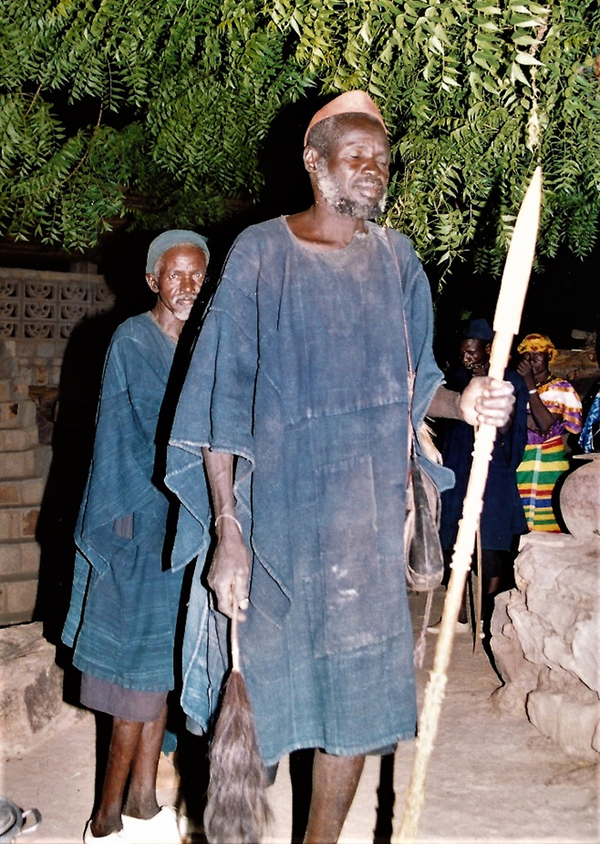
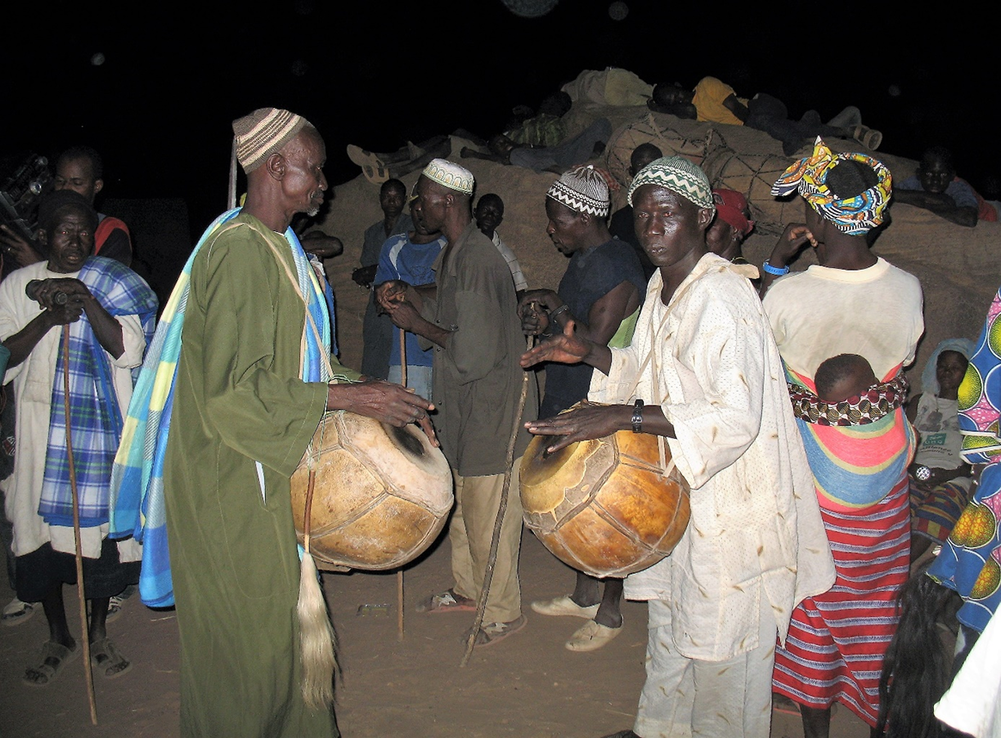
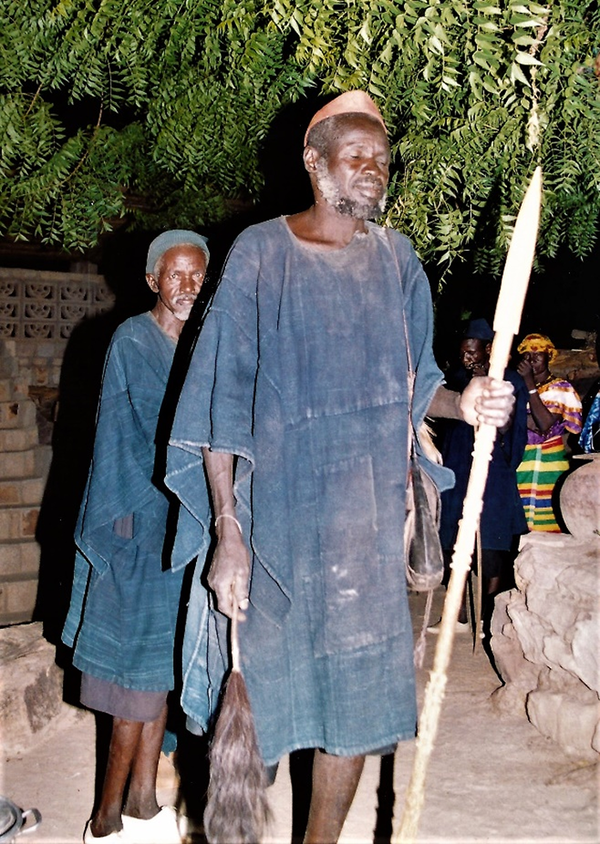
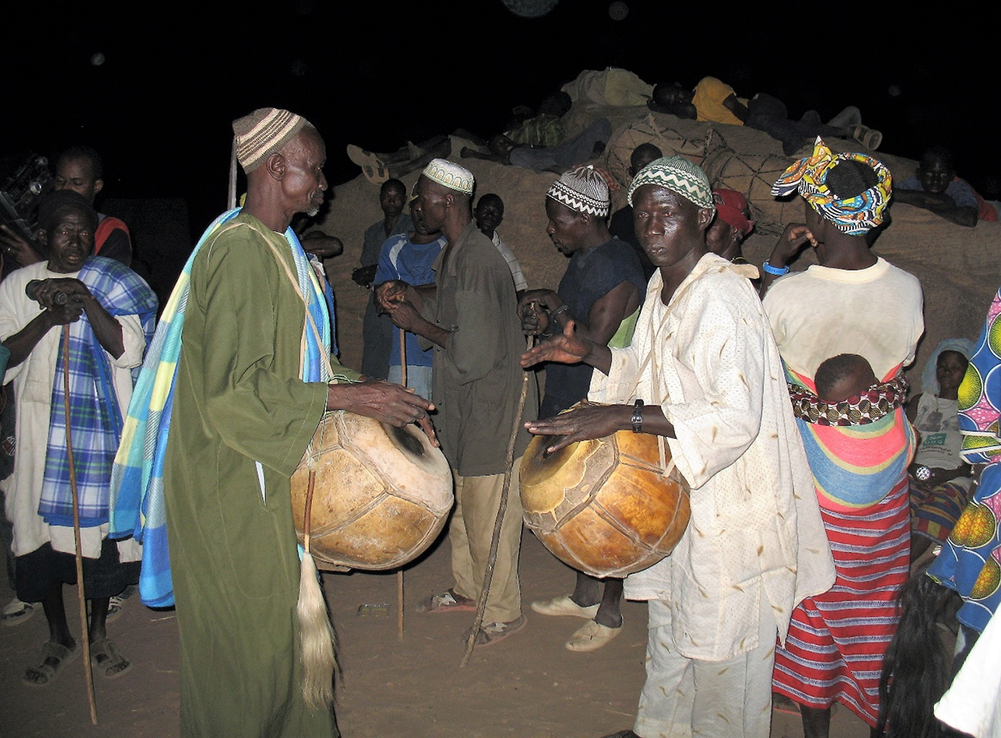
All baja ni performances must take place at night, without hardly any audience, and are accompanied by spherical calabash drums, called barubo (see Figure 3), which are used only for this performance.Footnote 28 Clothed in their long dark blue gowns, with a spear in their hand, the singers line up at the public square and follow the drummers around the mound of stones at the center, turning anti-clockwise in a slow, gentle shuffle that they will keep up all night. The performers often carry a special blanket on their head, a blue-white striped woollen one called the wɔrɔdɛwɛ, the very blanket in which they will be wrapped for their burial; the lyrics frequently refer to them. Singing the baja ni is not only part of a funeral ritual complex, it is considered the epitome of mourning, so dancing with one’s own death blanket as part of the group of singers implies a deep participation in this musical farewell. One of the participants leads the song, and responding to specific cues, the others join in as a chorus singing fixed lines. The lead singer may vary, improvise, or make detours, as they are called, and he is also the one who selects the specific song. In principle, each song is repeated four times, and then the next lead singer will choose a new one. After several rounds a new lead singer will take over, announcing his intention by pitching his voice during the last chorus.Footnote 29
These baja ni lyrics are always sung to the same melody, which is based on three descending notes upon which the lead singer can vary and improvise (Figure 2).
A baja ni singer imitates Abirè. Tireli, 2005.Footnote 3
Basic melody line of baja ni. Footnote 30

Two barubo players start a baja ni session on the public place of Tireli. Tireli, 2005.
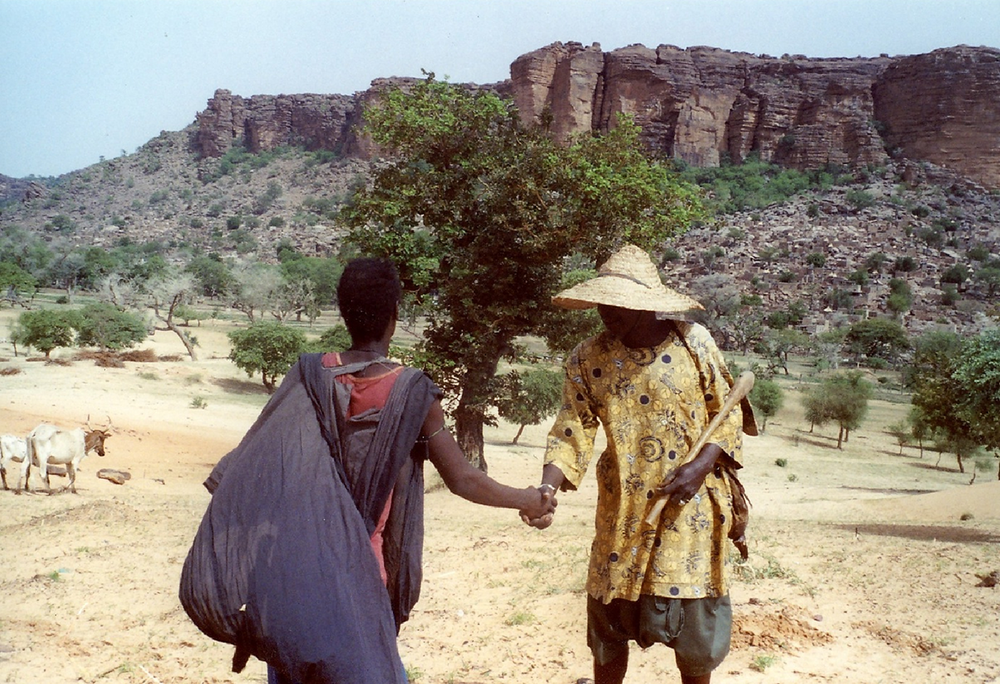
Local relations have been good between the Dogon and the Fulbe: Dogolu Saye (right) and the Pulo who herds his cattle (left). Tireli, 2008.

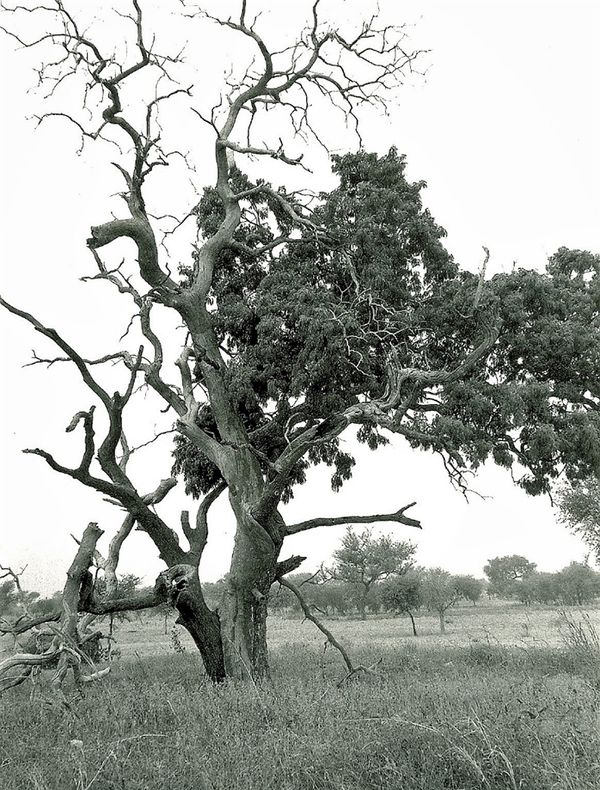
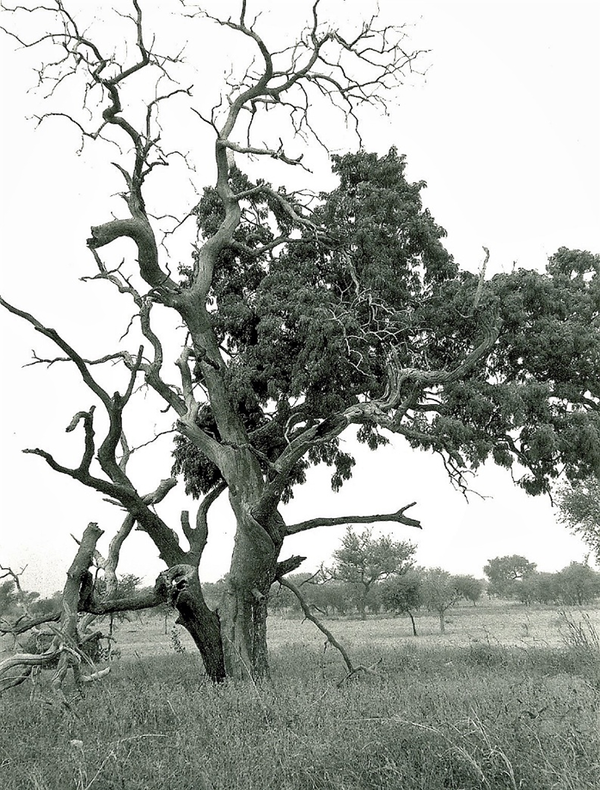
Abirè’s tree. Youdiou, 2000.
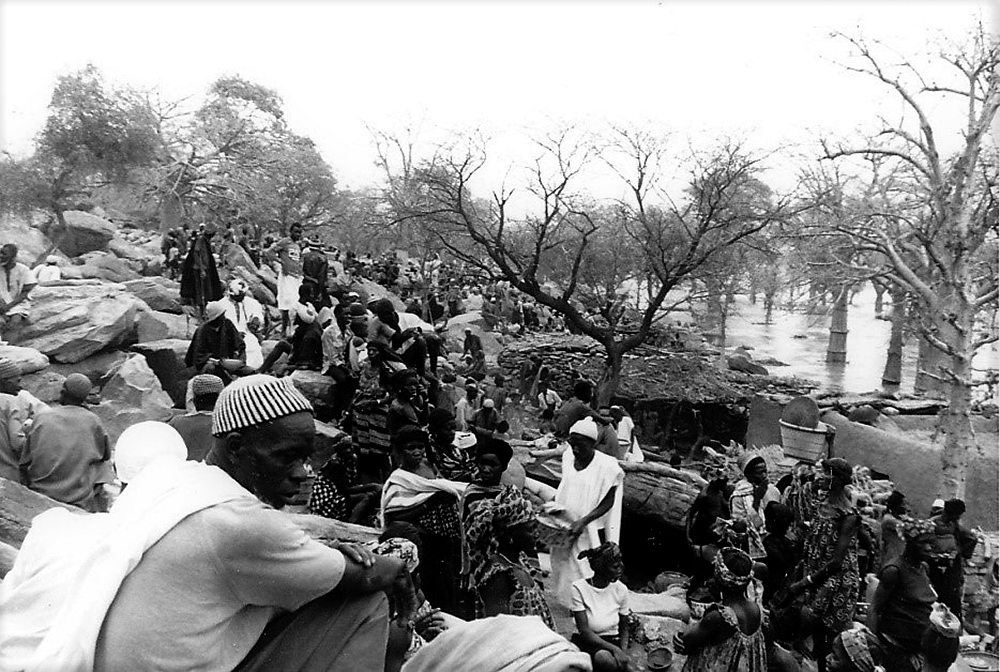
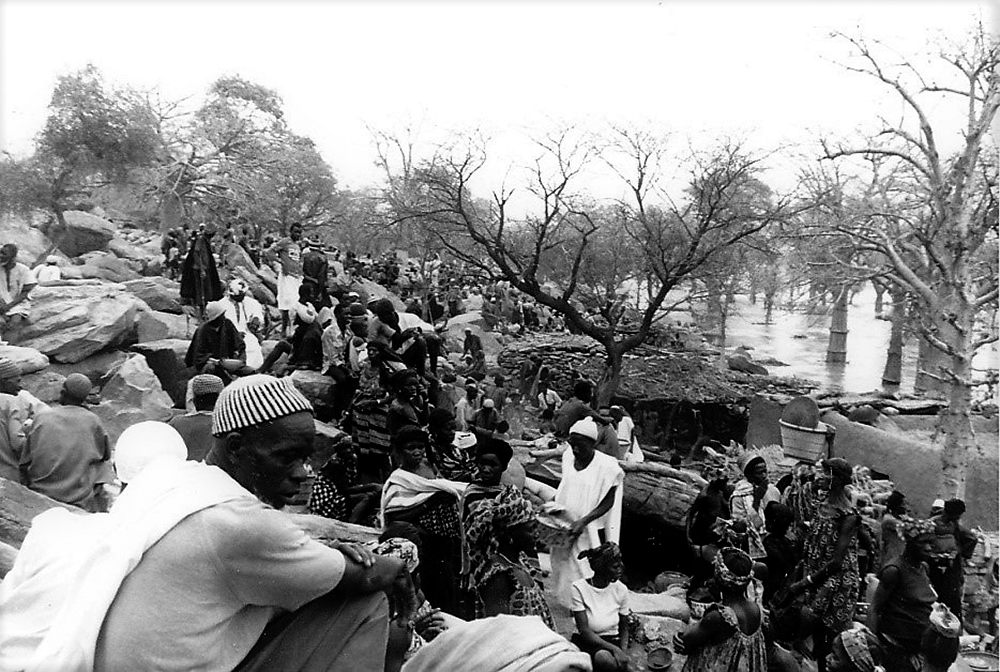
“Plains full of water.” This photo shows a temporary inundation in the village of Tireli. After a heavy local rain, the rivulet that borders the market flowed over, and people fled to high ground. Tireli, 1993.
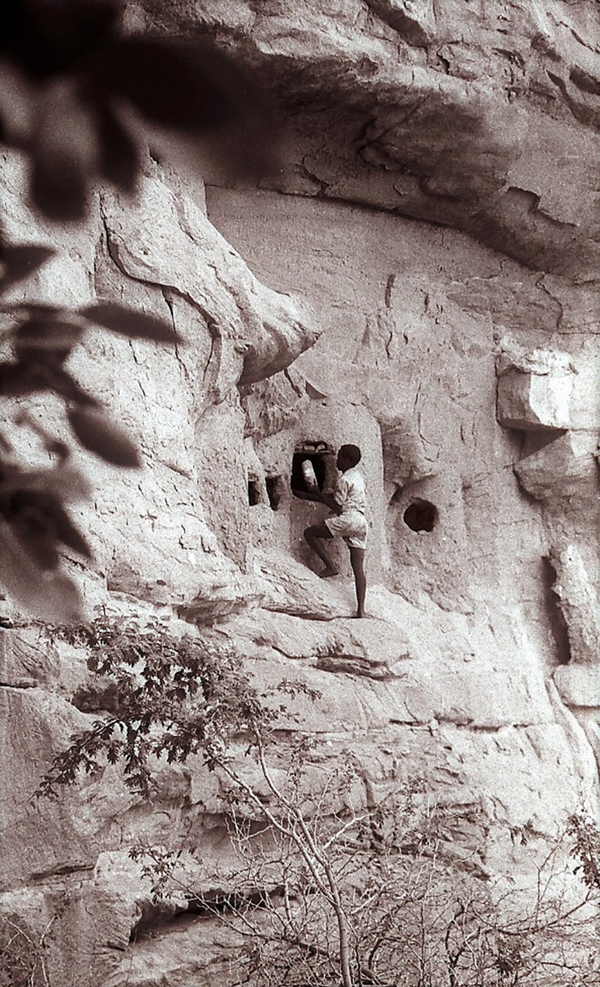
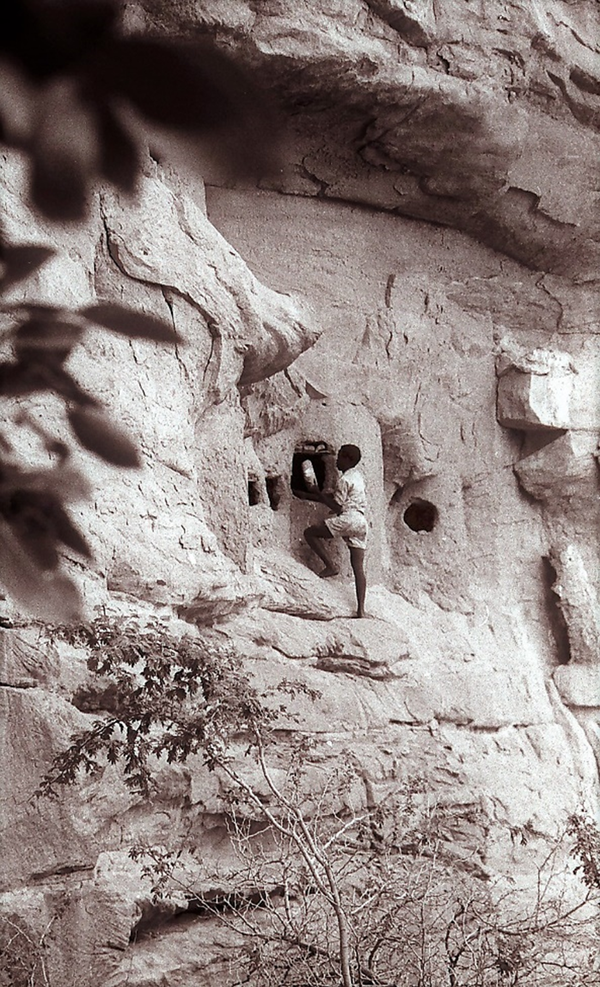
The abode of the dead in a cliff-side village. Amani, 1989.
The baja ni do not form one song but instead consist of a corpus of related texts in Jamsay, the Dogon language of the plains; however, the singers are Toro so speakers – the cliffside Dogon language – so they perform in a different, though related, tongue. All songs are sung right after each other without any break in the musical accompaniment, and one funeral performance comprises some sixty pieces, chosen from the much larger baja ni corpus. The latter is divided into two basic genres, the sɛmbɛlɛ ni and the baja na. The first are mainly general songs of mourning and farewell, while the second, the baja na or grand baja, are Abirè’s texts, and these are the pieces that deal with the Fulbe of his time. Six themes can be defined within the lyrics, both in the sεmbεlε ni and the baja na:
-
• Greeting and welcoming songs
-
• Praise songs for the deceased
-
• Incidents in Abirè’s life
-
• Elegies for the prophet’s close kin
-
• Death, destiny, and the philosophy of life
-
• War and Fulbe
Strewn throughout these themes are counsels to heed Dogon customs, and remarks on incidents during the performance, such as the late arrival of a singer, or someone dozing off during the night. Crucial to singing the baja ni is that no singer may fall asleep, as staying awake throughout the whole night is deemed essential for a proper performance.
What is the character of these texts? The lyrics of the baja ni do not tell stories, nor do they recount specific histories. They definitely do not constitute an epic such as the one on Sunjata, or the mini-historical baji kan songs.Footnote 31 Apart from greeting the singers and bewailing the deceased – elements to be expected in any mourning – most of the song texts relate to events in the life of the poet, to wars, to political happenings, or to his observations of daily life. But the point is that these events are supposed to be common knowledge and are never explicitly mentioned in the lyrics. The texts thus reflect on unknown events from the nineteenth century, some of which figure in oral traditions, while for other songs the performers themselves have no clue. As a result, many of the texts are cryptic, their opacity increased by the use of parables, epithets, and hidden figures of speech.
What shines through in the texts, however, is the poet’s relation with death, for the lyrics are clearly about death and mourning, and about the way life has to be lived in the short span allotted to man, and one can glean from them a philosophy of life.Footnote 32 Here we focus on history: we provide some text fragments relating to the first five themes, and then zoom in on the more historical last theme. All the lyrics given below stem from one baja ni performance, 8–9 June 2005, in the village of Tireli.
Greeting always comes first, a major item in all Dogon social interactions – all greeting songs are part of the sɛmbɛlɛ ni and form the start of the night’s session; the indented phrases are the lines sung by the chorus.
Mourning songs tend to extoll the virtues of the deceased and the baja ni are no exception; here the lament for a rich and generous man, Atimè.
After a series of these greetings and eulogies, the singers move to theme three, the prophet’s life, and a crucial song recounts his journey to collect his singing company; we give a fragment that also shows some of the enigmas built into these texts:
For the remainder of the night, the themes intermingle. Among the most poetic are the laments for his own family, theme four, like this one for his sister.
The baja na corpus forms a treasure trove for musings about humanity, destiny, and the nature of death, the fifth theme. These notions are expressed in many symbols and parabolas: death as the great surprise or a new wife; as the fulfilment of a prenatal contract; as an elephant fallen into a well; and any human being as destined to become an orphan.Footnote 38 A core song is on the notion of destiny:Footnote 39
Abirè, Fulbe, and war
We delve deeper into theme six, war and Fulbe (see Figure 4). Wars and their ravages are only mentioned in the baja na, the songs attributed directly to Abirè. The poet is crystal clear: in a war all parties suffer, and certainly the “little ones” who will suffer at the hands of the “great ones.” War is for the people of power; others only get misery, so his songs reflect his abhorrence of armed conflict. One symbol is cold: the temperature of death.
In other songs, war is associated with dirt and chaos, but it does also teach several lessons, usually voiced in cryptic terms, for example: “The war of the Fulbe washes the face.”Footnote 43 Three explanations were given by the singers. First, war is a harsh period, but then a new time dawns that promises a new beginning: the face has been washed. Second, some people seem to be nice, but in fact lack value: war brings out the best and the worst in people. Finally, when war breaks out with the Fulbe, women still have to dress themselves, wash their bodies, and take care of themselves. This counsel also is applied to the Hogon, the village priest, who has to pray for his village even when on the move: Whatever happens, behave and do your duty!
As a group, the Fulbe constitute the quintessential other for the Dogon, the well-known strangers who live close at hand in the bush but cannot be trusted. This notion is part and parcel of general Dogon culture, and surfaces in Abirè’s lyrics as well.
One standard funerary orationFootnote 46 in Dogon – not from Abirè – praises the deceased as a fierce fighter who has killed his Pulo in the bush, even going into gory details of using the victim’s entrails as a belt, and the head as a sitting stool for his grandmother. The baja ni also features a song with this message, if only in the sɛmbɛlɛ ni, but it stands out in its description of the Fulbe as prey and thus can be seen as a hidden transcript, a way to get even with a dominant power. Abirè’s approach is different but equally effective: quite a few songs note the fact that the Fulbe will fall.
Yet, these predictions of the fall of the Fulbe are voiced as a lament without any notion of vengeance, because the poet considers all power as transient. Abirè goes a step further with texts that clearly transcend collective enmity. One of these tells about a generous Pulo who endowed an orphan with a horse, implying that a society where orphans are feted is a society worth living in, irrespective of who is the benefactor.Footnote 51 In his song lyrics the prophet never loses the shared humanity from sight, and since he was on good terms with individual Pulo,Footnote 52 quite a few chants lament their passing.
Prophecies and the Fulbe
Abirè’s prophecies are known in a wider circle of villages than the baja ni funeral songs. His singing tours mainly took place in the central part of the Seeno plains, near the Bandiagara cliff, while many of his predictions can be traced to the outskirts of Dogon territory. The corpus of Abirè’s prophecies addresses several levels of Dogon society – local political leaders, villages, and the Dogon as an ethnic group – and has three major themes: ecological issues, internal social dynamics, and external influences, in particular the Fulbe.
The ecological predictions are usually quite locally focused, and center on trees, water, and rocks. Shortly after leaving Domuno Soy, Abirè came up with a prophecy about his native village: a market would be organized there on the very day that a specific spot would be in the shade of date trees. And not just a market; at that very time the Fulbe would lose their dominance. As a result of this prophecy, people in Domuno stated that everyone who cut down a date tree, would die the same day by an invisible hand. Since Abirè’s departure, this has happened four times, all of the victims being Fulbe, according to local – Dogon! – informants.
The best-known prophecy mentions a tree in Youdiou (see Figure 5). When Abirè entered this village with his troupe, he was welcomed to solve a problem; an ironwood tree (Prosopis africana) at the village’s waterhole was dying. The prophet told the villagers that the tree would live, but only half of it: half of the tree would die, and the other half would grow back and flourish. He also predicted that the village would grow together with that ironwood, so the people from Youdiou never cut down this iconic tree.Footnote 53 Youdiou has not only grown in size, but also plays a central role among the neighboring villages: it is a political center, housing the headquarters of the Youdiou Commune, and its market is one of the most important on the Seeno plains. The people of Youdiou still proudly tell about this prophecy to visitors as a tribute to Abirè, and like to show the tree.
Wells also figure prominently in Abirè’s prophecies. Villages will receive a well, a well will cave in, water will appear in a dry well, or a well will run dry – the common worries about water in an arid ecological environment resonate in the tales.Footnote 54 Sometimes the fate of the well is linked to the fate of the chief.Footnote 55 The link between tree, well, and market is found as a symbolic triangle in many versions and variations of the prophecies.
Water as such is another promise. In Diangkabou, the elders reported that Abirè had prophesied that all who originated in the west would ultimately go back there in search of water and of moist soils. A more generous promise was heard in Ireli, with a vision of abundant water: the entire plain would be covered in water, as far as the eye could see; a splendid sight (see Figure 6). In Guimini, a village that was very hospitable for the singer, a great river would arrive, too large to cross on foot; one would need a canoe to cross it. The people are still waiting eagerly …
Other predictions focus on the most spectacular aspect of the Dogon habitat: the cliff (see Figure 7). Many prophecies involve falling rocks, a splitting rock face or a floundering cliff, and these stories of changes in rock formation serve as indications for the general well-being of that particular village. In Teli, people point at a rock side that is slowly splitting, so that the inhabitants can no longer jump over it. Once it splits completely, the whole village will disappear, Abirè told them. At present, the village is partly deserted, so the prediction seems to be coming true piecemeal. Falling rock may assume apocalyptic proportions. During the funeral of a chief of one particular village, a huge rock would fall upon the dancing crowd, killing most of the people. Seven persons absent at that funeral would later return to the village to repopulate it.
Social dynamics trigger predictions as well. Dogon villages have a diffuse power balance that leaves room for strong men to establish a personal rule, and the prophecies tend to address the dangers of establishing such a centralized chieftainship. One tradition in Tireli states that in Gourou, a village near Niangali, a boy born in the bush will grow into a great chief, which in Abirè’s terms means a dangerous ruler. People hasten to add that this prediction has not yet been realized. In the village of Yendouma, informants relate similar predictions about chiefs from Mopti, Koporo, and Koro, the major cities of the area, chiefs who are often mentioned by their personal name. In Koro, for example, two rulers will be installed at the same time, with the same name: Amiru – which is in fact the Fulbe term for chief. People are still waiting. Many of Abirè’s predictions address rifts within villages, as well as their “fall” and disappearance: villages will crumble, split into two, while others will be rebuilt after a social disaster. The prophet also predicted that young people would leave their home village in favor of the cities,Footnote 56 and that the young would not listen any longer to their elders – an issue in any gerontocratic system.
However, the main thrust of the prophecies is directed towards the Fulbe and the main prophecy, one that reverberates through many predictions, was and still is: “The Fulbe will fall,” often predicting a simultaneous rise of the Dogon. This is the only prophecy well represented in the songs, since other prophecies hardly appear in the chants at all. Such predictions are often framed locally. In the large market town of Koporo Kenie, the Fulbe would never gain dominance as long as the Dogon chief was a twin. In Douentza, on the other hand, the Fulbe would simply be chased from the town, while in Madougou the appearance of a forest would signal the end of Fulbe rule.
The balance of power has indeed shifted, since the Fulbe have lost most of their political clout and economic wealth, while the Dogon have risen to some national prominence. The prophecy about a final military clash between the two, on the plains of Dangatène, has never materialized as such, but some recent developments give credence to this prophecy. Since 2018, Dangatène houses one the largest camps of the Dogon resistance group called Dan Nan Ambassagou, self-defense groups which have caused the majority of the Fulbe in this region to take refuge elsewhere. Such an emergence of a Dogon resistance stronghold invites one to see this as a fulfillment of prophecy. Similarly, the tensions mentioned at Dinangourou – “If a second mosque is built, blood will flow” – can easily be understood as a new way of practicing Islam, with the rise of jihadists as an evident “proof.” Because of all this, Dinangourou has been under embargo for more than a year by jihadist groups, and much blood has been shed during this embargo period; these antagonisms continue to this day.
The final item on the prophetic agenda is the advent of modernity. Informants love to cite these latter predictions, since they so clearly define Abirè as a real prophet, one who foresaw things far into the future and whose predictions were realized in spectacular and unexpected ways. A small example: the prophet predicted that in Guimini, “the bell will sound every day” and lo and behold, the Catholic mission installed itself. One prophecy that is cited with enthusiasm in several villages mentions the arrival of “a white tortoise from which people emerge.” According to our informants, this clearly refers to an automobile with passengers, Europeans, of course. Also, “people will be linked by threads” is easy to interpret, especially since Abirè added “a very fine cotton thread that one cannot even see”; the telephone, electricity, and radio easily come to mind, and now even the internet.
Modernity also brings risks. Abirè spoke about the “sound of grenades” coming from the plains, and the “sound of rifles.” Firearms, in the form of muskets, have long been part and parcel of Dogon funerals, made by local blacksmiths and with a ritual function. Modern warfare, however, is envisioned in one prophecy: “The war with horses will be replaced by the war with dust and wind,” which evidently can be interpreted as tanks and airplanes. One prediction on the arrival of people all wearing the same outfit could indicate a colonial army. Abirè’s prophecy about the coming of football is often cited, a highly appreciated introduction by the colonizer; modernity comes in many forms, and the priorities are evident.
Abirè and the present
Contemporary Mali is the scene of a continuing conflict between jihadists and the Malian state, which in the heartland of the Dogon translates into a conflict between Dogon and armed robber groups, defined by Dogon as Fulbe.Footnote 57 This conflict has led to an increased popularity of two themes in the Abirè prophecies, the first of which is the return of the Dogon to Mande. In our collections at the Dogon heartland, this prediction never surfaced, but elsewhere it does. Isai Dougnon interviewed old Dogon who had moved to Ghana and to the Office du Niger, a large irrigation scheme to the West of Dogon country; both groups traced back a whole array of historical migrations to the prophet. The movement of young women to the cities is sometimes mentioned as the fulfilment of prophecy, but more particularly, a “move to the waterfront” is seen as such.
According to Lewenignu Sagara, who has lived in Accra since 1939, Abirè predicted that the Dogon would one day move to the waterfront. In fact, this means the Atlantic Ocean for the migrants from Ghana and the irrigation channels of the Office du Niger for the migrants to the Inner Niger Delta. The migrants remember that Abirè had predicted that the day would come when the Dogon populations would return to where they had come from, i.e. Mande. The old migrants, during our discussions, briefly recall the first migration that led the Dogon from Mande to the plateau. Then they insist on the process of returning to the country of departure.Footnote 58
With this discourse, the informants refer back to their purported origins. Most Dogon groups trace themselves back to Mande, the legendary realm based in southwest Mali and the core area of the famous Sunjata epos.Footnote 59 Abirè never seems to elaborate on this origin as such, but a prophecy that is attributed to him is cited with increasing frequency: “The Dogon came out of Mande and the Dogon will return to Mande. The return of the Dogon to Mande will mean a great catastrophe for the Dogon.” The last sentence is curious, since the association with Mande is usually a positive one, but for some informants the armed conflict itself constitutes the predicted calamity. Yet, the notion of a series of catastrophes fits in well with the other prophecies by Abirè, and especially their ambivalent character is typical. Despite his constant reminder that “the Fulbe will fall,” the prophet always looks at both sides in a conflict, recognizing that both contesting partners are powerless against the vagaries of history and fate.
Nevertheless, this prophecy on Mande has gained prominence in recent years. In 2015 the representative Ginna Dogon AssociationFootnote 60 launched a project for the “return” of the Dogon to Mande. Lanceni Balla Keita, a Mandé member of the National Assembly, invited Dogon officials and leaders of Ginna Dogon to visit his village of Nana-Kéniéba, located in the heart of Mande at some 150 km from Bamako, and meet with traditional leaders. Because of insufficient land resources in Dogon country and the gradual decline in rainfall, Dogon farmers were moving away, so Ginna Dogon started to stimulate their settlement in Nana-Kéniéba. Land was made available, and new wards were created to accommodate the Dogon who were returning to what they considered to be their original homeland; one ward even bears the name of Abirè-bougou, Abirè ward. When jihadist bands destroyed villages in the Dogon area, other Dogon groups moved to southern Mali, and some of them also found refuge in Nana-Kéniéba, where approximately 400 Dogon families lived at the time of writing.
One resettlement area for the Dogon is the Wassoulou, the region where south Mali borders Guinea and Ivory Coast. Due to land scarcity, Dogon have been settling there for two generations already, hosted in the region by the local Manding populations on the basis of their joint descent from Mande. In recent years, the commercialization of land created some internal problems, and the descendants of these Dogon immigrants, who had been Islamized long ago, organized their own delegation to Kangaba, the central town in the Malian part of Mande, which is just north of Wassoulou. There they were received with due honors, recognized as legitimate partners in the Mande world.
In Malian politics the Sunjata epos, which is deeply rooted in Mande, forms the main historical discourse and serves as a charter legend for Mali.Footnote 61 As Abirè is gaining popularity, the Dogon gain political respect because they now also have a mythical charter. A well-known griot in Mali, Bakoroba Diabaté, has dedicated a song in the Bamana language to the Dogon and their cultural richness, highlighting the central role of the prophetic figure of Abirè, and telling about his birth, prophecies, and blindness:
Among the Dogon, there have been many people with exceptional knowledge. Abirè Goro is one of these great figures that I am going to tell you about … He told the ancient words, words that were full of meaning.
He then mentions his blindness, his songs, and prophecies, which are now increasingly cited, and exclaims:
Ah, to be Dogon is a great thing! A worthy thing! So many important things have happened and are still happening today among the Dogon. That is why I, Bakoroba Diabaté, speak so that those who are not Dogon can know the scope of the cultural greatness of being Dogon.
It is noteworthy that this Bamana text from a Bambara griot heralds a Dogon prophet, and as such addresses also the Dogon born outside of Dogon country. Coming forth out of the numerous migrations in Mali and in the West African subregion, those “expat” Dogon speak only Bamana and today constitute a significant part of the Dogon population.
The second surge in the use of Abirè predictions deals with the “Fall of the Fulbe.” An example is a conversation between two retired schoolteachers in Bandiagara, the main city of the Dogon area. One of them, Amassagou, explained the background of ethnic conflict.
Abirè predicted what we are experiencing today. Abirè said that Dogon and Fulbe would enter into conflict on the plains. He said that this conflict would end with the victory of the Dogon.Footnote 62
Adding to his comments, his colleague Iguèrè stated:
You know, the Dogon knew that this war with the Fulbe was going to happen sooner or later because Abirè announced it clearly. Abirè said everything. He predicted all about the future of the Dogon and the Dogon country. It is the Fulbe who provoked this war and who will all perish, just as Abirè prophesied.
Their interpretation has become quite common among today’s Dogon, also in the capital Bamako. In fact, this story is one of the main narratives among the fighters of Dan Nan Ambassagou, the Dogon self-defence group against jihadist insurgents, which was created around 2016 and is still fighting. As the leader of a local Dogon self-defence group explained:
Our struggle is a struggle for survival, a struggle for the homeland and a resistance to the domination of the Fulbe. They want to enslave us as they have done in the past. They want to take our land and turn it into pasture for their cattle. But they will never be able to do that. We are here to fight and we will win this war, as Abirè said. He said that the Dogon will drive the Fulbe out of their villages, out of the whole Seeno. Everything Abirè said is coming true. Many predictions have already come true.
Discussion
All in all, the legacy of Abirè in Dogon culture is multifaceted. As an expression of Dogon ethnic philosophy, the baja ni holds a central place in the performative culture of this group, with especially the baja na articulating crucial notions on life and death, on the definition of self, and on the problematic nature of power.Footnote 63 The song cycle is primarily used for mourning, stressing that death is a constant companion of life, and life is a conditional loan. At the same time, the format of the performance allows for some improvisation and for a dynamic interaction with a large reservoir of songs. We saw two sides of Abirè – one of compassion with individual Fulbe, another warning against them – but while the second notion is dominant in Dogon society at large, the first is dominant in Abirè’s lyrics.
Anthropology routinely inscribes personalities within their time and culture, embedded in their sociocultural environment. Indeed, Abirè is recognizable in this way: as a singer he is appreciated by the Dogon who relish singing, while as a poet he uses the symbolic reservoir of Dogon speech. The notion of life as a premortal pact with death, and the insistence of dignity and the value of tradition are also at the core of Dogon ways of thinking. But Abirè is exceptional in other ways. With its heavy focus on rituals, Dogon religion is not a normal haven for prophets, and divination is done by technical means, not inspiration.Footnote 64 Our point is that there is actually no niche for a prophet in Dogon culture. Oral tradition tells that in many villages people wanted to operate on Abirè’s eyes to expose him as an impostor, tales they use to underscore Abirè’s omniscience. But from another angle, these stories actually highlight his lack of assimilation into his own society: as a prophet he was an enigma to the Dogon.
Historically, in Abirè we encounter a figure who created his own voice inside a besieged culture in harsh times. Abirè’s legacy highlights the situation of the Dogon in much of the nineteenth century, a society under threat of slave raiding. Throughout the world, prophets tend to rise in times of stress and often are the core of resistance or revitalization movements, but such an interpretive framework poorly fits Abirè in his sociocultural context. So the story of Abirè is more than just a tale of a figure who is a child of his time, creative in generating a muted voice of resistance. Instead, we have an exceptional individual, standing out despite severe handicaps – blind, and in one song even called a hunchback – displaying existential qualities that transcend the “enabling constraints” of his own time and culture.
Still, his songs and messages have found general acceptance among the Dogon, and that very acceptance is explainable. James Scott coined the terms “hidden transcripts,” or “weapons for the weak”Footnote 65 for peasant communities in relatively strong and oppressive states. In contrast, the Dogon were self-sufficient horticulturalists, but under an unabating threat of slave raiding, which even the presence of peaceful Fulbe herders could not efface. And that reaction to Fulbe dominance echoes in the lyrics, while the other side of Abirè’s poetic legacy expresses shared humanity and compassion in suffering. So the baja ni voices both the mainstream resistance against the Fulbe and the counterpoint of building bridges over cultural divides. Dogon culture is harmony-oriented, aiming at complementarity instead of opposition, and consensus instead of dissension, and thus offers a niche for voices like Abirè’s. So, yes, the admiration for the lyrics and the high regard for Abirè’s legacy can be partly considered as a hidden transcript, a way to get even with a former oppressor within the confines of one’s culture. Another sizable part, however, of Abirè’s message transcends that resistance element, arriving at an existential unity of all people, so both the figure of Abirè and his message retain a measure of exceptionality.
The notion of the hidden transcript suits in a quite different way Abirè’s prophetic utterances. Though most prophecies do not regard the Fulbe, many do. In the current armed conflict the Dogon refer mainly to the prophecies of Abirè that focus on the Fulbe, and have thus truncated Abirè’s message to suit their political ends. This is, of course, quite understandable, for in a violent conflict one uses any symbolic ammunition one can get; the mantra-like repetition that the Fulbe will fall seems a welcome charter for the present Dogon struggles. However, that prophecy has already largely come true during the colonial and postcolonial period, as the political domination of the Fulbe ended over half a century ago. Currently, the Dogon have more influence in Mali than they ever had before, while the present conflict is of a completely different character, moving more and more into the realm of banditry in a power vacuum. Thus, in the prophecies the hidden transcript has morphed into a war cry, despite the prophet’s abhorrence of war.
Abirè’s main message transcends any construction of the other as an enemy. His legacy goes beyond that of social protest, for he does not sound like a revolutionary, neither in his songs nor in his prophecies, and his style is more that of a poet than that of an apocalyptic prophet, accepting the facts of life rather than wishing for supremacy. Revenge is not on the agenda; compassion is. Certainly, in Abirè’s time the world was a broken place in need of reparation – just as it is right now – but his prescription was neither to turn the tables on the enemy nor a complete upheaval of society. Rather, he urged people to follow the “normal” rules of proper conduct, searching the dignity of life, however short that life may be, in full recognition of the other as a fellow traveler on the same path.
Acknowledgements
This article results from the PC-ICH financed project DigiDogon, a cooperation between the African Studies Centre Leiden and the Department of Anthropology, University College London. The authors thank the anonymous reviewers for their constructive comments.


 Open access

