


INTRODUCTION
In an analysis of oil-producing regions in the eastern half of the Roman Empire, and the types of containers used for this product, Reynolds (Reference Reynolds, Bernal-Casasola, Bonifay, Pecci and Leitch2021, 312) writes ‘I see no reason … why Crete, like mainland Greece, could not have also been engaged in oil production and exports, as was the case in modern times and is documented for the 2nd century AD’. The study of Crete under Roman rule has seen increased attention over the past few decades, with a particular focus on the economy of the island and on ceramic amphoras, which serve as the most visible archaeological indicator of Cretan trade during the Roman period (e.g. Chaniotis Reference Chaniotis1988; Marangou-Lerat Reference Marangou-Lerat1995; Gallimore Reference Gallimore2015). Several different types of amphoras were manufactured on Crete, and the available evidence, particularly during the Early Roman period (first to third centuries AD), argues for their use primarily as containers for wine (Gallimore Reference Gallimore2017a, 143–4). The extent to which, as suggested by Reynolds, Crete also engaged in large-scale production of olive oil, perhaps even in support of export to different regions, is not well understood. This paper aims to examine textual, archaeological and paleoenvironmental data to assess the extent to which oleoculture took place on Roman Crete and whether there is any attestation of some degree of export of olive oil beyond the island’s shores. The focus will first be on outlining the available archaeological data, including rock-cut pressing installations in different parts of Crete and finds from excavation and survey, to reconstruct a picture of the potential scale of oleoculture in different parts of the island, followed by a critique of any evidence for the export of oil from Crete. An analysis of oleoculture on Roman Crete is necessary to provide a more comprehensive understanding of the complexity of the island’s economy. Oil was a standard amphora content in many regions of the Roman world, and the potential of Cretan amphoras holding this product, particularly in the context of pan-Mediterranean exchange networks, is a necessary variable to consider. The standard assumption of Cretan amphora equals wine, while perhaps correct in the majority of cases, requires critical assessment, and consideration of amphora contents is a point of growing concern within economic studies.
OLIVE CULTIVATION ON ROMAN CRETE
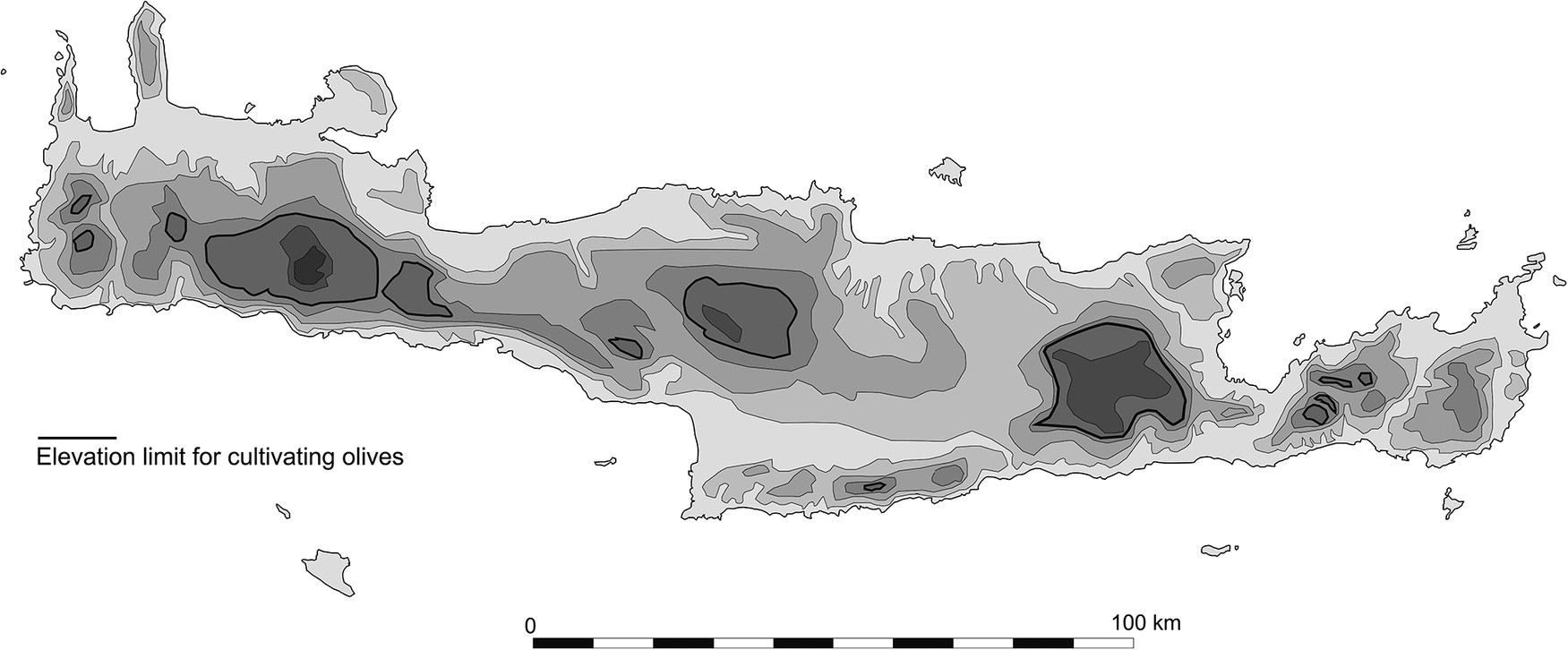
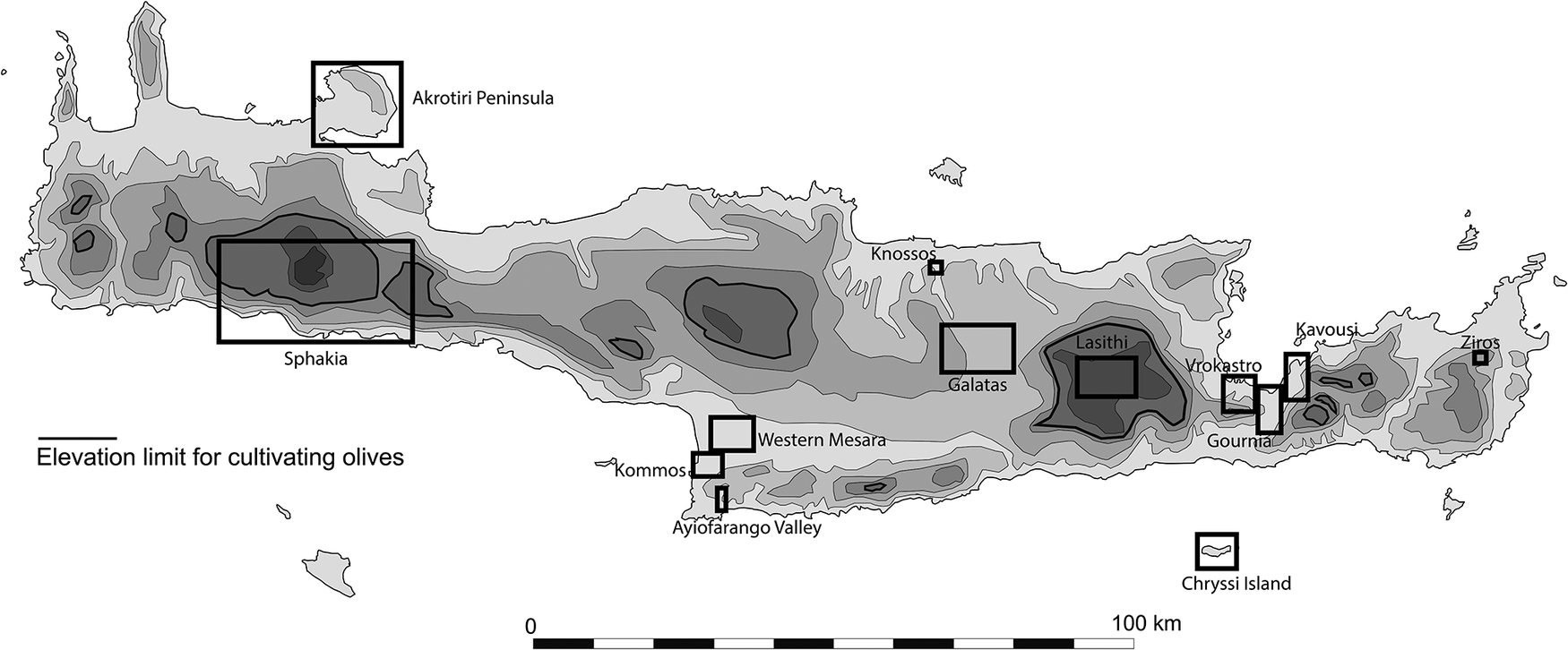
Evidence for olive cultivation in the archaeological record of Crete dates back at least to the Final Neolithic period, with increases in the levels of olive pollen during and after this period suggestive of increasing exploitation (Vogiatzakis and Rackham Reference Vogiatzakis, Rackham, Vogiatzakis, Pungetti and Mannion2008, 257; Livarda and Kotzamani Reference Livarda and Kotzamani2013, 13). Crete had suitable landscapes for the cultivation of olive trees, along with favourable climatic conditions. Olive trees are noted as a very resilient crop overall, capable of withstanding significant variation with respect to temperature, soil conditions, water and altitude. The trees can survive temperatures in excess of 40 degrees Celsius, for instance, but do suffer when the temperature dips below -7 degrees (Pansiot and Rebour Reference Pansiot and Rebour1961, 40–1). They can also withstand highly variable soil conditions, including nutrient-poor soils (Pansiot and Rebour Reference Pansiot and Rebour1961, 48–50). Sunlight is a key variable, and often olive trees prefer a southern exposure for maximum exposure to light (Pansiot and Rebour Reference Pansiot and Rebour1961, 44). The preferred amount of annual rainfall for olives to thrive is approximately 600–800 mm, although this can vary by region and time of year when rainfall occurs (e.g. early Autumn can often be most beneficial) (Pansiot and Rebour Reference Pansiot and Rebour1961, 42). On Crete, the data available from the second half of the twentieth century shows that much of the island, with the exception of a few areas along the coast, receives at least 500 mm per year (Rackham and Moody Reference Rackham and Moody1996, 35, fig. 4:2). The maximum altitude at which olive trees will grow and thrive varies significantly region by region, with 500 masl noted in some regions and up to 1000 masl in others (Mattingly Reference Mattingly, Shipley and Salmon1996, 215; Foxhall Reference Foxhall2007, 5). For Crete, the maximum altitude for cultivation is approximately 750 masl (Rackham and Moody Reference Rackham and Moody1996, 80), which does make much of the island suitable for oleoculture (Fig. 1). Interestingly, olive trees also produce fruit biennially. While there can be some variation in different regions, Greece is one region where a two-year cycle is standard (Foxhall Reference Foxhall2007, 7).
Topographic map of Crete showing elevation limit for cultivating olives. Map by author.

With some notable exceptions (discussed below), direct evidence for oleoculture on Crete during the Roman period is difficult to identify and assess. As will be discussed below, the archaeological evidence is fragmentary, and distinguishing between activities like olive- and grape-pressing is fraught with challenges. Textual evidence is also very limited. Recent paleoenvironmental studies of Crete offer some data, but not enough to enable any island-wide (or even microregional) conclusions. These studies have been challenging to carry out on the island because of a lack of areas which preserve sediment and pollen back to antiquity. Several such areas have now been identified, however, providing a means of taking core samples for analysis of past environmental conditions. One of these regions is Lake Kournas in north-west Crete, located approximately 20 km west of Rethymno and approximately 3 km from the coast in the foothills of the White Mountains (Jouffroy-Bapicot et al. Reference Jouffroy-Bapicot, Pedrotta, Debret, Field, Sulpizio, Zanchetta, Sabatier, Roberts, Tinner, Walsh and Vannière2021). It is considered to be the only natural lake on the island and is approximately 1 km2 in size, with a maximum depth of 21–2 m. Analysis of core samples taken from Lake Kournas includes data for the Hellenistic and Roman periods. Pollen and sediment records within these cores indicate a decline in olive pollen by the end of the Bronze Age, with this trend continuing into the Archaic and Classical periods (Jouffroy-Bapicot et al. Reference Jouffroy-Bapicot, Pedrotta, Debret, Field, Sulpizio, Zanchetta, Sabatier, Roberts, Tinner, Walsh and Vannière2021, 15). A distinct increase in olive pollen appears in the Hellenistic period, and these levels remain stable for approximately 1000 years (Jouffroy-Bapicot et al. Reference Jouffroy-Bapicot, Pedrotta, Debret, Field, Sulpizio, Zanchetta, Sabatier, Roberts, Tinner, Walsh and Vannière2021, 11, 15, fig. 6). This points to the presence of olive groves within proximity of the lake, perhaps associated with nearby settlements like Lappa, located approximately 6 km to the south-east. Olive pollen begins decreasing again in the core samples beginning around AD 650.
Data from other similar studies is not helpful for the Roman period. For instance, the analysis of core samples taken from the Asi Gonia peat bog in the eastern part of the White Mountains in western Crete, situated at the head of a spring-fed stream which feeds into the Koularas river, has very little olive pollen represented, and may reflect mainly wild olives (Jouffroy-Bapicot et al. Reference Jouffroy-Bapicot, Vannière, Iglesias, Debret and Delarras2016). The peat bog is located at 780 masl, above the maximum altitudinal limit for olive cultivation on Crete. In the Mesara Plain, in south-central Crete, coring has also been undertaken next to the Bronze Age palace site of Phaistos, where an ancient freshwater lake transformed into swampland around 1100 BC (Ghilardi et al. Reference Ghilardi, Psomiadis, Andrieu-Ponel, Colleu, Sotiropoulos, Longo, Rossi, Amato, Gasse, Sinibaldi, Renard, Bicket, Delanghe, Demory and Fleury2018; Reference Ghilardi, Revelles, Glais, Theodorakopoulou, Theodoropoulou, Lespez, Longo, Rossi, Bellier, Benedetti and Fleury2019). Unfortunately, data for the Hellenistic and Roman periods is not available from these samples as the swamp had disappeared by that point. One of the conclusions that derived from study of the Phaistos samples, however, is that olive cultivation on Crete appears to have increased during climatic periods when conditions were warm and dry, while also being dependent on social and economic conditions during a specific period (Ghilardi et al. Reference Ghilardi, Revelles, Glais, Theodorakopoulou, Theodoropoulou, Lespez, Longo, Rossi, Bellier, Benedetti and Fleury2019, 11). A recent overview of paleoclimatological data for Crete and the south-west Aegean by Moody (Reference Moody, Francis and Kouremenos2016, 63–9) shows cool and dry conditions from the third to second centuries BC, returning to this pattern beginning in the third century AD. The intervening centuries (first century BC to second century AD) were characterised by warmer, wetter conditions. This indicates that conditions for olive cultivation were more ideal during the Early Roman period than during the centuries before and after.
Archaeological data
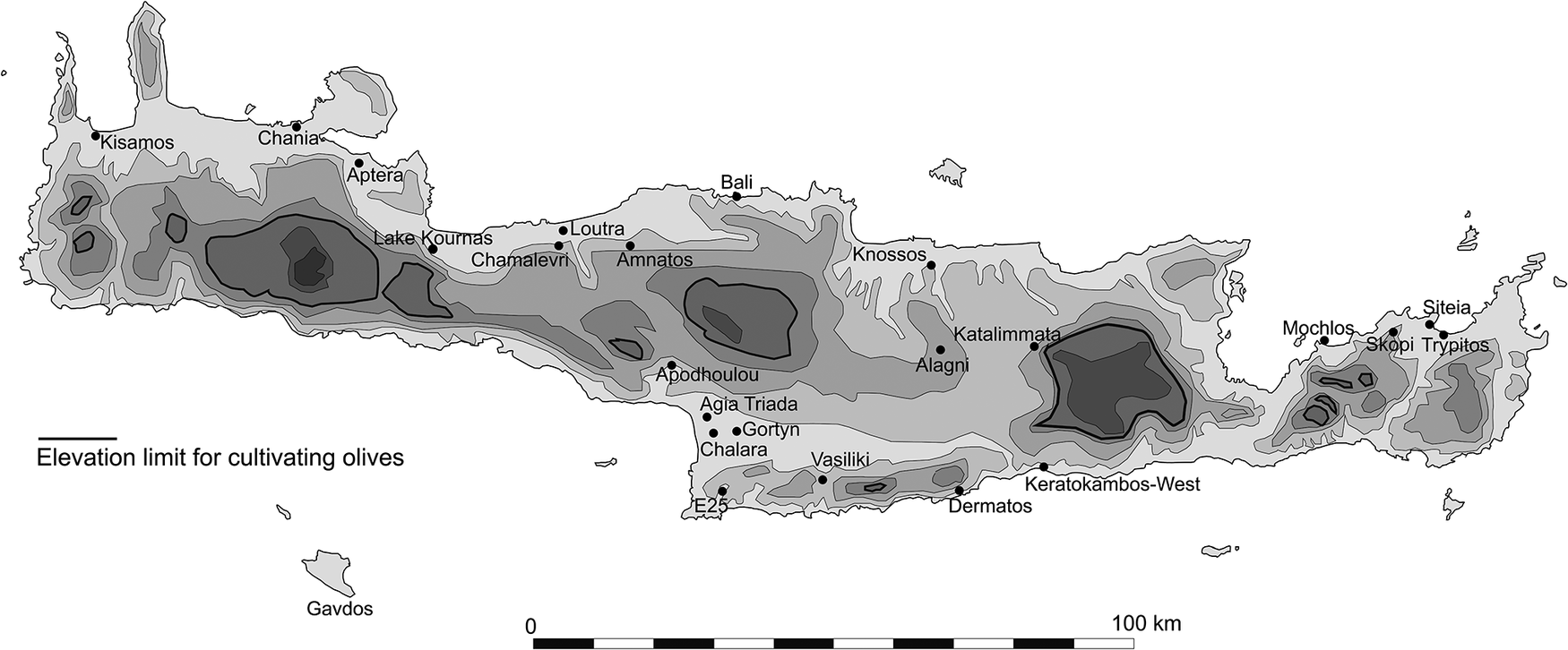
When discussing the economy of Roman Crete in his seminal book, Sanders (Reference Sanders1982, 32) observes that there is very little archaeological evidence for grain production or viticulture, but more for oleoculture (Fig. 2). The basis for this observation is the higher presence of Roman-period olive pressing equipment compared to grain mills or wine presses. Hadzi-Vallianou (Reference Hadzi-Vallianou and Polymerou-Kamelaki2004, 78–9, 91–3), writing 20 years ago, provides a brief overview of Hellenistic and Roman finds in an overview of the evidence for olive oil production on Crete in antiquity, but notes this consists of a limited corpus. Unfortunately, Sanders’ interpretation glosses over several challenges with the evidence available from Crete. First, the similarity between the equipment and installations used for production of oil and wine is striking, and there is often very little evidence to indicate which activity predominated at a given site (Foxhall Reference Foxhall2007, 133; Dodd Reference Dodd2020, 13–14). In many instances, both the pressing of olives and grapes may have occurred in the same facility. Also, very few finds on Crete potentially associated with Roman period oleoculture have been recovered through stratigraphic excavation, making them difficult to date. The technology of pressing equipment from the Hellenistic (and earlier) periods through the Roman period shows very little transformation, and assigning finds to specific periods has not always acknowledged this longevity of type.
Map of Crete showing location of sites discussed in text. Map by author.

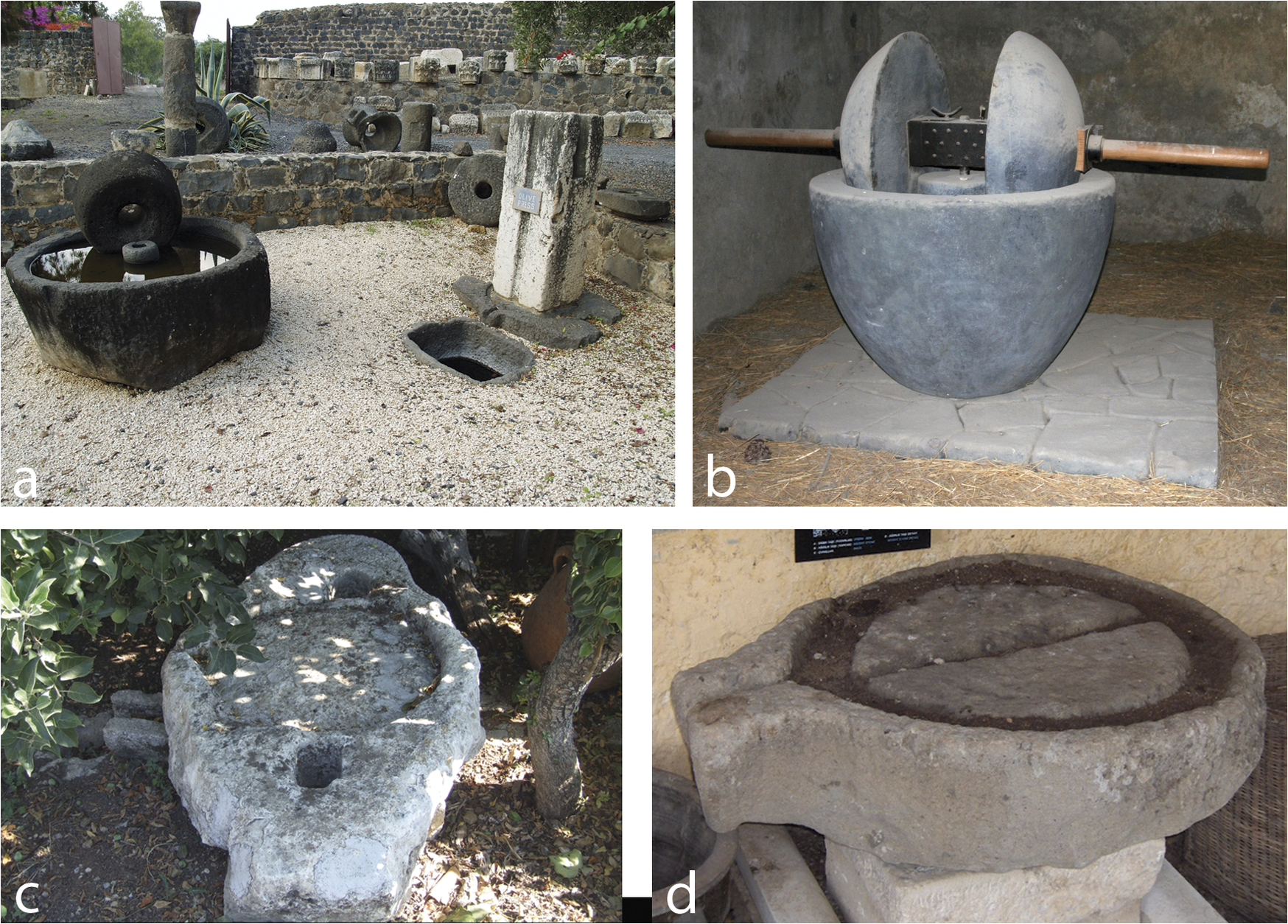
Standard equipment used for production of olive oil that is attested on Crete includes the trapetum, the mola olearia, and the beam press (Fig. 3). All have stone components that can preserve well in the archaeological record (White Reference White1975, 228–31). A trapetum consists of a large stone mortar with a curved floor. Two hemispherical stones known as orbes were connected by a wooden rod and rolled against the mortar surface. The trapetum was used to crush olives and create the paste that could then be pressed for oil extraction. A mola olearia fulfilled the same function and had a large stone mortar, but typically with a flat floor. Two cylindrical millstones rotated around the mortar to crush the olives. The beam press included a pressing floor or stone press bed on which the olive paste was placed and a millstone attached to a long, wooden beam. These millstones could have cuttings to accommodate one or two screws that were part of the press mechanism that aided in squeezing the millstone against the press bed. Stone press beds could have spouts and typically had channels carved into them to help the oil flow into a basin.
Examples of olive oil production equipment from Roman sites. a) Mola olearia at Capernum, Israel (photo by D. Shankbone. Courtesy of Creative Commons [https://creativecommons.org/licenses/by-sa/3.0/?ref=openverse]). b) Trapetum at Pompeii, Italy (photo by H.-J. Lücking. Courtesy of Creative Commons [https://creativecommons.org/licenses/by-sa/3.0/?ref=openverse]). c) Screw press at Alagni, Crete (photo by S. Beckmann). d) Spouted press bed at Bodrum, Turkey (photo by G. Jansoone. Courtesy of Creative Commons [https://creativecommons.org/licenses/by-sa/3.0/?ref=openverse]).

Published references to related finds
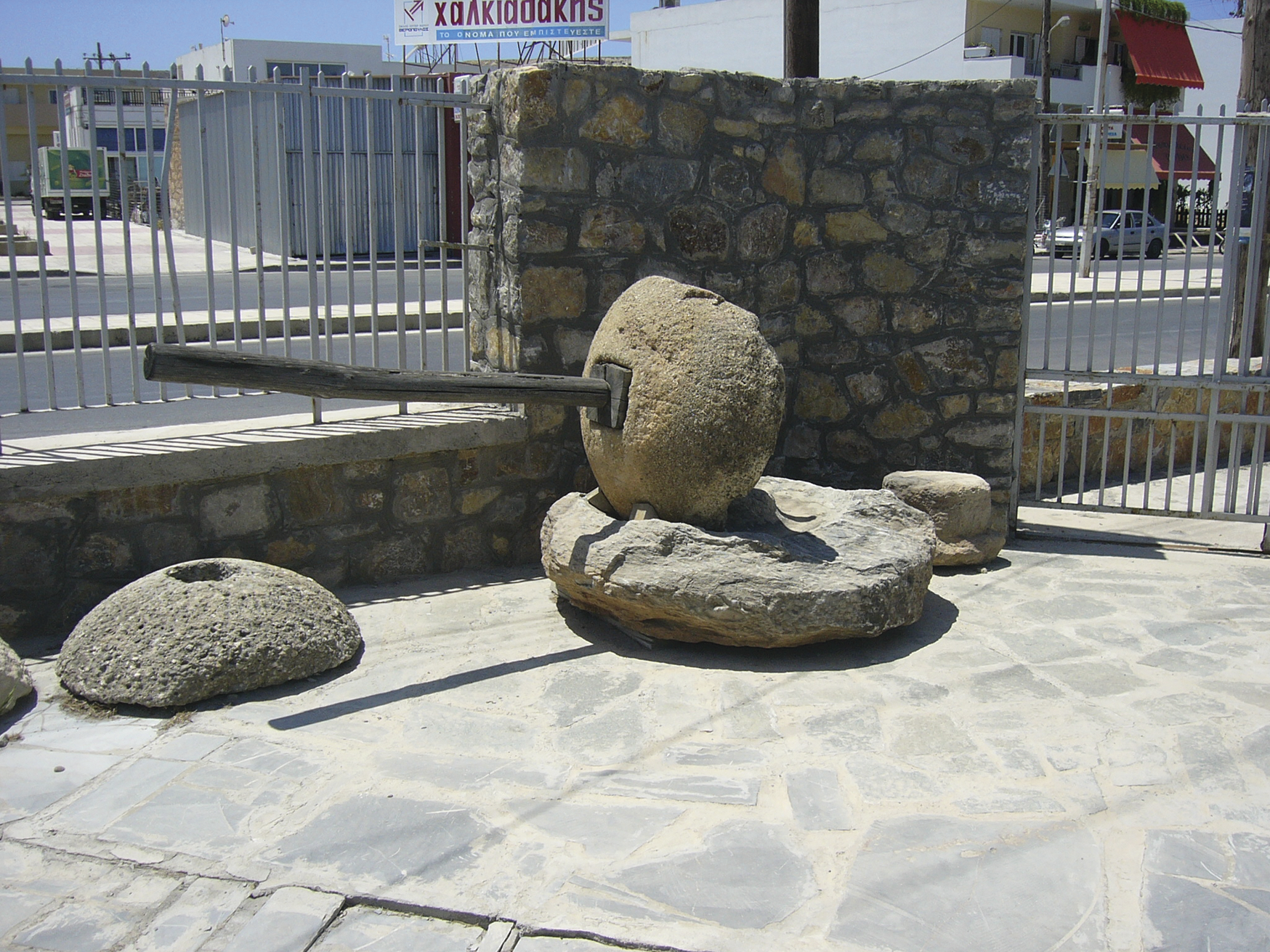
Some examples of olive production equipment on Crete have been noted as chance finds in various publications. Sanders (Reference Sanders1982, 136, 159–61; see also Alexiou Reference Alexiou1968), for instance, records a large stone oil press at Skopi in north-east Crete near Siteia and possible olive presses at Vasiliki and Agia Triada in the Mesara region of south-central Crete. It is difficult to assess, however, what specific type of equipment is indicated by these brief descriptions. During topographic work by British archaeologists in the early 1960s within the Amari Valley in western Crete near the village of Apodhoulou, some faint traces of Roman activity and/or settlement on the outskirts of a Minoan site were encountered, including a stone olive press (Hood, Warren and Cadogan Reference Hood, Warren and Cadogan1964, 78; Sanders Reference Sanders1982, 162). To the north, at Amnatos, which sits approximately 4.5 km west of Eleutherna, they documented a site with surface pottery datable from the Classical through Roman periods (Hood, Warren and Cadogan Reference Hood, Warren and Cadogan1964, 67–8; Sanders Reference Sanders1982, 164). An orbis was noted as part of the site, indicating that crushing of olives may have taken place. Farther west at Aptera, located approximately 12 km east of Chania, a stone olive press was found in the courtyard of a Roman-period house (Niniou-Kindeli Reference Niniou-Kindeli2008, 41). In central Crete at a site called Katalimmata in the Pediada region to the north-west of the village of Mathia, Platon (Reference Platon1957, 334) investigated walls that may have been part of a house dated to the Late Minoan III period. That structure had been partially destroyed by a later Roman farmhouse that had a press preserved (Sanders Reference Sanders1982, 149). The publication implies this may be a wine press (ληνός), but there is no description or image to aid in its identification. There are other instances where pressing equipment can be seen on Crete with no indication of their provenience. Examples include finds within the courtyards of museums, such as parts of trapeta at the Siteia Museum in the north-east part of the island (Fig. 4). During the Galatas Survey Project in the Pediada Plain of central Crete, screw presses were noted as décor within gardens and around houses at the village of Alagni (Gallimore Reference Gallimore, Watrous, Buell, Kokinou, Soupios, Sarris, Beckmann, Rethemiotakis, Turner, Gallimore and Hammond2017b, 113). This type of press could be used for pressing both grapes and olives.
Olive pressing equipment in the courtyard of the Siteia Museum in north-eastern Crete. Photo by author.

Indirect evidence for olive oil production also appears on Roman Crete. Olive pits, for instance, were found in large quantities at a small, private bath complex associated with the House of Phidias at Kisamos in north-west Crete, datable to the second to third centuries AD (Markoulaki Reference Markoulaki, Loukos, Xifaras and Pateraki2009, 364). They were recovered from the hypocaust and were interpreted as a fuel source to heat this part of the baths. Olive waste from pressing, known as pomace, was an important fuel source in the Mediterranean from at least the Bronze Age onwards (Rowan Reference Rowan2015). Erica Rowan (Reference Rowan2015, 469, table 1) has summarised evidence for this practice that includes Roman-period exploitation of pomace in domestic contexts at Pompeii and Herculaneum, Italy, as fuel at bakeries at Pompeii and a bath complex at La Garde, France, for pottery kilns at Carthage and Leptiminus in Tunisia and for a glass furnace at Sepphoris, Israel. Those are examples with well-published assemblages that include details about carbonised olive remains, and this practice was likely much more widespread than has been acknowledged, including across Crete. Pomace has also been found as a fuel source in association with production of olive oil, such as at an oil production site of Hellenistic date at Kopetra, Cyprus (Hadjisavvas Reference Hadjisavvas, Eitam and Helzer1996, 67).
Rock-cut pressing installations
One interesting feature of the Cretan landscape related to oleoculture and/or viniculture is rock-cut pressing installations carved into the bedrock. Such installations are known in other regions, such as Rough Cilicia, where they often include treading floors, collection basins and walls with a niche to accommodate the wooden beam of a press (Aydinoğlu and Alkaç Reference Aydinoğlu and Alkaç2008). They are typically found in open fields near agricultural catchments, and Aydinoğlu and Alkaç (Reference Aydinoğlu and Alkaç2008, 280) emphasise the benefits of this type of infrastructure, at least in the context of viniculture: ‘Firstly, it is easier to keep the surface clean, which is important for the oil and wine process. Secondly, the sun light at the open-air vaporises the sap of the grape and accelerates the fermentation reaction’. On Crete, rock-cut pressing installations have been documented in several regions, primarily through survey archaeology, and tentatively dated to the Roman period. One example was identified in the Ayiofarango Valley, a region adjacent to the south coast in central Crete, during a survey from 1971 to 1972 (Blackman and Branigan Reference Blackman and Branigan1977). At a site (E25) in the north-eastern corner of the survey zone, the researchers documented a circular basin with a 1 m diameter hollowed out of a rock, with a circular cistern cut into the bedrock 5 m to the south (Blackman and Branigan Reference Blackman and Branigan1977, 49). The cistern was lined with roughly hewn stones that were then coated in mortar to form a waterproof surface. A date in the Hellenistic and/or Roman period is suggested by pottery scattered around the surface. Similarly, rock-cut vats in the south-central part of the Akrotiri Peninsula in north-west Crete may be part of a pressing installation (Raab Reference Raab2001, 97). They have been interpreted as Byzantine in date, but Raab indicates the potential of an earlier date for these features.
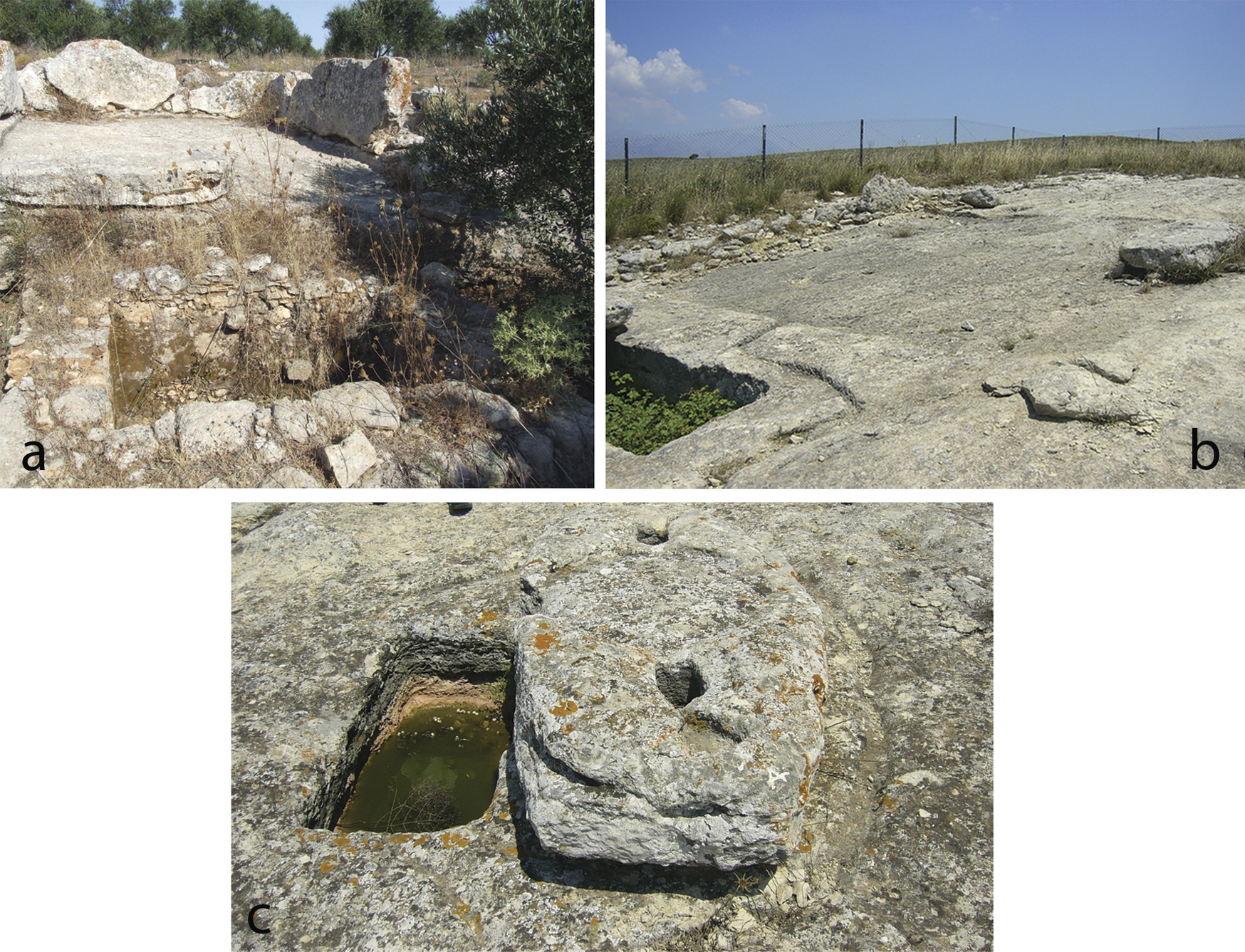
Two rock-cut pressing installations were attested by the Galatas Survey (Gallimore Reference Gallimore, Watrous, Buell, Kokinou, Soupios, Sarris, Beckmann, Rethemiotakis, Turner, Gallimore and Hammond2017b, 113). Unfortunately, neither had much evidence of Roman pottery in close proximity, but they are comparable to the installations in Rough Cilicia and in other parts of Crete. The first is located approximately 700 m west of the village of Alagni (Fig. 5). In the south-west corner, the bedrock has been carved into a flat treading floor with a raised lip. Large stones have also been placed on three sides to act as an additional barrier. At the centre of the western wall of stones, there is a triangular niche that may have been a pivot for a beam press. Liquid would flow down a channel to the north into a rectangular basin partially cut into the bedrock and built up through walls of small- to medium-sized stones. There are traces of plaster along the interior of the basin. To the east of the treading floor, there is a second rectangular basin with a channel carved around it. Part of a screw press sits directly beside the basin.
Pressing installations near Alagni. a) Treading floor and basin at first installation. b) Treading floor and basin at second installation. c) Small basin and screw press at second installation. Photos by S. Beckmann.

The second installation sits approximately 850 m west of Alagni and also consists of rock-cut and built features. There is a large, rectangular treading floor with a shallow lip, bordered on its western side by a wall with a single course of stones preserved. It is possible the wall extended farther around the treading floor in antiquity. This treading floor is connected to a rectangular basin by a channel carved into the bedrock, and the basin also has a raised lip encircling it. To the south of the large treading floor lies a second, smaller treading floor. It also has a raised lip and is connected to a rectangular basin by a bedrock channel, with part of a screw press sitting next to the basin.
An additional 16 rock-cut pressing installations have been identified on Gavdos, a small island located 40 km to the south of south-western Crete, that are comparable to the Alagni features (Christodoulakos et al. Reference Christodoulakos, Moschovi, Kopaka, Drosinou and Arakadaki2000). The Gavdos installations, however, do not have evidence of built components, and the collection basins tend to be circular rather than rectangular. The team that documented these installations developed a typology of four types: (A) single treading floor and collection basin; (B) two treading floors with a shared collection basin; (C) two treading floors each with their own collection basin; (D) two treading floors with one shared collection basin and one collection basin associated with only one of the treading floors (Christodoulakos et al. Reference Christodoulakos, Moschovi, Kopaka, Drosinou and Arakadaki2000, 558–9, fig. 1). The first Alagni installation may be an example of Type B since it has evidence of a single treading floor and two collection basins, while the second Alagni installation appears to adhere more closely to Type C.
Finds from excavation
While stratigraphic excavations of sites on Crete that have recovered evidence of oleoculture are rare, there are some intriguing examples to consider. One important site is Loutra, located approximately 9 km east of Rethymno (Tsatsaki and Nodarou Reference Tsatsaki and Nodarou2014). Rescue excavations in a plot at Loutra from 2003 to 2004 uncovered a farmhouse, with several different industrial activities attested, including production of ceramic amphoras. In room 1 of the farmstead, there was a beam press consisting of a raised, built platform with a spout next to a large pit. No other part of the press was preserved. Carbonised olive remains were found in this same room, corroborating the use of the beam press for olive oil production (Tsatsaki and Nodarou Reference Tsatsaki and Nodarou2014, 289). The amphoras manufactured in this structure were the Late Hellenistic Amphore Crétoise (AC) 7 and the Early Roman AC3 (Tsatsaki and Nodarou Reference Tsatsaki and Nodarou2014, 290–4). A date from the third to second quarter of the first century BC was assigned to the structure, although the AC3 can date after this as well. The potential connection between these amphora types and Cretan olive oil will be explored below. A comparable Late Hellenistic beam-press complex has also been documented at Mochlos, in north-east Crete, datable from the late second century BC, but it was abandoned around the time of the Roman conquest of the island (Vogeikoff-Brogan Reference Vogeikoff-Brogan2014). The building has a raised platform where the press-bed would have been positioned, although it is no longer preserved. A stone back support would have held the wooden beam. Charred and crushed olive pips were found in abundance as part of the floor deposit around the beam press, perhaps indicating that pomace was being used as a fuel source as part of the production process, similar to the example of Kopetra, Cyprus, mentioned above.
A short distance to the south of Loutra at Chamalevri, another oil-producing facility has been excavated and documented (Tsatsaki and Kapranos Reference Tsatsaki, Kapranos, Andreadaki-Vlazaki and Papadopoulou2011). Rescue excavations at this site took place from 2002 to 2004, revealing a structure measuring 13 x 7 m buried beneath a layer of destruction debris. Infrastructure was attested for three stages of olive oil production: (1) crushing of the olives; (2) pressing to extract the oil; and (3) separating the oil from other materials. For crushing the fruit, two olive mills of mola olearia type are located in the northern and southern parts of the complex. Each consists of a stone-built base with a flat surface. Both of these mills also had two cylindrical millstones present. To extract the oil, three beam-press installations were documented, one of which is in situ in the north-west part of the complex. It consists of a stone-built support with a circular base and a spout. Fragments of the other two installations were also found in the northern part of the complex. Stone counterweights with cuttings for the wooden beams appear near the eastern and western walls. In the north-west, north-east and south-west parts of the building, separation tanks are documented. After the olive pulp had been pressed, it may have been stored in a tank at the northern end of the structure. Based on pottery found at the site, the main phase of use of the olive pressing equipment appears to be the second to third centuries AD, with some indication of re-use in the Late Roman period (Tsatsaki and Kapranos Reference Tsatsaki, Kapranos, Andreadaki-Vlazaki and Papadopoulou2011, 164).
Farther to the west, pressing installations have been documented during rescue excavations at Kisamos and Chania. The Kisamos facility was found in a structure excavated in the Raïsaki Plot in 1991 and 1992 (Drosinou Reference Drosinou1992). Unfortunately, the published report does not provide much detail about the equipment associated with oil production, but Drosinou (Reference Drosinou, Livadiotti and Simiakaki2004, 424) indicates there are comparable features to the Gavdos facility discussed below. At Chania, an installation with a press (designated by the term ληνός) is located near to a room associated with pottery production (Markoulaki Reference Markoulaki1998). These activities may date into the Late Hellenistic period (third to first centuries BC), and there is evidence of Roman period activity in the same structure.
Another complex interpreted as an olive oil production facility was excavated on the small island of Gavdos (Drosinou Reference Drosinou, Livadiotti and Simiakaki2004). The site, located in the north-east part of the island, a little to the south-west of Saraknikos Beach, was excavated in 1998 and 1999. A beam-press installation was documented in the northernmost of the three rooms of the complex (Drosinou Reference Drosinou, Livadiotti and Simiakaki2004, 418–24, figs 7–13). Within that room, fragments of a trapetum for crushing the olives into a paste were identified, along with components of the beam press. The latter consisted of a raised platform with a flat, stone floor with channels carved into it. A circular stone in front of the platform had a central cutting for a screw that lowered the press. Finds from the excavation, including pottery and lamps, suggest a date in the Early Roman period, from the first half of the second century through to the third century AD (Drosinou Reference Drosinou, Livadiotti and Simiakaki2004, 424–5).
Also of interest is an excavation that took place from 1960 to 1964 under the aegis of the Scuola Archeologica Italiana di Atene at Chalara, adjacent to the site of Phaistos (Levi Reference Levi1967–8, 77–8). This work uncovered a Hellenistic structure that was refurbished and renovated into a farmstead that included olive pressing equipment during the Roman period. Some pottery, including lamps, recovered during the excavations suggested a date in the second or third century AD for the Roman farmhouse (Mercando Reference Mercando1974–5, 123, 136, nos 44–6, fig. 126). Recent reassessment of these excavations, however, has provided significant reinterpretations of the finds and the chronology (La Rosa and Portale Reference La Rosa, Portale, Livadiotti and Simiakaki2004). The lamps, for instance, were noted to come from a mixed fill that included Hellenistic material and do not provide good chronological data for the construction of the Roman building (La Rosa and Portale Reference La Rosa, Portale, Livadiotti and Simiakaki2004, 502). Instead, the farmstead appears to date to the sixth or seventh century AD, with pottery and other finds consistent with material at Gortyn datable to that period. Pressing equipment interpreted as being for olive oil production was found in a part of the complex referred to as ‘Chalara Centro’ (La Rosa and Portale Reference La Rosa, Portale, Livadiotti and Simiakaki2004, 502, figs 22, 32). This includes one orbis and two press beds. In the publication of the Western Mesara survey, there is reference to part of a trapetum documented in the same area at Agia Photia (Watrous and Hadzi-Vallianou Reference Watrous, Hadzi-Vallianou, Watrous and Hadzi-Vallianou2004a, 354). A review of Levi’s (Reference Levi1976, 633) original publication, however, suggests that the reference to the trapetum find was related to the farmhouse at Chalara and not Agia Photia. While later than much of the evidence under consideration in this study, Chalara shows potential continuation of oleoculture into Late Antiquity.
Finds from pedestrian surveys
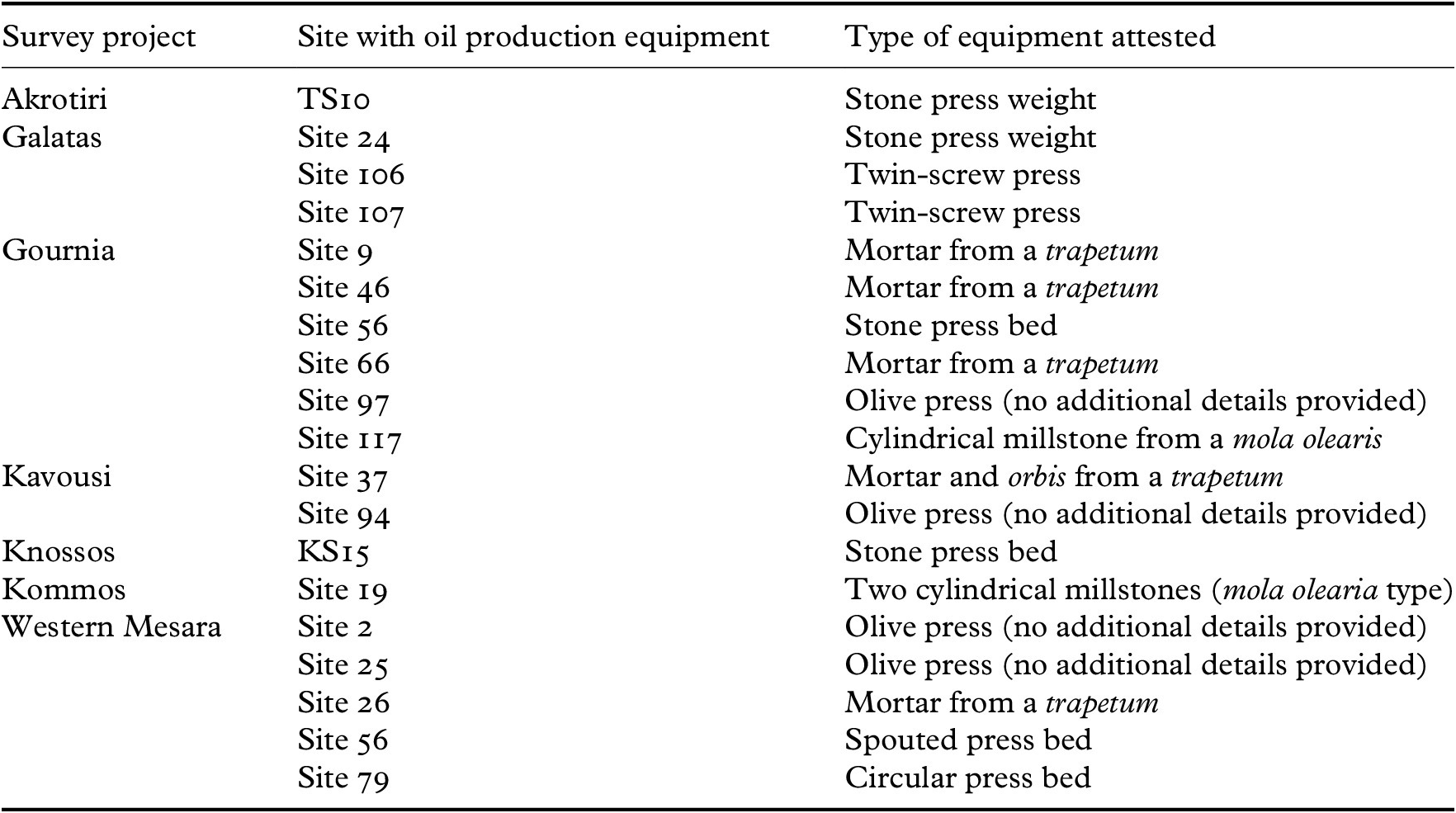
Survey projects on Crete have regularly documented evidence of presses and other equipment associated with oleoculture and/or viticulture (Table 1). Much of this evidence does appear to be Roman in date or at least datable to the Hellenistic through Roman periods. These types of finds, however, can be difficult to identify during a surface investigation. For several survey projects that include Roman-period finds, such as Ziros (Branigan Reference Branigan1998), Siteia (Tsipopoulou Reference Tsipopoulou1989), Chryssi Island (Chalikias Reference Chalikias2013) and Sphakia (Nixon, Moody and Rackham Reference Nixon, Moody and Rackham1988; Nixon et al. Reference Nixon, Moody, Price and Rackham1989; Reference Nixon, Moody, Niniou-Kindeli, Price and Rackham1990), no finds of pressing equipment or anything related to oleoculture or viniculture are noted. When discussing the results of the Lasithi survey in central Crete, Watrous (Reference Watrous1982, 8) observed that the elevation of the plain was above the maximum growing range for olives and that olive cultivation did not take place there. Within the Vrokastro region in north-eastern Crete, Hayden (Reference Hayden2004, 212) suggested several areas in which olive and grape cultivation may have taken place during the Roman period, but no direct evidence for oleoculture or production of olive oil was attested during the survey. For other projects, the results of which are summarised below moving from east to west, evidence of oil production has been described (Fig. 6).
Summary of finds from pedestrian survey projects on Crete.

Map of Crete showing location of survey projects discussed in text. Map by author.

Kavousi
The Kavousi Survey Project, undertaken from 1988 to 1990 in the Kampos Plain, just to the north-east of the Isthmus of Ierapetra in north-east Crete, recorded potential olive pressing equipment at two sites (Haggis Reference Haggis2005, 87, 117–18, 142). This includes Site 37, where fragments of a trapetum, including part of the mortar and an orbis, for crushing olives was noted. Additional olive pressing equipment was identified at Site 94, but the type is not specified. In both cases, surface assemblages of Roman pottery suggested a date for the finds.
Gournia
The Gournia Archaeological Survey, which took place from 1992 to 1994 in the northern part of the Isthmus of Ierapetra, identified large, olive pressing equipment suggestive of installations of Roman date at six sites (Vogeikoff-Brogan Reference Vogeikoff-Brogan, Watrous, Haggis, Nowicki, Vogeikoff-Brogan and Schultz2012, 87, pl. 9c; Watrous Reference Watrous, Watrous, Haggis, Nowicki, Vogeikoff-Brogan and Schultz2012, 108, 117, 118, 120, 124–5, 128). This includes the mortars from trapeta at Sites 9, 46, and 66 and a press bed with carved channels at Site 56. At Site 117, the publication indicates a trapetum was found but the image provided shows a cylindrical millstone from a mola olearis. No specific details are provided for the type of equipment found at Site 97. Of these six sites, five have evidence of Roman activity but no Hellenistic finds, while only one (Site 66) has Hellenistic material also, which led to the interpretation of Roman-period oleoculture. These sites were interpreted as being able to produce oil in greater quantities than was necessary for local subsistence. One additional site identified by the survey (86) may have been a kiln site for manufacture of Roman amphoras, particularly the AC1 (Vogeikoff-Brogan Reference Vogeikoff-Brogan, Watrous, Haggis, Nowicki, Vogeikoff-Brogan and Schultz2012, 87).
Knossos
The archaeological survey around the area of Knossos documented some squared limestone blocks, and a large stone with a press-bed cut into it that was interpreted as an olive press at locale KS15 (Hood and Smyth Reference Hood and Smyth1981, 35). It may have been part of a building dated broadly to the Greco-Roman period by the survey.
Galatas
Undertaken from 2005 to 2007 in the Pediada Plain in central Crete, the Galatas Survey identified pressing equipment at Sites 106 and 107 near the village of Alagni (Reference Gallimore, Watrous, Buell, Kokinou, Soupios, Sarris, Beckmann, Rethemiotakis, Turner, Gallimore and HammondGallimore 2017b, 113). Both sites had fragments of screw presses, which, as noted above, can be used for pressing grapes and olives. These finds are in addition to the pressing installations discussed above. Farther north in the survey zone near the village of Astritsi (Site 24), a weight stone used as part of a press was recovered, although very little Roman pottery is noted in that area (Turner Reference Turner, Watrous, Buell, Kokinou, Soupios, Sarris, Beckmann, Rethemiotakis, Turner, Gallimore and Hammond2017, 91, pl. 34B).
Western Mesara
The Western Mesara Survey, carried out from 1984 to 1987 around the Bronze Age site of Phaistos, identified olive pressing equipment at several rural sites (Watrous and Hadzi-Vallianou Reference Watrous, Hadzi-Vallianou, Watrous and Hadzi-Vallianou2004b, 527, 530, 534, 536). A mortar from a trapetum was found at Site 26, a spouted press bed at Site 56, and a circular press bed at Site 79. At Sites 2 and 25, the publication identifies parts of an olive press, but no specific details are provided. In addition, a stone press bed with carved channels was seen by the surveyors south of the village of Sivas (Watrous and Hadzi-Vallianou Reference Watrous, Hadzi-Vallianou, Watrous and Hadzi-Vallianou2004a, 357, pl. 13:2). The finds from these sites range mainly from Late Hellenistic to Early Roman, with some earlier and later material present.
Kommos
During the intensive survey of the Kommos region at the western edge of the Mesara Plain from 1978 and 1979, one site, referred to as Kouloura (Site 19), had two large cylindrical stones with square cuttings that potentially came from a mola olearia (Hope Simpson Reference Hope Simpson, Shaw and Shaw1995, 355). Hope Simpson (Reference Hope Simpson, Shaw and Shaw1995, 399) discusses this potential press within his synthesis of Early Roman activity within the Kommos region.
Akrotiri
The survey of the Akrotiri Peninsula in north-west Crete from 1978 to 1982, as part of the larger Khania Archaeological Survey Project, uncovered evidence for the pressing installation discussed above along with one site (TS10) with stone pressing equipment (Raab Reference Raab2001, 145, fig. 59). That site produced a large, stone press weight that Raab (Reference Raab2001, 156) argues was used for crushing olives. She notes comparanda for the press weight of Classical to Hellenistic date, and the site also has Early and Late Roman pottery as part of its assemblage.
WAS OLIVE OIL EXPORTED FROM ROMAN CRETE?
Comments cited above by Reynolds (Reference Reynolds, Bernal-Casasola, Bonifay, Pecci and Leitch2021, 312) and Harris (Reference Harris and Chaniotis1999, 357) emphasise the potential of Crete as an exporter of olive oil under Roman rule, despite a lack of evidence to support that interpretation. Evidence for oleoculture and production of olive oil on Roman Crete discussed above could point to some degree of export trade. Assessment of the island’s role in the Roman economy has often pointed to the importance of transshipment and the idea that Crete’s position within the eastern Mediterranean made it an important facilitator of east–west and north–south exchange (Gallimore Reference Gallimore2015, 272–4). This role helped to stimulate trade of goods from the island during the first century AD, with products like those packaged in amphoras likely serving as piggy-back commodities taken aboard ships that passed along Crete’s shores. This is a primary interpretation behind the development of the island’s large-scale export of wine packaged in amphoras to sites like Rome, for instance (Tchernia Reference Tchernia1986, 244, 298; Gallimore Reference Gallimore2015, 289; Reference Gallimore2019, 606–12). Yet, Cretan amphoras likely did hold contents other than wine at least on occasion. Some examples, based on painted inscriptions known as tituli picti found on Cretan amphoras recovered from sites in the western Mediterranean, include honey (CIL 4.5741; Liou Reference Liou1993, 137, no. PN14), garum (CIL 4.9392), sorb apples (Williams Reference Williams1993, 30, no. 2) and psilothrum (CIL 4.2613; 4.2614), an unguent used in hair removal. Perhaps olive oil was also a content of Cretan amphoras, at least on occasion.
Textual evidence for Cretan oil is very limited, unfortunately. No titulus pictus, for example, has been identified on a Cretan amphora that mentions olive oil. Pliny the Elder, despite specifically mentioning several other products from Crete (e.g., honey: Natural History 11.33; onions: Natural History 19.04; quinces: Natural History 13.24; Cyprian figs: Natural History 13.58), does not include olive oil from the island in his discussion. Pliny’s overview of olive oil and the regions from which it comes, however, is somewhat generalising. In the Natural History (15.3), after ranking oil from Italy first, followed by a competition between Istria and Baetica for second place, Pliny writes that the third rank goes to all other provinces in the Roman Empire, except for Africa, where he argues local conditions made olive cultivation difficult. It is possible that Crete is included among the plethora of regions covered within this third rank.
There are two literary references preserved that suggest export of Cretan olive oil during the Early Roman period, although this limited evidence is difficult to interpret. The first text consists of several lines in a papyrus document, P.Bingen 77, recovered at Karanis in Egypt that dates to the second century AD (Heilporn Reference Heilporn, De Smet, Melaerts and Saerens2000; Litinas Reference Litinas, Gavrilaki and Tzifopoulos2006). It records an itinerary of ships and cargoes, with harbours mentioned in Italy (Ostia), the Black Sea, Asia Minor, Syria and Crete (Litinas Reference Litinas, Gavrilaki and Tzifopoulos2006, 290–1). The reference to Crete appears in the opening lines (1–4):
ἐλ(αίου) Ἀτταλίου τῆς Κρήτη[ς –ca?– τ]οῦ Σωζομένου
[.Ἐρι]νύες Τύχη Ἀσκληπ( )
(ἀρτάβαι) .[ἄγει –ca?– ] … ἐλαίο(υ) ἡμικ(άδια)
[…] .Σερήνῳ ἐλ(αίου) ἡμικ(άδια) μα
… oil. From Attalion of Crete [the ship of …], son of Sozomenos, ‘Furies(?) and Fortune’. Asklep() … artabas. [transported for …] demi-jars of oil, and for Serenos, 41 demi-jars of oil. (Heilporn Reference Heilporn, De Smet, Melaerts and Saerens2000, 349)
Unfortunately, the papyrus is quite fragmentary, particularly in its early lines. Several more complete entries within the text permit us to see that the specific information recorded consists of: a record of types of goods, port of origin, name of the captain, name of the ship, recipient and specific quantity of goods to be delivered (Litinas Reference Litinas, Gavrilaki and Tzifopoulos2006, 290–1). Enough information is present in these lines to indicate that an unknown quantity of oil was being transported from Crete. The measurement used for the oil is the artaba, which is typically a dry measure used for grain, but one that was also defined in antiquity in relation to weight of olive oil (Rathbone Reference Rathbone1983, 267, n. 8). Litinas (Reference Litinas, Gavrilaki and Tzifopoulos2006, 291) argues that Attalion is a location on Crete, based on the structure of the other entries in the text, perhaps equivalent to an ancient site called Atali (modern Bali) situated along the coast in north-central Crete. The use of demi-jars to describe the container holding the olive oil is interesting. During the second century AD, there were four primary amphora types manufactured on Crete, the AC1–4 (Marangou-Lerat Reference Marangou-Lerat1995, 67–89). The AC1, AC2 and AC3 had standard capacities of roughly 22–6 litres, while the AC4 had a standard capacity of half that size, approximately 11 litres (Vidal and Corredor Reference Vidal and Corredor2018, 304–5, table 1). This could indicate that the oil in question was being transported in AC4 amphoras, for which manufacture is currently documented at Dermatos, Heraklion, Hierapytna, and Tsoutsouros-East (Marangou-Lerat Reference Marangou-Lerat1995, 85–6; Sofianou and Gallimore Reference Gallimore2019), although this is only speculative.
A second reference to olive oil from Crete appears in the Life of Saint Pankratios of Taormina, an account of a first-century AD missionary sent by Peter to the island of Sicily. The relevant passage (ch. 315) records transport of Cretan oil to Sicily:
ἀκούσας δὲ ὁ μακάριος Μάξιμος ἐν Σικελίᾳ εἶναι ἐπίσκοπον τὸν ἅγιον Παγκράτιον, πλήσας σκάφην ἔλαιον Κρητικὸν καὶ θυμίαμα διάφορον καὶ στολὰς ἱερὰς τῶν ὑφαντῶν Ἀρμενίας, αὶ ἐπιβιβάσας τοὺς παῖδας τοῦ μακαρίου Παγκρατίου εἰς τὰς σκάφεις, οὓς ἦν τῷ θεῷ προσενέγκας, ἦλθον ἀναζητοῦντες ἡμᾶς κατὰ πάσης τῆς νήσου.
Saint Maximos heard that Saint Pankratios was a bishop in Sicily, and after loading a boat with Cretan oil and different sorts of incense and sacred vestments from the weavers of Armenia, and embarking Saint Pankratios’ slaves, whom he had offered to God, on the boats, they came looking for us over the whole island. (Stallman-Pacitti and Burke Reference Stallman-Pacitti and Burke2018, 456–9)
One difficulty with this passage, however, is the distinction between its hagiographical date (first century AD) and the date of its writing. The author named in the text is Pankratios’ successor, Euagrios, but there are internal markers in the work, including specific phrasing, geographic references, and potential attempts to engage with much later theological debates, that indicate it was written between the early seventh and eighth centuries (Stallman-Pacitti and Burke Reference Stallman-Pacitti and Burke2018, 1, 11). References to the Life also appear in other late eighth- and early ninth-century texts, indicating it was known by that time but was likely not written much earlier. This anachronistic aspect of the text calls into question details such as the reference to olive oil from Crete. For ‘Cretan oil’, should we interpret this as a reflection of trade in the first century or a marker of seventh- or eighth-century economic practices?
Possible reference to olive oil may also be found in an archive of ostraca (O.Cret.Chers.) found in a well at the coastal site of Chersonesos in north-central Crete that dates from the later second century into the mid-third century AD (Litinas Reference Litinas2008; Gallimore Reference Gallimore2014). Ninety-two ostraca were recovered that record transport of goods to Chersonesos, perhaps for export. The measurement used in the texts is metretai, which is a liquid measure equivalent to approximately 35–40 litres. The specific product is never mentioned, and it is possible that the ostraca are referring to wine and/or olive oil (Litinas Reference Litinas2008, 12; Hadjisavvas and Chaniotis Reference Hadjisavvas, Chaniotis, Cadogan, Whitley, Kopaka and Iakovou2012, 169). During the Early Roman period, Chersonesos was the primary harbour of the inland city-state of Lyttos, which is the best represented site on Crete with respect to tituli picti found on Cretan amphoras outside of the island, including those that make specific reference to wine (e.g. Martín-Arroyo Reference Martín-Arroyo2020). At Pompeii, 66 tituli picti associated with Lyttos have been identified. This does not mean that the Chersonesos ostraca must refer exclusively to wine, but any association with those texts and olive oil must be tentative.
Archaeological data does not add much to the discussion of potential export of Cretan oil. Ceramic amphoras are the clearest indicators of the export of goods from Crete, particularly wine (Gallimore Reference Gallimore2017a). Yet, the lack of any titulus on a Cretan amphora that names olive oil as the content is conspicuous. Potential connections between amphora manufacture and olive oil production on the island are limited. As noted above, in the Isthmus of Ierapetra in eastern Crete, possible oil pressing facilities were identified in close proximity to a kiln site that manufactured AC1 amphoras (Vogeikoff-Brogan Reference Vogeikoff-Brogan, Watrous, Haggis, Nowicki, Vogeikoff-Brogan and Schultz2012, 87). Whether those containers were used for packaging oil and, if that was case, sent for export can only be speculative.
Perhaps the clearest association between Cretan amphoras and olive oil is found at the farmhouse/industrial facility at Loutra in north-west Crete near Rethymno (Tsatsaki and Nodarou Reference Tsatsaki and Nodarou2014). Along with a beam-press installation located in Room 1 of that structure that also had carbonised olive pits present, there is evidence of manufacture of AC7 and AC3 amphoras in the same building. The proximity of amphora production to olive oil production in this facility led the excavators to argue those containers may have been used for the transport of olive oil. This is an intriguing hypothesis and represents the most direct evidence for potential use of Cretan amphoras for the packaging of olive oil. Manufacture of AC7 amphoras has also been documented at Keratakombos-West along the south-central coast of Crete and has been suggested for the Mesara Plain too, based on finds from Gortyn (Marangou-Lerat Reference Marangou-Lerat1995, 67; Portale and Romeo Reference Portale and Romeo2001, 265–6). The form dates primarily to the first century BC but may have originated in the late second century. At Gortyn, the AC7 has also been classified as the Ellenistico Cretesi (EC) 2 (Portale and Romeo Reference Portale and Romeo2001, 265). AC3 amphoras, which appear to have evolved from the AC7 based on morphological similarities, were manufactured at Trypitos, Dermatos, and perhaps Knossos, and date from the late first century BC to the end of the second century AD (Hayes Reference Hayes1983, 141–3; Marangou-Lerat Reference Marangou-Lerat1995, 82).
While many of the characteristics of the AC7 and AC3 are consistent with the other Early Roman Cretan amphora types (e.g., ovoid body; height; capacity; maximum diameter; see Gallimore Reference Gallimore2023, 373, table 1), both types have a distinct morphological attribute. They each have a much wider rim diameter, typically in the range of 11–15 cm (Marangou-Lerat Reference Marangou-Lerat1995, fig. 64, pl. XVII). The other three types (AC1, AC2, AC4) typically have a rim diameter ranging from 6–8 cm (Marangou-Lerat Reference Marangou-Lerat1995, figs 26, 34, 41, 52, 59, 69, 72, 75, pls I, V, VIII, XII, XV, XIX–XXI). In consideration of Late Roman Amphora 2 (LRA2) jars, a common Late Roman eastern Mediterranean type, Karagiorgiou (Reference Karagiorgiou, Kingsley and Decker2001, 148–9) has argued they were primarily containers for olive oil, in part due to their wider mouth, which may have accommodated a funnel for pouring a more viscous liquid. Yet, LRA2 amphoras are also interpreted as packaging containers for wine in some cases (Opaiţ Reference Opaiţ2004, 96–7), and a simple variable of wide versus narrow mouth seems insufficient for suggesting an amphora was used for a particular content. For the AC7 and AC3 amphoras manufactured at Loutra, their direct proximity to oleoculture indicates an association with oil as their content. There is not sufficient evidence, however, to suggest that these amphora types were more broadly connected to olive oil across the entire island.
Interestingly, the AC7 has not been documented outside of Crete at this point and the AC3 is the least attested of the Early Roman Cretan amphora types beyond the island’s shores. Even, for instance, when products packaged in Cretan amphoras were being exported to Rome at their largest scale by the mid-second century AD, accounting for approximately 12 per cent of the total amphora assemblage at the site (Rizzo Reference Rizzo2003, 180, table 30b), AC3 jars appeared in very small quantities. They accounted for 0.2 per cent of Rome’s total amphora assemblage while the AC2 was 1.5 per cent, the AC4 2.0 per cent, and the AC1 7.9 per cent. If the AC3 did have any type of connection to olive oil, it indicates a low export rate compared to products (likely wine) in the other Cretan amphora types.
DISCUSSION AND CONCLUSIONS
Evidence for olive oil production on Crete does offer potential for more detailed assessment, even if export of this commodity during the Roman period was limited. There are hints, such as in P.Bingen 77, that export of oil did occur, packaged in amphoras manufactured on the island, but it is not possible at present to quantify this trade or argue for any interpretation beyond saying it may have occurred intermittently and on a small scale. Textual evidence, including literary sources and tituli picti, continue to heavily bias toward wine as the primary content of Cretan amphoras (Gallimore Reference Gallimore2017a). The very limited residue analysis carried out on amphoras from Crete has also pointed to wine as the content. Five AC4 amphoras recovered from excavations in a series of warehouse complexes (Nuovo Mercato Testaccio) near Monte Testaccio in Rome were subjected to residue analysis and shown to have biomarkers suggesting the presence of wine and an organic compound like pine resin (Notarstefano and Lettieri Reference Notarstefano, Lettieri, Bernal-Casasola, Bonifay, Pecci and Leitch2021, 135, fig. 1). This represents a small sample from a single excavation at one site, however, and additional, comparable studies from other sites and across the full range of Cretan amphora types are required to develop a more comprehensive interpretation.
The lack of evidence for export of Cretan oil during the Roman period to one extent is surprising. In an assessment of the major oil-producing regions of the Roman world, including southern Spain and Tripolitania and Tunisia in North Africa, Mattingly (Reference Mattingly1988, 34) noted that ‘olive oil tended to be exported from areas which lay on an established trade route or which produced some other exportable commodity’. Crete meets both of those criteria under Roman rule. It was positioned along east–west and north–south trade routes and exported commodities in large quantities, including wine packaged in amphoras and medicinal plants (Gallimore Reference Gallimore2015, 286–95). That evidence for any Cretan oil exports continues to be elusive may indicate that the scale of production on the island was not suited for regular, large-scale export. Cretan wine had many attributes, such as low cost, high stability and use in cooking and as medicine, that made it appealing to customers, and the island was regarded as the most important supplier of medicinal plants in the Empire (Rouanet-Liesenfelt Reference Rouanet-Liesenfelt1992; Gallimore Reference Gallimore2017a, 144–7). If olive oil from the island lacked a similar reputation, it would have been extraordinarily difficult for it to compete with the massive quantity of exports coming from regions like Spain and North Africa that were being shipped to Rome, military sites across the Empire and other regions.
Despite limited export potential, evidence for oleoculture and the production of olive oil on Roman Crete is more robust. Pressing equipment associated with oil production has been documented through excavation and survey across the island. The trapetum appears to have been more commonly used than the mola olearis for crushing olives, but both are attested. Various types of press beds also appear. Of particular interest is that the current evidence points to different areas of the island where oleoculture may have been concentrated. This includes the region around Rethymno (Chamalevri, Loutra, Amnatos) in north-western Crete (and perhaps the area extending farther west to Chania and the Akoritiri Peninsula), the northern part of the Isthmus of Ierapetra into the Kampos Plain in north-eastern Crete (Gournia and Kavousi surveys), and the Mesara Plain in south-central Crete (Western Mesara and Kommos surveys, Agia Triada, Vasiliki, Chalara). The Pediada Plain (Galatas survey, Alagni, Katalimmata) and the small island of Gavdos, particularly if the rock-cut pressing installations in both were used even occasionally for oil production, may also have had a focus on oleoculture.
The area around Rethymno is particularly interesting since much of the data comes from excavated oil production facilities as opposed to surface finds through survey. Paleoenvironmental data from Lake Kournas may also point to an extension of oleoculture west of Rethymno, that extended into the Chania/Kisamos area. As discussed above, the evidence of amphora manufacture in the same complex as the oil press at Loutra also provides the clearest connection between oil production and packaging in ceramic jars on the island. At Chamalevri, the presence of multiple apparatuses for crushing and pressing olives points to oil production on a larger scale. While almost all other evidence from sites on Crete consists of single presses, Chamalevri may be the one site currently that could be termed an oilery. If there is potential for export of Cretan oil to have occurred, the Rethymno region may be one area tied to that activity. Evidence of large amounts of olive pits that could suggest the use of waste from pressing as fuel in the bath complex at the House of Phidias at Kisamos also points to olive oil production in the area of north-western Crete (Kouremenos Reference Kouremenos and Kouremenos2018, 49). The rock-cut pressing installations in the Pediada and on Gavdos may also indicate larger-scale production, but it is difficult to determine if their primary function was related to viniculture, oleoculture, or both.
There is insufficient data from any of these regions to calculate yields and how extensive any surpluses may have been. Yet, surpluses do seem feasible, and these do not need to equate to export. There are other motivations that populations may have had for production at this level. One model to consider has been termed by Foxhall (Reference Foxhall2007, 38) as domestic production. When describing this, in the context of wealthy households within the ancient Greek world, Foxhall indicates it consisted of production of surpluses well beyond the needs of subsistence. She deliberately discusses this in the context of wealthy households, which had the means to produce such surpluses, in contrast to the lower classes which may have been subject to fighting for subsistence on an annual basis. For domestic production, the primary goal was risk mitigation and security (i.e., having sufficient supplies on hand in case of poor harvests or other detrimental factors), an outcome that was extraordinarily difficult for the lower classes to achieve. Foxhall (Reference Foxhall2007, 85) observes too that ‘A central problem for any attempt to quantify the use of oil in ancient times is that olive crops are notoriously unreliable and unpredictable from year to year’. Unpredictable harvests and potential shortages would have been an important stimulus behind production of surpluses and storage of goods like oil to protect against future risk. This also could have prompted regional trade between different parts of Crete if particular microregions faced difficult circumstances in a given year, requiring them to obtain supplies from other producers.
Crete also shows interesting parallels with Italy based on its potential level of oleoculture and production of surpluses. Olive cultivation is well attested in Roman Italy but never appears to have yielded major surpluses for export. Instead, the region, and in particular Rome, relied on significant imports of oil from Spain and North Africa. As Mattingly (Reference Mattingly1988, 49) describes:
On the other hand, olives were no doubt grown in large numbers as part of the mixed economy of most farms, at a level which was always of local significance, if rarely with export potential … The ancient literary sources on Italian agriculture were far more concerned with viticulture and there are indications that in the late republic and early empire vineyards were the preferred form of speculative capital investment in Italian farming. This picture is supported by the archaeological evidence in the form of massive quantities of exported Italian wine amphorae.
It is possible to substitute ‘Cretan’ for ‘Italian’ in that statement and for the conclusions to remain consistent. Literary sources that reference agricultural products from Crete do overwhelmingly focus on wine (Gallimore Reference Gallimore2017a, 143–4). Cretan amphoras are attested across the Roman world, in some cases in significant quantities, pointing to a major export economy, with the current understanding that they were used as packaging for wine (Gallimore Reference Gallimore2023, 375–6, figs 2, 3). Yet, this does not discount the potential of mixed agricultural strategies on the island that could include oleoculture and production of oil to meet local needs and perhaps for regional trade across Crete. There are attested regions where oleoculture appears to be a vibrant industry even if export potential was low.
Previous suggestion of the potential of Crete as an exporter of olive oil during the Roman period has not seen critical appraisal of the available evidence. Careful assessment of archaeological, paleoenvironmental and textual evidence suggests that oleoculture was widely practised on Crete and that surpluses were likely produced. Evidence to corroborate any degree of regular export of oil from the island remains limited, however, and Cretan merchants appear to have been much more focused on trade in wine packaged in amphoras during this period. Additional study could help to shed more nuanced light on this picture and perhaps tease out indicators where export of Cretan oil did occur, particularly from regions like north-west Crete, where evidence for oleoculture is more robust. At this time, however, the interpretation of Cretan amphoras primarily being used to package wine does still hold, even if there is potential for diverse commodities to be contained in those vessels. Such analyses are necessary to critique and question discussions of trade and the ancient economy to understand the intricacy of production, exchange, markets and consumption. Crete played a significant role in the Roman economy and further study will help to shed additional light on the contributions of oleoculture and other industries to these broader exchange networks.
ACKNOWLEDGEMENTS
I thank Jessica Allin and Jennifer Muslin for reading drafts of the manuscript and providing invaluable comments and suggestions. The comments from three anonymous reviewers helped greatly in reframing the argument and emphasising key points of focus. I also thank Peter Liddel for his support as Editor in bringing this manuscript to fruition. The work was supported by Wilfrid Laurier University and the Social Sciences and Humanities Research Council of Canada; it also received assistance from the Research Support Fund.

 Open access

